It’s easy to get caught up in the hunt for unique insights that will transform your business, conquer your competition, and put you on an ever-accelerating path to growth. But sometimes, the most valuable insights can come from listening to customers in their natural environment. That’s precisely what happened when I eavesdropped on a conversation at a local pizza joint. What I learned could be worth millions to your business.
A guy walked into a pizza place.
Last Wednesday, I met a friend for lunch. As usual, I was unreasonably early to the local wood-fired pizza joint, so I settled into my chair, content to spend time engaged in one of my favorite activities – watching people and eavesdropping on their conversations.
Although the restaurant is on the main street of one of the wealthier Boston suburbs, it draws an eclectic crowd, so I was surprised when a rather burly man in a paint-stained hoodie flung open the front door. As he stomped to the take-out order window, dust fell from his shoes, and you could hear the clanging of tools in his tool belt. He placed his order and thumped down at the table next to me.
A Multi-Million Dollar Chat
He pulled out his cell phone and made a call. “Hey, yeah, I’m at the pizza place, and they need your help. Yeah, they hate their current system, but they don’t have the time to figure out a new one or how to convert. Yeah, ok, I’ll get his number. Ok if I give him yours. Great. Thanks.”
A few minutes later, his order was ready, and the manager walked over with his pizza.
Hoodie-guy: “Hey, do you have a card?”
Manager: “No, I don’t. Something I can help you with?”
H: “I just called a friend of mine. He runs an IT shop, and I told him you’re using the RST restaurant management system, and you hate it…”
M: “I hate it so much…”
H: “So my buddy’s business can help you change it. He’s helped other restaurants convert away from RST, and he’d love to talk to you or the owner.”
M: “I’m one of the co-owners, and I’d love to stop using RST, but we use it for everything – our website, online ordering, managing our books, everything. I can’t risk changing.”
H: “That’s the thing, my friend does it all for you. He’ll help you pick the new system, set it up, migrate you from the other system, and ensure everything runs smoothly. You have nothing to worry about.”
M: “That would be amazing. Here’s my direct line. Have him give me a call. And if he’s good, I can guarantee you that every other restaurant on this street will change, too. We all use RST, and we all hate it. We even talked about working together to find something better, but no one had time to figure everything out.”
They exchanged numbers, and the hoodie guy walked out with his pizza. The manager/owner walked back to the open kitchen, told his staff about the conversation, and they cheered. Cheered!
Are You Listening?
In just a few minutes of eavesdropping, I uncovered a potential goldmine for a B2B business – 15 frustrated customers, all desperate to switch from a system they hate but unable to do so due to time and resource constraints. The implications are staggering – an entire local market worth tens of millions of dollars ripe for the taking simply by being willing to listen and offer a solution.
As a B2B leader, the question is: are you truly tapping into the insights right in front of you? When was the last time you left your desk, observed your customers in their natural habitat, and listened to their unvarnished feedback? If you’re not doing that, you’re missing out on opportunities that could transform your business.
The choice is yours. Will you stay in your office and rely on well-worn tools, or venture into the wild and listen to your customers? Your answer could be worth millions.
Image credit: Pixabay
Sign up here to join 17,000+ leaders getting Human-Centered Change & Innovation Weekly delivered to their inbox every week.
You are a natural-born problem solver. From the moment you were born, you’ve solved problems. Hungry? Start crying. Learning to walk? Stand up, take a step, fall over, repeat. Want to grow your business? Fall in love with a problem, then solve it more delightfully than anyone else.
Did you notice the slight shift in how you solve problems?
Initially, you solved problems on your own. As communication became easier, you started working with others. Now, you instinctively collaborate to solve complex problems, assembling teams to tackle challenges together.
But research indicates your instincts are wrong. In fact, while collaboration can be beneficial for gathering information, it hinders the process of developing innovative solutions. This counterintuitive finding has significant implications for how teams approach problem-solving.
What a Terrorism Study Reveals About Your Team
In a 2015 study, researchers used a simulation developed by the U.S. Department of Defense to examine how collaboration impacts the problem-solving process. 417 undergrads were randomly assigned to 16-person teams with varying levels of “interconnectedness” (clarity in their team structure and information-sharing permissions) and asked to solve aspects of an imaginary terrorist attack scenario, such as identifying the perpetrators and target. Teams had 25 minutes to tackle the problem, with monetary incentives for solving it quickly.
Highly interconnected teams “gathered 5 percent more information than the least-clustered groups because clustering prevented network members from unknowingly conducting duplicative searches. ‘By being in a cluster, individuals tended to contribute more to the collective exploration through information space—not from more search but rather by being more coordinated in their search,’”
The Least Interconnected teams developed 17.5% more theories and solutions and were more likely to develop the correct solution because they were less likely to “copy an incorrect theory from a neighbor.”
How You Can Help Your Team Create More Successful Solutions
You and your team rarely face problems as dire as terrorist attacks, but you can use these results to adapt your problem-solving practices and improve results.
Work together to gather and share information. This goes beyond emailing around research reports, interview summaries, and meeting notes. “Working together” requires your team to take action, like conducting interviews or writing surveys, with one another in real-time (not asynchronously through email, text, or “collaboration” platforms).
Start solving the problem alone. For example, at the start of every ideation session, I ask people to spend 5 minutes privately jotting down their ideas before group brainstorming. This prevents copying others’ theories and ensures all voices are heard. (not just the loudest or most senior)
Invite the “Unusual Suspects” into the process. Most executives know that diversity amplifies creativity, so they invite a mix of genders, ages, races, ethnicities, tenures, and industry experiences to brainstorming sessions. While that’s great, it also results in the same people being invited to every brainstorm and, ultimately, creating a highly interconnected group. So, mix it up even more. Invite people never before invited to brainstorming into the process. Instead of spending a day brainstorming, break it up into one-hour bursts at different times of the day.
Are You Willing to Take the Risk?
For most of your working life, collaboration has been the default approach to problem-solving. However, this research suggests that rethinking when and how to leverage collaboration can lead to greater success.
Making such a change isn’t easy – it invites skepticism and judgment as it deviates from the proven “status quo” process.
Are you willing to take that risk, separating information gathering from solution development, for the potential of achieving better, more innovative outcomes? Or will you remain content with “good enough” solutions from conventional methods?
Image credit: Unsplash
Sign up here to join 17,000+ leaders getting Human-Centered Change & Innovation Weekly delivered to their inbox every week.
One of my coaching clients shared with me recently how she was feeling insecure in her job role and lacking motivation. The company she works for is acknowledged as an entrepreneurial industry leader. Because it is currently being challenged by poor sales performance, it has hunkered down and frozen any change initiatives, learning programs or new projects until mid-2025. My client is in a substantial Research and Development function, crucial to innovation, so we aimed to explore new ways of helping the company use their existing equipment (capital investments) and resources (people and expertise) to design and deliver low-cost and sustainable innovations to the market. To create a focused, meaningful, purposeful role and a values-based motivating opportunity for my client to be proactive, that impacts the company by adding value to the bottom line by improving productivity and cost efficiency because anyone can learn to innovate.
Learning to innovate
As a result of our short time together, my client felt confident and empowered, motivated and energized, to invest time in learning how to apply her current skills and strengths, focus and attention to connect with key people and resources, explore options globally for identifying new business development opportunities, and in developing her technical skillset.
My client enrolled in an online innovation learning program to learn to innovate by acquiring the fundamentals of mindset and behavior changes to shift their thinking and act differently.
The innovation imperative has shifted
Productivity growth needs to accelerate
According to McKinsey and Co, in the article “Investing in Productivity Growth” it’s not only time to raise investment and catch the next productivity wave; the world needs to and can accelerate productivity growth.
“Productivity growth means getting more from our work and our investments. It is especially needed now as the world faces the many challenges of a new geo-economic era. Productivity growth is the best antidote to the asset price inflation of the past two decades, which has created about $160 trillion in “paper wealth” and even larger amounts of new debt”.
Adapting to the new net zero reality
The world is currently not on track to meet net-zero targets, yet many opportunities are available to accelerate efforts and help meet de-carbonization goals. Whilst some progress has been made to reduce global carbon emissions, under the current trajectory, the world won’t achieve net-zero emissions even during this century. Again, according to McKinsey and Co., in an article “Adapting to the new net-zero reality”, mitigation efforts alone are no longer sufficient – the world will need to adapt as well by going green, ramping up technologies and increasing investments.
Improving cost efficiencies
According to new BCG research, corporate leaders are making better cost management a priority as a hedge against ongoing economic, financial, and political uncertainties, stating that:
“Wholesale cuts are one way to manage costs. However, drastic measures such as sudden workforce reductions may lead to unintended consequences because they fail to address the root causes of inefficiencies. Nor do they position an organization for future success”.
Generative Ai is a critical enabler of innovation
Whether the organization focuses on developing new products, services, processes, or business models, Generative AI (GenAI) can enhance and challenge the work of leaders and teams across all phases of the innovation cycle and process.
By learning to innovate through knowing how to generatively question and listen, reveal and challenge operating beliefs and test assumptions to enable them to emerge, diverge, converge and prioritize high-quality creative ideas for change.
“GenAI’s most prominent contribution is in idea generation and validation—innovation’s divergence and convergence phases. Yet, it can play an even more critical role in helping leaders confront and update the strategic assumptions at the foundation of their business and innovation strategies: the doubt phase of the cycle. Organizations that regularly question their beliefs are more resilient because they are more likely to see and position themselves to benefit from the shifts on which competitive advantage turns”.
The innovation imperative is paradoxical.
Suppose we combine the contradictory features or qualities of developing productivity growth while adapting to the new net zero reality and improving cost efficiencies. In that case, many organizations have reverted to their conventional, business-as-usual focus, relying on Generative Ai to solve their problems.
This demonstrates a typically faddish response to a revolutionary, transformative new invention whilst being avoidant and resisting the urgent need to change by building the fundamental foundations in learning to innovate.
Thinking and acting differently
Anyone can learn to innovate, and it starts with allowing, accepting and acknowledging that a business-as-usual focus, avoiding risk, making the tough decisions and resisting change are no longer effective, profitable, or sustainable because:
We all know that doing the same thing and expecting a different result is the definition of insanity.
We can no longer afford to keep producing the same results that no one wants.
We can’t solve the problem with the same thinking that created it; we have to learn how to be, think and act differently to deliver the sustainable and innovative solution we want to have.
Learning to innovate requires a radical strategic shift
Harnessing collective intelligence
Anyone can learn to innovate; it’s simply a matter of knowing, combining, leveraging and scaling people’s multiple and collective intelligence – heads/cognition, hearts/emotions and hands/actions.
Revealing and closing knowing-doing gaps
Then, we should align these to close the significant knowing-doing gap or disconnect between what people know and what people do.
Everyone knows that innovation is the most impactful lever to use to scale and leverage change, yet are primarily unwilling to pause, stop and take time to retreat from their short-term focus, pay attention and reflect on how to equip people with the innovation fundamentals by getting people’s:
Heads to make sense of innovation and what innovation means by defining and framing it in their organization’s unique context, setting a strategic focus, determining the level of risk involved in achieving it, and mitigating the roadblocks that may arise.
Hearts aligned to embody and enact what innovation means by setting and sharing a passionately purposeful reason for innovation, building change receptivity and readiness for designing and delivering a range of bespoke deep learning processes and equipping people to activate it.
Hands dirty by creating a safe environment where people are encouraged to emerge and share creative ideas and permission and be allowed to experiment by making small bets and mistakes and learning by doing to know what not to do.
Innovation requires a strategic and systemic focus
Innovation is subjective and contextual, so it must be defined and framed in an organization’s unique context. It requires a strategic and systemic focus, so an organization needs to agree on whether they will choose an incremental, sustainable or disruptive strategy and the level of risk.
The 21st century requires us to unlearn, learn, and relearn a different set of mindsets, behaviors, and skills, and anyone can learn to innovate.
Commitment and conviction to learn to innovate
It’s only through being committed and having the conviction that my coaching client now has – to explore new ways of helping their organizations use their existing capital investments, collective intelligence, people resources, and expertise, supported by Generative AI and deep learning processes, to design and deliver low-cost and sustainable innovations to the market.
Image Credit: Pexels
Sign up here to join 17,000+ leaders getting Human-Centered Change & Innovation Weekly delivered to their inbox every week.
“But even more importantly, our employees were working from home for two and a half years. And in hindsight, it turns out, it’s really hard to do bold, disruptive innovation, to develop a boldly disruptive shoe on Zoom.” – John Donahoe, Nike CEO
I am so glad CNBC’s interview with Nike’s CEO didn’t hit my feed until Friday afternoon. It sent me into a rage spiral that I am just barely emerging from. Seriously, I think my neighbors heard the string of expletives I unleashed after reading that quote, and it wasn’t because it was a lovely day and the windows were open.
Blaming remote work for lack of innovation is cowardly. And factually wrong.
I’m not the only one giving Mr. Donahoe some side-eye for this comment. “There were a whole bunch of brands who really thrived during and post-pandemic even though they were working remotely,” Matt Powell, advisor for Spurwink River and a senior advisor at BCE Consulting, told Footwear News. “So I’m not sure that we that we can blame remote work here on Nike’s issues.”
There’s data to back that up.
In 2023, Mark (Shuai) Ma, an associate professor at the University of Pittsburgh, and Yuye Ding, a PhD student at the university’s Katz Graduate School of Business, set out to empirically determine the causes and effects of a firm’s decision to mandate a return to work (RTO). They collected RTO mandate data from over 100 firms in the S&P 500, worked backward to identify what drove the decision, and monitored and measured the firm’s results after employees returned to work.
Their findings are stark: no significant changes in financial performance for firm value after RTO mandates and significant declines in employee job satisfaction. As Ma told Fortune, “Overall, our results do not support these mandates to increase firm values. Instead, these findings are consistent with managers using RTO mandates to reassert control over employees and blame employees as a scapegoat for firm bad performance.”
Or to justify spending more than $1B to double the size of its Beaverton, OR campus.
When you start blaming employees, you stop being a leader.
CEOs make and approve big, impactful, complex, high-stakes decisions. That’s why they get paid the big bucks. It’s also why, as Harry Truman said, “The buck stops here.”
Let’s examine some of the decisions Mr. Donahue made or supported that maybe (definitely) had a more significant impact on innovation than working from home two days a week.
Ignoring customers, consumers, and the market: Nike has a swagger that occasionally strays into arrogance. They set trends, steer culture, and dictate the rules of the game. They also think that gives them the right to stop listening to athletes, retailers, and consumers, as evidenced by the recently revealed Team USA Track & Field uniforms, the decision to stop selling through major retailers like Macy’s and Olympia Sports, and invest more in “hype, limited releases, and old school retro drops” than the technology and community that has consumers flocking to smaller brands like Hoka and Brooks.
Laying off 2% of its workforce: Anyone who has ever been through a layoff senses it’s coming months before the announcement and the verdicts are rendered. Psychological safety, feeling safe in your environment, is a required element for risk-taking and innovation. It’s hard to feel safe when saying goodbye to 1500 colleagues (and wondering if/when you’ll join them).
Investing too much in the core: Speaking of safety, in uncertain times, it’s tempting to pour every resource into the core business because the ROI is “known.” Nike gave in to that temptation, and consumers and analysts noticed. Despite recent new product announcements like the Air Max DN, Pegasus Premium, and Pegasus 41, “analysts point out these ‘new’ innovations rely too much on existing franchises.”
Innovation is a leadership problem that only leaders can solve
Being a CEO or any other senior executive is hard. The past four years have been anything but ordinary, and running a business while navigating a global pandemic, multiple societal upheavals, two wars, and an uncertain economy is almost impossible.
Bosses blame. Leaders inspire.
Mr. Donohue just showed us which one he is. Which one are you?
One MORE thing
This is a losing battle, but STOP USING “DISRUPTIVE” INCORRECTLY!!!! “Disruptive Innovation,” as defined by Clayton Christensen, who literally coined the phrase, is an innovation that appeals to non-consumers and is cheaper and often lower quality than existing competitors.
Nike is a premium brand that makes premium shoes for premium athletes. Employees could spend 24/7/365 in the office, and Nike would never develop and launch a “boldly disruptive shoe.”
Image credit: Pixabay
Sign up here to join 17,000+ leaders getting Human-Centered Change & Innovation Weekly delivered to their inbox every week.
“Time is a flat circle. Everything we have done or will do we will do over and over and over and over again – forever.” –- Rusty Cohle, played by Matthew McConaughey, in True Detective
For the whole of human existence, we have created new things with no idea if, when, or how they will affect humanity, society, or business. New things can be a distraction, sucking up time and money and offering nothing in return. Or they can be a bridge to a better future.
As a leader, it’s your job to figure out which things are a bridge (i.e., innovation) and which things suck (i.e., shiny objects).
Innovation is a flat circle
The concept of eternal recurrence, that time repeats itself in an infinite loop, was first taught by Pythagoras (of Pythagorean theorem fame) in the 6th century BC. It remerged (thereby proving its own truth) in Friedreich Nietzsche’s writings in the 19th century, then again in 2014’s first season of True Detective, and then again on Monday in Jamie Dimon’s Annual Letter to Shareholders.
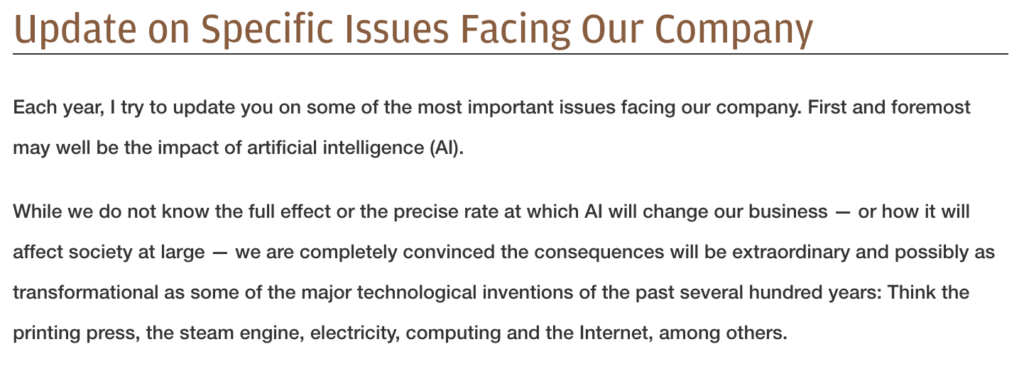
Mr. Dimon, the CEO and Chairman of JPMorgan Chase & Co, first mentioned AI in his 2017 Letter to Shareholders. So, it wasn’t the mention of AI that was newsworthy. It was how it was mentioned. Before mentioning geopolitical risks, regulatory issues, or the recent acquisition of First Republic, Mr. Dimon spends nineparagraphs talking about AI, its impact on banking, and how JPMorgan Chase is responding.
Here’s a screenshot of the first two paragraphs:
He’s right. We don’t know “the full effect or the precise rate at which AI will change our business—or how it will affect society at large.” We were similarly clueless in 1436 (when the printing press was invented), 1712 (when the first commercially successful steam engine was invented), 1882 (when electricity was first commercially distributed), and 1993 (when the World Wide Web was released to the public).
Innovation, it seems, is also a flat circle.
Our response doesn’t have to be.
Historically, people responded to innovation in one of two ways: panic because it’s a sign of the apocalypse or rejoice because it will be our salvation. And those reactions aren’t confined to just “transformational” innovations. In 2015, a visiting professor at Kings College London declared that the humble eraser (1770) was “an instrument of the devil” because it creates “a culture of shame about error. It’s a way of lying to the world, which says, ‘I didn’t make a mistake. I got it right the first time.’”
Neither reaction is true. Fortunately, as time passes, more people recognize that the truth is somewhere between the apocalypse and salvation and that we can influence what that “between” place is through intentional experimentation and learning.
JPMorgan started experimenting with AI over a decade ago, well before most of its competitors. As a result, they “now have over 400 use cases in production in areas such as marketing, fraud, and risk” that are producing quantifiable financial value for the company.
It’s not just JPMorgan. Organizations as varied as John Deere, BMW, Amazon, the US Department of Energy, Vanguard, and Johns Hopkins Hospital have been experimenting with AI for years, trying to understand if and how it could improve their operations and enable them to serve customers better. Some experiments worked. Some didn’t. But every company brave enough to try learned something and, as a result, got smarter and more confident about “the full effect or the precise rate at which AI will change our business.”
You have free will. Use it to learn.
Cynics believe that time is a flat circle. Leaders believe it is an ever-ascending spiral, one in which we can learn, evolve, and influence what’s next. They also have the courage to act on (and invest in) that belief.
What do you believe? More importantly, what are you doing about it?
Image credit: Pixabay
Sign up here to join 17,000+ leaders getting Human-Centered Change & Innovation Weekly delivered to their inbox every week.
You’ve heard the adage that “culture eats strategy for breakfast.” Well, AI is the fruit bowl on the side of your Denny’s Grand Slam Strategy, and culture is eating that, too.
1 tool + 2 companies = 2 strategies
On an Innovation Leader call about AI, two people from two different companies shared stories about what happened when an AI notetaking tool unexpectedly joined a call and started taking notes. In both stories, everyone on the calls was surprised, uncomfortable, and a little bit angry that even some of the conversation was recorded and transcribed (understandable because both calls were about highly sensitive topics).
The storyteller from Company A shared that the senior executive on the call was so irate that, after the call, he contacted people in Legal, IT, and Risk Management. By the end of the day, all AI tools were shut down, and an extensive “ask permission or face termination” policy was issued.
Company B’s story ended differently. Everyone on the call, including senior executives and government officials, was surprised, but instead of demanding that the tool be turned off, they asked why it was necessary. After a quick discussion about whether the tool was necessary, when it would be used, and how to ensure the accuracy of the transcript, everyone agreed to keep the note-taker running. After the call, the senior executive asked everyone using an AI note-taker on a call to ask attendees’ permission before turning it on.
Why such a difference between the approaches of two companies of relatively the same size, operating in the same industry, using the same type of tool in a similar situation?
1 tool + 2 CULTURES = 2 strategies
Neither storyteller dove into details or described their companies’ cultures, but from other comments and details, I’m comfortable saying that the culture at Company A is quite different from the one at Company B. It is this difference, more than anything else, that drove Company A’s draconian response compared to Company B’s more forgiving and guiding one.
This is both good and bad news for you as an innovation leader.
It’s good news because it means that you don’t have to pour hours, days, or even weeks of your life into finding, testing, and evaluating an ever-growing universe of AI tools to feel confident that you found the right one.
It’s bad news because even if you do develop the perfect AI strategy, it won’t matter if you’re in a culture that isn’t open to exploration, learning, and even a tiny amount of risk-taking.
Curious whether you’re facing more good news than bad news? Start here.
8 culture = 8+ strategies
In 2018, Boris Groysberg, a professor at Harvard Business School, and his colleagues published “The Leader’s Guide to Corporate Culture,” a meta-study of “more than 100 of the most commonly used social and behavior models [and] identified eight styles that distinguish a culture and can be measured. I’m a big fan of the model, having used it with clients and taught it to hundreds of executives, and I see it actively defining and driving companies’ AI strategies*.
Results (89% of companies): Achievement and winning
AI strategy: Be first and be right. Experimentation is happening on an individual or team level in an effort to gain an advantage over competitors and peers.
Caring (63%): Relationships and mutual trust
AI strategy: A slow, cautious, and collaborative approach to exploring and testing AI so as to avoid ruffling feathers
Order (15%): Respect, structure, and shared norms
AI strategy: Given the “ask permission, not forgiveness” nature of the culture, AI exploration and strategy are centralized in a single function, and everyone waits on the verdict
Purpose (9%): Idealism and altruism
AI strategy: Torn between the undeniable productivity benefits AI offers and the myriad ethical and sustainability issues involved, strategies are more about monitoring than acting.
Safety (8%): Planning, caution, and preparedness
AI strategy: Like Order, this culture takes a centralized approach. Unlike Order, it hopes that if it closes its eyes, all of this will just go away.
AI strategy: Slightly more deliberate and guided than Purpose cultures, this culture encourages thoughtful and intentional experimentation to inform its overall strategy
Authority (4%): Strength, decisiveness, and boldness
AI strategy: If the AI strategies from Results and Order had a baby, it would be Authority’s AI strategy – centralized control with a single-minded mission to win quickly
Enjoyment (2%): Fun and excitement
AI strategy: It’s a glorious free-for-all with everyone doing what they want. Strategies and guidelines will be set if and when needed.
What do you think?
Based on the story above, what culture best describes Company A? Company B?
What culture best describes your team or company? What about your AI strategy?
*Disclaimer. Culture is an “elusive lever” because it is based on assumptions, mindsets, social patterns, and unconscious actions. As a result, the eight cultures aren’t MECE (mutually exclusive, collectively exhaustive), and multiple cultures often exist in a single team, function, and company. Bottom line, the eight cultures are a tool, not a law(and I glossed over a lot of stuff from the report)
Image credit: Wikimedia Commons
Sign up here to join 17,000+ leaders getting Human-Centered Change & Innovation Weekly delivered to their inbox every week.
How to Embrace Agile Leadership to Innovate at Speed
GUEST POST from Diana Porumboiu
In a world dominated by uncertainty, how can we prepare for the unpredictable and keep innovating in what seems like a highly chaotic environment?
We simply need to be faster in adapting to change and navigating uncertainty. Studies show that organizations that move faster achieve significantly better results across various metrics, including profitability, operational resilience, organizational health, and growth.
How to make sure your organization is fast enough? Innovation at speed is more relevant than ever, but someone must put the pedal to the metal. Typically, that someone has to be a leader, because in the face of unprecedented change, leaders are needed to get us through the transformation.
However, unless organizations rethink leadership, they won’t be able to innovate systematically. In this day and age, great leadership requires a different mindset and a new approach to drive innovation and keep pace with change. We call this agile leadership.
This article, the second in the series dedicated to Agile Innovation Management, explores the critical role of agile leadership in innovating at speed.
Discover the key challenges and misconceptions surrounding the topic and understand why many leaders struggle with it. We’ll also provide practical steps and examples that will hopefully inspire you to increase the agility of your organization.
From Old Leadership Models to Agile Leadership
Let’s begin by clarifying what we mean by agile leadership and its position in relation to established leadership models.
The history of leadership traces back to Frederick Winslow Taylor, American engineer renown for his methods aimed at enhancing efficiency and productivity. Innovative at his time for shaping industrial management, his legacy still lives on today.
Unfortunately, his methods are not adapted for this century. Despite this, many leaders and managers still adhere to “Taylorism”, a top-down approach where leaders make the decisions and plans, and employees are tasked with executing them.
This model conflicts with the flexible and adaptable mindset required for agility. The gap between employees and Taylorist leaders trying to implement agile practices often leads to frustration and inefficiency.
Even if they introduce squads and sprints, Taylorists maintain a top-down approach, telling people what to do and how.
For successful agile transformations, you need to move away from rigid, outdated models. As we saw in the ING examplepresented in the “Guide to Business Agility” article, simply copying other companies without suitable leadership will not produce the desired outcomes. Therefore, fundamental change is needed.
True agile leadership allows for rapid decision making, resilience, adaptability and innovation. It requires leaders to embrace new ideas, offer clear direction without micromanaging, and create a culture that supports speed and innovation.
Agile leadership is about rapid decision making, resilience, adaptability and innovation.
It’s also important to remember that managers and leaders are not the same. Leadership goes beyond overseeing a group and delivering desired outcomes.
As Seth Godin stated in his “Leadership vs Management” speech, “managers do things right, leaders do the right things”.
While it would be ideal for all managers to cultivate leadership skills, the reality is that their primary focus is on increasing efficiency and productivity within their domains, often overlooking the broader picture. Such skills are essential in leading people, lifting them up and empowering them to become agile, innovative problem solvers.
Despite the progress of AI and technology automating mundane tasks, we still need leaders capable of making decisions that address both present and future challenges. Effective agile leaders should be able to navigate failure and complexities, and map a way to move forward.
To succeed, we need to hone in on critical thinking and those often overlooked “soft skills” like navigating tough conversations, giving and receiving feedback, and showing empathy. No matter where you fall on the org chart, mastering these skills can be the game-changer between just getting by and achieving excellence.
While agile leadership might not be about the “Agile” way, being familiar with the agile values and principles can be useful on a practical level.
For example, the authors of Doing Agile Right help leadership teams shift to agile methods by tailoring the Agile Manifesto’s core values to fit their unique situations. It’s about adapting and making it work for you.
Viima design created from Doing Agile Right: Transformation Without Chaos
To give another example, think of the principle of self-organizing teams. It’s important to know how to build self-organizing teams that thrive, collaborate and continuously learn from each other through continuous feedback and transparent communication.
We’ve seen this time and again in how teams use Viima to collaborate on their ideas, assess, prioritize and develop those that have been discussed openly. We noticed that most successful projects created using Viima have strong leadership too.
But moving away from the practical details to the bigger picture, how much can leaders influence the speed of innovation at an organizational level?
Can Agile Leadership Drive Innovation?
We established in The Guide to Agile Innovation Management that agility enables innovation by embracing experimentation and learning, implementing adaptive planning processes, emphasizing cross-functional collaboration and bringing together diverse perspectives and expertise.
All these elements would not be possible without the guidance of a great leader. So how can a good agile leader unlock innovation in an organization?
Adapting fast by building trust
Agility in leadership is about adapting to changing environments quickly, often under the pressure of performance.
However, this can have negative consequences. The Work Trend Index from Microsoft surveyed over 20,000 people across 11 countries and found that half of them reported experiencing burnout. Although 83% of employees claimed to be productive, only 12% of leaders felt confident their teams were genuinely productive.
To build trust and participation in feedback systems, leaders should regularly share what they’re hearing, how they’re responding, and why. — Work Trend Index 2022
As a leader, offering support and trust can help balance the pressure of performance. Including people in the organization’s narrative and showing them where they fit in helps build trust and provides a sense of purpose.
This sense of purpose encourages people to commit, learn, grow, improve, and innovate. Which brings us to the next point: agile leadership nurtures not only the ability but also the willingness of people to innovate.
Speed requires commitment
Many large firms still rely on outdated “industrial-era management” models. These models focus on hierarchical organizational charts, emphasizing static reporting relationships.
In such environments, it can be extremely difficult for ideas and initiatives to navigate through the many layers of hierarchy and reach the right decision-makers. If they do make it through, the process takes so long that the opportunity may be lost by the time an idea reaches approval.
This approach can lead to a culture with limited transparency and collaboration across teams and departments, along with an attitude of “every man for himself.”
It’s no surprise that over 70% of workforce is disengaged or quietly quitting, which significantly stifles an organization’s ability to innovate. When employees lack motivation, everything slows down. But when there is a sense of ownership and pride, there is higher commitment.
An agile leader fosters a sense of community and nurtures people’s commitment and dedication. This leads to speed and adaptability.
While the right mindset is crucial, using the right tools can also help build trust and promote collaboration. Many leaders use Viima to create processes that enhance idea sharing at all levels, collaboration and trust. They can provide feedback and follow up on people’s ideas in a timely manner, while employees can see the progress of their ideas.
But to reach this level, it’s important to understand the behavioral changes needed. In the next section, we’ll dive into practical tips on how to adapt your mindset by examining leaders who have successfully guided their organizations to thrive and innovate.
How to Be an Agile Leader
How can you become a great leader who adapts to change and guides others into the future? To provide some practical examples, I turned to Collective Genius: The Art and Practice of Leading Innovation by Linda Hill, Greg Brandeau, Emily Truelove, and Kent Lineback.
The authors conducted a decade-long research study of 24 leaders across different organizations and industries. They offer valuable insights into how exceptional leaders cultivate environments that foster collective creativity, collaboration, and experimentation.
In a nutshell, the authors describe the ABC of leadership which drives innovation and makes the shift from “vertical ideology of control” to “horizontal ideology of enablement”.
Their research has identified that to lead an organization that innovates at scale with speed, you need leaders that fill in three different functions:
the Architect — to build the culture and capabilities necessary to collaborate, experiment and work.
the Bridger — to create the bridge between the outside and the inside of the organization by bringing together skills and tools to innovate at speed.
the Catalyst — to accelerate co-creation through the entire ecosystem.
The Architect: Create the right environment
The paradox of business agility is that it takes time to build the capabilities needed for fast response and adaptability. Even if you want to move quickly and encourage others to do the same, you can’t force change.
Achieving agility requires a different mindset — letting go of some control that conventional leadership often demands. This is perhaps the most challenging aspect for many leaders who believe their power lies in maintaining control.
However, as an agile leader, you must recognize existing interdependencies. You rely on employees’ willingness, commitment, and ability to drive progress. Your success depends heavily on others, which is why it’s crucial to create an environment where people can ideate, create, and execute. As we will see in the next chapter, agile leadership involves balancing relinquishing control with providing enough direction and guidance to prevent chaos.
Many elements are at play here, but one of the most innovative animation studios, Pixar, offers a clear example. They created the first feature-length computer-animated film, Toy Story. What’s remarkable about Pixar is that every film they released after Toy Story became an instant commercial success.
Ed Catmull, co-founder of Pixar, is a mastermind of innovation and a pioneer in technology and storytelling. His legacy offers numerous inspiring lessons for leaders, but here are some key points on how he and other company leaders fostered an environment where innovation thrives.
Pixar’s culture is built on two essential elements: diversity and conflict.
Diversity
In this context, diversity means intellectual diversity — bringing together people with different perspectives, skills, working styles, and problem-solving approaches.
At Pixar, three different worlds converged: creative, technical, and business. People from all areas were treated as peers, and all perspectives were valued equally. Among visual artists and tech people, you could also find cultural anthropologists, music producers, and even a professional cheerleader.
When different views come together, great ideas, solutions, and innovations can emerge. But inevitably, disagreements and conflict can also arise.
Conflict
Conflict is something many leaders fear and seek to minimize. When conflict becomes destructive, personal, or a battle for who is right and who is wrong, nobody wins. However, at Pixar, feedback is honest and direct. Sometimes even brutal. But the aim is to improve things and find the best solution.
A confrontation becomes a debate in search of a better solution that serves everyone’s goals. Those who receive and provide feedback should always keep this in mind.
Naturally, this is not always achievable, and tempers can flare quickly under pressure, frustration or when passionate people clash. When conflict turns into a fight to win an argument, you should intervene, remind people of the greater purpose, and bring them back on track.
As a leader, community building should also be on your radar. Foster a strong sense of “we” and psychological safety. This encourages people to stand up for their ideas and pursue the solutions they believe are best for the greater good.
This is what contributed to Pixar’s continued innovation. As a leader, Ed Catmull realized early on the critical role of leadership in creating the context for innovation.
I realized the most exciting thing I had ever done was to help create the unique environment that allowed that film (Toy Story) to be made. My new goal became … to build a studio that had the depth, robustness, and will to keep searching for the hard truths that preserve the confluence of forces necessary to create magic.
The Bridger: Decentralize decision making
Decentralized decision-making is key to breaking down silos and eliminating bottlenecks, enabling faster experimentation, learning, and improvement. Although this approach is increasingly popular and recommended for driving innovation, many struggle with its implementation.
Decentralization demands strong leadership that empowers teams to drive progress, avoids micromanagement, and provides the right support while removing barriers and building innovation capabilities.
For teams to collaborate effectively, they need a leader who plays a central role — not to manage decisions, but to facilitate innovation.
Take the example of Volkswagen. In 2010, Luca De Meo was the CMO for VW, a group of nine brands, helping the organization achieve its goal of becoming a leading car manufacturer.
VW’s marketing decisions were decentralized, with local marketing teams independently creating and implementing their own strategies based on general guidelines from headquarters.
However, this approach led to a lack of communication and collaboration among marketing teams worldwide. Marketing spoke with different voices in each market, lacked alignment, and had no clear strategic role within the organization.
To build mutual trust and respect De Meo organized a two-day design lab where he brought together over seventy people to collaborate, ideate and work together to build a global brand. Of course, a one-time brainstorming workshop is not enough, so this became a recurrent event. Each gathering had different goals or action points on which diverse teams had to work together, bring their own experience and expertise to the table.
He also took a new approach in handling launches by creating a cross-functional team that brought together fresh perspective from young employees in marketing or other fields. He created a small team and gave them a free hand to come up with an integrated marketing strategy for the launch of a new city car model.
De Meo did not interfere and did not tell them how to go about it. Instead, he encouraged them to work as intrapreneurs within the larger organization. He set high expectations and tried to nudge them in the right direction when needed. Most importantly, he encouraged them to take risks and allowed them to make mistakes. The agile way.
A very important thing to highlight from this story is that De Meo made sure that minority voices were heard. In setups with a conventional approach to leadership, the loudest (or more experienced) voices usually get their ideas across. This means that many opportunities can be missed.
Long story short, leadership created the environment for people to innovate and removed barriers and enabled people to move faster. The efforts paid off and VW grew both as a recognized brand and in financial results.
The Catalyst: Grow capabilities of everyone around you
Visionary leaders made history, but if we take a closer look, it was not all about vision. It’s not enough to have a vision and expect others to follow you. You also need to set direction on how to get there, not just by dictating but by unleashing and amplifying people’s own capabilities, talents, passion and strengths that are useful for the bigger goal.
In our latest conversation in The Innovation Room podcast, we had the great pleasure of talking to John Bessant, an innovation veteran. From his vast experience he shared a few examples of how innovation leaders focused on facilitating conversations and debates to lead people to the future.
Such leaders can cultivate agility, and what is called dynamic capability: the ability to integrate, build and reconfigure internal and external competences to address rapidly changing environments.
To illustrate dynamic capability, Bessant gives the example of Procter and Gamble. P&G made a major change after 150 years of excelling in R&D and market research. They switched to a model they called “Connect and Develop” — their open innovation approach — well ahead of the open innovation trend. This shift involved a significant change in mindset and took them 20 years to get through it. They stepped back, reassessed, and adapted to the changing world.
This is a summary of their achievements, but reaching such results required an internal shift in culture. P&G needed to get everyone on board with open innovation, not just to embrace external ideas, but internal ones too. Early on, they recognized this model as essential for adapting to future challenges.
P&G leadership understood the critical role of employees in driving these changes. The new approach required employees to be more agile and flexible, to develop skills like curiosity, collaboration, and connectedness.
They worked to support employees who were inclined to control more, were insecure, or were resistant to sharing and opening up. P&G set new challenges and increased the complexity of some tasks to push employees’ capabilities. They ensured that employees worked across the business in different markets. As employees gained experience in different areas and improved at identifying and solving problems, their mindsets began to evolve.
Cultivating an innovative mindset is a process that takes time and a structured, intentional approach.
These are just a few examples, and although summarizing them may make it sound simple, each of these leaders struggled in their journey to achieve the desired outcomes.
Excellent agile leadership is challenging, but it doesn’t have to be an all-or-nothing approach. Let’s explore these challenges in more detail to help you assess what you can realistically implement in your own leadership role.
Challenges and Limitations of Agile Leadership
Being a great leader is never easy and being an agile one — navigating through uncertainty — is even tougher. Whether you call it agile leadership or not, your role as a leader is to create spaces for your teams to adapt quickly and steer the organization toward future success.
Let’s see what are some of these challenges and how you can address them by leading with agility.
1. Providing a sense of certainty in an uncertain environment
Certainty is an emotional state that can influence how we perceive our work environment. While you can’t control uncertainty, you can manage the fear of the unknown by being transparent. The least transparent environments often breed anxiety, rumors and speculations.
Remember: Share the big picture with your team, and don’t shy away from the truth. Provide updates on ongoing projects, successes, and setbacks. This way you build trust and foster a sense of purpose. Balance transparency with discretion — too much detail can overwhelm people, but too little breeds suspicion.
2. Managing the chaos
You want your team to take initiative and explore new ideas, but a lack of guidance can cause confusion and inefficiency. I’ve seen leaders struggle with this balance, either micromanaging their teams or stepping back too far.
Remember: Define clear ground rules and processes to guide your team. Support people to innovate within a framework that provides structure. Encourage ideas to surface and provide top-down guidance to turn them into actionable innovations.
3. Adapting to a new leadership model
Embracing agile leadership requires stepping out of your comfort zone and taking others with you. It demands discipline and a low tolerance for incompetence, with a focus on striving for excellence.
Remember: Encourage a disciplined approach to experimentation and ensure that failures lead to valuable lessons rather than wasted efforts. Candid feedback should flow both ways. Both leaders and employees should be open to having their ideas challenged. Embracing this kind of culture fosters growth and adaptability, but it also demands discipline and high standards to strive for excellence, as mediocrity thrives in comfort zones.
Conclusion
Whether you’re a leader or aspiring to be one, it’s important to recognize that perfection in leadership doesn’t exist — everyone has their own shortcomings and challenges. While we should empathize with these struggles, we must also hold leaders accountable.
Today, speed is a crucial competitive advantage, often going hand in hand with scale. Agility at the team level alone may not be enough; you need speed and scale in innovation to drive meaningful change.
Achieving this requires responsible and committed leadership that understands the need for both rapid and large-scale innovation. As you navigate your leadership journey, strive to lead with accountability, adaptability, and a focus on accelerating innovation.
Not long ago, pitchers and catchers reported to MLB Spring Training facilities in Florida and Arizona. For baseball fans, this is the first sign of Spring, an occasion that heralds months of warmth and sunshine, ballparks filled (hopefully) with cheering fans, dinners of beers and brats, and the undying belief that this year will be the year.
Moneyball is based on the book of the same name by Michael Lewis and chronicles the 2002 Oakland Athletics season. The ’02 Oakland A’s, led by General Manager Billy Beane (played by Brad Pitt), forever changed baseball by adopting an approach that valued rigorous statistical analysis over the collective wisdom of baseball insiders (coaches, scouts, front office personnel) when building a team. This approach, termed “Moneyball,” enabled the A’s to reach the postseason with a team that cost only $44M in salary, compared to the NY Yankees that spent $125M to achieve the same outcome.
While the whole movie (and book) is a testament to the courage and perseverance required to challenge and change the status quo, time and again I come back to three lines that perfectly sum up the journey of every successful intrapreneur I’ve ever met.
The Beginning
“I know you’ve taken it in the teeth out there, but the first guy through the wall…he always gets bloody…always always gets bloody. This is threatening not just a way of doing business… but in their minds, it’s threatening the game. Really what it’s threatening is their livelihood, their jobs. It’s threatening the way they do things… and every time that happens, whether it’s the government, a way of doing business, whatever, the people who are holding the reins – they have their hands on the switch – they go batshit crazy.”John Henry, Owner of the Boston Red Sox
Context
The 2002 season is over, and the A’s were eliminated in the first round of the playoffs. John Henry, an owner of the Boston Red Sox, has invited Bill Beane to Boston to offer him the Red Sox GM job.
Lesson
This is what you sign up for when you decide to be an Intrapreneur. The more you challenge the status quo, the more you question how business is done, the more you ask Why and demand an answer, the closer you get to “tak(ing) it in the teeth.”
This is why courage, perseverance, and an unshakeable belief that things can and should be better are absolutely essential for intrapreneurs. Your job is to run at the wall over and over until you get through it.
People will follow. The Red Sox did. They won the World Series in 2004, breaking an 84-year-old curse.
The Middle
“It’s a process, it’s a process, it’s a process” — Bill Beane
Context
Billy has to convince the ballplayers to forget all the habits that made them great and embrace the philosophy of Moneyball. To stop stealing bases, turning double plays on bunts, and swinging for the fences and to start taking walks, throwing to first for the easy out, and prioritize getting on base over hitting a home run.
The players are confused and frustrated. Suddenly, everything that they once did right is wrong and what was not valued is deeply prized.
Lesson
Innovation is something new that creates value. Something new doesn’t just require change, it requires people to stop doing things that work and start doing things that seem strange or even wrong.
Change doesn’t happen overnight. It’s not a switch to be flipped. It’s a process to be learned. It takes time, practice, reminders, and patience.
The End
“When you get an answer you’re looking for, hang up.” — Billy Beane
Context
In this scene, Billy has offered one of his players to multiple teams, searching for the best deal. When the phone rings with a deal he likes, he and the other General Manager (GM) agree to it, Billy hangs up. Even though the other GM was in the middle of a sentence. When Peter Brand, the Assistant GM played by Jonah Hill, points out that Billy had just hung up on the other GM, Billy responds with this nugget of wisdom.
Lesson
It’s advice intrapreneurs should take very much to heart. I often see Innovation teams walk into management presentations with long presentations, full of data and projections, anxious to share their progress, and hoping for continued funding and support. When the meeting starts, a senior exec will say something like, “We’re excited by the progress we’re hearing about and what it will take to continue.”
That’s the cue to “hang up.”
Instead of starting the presentation from the beginning, start with “what it will take to continue.” You got the answer you’re looking for – they’re excited about the progress you’ve made – don’t spend time giving them the info they already have or, worse, could raise questions and dim their enthusiasm. Hang up on the conversation you want to have and have the conversation they want to have.
In closing
Moneyball was an innovation that fundamentally changed one of the most tradition-bound businesses in sports. To be successful, it required someone willing to take it in the teeth, to coach people through a process, and to hang up when they got the answer they wanted. It wasn’t easy but real change rarely is.
The same is true in corporations. They need their own Bill Beanes.
Are you willing to step up to the plate?
Image credit: Wikimedia Commons
Sign up here to join 17,000+ leaders getting Human-Centered Change & Innovation Weekly delivered to their inbox every week.
Growth is the lifeblood of any organization, and the quest for growth opportunities is not just a strategic imperative. It is a fundamental necessity because the ability to identify and capitalize on opportunities is a game-changer for companies wanting to achieve sustainable success and stay ahead of the competition.
The challenge, however, is that not all opportunities are the same – some are head-smackingly obvious, while others are like trying to nail down JELL-O. Yet companies take a “one size fits all” approach to finding, developing, and capitalizing on them.
SEARCH when need to transform
What do you do when you need information but don’t know precisely what you need and certainly don’t know where to find it? You Google it or, in less-branded terms, you search for it.
When searching for growth opportunities, you’re looking for something but don’t know exactly what you need or where you’ll find it. Finding opportunities requires you to go beyond traditional market analysis and adopt a learner’s mindset to see ways to disrupt the status quo, challenge existing paradigms, and create new value propositions for your customers.
Searching is a creative process that entails investing in R&D, fostering a culture of intrapreneurship, and experimenting with new technologies. It requires a culture of creativity, experimentation, and agility to adapt to changing market dynamics. You have to be willing to be wrong on your way to being right, to move slowly so you can act quickly, and to throw out the timeline to harness the game-changing opportunity.
SEEK when you need to innovate
What do you do when you know what you need and generally where to find it? You seek it out – you go to where you think it will be, and, on the off-chance it’s not there, you pivot to Option B.
When you’re seeking growth opportunities, you have a target in mind but are not 100% sure how to hit it. Maybe you know you want to enter a new geography, but you need to figure out how to do it successfully and avoid the mistakes of previous entrants. Maybe it’s a new industry or category, but you must understand if and how to do it without disrupting your existing business model.
Seeking is both creative and analytical. You look for data and market intelligence, interview experts and individuals, analyze industry trends and explore untapped segments. It also requires you to stay open to surprises and new possibilities and take calculated risks to capitalize on emerging trends or consumer preferences. Like searching, it requires patience. Unlike searching, it respects a deadline.
STALK when you need to improve
Just like a lioness stalking a wildebeest, you do this when you see an opportunity and know exactly how to capture it. Yes, there will be zigs and zags along the way, and an unexpected competitor may pop up. But this is who you are and what you do.
When stalking opportunities, you bring the full value and power of your experience, expertise, resources, and capabilities to bear on an opportunity. This may happen when you’re operating and improving your core business. It may also occur after you’ve searched (and found) an opportunity, sought (and decided on) a strategy, and now you have the confidence to launch and scale.
Do Your Approaches Align with Your Goals?
Most companies say that they want to transform. Still, very few have the patience or intestinal fortitude to search because there is no Google for Transformation that produces the exact plan you need to transform successfully.
Companies also tend to stalk when they want to innovate, leaving opportunities to change the game and build sustainable competitive advantage on the sideline because they’re too uncertain or take too long.
Growth requires all three approaches – search, seek, and stalk – but only happens when your chosen approach aligns with your goals.
Image credit: Pexels
Sign up here to join 17,000+ leaders getting Human-Centered Change & Innovation Weekly delivered to their inbox every week.
In 2014, rumors started to circulate that Apple was developing a self-driving autonomous car to compete with Tesla. At the end of February 2024, rumors circulated that Apple was shutting down “Project Titan,” its car program. According to multiple media outlets, the only logical conclusion from the project’s death is that this decision signals the beginning of the end of Apple.
As much as I enjoy hyperbole and unnecessary drama, the truth is far more mundane.
The decision was just another day in the life of an innovation.
As always, there is a silver lining to this car-shaped cloud: the lessons we can learn from Apple’s efforts.
Lesson 1: Innovation isn’t all rainbows and unicorns
People think innovation is fun. It is. It is also gut-wrenching, frustrating, and infuriating. Doing something new requires taking risks, which is uncomfortable for most people. Even more challenging is that, more often than not, when you take a risk, you “fail.” (if you learned something, you didn’t fail, but that’s another article).
What you can do: Focus on the good stuff – moments of discovery, adventures when experimenting, signs that you’re making life better for others – but don’t forget that you’re defying the odds.
Lesson 2: More does not mean success
It’s been reported that Apple spent over ten billion dollars on Project Titan and that over 2000 people were working on it before it was canceled. With a market cap of over two trillion dollars, a billion dollars a year isn’t even a rounding error. But it’s still an eye-popping number, which makes Apple’s decision to cut its losses downright courageous.
What you can do: Be on guard for the sunk-cost fallacy. It’s easy to believe that you’ll eventually succeed if you keep working and pouring resources into a project. That’s not true, as Apple experienced. And in the rare cases when it is, executives are often left wondering if the success was worth the cost.
Lesson 3: Pivot based on data, not opinions
At least four different executives led Project Titan during its decade in development, and each leader brought their own vision for what the Apple Car should be. First, it was an electric vehicle with driver assistance that would compete with Tesla. Next, it was a self-driving car to compete with Google’s WayMo. Then, plans for fully autonomous driving were canceled. Finally, the team returned to its original target of matching Tesla’s Level 2 automation.
Changes in project objectives, strategies, and execution plans are necessary for innovation, so there’s nothing obviously wrong with these pivots. But the fact that they tended to happen when a new leader was appointed (and that Jony Ive caused an 18-month hiring freeze simply by expressing “displeasure”) makes me question how data-based these pivots actually were
What you can do: Be willing to change but have a high standard for what is required to cause a change. Data, even qualitative and anecdotal data, should be seriously considered. The opinion of a single executive, not so much.
Lesson 4: Dream big, build small
Apple certainly dreamed big with its aspirations to build a fully semi-autonomous vehicle and it poured billions into developing and testing the sensors, batteries, and partnership required to make it a reality. But it was never all-or-nothing in its pursuit of the automotive industry. Apple introduced CarPlay the same year it kicked off Project Titan, and it continues to offer regular updates to the system. Car Key was announced in 2020 and is now offered by BMW, Genesis, Hyundai, and Kia.
What you can do: Take a portfolio approach towards your overall innovation portfolio (Apple kept working on the iPhone, iPad, Apple Watch, and Vision Pro) and within each project. It’s not unusual that a part of the project turns out to be more valuable than the whole project.
Lesson 5: ___________________________
Yes, that is a fill-in-the-blank because I want to hear from you. What lesson are you taking away from Project Titan’s demise, and how will it make you a better innovator?
Image credit: Dall-E via Bing
Sign up here to join 17,000+ leaders getting Human-Centered Change & Innovation Weekly delivered to their inbox every week.

 Sign up here to join 17,000+ leaders getting Human-Centered Change & Innovation Weekly delivered to their inbox every week.