Tag Archives: Design Thinking

Innovation organization only thrives along with innovation culture

Guest Post from Nicolas Bry

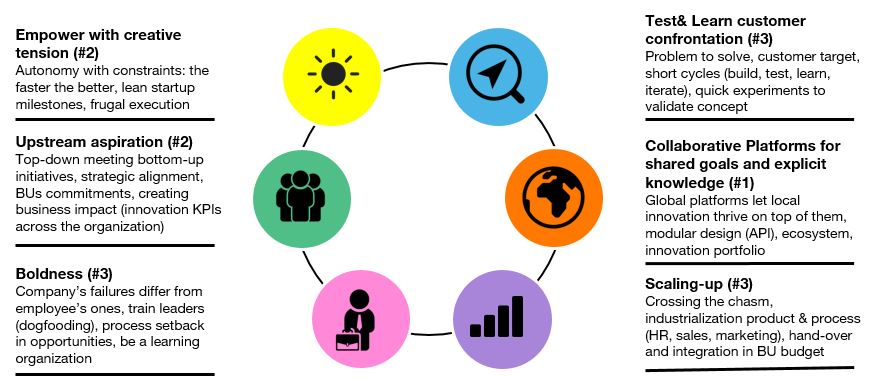
Innovation organization doesn’t thrive without innovation culture: organization and process without culture are like a factory without raw materials; culture without organization and process is appropriate to initiate a handful of innovation projects, but doesn’t scale.

Looking at 3 major innovation programs I shaped (open innovation with internet user and entrepreneursempowering employees with intrapreneurship, exploring and experimenting in short cycles in Africa), this correlation between organization and culture became obvious to me. Some fundamental pieces to assemble have come to my mind, in order to make innovation organization match with culture in a complete jigsaw: these essentials let fledgling innovators fly the nest, and seasoned ones hit the nail even better. Thus entrepreneurship can emerge as a second nature, and a core value for organizations.

1. Innovation Organization

To set-up a streamlined innovation process, I find these 3 organization pieces to be paramount:

1. Test and learn iterative path

Share the virus of test and learn in short cycles with your innovators; confronting the value proposition with the customer target as soon as possible to capture insights, and iterating positively on your solution as on your target users; avoiding the product bias pitfall: ‘don’t fall in love with your product, fall in love with the user problem’ as Ash Maurya says; spending the initial time on materializing the value proposition, designing mock-up to let users clearly visualize it and express feedback and insights; sorting out the key hypothesis to validate and the appropriate tests to perform, and capturing The Right It, without yet engaging in significant product development;

2. Collaborative platforms design

Open innovation blossoms with shared goals and explicit knowledge; to facilitate knowledge sharing, entice innovators to create a platform that let others create value on top of it, applying modular design from the very beginning; having in mind end-users and developers ecosystem as 2 different user targets; exposing building blocks (APIs) that can be quickly reused internally and externally to create instantly new businesses;

3. Scale-up preparation stage

Once product market fit is on the trend to prove true, the innovator’s venture shall anticipate the acceleration of sales and operations, the scale-up. Crossing the chasm and industrializing processes (marketing, product, sales, recruitment and on-boarding, partnerships) requires preparation, just as if you were upgrading your sailboat from a promenade near the coast to a transatlantic journey with heavy wind blowing. Have also in mind that the corporate scale-up has simultaneously to win.

Homme Tenant Un Sac à Dos Noir

2. Innovation Culture

To instill an innovation culture, I find these 3 cultural pieces quite efficient:

1. Empowerment with creative tension

Unleashing creativity and autonomy is fine, but a framework actually helps innovators; At Google, they say ‘innovation loves constraints’, and ‘the faster, the better’: speed is a constraint that pushes you to focus on the core, and to eliminate the superfluous, leading to frugal execution. ‘Less is more’ claimed famous designer Mies van der Rohe. In that sense, speed triggers a positive tension;

2. Upstream aspiration with C-level and business units commitment

Innovators often start bottom-up initiatives; at a certain point, innovators need to be aspired with C-level and business units support to leverage the corporation assets; explain to these sponsors how innovation differs from ideation, and that it seeks for business impact, just like marketing and sales: innovation is about conquering new customers, improving loyalty, differentiating from competition, creating value for the users and for the company; align innovators endeavors with corporation strategy, and gain credibility with quick wins in your innovation portfolio; you’ll know you have succeeded when business units will include innovation KPIs across the organization;

3. Stimulation of boldness, and risk taking spirit

innovation contests and crowdsourcing stimulate ideation if appropriate recognition comes along; if we want employees to further engage with boldness in execution, failure has to be accepted as part of the innovation process, as Gore company shows it with its Celebrate Failure event; do not underestimate that, while a company has dozen of successful projects to hide a failure behind the curtain, it’s not possible for an employee to offset an experience on his resume; how to detect opportunities out of setbacks, how to become a learning organization is a necessary culture: ‘I never fail, I either succeed or learn’ claimed Nelson Mandela. It requires training for the employees and for the leaders: letting the leaders embrace and learn from failure during a ‘eat your own dog food’ workshop is a fruitful practice I’m a great believer in.

Propagating a culture of organized innovation, while organizing innovation culture, you will durably shape people to become successful innovators, and win the game. That’s the best mean to achieve impactful outcome: innovation that change people’s lives.

Image credit: Pexels.com

Subscribe to Human-Centered Change & Innovation WeeklySign up here to get Human-Centered Change & Innovation Weekly delivered to your inbox every week.

Why Design Thinking is Essential for Corporate Transformation and Growth

Why Design Thinking is Essential for Corporate Transformation and Growth

GUEST POST from Art Inteligencia

In today’s rapidly evolving business landscape, successfully adapting to change is crucial for corporate transformation and sustained growth. Design thinking, a human-centered approach to problem-solving, has emerged as a powerful framework that enables organizations to innovate, empathize with customers, and build truly impactful solutions. This article deep dives into the essence of design thinking and highlights its significance through two compelling case studies, demonstrating how it can drive corporate transformation and foster growth.

Case Study 1: Airbnb – Reinventing the Travel Experience

Airbnb’s journey from a struggling startup to a hospitality giant can be closely attributed to their embrace of design thinking principles. Before design thinking’s integration, the founders realized the existing travel industry lacked a sense of personal connection and authenticity. Empathy was at the core of their transformational journey.

By immersing themselves in the customer experience, Airbnb identified the unmet needs of travelers seeking unique, local experiences. Design thinking empowered Airbnb to empathize with their users, conducting interviews, and gathering insights. This led to the creation of impactful solutions that transformed the travel experience completely. Through the power of design, they bridged the gap, creating a platform that revolutionized the industry, connecting hosts with travelers worldwide.

Case Study 2: IBM – Shifting Focus Towards User-Driven Solutions

As a technology leader, IBM faced the challenge of staying relevant and competitive in a rapidly evolving market. They recognized the need to prioritize user experience and demonstrated their commitment to design thinking for corporate transformation.

IBM embarked on a company-wide transformation by placing design thinking at the forefront of their initiatives. They invested in comprehensive training programs, ensuring every employee understood and practiced design-led problem-solving. This shift in mindset allowed IBM to emphasize user-driven solutions throughout their innovation processes, resulting in improved customer satisfaction and higher quality products. By incorporating design thinking, IBM acknowledged the significance of empathy, creativity, and collaboration in driving company-wide growth.

Key Principles of Design Thinking:

1. Empathy: Design thinking emphasizes understanding the needs and emotions of end-users to create products and services that truly resonate. This empathetic approach helps companies identify pain-points and opportunities for innovation.

2. Iterative Thinking: Design thinking embraces an iterative process, enabling organizations to experiment, learn, and refine ideas based on real-time feedback. This flexible approach minimizes risks and maximizes chances of success.

3. Collaboration: Design thinking is inherently collaborative, encouraging cross-functional teams to work together towards a common goal. By integrating diverse perspectives, organizations foster innovation and create holistic solutions.

4. Visualization: Design thinking promotes visual representation, helping teams articulate and communicate ideas effectively. Visualization bridges the gap between stakeholders and enables faster decision-making.

Conclusion

Design thinking emerges as an indispensable tool for corporate transformation and growth. As demonstrated by Airbnb and IBM, this human-centered approach empowers organizations to connect with customers on a deeper level, drive innovation, and create solutions that positively impact lives. By embracing empathy, collaboration, and iterative thinking, companies can unlock hidden potential, revolutionize industries, and secure a sustainable path towards growth in an ever-changing business ecosystem.

Bottom line: Futurology is not fortune telling. Futurists use a scientific approach to create their deliverables, but a methodology and tools like those in FutureHacking™ can empower anyone to engage in futurology themselves.

Image credit: Pexels

Subscribe to Human-Centered Change & Innovation WeeklySign up here to get Human-Centered Change & Innovation Weekly delivered to your inbox every week.

Design Thinking as a Catalyst for Radical Innovation

Real-World Examples

Design Thinking as a Catalyst for Radical Innovation

GUEST POST from Art Inteligencia

Design thinking has emerged as a powerful approach for fostering radical innovation across various industries. By placing human needs and experiences at the core of problem-solving processes, design thinking enables organizations to unlock transformative solutions and drive meaningful change. In this article, we will explore two compelling case studies that illustrate the profound impact of design thinking in different contexts. Additionally, I will provide an HTML link to another of my articles, further enhancing the reader’s understanding of this fascinating subject.

Case Study 1: Airbnb’s Journey to Disrupting the Hospitality Industry:

Starting as a tiny startup in 2008, Airbnb revolutionized the way people think about accommodation. By leveraging design thinking principles, Airbnb established itself as a key disruptor in the traditional hospitality industry. Initially facing challenges in gaining user adoption, the founders employed empathy, one of the foundational principles of design thinking, to deeply understand the needs and desires of both hosts and guests.

Through in-depth interviews and observations, the team empathized with their users’ pain points, such as trust issues and the desire for authentic experiences. Building on these insights, Airbnb focused on creating a seamless user experience, leveraging user-generated content and design principles to foster trust among users. As a result, Airbnb transformed the perception of staying in someone else’s home, enabling millions to explore unique accommodations worldwide.

Case Study 2: IDEO’s Redesign of the Shopping Cart:

The redesign of the shopping cart by IDEO, a renowned design consultancy, exemplifies how design thinking can drive radical innovation even in seemingly mundane areas. IDEO took on the challenge of addressing the frustrations people experienced while shopping, particularly in navigating crowded aisles and wrestling with ill-designed carts.

To truly understand users’ struggles and motivations, IDEO immersed themselves in the shopping experience by conducting in-store observations. Through this empathetic approach, they identified key pain points such as unergonomic handles, limited maneuverability, and lack of child-friendly features. IDEO then collaborated with users, designers, and engineers to brainstorm and prototype concepts. The result was an ergonomic, easy-to-navigate, and versatile shopping cart design, impacting the shopping experience globally.

Further Exploration:

To delve deeper into design thinking and its application, I highly recommend reading my other insightful article, The Power of Design Thinking in Driving Innovation available here on this site. This article provides a comprehensive overview of design thinking principles, highlighting its potential to fuel innovation across various industries.

Conclusion:

The case studies of Airbnb and IDEO demonstrate the transformative power of design thinking in driving radical innovation. By empathizing with users, identifying their pain points, and applying creative problem-solving techniques, these organizations pushed boundaries and transformed industries. Design thinking’s human-centric approach allows organizations to uncover unmet needs and develop innovative solutions to shape a better future. As organizations continue to embrace design thinking, they unlock untapped potential, driving radical innovation in a rapidly evolving world.

Bottom line: Futurology is not fortune telling. Futurists use a scientific approach to create their deliverables, but a methodology and tools like those in FutureHacking™ can empower anyone to engage in futurology themselves.

Image credit: Pexels

Subscribe to Human-Centered Change & Innovation WeeklySign up here to get Human-Centered Change & Innovation Weekly delivered to your inbox every week.

The Design Thinking Process

A Step-by-Step Guide

The Design Thinking Process

GUEST POST from Chateau G Pato

In an age where technological advancements and global connectivity continually reshape the competitive landscape, the ability to innovate has never been more critical. Design thinking has emerged as a potent methodology to foster innovation, enabling organizations to approach problems from a human center to drive disruptive solutions. Today, I delve into this dynamic process in crafting my very best article ever, outlining the fundamental steps with insightful case studies to illuminate how design thinking can catalyze transformative results.

Understanding Design Thinking

Design thinking is not just a problem-solving tool; it is a way to infuse innovation into the cultural fabric of an organization. At its core, design thinking is about harnessing empathy to understand user needs deeply, ideating solutions collaboratively, and iterating continuously to refine those solutions.

What is the Design Thinking Process?

The design thinking process is a human-centered, iterative approach to problem-solving that prioritizes deep understanding of user needs before generating and testing solutions. Unlike traditional linear problem-solving methods that move from problem definition directly to solution implementation, design thinking embraces ambiguity, encourages experimentation, and treats early failures as essential learning rather than setbacks to avoid.

Design thinking was formalized as a methodology at Stanford’s d.school and popularized by the design firm IDEO, but its roots go back decades in engineering, architecture, and cognitive science. Today it is applied across industries — from product design and software development to organizational change, healthcare, education, and public policy — wherever complex, human-centered problems need to be solved creatively.

The five stages of the design thinking process are: Empathize, Define, Ideate, Prototype, and Test. These stages are not strictly sequential — design thinking is an iterative process, meaning teams regularly cycle back through earlier stages as new insights emerge. A prototype that fails in testing, for example, typically sends the team back to Define or even Empathize to reexamine their understanding of the problem.

The Five Stages of Design Thinking — In Depth

Stage 1: Empathize

Empathy is the foundation of design thinking and the stage that most distinguishes it from conventional problem-solving approaches. In the Empathize stage, the goal is to develop a deep, genuine understanding of the people you are designing for — their needs, motivations, frustrations, behaviors, and the context in which they live and work.

This understanding is built through direct engagement rather than assumption. Common empathy methods include:

  • Observation — watching people in their natural environment to understand how they actually behave, as opposed to how they say they behave
  • Interviews — open-ended conversations designed to surface feelings, motivations, and needs that users themselves may not consciously articulate
  • Immersion — experiencing the user’s situation firsthand, where possible, to develop visceral understanding of their context
  • Journey mapping — documenting the end-to-end experience of a user to identify pain points, friction, and moments of delight

The most common mistake in this stage is shortcutting it. Organizations under pressure to deliver solutions quickly often skip deep empathy work and rely on assumptions, surveys, or existing data instead. The result is solutions that are technically functional but miss the actual human need — or solutions that solve the wrong problem entirely.

What good looks like: A team that has spent significant time with real users, has specific stories and observations (not just data summaries), and can articulate not just what users do but why they do it and how they feel about it.

Stage 2: Define

The Define stage synthesizes everything learned in the Empathize stage into a clear, actionable problem statement — often called a Point of View (POV) or How Might We (HMW) statement. This is the bridge between understanding the user and generating solutions, and it is arguably the most consequential stage in the process.

A well-crafted problem definition is specific enough to provide meaningful direction for ideation but open enough not to prematurely constrain the solution space. Compare:

  • Weak definition: “How might we improve our onboarding process?”
  • Strong definition: “How might we help new employees who feel overwhelmed by information in their first two weeks develop the confidence and connections they need to contribute meaningfully within 30 days?”

The strong definition is grounded in a specific human insight (feeling overwhelmed, needing confidence and connection), targets a specific outcome (contribute meaningfully within 30 days), and opens multiple solution directions without prescribing any of them.

Common tools used in the Define stage include affinity mapping (organizing observations into themes), persona development (creating composite user archetypes that capture key insights), and empathy maps (visual tools for synthesizing what users say, think, do, and feel).

What good looks like: A problem statement that the whole team finds genuinely energizing and that opens more solution directions than the team initially anticipated.

Stage 3: Ideate

Ideation is the generative stage of design thinking — the phase dedicated to producing a wide range of possible solutions to the defined problem. The guiding principle is quantity before quality: the goal is to generate as many ideas as possible before evaluating any of them.

This runs counter to how most organizations approach problem-solving, where the first plausible solution is often adopted without exploration of alternatives. Design thinking’s insistence on wide ideation before evaluation is grounded in research showing that the best ideas rarely emerge first — they emerge after the obvious solutions have been exhausted and the team is forced to think more creatively.

Effective ideation techniques include:

  • Brainstorming — structured group ideation with explicit rules (defer judgment, build on others’ ideas, stay focused, go for quantity)
  • Brainwriting — silent individual ideation before group sharing, which reduces groupthink and surfaces more diverse ideas
  • Worst possible idea — deliberately generating terrible solutions, then inverting them to find unexpected approaches
  • Analogous inspiration — looking at how similar problems are solved in completely different industries or contexts
  • SCAMPER — a structured prompt framework (Substitute, Combine, Adapt, Modify, Put to other uses, Eliminate, Reverse) for generating variations on existing ideas

After ideation, ideas are clustered, evaluated against the problem definition and user needs, and narrowed to the most promising candidates for prototyping. Evaluation criteria should include desirability (do users want this?), feasibility (can we build it?), and viability (does it make business sense?).

What good looks like: A team that has generated 50–100+ ideas, including some that seem absurd, before narrowing to 3–5 candidates for prototyping.

Stage 4: Prototype

Prototyping is the stage where ideas become tangible enough to be tested and learned from. The central principle of design thinking prototyping is: build to think, not to present. A prototype is not a polished deliverable — it is a learning tool designed to test a specific assumption or hypothesis as quickly and cheaply as possible.

Prototypes in design thinking can take many forms depending on what you are trying to learn:

  • Paper prototypes — hand-drawn sketches of interfaces, products, or experiences that can be tested with users in minutes
  • Role-play and bodystorming — physically acting out a service or experience to identify friction points and opportunities
  • Storyboards — visual narratives that walk through a user’s experience with a proposed solution
  • Wireframes and mockups — low-fidelity digital representations of digital products
  • Physical models — rough three-dimensional representations of physical products built from inexpensive materials
  • Service blueprints — detailed maps of how a service experience would work, including frontstage user interactions and backstage operational requirements

The critical discipline in this stage is maintaining low fidelity until you have validated the core concept. Organizations that invest in high-fidelity prototypes before testing basic assumptions waste time and money — and create psychological investment in the prototype that makes it harder to abandon when testing reveals fundamental flaws.

What good looks like: Multiple rough prototypes built in hours or days rather than weeks, each designed to test one specific assumption, with teams that are emotionally willing to discard any of them based on what they learn.

Stage 5: Test

Testing brings prototypes back to real users to gather feedback, validate assumptions, and generate new insights. In design thinking, testing is not a validation exercise — it is a learning exercise. The goal is not to prove that your solution works; it is to discover what you got right, what you got wrong, and what you still don’t understand.

Effective testing in design thinking involves:

  • Observing how users interact with the prototype rather than just asking them if they like it
  • Asking open-ended questions that surface underlying needs and reactions rather than leading questions that confirm existing assumptions
  • Paying particular attention to confusion, hesitation, and workarounds — these are often more informative than direct feedback
  • Testing with people who represent the actual target user, not just the most convenient available participants

What you learn in testing typically sends you back through the process — refining the prototype, redefining the problem, or in some cases returning to empathy work to investigate unexpected user reactions. This iterative cycling is not a sign that the process is failing; it is the process working exactly as intended.

What good looks like: A team that treats negative feedback as valuable data, that can clearly articulate what they learned from each test, and that is willing to significantly change direction based on what they observe.

Design Thinking vs. Traditional Problem-Solving

Design Thinking Traditional Problem-Solving
Starting point Deep understanding of the human need Definition of the technical problem
Problem definition Emerges from empathy research; often reframed Defined upfront, rarely revisited
Solution generation Wide ideation before evaluation First plausible solution often adopted
Validation approach Cheap, fast prototypes tested with real users Detailed specification followed by full build
Attitude to failure Failure is learning; fail early and cheaply Failure is to be avoided; risk is minimized upfront
Process structure Iterative; regularly cycles back through stages Linear; stages completed sequentially
Success metric Solutions that genuinely serve human needs Solutions that meet technical specifications

Design Thinking in Organizational Change and Innovation

Design thinking was developed in the context of product and service design, but its principles transfer directly to organizational change and innovation leadership — which is where it becomes most powerful for readers of this blog.

Applied to change management: The most common failure in organizational change is designing change programs around the organization’s needs rather than the needs of the people experiencing the change. Applying the Empathize stage to change management means spending real time understanding how employees experience the current state — what works, what doesn’t, what they fear losing, and what they hope to gain. This human insight then informs a change approach that is more likely to earn genuine adoption rather than grudging compliance.

Applied to innovation programs: Design thinking provides innovation teams with a structured methodology for moving from insight to validated concept without the enormous upfront investment that traditional innovation processes require. The prototype-test cycle enables organizations to explore many more potential innovations at low cost, failing fast on the ones that don’t work and doubling down on the ones that do.

Applied to leadership: The mindsets that design thinking develops — empathy, comfort with ambiguity, bias toward action, learning orientation — are exactly the mindsets that effective change and innovation leaders need. Organizations that embed design thinking not just as a process but as a way of working develop leaders who are fundamentally better equipped for the complexity of modern organizational challenges.

Braden Kelley’s Human-Centered Change™ methodology draws directly on design thinking principles — particularly the emphasis on deep empathy with the people experiencing change, collaborative visual planning, and iterative refinement. The Change Planning Toolkit™ provides the visual, collaborative tools that bring these principles into practice for change leaders and their teams.

Case Study 1: Empathy in Healthcare Design

Consider the case of IDEO’s redesign of hospital patient admission processes. The team immersed themselves in the healthcare environment, observing, interviewing, and shadowing patients, nurses, and doctors. They discovered that anxiety stemmed not just from medical concerns but from inadequate communication and disorganized workflows. By empathizing deeply with patients and healthcare workers, IDEO identified nuanced pain points—insights that underpinned innovative solutions.

Case Study 2: Redesigning the Banking Experience

Another illuminating example is the redesign of the financial services experience by Bank of America. To capture the essence of user needs, their design team spent extensive time interviewing and observing customers and bank employees.

After empathizing and defining the core problems—such as the stress surrounding financial management and the intimidating nature of banking for new customers—they ideated solutions focusing on ease and trust.

Prototypes included simplified online interfaces, interactive financial planning tools, and revamped branch layouts to promote a welcoming atmosphere. Testing these prototypes with users led to iterative enhancements, eventually culminating in features like the “Keep the Change” program, which rounds up debit-card purchases to the nearest dollar and deposits the difference into a savings account—making saving effortless and habitual.

Conclusion

Design thinking is more than a methodological approach; it is a philosophy that places human needs at the epicenter of problem-solving. By embodying empathy, framing actionable challenges, embracing diverse ideas, and iterating through prototypes and tests, organizations can unlock unprecedented creativity and innovation.

As witnessed through IDEO’s healthcare intervention and Bank of America’s user-centric banking overhaul, design thinking can drive meaningful change across industries. It is a beacon guiding us toward innovations that resonate profoundly with end-users, creating solutions that are not only successful but also deeply impactful.

Let us continue to champion design thinking, fostering a world where creative solutions and human-centered innovations usher in a future replete with possibilities.

Frequently Asked Questions About the Design Thinking Process

What are the 5 stages of the design thinking process?

The five stages of the design thinking process are: Empathize (developing deep understanding of the people you are designing for), Define (synthesizing empathy insights into a clear problem statement), Ideate (generating a wide range of possible solutions), Prototype (building rough, testable representations of the most promising solutions), and Test (gathering feedback from real users to learn and refine). These stages are iterative rather than strictly sequential — teams regularly cycle back through earlier stages as new insights emerge from testing and prototyping.

What is design thinking used for?

Design thinking is used to solve complex, human-centered problems across virtually any domain. It originated in product and service design but is now applied to software development, organizational change, healthcare system design, education, public policy, social innovation, and business model development. The methodology is most valuable when the problem is not fully understood at the outset, when the solution needs to work for real humans rather than just meeting technical specifications, and when early-stage experimentation is preferable to large upfront investments in unvalidated solutions.

What is the difference between design thinking and agile?

Design thinking and agile are complementary but distinct methodologies. Design thinking focuses on understanding the problem and generating validated concepts — it is most powerful in the early, exploratory phases of innovation when the right solution is not yet known. Agile focuses on building and delivering working solutions iteratively — it is most powerful once the direction is established and the challenge is execution. Many organizations combine both: using design thinking to discover and define the right problem and solution concept, then using agile to build and deliver it efficiently.

Is design thinking only for designers?

No — design thinking is for anyone who needs to solve complex problems that involve human needs. The methodology is widely taught in business schools (Stanford, Harvard, MIT), used by management consultants, applied by change leaders and HR professionals, and practiced in government and nonprofit organizations. The “design” in design thinking refers to a way of thinking and working — human-centered, iterative, prototype-driven — not to visual or aesthetic design skills. Leaders, managers, strategists, and practitioners in any field can learn and apply design thinking effectively.

How long does the design thinking process take?

The design thinking process can be compressed into a single day for simple challenges or run over months for complex ones. Design sprints — a popular format developed at Google Ventures — complete the full five-stage process in five days. For organizational change or complex innovation challenges, deep empathy research alone may take several weeks, with the full process running three to six months before a validated concept is ready for scaling. The key principle is that speed in prototyping and testing saves time overall — organizations that build cheap prototypes and test quickly consistently outperform those that spend months specifying solutions before any user validation.

What are the most common mistakes in applying design thinking?

The most common mistakes are: shortcutting the Empathize stage by relying on assumptions or surveys instead of direct user engagement; treating the process as linear and not returning to earlier stages when new insights emerge; building high-fidelity prototypes before validating the core concept; testing with internal stakeholders instead of real users; and treating design thinking as a one-time workshop rather than an ongoing practice. The organizations that get the most value from design thinking are those that embed it as a regular way of working — not a special event — and that build the empathy, curiosity, and comfort with ambiguity that the methodology requires across their leadership teams.

SPECIAL BONUS: The very best change planners use a visual, collaborative approach to create their deliverables. A methodology and tools like those in Change Planning Toolkit™ can empower anyone to become great change planners themselves.

Image credit: Pixabay

Subscribe to Human-Centered Change & Innovation WeeklySign up here to get Human-Centered Change & Innovation Weekly delivered to your inbox every week.
Design Thinking for Innovation

How to Generate Creative Ideas

Design Thinking for Innovation

GUEST POST from Art Inteligencia

Innovation is the lifeblood of any forward-thinking organization, yet many struggle to cultivate a structured approach to creativity. Enter design thinking—a human-centered methodology that can unlock imaginative solutions to problems both known and unknown. In this article, we’ll delve into the principles of design thinking, outline actionable strategies, and examine case studies showcasing its power in generating game-changing ideas.

The Core Principles of Design Thinking

Design thinking is not just a process but a mindset that revolves around understanding the user. Rooted in empathy, it involves iterative cycles of ideation, prototyping, and testing. The process typically comprises five stages:

  1. Empathize: Understand the needs, desires, and challenges of your target users.
  2. Define: Clearly articulate the problem you aim to solve.
  3. Ideate: Generate a broad array of possible solutions.
  4. Prototype: Create scaled-down versions of potential solutions.
  5. Test: Collect feedback and refine your prototypes.

While design thinking may seem linear, it’s inherently iterative, encouraging perpetual loops of ideation and refinement.

Strategies to Generate Creative Ideas

  1. Foster a Diverse Team: Diverse perspectives drive broader, more innovative thinking. Engage team members with different skills, backgrounds, and cognitive styles.
  2. Create a Safe Environment: Psychological safety allows team members to express wild and divergent ideas without fear of judgment. Normalize failure as a step toward success.
  3. Utilize Analogous Inspiration: Learning from unrelated industries can spark fresh ideas. For example, healthcare organizations could look at user experiences in retail to revamp patient care.
  4. Facilitate Brainstorming Sessions: Encourage techniques like mind mapping, SCAMPER (Substitute, Combine, Adapt, Modify, Put to another use, Eliminate, and Reverse), or the Six Thinking Hats to structure and diversify brainstorming.
  5. Embrace Rapid Prototyping: Quickly transition from ideas to tangible models, no matter how rudimentary. These prototypes can serve as conversation starters and gather early feedback.
  6. Encourage Cross-pollination: Promote collaboration across different departments to unify varying perspectives in tackling a challenge.

Case Study 1: IDEO and the Shopping Cart

IDEO, a global design firm, is often cited as a pioneer in design thinking. One of their seminal projects was to redesign the shopping cart. The project illustrated the efficacy of the design thinking process comprehensively:

  1. Empathy: IDEO’s team spent time observing shoppers and supermarket staff. They identified various needs, like safety concerns for children and theft prevention.
  2. Define: They clearly articulated the problem as devising a shopping cart that met these divergent needs while enhancing the overall shopping experience.
  3. Ideate: The diverse team brainstormed prolifically, generating hundreds of ideas ranging from minor tweaks to radical redesigns.
  4. Prototype: They rapidly created multiple prototypes, incorporating basket safety features, ergonomic designs, and even integrated barcode scanners.
  5. Test: These prototypes were tested in actual supermarkets, gathering valuable feedback that led to further refinements.

The outcome was a groundbreaking cart design addressing multiple user concerns, showcasing how empathetic and iterative processes can lead to innovative solutions.

Case Study 2: Airbnb Transformation

Airbnb’s success story is another testament to the power of design thinking. In its early days, the company struggled with user acquisition and retention. Through design thinking, they transformed their fortunes:

  1. Empathize: The founders made a bold decision—they became their own customers. They rented out properties and communicated extensively with hosts and guests to identify pain points.
  2. Define: The clear problem statement emerged: how to create trust and reliability in lodging listings to attract and reassure users.
  3. Ideate: After pinpointing the issue, they brainstormed a slew of potential improvements, from professional photography services for listings to user profile verifications.
  4. Prototype: Airbnb quickly rolled out these ideas in selected markets. They introduced high-quality photos and verification processes in a pilot phase.
  5. Test: The feedback from hosts and guests was overwhelmingly positive, directly translating into increased bookings and reduced friction.

Airbnb’s transformation was not just about adding features but was fundamentally human-centered—building trust through empathetic understanding of their users’ needs.

Conclusion

Design thinking is not a magical shortcut but a systematic, human-centered approach to innovation. By deeply understanding user needs and embracing an iterative process, organizations can unlock their creative potential, adapt to an ever-changing landscape, and solve complex problems. The case studies of IDEO and Airbnb illustrate how this methodology can generate creative, practical, and impactful ideas.

Embrace design thinking, and you will find that the journey of innovation is as transformative as the destination itself.

Bottom line: Futurology is not fortune telling. Futurists use a scientific approach to create their deliverables, but a methodology and tools like those in FutureHacking™ can empower anyone to engage in futurology themselves.

Image credit: Pixabay

Subscribe to Human-Centered Change & Innovation WeeklySign up here to get Human-Centered Change & Innovation Weekly delivered to your inbox every week.

The Best Tools and Techniques for Implementing Human-Centered Design

GUEST POST from Art Inteligencia

In our fast-paced, technology-driven world, crafting solutions that genuinely meet human needs is more challenging and crucial than ever. Human-Centered Design (HCD) stands out as an approach that prioritizes human values and needs in the design process, ultimately leading to more effective and meaningful outcomes. This article explores the best tools and techniques for implementing HCD and highlights two successful case studies from real-world applications.

Understanding Human-Centered Design

Human-Centered Design is built on three core pillars: empathy, ideation, and experimentation. It is a problem-solving method that involves deeply understanding the people you’re designing for, generating ideas based on that understanding, and iteratively prototyping and testing solutions.

Tools and Techniques for Human-Centered Design

1. Empathy Mapping

Empathy maps help designers visualize their understanding of the users and organize the process of empathy collection. These maps include segments such as what users think, feel, see, and say, facilitating a comprehensive understanding of their experiences and perspectives.

Technique:

  • Observations and Interviews: Conduct in-depth interviews and observations to gather qualitative data about the user’s behaviors, goals, and pain points.
  • Persona Development: Create detailed personas based on real data to represent different user archetypes, ensuring that design decisions meet actual user needs.

2. Journey Mapping

A journey map is a visual representation of the process a user goes through to achieve a goal. This tool helps in identifying pain points and opportunities for innovation by tracing the entire user experience.

Technique:

  • Touchpoint Identification: List all the touchpoints a user interacts with, including emotional highs and lows throughout their journey.
  • Experience Mapping Workshops: Collaborate with multidisciplinary teams to map the user’s journey and brainstorm potential improvements.

3. Prototyping

Prototyping transforms ideas into tangible products for testing. It can range from simple sketches to fully functioning models, allowing teams to visualize and experiment with different solutions.

Technique:

  • Low-Fidelity Prototypes: Start with sketches and paper models to iterate quickly and gather early user feedback.
  • High-Fidelity Prototypes: Develop more detailed prototypes using digital tools like Sketch or Figma for thorough testing and refinement.

4. User Testing

User testing is a critical step to validate and refine solutions. It involves observing how users interact with the prototype and collecting feedback to improve the design.

Technique:

  • Usability Testing: Have users complete tasks with the prototype while observing their behavior and noting any issues or confusion.
  • A/B Testing: Compare two versions of a prototype to determine which one performs better based on user interaction and feedback.

Case Study 1: IDEO and Bank of America – Keep the Change

Background:

IDEO partnered with Bank of America to innovate its banking services. Through extensive research, they discovered that many customers struggled with saving money.

Process:

  1. Empathy Mapping: IDEO conducted hundreds of interviews and focus groups to understand customers’ financial behaviors and pain points.
  2. Journey Mapping: They mapped out the banking experiences of various customer segments, identifying a common challenge: the difficulty of saving money.
  3. Ideation and Prototyping: The team brainstormed the “Keep the Change” program, which rounds up purchases to the nearest dollar and transfers the difference into a savings account. They created low-fidelity prototypes and iteratively refined them based on customer feedback.
  4. User Testing: After multiple iterations, they pilot-tested the concept with a small group of customers, fine-tuning the process based on real-world usage.

Outcome:

The “Keep the Change” program was wildly successful, signing up millions of users and significantly increasing Bank of America’s customer engagement and savings rates.

Case Study 2: General Electric – MRI Machines for Children

Background:

GE sought to improve the experience of children undergoing MRI scans, as many found the process frightening.

Process:

  1. Empathy Mapping: GE’s team interviewed families, pediatricians, and radiologists to understand the children’s fears and anxieties related to MRI scans.
  2. Journey Mapping: They mapped out the MRI experience from a child’s perspective, identifying moments of stress and discomfort.
  3. Ideation and Prototyping: The team brainstormed creative ideas and landed on transforming the MRI experience into an adventure. They created prototypes of various themed environments, such as pirate ships and space adventures, that integrate the MRI machine.
  4. User Testing: GE tested these environments in hospitals and gathered feedback from children, parents, and healthcare workers, iterating on the themes and improving the overall experience.

Outcome:

The revamped MRI experience significantly reduced children’s anxiety and increased the completion rate of scans. Hospitals reported less need for sedation, and the initiative was lauded as a groundbreaking approach to pediatric care.

Conclusion

Implementing Human-Centered Design requires a deep commitment to understanding and prioritizing user needs through empathy, ideation, and iterative testing. Tools like empathy maps, journey maps, prototypes, and user testing are indispensable in this process. The success stories of Bank of America’s “Keep the Change” and GE’s child-friendly MRI machines vividly demonstrate the power of HCD in creating innovative, effective solutions that truly resonate with users. By embracing these methods, we can drive transformative innovations that genuinely improve human experiences.

If you’re looking for someone to help you bring human-centered design to your organization, Braden Kelley is a globally-recognized thought leader in human-centered change and innovation. His work continues to inspire organizations to harness the power of HCD for meaningful, impactful design.

Bottom line: Futurology is not fortune telling. Futurists use a scientific approach to create their deliverables, but a methodology and tools like those in FutureHacking™ can empower anyone to engage in futurology themselves.

Image credit: Pixabay

Subscribe to Human-Centered Change & Innovation WeeklySign up here to get Human-Centered Change & Innovation Weekly delivered to your inbox every week.
550 Quote Slides on Design, Innovation, and Change

550 Quote Slides on Innovation, Change and Design

Free Downloads for Keynote Speeches, Presentations and Workshops

Looking for a compelling quote for a keynote speech, workshop or presentation on any of these topics?

  • Innovation
  • Design
  • Change
  • Digital Transformation
  • Design Thinking
  • Creativity
  • Leadership

I’m flattered that people have been quoting my keynote speeches and my first two books Stoking Your Innovation Bonfire and Charting Change.

So, I’m making some of my favorite quotes available from myself and other thought leaders in a fun, visual, easily shareable format.

I’ve been publishing them on Instagram, LinkedIn, Facebook, and Twitter.

But now you can download ten (10) volumes of fifty (50) quote posters, for a total of 550, for FREE from my store:

You can add them all to your shopping cart at once and download them for FREE.

Print them, share them on social media, or use them in your presentations, keynote speeches or workshops.

They are all Adobe PDF’s and the best way to add them to your presentation is to:

  1. Put the PDF into FULL SCREEN MODE
  2. Take a screenshot
  3. Paste it into your presentation
  4. Crop it and adjust the size to your liking
  5. Change the background color of the slide to a suitable color (if necessary)

Contact me with your favorite innovation, design thinking, change, transformation, or design quotes and I’ll consider adding them to my library of future downloads.


Accelerate your change and transformation success

Subscribe to Human-Centered Change & Innovation WeeklySign up here to get Human-Centered Change & Innovation Weekly delivered to your inbox every week.

Real-World Applications of Design Thinking

Real-World Applications of Design Thinking

GUEST POST from Art Inteligencia

Design thinking is an effective problem-solving methodology that emphasizes empathy, experimentation, and iteration to devise innovative solutions to complex challenges. Grounded in placing human at the center of solution ideation, design thinking diverges from traditional problem-solving approaches, making it an increasingly appealing method for many businesses. To illustrate this powerful approach, let’s delve into two compelling case studies where design thinking drastically redefined and optimized entire operation chains.

Case Study 1: Ford Motor Company

Until 2005, Ford was on a path of decline; dwindling market share, faced with global efforts to reduce carbon footprints, and the growing need for smarter cars, they had to reassess their strategy. The new CEO, Alan Mulally, proposed a shift from the orthodox production-focused approach to a consumer-centric perspective – utilizing design thinking as the vehicle to drive this transformation.

Rather than staying confined in boardrooms, cross-functional teams spent time with customers to understand their driving experiences, needs, and motives. The teams immersed themselves into the users’ world to identify routine problems overlooked in traditional product development processes.

Understanding user requirements, Ford developed the ‘SYNC’ technology, allowing drivers to make hands-free telephone calls and control music and other functions with simple voice commands. Immediately, Ford cars transformed from mere transportation means to personalized, digital experiences.

This move revived Ford’s dwindling market fortunes, with the company recording a profit of $6.6 billion in 2010, the highest in more than a decade and proof that, indeed, design thinking has real-world applications that can completely turn around an enterprise’s fortunes.

Case Study 2: Kaiser Permanente

A healthcare giant in the US, Kaiser Permanente (KP), provided medical services focusing primarily on efficiencies and cost savings. But the team at KP recognized a need to shift their focus from solely being operationally efficient to also improving the patient experience.

Design thinking came into play, and nurses across various KP hospitals were equipped with stopwatches and spreadsheets to note time spent on various activities. The data painted a clear picture – nurses spent a considerable amount of time not with the patients but at computer stations recording data. A nurse shift change, which ideally should take only a few minutes, took up to 40 minutes, reducing efficiency and satisfaction for both nurse and patient.

In response, KP implemented a radical solution, an innovative ‘nurse knowledge exchange’ at the patients’ bedside. Not only did this change increase face-to-face interaction between nurses and patients, but the problem of documentation was also solved in a more consumer-aligned manner. With this change, KP’s satisfaction score improved by up to 15%.

Conclusion

Both Ford and Kaiser Permanente attributed their operational improvements to design thinking methodology. The case studies provide a compelling argument that design thinking, when internalized as a part of an organization’s culture, has the potential to enhance overall performance drastically.

Design thinking methodology reminds us that solutions should be designed around people, not processes. By understanding and empathizing with end-users, businesses can create innovative solutions that not only solve the problem but improve the overall user experience. With the help of design thinking, new horizons of innovation and problem-solving could be on the horizon for any industry willing to embrace it.

Bottom line: Futurology is not fortune telling. Futurists use a scientific approach to create their deliverables, but a methodology and tools like those in FutureHacking™ can empower anyone to engage in futurology themselves.

Image credit: Pixabay

Subscribe to Human-Centered Change & Innovation WeeklySign up here to get Human-Centered Change & Innovation Weekly delivered to your inbox every week.
Design Thinking in Product Development

Driving Success through User-centric Design

Design Thinking in Product Development: Driving Success through User-centric Design

GUEST POST from Chateau G Pato

In today’s fast-paced and highly competitive market, businesses can no longer solely rely on creating products based on assumptions or mere technical feasibility. Instead, they need to embrace a user-centric approach that prioritizes the needs and desires of their target audience. This is where design thinking comes into play. Design thinking is a problem-solving methodology that emphasizes empathy, ideation, prototyping, and continuous iteration. By incorporating design thinking principles into product development, businesses can drive success by delivering products that truly resonate with their users. In this article, we will explore the concept of design thinking and present two case studies that exemplify its effectiveness in creating successful products.

Case Study 1: Apple iPhone – Revolutionizing the Smartphone Industry

The Apple iPhone serves as a remarkable example of how design thinking can drive success in product development. Before the iPhone was introduced in 2007, smartphones were typically bulky, complicated, and lacked an intuitive user interface. Apple understood the need for a revolutionary design that prioritized the user experience. By immersing themselves in the lives of potential users and empathizing with their frustrations, Apple’s team of designers identified key pain points such as complex navigation, limited functionality, and lack of touch-based interaction.

Applying the principles of design thinking, Apple ideated and prototyped various concepts until they arrived at the iconic iPhone design. They focused on simplicity, ease of use, and intuitive gestures, leading to the creation of a touchscreen interface that eliminated the need for physical keyboards. The iPhone’s user-centric design not only won over millions of users but also disrupted the entire smartphone industry. By prioritizing the needs and desires of users, Apple achieved unprecedented success and set new standards for smartphone design.

Case Study 2: Airbnb – Revolutionizing the Hospitality Industry

Airbnb, the popular accommodation platform, utilized design thinking to redefine the hospitality industry. The founders of Airbnb recognized that travelers were seeking unique, affordable, and personalized experiences rather than sterile hotel rooms. By observing potential users and conducting in-depth interviews, they empathized with the pain points of both guests and hosts, including lack of trust, limited options, and cumbersome booking processes.

Applying design thinking principles, Airbnb ideated innovative solutions that addressed these pain points. They created a platform that connected hosts and guests, allowing users to personalize their travel experiences. To instill trust, Airbnb introduced user profiles, reviews, and secure payment systems.

Furthermore, Airbnb continuously iterated its platform based on user feedback, driving greater success. This user-centric approach revolutionized the hospitality industry, empowering individuals to monetize their spaces and providing travelers with unique, affordable, and authentic accommodations.

Conclusion

Design thinking offers a powerful framework for businesses to optimize product development processes. The case studies of Apple iPhone and Airbnb demonstrate how incorporating the principles of design thinking leads to successful, user-centric products. By empathizing with users, identifying pain points, and continuously iterating, businesses can deliver products that not only meet but exceed user expectations. As the market becomes increasingly user-driven, organizations that embrace design thinking have a competitive edge in driving success through user-centric design.

SPECIAL BONUS: Futurology is not fortune telling. Futurists use a scientific approach to create their deliverables, but a methodology and tools like those in FutureHacking™ can empower anyone to engage in futurology themselves.

Image credit: Unsplash

Subscribe to Human-Centered Change & Innovation WeeklySign up here to get Human-Centered Change & Innovation Weekly delivered to your inbox every week.

Implementing Design Thinking in Your Organization

Implementing Design Thinking in Your Organization

GUEST POST from Chateau G Pato

Design Thinking is a human-centered approach to innovation that draws from the designer’s toolkit to integrate the needs of people, the possibilities of technology, and the requirements for business success. It’s a mindset that helps organizations to think more creatively and to behave in a more user-centric way. Below, we explore two case studies that demonstrate the successful implementation of Design Thinking in organizations.

Case Study 1: The Guardian Newspaper

The Challenge: The Guardian faced the challenge of adapting to the digital age, needing to change their funding model, boost revenue, and engage with their readers on an emotional level.

The Design Thinking Approach: The Guardian implemented Design Thinking to overhaul their approach to reader engagement and revenue generation. They focused on understanding their readers’ needs and desires, which led to the development of new user-centric products and services.

The Outcome: By applying Design Thinking, The Guardian was able to create a more sustainable business model. They increased reader engagement and revenue by introducing new digital products that were closely aligned with their readers’ expectations¹.

Case Study 2: Lummi Tribal Clinic – Tackling the Opioid Crisis

The Challenge: The Lummi Tribal clinic was grappling with the devastating effects of the opioid crisis on its community.

The Design Thinking Approach: The clinic used Design Thinking to address the crisis at both human and systemic levels. They empathized with affected individuals to understand the root causes and developed solutions that were culturally sensitive and community-focused.

The Outcome: The clinic’s Design Thinking approach led to the creation of programs that significantly reduced opioid overdoses in the community. Their solutions were not only effective but also respectful of the community’s cultural values¹.

Conclusion

Design Thinking is not just a process; it’s a way of thinking that can transform organizations. It encourages empathy, fosters creativity, and drives innovation. As seen in the case studies of The Guardian and the Lummi Tribal clinic, Design Thinking can lead to profound changes in organizational culture and outcomes. It’s a powerful tool for any organization looking to stay relevant and responsive in today’s fast-paced world.

For those interested in exploring more about Design Thinking and its impact, the Design Thinking Association offers a wealth of resources and case studies that delve deeper into this transformative approach¹.

References:
(1) Explore: Design Thinking Case Studies | The Design Thinking Association. https://www.design-thinking-association.org/explore-design-thinking-topics/design-thinking-case-studies.
(2) Explore 10 Great Design Thinking Case studies – The Knowledge Academy. https://www.theknowledgeacademy.com/blog/design-thinking-case-study/.
(3) Implementing Design Thinking: Understanding Organizational Conditions …. https://cmr.berkeley.edu/2020/02/62-2-wrigley/.
(4) Can Design Thinking Succeed in Your Organization?. https://sloanreview.mit.edu/article/can-design-thinking-succeed-in-your-organization/.
(5) Implementing Design Thinking: Understanding Organizational Conditions …. https://hbsp.harvard.edu/product/CMR729-PDF-ENG.

SPECIAL BONUS: Futurology is not fortune telling. Futurists use a scientific approach to create their deliverables, but a methodology and tools like those in FutureHacking™ can empower anyone to engage in futurology themselves.

Image credit: Pexels

Subscribe to Human-Centered Change & Innovation WeeklySign up here to get Human-Centered Change & Innovation Weekly delivered to your inbox every week.