Tag Archives: Business Transformation

Voting Closed – Top 40 Innovation Bloggers of 2020

Vote for Top 40 Innovation BloggersFor more than a decade I’ve devoted myself to making innovation insights accessible for the greater good, because I truly believe that the better our organizations get at delivering value to their stakeholders the less waste of natural resources and human resources there will be.

As a result I am eternally grateful to all of you out there who take the time to create and share great innovation articles, presentations, white papers, and videos and to make a list of the Top 40 Innovation Bloggers available each year.

My lists from the eight previous years have been tremendously popular:

Top 40 Innovation Bloggers of 2012
Top 40 Innovation Bloggers of 2013
Top 40 Innovation Bloggers of 2014
Top 40 Innovation Bloggers of 2015
Top 40 Innovation Bloggers of 2016
Top 40 Innovation Bloggers of 2017
Top 40 Innovation Bloggers of 2018
Top 40 Innovation Bloggers of 2019

Business Strategy Innovation is now looking for the Top 40 Innovation Bloggers of 2020.

Do you, or does someone you know, write articles about innovation?

Or do you just have someone that you like to read that writes about innovation, or some of the important adjacencies – trends, consumer psychology, change, leadership, strategy, marketing, management, collaboration, or social media (as they relate to innovation)?

Well, Business Strategy Innovation is looking to recognize the Top 40 Innovation Bloggers and you helped us find them with your nominations. Now it is time to vote, and help us narrow things down to a list of the Top 40 Innovation Bloggers of 2020.
Build a Common Language of Innovation on your team

The deadline for submitting votes is January 7, 2021 at midnight GMT.

The ranking will be done by me with influence from votes and nominations. The quality and quantity of contributions by an author will be a BIG contributing factor (through the end of the voting period).

You can vote in any of these three ways (and each earns points for them, so please feel free to vote all three ways):

  1. Sending us the name of the blogger by @reply on twitter to @innovate
  2. Adding the name of the blogger as a comment to this article’s posting on Facebook
  3. Adding the name of the blogger as a comment to this article’s posting on our Linkedin Page (Be sure and follow us)

The official Top 40 Innovation Bloggers of 2020 and the contest winners will then be announced here in early January 2021.

Here is who received nominations (in alphabetical order):

Adi Gaskell – @adigaskell
Alex Goryachev
Andy Heikkila – @AndyO_TheHammer
Arlen Meyers
Braden Kelley – @innovate
Chad McAllister – @ChadMcAllister
Chris Beswick
Dan Blacharski – @Dan_Blacharski
Daniel Burrus – @DanielBurrus
Daniel Lock
Dave Wendland
David Burkus
Douglas Ferguson
Drew Boyd – @DrewBoyd
Frank Mattes – @FrankMattes
Gregg Fraley – @greggfraley
Greg Satell – @Digitaltonto
Hugo de Sousa
Ian Ure
Janet Sernack – @JanetSernack
Jay Boolkin
Jeffrey Baumgartner – @creativejeffrey
Jeff Freedman – @SmallArmyAgency
Jeffrey Phillips – @ovoinnovation
Jorge Barba – @JorgeBarba
Julian Birkinshaw – @JBirkinshaw
Julie Anixter – @julieanixter
Kate Hammer – @Kate_Hammer
Kevin McFarthing – @InnovationFixer
Kevin Namaky – @knamaky
Kevin Popovic
Lou Killeffer – @LKilleffer
Mari Anixter- @MariAnixter
Maria Paula Oliveira – @mpaulaoliveira
Marty Zwilling – @StartupPro
Matthew E May – @MatthewEMay
Michael Graber – @SouthernGrowth
Mike Brown – @Brainzooming
Mike Shipulski – @MikeShipulski
Mukesh Gupta
Nick Partridge – @KnewNewNeu
Nicolas Bry – @NicoBry
Pamela Soin
Paul Hobcraft – @Paul4innovating
Paul Sloane – @paulsloane
Pete Foley – @foley_pete
Ralph Christian Ohr – @ralph_ohr
Richard Haasnoot – @Innovate2Grow
Robert B Tucker – @RobertBTucker
Rowan Gibson – @RowanGibson
Saul Kaplan – @skap5
Scott Anthony – @ScottDAnthony
Scott Bowden – @scottbowden51
Shelly Greenway – @ChiefDistiller
Soren Kaplan – @SorenKaplan
Stefan Lindegaard – @Lindegaard
Stephen Shapiro – @stephenshapiro
Steven Forth – @StevenForth
Tamara Kleinberg – @LaunchStreet
Tim Stroh
Tom Koulopoulos – @TKspeaks
Yoram Solomon – @yoram

We’re curious to see who you think is worth reading!

Accelerate your change and transformation success

Subscribe to Human-Centered Change & Innovation WeeklySign up here to get Human-Centered Change & Innovation Weekly delivered to your inbox every week.

Nominations Closed for the Top 40 Innovation Bloggers of 2020

Nominations Open for the Top 40 Innovation Bloggers of 2020Business Strategy Innovation loves making innovation insights accessible for the greater good, because we truly believe that the better our organizations get at delivering value to their stakeholders the less waste of natural resources and human resources there will be.

As a result we are eternally grateful to all of you out there who take the time to create and share great innovation articles, presentations, white papers, and videos with Braden Kelley and the Business Strategy Innovation team. As a small thank you to those of you who follow along, we like to make a list of the Top 40 Innovation Bloggers available each year!

Our lists from the ten previous years have been tremendously popular, including:

Top 40 Innovation Bloggers of 2012
Top 40 Innovation Bloggers of 2013
Top 40 Innovation Bloggers of 2014
Top 40 Innovation Bloggers of 2015
Top 40 Innovation Bloggers of 2016
Top 40 Innovation Bloggers of 2017
Top 40 Innovation Bloggers of 2018
Top 40 Innovation Bloggers of 2019

Do you just have someone that you like to read that writes about innovation, or some of the important adjacencies – trends, consumer psychology, change, leadership, strategy, behavioral economics, collaboration, or design thinking?

Business Strategy Innovation is now looking for the Top 40 Innovation Bloggers of 2020.

The deadline for submitting nominations is December 31, 2020 at midnight GMT.

You can submit a nomination either of these two ways:

  1. Sending us the name of the blogger and the url of their blog by @reply on twitter to @innovate
  2. Sending the name of the blogger and the url of their blog and your e-mail address using our contact form

So, think about who you like to read and let us know by midnight GMT on December 31, 2020.

We will then compile a voting list of all the nominations, and publish it on January 1, 2021.

Voting will then be open from January 1-7, 2021 via comments and twitter @replies to @innovate.

The ranking will be done by me with influence from votes and nominations. The quality and quantity of contributions by an author will be a contributing factor.

The official Top 40 Innovation Bloggers of 2020 will then be announced on here in early January 2021.

We’re curious to see who you think is worth reading!


Accelerate your change and transformation success

Subscribe to Human-Centered Change & Innovation WeeklySign up here to get Human-Centered Change & Innovation Weekly delivered to your inbox every week.

The Importance of Stakeholder Mapping

The Importance of Stakeholder Mapping

GUEST POST from Art Inteligencia

Stakeholder mapping is an essential tool for any organization that wants to succeed. It allows a company to identify the key stakeholders who are involved in a project or initiative, and to better understand their interests and needs. By understanding the stakeholders and their interests, a company can develop strategies that will ensure the successful completion of their project or initiative.

Stakeholder mapping is not only important for the success of a project or initiative, but it is also a vital part of any organizational strategy. The process of mapping stakeholders allows organizations to identify the various stakeholders that could potentially be involved in the project or initiative. This includes both internal and external stakeholders and allows the organization to better understand the potential benefits and risks associated with each stakeholder. It can also help the organization to better manage the relationship with stakeholders and to ensure that all stakeholders are aligned with the objectives of the project or initiative.

Stakeholder mapping can also provide organizations with valuable insight into the interests and needs of each stakeholder. This insight can be used to develop strategies that will ensure the successful completion of the project or initiative. By understanding the interests and needs of each stakeholder, organizations are better able to develop strategies that will account for the interests of all stakeholders.

Finally, stakeholder mapping is also important for organizations because it allows them to identify potential risks and opportunities associated with each stakeholder. By understanding the risks and opportunities associated with each stakeholder, organizations can develop strategies to minimize the risks and maximize the benefits for all stakeholders.

In summary, stakeholder mapping is an essential tool for any organization that wants to succeed. It allows a company to identify the key stakeholders who are involved in a project or initiative, and to better understand their interests and needs. By understanding the stakeholders and their interests, a company can develop strategies that will ensure the successful completion of their project or initiative. Additionally, stakeholder mapping can provide organizations with valuable insight into the interests and needs of each stakeholder, as well as potential risks and opportunities associated with each stakeholder.

Continue reading to explore the role of stakeholder analysis in change management

Image credit: Pixabay

Subscribe to Human-Centered Change & Innovation WeeklySign up here to get Human-Centered Change & Innovation Weekly delivered to your inbox every week.

What is a Chief Transformation Officer?

What is a Chief Transformation Officer?

GUEST POST from Art Inteligencia

The role of the Chief Transformation Officer (CTO) is an increasingly important one within modern organizations. A CTO is responsible for leading and managing the transformation of an organization, both strategically and operationally. This includes overseeing the development of new processes, systems and structures to improve the organization’s efficiency and effectiveness.

The key responsibilities of a CTO involve developing and implementing a strategic plan that outlines the goals and objectives of the organization, as well as its commitment to transformation. This includes the establishment of a transformation framework that outlines the necessary steps and processes required to achieve the desired outcomes. The CTO is also responsible for leading the implementation of the transformation plan, which includes the design and implementation of new processes and systems, as well as the development of a culture of continuous improvement.

CTOs must also be able to identify and manage risks associated with the transformation process. This includes the identification of potential obstacles to achieving the desired outcomes and developing plans to mitigate these risks. Additionally, CTOs must be able to identify and implement new technologies and processes that can help streamline operations and optimize performance.

CTOs must be well-versed in the latest technology trends, as well as the latest business principles and best practices. They must understand the implications of their decisions on the organization’s overall performance, as well as the potential impact on customer satisfaction.

Finally, CTOs must be able to effectively communicate and collaborate with all stakeholders, including customers, employees, partners, and suppliers. This includes the ability to effectively manage expectations and build trust among all stakeholders.

In summary, the role of a Chief Transformation Officer is a critical one in today’s organizations. CTOs must be able to lead and manage the transformation process, while ensuring the organization’s objectives are achieved. They must also be able to identify and manage risks, as well as implement new technologies and processes to optimize performance. Finally, they must be able to effectively communicate and collaborate with all stakeholders to ensure the organization’s success.

Image credit: Pexels

Subscribe to Human-Centered Change & Innovation WeeklySign up here to get Human-Centered Change & Innovation Weekly delivered to your inbox every week.

Change Management Best Practices for Mergers and Acquisitions

Change Management Best Practices for Mergers and Acquisitions

GUEST POST from Art Inteligencia

Mergers and acquisitions (M&A) can be one of the most challenging events any business will ever experience. Change management is essential to ensure the successful integration of two organizations, cultures, and systems. To ensure a smooth transition, it’s important to have a plan in place that covers every aspect of the process. Here are some key best practices for change management during mergers and acquisitions.

1. Establish Clear Goals and Objectives: Before beginning any merger or acquisition, it’s important to set clear goals and objectives. This includes the desired outcomes of the transaction, the timeline for the integration process, and the resources that will be required. Having a clear understanding of the objectives will help ensure that everyone is on the same page throughout the process.

2. Develop a Change Management Plan: A comprehensive change management plan should be developed to guide the transition process. The plan should address the impact of the merger or acquisition on the people, processes, and technologies involved. It should also include strategies for communicating the changes to stakeholders, as well as plans for training and supporting employees during the transition.

3. Create an Open Communication Platform: Open and effective communication is essential for managing change during a merger or acquisition. All stakeholders should be kept informed of the progress of the merger or acquisition, and any changes that arise should be communicated in a timely manner. An open communication platform should be established to ensure that information is shared quickly and accurately.

4. Stress the Benefits: It’s important to emphasize the positive aspects of the merger or acquisition to all stakeholders. Employees should be made aware of the benefits they will experience as a result of the transaction. This could include new job opportunities, expanded markets, or access to new technologies.

5. Monitor and Adjust: The transition process should be constantly monitored and adjusted as needed. This could include changing the timeline, adjusting the resources required, or even scrapping the plan altogether and starting over. It’s important to remain flexible and be prepared to adjust the plan as needed.

Mergers and acquisitions can be a difficult and stressful process, but with the right change management plan in place, the transition can be much smoother. By following these best practices, businesses can ensure that the transition is successful and that stakeholders are satisfied with the outcome.

Image credit: Pexels

Subscribe to Human-Centered Change & Innovation WeeklySign up here to join 17,000+ leaders getting Human-Centered Change & Innovation Weekly delivered to their inbox every week.

Innovation, Change and Transformation in London – Part One

Innovation, Change and Transformation in London - Part One

I’m off to London tomorrow for my London Business School class reunion. And, while I’m looking forward to reuniting with my LBS classmates, I’m also looking forward to connecting in person with some of the smartest innovation, change and transformation professionals, academics and entrepreneurs on the planet.

But I need your help…

I’m trying to organize a meetup of London innovation, change, and transformation professionals on Friday afternoon, 3 May 2019 in central London, but I’m still looking for someone to provide a space to facilitate this cross-pollination of ideas.

If you would like to host me and a dozen or so amazing innovation, change and transformation professionals, academics and entrepreneurs to empower some great conversations and information sharing, please contact me.

I will be returning to London in June/July, but more about that later. Stay tuned!

UPDATE: I was able to secure a room at the Oracle office in Central London near Moorgate for Friday afternoon from 1pm-4pm. Please contact me if you’re interested in attending as I’m finalizing the attendee list and I have a maximum capacity for 25 people. I’ll send final details by email once the attendee list is finalized.

UPDATE: We had a great turnout at this innovation, change and transformation meetup at the Oracle office in Central London. It was a great opportunity to meet some great Innovation Excellence contributors in person, to make a lot of great connections between people and to share information and inspiration. For those of you unable to make it, sorry, but you really missed out! Maybe next time…


Accelerate your change and transformation success

Subscribe to Human-Centered Change & Innovation WeeklySign up here to get Human-Centered Change & Innovation Weekly delivered to your inbox every week.

Transform Your Business with a Change Success Manager

Transform Your Business with a Change Success Manager

“Stealing the role of customer success manager from the world of SaaS is the key to making your digital transformation efforts a success.”

I was speaking with a headhunter recently about some of the roles she was recruiting for and there was one that captured my attention. It was a posting she had for a customer success manager at one of your favorite three letter software companies. And, as she extolled the merits of the role I found myself thinking that the management practice of organizational change is still so immature. There are still so many missing tools and mindsets in the organizational behavior area of management science.

What I found so captivating about the responsibilities of a customer success manager, is that the kinds of tasks she described are exactly the kinds of activities that need to be performed as part of any organizational change effort. The difference is that software companies have recognized that they need to have people dedicated, ideally from the very beginning of the process, to help connect the cross-functional dots for the customer behind the scenes, actively manage expectations and outcomes, ensure a mutual understanding of what success looks like, and to make sure that it is ultimately achieved.

Technology companies everywhere seem to be racing to embrace the role of customer success manager as a new member of their army of service professionals. And, the customer success manager, above all else, strives to ensure that every customer moves beyond purchase, beyond installation, beyond first use, to productive use, deepening engagement, and the holy grail of retention and referral.

And retention is key in SaaS businesses because the churn rate (13% per year on adverage) is higher than other subscription type businesses (6-8% per year according to Recurly Research), but lower than the churn rate for some wireless carriers (which averages between 1-3% per month). Churn rate is a statistic measuring those customers who choose not to renew their service, or to switch their service to another subscription provider. A churned customer doesn’t write you a check for next year, or future years either.

The main reason SaaS customers churn, especially after their first year, is that the perceived value of the subscription is insufficient relative to the price to justify renewing it. They may have bought the software but didn’t install it, installed it but never really got up and running with it, or just found it too hard to get the value out of the software that they were promised. The old technology sales model didn’t care about these situations. Tech companies just focused on closing the sale, recognizing the revenue and moving on to close the next prospect. With the SaaS model, sales are no longer king, adoption and engagement are king. If the customer doesn’t adopt, engage and expand their footprint with your SaaS offering then it is easy for them to switch to an offering of a competitor.

So, if customer success managers are so instrumental to the success of technology companies in the era of the cloud, why shouldn’t they also be considered instrumental inside of our organizations as the key to successful change?

The problem is that too many organizations are still stuck in an upside-down paradigm where change management is seen as a bolt on to project management, instead of truly architecting our organizations for successful change.

Companies that want to be successful over the long term understand that change is not an event but a constant. They strategically select those capabilities and competencies needed for the next phase of their evolution, plan a portfolio of change initiatives that executes upon their strategy, and understand that change saturation and change readiness must always be considered. Companies that succeed in this era of unending change will constantly manage the expectations of their people around each change initiative and how the process will work and what the technology can and can’t do.

It is not surprising that companies would first embrace a role that adds tremendous value on the revenue generating side of the business first. Technology companies have determined customer success managers are critical to helping customer organizations adopt changes imposed by new technologies while ultimately increasing the lifetime value of each new customer. But for similar reasons internal to the organization, companies must also now embrace the need for a role I’d like to call the change success manager.

A change success manager is a change manager on steroids. However, in today’s business climate most people think of a change manager as the person a project manager brings in near the end of a software implementation project that does the training or communications. That may be how companies are doing the so-called people side of change today, but it is wrong!

This new role of change success manager is intended to lead each change initiative inside the organization from beginning to end. A change success manager is brought in at the beginning of the process to reach across the organization and identify a cross functional team specific to the needs of each change initiative for the purposes of convene as part of a change planning workshop. This change planning team will facilitate each change planning workshop using tools like the Change Planning Toolkit™ to identify the change leadership team that will take decisions and remove roadblocks for the change management team that will facilitate the actions necessary to advance the change initiative to its desired outcomes.

And, unlike the current model of change that many organizations follow, a change success manager will have one or more project managers on their change management team to identify the appropriate pace for the project, and the right size for the work packages, in order to maintain momentum across the entire duration of the change initiative and increase the adoption of internal change – just like a customer success manager increases the adoption of external changes!

This article originally appeared on CIO.com


Accelerate your change and transformation success

Subscribe to Human-Centered Change & Innovation WeeklySign up here to get Human-Centered Change & Innovation Weekly delivered to your inbox every week.

Flaws in the Crawl Walk Run Methodology

The Flawed Crawl Walk Run Methodology

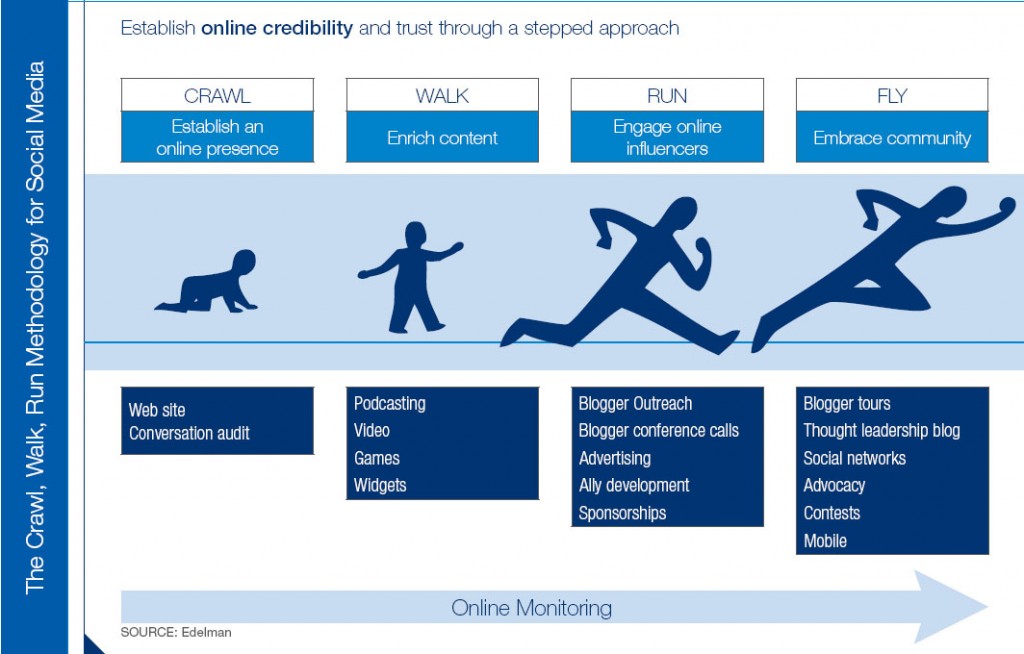
Many of you may have heard of the Crawl Walk Run project methodology. For those of you that haven’t the idea is that if a project team is trying to achieve something big, that sometimes you have to evolve your approach in stages rather than trying to make all the changes all at once. Many people are quite fond of this approach and can be heard repeating the mantra “Let’s crawl before we walk, let’s walk before we run.” Others have evolved Crawl Walk Run into Crawl Walk Run Fly. One of those groups is Edelman (a public relations firm), which in the following image proposes the following Crawl Walk Run Fly approach to social media:

Crawl Walk Run Fly Edelman

Ultimately the Crawl Walk Run Fly project approach looks back to the following Martin Luther King, Jr. quote for its inspiration and structure:

“If you can’t fly then run, if you can’t run then walk, if you can’t walk then crawl, but whatever you do you have to keep moving forward.” – Martin Luther King, Jr.

But the flaw in the Crawl Walk Run project approach was exposed in a conversation I had yesterday with Stewart Pearson, a former client and friend, who happens to be the founder of Consilient Group, an emerging consulting group focused on helping clients undertake data-driven, insight-driven digital transformations to empower organizations to ignite sustainable growth and innovation.

Stewart was speaking about how some companies get stuck in this Crawl Walk Run mindset, and potentially jeopardize their future as a going concern. The truth is that Crawl Walk Run is only applicable to a small subset of projects, and definitely not appropriate for strategic projects because of the imminent danger of the competition transforming faster than you to better serve (and thus take) customers in the marketplace. Stewart captured this in the following way (slightly modified here by me):

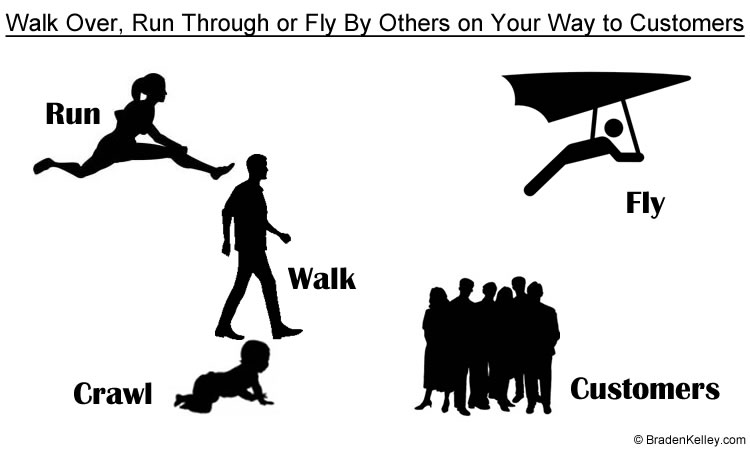
“The danger of Crawl Walk Run is that while you’re busy crawling, a competitor is going to walk over you, right before another competitor runs over both of you.”

Then of course we can add in to this that if the customers wants and/or needs have changed, then simultaneously startups will not be crawling, or walking, or running, but FLYING by those incumbents engaged in a crawl, walk, or run strategies to maintain their relevance to the customers in the marketplace. But startups face their own danger in their FLY strategy, embodied in their lack of experience and infrastructure, and in many cases, their need to educate. This can cause startups to fly past the place where customers wants and needs have moved. So the flying strategy is not without risk.

Consulting clients or people inside your firm (depending on your context) may push back against this idea and again something like “Let’s crawl before we walk.” and it’s really seductive to give into this and tow the company line that achieving something is better than achieving nothing. But at the same time, the financial, human and capital resources that you might invest in implementing a broad crawl effort could potentially be more smartly implemented in a narrow run or fly effort off to the side that may then have the potential to be rolled out in a broad manner.

So, in situations where the company potentially faces more risk from moving slowly than from moving too fast, look for opportunities to craft a strategy that allows you to pick a small part of your business (possibly a single project or a single client) that you can begin building out a run strategy for (a strategy that leverages the existing experience and infrastructure of the organization) or a fly strategy (one that completely re-imagines your market approach).

The idea here being to prototype, test, learn, and then scale your transformative new market approach rather than gradually transforming your market approach in a series of phases. This is more like the approach we use in the innovation space, and has a lot of potential in helping to accelerate your ability to continuously transform your organization the maintain optimal value exchanges with your customers.

What do you think?

Do you think your organization could move away from the siren’s song of Crawl Walk Run, or are you stuck on all fours for the rest of your career with your existing client or employer?

This article originally was featured on Linkedin


Accelerate your change and transformation success

Subscribe to Human-Centered Change & Innovation WeeklySign up here to get Human-Centered Change & Innovation Weekly delivered to your inbox every week.

Measuring Organizational Agility – The Triple T Metric v1.0

Measuring Organizational Agility - The Triple T MetricThere is an increasing amount of chatter and confusion out there around what organizational agility is and feeling that it must be important to organizational success.

But, before we discuss organizational agility, it is important to define what we mean by the term.

BusinessDictionary.com has a decent definition:

“The capability of a company to rapidly change or adapt in response to changes in the market. A high degree of organizational agility can help a company to react successfully to the emergence of new competitors, the development of new industry-changing technologies, or sudden shifts in overall market conditions.”

Usually people begin speaking about organizational agility and its importance to the success of the organization when they speak about the increasing pace of change, and the challenge the organization faces in keeping up.

Because of this, one of the key measures of organizational agility you may want to consider using, I like to call the Triple T Metric:

Time
to
Transform

The Triple T Metric is a measure of how long it takes an organization to make a transformation. But to measure your progress on the Triple T Metric over time, you must define it and measure it in a consistent manner. So, if a transformation is like a trip from Point A to Point B, we must define Point A and Point B.

  • Point A = the point in time at which the organization recognizes a change is needed away from the steady state
  • Point B = the point in time at which the organization successfully arrives at the new steady state

You’ll notice that Point A doesn’t start at the point at which people AGREE that a change is needed and AGREE to make it, but at the point the organization RECOGNIZES a change is needed. This is because there is great opportunity to increase your organizational agility by increasing the speed at which the organization moves from recognizing the need for change, to agreeing to change, to planning the change, to executing the change.

This is just v1.0 of our discussion of the Triple T Metric, to introduce the concept. We’ll get into more detail in a future post.

All of these transitions must be included because organizational agility is ultimately about how quickly the organization can successfully plan, lead, and execute (manage and maintain) a change effort, increasing your organizational agility requires that you increase both your change capability and your change capacity.

How fast can your organization change?

If you want to learn how to change faster, and make your organization more agile, grab a copy of Charting Change and the supporting materials for book buyers!


Accelerate your change and transformation success

Subscribe to Human-Centered Change & Innovation WeeklySign up here to get Human-Centered Change & Innovation Weekly delivered to your inbox every week.

What Change Roles Are Missing?

What Change Roles Are Missing?

I’m gearing up to write a new app and book on organizational change to complement a powerful new visual change toolkit that will be incredibly useful for use in change programs, project and portfolio management, and even innovation, and so I’m canvasing the organizational change literature space (including change leadership, change management, and business transformation) and looking to identify:

  1. The best organizational change thought leaders
  2. The most powerful organizational change frameworks
  3. The most useful organizational change tools
  4. The best organizational change books (including change leadership, change management, and business transformation)

Please contact me to tell me your favorites or add below in the comments.

I will be launching a new community and information site soon to launch this visual change toolkit free to the world, in an extremely collaborative way. Which is why I’m looking for your thoughts on the four items above. Once the skeleton site is up in the next week or so, people will also be able to submit their suggestions on the site.

But in the meantime, based on the success of the Nine Innovation Roles from my last book Stoking Your Innovation Bonfire and some ideas that have been triggered by the work I’ve done in various workshops with organizations around the world with the Nine Innovation Roles, I’ve decided to identify a similar set of roles that people should make sure are occupied on their guiding coalitions.

And as I look at the Nine Innovation Roles there are a few that are still applicable in a broader change context (after all, Innovation Is All About Change). Here are the ones that I believe still are necessary in an organizational change program:

1. Revolutionary

The Revolutionary is the person who is always eager to change things, to shake them up, and to share his or her opinion. These people are uncomfortable standing still and not shy about sharing their opinions. Often they see the status quo as not good enough, so the Revolutionary wants to change it.

2. Architect

Change doesn’t emerge from a vacuum. Someone has to see the bigger picture, bring the idea fragments together and create a cohesive change program, a new business architecture, and guide people to create a collection of project artifacts to help guide the change effort. This is the role of the Architect.

3. Artist

The Artist doesn’t seek change like the Revolutionary or see the big picture like the Architect, but Artists are really good at evolving the seeds of change, shaping them, watering them, and ultimately making the impetus for change more clear, the benefits more compelling, and the change plan more complete.

4. Barrier Buster

Every change effort should identify several potential barriers to change, and the team must identify ways to overcome them before the change program is ready to be communicated to the masses. This is where the Barrier Buster comes in. Barrier Busters love solving tough problems and often have the deep domain knowledge or the deep insight into the change target’s mindset necessary to move minds and resources to support the change program.

5. Connector

The Connector does just that. These people hear a Revolutionary say something interesting and put him together with an Architect and an Evangelist; The Connector listens to the Artist and knows exactly where to find the Barrier Buster that the change effort needs.

6. Lion Tamer

The Lion Tamer is really good at identifying risks, potential negative outcomes, and the steps necessary to implement a change. Lion Tamers take the unwieldy beast that any change program can easily become, tame it, help break it down into digestible chunks, and make it real. These are the people who can picture how the change is going to be made and line up the right resources to make it happen.

7. Evangelist

The Evangelists know how to educate people on what the change is and help them understand it. Evangelists are great people to help attract guiding coalition members and to build support for a change effort among leadership. Evangelists also are great at both evangelizing on behalf of customers, employees and partners, but also in helping to educate customers, employees, and partners on the value of the change effort.

8. INSERT YOUR SUGGESTION HERE

9. INSERT YOUR SUGGESTION HERE

So, that’s only a first cut at a set of Change Roles that must be filled on the guiding coalition or the change program team.

What roles are missing?

Are there any there that are not needed or redundant?

Please sound off in the comments below.


Build a common language of innovation on your team

Subscribe to Human-Centered Change & Innovation WeeklySign up here to get Human-Centered Change & Innovation Weekly delivered to your inbox every week.