Most AI-and-work frameworks are built around economics – job categories, task automation rates, re-skilling costs. This one is built around something different: the interior experience of the person sitting at the desk. The four disruptions mapped in this infographic were identified not through labor market data, but through a human-centered lens – the same lens used in design thinking and change management to surface the needs, fears, and identity stakes that people rarely articulate out loud but always feel.
The framework draws on three converging sources: organizational psychology research on professional identity and role transition; change management practice, particularly the observed patterns of how workers respond when their expertise is devalued or displaced; and direct observation of how individuals are actually experiencing AI adoption in their workplaces right now – not in surveys, but in the unguarded conversations that happen before and after workshops, in the margins of keynotes, in the questions people ask when they think no one important is listening.
Why these four disruptions
1
Competence Displacement
The skill that defined you no longer distinguishes you.
Professional identity is heavily anchored in the belief that what I know how to do has value. When AI can replicate a signature competency – even imperfectly – it attacks that anchor directly. The disruption isn’t primarily about job loss. It’s about the sudden, disorienting feeling that years of deliberate practice have been, in some meaningful sense, made ordinary.
This disruption appears earliest and most acutely in knowledge workers whose expertise was previously considered difficult to acquire – writers, analysts, coders, researchers, strategists.
2
Purpose Erosion
The meaning embedded in the craft begins to hollow out.
Work is not only instrumental – it is ritual. The process of doing difficult things carefully, over time, is itself a source of meaning. When automation removes the friction, it can also remove the satisfaction. This is subtler than competence displacement and slower to surface, but ultimately more corrosive. People find themselves producing more output and feeling less connected to it.
This disruption is particularly acute for people who chose their profession not just for income but for intrinsic love of the work – and who built their identity around that love.
3
Belonging Disruption
The social fabric of work shifts when AI enters the team.
Work teams are social ecosystems built on complementary expertise, shared struggle, and mutual reliance. AI changes those dynamics in ways that are easy to overlook. When an AI tool makes one team member dramatically more productive, or when collaborative tasks are partially automated, the invisible social contracts of the team – who depends on whom, who contributes what – are quietly renegotiated. Belonging depends on feeling needed. When that changes, isolation can follow.
This disruption tends to surface not as explicit conflict but as a gradual withdrawal – people collaborating less, sharing less, protecting their remaining territory.
4
Status Anxiety
The professional hierarchy is being redrawn by AI fluency.
Workplace status has always been tied to expertise scarcity – the person who knew things others didn’t held power. AI is redistributing that scarcity rapidly. Early and confident AI adopters gain speed, output, and visibility. Those who resist, or who are slower to adapt, find themselves losing ground in ways that feel both unfair and disorienting. The new status question – are you someone who uses AI, or someone AI is used on? – is already being asked in organizations, even when no one says it explicitly.
This disruption is uniquely uncomfortable because it combines external threat (status loss) with internal shame (the fear of being seen as behind).
How to read the framework
These four disruptions are not sequential stages – they are simultaneous and overlapping. A single professional can be experiencing all four at once, with different intensities depending on their role, their organization, and how rapidly AI is being adopted around them. The infographic presents them as discrete panels for clarity, but the lived experience is messier and more entangled.
They are also not uniformly negative. Each disruption contains within it the seed of a corresponding renewal: competence displacement can become an invitation to lead with judgment rather than task execution; purpose erosion can prompt a deeper reckoning with what the work is ultimately for; belonging disruption can surface the human connection that was always the real foundation of team cohesion; status anxiety can motivate the kind of deliberate identity authoring that makes professionals more resilient over the long term.
The framework is designed to give leaders and individuals a common language for conversations that are currently happening in fragments — in one-to-ones, in exit interviews, in the silence after a difficult all-hands. Named things can be worked with. Unnamed things can only be endured.
This framework is a practitioner’s model, not a peer-reviewed clinical instrument. It is designed for use in workshops, coaching conversations, and organizational change programs as a starting point for honest dialogue — not as a diagnostic or classification system. It will evolve as our collective understanding of AI’s human impact deepens.
Content Authenticity Statement: The topic area, key elements to focus on, etc. were decisions made by Braden Kelley, with a little help from Claude AI to clean up the article and add citations.
Sign up here to get Human-Centered Change & Innovation Weekly delivered to your inbox every week.
For years, economists and technologists have comforted the public with a familiar refrain: as new technologies destroyed jobs, new ones arose even faster. The tractor displaced farm laborers, yet factories absorbed them. Computers replaced typewriters but created programmers.
The pattern seemed reassuringly predictable. Creative destruction, we were assured, always has a job-producing rainbow at the end of the storm. But artificial intelligence is not simply another tool like the computer or the tractor.
For starters, AI doesn’t just augment human capability in a narrow domain. It is a multi-faceted system that learns, adapts, writes, designs, diagnoses, analyzes, composes, and increasingly decides. In other words, AI is not replacing a single category of work. Rather, it is encroaching simultaneously on dozens. White-collar, creative, analytical, and technical roles are all within its expanding reach.
The first loud alarm bell of mass job displacement came in 2025, when Anthropic CEO Dario Amodei warned in an Axios interview that AI could eliminate “roughly 50% of entry-level white-collar jobs within 1–5 years, and that unemployment could spike to 10–20% within one to five years.”
To be sure, new jobs are appearing. According to LinkedIn’s Economic Graph—the world’s largest real-time map of jobs and skills, over 1.3 million AI-related job opportunities have appeared in the past two years alone. Many of these jobs did not even exist five years ago. But many of these jobs are specialized, technical, or niche. Meanwhile, large-scale occupations employing millions are shrinking.
“Something big is happening,” noted AI investor and CEO Matt Shumer, in an influential post in February 2026, read by 80 million people. “I am no longer needed for the actual technical work of my job. I describe what I want to be built, in plain English, and it just appears. Not a rough draft I need to fix. The finished thing. I tell the AI what I want, walk away from my computer for four hours, and come back to find the work done better than I would have done it myself.”
Citrini Research added to the with a new strain of fears about AI, painting what The Wall Street Journal called a “dark portrait of a future in which technological change inspires a race to the bottom in white-collar knowledge work. “For the entirety of modern economic history, human intelligence has been the scarce input,” Citrini noted. “We are now experiencing the unwind of that premium.” The Dow dropped 820 points on the post.
As AI models are becoming capable of building AI models, the pace of progress in AI has become exponential rather than linear. As the implications of recent advances cascade throughout the economy, stock markets gyrate, and career anxiety pervades the white-collar sector.
This new reality should prompt us to question the breezy optimism that “new jobs will appear.” Of course they will. The real question is: what kind of jobs?
Gig economy jobs have exploded over the past two decades. In 2005, only about 10% of the U.S. workforce participated in gig or independent work. Today that share has surged to roughly 35–38% of workers—about 60–70 million Americans—and still growing. In one sense, gig work offers freedom: flexibility, autonomy, and the ability to diversify income streams. For many workers it’s a hedge against layoffs and economic volatility. But the downsides are equally real. Gig workers often lack employer benefits, job security, retirement plans, and predictable income—and many earn less per hour than in traditional roles.
Yet another occupation often cited as evidence of this “new jobs will appear” optimism is the rise of the social media influencer. In theory, it represents a new category of work born of the digital economy—individuals building audiences, shaping tastes, and monetizing attention. Some sources have suggested that those who manage to accumulate over 50,000 followers could pull in an income of between $40,000 and $100,000 a year.
But the reality of this new job category, at least for some, hides a darker reality. Wellness influencer Lee Tilghman built a large Instagram following and earned hundreds of thousands from brand-sponsored posts. Yet behind the bright lights, she battled anxiety, loneliness, and disordered eating while spending up to ten hours a day online chasing validation. The constant pressure to post content became a ball and chain, which Tilghman later called “performing your life for content.” Suffering from stress and the recurrence of an eating disorder, she quit and now works a traditional 9-5 job which stops at the end of the day. As she told The New York Times, “When you’re an influencer, then you have chains on.”
A growing share of our economy may be shifting from producing tangible value to competing for attention inside algorithm-driven platforms. Millions of aspiring influencers chase likes, followers, and brand partnerships, yet only a tiny fraction earn a stable living. The rest exist in a precarious ecosystem of constant posting, self-promotion, and digital performance. “The information economy that we are currently building is really a new form of feudalism,” notes technologist Jaron Lanier.
In other words, the “new jobs” created by the technological revolution is often not a profession at all; it is a lottery. And even here, AI is moving rapidly. Synthetic influencers, automated content creation, and algorithmically generated personalities are already beginning to crowd the space.
The deeper issue is not simply employment but meaning. A society in which vast numbers of people struggle to find work that is steady, economically viable, socially valued, and personally fulfilling will face pressures far beyond the labor market.
In the Age of Acceleration, the question is no longer whether technology creates or destroys jobs. The question is how fast we adapt.
This article originally appeared in Forbes
Image credit: Pexels
Sign up here to get Human-Centered Change & Innovation Weekly delivered to your inbox every week.
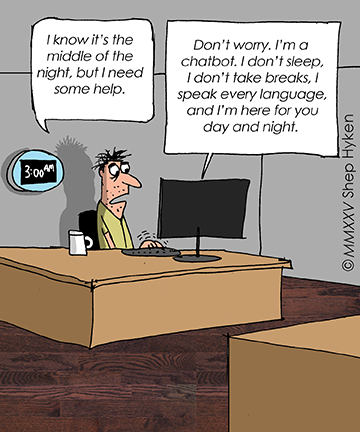
One of the reasons customers are concerned about or even scared of artificial intelligence (AI) is that it has been known to provide incorrect answers. The result is frustration and concern over whether to believe any AI-fueled technology. In my annual customer service and customer experience research, I asked more than 1,000 U.S. consumers if they ever received wrong or incorrect information from an AI self-service technology. Fifty-one percent said yes.
No, AI is not perfect. Even though the technology continues to improve, it still makes mistakes. And my response to those who claim they won’t trust AI because of those mistakes is to ask, “Has a live customer support agent ever given you bad information?”
That question gets a surprised look, and then a smile, and then an acknowledgement, something like, “You’re right. I never thought about that.”
When AI gives bad information, I refer to that as Artificial Incompetence. It’s just as frustrating when we experience bad information from a live agent, which I call HI, or Human Incompetence. I doubt – I actually know – that the AI and the human aren’t trying to give you bad information.
I once called a customer support number to get help with what seemed like a straightforward question. I didn’t like the answer I received. It just didn’t make sense. Rather than argue, I thanked the agent, hung up, and dialed the same customer support number. A different agent answered, and I asked the same question. This time, I liked the answer. Two humans from the same company answering the same question, but with two completely different answers. And we worry about AI being inconsistent!
AI and Humans Make Mistakes
The reality is that both AI and humans make mistakes, and both will continue to do so. The difference is our expectations. We don’t expect humans to be perfect, so when they are not, we may be disappointed, maybe even angry. We may or may not forgive them, but usually, we just chalk it up to being … human. But it’s different when interacting with AI. We expect it to be reliable, and when it makes a mistake, we often assume the entire system is flawed.
Perhaps we should treat both with the same reasonable expectations and the same healthy skepticism we apply to weather forecasters, who use sophisticated technology and have years of training yet still can’t seem to get tomorrow’s forecast right half the time. Well, it seems like half the time! That doesn’t mean we won’t be checking the forecast before we plan our outdoor activities. AI, too, is sophisticated technology that can make life easier.
Image credits: Gemini, Shep Hyken
Sign up here to join 17,000+ leaders getting Human-Centered Change & Innovation Weekly delivered to their inbox every week.
A new wave of layoffs across technology companies has reignited a familiar but increasingly urgent question: what exactly are we witnessing? On the surface, the explanation seems straightforward — companies are tightening costs, responding to macroeconomic pressures, and recalibrating after years of aggressive hiring. But beneath that surface lies a deeper and more consequential debate about the future of innovation, the role of engineers, and the impact of artificial intelligence on knowledge work itself.
Two competing narratives have quickly emerged. The first frames these layoffs as a rational and even necessary evolution. In this view, advances in AI-powered development tools — ranging from large language models to code-generation systems — have fundamentally altered the productivity equation. Engineers equipped with tools like Claude or OpenAI Code can now accomplish in hours what once took days. The implication is clear: if output can be maintained or even increased with fewer people, then reducing headcount is not a sign of weakness but a signal of maturation. Companies are becoming leaner, more efficient, and ultimately more profitable.
The second narrative is far less optimistic. It suggests that layoffs are not a leading indicator of a smarter, AI-augmented future, but a trailing indicator of something more troubling — an innovation slowdown. According to this perspective, many technology companies have already harvested the most accessible opportunities within their existing platforms. What remains is incremental improvement rather than transformative change. In such an environment, cutting engineering talent becomes less about efficiency gains and more about a lack of compelling new problems to solve. The cupboard, in other words, may not be empty — but it may be significantly less full than it once was.
What makes this moment particularly complex is that both narratives can be true at the same time. AI is undeniably increasing productivity in certain domains, compressing development cycles and enabling smaller teams to deliver meaningful results. At the same time, innovation has never been solely a function of efficiency. Breakthroughs emerge from exploration, from cross-functional collisions, and from a willingness to invest in uncertain futures. Layoffs, especially when executed at scale, can disrupt the very conditions that make those breakthroughs possible.
This tension forces us to confront a more nuanced question: are these layoffs a signal of transformation or a symptom of stagnation? Are organizations courageously embracing a new model of AI-augmented work, or are they retreating into cost-cutting as a substitute for bold thinking? The answer matters, because it shapes not only how we interpret today’s decisions, but how we design organizations for tomorrow.
For leaders, the stakes extend beyond quarterly earnings. The choices being made now will determine whether AI becomes a catalyst for a new era of human-centered innovation or a tool that accelerates efficiency at the expense of imagination. For engineers, the implications are equally profound. Their roles are being redefined in real time — not just in terms of what they produce, but in how they create value within increasingly AI-mediated systems.
Ultimately, this is not just a debate about layoffs. It is a debate about what organizations choose to optimize for: productivity or possibility, efficiency or exploration, output or insight. And in that choice lies the future trajectory of innovation itself.
The Case for “Smarter, Leaner, More Profitable”
For many technology leaders, the recent wave of layoffs is not a retreat — it is a re-calibration. The argument is grounded in a simple but powerful premise: the economics of software development have fundamentally changed. With the rapid advancement of AI-assisted coding tools, the amount of output a single engineer can produce has increased dramatically. What once required large, specialized teams can now be accomplished by smaller, more versatile groups augmented by intelligent systems.
Tools such as Claude and OpenAI Code are not merely incremental improvements in developer productivity; they represent a shift in how work gets done. Routine coding tasks, boilerplate generation, debugging assistance, and even architectural suggestions can now be offloaded to AI. This allows engineers to spend less time writing repetitive code and more time focusing on higher-value activities such as system design, problem framing, and integration across complex environments.
In this emerging model, the role of the engineer evolves from builder to orchestrator. Instead of manually crafting every line of code, engineers guide, refine, and validate the outputs of AI systems. The result is a compression of development cycles — features are built faster, iterations occur more rapidly, and time-to-market shrinks. From a business perspective, this translates into a compelling opportunity: maintain or even increase output while reducing labor costs.
This logic is not without precedent. Across industries, waves of automation have consistently redefined the relationship between labor and productivity. In manufacturing, the introduction of robotics did not eliminate production; it scaled it. In many cases, it also improved quality and consistency. Proponents of the current shift argue that AI represents a similar inflection point for knowledge work. The companies that adapt fastest will be those that learn to pair human creativity with machine efficiency.
From a financial standpoint, the incentives are clear. Reducing headcount while sustaining output improves margins, a priority that has become increasingly important in an environment where growth-at-all-costs is no longer rewarded. Investors are placing greater emphasis on profitability and operational discipline, and companies are responding accordingly. Leaner teams are not just a byproduct of technological change — they are a strategic choice aligned with evolving market expectations.
There is also a strategic argument that goes beyond cost savings. By automating lower-value tasks, organizations can theoretically redeploy human talent toward more innovative efforts. Engineers freed from routine work can focus on solving harder problems, exploring new product ideas, and experimenting with emerging technologies. In this view, AI does not replace innovation capacity; it expands it by removing friction from the development process.
Smaller teams can also mean faster decision-making. With fewer layers of coordination required, organizations can become more agile, responding quickly to changing market conditions and customer needs. This agility is often cited as a competitive advantage, particularly in fast-moving technology sectors where speed can determine success or failure.
Ultimately, the “smarter, leaner” argument rests on a belief that efficiency and innovation are not mutually exclusive. Instead, they are mutually reinforcing. By leveraging AI to increase productivity, companies can create the financial and operational headroom needed to invest in the next wave of innovation. Layoffs, in this context, are not an admission of weakness — they are a signal that the underlying system of value creation is being rewritten.
The Case for “Innovation Is Running Dry”
While the efficiency narrative is compelling, an equally important — and more unsettling — interpretation of recent layoffs is gaining traction: that they reflect not technological progress, but an innovation slowdown. In this view, companies are not simply becoming leaner because they can do more with less, but because they have fewer truly novel problems worth investing in. The layoffs, therefore, are less a signal of transformation and more a symptom of diminishing opportunity.
Over the past decade, many technology companies have scaled around a set of highly successful platforms and business models. These platforms have been optimized, expanded, and monetized with remarkable effectiveness. But maturity brings constraints. As systems stabilize and markets saturate, the number of greenfield opportunities naturally declines. What remains is often incremental improvement — refinements, extensions, and efficiencies — rather than the kind of breakthrough innovation that requires large, exploratory engineering teams.
In this context, layoffs can be interpreted as a rational response to a shrinking frontier. If there are fewer bold bets to pursue, there is less need for the capacity required to pursue them. The risk, however, is that this becomes a self-reinforcing cycle. As organizations reduce investment in exploration, they further limit their ability to discover the next wave of opportunity. Over time, efficiency begins to crowd out possibility.
Compounding this dynamic is an increasing reliance on metrics that prioritize productivity over potential. Organizations are becoming exceptionally good at measuring what is already known — velocity, output, utilization — but far less adept at valuing what has yet to be discovered. When success is defined primarily by efficiency gains, it becomes harder to justify the uncertainty and longer time horizons associated with breakthrough innovation.
The rise of AI tools adds another layer of complexity. While these tools can accelerate development, they do not inherently generate new insight. They are trained on existing patterns, which means they are exceptionally effective at extending the present but less equipped to invent the future. This creates the risk of an “illusion of progress,” where output increases but originality does not. More code is produced, but not necessarily more meaningful innovation.
There are also significant cultural consequences to consider. Layoffs, particularly when they affect engineering and product teams, can erode trust and psychological safety within an organization. When employees perceive that their roles are precarious, they are less likely to take risks, challenge assumptions, or pursue unconventional ideas. Yet these behaviors are precisely what fuel innovation. In attempting to optimize for efficiency, companies may inadvertently suppress the very creativity they depend on for long-term growth.
Another often overlooked impact is the loss of institutional knowledge. Experienced engineers carry not just technical expertise, but contextual understanding of systems, decisions, and past experiments. When they leave, they take with them insights that are difficult to codify or replace. This loss can slow future innovation efforts, even as short-term efficiency metrics appear to improve.
Ultimately, the concern is not that companies are becoming more efficient — it is that they may be becoming too narrowly focused on efficiency at the expense of exploration. Innovation requires slack, curiosity, and a willingness to invest in uncertain outcomes. When organizations begin to treat these elements as expendable, they risk signaling something far more significant than cost discipline: a diminishing appetite for invention itself.
The Human-Centered Tension: Productivity vs. Possibility
Beneath the surface of the efficiency versus stagnation debate lies a deeper, more human tension — one that cannot be resolved by technology alone. At its core, innovation has never been just about output. It has always been about the quality of thinking, the diversity of perspectives, and the collisions between ideas that spark something new. When organizations focus too narrowly on productivity, they risk overlooking the very conditions that make possibility achievable.
Innovation does not emerge from isolated efficiency; it emerges from interaction. It is the byproduct of cross-functional curiosity — engineers engaging with designers, product managers challenging assumptions, customers re-framing problems, and leaders creating space for exploration. These interactions are often messy, inefficient, and difficult to measure. But they are also where breakthroughs live. When layoffs reduce not just headcount but diversity of thought and opportunities for collaboration, the innovation system itself becomes less dynamic.
The rise of AI-augmented work introduces a new layer to this tension. As engineers increasingly rely on AI tools to generate code, suggest solutions, and optimize workflows, their role begins to shift. They move from hands-on builders to orchestrators of machine-assisted output. While this shift can increase speed and efficiency, it also raises an important question: what happens to deep craft? The tacit knowledge developed through wrestling with complexity — the kind that often leads to unexpected insights — may be diminished if too much of the process is abstracted away.
There is also a cognitive risk. AI systems are designed to identify and replicate patterns based on existing data. This makes them powerful tools for scaling what is already known, but less effective at challenging foundational assumptions. If organizations become overly dependent on these systems, they may unintentionally standardize thinking. The range of possible solutions narrows, not because people lack creativity, but because the tools they use guide them toward familiar patterns.
Trust plays a critical role in navigating this tension. In environments where employees feel secure, valued, and empowered, they are more likely to experiment, take risks, and pursue unconventional ideas. Layoffs, particularly when they are frequent or poorly communicated, can erode that trust. The result is a more cautious workforce — one that prioritizes safety over exploration. In such environments, productivity may remain high, but the willingness to pursue breakthrough innovation often declines.
Curiosity is the other essential ingredient. It is the force that drives individuals to ask better questions, challenge the status quo, and seek out new possibilities. Yet curiosity requires space — time to think, room to explore, and permission to deviate from immediate objectives. When organizations optimize relentlessly for efficiency, that space tends to disappear. Every moment is accounted for, every effort measured, and every outcome expected to justify itself in the short term.
This creates a paradox. The same tools and strategies that enable organizations to move faster can also constrain their ability to think differently. Speed without reflection can lead to acceleration in the wrong direction. Efficiency without exploration can result in incremental progress that ultimately limits long-term growth.
For leaders, the challenge is not to choose between productivity and possibility, but to intentionally design for both. This means recognizing that innovation systems require balance — between execution and exploration, between structure and flexibility, and between human judgment and machine assistance. It requires protecting the conditions that enable creativity even as new technologies reshape how work gets done.
Ultimately, the question is not whether AI will make organizations more efficient — it already is. The question is whether leaders will use that efficiency to create more space for human ingenuity, or whether they will allow it to crowd out the very behaviors that make innovation possible in the first place.
The Future of Innovation in the Age of AI: Augmentation or Abdication?
As organizations navigate layoffs, AI adoption, and shifting expectations around productivity, the future of innovation is not predetermined — it is being actively shaped by the choices leaders make today. The central question is no longer whether artificial intelligence will transform how work gets done, but how that transformation will be directed. Will AI serve as an amplifier of human ingenuity, or will it become a mechanism for narrowing ambition in the pursuit of efficiency?
Three distinct paths are beginning to emerge. The first is an augmentation-led renaissance, where organizations successfully combine human creativity with machine capability. In this scenario, AI handles the repetitive and computationally intensive aspects of work, freeing humans to focus on problem framing, experimentation, and breakthrough thinking. Innovation accelerates not because there are fewer people, but because those people are empowered to operate at a higher level of abstraction and impact.
The second path is the efficiency trap. Here, organizations become so focused on optimizing output and reducing cost that they gradually lose their capacity for exploration. AI is used primarily to streamline existing processes rather than to unlock new possibilities. Over time, these organizations become highly efficient at executing yesterday’s ideas, but increasingly disconnected from tomorrow’s opportunities. What appears to be strength in the short term reveals itself as fragility in the long term.
The third path is a bifurcation of the competitive landscape. Some organizations will lean into augmentation, investing in both AI capabilities and the human systems required to harness them effectively. Others will prioritize efficiency, focusing on cost control and incremental gains. The result is a widening gap between companies that consistently generate new value and those that primarily replicate and optimize existing models. In such an environment, innovation becomes a defining differentiator rather than a baseline expectation.
What separates the leaders from the laggards will not be access to AI alone — those tools are increasingly commoditized — but how organizations integrate them into their innovation systems. Leading organizations will invest not just in AI infrastructure, but in what might be called curiosity infrastructure: the cultural, structural, and leadership practices that encourage questioning, exploration, and cross-functional collaboration. They will recognize that technology can accelerate execution, but only humans can redefine the problems worth solving.
This shift will require a redefinition of roles. Engineers, for example, will need to move beyond execution and into areas such as systems thinking, ethical judgment, and interdisciplinary collaboration. Their value will be measured not just by what they build, but by how they frame problems, challenge assumptions, and integrate diverse inputs into coherent solutions. Similarly, leaders will need to become stewards of both performance and possibility, ensuring that the drive for efficiency does not crowd out the pursuit of innovation.
Organizations that thrive will also be those that intentionally protect space for exploration. This does not mean abandoning discipline or ignoring financial realities. It means recognizing that innovation requires a portfolio approach — balancing investments in core optimization with bets on uncertain, high-potential opportunities. AI can make this balance more achievable by reducing the cost of experimentation, but only if leaders choose to reinvest those gains into discovery rather than solely into margin expansion.
Ultimately, the future of innovation in the age of AI will be defined by whether organizations treat these tools as a substitute for human thinking or as a catalyst for it. The real risk is not that AI replaces engineers — it is that organizations stop asking the kinds of questions that require engineers to think deeply, creatively, and collaboratively in the first place.
Augmentation or abdication is not a technological choice. It is a leadership choice. And in making it, organizations will determine whether this moment becomes a turning point toward a more innovative future — or a gradual slide into highly efficient irrelevance.
Frequently Asked Questions
1. Why are technology companies laying off engineers despite using AI tools?
Layoffs may result from a combination of efficiency gains and slowing innovation opportunities. AI tools like
Claude and OpenAI Code allow smaller teams to maintain or increase output, reducing the need for some roles.
At the same time, some companies face fewer breakthrough projects to pursue, which can also drive workforce reductions.
2. Does AI replace human engineers or just augment their work?
AI primarily augments engineers by automating repetitive coding, debugging, and optimization tasks. This allows
engineers to focus on higher-value activities such as system design, problem framing, and creative innovation.
While some roles shift, AI is intended as an amplifier of human ingenuity rather than a replacement.
3. How can companies maintain innovation in the age of AI?
Companies can preserve innovation by investing in curiosity infrastructure, protecting time and space for
experimentation, fostering cross-functional collaboration, and reinvesting efficiency gains into exploratory,
high-potential projects. Balancing productivity with opportunity ensures that humans and AI together drive breakthroughs.
Image credits: ChatGPT
Content Authenticity Statement: The topic area, key elements to focus on, etc. were decisions made by Braden Kelley, with a little help from ChatGPT to clean up the article and add citations.
Sign up here to get Human-Centered Change & Innovation Weekly delivered to your inbox every week.
I don’t want to sound like an alarmist, but if your work involves sitting at a computer, your job could be in jeopardy. The pace of progress in AI has become exponential rather than linear, as AI models are becoming capable of building AI models. As the implications of recent advances cascade throughout the economy, stock markets gyrate, and career anxiety pervades the white-collar sector.
As a futurist and innovation expert advising organizations for over three decades, I have had a front-row seat to many varieties of disruptions. This experience has led me to conclude that technological innovations rarely eliminate those who are willing to experiment and adapt. Most at risk are those who are complacent: those who assume they can get by without fundamentally changing how they operate.
“Something big is happening,” noted AI investor and CEO Matt Shumer, in an influential post read by 80 million people. “I am no longer needed for the actual technical work of my job. I describe what I want to be built, in plain English, and it just appears. Not a rough draft I need to fix. The finished thing. I tell the AI what I want, walk away from my computer for four hours, and come back to find the work done better than I would have done it myself.”
The first big warning of mass job displacement came in 2025, when Anthropic CEO Dario Amodei warned in an Axios interview that AI could eliminate “roughly 50% of entry-level white-collar jobs within 1–5 years, and that unemployment could spike to 10–20% within one to five years. “
Following Matt Shumer’s post last week, Citrini Research earlier this week tapped into a new strain of fears about AI, painting what the Wall Street Journal called a “dark portrait of a future in which technological change inspires a race to the bottom in white-collar knowledge work. “For the entirety of modern economic history, human intelligence has been the scarce input,” Citrini noted. “We are now experiencing the unwind of that premium.” The Dow dropped 820 points on the post.
The question on everyone’s mind right now seems to be: What happens when artificial intelligence can do my job faster, cheaper, and perhaps better than I can? But as a futurist and innovation consultant, I believe there’s a better question that one can ask: In what ways do I protect my career when the pace of AI progress is exponential, rather than linear?
My suggestions are below:
1. Stop Trying to Compete with AI on Efficiency. Compete on value
If your primary value add comes from sitting at a computer processing information, summarizing documents, generating reports, or performing predictable analysis, AI systems are intent on making you redundant. My suggestion here is to alter your value proposition.
In the legal arena, AI can conduct research, analyze and draft contracts, and otherwise do the job of entry-level workers. In healthcare, AI can read scans, analyze lab results, review medical journals, and suggest diagnoses. In customer service, genuinely capable AI agents are often more competent than call center workers. In 2023, AI struggled to write code. Today, at a growing number of companies, AI is writing much of the code.
Three years ago, AI could generate text but struggled to reason. In 2026, it solves complex problems step-by-step. In 2022, AI needed constant prompting. Today, agentic systems are planning and executing multi-stage projects on their own. And where AI once missed human nuance entirely, it is beginning to recognize emotion and adapt responses accordingly. You get the idea; AI is assaulting assumptions about what it can and cannot do at every juncture.
Many professionals unknowingly position themselves as competitors to automation. But competing on efficiency or productivity alone is a losing battle. To shift, ask yourself a different question: What do I uniquely contribute when the data is already available?
2. Become AI-fluent, starting today
NVIDIA CEO Jensen Huang warned in May 2025 at the Milken Institute Global Conference, “You’re not going to lose your job to an AI, you’re going to lose it to someone who uses AI.” Why not be that person instead?
In Build a Better Future: 7 Mindsets for Navigating the Age of Acceleration, I describe the Preparedness Mindset as most important of all — proactively anticipating change rather than reacting too late. Preparedness demands that, regardless of any misgivings about AI, we lean in to it, we become experts in it, and we design effective early warning systems to keep us abreast.
My suggestion is: spend time each week using new AI tools to draft communications, analyze data, brainstorm strategy, simulate customer conversations, and stress-test ideas. In doing so, you are not just learning to use new software. You are learning collaboration with a new type of intelligence. Those who understand what AI can and cannot do become indispensable translators between technology and business results. There’s no time to waste in becoming AI-fluent.
3. Hone your innovation skills
When the personal computer arrived, some employees feared it. Others stayed late learning spreadsheets and word processing. Within a few years, the difference in career trajectory was unmistakable. This same dynamic is unfolding again.
Tens of thousands of white-collar jobs are vanishing as AI starts to bite. Yet today organizations are desperately in need of people with an opportunity mindset – the outward focus to “find a (customer) need and fill it,” and to get new projects done, improve customer experience, motivate teams, enter new markets, and achieve unconventional results.
Human agency — the willingness to initiate action rather than await instruction — becomes a career differentiator. That might mean: proposing new AI-enabled services to clients, redesigning workflows, volunteering for experimental projects, or building personal expertise outside formal job descriptions. History shows that disruption rewards proactive learners who act on their ideas.
4. Move Closer to Problems, Not Tasks
AI replaces tasks faster than it replaces responsibility. Professionals who define themselves narrowly — “I prepare quarterly reports” or “I write marketing copy” — face greater exposure than those who own outcomes.
Executives increasingly value people who solve problems rather than execute assignments.
Consider shifting your identity toward improving customer retention, accelerating product innovation, strengthening culture, managing risk, or enabling growth. Tasks may change as AI evolves. Problems remain. This reflects what I call the Adaptability and Human Agency Mindsets — expanding your role faster than disruption can shrink it.
5. Develop A Long View of Value Creation
Periods of technological upheaval tempt people toward short-term survival thinking. Yet careers are marathons measured over decades. The professionals who flourish are those who continually reinvent how they add value.
Three forward-looking questions:
What skills will matter more five years from now?
What emerging problems will organizations struggle to solve?
Where can I become known as a trusted guide?
The Long View mindset encourages investing in capabilities that compound over time: leadership presence, interdisciplinary thinking, ethical judgment, and strategic foresight. Ironically, these human-centered abilities become more valuable as machines grow more capable.
The Opportunity Hidden Inside the Fear
As the futurist Thomas Koulopoulos observed in Gigatrends: Six Forces That Are Changing the Future for Billions, “As a species, we consistently allow the peril of the present to eclipse the promise of the future, and by doing that, we fail to comprehend just how much we can accomplish.”
Artificial intelligence will undoubtedly reshape entry-level work and certain knowledge professions. But history suggests something equally important: entirely new roles emerge alongside disruption. Entirely new opportunities will inevitably arise as well.
The printing press eliminated scribes but created publishers. The internet disrupted travel agents, yet produced digital marketing, cybersecurity, and platform entrepreneurship. AI will do the same.
The essential question is not whether change is coming. It is whether we as individuals choose to become passengers or navigators.
In an accelerated age, the safest career strategy is not hiding from technology but running toward it — with curiosity, agency, and vision. Those who learn fastest, adapt deliberately, and commit themselves to solving meaningful problems will not merely avoid displacement. They will help build the future that others are still struggling to understand.
This article originally appeared in Forbes
Image credit: Unsplash
Sign up here to get Human-Centered Change & Innovation Weekly delivered to your inbox every week.
What Elements of Human-Centered Design Can AI Not Own? (Short Answer)
Five elements of human-centered design AI cannot own: lived contact with people doing the job, problem framing before solutions, constraint and tradeoff honesty, behavior falsification (not demo applause), and adoption design for Tuesday. AI can draft personas, journey maps, wireframes, and “How might we…” at volume. It cannot bear dignity costs, name what you are empowered to change, choose under uncertainty with accountability, measure what people do, or own the seam after the workshop.
When generation is cheap, the elements that require a body in the room become the whole design — not the wallpaper around the model.
Why Are Artifacts Cheap and Judgment the Design?
I have watched the same room light up twice — once when sticky notes arrived, and again when the model could generate a persona, a journey map, and a clickable prototype before lunch. The second room felt more advanced. It was often less honest.
AI did not retire human-centered design. It made the human elements more urgent. Models can invent users who never existed, roadmaps that answer the wrong question beautifully, and pilots that prove the demo while the operating model stays frozen. Generation got cheap. Design judgment is still expensive — in the right way: contact, stakes, mandate, falsifiable learning, and adoption.
This is not a list of things to ban. It is a division of design labor. AI can assist each element. Humans must own them — because each requires someone who bears stakes, accountability, and contact with Tuesday.
Element
AI can assist
Humans must own
1. Lived contact
Summarize interviews, cluster themes
Field time, dignity costs, reality that contradicts the roadmap
2. Problem framing
Explore options inside a human-set frame
The question, the mandate, killing the wrong problem
3. Constraint honesty
Retrieve policy, model scenarios
Tradeoffs, winners and losers, what we stop doing
4. Behavior falsification
Generate flows, demos, copy variants
What to test, what people do, when to kill the idea
5. Adoption design
Draft rollout plans and training outlines
Owners, seams, shadow-process kill dates, Tuesday
1. Why Can’t AI Own Lived Contact in Human-Centered Design?
The element: Understanding humans by contact — jobs-to-be-done, friction, dignity costs — in their language and context, before the artifact freezes the story.
AI can assist: Summarize interviews, cluster themes, draft empathy maps after contact. Useful synthesis once reality has entered the room.
The costume: Synthetic users, scraped reviews, generated personas nobody met; empathy theater at machine speed. Fluency mistaken for evidence.
Humans own: Field time, ride-alongs, the awkward conversation where reality contradicts the roadmap. If the insight could have been invented in the building, it is not design. It is decoration.
2. Why Is Problem Framing a Design Element AI Cannot Own?
The element: Naming the right problem, constraints, and stakes before freezing solutions — the frame that makes options meaningful.
AI can assist: Explore options inside a human-set frame; draft scenarios; challenge assumptions once the frame exists.
The costume: Instant roadmaps and solution spam that answer the wrong brief beautifully; “innovation” that skips the question entirely.
Humans own: The mandate to sit with the problem; kill ideas that solve a different problem; sponsor alignment on what is actually being designed. Faster wrong is still wrong — and now it ships faster too.
3. What Design Tradeoffs Must Humans Own That AI Cannot Fake?
The element: Surfacing policy, power, incentives, risk, staffing, and dignity limits that govern what can actually ship — and naming winners and losers.
AI can assist: Retrieve policy, summarize regulations, model scenarios within declared constraints.
The costume: Infinite “yes” in the prototype; designs that assume permission nobody has; surprise policy after “done.”
Humans own: The political work of tradeoffs; what we will stop doing; who loses if this works. Design without constraint honesty is a portfolio piece, not a plan. For sharper framing before specs freeze, see 10 Design Questions That Beat a 40-Page Requirements Document.
4. How Do Humans Own Behavior Falsification When AI Makes Prototypes Cheap?
The element: Prototyping and testing to falsify a named human behavior hypothesis — completion, workaround abandoned, time-to-confidence — not to win a room.
AI can assist: Generate clickable flows, agent demos, copy variants for tests. Speed to artifact, not speed to truth.
The costume: Applause demos; portfolio pieces; A/B theater without a behavior theory. Gorgeous output that teaches nothing about Tuesday.
Humans own: Choosing what to falsify; interpreting what people do; killing the idea when the evidence says kill. A beautiful demo that teaches nothing is still theater — and AI makes theater cheaper every quarter.
5. Who Owns Adoption Design That AI Cannot?
The element: Designing for who operates the journey after the markers dry — owners, handoffs, incentives, retirement of the old path, recovery power at the moment of truth.
AI can assist: Draft rollout plans, comms, training outlines — inside a human-owned adoption frame.
The costume: Workshop output that ends at the wall; maps without operators; “we’ll figure out ownership at scale.”
Humans own: Named workflow owner; seam owners; kill date for shadow process; enablement as practice, not completions. Design that stops at demo day is not human-centered. It is human-decorated. For friction customers feel before any map names it, read 12 Friction Points Customers Feel Before Your Journey Map Does.
How Do You Check the Division of Design Labor Before an AI-Assisted Sprint?
Before the next AI-assisted design sprint, run five go/no-go questions. If you cannot answer them, you are buying artifacts without a design:
Who did we talk to — real humans doing the job, in their words?
What problem are we empowered to change — decide, ship, or stop?
What constraint or tradeoff are we naming out loud — policy, power, dignity, what we stop?
What behavior are we falsifying — not what demo are we showing?
Who owns Tuesday after the workshop — workflow, seams, shadow process retired?
AI can own the draft. Humans own the design — contact, frame, tradeoffs, behavior, and adoption.
Frequently Asked Questions
What elements of human-centered design can AI not replace?
AI cannot own lived contact with real users, problem framing before solutions, honest constraint and tradeoff work, behavior falsification in testing, or adoption design for Tuesday. It can assist each — drafting, clustering, prototyping — but humans must bear stakes, mandate, accountability, and contact with reality.
Can AI do human-centered design?
AI can accelerate artifacts inside human-centered design — personas, maps, wireframes, copy — but it cannot do the design discipline on its own. Without human-owned contact, framing, tradeoffs, falsification, and adoption, AI produces fluent decoration: faster artifacts, same theater.
What is the difference between AI-assisted design and AI-owned design?
AI-assisted design uses models after humans set the problem frame, gather real evidence, and clarify decision rights — then to explore, draft, and test faster. AI-owned design lets generation substitute for contact, framing, tradeoffs, learning, and adoption — producing impressive artifacts that never land on Tuesday.
Why do AI-generated personas fail in human-centered design?
They often replace lived contact instead of summarizing it. Synthetic personas feel researched because the prose is fluent, but they optimize for a human who never existed — skipping dignity costs, workarounds, and the awkward truth that contradicts the roadmap. Empathy theater at machine speed.
How do you keep design human with AI?
Keep humans owning contact, problem framing, constraint honesty, behavior falsification, and adoption design. Use AI inside that frame for synthesis and speed. Run a division-of-labor check before each sprint: real humans in the evidence, empowered problem, named tradeoffs, falsifiable behavior, and an owner for Tuesday.
Image credits: Gemini
Content Authenticity Statement: The topic area, key elements to focus on, etc. were decisions made by Braden Kelley, with a little help from Google Gemini and Cursor to clean up the article, add images and create infographics.
Sign up here to get Human-Centered Change & Innovation Weekly delivered to your inbox every week.
Something fundamental has changed in how products are created.
Artificial intelligence can now generate working software in minutes. Designers can move from an idea to a functional prototype without waiting for engineering. Engineers can generate interface concepts, user flows, and even early product ideas with a few well-crafted prompts.
The traditional product development cycle — design, then build, then test — is collapsing into something faster, messier, and far more fluid.
In the past, the biggest constraint in innovation was the cost and time required to build something. Today, AI dramatically reduces that barrier. Entire features, experiments, and even applications can be created almost instantly.
Which raises an uncomfortable question that many product leaders, designers, and engineers are quietly asking:
If we can ship almost immediately, do we still need design thinking?
At first glance, the answer might seem obvious. Design thinking was created to help teams understand people, define the right problems, and avoid building the wrong solutions. Those goals have not disappeared.
But when the cost of building approaches zero, the role of design inevitably changes. The traditional pacing of discovery, ideation, prototyping, and testing begins to compress. The boundaries between designer and engineer begin to blur.
And as those boundaries dissolve, the question is no longer simply whether design thinking still matters.
The deeper question is whether the discipline itself must evolve to survive in a world where almost anyone can turn an idea into working software.
II. Design Thinking Was Built for a World of Scarcity
To understand how artificial intelligence is reshaping product creation, it helps to remember the environment in which design thinking originally emerged.
Design thinking did not appear because organizations suddenly discovered empathy or creativity. It emerged because building things was expensive, slow, and risky. Every product decision carried significant cost, and mistakes could take months or years to correct.
In that world, organizations needed a structured way to reduce uncertainty before committing engineering resources. Design thinking provided that structure.
Its now-famous stages helped teams move deliberately from understanding people to building solutions:
Empathize — deeply understand the people you are designing for.
Define — frame the real problem worth solving.
Ideate — generate a wide range of possible solutions.
Prototype — create rough representations of potential ideas.
Test — validate whether those ideas actually work for people.
The goal was simple: avoid spending months building something no one actually needed.
Design thinking slowed teams down in the right places so they could move faster later. It created space for exploration before the heavy machinery of engineering was set in motion.
But this entire framework assumed one critical constraint:
Building was the most expensive part of innovation.
Prototypes were often static mockups. Experiments required engineering time. Even small product changes could take weeks or months to ship.
In other words, design thinking was optimized for a world where the biggest risk was building the wrong thing.
Today, AI is rapidly changing that assumption. When working software can be generated in minutes rather than months, the bottleneck shifts — and the role of design must evolve with it.
III. AI Has Flipped the Innovation Constraint
For most of the history of digital product development, the limiting factor in innovation was the ability to build. Even the best ideas had to wait in line for scarce engineering resources, long development cycles, and complex release processes.
Artificial intelligence is rapidly dismantling that constraint.
Today, AI tools can generate functional code, working interfaces, and interactive prototypes in minutes. What once required a team of specialists and weeks of effort can often be produced by a single individual in an afternoon.
Designers can now:
Create interactive prototypes that behave like real products
Generate front-end code directly from design concepts
Rapidly explore multiple product directions
Engineers can now:
Generate user interfaces and layouts
Experiment with product concepts before committing to full builds
Quickly iterate on product experiences
The barrier between idea and implementation is shrinking dramatically.
As a result, the core constraint in innovation is no longer the ability to build something. The new constraint is the ability to decide what should actually be built.
When creation becomes cheap, judgment becomes the scarce resource.
Organizations can now generate more ideas, features, and experiments than they have the capacity to evaluate thoughtfully. The risk is no longer simply building the wrong thing slowly.
The risk is building thousands of things quickly without enough clarity about which ones actually matter.
This shift fundamentally changes the role of design. Instead of primarily helping teams avoid costly mistakes in development, design increasingly becomes the discipline that helps organizations navigate overwhelming possibility.
IV. The Blurring of Roles: Designers Reach Forward, Engineers Reach Back
One of the most profound effects of AI in product development is the erosion of traditional professional boundaries.
For decades, the technology industry operated with relatively clear separations of responsibility. Designers focused on user needs, interaction models, and visual systems. Engineers translated those designs into working software. Product managers coordinated priorities and timelines between the two.
That structure was largely a reflection of technical limitations. Designing and building required specialized tools, knowledge, and workflows that made cross-disciplinary work difficult.
AI is rapidly dissolving those barriers.
Designers can now reach forward into the domain that once belonged exclusively to engineering. With AI-assisted tools, they can generate working interfaces, produce front-end code, and simulate complex user interactions without waiting for implementation.
At the same time, engineers can reach backward into design. AI systems can help them generate layouts, propose interface structures, and explore experience flows that once required specialized design expertise.
The result is a new kind of creative overlap:
Designers who can prototype in code
Engineers who can explore experience design
Product creators who move fluidly between disciplines
The traditional model of work moving through a linear chain — research to design to engineering — begins to give way to a far more integrated creative process.
The future product creator is not defined by a job title, but by the ability to move fluidly between understanding problems and building solutions.
This does not mean design expertise or engineering skill become less important. If anything, the opposite is true. As tools make it easier for everyone to participate in creation, the depth of real craft becomes more visible and more valuable.
But it does mean the rigid boundaries between “designer” and “builder” are beginning to dissolve, creating a new generation of hybrid creators who can move seamlessly between imagining, designing, and shipping experiences.
V. The Death of the Handoff
For decades, most product development operated like a relay race. Work moved from one team to the next through a series of formal handoffs.
Researchers gathered insights and passed them to designers. Designers created wireframes and mockups that were handed to engineering. Engineers translated those designs into working software and eventually passed the finished product to testing and operations.
Each transition introduced delays, misinterpretations, and loss of context. The original understanding of the problem often became diluted as it traveled through the system.
Artificial intelligence is accelerating the collapse of this model.
When individuals can move rapidly from idea to prototype to functional product, the need for rigid handoffs begins to disappear. A single person can now:
Explore a user problem
Design a potential solution
Generate working code
Launch an experiment
Instead of waiting for work to pass from one discipline to another, creators can stay connected to the entire lifecycle of an idea.
The distance between insight and implementation is shrinking.
This shift has profound implications for how innovation happens inside organizations. Instead of large teams coordinating complex handoffs, smaller groups — or even individuals — can rapidly test ideas and learn from real-world feedback.
Product development begins to look less like an industrial assembly line and more like a creative studio, where ideas are explored, built, and refined continuously.
The most effective teams in this environment will not simply move faster. They will maintain ownership of ideas from the moment a problem is discovered all the way through to the moment a solution is experienced by real people.
VI. What AI Actually Kills
Artificial intelligence is not killing design thinking.
What it is killing are many of the habits that organizations adopted in the name of design thinking but that were never truly about understanding people or solving meaningful problems.
For years, some teams have mistaken the appearance of innovation for the practice of it. Workshops replaced experiments. Sticky notes replaced decisions. Slide decks replaced prototypes.
When building was slow and expensive, these behaviors were often tolerated because teams needed time to align before committing resources. But in a world where working solutions can be generated almost instantly, those habits quickly become friction.
AI removes the excuses that allowed these patterns to persist.
Process Theater
Innovation workshops that generate energy but not outcomes become difficult to justify when teams can build and test ideas immediately.
Endless Ideation
Brainstorming sessions that produce dozens of ideas without committing to experiments lose their value when ideas can be rapidly turned into prototypes and evaluated in the real world.
Documentation Instead of Exploration
Detailed reports, long strategy decks, and static artifacts once helped communicate ideas across teams. But when AI allows concepts to be expressed through working experiences, documentation becomes less important than experimentation.
Safe Innovation
Perhaps most importantly, AI challenges organizations that use process as a shield against risk. When it becomes easy to test bold ideas quickly and cheaply, avoiding experimentation becomes a choice rather than a necessity.
AI doesn’t eliminate design thinking. It eliminates the distance between thinking and doing.
The organizations that thrive in this environment will not be the ones with the most polished innovation processes. They will be the ones that are most willing to replace discussion with discovery and ideas with experiments.
VII. The New Role of Design: Decision Velocity
When the cost of building drops dramatically, the nature of competitive advantage changes.
In the past, organizations succeeded by efficiently transforming ideas into products. Engineering capacity, technical expertise, and operational discipline were often the primary constraints.
But when AI can generate working software, prototypes, and experiments almost instantly, the challenge is no longer how quickly something can be built.
The challenge becomes how quickly and wisely teams can decide what is actually worth building.
In an AI-driven world, innovation speed is no longer about development velocity — it is about decision velocity.
This is where the role of design evolves.
Design shifts from primarily producing artifacts — wireframes, mockups, and prototypes — to guiding the choices that shape meaningful innovation.
Designers increasingly become the people who help teams:
Frame the right problems to solve
Clarify human needs and motivations
Prioritize which ideas deserve experimentation
Interpret signals from real-world user behavior
In other words, design becomes less about shaping the interface of a product and more about shaping the direction of learning.
When organizations can generate thousands of potential solutions, the real value lies in identifying the small number that actually create meaningful value for people.
Designers, at their best, help organizations navigate that complexity. They connect technology to human context, helping teams avoid the trap of building faster without thinking better.
In the AI era, design is not slowing innovation down. It is helping organizations move quickly without losing their sense of where they should be going.
VIII. From Design Thinking to Design Doing
As artificial intelligence compresses the distance between idea and implementation, the nature of design practice begins to change. The emphasis shifts away from structured stages and toward continuous experimentation.
Traditional design thinking frameworks helped teams organize their thinking before committing to build. But in an AI-enabled environment, building itself becomes part of the thinking process.
Instead of long cycles of analysis followed by development, teams can now explore ideas directly through working prototypes and rapid experiments.
The most effective teams no longer separate thinking from building. They think by building.
This shift marks a move from design thinking to what might be called design doing.
In this model, learning happens through fast cycles of creation, feedback, and refinement. Ideas are not debated endlessly in workshops or captured in lengthy documents. They are explored through tangible experiences that can be observed, tested, and improved.
The practical differences begin to look like this:
Traditional Model
AI-Enabled Model
Workshops and brainstorming sessions
Rapid experiments and live prototypes
Personas and research summaries
Behavioral data and real-world signals
Concept mockups
Functional prototypes
Long planning cycles
Continuous learning loops
None of this diminishes the importance of understanding people. If anything, the need for deep human insight becomes even more important as the pace of experimentation accelerates.
What changes is how that understanding is expressed. Instead of existing primarily as documents or presentations, insight becomes embedded directly into the experiences teams create and test.
In an AI-native organization, design is no longer a phase that happens before development begins. It becomes an ongoing activity woven directly into the act of building and learning.
IX. Human Trust Becomes the New Design Material
As artificial intelligence accelerates the speed of building, the most important design challenges begin to shift away from usability and toward something deeper: trust.
When products can be created, modified, and deployed almost instantly, the risk is not simply poor interface design. The risk is creating experiences that feel disconnected from human values, human context, and human expectations.
AI makes it easier than ever to generate functionality. But it does not automatically ensure that what is generated is responsible, understandable, or aligned with the needs of the people who will use it.
In an AI-driven world, the most important design material is no longer pixels or screens — it is human trust.
This raises a new set of responsibilities for designers, engineers, and product leaders alike.
Teams must think carefully about questions such as:
Do people understand what the system is doing?
Are decisions being made transparently?
Does the experience respect human autonomy?
Does the technology reinforce or erode confidence?
As AI systems become more powerful, the danger is not just that they might fail. The danger is that they might succeed in ways that quietly undermine the relationship between organizations and the people they serve.
Design therefore becomes a critical safeguard. It ensures that rapid technological capability does not outpace thoughtful consideration of human consequences.
In this sense, the role of design expands beyond shaping products. It becomes the discipline that ensures technology remains grounded in human meaning, responsibility, and trust.
X. The Future: Designers Who Ship, Engineers Who Empathize
As AI blurs the traditional boundaries between design and engineering, the most valuable creators in the future will be those who can move fluidly between imagining, designing, and building.
Designers will need to ship working products, not just static prototypes. Engineers will need to empathize deeply with users, understanding problems and shaping experiences that align with human needs.
The new hybrid product creator embodies both curiosity and capability, bridging the gap between thinking and doing. They are able to:
Rapidly translate insights into working solutions
Experiment and learn from real-world user behavior
Balance technical feasibility with human desirability
Maintain alignment between strategy, design, and execution
In this new landscape, design thinking does not disappear — it evolves. AI removes many of the barriers that previously prevented designers and engineers from collaborating fully and iterating quickly.
The organizations that succeed will be those where everyone has the ability to both understand humans and act on that understanding at the speed of AI.
The future belongs to hybrid creators who can navigate ambiguity, make fast decisions, and embed human trust into every experiment. In such a world, innovation is no longer the domain of specialists — it is the responsibility of anyone capable of connecting insight with action.
XI. The Real Question Leaders Should Be Asking
The debate is often framed as a dramatic question: “Has AI killed design thinking?” But this framing misses the deeper challenge facing organizations today.
The real question is not whether design thinking survives — it is whether organizations are prepared to operate in a world where anyone can turn ideas into working products almost instantly.
In this AI-accelerated environment, success depends less on the speed of coding or the elegance of design frameworks. It depends on human judgment, understanding, and alignment.
Leaders must ask themselves:
Do our teams know what problems are truly worth solving?
Can we prioritize experiments that create real human value?
Are we embedding human trust and ethical consideration into everything we build?
Are our designers and engineers equipped to operate across traditional boundaries?
In this new era, the organizations that thrive will not be the ones with the fastest developers or the slickest design processes.
They will be the organizations that can rapidly identify meaningful opportunities, make thoughtful decisions, and maintain human-centered principles while moving at the speed of AI.
Innovation will no longer belong to the people who can code. It will belong to the people who understand humans well enough to know what should be built in the first place.
The role of leadership is no longer just managing workflows — it is shaping the environment in which hybrid creators can think, act, and build responsibly at unprecedented speed.
New Tools for the New Design Reality
To help you find problems worth solving and to design and execute experiments, I created a couple of visual and collaborative tools to help you thrive in this new reality. Download them both from my store and enjoy!
No. AI has not killed design thinking, but it has changed the context in which it operates. Traditional design thinking frameworks assumed that building was slow and expensive. With AI accelerating the creation of prototypes and software, design thinking evolves from a staged process into a continuous cycle of experimentation and decision-making.
2. How are the roles of designers and engineers changing with AI?
AI blurs the traditional boundaries between designers and engineers. Designers can now generate working code and functional prototypes, while engineers can explore user experience and interface design. The future favors hybrid creators who can both understand human needs and rapidly implement solutions.
3. What becomes the main focus of design in an AI-driven product environment?
The primary focus shifts from producing artifacts to guiding decision-making and protecting human trust. Design becomes the discipline that helps teams prioritize meaningful experiments, interpret real-world feedback, and ensure that rapid technological development remains aligned with human values and needs.
Image credits: ChatGPT
Content Authenticity Statement: The topic area, key elements to focus on, etc. were decisions made by Braden Kelley, with a little help from ChatGPT to clean up the article and add citations.
Sign up here to get Human-Centered Change & Innovation Weekly delivered to your inbox every week.
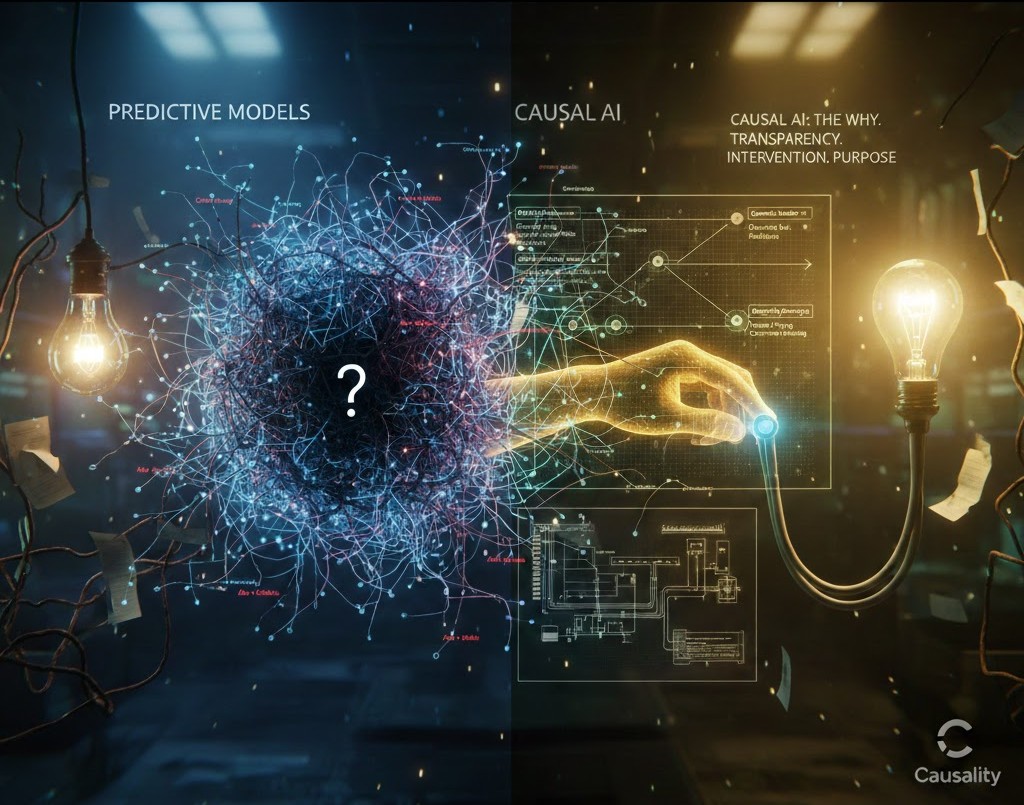
For the last decade, the business world has been obsessed with predictive models. We have spent billions trying to answer the question, “What will happen next?” While these tools have helped us optimize supply chains, they often fail when the world changes. Why? Because prediction is based on correlation, and correlation is not causation. To truly innovate using Human-Centered Innovation™, we must move toward Causal AI.
Causal AI is the next frontier of FutureHacking™. Instead of merely identifying patterns, it seeks to understand the why. It maps the underlying “wiring” of a system to determine how changing one variable will influence another. This shift is vital because innovation isn’t about following a trend; it’s about making a deliberate intervention to create a better future.
“Data can tell you that two things are happening at once, but only Causal AI can tell you which one is the lever and which one is the result. Innovation is the art of pulling the right lever.” — Braden Kelley
The End of the “Black Box” Strategy
One of the greatest barriers to institutional trust is the “Black Box” nature of traditional machine learning. Causal AI, by its very nature, is explainable. It provides a transparent map of cause and effect, allowing human leaders to maintain autonomy and act as the “gardener” tending to the seeds of technology.
Case Study 1: Personalized Medicine and Healthcare
A leading pharmaceutical institution recently moved beyond predictive patient modeling. By using Causal AI to simulate “What if” scenarios, they identified specific causal drivers for individual patients. This allowed for targeted interventions that actually changed outcomes rather than just predicting a decline. This is the difference between watching a storm and seeding the clouds.
Case Study 2: Retail Pricing and Elasticity
A global retail giant utilized Causal AI to solve why deep discounts led to long-term dips in brand loyalty. Causal models revealed that the discounts were causing a shift in quality perception in specific demographics. By understanding this link, the company pivoted to a human-centered value strategy that maintained price integrity while increasing engagement.
Leading the Causal Frontier
The landscape of Causal AI is rapidly maturing in 2026. causaLens remains a primary pioneer with their Causal AI operating system designed for enterprise decision intelligence. Microsoft Research continues to lead the open-source movement with its DoWhy and EconML libraries, which are now essential tools for data scientists globally. Meanwhile, startups like Geminos Software are revolutionizing industrial intelligence by blending causal reasoning with knowledge graphs to address the high failure rate of traditional models. Causaly is specifically transforming the life sciences sector by mapping over 500 million causal relationships in biomedical data to accelerate drug discovery.
“Causal AI doesn’t just predict the future — it teaches us how to change it.” — Braden Kelley
From Correlation to Causation
Predictive models operate on correlations. They answer: “Given the patterns in historical data, what will likely happen next?” Causal models ask a deeper question: “If we change this variable, how will the outcome change?” This fundamental difference elevates causal AI from forecasting to strategic influence.
Causal AI leverages counterfactual reasoning — the ability to simulate alternative realities. It makes systems more explainable, robust to context shifts, and aligned with human intentions for impact.
Case Study 3: Healthcare — Reducing Hospital Readmissions
A large health system used predictive analytics to identify patients at high risk of readmission. While accurate, the system did not reveal which interventions would reduce that risk. Nurses and clinicians were left with uncertainty about how to act.
By implementing causal AI techniques, the health system could simulate different combinations of follow-up calls, personalized care plans, and care coordination efforts. The causal model showed which interventions would most reduce readmission likelihood. The organization then prioritized those interventions, achieving a measurable reduction in readmissions and better patient outcomes.
This example illustrates how causal AI moves health leaders from reactive alerts to proactive, evidence-based intervention planning.
Case Study 4: Public Policy — Effective Job Training Programs
A metropolitan region sought to improve employment outcomes through various workforce programs. Traditional analytics identified which neighborhoods had high unemployment, but offered little guidance on which programs would yield the best impact.
Causal AI empowered policymakers to model the effects of expanding job training, childcare support, transportation subsidies, and employer incentives. Rather than piloting each program with limited insight, the city prioritized interventions with the highest projected causal effect. Ultimately, unemployment declined more rapidly than in prior years.
This case demonstrates how causal reasoning can inform public decision-making, directing limited resources toward policies that truly move the needle.
Human-Centered Innovation and Causal AI
Causal AI complements human-centered innovation by prioritizing actionable insight over surface-level pattern recognition. It aligns analytics with stakeholder needs: transparency, explainability, and purpose-driven outcomes.
By embracing causal reasoning, leaders design systems that illuminate why problems occur and how to address them. Instead of deploying technology that automates decisions, causal AI enables decision-makers to retain judgment while accessing deeper insight. This synergy reinforces human agency and enhances trust in AI-driven processes.
Challenges and Ethical Guardrails
Despite its potential, causal AI has challenges. It requires domain expertise to define meaningful variables and valid causal structures. Data quality and context matter. Ethical considerations demand clarity about assumptions, transparency in limitations, and safeguards against misuse.
Causal AI is not a shortcut to certainty. It is a discipline grounded in rigorous reasoning. When applied thoughtfully, it empowers organizations to act with purpose rather than default to correlation-based intuition.
Conclusion: Lead with Causality
In a world of noise, Causal AI provides the signal. It respects human autonomy by providing the evidence needed for a human to make the final call. As you look to your next change management initiative, ask yourself: Are you just predicting the weather, or are you learning how to build a better shelter?
Strategic FAQ
How does Causal AI differ from traditional Machine Learning?
Traditional Machine Learning identifies correlations and patterns in historical data to predict future occurrences. Causal AI identifies the functional relationships between variables, allowing users to understand the impact of specific interventions.
Why is Causal AI better for human-centered innovation?
It provides explainability. Because it maps cause and effect, human leaders can see the logic behind a recommendation, ensuring technology remains a tool for human ingenuity.
Can Causal AI help with bureaucratic corrosion?
Yes. By exposing the “why” behind organizational outcomes, it helps leaders identify which processes (the wiring) are actually producing value and which ones are simply creating friction.
Disclaimer: This article speculates on the potential future applications of cutting-edge scientific research. While based on current scientific understanding, the practical realization of these concepts may vary in timeline and feasibility and are subject to ongoing research and development.
Image credits: Google Gemini
Sign up here to get Human-Centered Change & Innovation Weekly delivered to your inbox every week.
More and more, brands are starting to get the chatbot “thing” right. AI is improving, and customers are realizing that a chatbot can be a great first stop for getting quick answers or resolving questions. After all, if you have a question, don’t you want it answered now?
In a recent interview, I was asked, “What do you love about chatbots?” That was easy. Then came the follow-up question, “What do you hate about chatbots?” Also easy. The truth is, chatbots can deliver amazing experiences. They can also cause just as much frustration as a very long phone hold. With that in mind, here are five reasons to love (and hate) chatbots:
Why We Love Chatbots
24/7 Availability: Chatbots are always on. They don’t sleep. Customers can get help at any time, even during holidays.
Fast Response: Instant answers to simple questions, such as hours of operation, order status and basic troubleshooting, can be provided with efficiency and minimal friction.
Customer Service at Scale: Once you set up a chatbot, it can handle many customers at once. Customers won’t have to wait, and human agents can focus on more complicated issues and problems.
Multiple Language Capabilities: The latest chatbots are capable of speaking and typing in many different languages. Whether you need global support or just want to cater to different cultures in a local area, a chatbot has you covered.
Consistent Answers: When programmed properly, a chatbot delivers the same answers every time.
Why We Hate Chatbots
AI Can’t Do Everything, but Some Companies Think It Can: This is what frustrates customers the most. Some companies believe AI and chatbots can do it all. They can’t, and the result is frustrated customers who will eventually move on to the competition.
A Lack of Empathy: AI can do a lot, but it can’t express true emotions. For some customers, care, empathy and understanding are more important than efficiency.
Scripted Retorts Feel Robotic: Chatbots often follow strict guidelines. That’s actually a good thing, unless the answers provided feel overly scripted and generic.
Hard to Get to a Human: One of the biggest complaints about chatbots is, “I just want to talk to a person.” Smart companies make it easy for customers to leave AI and connect to a human.
There’s No Emotional Connection to a Chatbot: You’ll most likely never hear a customer say, “I love my chatbot.” A chatbot won’t win your heart. In customer service, sometimes how you make someone feel is more important than what you say.
Chatbots are powerful tools, but they are not a replacement for human connection. The best companies use AI to enhance support, not replace it. When chatbots handle the routine issues and agents handle the more complex and human moments, that’s when customer experience goes from efficient to … amazing.
Image credits: Unsplash
Sign up here to join 17,000+ leaders getting Human-Centered Change & Innovation Weekly delivered to their inbox every week.
How Does AI Change Change Management Without Replacing It? (Short Answer)
Seven ways AI changes change management without replacing it: (1) sensing replaces guessing, (2) enablement can become personal, (3) rehearsal before cutover, (4) portfolio load becomes visible, (5) message volume stops being the bottleneck, (6) AI densifies the change — roles and decision rights — and (7) maintenance gets instrumented. AI drafts, clusters, simulates, and surfaces patterns at machine speed. Humans still own mandate, dignity, practice design, kill dates for the old path, and stop/start honesty.
AI can speed the artifacts of change. It cannot own the human adoption challenge — and pretending it can is how organizations buy a harder landing.
Why Doesn’t Faster Change Artifact Work Mean Less Change Management?
I keep hearing the same executive shortcut: the tools feel intuitive, the demo looks easy, so we can “do less change management this time.” That is how you buy denser busywork with a friendlier UI.
AI accelerates sensing, drafting, personalization, simulation, and portfolio visibility. That does not shrink the need for change management. It densifies the work: more roles rewritten, more decision rights in play, more temptation to confuse message volume with enablement. Soft landings treat AI as a change amplifier designed with humans — not as a substitute for sponsorship, practice, maintenance, and portfolio honesty.
Way
What AI changes
Still human
1. Sensing
Earlier resistance and confusion patterns
Meaning, dignity, and who can act
2. Personal enablement
Role- and journey-aware learning paths
Practice, coaching, redesigned work
3. Rehearsal
Cheaper scenario practice before go-live
Success behavior and sponsors with levers
4. Portfolio visibility
Collision maps and capacity signals
Stop/start honesty and tradeoffs
5. Message volume
Nearly free cascade drafts
Capacity — enablement, not broadcast
6. Densified change
Rewritten tasks and decision rights
Job redesign and accountable judgment
7. Instrumented maintenance
Drift and relapse sensing after applause
BAU ownership and old-path kill dates
1. How Does Sensing Replace Guessing — Without Replacing Judgment?
What AI changes: Continuous signal from tickets, chat, surveys, usage, and search — resistance, confusion, and workaround patterns can surface earlier than a quarterly pulse.
Costume temptation: Dashboard theater. “Sentiment” as a green RAG without contact or a response anyone will fund.
Still human: Meaning, stakes, and dignity — deciding what the pattern asks of leaders, not only that a score moved.
Human-centered move: Pair sensing with a named owner who can change work, policy, or enablement — not only refresh a slide.
2. Can Enablement Become Personal While Capability Still Needs Practice?
What AI changes: Role-, journey-, and skill-aware learning paths; adaptive practice prompts instead of one cascade deck for thousands.
Costume temptation: Completions and prompt workshops mistaken for competence. Personalized spam that still leaves the old path easy.
Still human: Coaching, redesigned work, permission to stop the workaround, manager judgment.
Human-centered move: Treat personalization as a path to practice on real work — measure behavior, not module finishes. That is the enablement half of change management in 5 Steps of Human-Centered Change — sped up by AI, not retired by it.
3. Why Is Rehearsal Before Cutover Not the Same as Sponsorship?
What AI changes: Scenario practice, agent-assisted dry runs, and “what if” walkthroughs before go-live — cheaper rehearsal at scale.
Costume temptation: Beautiful simulations that never touch floor constraints. Rehearsal theater while sponsors lack levers.
Still human: Defining success behavior, psychological safety to fail in practice, and sponsors who can move budget, policy, and metrics.
Human-centered move: Rehearse the median user’s moment of truth — then fund the system changes the rehearsal exposed. Simulation without levers is still a costume.
4. How Does Portfolio Visibility Change Change Management?
What AI changes: Collision maps, capacity estimates, and initiative overlap become easier to surface across the change portfolio.
Costume temptation: Pretty heatmaps while every pet project remains “priority.” Visibility without stop authority.
Still human: Portfolio honesty — stop/start rules, protecting frontline capacity, naming what the organization will not absorb.
Human-centered move: Treat AI portfolio views as evidence for tradeoffs, not as permission to stack more change. Seeing the load is not the same as choosing what to stop.
5. When Message Volume Stops Being the Bottleneck, What Becomes the Test?
What AI changes: Drafting cascade emails, FAQs, talking points, and “personalized” announcements is nearly free.
Costume temptation: More communication mistaken for more change. AI as an infinite broadcast engine.
Still human: Capacity — time, coaching, redesigned incentives, retirement of the old way.
Human-centered move: Raise the bar. If enablement is not funded, do not celebrate message velocity. Informed is still not enabled — a truth that survived every new channel, including this one. For the belief patterns underneath the costume, see 8 Change Myths Leaders Still Believe in 2026.
6. How Does AI Densify Change — Roles, Judgment, and Decision Rights?
What AI changes: Introducing AI rewrites tasks, who decides, who is accountable, and where human judgment must sit. That is denser change than “a new tool.”
Costume temptation: “Intuitive agents adopt themselves.” Change-management budgets cut because the vendor demo felt easy.
Still human: Job redesign, accountability for model-assisted decisions, deep-work policy, and recovery power when the agent fails.
7. How Does Instrumented Maintenance Still Need Human Owners?
What AI changes: Post-go-live drift detection — usage drop-off, shadow-process return, help-desk themes — can be sensed continuously after applause.
Costume temptation: Hypercare dashboards with nobody in BAU responsible for reinforcement or killing the old path.
Still human: Maintenance ownership, celebration of retired workarounds, and metric realignment that makes the new way the easy way.
Human-centered move: Instrument for relapse and name the BAU owner before cutover cake. Launch without maintenance is still a relapse with better branding. The full visual method behind planning, enablement, and maintenance lives in Charting Change.
How Do You Split Change Labor Between AI and Humans Before the Next Review?
Before the next AI-assisted transformation review, run five go/no-go questions:
What are we sensing — and who can act on it?
Are we personalizing practice or only broadcasting faster?
What did rehearsal force us to redesign?
What will we stop so portfolio load is real?
Who owns reinforcement after go-live — and what old path dies on a date?
AI changes the speed of change artifacts. Humans still own whether the median person can succeed — and whether the organization will let them.
Frequently Asked Questions
Does AI replace change management?
No. AI can accelerate sensing, drafting, personalization, simulation, and portfolio visibility, but it cannot own mandate, dignity, practice design, sponsorship with levers, or stop/start honesty. Treating AI as a substitute for change management usually densifies role and decision-rights change while starving enablement.
How does AI change change management?
AI changes change management by making sensing continuous, enablement more personalizable, rehearsal cheaper before cutover, portfolio collisions more visible, broadcast nearly free, AI itself a denser work redesign, and post-go-live drift easier to instrument. The human job shifts toward judgment, redesign, and ownership — not away from change management.
Why do organizations still need change management with AI?
Organizations still need change management with AI because introducing models rewrites tasks, accountability, and judgment seams. People still need practice, permission to stop workarounds, aligned metrics, sponsors who can change the system, and BAU owners after go-live. Intuitive demos do not equal adopted behavior.
What is AI-assisted change management?
AI-assisted change management uses models to draft communications, cluster employee signals, personalize learning paths, simulate scenarios, and surface portfolio load — while humans own interpretation, enablement design, tradeoffs, sponsorship, and reinforcement. AI speeds the artifacts; humans own the adoption challenge.
How do you soft-land an AI transformation?
Soft-land an AI transformation by pairing every material AI bet with work redesign and change muscle: named owners who can act on signals, practice over completions, rehearsal that funds redesign, portfolio stop/start honesty, enablement funded beyond broadcast, clear decision rights for model-assisted work, and instrumented maintenance with a kill date for the old path.
Image credits: Gemini
Content Authenticity Statement: The topic area, key elements to focus on, etc. were decisions made by Braden Kelley, with a little help from Google Gemini and Cursor to clean up the article, add images and create infographics.
Sign up here to get Human-Centered Change & Innovation Weekly delivered to your inbox every week.
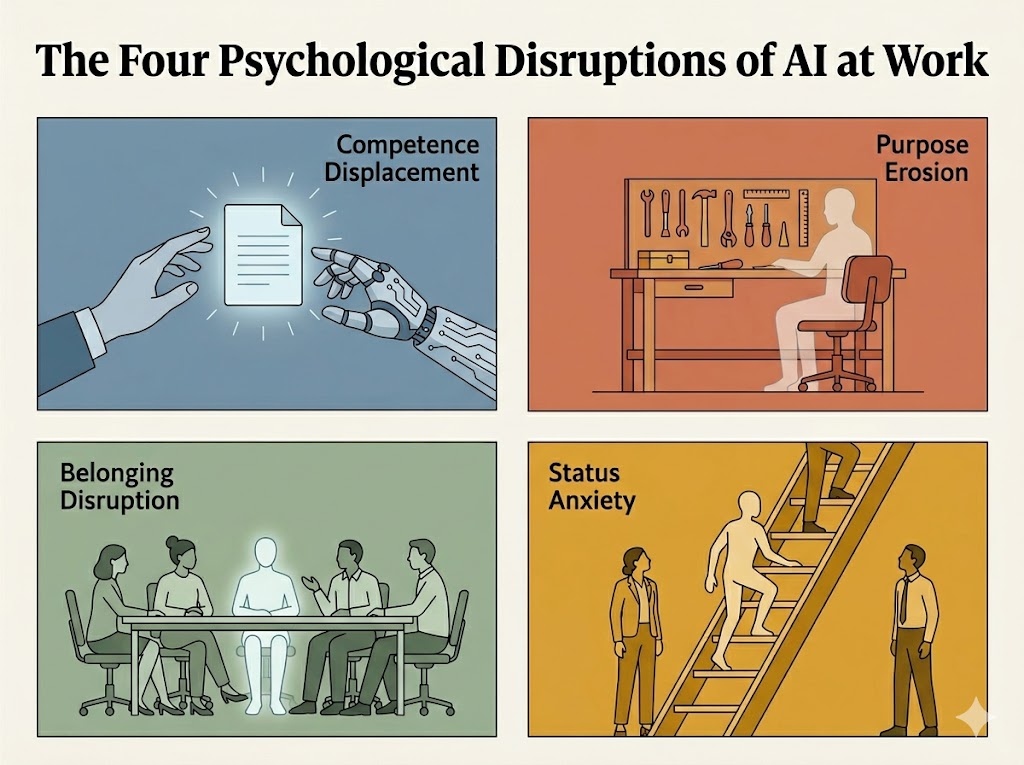
 Sign up here to get Human-Centered Change & Innovation Weekly delivered to your inbox every week.
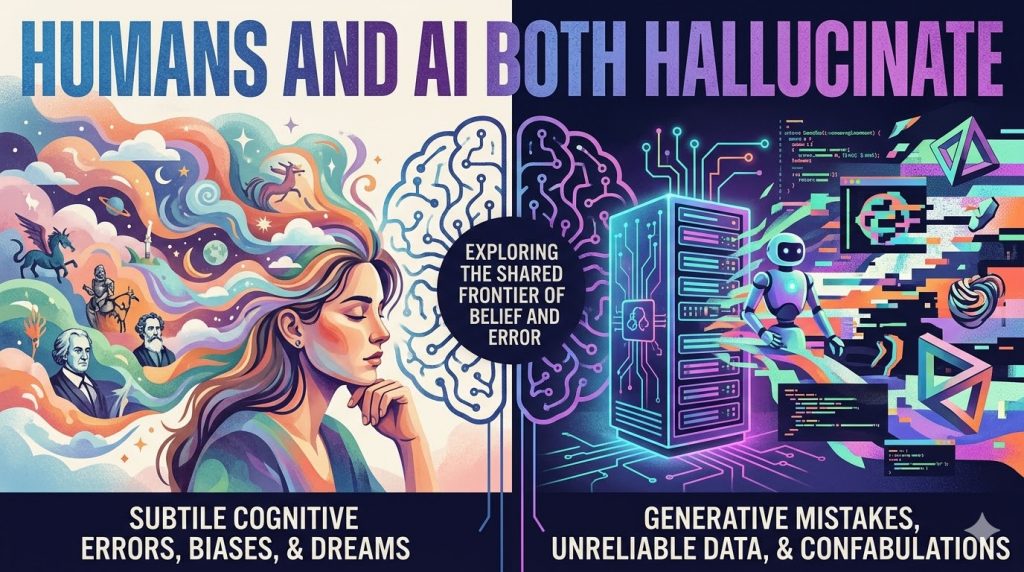
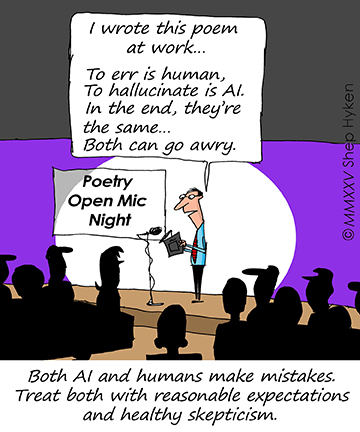
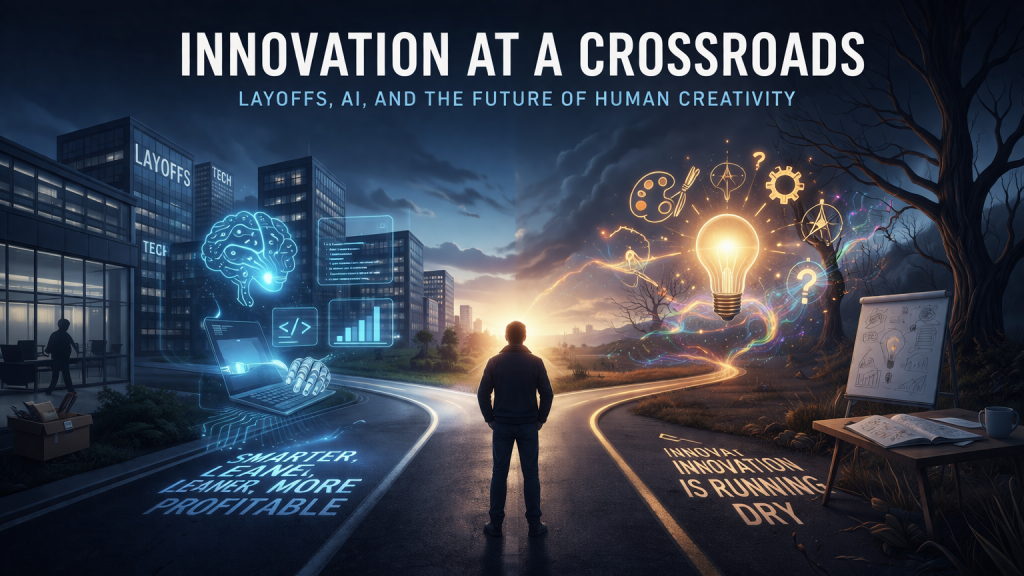
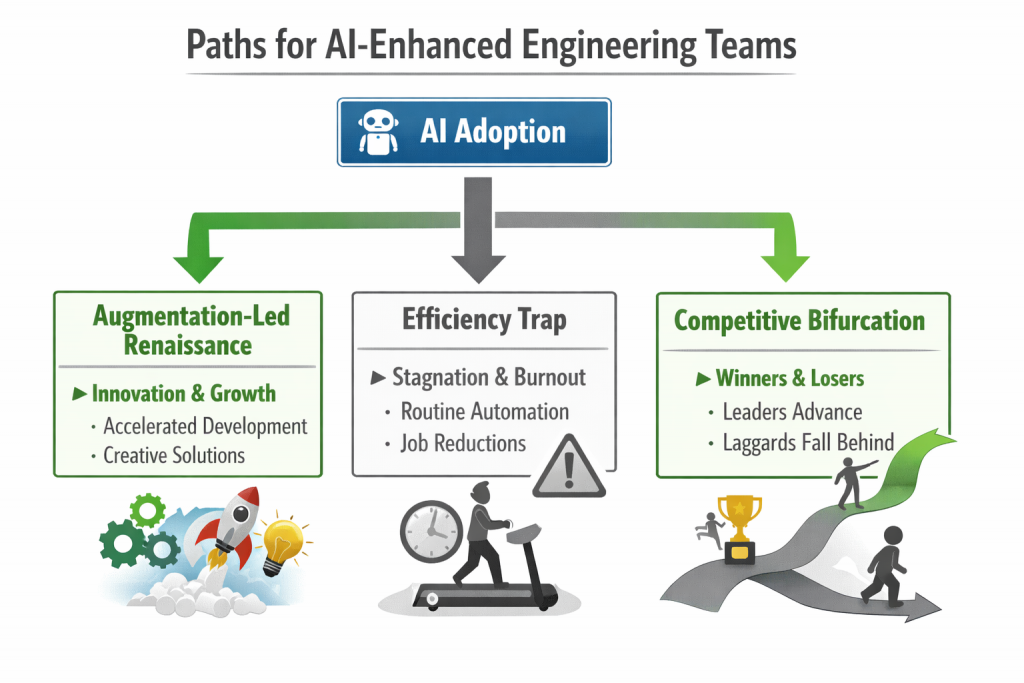

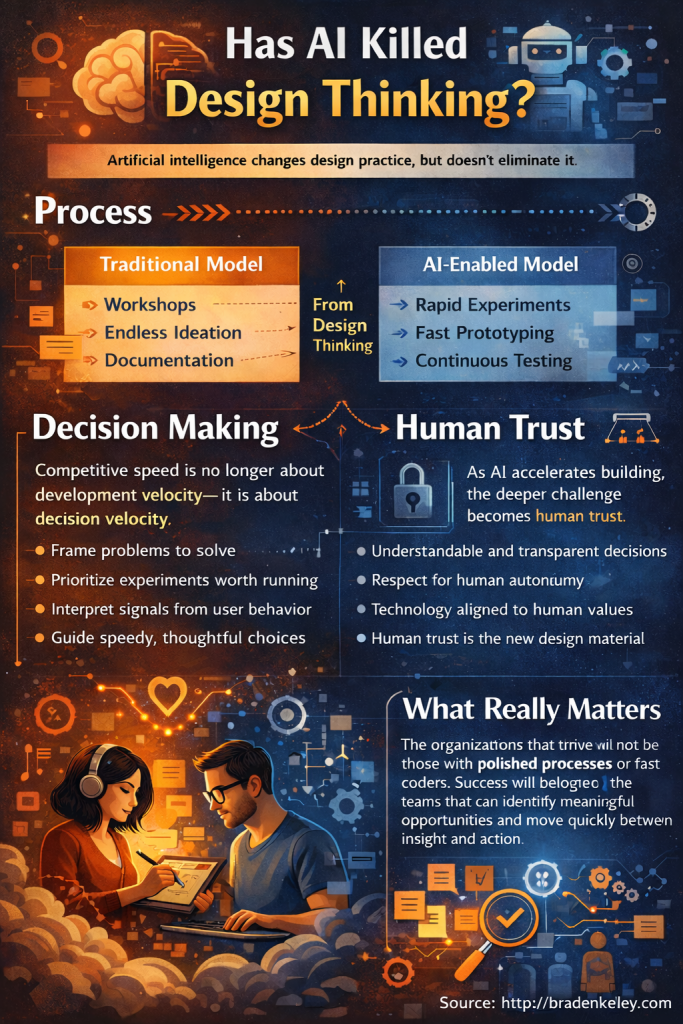
 To help you find problems worth solving and to design and execute experiments, I created a couple of visual and collaborative tools to help you thrive in this new reality. Download them both from my store and enjoy!