Tag Archives: Artificial Intelligence

The Future of Automation and Artificial Intelligence

The Future of Automation and Artificial Intelligence

GUEST POST from Art Inteligencia

The future of automation and artificial intelligence is highly debated in today’s world. As technology continues to advance, so does the potential for automation and AI to radically transform how we live our lives. From automated robots in factories to smart assistants in our homes, automation and AI are becoming a reality in more and more areas of everyday life. This article will examine the potential of automation and AI, their impact on society, and provide two case study examples of where automation and AI are being applied today.

The potential of automation and AI is vast. Automation can take on mundane tasks, freeing up more time to focus on important and fulfilling work. AI can augment our knowledge, helping us to make better decisions for our businesses, families, and communities. As technology progresses, machines will more and more be used for tasks that have traditionally been done by humans. Automation and AI could soon lead to highly efficient, reliable, and even completely autonomous systems.

However, automation and AI come with their own set of risks. There is a lot of fear that automation and AI will lead to job losses, inequality, and ethical dilemmas, especially as AI becomes increasingly capable of replicating complex decisions and tasks. Though the advancement of these technologies could bring great benefits, it is important to consider potential risks and explore ways to ensure that any automation or AI systems are beneficial for everyone.

To better understand how automation and AI are impacting the world, let us look at two case study examples.

Case Study 1 – Manufacturing

The first example is the story of Foxconn, an electronics manufacturing company based in Taiwan. To increase efficiency, the company started to incorporate robots into their workflow. Recently, they announced that they will be reducing the number of employees by over 50,000 and replacing them with robotic automation. Though this might seem like a benefit to Foxconn, it has had negative impacts on their workers who are losing their jobs.

Case Study 2 – Healthcare

The second example is the application of AI in healthcare. AI is being used in a number of ways in healthcare, from automating simple tasks like medical record keeping to aiding in diagnosis and decisions. For example, a recent study found that AI systems can accurately predict heart attack risks by analyzing CT scans, which could potentially lead to earlier and more effective treatments.

Conclusion

Overall, the future of automation and AI is extremely promising, and their potential could bring tremendous benefits. It is important, however, to consider the risks and ethical implications of these technologies, and to explore ways to ensure that their application is beneficial for everyone.

Bottom line: Futurology is not fortune telling. Futurists use a scientific approach to create their deliverables, but a methodology and tools like those in FutureHacking™ can empower anyone to engage in futurology themselves.

Image credit: Pixabay

Subscribe to Human-Centered Change & Innovation WeeklySign up here to get Human-Centered Change & Innovation Weekly delivered to your inbox every week.

AI for Inclusive Innovation Design

LAST UPDATED: April 23, 2026 at 6:23 PM
AI for Inclusive Innovation Design

GUEST POST from Art Inteligencia


I. Introduction: The New Frontier of Empathy

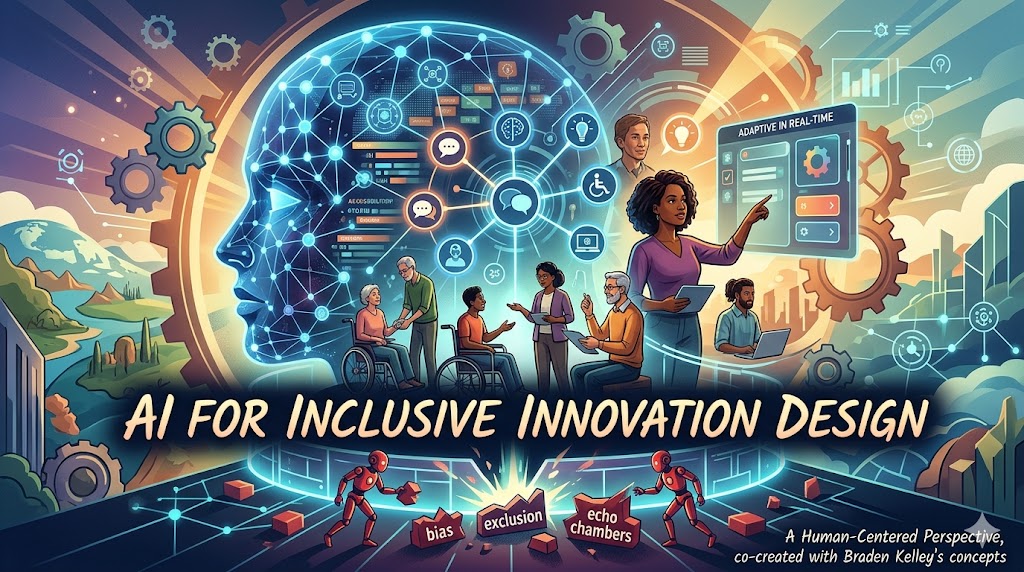
In the traditional landscape of human-centered design, our greatest limitation has always been the physical and cognitive bandwidth of the designer. We strive for empathy, yet we are often trapped by our own unconscious biases and the constraints of small sample sizes. As we enter this new era, we must recognize that AI is not a replacement for human intuition; it is a cognitive exoskeleton that allows us to see, hear, and design for those who have been historically pushed to the margins.

The Shift from Compliance to Belonging

For too long, “inclusive design” has been treated as a synonym for accessibility — a checklist of compliance requirements to be met at the end of a project. Inclusive Innovation demands more. It requires us to move beyond simply making things “usable” for people with disabilities and toward intentionally creating a sense of belonging for every user, regardless of their physical, cognitive, or socio-economic reality.

Designing with the Edge Cases

The core philosophy of this shift is a move away from the “Average User” myth. When we use AI to analyze and integrate the needs of edge cases — those users with the most extreme or unique requirements — we don’t just help a minority. We create more resilient, flexible, and intuitive solutions that benefit the entire ecosystem. AI gives us the power to scale this “designing for one” approach to reach the many.

“The goal is no longer to design for the many, but to design with the edges.” — Braden Kelley

II. Phase 1: AI-Powered Empathy and Discovery

Discovery is the bedrock of innovation, yet it is often where exclusion begins. Traditional research methods — surveys, focus groups, and ethnographic studies — are frequently limited by geography, language, and the “loudest voice” bias. AI transforms this phase by acting as a bridge between the designer’s perspective and the vast, diverse realities of the global population.

Breaking the Echo Chamber with Natural Language Processing

By leveraging advanced Natural Language Processing (NLP), we can now synthesize insights from billions of data points — social conversations, support forums, and local community archives — in real-time. This allows designers to move beyond their immediate bubble and understand how different cultures, dialects, and marginalized communities articulate their own problems. We aren’t just reading data; we are hearing the nuances of lived experiences that were previously “noise” in the system.

Simulating Lived Realities for High-Fidelity Empathy

Empathy is often hindered by the inability to truly experience another person’s friction. AI-driven simulations allow us to model various physical or cognitive constraints within a digital environment. Whether it is simulating visual impairments, motor control challenges, or cognitive load issues, AI helps designers “feel” the friction points during the early discovery phase. This proactive identification ensures that we aren’t “fixing” exclusion later, but preventing it from the start.

Uncovering Latent Needs through Pattern Recognition

Traditional analytics look for the “mean,” often ignoring the outliers. However, in inclusive innovation, the outliers are where the breakthroughs happen. AI excels at uncovering latent needs — identifying subtle patterns in behavior from underrepresented groups that signal a significant, unmet demand. By analyzing these “quiet” signals, we can spot opportunities to innovate for specific communities that eventually lead to universal improvements in the user experience.

“AI allows us to scale empathy by transforming massive amounts of unstructured human experience into actionable design intelligence.” — Braden Kelley

III. Phase 2: Co-Creation and Radical Prototyping

The most profound shift in inclusive innovation is the transition from designing for a community to designing with them. AI serves as the ultimate translator and facilitator in this process, stripping away the technical barriers that have traditionally kept “non-designers” out of the creative engine room.

Democratizing the Design Language

Generative AI tools act as a bridge for individuals who have the lived experience but perhaps lack formal design training. By using natural language prompts or simple sketches, end-users from diverse backgrounds can generate high-fidelity visual prototypes of the solutions they envision. This democratization of the design language ensures that the people closest to the problem are the ones leading the architectural vision of the solution.

Rapid Iteration for Universal Accessibility

In a traditional workflow, testing for accessibility is a slow, iterative process. AI changes the math. Automated agents can now instantly audit prototypes against Universal Design principles and international standards like the Web Content Accessibility Guidelines (WCAG). This allows for “real-time inclusion,” where flaws in contrast, navigation logic, or screen-reader compatibility are identified and corrected the moment a design is conceived, rather than weeks later during a formal audit.

The “Infinite Version” Paradigm

We are moving away from the “One-Size-Fits-All” model toward what I call The Infinite Version Paradigm. Rather than forcing every user to adapt to a single static interface, AI allows the interface to dynamically adapt to the user. Whether it’s adjusting cognitive load for a neurodivergent individual or reconfiguring navigation for someone with limited motor control, AI enables a level of deep personalization that makes the product feel like it was built specifically for the individual using it.

Prototyping for the Edge: When we use AI to solve for the most extreme accessibility requirements, we often discover “the Curb-Cut Effect” — innovations that were intended for a specific group (like closed captions) end up becoming essential for everyone.

IV. The Ethical Guardrail: Auditing for Algorithmic Bias

As we embrace the speed of AI, we must remain vigilant. AI is a mirror; if we feed it a history of exclusion, it will reflect and amplify those same biases in the designs it generates. Inclusive innovation requires a rigorous, proactive approach to ethics — ensuring that our “intelligent” assistants aren’t inadvertently building new digital walls.

The Mirror Effect: Acknowledging Embedded Bias

We must start with the uncomfortable truth: datasets are often skewed toward the dominant culture. If an AI is trained on images, text, and code that ignore marginalized groups, its output will naturally cater to the “standard” user. As innovation leaders, our job is to interrogate the training data and recognize where the gaps exist before we let the AI begin the design process.

Proactive Bias Hunting and Red Teaming

To counter these risks, we employ “Red Team” AI agents. These are secondary AI systems specifically programmed to attack a design from the perspective of different personas — searching for exclusionary patterns, cultural insensitivity, or hidden barriers to entry. By simulating how a neurodivergent user or someone from a different socio-economic background might interact with the product, we can catch “algorithmic microaggressions” before they ever reach the user.

Transparency and the “Open Box” Approach

Inclusive innovation cannot happen in a “Black Box.” To build trust with diverse communities, we must be transparent about how AI decisions are being made. This means moving toward Explainable AI (XAI), where the logic behind a personalized recommendation or an interface adjustment is clear and auditable. When users understand why a system is adapting to them, they feel empowered rather than monitored.

“Innovation without ethics is merely disruption. True inclusive innovation requires the courage to slow down and audit the algorithm to ensure it serves everyone.” — Braden Kelley

V. The Future Role of the Innovation Leader

The integration of AI into the design process necessitates a fundamental evolution of our leadership models. As the technical barriers to execution lower, the value of the innovation leader shifts from managing the “how” to orchestrating the “why.” We are moving from an era of craft-based creation to one of strategic curation and ethical stewardship.

From Creator to Curator

In an AI-augmented world, the designer’s primary skill is no longer just the ability to push pixels or write code, but the ability to orchestrate collaboration between human stakeholders and machine intelligence. The innovation leader becomes a curator of perspectives, ensuring that the AI has the right “empathy inputs” to generate inclusive outputs. Our job is to provide the vision and the values that guide the algorithm’s creative power.

The Competitive Edge of Inclusive Futurology

From a futurology perspective, designing for inclusion isn’t just a moral imperative — it’s a massive market opportunity. Historically, innovations that solve for “the edges” (such as the typewriter, originally designed for the blind) eventually redefine the mainstream. By using AI to anticipate the needs of the marginalized, organizations build more resilient, flexible, and robust products. Those who master inclusive design today are building the foundational infrastructure for tomorrow’s global economy.

Sustaining the Human-Centered Focus

As we look toward a future of agentic AI and neuroadaptive interfaces, the risk of “dehumanization” grows. The role of the innovation leader is to act as the guardian of the human experience. We must ensure that as our tools become more autonomous, they remain subservient to the goal of enhancing human connection, dignity, and agency. The future belongs to those who can use the highest technology to serve the deepest human needs.

The Futurist’s Prediction: Within the next decade, “inclusive design” will simply be called “design.” Companies that fail to use AI to bridge the accessibility gap will find themselves obsolete in an increasingly diverse and demanding global marketplace.

VI. Conclusion: Human-Centered, AI-Augmented

We stand at a unique crossroads in the history of innovation. For the first time, we possess tools powerful enough to bridge the gap between our empathetic intentions and the practical realities of large-scale design. But as we have explored, the true power of AI for Inclusive Innovation Design does not lie in the code itself, but in how we choose to direct that code to serve the human spirit.

Innovation is Only “New” if it is Inclusive

If we continue to use AI merely to optimize for the majority, we are not innovating; we are simply accelerating the status quo. Real innovation happens when we use these technologies to include those who were previously left behind. By bringing the “edge cases” into the center of our design process, we unlock new forms of value that were previously invisible.

The Path Forward: From Average to Infinite

The transition from the era of the “Average User” to the era of Infinite Inclusion is now underway. As innovation leaders, our mission is to ensure that AI acts as a leveling force — one that dissolves barriers, celebrates diversity, and creates a world where every individual feels that the products and services they interact with were built with them in mind.

The goal isn’t to make AI more human, but to use AI to make us more humane in how we design the world around us.

Let’s get to work on building a future that belongs to everyone.

Frequently Asked Questions

How does AI specifically enable more inclusive innovation?

AI acts as a cognitive exoskeleton, allowing designers to synthesize diverse global perspectives through Natural Language Processing (NLP) and simulate lived realities. It democratizes the design process by enabling non-designers to prototype their own solutions and dynamically adapts interfaces to meet individual accessibility needs in real-time.

What is the ‘Infinite Version’ paradigm in inclusive design?

The Infinite Version paradigm moves away from “one-size-fits-all” products. It uses AI to create interfaces that dynamically reconfigure themselves based on a user’s unique physical or cognitive requirements, ensuring the experience is personalized for every individual rather than forced into a static average.

How do we prevent AI from amplifying existing biases in the design process?

We prevent bias by implementing “Red Team” AI agents to proactively hunt for exclusionary patterns, auditing training datasets for diversity gaps, and adopting Explainable AI (XAI) practices. This ensures the design process remains transparent and accountable to human-centered ethical standards.

SPECIAL BONUS: Braden Kelley’s Problem Finding Canvas can be a super useful starting point for doing design thinking or human-centered design.

“The Problem Finding Canvas should help you investigate a handful of areas to explore, choose the one most important to you, extract all of the potential challenges and opportunities and choose one to prioritize.”

Image credit: Google Gemini

Subscribe to Human-Centered Change & Innovation WeeklySign up here to get Human-Centered Change & Innovation Weekly delivered to your inbox every week.
The Impact of Technology on Futures Research

The Impact of Technology on Futures Research

GUEST POST from Art Inteligencia

Technology has been a game changer in the world of futures research. In the past, futurists had to rely on slow and manual processes to analyze data and make predictions. But with the advent of advanced technologies such as artificial intelligence (AI) and machine learning (ML), the process has become much more efficient and accurate. In this article, we’ll explore the impact of technology on futures research and provide two case studies to illustrate the point.

Case Study 1 – Artificial Intelligence (AI) and Machine Learning (ML)

The first example of technology’s impact on futures research is the use of AI and ML. These technologies allow researchers to analyze large amounts of data quickly and accurately. AI and ML can identify patterns and trends that may have been difficult to spot in the past. This makes it easier for futurists to make predictions about the future. For instance, AI and ML can be used to analyze stock market data and predict market movements. This can be invaluable to investors and traders who want to make informed decisions about their investments.

Case Study 2 – Big Data

The second case study involves the use of big data. Big data is a term used to refer to extremely large datasets that are difficult to process using traditional methods. Big data can be used by futurists to gain insights into a wide variety of topics, such as consumer behavior, economic trends, and the impact of technological developments. For example, by analyzing big data, futurists can make predictions about how emerging technologies may shape the future.

Conclusion

As these two examples illustrate, technology has had a profound impact on the field of futures research. By leveraging AI and ML, big data, and other advanced technologies, futurists can now make more accurate predictions about the future. This can be invaluable to businesses and investors who want to make informed decisions about their investments. In short, technology has revolutionized the field of futures research and is only going to become more important as new technologies continue to emerge.

Bottom line: Futurists are not fortune tellers. They use a formal approach to achieve their outcomes, but a methodology and tools like those in FutureHacking™ can empower anyone to be their own futurist.

Image credit: Pexels

Subscribe to Human-Centered Change & Innovation WeeklySign up here to get Human-Centered Change & Innovation Weekly delivered to your inbox every week.

Building Explainable AI that Humans Can Trust

LAST UPDATED: April 13, 2026 at 5:31 PM

Building Explainable AI that Humans Can Trust

GUEST POST from Chateau G Pato


The Trust Gap in the Age of Intelligence

As we stand on the precipice of a new era of cognitive automation, we are witnessing a widening Trust Gap. While AI capabilities are accelerating at an exponential rate, our ability to understand, interrogate, and emotionally connect with these systems is lagging behind.

The Paradox of Power

We find ourselves in a unique technological paradox: the more powerful an AI model becomes, the more “opaque” it tends to be. Modern neural networks are often described as Black Boxes — systems where the inputs and outputs are visible, but the internal logic remains a mystery. For a consumer looking for a movie recommendation, this opacity is a minor inconvenience. However, for a human-centered organization, “it just works” is no longer a sufficient standard.

Defining the Stakes

In high-stakes environments — healthcare diagnostics, financial credit modeling, and human resources — the cost of “blind trust” is too high. Without legibility, we risk:

  • Systemic Bias: Dark logic hiding discriminatory patterns.
  • Reduced Adoption: Skilled professionals rejecting tools they cannot verify.
  • Legal Liability: An inability to provide “the right to an explanation” in regulated industries.

The Human-Centered Thesis

Trust is not a technical feature you “toggle on” in the code; it is a human experience that must be designed. Explainable AI (XAI) shouldn’t just be an engineering audit trail. It must be an exercise in empathy and experience design, ensuring that as systems get smarter, they also become more relatable and accountable to the humans they serve.

The Pillars of Human-Centered Explainability (HCX)

To move beyond the “Black Box,” we must shift our focus from technical interpretability to Human-Centered Explainability. This approach acknowledges that transparency is only valuable if it is digestible, actionable, and aligned with the user’s intent.

Transparency vs. Translucency

True innovation in AI design requires a distinction between showing everything and showing what matters. Transparency in engineering often results in a “data dump” — thousands of lines of code or weights that overwhelm the human mind.

We advocate for Translucency: a purposeful design choice to reveal the specific logic layers that impact the user’s decision-making process while abstracting the unnecessary noise. It’s about clarity, not just visibility.

The Three “Whys” of XAI

For AI to be considered trustworthy by humans, it must be able to answer three distinct types of inquiry:

  • Global Explainability (The “How”): How does this system function in general? This provides a high-level map of the model’s logic, helping users understand the overarching guardrails and data inputs.
  • Local Explainability (The “Why Me”): Why did the AI make this specific decision at this specific moment? This is the core of experience design, providing a narrative for an individual outcome — such as why a loan was denied or a specific medical scan was flagged.
  • Counterfactual Explainability (The “What If”): What would need to change in the input to achieve a different result? This is the ultimate tool for Human Agency. By showing the path to a different outcome, we empower the user to take action rather than just receive a verdict.

Designing for Intellectual Dignity

At its heart, HCX is about maintaining the intellectual dignity of the human user. When we build explainable systems, we aren’t just checking a compliance box; we are ensuring that the human remains the ultimate “Experience Architect,” using AI as a partner rather than a replacement.

Designing for the “Mental Model”

The most sophisticated algorithm in the world is useless if it creates Cognitive Dissonance — a clash between what the user expects and what the machine delivers. To build trust, we must bridge the gap between the AI’s mathematical weights and the human’s intuitive understanding.

Bridging the Gap

Experience design in AI requires us to map the system’s logic to a Mental Model that a human can recognize. This isn’t about dumbing down the technology; it’s about translating high-dimensional mathematics into the language of human reasoning. When the AI’s “thought process” aligns with human logic, trust is a natural byproduct.

Contextual Relevance: The Persona-First Approach

Explainability is not “one size fits all.” A human-centered approach requires that the explanation be tailored to the persona engaging with the system:

  • The Specialist (e.g., a Radiologist): Needs deep, feature-level data and “saliency maps” to verify clinical findings.
  • The Consumer (e.g., a Patient): Needs clear, empathetic, natural language summaries that focus on impact rather than raw data.
  • The Auditor (e.g., a Compliance Officer): Needs a comprehensive trail of data lineage and bias-detection metrics.

Visualizing Logic and UX

We must use Visual Design to make complexity intuitive. By utilizing heatmaps, feature importance charts, and interactive dashboards, we turn a “judgment” into a “conversation.”

Effective UX design allows users to “peek under the hood” without being blinded by the engine. This visual transparency reduces the cognitive load on the user, moving the interaction from a state of suspicion to one of collaborative Co-Intelligence.

From SLA to XLM: Measuring the Trust Experience

Historically, we have measured AI performance through the lens of technical efficiency — uptime, latency, and predictive accuracy. However, in a world where AI is a collaborative partner, these Service Level Agreements (SLAs) are insufficient. To build truly human-centered systems, we must pivot toward Experience Level Measures (XLMs).

Beyond Accuracy

A model can be 99% accurate, but if that 1% error occurs in a way that feels “inhuman,” “creepy,” or biased, user trust will evaporate instantly. Accuracy is a math problem; trust is a perception problem. We must measure not just how often the AI is right, but how reliable it feels to the human at the other end of the interface.

The Core XLMs for Explainable AI

To quantify the “Trust Experience,” organizations should track specific qualitative and behavioral metrics:

  • Cognitive Load: Does the explanation help the user make a faster decision, or does it overwhelm them with unnecessary complexity?
  • Perceived Agency: Do users feel they have the power to override or influence the AI’s output based on the explanation provided?
  • Appropriate Reliance: Does the user know when to trust the AI and, crucially, when to be skeptical? Over-trust is just as dangerous as under-trust.
  • Explanation Satisfaction: A qualitative measure of whether the user feels the “Why” provided by the system was sufficient for the context of the task.

The Feedback Loop

Measuring trust is not a one-time event. By treating explainability as a dynamic experience, we can create a continuous feedback loop. When a user flags an explanation as “unhelpful” or “confusing,” it provides the essential data needed to refine the model’s communication layer, ensuring the technology evolves in lockstep with human expectations.

Mitigating “The Great American Contraction” through Agency

As AI begins to automate cognitive tasks at scale, we face a pivotal economic and social shift — the Great American Contraction. In this landscape, the fear of displacement is the primary barrier to adoption. To overcome this, we must shift the narrative from “replacement” to “augmentation” through the lens of human agency.

The Fear Factor: Displacement vs. Empowerment

Opaque AI fuels anxiety. When an employee doesn’t understand why a system is making recommendations, they view the technology as a competitor or a threat. By prioritizing Explainability, we transform the AI from a “black box” that replaces judgment into a transparent partner that enhances it.

AI as an Exoskeleton for the Mind

We must design AI to act as a Cognitive Exoskeleton. Just as a physical exoskeleton amplifies a worker’s strength without removing their control, Explainable AI should amplify a professional’s expertise. When a user can see the logic, they retain the “steering wheel,” allowing them to focus on high-value strategy, empathy, and creative problem-solving—the very human traits that AI cannot replicate.

The Evolution of Human-in-the-Loop (HITL)

The traditional “Human-in-the-Loop” model is evolving. It is no longer just about a human clicking “approve.” True human-centered design requires:

  • Interactive Auditing: Interfaces that allow humans to “scrub” through variables to see how the output changes.
  • Real-Time Correction: The ability for a subject matter expert to “teach” the AI by correcting its logic path, not just its result.
  • Collaborative Friction: Designing moments where the AI prompts the human to double-check a low-confidence explanation, ensuring that critical thinking remains sharp.

By embedding explainability into the workflow, we protect the value of human labor. We ensure that even as the demand for routine tasks contracts, the demand for Human-Centric Insight expands.

Ethical Governance and Accountability

Innovation without accountability is a liability. As we integrate AI deeper into the fabric of our organizations, explainability moves from a “nice-to-have” feature to a fundamental pillar of Ethical Governance. We must ensure that our systems are not only efficient but also justifiable.

The Bias Audit: Explainability as a Diagnostic Tool

Black-box systems often inherit and amplify the hidden biases present in their training data. Without explainability, these biases remain invisible until they cause real-world harm. By designing for HCX, we create a built-in diagnostic tool. When we can see why an AI is prioritizing certain variables, we can identify and strip away discriminatory patterns before they scale.

The Right to Explanation: Navigating Regulation

The regulatory landscape is shifting rapidly. With the rise of the EU AI Act and similar global frameworks, “The Right to Explanation” is becoming a legal mandate. Organizations must move beyond defensive compliance and embrace proactive transparency.

  • Data Lineage: Being able to prove where data came from and how it influenced the final decision.
  • Algorithmic Impact Assessments: Regularly reviewing the “Explainability Scores” of deployed models to ensure they meet ethical standards.

Designing for Recourse

Trust is truly tested when things go wrong. A human-centered system must provide a clear “Off-Ramp” for human intervention. This means designing interfaces that don’t just explain an error, but provide a direct path for a human to challenge the output, correct the record, and override the machine.

Accountability means that at the end of every algorithmic chain, there is a human who understands the logic enough to take responsibility for the outcome.

Conclusion: Leading the Change

The future of artificial intelligence will not be won by the organizations with the most complex algorithms, but by those with the most trusted ones. As we navigate the complexities of digital transformation, we must remember that technology serves people — not the other way around.

The Futurologist’s Outlook

In the coming decade, we will see a Great Bifurcation. On one side will be companies that deploy “Black Box” solutions, leading to employee burnout, customer skepticism, and regulatory friction. On the other will be the Experience Leaders — those who champion a “Human-First” AI strategy that prioritizes legibility, empathy, and agency. These leaders will find that explainability isn’t a drag on innovation; it is its primary accelerator.

A Call to Action

Building explainable AI requires a multidisciplinary effort. It demands that data scientists, experience designers, and change leaders sit at the same table to solve for:

  • Clarity: Making the invisible visible.
  • Confidence: Providing the context needed for bold decision-making.
  • Connection: Ensuring AI remains a tool for human flourishing.

We have a unique opportunity to rewrite the social contract between humans and machines. By designing for trust today, we ensure a resilient and innovative tomorrow. Let’s stop building boxes and start building bridges.

Frequently Asked Questions

Why is explainability more important than accuracy in AI?

While accuracy measures how often a model is correct, explainability builds the trust necessary for human adoption. Without understanding the ‘why’ behind a decision, humans cannot ethically or legally take responsibility for AI-driven outcomes, especially in high-stakes industries like healthcare or finance.

What is the difference between Transparency and Translucency?

Transparency often involves a ‘data dump’ of complex code that overwhelms the user. Translucency is a design-led approach that purposefully reveals only the relevant logic layers a human needs to make an informed decision, effectively balancing technical detail with cognitive clarity.

How does Explainable AI (XAI) protect human jobs?

XAI mitigates ‘The Great American Contraction‘ by repositioning AI as a cognitive exoskeleton. By making AI logic legible, we allow professionals to remain ‘in the loop,’ using their unique human judgment to audit, challenge, and refine machine outputs rather than being replaced by them.

Image credits: Gemini

Subscribe to Human-Centered Change & Innovation WeeklySign up here to join 17,000+ leaders getting Human-Centered Change & Innovation Weekly delivered to their inbox every week.

How AI Transparency Impacts Organizational Trust

LAST UPDATED: April 12, 2026 at 8:43 AM

How AI Transparency Impacts Organizational Trust

GUEST POST from Chateau G Pato


I. The New Currency of the Digital Age

In the modern organizational landscape, trust has evolved from a “soft” cultural attribute into a hard currency. As Artificial Intelligence (AI) permeates every layer of the enterprise—from recruitment algorithms to predictive analytics—the traditional methods of building trust are being challenged. We are currently facing a significant Trust Deficit, driven by the inherent skepticism employees and customers feel toward “black box” systems that make life-altering decisions without explanation.

Transparency as Strategy

To bridge this gap, leaders must shift their perspective: transparency is not merely a compliance burden or a legal checkbox. Instead, it is a core innovation strategy. By demystifying how AI operates, organizations can move from a defensive posture to a competitive advantage, fostering an environment where technology is viewed as an ally rather than a hidden supervisor.

The Human-Centered Lens

From an experience design standpoint, the need for transparency is rooted in fundamental human psychology. For an innovation culture to thrive, individuals need to understand the why and how behind the tools they use. When we apply a human-centered lens to AI, we prioritize the dignity of the user, ensuring that automated logic aligns with human values and organizational purpose.

II. The Three Pillars of AI Transparency

To design experiences that resonate and endure, we must move beyond the vague concept of “openness” and ground our AI initiatives in three functional pillars. These aren’t just technical requirements; they are the architectural supports for organizational trust.

1. Algorithmic Legibility

There is a vast difference between explainability and legibility. While an engineer might understand a neural network’s weights, the average employee needs “human-understandable” logic. Legibility is about translating complex mathematical correlations into clear narratives that explain why a specific outcome was reached. If a human can’t follow the breadcrumbs, they won’t trust the path.

2. Data Provenance

Trust is often contaminated at the source. Organizational transparency requires radical honesty about data provenance—where the data comes from, how it was curated, and what inherent biases it may carry. By being upfront about the “ingredients” being fed into the system, we allow for collective scrutiny and continuous improvement, rather than pretending the machine is an objective arbiter of truth.

3. Intentionality

The most critical pillar is the communication of intent. Trust evaporates when AI is introduced under a cloud of ambiguity. Leaders must clearly articulate the purpose: Is this tool designed to augment human capability, sparking a new wave of co-creation? Or is it a cost-cutting measure designed for displacement? True innovation leaders know that aligning AI’s intent with the organization’s human values is the only way to ensure long-term adoption.

III. The Impact on Internal Culture and Change Management

Innovation is a team sport, and like any team, the players must trust the equipment they are using. When we introduce AI into the workplace, we aren’t just deploying software; we are managing a profound cultural shift. Transparency acts as the lubricant that prevents the friction of fear from seizing the gears of progress.

Reducing Fear through Visibility

The greatest enemy of organizational agility is “replacement anxiety.” When AI operates in the shadows, employees naturally assume the worst—that their roles are being silently engineered away. By providing visibility into how AI tools function and the specific tasks they handle, we replace irrational fear with grounded understanding, allowing the workforce to focus on high-value creative work.

Psychological Safety and Risk-Taking

Innovation requires a high degree of psychological safety. If an employee believes a hidden algorithm is judging their every move or evaluating their performance based on opaque metrics, they will stop taking the risks necessary for breakthrough ideas. Transparent AI frameworks ensure that people feel safe to experiment, knowing that the “digital supervisor” is fair, consistent, and understandable.

Empowering the “Human in the Loop”

A transparent system invites participation. When employees understand the logic behind an AI’s output, they are better equipped to provide critical feedback and course-correction. This creates a powerful feedback loop where human insight and machine efficiency reinforce one another. We move away from passive consumption and toward an active, co-creative environment where technology elevates human potential.

IV. Rebuilding External Experience and Brand Design

As experience designers, we know that every touchpoint is a promise made to the customer. When AI enters the customer journey, it shouldn’t be a hidden ghost in the machine. Instead, we must design for intentional friction—moments of clarity that reinforce the brand’s integrity.

The Customer Experience (CX) Connection

There is a fine line between a personalized recommendation and “creepy” surveillance. Hidden AI can feel manipulative, leading customers to wonder if they are being nudged toward decisions that benefit the company rather than themselves. Transparent AI transforms the experience into a partnership, where the system openly says, “I’m suggesting this because you’ve shown interest in X,” turning a transaction into a relationship.

The “Uncanny Valley” of Automation

We must avoid the trap of trying to make AI seem too human. When customers realize they’ve been talking to a bot they thought was a person, the sense of betrayal is immediate. By finding the balance between seamless tech and honest disclosure, we respect the customer’s intelligence. Authenticity is the antidote to the “uncanny valley,” ensuring that high-tech interactions don’t lose their high-touch feel.

Case Studies in Contrast

History—and the market—will remember two types of brands: those that won trust through radical disclosure and those that lost it through “shadow AI.” Brands that proactively label AI-generated content or explain their data usage build a reservoir of goodwill. Conversely, those that hide their algorithms risk a PR catastrophe and a permanent loss of consumer confidence the moment the curtain is pulled back.

V. Operationalizing Transparency (The “How-To”)

Vision without execution is just hallucination. To move from the philosophy of trust to the reality of a transparent organization, we must embed these principles into our operational DNA. This requires a systemic approach to how we select, design, and manage our technological ecosystem.

The Transparency Audit

Before moving forward, we must look at where we stand. Organizations should conduct a comprehensive audit to evaluate the “opacity levels” of their current AI tools. This involves identifying which systems are making autonomous decisions, determining if those decisions can be explained to a layperson, and surfacing any “black boxes” that pose a risk to institutional integrity.

Designing the Interface of Trust

As experience designers, our goal is to surface AI reasoning without creating cognitive overload. This means designing UI/UX components that provide “just-in-time” explanations—simple, accessible tooltips or “Why am I seeing this?” modules that empower the user. We aren’t just showing the math; we are designing for confidence and clarity at the point of interaction.

Governance as Collaboration

Transparency cannot be siloed within the IT department. We must move AI ethics and governance into cross-functional innovation labs where diverse voices—from HR and marketing to legal and frontline staff—can weigh in. When governance is collaborative, the rules of transparency are co-created by the people they impact most, ensuring the system remains both ethical and effective.

VI. Conclusion: The Future Belongs to the Open

As we stand on the precipice of an AI-driven revolution, we must remember that technology is only as effective as the human systems that support it. The transition to artificial intelligence isn’t just a technical upgrade; it’s a social contract. To lead in this new era, we must move beyond the allure of the “magic” black box and embrace the discipline of clarity.

The Long Game

Trust is a fragile asset—painfully slow to build, yet instantaneous to shatter. In a world where AI-generated content and automated decisions are becoming the norm, transparency serves as the ultimate insurance policy. It protects the brand’s reputation and ensures that when the inevitable technical hiccup occurs, the organization has a reservoir of goodwill and understanding to draw upon.

Leading with Clarity

The challenge for today’s leaders is to stop hiding behind the perceived complexity of algorithms. True leadership in the age of AI means having the courage to be open about what the tools can do, what they can’t do, and how they are changing our world. By fostering transparency, we don’t just mitigate risk; we unlock the true potential of organizational agility and human-centered innovation.

The future of work isn’t about humans versus machines—it’s about humans and machines operating in a transparent, high-trust ecosystem that elevates the capabilities of both.

Frequently Asked Questions

1. Why is AI transparency more than just a technical requirement?

Transparency is a cornerstone of experience design and organizational trust. It bridges the “trust deficit” by allowing employees and customers to understand the logic behind decisions, reducing fear and fostering a culture of co-creation.

2. How does transparency impact employee innovation?

It creates psychological safety. When employees understand how AI evaluates their work or processes data, they are more willing to take creative risks and engage with the technology as a partner rather than a competitor.

3. What is the “Uncanny Valley” in AI branding?

It refers to the discomfort felt when an AI mimics human behavior too closely without disclosure. Braden Kelley emphasizes that honest disclosure is the antidote to this discomfort, ensuring brand authenticity remains intact.

Image credits: Gemini

Subscribe to Human-Centered Change & Innovation WeeklySign up here to join 17,000+ leaders getting Human-Centered Change & Innovation Weekly delivered to their inbox every week.

The Psychological Impact of AI on Work Identity

LAST UPDATED: April 3, 2026 at 3:45 PM

The Psychological Impact of AI on Work Identity

GUEST POST from Chateau G Pato


The Mirror and the Machine

The 21st century is witnessing a profound identity crisis as we transition from using tools that merely assist our labor to interacting with systems that mimic our core expertise. This shift marks a departure from the traditional industrial and digital revolutions, moving into an era where the boundary between human contribution and algorithmic output becomes increasingly blurred.

At the heart of this transition is a critical tension: the friction between human-centered design — which prioritizes the needs, dignity, and growth of people — and algorithmic efficiency, which prioritizes speed, optimization, and scale. As AI assumes more cognitive and creative responsibilities, we must address the psychological fallout of this collision.

The fundamental thesis of this exploration is that AI is not just a productivity multiplier; it is a disruptor of the self. By automating tasks once reserved for human intellect, AI is destabilizing the three traditional pillars of work identity:

  • Competence: The sense of mastery over a specific craft or knowledge base.
  • Autonomy: The freedom to direct one’s own actions and decisions.
  • Purpose: The belief that one’s work provides unique value to the world.

“The threat to work identity precedes the threat to employment — and it arrives silently, often before a single role has been eliminated.” — Braden Kelley

The Erosion of Expertise as an Identity Anchor

For decades, professional identity has been anchored in the acquisition of specialized knowledge. We define ourselves as coders, analysts, or designers based on the “hard skills” we’ve spent years mastering. However, as AI demonstrates a growing capacity for high-level cognitive tasks — from legal synthesis to complex diagnostic work — the specialist faces a profound dilemma: If a machine can perform my core function, what am I?

This shift forces a psychological migration from the role of the “Doer” to that of the “Reviewer.” When the active phase of creation is compressed by a prompt, many professionals experience a perceived loss of craft. The satisfaction derived from “getting your hands dirty” in a spreadsheet or a design file is replaced by the passive oversight of an algorithmic output.

Furthermore, we are seeing the rise of a specific “Imposter Syndrome Loop.” In this cycle, professionals fear that their perceived value is no longer derived from their innate skill or experience, but solely from their ability to use a specific tool. To maintain a healthy work identity, we must move beyond technical execution and recognize that human expertise now lies in the nuance, the context, and the ethical judgment that algorithms cannot replicate.

Autonomy and the Algorithmic Manager

The psychological health of any professional depends heavily on agency — the ability to influence one’s own environment and outcomes. As AI-driven workflows become more prevalent, many workers feel a diminishing sense of control, often feeling more like “cogs in a black box” than autonomous creators. When a system provides the “best” path forward based on data we cannot see, the human element of strategic intuition begins to atrophy.

We are also entering the era of the “Quantified Self” at work. The psychological pressure of being constantly monitored by performance-tracking algorithms creates a state of perpetual hyper-vigilance. There is a deep-seated anxiety in being judged by an entity that understands metrics and speed, but fails to grasp the messy, human context of creative problem-solving or relationship building.

Ultimately, the struggle for creative control is the new frontier of employee engagement. To prevent total disengagement, we must intentionally design systems that leave room for human “interference.” Maintaining a sense of ownership over the final outcome is essential; otherwise, the work ceases to be an expression of the individual and becomes merely a byproduct of the system.

Redefining Purpose: From Output to Outcomes

As AI masters the ability to generate “outputs” — the reports, the code, the initial drafts — humans are being pushed toward a deeper search for meaning. If the value of our labor is no longer measured by the volume of what we produce, our work identity must shift toward the “why” behind the work. This is where we transition from being creators of things to orchestrators of value.

The human-centered pivot requires us to double down on the qualities that machines struggle to simulate: deep empathy, ethical discernment, and strategic vision. Our professional worth is moving away from technical execution and toward our ability to navigate the complex emotional landscapes of stakeholders and customers.

This evolution is a form of Experience Design for the Self. By intentionally offloading repetitive cognitive tasks to AI, we create the “white space” necessary to focus on high-touch, high-emotion interactions. The goal is to redesign our roles so that we are not competing with the machine, but rather using it to amplify our uniquely human capacity for connection and purpose.

The Social Fabric: Belonging in a Hybrid Workforce

Work identity is rarely formed in a vacuum; it is forged through the social interactions, mentorship, and shared culture of a professional community. As AI begins to mediate our communication and take over collaborative task-sharing, we face the loneliness of automation. When the “colleague” we interact with most is an interface, the collective sense of belonging that defines a workplace begins to dilute.

We must also navigate a shifting social hierarchy — the emergence of a new “In-Group.” This creates a psychological divide between those who “drive” the AI and feel empowered by its capabilities, and those who feel “displaced” or overshadowed by it. Managing this friction is a critical challenge for organizational agility; a fragmented culture cannot effectively innovate or manage change.

Perhaps most concerning is the impact on mentorship for the next generation. Historically, junior talent built their professional identity by performing “entry-level” tasks that provided the foundational context of their industry. If these tasks are fully automated, we must find new ways to help emerging professionals develop their “gut instinct” and professional soul. Without intentional intervention, we risk a future workforce that knows how to prompt, but doesn’t know how to lead.

Building Psychological Resilience and “Change Readiness”

Thriving in the age of AI requires more than just technical upskilling; it demands a fundamental shift from a “fixed” work identity to a “fluid” one. When our sense of self is tied to a static job description, automation feels like a threat. When it is tied to our capacity for continuous re-imagination and learning, automation becomes an opportunity for evolution.

Organizational leadership plays a pivotal role in this transition by applying experience design principles to the employee journey. Leaders must guide their teams through the “neutral zone” of change — that uncomfortable middle ground where the old ways of working have vanished but the new ones aren’t yet fully formed. This requires a deliberate focus on empathy and transparent communication to minimize the “identity friction” caused by new technology.

Ultimately, the goal is to foster a culture of psychological safety. Employees must feel empowered to experiment with AI, to fail, and to iterate without fearing that their professional value is being audited out of existence. By creating an environment where humans are encouraged to explore the boundaries of human-machine collaboration, we ensure that the workforce remains agile, engaged, and anchored in their uniquely human contributions.

Conclusion: Reclaiming the Human Narrative

As we have explored, AI is far more than a simple productivity tool; it is a catalyst for a profound human evolution. It challenges our traditional definitions of expertise, autonomy, and purpose, forcing us to look in the mirror and ask what truly makes our contribution valuable. While the machine can mimic our logic and patterns, it cannot replicate the soul of human-centered innovation.

The call to action for today’s leaders and professionals is clear: we must design the integration of AI with intentionality. This means putting “human-centeredness” at the core of every implementation, ensuring that technology serves to amplify our identity rather than erase it. We must move from a fear of replacement to a focus on augmentation and orchestration.

The final word on our work identity is one of empowerment. Our ultimate value is not found in what we can do that a machine can do faster or more accurately. Instead, our value resides in what we can imagine, the empathy we can extend, and the complex “why” we can define — all things that a machine, by its very nature, cannot possess. By reclaiming this narrative, we don’t just survive the age of AI; we lead it.

Frequently Asked Questions

Does AI replacement of tasks mean a replacement of professional identity?

Not necessarily. While AI may automate specific “outputs,” professional identity is shifting toward “outcomes.” Value is increasingly found in strategic orchestration, ethical judgment, and human-centered empathy rather than just technical execution.

How can leaders maintain employee autonomy in an AI-driven workplace?

Leaders must design “human-in-the-loop” systems that allow for human intervention and creative control. Autonomy is preserved when AI acts as a co-pilot that enhances decision-making rather than a “black box” that dictates actions.

What is the biggest psychological risk of AI integration?

The primary risk is the “erosion of craft,” where professionals feel like passive observers of automated processes. Counteracting this requires a shift in work design to focus on high-touch, high-emotion tasks that machines cannot replicate.

Image credits: Gemini

Subscribe to Human-Centered Change & Innovation WeeklySign up here to join 17,000+ leaders getting Human-Centered Change & Innovation Weekly delivered to their inbox every week.

Exploring the Use of Artificial Intelligence in Futures Research

Exploring the Use of Artificial Intelligence in Futures Research

GUEST POST from Chateau G Pato

The use of Artificial Intelligence (AI) in futures research is becoming increasingly popular as the technology continues to develop and become more accessible. AI can be used to quickly analyze large amounts of data, identify patterns, and make predictions that would otherwise be impossible. This can significantly reduce the amount of time and resources needed to conduct futures research, making it more efficient and cost-effective. In this article, we will explore how AI can be used in futures research, as well as look at two case studies that demonstrate its potential.

First, it is important to understand the fundamentals of AI and how it works. AI is a field of computer science that enables machines to learn from experience and make decisions without being explicitly programmed. AI systems can be trained using various methods, such as supervised learning, unsupervised learning, and reinforcement learning. The most common type of AI used in futures research is supervised learning, which involves using labeled data sets to teach the system how to recognize patterns and make predictions.

Once an AI system is trained, it can be used to analyze large amounts of data and identify patterns that would otherwise be impossible to detect. This can be used to make predictions about future trends, as well as to identify potential opportunities and risks. AI can also be used to develop scenarios and simulations that can help to anticipate and prepare for future events.

To illustrate the potential of AI in futures research, let’s look at two case studies. The first is a project conducted by the US intelligence community to identify potential terrorist threats. The project used AI to analyze large amounts of data, including social media posts and other online activities, to identify patterns that could indicate the potential for an attack. The AI system was able to accurately identify potential threats and alert the appropriate authorities in a timely manner.

The second case study is from a team at the University of California, Berkeley. The team used AI to develop a simulation of the California energy market. The AI system was able to accurately predict future energy prices and suggest ways that energy companies could optimize their operations. The simulation was highly successful and led to significant cost savings for energy companies.

These two case studies demonstrate the potential of AI in futures research. AI can be used to quickly analyze large amounts of data, identify patterns, and make predictions that would otherwise be impossible. This can significantly reduce the amount of time and resources needed to conduct futures research, making it more efficient and cost-effective.

Overall, AI is rapidly becoming an invaluable tool for futures research. It can be used to quickly analyze large amounts of data, identify patterns, and make predictions that would otherwise be impossible. AI can also be used to develop scenarios and simulations that can help to anticipate and prepare for future events. With the continued development of AI technology, there is no doubt that its use in futures research will only continue to grow.

Bottom line: Futurology is not fortune telling. Futurists use a scientific approach to create their deliverables, but a methodology and tools like those in FutureHacking™ can empower anyone to engage in futurology themselves.

Image credit: Unsplash

Subscribe to Human-Centered Change & Innovation WeeklySign up here to get Human-Centered Change & Innovation Weekly delivered to your inbox every week.

AI Literacy for Every Role (Not Just CoE Members)

LAST UPDATED: March 4, 2026 at 11:14 AM

AI Literacy for Every Role (Not Just CoE Members)

GUEST POST from Art Inteligencia


I. The Myth of the “AI Specialist” Silo

In my years helping organizations navigate the Human-Centered Innovation™ landscape, I’ve seen a recurring ghost in the machine: the belief that innovation belongs in a locked room. We saw it with the early days of “Digital Transformation,” and we are seeing it again with Artificial Intelligence. Many leaders are rushing to build an AI Center of Excellence (CoE), thinking that by gathering a few specialists in a silo, they have “solved” the AI problem.

This is a dangerous misunderstanding of how organizational agility works. When you confine AI literacy to a CoE, you create a catastrophic “Assumption Gap.” The specialists understand the math, but they don’t understand the friction of the front-line salesperson or the nuanced empathy required by a customer success lead.

“Software — and by extension, AI — is far too important to be left solely to the software people.”

If the rest of your workforce remains AI-illiterate, your CoE becomes an island. You end up with “Rigid Decay,” where the specialist team builds high-tech solutions that the rest of the organization is either too afraid to use or too uninformed to integrate. To move from a static “project” mindset to a living Inherent Capability, we must democratize the language of AI.

The goal isn’t to turn every accountant into a data scientist; it is to ensure every accountant knows how to collaborate with one. We need to stop treating AI as a “specialty” and start treating it as a foundational layer of the Change Planning Canvas™.

II. Defining AI Literacy: The “Stable Spine” of Knowledge

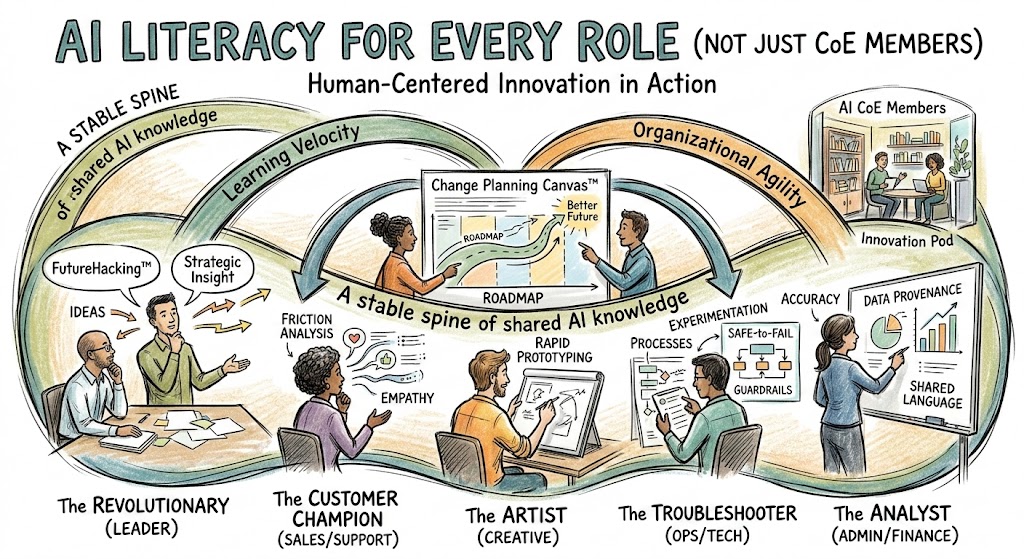
In any Human-Centered Innovation™ initiative, we must distinguish between “tool-fluency” and “literacy.” Knowing how to type a prompt into a chatbot is a fleeting skill; understanding the logic of Generative AI and its impact on your specific value chain is a durable capability. I call this the “Stable Spine” — the core set of principles that stay upright even as the technology shifts beneath our feet.

True AI literacy for the broader workforce isn’t about learning Python. It’s about building a Common Language across the organization. When Marketing, HR, and Operations speak the same dialect of “Data Provenance,” “Hallucination Risks,” and “Iterative Refinement,” the Change Planning Canvas™ actually begins to work.

  • Beyond Tool-Picking: We must move from “What tool should I use?” to “What problem am I solving?” This reduces “Cognitive Clutter” and ensures we aren’t just automating bad processes.
  • Understanding Causal AI: Every employee should grasp the “Why” behind the output. If you don’t understand the logic, you can’t provide the “Human-in-the-Loop” oversight that prevents catastrophic brand or operational errors.
  • The Ethics of Insight: Literacy includes recognizing bias. We must learn the lessons of the past — like the “Tay” chatbot — to ensure our AI implementations don’t scale our existing organizational prejudices.

By establishing this spine, we move from “Experience Narcissism” (assuming our old ways are best) to a state of Marked Flexibility. We aren’t just using AI; we are integrating it into the very marrow of how we innovate.

III. The Role-Based AI “Squad” Strategy

One size does not fit all in the Change Planning Canvas™. To democratize AI literacy, we must translate it into the specific “Value-Add” for different roles. When we move beyond the CoE, we empower individuals to become part of an Innovation Squad, each using AI as a “Force Multiplier” for their unique perspective.

The Persona The AI “Superpower” Human-Centered Outcome
The Revolutionary (Leadership) Strategic “FutureHacking™” and Trend Synthesis. Reducing “Time-to-Insight” to make bolder, data-backed bets.
The Customer Champion (Front Line) Real-time Friction Analysis and Sentiment Mapping. Closing the “Experience Narcissism” gap by truly hearing the customer.
The Artist & Troubleshooter (Technical/Creative) Rapid Prototyping and “Safe-to-Fail” Simulation. Increasing “Learning Velocity” without risking the core business.

By equipping The Revolutionary with AI literacy, we ensure they aren’t just chasing “Shiny Object Syndrome.” Instead, they are using AI to identify where the organization can be Markedly Flexible.

Meanwhile, The Customer Champion uses AI to sift through the “Cognitive Clutter” of thousands of feedback points, identifying the one intervention that will actually move the needle on customer loyalty. This isn’t just “using a tool” — it’s a deliberate Human-Centered Intervention to create a better future for the user.

IV. Overcoming the “70% Failure Rate” in AI Adoption

Statistics in the change management world are sobering: nearly 70% of change initiatives fail. When we layer the complexity of Artificial Intelligence onto that, the risk of “Rigid Decay” skyrockets. To beat these odds, we must look past the algorithms and focus on the PCC Framework: Psychology, Capability, and Capacity.

1. Addressing the Psychology of “Replacement Anxiety”

If an employee perceives AI as a threat to their livelihood, they will subconsciously (or consciously) sabotage its adoption. We must reframe AI as a tool for “Subjective Time Expansion.” By automating the mundane, we aren’t replacing the human; we are freeing them to perform the high-value, high-empathy tasks that AI cannot touch.

2. Clearing the “Cognitive Clutter”

AI literacy helps teams identify where they are drowning in “Cognitive Clutter” — those low-value tasks that prevent them from reaching a state of flow. Literacy allows a worker to say, “AI can handle the data synthesis here, so I can focus on the strategic intervention.”

3. Establishing “Safe-to-Fail” Zones

Organizational Agility requires a culture where experimentation is the norm. We must reward Learning Velocity. If a team tries an AI-driven workflow and it fails, but they document why and share that insight across the Change Planning Canvas™, that is a win for the entire organization.

“The goal of AI literacy is to move from fear of the unknown to the mastery of a new medium.”

By visualizing these change hurdles using collaborative tools, we ensure the entire “Squad” is literally on the same page. We aren’t just pushing a new tool; we are performing a Deliberate Intervention to evolve the company culture.

V. Moving from Theory to Practice: The Implementation Checklist

To avoid “Rigid Decay,” we must treat AI literacy as a living organism, not a one-time workshop. This checklist is designed to integrate AI into your Change Planning Canvas™, ensuring that the entire organization moves at the same Learning Velocity.

1. Audit for “Marked Flexibility”

Every department should identify three legacy processes that are currently “rigid.” Ask: “If we had an infinite amount of data synthesis capability, how would this process change?” This identifies where AI literacy can provide the most immediate Human-Centered lift.

2. Deploy “Safe-to-Fail” Micro-Pilots

Don’t wait for a company-wide rollout. Encourage Innovation Squads to run two-week experiments. The goal isn’t necessarily a “win,” but a documented insight. If the pilot fails, but the team learns something about their data quality, that is a successful intervention.

3. Establish the “Shared Vocabulary” Baseline

Create a “No-Jargon Zone.” Ensure that everyone from the CEO to the front-line intern understands the basics of Prompt Engineering, Algorithmic Bias, and Data Privacy. When everyone speaks the same language, the “Assumption Gap” disappears.

4. Visualize the Flow

Use collaborative tools to map out how AI-augmented work flows through the company. If the AI output stays in a silo, it’s useless. We must visualize how an AI-generated insight in Marketing triggers a Deliberate Intervention in Sales or Product Development.

“The future belongs to the organizations that can learn as fast as their tools evolve.”

By following this checklist, you aren’t just “buying AI” — you are building a Future-Ready culture that is Markedly Flexible and deeply human.

VI. Conclusion: The Future is Human-Led, AI-Augmented

Innovation is never about the technology itself; it is a Deliberate Intervention to create a better future. When we democratize AI literacy, we aren’t just teaching a new skill — we are dismantling “Rigid Decay” and replacing it with Organizational Agility.

By moving AI out of the CoE and into every role, we empower the Customer Champion, the Revolutionary, and the Troubleshooter to speak a Common Language. We bridge the “Assumption Gap” and ensure that our digital transformation is anchored in human empathy.

“The question is not how intelligent the AI is, but how we are intelligent in using it to expand our human potential.”

The organizations that thrive in this era will be those that prioritize Learning Velocity over static expertise. They will be the ones that use the Change Planning Canvas™ to visualize a future where AI handles the “spin” so that humans can provide the “lift.”

The future is not a destination we reach; it is a state of Marked Flexibility we inhabit every day. Let’s stop building silos and start building a literate, empowered, and innovative workforce.

Frequently Asked Questions: AI Literacy for All

1. Why should AI literacy extend beyond the Center of Excellence (CoE)?

Confining AI knowledge to a CoE creates “Rigid Decay,” where specialists build tools that the broader workforce cannot or will not use. Extending literacy to every role bridges the Assumption Gap, ensuring that AI solutions are human-centered and solve real-world friction rather than just adding to “Cognitive Clutter.”

2. Does every employee need to learn how to code or build AI models?

No. True AI literacy is about building a “Stable Spine” of knowledge—understanding the “why” and “how” of AI logic, data ethics, and Human-in-the-Loop oversight. The goal is Organizational Agility, where every “Innovation Squad” member has the common language to collaborate on the Change Planning Canvas™.

3. What is the immediate benefit of role-based AI literacy?

The primary benefit is “Subjective Time Expansion.” When every role — from the Revolutionary to the Customer Champion — understands how to use AI for data synthesis and rapid prototyping, they reduce their Learning Velocity and clear away the “Cognitive Clutter” of low-value tasks. This allows the human workforce to focus on high-empathy, high-strategy interventions that AI cannot replicate.

Image credit: Google Gemini

Subscribe to Human-Centered Change & Innovation WeeklySign up here to get Human-Centered Change & Innovation Weekly delivered to your inbox every week.

Guardrails for Ethical Algorithmic Decisions

LAST UPDATED: February 23, 2026 at 9:41AM
Guardrails for Ethical Algorithmic Decisions

GUEST POST from Art Inteligencia

I. Introduction: The Myth of Algorithmic Neutrality

We must stop treating algorithms as objective referees. In the architecture of innovation, a line of code is as much a value judgment as a mission statement.

The “Black Box” Trap

The greatest danger to modern innovation is the belief that math is inherently neutral. When we outsource critical decisions to a “Black Box,” we aren’t just automating logic; we are often automating Experience Narcissism — the tendency of a system to reflect the unconscious biases and limited perspectives of its creators. In 2026, “the algorithm made the decision” is no longer an excuse; it is a confession of a lack of oversight.

The Strategic Necessity of Trust

In a digital-first economy, Trust is the only currency that matters. Every time an algorithm makes an opaque, biased, or harmful decision, it devalues your brand. Guardrails are not about slowing down; they are about providing the “high-performance brakes” that allow an organization to move at the speed of the future without the fear of a catastrophic ethical failure.

From Reactive Compliance to Proactive Integrity

Ethical guardrails represent a shift in the innovator’s mindset. We are moving from a compliance-based approach (doing the bare minimum to avoid a fine) to an integrity-based approach (designing systems that actively empower the user). This is the “Human-Centered Mandate”: ensuring that as we build more complex tools, the human stays at the center of the value proposition.

The Braden Kelley Insight: True innovation isn’t about the smartest code; it’s about the wisest change. We don’t program technology to replace human judgment; we program it to extend the reach of human empathy.

II. The Three Pillars of Ethical Algorithmic Decision-Making

Building a trust-based ecosystem requires shifting from “Black Box” automation to an architecture of accountability. These three pillars serve as the foundation for every ethical decision-making engine.

1. Radical Transparency & Explainability (XAI)

Transparency is not just about showing the code; it’s about explaining the logic of the outcome. In 2026, the “Right to an Explanation” is a baseline consumer expectation. We must move toward Explainable AI (XAI), where every algorithmic output is accompanied by a plain-language summary of the weights and variables that influenced the result.

2. Purpose-Driven Data Minimization

The old innovation mantra of “collect everything and find the value later” is an ethical dead end. Ethical guardrails require Data Intentionality. We only collect the specific data points necessary to drive the stated human-centered value. By minimizing the footprint, we minimize the potential for “data bleed” and unintended algorithmic bias.

3. The “Benefit Flow” Audit

We must constantly ask: Who wins? An ethical algorithm ensures that the value derived from a decision flows back to the individual, not just the organization’s bottom line. A Benefit Flow Audit maps the distribution of value, ensuring that the algorithm isn’t just optimizing for corporate margin at the expense of user agency or equity.

The Braden Kelley Insight: Transparency without utility is just noise. Ethical innovation means providing stakeholders with the clarity they need to make informed choices, not just dumping data on them. Guardrails are the bridge between technical capability and human confidence.

III. Operationalizing the Guardrails: The Innovation Toolkit

Ethics cannot remain a high-level philosophy; it must be baked into the daily workflow of your engineering and product teams. Operationalizing integrity means building the systems that catch bias before it becomes code.

1. The Algorithmic Risk Committee (ARC)

The ARC is a cross-functional “Red Team” that evaluates algorithmic logic before deployment. Unlike a traditional legal review, the ARC includes CX Designers, Ethicists, and Frontline Employees. Their job is to stress-test the algorithm against real-world human edge cases, identifying where “mathematical efficiency” might inadvertently lead to human harm or exclusion.

2. Managing “Shadow AI” and Governance

In the decentralized environment of 2026, many algorithmic decisions are made by “Shadow AI”—tools adopted by departments without formal IT oversight. We must implement Governance as a Service: providing teams with pre-approved, ethically-vetted “logic modules” and API wrappers that include built-in audit trails. This allows for rapid innovation without bypassing the organization’s moral compass.

3. Continuous Feedback & Human-in-the-Loop (HITL)

An algorithm is never “done.” We must establish Continuous Calibration Loops where human supervisors can flag and override algorithmic decisions. These “Human-in-the-Loop” corrections are then fed back into the training set, allowing the machine to learn from human nuance and empathy over time.

The Braden Kelley Insight: You don’t build a culture of integrity by policing people; you build it by providing them with the tools to do the right thing easily. Operationalizing guardrails is about making “ethical” the default setting for every innovation.

IV. Measuring Success: Human-Centered Metrics

If you aren’t measuring integrity, you aren’t managing it. In 2026, we must move beyond “accuracy scores” toward metrics that reflect our commitment to human equity and trust.

1. The Strategic Alignment Score (SAS)

We must quantify how closely an algorithm’s decision path mirrors our stated organizational values. The Strategic Alignment Score measures the delta between algorithmic “optimization” (e.g., maximizing profit) and human-centered goals (e.g., long-term customer health). A low SAS is an early warning signal that the machine’s logic is drifting away from the brand’s soul.

2. The Equity Audit & Disparate Impact Ratio

An ethical guardrail is only as strong as its weakest link. We conduct regular Equity Audits to test for “Disparate Impact” — checking if the algorithm’s outcomes vary significantly across demographic groups (age, gender, ethnicity). Our goal is a ratio as close to 1:1 as possible, ensuring the algorithm provides a level playing field for all stakeholders.

3. The Trust Index (TI)

Ultimately, the market decides if your guardrails are effective. The Trust Index measures user confidence through direct feedback and behavioral signals. Are users more likely to follow an algorithmic recommendation when the “Explainability” layer is visible? High TI scores correlate directly with long-term customer retention and lower churn.

The Braden Kelley Insight: Data tells you what happened; metrics tell you why it matters. By measuring the human impact of our algorithms, we transform ethics from a “checkbox” into a competitive advantage. We don’t just innovate for the sake of speed; we innovate for the sake of progress.

V. Case Studies: Integrity in Action

The theory of ethical guardrails meets reality in high-stakes environments. These cases demonstrate how organizations have pivoted from “efficiency at all costs” to “integrity by design.”

Case Study 1: Healthcare & The Accountability Gap

The Challenge: A leading diagnostic AI was achieving 98% accuracy in early-stage oncology detection but was being rejected by practitioners because they couldn’t understand the “reasoning” behind its flags. This created an Accountability Gap — doctors felt they couldn’t legally or ethically sign off on a diagnosis they couldn’t explain.

  • The Guardrail: The team implemented an Explainability Layer that highlighted the specific pixel clusters and biometric markers influencing the AI’s confidence score.
  • The Result: Adoption rates among specialists increased by 65%. By bridging the gap between “math” and “medicine,” the tool became a trusted collaborator rather than a black-box intruder.

Case Study 2: Finance & The Shareholder Value Trap

The Challenge: A fintech startup’s credit-scoring algorithm was mathematically perfect at minimizing short-term default risk. However, it was inadvertently creating a “poverty trap” by penalizing applicants for living in specific zip codes — a classic example of Encoded Bias.

  • The Guardrail: The firm shifted its optimization variable from “Short-term Default Risk” to “Long-term Economic Empowerment.” They removed zip codes as a primary weight and replaced them with “Growth Potential” markers like consistent utility payments and educational progress.
  • The Result: The company expanded its market into underbanked segments without a significant increase in defaults, proving that ethical guardrails can unlock new revenue streams.
The Braden Kelley Insight: These organizations didn’t succeed because they had the best “data”; they succeeded because they had the best judgment. Guardrails are the mechanism that allows us to scale human wisdom at machine speed.

VI. Conclusion: Leading with the Soul of the Customer

As we navigate the complexities of 2026, we must recognize that ethical guardrails are the infrastructure of sustainable innovation. They are not intended to bind our hands, but to protect our integrity. In an era where algorithms can scale bias at the speed of light, our role as leaders is to ensure that technology serves as a bridge to opportunity, not a barrier to it.

The Wisdom of the Brake

The fastest cars in the world require the most powerful brakes. Similarly, the most transformative AI requires the most robust ethical frameworks. When we stop worshipping the efficiency of the algorithm and start empowering the agency of the human, we create a Trust Ecosystem that competitors cannot easily replicate. True competitive advantage is no longer found in “who has the most data,” but in “who is most trusted with that data.”

The path forward requires courage — the courage to slow down when a “Black Box” lacks clarity, the courage to delete profitable data that lacks purpose, and the courage to put the human back in the loop. We don’t just innovate to change the world; we innovate to make the world more human.

The Final Word: Integrity is the Ultimate Algorithm

Innovation is a human endeavor. If we lose our values in the pursuit of velocity, we haven’t innovated — we’ve simply accelerated a mistake.

— Braden Kelley

Ethical Algorithmic Guardrails FAQ

1. What are ethical algorithmic guardrails?

Think of them as the braking system for high-speed innovation. They are rules and filters built into your AI that ensure it doesn’t make biased, unfair, or “secret” decisions. They keep the machine’s logic aligned with human values.

2. Why is “Explainable AI” (XAI) important for business?

In 2026, trust is your most valuable asset. If a doctor or a customer doesn’t understand why an AI made a recommendation, they won’t use it. XAI turns the “Black Box” into a glass box, making innovation transparent and adoption easier.

3. How does data minimization improve ethics?

By only collecting the data that actually matters for a specific goal, we prevent the algorithm from picking up on unintended patterns that lead to bias. Less “noise” in the data leads to more integrity in the decision.

Image credit: Google Gemini

Subscribe to Human-Centered Change & Innovation WeeklySign up here to get Human-Centered Change & Innovation Weekly delivered to your inbox every week.

Design Thinking in the Age of AI and Machine Learning

Design Thinking in the Age of AI and Machine Learning

GUEST POST from Chateau G Pato

The world is rapidly changing, and with the emergence of new technologies like artificial intelligence (AI) and machine learning, it is becoming increasingly important for businesses to stay ahead of the curve. Design thinking has become a powerful tool for businesses to stay competitive by helping them to better understand customer needs and develop innovative solutions. In the age of AI and machine learning, design thinking can be used to create better experiences, drive innovation, and improve the quality of products and services.

Design thinking is an approach that focuses on understanding user needs, designing solutions that meet those needs, and testing those solutions to ensure they are successful. By taking a human-centered approach to problem solving, design thinking helps businesses to develop products and services that are tailored to customer needs. It also provides a structure for understanding customer feedback and making iterative improvements.

In the age of AI and machine learning, design thinking is more important than ever for businesses to stay competitive. AI and machine learning technologies are transforming the way businesses operate and creating new opportunities for innovation. Design thinking can help businesses to identify the customer needs that AI and machine learning can address, develop solutions to meet those needs, and create customer experiences that are tailored to the changing landscape.

One example of design thinking in the age of AI and machine learning is the development of predictive customer service. Predictive customer service uses AI and machine learning technologies to anticipate customer needs and provide personalized experiences. Companies like Amazon and Google are using AI and machine learning to provide personalized recommendations and customer support. By understanding customer needs and leveraging the power of AI and machine learning, these companies are able to provide better experiences and improve customer satisfaction.

Another example of design thinking in the age of AI and machine learning is the development of intelligent products and services. Companies are using AI and machine learning technologies to create products and services that can anticipate customer needs and provide tailored experiences. For example, Amazon is using AI and machine learning to develop Alexa, a virtual assistant that is able to understand customer requests and provide personalized responses. By leveraging the power of AI and machine learning, companies are able to create products and services that are more intuitive and provide better customer experiences.

Design thinking is an important tool for businesses to stay competitive in the age of AI and machine learning. By understanding customer needs and leveraging the power of AI and machine learning, businesses can create better customer experiences and drive innovation. Design thinking provides a framework for understanding customer needs and developing solutions that will meet those needs. By using design thinking, businesses can create products and services that are tailored to the changing landscape and stay ahead of the competition.

SPECIAL BONUS: Braden Kelley’s Problem Finding Canvas can be a super useful starting point for doing design thinking or human-centered design.

“The Problem Finding Canvas should help you investigate a handful of areas to explore, choose the one most important to you, extract all of the potential challenges and opportunities and choose one to prioritize.”

Image credit: Pixabay

Subscribe to Human-Centered Change & Innovation WeeklySign up here to get Human-Centered Change & Innovation Weekly delivered to your inbox every week.