Tag Archives: Artificial Intelligence

Making the Most of AI-Powered Business Solutions

Making the Most of AI-Powered Business Solutions

GUEST POST from Art Inteligencia

Artificial Intelligence (AI) has become an integral part of the business landscape, revolutionizing the way organizations operate, streamline processes, and make data-driven decisions. With the ability to analyze vast amounts of data in real-time, AI-powered business solutions are transforming industries and helping companies gain a competitive edge. In this article, we will explore two case studies that showcase how businesses are harnessing the power of AI to drive innovation and success.

Case Study 1: Retail Giant Boosts Sales and Personalization with AI

One of the world’s largest retail chains sought to enhance its customer experience and increase sales through targeted marketing campaigns. By leveraging AI-powered business solutions, the company was able to analyze customer data, preferences, and purchase history to develop personalized recommendations for each shopper.

Using advanced machine learning algorithms, the AI system analyzed vast amounts of customer data, including demographics, online behavior, and purchase patterns, to identify trends and patterns. This insight enabled the retail giant to segment their customer base and tailor marketing campaigns based on individual preferences.

As a result, the company achieved significant improvements in customer engagement and loyalty. By sending targeted offers and product recommendations, they saw a substantial increase in sales conversion rates. Additionally, the personalized approach led to higher customer satisfaction, as shoppers felt that the brand understood their needs and preferences.

Case Study 2: Healthcare Provider Enhances Diagnosis Accuracy with AI

A leading healthcare provider aimed to improve diagnostic accuracy by leveraging AI technology. The organization utilized AI algorithms to analyze diverse patient data, medical images, and electronic records, allowing doctors to make more precise and efficient diagnoses.

Through deep learning techniques, the AI-powered system was able to analyze thousands of medical images, identify patterns, and highlight potential areas of concern. This not only expedited the diagnosis process but also reduced the rate of misdiagnosis.

The healthcare provider also integrated AI in their electronic health records (EHR) system to enable real-time analysis of patient data. This allowed doctors to receive immediate alerts and recommendations based on critical health indicators, ensuring timely intervention and proactive care.

By implementing AI-powered business solutions, the healthcare provider witnessed a significant improvement in diagnostic accuracy and patient outcomes. The technology not only reduced the burden on healthcare professionals but also enhanced patient trust and satisfaction.

Conclusion

These case studies demonstrate how AI-powered business solutions can revolutionize industries and drive transformative success. By leveraging the power of AI, companies can gain deep insights into customer preferences, develop personalized marketing strategies, enhance diagnostic accuracy, and improve patient outcomes.

However, it is essential to note that implementing AI systems requires an understanding of the technology and its potential impact on business operations. Organizations must invest in robust data infrastructure, ensure ethical usage of data, and provide adequate training to employees to leverage AI effectively.

As AI continues to evolve, businesses that embrace and integrate AI-powered solutions will accelerate their growth, stay ahead of the competition, and deliver exceptional value to their customers.

Image credit: Pixabay

Subscribe to Human-Centered Change & Innovation WeeklySign up here to get Human-Centered Change & Innovation Weekly delivered to your inbox every week.

Human-Centered Design and AI Integration

Human-Centered Design and AI Integration

GUEST POST from Chateau G Pato

As the realm of artificial intelligence continues to evolve, so does its integration into various sectors of our society. One crucial aspect of seamlessly blending AI technologies into our daily lives is through human-centered design. Human-centered design focuses on designing systems, products, and services that prioritize the needs and experiences of people. By incorporating this design approach into the development and implementation of AI technologies, we can ensure that these advancements are effective, intuitive, and ultimately benefit human users. In this article, we will explore two case study examples that demonstrate the successful integration of human-centered design and AI.

Case Study 1: Amazon Echo

The Amazon Echo, powered by the AI assistant Alexa, is an excellent example of human-centered design combined with AI integration. When Amazon first launched the Echo, they understood that the key to ensuring widespread adoption of this voice-activated speaker was by making it as user-friendly as possible. The design team conducted extensive research to understand how people interact with technology and what features would enhance their daily lives.

Through this process, they identified voice input as the most natural and intuitive form of interaction. By enabling users to speak naturally to Alexa, Amazon created a device that seamlessly fit into people’s existing routines. Additionally, the team emphasized understanding user context and needs, allowing Alexa to provide personalized and context-aware responses. Whether it is playing music, setting reminders, or controlling smart home devices, the Amazon Echo demonstrates how AI integration can be harnessed successfully through human-centered design.

Case Study 2: Apple Health App

The Apple Health app is another prime example of human-centered design principles applied in conjunction with AI integration. The goal of this app is to empower individuals to take more control of their health by offering them valuable insights and information. By seamlessly connecting with various health devices and apps, the app collects and presents data in a user-friendly manner, making it easy for individuals to track their health and well-being.

Apple’s design team recognized the importance of providing meaningful and understandable data visualization. They ensured that users can effortlessly comprehend their health information, empowering them to make informed decisions about their lifestyle choices. The AI integration in the app leverages complex algorithms to analyze data in real-time, offering personalized suggestions and notifications to the users based on their unique health goals.

By considering the very essence of human-centered design, Apple successfully integrated AI technologies into the Health app, making it an indispensable tool for individuals seeking to prioritize their well-being.

Conclusion

The successful integration of artificial intelligence into our daily lives relies heavily on the principles of human-centered design. Case studies such as Amazon Echo and Apple Health app provide excellent examples of how AI technologies can be seamlessly incorporated into products and services while prioritizing the needs and experiences of users. By implementing human-centered design, companies can ensure that AI interventions are intuitive, accessible, and ultimately enhance the overall human experience.

Image credit: Unsplash

Subscribe to Human-Centered Change & Innovation WeeklySign up here to get Human-Centered Change & Innovation Weekly delivered to your inbox every week.

What Will the Smart Home of the Future Look Like?

What Will the Smart Home of the Future Look Like?

GUEST POST from Art Inteligencia

In recent years, the concept of a smart home has become increasingly popular. From voice-activated virtual assistants to interconnected devices, the technological advancement in home automation has revolutionized the way we live. With rapid advancements in artificial intelligence and the Internet of Things (IoT), it is intriguing to speculate about what the smart home of the future will look like. In this article, we will explore two case studies that offer a glimpse into the potential future of smart homes.

Case Study 1: The Connected Oasis

Imagine walking into a home where everything is interconnected, and your every need is anticipated. This vision of the future smart home is epitomized in the concept of the “Connected Oasis.” One example of this is showcased through the collaboration between Samsung and BMW. The companies are working on integrating their respective technologies to create a seamless experience between the car and the home.

Using artificial intelligence and sensors, the smart home of the future can recognize when the car is approaching and prepare everything accordingly. As you near your home, the lights automatically turn on, the temperature adjusts to your preferred setting, and the door unlocks as you approach it. Once inside, your smart home assistant greets you with personalized suggestions based on your daily routine and preferences. The smart home can even sync with your car, automatically setting GPS directions based on your calendar events or providing traffic updates as you prepare to leave.

Case Study 2: Sustainable and Energy-Efficient Living

With growing concerns about climate change and environmental sustainability, the future smart home is likely to prioritize energy efficiency and sustainable living. The GreenSmartHome project, developed by researchers at the University of Nottingham, envisions a home that utilizes renewable energy sources, maximizes energy efficiency, and encourages eco-friendly practices.

This smart home incorporates various features such as smart thermostats, solar power generation, and energy management systems. By analyzing data from smart sensors and weather forecasts, the home can optimize energy usage by controlling heating, cooling, and lighting systems. The smart home can also provide real-time feedback on energy consumption, offering homeowners insights to reduce their carbon footprint.

Furthermore, the GreenSmartHome integrates waste management systems, promoting recycling and composting practices. It even has a smart garden, where irrigation systems are automatically adjusted based on weather conditions and moisture levels in the soil, ensuring efficient water usage.

Conclusion

The smart home of the future holds vast potential, with a focus on enhanced convenience, interconnectivity, sustainability, and energy efficiency. From the Connected Oasis, where homes and cars seamlessly communicate, to the GreenSmartHome promoting eco-friendly practices, these case studies offer a glimpse into what we can expect from the future of smart homes.

While these concepts may seem like science fiction today, advancements in AI, IoT, and sustainable technologies suggest that these visions are within reach. As technology continues to evolve, the smart home of the future will likely become an integral part of our lives, shaping the way we interact with our homes and the environment.

Bottom line: Futurists are not fortune tellers. They use a formal approach to achieve their outcomes, but a methodology and tools like those in FutureHacking™ can empower anyone to be their own futurist.

Image credit: Pixabay

Subscribe to Human-Centered Change & Innovation WeeklySign up here to get Human-Centered Change & Innovation Weekly delivered to your inbox every week.

Just Walk Out Groceries — by Amazon

Just Walk Out Groceries -- by Amazon

Amazon Go is going big – grocery store big. Today it was revealed that Amazon has opened up a new Amazon Go that is four times (4x) bigger than previous Amazon Go stores. What’s new?

Well, this new Amazon Go store has produce, packaged meats, an expanded frozen food section, sundries like paper towels, and more!

This is a big step forward for Amazon and will be stretching its technology to the breaking point as Amazon looks not only to explore what’s possible, but to prove its technology to the point where its collection of technology could become another revenue pillar that it can build by licensing its technology to other convenience store and grocery store chains.

The Amazon Go approach, should it expand, also puts even more of the 3 million grocery store jobs in the United States at risk. This 3 million jobs number is already declining because of self checkout and Walmart’s robotic inventory systems, among other pressures.

Is the Amazon Go approach a good thing?

Do we really all want to live in a world where packages show up at the door or food can be obtained in a grocery store without talking to anyone?

Americans are becoming increasingly lonely and isolated. I could include dozens of supporting links to back this up, but here is a good one:

https://www.nbcnews.com/think/opinion/lonely-you-re-not-alone-america-s-young-people-are-ncna945446

The grocery store has become one of the last remaining places where someone will actually speak to you, but self checkout and technologies like Amazon Go look to stamp out this human interaction too!

But even though there are still humans in the grocery store, the level of human interaction seems to be fading there too as younger, non-unionized workers replace older unionized workers in grocery stores. Has this been your experience?

What’s next the barbershop and the hairdresser?

And can our society survive any more isolation?


Accelerate your change and transformation success

Subscribe to Human-Centered Change & Innovation WeeklySign up here to get Human-Centered Change & Innovation Weekly delivered to your inbox every week.

The Modern Luddite Movement

Anticipating the Cultural Backlash to AI Displacement

The Modern Luddite Movement

GUEST POST from Chateau G Pato


The Friction of Unmanaged Progress

For years, the technology sector has operated under a dangerous illusion: the myth of seamless adoption. The prevailing corporate narrative suggests that artificial intelligence will be universally welcomed, quietly absorbing friction and smoothly elevating the workforce. But this viewpoint ignores a fundamental law of human-centered change: when technology moves faster than human psychology can process, culture strikes back.

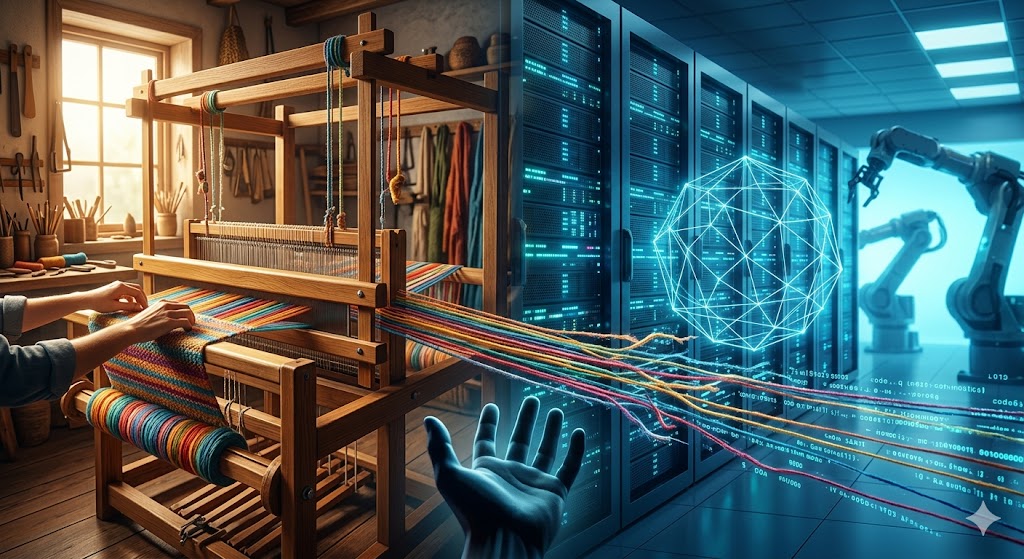
To understand the looming cultural backlash, we must first rescue history from its own terminology. In common parlance, a “Luddite” is dismissed as a technophobe — someone stubbornly clinging to the past out of ignorance. In reality, the 19th-century English textile workers who smashed mechanical looms weren’t fighting technology; they were fighting the destruction of their communities, their livelihoods, and their dignity. They were protesting a systemic failure of experience design. The Modern Luddite Movement will not be born in factories, but in the digital workspaces of knowledge workers, creatives, and strategists who see their intellectual sovereignty being commoditized overnight.

“True innovation is never just about building what is technologically possible; it’s about designing a future where humanity actually wants to live.”

The core tension of our current era is that we are treating a massive societal transformation as a mere software update. We are obsessing over algorithmic efficiency while completely neglecting the human experience of that change. The coming backlash is not a failure of human adaptability — it is a predictable, deeply human reaction to a profound lack of empathy in how innovation is being managed and deployed. If we continue to design people out of the equation, we shouldn’t be surprised when they decide to break the equation entirely.

I. The Anatomy of Disruption: Why This Backlash is Different

Every industrial milestone has forced humanity to renegotiate its relationship with labor. However, treating the rise of generative artificial intelligence as just another predictable chapter in economic history is a grave strategic error. The impending friction is structurally unique, characterized by unprecedented velocity, deep psychological dislocation, and a fundamental degradation of the end-user experience.

The Speed-to-Scale Problem

In past industrial revolutions, the transition of the workforce was measured in generations. When steam power or assembly lines reshaped manufacturing, the prolonged timeline allowed society to build new educational pipelines, adapt labor laws, and give workers time to naturally transition. Generative AI moves at internet speed, scaling globally in days rather than decades. This compressed adoption curve completely outpaces human psychological and economic retraining cycles. We are expecting professionals to reinvent their entire career architectures in months, creating an unprecedented deficit in human change management.

Identity vs. Utility

When mechanical automation disrupted blue-collar labor, it targeted physical exertion. The AI revolution targets cognitive output, striking directly at the core of human identity. For knowledge workers, strategists, and creatives, “what they do” is inextricably linked to “who they are.” When an algorithm can instantly replicate a piece of writing, a strategic analysis, or a visual design, the resulting crisis isn’t merely financial — it is deeply existential. Organizations that view headcount reduction purely as a line-item efficiency gain fail to realize they are tearing at the fabric of professional self-worth, triggering a potent, emotionally charged defensive response.

The Loss of the “Human Touch”

From an experience design perspective, the aggressive rush toward total automation introduces a critical flaw: the complete prioritization of transactional efficiency over relational connection. When every customer touchpoint, creative artifact, and organizational interface is filtered through an automated layer, the overall human experience begins to homogenize and degrade. This creates a vacuum of authentic connection. As digital spaces become hyper-automated and sterile, we will witness a powerful, consumer-led demand for friction — a deliberate rejection of algorithmic optimization in favor of verified, authentic human interaction.

II. Signals of the Emerging Counter-Culture

The cultural backlash to unmanaged automation is no longer a distant, hypothetical scenario; the early warning signals are already flashing across the professional and cultural landscape. As organizations continue to deploy technology without an accompanying architecture for human change management, a distinct, decentralized counter-culture is beginning to manifest. This movement is defined by a conscious retreat from algorithmic spaces and an active resistance against digital displacement.

The Rise of “Analog Enclaves”

We are witnessing the emergence of spaces, products, and communities that explicitly ban or restrict automated inputs. Just as the slow food movement arose in response to industrial fast food, “Analog Enclaves” are forming to preserve unoptimized human experiences. From creative agencies guaranteeing 100% human-authored strategies to local marketplaces operating on zero-algorithm models, consumer preferences are shifting. A premium is being placed on the intentional injection of human friction. The label “Human-Made” is transitioning from a point of nostalgic pride to a highly sought-after, defensive certification of authenticity and quality.

Digital Sabotage and Creative Non-Compliance

Resistance inside the enterprise is rarely loud; it is typically quiet, calculated, and highly effective. Knowledge workers are increasingly engaging in creative non-compliance to protect their domains. This manifests as data poisoning — intentionally introducing flawed inputs to disrupt automated training models — and the deliberate bypassing of corporate AI tools in favor of legacy, human-centric workflows. When workers feel they are being automated out of their own roles rather than augmented within them, survival instincts drive them to quietly sabotage the very systems designed to replace them.

Algorithmic Cynicism and Consumer Fatigue

From an experience design standpoint, the internet is rapidly approaching a saturation point of synthetic mediocrity. The digital ecosystem is cluttered with low-effort, AI-generated noise, resulting in widespread algorithmic cynicism among consumers. People are developing a profound fatigue toward hyper-optimized, sterile interfaces and generic content. This fatigue is driving users away from mass digital platforms and toward small, private, low-tech communities where the interaction is messy, unoptimized, and undeniably human. When efficiency completely destroys novelty and delight, the consumer simply walks away.

III. Designing the Alternative: Co-Creation Over Displacement

The solution to a cultural backlash is not to halt technological progress, but to change how we architect it. If leadership continues to treat human beings as variables to be optimized out of the system, resistance is guaranteed. To avoid systemic friction, organizations must pivot from predatory automation to participatory innovation, designing new organizational structures that value human ingenuity as the ultimate differentiator.

From Automation to Augmentation

We need to fundamentally reframe the corporate balance sheet. The current trend asks, “How many headcounts can this technology eliminate?” A human-centered leader asks, “How can this technology liberate our people to solve higher-order problems?” True innovation occurs at the intersection of technological capability and human insight. When we shift our focus from automation to augmentation, we design workflows where machines handle the heavy lifting of data processing, leaving humans free to focus on empathy, contextual judgment, and creative breakthroughs.

The “Human-in-the-Loop” Experience Architecture

In experience design, a system is only as good as the human outcomes it produces. Deploying automated systems without a robust human interface creates an fragile environment prone to failure. Organizations must intentionally build “Human-in-the-Loop” architectures, where human oversight is not an afterthought or a safety net, but a core structural component. By positioning employees and customers as active co-creators of the technology rather than passive recipients of its outputs, we foster ownership, drastically reduce change resistance, and ensure the final experience retains its vital human touch.

Continuous Upskilling as a Change Framework

You cannot successfully manage a technical transition without a matching human transition architecture. Expecting employees to adapt to a radically altered operational landscape without systemic support is a failure of leadership. Organizations must embed continuous upskilling directly into their operational models. This means designing clear, empathetic learning pathways that allow workers to evolve alongside the tools they use. When people see a clear path forward for their personal growth and economic security within the future vision of the company, the urge to resist transforms into an incentive to innovate.

Conclusion: A Call for Human-Centered Futurology

We stand at a critical crossroads in the evolution of work and culture. The rise of the Modern Luddite Movement is not an inevitable tragedy, but a flashing dashboard indicator warning us that our current innovation trajectory is dangerously out of balance. If we continue to allow technology to outpace empathy, we will lock ourselves into an era defined by systemic cultural friction, bitter labor disputes, and a fragmented digital ecosystem built entirely on mutual distrust.

The choice before us is a design challenge. We can either deploy artificial intelligence as a tool of displacement, or we can deliberately architect an inclusive future of work that honors and amplifies human capability. True futurology is not about passively predicting what technology will do to us; it is about actively designing what we will do with technology. It is time to move past the obsession with what is merely technologically possible and start focusing on what is humanly desirable. The best way to manage change is to ensure that everyone has a stake in the future we are building.

Frequently Asked Questions

Who are the “Modern Luddites” in the context of the AI revolution?

Unlike the historical stereotype of technophobes who hate progress, Modern Luddites are primarily knowledge workers, creatives, and strategists. They are resisting the systemic destruction of their livelihoods, intellectual sovereignty, and professional identities caused by rapid, unmanaged AI displacement.

What are the primary signals of an emerging cultural backlash to AI?

Key signals include the rise of “Analog Enclaves” (spaces and products certifying 100% human creation), quiet enterprise resistance like data poisoning or legacy workflow compliance, and consumer algorithmic cynicism driven by a saturation of sterile, AI-generated digital noise.

How can organizations avoid this backlash and manage AI changes successfully?

Organizations must shift from predatory automation to human-centered augmentation. This involves building “Human-in-the-Loop” experience architectures, involving employees in participatory co-creation, and implementing structured, empathetic upskilling frameworks that provide a clear path forward for human workers.

FutureHacking™ Is Coming

FutureHacking™ is Braden Kelley’s strategic foresight methodology — and a paid download and training program is launching soon. Register your interest now to be the first to know when it’s available, and get early access pricing.

Image credit: Gemini

Subscribe to Human-Centered Change & Innovation WeeklySign up here to get Human-Centered Change & Innovation Weekly delivered to your inbox every week.

How AI is Democratizing the Power of Scale

The Micro-Enterprise Explosion

How AI is Democratizing the Power of Scale

GUEST POST from Chateau G Pato


The New Architecture of Scale

For over a century, the rules of business strategy have been dictated by a single, unyielding law: the law of physical and organizational scale. In the Industrial Era mindset, creating global impact required massive capital infusions, complex organizational hierarchies, and armies of specialized talent to navigate the friction of operations, logistics, and market outreach. Bigger meant more resources, wider distribution, and an impenetrable moat against smaller competitors.

Today, we are witnessing a profound structural shift. Artificial intelligence is completely decoupling operational capability from headcount. The historical paradigm where output was directly tied to the size of a workforce is collapsing. By replacing traditional bureaucratic infrastructure with autonomous digital workflows and intelligent orchestrator agents, the cost of scaling an idea has plummeted toward zero.

We are entering the era of the Micro-Enterprise Explosion. This is not merely a boom in freelancing or a digital iteration of the traditional small business; it is a fundamental democratization of the power of scale. Armed with generative tools and cognitive infrastructure, solitary innovators and lean teams can now design, deploy, and optimize world-class customer experiences on a global canvas — effectively leveling the playing field and challenging corporate giants on terms that were unimaginable just a decade ago.

I. From Organizational Scale to Cognitive Scale

To understand this revolution, we have to look past the idea of AI as a simple productivity tool. We are moving rapidly beyond the era of isolated text generation and basic autocomplete. The true catalyst of the micro-enterprise explosion is the emergence of a robust AI co-pilot ecosystem — highly specialized, autonomous functional multipliers.

Today, a single founder can deploy a network of agentic workflows to handle everything from legal vetting and predictive financial forecasting to localized market research and continuous code generation. Instead of managing people, the modern innovator orchestrates digital assets, transforming raw human intent into institutional-grade execution overnight.

This shift fundamentally lowers the friction of innovation. Historically, the journey from a validated spark of an idea to a functioning business was throttled by technical debt, administrative overhead, and capital constraints. Low-code and no-code platforms, fully supercharged by natural language processing, mean that a lack of traditional software engineering or venture capital backing is no longer a terminal diagnosis for a startup.

The proof is in the data. The rapid rise of the million-dollar, one-person business is shifting from a statistical anomaly into a repeatable, open-source blueprint. When cognitive capacity can be rented on demand via cloud APIs, scale becomes a measure of your imagination and organizational design, not the size of your payroll.

II. Human-Centered Change: Redefining the “Solopreneur” Identity

This democratization demands a massive psychological shift. We have to fundamentally redefine what it means to build a business alone. For years, the term “solopreneur” or “freelancer” conjured images of someone trading time for money — a lone operator locked in a perpetual hustle, writing every email, designing every slide, and chasing every invoice. AI shatters this ceiling by requiring a transition from linear technician to systemic architect.

True human-centered change starts with the individual creator. Change management is no longer just a discipline for Fortune 500 executives steering massive corporate ships; it is a deeply personal requirement for the modern founder. Navigating this transition means learning to manage our own cognitive load, trusting algorithmic partners with operational execution, and deliberately designing a brand-new workflow that prioritizes mental agility over sheer hours logged.

When operational and administrative tasks are effectively automated, a beautiful paradox emerges: the true competitive advantage shifts entirely back to the human premium. When anyone can generate a baseline marketing plan or build an API integration with a simple prompt, commodity execution loses its economic value.

The winners in this new micro-enterprise landscape will win because of their deeply human capabilities. Success will be driven by raw curiosity to find unaddressed problems, genuine empathy to understand user frustration, unique cultural insights, and the ability to build trusted, authentic relationships. AI handles the scale; humans provide the soul.

III. Experience Design (XD) in a Hyper-Personalized Market

In this new landscape, micro-enterprises do not just compete on cost or niche specialization — they compete on pure agility. Traditional, heavily matrixed corporate structures are inherently sluggish; a single strategic change or user experience modification can take months to clear committee approvals, compliance reviews, and technical deployment cycles. A lean, AI-empowered micro-enterprise can interpret real-time data and completely pivot a customer journey in hours, turning execution velocity into a profound competitive advantage.

This agility enables the deployment of what we can call the algorithmic concierge. By leveraging lightweight, highly contextualized AI models, small teams can provide enterprise-grade, hyper-personalized customer experiences that feel deeply tailored, proactive, and human. The customer no longer feels like a ticket number in a vast corporate system; instead, they experience a high-touch, context-aware journey where their specific needs are anticipated and met instantaneously.

Furthermore, this operational model naturally drives frictionless global operations. Historically, localizing an experience across multiple regions required vast international teams, massive translation budgets, and localized legal entities. Today, a micro-enterprise can act globally from day one. Automated cross-border compliance, real-time linguistic and cultural localization tools, and decentralized, API-driven supply chains allow a three-person team to serve customers worldwide with the same precision and polish as a multinational corporation.

IV. The Futurist’s View: The Macro Impact of Micro-Scales

Zooming out to a macro perspective reveals that this shift will trigger a profound structural reorganization of the global workforce. We are standing on the precipice of a massive unbundling of the traditional corporation. Historically, large firms acted as gravity wells, pulling in top-tier talent by offering resources, security, and operational scale. As AI completely democratizes access to those exact resources, the value proposition of corporate employment alters dramatically. High-performing individuals will increasingly choose to leave rigid corporate hierarchies to build, own, and orchestrate their own lean micro-empires.

This trend will not result in a fragmented, isolated business landscape, but rather in the rise of hyper-dynamic, collaborative ecosystems. The future of commerce will be defined by fluid networks of independent micro-enterprises. Utilizing smart contracts, decentralized autonomous frameworks, and shared, interoperable AI protocols, these agile nodes can instantly coalesce to tackle massive, enterprise-level projects, and then dissolve just as quickly once the objective is met.

However, an economy composed of millions of decentralized, high-output nodes will inevitably run into friction with legacy institutions. This systemic transition forces a major regulatory and economic evolution. Our current social safety nets, tax codes, intellectual property frameworks, and banking infrastructures were explicitly engineered for an era of predictable, centralized corporate employment. As the micro-enterprise explosion accelerates, society will be forced to reinvent its socioeconomic contracts, creating entirely new baseline safety nets and infrastructure tailored to support a highly agile, self-determined, and distributed workforce.

Conclusion: A Call to Action for Innovators

The democratization of capability is no longer a distant futurist theory — it is our immediate reality. The sophisticated technological tools that once required multi-million dollar IT budgets, specialized implementation teams, and massive infrastructure investments are now accessible to anyone with a web browser and an internet connection. The barrier to entry has officially fallen to zero. In this new landscape, capital and headcount are no longer the ultimate arbiters of business viability. The only remaining constraint is organizational imagination.

For builders, leaders, and entrepreneurs, the directive is clear: stop thinking about how to expand your headcount, and start focusing on how to maximize your cognitive leverage. The future of business does not belong to the entities that own the largest physical footprints or the most expansive corporate campuses. It belongs to the agile orchestrators — those who can most elegantly blend human empathy, strategic design, and machine intelligence to solve real, pressing human problems. The power of scale is in your hands; it is time to build.

Frequently Asked Questions

What exactly is the “Micro-Enterprise Explosion”?

It is the rapid rise of solo entrepreneurs and lean, small teams who utilize autonomous AI agents, workflows, and no-code tools to wield the operational capacity, global reach, and execution quality traditionally reserved for mid-to-large-sized corporations.

How does AI allow a small business to achieve enterprise-level scale?

AI decouples business capability from headcount. By deploying specialized AI agents to manage complex operations like localization, compliance, financial forecasting, and code generation, human creators can transition from linear tasks to system orchestration, drastically amplifying their output.

Does the rise of AI micro-enterprises eliminate the need for human talent?

No, it actually heightens the value of unique human skills. Because baseline operational tasks can be easily automated, competitive advantage shifts entirely to the “human premium” — core strengths like genuine empathy, deep customer understanding, unique insight, and authentic relationship-building.


Image credit: Gemini

Subscribe to Human-Centered Change & Innovation WeeklySign up here to get Human-Centered Change & Innovation Weekly delivered to your inbox every week.

AI Resistance and How to Address It Humanely

AI Resistance and How to Address It Humanely

GUEST POST from Art Inteligencia


The Ghost in the Organization

The arrival of generative AI isn’t just another line item in a digital transformation roadmap; it represents a fundamental psychological shift. We are moving from a world where tools follow explicit instructions to one where systems generate cognitive outputs. This transition creates a unique kind of friction — one that cannot be solved with a software patch or a mandatory training session.

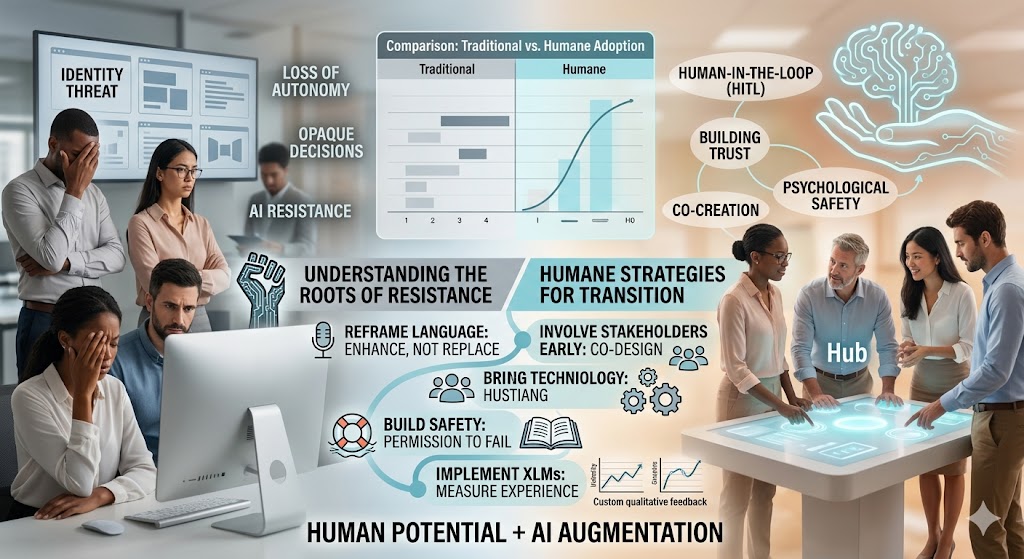
Resistance within an organization is rarely about “obstructionism.” Instead, it is a natural defense mechanism against the perceived loss of agency and the blurring of professional identity. When employees push back, they aren’t rejecting efficiency; they are protecting their sense of purpose.

To navigate this era successfully, leaders must pivot from “managing change” to designing transition. Success will not be measured by the sophistication of the LLM integrated into the workflow, but by the level of psychological safety and empathy woven into the culture. We must ensure that as our systems get smarter, our organizations stay human.

Identifying the Four Pillars of AI Fear

Addressing resistance requires us to look beneath the surface of “efficiency” and “optimization” to understand the visceral concerns that keep employees up at night. Resistance to AI generally crystallizes around four distinct pillars.

1. Identity Erosion

For many professionals, their value is tied to their craft — the ability to write, analyze, or design. When an AI can produce a draft in seconds that previously took a human hours, it triggers a crisis of identity: “If a machine can do this, what is my unique value?” We must redefine roles to focus on the human elements of strategy, ethics, and “soul” that machines cannot replicate.

2. The Black Box Problem

Trust is built on transparency. When AI systems make recommendations or automate decisions without a clear “why,” it creates a vacuum of accountability. This lack of legibility leads to a profound loss of trust in the decision-making process, making employees feel like they are passengers in their own workflows.

3. Economic Survival

This fear goes beyond the headline-grabbing “job replacement.” It includes the more subtle anxiety of task de-skilling and wage stagnation. Employees worry that as tasks become automated, their specialized expertise will be commoditized, reducing their bargaining power and long-term career resilience.

4. The Cognitive Load

We are living in a state of “perpetual beta.” The sheer velocity of AI development forces employees into a cycle of constant upskilling. This creates a cumulative cognitive load that leads to burnout. Resistance, in this context, is often a plea for a sustainable pace of change.

Moving Beyond Technical Implementation

The fatal flaw in many AI initiatives is treating the rollout as a technical deployment rather than a human experience. To address resistance, we must apply the principles of experience design to the organizational change itself. It isn’t about how the technology works; it’s about how the people work with the technology.

Experience Design for Change

We must treat the employee journey with the same rigor and empathy we afford the customer journey. This means mapping the emotional highs and lows of the transition — from the initial “fear of the unknown” to the “messy middle” of skill acquisition — and designing interventions that provide support at each critical touchpoint.

The Human-Centered Innovation Framework

True innovation occurs at the intersection of feasibility, viability, and desirability. To make AI desirable, we must utilize a framework that prioritizes human agency:

  • Inquiry over Instruction: Instead of mandating a new tool, start by asking teams: “Where are you currently stuck?” or “What tasks drain your energy?” When AI solves a self-identified pain point, resistance evaporates.
  • Co-creation: The most effective way to eliminate the “us vs. them” mentality is to bring the skeptics into the design process. By involving employees in prompt engineering and workflow redesign, we turn them from passive observers into active architects of their own future.

Strategies for Humane Integration

Humane integration is about creating a bridge between current capabilities and future possibilities without leaving the workforce behind. It requires a shift from viewing AI as a “replacement” to viewing it as a “partner” that respects human dignity.

1. Radical Transparency

Ambiguity is the fuel of anxiety. Leaders must be explicit about the roadmap for AI integration. This involves clearly mapping which tasks are targeted for augmentation (making the human faster/better) versus which are targeted for replacement. When employees understand the “why” and the “where,” they can begin to proactively pivot their skill sets.

2. The “Human-in-the-Loop” Guarantee

To address the fear of losing control, organizations should establish a “Human-in-the-Loop” policy. This ensures that while AI can generate drafts, analyze data, or suggest actions, the final accountability, ethical judgment, and creative “soul” remain a human responsibility. This preserves the employee’s role as the essential curator and decision-maker.

3. Psychological Safety Nets

Learning to work with AI involves a steep and often public learning curve. Organizations should create low-stakes “sandboxes” — environments where employees can experiment with prompts, fail, and learn without these efforts being tied to formal performance reviews. Giving people the “right to be bad” at something new is a prerequisite for them eventually becoming great at it.

4. Redefining Value and KPIs

If we continue to measure success solely by “output volume,” humans will always lose to AI. To address resistance, we must evolve our Key Performance Indicators (KPIs). We should shift our focus toward rewarding strategic insight, relational depth, and complex problem-solving — areas where the human element provides a competitive advantage that technology cannot replicate.

The Role of the Modern Leader

In the age of AI, the definition of leadership is undergoing a radical transformation. It is no longer about having all the answers, but about asking the right questions and fostering an environment where human ingenuity can thrive alongside machine intelligence.

The Vulnerable Leader

The most effective leaders are those willing to admit they don’t have a perfect crystal ball. By modeling vulnerability — acknowledging the uncertainty of the AI landscape and sharing their own learning journey — leaders lower the collective anxiety of the organization. This “in-it-together” mentality replaces top-down mandates with shared exploration.

From Commander to Curator

Traditional leadership focused on directing execution. The modern leader, however, acts as a curator. Their role is to help teams evaluate AI-generated outputs, ensuring they align with the organization’s ethical standards, brand voice, and long-term vision. They shift the team’s focus from the “grind” of production to the “art” of selection and refinement.

Empathy as a Hard Skill

Leaders must develop the ability to distinguish between process friction (technical hurdles) and emotional friction (fear and resistance). Addressing the former requires better tools; addressing the latter requires active listening and radical empathy. In a world of automated logic, empathy becomes the ultimate competitive advantage and a non-negotiable leadership competency.

Conclusion: The Future is Symbiotic

As we stand on the precipice of this new era, we must remember that technology is a mirror of our intentions. If we approach AI with a mindset of pure cost-cutting and replacement, we will harvest a culture of fear and stagnation. If, however, we approach it through the lens of human-centered innovation, we can unlock a level of creativity and problem-solving previously unimaginable.

The Human Advantage

The ultimate goal of humane AI integration is not to make humans act more like machines, but to free humans to be more human. By offloading the routine and the repetitive, we create the space to double down on our unique “Human Advantage” — intuition, ethical judgment, and deep emotional connection. These are the qualities that no algorithm can simulate and the true drivers of long-term value.

The challenge for leaders today is to build a future where technology serves the human spirit, not the other way around. We aren’t just building better tools; we are designing better ways for people to thrive in an increasingly complex world. When we lead with empathy and design with intent, resistance transforms into a shared journey toward a more symbiotic future.

Frequently Asked Questions

How do we distinguish between “change management” and “human-centered transition”?

Traditional change management often focuses on the “what” and the “how” of technical implementation. A human-centered transition focuses on the “who.” It prioritizes the psychological and emotional journey of the employee, ensuring that agency and identity are preserved as workflows evolve.

Will AI eventually replace the need for human intuition in innovation?

No. While AI is exceptional at pattern recognition and data synthesis, it lacks the lived experience, ethical nuance, and “gut feeling” that drive true innovation. The future belongs to the “Magic Maker”—the human who uses AI to amplify their creative vision rather than being replaced by it.

What is the first step for a leader facing high team resistance to AI?

The first step is radical transparency. Open a dialogue that moves beyond corporate talking points to address specific fears regarding job security and identity. By acknowledging the friction and creating a low-stakes environment for experimentation, you begin to rebuild the trust necessary for collaboration.


SPECIAL BONUS: Braden Kelley’s Problem Finding Canvas can be a super useful starting point for doing design thinking or human-centered design.

“The Problem Finding Canvas should help you investigate a handful of areas to explore, choose the one most important to you, extract all of the potential challenges and opportunities and choose one to prioritize.”

Image credit: Gemini

Subscribe to Human-Centered Change & Innovation WeeklySign up here to get Human-Centered Change & Innovation Weekly delivered to your inbox every week.

The Future of Innovation KPIs in the Age of AI

AI’s Impact on Innovation KPIs

The Future of Innovation KPIs in the Age of AI

GUEST POST from Art Inteligencia


I. Introduction: Beyond the Efficiency Trap

For decades, innovation leaders have been obsessed with velocity — how many ideas can we push through the funnel, and how fast? However, as we enter the age of Agentic AI, the traditional “speedometer” of innovation is breaking. When an AI can generate a thousand product concepts in the time it takes to pour a cup of coffee, volume is no longer a competitive advantage; it is a noise problem.

  • The Paradigm Shift: We are moving away from treating innovation as a sporadic “side project” or a series of workshops. In this new era, innovation must be a continuous, AI-integrated capability that functions as the organization’s nervous system.
  • The Trap of Productivity: There is a dangerous temptation to use AI merely to do the wrong things faster. Measuring “output” without measuring “outcome” leads to the Efficiency Trap — where teams become remarkably good at delivering features that nobody actually needs.
  • The Core Thesis: The future of Innovation KPIs isn’t about tracking machine speed; it’s about measuring Human-Machine Synergy. We must redesign our dashboards to focus on how AI augments human intuition to create deeper empathy, higher-fidelity experiences, and sustainable ecosystem impact.

“The goal is no longer to be the fastest to market, but to be the most precise in solving human problems.” — Braden Kelley

II. The Evolution of Traditional Metrics

As AI commoditizes the “generation” phase of innovation, the metrics we once used to measure success are becoming obsolete. To remain relevant, we must shift our focus from tracking activity to measuring strategic movement.

Traditional frameworks like the Innovation Funnel are being compressed. What used to take months of market research can now be synthesized in hours, necessitating a fundamental update to our measurement criteria:

  • From Throughput to Outcomes: In the past, “number of ideas generated” was a common KPI. Today, that metric is a vanity project. AI makes ideas cheap; validation is what remains expensive. We must prioritize metrics that track the quality of problem-solving over the quantity of brainstorming.
  • Reimagining R&D Spend: Instead of viewing R&D as a flat percentage of revenue, we should measure the Speed of Learning. How much does it cost us to fail? By using AI to simulate market conditions, we can lower the “Cost of Experimentation,” allowing us to explore more radical horizons without increasing financial risk.
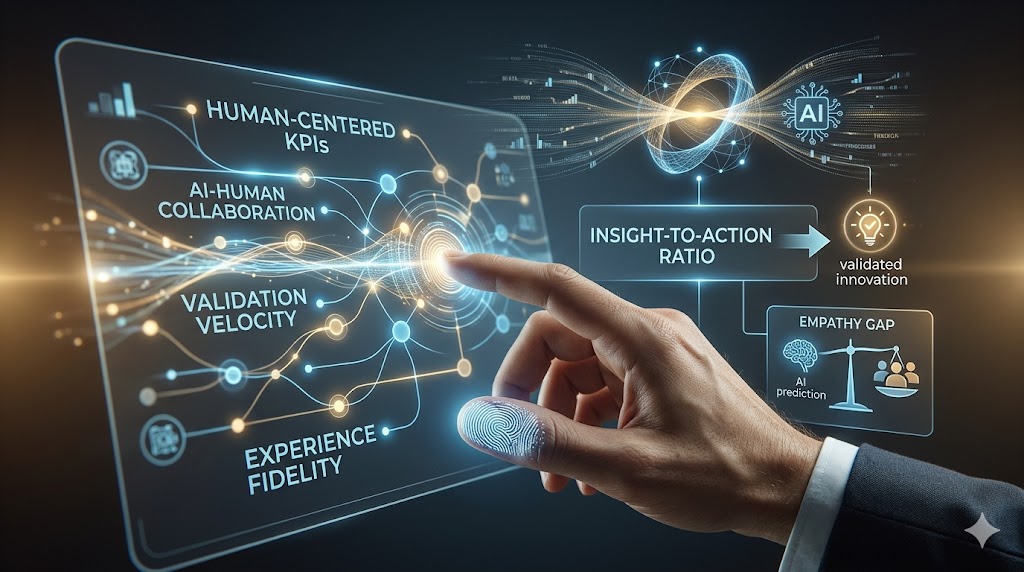
  • Human-Centered Design (HCD) Metrics: As we rely more on synthetic users and AI-driven personas, we risk losing touch with reality. We need to track the “Empathy Gap” — the distance between what an AI predicts a human needs and what a human actually experiences.

The goal is to move from a “Supply-Side” view of innovation (what we produced) to a “Demand-Side” view (the value the customer actually unlocked).

III. New KPIs for the AI Era

To lead in an AI-augmented landscape, we must introduce specialized metrics that go beyond traditional business logic. These “New KPIs” focus on the intersection of data, ethics, and the unique synergy between human creativity and machine intelligence.

1. The Insight-to-Action Ratio

Data is only as valuable as the decisions it informs. This metric measures the temporal distance between an AI-detected market signal (a “weak signal”) and the deployment of a validated, human-vetted prototype. A high ratio suggests an organization that is data-rich but “action-poor.”

2. Data Liquidity & Literacy

Innovation thrives on the fluid movement of information. Data Liquidity tracks how effectively innovation-related insights move across departmental silos to train and refine internal AI models. Combined with Literacy, it measures the organization’s ability to turn raw data into a strategic asset.

3. Collaborative Intelligence (CQ)

The most successful future organizations won’t just have the best AI; they will have the best human-AI teams. The CQ metric evaluates how effectively humans are prompting, refining, and steering AI outputs to achieve results that neither could produce in isolation.

4. Ethical Innovation Index

In the age of AI, guardrails are not obstacles — they are essential KPIs. This index measures bias detection frequency, transparency scores in algorithmic decision-making, and the alignment of new solutions with long-term human agency and societal well-being.

By implementing these measures, we ensure that AI remains a tool for Human-Centered Change, rather than just a driver of automated mediocrity.

IV. Measuring the “Middle of the Funnel”

The “Middle of the Funnel” is traditionally where innovation goes to die — the messy transition from a promising idea to a scalable reality. In the AI era, this stage becomes a high-speed laboratory where Experience Level Measures (XLMs) take precedence over rigid operational quotas.

  • Validation Velocity: We no longer need to wait months for physical market tests. By utilizing AI to simulate complex market conditions and consumer behaviors, we measure how quickly we can “kill” a bad idea. Success is defined by the speed at which we stop investing in the wrong things.
  • Pivot Frequency: In a volatile landscape, staying the course is often a recipe for irrelevance. This KPI tracks the number of strategic shifts informed by real-time AI data analysis. It rewards teams for being agile enough to redirect resources toward higher-value opportunities as they emerge.
  • Experience Fidelity: As we move through development, we must measure how closely the evolving product aligns with the intended Human Experience (HX). This involves using AI to audit journey maps and touchpoints, ensuring that the qualitative essence of the design isn’t lost in the technical execution.

By focusing on these middle-stage metrics, we transform the innovation process from a linear assembly line into a dynamic, iterative cycle of FutureHacking™.

V. Strategic Impact and Futurology

To truly future-proof an organization, Innovation KPIs must look beyond the current fiscal year. In the Age of AI, we must measure our ability to shape the future, not just react to it. This requires a shift toward Ecosystem Thinking and the valuation of intellectual capital.

  • The Ecosystem Health Score: We are moving away from isolated “Product KPIs” toward measures of mutual value. This score evaluates how an innovation strengthens the entire network — including partners, customers, and the environment. In a connected world, an innovation that succeeds at the expense of its ecosystem is a long-term failure.
  • Future-Proofing Index: This metric audits the innovation portfolio against the three horizons of growth. Specifically, it tracks the balance between Horizon 1 (incremental AI improvements to current products) and Horizon 3 (transformational AI applications that could disrupt our own business model).
  • The Return on Intelligence (ROI 2.0): Traditional ROI focuses on immediate financial gains. ROI 2.0 measures the “Knowledge Equity” generated during the innovation process. Even a project that never reaches the market can yield a high ROI if it produces unique data, reusable AI models, or deep customer insights that fuel future breakthroughs.

By shifting our perspective toward these long-term signals, we ensure that our strategic investments are building a sustainable Experience Management Office (XMO) rather than just chasing the latest tech trend.

VI. Conclusion: The Leader’s New Compass

As we navigate the complexities of the Age of AI, our measurement systems must evolve from tools of control to tools of exploration. The metrics we choose to track do more than just report progress — they signal to our organizations what we truly value. If we measure only efficiency, we will get automation; if we measure meaning, we will get innovation.

  • The Shift in Mindset: Modern Innovation KPIs should function like a GPS for exploration rather than a speedometer for production. Their purpose is to help us navigate uncertainty and re-calibrate our path toward long-term value.
  • Empowering the Human Element: In an increasingly automated world, the ultimate differentiators remain human curiosity, intuition, and empathy. Leaders must protect the space for these qualities to flourish, using AI to handle the “predictable” so humans can focus on the “possible.”
  • Final Thought: Innovation has always been about making the world better for people. AI is not the destination; it is the most powerful vehicle we’ve ever had to reach that goal. By aligning our KPIs with human-centered change, we ensure that our technological progress leads to genuine human advancement.

The future isn’t something that happens to us — it’s something we build, one measured step at a time.

Frequently Asked Questions

Will AI eventually replace the need for Innovation KPIs?

No. AI will automate the collection and analysis of data, but it cannot define what “value” looks like for your specific organization or customers. As we move toward Agentic AI, KPIs become even more critical as the steering mechanism that ensures autonomous systems remain aligned with human-centered goals.

How do Experience Level Measures (XLMs) differ from traditional SLAs in innovation?

While SLAs (Service Level Agreements) focus on technical performance and uptime, XLMs measure the qualitative impact of an innovation on the human experience. In the age of AI, technical success is the baseline; true innovation success is measured by how effectively a solution removes friction and empowers the user.

What is the most important “New KPI” for a leadership team to adopt first?

The Insight-to-Action Ratio is the most critical starting point. In an AI-driven landscape, the bottleneck is rarely a lack of insights; it is the organizational inertia that prevents those insights from becoming prototypes. Improving this ratio directly increases your organizational agility.


SPECIAL BONUS: Braden Kelley’s Problem Finding Canvas can be a super useful starting point for doing design thinking or human-centered design.

“The Problem Finding Canvas should help you investigate a handful of areas to explore, choose the one most important to you, extract all of the potential challenges and opportunities and choose one to prioritize.”

Image credit: Gemini

Subscribe to Human-Centered Change & Innovation WeeklySign up here to get Human-Centered Change & Innovation Weekly delivered to your inbox every week.

Accountability Frameworks for Human-AI Teams

LAST UPDATED: May 3, 2026 at 10:10 AM
Accountability Frameworks for Human-AI Teams

GUEST POST from Chateau G Pato


The Death of the “Black Box” Excuse

For years, we have treated Artificial Intelligence as a sophisticated utility — a faster calculator or a more intuitive search engine. But that era is over. We have crossed the threshold into agentic collaboration, where AI is no longer a silent tool but a functional, active teammate. This shift demands more than just a change in workflow; it requires a fundamental redesign of our ethical and operational foundations.

The Growing Responsibility Gap

As human-AI teams begin to co-create, we encounter the “Responsibility Gap.” Traditional organizational structures are ill-equipped to handle outcomes generated through hybrid intelligence. When a process is obscured by algorithmic complexity, and the human “partner” acts only as a rubber stamp, accountability evaporates. If we cannot trace the logic of a decision, we cannot learn from its failure.

A Human-Centered Thesis for Innovation

To unlock the true potential of this partnership, we must stop viewing accountability as a punitive liability and start designing it as a shared, transparent, and human-centered asset. True innovation thrives on trust, and trust is built on the clarity of who owns the intent, who owns the execution, and how we collectively govern the results. We aren’t just building better tools; we are building a more responsible future for work.

Defining the New “Shared Agency”

In the landscape of human-centered innovation, we must distinguish between output and outcome. While an AI can generate a high volume of output (data, code, or copy), the human teammate is responsible for the outcome — the real-world impact and the strategic alignment of that work. Agency in this new era is not a zero-sum game; it is a collaborative spectrum.

The “Human-in-the-Loop” Fallacy

Simply placing a human in the workflow to “check the box” is a recipe for catastrophic failure. This “passive oversight” leads to automation bias, where humans become too trusting of the system and lose their critical edge. To maintain true accountability, the human role must shift from supervisor to active collaborator, ensuring that the AI’s speed is always balanced by human judgment and ethical context.

A Taxonomy of Collaboration

Establishing clear boundaries of agency is the first step toward a robust accountability framework. We categorize these interactions into three distinct levels:

  • AI-Driven / Human-Verified: The AI takes the lead on heavy lifting and pattern recognition, while the human provides a rigorous audit and final approval.
  • Human-Driven / AI-Augmented: The human directs the creative and strategic vision, using AI to expand capabilities, brainstorm, or refine specific elements.
  • Autonomous Edge Cases: Pre-defined parameters where the AI operates independently within high-speed, low-risk environments, with humans designing the governance “guardrails.”

By codifying these roles, we move away from accidental collaboration and toward a structured, intentional partnership where every contributor — carbon or silicon — has a defined purpose.

The Architecture of a Modern Accountability Framework

Designing for accountability requires us to move beyond vague notions of “responsibility” and into the granular details of systems design. We must build structures that can withstand the speed of AI while maintaining the integrity of human oversight. This architecture isn’t just about technical constraints; it’s about experience design (XD) for the people who manage these systems.

The RACI Matrix 2.0

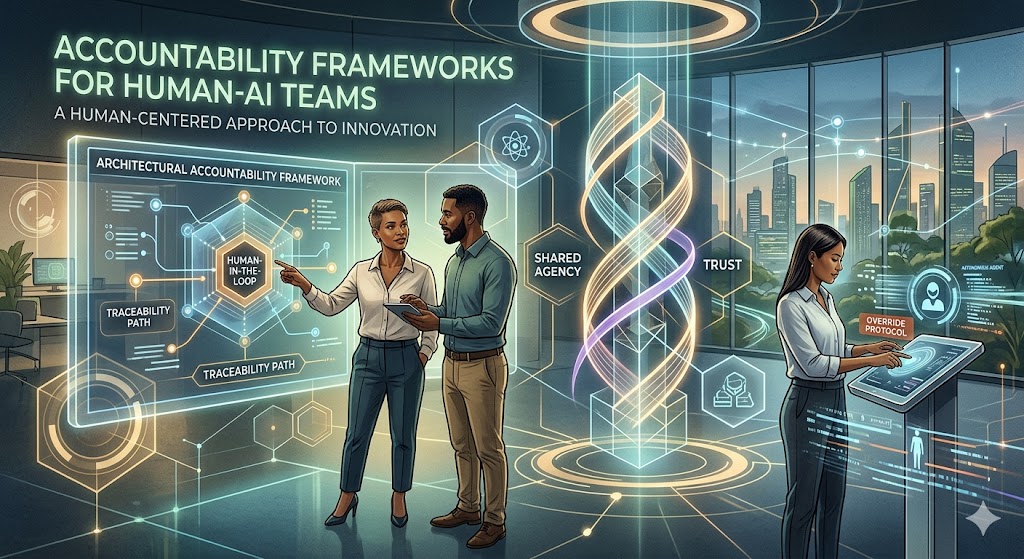
The traditional RACI model (Responsible, Accountable, Consulted, Informed) must be re-engineered for the hybrid workforce. In a human-AI team, the AI might be Responsible for the execution of a task, but a human must always remain Accountable for the result. We must clearly define who is “Informed” when an AI drifts from its baseline and who must be “Consulted” when the AI suggests a radical pivot in strategy.

Traceability by Design

Accountability is impossible without transparency. Every output generated by an AI teammate must have a “provenance trail” — a clear map of the data inputs, prompts, and logic used to arrive at a conclusion. By treating traceability as a core design requirement, we ensure that when a system fails, we aren’t looking at a “black box,” but at a documented path that can be audited, understood, and corrected.

The “Kill Switch” and Override Protocols

True leadership in an AI-integrated world means knowing when to pull the plug. A robust framework establishes clear “Kill Switch” protocols:

  • Threshold Alerts: Automated triggers that notify human leads when AI confidence scores drop below a specific percentage.
  • Manual Override Authority: Clearly designated roles with the power to bypass AI-driven decisions without bureaucratic delay.
  • Emergency Rollbacks: The ability to revert to a “last known good” human-validated state when an autonomous agent produces unexpected outcomes.

By building these safeguards directly into the organizational fabric, we empower our teams to innovate boldly, knowing that the safety nets are both visible and functional.

Designing for Transparency and Trust

Trust is the currency of innovation. In a human-AI partnership, trust cannot be blind; it must be earned through transparency. If a team does not understand how their digital counterpart arrives at a conclusion, they will either follow it off a cliff or ignore it entirely — both of which are disastrous for experience design and organizational growth.

Explainability as a Right

We must move toward a standard where “Explainable AI” (XAI) is not a luxury feature but a fundamental right for every employee. “The AI said so” is an unacceptable defense in any business context. Accountability frameworks must mandate that AI outputs include a plain-language rationale, allowing human teammates to evaluate the logic behind the recommendation rather than just the result.

Real-Time Feedback Loops

Accountability is a two-way street. To prevent algorithmic drift and the entrenchment of bias, we must design mechanisms where humans can correct AI outputs in real-time. This isn’t just about fixing an error; it’s about active mentoring. These feedback loops ensure that the AI learns from the human’s nuanced understanding of culture, ethics, and strategy, creating a virtuous cycle of continuous improvement.

Cultivating Psychological Safety

Innovation dies in an environment of fear. For a human-AI team to function, humans must feel psychologically safe to question, challenge, or reject an AI’s suggestion. A robust framework ensures that:

  • Dissent is Valued: Challenging an algorithm is viewed as a form of “quality assurance” rather than an obstacle to efficiency.
  • Bias Reporting: There are clear, non-punitive channels for reporting perceived biases or ethical lapses in the AI’s behavior.
  • Human Agency: The ultimate decision-making power is visibly vested in people, reinforcing that AI is a partner in the process, not the master of it.

By prioritizing these human-centered elements, we transform the AI from a mysterious “black box” into a transparent, reliable, and accountable colleague.

Change Management: Implementing the Framework

The most sophisticated accountability framework in the world is useless if it exists only as a static document. Integrating AI into the team fabric is a cultural transformation, not a software deployment. To move from theory to practice, we must design the transition with as much intentionality as the technology itself.

From Monitoring to Mentoring

We must shift the organizational mindset. Traditional management often views AI oversight as “monitoring” — a defensive posture designed to catch errors. To drive innovation, we must reframe this as “mentoring.” When a human teammate audits an AI’s output, they are not just checking for mistakes; they are training the system on the nuance of the brand, the ethics of the industry, and the complexities of human experience.

Upskilling for Governance

Accountability requires a new set of competencies. It is no longer enough for employees to be “AI literate”; they must be governance-capable. This includes:

  • Critical Prompting: The ability to structure inquiries that minimize bias and maximize transparency.
  • Algorithmic Auditing: Basic skills in identifying “hallucinations” or logical inconsistencies in generative outputs.
  • Ethical Decision-Making: Strengthening the human capacity to make value-based judgments that an AI, by its very nature, cannot replicate.

Iterative Governance: The Living Document

In the world of futurology, we know that the only constant is acceleration. An accountability framework must be a “living document” that evolves alongside the technology. We recommend Quarterly Governance Sprints, where teams reconvene to assess where the framework held firm and where the speed of agentic AI created new, unforeseen “blind spots.”

By treating the implementation as an ongoing journey of experience design, we ensure that our teams remain agile, empowered, and — above all — accountable for the future they are building.

Conclusion: The Futurist’s Perspective

As we look toward the horizon of the next decade, the organizations that thrive won’t just be those with the fastest processors or the largest datasets. They will be the ones that have mastered the social architecture of Human-AI collaboration. Accountability is not a bureaucratic anchor; it is a competitive advantage that provides the psychological safety necessary for radical experimentation.

Accountability as a Catalyst for Speed

There is a common misconception that guardrails slow us down. In reality, a well-designed accountability framework acts like the brakes on a high-performance racing car — it is precisely because you know you can stop that you have the confidence to go faster. When teams understand exactly where the responsibility lies, they can iterate with a level of boldness that “black box” systems simply don’t allow.

The Architect of Intent

Ultimately, the goal of human-centered innovation is to ensure that technology serves humanity, not the other way around. While we will increasingly share our labor with AI, we must never outsource our intent. The future belongs to the leaders who treat AI as a powerful co-author of the work, while remaining the ultimate architects of the mission.

“We are moving from a world of ‘doing the work’ to a world of ‘designing the outcomes.’ In this shift, our accountability is the only thing that keeps our innovation anchored to our values.” — Braden Kelley

The frameworks we build today are the blueprints for the collaborative culture of tomorrow. Let’s design them to be as intelligent, transparent, and resilient as the future we hope to create.

Frequently Asked Questions

Who is ultimately responsible for an AI’s error?

In a human-centered framework, the human lead remains the Accountable party. While the AI is responsible for the execution (the output), the human is responsible for the outcome and must ensure the result aligns with ethical and strategic standards.

Does an accountability framework slow down innovation?

Quite the opposite. By defining clear guardrails and “Kill Switch” protocols, teams gain the psychological safety needed to move faster. Clear boundaries prevent the “analysis paralysis” that often occurs when ethical or operational risks are ambiguous.

What is “Traceability by Design”?

It is the practice of building AI systems that automatically document their logic and data sources. This ensures that every decision can be audited, allowing human teammates to understand the “why” behind an AI’s suggestion.

Bottom line: Futurology is not fortune telling. Futurists use a scientific approach to create their deliverables, but a methodology and tools like those in FutureHacking™ can empower anyone to engage in futurology themselves.

Image credit: Gemini

Subscribe to Human-Centered Change & Innovation WeeklySign up here to get Human-Centered Change & Innovation Weekly delivered to your inbox every week.
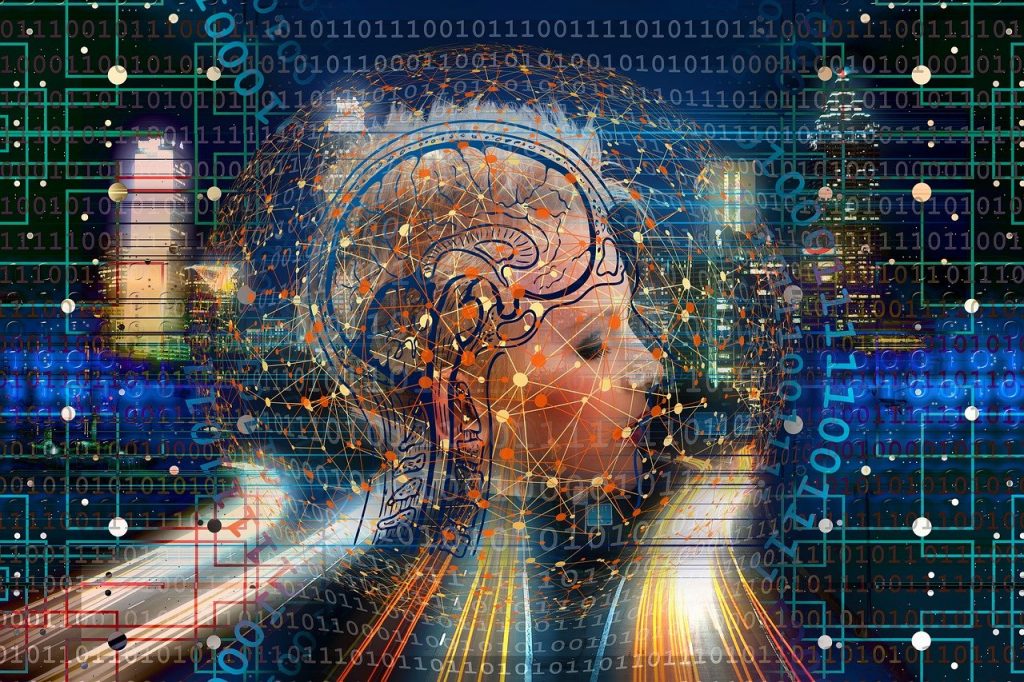
AI-Enabled Decision Making: What Are the Benefits?

AI-Enabled Decision Making: What Are the Benefits?

GUEST POST from Chateau G Pato

Artificial intelligence (AI) is quickly emerging as a powerful tool for business decision making. Companies of all sizes are realizing the potential of AI to provide insights and automate manual processes that previously served to hinder the decision-making process. In this article, we’ll take a look at some of the benefits that AI-enabled decision making can bring to a business, as well as some examples of successful implementations.

One of the most significant benefits of AI-enabled decision making is the ability to analyze large data sets and identify patterns that inform decisions. By harnessing powerful algorithms, AI can uncover correlations that are otherwise not visible. This can be especially beneficial in customer and market segmentation, where the application of AI-driven analytics can help uncover new growth opportunities. For example, one company used AI to analyze customer data as part of its product segmentation strategy. This enabled the company to develop personalized recommendations that drove increased customer loyalty and revenue growth.

Case Study 1 – Automating Chargeback Calculations

In addition to analyzing data, AI can automate tedious manual tasks for more efficient and accurate decision-making. For example, a global accounting firm used AI to automate chargeback calculations. By eliminating manual human review, AI enabled the company to process thousands of invoices in a fraction of the time. This reduced the cost of processing while improving accuracy and creating an overall better customer experience.

Case Study 2 – AI-Enabled Predictive Logistics

Finally, AI can be used to create predictive models that anticipate future actions, trends, and outcomes. By using AI to develop predictive models, businesses can get a jumpstart on preparing for potential events ahead of time. For example, a logistics firm developed an AI-enabled predictive model that anticipated customer buying patterns and adjusted its shipping routes accordingly. This enabled the company to save time and money through improved deployment of its assets.

Conclusion

AI-enabled decision making offers a range of potential benefits to businesses of all sizes. By leveraging powerful algorithms to analyze data, automate processes, and create predictive models, companies can improve decision making while creating a competitive edge. Through the use of case studies, this article has highlighted some of the key benefits of AI-enabled decision making that can be applied to a variety of organizational contexts.

Image credit: Pixabay

Subscribe to Human-Centered Change & Innovation WeeklySign up here to get Human-Centered Change & Innovation Weekly delivered to your inbox every week.