
Tag Archives: Artificial Intelligence

The Experience Economy After AI

The Experience Economy After AI

GUEST POST from Chateau G Pato


I. The Generated Abundance Paradox

The Cost-of-Entry Trap: When Infinite Output Meets Marginal Cost Zero

For decades, digital transformation was built on a simple promise: digitize the asset, remove transaction friction, and scale without incremental cost. Generative artificial intelligence, autonomous agents, and synthetic content engines represent the logical conclusion—and sudden break—of that paradigm. Today, software can instantly generate bespoke software code, synthesize personalized marketing campaigns, generate infinite media, and automate transactional interactions at near-zero marginal cost.

However, this capabilities explosion creates a profound strategic trap for organizational leadership. When every enterprise gains access to the same generative foundation models and automated execution engines, speed and volumetric production collapse into baseline expectations. When content, code, and basic interactions become infinitely abundant, their standalone economic value trends toward zero. Hyper-efficiency and automated generation cease to be source advantages; they become mere cost-of-entry table stakes.

The Strategic Inversion: The Commoditization of Efficiency

This reality forces a fundamental strategic inversion. In the traditional business playbook, competitive advantage was earned by optimizing processes, shortening turnaround times, and eliminating human touchpoints to drive efficiency. In a post-AI landscape, because efficiency is universally accessible via API, it can no longer deliver long-term differentiation.

The strategic leverage point flips completely:

  • Old Paradigm: Value lived in the production and execution layer (building, drafting, calculating, scheduling, and transaction handling).
  • New Paradigm: The production layer is automated, shifting value upward to intent, curation, context, and emotional resonance.

Organizations that attempt to compete solely on automated volume or algorithmic speed find themselves trapped in a race to the bottom—a commodity treadmill where every participant offers instantaneous, highly competent, yet completely unmemorable outputs.

The Shift to Experience Economy 2.0

In B. Joseph Pine II and James H. Gilmore’s original framing of the Experience Economy, businesses progressed from commodities to goods, goods to services, and services to staged experiences. In the AI era, we are witnessing the emergence of Experience Economy 2.0.

If digital services and automated interactions become ambient and invisible, economic scarcity moves from the efficiency of digital delivery to the authenticity of human connection. Customers and employees alike do not suffer from a lack of information, choice, or automated response; they suffer from noise, synthetic overload, and relational fatigue.

Experience Economy 2.0 re-anchors economic value around what algorithms cannot replicate:

  • Contextual Wisdom over Synthetic Information: Moving from generating data to applying human judgment, ethics, and nuance.
  • Shared Human Reality over Algorithmic Isolation: Prioritizing authentic physical presence, tactile engagement, and verified human craftsmanship.
  • Radical Trust over Automated Convenience: Building deep relational equity in an ecosystem saturated with synthetic noise and machine-driven interactions.

To win in this next era, executive leaders must stop treating AI as a tool for cutting human touch points out of the value chain. Instead, they must deploy AI to absorb transactional friction, liberating human capital to architect meaningful, high-empathy experiences that drive lasting loyalty and organizational resilience.

II. The Four Pillars of Human Value in the Post-AI Landscape

As algorithmic capability scales across every industry, executives must ask a fundamental question: When competent task execution is free, instant, and ubiquitous, what creates durable value? The answer lies in four human-centered pillars that cannot be synthesized by mathematical models or generative loops. These pillars form the structural bedrock of strategy and experience design in a post-AI world.

1. Emotional Resonance Over Frictionless Scale

For two decades, experience design was dominated by the pursuit of frictionless transactions. Companies streamlined checkouts, automated customer service, and optimized digital flows to minimize effort. In an AI-saturated market, however, frictionless interaction is merely the baseline expectation, not a differentiator. Cold, hyper-optimized algorithmic touchpoints—no matter how fast or accurate—fail to build emotional equity.

When consumers interact with frictionless AI interfaces all day, flawless performance becomes invisible, while synthetic coldness becomes grating. Sustainable loyalty is built through emotional resonance—the intentional design of moments that evoke feeling, demonstrate empathy, and convey genuine human intent. Brands that thrive in Experience Economy 2.0 do not merely solve problems efficiently; they architect interactions that make people feel seen, valued, and understood.

2. The Premium of Physicality & Presence

As digital content, virtual assistants, and synthetic media flood every channel, digital experiences suffer from systemic devaluation. When anything can be generated on a screen in seconds, screen-bound interactions lose their novelty and weight. Consequently, a powerful counter-trend emerges: a dramatic resurgence in the value of physical, tactile, and spatially shared experiences.

Physicality carries an inherent proof of commitment and effort that digital pixels cannot mimic. Whether through face-to-face executive advisory, tactile product design, immersive physical environments, or locally anchored community spaces, physical presence provides grounding in an increasingly synthetic world. Experience architects must treat physical spaces not as legacy real estate costs, but as high-value sanctuaries for authentic human connection.

3. Radical Trust & Verified Authenticity

The proliferation of generative models, synthetic voices, automated communications, and deepfakes creates a climate of pervasive cognitive fatigue and skepticism. When customers cannot easily distinguish whether an article, email, video, or support agent is human or synthetic, trust becomes the rarest and most fragile organizational asset.

Radical trust is not built through compliance statements or marketing claims; it is forged through radical transparency, verified origin, and consistent operational integrity. Organizations must cultivate clear boundaries regarding where synthetic automation ends and human accountability begins. Brands that openly protect human authenticity and consistently honor their commitments build an unshakeable moat of trust that algorithmic competitors cannot erode.

4. Human Judgment & Discernment

Generative AI is an extraordinary engine for possibility generation—it can produce hundreds of design variations, draft dozens of strategies, or analyze millions of data points instantly. However, synthetic generation lacks taste, moral responsibility, and contextual wisdom. Abundance without direction yields chaos.

This reality elevates human judgment and discernment from secondary supervisory tasks to the primary engine of strategic value. True innovation shifting from “What can we generate?” to “What should we create?” Human discernment applies ethics, cultural nuance, strategic alignment, and empathy to curate options and make meaningful choices. In Experience Economy 2.0, the ultimate competitive advantage lies not in the volume of ideas generated, but in the wisdom applied to select and execute the right ones.

III. Redesigning the Experience Architecture

To capture the value generated by human context, emotional resonance, and radical trust, organizations must fundamentally overhaul their experience architecture. Traditional enterprise systems were designed to standardize human behavior into repeatable, assembly-line tasks. In Experience Economy 2.0, the goal is inverted: we must systemize algorithmic work into invisible background infrastructure, liberating human workforce capability to deliver high-empathy, high-discernment value at every critical touchpoint.

1. Invisible Infrastructure vs. Human Touchpoints

Architecting experiences in a post-AI landscape requires a rigorous division between back-stage operations and front-stage human engagement. AI models, predictive analytics, and automated workflows belong in the background—acting as a high-speed engine that eliminates administrative friction, anticipates needs, and surfaces relevant context in real time.

When customer-facing or employee-facing interactions occur, the technology should feel invisible, acting as an empowering proxy rather than a barrier. The front stage must be intentionally reserved for human connection, creative direction, and relational depth. By drawing a clear boundary between machine prediction and human presentation, leaders ensure that technology handles the routine data processing while humans drive the meaningful interactions that build brand equity.

2. Overcoming the Four Psychological Disruptions

Transforming experience architecture is impossible if the internal workforce is paralyzed by technological change. As AI assumes cognitive and analytical tasks, employees experience four distinct psychological disruptions that leaders must proactively address:

  • Worker Anxiety: The existential fear of displacement by automated agents, which leads to passive resistance or quiet withholding of expertise.
  • Purpose Erosion: The loss of professional identity when routine tasks that once defined daily achievement are performed instantly by software.
  • Competence Displacement: The frustration that occurs when legacy skills become obsolete overnight, requiring new modes of human-machine orchestration.
  • Belonging Disruption: The isolation stemming from reduced interpersonal collaboration as workers interact increasingly with algorithmic tools rather than peers.

Human-centered innovation strategies must address these disruptions directly by redefining career pathways, emphasizing high-value judgment roles, and cultivating an organizational culture where technology liberates human potential rather than replacing it.

3. From Service Level Agreements (SLAs) to Experience Level Measures (XLMs)

Traditional operational management relies heavily on Service Level Agreements (SLAs)—metrics focused on speed, volume, uptime, and transactional efficiency (e.g., average handle time, response latency, ticket resolution counts). In a world where AI can resolve basic queries instantly, SLA-driven metrics become vanity indicators that fail to capture genuine customer satisfaction or relational health.

Forward-thinking organizations must transition to Experience Level Measures (XLMs). While SLAs evaluate operational throughput, XLMs measure the emotional, cognitive, and relational impact of an interaction. XLMs shift the diagnostic focus from efficiency to efficacy:

Metric Domain Traditional SLA Focus (Operational Efficiency) Post-AI XLM Focus (Human-Centered Value)
Customer Support Average Handle Time (AHT) & Ticket Speed Empathy Index, Friction Reduction & Trust Equity
Product Design Feature Count & Deployment Velocity Cognitive Clarity, Delight & Physical Ergonomics
Employee Experience Task Throughput & Process Adherence Creative Autonomy, Purpose Alignment & Empowerment
Client Advisory Report Generation & Meeting Frequency Strategic Clarity, Confidence & Judgment Quality

By measuring progress through Experience Level Measures, executive leaders align operational goals with true value creation—ensuring that efficiency gains powered by AI directly elevate the human experience for both customers and employees.

IV. Strategic Imperatives for Innovation Leaders

Navigating the transition into Experience Economy 2.0 requires C-suite executives and innovation leaders to fundamentally reassess how they measure value, deploy capital, and orchestrate their organizational capabilities. When generative tools render transactional tasks universally accessible, competitive advantage is no longer determined by how aggressively an organization cuts human costs, but by how effectively it leverages technology to liberate human empathy, creativity, and strategic foresight.

1. Resisting the Cost-Cutters’ Trap

The most dangerous trap facing executive leadership in the AI era is the temptation to view advanced automation purely as a headcount reduction exercise. When algorithms can draft copy, synthesize data, or manage basic customer inquiries at negligible cost, short-term financial pressure creates an urgency to replace human workers with synthetic touchpoints across the entire value chain.

This efficiency-first mindset leads to corporate anorexia—a condition where an organization strips out the very human presence, emotional resonance, and relational trust that give its brand distinct meaning. While cutting human touchpoints may yield an immediate, temporary margin expansion, it simultaneously erodes long-term pricing power and brand equity. When every competitor uses the same generative models to deliver identical, frictionless interactions, the automated enterprise becomes an interchangeable commodity. Leaders must resist this trap, redirecting cost savings from routine automation into funding high-empathy, high-touch human experiences that create sustainable market moats.

2. Orchestrating Human-AI Symbiosis

True competitive differentiation in a post-AI landscape stems from human-machine orchestration—a strategic paradigm where artificial intelligence and human discernment reinforce one another in a continuous feedback loop. AI serves as the ultimate systemic liberator, handling complex pattern recognition, background predictive analytics, synthetic prototyping, and administrative friction at scale.

This liberation allows human workforce capability to focus on what algorithms inherently lack:

  • Contextual Wisdom: Interpreting nuanced, ambiguous customer needs that fall outside historical training data.
  • Ethical Stewardship: Ensuring strategic decisions, automated outputs, and customer engagements align with human values and organizational integrity.
  • Creative Synthesis: Connecting disparate ideas across domain boundaries to invent entirely new categories, business models, and experience frameworks.
  • Relational Depth: Building authentic, high-trust connections that inspire confidence during moments of crisis, complexity, or transformation.

By positioning AI as a cognitive copilot rather than a human replacement, organizations build an agile, adaptive operating model where technology elevates human potential rather than suppressing it.

3. Building for Lasting Differentiation

To lead effectively in Experience Economy 2.0, executive teams must pivot their strategic planning horizons from managing transactional volume to cultivating brand soul, physical engagement, and verified authenticity. Lasting differentiation requires a commitment to three core organizational capabilities:

Strategic Vector Legacy Approach (Transaction-Centric) Post-AI Approach (Experience-Centric)
Value Proposition Speed, volume, and cost minimization per transaction. Emotional resonance, trust equity, and transformational outcomes.
Technology Deployment Paving front-stage customer touchpoints with automated bots. Embedding AI into invisible back-stage operations to empower front-stage staff.
Core Competency Process execution and task standardization. Human discernment, taste, judgment, and high-empathy curation.
Success Architecture Measured by Service Level Agreements (SLAs) and throughput. Governed by Experience Level Measures (XLMs) and relational lifetime value.

Ultimately, the post-AI era does not herald the obsolescence of human effort; it marks a profound renaissance of human value. Leaders who recognize this shift early will move beyond the race for synthetic abundance, building resilient, human-centered organizations that thrive at the intersection of technological efficiency and authentic human experience.

Frequently Asked Questions

What is Experience Economy 2.0 in the context of AI?

Experience Economy 2.0 is a strategic shift where automated generation, synthetic content, and hyper-efficient digital transactions become table stakes. As AI commoditizes transactional efficiency to near-zero marginal cost, economic scarcity and value shift toward what machines cannot replicate: human discernment, physical presence, emotional resonance, and radical trust.

How do Experience Level Measures (XLMs) differ from traditional SLAs?

Service Level Agreements (SLAs) evaluate operational efficiency and throughput, measuring metrics like response times, handle times, and ticket volumes. Experience Level Measures (XLMs) assess the qualitative, emotional, and relational impact of an interaction, tracking indicators such as empathy, cognitive clarity, trust equity, and friction reduction.

Why is replacing human touchpoints strictly with AI a strategic trap for brands?

Viewing AI purely as a tool for headcount reduction strips out the human presence and relational depth that give a brand distinct meaning. When competitors leverage the same generative foundation models to deliver identical, frictionless interactions, the enterprise becomes an interchangeable commodity, eroding long-term pricing power and brand equity.


Bottom line: Futurology is not fortune telling. Futurists use a scientific approach to create their deliverables, but a methodology and tools like those in FutureHacking™ can empower anyone to engage in futurology themselves.

Image credit: Gemini

Subscribe to Human-Centered Change & Innovation WeeklySign up here to get Human-Centered Change & Innovation Weekly delivered to your inbox every week.

The Role of AI in Shaping the Future of Work

The Role of AI in Shaping the Future of Work

GUEST POST from Chateau G Pato

Artificial Intelligence (AI) is no longer just a concept from science fiction movies – it has become a reality that is reshaping various industries, including the way we work. As AI technologies continue to evolve, they are playing an increasingly significant role in revolutionizing work processes across different sectors. In this article, we will explore how AI is shaping the future of work and discuss two case study examples that demonstrate its potential.

Case Study 1 – Customer Service

One prominent example of AI transforming the workplace is in the field of customer service. Traditionally, customer inquiries were handled by human operators, often resulting in long wait times and limited availability. However, with the advent of AI-powered chatbots, organizations are able to provide 24/7 customer support with minimal wait times. These AI chatbots are capable of understanding and responding to customer queries in real-time, offering personalized assistance and resolving issues efficiently. For instance, leading global e-commerce platform, Amazon, utilizes AI-powered chatbots to assist customers with order inquiries, tracking shipments, and answering frequently asked questions. The implementation of these AI chatbots has not only improved customer satisfaction but also reduced the workload for human customer service agents, allowing them to focus on more complex and specialized tasks.

Case Study 2 – Healthcare

Another example of AI’s impact on work processes can be seen in the healthcare industry. Medical professionals are now leveraging AI technologies to enhance diagnostic accuracy and patient care. AI algorithms can analyze vast amounts of medical data, including patient records, lab results, and medical images, to assist doctors in making more informed decisions. One such case study involves the use of AI in radiology. A study published in Nature found that an AI algorithm developed by Google’s DeepMind outperformed human radiologists in detecting breast cancer from mammogram images. By leveraging AI’s ability to detect subtle patterns and anomalies, this technology has the potential to tremendously improve early diagnosis rates and reduce the burden on radiologists.

Beyond Healthcare and Customer Service

The application of AI in the workplace extends beyond customer service and healthcare. Industries such as finance, manufacturing, and logistics are also witnessing the transformational impact of AI on work processes. Financial institutions are employing AI-powered algorithms to automate repetitive tasks, such as fraud detection and risk assessment, enabling them to operate more efficiently and securely. In manufacturing, AI-powered robots are being utilized for tasks that require precision and repetitive manual labor, resulting in increased productivity and cost savings. Moreover, in logistics and supply chain management, AI technologies are being used to optimize route planning, inventory management, and demand forecasting, reducing operational costs and enhancing delivery efficiency.

As AI continues to evolve, it is evident that its role in shaping the future of work will expand even further. It presents both opportunities and challenges. While the implementation of AI can automate mundane tasks, improve efficiency, and reduce human error, it also raises concerns about job displacement and the need for upskilling. It is important for organizations and individuals to adapt and embrace AI technologies to stay competitive in the evolving job market.

Conclusion

AI is revolutionizing the way we work across various industries. Case studies show that AI-powered chatbots are transforming customer service, ensuring round-the-clock assistance and enhancing customer satisfaction. Additionally, AI algorithms are augmenting the capabilities of healthcare professionals, allowing for more accurate diagnoses and improved patient care. From finance to manufacturing and logistics, AI is impacting work processes and opening up new opportunities for efficiency and innovation. The future of work is undoubtedly intertwined with AI, and embracing its potential will be essential for success in the evolving job market.

Bottom line: Futurology is not fortune telling. Futurists use a scientific approach to create their deliverables, but a methodology and tools like those in FutureHacking™ can empower anyone to engage in futurology themselves.

Image credit: Pixabay

Subscribe to Human-Centered Change & Innovation WeeklySign up here to get Human-Centered Change & Innovation Weekly delivered to your inbox every week.

What Role Should Artificial Intelligence Play in Innovation?

What Role Should Artificial Intelligence Play in Innovation?

GUEST POST from Art Inteligencia

Innovation is an ever-evolving process that is constantly pushing the boundaries of what we can do. Artificial intelligence (AI) is quickly becoming a major player in the world of innovation, and its impact is already being felt across many different industries.

From increasing the efficiency of production processes to making more informed decisions, AI is helping to revolutionize the way businesses operate. AI is able to process large amounts of data quickly and accurately, allowing businesses to make better decisions faster. By leveraging AI, businesses can optimize their operations and increase productivity.

AI is also helping to drive innovation in healthcare. AI-powered algorithms are being used to detect diseases and diagnose medical conditions more accurately, and to develop more personalized treatments. AI is also helping medical professionals to better manage their patient data, providing them with more accurate insights into the patient’s condition.

AI is also revolutionizing the transportation industry. Self-driving cars are now a reality, and AI is helping to make them a safe and efficient form of transportation. AI-powered navigation systems are helping to reduce traffic congestion, and are allowing for more efficient route planning.

AI is also impacting the retail industry. AI-powered chatbots are helping to improve customer service and provide a more personalized shopping experience. AI-powered facial recognition technology is being used to increase security and reduce fraud.

The list of ways in which AI is impacting innovation is seemingly endless. AI is helping to revolutionize industries and is transforming the way businesses operate. As AI continues to evolve, it will no doubt continue to revolutionize the way we innovate.

Image credit: Pixabay

Subscribe to Human-Centered Change & Innovation WeeklySign up here to get Human-Centered Change & Innovation Weekly delivered to your inbox every week.
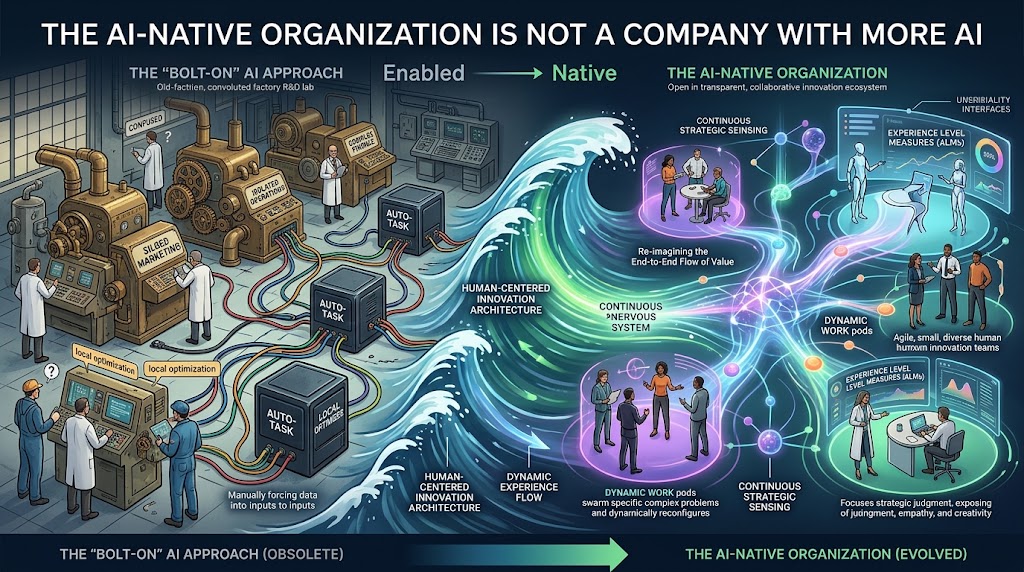
The AI-Native Organization is Not a Company With More AI

The AI-Native Organization is Not a Company With More AI

GUEST POST from Art Inteligencia


Executive Summary: The Strategic Illusion of Tech Accretion

Most enterprise leaders approaching artificial intelligence today are making a fundamental strategic error: they are deploying cutting-edge technology to optimize legacy operating models. By injecting AI agents into existing departmental silos and automating task-level friction, organizations achieve localized efficiency gains while leaving their core structural bottlenecks completely intact.

True AI-native transformation is not an exercise in software accretion—it is a comprehensive redesign of value creation, human-centered experience design, and organizational architecture. An AI-native enterprise does not simply execute old work faster; it fundamentally reimagines how decision-making, innovation, and value flow when machine intelligence is ambient, continuous, and systemic.


Key Strategic Shifts for Leadership:

  • From Point Automation to Structural Redesign: Shifting focus from automating legacy workflows to architecting end-to-end adaptive value streams.
  • Unified Experience Architecture: Integrating employee experience (EX) and customer experience (CX) into a singular model evaluated by Experience Level Measures (XLMs) rather than transactional unit costs.
  • Human-Centered Augmentation: Aligning distributed human talent and synthetic agents to reduce cognitive complexity and elevate human judgment, empathy, and strategic vision.

“The ceiling of your AI capability is not defined by your tech stack—it is bounded by your human-centered change readiness and organizational architecture.”

I. The Strategic Illusion: Acceleration vs. Architecture

The primary mistake enterprise leaders make during technological shifts is treating revolutionary tools as simple efficiency layer-ons. Injecting AI into existing enterprise workflows doesn’t create an innovative organization—it simply executes legacy processes with slightly less latency.


The “More AI” Trap

When organizations focus on tech accretion—buying more copilot licenses, deploying disparate AI agents, and scaling departmental LLM experiments—they default to local optimization. This tactical focus creates localized pockets of speed while simultaneously compounding organizational complexity, magnifying data silos, and causing cognitive fatigue across teams.


The Paving-the-Cow-Path Phenomenon

When legacy structures adopt AI without changing their underlying architecture, they engage in modern “cow-path paving.” Instead of asking why a business process exists or how value should uniquely flow in a digitally continuous environment, companies use AI to automate steps that shouldn’t exist in the first place.


Defining the Strategic Spectrum

To build an enterprise capable of sustained relevance, leadership must recognize the structural distinction between simple enablement and true native integration:

  • AI-Enabled (Tactical Acceleration): Existing organizational structures, workflows, and functional silos remain intact, with point-solution automation layered on top to reduce task-level friction and unit costs.
  • AI-Native (Architectural Transformation): Purpose, dynamic workflows, decision rights, governance, and end-to-end experience design are rebuilt from the ground up under the assumption that continuous machine intelligence is an foundational operational primitive.

II. Reimagining Experience Design: Beyond Efficiency to Human Flourishing

When artificial intelligence is treated merely as a cost-cutting engine, organizations default to measuring transactional speed. True experience design in an AI-native organization shifts the focus from simple task elimination to expanding human capability, agency, and value realization.


The Unified Experience Engine (CX & EX Integration)

Customer Experience (CX) and Employee Experience (EX) can no longer be designed or managed in operational silos. In an AI-native architecture, synthetic intelligence acts as a two-sided mediator—simultaneously shaping employee workflows and customer interactions. Disruptions or friction on the internal employee side directly degrade the external customer experience, requiring a singular, integrated experience management framework.


Evolving to Experience Level Measures (XLMs)

Legacy Service Level Agreements (SLAs) focus on operational throughput, such as handle time or cost-per-ticket. AI-native organizations elevate their measurement architecture toward Experience Level Measures (XLMs) that track qualitative and strategic outcomes:

  • Cognitive Load Reduction: Measuring how effectively AI removes administrative drag and decision fatigue from human team members.
  • Capability Expansion: Assessing how machine intelligence enhances an individual’s ability to solve complex, non-routine problems.
  • Value Realization Speed: Tracking the time it takes for a customer to achieve their desired outcome, rather than simply measuring contact resolution speed.


Designing Human-Machine Collaboration

Rather than positioning synthetic intelligence as a human replacement or reducing employees to passive monitors of automated outputs, human-centered experience design places AI in an supportive context. The goal is intentional symbiosis: machines process continuous patterns and scale routine execution, freeing human judgment, empathy, and strategic creativity to drive meaningful differentiation.

III. The Nine Innovation Roles in an AI-Native World

As continuous intelligence becomes embedded across the enterprise, the dynamics of team collaboration fundamentally shift. Building high-performing teams in an AI-native organization requires re-evaluating how key innovation roles operate when human strengths are augmented by synthetic agents.


Evolving the Talent & Role Landscape

Traditional job descriptions are far too rigid for dynamic, AI-enabled environments. Leveraging the Nine Innovation Roles™ framework (9roles.com)—comprising the Revolutionary, Conscript, Connector, Artist, Customer Champion, Troubleshooter, Judge, Magic Maker, and Evangelist—allows organizations to map human strengths, behaviors, and contributions dynamically alongside AI tools.


Key Role Transformations

  • The Customer Champion: Rather than relying solely on lagging surveys or periodic interviews, The Customer Champion leverages continuous sentiment streams and real-time behavioral models to synthesize latent needs and keep the customer at the center of every AI-driven initiative.
  • The Revolutionary & The Artist: As synthetic agents automate routine output generation, The Revolutionary challenges incremental assumptions while The Artist focuses on higher-order problem framing, imaginative boundary-pushing, and original value creation.
  • The Troubleshooter & The Judge: As machine intelligence scales rapid scenario simulations, The Troubleshooter identifies hidden operational friction while The Judge applies critical, ethical evaluation to synthetic recommendations before committing enterprise capital.
  • The Evangelist, Connector, Magic Maker & Conscript: The Connector and Evangelist build cross-functional momentum and buy-in across human networks, while the Magic Maker turns abstract capabilities into seamless experiences and the Conscript is thoughtfully engaged to turn passive participation into active ownership.


Mitigating the Complexity Tax

Adding autonomous AI agents to cross-functional human teams without clear role alignment creates noise and coordination drag—a heavy “complexity tax.” AI-native leaders explicitly align these nine natural roles with synthetic capabilities, ensuring technology amplifies individual strengths rather than creating organizational confusion.

IV. Human-Centered Change: Preparing the Enterprise Mindset

Technological capability rarely dictates the success of digital transformation—human adaptability does. While technology accelerates exponentially, human organizations absorb change linearly. Bridging this gap requires moving beyond rigid, project-based change management toward a continuous human-centered change methodology.


Overcoming Psychological and Operational Resistance

Resistance to AI integration rarely stems from anti-technology sentiment; it arises from perceived loss of agency, cognitive exhaustion, and fear of role obsolescence. Organizations that treat change as a top-down mandate amplify friction. Human-centered change actively involves employees in co-designing their transformed workflows, turning passive adoption into active ownership.


Building Emotional Agility for Continuous Market Chaos

When operational cycles collapse from years to weeks, uncertainty becomes the steady state. Leadership development must prioritize emotional agility—training executives and managers to respond thoughtfully to disruption rather than reacting defensively. Leaders who cultivate emotional resilience create teams that view market turbulence as a catalyst for innovation rather than an existential threat.


Culture as the True Enterprise Infrastructure

Your technology stack sets your theoretical potential, but your organizational culture determines your actual output velocity. AI-native enterprises cultivate three non-negotiable cultural foundations:

  • Psychological Safety: Employees must feel safe to experiment, report synthetic errors, and challenge automated decisions without fear of penalty.
  • High Trust & Transparency: Clear visibility into how AI models are utilized, evaluated, and governed across internal processes.
  • Ethical Boundaries: Explicit guardrails that protect human dignity, customer privacy, and organizational integrity above short-term efficiency gains.

V. The Architecture of the AI-Native Enterprise

To fully capitalize on ambient intelligence, organizations must move beyond rigid functional hierarchies. An AI-native structure is designed for dynamic adaptation, continuously reconfiguring teams, workflows, and strategic priorities in response to real-time market signals.


Fluid Organizational Design

Static org charts with rigid, multi-layered hierarchies create latency and slow execution. AI-native enterprises replace static structures with fluid, project-based networks. Cross-functional human talent pairs with synthetic agents on demand, forming dynamic pods that swarm specific challenges and re-assemble as organizational priorities evolve.


Continuous Horizon Scanning & Trend Audits

Annual strategic planning cycles are ill-suited for rapidly moving markets. By leveraging ambient signal identification and continuous trend detection frameworks, leadership can monitor macro shifts, customer behaviors, and technological inflections as they emerge. Strategy becomes an ongoing, real-time sensing function rather than a once-a-year retreat.


The Experiment Canvas for AI Interventions

Before deploying machine intelligence across value streams, AI-native leaders utilize a structured evaluation framework to ensure alignment with strategy and human needs:

  • Intentional Placement: Defining precisely where and why synthetic interventions add value, avoiding technology deployment for its own sake.
  • Hypothesis-Driven Testing: Running rapid, small-scale experiments to evaluate efficacy, human satisfaction, and operational friction before scaling.
  • Systemic Impact Assessment: Measuring upstream and downstream effects on cross-functional teams and customer touchpoints to prevent unintended complexity.

VI. Executive Call to Action: The Diagnostic Readiness Test

Becoming an AI-native organization is not a capital expenditure challenge—it is a leadership mindset shift. To determine whether your enterprise is architecting true native capability or merely paving cow paths with faster technology, leadership teams must confront three critical diagnostic questions.


Strategic Audit Questions for Leadership

  1. Are we automating an existing bottleneck, or eliminating the step entirely?
    If your AI initiatives simply speed up legacy handoffs between functional silos, you are compounding tech debt and organizational complexity rather than architecting dynamic value streams.
  2. How does our change methodology evolve when technology outpaces learning cycles?
    When software iterations occur continuously, static 18-month change management plans fail. Success requires building organizational agility, emotional resilience, and real-time feedback loops.
  3. What unique human value are we unlocking with freed-up capacity?
    Efficiency gains without purpose lead to headcount reduction or empty busywork. True AI-native leaders redirect saved time toward strategic foresight, deeper customer empathy, and breakthrough innovation.


The Strategic Roadmap Forward

Shift your focus and resources from enterprise software licensing toward experience architecture, culture building, and human capability expansion. The future belongs to organizations that treat artificial intelligence not as a bigger engine for old work, but as the foundation for entirely new ways of thinking, serving, and creating value.

About the Author

Braden Kelley is a human-centered change, innovation, futurology, and experience design thought leader, author of Charting Change and Stoking Your Innovation Bonfire, and creator of the Change Planning Toolkit™ and Nine Innovation Roles™.

Frequently Asked Questions


What is the difference between an AI-enabled and an AI-native organization?

An AI-enabled organization layers point-solution automation onto existing operational silos to speed up legacy processes. An AI-native organization fundamentally redesigns its enterprise architecture, workflows, experience models, and decision-making assuming continuous machine intelligence is an essential operational baseline.


Why do traditional Service Level Agreements (SLAs) fail in AI-native transformations?

Traditional SLAs focus strictly on transactional metrics like handle time or cost-per-ticket. AI-native transformations require Experience Level Measures (XLMs) that track qualitative outcomes such as cognitive load reduction, capability expansion, and customer value realization speed.


How does team collaboration change when synthetic agents join human workflows?

Instead of static job descriptions, teams adapt using dynamic behavioral frameworks like the Nine Innovation Roles™. Human professionals elevate their focus toward strategic problem framing, continuous sensing, and scenario evaluation while synthetic agents handle rapid pattern recognition and execution.


EDITOR’S NOTE: Braden Kelley’s Problem Finding Canvas can be a super useful starting point for doing design thinking or human-centered design.

“The Problem Finding Canvas should help you investigate a handful of areas to explore, choose the one most important to you, extract all of the potential challenges and opportunities and choose one to prioritize.”

Image credit: Gemini

Subscribe to Human-Centered Change & Innovation WeeklySign up here to get Human-Centered Change & Innovation Weekly delivered to your inbox every week.
The Human Advantage: What AI Still Cannot Automate

The Human Advantage: What AI Still Cannot Automate

GUEST POST from Chateau G Pato


I. The Machine Horizon: Auditing What AI Solves

The narrative surrounding artificial intelligence routinely gravitates toward absolute replacement, operational efficiency, and rapid cost optimization. Organizations scramble to integrate generative models and autonomous agents into their workflows, treating speed as the ultimate metric of progress. Yet, to construct a sustainable future-ready enterprise, we must conduct a clear-eyed audit of what machine intelligence actually solves—and where its inherent boundaries begin to emerge.

The Scalability Paradox

AI excels exceptionally at scale, high-throughput compute, pattern recognition across massive datasets, and routine task execution. It collapses processing time from days to milliseconds. However, this creates a paradoxical reality: as the technical velocity of output accelerates, the volume of noise increases exponentially. Acceleration without intentional strategic direction merely allows organizations to make bad decisions faster.

Strategic Imperative: Machine intelligence delivers unprecedented speed and synthesis, but raw speed without strategic alignment only accelerates friction across the enterprise.

The Commoditization Trap

When every competitor in an industry gains access to identical algorithmic models, standardized prompt libraries, and foundation architectures, algorithmic efficiency ceases to function as a durable competitive differentiator. Standardized intelligence yields standardized outcomes.

  • Algorithmic Uniformity: Reliance on off-the-shelf models leads to homogenized strategic thinking and me-too customer experiences.
  • The Differentiation Vacuum: Unique value shifts away from raw computational execution to human insight, brand narrative, and proprietary domain experience.

The Expectation Gap

Automation alone consistently fails to build internal organizational capability or enduring external customer trust. Implementing technology solves technical bottlenecks, but technology never adopts itself. When leadership misinterprets software deployment as organizational transformation, they create a widening gap between algorithmic capability and human adoption.

II. The Unautomatable Triad: Empathy, Context, and Meaning

While artificial intelligence excels at processing data and detecting explicit trends, competitive advantage in modern enterprise design resides in human capabilities that algorithms cannot replicate. The true frontier of innovation is not technical speed, but the ability to extract meaning, demonstrate genuine empathy, and synthesize context across complex systems.

Deep Customer & Employee Experience (CX/EX)

AI engines process metrics, sentiment scores, and telemetry data, yet they remain blind to emotional nuance. Human leaders and experience designers uncover latent needs—the unarticulated frustrations and aspirations that never appear in standard analytics dashboards.

Human Insight: Algorithms measure behaviors, but humans understand motivations. Transforming experience requires decoding the emotional subterranean layers of customer and employee journeys.

Contextual Wisdom & Sensemaking

Machine models operate fundamentally by extrapolating historical patterns into the future. However, enterprise strategy rarely unfolds in a controlled historical loop. When navigating unprecedented market shifts, ethical dilemmas, or organizational crises, humans provide contextual wisdom—weighing trade-offs, reading non-verbal dynamics, and making judgements where data is incomplete or ambiguous.

  • Beyond Data Synthesis: Sensemaking is the uniquely human process of determining what information actually matters in a given strategic context.
  • Ethical & Cultural Stewardship: Preserving brand integrity and organizational culture requires human accountability that cannot be outsourced to code.

Shared Purpose & Vision

An algorithm can calculate an optimized path to an objective, but it cannot inspire people to pursue it. Organizational momentum depends on shared purpose and trust. Leaders translate raw strategic objectives into a compelling change story, aligning diverse teams around a vision that sparks commitment rather than compliance.

III. Human-Centered Change™ in the AI Era

As algorithms take on complex analytical operations, the success of technological transformation increasingly rests on human dynamics. Technology enables capability, but human adoption dictates value creation. Organizations that treat AI deployment purely as a technical integration repeatedly fall into predictable patterns of friction, resistance, and stranded capital.

Overcoming the 70% Failure Rate

For decades, studies have cited that up to 70 percent of organizational transformation initiatives fail to achieve their intended business outcomes. In the AI era, this risk is compounded: algorithms can generate strategies, scripts, and workflows in seconds, but human behavior changes at the speed of trust. Transformations fail not because the technology is flawed, but because leaders treat human adoption as an afterthought rather than the core design criteria.

Core Principle: Software never adopts itself. Sustainable enterprise transformation requires shifting focus from technical delivery to human capability creation.

Visual Collaboration with the Change Planning Canvas™

To bridge the gap between AI-driven strategy and execution, organizations require shared visual frameworks that drive alignment across cross-functional leadership. Utilizing tools like the Change Planning Canvas™ transforms abstract technology goals into a co-created visual plan.

  • Cross-Functional Alignment: Gets leadership, project managers, and operational teams literally and figuratively on the same page.
  • Mapping Friction Points: Identifies organizational barriers, skill gaps, and psychological resistance points long before deployment.
  • Shared Ownership: Moves stakeholders from passive recipients of change to active architects of the transformation journey.

Designing for Continuous Adoption

Achieving the human advantage in an automated landscape demands shifting from top-down directives to participatory design. When employees help co-create the workflows, guardrails, and user experiences around AI systems, resistance transforms into advocacy. Designing for human adoption ensures that technological speed is paired with collective organizational capability.

IV. FutureHacking™: Shaping Tomorrow vs. Predicting It

In a business landscape dominated by predictive analytics, leaders frequently mistake algorithmic forecasting for strategic foresight. AI models project tomorrow by calculating probabilities based on yesterday’s datasets. However, true futurology is not an exercise in passive prediction—it is an active discipline of intentional shape-making.

Beyond Algorithmic Extrapolation

Machine learning algorithms excel at identifying linear trends and optimizing within existing paradigms. Yet, breakthrough innovation and market disruption rarely follow linear trajectories. Relying exclusively on predictive AI creates strategic blind spots, trapping organizations in historical assumptions and leaving them vulnerable to non-linear disruptions.

Futurology Principle: AI forecasts the expected future based on past data; human strategic foresight architects the preferred future through creative vision and bold intent.

Strategic Foresight & Weak Signals

Pioneering organizations utilize FutureHacking™ methodologies to identify weak signals—emerging cultural shifts, subtle behavioral changes, and nascent technology overlaps before they register in macro-data streams. Synthesizing these weak signals into actionable strategic choices requires human intuition, imagination, and holistic sensemaking.

  • Sensing Discontinuity: Spotting inflection points where market dynamics break away from historic norms.
  • Scenario Architecture: Constructing dynamic alternative futures to stress-test enterprise strategy against uncertainty.

Architecting Sustainable Innovation Capabilities

Translating strategic foresight into continuous capability requires orchestrating diverse human roles within the innovation ecosystem. While AI accelerates task execution, humans drive the key personas needed to move ideas from concept to commercial reality—from Revolutionaries who challenge status quo assumptions to Evangelists who build organizational buy-in.

V. The Symbiotic Enterprise: Orchestrating Human + Machine

The ultimate objective of digital transformation is not to build an automated enterprise, but to architect a symbiotic one. When organizations move past false dichotomies of human replacement, they unlock an ecosystem where computational efficiency amplifies human creativity, strategic vision, and empathy.

The Business Architect’s New Role

Leaders must transition from traditional process managers to ecosystem orchestrators. Redesigning work for the AI era requires clearly defining the operational boundaries: assigning high-volume data synthesis, routine execution, and pattern processing to machine models, while elevating human roles to focus on judgment, strategic direction, visual alignment, and stakeholder trust.

Orchestration Imperative: Competitive leadership is measured not by how much technology an enterprise deploys, but by how seamlessly machine power amplifies human capability across every touchpoint.

Building a Culture of Infinite Innovation

Sustained market leadership requires moving beyond episodic technology adoption toward a perpetual organizational capability. Utilizing frameworks like the Eight I’s of Infinite Innovation™ ensures that human curiosity and structured experimentation continuously feed the enterprise pipeline, turning technological disruptions into growth catalysts.

  • Continuous Capability: Embedding structured innovation processes into daily organizational rhythms rather than relying on one-off initiatives.
  • Human-Centered Synergy: Ensuring technological deployments serve to liberate talent for high-value strategic and creative contributions.

Final Strategic Imperative

Algorithms provide the engine, but human purpose remains the compass. Winning the future requires investing as heavily in human adoption, visual collaboration, and organizational empathy as we do in computational power. Those who master this balance will not merely adapt to tomorrow—they will shape it.


The Human Advantage — FAQ

Frequently Asked Questions

What is the core limitation of AI in enterprise transformation?

AI excels at pattern recognition, data synthesis, and task execution at scale, but it cannot automate empathy, sensemaking, contextual judgment, or human adoption. Technology enables capability, but human adoption dictates value creation.

How does Human-Centered Change™ improve project success rates?

By shifting focus from technical implementation to human capability creation, Human-Centered Change™ addresses the psychological resistance and organizational friction behind the 70% transformation failure rate, utilizing visual frameworks like the Change Planning Canvas™ to build cross-functional alignment.

What is the difference between AI forecasting and FutureHacking™?

AI forecasting relies on extrapolating historical data to predict linear trends, whereas FutureHacking™ leverages human strategic foresight to identify weak signals, sense market discontinuities, and actively architect a preferred future.

EDITOR’S NOTE: Braden Kelley’s Problem Finding Canvas can be a super useful starting point for doing design thinking or human-centered design.

“The Problem Finding Canvas should help you investigate a handful of areas to explore, choose the one most important to you, extract all of the potential challenges and opportunities and choose one to prioritize.”

Image credit: Gemini

Subscribe to Human-Centered Change & Innovation WeeklySign up here to get Human-Centered Change & Innovation Weekly delivered to your inbox every week.
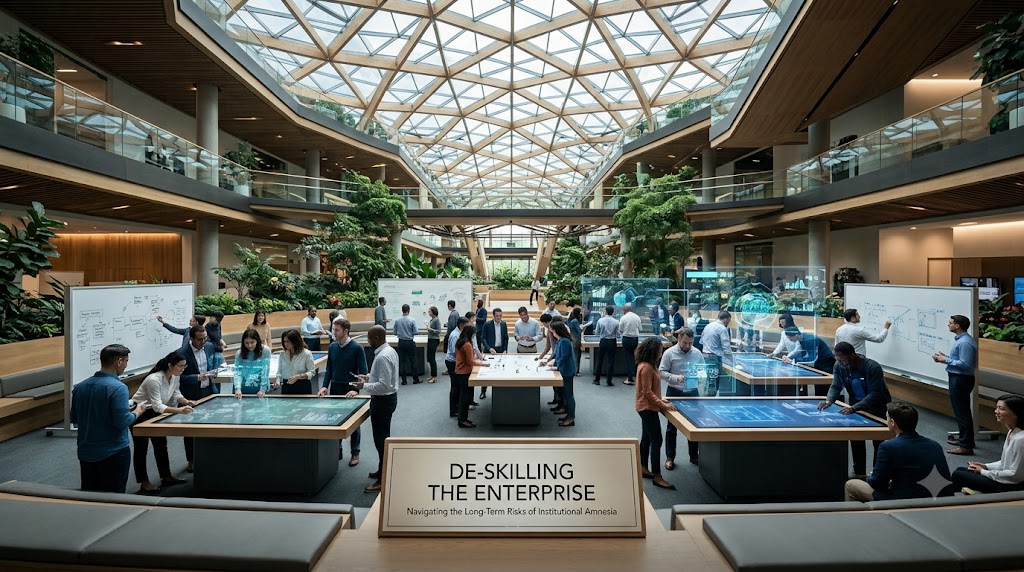
The De-Skilling of the Enterprise

Navigating the Long-Term Risks of Institutional Amnesia

The De-Skilling of the Enterprise

GUEST POST from Art Inteligencia


When organizations prioritize short-term efficiency and algorithmic automation over human capability development, they inadvertently create a dangerous trade-off: operational speed in the present at the cost of institutional intelligence in the future.

As automation, AI generation, and hyper-optimized workflows strip away the friction of daily problem-solving, they also remove the primary mechanism through which organizational knowledge, intuition, and adaptive capacity are built.

The Illusion of Efficiency: How Automation Breeds Institutional Amnesia

In the relentless pursuit of digital transformation, organizations often confuse operational speed with organizational intelligence. We celebrate frictionless workflows and algorithmic decision-making as triumphs of modern management. Yet, beneath the surface of these optimized dashboards lies a dangerous, creeping reality: the slow bleed of institutional memory. When we automate the human out of the loop, we don’t just eliminate busywork; we often inadvertently eliminate the crucible where human expertise and adaptive capacity are forged.

The Capability Paradox

Every enterprise faces a systemic trade-off that I call the Capability Paradox. In the short term, introducing advanced automation and generative AI into workflows yields undeniable productivity spikes. Cycle times decrease, and output volume surges. However, these immediate gains act as a smokescreen, masking the quiet erosion of foundational employee skills and judgment. We have become hyper-focused on measuring the velocity of execution, completely neglecting to measure the cognitive atrophy of our workforce. When the machine does the heavy lifting of problem-solving, the human muscle of critical thinking begins to waste away.

From Apprenticeship to Execution

Historically, deep organizational knowledge was never transferred through static manuals; it was passed down through the messy, friction-filled intermediate steps of actually doing the work. This informal apprenticeship model relied on employees wrestling with raw data, making mistakes, and relying on senior experts for course correction. Today, automated workflows bypass these developmental milestones entirely. When an employee is transitioned from a creator to a mere editor or approver of an algorithmic output, the chain of tacit knowledge is severed. We are minting a generation of operators who know how to deploy technological tools, but lack the underlying mastery to fundamentally question or improve them.

The Danger of Black-Box Operations

The ultimate risk of enterprise de-skilling is the creation of black-box operations — systems that function seamlessly until they don’t, managed by teams who have no idea how they actually work. By abstracting the “why” and the “how” behind operational decisions, we leave our teams blind to nuance and context. This systemic fragility means that when edge cases arise, market conditions suddenly shift, or the algorithm fails, there is no one left inside the building who knows how to audit the logic, troubleshoot the root cause, or rebuild the process from scratch. Institutional amnesia transforms the enterprise from a resilient, human-centered organism into a brittle, inflexible machine.

The Human Cost of Skill Atrophy

While the financial impact of de-skilling manifests in operational bottlenecks, the human cost is far more pervasive. When we reduce complex, human-centered work to a series of mechanical hand-offs and automated validations, we do not merely streamline tasks — we alter the psychological contract between employees and their work. Human capability is built through friction, struggle, and agency. When technology removes that friction entirely, it strips away the very conditions required for deep cognitive engagement and professional mastery.

The Erosion of Critical Thinking

The most immediate casualty of enterprise de-skilling is the degradation of critical reasoning. As smart platforms, predictive analytics, and automated decision engines take center stage, human teams are progressively repositioned from active problem solvers to passive prompt approvers and exception handlers. Over time, this reliance creates a cognitive shortcut loop: employees default to the system’s recommendations without evaluating the underlying logic or testing assumptions against ground reality. When critical thinking is no longer exercised daily, the muscle weakens, leaving teams ill-equipped to recognize subtle flaws, question invalid premises, or navigate ambiguity when automated systems offer flawed outputs.

Loss of Organizational Context

Algorithmic abstraction promises clarity by distilling vast inputs into simple binary choices or pre-packaged outputs. However, in stripping away the raw complexity of a process, it also strips away the operational “why.” Employees lose sight of how their specific choices ripple across the value chain, how legacy decisions shaped current parameters, and how subtle human behaviors influence outcomes. Without this deep contextual map, decision-making becomes transactional rather than strategic. Teams lose the ability to read the room, evaluate edge cases with empathy, or interpret nuance — resulting in organizations that operate efficiently on paper, yet remain fundamentally out of touch with the living ecosystem of their business.

Cognitive Disengagement and Loss of Agency

Beyond skill loss lies a profound human and organizational threat: the erosion of employee agency. Pride in craftsmanship and career growth are intrinsically linked to autonomy, mastery, and purpose. When employees are relegated to monitoring algorithms and stamping approvals on machine-generated deliverables, their sense of ownership evaporates. Work becomes passive surveillance rather than active creation. This systemic disengagement degrades employee motivation, stifles internal mobility, and fuels high turnover among top-tier talent who refuse to serve as placeholders for a system that no longer values human intelligence.

The Innovation Threat: Why De-Skilled Organizations Can’t Adapt

The ultimate paradox of enterprise de-skilling is that in our obsession with optimizing for current operations, we systematically dismantle our capacity to invent future ones. True innovation is rarely the product of pristine, perfectly linear algorithms executing predictable tasks. It emerges from the edges — from domain experts wrestling with operational friction, questioning legacy assumptions, and synthesizing disparate insights. When an enterprise replaces deep human domain mastery with surface-level tool operation, it trades its long-term adaptability for short-term predictability.

The Death of Unintended Discovery

Breakthrough innovation relies heavily on serendipity, lateral thinking, and what I call “productive friction.” When humans actively engage in the messy details of problem-solving, they notice anomalies, discover unscripted workarounds, and stumble upon happy accidents that open entirely new market opportunities. Automated, hyper-optimized workflows are explicitly designed to eliminate this friction. In doing so, they also eliminate the variance that feeds creative problem-solving. A de-skilled enterprise may execute its current business model with razor-sharp precision, but it becomes incapable of stumbling upon the next one.

Fragility in Crisis

De-skilled organizations perform exceptionally well under static, predictable conditions. However, when market disruptions, technological shifts, or Black Swan events shatter the baseline assumptions encoded into automated systems, these organizations experience catastrophic failure. Algorithmic loops cannot improvise when confronted with unprecedented contexts. In a crisis, the survival of the enterprise depends entirely on human adaptability, intuitive judgment, and fundamental first-principles thinking. If those human capabilities have been allowed to atrophy, the organization stands paralyzed — unable to override its own broken scripts.

The Experience Design Gap

There is an unbreakable tether between internal operational mastery and the external customer experience. When employees lose their deep, intuitive understanding of the products, services, and systems they manage, the quality of customer interaction degrades exponentially. Experience design is fundamentally an exercise in empathy, nuance, and value delivery. When de-skilled teams rely blindly on automated scripts and AI outputs to serve customers, interactions become mechanical, rigid, and transactional. The human touch — the capacity to truly listen, resolve complex edge cases, and forge meaningful relationships — is lost, leaving the brand vulnerable to agile competitors who prioritize human-centered value creation.

FutureHacking™ the Enterprise: A Call to Action

The choice facing modern executives is not whether to adopt advanced automation and intelligent technologies, but how to deploy them without bankrupting the organization’s human capital. The current trajectory — maximizing short-term margin by trading away institutional knowledge — is a strategic dead end. To build an enterprise that thrives amidst relentless disruption, we must fundamentally shift our perspective: technology should serve to elevate human intellect, not eclipse it.

Redefining the ROI of Technology

It is time for leadership to abandon narrow, headcount-reduction metrics when evaluating technological investments. True technology ROI cannot be measured solely by how many human hours are excised from a process. We must expand our executive dashboards to evaluate systemic resilience, adaptive capacity, and skill health. A technology implementation that slashes operational costs by 20% while simultaneously destroying the organization’s ability to innovate, audit, or respond to market shifts is not an efficiency gain — it is an unmanaged liability.

The Leader’s Imperative

The ultimate role of the future-focused leader is not to automate human intelligence out of the value chain, but to architect dynamic ecosystems where human creativity, empathy, and strategic judgment remain the primary engines of value creation. By embedding intentional learning loops, leveraging visual collaborative frameworks, and protecting the cognitive exercise of our workforce, we ensure our organizations remain sharp, agile, and deeply human-centered. Navigating the future requires technology that accelerates our speed, powered by human capabilities that preserve our soul.

Frequently Asked Questions

What is enterprise de-skilling?

Enterprise de-skilling is the gradual loss of foundational employee skills, critical thinking, and domain expertise caused by over-reliance on automated systems, generative AI, and hyper-optimized, friction-free workflows.

How does automation lead to institutional amnesia?

When automated workflows bypass the messy, problem-solving steps where tacit knowledge is traditionally built and passed down, organizations lose the contextual “why” behind operational decisions. This leaves teams unable to audit, troubleshoot, or rebuild processes when systems fail.

How can organizations adopt AI and automation without losing human capability?

Leaders can protect institutional knowledge by designing workflows with “desirable difficulty” (strategic manual touchpoints), creating continuous experiential learning loops, and using visual collaborative toolkits to ensure human judgment and systemic transparency remain central to operations.


Bring This Thinking to Your Next Event

Braden Kelley is a LinkedIn Top Voice, bestselling author, and innovation keynote speaker who helps organizations get to the future first and build sustainable innovation cultures.

Book Braden as a Keynote Speaker →

Image credit: Gemini

Subscribe to Human-Centered Change & Innovation WeeklySign up here to get Human-Centered Change & Innovation Weekly delivered to your inbox every week.
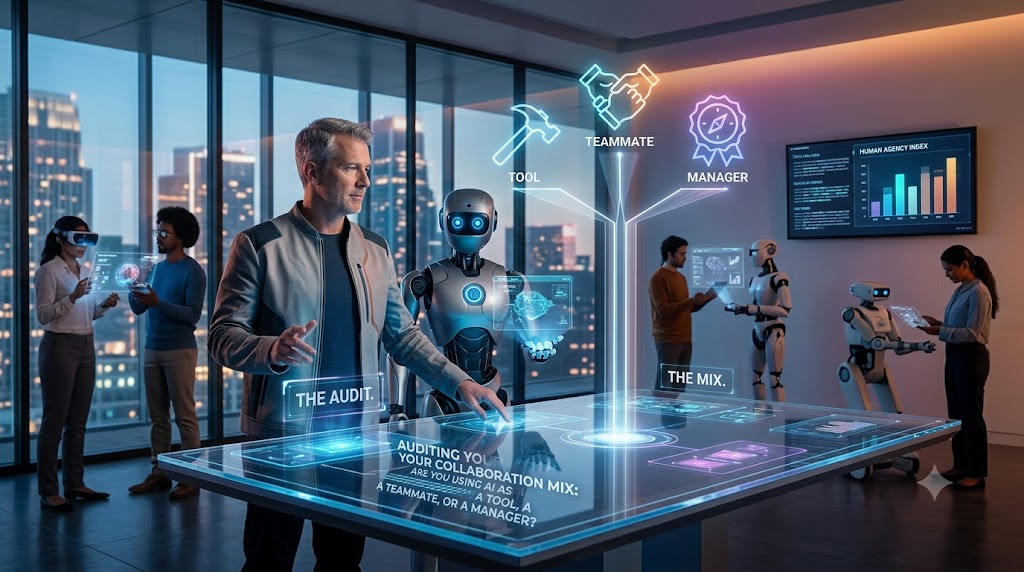
Are You Using AI as a Tool, a Teammate, or a Manager?

Auditing Your Collaboration Mix

Are You Using AI as a Tool, a Teammate, or a Manager?

GUEST POST from Chateau G Pato


I. The Unintended Evolution of Human-AI Dynamics

As artificial intelligence weaves deeper into day-to-day organizational workflows, leaders must look beyond basic speed-and-efficiency metrics. The crucial question is no longer if teams are using AI, but how the division of labor, creative authority, and decision-making power is actually distributed between human talent and intelligent systems.

Without intentional design, organizations drift into unexamined technological relationships. By conducting an audit of your human-AI collaboration mix across three distinct operational modes—Tool, Teammate, and Manager—you can ensure automation amplifies human agency, creativity, and strategic foresight rather than eroding them.

Most enterprise AI implementations begin with a straightforward mandate: eliminate friction and boost productivity. Yet software is no longer a passive medium waiting for explicit commands. Generative models and agentic workflows possess variable levels of autonomy, synthetic reasoning, and directive capability.

Without a deliberate strategy, teams frequently experience a strange paradox:

  • They attempt to use advanced AI merely as a fast copy-pasting tool, missing its potential for collaborative problem-solving.
  • Simultaneously, they unconsciously surrender delegation, evaluation, and prioritization choices to algorithms, turning AI into an unvetted manager.

Sustainable, human-centered innovation requires us to pause and audit these dynamics. Building a high-performing, resilient organization means consciously designing where human judgment is preserved, where machine intelligence acts as a partner, and where algorithmic systems are strictly constrained.

II. Mode 1: AI as a Tool (Efficiency & Execution)

When used as a Tool, AI operates in a classic transactional mode. Human actors retain full directive control, defining inputs and evaluating outputs against strict boundaries.

[ Human Directive ] ──> [ AI Execution ] ──> [ Human Review & Action ]
  • Key Characteristics: Task-bound, reactive, and execution-focused (e.g., reformatting unstructured data, summarizing lengthy transcripts, generating initial code blocks, basic research synthesis).
  • Strategic Value: Eliminates cognitive friction, reduces routine operational toil, and accelerates delivery cycle times.
  • The Strategic Pitfall: Treating dynamic intelligence solely as a static utility limits its value. If your organization only uses AI to do yesterday’s work slightly faster, you run the risk of accelerating outdated processes rather than innovating new ones.

III. Mode 2: AI as a Teammate (Co-Creation & Thought Partnership)

When elevated to a Teammate, AI transitions from execution to interaction. The relationship shifts to an iterative dialogue where human and artificial capabilities challenge, refine, and expand upon one another.

[ Human Perspective ] <── Iterative Dialogue & Friction ──> [ AI Synthesis ]
                                   │
                                   ▼
                      [ Expanded Solution Space ]
  • Key Characteristics: Scenario planning, rapid prototyping, perspective-shifting exercises (“What customer blind spots are we missing?”), and joint problem-solving.
  • Strategic Value: Unlocks productive friction, expands the initial search space for innovations, and enables rapid experience design testing before committing real-world resources.
  • The Strategic Pitfall: Diffused accountability and false empathy. Synthetic intelligence lacks lived human context, emotional resonance, and ethical accountability. A machine can simulate strategic alternatives, but humans must retain ownership of the choice and its consequences.

IV. Mode 3: AI as a Manager (Direction & Governance)

When AI assumes the role of a Manager, it gains agency over direction, resource allocation, performance assessment, or process gating.

[ System Rules & Data ] ──> [ Algorithmic Decision ] ──> [ Human Workforce ]
  • Key Characteristics: Dynamic resource scheduling, automated ticket routing, algorithmic performance scoring, and automated compliance gatekeeping.
  • Strategic Value: High-speed pattern matching and logistical optimization across complex systems that exceed human processing bandwidth.
  • The Strategic Pitfall: “Ghost Management.” When algorithmic rules dictate daily priorities without transparent human oversight or empathy, psychological safety declines, organizational trust breaks down, and frontline autonomy gets stripped away.

V. The Organizational Audit Framework: Mapping Your Mix

To align your technology strategy with human-centered principles, run your current AI implementations through a three-part organizational audit:

1. Agency & Authority Mapping

Identify where systems act strictly upon human instruction (Tool), where they shape thinking iteratively (Teammate), and where they dictate outcomes or workflows (Manager).

Operational Focus Tool Mode Teammate Mode Manager Mode
Primary Function Task execution & automation Ideation & counterpoint Workflow routing & governance
Locus of Control 100% Human-driven Shared / Conversational System-driven / Algorithmic
Success Metric Time saved / Error reduction Solution breadth & depth Operational throughput

2. Experience Impact Assessment

Evaluate how your current mix impacts worker agency and customer experiences:

  • Are team members feeling empowered by thought-partnership, or micromanaged by opaque metrics?
  • Is technological adoption giving employees time to focus on strategic work, or simply increasing task volume?

3. Accountability Alignment

Establish clear rules of ownership:

  • The Non-Delegable Rule: Strategic intent, moral responsibility, and relationship building must remain 100% human functions.
  • The Audit Rule: Any system operating in Manager mode must feature clear human-in-the-loop escalation paths and transparent, challengeable decision logic.

VI. Conclusion: Designing Intended Collaboration Futures

The future of work is not about replacing human talent with technology; it is about designing intentional, high-trust environments where human creativity, wisdom, and strategic foresight remain central.

When you audit and balance your collaboration mix, you transition your organization from passive software adoption to deliberate experience design. Treat AI as a precision tool to strip away toil, leverage it as an agile teammate to expand your creative horizons, and keep it firmly on a tight leash whenever it touches management. Innovation flourishes when technology serves as a lever for human potential, not a substitute for human perspective.

Frequently Asked Questions

What is the difference between using AI as a tool, a teammate, and a manager?

Using AI as a Tool involves transactional, task-bound execution where humans maintain complete control (e.g., summarizing text). Using AI as a Teammate creates an iterative dialogue for co-creation, scenario planning, and thought partnership. Using AI as a Manager delegates operational agency to algorithms for resource allocation, workflow routing, or performance gating.

Why is it dangerous to let AI act as an unmonitored manager?

When AI assumes manager-level authority without transparent human oversight—a phenomenon known as “ghost management”—it can erode psychological safety, destroy organizational trust, and strip autonomy from frontline employees by prioritizing algorithmic efficiency over human context and empathy.

How can organizations audit their current human-AI collaboration mix?

Organizations can audit their collaboration mix by mapping agency and authority across workflows, assessing the impact of AI on employee experience and agency, and enforcing accountability rules ensuring strategic and ethical decisions remain non-delegable human responsibilities.


Bottom line: Futurology is not fortune telling. Futurists use a scientific approach to create their deliverables, but a methodology and tools like those in FutureHacking™ can empower anyone to engage in futurology themselves.

Image credit: Gemini

Subscribe to Human-Centered Change & Innovation WeeklySign up here to get Human-Centered Change & Innovation Weekly delivered to your inbox every week.
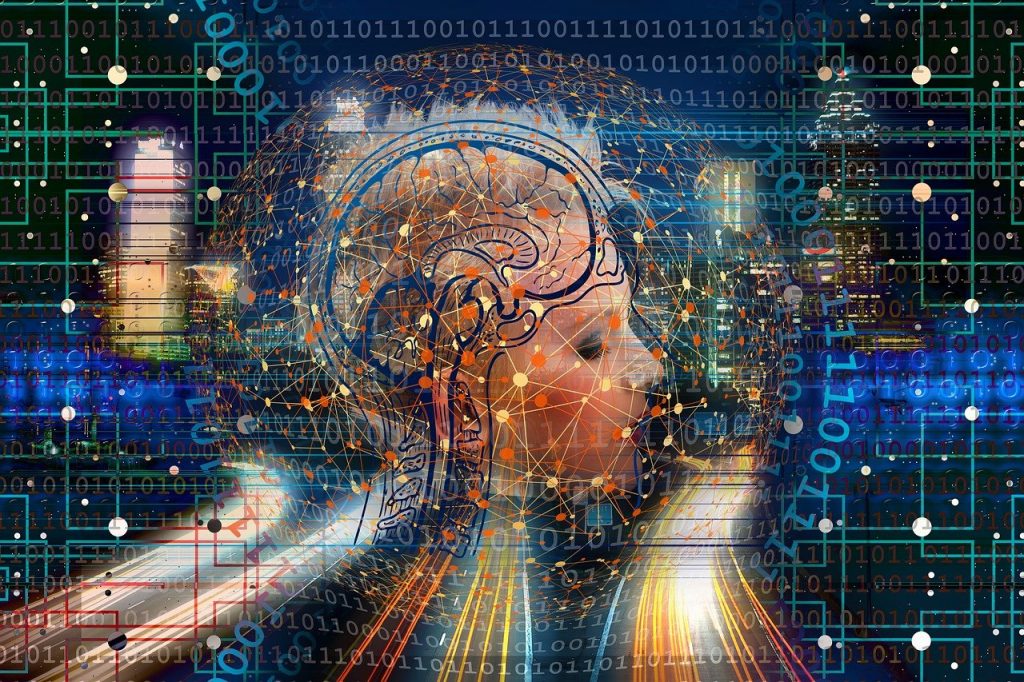
Making the Most of AI-Powered Business Solutions

Making the Most of AI-Powered Business Solutions

GUEST POST from Art Inteligencia

Artificial Intelligence (AI) has become an integral part of the business landscape, revolutionizing the way organizations operate, streamline processes, and make data-driven decisions. With the ability to analyze vast amounts of data in real-time, AI-powered business solutions are transforming industries and helping companies gain a competitive edge. In this article, we will explore two case studies that showcase how businesses are harnessing the power of AI to drive innovation and success.

Case Study 1: Retail Giant Boosts Sales and Personalization with AI

One of the world’s largest retail chains sought to enhance its customer experience and increase sales through targeted marketing campaigns. By leveraging AI-powered business solutions, the company was able to analyze customer data, preferences, and purchase history to develop personalized recommendations for each shopper.

Using advanced machine learning algorithms, the AI system analyzed vast amounts of customer data, including demographics, online behavior, and purchase patterns, to identify trends and patterns. This insight enabled the retail giant to segment their customer base and tailor marketing campaigns based on individual preferences.

As a result, the company achieved significant improvements in customer engagement and loyalty. By sending targeted offers and product recommendations, they saw a substantial increase in sales conversion rates. Additionally, the personalized approach led to higher customer satisfaction, as shoppers felt that the brand understood their needs and preferences.

Case Study 2: Healthcare Provider Enhances Diagnosis Accuracy with AI

A leading healthcare provider aimed to improve diagnostic accuracy by leveraging AI technology. The organization utilized AI algorithms to analyze diverse patient data, medical images, and electronic records, allowing doctors to make more precise and efficient diagnoses.

Through deep learning techniques, the AI-powered system was able to analyze thousands of medical images, identify patterns, and highlight potential areas of concern. This not only expedited the diagnosis process but also reduced the rate of misdiagnosis.

The healthcare provider also integrated AI in their electronic health records (EHR) system to enable real-time analysis of patient data. This allowed doctors to receive immediate alerts and recommendations based on critical health indicators, ensuring timely intervention and proactive care.

By implementing AI-powered business solutions, the healthcare provider witnessed a significant improvement in diagnostic accuracy and patient outcomes. The technology not only reduced the burden on healthcare professionals but also enhanced patient trust and satisfaction.

Conclusion

These case studies demonstrate how AI-powered business solutions can revolutionize industries and drive transformative success. By leveraging the power of AI, companies can gain deep insights into customer preferences, develop personalized marketing strategies, enhance diagnostic accuracy, and improve patient outcomes.

However, it is essential to note that implementing AI systems requires an understanding of the technology and its potential impact on business operations. Organizations must invest in robust data infrastructure, ensure ethical usage of data, and provide adequate training to employees to leverage AI effectively.

As AI continues to evolve, businesses that embrace and integrate AI-powered solutions will accelerate their growth, stay ahead of the competition, and deliver exceptional value to their customers.

Image credit: Pixabay

Subscribe to Human-Centered Change & Innovation WeeklySign up here to get Human-Centered Change & Innovation Weekly delivered to your inbox every week.

Human-Centered Design and AI Integration

Human-Centered Design and AI Integration

GUEST POST from Chateau G Pato

As the realm of artificial intelligence continues to evolve, so does its integration into various sectors of our society. One crucial aspect of seamlessly blending AI technologies into our daily lives is through human-centered design. Human-centered design focuses on designing systems, products, and services that prioritize the needs and experiences of people. By incorporating this design approach into the development and implementation of AI technologies, we can ensure that these advancements are effective, intuitive, and ultimately benefit human users. In this article, we will explore two case study examples that demonstrate the successful integration of human-centered design and AI.

Case Study 1: Amazon Echo

The Amazon Echo, powered by the AI assistant Alexa, is an excellent example of human-centered design combined with AI integration. When Amazon first launched the Echo, they understood that the key to ensuring widespread adoption of this voice-activated speaker was by making it as user-friendly as possible. The design team conducted extensive research to understand how people interact with technology and what features would enhance their daily lives.

Through this process, they identified voice input as the most natural and intuitive form of interaction. By enabling users to speak naturally to Alexa, Amazon created a device that seamlessly fit into people’s existing routines. Additionally, the team emphasized understanding user context and needs, allowing Alexa to provide personalized and context-aware responses. Whether it is playing music, setting reminders, or controlling smart home devices, the Amazon Echo demonstrates how AI integration can be harnessed successfully through human-centered design.

Case Study 2: Apple Health App

The Apple Health app is another prime example of human-centered design principles applied in conjunction with AI integration. The goal of this app is to empower individuals to take more control of their health by offering them valuable insights and information. By seamlessly connecting with various health devices and apps, the app collects and presents data in a user-friendly manner, making it easy for individuals to track their health and well-being.

Apple’s design team recognized the importance of providing meaningful and understandable data visualization. They ensured that users can effortlessly comprehend their health information, empowering them to make informed decisions about their lifestyle choices. The AI integration in the app leverages complex algorithms to analyze data in real-time, offering personalized suggestions and notifications to the users based on their unique health goals.

By considering the very essence of human-centered design, Apple successfully integrated AI technologies into the Health app, making it an indispensable tool for individuals seeking to prioritize their well-being.

Conclusion

The successful integration of artificial intelligence into our daily lives relies heavily on the principles of human-centered design. Case studies such as Amazon Echo and Apple Health app provide excellent examples of how AI technologies can be seamlessly incorporated into products and services while prioritizing the needs and experiences of users. By implementing human-centered design, companies can ensure that AI interventions are intuitive, accessible, and ultimately enhance the overall human experience.

Image credit: Unsplash

Subscribe to Human-Centered Change & Innovation WeeklySign up here to get Human-Centered Change & Innovation Weekly delivered to your inbox every week.

What Will the Smart Home of the Future Look Like?

What Will the Smart Home of the Future Look Like?

GUEST POST from Art Inteligencia

In recent years, the concept of a smart home has become increasingly popular. From voice-activated virtual assistants to interconnected devices, the technological advancement in home automation has revolutionized the way we live. With rapid advancements in artificial intelligence and the Internet of Things (IoT), it is intriguing to speculate about what the smart home of the future will look like. In this article, we will explore two case studies that offer a glimpse into the potential future of smart homes.

Case Study 1: The Connected Oasis

Imagine walking into a home where everything is interconnected, and your every need is anticipated. This vision of the future smart home is epitomized in the concept of the “Connected Oasis.” One example of this is showcased through the collaboration between Samsung and BMW. The companies are working on integrating their respective technologies to create a seamless experience between the car and the home.

Using artificial intelligence and sensors, the smart home of the future can recognize when the car is approaching and prepare everything accordingly. As you near your home, the lights automatically turn on, the temperature adjusts to your preferred setting, and the door unlocks as you approach it. Once inside, your smart home assistant greets you with personalized suggestions based on your daily routine and preferences. The smart home can even sync with your car, automatically setting GPS directions based on your calendar events or providing traffic updates as you prepare to leave.

Case Study 2: Sustainable and Energy-Efficient Living

With growing concerns about climate change and environmental sustainability, the future smart home is likely to prioritize energy efficiency and sustainable living. The GreenSmartHome project, developed by researchers at the University of Nottingham, envisions a home that utilizes renewable energy sources, maximizes energy efficiency, and encourages eco-friendly practices.

This smart home incorporates various features such as smart thermostats, solar power generation, and energy management systems. By analyzing data from smart sensors and weather forecasts, the home can optimize energy usage by controlling heating, cooling, and lighting systems. The smart home can also provide real-time feedback on energy consumption, offering homeowners insights to reduce their carbon footprint.

Furthermore, the GreenSmartHome integrates waste management systems, promoting recycling and composting practices. It even has a smart garden, where irrigation systems are automatically adjusted based on weather conditions and moisture levels in the soil, ensuring efficient water usage.

Conclusion

The smart home of the future holds vast potential, with a focus on enhanced convenience, interconnectivity, sustainability, and energy efficiency. From the Connected Oasis, where homes and cars seamlessly communicate, to the GreenSmartHome promoting eco-friendly practices, these case studies offer a glimpse into what we can expect from the future of smart homes.

While these concepts may seem like science fiction today, advancements in AI, IoT, and sustainable technologies suggest that these visions are within reach. As technology continues to evolve, the smart home of the future will likely become an integral part of our lives, shaping the way we interact with our homes and the environment.

Bottom line: Futurists are not fortune tellers. They use a formal approach to achieve their outcomes, but a methodology and tools like those in FutureHacking™ can empower anyone to be their own futurist.

Image credit: Pixabay

Subscribe to Human-Centered Change & Innovation WeeklySign up here to get Human-Centered Change & Innovation Weekly delivered to your inbox every week.