As 2018 picks up speed, perhaps you are a manager or leader with a project that you are responsible for finishing before the end of the first or second quarter. Why not get an MBA-qualified resource to help you complete the work?
I have a good network of highly skilled individuals and could find you a talented resource that can jump right in to almost any situation, get up to speed quickly and accelerate your 2018 commitments.
Or, perhaps I might be able to jump in and help out…
Whether you need part-time help or a full-time resource to help you close out a project before the end of the first or second quarter, please contact me, and let’s see if we can satisfy your resource needs, including specialties like:
Presentation creation
Help crafting a thought leadership piece you committed to
Executive communications
Marketing communications
Project management
Program management
Marketing strategy
Online marketing execution
Social media or community management
Training delivery or course creation
Workshop facilitation or assistance with workshops
As 2017 comes to a close, perhaps you are a manager or leader with a project that you are responsible for finishing before the end of the year. Why not get an MBA-qualified resource to help you complete the work?
I have a good network of highly skilled individuals and could find you a talented resource that can jump right in to almost any situation, get up to speed quickly and close out 2017 with a bang.
Whether you need part-time help or a full-time resource to help you close out a project before the end of the year, please contact me, and let’s see if we can satisfy your resource needs, including specialties like:
Presentation creation
Help crafting a thought leadership piece you committed to
Executive communications
Marketing communications
Project management
Program management
Marketing strategy
Online marketing execution
Social media or community management
Training delivery or course creation
Workshop facilitation or assistance with workshops
According to multiple sources, including McKinsey, 70% of change efforts fail. The reason many change efforts fail is that they often lack a clear plan.
So, what’s a company struggling to keep up with the accelerating pace of change to do?
Why not revolutionize your ability to change faster than the competition using the Change Planning Toolkit™?
The Change Planning Toolkit™ allows you to:
Quickly visualize, plan and execute on your change initiative (from simple projects to complicated mergers or acquisitions)
Deliver projects and change efforts on time
Accelerate implementation and adoption
Get a lot of valuable tools for a much lower cost than lesser offerings
I believe so much in the power of the Change Planning Toolkit™ that I am willing to offer a free* site license to the next three (3) firms to purchase a Change Planning Toolkit™ training session (which includes train-the-trainer).
For large companies like IBM, Accenture, Amazon, GE, Wells Fargo, Cognizant, HP Enterprise, Convergys, Oracle, or Microsoft, a free* site license represents a savings of up to $830,000 on tools with a value of nearly $500 million for a nominal investment in one day of training.
The Change Planning Toolkit™ will help you increase:
Alignment
Collaboration
Engagement
Buy-In
Visibility
Transparency
Agility
Speed
Adoption
While decreasing:
Project Risk
Failure
Cost Overruns
Late Deliveries
Surprises
Confusion
Resistance
In-Fighting
Staff Turnover
In addition, consulting firms will be able to increase their revenue and customer lifetime values using the Change Planning Toolkit™ and earn extra revenue as a reseller.
Meanwhile, after the training, the QuickStart Guide and my book Charting Change (which training participants will receive**) will keep you (and your clients) on track and reinforce your learning.
* The site license is free for the first year. After 365 days it can be renewed for a very affordable $2/employee per year. Each employee gets access to tools that other companies might charge up to $20,000 for a single user to access.
** Depending on the country, book will be provided in either hardcover or digital form to training participants, but not both
In a popular previous article we looked at the Top 10 Reasons Not to Innovate. In this article we will look at Ten Reasons You Might Suck at Innovation as we explore the following question:
Do you need an innovation intervention?
Unless you feel that your innovation program is a runaway success and exceeding your expectations, the answer might very well be…
yes.
Ten Reasons You Might Suck at Innovation
Nobody can articulate your definition of innovation (or you don’t have one)
Nobody can articulate your innovation vision/strategy/goals (or you don’t have them)
People struggle to tell the story of one or more innovations launched to wide adoption by the organization
Most of what passes as innovation inside the organization would actually be classified as improvements (not innovation) by people outside the organization
The organization no longer makes external innovation perspectives available to a wide audience
Nobody takes the time to participate in our innovation efforts anymore
Your organization is unable to accept insights and ideas from outside the organization and develop them into concepts that can be scaled to wide adoption
Innovation program leadership has difficulty getting time on the CEO’s calendar any more
Your innovation team is trying to do all of the innovating instead of helping to accelerate the innovation efforts of others
Your pace of innovation is slower than the organizations you compete with for market share, donations, votes, etc.
What is an innovation intervention?
An innovation intervention is a professionally directed, education process resulting in a face to face meeting of consultants, leaders and/or managers with the organization in trouble with innovation. People who struggle with innovation are often in denial about their situation and unwilling to seek treatment. They may not recognize the negative effects their behavior has on themselves and others. Intervention helps the person make the connection between their use of innovation and the problems in their organization. The goal of intervention is to present the innovation user with a structured opportunity to accept help and to make changes before things get even worse.
This may be a somewhat tongue in cheek adaptation of a definition from the substance abuse context*, but it’s almost scary how much I didn’t have to change in the switching of contexts. To make it easier for people to accept help, I came up with the Ten Reasons You Might Suck at Innovation above, and a service offering to hopefully fit within your purchasing authority and your budget (especially if you split it up into two installments of $4,999.99).
Purchasing an Innovation Intervention for $9,999.98 + expenses (or two payments of $4,999.99 + expenses) will get you a three day engagement including:
A cross-functional and/or cross-site innovation maturity study using my 50 question innovation audit, including analysis of the results, and presentation of the findings
One or two days on-site:
Seeing where and how your innovation happens
Conducting interviews to understand the structure of your innovation programs, processes, and other key elements of your innovation infrastructure
Walking through past innovation successes and failures
The balance of the three days will then be spent analyzing the on-site observations and creating a set of actionable recommendations
A 10% discount on any Disruptive Innovation Toolkit™ site license purchases for your organization
Together we’ll get your innovation efforts back on track towards success and build a foundation capable of sustaining continuous innovation. Forward-thinking organizations that haven’t begun an innovation program or a focus on innovation and want to get off to a strong start will be able to leverage the Innovation Intervention service too.
Image credit: calbaptist.edu
*Thanks to the NCADD (National Council on Alcoholism and Drug Dependence, Inc.) for the inspiration
Sign up here to get Human-Centered Change & Innovation Weekly delivered to your inbox every week.
I am excited to announce on behalf of Innovation Excellence friend Tiffany Shlain that 50/50 Day is less than a month away and we can’t wait for this global conversation about gender equality! For those of you who haven’t signed up yet to host an event at your company, school, organization, or home, there’s still time. Watch a 2 minute trailer and sign up here.
About 50/50
50/50 gives the 10,000 year history of women + power — from setbacks and uprisings, to the bigger context of where we are today. Using her signature, cinematic-thought-essay style, Emmy-nominated filmmaker & founder of The Webby Awards Tiffany Shlain brings us on an electric ride to explore, where are we really on the greater arc of history of women and power? And what’s it going to take to get to a 50/50 world — not just to 50/50 in politics and board rooms, but to truly shift the gender balance to be better for everyone?
50/50 premiered on Oct 27, 2016 simultaneously live at #TEDWomen and 275 TEDx’s globally, online on @Refinery29 and on TV on Comcast’s Watchable. It is the most viewed long form film Refinery29 has released with over 4 million views to date. It will now be the centerpiece film for a global conversation set for May 10th about what it’s going to take to get to a more gender balanced world called 50/50 Day.
Please Join Me in Supporting 50/50 Day on May 10, 2017
We’re also very excited to share the above image, which is the poster that will be included in the free discussion kits provided to participants. The kits, currently at the printer (!), include this poster as well as a deck of 44 discussion cards that go deeper into each of those circles for all age groups and all different types of environments. Organizers only have a finite number of kits, so be sure to sign up to host your event soon.
And if you just can’t wait to until May 10th to see the full movie, then here it is below, just for you:
Let’s support our mothers, sisters, and daughters in their fight for gender equality and as a result help create the conditions for maximum innovation!
Sign up here to get Human-Centered Change & Innovation Weekly delivered to your inbox every week.
It is not too often that the leader of a Fortune 500 gives you an insight into how their company achieves competitive advantage in the marketplace in a letter to shareholders, instead of launching into a page or two of flowery prose written by the Public Relations (PR) team that works for them. The former is what Jeff Bezos tends to deliver year after year. This year’s letter is particularly interesting.
The two key insights in this year’s letter were that:
#1 – Amazon strives to view itself as a startup champion riding to the rescue of customers
#2 – Amazon chooses to be customer-obsessed, not customer-focused or customer-centric, but customer-obsessed
Both of these are crucial to sustaining innovation, and are supported by Jeff’s other main pieces of advice:
– Resisting proxies
– Embracing external trends
– Practicing high velocity decision making
But, I won’t steal Jeff’s thunder. I encourage you to read Jeff’s letter to shareholders in its entirety, check out the bonus video interview at the end, and add comments to share what you find particularly interesting in the letter.
Keep innovating!
—————————————————————- 2016 Letter to Amazon Shareholders
April 12, 2017
“Jeff, what does Day 2 look like?”
That’s a question I just got at our most recent all-hands meeting. I’ve been reminding people that it’s Day 1 for a couple of decades. I work in an Amazon building named Day 1, and when I moved buildings, I took the name with me. I spend time thinking about this topic.
“Day 2 is stasis. Followed by irrelevance. Followed by excruciating, painful decline. Followed by death. And that is why it is always Day 1.”
To be sure, this kind of decline would happen in extreme slow motion. An established company might harvest Day 2 for decades, but the final result would still come.
I’m interested in the question, how do you fend off Day 2? What are the techniques and tactics? How do you keep the vitality of Day 1, even inside a large organization?
Such a question can’t have a simple answer. There will be many elements, multiple paths, and many traps. I don’t know the whole answer, but I may know bits of it. Here’s a starter pack of essentials for Day 1 defense: customer obsession, a skeptical view of proxies, the eager adoption of external trends, and high-velocity decision making.
True Customer Obsession
There are many ways to center a business. You can be competitor focused, you can be product focused, you can be technology focused, you can be business model focused, and there are more. But in my view, obsessive customer focus is by far the most protective of Day 1 vitality.
Why? There are many advantages to a customer-centric approach, but here’s the big one: customers are always beautifully, wonderfully dissatisfied, even when they report being happy and business is great. Even when they don’t yet know it, customers want something better, and your desire to delight customers will drive you to invent on their behalf. No customer ever asked Amazon to create the Prime membership program, but it sure turns out they wanted it, and I could give you many such examples.
Staying in Day 1 requires you to experiment patiently, accept failures, plant seeds, protect saplings, and double down when you see customer delight. A customer-obsessed culture best creates the conditions where all of that can happen.
Resist Proxies
As companies get larger and more complex, there’s a tendency to manage to proxies. This comes in many shapes and sizes, and it’s dangerous, subtle, and very Day 2.
A common example is process as proxy. Good process serves you so you can serve customers. But if you’re not watchful, the process can become the thing. This can happen very easily in large organizations. The process becomes the proxy for the result you want. You stop looking at outcomes and just make sure you’re doing the process right. Gulp. It’s not that rare to hear a junior leader defend a bad outcome with something like, “Well, we followed the process.” A more experienced leader will use it as an opportunity to investigate and improve the process. The process is not the thing. It’s always worth asking, do we own the process or does the process own us? In a Day 2 company, you might find it’s the second.
Another example: market research and customer surveys can become proxies for customers – something that’s especially dangerous when you’re inventing and designing products. “Fifty-five percent of beta testers report being satisfied with this feature. That is up from 47% in the first survey.” That’s hard to interpret and could unintentionally mislead.
Good inventors and designers deeply understand their customer. They spend tremendous energy developing that intuition. They study and understand many anecdotes rather than only the averages you’ll find on surveys. They live with the design.
I’m not against beta testing or surveys. But you, the product or service owner, must understand the customer, have a vision, and love the offering. Then, beta testing and research can help you find your blind spots. A remarkable customer experience starts with heart, intuition, curiosity, play, guts, taste. You won’t find any of it in a survey.
Embrace External Trends
The outside world can push you into Day 2 if you won’t or can’t embrace powerful trends quickly. If you fight them, you’re probably fighting the future. Embrace them and you have a tailwind.
These big trends are not that hard to spot (they get talked and written about a lot), but they can be strangely hard for large organizations to embrace. We’re in the middle of an obvious one right now: machine learning and artificial intelligence.
Over the past decades computers have broadly automated tasks that programmers could describe with clear rules and algorithms. Modern machine learning techniques now allow us to do the same for tasks where describing the precise rules is much harder.
At Amazon, we’ve been engaged in the practical application of machine learning for many years now. Some of this work is highly visible: our autonomous Prime Air delivery drones; the Amazon Go convenience store that uses machine vision to eliminate checkout lines; and Alexa, our cloud-based AI assistant. (We still struggle to keep Echo in stock, despite our best efforts. A high-quality problem, but a problem. We’re working on it.)
But much of what we do with machine learning happens beneath the surface. Machine learning drives our algorithms for demand forecasting, product search ranking, product and deals recommendations, merchandising placements, fraud detection, translations, and much more. Though less visible, much of the impact of machine learning will be of this type – quietly but meaningfully improving core operations.
Inside AWS, we’re excited to lower the costs and barriers to machine learning and AI so organizations of all sizes can take advantage of these advanced techniques.
Using our pre-packaged versions of popular deep learning frameworks running on P2 compute instances (optimized for this workload), customers are already developing powerful systems ranging everywhere from early disease detection to increasing crop yields. And we’ve also made Amazon’s higher level services available in a convenient form. Amazon Lex (what’s inside Alexa), Amazon Polly, and Amazon Rekognition remove the heavy lifting from natural language understanding, speech generation, and image analysis. They can be accessed with simple API calls – no machine learning expertise required. Watch this space. Much more to come.
High-Velocity Decision Making
Day 2 companies make high-quality decisions, but they make high-quality decisions slowly. To keep the energy and dynamism of Day 1, you have to somehow make high-quality, high-velocity decisions. Easy for start-ups and very challenging for large organizations. The senior team at Amazon is determined to keep our decision-making velocity high. Speed matters in business – plus a high-velocity decision making environment is more fun too. We don’t know all the answers, but here are some thoughts.
First, never use a one-size-fits-all decision-making process. Many decisions are reversible, two-way doors. Those decisions can use a light-weight process. For those, so what if you’re wrong? I wrote about this in more detail in last year’s letter.
Second, most decisions should probably be made with somewhere around 70% of the information you wish you had. If you wait for 90%, in most cases, you’re probably being slow. Plus, either way, you need to be good at quickly recognizing and correcting bad decisions. If you’re good at course correcting, being wrong may be less costly than you think, whereas being slow is going to be expensive for sure.
Third, use the phrase “disagree and commit.” This phrase will save a lot of time. If you have conviction on a particular direction even though there’s no consensus, it’s helpful to say, “Look, I know we disagree on this but will you gamble with me on it? Disagree and commit?” By the time you’re at this point, no one can know the answer for sure, and you’ll probably get a quick yes.
This isn’t one way. If you’re the boss, you should do this too. I disagree and commit all the time. We recently greenlit a particular Amazon Studios original. I told the team my view: debatable whether it would be interesting enough, complicated to produce, the business terms aren’t that good, and we have lots of other opportunities. They had a completely different opinion and wanted to go ahead. I wrote back right away with “I disagree and commit and hope it becomes the most watched thing we’ve ever made.” Consider how much slower this decision cycle would have been if the team had actually had to convince me rather than simply get my commitment.
Note what this example is not: it’s not me thinking to myself “well, these guys are wrong and missing the point, but this isn’t worth me chasing.” It’s a genuine disagreement of opinion, a candid expression of my view, a chance for the team to weigh my view, and a quick, sincere commitment to go their way. And given that this team has already brought home 11 Emmys, 6 Golden Globes, and 3 Oscars, I’m just glad they let me in the room at all!
Fourth, recognize true misalignment issues early and escalate them immediately. Sometimes teams have different objectives and fundamentally different views. They are not aligned. No amount of discussion, no number of meetings will resolve that deep misalignment. Without escalation, the default dispute resolution mechanism for this scenario is exhaustion. Whoever has more stamina carries the decision.
I’ve seen many examples of sincere misalignment at Amazon over the years. When we decided to invite third party sellers to compete directly against us on our own product detail pages – that was a big one. Many smart, well-intentioned Amazonians were simply not at all aligned with the direction. The big decision set up hundreds of smaller decisions, many of which needed to be escalated to the senior team.
“You’ve worn me down” is an awful decision-making process. It’s slow and de-energizing. Go for quick escalation instead – it’s better.
So, have you settled only for decision quality, or are you mindful of decision velocity too? Are the world’s trends tailwinds for you? Are you falling prey to proxies, or do they serve you? And most important of all, are you delighting customers? We can have the scope and capabilities of a large company and the spirit and heart of a small one. But we have to choose it.
A huge thank you to each and every customer for allowing us to serve you, to our shareowners for your support, and to Amazonians everywhere for your hard work, your ingenuity, and your passion.
As always, I attach a copy of our original 1997 letter. It remains Day 1.
Sincerely,
Jeff
———————————
If you’d like dive deeper into the mind of Jeff Bezos, then check out this interview with him conducted by Walt Mossberg of The Verge last year at Code Conference 2016:
And here is another fascinating peek inside the mind of Jeff Bezos from 1997:
Sign up here to get Human-Centered Change & Innovation Weekly delivered to your inbox every week.
If your organization is struggling to sustain its innovation efforts, then I hope you will do the following things.
Find the purpose and passion that everyone can rally around.
Create the flexibility necessary to deal with the constant change that a focus on innovation requires for both customers and the organization.
Make innovation the social activity it truly must be for you to become successful.
If your organization has lost the courage to move innovation to its center and has gotten stuck in a project – focused, reactive innovation approach, then now is your chance to regain the higher ground and to refocus, not on having an innovation success but on building an innovation capability. Are you up to the challenge?
There is a great article “ Passion versus Obsession ” by John Hagel that explores the differences between passion and obsession. This is an important distinction to understand in order to make sure you are hiring people to power your innovation efforts who are passionate and not obsessive. Here are a few key quotes from the article:
“The first significant difference between passion and obsession is the role free will plays in each disposition: passionate people fight their way willingly to the edge to find places where they can pursue their passions more freely, while obsessive people (at best) passively drift there or (at worst) are exiled there.”
“It’s not an accident that we speak of an “object of obsession,” but the “subject of passion.” That’s because obsession tends towards highly specific focal points or goals, whereas passion is oriented toward networked, diversified spaces.”
More quotes from the John Hagel article:
“The subjects of passion invite and even demand connections with others who share the passion.”
“Because passionate people are driven to create as a way to grow and achieve their potential, they are constantly seeking out others who share their passion in a quest for collaboration, friction and inspiration . . . . The key difference between passion and obsession is fundamentally social: passion helps build relationships and obsession inhibits them.”
“It has been a long journey and it is far from over, but it has taught me that obsession confines while passion liberates.”
These quotes from John Hagel’s article are important because they reinforce the notion that innovation is a social activity. While many people give Thomas Edison, Alexander Graham Bell, and the modern-day equivalent, Dean Kamen, credit for being lone inventors, the fact is that the lone inventor myth is just that — a myth, one which caused me to create The Nine Innovation Roles.
The fact is that all of these gentlemen had labs full of people who shared their passion for creative pursuits. Innovation requires collaboration, either publicly or privately, and is realized as an outcome of three social activities.
1. Social Inputs
From the very beginning when an organization is seeking to identify key insights to base an innovation strategy or project on, organizations often use ethnographic research, focus groups, or other very social methods to get at the insights. Great innovators also make connections to other industries and other disciplines to help create the great in sights that inspire great solutions.
2. Social Evolution
We usually have innovation teams in organizations, not sole inventors, and so the activity of transforming the seeds of useful invention into a solution valued above every existing alternative is very social. It takes a village of passionate villagers to transform an idea into an innovation in the marketplace. Great innovators make connections inside the organization to the people who can ask the right questions, uncover the most important weaknesses, help solve the most difficult challenges, and help break down internal barriers within the organization — all in support of creating a better solution.
3. Social Execution
The same customer group that you may have spent time with, seeking to understand, now requires education to show them that they really need the solution that all of their actions and behaviors indicated they needed at the beginning of the process. This social execution includes social outputs like trials, beta programs, trade show booths, and more. Great innovators have the patience to allow a new market space to mature, and they know how to grow the demand while also identifying the key shortcomings with customers who are holding the solution back from mass acceptance.
Conclusion
When it comes to insights, these three activities are not completely discrete. Insights do not expose themselves only in the social inputs phase, but can also expose themselves in other phases — if you’re paying attention.
Flickr famously started out as a company producing a video game in the social inputs phase, but was astute enough during the social execution phase to recognize that the most used feature was one that allowed people to share photos. Recognizing that there was an unmet market need amongst customers for easy sharing of photos, Flickr reoriented its market solution from video game to photo sharing site and reaped millions of dollars in the process when they ultimately sold their site to Yahoo!.
Ultimately, action is more important than intent, and so as an innovator you must always be listening and watching to see what people do and not just what they say. Build your solution on the wrong insight and nobody will be beating a path to your door.
NOTE: This article is an adaptation of some of the great content in my five-star book Stoking Your Innovation Bonfire (available in many local libraries and fine booksellers everywhere).
Sign up here to get Human-Centered Change & Innovation Weekly delivered to your inbox every week.
We have all been to many conferences, and heard many good (and bad) keynote and session speakers with a variety of styles (all of which are perfectly acceptable), including:
1. The Motivator
Say this public speaking style and most people will envision Bill Clinton, Tony Robbins, Steve Ballmer or someone like that. Notice that not all three examples are people you think of as full of boundless energy, that can be incredibly motivating. The motivator tries to connect on an emotional level with the audience and dial up the inspiration.
2. The Academic
This speaking style is nearly, but not completely synonymous with college professors and others in the “teaching” business. My personal style straddles between The Academic and The Storyteller. The Academic focuses on bringing compelling content and connecting with the intellect of the audience, bringing them tools and concepts that done well, are easy to grasp and use.
3. The Storyteller
The Storyteller makes a strong use of similes, metaphors, and stories to get their points across. Bill Clinton straddles the line between The Motivator and The Storyteller. Storytellers try to connect on an emotional level and along with The Academic, tend to dive deeper into their points than The Motivator or The Standup comedian. Personally I love good stories and funny pictures and so my personal T-shaped speaking style embraces bits of The Storyteller and The Standup Comedian as well.
4. The Standup Comedian
The Standup Comedian aims to keep the audience laughing, using humor to underscore and to make their points. Other than comedy writers or standup comedians, few speakers will rely on this as their primary style, but many will drift into this style from time to time.
As you might expect, all of these styles are perfectly valid as long as the content is solid and valuable, but the energy of The Motivator entices a lot of people and as you can imagine, this group does the most to both help and hurt people’s perceived value of keynote speakers. Sometimes The Motivator inspires people to action, and other times they are the equivalent of cotton candy, firing people up with weak content that they can’t do anything with.
So, if with public speaking, like other communication vehicles, content is king and all speaking styles are valid, then you need to find the right content, the right speaker, and have the right reasons for employing one.
With that in mind, let’s look at the…
Top 10 Reasons to Hire an Innovation Keynote Speaker
To begin an honest dialog around the role of innovation in your organization’s future
To bring additional perspectives to existing innovation conversations
To lay the groundwork for building an innovation infrastructure
To help reduce the fear of innovation in your organization
To reinforce your commitment to innovation publicly to your employees
To increase the energy for innovation in your company
To inject fresh life into an existing innovation program
To combine with an innovation workshop to build new innovation capabilities
Click the image to download as a PDF:
This is of course, not a comprehensive list of the reasons that companies around the world find value in periodically bringing in an innovation keynote speaker to dialog with their employees. Some companies choose to achieve some of these objectives via the innovation keynote, and others by sponsoring innovation training programs, or by retaining an innovation thought leader in an advisory capacity to provide the same kind of external perspectives, input, insights, and diversity of thought.
So, whether you are a new innovation leader seeking guidance on how to get off on the right foot, or an experienced Chief Innovation Officer, VP of Innovation, or Innovation Director, I encourage you to consider having myself or another innovation keynote speaker or workshop leader as a guest from time to time. I know you’ll find value in it!
Sign up here to get Human-Centered Change & Innovation Weekly delivered to your inbox every week.
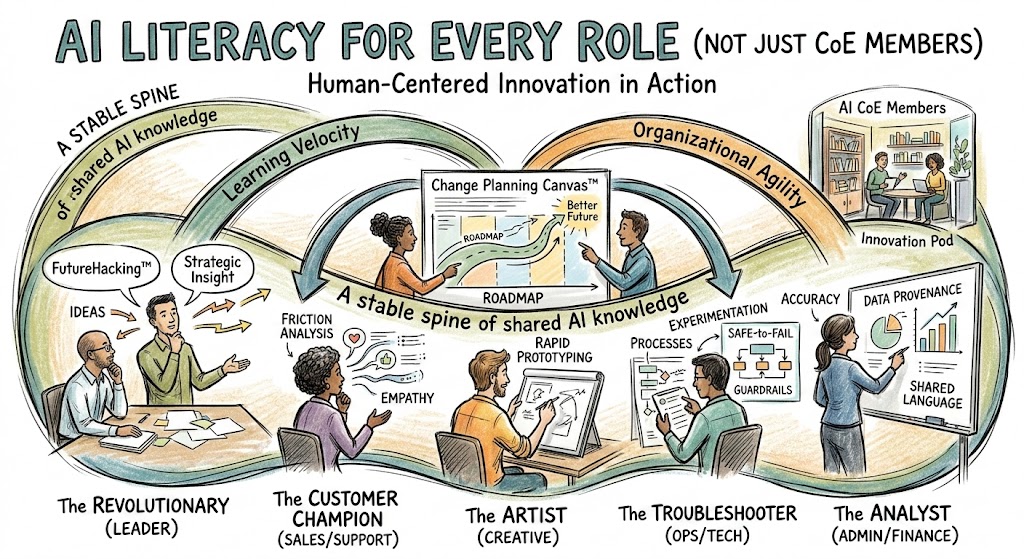
Change can be complicated, change can be confusing, and change can be difficult to successfully implement in any organization. This is why 70% of change initiatives have been found to fail.
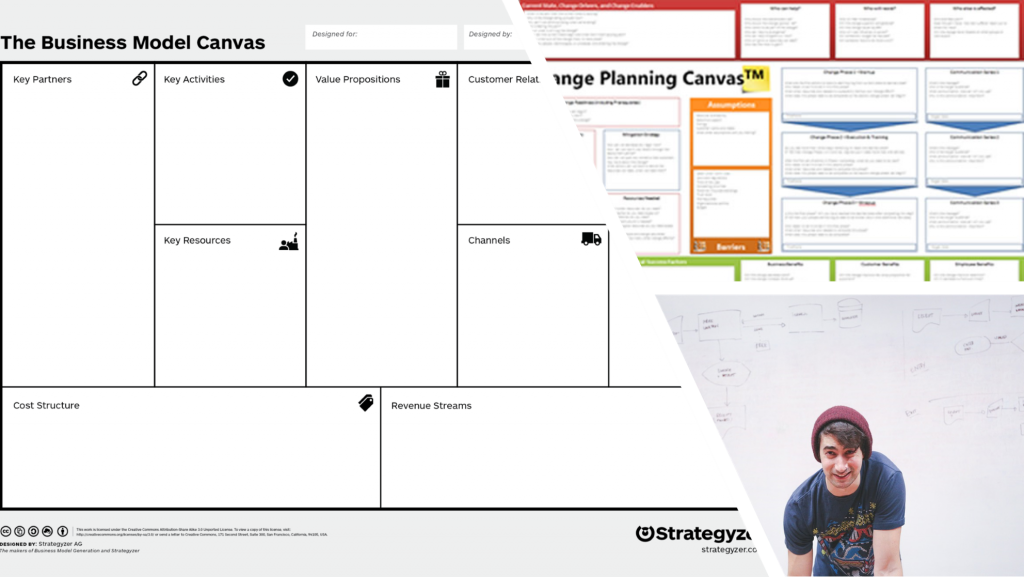
To help make change less overwhelming, and instead more visual and more collaborative, I set out to create the Change Planning Toolkit™ for project managers, change managers, and leaders everywhere to pick up and use with their change leadership teams to better plan and execute their organizational change initiatives, and even projects.
Change Planning Team Contributions
Creating a change planning team that can bring the information and influence to the table that you really need is one of the keys to the eventual success of your change planning sessions and the overall change effort as a whole. The information you need will obviously be driven by the topics that your team should cover as part of your change planning efforts. These include:
What is the current state?
What are the change drivers? (It is helpful to discuss history, context, and the main proponents.)
Is there a budget for both planning and executing this change?
What other change programs are in progress or about to begin?
How ready are we as an organization to make this change?
To see the rest of this list, please get yourself a copy of my book Charting Change
Who needs to be involved in change?
Nothing is more important for creating successful change in an organization than getting the right people in the room and engaged during the change planning process. And if you want to get your change effort off to a strong start and set it up for success, then I encourage you to focus more on knowledge than authority. Think about who knows the most about the key components of a holistic change plan.
Take a moment to consider which individuals in your organization will have the most knowledge and information on the intended change, and which individuals will provide the most considered viewpoints on the topics that you will focus on as you work through the series of worksheets and other tools in the Change Planning Toolkit™ on your way to creating your roadmap and series of fully populated change execution plans.
As we consider all of the data, personalities, ecosystem interactions and work items that must be considered, you’ll quickly see that change is a team sport and that there are many different roles for people to play.
With this in mind, I’ve created The Eleven Change Roles™ to identify the eleven roles that are important to the forming of a balanced and successful change leadership team, so start considering your candidates for:
1. Authority Figures/Sponsors
Somebody has to be in charge. This includes one main sponsor and a coalition of authority figures that can help push things forward when a push is required.
2. Designers
Designers are your big picture thinkers, people that can see how the pieces fit together, are skilled meeting facilitators, can quickly achieve mastery of new methodologies (like my Change Planning Toolkit™), and can help keep people on track as you build out the plans for your change effort.
3. Influencers
Influencers are well-respected and forceful people in the organization. They may lack the formal position power of a sponsor or authority figure, but they can help rally people to the cause with their words and actions.
4. Integrators
Integrators are good at bridging silos, building relationships that cut across geographies and hierarchies, and finding ways for different work teams and departments to work together to achieve a common goal.
5. Connectors
Connectors are slightly different than Integrators, and the difference is that they know where the overt and hidden resources lie in the organization, and have the personal connections and influence necessary to open a dialogue that hopefully results in both needed connections AND access to resources.
6. Resource Controllers/Investors
These people have things that you need – human resources, information resources, physical resources, and human resources. You must convince them to invest those resources in helping you successfully achieve your desired change.
7. Troubleshooters
There are always going to be hiccups and problems that emerge along the way, some expected, and some not. Troubleshooters are really good at helping to identify those up front and enjoy the challenge of finding ways around, over, or under these potential barriers when they crop up. It is even better when the team can identify ways to avoid or overcome them before broader communications begin. Troubleshooters can help with this and often have the deep domain knowledge or the deep insight into the change target’s mindset necessary to also help move minds and resources to support the change program.
8. Evangelists/Storytellers
Every change effort has a story to tell about how the desired future state is better than the current state, and is worth the disruption of making the change. There is the building of a vision, the creation of themes that will weave together into your story, and symbols that will reinforce and show your commitment to realizing the goals you set out for the change effort. Without these, evangelism and storytelling will find it hard to help people understand or support the change goals. So, you need to have evangelists and storytellers at the ready.
9. Endorsers/Supporters
Getting people to agree to talk up the change effort, even if they are not taking an active role in pushing it forward towards completion, is incredibly powerful. Don’t be afraid to reach out and ask for this seemingly insignificant assistance, but be sure and arm these individuals with the themes, symbols and stories that will reinforce the change vision and sustain the change effort’s momentum.
10. The Impacted (key groups of impacted individuals)
Who’s going to be affected by this change? Don’t be afraid to invite these people into your planning efforts early on to voice their concerns so that you can understand their otherwise unvoiced objections, identify solutions or mitigations, and potentially recruit them as impactful Evangelists or Endorsers/Supporters.
11. The External (perspectives from people not affected)
It’s easy to miss risks, assumptions, barriers, and points of potential resistance when you get too close to the effort. Inviting people from outside your organization into your planning process, or to provide feedback on your change effort, will prove enlightening through the additional perspectives they contribute.
Conclusion
When you take the time to thoughtfully recruit people into all of The Eleven Change Roles™ listed above you will have a richer set of inputs, a much livelier discussion, and a stronger set of outputs from your change planning process.
Getting the right people with the right knowledge in the room and engaged during the change planning process will get you off to a strong start and set your change effort up for success. Having people with a strong ability to verbalize meaningful, well intentioned and well informed contributions around the key components of the planning process will provide powerful content as you work through the series of worksheets and other tools contained in the Change Planning Toolkit™ and ultimately populate your Change Planning Canvas™ and your execution plans. The toolkit includes more than 50+ tools including an Eleven Change Roles Worksheet™ that you can use in your change planning meetings or off-site to make sure you have all eleven roles filled.
Recently I had the opportunity to sit down and have a chat with Will Sherlin of 3PillarGlobal about my latest book Charting Change on The Innovation Engine podcast.
In this conversation we focused on how to make change efforts stick within any organization. Among the topics we discuss are how non-software companies can still benefit from Agile methodologies, how to develop actions when the desire to make changes reaches a groundswell, ways to make changes seem less overwhelming and more human, and several other topics of organizational change, digital transformation, and innovation success. You can find the interview here on SoundCloud:
The Change Planning Toolkit™ contains more than 50 visual, collaborative tools to help you beat the 70% change failure rate. You can get the listed number of tools from the Change Planning Toolkit™ by doing the following.