Category Archives: Customer Experience

Customer Churn

The Hidden Experience Failures Driving Customers Away

Customer Churn

by Braden Kelley and Art Inteligencia

Customer churn is the most honest signal your organization receives. When customers leave, they are telling you — with their feet — that something in their experience with you fell below the threshold required to stay. Most organizations respond to churn with data: dashboards, cohort analysis, predictive models, and win-back campaigns. These tools are valuable. But they treat churn as a measurement problem when it is fundamentally an experience problem.

You cannot data-model your way out of experience failures. You have to find them, understand them, and fix them. That requires a different kind of inquiry — one that starts with the human experience, not the spreadsheet.

What is Customer Churn?

Customer churn — also called customer attrition — is the rate at which customers stop doing business with an organization over a given period. It is calculated as:

Churn Rate = (Customers Lost During Period ÷ Customers at Start of Period) × 100

A 5% monthly churn rate means you are replacing your entire customer base roughly every 20 months — just to stay flat. The business math is brutal: acquiring a new customer costs 5–25x more than retaining an existing one, and a 5% improvement in retention rate can increase profitability by 25–95% (Bain & Company / Harvard Business Review). This is why customer churn is one of the most consequential metrics in any business.

But the number alone tells you nothing about why customers are leaving — or how to stop them.

The Two Types of Customer Churn

Voluntary churn is when customers actively choose to leave — canceling subscriptions, switching to competitors, or simply stopping purchases. Voluntary churn is almost always caused by experience failures: unmet expectations, accumulated frustrations, competitive alternatives that seem better, or a specific incident that broke trust.

Involuntary churn is when customers leave for passive reasons — failed payments, expired cards, technical issues, or life circumstances. Involuntary churn is more mechanical and can be addressed through better billing infrastructure and proactive outreach. It is typically 20–40% of total churn in subscription businesses.

Most churn reduction programs focus on involuntary churn because it is easier to address with automation. Most churn value is in voluntary churn because fixing experience failures has compounding effects — it retains existing customers, reduces negative word of mouth, and improves the experience for future customers simultaneously.

The Real Causes of Customer Churn

Research and practitioner experience consistently point to the same root causes of voluntary churn. None of them are primarily data problems:

1. The experience didn’t deliver on the promise
The most common cause of churn is the gap between what was promised in marketing and sales and what was actually delivered. Customers who feel misled — even subtly, even unintentionally — lose trust quickly and rarely recover it. This gap is often invisible to internal teams because the people who make the promise (marketing and sales) and the people who deliver the experience (product and service) rarely sit together and compare notes.

2. Friction accumulated across the journey
Customers rarely churn because of a single bad experience. They churn because friction accumulated over time — small inconveniences that individually seem trivial but collectively communicate “this company doesn’t value my time.” Difficult onboarding, confusing interfaces, slow support responses, and unnecessary process steps all add to the friction load. Most organizations have no systematic way to identify where this friction lives because they measure transactions, not journeys.

3. A critical moment was handled badly
Every customer relationship has moments of truth — high-stakes interactions that define whether trust is built or broken. A billing dispute, a product failure, a service incident, an onboarding call. When these moments are handled well, they can actually increase loyalty beyond the pre-incident level (the well-documented “service recovery paradox”). When they are handled badly, they trigger churn decisions that no amount of loyalty program points will reverse.

4. The customer never fully succeeded with the product or service
In subscription and service businesses, customers who never achieve the outcome they purchased for are churning before they formally cancel — they are just paying while they look for alternatives. Customer success failure is one of the most underdiagnosed causes of churn because organizations measure activation and onboarding completion, not whether customers are actually achieving meaningful outcomes.

5. A competitor offered a better experience
Customers don’t leave because competitors are cheaper. Research consistently shows that price is rarely the primary stated reason for churn — and almost never the actual reason. They leave because a competitor’s experience made them feel more valued, more understood, or more successful. Experience-driven competitive loss is particularly dangerous because it is silent: customers don’t complain, they just leave.

6. The relationship was never built
In many organizations, the customer relationship effectively ends at purchase. No proactive outreach, no success check-ins, no relationship beyond transactional interactions. Customers who feel like account numbers rather than people are easy to lose to any competitor who treats them like humans.

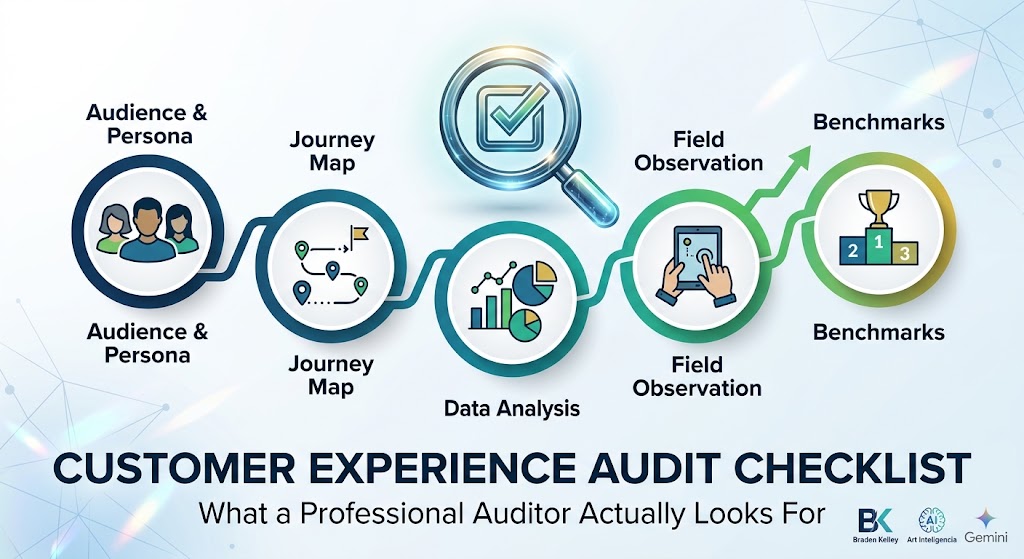
Causes of Customer Churn Infographic

Why Most Churn Reduction Programs Fall Short

Most churn reduction programs are built on two flawed assumptions: that churn is primarily a data problem, and that it can be solved primarily through automation.

The data assumption leads organizations to invest in increasingly sophisticated churn prediction models — systems that identify customers likely to leave based on behavioral signals. These models are valuable for triage, but they don’t fix anything. They tell you who is at risk; they don’t tell you why, and they don’t address the underlying experience failures causing the risk in the first place. Predicting churn without fixing its causes is like repeatedly bailing out a leaking boat without patching the hole.

The automation assumption leads organizations to invest in win-back campaigns, automated health score outreach, and in-app nudges. Again, these are useful tools. But they are responses to churn, not prevention of it. By the time a customer is in your win-back campaign, the experience failure has already occurred — you are trying to recover a relationship that your experience has already damaged.

The organizations that consistently achieve low churn rates do something different: they invest in understanding and improving the actual customer experience across the full journey — not just the moments that show up in their metrics.

How an Experience Audit Identifies the Real Drivers of Churn

A customer experience audit is the most direct path to understanding why customers are actually churning — not why your data suggests they might be churning, but why they actually are.

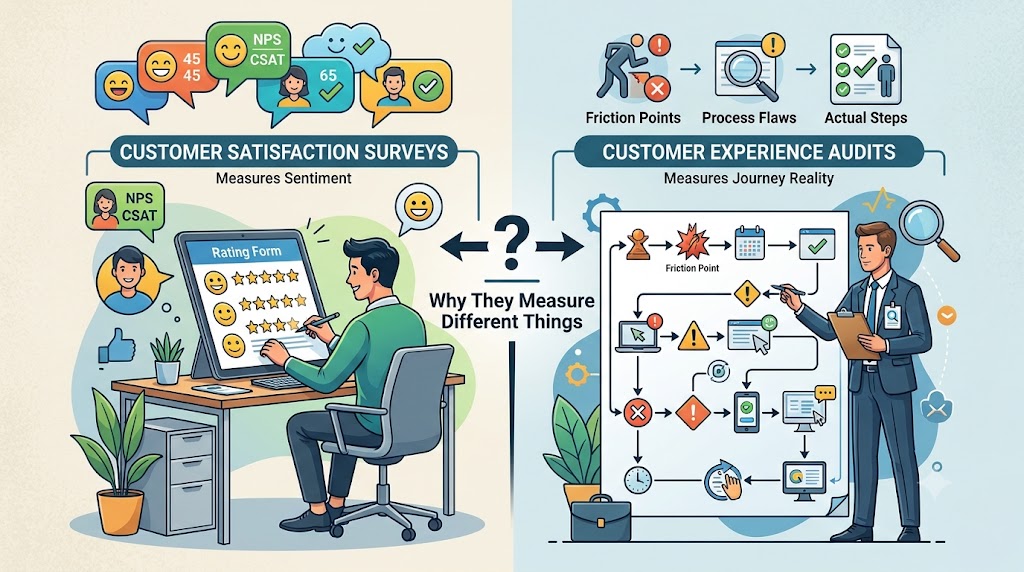
An experience audit approaches churn from the customer’s perspective rather than the organization’s. Rather than analyzing behavioral data, it walks the actual customer journey — across all channels and touchpoints — to identify the specific experience failures that are driving departure decisions. It surfaces:

  • The friction points that accumulate into churn decisions
  • The gaps between promised and delivered experience
  • The critical moments that are being handled badly
  • The competitive experience gaps that make alternatives look attractive
  • The relationship voids where customers feel like numbers rather than people

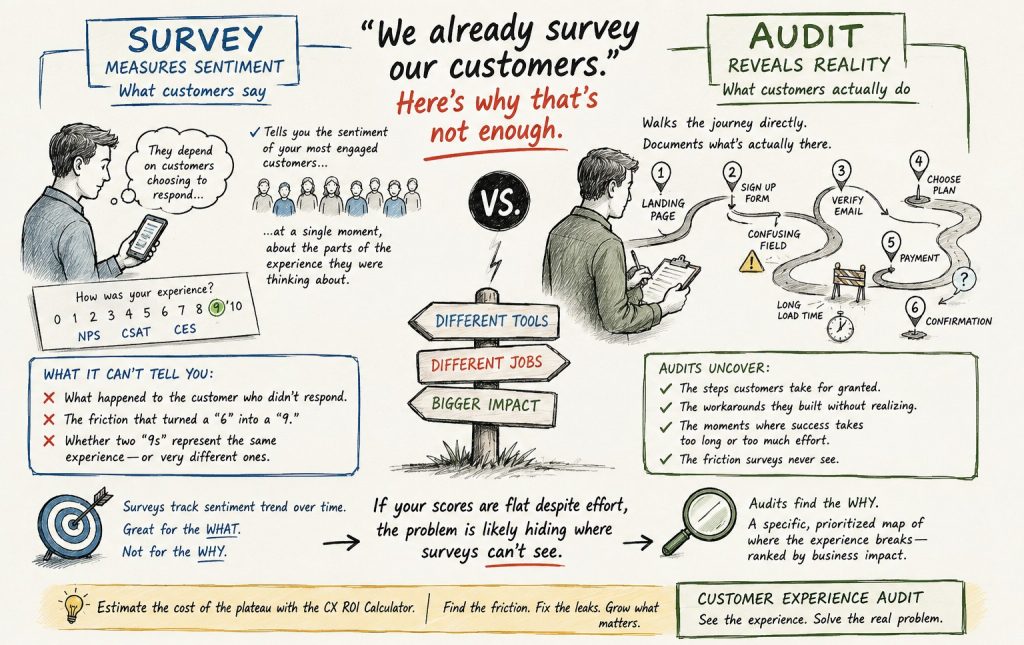
Critically, an experience audit finds the failures that your data isn’t showing you — the things customers endure without complaint, the friction they work around rather than report, and the competitive experiences they compare you to that you’ve never measured against. These invisible failures are often the most important drivers of churn precisely because they are invisible to internal teams.

The result is not a churn prediction — it is a churn explanation, with specific, prioritized experience improvements that address the actual causes rather than the symptoms.

A Framework for Addressing Customer Churn Through Experience Improvement

Based on the root causes above, here is a practical framework for reducing churn through experience improvement:

Step 1: Audit the actual experience
Before investing in churn reduction tactics, understand what the experience actually is — not what you designed it to be, but what customers actually encounter. Walk the journey. Call your own support line. Go through your own onboarding. Submit a billing dispute. What you find will almost certainly surprise you.

Step 2: Map churn to experience failures, not to data signals
For each significant churn segment, identify the specific experience failures most likely to be driving it. Exit interviews, customer journey research, and direct observation will give you information that no behavioral dataset can.

Step 3: Prioritize by impact and fixability
Not all experience failures are equal. Prioritize fixes that address high-frequency friction (affecting many customers), critical moments of truth (high emotional stakes), and competitive gaps (experiences where alternatives are demonstrably better). Fix the leaky bucket before you pour more water in.

Step 4: Fix the experience, then measure the effect on churn
Most churn reduction programs measure first and fix second. Flip this: fix the highest-priority experience failures, then measure whether churn rates move. This approach produces sustainable churn reduction rather than temporary improvements driven by win-back campaigns that reset when the campaign ends.

Step 5: Build ongoing experience intelligence
Churn prevention is not a project — it is a capability. Organizations that consistently achieve low churn rates have built systematic ways to monitor the customer experience continuously, not just when churn spikes. This means regular journey reviews (customer journey mapping helps here), systematic feedback collection at key touchpoints, and competitive experience benchmarking.

Framework for Reducing Customer Churn Infographic

Frequently Asked Questions About Customer Churn

What is a good customer churn rate?

A good customer churn rate varies significantly by industry and business model. For SaaS businesses, monthly churn rates below 2% (roughly 22% annually) are generally considered acceptable, with best-in-class companies achieving under 0.5% monthly churn. For subscription consumer businesses, annual churn below 5-7% is strong. For B2B enterprise businesses with long contracts, annual churn below 5% is typical for well-performing companies. The most meaningful benchmark is not an industry average but your own trend over time — and whether your churn rate is higher or lower than your key competitors.

What is the difference between customer churn and customer attrition?

Customer churn and customer attrition are used interchangeably in most contexts and refer to the same phenomenon: customers stopping their relationship with an organization. Some practitioners use “attrition” for the broader category (including involuntary churn from payment failures) and “churn” specifically for voluntary departures, but there is no universal standard. What matters more than terminology is distinguishing between voluntary churn (customers actively choosing to leave) and involuntary churn (customers lost due to passive factors like payment failures), as these require fundamentally different interventions.

How do you reduce customer churn?

The most effective approach to reducing customer churn starts with understanding why customers are actually leaving — not just predicting who might leave next. This requires walking the actual customer journey to identify the experience failures driving departure decisions: accumulated friction, gaps between promised and delivered experience, badly handled critical moments, and competitive experience gaps. Once root causes are identified, targeted experience improvements produce more sustainable churn reduction than win-back campaigns or loyalty programs, which address symptoms rather than causes. A customer experience audit is the most direct way to identify the specific experience failures driving churn in your organization.

What is the relationship between customer experience and churn?

Customer experience is the primary driver of voluntary churn. Research by Bain & Company found that 80% of companies believe they deliver superior customer experience, while only 8% of their customers agree — and the gap between those perceptions is where churn lives. Customers who rate their experience as “very good” churn at dramatically lower rates than those who rate it “good” — the difference between satisfied and truly delighted customers is measurable in retention rates. Improving customer experience is not just a service initiative; it is one of the highest-ROI investments available for reducing churn and improving the financial performance of any customer-facing business.

How does a customer experience audit help reduce churn?

A customer experience audit identifies the specific experience failures driving churn by walking the actual customer journey across all channels and touchpoints — finding the friction, gaps, and critical moment failures that behavioral data doesn’t surface. Unlike churn prediction models that identify who is at risk, an experience audit explains why customers are actually leaving and provides a prioritized roadmap of experience improvements that address root causes rather than symptoms. Organizations that conduct experience audits before investing in churn reduction tactics consistently achieve more durable retention improvements than those that rely on data-driven outreach alone.

Ready to find the experience failures driving churn in your organization? Learn more about the Experience Audit →

Content Authenticity Statement: The topic area, key elements to focus on, etc. were decisions made by Braden Kelley, with a little help from Claude and Google Gemini to clean up the article, add images and create infographics.

Image credits: Google Gemini

Subscribe to Human-Centered Change & Innovation WeeklySign up here to get Human-Centered Change & Innovation Weekly delivered to your inbox every week.
How Claytronics Will Redefine Co-Creation and Experience Design

The Morphing Paradigm

LAST UPDATED: May 29, 2026 at 5:06 PM

How Claytronics Will Redefine Co-Creation and Experience Design

GUEST POST from Art Inteligencia


I. Introduction: Beyond the Flat Screen and the Static Prototype

The Hook: For decades, innovators and experience designers have been trapped in two dimensions (screens) or limited by static three dimensions (3D printing). What happens when matter itself becomes dynamic?

Defining the Tech: Introduce Claytronics and the concept of “catoms” (claytronic atoms)—sub-millimeter micro-robots that self-assemble, shift, and lock on demand based on software.

The Thesis: Claytronics is not just a technological milestone; it is the ultimate evolution of human-centered experience design and futurology. It shifts us from interacting with devices to collaborating with physical matter that adapts dynamically to human intent.

II. The Futurology Lens: A New Era for Physical UI (User Interface)

The Death of Fixed Forms: Explore how the concept of a “device” changes when form follows function in real-time.

Real-time Ergonomic Configuration: If a user grabs a physical tool, the tool’s matter dynamically adjusts its texture, grip, and weight distribution to perfectly fit that specific human hand.

Continuous Evolution: Products are no longer “finished” when they leave a factory. Through software updates, physical objects can completely rewrite their hardware configuration in the consumer’s home.

The Tech Pioneers: Who is Shaping the Programmable Matter Landscape?

As we transition from theory to practice, the claytronics and programmable matter market is expanding rapidly, with projections positioning its value to reach tens of billions of dollars over the next decade. Moving the needle on this technology requires immense R&D infrastructure and cross-disciplinary agility. Today, a distinct mix of tech giants, specialized pioneers, and academic heavyweights are laying the foundation for a morphing physical world.

1. Industry Titans & Enterprise Investors

Large enterprise technology leaders are quietly securing intellectual property and investing heavily in the underlying material science and processing architecture required to synchronize millions of micro-robots.

  • Intel Corporation: A long-standing force in the claytronics space, Intel focuses heavily on researching the advanced materials, nanotechnology, and micro-electromechanical systems (MEMS) necessary to scale catom hardware.
  • IBM: Leveraging its profound computing capabilities, IBM recently forged partnerships with leading academic research labs to focus on micro-robotic scaling and advanced distributed control algorithms.
  • Sony & Samsung: Consumer electronics giants are increasingly looking toward a “fluid device” future, establishing joint ventures and research pipelines to figure out how modular, shape-shifting interfaces can be commercialized for home and entertainment ecosystems.

2. Specialized Pioneers & Modular Robotics Startups

While the market is still deeply rooted in advanced engineering, several dedicated commercial entities and venture-backed players are pushing the boundaries of physical automation.

  • Claytronics, Inc.: A foundational enterprise dedicated solely to this paradigm shift, driving the design of actual millimeter-scale catom prototypes and software frameworks to coordinate them.
  • Modular Robotics (Cubelets): Operating successfully at the intersection of education and design, their “Cubelets” system serves as an early, commercialized proof-of-concept for how individual robot blocks can use emergent behavior to collaborate and form complex structures.
  • Early-Stage Innovators: The sector is witnessing a sharp uptick in funding from elite venture arms—such as Boston Dynamics Ventures—backing next-generation startups focused on high-resolution reconfigurable motors and haptic 3D replication tools.

3. Elite Academic & Defense Innovation Hubs

Because programmable matter sits at the bleeding edge of physics and computer science, the intellectual capital is driven by elite institutional partnerships.

  • Carnegie Mellon University (CMU): The historic epicentre of claytronics research. CMU continually breaks ground on the algorithmic breakthroughs needed for self-assembling structures, spatial control, and dynamic interlocking physics.
  • MIT (Distributed Robotics & CSAIL): Renowned for inventing “self-sculpting sand” and programmable origami sheets, MIT specializes in high-resolution, low-power reconfigurable chains and magnetically reprogrammable materials that connect autonomously.
  • Defense Advanced Research Projects Agency (DARPA) & US Army Research Lab: Through initiatives like the Programmable Matter Project, defense funding acts as a massive catalyst, validating use cases ranging from rapid disaster relief infrastructure to remote medical simulation tools.

III. Transforming the Design Thinking Sandbox

The Hyper-Agile Workshop: How design thinking squads will run co-creation workshops using programmable matter.

Instant Prototyping: Instead of waiting hours for a 3D print or sketching on a whiteboard, a team can say, “Let’s see what a more aerodynamic dashboard feels like,” and the matter morphs instantly under their fingers.

Failing Fast in Three Dimensions: Reducing the cost and friction of physical experimentation, allowing teams to iterate on tactile, real-world experiences as quickly as software developers push code.

IV. Human-Centered Change: Leading Organizations Through the Transition

The Mindset Shift: Moving organizations away from “product-centric” thinking to “fluid experiential” thinking. When physical assets become software-defined, product management must merge completely with software engineering agile loops.

Overcoming Resistance to Radical Change: Shifting from predictable, rigid supply chains to dynamic, software-driven physical assets will trigger immense organizational anxiety. Supply chain managers will fear obsolescence, and quality assurance teams will struggle with testing an object that can have infinite forms. Leaders must establish psychological safety by framing claytronics not as a replacement for human craft, but as an amplifier for creative intent.

The New Skillsets (The Co-Creation Canvas): What experience designers, innovation managers, and change agents need to learn today. To help teams transition, organizations should adopt a 3-part internal upskilling framework:

  • Tactile Storytelling: Designers must learn to program haptic feedback, defining not just how an object looks on a screen, but how its weight, texture, and density shift to communicate with the user.
  • Dynamic Safety Mapping: Change agents must define the operational guardrails of morphing spaces, creating strict environmental rules for when and where matter is allowed to change shape to protect human workers.
  • Elastic Branding: Marketing and experience leaders must move past fixed logos and static industrial designs, learning to build brands that express themselves through physical motion and real-time physical adaptation.

V. Ethical and Experiential Guardrails (The Human Factor)

The Cognitive Load of a Shifting Reality: How do we maintain trust and spatial familiarity when the objects around us can change shape on a whim?

Safety and Standards: Ensuring that self-assembling structures are structurally sound, reliable, and secure from digital tampering (malicious software redefining physical shapes).

Sustainability: The potential for claytronics to radically reduce waste—one block of programmable matter can become a hundred different tools over its lifecycle, eliminating single-use plastic and manufacturing overhead.

VI. The Claytronics Playbook: Strategic Horizons for Investors and Executives

Programmable matter is not a distant science fiction fantasy; it is an emerging asset class and a looming disruptive force for traditional manufacturing. To capitalize on this shift, leaders and investors must look at the transition through three distinct commercial horizons.

Horizon 1: The Software Layer & Control Infrastructure (Next 3–5 Years)

The Opportunity: The immediate value lies not in the physical hardware, but in the software, algorithms, and digital security required to manage millions of moving parts simultaneously.

  • Investment Vector: Target companies developing decentralized operating systems, micro-robotic mesh networking protocols, and AI-driven spatial compilers that translate 3D CAD files into catom movement commands.
  • Corporate Action: IT and product design departments should begin auditing their existing digital twins and asset pipelines, ensuring software architectures can eventually export to dynamic physical matter.

Horizon 2: High-Value, Niche Prototyping & Medical Tooling (5–8 Years)

The Opportunity: As catom hardware scales down in cost, initial commercialization will thrive in industries with high margins and low volume requirements.

  • Investment Vector: Monitor advanced medical device companies utilizing programmable materials for minimally invasive surgery tools that morph inside the body, or aerospace firms using fluid materials for wind-tunnel testing.
  • Corporate Action: Research and development (R&D) centers should prepare to phase out traditional additive manufacturing (3D printing) in favor of early-stage programmable matter sandboxes to cut rapid prototyping cycles from days to seconds.

Horizon 3: The Programmable Consumer Ecosystem (8+ Years)

The Opportunity: This is the ultimate destination: consumer goods that redefine their own form factors on demand, radically altering global supply chains.

  • Investment Vector: Long-term venture capital should track innovations in advanced material science, specifically room-temperature electromagnetics and low-power latching mechanisms that allow catoms to stay rigid without draining energy.
  • Corporate Action: Supply chain and logistics executives must begin scenario-planning for a “hardware-as-a-service” model, where physical inventory shipping is replaced by digital design licensing streams.

VII. The Ripple Effect: Which Industries Face Imminent Disruption?

Claytronics represents a massive threat to legacy businesses that rely on the mass production of static items. Forward-thinking investors should carefully evaluate their exposure to fields vulnerable to the rise of programmable matter.

Vulnerable Sector The Claytronics Threat The Strategic Pivot
Tooling & Hardware Manufacturing Single-use mechanical tools become obsolete when a single block of claytronic matter can morph into a wrench, a hammer, or a custom caliper on demand. Shift from manufacturing physical steel and plastic components to selling proprietary, certified 3D geometry software licenses.
Commercial Warehousing & Logistics The need for massive warehouses stuffed with static safety stock plummets when raw programmable matter can be stored efficiently and shaped instantly at the point of sale. Invest heavily in localized, highly secure “material computation hubs” rather than sprawling hub-and-spoke distribution warehouses.
Office & Retail Real Estate Fixed layouts limit commercial utility. Programmable walls, desks, and retail displays mean a single square foot of real estate can effortlessly shift from a collaborative workspace by day to an immersive retail store by night. Value real estate assets based on adaptive spatial capacity and structural data throughput rather than pure square footage.

VIII. Conclusion: Designing a Fluid Future

Summary: Claytronics turns the physical world into a digital canvas, putting unprecedented power into the hands of experience designers and innovators.

Call to Action: The future isn’t something that happens to us; it’s something we build. Innovators must start thinking beyond static constraints today, because tomorrow, the very matter around us will bend to human imagination.

Frequently Asked Questions

What is Claytronics and how does it work?

Claytronics, or programmable matter, combines micro-robotics and computer science to create millions of sub-millimeter units called “catoms” (claytronic atoms). These units dynamically self-assemble, shift, and lock together to form three-dimensional physical objects that change shape, texture, and function on demand based on software inputs.

How will programmable matter transform design thinking and prototyping?

Programmable matter eliminates the lag time of traditional 3D printing and the limitations of flat screens. Design thinking squads can use it to create hyper-agile workshops where physical prototypes morph instantly in real time based on human intent, allowing teams to test ergonomics, fail fast in three dimensions, and iterate rapidly.

What are the organizational and human challenges of adopting Claytronics?

The primary challenges involve a massive mindset shift from rigid, product-centric manufacturing to fluid, experiential design. Organizations must manage the anxiety of shifting supply chains to software-driven assets, address the cognitive load humans experience when their physical surroundings change shape, and build rigorous digital security guardrails to prevent physical tampering.


Disclaimer: This article speculates on the potential future applications of cutting-edge scientific research. While based on current scientific understanding, the practical realization of these concepts may vary in timeline and feasibility and are subject to ongoing research and development.

Image credits: Gemini

Subscribe to Human-Centered Change & Innovation WeeklySign up here to get Human-Centered Change & Innovation Weekly delivered to your inbox every week.
Customer Loyalty

Why Satisfaction Isn’t Enough and What Actually Builds It

Customer Loyalty

by Braden Kelley and Art Inteligencia

Customer loyalty is the most misunderstood concept in business. Organizations spend billions annually on loyalty programs — points, rewards, tiers, and perks — while the research consistently shows that programs are not what makes customers loyal. Customers are loyal because of how an organization makes them feel, how reliably it delivers on its promises, and how effectively it helps them succeed. The program is the mechanism. The experience is the cause.

This distinction matters enormously in practice. Organizations that invest in loyalty programs without fixing the underlying experience are building an expensive structure on a cracked foundation. Organizations that invest in experience first — and use programs to reinforce the relationship — build the kind of loyalty that is genuinely difficult for competitors to disrupt.

What is Customer Loyalty?

Customer loyalty is the sustained preference a customer shows for an organization — expressed through repeat purchases, resistance to competitive alternatives, willingness to pay a premium, and active advocacy on the organization’s behalf. It is not the same as customer retention (which can be driven by switching costs and inertia), and it is not the same as customer satisfaction (which measures a moment in time, not a sustained behavioral pattern).

True loyalty has three dimensions:

  • Behavioral loyalty — customers consistently choose you over alternatives and purchase repeatedly, even when alternatives are available
  • Attitudinal loyalty — customers have a genuinely positive disposition toward your organization, feel emotionally connected to it, and trust it
  • Advocacy loyalty — customers actively recommend you to others, defend you when criticized, and invest their social capital in your brand

Most loyalty metrics measure only the behavioral dimension — repeat purchase rates, retention rates, and NPS scores as a proxy for advocacy. The attitudinal dimension is harder to measure and receives far less management attention, which is why so many organizations are surprised when behaviorally “loyal” customers defect at the first attractive alternative: they were retained, not loyal.

The Business Case for Customer Loyalty

The financial argument for investing in customer loyalty is among the strongest in business strategy:

  • 80% of future profits will come from just 20% of existing customers — making the retention and deepening of existing relationships the highest-ROI investment available to most organizations.
  • Customers with an emotional bond to a brand have a 306% higher lifetime value than those who are merely satisfied — the gap between satisfied and loyal is not incremental, it is transformational.
  • Acquiring a new customer costs 5x more than retaining an existing one — and loyal customers require less acquisition investment, less service investment, and generate more referral value simultaneously.
  • Brands that align customer experience and brand experience unlock up to 3.5x revenue growth compared to those that manage them separately, according to Forrester’s Total Experience Score research.
  • Customers who trust a brand are 88% more likely to be repeat buyers — trust is the foundation of loyalty, and trust is built through experience, not programs.

Why Loyalty Programs Alone Don’t Build Loyalty

Loyalty programs are ubiquitous — and their limitations are increasingly well documented. In 2026, roughly 59% of consumers are more likely to join a loyalty program than 12 months ago, and loyalty programs now account for 31.4% of total marketing budgets. Yet the research on whether programs actually build loyalty is sobering.

The fundamental problem with loyalty programs is that they address behavior without addressing attitude. A points program can change what a customer does — encouraging them to concentrate purchases with your organization to maximize rewards — without changing how they feel about you. Behavioral loyalty driven by a program is fragile: it persists only as long as the program’s economics are attractive. The moment a competitor offers a better program, the “loyal” customer transfers their purchases immediately.

This is the difference between loyalty that is earned and loyalty that is purchased. Earned loyalty — built through consistently excellent experience, genuine trust, and emotional connection — is durable. Purchased loyalty — maintained through rewards and discounts — is ephemeral.

Forrester’s 2025 CX Index reached a new low after four consecutive years of decline, with 25% of US brands seeing CX scores decline for a second straight year. This is happening at the same time that loyalty program investment is rising — a clear signal that programs are not compensating for experience failures.

The Real Drivers of Customer Loyalty

The research on what actually drives sustained customer loyalty consistently points to the same factors — and none of them are primarily program-driven:

1. Consistent, reliable experience delivery
80% of customers state that the experience a company provides is just as important as its products and services. Consistency matters as much as peak quality — customers who know what to expect from you, and reliably get it, develop a form of trust that is the foundation of genuine loyalty. Inconsistency, even when punctuated by excellent experiences, creates uncertainty that erodes trust over time.

2. Trust
Trust is both the prerequisite for loyalty and its most fragile component. In PwC’s 2025 CX research, 93% of consumers say a brand will lose their trust if it mishandles personal data. Trust is built slowly through consistent behavior and destroyed quickly through specific failures — particularly failures of honesty, competence, or care at critical moments. Organizations that treat trust as an implicit asset rather than an explicit management priority consistently underinvest in the behaviors that build it.

3. Emotional connection
Customers with an emotional bond to a brand have a 306% higher lifetime value than those who are merely satisfied. Emotional connection is built when customers feel genuinely understood, when the organization demonstrates that it knows and values them as individuals, and when interactions feel human rather than transactional. It is the hardest loyalty driver to manufacture deliberately — and the most durable when it exists.

4. Value realization
Customers are loyal to organizations that reliably help them succeed — that deliver the outcomes they purchased for, consistently and predictably. Value realization is distinct from product quality: a high-quality product that customers can’t fully use, don’t know how to use, or aren’t supported in using does not build loyalty. Organizations that invest in customer success — in helping customers actually achieve the outcomes they bought — build the kind of loyalty that survives competitive disruption.

5. Personalization
91% of consumers now prefer brands that offer personalized content and offers. Personalization signals that you know the customer as an individual — that they are not interchangeable with every other customer you serve. At its best, personalization is not about data and algorithms; it is about demonstrating through every interaction that you understand who this specific customer is, what they value, and what they need.

6. Shared values
89% of consumers prefer brands that share their social or ethical values. Values alignment has become an increasingly important loyalty driver, particularly among younger customers. Organizations whose behavior visibly aligns with values their customers hold — environmental responsibility, social equity, community investment, employee treatment — build a form of loyalty that transcends the transactional relationship entirely.

7. Exceptional service recovery
The service recovery paradox — the well-documented phenomenon where customers who experience a problem that is handled exceptionally well become more loyal than customers who never experienced a problem at all — is one of the most actionable loyalty drivers available. Every service failure is a loyalty opportunity if handled correctly. Organizations that invest in exceptional service recovery — not just adequate resolution but genuinely impressive response — consistently outperform on loyalty metrics.

The Satisfaction-Loyalty Gap: Why Satisfied Customers Aren’t Always Loyal

One of the most important findings in customer loyalty research is the non-linear relationship between satisfaction and loyalty. Satisfaction and loyalty are not the same thing, and the gap between them is where most loyalty investment goes to waste.

Research by Xerox consistently found that customers rating an experience 5 out of 5 were six times more likely to repurchase than customers rating it 4 out of 5. The difference between “satisfied” and “completely satisfied” — between adequate and excellent — is enormous in its loyalty implications. This is why organizations that manage to average satisfaction scores miss the point: the goal is not average satisfaction, it is the consistent delivery of genuinely excellent experience at the moments that matter most.

The practical implication is that loyalty investment should focus on the moments of truth — the high-stakes interactions that define whether customers feel excellent or merely adequate — rather than on incremental improvements to already-acceptable baseline experiences.

How Customer Experience Drives Customer Loyalty

Every loyalty driver identified above is fundamentally an experience outcome. Trust is built through experience. Emotional connection is built through experience. Value realization is built through experience. Personalization is delivered through experience. Service recovery is an experience intervention.

This means that the most direct path to building customer loyalty is investing in customer experience — specifically, in understanding where the current experience is falling short of the standard required to build the trust, emotional connection, and consistent value realization that sustain loyalty over time.

A customer experience audit is the most systematic way to identify the specific experience gaps that are preventing loyalty from forming — or actively eroding loyalty that has been built. An experience audit walks the actual customer journey across all touchpoints to identify:

  • The moments of truth being handled adequately when they should be handled exceptionally
  • The consistency failures creating uncertainty and undermining trust
  • The personalization gaps signaling to customers that they are not truly known
  • The service recovery processes that are resolving problems without rebuilding loyalty
  • The value realization gaps preventing customers from achieving the outcomes that sustain engagement

The result is not a loyalty strategy — it is a prioritized experience improvement roadmap that addresses the specific gaps preventing loyalty from forming in your specific customer base, which competitive experience benchmarking can help identify.

Building a Loyalty Strategy That Actually Works

A loyalty strategy that produces genuine, durable loyalty — not just behavioral compliance maintained by program economics — is built in this sequence:

Step 1: Understand what loyalty actually looks like in your customer base
Before investing in loyalty, define what loyalty means in your specific context. What does a genuinely loyal customer do that a merely retained customer doesn’t? How do your most loyal customers behave differently from your average customers? This profile becomes the target state for your loyalty investment.

Step 2: Audit the experience that loyalty is built on
Identify the specific experience gaps — the moments of truth handled adequately rather than exceptionally, the consistency failures, the personalization gaps — that are preventing your average customers from becoming your most loyal customers. This is the foundation that programs and campaigns are built on, and it must be solid before those investments will pay off.

Step 3: Fix the experience failures before layering on programs
The most common loyalty investment mistake is launching a program to compensate for experience failures. Programs attract customers who are loyal to the program, not to you — and they attract your competitors’ customers on the same basis. Fix the experience that builds genuine loyalty first, then use programs to reinforce and reward it.

Step 4: Design moments of truth for excellence, not adequacy
Identify the five to ten moments in your customer journey (customer journey mapping helps here) where the quality of the experience has a disproportionate impact on loyalty — typically onboarding, first value realization, first service incident, renewal, and expansion. Invest in making these moments genuinely excellent rather than merely adequate. The gap between adequate and excellent at these specific moments is where most of the loyalty value lives.

Step 5: Build loyalty measurement that captures what matters
NPS is a useful signal but an incomplete loyalty measure. Build a measurement approach that captures all three dimensions of loyalty — behavioral, attitudinal, and advocacy — and tracks them over time. Understand not just whether customers are renewing but whether they feel genuinely connected, whether they trust you, and whether they would actively recommend you unprompted.

Frequently Asked Questions About Customer Loyalty

What is customer loyalty?

Customer loyalty is the sustained preference a customer shows for an organization — expressed through repeat purchases, resistance to competitive alternatives, willingness to pay a premium, and active advocacy. It has three dimensions: behavioral loyalty (consistently choosing you over alternatives), attitudinal loyalty (genuinely positive feelings and trust toward your organization), and advocacy loyalty (actively recommending you to others). Most loyalty metrics measure only behavioral loyalty, missing the attitudinal and advocacy dimensions that determine whether loyalty is genuine and durable or merely habitual and fragile.

What is the difference between customer loyalty and customer retention?

Customer retention measures whether customers continue purchasing — it can be driven by genuine loyalty, switching costs, inertia, or lack of alternatives. Customer loyalty is a more specific condition: customers are retained because they genuinely prefer your organization, trust it, and feel positively connected to it. A retained customer who is not loyal will defect at the first attractive competitive offer; a genuinely loyal customer will resist competitive alternatives even when they are objectively similar or cheaper. The distinction matters because retention-focused strategies and loyalty-focused strategies require different investments — retention can be managed operationally, but loyalty requires experience investment.

Do loyalty programs actually build customer loyalty?

Loyalty programs can reinforce loyalty in customers who are already loyal, but they rarely create loyalty in customers who are not. The fundamental limitation of loyalty programs is that they change behavior without changing attitude — they can encourage customers to concentrate purchases with your organization, but they cannot make customers trust you, feel emotionally connected to you, or advocate for you. Behavioral loyalty driven by program economics is fragile: it persists only as long as the program’s rewards are attractive relative to alternatives. Organizations that invest in loyalty programs without fixing the underlying experience failures limiting genuine loyalty are building on a cracked foundation.

What is the most important driver of customer loyalty?

Research consistently identifies consistent, reliable experience delivery as the foundation of customer loyalty — before emotional connection, personalization, or program incentives. Customers who know what to expect from an organization and reliably get it develop a form of trust that is the prerequisite for all other loyalty dimensions. Trust, once established, is the single most powerful loyalty driver: customers who trust a brand are 88% more likely to be repeat buyers, and customers with emotional bonds to a brand have a 306% higher lifetime value than those who are merely satisfied. Both trust and emotional connection are built through experience — not through programs.

How does customer experience affect customer loyalty?

Customer experience is the primary mechanism through which loyalty is built or destroyed. Every loyalty driver — trust, emotional connection, value realization, personalization, and service recovery — is delivered through experience. Organizations that invest in understanding and improving their customer experience build the genuine loyalty that resists competitive disruption and generates advocacy. Organizations that manage experience to adequacy while investing in loyalty programs are managing the symptom while neglecting the cause. The most direct path to improving customer loyalty is identifying and fixing the specific experience failures that are preventing trust and emotional connection from forming — which is what a customer experience audit is designed to do.

What is the service recovery paradox?

The service recovery paradox is the well-documented phenomenon where customers who experience a service failure that is handled exceptionally well become more loyal than customers who never experienced a problem at all. It occurs because exceptional service recovery demonstrates, in a high-stakes moment, that the organization genuinely cares about the customer — producing a stronger emotional signal than routine good service. The paradox is real but conditional: it requires genuinely exceptional recovery, not just adequate resolution. Organizations that treat service failures as loyalty opportunities and invest in recovery processes that produce genuine customer delight consistently outperform on loyalty metrics.

Ready to identify the experience gaps limiting loyalty in your organization? Learn more about the Experience Audit →

Image credits: Google Gemini

Content Authenticity Statement: The topic area, key elements to focus on, etc. were decisions made by Braden Kelley, with a little help from Google Gemini to clean up the article, add images and create infographics.

Subscribe to Human-Centered Change & Innovation WeeklySign up here to get Human-Centered Change & Innovation Weekly delivered to your inbox every week.

Revenue Leakage

The Customer Experience Failures Silently Draining Your P&L

Revenue Leakage

by Braden Kelley and Art Inteligencia

Revenue leakage is one of the most widely discussed topics in finance and operations — and one of the most narrowly defined. Ask most CFOs what revenue leakage means and they will describe billing errors, missed invoices, and contract compliance gaps. These are real problems worth solving. But they represent only the visible surface of a much larger issue.

The revenue leakage that does the most damage to most organizations is not found in the billing system. It is found in the customer experience — in the friction, failed moments, and unmet expectations that cause customers to buy less, expand less, renew less, and advocate less than they would if their experience were better. This form of revenue leakage is invisible in most financial reports. It shows up in churn rates, in Net Promoter Scores, in declining share of wallet, and in the slow erosion of customer lifetime value that compounds quietly over years.

This article addresses both: the operational revenue leakage that finance teams understand, and the experience revenue leakage that most organizations are leaving on the table without realizing it.

What is Revenue Leakage?

Revenue leakage is the gap between the revenue an organization should be capturing and the revenue it actually captures. The standard formula is:

Revenue Leakage % = (Total Potential Revenue − Actual Collected Revenue) ÷ Total Potential Revenue × 100

Industry benchmarks suggest that leakage under 3% is excellent, 3–5% is acceptable, and above 5% requires immediate attention. For a $100M revenue business, 5% leakage represents $5M walking out the door annually — before any consideration of the experience-driven leakage that rarely appears in these calculations at all.

Two Types of Revenue Leakage — and Why Most Organizations Only See One

Type 1: Operational Revenue Leakage

Operational revenue leakage is the form most commonly discussed in finance and RevOps contexts. It includes:

  • Billing errors — incorrect charges, missed charges, duplicate invoices, and pricing discrepancies between what was contracted and what was billed
  • Unbilled services — work performed or value delivered that was never invoiced, often due to disconnected systems between service delivery and billing
  • Contract compliance gaps — discounts that were meant to be temporary becoming permanent, usage overages that were never billed, and renewal terms that weren’t enforced
  • Failed collections — invoices issued but not collected due to expired payment methods, billing contact churn, or inadequate dunning processes
  • Handoff failures — context and commitments lost between sales, implementation, and customer success teams that result in under-delivering against what was sold

This form of leakage is well understood and increasingly addressable through better billing infrastructure, contract management systems, and revenue operations discipline. It is important and worth fixing. It is also, in most organizations, the smaller of the two leakage problems.

Type 2: Experience Revenue Leakage

Experience revenue leakage is the revenue an organization fails to capture — or actively destroys — because of failures in the customer experience. It is the harder-to-see, harder-to-measure, and almost always larger form of revenue leakage. It includes:

  • Churn driven by experience failure — customers who cancel, don’t renew, or stop purchasing because their experience fell below expectations, not because they found a cheaper alternative
  • Expansion revenue never realized — customers who could have bought more, upgraded, or expanded their relationship but didn’t because their experience gave them no reason to
  • Referrals never given — customers who would have recommended you to peers but didn’t because their experience was merely adequate rather than genuinely excellent
  • Repurchase cycles shortened or broken — customers who bought less frequently or in smaller amounts because friction in the experience made doing more business with you feel like more effort than it was worth
  • Price sensitivity artificially elevated — customers who demanded discounts or pushed back on pricing not because your prices were genuinely too high, but because the experience didn’t justify the value you were charging for
  • Recovery costs from poor experiences — the service calls, refunds, make-goods, and relationship repair investments required to address experience failures that should never have occurred

None of these show up cleanly in a billing audit. They are diffuse, difficult to attribute, and invisible in most financial reporting. But their combined scale is enormous. Bain & Company research found that companies that excel at customer experience grow revenues 4–8% above their market — meaning the gap between average and excellent experience represents revenue leakage of that magnitude for every organization that isn’t at the top.

The Six Experience Failures That Drive the Most Revenue Leakage

1. The onboarding gap
The period immediately after purchase is the highest-risk window for experience revenue leakage. Customers arrive with expectations shaped by the sales process and are immediately confronted with the reality of onboarding — which is almost always harder, slower, and more confusing than what they were led to expect. Customers who never fully succeed with onboarding rarely expand, rarely renew enthusiastically, and frequently churn at the first renewal. The revenue lost to poor onboarding is rarely attributed to onboarding — it shows up months later as churn or non-renewal.

2. The service experience valley
Every customer relationship encounters service moments — billing questions, support issues, complaints, and problems that need resolving. These moments are disproportionately important to the overall experience because they are emotionally charged. A service experience handled badly damages trust in a way that no amount of good routine experience can quickly repair. The “service recovery paradox” — where a problem handled exceptionally well can produce higher loyalty than if no problem had occurred — is real, but it requires genuinely excellent recovery, not just adequate resolution. Most organizations deliver adequate. The gap between adequate and excellent is where experience revenue leakage lives.

3. The value realization gap
Customers who don’t fully realize the value they purchased don’t expand their relationship and are easy to lose. Value realization gaps are pervasive — they exist in virtually every B2B and B2C relationship where the product or service requires any customer effort to deliver its benefits. Organizations that actively help customers realize value retain more, expand more, and generate more referrals. Organizations that deliver the product and move on leave the value realization gap unfilled and lose the revenue that would have followed from success.

4. The friction tax
Friction accumulates across the customer journey in ways that are individually minor but collectively significant. Difficult processes, confusing interfaces, slow response times, unnecessary steps, and inconsistent experiences across channels all add to the friction tax customers pay to do business with you. As friction accumulates, customers do less: they buy less often, buy less per transaction, engage less with expansion opportunities, and recommend less enthusiastically. The revenue impact of accumulated friction is diffuse and hard to measure — which is exactly why it persists.

5. The consistency failure
Customers who have excellent experiences in some channels and poor experiences in others trust you less than customers who have consistently good experiences everywhere. Inconsistency is particularly damaging because it creates uncertainty — customers don’t know which version of your organization they are going to encounter. Uncertainty suppresses engagement. Customers who are uncertain about their experience buy less, recommend less, and churn more readily when alternatives present themselves.

6. The relationship void
Organizations that treat customers as transactions rather than relationships systematically leave expansion revenue on the table. Customers who feel known, understood, and valued by their providers spend more, stay longer, and are far more resistant to competitive alternatives. Most organizations are not building relationships — they are processing transactions and calling the result a customer relationship. The revenue gap between transactional and relational customer management is measurable and substantial.

Six Experience Failures That Drive Revenue Leakage

How to Identify Experience Revenue Leakage in Your Organization

Operational revenue leakage can be found through billing audits and contract reviews. Experience revenue leakage requires a different diagnostic approach — one that starts with the customer experience rather than the financial systems.

The most direct method is a customer experience audit — a systematic, human-centered evaluation of how customers actually experience your organization across every channel and touchpoint. An experience audit identifies the specific friction points, service experience failures, value realization gaps, and consistency failures that are driving the revenue leakage your P&L can’t fully explain.

Unlike financial audits that work backwards from revenue data, an experience audit works forward from the customer journey — finding the failures before they fully show up in the numbers. This is critical because experience revenue leakage compounds: a poor onboarding experience in month one doesn’t show up in revenue until month twelve when the renewal doesn’t happen. By the time the financial signal is visible, the customer relationship damage has been accumulating for a year.

Specific diagnostic questions an experience audit answers:

  • Where in the customer journey are the highest-friction moments — the ones customers endure without complaint but that silently reduce their willingness to expand or renew?
  • Which service experience failures are occurring most frequently, and how well are they being recovered from?
  • Are customers actually achieving the outcomes they purchased for, or is there a systematic value realization gap in specific segments or use cases?
  • How consistent is the experience across channels — and where are the inconsistency gaps largest?
  • How does the experience compare to key competitors — and where are you losing on experience quality rather than price?

Quantifying Experience Revenue Leakage

One of the reasons experience revenue leakage persists is that it is difficult to attach a specific number to it. Unlike billing errors, which have a clear dollar value, experience revenue leakage shows up indirectly — in churn rates, expansion rates, NPS scores, and competitive win/loss ratios. But it can be quantified with the right framework.

The Customer Experience Revenue Leakage diagnostic — part of the Experience Audit methodology — maps specific experience failures to their estimated revenue impact across five dimensions: churn contribution, expansion revenue foregone, referral revenue foregone, service recovery cost, and price sensitivity premium. This produces a prioritized estimate of where experience investment will generate the highest financial return — giving CFOs and CX leaders a common language for making the case for experience improvement investment.

A Framework for Addressing Experience Revenue Leakage

Step 1: Audit the experience, not just the data
Before investing in retention programs, expansion campaigns, or NPS improvement initiatives, understand what the actual customer experience is. Walk your own journey. Call your own support line. Go through your own onboarding as a new customer. The gap between what you think the experience is and what it actually is almost always contains the most important revenue leakage.

Step 2: Map revenue leakage to experience failures, not to revenue metrics
For each significant revenue leakage source — high churn in a specific segment, low expansion in a specific cohort, low NPS in a specific channel — trace it back to the specific experience failures most likely driving it. This requires qualitative research, not just quantitative analysis.

Step 3: Prioritize experience improvements by revenue impact
Not all experience failures drive equal revenue leakage. Prioritize fixes that address high-volume friction (affecting many customers), high-stakes moments (emotionally significant interactions), and competitive gaps (experiences where alternatives are measurably better).

Step 4: Fix the experience before investing in acquisition
The most common and expensive mistake in revenue management is investing heavily in customer acquisition while experience failures are driving significant leakage. Fixing the leaky bucket before pouring more water in consistently delivers better ROI than acquisition investment against a poor retention foundation.

Step 5: Build ongoing experience intelligence
Experience revenue leakage is not a one-time problem to be solved — it is an ongoing management challenge. Organizations that achieve consistently low leakage have built systematic ways to monitor customer experience quality continuously, identify emerging failures early, and act on them before they compound into significant revenue impact.

Framework for Addressing Experience Revenue Leakage

Frequently Asked Questions About Revenue Leakage

What is revenue leakage?

Revenue leakage is the gap between the revenue an organization should be capturing and the revenue it actually captures. It includes both operational leakage — billing errors, unbilled services, contract compliance gaps, and failed collections — and experience leakage — the revenue lost because customer experience failures drive churn, suppress expansion, prevent referrals, and erode price realization. Most definitions of revenue leakage focus exclusively on operational causes, significantly underestimating the total revenue impact. The formula is: Revenue Leakage % = (Total Potential Revenue − Actual Collected Revenue) ÷ Total Potential Revenue × 100.

What causes revenue leakage?

Revenue leakage has two primary categories of causes. Operational causes include billing errors, missed charges, contract compliance failures, failed payment collections, and handoff failures between sales and service teams. Experience causes — which are typically larger in total impact but less visible — include poor onboarding that prevents value realization, service experience failures that damage trust and accelerate churn, friction accumulation across the customer journey that suppresses expansion and repurchase, inconsistent cross-channel experiences that undermine confidence, and transactional rather than relational customer management that leaves expansion revenue uncaptured.

How do you identify revenue leakage?

Operational revenue leakage is identified through billing audits, contract reviews, and revenue operations analysis. Experience revenue leakage requires a different diagnostic approach — specifically, a customer experience audit that walks the actual customer journey to identify the friction points, service failures, value realization gaps, and consistency failures driving churn, suppressing expansion, and eroding customer lifetime value. Financial data can signal that experience revenue leakage exists; only customer experience research can identify where it lives and what is causing it.

What is the difference between revenue leakage and customer churn?

Customer churn is one specific form of revenue leakage — the revenue lost when customers stop doing business with you entirely. Revenue leakage is a broader concept that includes churn but also encompasses revenue lost from customers who stay but buy less, expand less, refer less, and pay less than they would if their experience were better. A customer who renews but never expands their relationship, who would have recommended you but doesn’t, or who accepts your full price reluctantly rather than willingly — all of these represent revenue leakage that doesn’t show up in churn metrics but is nonetheless real and quantifiable.

How does a customer experience audit identify revenue leakage?

A customer experience audit identifies experience revenue leakage by walking the actual customer journey across all channels and touchpoints — finding the specific friction points, service failures, value realization gaps, and consistency failures that are driving revenue loss your financial reports can’t fully explain. Unlike data analysis that works backwards from revenue metrics, an experience audit works forwards from the customer journey (going beyond customer journey mapping), finding failures before they fully compound into financial impact. The result is a prioritized map of experience improvements ranked by their estimated revenue impact — giving leaders a clear, actionable roadmap for fixing the experience failures that are silently draining the P&L.

Ready to find the experience failures driving revenue leakage in your organization? Learn more about the Experience Audit →

Image credits: Google Gemini

Content Authenticity Statement: The topic area, key elements to focus on, etc. were decisions made by Braden Kelley, with a little help from Google Gemini to clean up the article, add images and create infographics.

Subscribe to Human-Centered Change & Innovation WeeklySign up here to get Human-Centered Change & Innovation Weekly delivered to your inbox every week.

Customers Don’t Care About Your Profit

They Care About Your Service

Customers Don't Care About Your Profit

GUEST POST from Shep Hyken

Recently, I heard from one of our subscribers, a sales and finance consultant at a luxury automobile dealership. He shared a story about how a customer was almost mistreated.

In the world of auto sales, some salespeople are 100% commission-based, and when they sell a vehicle at a discounted price, there is little to no profit, resulting in a very small commission. This is important, as sometimes these low-commission sales cause employees to treat customers differently than they would for a high-commission sale.

Customers expect to be treated the same regardless of how much or little they pay for their vehicle. Furthermore, they don’t realize, nor do they care, how much of a sales commission is paid to the employee.

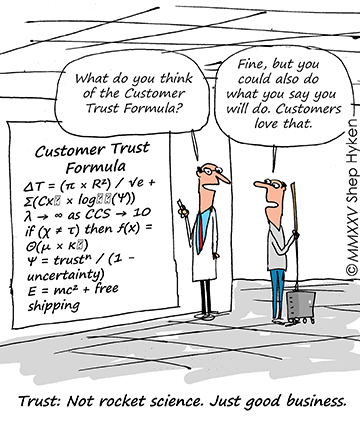
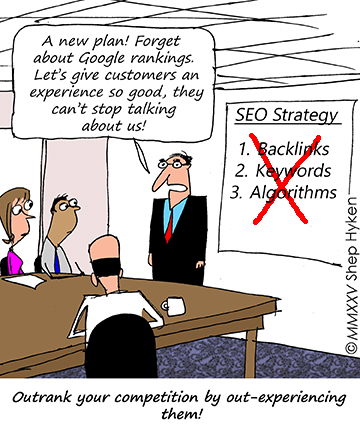
Shep Hyken Customer Service vs Profit Cartoon

That brings us to the customer who bought a two-year-old luxury sports car. The first time it rained, she realized the windshield wipers needed to be replaced. The customer called her salesperson, who explained that he was happy to replace the blades. He went to his sales manager to ask how to handle the replacement and was told to charge her the cost of the blades or to tell her to buy them at Walmart for less than the dealership’s cost and bring them in to have them replaced.

The salesperson was shocked and reminded his sales manager that they were selling a premium brand. Eventually, the manager agreed, but the experience reminded him that profit, or the lack thereof, dictated the level of service the dealership would offer.

Three Customer-First Lessons

With that in mind, let’s use the story as a learning experience for all businesses. Here are three lessons from the story:

  1. The Customer Doesn’t Care about Your Profit: Every customer deserves respect and a consistent experience, whether it’s $20 transaction or a $200,000 one. Profit per interaction shouldn’t determine the level of care.
  2. Know the Lifetime Value of the Customer: The wiper blades may have been a $20 problem, but how the customer was treated for the problem could determine the future sale of a high-end luxury automobile worth thousands of times more. Knowing the average value of a customer will help employees make more informed, customer-focused decisions. Small gestures today can protect long-term loyalty and repeat business.
  3. Consistency Builds Trust: Luxury brands thrive on consistent treatment, but the principle applies to all types of businesses. Today’s customers demand a good customer experience. Train and empower employees to deliver a consistent standard of service, every time, for every customer.

In the end, customers remember the experience, not your profit margins. Get the small things right, and the money follows as you earn their trust, confidence, and loyalty.

Image Credit: Unsplash, Shep Hyken

Subscribe to Human-Centered Change & Innovation WeeklySign up here to join 17,000+ leaders getting Human-Centered Change & Innovation Weekly delivered to their inbox every week.

Top 10 Human-Centered Change & Innovation Articles of April 2026

Top 10 Human-Centered Change & Innovation Articles of April 2026Drum roll please…

At the beginning of each month, we will profile the ten articles from the previous month that generated the most traffic to Human-Centered Change & Innovation. Did your favorite make the cut?

But enough delay, here are April’s ten most popular innovation posts:

  1. Why an AI Soft Landing Might Look Like Victorian England — by Braden Kelley
  2. The Four Psychological Disruptions of AI at Work — by Braden Kelley
  3. Liberated to Care – How AI Can Restore Humanity in Healthcare — by Kellee M. Franklin, PhD.
  4. The Consumption Collapse – When the Feedback Loop Bites Back — by Art Inteligencia
  5. Four Steps to the Future – Announcing the Newest FREE Addition to the FutureHacking™ Toolkit — by Braden Kelley
  6. Which of the Nine Innovation Roles do you play? (A Quiz) — by Braden Kelley
  7. How to Consciously Develop More Courage — by Tullio Siragusa
  8. Does Planned Obsolescence Fuel the Fire or Just Burn the House Down? – The Innovation Paradox — by Braden Kelley
  9. Misunderstanding Big Ideas is Very Dangerous — by Greg Satell
  10. Artificial Intelligence Powered Teamwork — by David Burkus

BONUS – Here are five more strong articles published in March that continue to resonate with people:

If you’re not familiar with Human-Centered Change & Innovation, we publish 4-7 new articles every week built around innovation and transformation insights from our roster of contributing authors and ad hoc submissions from community members. Get the articles right in your Facebook, Twitter or Linkedin feeds too!

Build a Common Language of Innovation on your team

Have something to contribute?

Human-Centered Change & Innovation is open to contributions from any and all innovation and transformation professionals out there (practitioners, professors, researchers, consultants, authors, etc.) who have valuable human-centered change and innovation insights to share with everyone for the greater good. If you’d like to contribute, please contact me.

P.S. Here are our Top 40 Innovation Bloggers lists from the last five years:

Subscribe to Human-Centered Change & Innovation WeeklySign up here to get Human-Centered Change & Innovation Weekly delivered to your inbox every week.

Participatory Design Meets Diversity

GUEST POST from Douglas Ferguson

A few years ago Voltage Control surveyed nearly 100 leaders on culture, mental health, DEI, experience, hybrid, leadership, facilitation, collaboration, technology, and change (in case you missed it). Within the findings, we explore leaders’ challenges, capability gaps, and opportunities to adapt to the current workplace ecosystem more effectively, in order to define a working maturity model. The maturity model is a snapshot of trends across the nearly 100 leaders we heard from, combining quotes with findings from a survey. Download Work Now 2023 here. (you can also get the 2022 edition at the same time)

Workplace culture and diversity are essential to co-creation and participatory design.  

Participatory Design Meets Diversity

Participatory design is a driving force in our innovation practice. The unique design methodology opens the door to rich conversations and remarkable collaboration. With this approach to design, participants are invited into the process of investigating, reflecting, developing, and essentially co-creating your products or services.

With engaging design processes in place, these sessions capture the needs of all participants in a hierarchical manner. As opposed to us telling customers or clients what they need, this approach allows for key stakeholders to show us what matters to them.

We’ve spent years practicing and incorporating this methodology into workshops and design sprints. What we discovered is invaluable: diversity is key.

Our team at Voltage Control found that in order to truly overcome bias and move industries forward, diversity in participants throughout this design process is vital. Hosting inclusive spaces in this co-design experience will lend itself to more ideas and fuel irreplicable growth.

Straight from our Work Now 2023 findings, here’s what leaders should ask themselves regarding their workplace culture before leading inclusive participatory design sessions:

  • How might we support organizations in (re)defining their cultures at this moment and beyond?
  • How might we enable leaders to communicate and co-create a shared culture—including to remote and hybrid teams?
  • For leaders who created a culture of “increased transparency of communication and encouraged virtual gatherings”—what would need to change so these practices are not lost as remote work time decreases?
  • How might we enable leaders to co-create meaningful work experiences with their teams in order to enhance environments of trust and collaboration?

For more on cultivating diverse teams and improving your participatory design strategy, join us in our Liberating Structure series where we will lead you in unleashing creativity in your meetings through maximum participation.

Douglas Ferguson | President, Voltage Control

Image credit: Pexels

Subscribe to Human-Centered Change & Innovation WeeklySign up here to get Human-Centered Change & Innovation Weekly delivered to your inbox every week.

The Final Frontier of Experience Design

Sensing the Future via Digital Olfaction

LAST UPDATED: May 15, 2026 at 6:56 PM

The Final Frontier of Experience Design

GUEST POST from Art Inteligencia


Breaking the Tyranny of the Screen

For decades, digital transformation has been trapped in a flat, two-dimensional paradigm. We have poured billions of dollars into refining pixels, expanding screen real estate, and perfecting spatial audio. Yet, despite these massive leaps in graphics and computational power, our digital interactions remain fundamentally detached from the full spectrum of human biology. We live in a world of glass and glare — a sensory monoculture that prioritizes sight and sound while leaving our other senses completely starved.

The Sensory Deficit in Modern UX/CX

This heavy reliance on visual and auditory stimuli has created a profound sensory deficit in modern user experience (UX) and customer experience (CX) design. Today’s digital landscape feels cold, clinical, and transactional. Whether we are navigating a corporate dashboard, exploring a virtual reality environment, or interacting with an e-commerce platform, the experience is mediated by barriers that keep us isolated from the physical world.

As experience designers and innovation leaders, we must ask ourselves: Have we reached the limits of what sight and sound can achieve for human engagement? When every brand possesses a sleek logo and a curated sonic identity, visual and auditory channels become noisy, overcrowded, and subject to diminishing returns. To truly differentiate and build deeper connections, we must look — and sniff — beyond the screen.

The Emotional Gravity of Smell

This is where the biological reality of olfaction changes everything. Unlike sight and sound, which are processed, filtered, and rationalized by the thalamus before reaching the higher brain, our olfactory system possesses a direct, unmediated highway to the limbic system — the evolutionary ancient seat of memory, emotion, and behavioral drive.

When we smell something, we don’t just process data; we feel it instantly. Scent has an unparalleled emotional gravity. It can trigger deep nostalgia, alter cortisol levels, shift cognitive focus, and inspire trust in a fraction of a second. By ignoring this hardwired human superpower, traditional digital design misses the ultimate tool for meaningful behavioral change, authentic memory retention, and empathetic engagement.

The Core Thesis: Moving Toward Molecular Awareness

Digital olfaction — or olfactory digitization — is not a marketing gimmick, a transient trend, or a sci-fi novelty. It represents a foundational shift toward a molecule-aware world.

By building the infrastructure to digitize, transmit, and synthesize scent data, we are introducing an entirely new layer of contextual intelligence to technology. This infrastructure will fundamentally redefine how humans interact with machines, environments, and brands. It transitions us away from merely manipulating data on a screen and guides us toward a future where technology adapts to, respects, and enriches the holistic human experience.

The Technical Frontier: Mapping the Unmappable

To build a molecule-aware world, we must first solve a massive engineering and translation problem. Nature is a breathtakingly complex designer; the biological nose has spent millions of years evolving to detect microscopic chemical shifts in real time. Replicating this capability in silicon and software requires us to bridge the gap between organic chemistry, data science, and advanced hardware. It is a frontier defined by two distinct structural barriers and a fundamental challenge of standardization.

The Dual Barriers of Machine Olfaction

True digital olfaction requires a system to do two things simultaneously: capture a physical molecule and understand what it means. In the field of machine olfaction, these are known as the two structural limits:

  • The Limit of Detection: This is a hardware challenge. A digital nose must possess near-single-molecule sensitivity to match the resolution of biological systems. It means engineering sensors capable of registering minuscule traces of volatile organic compounds (VOCs) drifting through highly chaotic, real-world environments.
  • The Limit of Recognition: This is a software and artificial intelligence challenge. Even if a sensor detects a plume of molecules, it must accurately decode the complex chemical signature. A single familiar scent — like fresh morning coffee or rain on hot asphalt — is rarely a single molecule; it is an intricate dance of dozens of compounds mixed together. Advanced AI classifiers are required to isolate, identify, and categorize these dynamic patterns against a noisy background.

The Standardization Hurdle: Why Smell Isn’t RGB

Why has digital olfaction lagged so far behind computer vision and digital audio? The answer lies in the lack of a universal data standard.

In digital vision, we conquered the world by breaking light down into three primary color channels: Red, Green, and Blue (RGB). By mixing varying intensities of these three channels, a screen can replicate almost any color the human eye can perceive. Audio functions similarly, mapping neatly onto measurable wave frequencies.

Scent possesses no such simplicity. There are no “primary smells” that can be combined to recreate every odor in the universe. Instead, olfaction relies on thousands of unique chemical structures interacting with hundreds of highly specialized biological receptors. Because of this multi-dimensional complexity, the industry currently lacks a consensus on the optimal sensor modality or a unified digital language to catalog the molecular world. We are essentially building the internet of scent before agreeing on the protocol.

The Modern Sensor Toolkit

Despite these hurdles, a sophisticated toolkit of biomachine noses is emerging, moving us away from bulky laboratory equipment and toward nimble, edge-computing devices. Innovation leaders should watch three primary sensor modalities:

Metal-Oxide (MOx) Sensors: These are the reliable workhorses of industrial gas detection. When volatile molecules hit a heated metal-oxide surface, a change in electrical resistance occurs. While excellent for detecting specific gases or simple environmental hazards, traditional MOx arrays often struggle with the nuanced, multi-layered scent profiles required for complex experience design.

Electrochemical Arrays: Operating via chemical reactions that produce measurable electrical currents, these sensors offer excellent sensitivity. They are increasingly deployed in localized industrial settings and specialized quality control loops where target chemical compounds are well-defined.

Peptide-Functionalized Optoelectronic Platforms: This represents the cutting edge of human-centered sensory innovation. By coating silicon-photonic chips with engineered synthetic peptides — microscopic strings of amino acids designed to mimic human scent receptors — these devices combine biological precision with light-based data transmission. When a scent molecule binds to the peptide, it alters the path of light through the chip, creating an instantaneous, highly accurate digital “fingerprint” of the odor.

Human-Centered Experience Design (UX/CX)

As experience designers, our ultimate goal has always been to close the gap between human intent and digital execution. We strive to create environments that feel natural, intuitive, and profoundly resonant. By introducing digital olfaction into our design toolkit, we move past the constraints of traditional user interfaces. We are no longer just designing interfaces for the eyes and fingers; we are designing holistic ecosystems for the entire human nervous system.

From Interfacing to Immersing: Achieving True Presence

The rise of spatial computing, augmented reality (AR), and virtual reality (VR) has exposed the limitations of purely visual and auditory immersion. You can render a flawless, photorealistic forest in a headset, and you can surround the user with the directional audio of wind rustling through leaves — but if the air smells like a sterile corporate office or a plastic headset, the illusion remains fragile. The user’s brain recognizes the sensory mismatch, preventing total cognitive buy-in.

When we integrate localized, precise olfactory cues alongside visual, auditory, and haptic feedback, something extraordinary happens: we unlock a state of genuine presence. Scent anchors the subconscious mind. By introducing the crisp note of pine or the damp aroma of earth at the exact moment the user steps into that virtual forest, we align the sensory inputs. This multisensory harmony deepens engagement, accelerates learning retention in training environments, and elevates digital storytelling from a passive viewing experience to an unforgettable lived event.

Designing Olfactory Brand Identities: The Invisible Logo

For decades, enterprise branding has relied heavily on the visual and the vocal. Organizations spend millions curating color palettes, typography, and sonic logos or jingles. Yet, the most emotionally direct channel for brand equity remains completely unmapped.

In a molecule-aware future, progressive organizations will design intentional, digitized olfactory brand identities. Imagine a luxury automotive brand delivering a subtle, signature digital scent through the cabin’s climate system the moment an autonomous vehicle picks up a passenger. Or consider an upscale hospitality brand synchronizing a digital scent profile across its physical lobbies, its digital unboxing experiences, and its virtual travel previews. Because scent bypasses critical filters and triggers historical nostalgia instantly, these invisible logos build an emotional stickiness that traditional visual advertising simply cannot match. It transforms a transaction into a relationship.

Sensory Assistive Technologies: Empathy in Innovation

Perhaps the most profound application of digital olfaction lies not in commerce, but in empathetic, human-centered innovation. When we look at experience design through the lens of accessibility and care, digital scent becomes a powerful tool for cognitive bridging and behavioral support.

Consider the design of environments for individuals living with advanced dementia or cognitive decline. As cognitive faculties diminish, traditional visual signs and auditory reminders can become confusing or anxiety-inducing. Digital olfaction offers a gentler, more deeply rooted alternative. By utilizing automated, sensory-based design architectures, care facilities can introduce specific ambient scents — such as the distinct aroma of baked bread or fresh citrus — just prior to mealtime. This subconscious cue naturally stimulates appetite, reduces anxiety, and provides a comforting sense of emotional grounding and temporal orientation without requiring complex cognitive processing. Here, innovation ceases to be about technological novelty and becomes an act of profound human empathy.

Strategic Industry Vectors: Where “Digital Sniffing” Disrupts First

While the consumer applications of digital olfaction in gaming and brand marketing grab headlines, the most immediate, high-value disruptions are occurring deep within enterprise operations. Digital sniffing is transitioning from a novelty to critical infrastructure. By operationalizing ambient chemical data, forward-thinking industries are solving legacy challenges that have resisted traditional digitization for decades. The vanguard of this molecular revolution is concentrated across three strategic vectors.

Healthcare & Non-Invasive Diagnostics: The Breath as a Biometric

For centuries, medicine has been a largely reactive discipline — we treat illnesses after symptoms manifest. Digital olfaction turns this paradigm on its head by transforming the human breath into a continuous, non-invasive biometric stream. Every metabolic process in the human body leaves behind a specific trail of Volatile Organic Compounds (VOCs) that escape through our breath, sweat, and fluids. Diseases like lung cancer, diabetes, and even early-stage Parkinson’s alter these VOC signatures long before a patient feels sick.

By embedding AI-powered biomachine noses into everyday medical devices, smartphones, or public wellness kiosks, we can detect these microscopic shifts with incredible accuracy. This unlocks low-cost, ultra-early screening platforms that democratize preventative care. The human-centered impact here cannot be overstated: we are moving away from invasive, anxiety-inducing diagnostic procedures toward a future of passive, continuous health monitoring that catches threats when they are most treatable.

Agribusiness & Food Safety: Dynamic Freshness Over Static Dates

The global food supply chain is plagued by a massive structural inefficiency: our reliance on arbitrary, static “best by” or expiration dates. These dates are often conservative estimates calculated months in advance, leading to staggering amounts of premature food waste, or conversely, failing to prevent outbreaks of foodborne illnesses when supply chains break down.

Digital olfaction introduces real-time, molecular transparency to agribusiness. By deploying sensor arrays within shipping containers, cold-storage warehouses, and processing facilities, companies can constantly monitor the chemical outgassing of produce, meat, and dairy. Instead of guessing freshness based on a calendar, logistics networks can track actual degradation, optimize shipping routes based on real-time shelf life, and instantly flag contamination or spoilage. This optimization reduces waste, enhances food security, and protects margins across the entire ecosystem.

Security & Defense: Decentralized Threat Detection

In high-stakes security environments, biological working dogs have long been the gold standard for detecting explosives, narcotics, and hazardous materials. However, K9 units are a finite, highly resource-intensive asset. Dogs get tired, require extensive training, and face immense physical danger in active threat zones.

Autonomous, localized digital olfaction platforms are stepping in to complement and augment these biological heroes. Highly ruggedized, peptide-functionalized sensor arrays can be integrated into stationary security checkpoints, autonomous drones, or robotic ground vehicles. These systems work continuously without fatigue, mapping invisible chemical plumes and identifying airborne hazards in real time. By decentralizing threat detection, we can safeguard critical infrastructure and protect human lives without putting operators — or animals — in harm’s way.

The Market Shapers: Leading Companies and Startups to Watch

The digital olfaction ecosystem is accelerating rapidly, moving from academic labs to commercial viability. For innovation leaders and experience designers, keeping a pulse on this landscape is no longer optional — it is a baseline requirement for future readiness. The market is currently being shaped by specialized pioneers who are building the foundational hardware, software, and chemical registries required to make technology molecule-aware.

To navigate this emerging sector, organizations should closely monitor these three trailblazing companies, each approaching the challenge from a distinct technological modality and targeting unique strategic markets:

Company / Startup Core Technology Modality Primary Strategic Target Market
Osmo AI-powered molecular scent mapping and predictive chemical synthesis. Built on a foundation of machine learning models that can predict how a molecule smells based solely on its molecular structure. Fragrance formulation, sustainable ingredient design, raw material sourcing, and digital scent replication for consumer goods.
Aryballe Peptide-functionalized, silicon-photonic optoelectronic noses. They combine biochemical sensors that mimic human olfactory receptors with advanced machine learning to deliver precise, repeatable digital scent fingerprints. Food and beverage quality control, automotive cabin diagnostics, industrial fluid monitoring, and supply chain integrity.
OVR Technology Micro-cartridge scent-dispensing hardware and spatial audio-visual integration tools. They specialize in ultra-precise, localized burst technology that releases and completely clears scents in milliseconds. Immersive professional training, spatial computing (AR/VR/XR), therapeutic digital wellness, and next-generation entertainment ecosystems.

Navigating the Ecosystem

What makes this landscape fascinating from an innovation perspective is that these players are not necessarily in direct competition; rather, they are constructing different pieces of the same puzzle. While Osmo acts as the brain cataloging and synthesizing the molecular world, Aryballe serves as the highly sensitive diagnostic receptor, and OVR Technology operates as the delivery mechanism for human interaction.

As these technologies mature and converge, they will form the backbone of a standardized internet of scent. Strategic leaders should begin identifying which modality aligns with their organizational needs — whether they need to decode the environment (Aryballe), predict chemical design (Osmo), or deliver a transformative user experience (OVR Technology).

Deep-Dive Case Study: Nondestructive Quality Control in Luxury Agribusiness

To truly understand the power of innovation, we must look at how it solves real-world, high-stakes problems where trust and value intersect. Theory inspires, but application instructs. To see digital olfaction in action, we look at the luxury agribusiness sector — specifically, the global market for Extra Virgin Olive Oil (EVOO), a premium product where liquid gold meets legacy fraud.

The Challenge: The Fragility of Premium Trust

Extra Virgin Olive Oil is one of the most economically vulnerable agricultural products in the world. It is highly susceptible to two critical vulnerabilities: natural degradation via oxidation, and deliberate financial fraud. Because true EVOO commands a premium price, bad actors frequently blend it with lower-grade seed oils or older, rancid inventories, passing it off as fresh, single-origin product.

For luxury brands, this is a catastrophic customer experience and brand equity risk. Yet, defending the supply chain has historically been a logistical nightmare. Traditional laboratory verification methods — such as Gas Chromatography-Mass Spectrometry (GC-MS) or panels of human sensory tasters—are slow, incredibly expensive, and completely destructive to the product sample being tested. A brand cannot easily or cost-effectively test every batch at every point of transfer, leading to a reactive, backward-looking quality assurance model that only catches fraud after the consumer has already had a subpar experience.

The Innovation: Upgrading to the Electronic Nose

To disrupt this cycle, progressive producers deployed an innovative solution built on a portable, peptide-functionalized silicon-photonic electronic nose platform (utilizing technology similar to Aryballe’s NeOse Advance). Instead of destroying the oil or waiting weeks for lab results, operators use handheld digital sniffing devices right on the factory floor and at receiving docks.

The process leverages headspace analysis. By capturing the volatile organic compounds vaporizing in the empty space right above the liquid oil, the digital nose pulls in the molecular “aroma plume” without ever touching or contaminating the product itself. The synthetic peptides on the sensor chip bind with the specific VOCs characteristic of pure, fresh olives. The device then uses machine learning algorithms to instantly compare the resulting digital fingerprint against an established baseline registry of verified EVOO profiles.

The Result: Shifting from Post-Mortem to Real-Time Experience

The integration of digital olfaction fundamentally transformed the agribusiness value chain, shifting quality control from a clinical post-mortem to a proactive, real-time design asset:

  • Instant Fraud Detection: The AI-driven platform can instantly flag if an oil has been cut with a cheaper alternative, identifying the molecular mismatch in under 60 seconds at a fraction of the cost of traditional lab tests.
  • Dynamic Shelf-Life Monitoring: Because the system detects the earliest microscopic markers of oxidation long before a human palate can taste the rancidity, producers can dynamically reroute inventories, ensuring only peak-condition product ever hits retail shelves.
  • Nondestructive Integrity: Zero product is wasted during testing. The supply chain remains completely fluid, transparent, and verified from grove to table.

By digitizing smell, this luxury agribusiness application proves that human-centered innovation isn’t just about building cooler apps; it’s about deploying invisible infrastructure that fiercely protects human trust, operational integrity, and the authenticity of the consumer experience.

The Ethics of Invisible Data & Change Management

Every profound technological leap brings a shadow side, and digital olfaction is no exception. As we build the infrastructure to sense the molecular world, we are introducing data streams that are entirely invisible to the naked eye. In human-centered design, innovation cannot be divorced from ethics. If we fail to design the governance frameworks around these technologies with the same care we use to build the sensors, we risk creating a deeply invasive future that erodes the very human trust we aim to build.

The Privacy of Odor Plumes: Non-Consensual Surveillance

We are accustomed to managing our digital footprints — we clear our browser cookies, turn off location services, and cover our webcams. But we cannot stop breathing, and we cannot stop shedding chemical signatures into the air around us. Every human being constantly leaves behind a unique, dynamic “odor plume” filled with metabolic, emotional, and environmental data.

The rise of decentralized molecular tracking creates intense new ethical dilemmas regarding privacy and non-consensual surveillance. If a retail environment can deploy passive digital noses to detect stress hormones in a customer’s sweat, or if an employer can passively scan an office to monitor health conditions or substance use, we cross a dangerous line from contextual assistance into dystopian violation. Innovation leaders must champion strict boundary lines: molecular data must be treated with the same weight as biometric or genomic data, requiring explicit user consent, radical transparency, and robust edge-computing privacy protections.

Organizational Adaptation: Navigating the Change Management of Data Fusion

Beyond the societal ethics, bringing digital olfaction into an enterprise requires a massive shift in organizational culture and change management. For legacy operations and engineering teams, integrating “ambient chemical data” into existing IoT architectures can feel overwhelming, disruptive, and unnecessary. People naturally resist what they do not understand, and a machine that “smells” can easily be misconstrued as an invasive policing tool or an eccentric, unstable gimmick.

To successfully guide organizations through this transition, change leaders must focus on two core pillars:

  • Demystifying the Technology: Frame digital olfaction not as an omniscient surveillance apparatus, but as a collaborative asset. Teams need to see the electronic nose as an extension of their own capabilities — a tool that automates tedious quality checks or safeguards their environment, rather than a system designed to audit their individual performance.
  • Emphasizing Human-Centered Data Fusion: Avoid the temptation to turn molecular insights into rigid, punitive metrics. Instead, design workflows where chemical data functions as a supportive layer of contextual intelligence. When a sensor flags a supply chain variance, the system should empower the human operator with options and insights, maintaining human agency at the center of the loop.

True transformation happens when technology aligns with human behavior, not when it forces humans to bend to the technology. By proactively managing the ethical guardrails and cultural shifts today, we ensure that the molecule-aware organizations of tomorrow remain profoundly human-centered.

Conclusion: Designing a Molecule-Aware World

We stand at a unique crossroads in the history of innovation. The digital architectures we have built over the last half-century are incredibly powerful, yet they remain fundamentally incomplete. By treating the human being as an organism that merely looks and listens, we have built a digital ecosystem that operates at a fraction of our true experiential capacity. Digital olfaction is the bridge that closes this gap, moving us from an era of superficial digital interaction to one of deep, molecule-aware integration.

The Innovation Mandate: Why Waiting is a Losing Strategy

When encountering an emerging frontier like olfactory digitization, the default corporate reflex is often to wait. Leaders look at the lack of a universal “RGB standard” for scent or the early stage of sensor convergence and decide to kick the container down the road, waiting for the market to mature and settle on a single victor.

This is a critical strategic blunder. The organizations that dominate the next decade will not be those that waited for absolute standardization, but those that began experimenting with the messy, beautiful reality of sensory enhancement today. The infrastructure is already viable. Whether you are using peptide-functionalized chips to protect a premium supply chain, or utilizing micro-burst delivery systems to deepen immersion in spatial computing, the tools to build a competitive advantage exist right now.

The mandate for innovation leaders is clear: begin auditing your customer and user journeys today. Look for the friction points, the cold zones, and the sensory deficits where emotional gravity and memory retention are lacking. That is where your digital olfaction roadmap begins.

The Future Smells Real

Ultimately, human-centered change is about designing a world that respects the entirety of the human experience. It is about using technology not to isolate us further behind sheets of glass, but to reconnect us to the rich, multi-layered textures of reality.

As we step boldly into this next horizon, we must remember that the ultimate destination of digital transformation isn’t a more complex virtual simulation — it is a more vibrant, authentic human existence. The future of technology will not just look sleek and sound sharp. It will smell real.

Digital Olfaction: Frequently Asked Questions

What is digital olfaction, and why does it matter for experience design?

Digital olfaction (or olfactory digitization) is the technology infrastructure used to capture, analyze, transmit, and synthesize scent data, effectively creating a molecule-aware world. For experience designers and innovation leaders, it matters because smell is the only sense that bypasses the logical brain and interacts directly with the limbic system — the seat of emotion and memory. Integrating digital olfaction allows us to move past a two-dimensional visual-auditory monoculture and build experiences with profound emotional gravity, accelerated learning retention, and authentic human connection.

How do machines actually “smell” without a universal standard like RGB?

Because scent relies on thousands of unique chemical structures rather than simple wave frequencies, it cannot be neatly mapped into an “RGB” equivalent. Instead, machine olfaction requires a dual-layer approach. The hardware layer utilizes biomachine noses — ranging from metal-oxide sensors to cutting-edge peptide-functionalized optoelectronic chips — to catch volatile organic compounds (VOCs). The software layer then uses advanced AI classifiers to analyze the resulting chemical patterns, matching the multi-dimensional “scent print” against digital registries to identify and decode the smell.

What are the primary ethical and change management risks of olfactory digitization?

The foremost ethical risk is privacy; humans constantly shed invisible odor plumes containing metabolic, emotional, and health data that cannot be turned off, opening the door to non-consensual biometric tracking if guardrails are not established. On an organizational level, the primary change management challenge is demystifying the technology. Leaders must proactively design workflows where digital noses are framed as collaborative assets that empower human operators and protect supply chains, rather than punitive, invasive surveillance tools.


Disclaimer: This article speculates on the potential future applications of cutting-edge scientific research. While based on current scientific understanding, the practical realization of these concepts may vary in timeline and feasibility and are subject to ongoing research and development.

Image credits: Gemini

Subscribe to Human-Centered Change & Innovation WeeklySign up here to get Human-Centered Change & Innovation Weekly delivered to your inbox every week.

Make Life Easier for Your Customers

Make Life Easier for Your Customers

GUEST POST from Mike Shipulski

Companies that have products want to improve them year-on-year. This year’s must be better than last year’s. For selfish reasons, we like to improve cost, speed and quality. Cost reduction drops profit directly to the bottom line. Increased speed reduces overhead (less labor per unit) and increases floor space productivity (more through the factory). Improved quality reduces costs. And for our customers, we like to improve their productivity by helping them do more value-added work with fewer resources. More with less! But there’s a problem – every year it gets more difficult to improve on last year, especially with our narrowly-defined view of what customers value.

And some companies talk about creating the next generation business model, though no one’s quite sure of what the business model actually is and what makes for a better one.

To break out of our narrow view of “better” and to avoid endless arguments over business models, I suggest an approach based on a simple mantra – Make It Easy.

Make it easy for the customer to _____________.

And take a broad view of what customers actually do. Here are some ideas:

Make it easy to find you. If they can’t find you, they can’t buy from you.

Make it easy to understand what you do and why you do it. Give them a reason to buy.

Make it easy to choose the right solution. No one likes buying the wrong thing.

Make it easy to pay. If they need a loan, why not find one for them?

Make it easy to receive. Think undamaged, recyclable packaging, easy to get off the truck.

Make it easy to install. Don’t think user manuals, think self-installation.

Make it easy to verify it’s ready to go. No screens, no menus. One green light.

Make it easy to deliver the value-added benefit. We over-focus here and can benefit by thinking more broadly. Make it easy to set up, easy to verify the setup, easy to know how to use it, easy change over to the next job.

Make it easy to know the utilization. The product knows when it’s being used, why not give it the authority to automatically tell people how much free time it has?

Make it easy to maintain. When the fastest machine in the world is down for the count, it becomes tied for the slowest machine in the world. Make it easy to know what needs be replaced and when, make it easy to know how to replace it, make it easy to order the replacement parts, make it easy to verify the work was done correctly, make it easy to notify that the work was done correctly, and make it easy to reset the timers.

Make it easy to troubleshoot. Even the best maintenance programs don’t eliminate all the problems. Think auto-diagnosis. Then, like with maintenance, all the follow-on work should be easy.

Make it easy to improve. As the product is used, it learns. It recognizes who is using it, remembers how they like it to behave, then assumes the desired persona.

Though this list is not exhaustive, it provides some food for thought. Yes, most of the list is not traditionally considered value-added activities. But, customers DO value improvements in these areas because these are the jobs they must do. If your competition is focused narrowly on productivity, why not differentiate by making it easy in a more broader sense? When you do, they’ll buy more.

And don’t argue about your business model. Instead, choose important jobs to be done and make them easier for the customer. In that way, how you prioritize your work defines your business model. Think of the business model as a result.

And for a deeper dive on how to make it easy, here’s one of my favorite posts. The takeaway – Don’t push people toward an objective. Instead, eliminate what’s in the way.

Image credit: Pexels

Subscribe to Human-Centered Change & Innovation WeeklySign up here to join 17,000+ leaders getting Human-Centered Change & Innovation Weekly delivered to their inbox every week.

Are Happy Customers or Employees More Valuable?

Are Happy Customers or Employees More Valuable?

GUEST POST from Shep Hyken

Do happy employees make happy customers, or is it the other way around? Do happy customers make employees happy?

I’ve written in many articles and books that a focus on the employee experience will improve the customer experience. The logic makes sense. If you treat employees well, they will be more engaged with their customers and fellow employees. My mantra has been:

What happens on the inside of an organization is felt on the outside by customers.

I had the chance to interview Sean Crichton-Browne, co-author of The Human Culture Imperative, for an episode of Amazing Business Radio. He challenges the concept, and in his book, he discusses how happy customers actually create happier and more engaged employees.

Crichton-Browne’s insights stem from his years of sales experience. He said, “I was happy when my customers were happy. Because at the end of the day, when I received that phone call from a disgruntled customer, I became exceptionally unhappy.” In other words, the emotional climate of a customer’s happiness (or unhappiness) had a direct impact on employee satisfaction.

Crichton-Browne’s “outside-in” approach flips the traditional “happy employees equals happy customers” approach and asks us to start with the end in mind. He argues that when customers are happy, employees will take greater pride in their work, stay longer and be more engaged.

While this idea makes sense, I’m still of the “happy employees first” mentality. No matter how great your product is, if you don’t support it with great service, the customer eventually moves on to the competition. That great service is the result of great employees positively engaging with their customers. You don’t want to make employees who control the customer experience unhappy. Again, what’s happening on the inside of the organization is felt on the outside by customers.

We did find some middle ground. There is no doubt that happy customers elevate employee morale. It’s like a continuous loop. Employees feel good when customers are happy, and customers feel good when employees are happy. Crichton-Browne says, “One cannot exist successfully without the other.”

So, what’s the takeaway from our conversation? First, don’t get caught up in the chicken-or-the-egg debate. The truth is that employee happiness and customer happiness feed off each other. Customers feel good when employees are engaged, and employees feel good when customers are happy. One can’t exist without the other, and together they create the kind of momentum that makes both employees and customers say, “I’ll be back!”

Image Credit: Gemini

Subscribe to Human-Centered Change & Innovation WeeklySign up here to join 17,000+ leaders getting Human-Centered Change & Innovation Weekly delivered to their inbox every week.