What the C-Suite Actually Asks

by Braden Kelley and Art Inteligencia
Every Customer Experience (CX) leader I’ve worked with believes, correctly, that their organization needs a customer experience audit. Very few of them get the budget approved on the first try. The gap almost never comes down to whether the need is real — it comes down to whether the person championing it walked into the room prepared for the four questions a C-suite reliably asks, in roughly this order.
“What does this cost us if we do nothing?”
This is the opening question, and it’s the one the CX ROI Calculator exists to answer. Walk in with your own churn rate, revenue per customer, and a modeled range — conservative to optimistic — rather than an industry statistic borrowed from a research report. A number that’s obviously yours survives scrutiny. A number that’s obviously generic invites the room to argue with the source instead of the substance.
“Why an audit, and not just another survey?”
This is where most business cases quietly fall apart, because the honest answer requires admitting a limitation of what you’re already doing. Your NPS and CSAT programs measure what customers are willing to tell you. An audit measures what’s actually happening in the journey, including the parts customers work around instead of reporting. If your organization has been running satisfaction surveys for years and CX metrics still haven’t moved the way they should, that’s not evidence the audit is unnecessary — it’s usually the single best evidence that it is. Surveys have had their chance to find the problem. They haven’t. A different method is the correct next step, not a redundant one.
“What will we actually be able to do differently afterward?”
An executive approving a budget is not funding a diagnosis for its own sake — they’re funding the decisions the diagnosis will enable. The strongest version of this answer is specific: an audit produces a prioritized list of friction points ranked by business impact, not a general health score. Walk in already able to name the kind of decision it unlocks — “we’ll know whether to fix onboarding or billing first” is a far stronger sentence than “we’ll understand our customers better.”
“How disruptive is this, and how long until we see something?”
This is the question that kills otherwise-approved initiatives at the last step, usually because nobody addressed it until it was asked live in the room. Have the realistic timeline ready before you’re asked for it, not after: when the audit starts, what it requires from internal teams, and when the first findings arrive. Vagueness here reads as risk, even when the actual answer would have been reassuring.
Sequencing the case correctly
The order matters as much as the content. Lead with the cost of inaction (the number), and the room is primed to hear the diagnosis as the obvious next step rather than an added expense. Lead with the audit itself, and you’re immediately negotiating from a weaker position — explaining a cost before anyone in the room has agreed there’s a problem worth solving.
If you haven’t run your own numbers yet, start with the calculator — it’s the fastest way to walk into that first conversation with your own defensible figure instead of someone else’s. When you’re ready to talk about what an audit specifically finds and how it runs, the audit page has the detail, and I’m glad to answer the disruption and timeline questions directly if you’d rather hear them from me before you’re asked them by your own leadership.
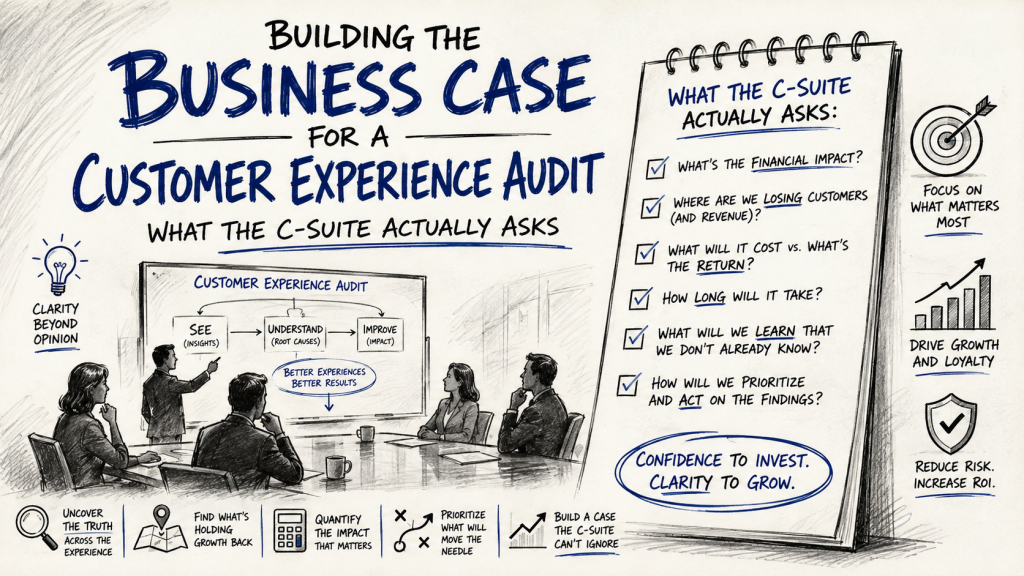
Image Credit: Gemini, ChatGPT
Content Authenticity Statement: The topic area, key elements to focus on, etc. were decisions made by Braden Kelley, with a little help from Claude to clean up the article.
 Sign up here to get Human-Centered Change & Innovation Weekly delivered to your inbox every week.