What a Professional Auditor Actually Looks For
by Braden Kelley and Art Inteligencia
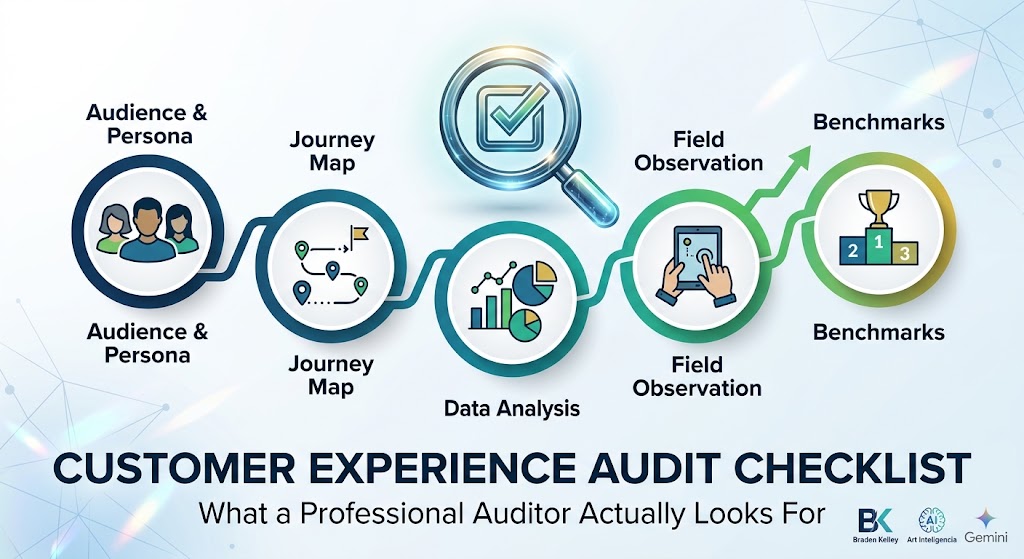
People often picture a customer experience audit as something closer to inspiration than inspection — a few interviews, some good ideas, a workshop. It isn’t. A real audit runs a specific, repeatable checklist across five activities, and knowing what’s actually on that checklist is useful even if you’re not commissioning a full audit yet — it tells you exactly where your own internal review is likely leaving gaps.
1. Audience research and persona validation
- Have you named your distinct audience segments explicitly, rather than treating “the customer” as one undifferentiated group?
- Are your existing personas based on validated research, or on assumptions that were accurate once and never rechecked?
- Do you know which needs, expectations, and pain points are consistent across segments, and which ones genuinely differ?
- Has anyone recently asked customers directly what they expect, rather than inferring it from internal debate?
Most organizations have personas. Far fewer have validated them against current reality in the last two years — and a persona built on outdated assumptions can misdirect an entire audit before it starts.
2. Journey mapping and touchpoint analysis
- Is there a current journey map for each validated persona, or one generic map applied to everyone?
- Are all relevant channels represented, not just the primary one your team happens to work in?
- Does the map capture emotional highs and lows at each touchpoint, or only the functional steps?
- Have improvement opportunities been identified at the touchpoint level, rather than as vague, journey-wide observations?
A journey map that only lists steps, without the emotional experience at each one, tells you what happens without telling you what it’s like — and “what it’s like” is usually where the real problem lives.
3. Existing data evaluation
- Are your KPIs, NPS, CSAT, and sentiment data being analyzed together, or read in isolation by different teams?
- Have you looked for patterns across data sources that no single dashboard would surface on its own?
- Is there a gap between what your data says and what your frontline teams say — and if so, has anyone reconciled it?
- What insight is your current reporting structurally unable to produce, no matter how closely you look at it?
This step exists because most organizations already have more data than they’ve actually used. The checklist item isn’t “collect more data” — it’s “extract what’s already sitting there unexamined.”
4. Walking the journey firsthand
- Has anyone on your team experienced the journey as a customer would — not reviewed it on paper, but actually gone through it?
- Does that include the channels that are hardest to observe from a desk — a retail visit, a live service call, a full sales cycle?
- For B2B experiences specifically, has the buying-committee journey been walked, not just the end-user journey?
- What did that firsthand pass turn up that no dashboard or survey had previously flagged?
This is consistently where an audit finds its most valuable insights, and it’s also the step most internal reviews skip entirely, because it requires time in the field rather than time in a meeting.
5. Competitive benchmarking
- Do you know how your experience compares to your closest competitors at the touchpoints that matter most, not just anecdotally?
- Have you looked at best-in-class examples outside your own industry, where customer expectations are quietly being reset?
- Is “good enough” being judged against your own history, or against where your customers’ expectations actually sit today?
Benchmarking is the item most often skipped to save time — understandably, since it’s the one activity that looks outward instead of inward. It’s also the one that answers the question your leadership will eventually ask: not “are we good,” but “are we good enough relative to the alternative.”
Using this checklist honestly
If you walk through these five sections and find real gaps — persona research from three years ago, a journey map from before a major process change, data that’s never been cross-analyzed, no one who’s actually walked the journey firsthand, no benchmarking at all — that’s not a failure. It’s an accurate picture of where a professional audit would start, and it’s useful information either way.
If the gaps are small, a lighter internal review might close them. If the gaps run through several of these five, it’s usually a sign that a proper Customer Experience Audit is worth the investment rather than another attempt to patch it internally — and if you want a sense of what closing those gaps could be worth before you commit, the CX ROI Calculator is the fastest way to find out.
Image Credits: Gemini
Content Authenticity Statement: The topic area, key elements to focus on, etc. were decisions made by Braden Kelley, with a little help from Claude to clean up the article.
 Sign up here to get Human-Centered Change & Innovation Weekly delivered to your inbox every week.