
Monthly Archives: May 2022

Transforming Leadership Styles for the Digital Age

Transforming Leadership Styles for the Digital Age

GUEST POST from Art Inteligencia

In today’s fast-paced digital landscape, traditional leadership styles are undergoing a significant transformation. The rise of technology and the acceleration of digital transformation processes demand leaders who are not only adaptive but also capable of fostering innovation and guiding organizations through the complexities of change. This article explores the evolving leadership styles suited for the digital age and presents case studies of organizations and leaders who have successfully navigated this transformation.

Embracing Agile Leadership

Agile leadership emphasizes flexibility, collaboration, and rapid decision-making. In a digital world, this style enables organizations to respond swiftly to market changes, technological advancements, and consumer demands. Agile leaders prioritize transparency, empower teams, and encourage continuous feedback to drive innovation.

Case Study 1: Spotify’s Agile Framework

Spotify, the digital music streaming service, exemplifies agile leadership. The organization employs a unique framework that divides teams into “squads,” each responsible for specific projects or features. These squads operate autonomously, with a high degree of flexibility and accountability. The leadership at Spotify focuses on setting clear goals and providing guidance while allowing squads the freedom to innovate and make decisions.

This agile approach has empowered Spotify to regularly release updates and enhancements, keeping the service fresh and responsive to user needs. The success of this leadership transformation lies in Spotify’s ability to cultivate a culture of trust, collaboration, and empowerment, which are crucial elements for thriving in the digital age.

Fostering Transformational Leadership

Transformational leadership goes beyond managing change; it inspires and motivates employees to go above and beyond, aligning their goals with the organization’s vision. In a digital context, transformational leaders are visionary, communicative, and capable of guiding their teams through disruption and innovation.

Case Study 2: Microsoft’s Cultural Renaissance

Under the leadership of CEO Satya Nadella, Microsoft underwent a significant cultural and strategic transformation. Nadella’s leadership style shifted towards empowerment, empathy, and fostering a growth mindset within the company. A key element was breaking down silos and encouraging cross-collaboration among different teams.

Nadella’s transformational leadership has revitalized Microsoft’s product offerings and improved employee engagement. His focus on empathy and understanding has encouraged a culture where innovative ideas can flourish, leading to the development of successful new products and services that are at the forefront of the digital era.

Leading with Emotional Intelligence

In the digital age, emotional intelligence (EI) is crucial for effective leadership. Leaders with high EI can navigate the complex interpersonal dynamics of diverse, often remote teams, fostering environments where employees feel valued and understood.

As organizations continue to adapt to the demands of the digital world, transforming leadership styles is not just a competitive advantage—it’s a necessity. By embracing agile and transformational leadership, and leading with emotional intelligence, leaders can guide their organizations through the challenges and opportunities of the digital age, creating resilient, innovative, and successful enterprises.

Conclusion

The digital age calls for adaptive, visionary leaders who are prepared to transform organizational cultures and lead with empathy and agility. The case studies of Spotify and Microsoft offer valuable insights into how modern leadership styles can drive innovation and success in a rapidly changing world.

Extra Extra: Futurology is not fortune telling. Futurists use a scientific approach to create their deliverables, but a methodology and tools like those in FutureHacking™ can empower anyone to engage in futurology themselves.

Image credit: Pixabay

Subscribe to Human-Centered Change & Innovation WeeklySign up here to get Human-Centered Change & Innovation Weekly delivered to your inbox every week.

The Entrepreneurial Mindset

The Entrepreneurial Mindset

GUEST POST from Arlen Meyers, M.D.

Most doctors, scientists, engineers, business school grads and lawyers I’ve taught don’t have an entrepreneurial mindset. There are lots of reasons why, some of which have to do with how they are chosen by their respective educational establishments. After all, you don’t get accepted to medical school because of your intense creativity. You get accepted, primarily, because of your GPA ,your performance on a standardized test, the MCAT, and how you perform in your scripted interviews.

Here are some mindset maps from Kevin Johnson:

  1. All risk isn’t risky. Entrepreneurs surely understand the high probability of failure, but they don’t necessarily like to gamble. Instead, they take calculated risks, stacking the deck in their favor. They must have enough confidence in themselves, supplemented by expert knowledge, solid relationships, or personal wealth, to see the risk as near zero.
  2. Business comes first, family second. This view isn’t a selfish one, but a recognition by serious entrepreneurs that family well-being is dependent on the success of the business, not the other way around. This is why airlines ask you to put on your oxygen mask first. Should you forego closing a million dollar deal to attend a ball game with your son?
  3. Following your passion is bogus. Look for a good business model first. Your passion may be for a good cause, like curing world hunger, but it may not be a good business. In any young business, you inevitably find things that are not enjoyable, but need to be done, like cold calls or firing unproductive employees. Just doing fun things is a myth.
  4. It’s not about being your own boss. Great entrepreneurs aren’t interested in being bosses at all. People who crave the freedom to do what they want when they want generally make terrible entrepreneurs. In order to be a successful entrepreneur, discipline is a must, and accept your new bosses as investors, partners, and customers.
  5. Fire your worst customers. We have all had customers who take advantage of us, to the detriment of other good customers. The best entrepreneurs are quick to make the tough decisions to bypass bad customers, with proper respect, to minimize frustration, resource drain, and reputation loss. You can’t please everyone all the time.
  6. Ignorance can be bliss. It’s great to be highly familiar with the industry in which you plan to compete, but many times people see too many challenges, and never start. In other cases, entrepreneurs are opening up new business areas, so no one yet knows the challenges. Serious entrepreneurs trust their ability to beat a new path to the opportunity.
  7. You’re in no rush to get an MBA. If you are already an entrepreneur, more education, including an MBA, will only slow you down. Consider it a waste of time. If you plan to become an entrepreneur, and already have business experience or an undergraduate business degree, skip the two-year delay and cost of the MBA.
  8. You are odd, and it’s OK. Entrepreneurs, especially those in technology, usually don’t start out as well-rounded, well-adjusted leaders. In fact, being odd is quite the norm. According to other studies, attention-deficit disorder (ADD) is common, as well as host of other personality disorders. It’s actually cool to be a geek in this lifestyle.
  9. A check in hand means nothing. Every entrepreneur remembers their naïve days when that first customer check bounced. When you receive a new purchase order, a check, a verbal agreement, or even a written agreement, don’t get too happy and excited. Save the celebration until you have cold cash in hand, or the funds are verified.
  10. There’s no such thing as a cold call. If you are an elite entrepreneur, you don’t go into anything cold. With the Internet and a plethora of other resources, you can warm up any call quickly, and not waste your time or theirs. Doing your homework first is one of the best ways to get an advantage over your competition.

Instead, when it comes to innovation and entrepreneurship, they have this kind of frame of reference:

  • They don’t acknowledge they don’t know what they don’t know
  • They don’t understand the difference between a scientific or clinical mindset and an entrepreneurial one
  • They take no for an answer
  • They are insecure and lack self esteem when early in their careers and therefore feel obligated to compensate with dysfunctional behaviors, often encouraged by the culture of their training programs
  • They don’t take personal responsibility for their mistakes and , therefore, don’t learn from them
  • They think that what got them to where they are now will get them to where they want to go
  • They don’t think networking is important, so, they don’t do it
  • They are not politically savvy
  • They lack entrepreneurial courage
  • They lack access to mentors, knowledge, education, resources, peer to peer support and career development guidance.

The entrepreneurial mindset is a state of mind interested in the pursuit of opportunity with scarce, uncontrolled resources. The goal is to create user defined value at various multiples of the existing competitive offering through the deployment of innovation.

Some describe “character” as a combination of personality, which is mostly fixed at a certain early age, and mindset, which is malleable. Character is fate.

Attitudes and motivation are what separates someone with an entrepreneurial mindset from another. The field of postive psychology has shown with overwhelming evidence that happiness creates success, not vice versa. Shawn Achor, in his book The Happiness Advantage, gives us a guided tour of the postive psychology field. noting that happiness is a positive emotion in three measurable components: pleasure, engagement and meaning. He states that happiness is the joy we feel striving after our potential. More imporantly, mindsets can change in humans from negative to positive. Consequently, happy people are primed for creativity, imagination and innovation.

Innovation starts with the right mindset and happiness makes it easier to see things clearer as well as the possibilities.

Some have described the Innovator’s DNA. Here are the amino acids that make up the genetic code.

Others note characteristics of the entrepreneurial mindset:

  1. Personal growth relates to the size of the challenge, not the size of the kingdom. What motivates real innovators is the more exciting challenge, not the number of people reporting to them. The ‘size of the difference’ they will make is more inspiring than the ‘size of the business.’ They relish getting out of their comfort zone, and into the unknown.
  2. The new direction is the challenge, not the destination. The challenge is the transformation vehicle for true innovators, and not a performance goal. They focus on legacy creation, not legacy protection. They ignore failures and are constantly looking at the progress made. They treat innovations reviews like performance reviews.
  3. Be an attacker of forces holding people back, not a defender. Real innovators start by questioning the world order rather than conforming to it. They begin by confronting the forces holding everyone back, rather than living with it. The forces include mindset gravity, organization gravity, industry gravity, country gravity, and cultural gravity.
  4. New insights come from a quest for questions, not a quest for answers. This discovery mindset searching for new questions drives real innovators away from more of the same. They fundamentally become value seekers; they look for value in every experience, in every conversation. They don’t seek prescriptions, they seek possibilities.
  5. Stakeholders must be connected into the new reality, not convinced. True innovators tip stakeholders into adopting and even co-owning the orbit-shifting idea. They go about tipping the heart first, assuming the mind will follow. They seek smart people, who openly express their doubts, and then collaborate to overcome them.
  6. Work from the challenge backward, rather than capability forward. Overcoming execution obstacles is combating dilution, not compromising, for these innovators. Their mindset is not ‘if-then’ but ‘how and how else?’ They convert problems to opportunities, and often the original idea grows far bigger than the starting promise
  7. Getting rid of your victim mentality.
  8. Having the discipline to practice the discipline
  9. You relish the role of leading the charge. Being a visionary or an idea person is not enough; you have to be anxious to jump in and get your hands dirty. Most success stories in business are not about envisioning the next big thing, but about making that change happen. Investors and strategic partners look for entrepreneurs who can execute.
  10. Able to balance right-brain and left-brain activities. Most technical entrepreneurs are left-brain logical thinkers, even perfectionists. Yet every business today needs a focus on visualization, creativity, relationships, and collaboration, which are normally in the domain of right-brainers. Successful and happy entrepreneurs have that rare whole-brain focus.
  11. Enjoy being outside your comfort zone. New businesses are an adventure into the unknown. You need to be mentally prepared to enjoy the roller coaster ride, rather than face it holding your breath with your teeth gritted at every turn. Only then can you enjoy the thrill of victory when you survive a major turn, and be energized for the next one.
  12. Proactively seek input, but make your own decisions. Great entrepreneurs seek out critical customers and industry experts, and actively listen, but are not afraid to trust their own judgment as well. Ultimately they accept the responsibility of “the buck stops here,” meaning they live by their own decisions, and never make excuses.
  13. Willing and able to do a little bit of everything. Technology experts tend to have a very deep level of knowledge, but not very wide. If your real interests are not very broad, then building a business will likely be frustrating and expensive. Startups have limited resources, so the founders have to enjoy trying things, and learning from their mistakes.
  14. Viewed by others as a successful problem solver. The best ideas for a new business are solutions to a real customer problem, rather than great ideas looking for a market. Creating a new business means tackling one difficult problem after another, until success suddenly appears. Entrepreneurs see problems as milestones to success, not barriers.
  15. Don’t demand or expect immediate gratification. Seth Godin once said “The average overnight success in business takes six years,” and he is an optimist. For some entrepreneurs that success is financial, and for others it is a legacy of good deeds. Because it takes so long to get there, it is important to be happy with the journey.
  16. Having a growth mindset. That means experimenting and letting your passion find you instead of finding your passion. Here are some tips on how to develop your growth mindset-think like employee #3 at a startup.
  17. Optimism Research suggests that optimists earn more money, have better relationships and even live longer. And the thing is: Optimism can be learned.

Here are the 8P’s of the Entrepreneurial Mindset:
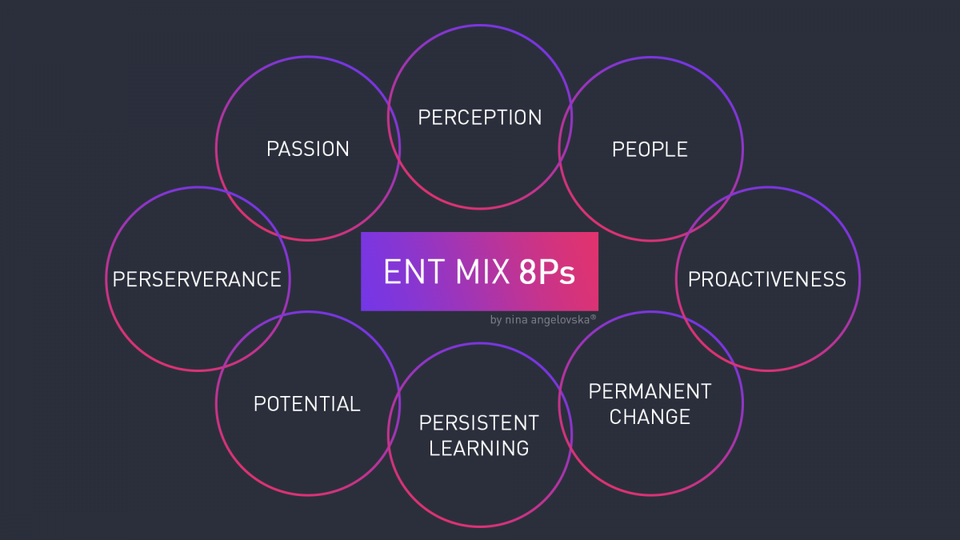
Eight P's of Entrepreneurial Mindset

Lately, the term “grit” is popular and describes the combination of passion and perseverance. The growth mindset is driven by curiosity and self-compassion.

Here’s how the entrepreneurial mindset differs from the clinical mindset. There are also age and generational variations, e.g. how to deal with ambiguity.

Entrepreneurial mindsets derive from entrepreneurial behaviors that are part of an entrepreneurial culture. Consequently, finding entrepreneurial champions to demonstrate the mindset to others is an important tactic in changing a culture.

True innovation in sick care is rare. Ideas and inventions rarely create substantial multiples of user defined value and can be counted on one hand. Antibiotics. Anesthesia. Clean water. Transplantation.

Here are some ways to look at the world through an innovative/entrepreneurial mindset:

Wonder about inconsistencies and anomalies instead of dismissing or explaining them away.

Wonder about coincidences that seem promising.

Give freer rein to curiosity, spending more time speculating about implications of events or ideas that aren’t on the main path we are pursuing.

Be alert to unexpected connections between ideas.

Notice leverage points that might help when we get stuck – alternative ways to move forward when our usual problem-solving methods aren’t working. Instead of simply making sure projects are progressing at a satisfactory pace, supervisors can ask employees more in-depth questions: How has your understanding of the project changed? What has surprised you? Are you tempted to change the project goals? If the employee responds that nothing has to be rethought, this may indicate that the person isn’t adopting the In/Stance. Confusions and conflicts may offer opportunities for gaining insights. Employees may have misconceptions of different ideas about how things work– Investigate these inconsistencies, as they may lead to insights.

Learning is about unlearning. Like every change, it requires unfreezing , changing and refreezing.

Of course determining how many of the roughly 900,000 active docs have an entrepreneurial mindset depends on how you define it and the instrument you use to measure it. Since few, if any, have done that, including search and placement firms, there is really no valid way to know.

Here’s an article that covers the landscape and attempts to measure the entrepreneurial mindset. Basically, personalities are fixed, but skills can be learned.

Personality Scales

Independence: The desire to work with a high degree of independence (e.g., I’m uncomfortable when expected to follow others’ rules.)

Preference for Limited Structure: A preference for tasks and situations with little formal structure (e.g., I find it boring to work on clearly structured tasks.)

Nonconformity: A preference for acting in unique ways; an interest in being perceived as unique (e.g., I like to stand out from the crowd.)

Risk Acceptance: A willingness to pursue an idea or a desired goal even when the probability of succeeding is low (e.g., I’m willing to take a certain amount of risk to achieve real success.)

Action Orientation: A tendency to show initiative, make decisions quickly, and feel impatient for results (e.g., I tend to make decisions quickly.)

Passion: A tendency to experience one’s work as exciting and enjoyable rather than tedious and draining (e.g., I’m passionate about the work that I do.)

Need to Achieve: The desire to achieve at a high level (e.g., I want to be the best at what I do.)

Skill Scales

Future Focus: The ability to think beyond the immediate situation and plan for the future (e.g., I’m focused on the long term.)

Idea Generation: The ability to generate multiple and novel ideas, and to find multiple approaches for achieving goals (e.g., Sometimes the ideas just bubble out of me.)

Execution: The ability to turn ideas into actionable plans; the ability to implement ideas well (e.g., I have a reputation for being able to take an idea and make it work.)

Self-Confidence: A general belief in one’s ability to leverage skills and talents to achieve important goals (e.g., I am a self-confident person.)

Optimism: The ability to maintain a generally positive attitude about various aspects of one’s life and the world (e.g., Even when things aren’t going well, I look on the bright side.)

Persistence: The ability to bounce back quickly from disappointment, and to remain persistent in the face of setbacks (e.g., I do not give up easily.)

Interpersonal Sensitivity: A high level of sensitivity to and concern for the well-being of those with whom one works (e.g., I’m sensitive to others’ feelings.)

It would be interesting to apply this to a physician population and compare to the general one.

Teaching and learning entrepreneurship is as much about nudging students to adopt an entrepreneurial mindset as it is teaching skills, particularly if they are narrowly focused on creating a business.

But, how do you reframe a mindset? Here are some tips on how to do it.

If we are to innovate our way out the the current “health” care system mess, we need to identify those with an entrepreneurial mindset and turn them loose on the most wicked problems that beset us. Marginalizing, stifling or channeling them into a limiting culture is a terrible waste of a mindset.

Image credits: Nina Angelovska, Pixabay

Subscribe to Human-Centered Change & Innovation WeeklySign up here to get Human-Centered Change & Innovation Weekly delivered to your inbox every week.

Nanotechnology is the Next Giant Leap in Innovation

Nanotechnology is the Next Giant Leap in Innovation

GUEST POST from Chateau G Pato

In the ever-evolving realm of technological advancement, nanotechnology stands out as both pioneering and transformative. By manipulating matter at an atomic and molecular scale, we open the doors to an infinite series of possibilities—Key innovations that could redefine industries and enhance the human experience.

Unlocking New Potential

Nanotechnology operates on a scale so minuscule it’s difficult for the human mind to grasp. Yet, its applications span from medicine to agriculture, enabling breakthroughs that were once only conceptualized in science fiction.

Case Study 1: Revolutionizing Drug Delivery

One of the most promising applications of nanotechnology lies in the field of medicine, particularly in targeted drug delivery systems.

The Case of Liposome Drug Carriers

Liposomes are tiny vesicles that can encapsulate drugs, protecting them from degradation while delivering them precisely to target sites within the body. The company Encore Pharmaceuticals has been at the forefront of this innovation, integrating liposomal nanotechnology in cancer treatment.

Their liposome-based drug carrier systems increase the efficacy of chemotherapeutic agents, minimizing damage to healthy cells and reducing side effects significantly. This breakthrough not only improves patient outcomes but also represents a quantum leap in how we can approach complex diseases at the molecular level.

Case Study 2: Transforming Clean Energy

The implications of nanotechnology in clean energy are profound, with potential game-changers in energy efficiency and sustainability.

The Case of Nano-Enhanced Solar Panels

One innovation that holds promise for a sustainable future is the development of nano-enhanced solar panels by Nanocap Solar Solutions.

By applying a nanostructured surface coating to solar cells, the company dramatically increases their efficiency by enhancing light absorption and minimizing energy loss. This approach not only improves performance but also reduces the cost per watt, making solar energy more accessible and competitive with fossil fuels.

Such advancements herald a significant step forward in achieving global energy sustainability and reducing our carbon footprint dramatically.

The Road Ahead

As nanotechnology continues to evolve, it presents a landscape ripe for innovation and impact. However, with great potential comes the responsibility to navigate ethical considerations and societal implications carefully. The convergence of technology and humanity is an opportunity to co-create a future that benefits not only industries but individuals at a deeply human level.

The journey into the nanoscale realm is indeed the next giant leap, and with focused effort and thoughtful implementation, it promises to be a leap that propels us toward a more innovative, sustainable, and human-centric future.

Extra Extra: Because innovation is all about change, Braden Kelley’s human-centered change methodology and tools are the best way to plan and execute the changes necessary to support your innovation and transformation efforts — all while literally getting everyone all on the same page for change. Find out more about the methodology and tools, including the book Charting Change by following the link. Be sure and download the TEN FREE TOOLS while you’re here.

Image credit: Pexels

Subscribe to Human-Centered Change & Innovation WeeklySign up here to get Human-Centered Change & Innovation Weekly delivered to your inbox every week.

The Role of Leadership in Driving Organizational Change

The Role of Leadership in Driving Organizational Change

GUEST POST from Art Inteligencia

In today’s rapidly evolving business environment, the need for organizational change is unavoidable. Organizations must adapt, innovate, and evolve to survive and thrive. At the heart of this transformation lies leadership. Effective leadership is pivotal in orchestrating change and guiding organizations through periods of transition. In this article, we will explore the essential roles that leaders play in driving organizational change, supported by two compelling case studies.

The Leadership Advantage in Change Management

Leadership is more than just setting the direction; it is about inspiring and engaging people to willingly pursue a new path. Successful leaders champion change, communicate a clear vision, and foster a culture that is open to new ideas. They also play a critical role in aligning resources, managing risks, and ensuring that the organizational structure supports the desired change.

1. Creating a Compelling Vision

A compelling vision acts as a North Star for organizational change. It is the leader’s responsibility to develop and articulate a vision that resonates with employees, customers, and stakeholders. This vision must be clear, inspirational, and aligned with the organization’s core values and objectives.

2. Communication and Engagement

Change initiatives often fail due to insufficient communication. Leaders must ensure that communication is ongoing, transparent, and two-way. Engaging with employees at all levels to gather feedback and address concerns is crucial for minimizing resistance and building trust.

3. Building a Change-Ready Culture

Leaders play a key role in creating and nurturing an organizational culture that embraces change. By encouraging innovation and rewarding flexibility, leaders reinforce behaviors conducive to change.

Case Study 1: Transforming a Traditional Retailer

A well-established retail company faced declining sales as consumer preferences shifted towards online shopping. Under the leadership of a forward-thinking CEO, the company embarked on a transformational journey. The CEO communicated a vision of becoming a customer-centric omnichannel retailer. Multiple initiatives were launched, including enhancing the online shopping experience and integrating digital touchpoints in physical stores.

Throughout the process, leadership played a crucial role. The CEO encouraged open communication forums where employees could voice concerns and ideas. Leadership training programs were implemented to equip managers with change management skills. As a result, the company successfully repositioned itself in the market, achieving a renewed competitive edge.

Case Study 2: Digital Transformation in Healthcare

A large healthcare provider recognized the need for digital transformation to improve patient care and operational efficiency. The initiative was championed by the CIO, who set forth a bold vision for leveraging technology to enhance service delivery.

Leadership was instrumental in this change journey. The CIO established cross-functional teams to break down silos and encourage collaboration. Regular updates and successes were communicated to all staff, with feedback loops to address challenges. By fostering an environment of continuous learning and adaptation, the healthcare provider successfully implemented electronic health records and telehealth services, significantly improving patient satisfaction.

Conclusion

Effective leadership is indispensable in navigating organizational change. By crafting a compelling vision, promoting transparent communication, and fostering a culture that welcomes change, leaders can drive successful transformations. As demonstrated in the case studies, the journey is fraught with challenges, but with the right leadership approach, organizations can emerge stronger and more resilient.

Extra Extra: Futurology is not fortune telling. Futurists use a scientific approach to create their deliverables, but a methodology and tools like those in FutureHacking™ can empower anyone to engage in futurology themselves.

Image credit: Unsplash

Subscribe to Human-Centered Change & Innovation WeeklySign up here to get Human-Centered Change & Innovation Weekly delivered to your inbox every week.

Keeping Pace with the Latest Trends in Social Media and Online Video

David Meerman ScottThe ways we communicate continue to evolve. Keeping pace with the latest trends in social media and online video, while preventing your product or service from getting lost in the digital clutter, is a daunting task. David Meerman Scott is a master at helping you speak directly to your audience, make a strong personal connection, and generate attention for your business.

In the eighth edition of The New Rules of Marketing & PR: How to Use Content Marketing, Podcasting, Social Media, AI, Live Video and Newsjacking to Reach Buyers Directly, David explores the latest approaches for highly effective public relations, marketing, and customer communications – while helping you avoid of the costs of traditional advertising!

New Rules of Marketing and PRI had the opportunity recently to interview David, a marketing strategist, entrepreneur, investor and advisor to emerging companies, and bestselling author of 12 books, including Fanocracy, about the new eighth edition of The New Rules of Marketing & PR.

Throughout his career he has been fascinated by seeing the future of how people and organizations work together, studied ‘what’s next’, and looked for patterns others don’t see.

Three times a year David (@dsmcott) is the lead marketing speaker at the legendary Tony Robbins Business Mastery events, delivering a two hour session on New Marketing Mastery.

Below is the text of the interview:

1. What is the biggest change in either PR or Marketing that today’s companies face?

I wrote this for the first edition of The New Rules of Marketing & PR back in 2007: “There used to be only three ways to get noticed: Buy expensive advertising, beg the mainstream media to tell your story for you, or hire a huge sales staff to bug people individually about your products. Now we have a better option: publishing interesting content on the web, content that your buyers want to consume.” The same is true today upon the publication of the 8th edition!

The tools of the marketing and PR trade have changed. The skills that worked offline to help you buy or beg or bug your way into opportunity are the skills of interruption and coercion. Online success comes from thinking like a journalist and publishing amazing content that will brand you as an organization or person it would be a pleasure to do business with. You are in charge of your own success.

2. Must companies re-think their approach to PR in the digital age?

Many people steeped in the tradition of product promotion naturally feel drawn to prattle on and on about their products and services. But I have news for you. Nobody cares about your products and services. Yes, you read that right.

What people do care about are themselves and how you can solve their problems. People also like to be entertained and to share in something remarkable. In order to have people talk about you and your ideas, you must resist the urge to hype your products and services. Instead, create something interesting that will be talked about online. When you get people talking on the Web, people will line up to learn more and to buy what you have to offer.

Sadly, marketers continue to hype products and services instead of understanding buyers and creating interesting content to reach them.

3. Do press releases still have value?

Yes, press releases have value but way less than most PR professionals believe. There is so much more that can be done.

Somehow along the way PR professionals have lost sight of what ‘true’ PR is and have set their focus on the media. What quick steps can PR pros take to get back to the public relations roots of creating mutually beneficial relationships with all of their publics (shareholders, stakeholders, communities, employees, etc.)?

To paraphrase the Public Relations Society of America (PRSA), definition: “Public relations helps an organization and its publics adapt mutually to each other.”

Nowhere does this description mention the media!

Somewhere along the line “public relations” became the same as “media relations.” What people need to realize is that these are different activities. Media relations, or working through journalists, is fine. Hey, who doesn’t want to be quoted in an important outlet?

But there are so many other ways to hear attention.

PR is about reaching your audience. There are many more ways to do that than just via the media: YouTube videos, blog posts, eBooks, charts, graphs, photos, a Twitter feed, a presence on Instagram, TikTok and so much more.

4. What role should LinkedIn play in companies’ marketing strategies? Any difference in your answer for B2B vs. B2C companies?

There are many social networks out there and LinkedIn is one of them. Marketers should understand their buyers and be active on the social networks that are most important to them. For many B2B businesses, LinkedIn is super important, so for them yes, LinkedIn is valuable. However many people use LinkedIn as another way to send unwanted sales messages. To be effective people should use LinkedIn to publish content and to engage with other people’s content.

Continue reading the rest of our conversation on CustomerThink

SIX more questions and answers!

Subscribe to Human-Centered Change & Innovation WeeklySign up here to get Human-Centered Change & Innovation Weekly delivered to your inbox every week.

Developing a Human-Centered Innovation Culture

Developing a Human-Centered Innovation Culture

GUEST POST from Chateau G Pato

In today’s rapidly evolving business landscape, the importance of cultivating a human-centered innovation culture cannot be overstated. At its core, a human-centered approach to innovation prioritizes the needs, experiences, and well-being of individuals at every stage of the innovation process. By building an environment that encourages creativity, empathy, and collaboration, organizations can generate solutions that truly resonate with their end-users. Let’s explore the principles of human-centered innovation culture and examine two case studies that exemplify this approach in action.

Principles of Human-Centered Innovation

At the heart of a human-centered innovation culture lie several key principles:

  • Empathy and Understanding: Prioritizing a deep understanding of the needs, motivations, and experiences of the people you serve.
  • Collaboration: Encouraging diverse teams to work together, bringing multiple perspectives and expertise to the table.
  • Iterative Process: Embracing a cycle of prototyping, feedback, and continuous improvement.
  • Openness to Risk: Accepting failure as a learning opportunity and fostering a willingness to take calculated risks.
  • Long-term Value Creation: Focusing on solutions that generate sustainable value for users and stakeholders.

Case Study 1: IDEO

The Challenge

IDEO, a global design and consulting firm, was tasked with reimagining the traditional shopping cart experience to reduce theft and enhance customer convenience.

The Approach

IDEO embraced a human-centered approach by first spending a significant amount of time observing and interviewing shoppers and store employees to gain insights into the challenges they faced with existing carts. They then assembled a diverse team of designers, engineers, and behavioral experts to collaborate on developing prototype solutions.

The Outcome

The result was a novel cart design with features such as a modular basket system, ergonomic handles, and advanced locking mechanisms. The innovative cart addressed many pain points identified during the research phase, leading to increased user satisfaction and reduced incidents of cart theft.

Case Study 2: Airbnb

The Challenge

Airbnb sought to improve the experience for both hosts and guests by making it easier for property owners to list their accommodations and for travelers to find and book stays that met their needs.

The Approach

Airbnb employed a human-centered design approach by involving users in the design process. They conducted extensive interviews and gathered feedback from both hosts and guests to understand their pain points and aspirations. This user research informed the redesign of the Airbnb platform, emphasizing ease of use, trust, and community.

The Outcome

The redesigned platform resulted in a more intuitive user interface, streamlined booking processes, and enhanced verification features to build trust. This human-centered approach not only improved the user experience but also contributed to Airbnb’s rapid growth and widespread acceptance in the travel industry.

Conclusion

Developing a human-centered innovation culture requires commitment, empathy, and a willingness to truly understand and address the needs of users. Organizations that successfully implement this approach are often rewarded with innovative solutions that stand the test of time. By prioritizing the human element in design and decision-making, companies can create products and services that delight users and drive sustainable growth.

Extra Extra: Because innovation is all about change, Braden Kelley’s human-centered change methodology and tools are the best way to plan and execute the changes necessary to support your innovation and transformation efforts — all while literally getting everyone all on the same page for change. Find out more about the methodology and tools, including the book Charting Change by following the link. Be sure and download the TEN FREE TOOLS while you’re here.

Image credit: Pexels

Subscribe to Human-Centered Change & Innovation WeeklySign up here to get Human-Centered Change & Innovation Weekly delivered to your inbox every week.

Leveraging Data to Drive Innovation Success

Leveraging Data to Drive Innovation Success

GUEST POST from Art Inteligencia

In today’s hyper-competitive business landscape, the ability to innovate is no longer just a strategic advantage; it’s an imperative for survival. However, innovation is often seen as a mysterious, complex process that is difficult to manage or measure. Enter data-driven innovation—a methodology that combines the vast potential of data analytics with the creative processes of innovation to not only generate groundbreaking ideas but also validate and scale them effectively.

This article explores how organizations can leverage data to foster a culture of innovation, reduce risk, and ultimately achieve greater success. We’ll also dive into case studies of companies that have successfully utilized data-driven strategies to revolutionize their business models.

The Role of Data in Innovation

Data serves as the backbone of informed decision-making, offering insights that can guide businesses through the uncertainties of the innovation process. From identifying unmet customer needs to predicting future trends, data provides the actionable intelligence required for both incremental and disruptive innovation. By leveraging big data, businesses can:

  • Understand customer behavior and preferences more deeply.
  • Identify new market opportunities and emerging trends.
  • Enhance product development processes through insights.
  • Track and measure the impact of innovation initiatives.

Let’s explore two case studies of companies that have successfully harnessed data to drive innovation.

Case Study 1: Netflix’s Predictive Analytics in Content Creation

Netflix is a pioneering example of how data can be leveraged to innovate in the realm of content creation. The streaming giant utilizes data analytics not only to understand viewer preferences but also to predict future content success. Utilizing a plethora of data points such as viewing history, search queries, and ratings, Netflix makes informed decisions about which shows to produce or license.

One of the most notable examples of this strategic approach is the creation of the critically acclaimed series “House of Cards.” Netflix analyzed user data to determine that a political drama starring Kevin Spacey and directed by David Fincher would likely succeed. This data-driven gamble resulted in a highly popular show that garnered millions of views and set new standards for original programming.

Case Study 2: Amazon’s Use of Machine Learning for Customer Experience

Amazon is another prime example of leveraging data to foster innovation, particularly in customer experience. The e-commerce giant employs data-driven strategies to personalize the shopping experience, optimize pricing, and streamline operations.

Amazon’s recommendation engine, powered by robust machine learning algorithms, analyzes user behavior and purchase history to suggest products that customers are likely to buy. This not only enhances the customer experience but also boosts sales and customer loyalty. Furthermore, Amazon uses data from customer feedback and return patterns to innovate in product delivery and supply chain management, ensuring faster and more efficient service.

Conclusion

The integration of data into the innovation process has transformed how organizations develop and implement new ideas. By leveraging data strategically, businesses can reduce the risks associated with innovation, tailor their offerings to meet customer needs more effectively, and capitalize on new market opportunities. As technology progresses, those who embrace data-driven innovation will continue to thrive, pushing the boundaries of what is possible and setting new benchmarks for success.

Extra Extra: Futurology is not fortune telling. Futurists use a scientific approach to create their deliverables, but a methodology and tools like those in FutureHacking™ can empower anyone to engage in futurology themselves.

Image credit: Pexels

Subscribe to Human-Centered Change & Innovation WeeklySign up here to get Human-Centered Change & Innovation Weekly delivered to your inbox every week.
5 Ways to Encourage Employee Engagement

5 Ways to Encourage Employee Engagement

GUEST POST from Douglas Ferguson

How do we become disengaged? What triggers disengagement in employees? When employees are engaged they embody the vision, values, and purpose of the company. The ultimate goal is to have a team of passionate contributors who are driven toward innovation and are positive and innovative problem solvers. As Leaders, we need to understand what causes our team to be disengaged if we want to shift them towards innovation.

Problems

When considering the signs of disengagement, often the first thing that comes to mind is laziness, apathy, and dissidence. These are merely symptoms, and as leaders, we need to dig deeper to discover what is happening at the core of our company and organizational culture that is causing these symptoms to surface.

To fully understand disengagement we first need to realize there are 3 employee classifications, according to Gallup; engaged, not engaged, and actively disengaged. Less than 31% of U.S workers were engaged in their jobs in 2014 and while it is easy to see the signs of an employee who is not engaged, actively disengaged employees tend to blend in as they are choosing this path, and just want to blend in.

There are a few telltale signs to look out for:

  • No initiative in employee performance
  • Unhealthy Activities
  • Silence can indicate a problem in the workplace
  • Lack of learning and lack of motivation
  • Wasted weekends

When we begin to look at our company culture and organizational culture we can start defining what the cause of this dissidence is. Systemic cultural issues can be due to:

  • Lack of challenge in the workplace
  • Lack of recognition
  • Lack of communication
  • Lack of trust
  • Siloed teamwork
  • Missing transparency

Employee Burnout

Disengaged employees sometimes need a spark. They are almost never bad employees, check out these 5 tips to reengage the disengaged.

1. How Might We

Addressing a lack of challenge in the workplace can seem like a difficult task, but one easy shift a leader can make lies in reframing. The first step in this type of reframing is identifying themes and insights for your company. This sheds light on problem areas for clients and employees alike. Reframing the insights to include ‘How might we’ creates an opportunity for would-be innovators to freely share ideas openly because it is framed as a possibility rather than a perfected final product. Reframing to these 3 words suggests that a solution is possible and it opens the door for a variety of creative ideation and problem-solving. When we pose a question to the team in the form of ‘How Might We’ we are encouraging them rather than inhibiting them. This combats disengagement by inviting each member of the team to voice their ideas in determining the solution. Every idea is valuable, and when you create a psychologically safe environment for all voices to be heard, your team will be fully unleashed.

2. Embrace Flexibility

The future of work is shifting, and with it many organizations are realizing that the traditional way we worked in the past, 9-5 in the office, may not necessarily be the best for unlocking teams’ full potential. The Bureau of Labor Statistics estimates that 50 million jobs are work-at-home capable. This means offering employees options for in-office, remote, or hybrid schedules is not only feasible, but it could increase positive productivity, and decrease the percentage of disengaged employees.

3. Employee Experience

Understanding the expectations and needs of your employees is vital to a company’s team health. When we work to recognize employees on a deeper level we can begin to change the culture to one that is thriving with ideas. Transparency and psychological safety will elevate your team and pave the way for healthy interactions that are sure to combat disengaged employees. A critical organization system we utilize is our Employee User Manual. This document is intended to open up conversations company-wide, to ensure every employee has the ability to share preferences, growth plans, and core values. By leading teams with an exercise such as this, you are building a foundation of psychological safety, transparency, and trust.

United Employees

4. Compassion and Empathy

As leaders, there has never been a better time to build meaningful relationships with employees and communities alike. Nurturing these relationships is key to keeping disengaged employees happy, productive, and satisfied with their work.

Happy Employees

“High-performing leaders of today are different. They’re empathetic, they think about people and society, and they really listen. There will always be financially-driven executives, but they’re getting pummeled and won’t be effective today,”

leading industry analyst, Josh Bersin.

Empathy, ethics, and values lining up between leaders and teams has the potential to increase retention, cultivate ideas, and deliver a healthy work environment.

5. Motivation and Talent

Disengaged employees may simply be lacking the recognition to develop their talents. It is reported that 69% of employers say they are struggling to find the talent that they need, but with a shift in organizational culture, that talent may be present and in need of a little nurturing to fully blossom. As Terry Lee outlines, there is great potential inside everyone. It’s up to great leaders to bring it out in four nurturing ways:

  • Training

Leaders should connect with their teams as they help them better understand their importance and the value they bring to the organization.

Employee Engagement

  • Connection

Leaders should connect with their teams as they help them better understand their importance and the value they bring to the organization. Every leader should understand their company’s mission and articulate that message to staff consistently and authentically.

  • Challenges

When team members complete meaningful tasks, they may receive an intrinsic reward. One way to amplify this reward is by talking to teams to determine what they think are the most important parts of their job. Then leaders can help them structure their day around tasks that give them a feeling of purpose.

  • Coaching

Team members need coaches to meet them where they’re at. They help staff identify what options they may have to reach goals and then set the appropriate challenges that lead them to success.

Shifting Work Culture to Engage the Disengaged

At Voltage Control we believe that every team member has potential that is waiting to be released. We believe that change is necessary to remain relevant in the world of work, and through interventions and training, we can help leaders and teams unlock and unleash that potential.

Article originally appeared on VoltageControl.com

Image credit: Pexels

Subscribe to Human-Centered Change & Innovation WeeklySign up here to get Human-Centered Change & Innovation Weekly delivered to your inbox every week.

Legal and Ethical Implications of Accessibility Standards

Legal and Ethical Implications of Accessibility Standards

GUEST POST from Chateau G Pato

As society transitions further into the digital age, accessibility is no longer simply a technological consideration but a legal and ethical obligation. Ensuring that digital products and environments are accessible to all individuals, regardless of disabilities, is crucial for promoting inclusivity, equity, and social justice. In this article, we will explore the legal bindings and ethical commitments tied to accessibility standards and dive into two compelling case studies that highlight their significance.

Understanding Accessibility Standards

Accessibility standards, such as the Web Content Accessibility Guidelines (WCAG), aim to provide a framework for making online content more accessible to people with disabilities. These standards are crucial in eliminating barriers that prevent interactions with web content, mobile applications, and various electronic devices.

Legal Implications

Legal frameworks around the world, such as the Americans with Disabilities Act (ADA) in the United States and the Equality Act in the United Kingdom, legally enforce the principle of accessibility. Organizations must ensure their digital properties comply with these standards to avoid legal repercussions, which can include lawsuits, fines, and severe reputational damage.

Ethical Implications

Beyond legal mandates, there lies an ethical responsibility. The ethical dimension of accessibility emphasizes equality, autonomy, and respect for all individuals. It implores organizations to prioritize users with disabilities, ensuring that they possess equal opportunities to access information, services, and experiences online.

Case Study 1: Domino’s Pizza

In 2019, Domino’s Pizza faced a significant legal battle over website accessibility. The case was brought forth by a visually impaired individual who was unable to order food through Domino’s website using a screen reader. This case escalated to the U.S. Supreme Court, which declined to hear Domino’s appeal, thereby upholding the Ninth Circuit Court of Appeals’ decision that the ADA applies to the company’s website.

This case underscores the legal implications businesses face when failing to ensure their digital offerings are accessible. It also highlights the need for comprehensive strategies to meet accessibility standards to avoid potential litigations and uphold societal values of equity.

Case Study 2: Target Corporation

Another high-profile case involved Target Corporation, where the National Federation of the Blind (NFB) filed a lawsuit claiming that their website was not accessible to visually impaired users. The landmark settlement in 2008 required Target to pay $6 million in damages and implement changes to their website to ensure accessibility.

This case serves as a reminder that ethical practices can also lead to pragmatic business benefits. By making their digital resources accessible, businesses not only avoid legal disputes but also open the doors to a wider customer base, promoting a brand image centered around inclusivity and social responsibility.

Conclusion

In conclusion, while accessibility standards are legally mandated, they also present an ethical call to action for organizations. The cases of Domino’s Pizza and Target Corporation poignantly reflect the consequences of neglecting legal obligations and ethical commitments. It is imperative for organizations to integrate accessibility into their digital strategies, not only to avoid legal repercussions but also to uphold their ethical duty to foster inclusive spaces online.

As we continue to innovate and evolve in a digital world, let us remain steadfast in our commitment to accessibility standards, ensuring that the digital landscape is welcoming and inclusive for all.

Extra Extra: Because innovation is all about change, Braden Kelley’s human-centered change methodology and tools are the best way to plan and execute the changes necessary to support your innovation and transformation efforts — all while literally getting everyone all on the same page for change. Find out more about the methodology and tools, including the book Charting Change by following the link. Be sure and download the TEN FREE TOOLS while you’re here.

Image credit: Pexels

Subscribe to Human-Centered Change & Innovation WeeklySign up here to get Human-Centered Change & Innovation Weekly delivered to your inbox every week.

Innovation is About Conversations Not Knowledge

Innovation is About Conversations Not Knowledge

GUEST POST from Greg Satell

One of the most often repeated stories about innovation is that of Alexander Fleming who, returning from his summer holiday in 1928, found that his bacterial cultures were contaminated by a strange mold. Yet instead of throwing away his work, he decided to study the mold instead and discovered penicillin.

What’s often left out is that it wasn’t Fleming who developed penicillin into a miracle drug. In fact, it wasn’t until a decade later that a team led by Howard Florey and Ernst Chain rediscovered Fleming’s work and, collaborating with several labs in the United States, ushered in the new era of antibiotics.

For some reason, we tend to assume that great innovators are lone geniuses. However, in researching my book, Mapping Innovation, I found just the opposite to be true. Innovation is, in fact, a highly social activity and great innovators cultivate long standing relationships with trusted thought partners. This was always true, but Covid has pushed it to new heights.

The “Martians” Of Fasori

Like a lot of children, Eugene Wigner lacked confidence in math class. In Eugene’s case, however, the problem wasn’t any lack of mathematical ability, but that his classmate and friend at the Fasori Gimnázium was John von Neuman, possibly the single greatest mathematician of the 20th century. Outmatched, Eugene chose to focus on physics, for which he would win the Nobel Prize in 1963.

The two were part of a group of Hungarian scientists that came to be known as the Martians, including such luminaries as Edward Teller, John Kemeny, George Polya and Paul Erdős, just to name a few. The group would help to revolutionize mathematics, physics and computer science for half a century.

In 1939, one of the “Martians,” Leo Szilard, became increasingly concerned about the explosive power of nuclear energy, which was poorly understood at the time. He went to confer with his friend Wigner and the two considered the matter important enough to sound the alarm. They drafted a letter, which Albert Einstein signed, which was ultimately delivered to President Roosevelt and led to the development of the Manhattan Project.

Each of the Martians was a genius in his own right, but combined they formed an important network of support that helped them all thrive and led to breakthroughs such as the first modern computer and the BASIC computer language. The world today is unquestionably better for it.

The Olympia Academy

In 1901, Albert Einstein was a recent graduate of the mathematics and physics in the teaching diploma program at the Zürich polytechnic school. Finding himself unable to find a job. he put an ad in the newspaper to attract students he could tutor to earn some money. A Romanian philosophy student named Maurice Solovine answered the ad.

As it turned out, Einstein didn’t think Solovine needed lessons in physics, but the two hit it off and Einstein invited his new friend to come and visit any time he wanted. Soon, a mathematician named Conrad Habicht joined the group and the three friends began to refer to their meetings as The Olympia Academy.

The meetings eventually began to take on a regular rhythm. They would read books from intellectual giants such as Ernst Mach, Henri Poincaré and David Hume, then discuss them late into the night and sometimes into the early morning hours. The debates were often vigorous, but always cordial.

Einstein would later credit these meetings with helping him come up with the ideas that led to the miracle year papers that would shift the foundations of modern physics. Einstein would, of course, become one of the world’s most famous people, but he never forgot his two friends from the Olympia Academy. The three stayed in touch throughout their lives, exchanging ideas and debating finer points.

The Bloomsbury Group

Historically, most intellectual clubs were exclusively male. That was certainly true of the Hungarian “Martians” and the Olympia Academy, as with others such as the Vienna Circle, but the Bloomsbury Group of early 20th century Cambridge was an unusual exception.

Although it was itself somewhat of an offshoot of the wholly male society of Apostles, the Bloomsbury included accomplished women such as Vanessa Bell and Virginia Woolf. It would come to be highly influential in areas as diverse as art, economics, literature and politics

It began in 1905, when Thoby Steven started hosting “Thursday Evening’s” for Cambridge intellectuals visiting London and his sister Vanessa followed up with “Friday Club.” The loose gathering’s became an informal network that included literary types like E. M. Forster and Lytton Strachey, as well as such luminaries as the economist John Maynard Keynes and the philosopher Bertrand Russell.

Although the group came to be seen as snobbish and out of touch, the accomplishments of its members cannot be denied. Nor can the fact that even as they grew in fame and had increasing demands on their time, they continued to see deep value in the dialogue they had with each other.

Collaboration Is A Competitive Advantage

What’s most interesting about groups such as the “Martians,” the Olympia Academy and the Bloomsbury group is not just that they exist, but how devoted their members were to them and how integral they saw the dialogue they produced to their own successes. For many of the same reasons, highly innovative firms often design workspaces to promote collaboration.

That’s no accident. Decades of research, including a study of “star” engineers at Bell labs as well as one of designers at IDEO, found that the best innovators are not necessarily the smartest or even the hardest working, but those who actively build up a strong network of collaborators. Another study of 17.9 million scientific papers found that the most highly cited work tends to come from a group of specialists in a specific field collaborating with an outsider.

Today’s technology creates new opportunities to collaborate and the impact is beginning to be felt. As Jennifer Doudna explained in The Economist, the Covid crisis is ushering in a “new era of science” in which collaboration is accelerating across national, institutional and disciplinary boundaries in ways that are unprecedented.

What’s becoming clear is that collaboration is increasingly becoming a competitive advantage and it’s not just what you know, but who you talk to, that will determine whether you succeed or fail. The better networks we build, the more likely it will be that we stumble across that random bit of information or insight that can help us solve an important problem.

— Article courtesy of the Digital Tonto blog
— Image credit: Pexels

Subscribe to Human-Centered Change & Innovation WeeklySign up here to get Human-Centered Change & Innovation Weekly delivered to your inbox every week.