Better to be Careful than Smart

Better to be Careful than Smart

GUEST POST from Greg Satell

Not too long ago, I had a post about the danger of trusting your feelings go viral on LinkedIn. The reason it was so popular wasn’t necessarily that everyone liked it, but because many wanted to voice their disapproval. A surprising number of people vehemently objected to the idea that they should interrogate their feelings or keep them in check.

Make no mistake. While it is true that our emotions can alert us to dangers that our rational mind fails to recognize, they can also lead us wildly astray. Our hippocampus, where our memories reside, has a bee line to our amygdala, which plays a role in governing our emotions, circumventing our rational brain in the prefrontal corpus.

We tend to assume that good judgment is a function of intelligence and education, but often it’s not. We need to recognize that there are glitches in our neural machinery and that our gut feelings can be triggered by random events as well as by people who seek to manipulate us. That’s why we need to be careful. It’s always the suckers who think they’re playing it smart.

Why Smart People Are So Easily Fooled

For decades, the global elite revered Bernie Madoff as one of the world’s most talented asset managers until it was all exposed to be, in his own words, “one big lie.” Elizabeth Holmes’s prominent board at Theranos were so clueless that they put their reputations behind a product that didn’t exist. Anna Sorokin, the daughter of a Russian truck driver, was able to convince the glitterati that she was, in fact, a fabulously wealthy heiress.

In each case, there was no shortage of opportunities to unmask the fraud. Inconsistencies in Madoff’s records were reported to regulators a number of times, but were ignored. Holmes wasn’t able to produce a single peer-reviewed study during 10 years in business to support her claims and there was no shortage of whistleblowers from inside and outside the company. Anna Sorokin left unpaid bills all over town.

Still, many bought the ruses and would interpret facts to support them. Madoff’s secrecy was seen as confirmation that he had a proprietary method. In Holmes’ case, her eccentricities were taken as evidence that she truly was a genius, in the mold of Steve Jobs or Mark Zuckerberg. Sorokin’s unpaid bills were seen as proof of her wealth. After all, who but the fabulously rich could be so nonchalant with money?

People should have known better. Stock market regulators are trained to recognize fraud. Prominent Theranos board members like George Shultz, David Bois and Henry Kissinger, earned their reputations over decades. Hotels allowed Sorokin to stay in luxury suites for weeks at a time before demanding payment. How could they have been so naive?

But what if smart people get taken in because they’re smart? They have a track record of seeing things others don’t, making good bets and winning big. People give them deference, come to them for advice and laugh at their jokes. They’re used to seeing things others don’t. For them, a lack of discernible evidence isn’t always a warning sign. It can be an opportunity.

Gated Community Elites And TED Talk Elites

Living in a gated community necessarily cuts you off from your surroundings. People outside can’t wander in and you can’t wander out. New businesses don’t sprout up and old ones don’t die. Routines are familiar and protected, you remain in your comfort zone and any random disturbance is immediately removed.

On the other end of the spectrum, when you go to fancy conferences your imagination becomes overstimulated. You are inundated with the new and unfamiliar. The normal human experiences begin to seem passé, a remnant of a lost age, while visions of the future begin to appear more genuine than the present reality.

The truth is that both of these environments are manufactured for the tastes of the well-heeled. Gated communities are built for those who want a simple sanctuary in a messy and complex world that doesn’t always follow a linear and understandable logic. The conference world tends to overemphasize the power of imagination and possibility, ignoring the fact that the status quo exerts a power of its own.

The best indicator of what we think and what we do is what the people around us think and do. We tend to conform to the opinions and behaviors of those around us and this effect extends out to three degrees of relationships. So not only our friends’ friends, influence us deeply, but their friends too—people that we don’t even know—affect what we think.

Confirming Our Priors

Clearly, the way we tend to self-sort ourselves into homophilic, homogeneous groups shapes how we perceive what we see and hear, but it will also affect how we access information. When a team of researchers at MIT looked into how we share information—and misinformation—with those around us. What they found was troubling.

When we’re surrounded by people who think like us, we share information more freely because we don’t expect to be rebuked. We’re also less likely to check our facts, because we know that those we are sharing the item with will be less likely to inspect it themselves. So when we’re in a filter bubble, we not only share more, we’re also more likely to share things that are not true. Greater polarization leads to greater misinformation.

We’re prone to think of our brains as biological forms of computers that take in and analyze data leading to rational conclusions. That’s not true. We tend to seize upon the most easily available information, rather than the most reliable sources. We then seek out information that confirms those beliefs and reject evidence that contradicts existing paradigms.

That’s the glitch in our mental machinery that Madoff, Holmes and Sorokin exploited. The investors in Madoff’s funds felt privileged to be allowed into an exclusive investment. Theranos board members thought they were building a better future. Sorokin made those around her feel like they had access to an aristocracy of sorts.

These weren’t mere notions or passing thoughts, but assertions of identity, which is why the shills were so eager to advocate for — and actively protect — their swindlers.

Making Allowances For The Glitches In Our Mental Machinery

We all like to have opinions and like act on them. When, for instance, people were asked if they supported bombing Agrabah, the fictional hometown of the Disney character Aladdin, 30% of Republicans and 19% of Democrats said yes. Yet our urge to make judgments has nothing to do with our ability to make wise choices.

Humans tend to think in terms of narratives. We like things to fit into neat patterns and fill in the gaps in our knowledge so that everything makes sense. People who are “smart,” have a greater ability to retain and process information than most and can use their imagination to build robust visions, but that’s no guarantee those visions will conform to reality.

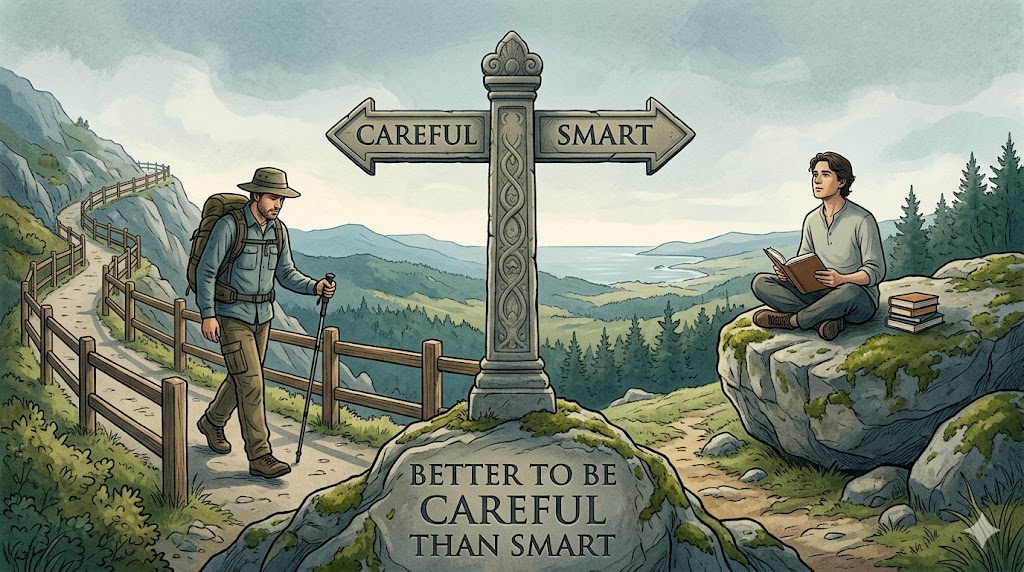
We need to be hyper-aware that a track record of success makes us more confident and confidence in our judgments is inversely correlated to their accuracy. That’s why it’s often better to be careful than smart. There are formal processes that can help us do that, such as pre-mortems and red teams, but most of all we need to keep ourselves in check.

Perhaps most important is to appreciate that there are glitches in our mental machinery and we are greatly influenced by our social networks. The people around us tend to have access to similar information as we do and our perceptions are colored by prior judgments we’ve made. We are surrounded by mental minefields and the only way out is to proceed with caution.

There’s a sucker born every minute and they’re usually the ones who think they’re playing it smart.

— Article courtesy of the Digital Tonto blog
— Image credit: Google Gemini

Subscribe to Human-Centered Change & Innovation WeeklySign up here to join 17,000+ leaders getting Human-Centered Change & Innovation Weekly delivered to their inbox every week.

Making Change Stick

Making Change Stick

GUEST POST from David Burkus

You’ve poured hours into developing a brilliant new strategy. Maybe it’s a streamlined process, a novel team ritual, or a bold cultural shift you know will improve how your team works. You present it to the team. Heads nod. There’s excitement. Applause, even.

And then…nothing.

A few weeks go by and everything’s back to the old way. People are still using the outdated process. The team ignores the new meeting cadence. That cultural initiative? Forgotten. It’s as if your big idea evaporated the moment the meeting ended.

So what happened?

As frustrating as it is, this scenario is all too common. And it reveals an important truth about making change stick: it’s not the brilliance of your idea that matters most. It’s how well that idea is presented and remembered. And for most leaders, that’s where the real challenge begins.

The Flawed Approach to Leading Change

For decades, leaders have looked to process improvement and efficiency as the holy grail of organizational success. From Frederick Taylor’s scientific management to modern methodologies like Six Sigma or Agile, there’s no shortage of change initiatives aimed at helping teams get better.

And in theory, many of them work.

But research from UNC’s Brad Staats and Oxford’s Matthias Holweg and David Upton tells a different story about what happens after rollout. According to their study of over 200 process improvement initiatives across a major European bank, roughly 50% of those projects were abandoned within the first year. And after two years? Only one in three remained.

They call it the improvement paradox—the fact that even successful initiatives often fade over time. And the reason isn’t because the ideas were bad. It’s because of how those ideas were introduced and sustained—or, more accurately, how they weren’t.

Why Good Ideas Don’t Stick

The researchers identified several culprits behind why making change stick is so difficult. And if you’ve ever led a change that didn’t last, these may sound familiar.

Initiative Fatigue
When every quarter brings a new mandate or buzzword, people stop getting excited and start getting cynical. It becomes easier to nod along in the meeting and quietly keep doing things the old way.

Lack of Personal Benefit

When change feels like it’s for the company but not for the individual, motivation suffers. People ask, “What’s in it for me?” And if they can’t find a compelling answer, they’re unlikely to put in the effort required to make the change real.

Loss of Ownership

Many initiatives are handed down from above—or worse, handed over from highly paid consultants—as rigid prescriptions rather than collaborative efforts. When people feel forced to comply instead of invited to contribute, they disengage.

Curse of Knowledge

But perhaps the most overlooked obstacle is this: we fall in love with our own ideas and forget what it’s like not to understand them.

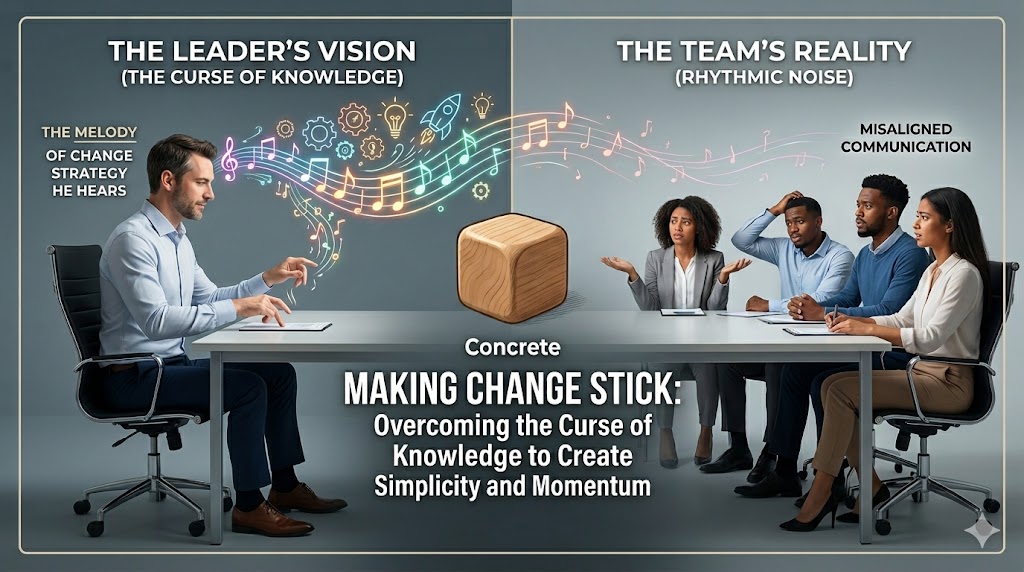
Psychologists call this the curse of knowledge. Once you know something well, it becomes almost impossible to imagine what it’s like not to know it. Which means that when we communicate our change initiatives, we often assume too much.

A classic study by Stanford Ph.D. student Elizabeth Newton illustrates this. Participants were asked to tap out the rhythm of a popular song while another person tried to guess what it was. Tappers thought their partners would guess the song about 50% of the time. In reality? Only 2.5% of the time.

Why? Because the tappers could hear the melody in their head. But to the listener, it was just tapping. They didn’t have the context.

The same thing happens with change efforts. Leaders have been thinking about their new strategy for weeks or months. They’ve connected the dots. They see how it all fits. But their teams haven’t been part of that process—and as a result, they don’t hear the melody. Just the tapping.

Making Change Stick

So how do you overcome the curse of knowledge, and the other traps that make change initiatives fade?

You don’t need to be more charismatic. You don’t need a better slide deck. You need a better design for your message. Authors Chip and Dan Heath argue that “sticky” ideas share a few key principles. And when it comes to making change stick, these three are especially powerful.

1. Be Simple: Find the Core Message

Don’t oversimplify. But do clarify. Strip away the jargon, the background noise, the long-winded rationale—and identify the one idea you want your team to remember.

What’s the slogan behind your initiative? What’s the one phrase they can use to guide their decisions?

If your team walks away from your message and forgets everything else, what’s the one thing they must retain? Then say that. A lot.

2. Make It Concrete: Use Sensory and Tangible Language

People don’t latch onto abstract mission statements. They remember vivid images. One of the best examples of this comes from Jeff Hawkins, lead designer of the original Palm Pilot.

To keep the device simple and user-friendly, he carried around a block of wood shaped like the Palm Pilot. Any time someone proposed a new feature, he’d pull it out and ask, “Where are we going to put it?”

It was a tangible symbol of the constraints—and priorities—of the team. And it worked.

You can do the same by anchoring your message in real-world actions, visuals, or metaphors. Don’t say “streamline communication.” Say, “We’re cutting weekly meetings in half so you can get your Wednesdays back.”

3. Use Stories: Help People Feel the Message

Data informs. Stories stick.

The oldest tool for spreading ideas is still the most effective. When you tell a story—about a time the team nailed collaboration, or a moment when things fell apart because the process wasn’t followed—you help people emotionally experience the change you’re trying to create.

Stories give people something to believe in. Something to remember. And something to model their behavior after. Before your next rollout, ask: What stories do I have that illustrate what good looks like? Or what happens when we get it wrong?

You don’t need a slide deck for this. You just need a story.

The Bottom Line

Making change stick isn’t about shouting louder or using fancier words. It’s about designing your message in a way that overcomes fatigue, sparks ownership, and connects emotionally.

That means asking yourself:

  • Is my idea simple enough to remember?
  • Is it concrete enough to visualize?
  • Is it wrapped in a story people want to be part of?

Because ultimately, people don’t follow mandates. They follow meaning. And your job as a leader is to help them see themselves in the better future your change is meant to bring.

Want to make your next change effort stick? Start by telling a better story.

Image credit: Google Gemini

Subscribe to Human-Centered Change & Innovation WeeklySign up here to get Human-Centered Change & Innovation Weekly delivered to your inbox every week.

8 Predictions Leaders Can Ignore — and 8 They Cannot Afford To

8 Predictions Leaders Can Ignore — and 8 They Cannot Afford To

by Braden Kelley and Chateau G Pato


Which Predictions Should Leaders Ignore — and Which Can’t They Afford To? (Short Answer)

Eight predictions leaders can ignore as decision drivers: (1) AGI arrives by a specific year, (2) a headline percentage of jobs will disappear, (3) the next platform will replace the web, (4) every company will become an AI company, (5) customers will only talk to AI, (6) either the office or remote work will win, (7) a startup will disrupt your industry next year, and (8) AI will automate innovation.

Eight they cannot afford to ignore: (1) customers will send AI agents to act for them, (2) the entry-level apprenticeship ladder is eroding, (3) answer engines are becoming the front door, (4) technology will keep outrunning operating models, (5) proof of what’s real becomes a scarce asset, (6) aging and caregiving will reshape who works and who buys, (7) volatility is the baseline and resilience beats optimization, and (8) human judgment becomes the bottleneck and the differentiator.

The loudest predictions are about technology arriving. The ones that matter are about humans and organizations adapting — and those are already underway.

Ignore the prediction that asks you to wait. Act on the one that is already changing behavior.

How Can Leaders Tell a Prediction Worth Acting On From Hype?

Leaders are drowning in predictions. Dates for artificial general intelligence. Percentages of jobs about to vanish. Platforms that will replace everything we know. Most of these forecasts are engineered to earn attention, not to guide decisions.

To be clear, “ignore” does not mean “false.” Some of the loud predictions may eventually come true in some form. It means the prediction should not be what drives the decisions that actually shape your organization’s future: what you fund, what you stop, and what you redesign this year.

Here is a simple triage test. A prediction deserves your attention when the answer to most of these four questions is yes:

  1. Is it already visible? Can you see early signs in customer, employee, or partner behavior now — not only in a keynote or a trend report?
  2. Is it expensive to be late? Does responding require long lead times: trust, skills, culture, operating model, or infrastructure?
  3. Does it change human behavior or expectations — not only the tool stack?
  4. Can you act on it this year with a concrete decision to fund, stop, or redesign something?

And here are the tells of a prediction you can safely set aside: an exact date, a headline percentage, a winner-take-all claim, or a vendor who profits if you believe it.

Good foresight starts with signals from the floor, not trend PDFs — a practice I cover in 6 Ways to Practice Strategic Foresight Without Buzzword Bloat. What follows applies that discipline to eight pairs: a loud headline to ignore, and the quieter prediction hiding underneath it that you cannot afford to miss.

Which Technology Predictions Matter Less Than the Quiet Shifts Underneath Them?

Pair 1 — Ignore: “AGI Arrives by [Year].” Can’t Ignore: Customers Will Send Agents to Act for Them.

Why it’s safe to ignore: Debates about when artificial general intelligence arrives don’t change what you should fund this year, and the goalposts keep moving with every model release.

Why you can’t afford to ignore the quiet shift: Shopping, comparing, booking, disputing, and cancelling will increasingly be done by software acting on a customer’s behalf. That means your experience has to work for the customer’s agent and protect the human behind it. An agent will not tolerate a confusing cancellation flow, and it will not be charmed by your brand voice. It will simply route around you.

First move this quarter: Walk through one key journey — purchase, cancellation, or dispute — as if an AI agent were the customer. What breaks? What would you not want an agent to be able to do without a human confirming? For the trust conditions this requires, see 6 Trust Pillars for Agentic Customer Experience.

Pair 2 — Ignore: “X% of Jobs Will Disappear by 2030.” Can’t Ignore: The Entry-Level Apprenticeship Ladder Is Eroding.

Why it’s safe to ignore: Headline job-loss percentages swing wildly from one study to the next, and you will need to redesign jobs regardless of which number turns out to be closest.

Why you can’t afford to ignore the quiet shift: When AI absorbs the routine work that junior employees used to learn on — first drafts, basic analysis, simple cases — organizations quietly lose the path that turns beginners into experts. The productivity gain shows up this year. The missing senior talent shows up in five.

First move this quarter: Map three roles where entry-level tasks are being automated. For each, design a new way for newcomers to build judgment on real work — pairing, shadowing, supervised decisions. For related warning signs, see 8 Signals You’re Preparing for the Wrong Future of Work.

Pair 3 — Ignore: “The Next Platform Will Replace the Web.” Can’t Ignore: Answer Engines Are Becoming the Front Door.

Why it’s safe to ignore: Platform-replacement prophecies — the metaverse, headsets, whatever gets pitched next — rarely arrive on schedule or all at once.

Why you can’t afford to ignore the quiet shift: Customers, candidates, and employees increasingly meet your organization through an AI-written summary before they ever reach your website, app, or people. What answer engines say about you is becoming your first impression — and they tend to repeat whatever the web agrees on, accurate or not.

First move this quarter: Ask five answer engines the top questions your customers ask about your category and your company. Note what’s wrong or missing, then fix it at the source by publishing clearer, more citable answers. I show what that looks like in 7 Customer Experience Myths Answer Engines Keep Repeating — Corrected.

Pair 4 — Ignore: “Every Company Will Become an AI Company.” Can’t Ignore: Technology Will Keep Outrunning Operating Models.

Why it’s safe to ignore: It’s a slogan, not a decision. It tells you nothing about what to change on Monday morning.

Why you can’t afford to ignore the quiet shift: The bottleneck is no longer access to tools. It is the organization’s capacity to absorb them — decision rights, incentives, roles, workflows, and the change saturation of the people doing the work. The gap between what technology can do and what your organization can adopt keeps widening, and the gap is where hard landings happen.

First move this quarter: Count the changes you are asking the frontline to absorb this year. Cut or sequence them before you add anything new. For why this gap keeps growing, see 12 Technologies That Change Experience Faster Than Operating Models.

Which Work and Market Predictions Matter Less Than the Quiet Shifts Underneath Them?

Pair 5 — Ignore: “Customers Will Only Talk to AI.” Can’t Ignore: Proof of What’s Real Becomes a Scarce Asset.

Why it’s safe to ignore: Total-replacement predictions ignore stakes, emotion, and regulation. Humans will stay in the loop wherever mistakes are costly, feelings run high, or accountability is required.

Why you can’t afford to ignore the quiet shift: As synthetic content, voices, and faces become cheap and convincing, the ability to prove what is real — who sent this, who decided this, and how to reach an accountable human — becomes a competitive advantage. Trust stops being a brand attribute and starts being infrastructure.

First move this quarter: Decide how a customer can verify that a message, call, or offer really came from you, and how they can reach a human with the authority to help when the stakes are high.

Pair 6 — Ignore: “The Office (or Remote Work) Will Win.” Can’t Ignore: Aging and Caregiving Will Reshape Who Works and Who Buys.

Why it’s safe to ignore: Winner-take-all workplace predictions keep flipping, and the right answer differs for every kind of work and every team.

Why you can’t afford to ignore the quiet shift: Aging customers and employees, growing caregiving responsibilities, and longer working lives are changing expectations for flexibility, accessibility, and service design. Unlike most predictions, this one arrives on a timeline you can already read in demographic data.

First move this quarter: Test one core customer journey and one core employee role with older customers, older employees, and people juggling caregiving. Fix what excludes them — it usually improves the experience for everyone.

Pair 7 — Ignore: “A Startup Will Disrupt Your Industry Next Year.” Can’t Ignore: Volatility Is the Baseline, and Resilience Beats Optimization.

Why it’s safe to ignore: Disruption-by-date stories are fear marketing. Disruption usually arrives slowly and then all at once — and rarely from the direction the keynote said.

Why you can’t afford to ignore the quiet shift: Supply shocks, climate events, regulatory swings, and technology shifts are now normal operating conditions, not rare exceptions. Systems optimized only for efficiency — no slack, no backup, no human override — break when conditions change, and customers and employees absorb the damage.

First move this quarter: Identify one critical process with no slack, no backup, and no human override. Design a soft failure mode for it: what happens, who decides, and how people are cared for when it breaks.

Pair 8 — Ignore: “AI Will Automate Innovation.” Can’t Ignore: Human Judgment Becomes the Bottleneck and the Differentiator.

Why it’s safe to ignore: AI will generate ideas, prototypes, and content in abundance — which is exactly why idea generation stops being the scarce part of innovation.

Why you can’t afford to ignore the quiet shift: When options are cheap, deciding what is worth doing, for whom, and what to stop becomes the real work. Organizations that don’t build judgment, sense-making, and the courage to kill good-looking ideas will drown in plausible options and fund none of them well.

First move this quarter: Add one explicit “What are we stopping?” decision to every innovation portfolio review, and make someone accountable for answering it.

What Do All Eight Pairs Look Like at a Glance?

Ignore as a decision driver Can’t afford to ignore First move this quarter
AGI arrives by [year] Customers send agents to act for them Test a key journey with an agent as the customer
X% of jobs disappear by 2030 The entry-level apprenticeship ladder erodes Redesign how newcomers build judgment in three roles
The next platform replaces the web Answer engines become the front door Audit what five answer engines say about you
Every company becomes an AI company Technology outruns operating models Count, cut, and sequence frontline changes
Customers only talk to AI Proof of what’s real becomes scarce Design verification and access to accountable humans
The office (or remote) wins Aging and caregiving reshape work and buying Test a journey and a role with older people and caregivers
A startup disrupts you next year Volatility is the baseline; resilience wins Design a soft failure mode for one brittle process
AI automates innovation Human judgment becomes the bottleneck Add “What are we stopping?” to portfolio reviews

Loud predictions are about the arrival of technology. Quiet predictions are about the adaptation of humans.

For a deeper look at the futures being pitched right now and what separates a soft landing from a hard one, see 10 Futures Being Pitched in 2026 — Soft Landing vs Hard Landing.

How Should Leadership Teams Review Predictions Each Quarter?

Predictions are only useful if they change decisions. Once a quarter, put five questions in front of your leadership team:

  1. Which prediction are we currently waiting on — and what would we do differently if it never arrived?
  2. Which quiet shift is already visible in our customer or employee behavior?
  3. Where would being late cost us years, not months?
  4. Who profits if we believe the loudest prediction in our industry?
  5. What will we fund, stop, or redesign this quarter because of what we see — not what we were told?

Boards should be asking a version of these too. For the questions I encourage directors to put to management, see 7 Questions Smart Boards Ask About the Next Five Years.

Don’t bet the organization on the prediction everyone is talking about. Prepare it for the one people are already living.

FAQ: Predictions Leaders Should Pay Attention To

Which future predictions should leaders pay attention to?

Leaders should prioritize predictions that are already visible in customer or employee behavior, expensive to respond to late, about changing human expectations, and actionable this year — such as customers using AI agents, answer engines as the front door, eroding entry-level career paths, aging and caregiving, and the growing gap between technology and operating models.

How do you tell hype from a real trend?

Hype usually comes with an exact date, a headline percentage, a winner-take-all claim, or a vendor who profits if you believe it. A real trend shows up in actual behavior today, changes what people expect, and rewards organizations that start adapting early.

Should leaders plan around predictions that AI will replace a percentage of jobs?

Not as a decision driver. Job-loss percentages vary widely between studies, and jobs need redesign regardless. The more urgent shift is that AI is absorbing the routine work newcomers used to learn on, which threatens how organizations develop future experts.

What are the most important business shifts for the next five years?

The most important shifts are human and organizational: customers delegating tasks to AI agents, AI summaries shaping first impressions, proof of authenticity becoming scarce, volatility as a normal operating condition, demographic change, and human judgment becoming the scarce resource as AI makes ideas and content abundant.

How should leaders use predictions in strategy?

Use predictions to change decisions, not to decorate slides. Review them quarterly, ask which ones you are waiting on and which are already visible, and tie each one you act on to a concrete decision to fund, stop, or redesign something.

Image credits: Unsplash

Content Authenticity Statement: The topic area, key elements to focus on, etc. were decisions made by Braden Kelley, with a little help from Google Gemini and Cursor to clean up the article, add images and create infographics.

Subscribe to Human-Centered Change & Innovation WeeklySign up here to get Human-Centered Change & Innovation Weekly delivered to your inbox every week.

10 More Human Future Tests for Any AI Investment

10 More Human Future Tests for Any AI Investment

by Braden Kelley and Art Inteligencia


What Are the “More Human Future” Tests for Any AI Investment? (Short Answer)

Ten “more human future” tests for any AI investment: (1) named soft landing, (2) cognitive-labor split, (3) time-dividend policy, (4) human accountability when AI acts, (5) work redesign funded with the bet, (6) trust contract for the affected humans, (7) human-success scoreboard, (8) change-capacity honesty, (9) behavior evidence before scale, and (10) dignity and honest winners/losers. Soft landings pass these tests in writing. Hard landings pass the demo and fail the humans.

A more human future is designed at the funding gate — or you inherit a hard landing with better branding.

Why Fund the Landing — Not Only the Model?

AI investments are not neutral. Soft landings design a more human future: machines absorb fragmentation and low-judgment transaction so people get larger blocks for insight, empathy, decision making, direction, problem definition, creativity, and collaboration. Hard landings buy speed, takeout, and denser leftovers. Efficiency alone on the dashboard is not a strategy.

I define that fork in The AI Soft Landing. These ten tests turn “we’re investing in AI” into a fundable landing — or a deliberate no — before the vendor demo becomes destiny. If your organization is already buying the wrong landing, see 8 Signals You’re Preparing for the Wrong Future of Work.

Test Pass Fail
1. Named soft landing Written human outcomes “Stay competitive / cut cost” only
2. Cognitive-labor split What AI absorbs / humans keep Humans compete with the model on volume
3. Time dividend Depth protected Saved minutes → denser busyness
4. Accountability Named askable human “The model decided”
5. Work redesign Jobs/incentives change with tech Tool bolted onto broken work
6. Trust contract Undo, consent, recovery Containment as the KPI
7. Scoreboard Human success + value FTE theater / automation rate only
8. Capacity What we stop “And also” portfolio
9. Evidence before scale Behavior + decision date Calendar / FOMO scale
10. Dignity Winners/losers named Silent extraction

If you cannot pass these ten on one page, you are not funding AI. You are funding a hard landing.

1. What Is the Named Soft Landing Test?

Test: Can we describe the more human future this investment creates — in human terms — not only the vendor roadmap?

Pass: A written soft landing: what machines absorb, what humans keep, what depth and dignity grow.

Fail: “AI to stay competitive and reduce cost” with no landing paragraph.

Ask before you fund: Which landing are we buying — soft or hard — in one paragraph? Boards that ask this early stay ahead of the spend — see 7 Questions Smart Boards Ask About the Next Five Years.

2. What Is the Cognitive-Labor Split Test?

Test: Is there an explicit split between glue and transaction work for AI and named human endeavors that must grow?

Pass: An offload list plus a protect list — insight, empathy, judgment, creativity, collaboration, teaching, repair, and more.

Fail: Vague “higher-value work” with no calendar or role changes.

Ask before you fund: What contiguous human work expands if this works? For the protect catalog, see 11 Human Endeavors AI Should Free (Not Replace).

3. What Is the Time-Dividend Policy Test?

Test: Is there a rule for reclaimed time — depth versus denser busyness?

Pass: Explicit policy — for example, a share of saved time funds deep work, coaching, and recovery — not only more tickets.

Fail: Utilization stays the religion; calendars refill automatically.

Ask before you fund: What happens to the first 100 hours this AI saves?

4. What Is the Human Accountability Test When AI Acts?

Test: When the system drafts, routes, decides, or acts — who is askable, with undo and escalation?

Pass: Named accountable role; decision rights; appeal path; “the model decided” banned as an answer.

Fail: Autonomy without ownership; humans as rubber stamps.

Ask before you fund: Who owns the outcome when the AI is wrong? Pair with 5 Scenarios for Agentic Organizations and 6 Trust Pillars for Agentic Customer Experience when agents act for customers.

5. What Is the Work-Redesign-Funded-With-the-Bet Test?

Test: Are job design, incentives, enablement, and old-path kill funded with the AI spend — not after?

Pass: Redesign budget and owners equal to the tech workstream.

Fail: Copilot bolted onto broken process; denser leftovers called transformation.

Ask before you fund: What work redesign ships in the same release train?

6. What Is the Trust Contract Test for Affected Humans?

Test: Do customers and/or employees get a trust contract — disclosure, control, consent to scope, recovery — matching stakes?

Pass: Written trust requirements for the use case; powered make-right.

Fail: Containment, surveillance, or “helpful” scope creep without consent.

Ask before you fund: What would betrayal look like — and how do we prevent it?

7. What Is the Human-Success Scoreboard Test?

Test: Will we measure human success and adopted behavior — not only FTE takeout, automation rate, or demos?

Pass: Dual scorecard: efficiency and time-to-confidence, completion, trust, relapse, depth time protected.

Fail: Business case opens and closes on headcount math.

Ask before you fund: Which human-success metrics can veto a “green” efficiency story?

8. What Is the Change-Capacity Honesty Test?

Test: Can the organization absorb this change without stacking another “and also”?

Pass: Visible stop/start list; portfolio load named; permission to refuse.

Fail: Another AI epic on top of an overloaded human system.

Ask before you fund: What initiative dies so this landing can live?

9. What Is the Behavior-Evidence-Before-Scale Test?

Test: Is there a falsifiable human behavior, a cheap evidence plan, and a decision date before enterprise scale?

Pass: Named behavior + kill criteria + date; scale gated on evidence.

Fail: FOMO scale from a demo; “we’re past pilot” without adopted-behavior proof.

Ask before you fund: What must humans do differently — and by when must we know? Before any pilot check clears, use 11 Questions Before Funding Any Innovation Pilot.

10. What Is the Dignity and Honest Winners/Losers Test?

Test: Have we named who gains, who loses, and how dignity is protected in transition?

Pass: Honest impact map; transition paths; no silent extraction.

Fail: “Win-win for everyone” while politics and fear go underground.

Ask before you fund: Whose agency shrinks if this works — and what do we owe them?

What Is the Go/No-Go Checklist Before the Next AI Investment Review?

Ten checks on one page:

  1. Landing named?
  2. Labor split written?
  3. Time-dividend policy?
  4. Askable human?
  5. Work redesign funded?
  6. Trust contract?
  7. Human-success metrics?
  8. Capacity / stop list?
  9. Behavior + decision date?
  10. Dignity map?

Fund only if the landing is soft by design. Pause if the demo is strong and the humans are vague. Kill if efficiency is the only value on the dashboard.

Mantra: Don’t buy a model. Buy a more human future — or don’t write the check.

FAQ: More Human Future Tests for AI Investment

How do you evaluate AI investments for a soft landing?

Evaluate AI investments for a soft landing by requiring a named more-human future, a cognitive-labor split, a time-dividend policy, human accountability, funded work redesign, a trust contract, human-success metrics, change capacity, behavior evidence before scale, and an honest dignity map — before you fund the model.

What is a more human future test?

A more human future test is a go/no-go check that asks whether an AI investment will free humans for deeper judgment, dignity, and contiguous work — or densify leftovers, shrink agency, and leave nobody accountable when the system acts.

How do you know if an AI project will create a hard landing?

An AI project is headed for a hard landing when the case is only cost and competitiveness, reclaimed time refills as denser busyness, humans rubber-stamp the model, work is not redesigned, containment is the KPI, and scale follows the demo calendar instead of adopted behavior.

What should AI business cases include beyond ROI?

Beyond ROI, AI business cases should include the soft landing in human terms, what AI absorbs versus what humans keep, where saved time goes, who is accountable when AI acts, funded job redesign, trust requirements, human-success metrics, what will be stopped for capacity, and kill/continue evidence gates.

How do you measure if AI makes work more human?

Measure whether AI makes work more human with protected deep-work time, time-to-confidence, job completion and trust outcomes, relapse after change, growth in named human endeavors, and whether efficiency gains are not automatically reinvested as denser interruptions.

Image credits: Pixabay

Content Authenticity Statement: The topic area, key elements to focus on, etc. were decisions made by Braden Kelley, with a little help from Google Gemini and Cursor to clean up the article, add images and create infographics.

Subscribe to Human-Centered Change & Innovation WeeklySign up here to get Human-Centered Change & Innovation Weekly delivered to your inbox every week.

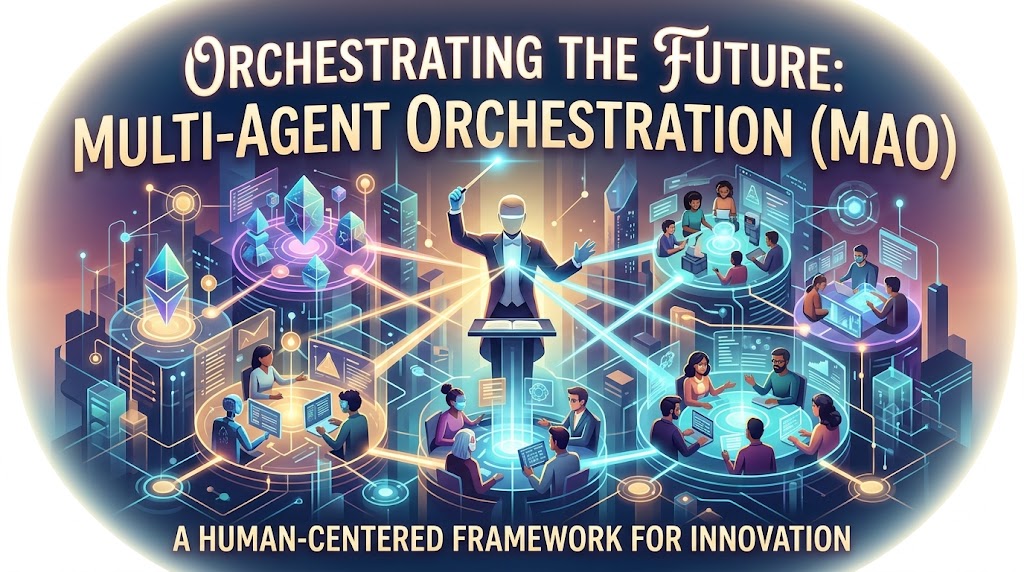
Leveraging Multi-Agent Orchestration Frameworks for Innovation

Orchestrating the Human-Centered Future

LAST UPDATED: May 7, 2026 at 7:10 PM

Leveraging Multi-Agent Orchestration Frameworks for Innovation

GUEST POST from Art Inteligencia


From Solitary Bots to Orchestrated Teams

The current innovation landscape is hitting a ceiling. While single-model AI has provided significant individual productivity gains, it often fails when faced with the multifaceted complexity of enterprise-scale digital transformation. We are witnessing the transition from isolated AI interactions to a paradigm of integrated digital ecosystems.

The Innovation Bottleneck

Relying on a single “jack-of-all-trades” model often leads to context collapse and a lack of depth. For true innovation to thrive, we need diverse perspectives and specialized expertise. Multi-Agent Orchestration (MAO) addresses this by moving us away from “chatting with AI” toward orchestrating outcomes through a coordinated digital workforce.

Defining the MAO Shift

MAO is the connective tissue that allows multiple AI agents — each with specific roles, tools, and personas — to collaborate on complex goals. It turns a series of prompts into a dynamic workflow, ensuring that the right “expert” agent is handling the right task at the right time, while maintaining a persistent thread of strategic intent.

The Human-Centered Lens

In this new era, the human role evolves rather than diminishes. An orchestrated framework still requires a conductor. Our focus remains on the human-centered design principles that ensure these agent swarms are aligned with real human needs, ethical guardrails, and the overarching vision of the organization.

The Anatomy of an Innovation-Ready MAO Framework

Building an orchestration framework for innovation requires more than just connecting APIs; it requires a structural design that mirrors high-performing human teams. To move beyond simple automation and toward true creative problem-solving, an MAO framework must balance three core pillars: specialization, communication, and persistence.

Specialization vs. Generalization

The era of the “Generalist Bot” is yielding to the Specialized Agent Swarm. In an innovation context, this means deploying distinct agents with narrow, deep mandates. You might have “The Researcher” scanning global patent databases, “The Devil’s Advocate” specifically programmed to find flaws in business models, and “The Rapid Prototyper” generating code or wireframes. This role-based approach prevents the cognitive dilution often seen in large, single-model prompts.

The Orchestration Layer: Solving “Context Collapse”

The true power of MAO lies in the orchestration layer — the “manager” that handles agent hand-offs. This layer uses standardized communication protocols to ensure that when a task moves from a researcher to a designer, the strategic intent isn’t lost. This solves the “broken telephone” problem, allowing for complex, multi-step innovation cycles that can run autonomously while remaining aligned with the initial human vision.

State Management and Shared Memory

Innovation is rarely linear; it is an iterative journey. A robust MAO framework utilizes persistent state management. By maintaining a “shared memory” across the swarm, agents can reference earlier pivots, discarded ideas, and customer feedback from previous sessions. This ensures the digital workforce isn’t just reacting to the latest prompt, but is learning and evolving alongside the project’s lifecycle.

Strategic Applications in the Innovation Lifecycle

Multi-Agent Orchestration (MAO) transforms innovation from a series of manual tasks into a scalable, high-velocity engine. By embedding intelligent agents across the innovation funnel, organizations can move from reactive problem-solving to proactive future-shaping.

FutureHacking and Trend Spotting

Traditional trend scanning is often limited by human bandwidth. Using MAO, we can deploy Agent Swarms to scan disparate data sources — from patent filings to social sentiment — simultaneously. These agents act as “Signal Pickers,” synthesizing weak signals into cohesive foresight scenarios. This allows leaders to “hack” the future by identifying emerging opportunities months or years before they become mainstream.

Rapid Concept Validation via “Digital Personas”

One of the most powerful applications of MAO is the ability to stress-test ideas before investing significant capital. We can create Synthetic Customer Personas — digital agents programmed with specific demographic data, behaviors, and pain points. These “synths” provide immediate, iterative feedback on new experience designs, ensuring that human-centered design principles are baked into the concept from the very first draft.

Closing the XLM Gap

While traditional metrics focus on system performance, Experience Level Measures (XLMs) focus on human outcomes. MAO frameworks can be configured to monitor these XLMs in real-time across digital and physical touchpoints. When friction is detected, agents don’t just alert a dashboard; they can autonomously propose friction-lessening interventions or prototype alternative workflows, ensuring the experience remains seamless and human-centric.

Managing the Change: The Human-Agent Work Collaboration

The successful integration of Multi-Agent Orchestration (MAO) isn’t just a technical deployment; it is a profound organizational shift. To leverage these frameworks effectively, we must redesign our workflows to treat AI agents as collaborative partners rather than just automated scripts.

The New Org Chart: Integrating Digital Agents

As we move toward hybrid teams, our organizational structures must evolve to include “digital coworkers.” This requires moving beyond traditional silos to create Human-AI Work Collaboration models. In this setup, digital agents are assigned specific roles — such as data synthesis or rapid iteration — allowing human team members to focus on high-level strategy, creative direction, and empathy-driven decision-making.

Avoiding the Trap of “Automated Austerity”

A critical challenge in the age of MAO is avoiding a race to the bottom. Organizations must resist the “Vicious Cycle of Automated Austerity,” where AI is used solely to cut costs and displace human labor. Instead, the focus should be on augmentation — using agent swarms to expand our capacity for innovation and to create new forms of value that were previously impossible to achieve.

Governance and “Escalation Gates”

Trust is the foundation of any collaborative system. To maintain this, MAO frameworks must include Escalation Gates — predefined points where autonomous processes must pause for human review. Whether it’s an ethical check, a brand alignment review, or a strategic pivot, these gates ensure that the “digital workforce” remains accountable to human leadership and organizational values.

The Skill Shift: From Prompting to Orchestration

The core competency for future leaders is shifting from “Prompt Engineering” to Orchestration Leadership. This involves the ability to design complex workflows, define agent personas, and manage the hand-offs between human and digital actors. It’s about being the conductor of the orchestra, ensuring every “player” is in sync to produce a harmonious and innovative outcome.

The Ecosystem: Leading Frameworks and Players to Watch

The shift toward Multi-Agent Orchestration (MAO) is supported by a rapidly maturing ecosystem of enterprise-grade platforms and agile, open-source frameworks. For innovation leaders, selecting the right stack is about balancing the need for governance with the requirement for creative flexibility.

The Infrastructure Giants: Enterprise-Grade Orchestration

The “Big Three” have moved beyond simple model hosting to provide full-lifecycle agent runtimes.

  • Microsoft (Azure AI Foundry & Semantic Kernel): The primary choice for organizations heavily invested in the .NET and Microsoft 365 stacks. Azure AI Foundry (formerly AI Studio) provides hierarchical orchestration, allowing a “manager” agent to delegate tasks to role-specific sub-agents with built-in SOC 2 and HIPAA compliance.
  • Google Cloud (Gemini Enterprise Agent Platform): Launched at Next ’26, this platform features a re-engineered Agent Runtime with sub-second cold starts and an Agent Memory Bank that allows agents to recall high-accuracy details for long-term project context.
  • AWS Bedrock (AgentCore): A serverless powerhouse that excels in model diversity. Its AgentCore platform is designed for production-scale autonomous agents, offering a 25-30% cost-performance advantage for inference-heavy innovation workloads.
  • IBM (watsonx Orchestrate): Remains the leader for highly regulated industries, focusing on sovereign AI and “hard” governance where every agentic action must be auditable and tied to legacy systems like SAP or Salesforce.

The Agile Frameworks: The Innovator’s Toolkit

For teams building bespoke innovation workflows, these frameworks offer the most granular control.

  • LangGraph (by LangChain): The “gold standard” for stateful, controllable workflows. It treats agent interactions as directed cyclic graphs, making it the best choice when you need precise control over branching, retries, and human-in-the-loop “time travel” debugging.
  • CrewAI: Known for its role-based paradigm. It is the most “human-centered” framework, allowing you to define a “crew” (e.g., Researcher, Writer, Reviewer) that mirrors real-world team dynamics. It is currently the fastest path from a conceptual “innovation roles” model to a working prototype.
  • Pydantic AI: A newcomer that has gained rapid adoption for its focus on “Type-Safe” Python agents. It is essential for projects where data integrity is non-negotiable, such as financial modeling or technical engineering simulations.

Startups to Watch: The Next Wave of “Agentic” Innovation

These private companies are defining specialized niches within the orchestration space.

  • Sierra: Led by Bret Taylor, Sierra is at the forefront of autonomous customer experience orchestration, moving beyond chatbots to agents that can actually execute complex transactions and resolutions.
  • Decagon & Maven AGI: These players are transforming support and operations into “proactive experience management,” using multi-agent systems to anticipate friction before it occurs.
  • XBOW: A critical player in the security and compliance layer, ensuring that as your agent swarms grow, they remain within legal and ethical guardrails.
  • Cognition AI & Anysphere (Cursor): While focused on coding, their “agentic” approach to software development provides a blueprint for how AI can handle complex, multi-step creative projects from start to finish.

Conclusion: Stoking the Digital Bonfire

We stand at a pivotal moment in the evolution of work and creativity. Multi-Agent Orchestration is not merely a “tech stack” upgrade; it is the infrastructure for a new era of human-augmented intelligence. By moving away from siloed tools and toward an orchestrated digital workforce, we can finally overcome the bottlenecks that have long slowed the innovation lifecycle.

However, the technology is only as effective as the vision behind it. As we deploy these frameworks, our guiding principle must remain human-centered. We don’t build agent swarms to replace the “magic maker” or the “conscript”; we build them to amplify the impact of every role within the innovation team.

The Call to Action: Don’t just build a bot; build a capability. Start by identifying the “Experience Level Measures” that matter most to your customers, and then design an orchestration framework specifically to move those needles.

MAO is the connective tissue that allows human creativity to scale. By offloading the coordination, data synthesis, and rapid prototyping to an orchestrated framework, we free up human innovators to do what they do best: dream, empathize, and decide. It’s time to stop managing software and start conducting the future.

Frequently Asked Questions

1. What is the difference between an AI Agent and Multi-Agent Orchestration (MAO)?

A single AI agent is a tool designed to perform a specific task or conversation. Multi-Agent Orchestration (MAO) is the framework that manages a “team” of these agents, handling the hand-offs, memory, and strategy required to complete complex, multi-step innovation projects without manual human intervention at every step.

2. How does MAO improve the innovation process?

MAO accelerates the innovation lifecycle by automating the “busy work” of research, prototyping, and validation. By deploying specialized agents (like a digital “Devil’s Advocate” or “Trend Spotter”), teams can stress-test more ideas in less time, ensuring only the most viable, human-centered concepts move forward.

3. Is MAO intended to replace human innovation teams?

No. In a human-centered framework, MAO is designed for augmentation. It offloads data-heavy and repetitive tasks to digital agents so that humans can focus on high-value roles—providing strategic vision, ethical oversight, and the emotional intelligence necessary to create meaningful experiences.

Disclaimer: This article speculates on the potential future applications of cutting-edge scientific research. While based on current scientific understanding, the practical realization of these concepts may vary in timeline and feasibility and are subject to ongoing research and development.

Image credits: Gemini

Subscribe to Human-Centered Change & Innovation WeeklySign up here to get Human-Centered Change & Innovation Weekly delivered to your inbox every week.

How to Test Your Business Model

How to Test Your Business Model

GUEST POST from Mike Shipulski

Sometimes we get caught up in the details when we should be working on the foundation. Here’s a rule: If the underlying foundation is not secure, don’t bother working on anything else.

If you’re working on a couple new technologies, but the overall business model won’t be profitable, don’t work on the new technologies. Instead, figure out a business model that is profitable, then do what it takes (technology, simplification, process improvement) to make it happen. But, often, that’s not what we do.

Often, we put the cart before the horse. We create projects to make prototypes that demonstrate a new technology, but the whole business premise is built on quicksand. There’s a reason why foundations are made from concrete and not quicksand. It’s because you can build on top of a base made of concrete. It supports the load. It doesn’t crack, nor does it fall apart. Think Pyramid of Giza.

Because foundations are big and expensive they can be difficult and expensive to test. For example, if an innovation is based on a new foundation, say, a new business model, building a physical prototype of the new business model is too expensive and the testing will not happen. And what usually happens is the foundation goes untested, the higher level technology work is done, the commercialization work is completed and the business model fails because it wasn’t solid.

But you don’t have to build a full-scale prototype of the Pyramid of Giza to test if a pyramid will stand the test of time. You can build a small one and test it, or you can run an analysis of some sort to understand if the pyramid will support the weight. But what if you want to test a new business model, a business model that has never been done before, using new products and services that have never seen the light of day? What do you do? In this case, it doesn’t make sense to make even a scale model. But it does make sense to create a one page sales tool that describes the whole thing and it does make sense to show it to potential customers and ask them what they think about it.

The open question with all new things is – will customers like it enough to buy it. And, it’s no different with the business model. Instead of creating a new website, staffing up, creating new technologies and products, create a one-page sales tool that describes the new elements and show it to potential customers. Distill the value proposition into language people can understand, describe the novelty that fuels the value, capture it on one page, show it to customers, and listen.

And don’t build a single, one-page sales tool, build two or three versions. And then, ask customers what they think. Odds are, they’ll ask you questions you didn’t think they’d ask. Odds are, they’ll see it differently than you do. And, odds are, you’ll have to incorporate their feedback into an improved version of the business model. The bad new is you didn’t get it right. The good news is you didn’t have to staff up and build the whole business model, create the technologies and launch the products. And more good news – you can quickly modify the one-page sales tool and go back to the customers and ask them what they think. And you can do this quickly and inexpensively.

Don’t develop the technology until you know the underlying business model will be profitable. Don’t staff up until you know if the business model holds water. Don’t launch the new products until you verify customers will buy what you want to sell.

Creating a new business model from scratch is an expensive proposition. Don’t build it until you invest in validating it’s worth building.

The worst way to validate a business model is by building it.

Image credit: Gemini

Subscribe to Human-Centered Change & Innovation WeeklySign up here to join 17,000+ leaders getting Human-Centered Change & Innovation Weekly delivered to their inbox every week.

6 Ways to Practice Strategic Foresight Without Buzzword Bloat

6 Ways to Practice Strategic Foresight Without Buzzword Bloat

by Braden Kelley and Chateau G Pato


How Do You Practice Strategic Foresight Without Buzzword Bloat? (Short Answer)

Six ways to practice strategic foresight without buzzword bloat: (1) collect floor signals, not only trend PDFs, (2) write two landings for every strategic bet, (3) run three scenarios with one decision date, (4) translate futures into job and operating-model implications, (5) premortem the hard landing with kill criteria, and (6) tie foresight to fund/stop decisions each quarter. Soft landings are designed. Buzzword bloat photographs well and changes nothing.

Strategic foresight without buzzword bloat is a habit of sensing, naming landings, and forcing decisions — not a costume of trends, horizons, and “disruption.”

What Counts as Foresight — and What Is Just Theater?

I have sat through rooms full of megatrends, PESTLE wallpaper, and “future-ready” slides that never stopped a weak bet or funded a hard redesign. That is not foresight. That is buzzword bloat with better typography.

Bloat that can entertain but does not practice foresight: megatrends decks nobody acts on, horizon labels without owners, scenario murals that never kill a project, futurist keynotes as strategy, and “we’re future-ready” claims with no job redesign.

If you need the pitch catalog with soft vs hard landings, see 10 Futures Being Pitched in 2026. If your organization is already buying the wrong landing, see 8 Signals You’re Preparing for the Wrong Future of Work. This piece is the lean practice kit.

Practice Replaces Decision it forces
1. Floor signals Megatrends theater What changed in the work this month?
2. Two landings Single destiny pitch Which landing are we buying?
3. Three scenarios + date Endless scenario catalogs What do we choose by [date]?
4. Job/OM implications Vision walls Whose work redesigns — and who owns it?
5. Premortem + kills Inspiration without brakes What would make us stop?
6. Quarterly fund/stop Annual offsite costume What do we fund or kill now?

If foresight cannot stop or start a bet, it is decoration.

1. How Do You Collect Floor Signals Instead of Trend PDFs?

Practice: Keep a living signal log from contact with customers, employees, partners, and the work — friction, workarounds, dignity costs, weak patterns — reviewed monthly.

Replaces: Megatrends decks, vendor “future of X” PDFs, and newsletter scanning as strategy.

Run lean: One page; five signals; who saw it; so-what for the portfolio.

Forces: Sensing before storytelling. Foresight grounded in lived work — not a costume of disruption language.

2. Why Write Two Landings for Every Strategic Bet?

Practice: For each major bet — AI, agentic, CX, operating model — write the soft landing and hard landing in human terms: what machines absorb, what humans keep, what dignity and agency look like.

Replaces: Single destiny narratives (“the future is…”) and competitive-parity urgency as strategy.

Run lean: Half page per bet; soft vs hard side by side; name the landing you are funding.

Forces: Choice of landing before spend. For the designed alternative in depth, see The AI Soft Landing.

3. How Do You Run Three Scenarios With One Decision Date?

Practice: Hold at most three plausible futures for a horizon — then set a date when leadership must fund, stop, or redesign based on which signals moved.

Replaces: Scenario weekends that produce murals and no owners; “horizon 1/2/3” labels without decisions.

Run lean: Three one-pagers; trigger signals; decision date on the calendar.

Forces: Foresight with a stopwatch. It kills endless workshop archaeology. For agentic ownership by scenario — not scenario theater — see 5 Scenarios for Agentic Organizations.

4. How Do You Translate Futures Into Job and Operating-Model Implications?

Practice: For each scenario or bet, name whose jobs change, what incentives shift, what old paths die, and who owns the new way — before the roadmap hardens.

Replaces: Vision walls, future-state posters, and capability maps with no operators.

Run lean: One implication card per bet — roles, seams, owners, old-path kill.

Forces: Foresight that redesigns work, not only slides. Boards that ask the landing question early stay ahead of this trap — see 7 Questions Smart Boards Ask About the Next Five Years.

5. How Do You Premortem the Hard Landing With Kill Criteria?

Practice: Assume the bet produced a hard landing; list how you would know early; write kill/continue criteria and who may pull the cord.

Replaces: Inspiration without brakes; “we’ll adapt” as governance.

Run lean: A 30-minute premortem; five early-warning signals; one kill rule per bet.

Forces: Learning and stop authority before scale. Cheap evidence with a decision date beats destiny theater every time.

6. How Do You Tie Foresight to Fund/Stop Decisions Each Quarter?

Practice: Make foresight a quarterly portfolio ritual: which signals moved, which landing is winning, what we fund, stop, or redesign — with receipts in the decision log.

Replaces: Annual offsite foresight costume; “future-ready” claims with no portfolio consequence.

Run lean: A 90-minute review; three decisions max; publish what stopped.

Forces: Foresight as capital allocation, not brand. If nothing stops, you ran a meeting with snacks — not foresight.

What Should You Ask Before the Next Strategy Offsite?

Five questions for foresight hygiene:

  1. Where are this month’s floor signals?
  2. Which landing are we buying — in writing?
  3. What three scenarios have a decision date?
  4. Whose jobs change if we’re right?
  5. What will we stop if the hard landing shows up?

Mantra: Practice foresight as decisions. Leave the buzzwords on the poster.

FAQ: Strategic Foresight Without Buzzword Bloat

How do you practice strategic foresight?

Practice strategic foresight by collecting floor signals, writing soft and hard landings for each bet, running a few scenarios with a decision date, translating futures into job and operating-model implications, premorteming hard landings with kill criteria, and tying the work to quarterly fund/stop decisions.

What is strategic foresight without buzzwords?

Strategic foresight without buzzwords is a decision habit — sensing, naming landings, and forcing fund/stop/redesign choices — not megatrends decks, horizon labels without owners, or scenario murals that never change the portfolio.

How do soft and hard landings relate to foresight?

Soft and hard landings turn foresight into a choice: for every strategic bet, write what a more-human landing and a less-human landing look like, then fund the landing you intend — instead of pretending there is only one destiny.

What replaces megatrends decks?

Replace megatrends decks with a living floor-signal log from contact with customers and the work, reviewed monthly, with a clear so-what for the portfolio — sensing before storytelling.

How often should companies do foresight?

Companies should practice foresight continuously through monthly signal reviews and a quarterly fund/stop ritual — not only as an annual offsite costume. Foresight that cannot change capital allocation is decoration.

Image credits: Pexels

Content Authenticity Statement: The topic area, key elements to focus on, etc. were decisions made by Braden Kelley, with a little help from Google Gemini and Cursor to clean up the article, add images and create infographics.

Subscribe to Human-Centered Change & Innovation WeeklySign up here to get Human-Centered Change & Innovation Weekly delivered to your inbox every week.

Investments That Make Your Company More Productive, Efficient and Customer-Friendly

Investments That Make Your Company More Productive, Efficient and Customer-Friendly

GUEST POST from Shep Hyken

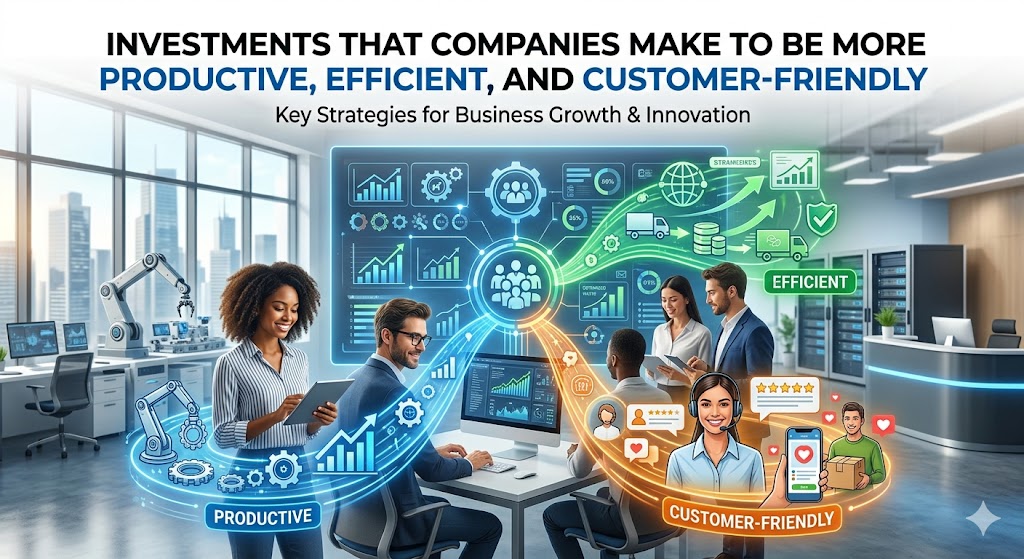
What company doesn’t want to be more productive, efficient, and customer-friendly? (That’s a rhetorical question.) Isn’t this what every leader wants? Yet recent survey findings from Call Centre Helper an inconsistency in how organizations pursue these goals. This inconsistency can make or break their customer experience strategy. And if they fail their customers, their company may fail, as well.

The Call Centre Helper numbers tell the story. When asked where organizations can get maximum value for money while improving customer experience, a staggering 40% pointed to self-service solutions. Personalization came in a distant second at 18%, followed by productivity tools (12%). And despite years of improvement in AI, chatbots only received 8% of the vote.

In my own 2025 customer service and CX research of over 1,000 U.S. consumers, 68% still prefer the phone as their first choice for customer support, followed by online chat with a live agent at 55%. This creates what I call the customer experience investment paradox, where companies are pushing their investment into self-service tools while customers continue to value human-to-human interactions with live support agents.

The Self-Service Revolution is Real

In spite of the preference for phone support, the digital self-service revolution is real and becoming more important to companies. While the phone is still king, my research found that 34% of customers stopped doing business with a company because self-service options weren’t offered. That’s a third of your potential customers. Even if they prefer the phone, they want the option of doing it themselves.

There are some digital rockstar brands like Amazon and Uber, which have trained customers to expect instant and easy experiences. When customers can order groceries, stream entertainment, or hail a ride with a few taps of their mobile screen, they naturally expect similar experiences with every brand they encounter.

This makes the case for self-service, in spite of the customer’s desire to make a phone call. When the right solution is provided, the benefits to the company are big in the form of reduced operational costs and an improved customer experience. When executed well, self-service allows customers to resolve simple issues instantly, freeing up human agents to take on complex problems that require expertise and empathy.

That said, I regularly caution my clients that going “all in” on self-service without considering the larger customer journey could be a mistake. The keywords to consider are “when executed well.” Poorly implemented self-service creates frustrated customers who eventually demand human assistance anyway, often at a higher cost to resolve, and not to mention the bad will caused by the frustration.

Personalization: A Competitive Differentiator

The 18% investment in improving personalization shows that companies are understanding the importance of creating the personalized experience. My research reveals that 79% of consumers consider a personalized experience to be important.

Consumers are still being bombarded with generic messages from the companies they do business with that often leave them asking, “Why is this company sending this to me?” The result is customers disengage and often move on. As personalization technology improves (dramatically), analytics on a customer’s buying habits, frequency, past products purchased, and more can be incorporated into messaging and customer support experiences that have customers saying, “This company knows me.”

Smart companies use customer data to do more than personalize marketing messages and improve customer support. The data allows companies to anticipate needs, make recommendations for other products and services, and improve the overall customer experience.

The Relevance of the Human Connection

Despite a focus on digital investment, the human-to-human connection cannot be ignored. The fact that 68% of customers still prefer the phone confirms that self-service and chatbots may not be enough. Customers still want to talk to a live human being, especially about complex problems or major complaints.

However, the technology is getting better, and customers are becoming more confident with self-service solutions, which include chatbots. Also, as Gen Zs and younger Millennials become financially secure, they become a major force in the economy. They are the ones becoming I predict the 68% number will go lower for two reasons:

And age makes a difference, or does it? While my research finds that 82% of Baby Boomers prefer the phone, you can’t ignore that 52% of Gen Zs prefer it as well. At the same time, I predict that 68% of customers preferring the phone will go down for at least two reasons. First, the technology is getting better, and customers are becoming more confident with self-service solutions, which include improved chatbots. Second, Gen Zs and younger Millennials, who are more comfortable with technology, are becoming financially secure. The result is that they will be a major force in the economy.

Productivity and Efficiency

The 12% investment into productivity is about efficiency and optimizing the workforce. Some companies believe that being more efficient means replacing the workforce with technology. That’s a dangerous move for reasons and information already shared in this article. However, rather than saving money by eliminating employees, companies can make employees more productive. Imagine technology that saves employees 20% of their workday by eliminating menial tasks or answering basic questions that AI and chatbots can respond to. In turn, they use that time to focus on more important issues and tasks.

Many companies view chatbots as an investment in productivity, however according to the Call Centre Helper findings, companies are investing less than 8% in this powerful tool. My take on this is that companies have been let down by AI-fueled chatbots that make mistakes and hallucinate. That’s yesterday’s chatbot technology. Today, chatbots are far better than they were just a year ago. And if you’re worried about chatbots giving bad information to customers, don’t think that customers haven’t had the same experience with human support.

Final Words

The most successful companies I work with aren’t choosing between digital efficiency and human connection. They’re creating integrated experiences that deliver both. They use self-service for simple, routine interactions while ensuring a seamless hand-off to a human when needed. They leverage personalization to anticipate customers’ needs and build relationships. They invest in tools that enhance rather than replace human connection, achieving what every leader wants: a business that’s more productive, efficient, and loved by its customers.

This article was originally published on Forbes.com.

Image Credit: Gemini

Subscribe to Human-Centered Change & Innovation WeeklySign up here to join 17,000+ leaders getting Human-Centered Change & Innovation Weekly delivered to their inbox every week.
12 Technologies That Change Experience Faster Than Operating Models

12 Technologies That Change Experience Faster Than Operating Models

by Braden Kelley and Art Inteligencia


Which Technologies Change Experience Faster Than Operating Models? (Short Answer)

Twelve technologies that change experience faster than operating models: (1) generative AI interfaces, (2) agentic automation, (3) hyper-personalization engines, (4) conversational front doors, (5) self-service deflection platforms, (6) always-on messaging and real-time alerts, (7) instant-promise commerce, (8) mobile/app feature factories, (9) recommendation and ranking systems, (10) frictionless identity, (11) connected products / IoT experience layers, and (12) low-code experience surfaces. Each can delight or betray in a sprint. The operating model — owners, incentives, policy, seams — still decides whether humans succeed.

Experience can now change at release velocity. Trust breaks at operating-model velocity — unless you redesign the model on purpose.

Why Isn’t Release Velocity the Same as Operating-Model Velocity?

Here, experience is what customers and employees encounter and feel across channels and moments. An operating model is how work, decisions, incentives, policies, ownership, and recovery actually run — not the org-chart slide.

I keep watching teams ship a new experience in a sprint while decision rights, recovery power, and the old path still move on political time. Soft landings are designed when leaders fund operating-model change with the stack. Hard landings arrive when experience outruns ownership. For the designed split of human and machine work, see The AI Soft Landing.

Technology Experience speed Operating-model lag
1. Generative AI Instant answers and drafts Accuracy, escalation, brand ownership
2. Agentic automation Actions without tickets Mandate, consent, liability
3. Hyper-personalization Real-time journey reshaping Consent, fairness, “optimize for whom?”
4. Conversational front doors Bot/voice as first door Handoff, context, human power
5. Self-service deflection Work shifted overnight Job completion, escape hatches
6. Always-on alerts Continuous attention claims Governance, truth, staffing
7. Instant-promise commerce One-click commitments Capacity truth, exception recovery
8. App feature factories Weekly UX change Policy, training, BAU owners
9. Ranking systems Invisible reordering Objectives, appeal, override
10. Frictionless identity Fast entry Recovery dignity when identity fails
11. Connected products / IoT Live device experiences Service design, parts, privacy
12. Low-code surfaces Publish without IT wait Ownership, quality, sunset

1. How Do Generative AI Interfaces Outrun Operating Models?

Changes experience fast: Drafts, advice, summaries, and “help” appear in seconds across product and service.

Operating model lags: Who owns accuracy, tone, escalation, and brand promise when the model is wrong?

Hard landing: Confident nonsense. Humans as rubber stamps. Trust spent on fluency.

Soft landing: Named judgment owners, disclosure, undo, and recovery power beside every gen-AI surface.

2. Why Does Agentic Automation Change Experience Before Mandate?

Changes experience fast: Systems refund, rebook, route, and trigger workflows without a human ticket.

Operating model lags: Decision rights, consent, liability, and who can be asked why.

Hard landing: Autonomy without ownership. Containment as the KPI.

Soft landing: Clarity, competence, control, care — accountability maps before scale. For ownership by scenario, see 5 Scenarios for Agentic Organizations and agentic CX that earns trust.

3. How Does Hyper-Personalization Move Faster Than Dignity Rules?

Changes experience fast: Offers, content, and journeys reshape per person in real time.

Operating model lags: Consent, minimization, fairness reviews, and “who we optimize for.”

Hard landing: Creepy recall. Manipulation that “converts.” Segment politics.

Soft landing: Purpose-bound memory. Opt-out that works. Care over conversion defaults.

4. Why Do Conversational Front Doors Outpace Seam Design?

Changes experience fast: Bot or voice becomes the first door for service and sales.

Operating model lags: Context handoff, human escalation without punishment, frontline power.

Hard landing: Loop traps. Retelling tax. Deflection celebrated as CX.

Soft landing: Designed handoffs. Dual scorecard. Finish-the-job metrics.

5. How Do Self-Service Platforms Change Experience Overnight?

Changes experience fast: Portals, FAQs, and apps push work to the customer overnight.

Operating model lags: Complexity reduction, failure ownership, escape hatches that work.

Hard landing: Unpaid labor. DIY that fails into worse contact. “Digital adoption” theater.

Soft landing: Job-completion design. Inventory unpaid labor. A human path with teeth. For the service design pattern, see 8 Service Design Mistakes That Create Efficient Misery.

6. Why Do Always-On Alerts Outrun Organizational Capacity?

Changes experience fast: Push, SMS, in-app, and status pings reshape attention continuously.

Operating model lags: Message governance, truth standards, staffing for the demand alerts create.

Hard landing: Anxiety as a product. Alert fatigue. Promises the back office cannot keep.

Soft landing: Status-as-experience with honest ETAs. Throttle rules. Owners for each alert class.

7. How Does Instant-Promise Commerce Outrun Fulfillment Politics?

Changes experience fast: Instant pay, same-day, “arrives tomorrow,” one-click commit.

Operating model lags: Inventory truth, exception handling, store/DC incentives, recovery when late.

Hard landing: Beautiful checkout, brutal disappointment. Brand trust spent on logistics theater.

Soft landing: Promise engines tied to real capacity. Make-right powered when the promise breaks.

8. Why Do App Feature Factories Outpace Policy and BAU Ownership?

Changes experience fast: Product teams ship features every sprint across the app.

Operating model lags: Policy, risk, training, and BAU ownership still move quarterly.

Hard landing: Feature dump. Shadow process. Humans learn by getting burned.

Soft landing: Progressive adoption. Policy-in-the-sprint. Named BAU owners before release. When good tools become unused licenses, see 12 Adoption Mistakes That Turn Good Tools Into Shelfware.

9. How Do Recommendation Systems Change Experience Without a Face?

Changes experience fast: What people see, buy, and try is reordered algorithmically.

Operating model lags: Governance of objectives, bias review, appeal paths, human override.

Hard landing: “The system said so.” Unfairness without a face. Local optima that hurt journeys.

Soft landing: Explainable objectives. Challenge paths. Humans accountable for ranking outcomes.

10. Why Does Frictionless Identity Outrun Trust Repair?

Changes experience fast: Biometrics, passwordless, and one-tap identity collapse login friction.

Operating model lags: Account recovery, fraud exception design, dignity when identity fails.

Hard landing: Locked-out humans. Identity theater. Fraud rules that punish the legitimate.

Soft landing: Recovery as a product. Stakes-matched friction. Accountable fraud/care balance.

11. How Do Connected Products Outrun Service Design?

Changes experience fast: Devices notify, update, and “need service” in the customer’s life.

Operating model lags: Support playbooks, spare parts, field force capacity, privacy of sensor data.

Hard landing: Smart product, dumb service. Alert without a fix path.

Soft landing: Device-plus-service operating model. Privacy minimization. Recovery before the ping.

12. Why Do Low-Code Experience Surfaces Ship Without Owners?

Changes experience fast: Business teams publish portals, forms, and tools that customers feel.

Operating model lags: Quality, accessibility, security, lifecycle ownership, kill criteria.

Hard landing: Shadow IT as customer experience. Orphan apps. Inconsistent brand promises.

Soft landing: Guardrails with speed. Named product owners. Sunset paths equal to publish paths. When pilots work and scale does not, see 9 Reasons Digital Transformations Stall After the Pilot.

How Do You Check the Tech-vs-Operating-Model Gap Before the Next Release?

Before the next release, run five go/no-go questions:

  1. Which experience will change this sprint — and which operating-model element will not?
  2. Who owns the new moment when it breaks?
  3. What incentive still rewards the old way?
  4. What policy or seam did we leave on political time?
  5. What will we stop so capacity exists to absorb the new experience?

Don’t only ship the experience. Ship the operating model that can keep the promise.

Frequently Asked Questions

Why does technology outpace operating models?

Technology outpaces operating models because software can ship experience changes in days or weeks, while roles, decision rights, incentives, policies, seams, and recovery power still move on political time. Without funding operating-model redesign with the stack, experience outruns ownership.

What is an operating model in CX?

In CX, an operating model is how work, decisions, incentives, policies, ownership, and recovery actually run across the journeys customers and employees live — not the org-chart slide. It determines whether a new digital experience can keep its promise.

How do you align tech and operating model change?

Align tech and operating-model change by naming owners before release, redesigning incentives and policy in the same sprint cycle, designing recovery and escalation with the feature, killing or constraining the old path, and refusing to ship experience that has no mandate or capacity behind it.

What technologies change customer experience fastest?

Technologies that change customer experience fastest include generative AI interfaces, agentic automation, hyper-personalization, conversational front doors, self-service platforms, real-time alerts, instant-promise commerce, rapid app feature shipping, recommendation systems, frictionless identity, connected products, and low-code experience surfaces.

How do you soft-land fast-moving tech?

Soft-land fast-moving tech by pairing every material release with operating-model work: accountability maps, consent and care defaults, designed handoffs, job-completion metrics, capacity-truthful promises, progressive adoption, explainable ranking objectives, recovery as a product, and named owners with sunset paths — not go-live alone.

Image credits: ChatGPT

Content Authenticity Statement: The topic area, key elements to focus on, etc. were decisions made by Braden Kelley, with a little help from Google Gemini and Cursor to clean up the article, add images and create infographics.

Subscribe to Human-Centered Change & Innovation WeeklySign up here to get Human-Centered Change & Innovation Weekly delivered to your inbox every week.

How to Design a Horrible, Terrible, No Good, Very Bad User Experience

How to Design a Horrible, Terrible, No Good, Very Bad User Experience

GUEST POST from Geoffrey A. Moore


Some of you may know that early in my career I taught English at the college level. The freshman writing requirement was always a challenge as textbook publishers struggled valiantly to find some reading material that would actually help students write better. One of their best efforts was an essay titled “How to Write an F Paper.” It turns out we learn better from failure than from success—who knew?

With that thought in mind, and taking liberties with the title of one of my favorite children’s books, I want to review an actual user experience delivered to me by the manufacturer of a luxury automobile. The vehicle itself performs admirably, so kudos to the product engineers. It is the customer experience team that needs to be taken to the woodshed.

Here’s how the experience starts. I get in my car, start it, and back out of my garage, benefiting as always from the rear camera system. The system stays on when I shift into drive until I get onto the road and have gone perhaps fifty yards. At that point, the multimedia display presents the following:

An update is ready for installation on your multimedia system. The following conditions must be agreed to before installation.
(READ NOW) (LATER)

Well, I am driving the car, so I don’t think READ NOW is a very good option. I hit LATER, the screen returns to normal, and I get on with my day. To tell the truth, I forget about the whole experience until the next day when, after backing out of my garage and getting onto the road, I get a replay of the same message. Astoundingly, I am driving my car again, so again I push LATER.

Now, as my spouse will testify, sometimes I am a slow learner, so it is not until the better part of a week has passed that I realize the only time I am going to get this message is the first time I start the car in the morning and have driven around fifty yards. At this point, I decide to pull over and push READ. Here is what I got in reply:

Software update for your infotainment system — In order to read the terms and conditions, please park the vehicle safely, switch off the ignition and apply the parking brake.

Well, as it turns out, the reason I got in my car and drove that first fifty yards is that I actually have someplace I need to get to on time, so the idea of switching off the ignition does not appeal. I go back, push the LATER button (feeling a bit like Neo in the Matrix at this point), sub-vocalize a few choice words for the vendor, and carry on with my day.

I won’t testify as to how many days after I had the same introductory message appear and pushed LATER because you guessed it, I actually had somewhere to go and wanted to arrive there on time. But, one day I had the opportunity to be parking somewhere for a good while, so that day I did not push either button until I got to the lot. (“You can fool some of the people all the time, and all of the people some of the time, but you cannot fool all the people all the time.”) Once parked, I did switch off my ignition and applied the parking brake, and was rewarded with the following messages.

Software update for your installation system

Notes
The installation process requires several minutes and cannot be canceled or closed. Individual functions and buttons in the vehicle are not available for use during the installation or their use is limited. The multimedia display does not support display messages.

In the unlikely event of a technical error during installation, functional restrictions of the multimedia system and the above-mentioned functions may persist and make it necessary to consult a workshop.

This is what happens when you let the legal team review the customer communications text. Fresh from their latest efforts with the Safe Harbor statement from the prior quarter’s earnings call, they are fiercely protecting their enterprise from any and every liability risk. Heartwarming as these words were, they actually felt they were not protection enough because they were followed by:

Warnings

During installation of this update, the multimedia system is not available. In particular, this includes systems such as the navigation system, phone, reversing camera, 360 camera, Active Parking Assist, Remote Parking Assist, PARKTRONIC, and the switch for DYNAMIC SELECT.

There is an increased risk of accident.

Installing the update while operating the vehicle may distract you from the traffic situation.

There is an increased risk of accident.

Carry out the installation

And yes, that last line is a call to action, clearly meant to benefit from the wave of inspiration created by the earlier sentences. My only surprise was that it did not append the phrase “at your own risk.”

Now, to be fair, I did carry out the installation, and it took about seven minutes or so, and it was fine. So again, the product engineers know what they are doing. But where in the name of all that is holy is the customer experience engineering? Who in their right mind would ever want their customers—and remember this is a luxury vehicle with some pretty high-end customers—to go through such an experience? And most importantly, what are the takeaways that will keep us from going down the same path?

Here are three that come to mind:

  1. Design the experience. Work backward from the end in mind, making sure each element is contributing to the desired outcome.
  2. Test the experience. Make this a real-world test, not a lab test. Recruit vehicle owners to participate. Capture their feedback.
  3. Eliminate friction. All hygiene processes entail some amount of friction. In such situations, your job is not to delight your customers here but rather to avoid annoying them. Do so by respecting their time.

In this case, what if the car company had sent me an email first? That could have included all their liability stuff. It also could coach me on when and how to best install the update. Once I replied I had read the stuff, then they could have sent a much simpler message over the multimedia system, or maybe just triggered the download on my behalf when my car was safely in my garage. The point is, there was clearly a better way, and just as clearly, nobody at the car company cared enough to advocate for it.

That’s what I think. What do you think?

Image Credit: Pexels, Geoffrey Moore

Subscribe to Human-Centered Change & Innovation WeeklySign up here to join 17,000+ leaders getting Human-Centered Change & Innovation Weekly delivered to their inbox every week.