GUEST POST from David Burkus
You’ve poured hours into developing a brilliant new strategy. Maybe it’s a streamlined process, a novel team ritual, or a bold cultural shift you know will improve how your team works. You present it to the team. Heads nod. There’s excitement. Applause, even.
And then…nothing.
A few weeks go by and everything’s back to the old way. People are still using the outdated process. The team ignores the new meeting cadence. That cultural initiative? Forgotten. It’s as if your big idea evaporated the moment the meeting ended.
So what happened?
As frustrating as it is, this scenario is all too common. And it reveals an important truth about making change stick: it’s not the brilliance of your idea that matters most. It’s how well that idea is presented and remembered. And for most leaders, that’s where the real challenge begins.
The Flawed Approach to Leading Change
For decades, leaders have looked to process improvement and efficiency as the holy grail of organizational success. From Frederick Taylor’s scientific management to modern methodologies like Six Sigma or Agile, there’s no shortage of change initiatives aimed at helping teams get better.
And in theory, many of them work.
But research from UNC’s Brad Staats and Oxford’s Matthias Holweg and David Upton tells a different story about what happens after rollout. According to their study of over 200 process improvement initiatives across a major European bank, roughly 50% of those projects were abandoned within the first year. And after two years? Only one in three remained.
They call it the improvement paradox—the fact that even successful initiatives often fade over time. And the reason isn’t because the ideas were bad. It’s because of how those ideas were introduced and sustained—or, more accurately, how they weren’t.
Why Good Ideas Don’t Stick
The researchers identified several culprits behind why making change stick is so difficult. And if you’ve ever led a change that didn’t last, these may sound familiar.
Initiative Fatigue
When every quarter brings a new mandate or buzzword, people stop getting excited and start getting cynical. It becomes easier to nod along in the meeting and quietly keep doing things the old way.
Lack of Personal Benefit
When change feels like it’s for the company but not for the individual, motivation suffers. People ask, “What’s in it for me?” And if they can’t find a compelling answer, they’re unlikely to put in the effort required to make the change real.
Loss of Ownership
Many initiatives are handed down from above—or worse, handed over from highly paid consultants—as rigid prescriptions rather than collaborative efforts. When people feel forced to comply instead of invited to contribute, they disengage.
Curse of Knowledge
But perhaps the most overlooked obstacle is this: we fall in love with our own ideas and forget what it’s like not to understand them.
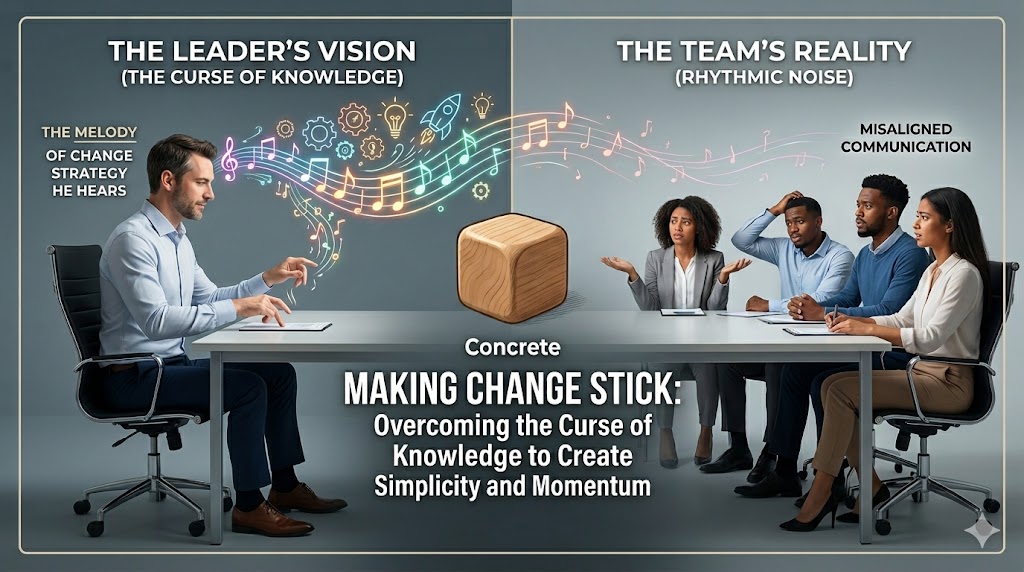
Psychologists call this the curse of knowledge. Once you know something well, it becomes almost impossible to imagine what it’s like not to know it. Which means that when we communicate our change initiatives, we often assume too much.
A classic study by Stanford Ph.D. student Elizabeth Newton illustrates this. Participants were asked to tap out the rhythm of a popular song while another person tried to guess what it was. Tappers thought their partners would guess the song about 50% of the time. In reality? Only 2.5% of the time.
Why? Because the tappers could hear the melody in their head. But to the listener, it was just tapping. They didn’t have the context.
The same thing happens with change efforts. Leaders have been thinking about their new strategy for weeks or months. They’ve connected the dots. They see how it all fits. But their teams haven’t been part of that process—and as a result, they don’t hear the melody. Just the tapping.
Making Change Stick
So how do you overcome the curse of knowledge, and the other traps that make change initiatives fade?
You don’t need to be more charismatic. You don’t need a better slide deck. You need a better design for your message. Authors Chip and Dan Heath argue that “sticky” ideas share a few key principles. And when it comes to making change stick, these three are especially powerful.
1. Be Simple: Find the Core Message
Don’t oversimplify. But do clarify. Strip away the jargon, the background noise, the long-winded rationale—and identify the one idea you want your team to remember.
What’s the slogan behind your initiative? What’s the one phrase they can use to guide their decisions?
If your team walks away from your message and forgets everything else, what’s the one thing they must retain? Then say that. A lot.
2. Make It Concrete: Use Sensory and Tangible Language
People don’t latch onto abstract mission statements. They remember vivid images. One of the best examples of this comes from Jeff Hawkins, lead designer of the original Palm Pilot.
To keep the device simple and user-friendly, he carried around a block of wood shaped like the Palm Pilot. Any time someone proposed a new feature, he’d pull it out and ask, “Where are we going to put it?”
It was a tangible symbol of the constraints—and priorities—of the team. And it worked.
You can do the same by anchoring your message in real-world actions, visuals, or metaphors. Don’t say “streamline communication.” Say, “We’re cutting weekly meetings in half so you can get your Wednesdays back.”
3. Use Stories: Help People Feel the Message
Data informs. Stories stick.
The oldest tool for spreading ideas is still the most effective. When you tell a story—about a time the team nailed collaboration, or a moment when things fell apart because the process wasn’t followed—you help people emotionally experience the change you’re trying to create.
Stories give people something to believe in. Something to remember. And something to model their behavior after. Before your next rollout, ask: What stories do I have that illustrate what good looks like? Or what happens when we get it wrong?
You don’t need a slide deck for this. You just need a story.
The Bottom Line
Making change stick isn’t about shouting louder or using fancier words. It’s about designing your message in a way that overcomes fatigue, sparks ownership, and connects emotionally.
That means asking yourself:
- Is my idea simple enough to remember?
- Is it concrete enough to visualize?
- Is it wrapped in a story people want to be part of?
Because ultimately, people don’t follow mandates. They follow meaning. And your job as a leader is to help them see themselves in the better future your change is meant to bring.
Want to make your next change effort stick? Start by telling a better story.
Image credit: Google Gemini
 Sign up here to get Human-Centered Change & Innovation Weekly delivered to your inbox every week.