7 Questions Smart Boards Ask About the Next Five Years

7 Questions Smart Boards Ask About the Next Five Years

by Braden Kelley and Chateau G Pato


What Questions Do Smart Boards Ask About the Next Five Years? (Short Answer)

Seven questions smart boards ask about the next five years: (1) Which landing are we buying — soft or hard? (2) What stays human-accountable as machines act? (3) Is work redesign funded with the technology bet? (4) Can the organization absorb the change portfolio we are approving? (5) How do trust and human success hold when agents and automation scale? (6) How will we know we are winning — outcomes, not theater? (7) Which capabilities will still matter when the tool stack turns over? Weak answers optimize for slides and takeout. Strong answers name ownership, dignity, capacity, and a scoreboard humans can live with.

Smart boards do not ask whether the future is coming. They ask which future the company is paying for — and who will still be able to succeed inside it.

Why Is Strategy Without a Landing Just Spend?

I have sat through five-year strategy sessions where the AI line item was confident, the competitive-parity slides were polished, and nobody could say — in one human paragraph — what kind of organization would exist if the bets worked. Efficiency takeout was clear. Accountability, redesign, and change capacity were “in the plan.”

The next five years will not be won by boards that only ask about spend and speed. Soft landings are designed. Boards either demand that design — or rubber-stamp a harder one.

Question Weak answer Strong answer
1. Soft or hard landing? Compete and cut cost with AI Named what machines absorb / humans keep
2. Human accountability? “Ethics is being stood up” Decision rights, undo, who answers why
3. Work redesign funded? Training is in the plan Budget and mandate beside the tech
4. Change capacity? Everything is priority Stop/start rules; what we will not ask
5. Trust at scale? NPS/SLA still strong Human success can stop a green review
6. Winning without theater? Adoption and maturity KPIs Behavior, value, transfer to BAU
7. Capabilities that age? Upskill on AI tools Judgment skills + time to practice

1. Which Landing Are We Buying — Soft or Hard?

Why smart boards ask: Technology strategy is not neutral. It either protects human judgment and agency or densifies leftover work.

Weak answer: “We’re investing in AI to stay competitive and reduce cost.”

Strong answer: A named soft landing — what machines absorb, what humans keep, what deep work and dignity we will protect.

Demand next: One paragraph in the strategy that defines the landing in human terms — not only the vendor roadmap. For the designed split, see The AI Soft Landing; for how common pitches land both ways, see 10 Futures Being Pitched in 2026.

2. What Stays Human-Accountable as Machines Act?

Why smart boards ask: Autonomy without ownership is liability with a demo.

Weak answer: “Governance and ethics are being stood up.”

Strong answer: Named decision rights, undo, escalation, and who can be asked why when an agent acts — for customers and for internal decisions.

Demand next: An accountability map for the highest-stakes agentic or automated paths — not a principles poster. For what leaders must own by scenario, see 5 Scenarios for Agentic Organizations.

3. Is Work Redesign Funded With the Technology Bet?

Why smart boards ask: Tools without redesigned jobs produce efficient misery and burned-out “exception handlers.”

Weak answer: “Change management and training are in the plan.”

Strong answer: Budget and mandate for job redesign, incentives, retirement of the old path, and manager development — tied to the same investment case as the tech.

Demand next: Line items and owners for redesign — not a training completion KPI as proxy.

4. Can the Organization Absorb the Change Portfolio We Are Approving?

Why smart boards ask: Strategy that stacks initiatives until humans break is not ambition — it is extraction.

Weak answer: “Everything is priority; we’ll sequence in PMO.”

Strong answer: Visible portfolio load, stop/start rules, and what will not be asked of the frontline this horizon.

Demand next: A capacity view beside the initiative list — what stops if this starts. If the organization is already optimizing for the wrong future of work, see 8 Signals You’re Preparing for the Wrong Future of Work.

5. How Do Trust and Human Success Hold When Agents and Automation Scale?

Why smart boards ask: Green operational metrics can hide red journeys. Containment is not care.

Weak answer: “CSAT/NPS and SLAs remain strong.”

Strong answer: Experience-level measures, recovery power, and customer/employee moments that matter — with owners who can change the system.

Demand next: One critical journey where human success can stop a “green” review. For the moments that outrank a scoreboard, see 8 Moments That Matter More Than Your NPS Dashboard.

6. How Will We Know We Are Winning — Outcomes, Not Theater?

Why smart boards ask: Five-year decks love activity — pilots, platforms, “AI maturity.” Boards need landings.

Weak answer: “We’ll track adoption, usage, and innovation KPIs.”

Strong answer: Adopted behavior, retired workarounds, value captured, kill rate with honor, transfer to BAU — outcomes that decide funding and promotion.

Demand next: A short scoreboard that demotes vanity metrics; theater cannot close the quarter. For the catalog, see 12 Metrics That Actually Measure Innovation Value.

7. Which Capabilities Will Still Matter When the Tool Stack Turns Over?

Why smart boards ask: Buying the next model is not building an organization that ages well.

Weak answer: “We’re upskilling everyone on AI tools.”

Strong answer: Investment in problem framing, sense-making, judgment, empathy with stakes, facilitation, repair, and meta-learning — and contiguous time to practice them.

Demand next: Hiring, promotion, and calendar design that reward those capabilities — not only prompt fluency. For the list, see 9 Skills That Age Well When Everything Automates.

How Do Smart Boards Run a Five-Year Readiness Check?

Before the next strategy offsite, run five go/no-go questions:

  1. Can we describe our landing in one human paragraph?
  2. Who is accountable when machines act?
  3. Where is redesign funded beside the tech?
  4. What will we stop so capacity is real?
  5. Which outcome metrics — not activity — will tell us we are winning in year three and year five?

Smart boards don’t buy the pitch. They buy the landing — and the humans who must live it.

Frequently Asked Questions

What questions should boards ask about AI and the future?

Boards should ask which soft or hard landing the AI strategy buys, what stays human-accountable as machines act, whether work redesign is funded with the tech, whether the organization can absorb the change portfolio, how trust and human success hold at scale, how winning will be measured without theater, and which capabilities will still matter when tools turn over.

What is a soft landing for boards?

A soft landing for boards is a five-year strategy where machines absorb fragmentation and low-judgment transaction while humans keep judgment, accountability, dignity, and contiguous time for meaningful work — with redesign, change capacity, and outcome metrics funded beside the technology bet. A hard landing densifies leftovers and calls it progress.

How should boards govern AI over five years?

Boards should govern AI over five years by demanding an accountability map for high-stakes automated action, funding work redesign with the investment case, insisting on portfolio stop/start honesty, requiring human-success measures that can stop green operational reviews, demoting vanity AI maturity metrics, and investing in capabilities that age past the next model cycle.

What should boards ask about change capacity?

Boards should ask whether the organization can absorb the change portfolio being approved — with a visible load view, stop/start rules, and clarity on what will not be asked of the frontline. Stacking every initiative as “priority” without capacity is extraction dressed as ambition.

How do boards measure AI success beyond pilots?

Boards measure AI success beyond pilots with outcomes that decide funding and promotion: adopted behavior, retired workarounds, value captured, honorable kill rate, and transfer to BAU — not only usage, adoption percentages, or “AI maturity” theater.

Image credits: Gemini

Content Authenticity Statement: The topic area, key elements to focus on, etc. were decisions made by Braden Kelley, with a little help from Google Gemini and Cursor to clean up the article, add images and create infographics.

Subscribe to Human-Centered Change & Innovation WeeklySign up here to get Human-Centered Change & Innovation Weekly delivered to your inbox every week.

The AI New Deal

Another AI Soft Landing Scenario Exploration — Government as the Employer of First Resort

LAST UPDATED: May 2, 2026 at 5:33 PM

The AI New Deal

by Braden Kelley and Art Inteligencia


The Structural Gap: Why Process Automation Requires a Civic Pivot

As we navigate the accelerating displacement of cognitive and administrative labor, the conversation around the “AI soft landing” has reached a critical juncture. In my previous explorations, I’ve examined how our future might mirror the extreme wealth gaps of Victorian England and how we might witness a Human Premium Renaissance, where uniquely human traits become our most valuable currency.

However, a significant structural link is missing. While AI is exceptionally efficient at automating process, it is incapable of automating presence. This creates a dangerous void: as middle-class administrative roles evaporate, we risk losing the economic liquidity and social cohesion that sustain our communities.

The prevailing solution often discussed is Universal Basic Income (UBI). But as I have argued, UBI is a fiscal mirage — a passive mechanism that fails to account for the human need for agency and the staggering mathematical reality of devalued tax bases. We don’t need a handout; we need a Civic Dividend. We must move from a scarcity mindset focused on protecting obsolete jobs to an abundance mindset that funds the essential work we have historically neglected. This is the foundation of the AI New Deal: positioning the government as the Employer of First Resort.

The Fiscal and Psychological Mirage of UBI

Universal Basic Income (UBI) is often presented as the “silver bullet” for the AI age, but a closer look at the mechanics reveals it to be a flawed tool for a human-centered transition. From a design perspective, UBI solves for survival but fails to solve for contribution.

First, we must confront the Math Problem. Funding a meaningful UBI requires a robust and consistent tax base. However, as AI drives down the cost of labor toward zero, the income tax pool — the traditional engine of government revenue — shrinks alongside it. Relying on passive redistribution in a devalued labor market is a race to the bottom that risks a permanent “subsistence trap” for the majority of the population.

Second, there is the Agency Problem. Innovation thrives on human agency — the ability to act, create, and impact one’s environment. UBI provides a safety net but offers no platform for growth. By decoupling income from contribution, we risk creating a “useless class” not because humans lack value, but because we have failed to design systems that utilize their unique “Human Premium.”

Finally, we must consider the Inflation Trap. Without a mechanism to ensure the circulation of capital through local, human-to-human services, stagnant UBI payments are easily consumed by the rising costs of private-sector essentials. To achieve a soft landing, we need a dynamic model that prioritizes the Velocity of Money over the mere distribution of funds.

The Core Concept: The Civic Dividend

To bridge the gap between AI-driven efficiency and human necessity, we must introduce the Civic Dividend. This is not a social safety net designed for the desperate; it is a strategic economic platform designed for a high-functioning society. At its heart is a fundamental shift in the social contract: the Government as the Employer of First Resort.

In this model, the government doesn’t just step in when the private market fails; it proactively identifies and funds the “work that matters” — the essential maintenance of our physical, social, and cultural existence. These are the roles that require empathy, physical dexterity, and contextual judgment — capabilities that remain firmly in the human domain.

The Civic Dividend operates on the principle that human labor is a public asset. By offering potential employment in public works, care networks, and community resilience projects, the state ensures that most citizens have the opportunity to contribute. This creates a “Social Floor” of activity and income that is immune to algorithmic displacement.

Crucially, this work is not “make-work” intended to keep hands busy. It is the vital labor required to repair our crumbling infrastructure, support our aging population, and revitalize our neighborhoods. Unlike a handout, these wages are earned, providing the dignity of contribution while fueling the Velocity of Money. As these wages are spent at local bakeries, barbershops, and bookstores, they sustain a secondary human-to-human service economy that AI simply cannot replicate.

Three Pillars of AI New Deal

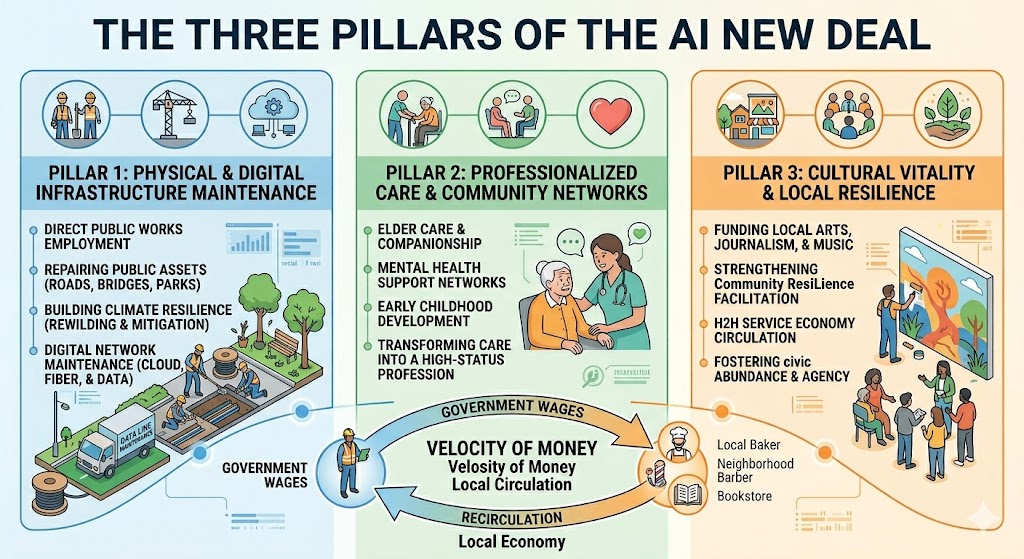
The Three Pillars of the AI New Deal

The success of the AI New Deal rests on a strategic focus on the “Un-automatable.” We must direct our collective energy toward three specific domains where human presence, judgment, and physical interaction are not just preferred, but essential for a thriving society.

Pillar 1: Physical and Digital Infrastructure

We are currently witnessing a “Tragedy of the Commons” in our physical world. Our bridges, transit systems, and power grids require more than just algorithmic optimization; they require physical intervention. The AI New Deal would mobilize a modern workforce to focus on Community Resilience — retrofitting cities for climate adaptation, urban “rewilding” to restore local ecosystems, and maintaining the physical nodes that allow our digital world to function. This work creates a tangible, high-quality public environment that serves as a shared wealth for all citizens.

Pillar 2: The Social and Care Fabric

As we automate cognitive tasks, the “Human Premium” in care becomes our most valuable asset. We are facing a global loneliness epidemic and an aging demographic that requires empathy, companionship, and nuanced psychological support. By professionalizing and scaling roles in elder care, mental health mentorship, and early childhood development, we transform these from marginalized sectors into the prestigious cornerstones of our new economy. These are roles where the goal is not “efficiency” (doing more with less time), but “effectiveness” (the quality of the human connection).

Pillar 3: Community Vitality and Cultural Resilience

In an era of AI-generated noise, local culture and verified information are at risk of erosion. The AI New Deal funds the “Civic Architects” — the local journalists, community theater directors, and public artists who document and celebrate the unique identity of a place. This pillar ensures that while our tools become more global and algorithmic, our lived experiences remain local, vibrant, and distinctly human. We aren’t just building roads; we are building the social connective tissue that prevents the isolation often triggered by rapid technological shifts.

Economic Mechanics: The Velocity of Human Connection

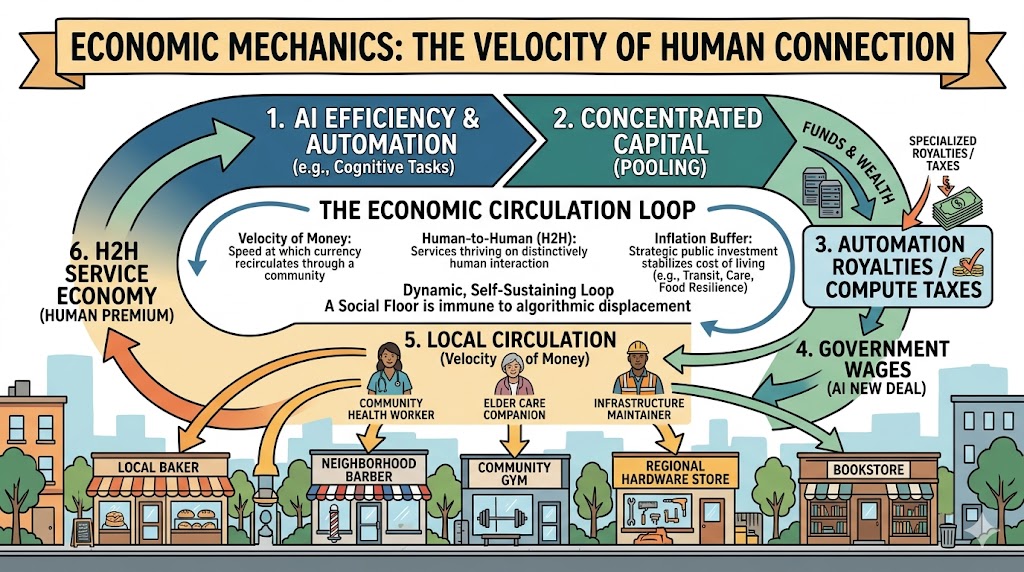
Economic Mechanics: The Velocity of Human Connection

The fiscal engine of the AI New Deal is built on a fundamental economic principle: the Velocity of Money. In a hyper-automated private sector, capital tends to pool at the top, concentrating in the hands of those who own the compute and the algorithms. Without a mechanism to pull that capital back into the hands of the many, the local economy — the shops, services, and neighborhood hubs — withers.

The Civic Dividend solves this by creating a continuous loop of circulation. When the government pays a living wage to a community health worker or a local infrastructure specialist, that income doesn’t sit idle. It is immediately recycled into the Human-to-Human (H2H) service economy. This worker buys bread from a local baker, gets a haircut from a neighborhood barber, and visits a local gym. These secondary businesses thrive precisely because their customers have earned, discretionary income to spend.

To fund this transition, we must look toward Automation Royalties or “Compute Taxes.” Rather than taxing labor — which AI is making artificially cheap — we shift the tax burden to the high-margin output of automated systems. This creates a sustainable cycle: the efficiency of AI funds the resilience of the human community.

Furthermore, the AI New Deal acts as a natural Inflation Buffer. By investing in public housing maintenance, efficient public transit, and community-led food resilience, we lower the “floor” of the cost of living. This ensures that the wages provided by the Civic Dividend maintain high purchasing power, shielding the population from the volatility of a purely algorithmic private market.

Addressing the Critics: Efficiency vs. Resilience

Critics often argue that government-led employment is inherently “inefficient” compared to the lean, optimized nature of the private sector. From the perspective of human-centered innovation, this critique misses the mark because it uses the wrong metric for success. In an AI-dominated age, social resilience is a far more valuable outcome than marginal efficiency.

The private sector’s drive for efficiency is exactly what is displacing workers. If we allow that same logic to dictate our social response, we end up with a society that is “optimized” into instability. The AI New Deal isn’t about competing with AI on speed or cost; it is about providing the stability that the private market, by its very nature, cannot offer. We are designing for systemic health, not just quarterly throughput.

Another common concern is the fear of “make-work” or a lack of individual choice. However, the AI New Deal is designed as a platform, not a cage. By providing a guaranteed social floor of meaningful work, we actually increase career mobility. When a citizen’s basic survival and dignity are secured through the Civic Dividend, they are more — not less — likely to take risks, launch their own H2H small businesses, or pursue creative endeavors in the Human Premium Renaissance.

Finally, we must recognize that this is a choice of design. We can choose to view displaced workers as a “surplus” to be managed, or we can view them as a massive, untapped reserve of human talent ready to be deployed toward the public good. The “inefficiency” of paying a human to do what an algorithm could do is only an inefficiency if you ignore the catastrophic social cost of a disengaged, impoverished populace.

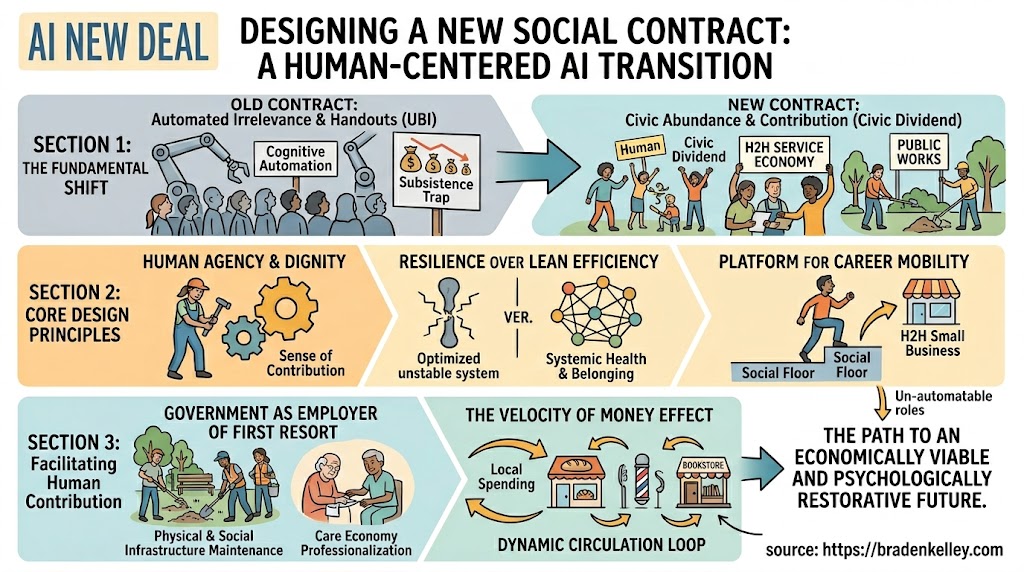
AI New Deal: Designing a New Social Contract

Conclusion: Designing a New Social Contract

We stand at a unique design crossroads in human history. The rapid advancement of artificial intelligence has presented us with a fundamental choice: do we design a future of automated irrelevance, where a vast majority of the population subsists on a dwindling digital handout, or do we design a future of civic abundance?

The AI New Deal is more than an economic policy; it is a reaffirmation of the value of human contribution. It recognizes that while technology can manage our systems, only humans can care for our communities, preserve our culture, and maintain our physical world. By moving toward a model of the Government as the Employer of First Resort, we ensure that the wealth generated by the AI revolution is directly reinvested into the human experience.

This “soft landing” requires us to be bold. We must stop asking how we will survive without the jobs of the past and start asking what kind of world we could build if we finally had the resources and the hands to do it. The Civic Dividend offers a path where technology does the “tasks” so that humans can finally do the “work” of being human—creating a society that is not just more efficient, but more resilient, more connected, and more purposeful.

The tools are in our hands, and the need is all around us. Now, we simply need the courage to sign a new contract with ourselves and build the future we actually want to live in.


Braden Kelley is a leading futurist and trusted voice in human-centered innovation and change. Stay tuned for next week’s next installment in this series on the AI Soft Landing.

Frequently Asked Questions

How is the AI New Deal different from Universal Basic Income (UBI)?

While UBI provides a passive payment regardless of activity, the AI New Deal is a “Civic Dividend” based on active contribution. It positions the government as the Employer of First Resort, paying living wages for essential public work — such as infrastructure maintenance and care services — rather than providing a handout that lacks a connection to social agency or the local service economy.

How can the government afford to become the ‘Employer of First Resort’?

The funding shifts from taxing human labor to taxing the high-margin output of automated systems, often referred to as “Automation Royalties” or “Compute Taxes.” By capturing the wealth generated by AI-driven efficiency, the state can reinvest that capital into the Human-to-Human (H2H) economy, ensuring currency continues to circulate through physical communities.

Does this mean the government is creating ‘make-work’ just to keep people busy?

No. The AI New Deal focuses on the “Un-automatable” — high-value needs that are currently neglected, such as climate resilience, elder care, and mental health support. These are not arbitrary tasks; they are the essential services required for a functional, healthy society that AI cannot perform because they require human empathy, physical presence, and contextual judgment.

EDITOR’S NOTE: This is a visualization of but one possible future. I will be publishing other possible futures as they crystallize in my mind (or as you suggest them for me to explore).

Image credits: Google Gemini

Content Authenticity Statement: The topic area, key elements to focus on, etc. were decisions made by Braden Kelley, with a little help from Google Gemini to clean up the article, add images and create infographics.

Subscribe to Human-Centered Change & Innovation WeeklySign up here to get Human-Centered Change & Innovation Weekly delivered to your inbox every week.

9 Skills That Age Well When Everything Else Automates

9 Skills That Age Well When Everything Else Automates

by Braden Kelley and Art Inteligencia


What Skills Age Well When Everything Else Automates? (Short Answer)

Nine skills that age well when everything else automates: (1) problem framing, (2) sense-making from weak signals, (3) empathy with stakes, (4) judgment under uncertainty, (5) taste and restraint, (6) facilitation across difference, (7) teaching judgment, (8) repair and recovery, and (9) meta-learning — unlearning and relearning as tools turn over. Automation absorbs search, draft, route, summarize, and first-pass options. What compounds is the human ability to ask better questions, connect meaning, hold dignity, choose with accountability, refuse the wrong elegant answer, convene conflict into progress, transfer judgment, mend what broke, and keep learning when the stack resets.

Tools expire. Skills that help humans make meaning, hold stakes, and choose under uncertainty compound.

Why Is Speed a Commodity — and Judgment a Skill That Compounds?

I have watched careers reorganize around whichever tool was loudest that quarter. First the dashboard. Then the chatbot. Then the agent. Each wave promised that fluency with the new instrument would be the scarce skill. Each wave made the instrument cheaper — and made the human capacities underneath more valuable, not less.

Soft landings are designed. Prompt fluency helps you use the tools. It is not the whole investment thesis for a human career or a learning organization. The skills that age well are portable: they travel across software generations, job titles, and industry costumes. They are also distinct from the work categories AI should free — insight, empathy, collaboration, and the rest — which I map elsewhere as endeavors to protect. Skills are how you practice those endeavors when the model is free and the calendar is still crowded.

Skill Why it ages well Costume version
1. Problem framing Answers get cheap; wrong frames still scale wrong Instant roadmaps that skip the question
2. Sense-making Summaries automate; meaning needs an owner Dashboard tourism; more slides, no insight
3. Empathy with stakes Synthetic personas scale; lived dignity does not Tone guidelines without contact
4. Judgment under uncertainty Options generate; accountability does not “The system decided”
5. Taste and restraint Generation floods; refusal becomes scarce Ship because you can
6. Facilitation across difference Notes automate; trust across conflict does not Standups without decisions
7. Teaching judgment How-tos are infinite; transfer is relational Completions mistaken for capability
8. Repair and recovery Failure modes multiply; recovery needs a human Apology scripts without power to fix
9. Meta-learning Tools churn; unlearning compounds One certification as a career

1. Why Does Problem Framing Age Well?

The skill: Naming the right problem, constraints, and stakes before freezing solutions.

Why it ages well: Models generate answers at volume. Wrong frames still produce wrong speed — only faster.

Costume: Instant roadmaps and “solutions” that skip the question entirely.

Practice: One crisp problem statement owned before ideation. Kill ideas that solve a different problem, even when the demo is gorgeous.

2. Why Is Sense-Making a Skill That Compounds?

The skill: Turning noise, fragments, and conflicting data into a point of view someone can act on.

Why it ages well: Summaries get cheap. Meaning still requires a human who will stand behind it.

Costume: Dashboard tourism — more slides, no insight.

Practice: Contiguous time to connect. Treat insight as a named deliverable, not a side effect of more output. For the work AI should free so this skill can grow, see 11 Human Endeavors AI Should Free (Not Replace).

3. What Is Empathy With Stakes — and Why Does It Age Well?

The skill: Understanding what a situation costs a real person — friction, fear, shame, power — not only what they click.

Why it ages well: Synthetic personas and sentiment tags scale. Lived stakes do not.

Costume: Empathy theater; tone guidelines without contact or recovery power.

Practice: Field contact. Ask what almost stopped them. Design for dignity, not only conversion.

4. Why Does Judgment Under Uncertainty Outlast Automation?

The skill: Deciding with incomplete information, naming tradeoffs, and remaining accountable for why.

Why it ages well: Options generate easily. Ownership of consequences does not automate.

Costume: Rubber-stamp approvals; “the system decided.”

Practice: Explicit decision rights. Undo. A human who can be asked why after the choice. Soft landings keep judgment human-accountable — see The AI Soft Landing.

5. Why Do Taste and Restraint Become Scarcer as Generation Gets Cheap?

The skill: Aesthetic, ethical, and strategic discernment — elegance that refuses the wrong elegant answer.

Why it ages well: Generation floods the zone. Curation and refusal become scarce.

Costume: Infinite variants; ship because you can.

Practice: Written “will not build” lists. Kill criteria. Quality standards that survive demos.

6. Why Does Facilitation Across Difference Still Matter?

The skill: Convening people with unequal power, incentives, and worldviews into a workable next step.

Why it ages well: Meeting notes and transcripts automate. Trust across difference does not.

Costume: Standups without decisions; collaboration theater.

Practice: Named outcomes for every convening. Surface winners and losers. Protect dissent.

7. Why Is Teaching Judgment a Skill That Multiplies?

The skill: Coaching others to frame, choose, and recover — multiplying capability beyond your own output.

Why it ages well: How-to content is infinite. Judgment transfer still requires a human relationship.

Costume: Training completions; prompt cheat sheets mistaken for capability.

Practice: Apprenticeship moments. Co-decide, then debrief. Measure behavior change in others — not video minutes. For related innovation practice, see 9 Habits of Human-Centered Innovators That Still Matter in the Age of AI.

8. Why Does Repair and Recovery Age Well as Automation Scales?

The skill: Restoring dignity and function when something breaks — for customers, colleagues, and communities.

Why it ages well: Failure modes multiply with automation. Recovery still needs a human who can own the seam.

Costume: Scripted apologies without power to fix.

Practice: Recovery authority. Close loops from incident to redesign. Practice after-action honesty. For org signals that shrink this skill while celebrating AI, see 8 Signals You’re Preparing for the Wrong Future of Work.

9. What Is Meta-Learning — and Why Does It Outlast Every Tool Wave?

The skill: Updating mental models, discarding obsolete craft, and acquiring new practice without identity collapse.

Why it ages well: Tools turn over. Learning agility compounds across every wave.

Costume: One certification as a career; “keeping up” as anxiety without depth.

Practice: Deliberate unlearning. Spaced practice. Reflect on what the last tool made you stop noticing — then reclaim it.

How Do You Check Skill Investment — for Yourself and Your Organization?

Before the next AI training push or hiring freeze, run five questions. If you cannot answer them, you may be funding tool fluency while starving the skills that compound:

  1. Which of the nine are we hiring and promoting for — not only prompt fluency?
  2. Where does contiguous time exist to practice sense-making and judgment?
  3. Who is rewarded for restraint and repair — not only volume?
  4. How do we teach judgment — not only tasks?
  5. What are we deliberately unlearning this quarter?

Don’t race the model on speed. Invest in skills that still matter when the model is free.

Frequently Asked Questions

What skills will still matter with AI?

Skills that still matter with AI include problem framing, sense-making, empathy with stakes, judgment under uncertainty, taste and restraint, facilitation across difference, teaching judgment, repair and recovery, and meta-learning. These compound as automation absorbs draft, search, and routine options.

What human skills age well with automation?

Human skills that age well with automation are portable capacities that help people make meaning, hold dignity, choose with accountability, refuse the wrong elegant answer, convene conflict into progress, transfer judgment, mend failure, and keep learning when tools reset — not only fluency with the current model.

Should I learn prompting or soft skills?

Learn both — but do not confuse them. Prompting helps you use tools. Soft skills that age well — framing, judgment, empathy with stakes, facilitation, teaching, repair, meta-learning — are what remain valuable when prompting itself becomes cheaper and more automated. Invest in both without treating prompts as a career strategy.

How do you develop judgment skills?

Develop judgment by practicing decisions with incomplete information, naming tradeoffs out loud, keeping decision rights explicit, reviewing outcomes with after-action honesty, and coaching others through co-decide-and-debrief cycles. Judgment grows with accountable practice — not with more option generation alone.

What skills should companies invest in as AI automates work?

Companies should invest in hiring, promoting, and giving contiguous time for problem framing, sense-making, empathy with stakes, judgment, taste and restraint, facilitation, teaching judgment, repair, and meta-learning — alongside tool training. If only volume and prompt fluency are rewarded, the skills that age well atrophy.

Image credits: Pixabay

Content Authenticity Statement: The topic area, key elements to focus on, etc. were decisions made by Braden Kelley, with a little help from Google Gemini and Cursor to clean up the article, add images and create infographics.

Subscribe to Human-Centered Change & Innovation WeeklySign up here to get Human-Centered Change & Innovation Weekly delivered to your inbox every week.

Top Futurist Sees Major Healthcare Disruption Ahead

Top Futurist Sees Major Healthcare Disruption Ahead

GUEST POST from Robert B. Tucker

The future of healthcare is not coming, it is already here. And according to Delphi Group CEO Thomas Koulopoulos, it is unfolding far faster than most traditional providers are prepared to handle.

In a recent conversation in Harvard’s Science Center, Koulopoulos laid out a stark and compelling vision: healthcare is on the verge of being fundamentally restructured. It’s not being restructured by hospitals or insurers, but by technology, data, and a radical shift in who (or what) patients trust.

At the center of his prognosis is a simple but often overlooked truth about innovation. “We tend to focus on the product,” he explains. “The iPhone, the app, the device. But what actually drives innovation is process.” In healthcare, those processes are deeply entrenched, fragmented systems, outdated workflows, and institutional inertia that slow everything down. That is precisely why disruption is not only inevitable, but imminent.

Koulopoulos is not speaking theoretically. These days, he works across a handful of advisory and consulting roles, roughly seven or eight at any given time, many of them at the intersection of artificial intelligence and healthcare transformation. Nearly every engagement involves rethinking how care is delivered, not just improving it incrementally. The work is intensely process-centric, but the outcomes are tangible: new services, new delivery models, and entirely new ways of interacting with patients.

What has changed most dramatically, he notes, is healthcare’s willingness to look outside itself. A decade ago, a non-clinician advising healthcare systems would have been dismissed. Today, that openness reflects something deeper: a recognition that the biggest threat to healthcare is not internal inefficiency—it is external disruption.

“Amazon, Apple, Google, Meta, they all want to own your healthcare,” Koulopoulos says. “And in some ways, they are already doing a better job.”

That statement may sound provocative, but the evidence is increasingly hard to ignore. Patients are arriving at doctor visits armed with data from wearables, AI-generated analyses of lab results, and a level of insight that would have been unthinkable just a few years ago. In one recent example, Koulopoulos brought AI-driven health insights into a routine appointment. His physician was stunned—not just by the quality of the analysis, but by the depth of the conversation it enabled.

That interaction, he believes, is a preview of what comes next. Within a very short timeframe, measured in years, not decades, patients will increasingly turn to AI as their first point of consultation. Trust, particularly among younger generations, is already shifting in that direction. While older patients may hesitate, younger ones see not just the current limitations of AI, but its trajectory. They understand that what is imperfect today will improve rapidly—and they are willing to bet on that curve.

But the real disruption goes far beyond diagnostics. It strikes at the core structural weakness of healthcare systems worldwide: the absence of continuity.

“Ask yourself a simple question,” Koulopoulos says. “Could you pull together your entire medical history from the past ten years in five minutes?” For most people, the answer is no. Records are scattered across providers, insurers, pharmacies, and systems that rarely communicate with one another. The result is inefficiency at best—and dangerous fragmentation at worst.

The solution he envisions is what he calls the “digital advocate,” a personal, AI-powered twin that holds a complete, longitudinal record of your health. This is not a distant concept. Koulopoulos already maintains such a system for himself, integrating years of medical data into a single, accessible interface that allows him to analyze trends, question anomalies, and make informed decisions in real time.

In this model, the patient (not the provider) becomes the central node in the healthcare ecosystem. The digital advocate does not operate in silos; it integrates everything, from lab results to imaging to behavioral patterns. It can speak for you, guide you, and coordinate your care. In aging populations, it may even serve as a surrogate voice when patients can no longer advocate for themselves.

This shift has profound implications. It effectively leapfrogs the existing system rather than attempting to fix it incrementally. And it introduces a new kind of intelligence into healthcare—one that is continuous, personalized, and deeply contextual.

The healthcare system is already in shock

At the same time, Koulopoulos and other healthcare futurists point to another overlooked force of disruption: the tortured economics of healthcare, and globally, not just in the US. The entire system is in cardiac arrest.

“Hospitals have essentially never recovered from the multiple shocks of COVID,” observes futurist Langdon Morris. “The entire delivery chain was so massively disrupted that it has not recovered. And the non-recovery threatens to bankrupt many hospitals, which would in many cases be disastrous for the communities they serve.” Disruptive companies are coming fast for all the incumbents in all markets, and the future winners in many markets will be the ones who do the best job of integration. “The days of standalone technology are finished,” Morris believes. We expect a major disruption in the supplier ecosystem.

The demand for healthcare in the future will diminish, according to forecasters. Advances in treatment may turn diseases like cancer into manageable chronic conditions rather than acute crises. Autonomous vehicles, longer term, could dramatically reduce accident-related injuries, a major source of emergency room visits. Each of these shifts erodes the volume-based economics that underpin much of today’s healthcare infrastructure.

The result? “Traditional providers are going to be in a world of pain,” Koulopoulos says bluntly.

Yet the greatest obstacle to transformation may not be technological, it is cultural. Organizations cling to what has worked in the past, even as the ground shifts beneath them. The pattern is familiar. Kodak protected film. Blockbuster protected brick-and-mortar stores. Healthcare providers risk protecting legacy systems at the expense of future relevance.

So what should healthcare leaders do?

In our interview, Koulopoulos was clear: start by building internal capability to understand and apply these technologies. That means not just experimenting with AI, but actively integrating it into clinical workflows—everything from “ambient listening” during patient visits to AI-assisted communication that translates complex diagnoses into understandable, actionable language.

Equally important is embracing the broader ecosystem. Patients are already using wearables, at-home diagnostics, and digital tools that operate outside traditional systems. Providers can either ignore these inputs, or integrate them into a more holistic model of care.

The competitive threat is not theoretical. In one case, Koulopoulos compared a hospital-based sleep study, typically requiring weeks of waiting and multiple appointments, to an at-home diagnostic device that delivered equivalent results in 72 hours. The question he posed to the provider was simple: how do you compete with that?

There was no easy answer.

Ultimately, the future of healthcare will not be defined by any single breakthrough, but by the convergence of technologies, processes, and shifting expectations. Patients will navigate an ecosystem of options, choosing convenience and speed alongside quality. Providers who resist this shift will find themselves increasingly marginalized.

Those who adapt, however, have an opportunity to redefine their role, not as gatekeepers of care, but as orchestrators within a dynamic, patient-centered system.

Koulopoulos sees that future clearly. The question is whether the rest of the industry is willing to see it, and act, before it is too late.

This article originally appeared in Forbes

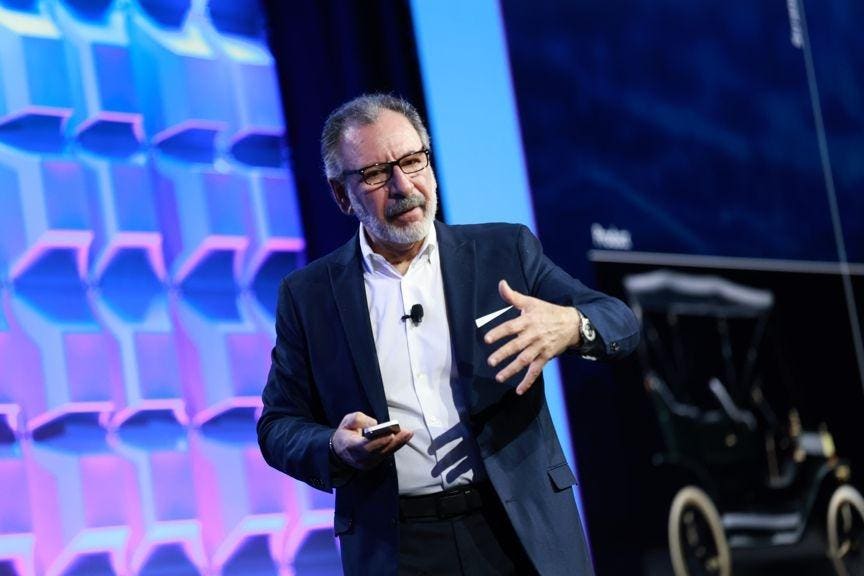
Image credit: The Delphi Group

Subscribe to Human-Centered Change & Innovation WeeklySign up here to get Human-Centered Change & Innovation Weekly delivered to your inbox every week.

We Must Think Less Like Engineers and More Like Gardeners

We Must Think Less Like Engineers and More Like Gardeners

GUEST POST from Greg Satell

In February, 1919, the famous philosopher Bertrand Russell received a card from his former student, Ludwig Wittgenstein, who was at that time in an Italian prison camp. “I’ve written a book which will be published as soon as I get home,” he would say in subsequent correspondence. “I think I’ve solved our problems finally.”

The “problems” he spoke of had to do with a foundational crisis in mathematics and logic that defied the efforts of the world’s greatest minds. The book, Tractatus Logico-Philosophicus, was an attempt to engineer a perfectly logical language from first principles. It would become enormously influential, leading to the Vienna Circle and the logical positivist movement of the 1920s.

Yet Wittgenstein would later disown the idea and it was, in the end, found to be unworkable. There are limits to what we can engineer. The world is a messy place. Rules inevitably have exceptions, which is why every system will always crash. That’s why we need to think less like engineers making machines and more like gardeners that grow and nurture ecosystems.

The Death of the Secular Gods

The problems Russell and Wittgenstein were working on were part of a larger paradigm shift. By the late 19th century, many intellectuals had begun to question ideas passed down from the ancient Greeks, such as Aristotle’s Logic, Euclid’s geometry and the miasma theory in medicine, overturning two thousand years of conventional wisdom.

It’s hard to overstate the seismic shift that this represented. Aristotle’s use of the syllogism, in which conclusions necessarily followed premises, Euclid’s postulate that parallel lines never intersect and Hippocrates theory that bad air causes disease, were considered to be the basic foundations upon which western thought was predicated.

Yet as human knowledge advanced, people began to see flaws in these precepts. Strange paradoxes called Aristotle’s logic into question. Mathematicians like Gauss, Lobachevsky, Bolyai and Riemann began to imagine curved spaces in which parallel lines did, in fact, intersect and scientists such as Robert Koch, Joseph Lister and Louis Pasteur established the germ theory of disease.

These would be, practically speaking, incredibly positive developments. The rise of non-Euclidean geometry made Einstein’s general theory of relativity possible and the germ theory of disease paved the way for antibiotics and much longer lifespans. Yet they created an unwarranted optimism about what the human mind could achieve.

A New Religion

In the early 20th century, science and technology emerged as a rising force in western society. The new wonders of electricity, automobiles and telecommunication were quickly shaping how people lived, worked and thought. Physicists like Einstein and Bohr became celebrities. It seemed that there was nothing that scientific precision couldn’t achieve.

It was against this backdrop that Moritz Schlick formed the Vienna Circle, which became the center of the logical positivist movement and throughout the 20’s and 30’s. At its core was Wittgenstein’s theory of atomic facts, the idea that the world could be reduced to a set of statements that could be verified as being true or false—no opinions or speculation allowed. Those statements, in turn, would be governed by a set of logical algorithms which would determine the validity of any argument.

Yet even as this logical movement was growing, the foundational crisis in logic continued. To solve the problem, David Hilbert the greatest mathematician of the era, proposed a program to solve the crisis that rested on three pillars. First, mathematics needed to be shown to be complete in that it worked for all statements. Second, mathematics needed to be shown to be consistent, no contradictions or paradoxes allowed. Finally, all statements need to be computable, meaning they yielded a clear answer.

Then things took a surprising turn. A young logician named Kurt Gödel would prove that every logical system is flawed with contradictions. Alan Turing would show that all numbers are not computable. The Einstein-Bohr debates would be resolved in Bohr’s favor, destroying Einstein’s vision of an objective physical reality and leaving us with an uncertain universe.

The Rise Of Faux Scientists

The verdict was in. Facts could never be absolutely verifiable, but would stand until they could be falsified. We could, after thorough testing, increase our confidence, but never be completely sure. Ironically, the demise of logic led directly to the era of digital computing and a new, technological age. Just as we learned that systems would always be fallible, the machines we built became unimaginably powerful.

At the same time, human agency was increasingly called into question. It was, after all, subjective judgements that led to the Great Depression of the 1930s and the enormous wars that followed it. As the Baby Boomers came of age in the 1960s, it seemed like everything was up for debate. All of the fuzziness and uncertainty of relying on human judgment increasingly seemed impractical.

Much like Wittgenstein and the Vienna Circle, a number of thinkers sought to engineer systems that would harness natural forces to create better outcomes. The Austrian School of economics eschewed government regulation in favor of consumer preferences. Neorealism in foreign relations argued that competition and conflict could govern that international order.

Yet unlike the original logical positivists, these ideas wouldn’t stay confined to academia, but would seep into the affairs of everyday people. The consumer welfare standard insisted that market price signals, not government bureaucrats, would decide if a transaction should be permitted, while the principle of shareholder value demanded that the stock market, not managers, should govern business decisions.

The results are clear. Too little antitrust regulation has increased concentration in the vast majority of American industries and strangled competition, which has decreased business dynamism and lowered productivity. Our economy has become markedly less productive, less competitive and less dynamic. Purchasing power for most people has stagnated. By just about every metric, we’re worse off.

We Need To Manage Ecosystems, Not Machines

We like to think of ourselves as rational actors, weighing each piece of evidence before making a decision. Yet our brains don’t work like that. We build up our perspectives through synapses in our brain and through our social networks, which form complex webs of influence. Once we adopt a point of view, we rarely adapt it to new evidence.

Engineers believe in laws that can be understood and put to specific use, so they build machines to perform specific tasks. Gardeners believe in complexity and emergence. They don’t design their garden as much as tend to it, nurture it and support its surrounding ecosystem. They don’t expect the same results every time, but understand they will need to adjust their approach as they go.

We need to think less like engineers and more like gardeners. For most important purposes, we manage ecosystems, not machines. We need to think more in terms of networks that grow and less in terms of nodes whose behavior we can predict and control. Our success or failure depends less on individual entities than the connections between them.

In a world driven by networks and ecosystems, we can no longer treat strategy as if it were a game of chess, planning out each move with near perfect precision and foresight. The task of leadership is to make decisions with full knowledge that many will be wrong and that you will need to make them right.

There’s no system to do that for us, no impersonal forces that will point the way. In the end, we have to put trust in ourselves. There isn’t anyone else.

— Article courtesy of the Digital Tonto blog
— Image credit: Google Gemini

Subscribe to Human-Centered Change & Innovation WeeklySign up here to join 17,000+ leaders getting Human-Centered Change & Innovation Weekly delivered to their inbox every week.

5 Scenarios for Agentic Organizations

And What Leaders Must Own in Each

5 Scenarios for Agentic Organizations

by Braden Kelley and Chateau G Pato


What Must Leaders Own in Agentic Organizations? (Short Answer)

Five scenarios for agentic organizations — and what leaders must own in each: (1) Agentic Front Door — customer-acting agents; leaders own consent, undo, escalation, and brand accountability. (2) Agentic Operating Model — work-orchestrating agents; leaders own fairness, EX, and who gets meaningful work. (3) Agentic Decision Systems — agents that approve or choose within policy; leaders own decision rights, undo, and who can be asked why. (4) Agentic Innovation & Change — agents that accelerate experiments; leaders own problem framing, kill criteria, and adoption. (5) Agentic Ecosystem — agents that act across vendors and partners; leaders own seam promises, liability, and recovery across the handoff.

An agentic organization authorizes AI systems to act — route, refund, rebook, assign, escalate, negotiate, trigger workflows — not only to chat or recommend. Autonomy for the model is not a strategy. Ownership for the human who can still be held to account is.

Why Don’t Agents Automate Ownership?

I have watched rooms celebrate “agentic” the way they once celebrated sticky notes and digital transformation: as if naming the technology were the same as designing the landing.

Agents that act are a different animal from chatbots that reply. They refund. They rebook. They assign work. They approve inside a band. They negotiate across a seam. That is not a UX upgrade. It is a transfer of authority — and authority without designed ownership is a hard landing waiting for a Tuesday.

Soft landings are designed. In every agentic scenario, something remains non-delegable: consent, mandate, accountability, fairness, and the promise the brand will still keep when the agent gets it wrong.

Scenario Agents do Leaders must own
1. Agentic Front Door Act for customers (refund, rebook, route) Consent, undo, escalation, brand accountability
2. Agentic Operating Model Orchestrate internal work Fairness, EX, judgment time, meaningful work
3. Agentic Decision Systems Approve or choose inside policy bands Decision rights, why on Tuesday, undo/appeal
4. Agentic Innovation & Change Accelerate drafts, demos, pilots Problem frame, kill criteria, adoption owners
5. Agentic Ecosystem Act across vendors and partners Seam ownership, liability, cross-entity recovery

1. What Must Leaders Own in an Agentic Front Door Scenario?

The scenario: The primary customer path is an agent that does — refund, reschedule, rebook, update, route — not a FAQ that chats. Multi-step journey work moves at machine speed.

Agents do: Execute customer intent across systems without waiting for a ticket to crawl through three departments.

Hard landing: Autonomy without consent, undo, or human handoff. Containment becomes the KPI. The brand is optimized; dignity is optional. Customers are trapped in loops that photograph well in the steering committee.

Leaders must own: Clarity of what the agent may do; competence thresholds before it acts; customer control to stop, reverse, and escalate; care at the moment of failure; a named human recovery path. Soft landing is delegated action with a trust contract — not a cheaper call-center costume. For the customer trust design behind this scenario, see When AI Agents Act on Your Behalf: Designing Agentic Customer Experience That Earns Trust.

2. What Must Leaders Own When Agents Orchestrate the Operating Model?

The scenario: Internal work is assigned, scheduled, triaged, and progressed by agents across tickets, cases, and handoffs. Glue shrinks. Throughput rises. The calendar looks free — until it does not.

Agents do: Route, prioritize, draft, chase, and assemble the next step so humans spend fewer hours on fragmentation.

Hard landing: Humans become faster exception handlers. Saved minutes refill with denser interruptions. “Efficiency” strips judgment time and frontline agency. People become the leftover of automation — not the point of it.

Leaders must own: What work agents absorb versus what humans keep; protected contiguous time for judgment; employee experience as a design constraint, not a wellness poster; fairness in routing (who gets the grind, who gets growth); metrics that name human success, not only cycle-time vanity. Soft landing means glue automated, meaning kept. For the designed split of human versus machine work, read The AI Soft Landing.

3. What Must Leaders Own in Agentic Decision Systems?

The scenario: Agents approve, deny, price, allocate, or recommend within policy bands — finance, risk, access, offers, exceptions. High-volume choices move without a meeting. Edge cases escalate — in theory.

Agents do: Decide inside declared rules at a speed no committee can match.

Hard landing: Humans as rubber stamps. Unowned model choices. “The system decided” as a career-safe shrug. No undo when the band was wrong — and nobody left who can be asked why on Tuesday.

Leaders must own: Explicit decision rights (what the agent may decide alone); auditability so a human can reconstruct the choice; undo and appeal; a named person accountable for outcomes, not only for “the model’s accuracy”; the mandate to narrow or widen the band when reality contradicts the policy. Soft landing is speed with someone who can still be held to account.

4. What Must Leaders Own When Agents Accelerate Innovation and Change?

The scenario: Agents draft personas, roadmaps, prototypes, pilots, and change artifacts before lunch. Innovation velocity looks historic. The room fills with demos.

Agents do: Generate options, simulate, document, and accelerate demo day until the portfolio looks busy.

Hard landing: Faster wrong. Synthetic empathy. Pilots without mandate. Adoption theater. Innovation cosplay at higher RPM — more output, less impact that lands on Tuesday.

Leaders must own: Problem framing before acceleration; match of method to decision rights; behavior falsification (not applause demos); kill criteria with social permission to stop; adoption owners after the markers dry. Soft landing means agents own the draft; humans own the design and the landing. For habits that protect this ownership, see 9 Habits of Human-Centered Innovators That Still Matter in the Age of AI.

5. What Must Leaders Own in an Agentic Ecosystem Scenario?

The scenario: Agents representing the company, customer, and partners negotiate, book, fulfill, and escalate across organizational boundaries. Email chains and war rooms shrink. Multi-entity orchestration becomes normal.

Agents do: Cross the seam that used to require humans with calendars, contracts, and courage.

Hard landing: Orphan seams. “Not our agent” blame. Liability that lives nowhere. A brand promise broken between two green systems — each vendor’s SLA fine, the customer’s Tuesday ruined.

Leaders must own: Who owns the seam when agents disagree; contractual and ethical boundaries for partner agents; recovery power that spans entities; customer-visible accountability when the multi-agent path fails; stop conditions when optimization conflicts with dignity. Soft landing is multi-agent speed with a single human promise that still holds.

How Do Leaders Check Ownership Before an Agentic Investment?

Before the next agentic program, run five go/no-go questions. If you cannot answer them, you are buying autonomy without a landing:

  1. Where will the agent act — not only chat or recommend?
  2. Who owns consent, undo, and escalation in that scenario?
  3. What human work are we freeing — and what contiguous time will we protect for judgment?
  4. Who can be asked why when the agent chooses?
  5. Who owns the seam when agents cross teams or partners?

For the work humans should keep when glue shrinks, see 11 Human Endeavors AI Should Free (Not Replace). For how the agentic enterprise pitch lands soft or hard, read 10 Futures Being Pitched in 2026 — Soft Landing vs Hard Landing. For signals you are preparing for the wrong future, use 8 Signals You’re Preparing for the Wrong Future of Work.

Agents can own the action. Leaders own the landing — consent, mandate, accountability, fairness, and the promise after failure.

Frequently Asked Questions

What is an agentic organization?

An agentic organization authorizes AI systems to act — route, refund, rebook, assign, escalate, negotiate, and trigger workflows — not only to chat or recommend. It is an operating model with non-human actors holding authority, which makes designed human ownership of consent, mandate, accountability, and recovery essential.

What must leaders own in an agentic enterprise?

Leaders must own what agents cannot: consent, undo, and escalation at the front door; fairness and judgment time in the operating model; decision rights and accountability when agents choose; problem framing, kill criteria, and adoption in innovation; and seam ownership, liability, and recovery when agents act across partners.

What are scenarios for agentic AI in organizations?

Five common scenarios: agentic front door (customer-acting agents), agentic operating model (work orchestration), agentic decision systems (approvals inside policy bands), agentic innovation and change (accelerated bets and artifacts), and agentic ecosystem (cross-vendor and partner action). Each needs a different leadership ownership list.

How do you avoid a hard landing with AI agents?

Design the landing before you scale autonomy. Name where agents will act, who owns consent and undo, what human work you are freeing and protecting, who can be asked why when the agent chooses, and who owns the seam across teams or partners. Autonomy without ownership is a hard landing on Tuesday.

What is the difference between agentic CX and an agentic organization?

Agentic CX focuses on customer-facing agents that act on a customer’s behalf — and the trust contract of clarity, competence, control, and care. An agentic organization is broader: agents also orchestrate internal work, decide inside policy, accelerate innovation, and act across partner ecosystems. CX is one scenario; the organization has five places where leaders must own the landing.

Image credits: Cursor

Content Authenticity Statement: The topic area, key elements to focus on, etc. were decisions made by Braden Kelley, with a little help from Google Gemini and Cursor to clean up the article, add images and create infographics.

Subscribe to Human-Centered Change & Innovation WeeklySign up here to get Human-Centered Change & Innovation Weekly delivered to your inbox every week.

Winning with Artificial Intelligence in 90 Days

Winning with Artificial Intelligence in 90 Days

Exclusive Interview with Charlene Li

The rapid evolution of artificial intelligence (AI) has shifted the technology from a futuristic curiosity to the primary engine of modern organizational growth. In an era defined by data-driven decision-making, the ability to effectively harness machine learning and predictive analytics is no longer just a competitive advantage; it is a fundamental requirement for long-term viability. However, the path to integration is rarely linear. Many organizations find themselves caught between the urgent need for transformation and the daunting reality of legacy infrastructure, talent shortages, and the cultural shifts required to move beyond small-scale pilots toward true enterprise-wide intelligence.

While the potential for increased efficiency and innovation is clear, the execution remains a significant hurdle.

The organizations that thrive in this new landscape are those that treat AI as a core strategic pillar rather than a plug-and-play software update. This requires a rethink of how human talent and machine intelligence coexist, ensuring that the technology enhances human capability rather than simply automating existing inefficiencies. Overcoming these challenges involves not just technical prowess, but a disciplined approach to change management and a clear vision for how intelligence will redefine the value the organization provides to its customers.

Today we will dive deep into what it takes to quickly achieve success with artificial intelligence with our special guest.

Creating a 90-Day Blueprint to Win with Artificial Intelligence

Charlene LiI recently had the opportunity to interview Charlene Li, a New York Times bestselling author, keynote speaker, and AI transformation strategist. Her latest book, Winning with AI: The 90-Day Blueprint for Success, co-authored with Dr. Katia Walsh, gives senior leaders a practical framework for moving from AI experimentation to measurable business value. Her prior books include The Disruption Mindset, Open Leadership, and Groundswell. Fast Company named her one of the most creative people in business, and she has worked with global organizations including 14 of the Dow Jones Industrial 30 companies. She is the founder of Altimeter Group (acquired by Prophet) and currently leads Quantum Networks Group.

Below is the text of my interview with Charlene and a preview of the kinds of insights you’ll find in Winning with AI: The 90-Day Blueprint for Success presented in a Q&A format:

1. What confusion is being created by speaking of “AI” as one thing when there are different kinds of AI, and how does this hold back AI adoption?

When people say “AI,” they’re usually thinking ChatGPT. But ChatGPT is generative AI — and that’s just one of three types of AI showing up in business today. There’s also predictive AI, which has been quietly running in your CRM, your fraud detection, and your streaming recommendations for years. And there’s agentic AI, which takes autonomous action toward a goal rather than waiting for a prompt.

The Oracle (predictive), the Creator (generative), and the Agent (agentic) — that’s how Katia and I describe them in Winning with AI. They do fundamentally different things, and they require fundamentally different things from you.

The conflation matters because it leads to bad decisions. Leaders see a generative AI demo, get excited, and ask their teams to “do something with AI” — when the actual business problem might be better solved with predictive AI (and probably already could’ve been three years ago). Or they hear “agentic AI” and assume their organization is ready to deploy autonomous agents when they haven’t even gotten generative AI into their workforce yet.

The winners aren’t choosing among types — they’re using all three strategically, in combination. A customer care transformation might use predictive AI to route inquiries, generative AI to draft responses, and agentic AI to handle routine cases autonomously. Once you can see the three distinctly, the question stops being “what can I do with AI?” and starts being “what can AI do for me?” That’s the question that actually unlocks value.

2. What are some of the key characteristics of AI inertia and some of the best ways to break free?

We call it pilot purgatory — and almost every organization we work with is stuck there. The signs are easy to spot: dozens of disconnected pilots, lots of conference attendance, lots of slide decks, no measurable financial impact. An MIT study found 95% of AI initiatives fail to scale. That’s not a technology failure. It’s a failure of leadership and culture.

The classic characteristics:

    • Use cases as a strategy. Many use cases equals procrastination. A long list of pilots is how organizations look busy without committing to anything.
    • Diffused accountability. When the CIO, CFO, and CMO all “share” responsibility for AI, no one owns the outcome.
    • Waiting for the foundation to be perfect. Clean data, the right platform, the perfect org structure — these become reasons to delay rather than constraints to solve through.
    • Confusing motion with progress. Running pilots feels like progress. It isn’t, unless those pilots are tied to your most important business problems.

To break free: pick your biggest strategic problems, figure out how AI solves them, invest heavily in those solutions, and move with urgency. Appoint one AI value owner who lives, breathes, and dreams AI outcomes. Kill pilots that aren’t on a path to scale. And replace “fail fast” with “learn fast” — nobody actually rewards failure, and the language of failure lets people walk away from things that should be pushed through.
Speed is the new moat. The companies that win aren’t the ones with the best technology. They’re the ones that adapt faster than their competitors.

3. There are still a lot of people out there not using AI (or not realizing that they are). What are some of the best ways for people to get started with AI?

Most people are already using AI — every spam filter, every Google Maps route, every recommendation on a streaming service is AI. So the real question is: how do you get started with the kind of AI that’s reshaping work right now, which is generative AI?

My advice is genuinely simple. Pick one of the major tools — Claude, ChatGPT, Gemini, Copilot — and start using it for one real task you do every week. Not a toy task. A real one. Drafting an email. Prepping for a meeting. Summarizing a long document. Brainstorming an approach to a problem you’re stuck on.

Two practical tips that make a big difference:

Write better prompts. A good prompt has a role (“Act as a marketing strategist”), instructions (what you want done), context (the background the AI needs), and an output format (memo, table, slide outline). Then refine through dialogue. Most people give AI two sentences and judge it on the result. Give it two paragraphs and you’ll be amazed.

Try the flipped interaction. Instead of asking AI for an answer, ask it to ask you questions until it has enough context to give a good answer. For example, at the end of a prompt, add this sentence: “Ask me any clarifying questions you may have.” It turns your prompt into a conversation.

I think of AI fluency as learning to eat with chopsticks: at first you’re concentrating on every motion, and eventually it’s just how you eat. You won’t get there by reading about it. You get there by using it. Every day. On real work.

4. Does AI safety really matter? It seems like all of the major AI players are just focused on speed and getting to AGI before China, am I wrong?

You’re not wrong about what the AI players are doing. But you’re probably not playing that game – more on that below. First, I’d push back on the framing that safety and speed are opposites.

Think of Formula 1. The drivers who win championships have absolute confidence in their brakes, their crash structures, their fire suppression systems. That’s why they can push so hard on speed. Safety is what makes speed possible. The companies moving fastest on AI adoption aren’t the ones cutting corners on responsibility — they’re the ones with the highest ethical standards, because trust eliminates friction. When your team knows where the guardrails are, when your customers trust your intentions, when your board has confidence in your approach, you can move at the speed AI demands.

The 2024 Edelman Trust Barometer found that 43% of people would reject AI in products and services if they don’t believe the innovation has been thoroughly scrutinized. That’s not a PR problem — it’s a revenue and competitive position problem.

On the AGI race specifically, the geopolitical framing oversimplifies what’s actually a much more textured conversation about how AI is deployed within companies, governments, and communities. Most leaders I work with aren’t worrying about AGI — they’re worrying about whether their AI customer service tool is treating customers fairly, whether their AI-driven hiring screen is introducing bias, and whether their data is being used in ways customers didn’t consent to. Those are the safety questions that matter for the next five years, regardless of what the frontier players are doing.

5. Where is the government being too hands off with AI and its impacts, and what conversations should governments and societies be having about AI and its impacts that they’re not?

I’ll be careful here because I’m not a policy person — I work with the leaders implementing AI inside organizations. But from that vantage point, a few things stand out.

The conversation we aren’t having enough is about workforce transition. Not “will AI take jobs” — we’ve been arguing about that abstractly for three years. The real question is what happens to the millions of people whose roles will substantially change in the next five years, and who’s responsible for helping them adapt. Right now, that’s mostly being left to individual employers, and the gap between what enlightened employers are doing and what the median employer is doing is enormous. That gap will become a societal problem long before regulators catch up.

The second underdiscussed conversation is about education. We’re training a generation of students with curricula designed for a pre-AI world. By the time we figure out what AI fluency looks like in K–12, the kids who needed it most will be in the workforce.

Third — and this is where I’d actually like to see governments lean in more — is data. Most AI regulation focuses on the models. The leverage is in the data: who owns it, how it can be used, what consent looks like in a world where data collected for one purpose can be repurposed for AI training that wasn’t imagined when it was collected.

That said, regulations always lag technology. Anchoring your responsible and ethical AI policy in your organization’s values rather than waiting for rules is the right move, regardless of what governments do.

6. What are the key pillars that form the basis of a strong AI foundation for those who seek to take full advantage of AI in their organization?

In Winning with AI, Katia and I lay out four building blocks. They develop together, not sequentially.

Mindset — the cultural ability to move at AI’s speed. Speed, focus, customer-centricity, experimentation, and learning from setbacks rather than treating them as evidence that the technology doesn’t work. Without the right mindset, you can have the best tools in the world, and they’ll sit unused.

Skillset — AI fluency across the workforce, not just in IT. Everyone needs to understand what AI can and can’t do, how to use it responsibly, and how to apply it to their actual work.

Toolset — the technical foundation. We tell leaders to build with LEGO, not cathedrals. Modular, interchangeable components you can swap as the technology evolves, sitting on top of data that’s good enough to start with.

Decision-set — the governance and decision-making structures that let you move fast without breaking things. Who decides what, how quickly, with what oversight.

The mistake organizations make is treating these as a sequence — first we’ll fix the data, then we’ll train people, then we’ll deploy. That sequence will take you a decade. The right approach is to build the blocks while delivering value, using each AI application to strengthen multiple blocks at once.

And one piece that wraps all four: leadership. Without active, visible commitment from the top, the four building blocks don’t compound. With it, they accelerate.

7. Of all the outcomes that the different types of AI can achieve, which activities create the most value for organizations?
Winning with AIWe frame the value AI creates in three areas: engagement, efficiencies, and reinvention.

Engagement is about deepening relationships with customers and employees through personalization, prediction, and proactive service. Anticipating what someone needs before they articulate it.

Efficiencies are about doing what you already do, faster and cheaper. This is where most organizations start — and where most get stuck. Efficiency gains are real, but they’re easy for competitors to replicate, which means they don’t create lasting advantage.

Reinvention is the most transformational and the most uncomfortable. It’s not asking “how can we do what we do faster?” — it’s asking “what becomes possible now that the old constraints are gone?” New business models. New revenue streams. New markets that were never economical before.

The trap is thinking efficiency is AI’s value. We call it the efficiency trap. Companies that limit themselves to efficiency are using a strategic weapon as a cost-cutting tool. The real competitive advantage comes from engagement and reinvention.

A great example: Coursera. Translation used to cost about $10,000 per course, which made global expansion economically impossible at the scale of their 5,000+ course catalog. Generative AI eliminated that constraint overnight. CEO Jeff Maggioncalda saw it immediately and launched Project Genesis by the end of 2022. That’s reinvention — AI removing a constraint that defined the business model.

If I had to pick one activity that creates the most value, it would be: using AI to remove a constraint that has shaped your industry’s economics for so long that nobody questions it anymore.

8. There was a lot of talk for a while about becoming an AI-first organization. Is this something that companies should be trying to do?

No. Be AI-ready instead.

“AI-first” is a technology company’s framing. It puts the technology in the driver’s seat, which sounds visionary but in practice produces dozens of disconnected pilots with no strategic impact. You end up chasing AI because it’s shiny rather than because it solves a real problem.

“AI-ready” is a business leader’s framing. It puts strategy in the driver’s seat. You’re building the culture, the skills, the decision systems, and the technical foundation that let AI create real value against the strategic priorities you already have.

Said simply: AI-first is a technology mindset. AI-ready is a business mindset.

You don’t actually need an AI strategy. You need a business strategy that uses AI. Anyone selling you on an AI strategy is selling you the wrong thing.

9. What should people be doing as individuals to maintain their value to their organizations and to grow their careers?

Three things, in order.

One: develop genuine AI fluency. Not “I’ve used ChatGPT a few times” fluency. Real fluency — the kind where AI is woven into how you think, prepare, decide, and communicate. The people and organizations who get to AI fluence in 2026 will pull dramatically ahead of those who don’t, and the gap will be very hard to close once it opens.

Two: deepen what’s uniquely human. AI can amplify cognition at speeds and scales no individual can match. What it can’t do is exercise empathy, self-reflection, intuition, judgment, and wisdom. These five traits — the foundation of what Katia and I call “superhumans” in the book — become more valuable, not less, as AI handles more of the cognitive work. The leaders who pair AI’s reach with these distinctly human capacities are the ones creating the most value.

Three: build a lifelong learning practice. The shelf life of any specific skill is shrinking. The skill that doesn’t depreciate is the ability to learn — quickly, repeatedly, with intellectual humility. Normalize not knowing. Embed reflection into how you work. Treat curiosity as a professional asset, not a side hobby.

If you do those three things, you’ll be more valuable in the future than you are today, regardless of what happens to your specific role.

10. What have organizations gotten wrong about rolling out AI and what can the early adopters do to recover from botched initial rollouts?

The biggest things organizations get wrong:

  • Treating AI as a technology project. It’s a business initiative for value creation that happens to use technology. When IT owns it, it stays small.
  • Use cases instead of strategy. A laundry list of pilots is procrastination dressed up as progress.
  • Diffused accountability. Without a single AI value owner, the work fragments.
  • Skipping the people work. Throwing tools at employees without addressing the fear underneath. Until fear is replaced by trust, no amount of training will change behavior.

If you’ve already botched the rollout, here’s the recovery path:

Stop and audit. What’s actually scaling, what’s not, what’s draining resources without producing value? Be honest. Sunset the dead ends.

Appoint one accountable AI leader. If no single person is accountable for AI value creation across the enterprise, fix that this quarter. Not part-time, not committee-led — one person whose performance is measured on the value that AI creates.

Pick one strategically meaningful problem and go after it. Not the easiest problem. The one whose solution would matter most to the business.

Learn from Ally Bank. When generative AI emerged, Ally’s CIO Sathish Muthukrishnan deliberately chose the most resistant audience — customer service agents — and a low-stakes problem: summarizing customer calls. The result was so valuable that the agents who’d been most skeptical became the loudest advocates: “Don’t take this away from me.” Targeting the skeptics with a real win is one of the most powerful change strategies we’ve seen.

A botched rollout isn’t a death sentence. It’s actually a useful clearing of the underbrush — assuming you learn from it.

11. Several studies have come out recently about the negative effects of AI on human cognition. Any tips for how to best use AI without degrading your brain?

This is a real concern and worth taking seriously. The risk isn’t AI itself — it’s lazy AI use. Using AI to skip thinking rather than to enhance it.

A few habits I’ve found useful:

Think first, then prompt. Before going to AI for an answer, write down what you think. Coursera’s Jeff Maggioncalda calls this cognitive bootstrapping — write your perspective on a decision, then ask AI to challenge it: “What are the strengths and weaknesses of this view? What are my blind spots? What would you recommend I improve?” AI sharpens your thinking instead of replacing it.

Treat AI outputs as drafts, not deliverables. Read critically. Push back. Ask why. Verify facts. The moment you stop questioning AI’s outputs is the moment your thinking starts to atrophy.

Protect deep work. Schedule time for thinking that doesn’t involve AI at all. Reading, writing, reflecting, walking — the unstructured time where your brain consolidates what it knows. AI can compress research, but it can’t compress wisdom. That still has to come from lived experience, integrated over time.

Notice the difference between using AI to accelerate something you understand and using AI to substitute for understanding. Acceleration is healthy. Substitution erodes you.

The promise of AI isn’t to do our thinking for us. It’s to help us think better. The discipline is staying on the right side of that line.

12. Any question you wish I had asked but didn’t?

Yes — I’d love a question about the human possibility on the other side of this.

Most AI conversation is about risk, displacement, and disruption. Those are real. But the conversation Katia and I get most excited about is what becomes possible when AI handles the cognitive work that has been depleting people for decades — the synthesis, the routing, the routine analysis — and frees up human capacity for what only humans can do.

We call those people “superhumans” — not because they’re enhanced by technology in some sci-fi sense, but because they finally have the room to be more deeply human. To exercise empathy, self-reflection, intuition, judgment, and wisdom at a level that’s been crowded out by cognitive overload.

The first companies to deliberately develop and organization filled with superhumans won’t just have a competitive advantage. They’ll be creating an entirely new form of value — one we haven’t fully named yet. That’s the future I want leaders thinking about. Not “how do I survive AI?” but “what becomes possible for my people on the other side of this?”

Dream it. Then build it.

Conclusion

Thank you for the great conversation Charlene!

I hope everyone has enjoyed this peek into the mind of one of the women behind the insightful new title Winning with AI: The 90-Day Blueprint for Success!

Image credits: Charlene Li, Pexels

Subscribe to Human-Centered Change & Innovation WeeklySign up here to join 17,000+ leaders getting Human-Centered Change & Innovation Weekly delivered to their inbox every week.

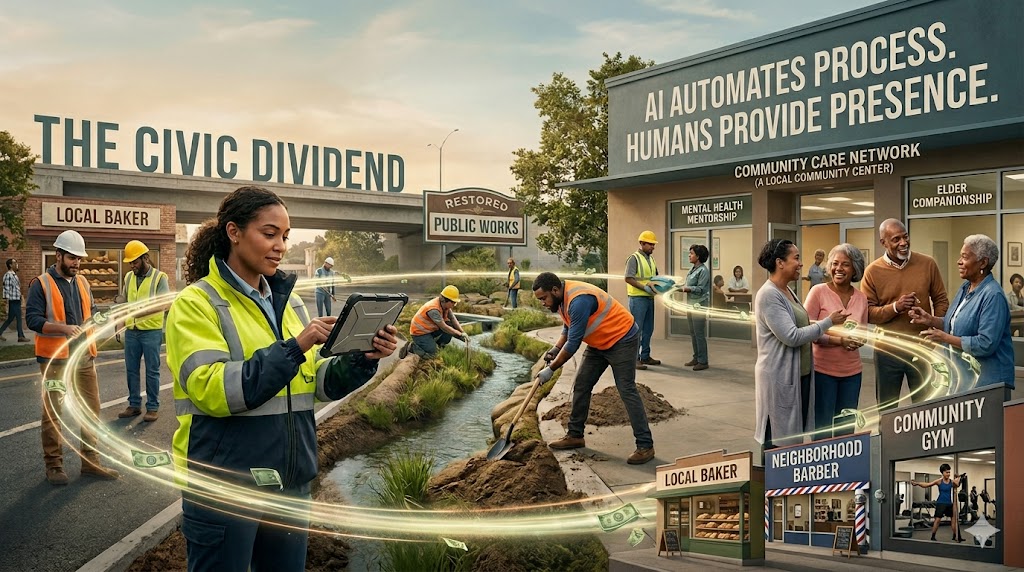
11 Human Endeavors AI Should Free (Not Replace)

11 Human Endeavors AI Should Free (Not Replace)

by Braden Kelley and Art Inteligencia


What Human Work Should AI Free Instead of Replace? (Short Answer)

AI should free, not replace, eleven human endeavors: insight, empathy, problem definition, accountable decision making, direction setting, creativity, collaboration, teaching judgment, repair and recovery, stewardship of consequences, and presence. Free means machines absorb search, draft, route, summarize, classify, and schedule so people get larger blocks for the human job. Replace means a costume version — volume without stakes, answers without questions, speed without someone who can be held to account.

Soft landings are designed. These endeavors are what you are designing for — or you are just buying a faster leftover.

Free Them. Don’t Fake Them.

I have watched rooms celebrate “AI replacing” the wrong list. Drafting. Routing. Summarizing. Fine. Those are glue. Then someone says the model can do insight, empathy, strategy, and care — and the room nods because the demo was fluent.

Fluency is not a human endeavor. A human endeavor has stakes. It has someone who can be asked, on Tuesday, why they chose this and what they owe the people who will live with it. Use AI to take the fragmentation. Grow the list below. If you use it to wear the list as a costume, you did not automate work. You hollowed out the job and kept the title.

Endeavor AI should absorb Do not replace
1. Insight Hunt, summarize, cluster A point of view
2. Empathy Triage, transcripts, routing Dignity and lived stakes
3. Problem definition Draft options, retrieve briefs Owning the question
4. Accountable decisions Scenarios, prior-case retrieval The human who can say why
5. Direction Deck assembly, scrapes Where we are going and why
6. Creativity Blank page, ordinary first drafts Taste and the thing the model would not
7. Collaboration Scheduling, notes archaeology Trust and the hard conversation
8. Teaching judgment Content libraries, quizzes Coaching on live work
9. Repair Routing, history, templates Making it right with authority
10. Stewardship Monitoring noise, log hunt Owning consequences
11. Presence Pings, calendar confetti Contiguous attention

1. Should AI Replace Human Insight — or Free It?

Free from: Hunting files, first-pass summaries, clustering noise so a person can finally see a pattern.

Hard landing: More output, no meaning. Dashboards that never become a point of view. Insight theater at token speed.

Protect: Contiguous time to connect weak signals. Name insight as an output — a stance someone will defend — not a side effect of more slides.

2. Can AI Replace Empathy, or Only Free Humans to Practice It?

Free from: Triage queues, transcript dumps, “next best action” scripts that skip the human in the story.

Hard landing: Simulated care. Personalization that remembers everything except dignity.

Protect: Contact with real people. Recovery power. Empathy as a job, not a tone guideline. If nobody is allowed to feel the stakes and act, you did not free empathy. You automated a smile.

3. Why Must Humans Still Own Problem Definition When AI Answers Faster?

Free from: Instant roadmaps and solution spam that answer the wrong brief beautifully.

Hard landing: Faster wrong. The question never gets a human owner. The model is rewarded for answering, not for noticing you asked the wrong thing.

Protect: A mandate to sit with the problem. Kill “solutions” that skip the frame. Better questions are the scarce resource. Volume of answers is not.

4. What Should Stay Human About Decision Making Under Uncertainty?

Free from: Option generation, scenario drafts, retrieval of what we decided last time.

Hard landing: Humans as rubber stamps. Unowned model choices. “The system recommended it” as a moral exit.

Protect: Named decision rights. Undo. A human who can be asked why on Tuesday. Accountability does not live in the weights. It lives in a name.

5. How Does AI Free Direction Setting Instead of Faking Strategy?

Free from: Deck assembly, competitive scrapes, status collage pretending to be a journey.

Hard landing: Strategy as generated prose. Motion without a destination people can join.

Protect: Leaders spend reclaimed time on where we are going and why it is worth it — not on prettier status. Direction is a human promise. A paragraph is not a north star.

6. Should AI Replace Human Creativity?

Free from: Blank-page dread, mood-board hunting, first drafts of the ordinary.

Hard landing: Average at scale. Sameness with better lighting. Creativity measured in assets shipped.

Protect: Taste, constraint, and the courage to make something the model would not. AI can widen the table of raw material. It cannot want. Wanting — and choosing against the average — stays human.

7. How Should AI Free Collaboration Without Replacing Trust?

Free from: Scheduling glue, notes, “who said what” archaeology.

Hard landing: More meetings, thinner trust. Collaboration theater inside the tool while the hard conversation never happens.

Protect: Time together for conflict, repair, and making progress. Tools serve the relationship. If the software is the collaboration, you have a log. You do not have a team.

8. Why Should AI Free Teaching Judgment Instead of Replacing Managers?

Free from: Content libraries, quiz generation, completion tracking dressed up as capability.

Hard landing: Prompt training without practice. Managers as ticket routers. “Enablement” as a course nobody had time to become good from.

Protect: Managers as developers of judgment. Practice on live work. Coaching as the job AI should make room for — not the job it should delete because the LMS is green.

9. Can AI Replace Repair After Harm — or Only Prepare It?

Free from: Routing, drafting the apology template, finding the account history so a human is not starting from zero.

Hard landing: Automated “sorry” with no authority. Containment as the KPI. The customer hears a paragraph. Nobody can make it right.

Protect: Humans own the repair. Agents prep context. Dignity is not a macro. If the person who shows up cannot undo the harm, you replaced care with a script.

10. What Stewardship Must Humans Keep When Models Act?

Free from: Monitoring noise, first-line exception queues, log archaeology.

Hard landing: “The model decided.” Nobody is steward of the outcome. Harm has a stack trace and no owner.

Protect: Steward roles with names. Audits of harm. Consequences stay human-accountable. Agency without stewardship is just speed with a liability costume.

11. Why Is Presence a Human Endeavor AI Should Free, Not Fill?

Free from: Pings, task-switching tax, calendar confetti that turns a day into shrapnel.

Hard landing: Denser busyness. Always-on humans competing with always-on agents. The “saved” minutes immediately refilled.

Protect: Calendar policy as part of the AI bet. Presence — contiguous attention, holding the moment — as a scarce resource you refuse to refill with tickets. If nobody is actually here, nothing else on this list has a place to live.

How Do You Design an AI Soft Landing Around These Human Endeavors?

Before you buy the next copilot, run five questions. If you cannot answer them, you are shopping for a demo, not a landing:

  1. Which of these eleven should grow if this investment works?
  2. What glue does the machine take so that growth is possible — not theoretical?
  3. What fake replacement are we refusing — the costume version of insight, empathy, or care?
  4. Who owns the endeavor on Tuesday after the pilot applause?
  5. What metric still punishes depth — volume, handle time, tickets closed, tokens used?

The designed future behind this list is The AI Soft Landing. For the pitches that can land either way, see 10 Futures Being Pitched in 2026. If your organization is already buying the wrong landing, the diagnostic is 8 Signals You’re Preparing for the Wrong Future of Work. And if you want the practice habits that keep innovation human while the tools speed up, start with 9 Habits of Human-Centered Innovators That Still Matter in the Age of AI.

If AI replaces the human endeavor, you did not get leverage. You got a hollow job with a better demo. Free the eleven. Keep the names on the line.

Frequently Asked Questions

What human work should AI free up?

AI should free time for insight, empathy, problem definition, accountable decisions, direction, creativity, collaboration, teaching judgment, repair, stewardship, and presence — by absorbing glue work such as search, drafting, routing, summarizing, classifying, and scheduling. Those eleven should grow. The glue should shrink.

Should AI replace human creativity?

No. AI can take blank-page friction and ordinary first drafts so humans can spend more capacity on taste, constraint, and combinations the model would not choose. Replacing creativity with average-at-scale output is a hard landing: more assets, less meaning, less courage.

What is the difference between AI freeing work and replacing it?

Freeing work means the machine takes fragmentation and low-judgment transaction so a human endeavor gets more contiguous time and authority. Replacing it means the model performs a costume version — fluent, fast, unowned — while no one is accountable for stakes, dignity, or Tuesday.

What should humans still own in an AI workplace?

Humans should still own meaning, questions, decisions they can explain, direction people can join, taste, trust, coaching, repair with power, consequences, and presence. Models can prepare, retrieve, and draft. They cannot be the steward you ask why when it goes wrong.

How do you design an AI soft landing around human endeavors?

Name which endeavors should grow, what glue the machine will take, what fake replacement you refuse, who owns the endeavor after go-live, and which volume metrics you will stop using to punish depth. Calendar policy and decision rights are part of the investment — not a later “change” workstream.

Image credits: Pexels

Content Authenticity Statement: The topic area, key elements to focus on, etc. were decisions made by Braden Kelley, with a little help from Google Gemini and Cursor to clean up the article, add images and create infographics.

Subscribe to Human-Centered Change & Innovation WeeklySign up here to get Human-Centered Change & Innovation Weekly delivered to your inbox every week.

Why Zero UI Will Redefine Experience Design

The Invisible Interface

LAST UPDATED: May 2, 2026 at 9:13 AM

Why Zero UI Will Redefine Experience Design

GUEST POST from Art Inteligencia


I. Introduction: The End of the Glass Slab

The Screen Fatigue Phenomenon: We have reached a point of peak saturation with traditional displays. Our lives are currently mediated by glowing rectangles, leading to a fragmented human experience where the tool often overshadows the task.

Defining Zero UI: This is not the absence of an interface, but the disappearance of the user interface as we know it. It represents a move away from rigid, button-heavy menus toward more organic inputs like voice, haptics, computer vision, and ambient intelligence.

The Core Thesis: Technology is at its most powerful when it is invisible. By removing the friction between human intent and technological execution, we allow people to return their focus to the experience itself, rather than the device required to facilitate it.

II. The Sensory Stack: How Zero UI Works

Voice & Natural Language: We are witnessing a transition from the “Command-Line Interface” era of voice (where specific keywords were required) to fluid, contextual conversations. The goal is a system that understands nuance, sarcasm, and intent, mirroring human-to-human interaction.

Biometrics & Gesture Control: In a Zero UI world, the body becomes the input device. Through computer vision and skeletal tracking, technology can interpret a wave of a hand or a shift in gaze, allowing for spatial computing that feels like an extension of natural movement.

Proactive vs. Reactive Design: Traditional UI waits for a user to click; Zero UI anticipates. By leveraging machine learning and sensor data, systems can predict needs—adjusting the lighting when you enter a room or preparing a summary of a meeting before you even ask for it.

Haptics & Sensory Feedback: Communication doesn’t always need to be audible or visual. Subtle vibrations (haptics) or environmental changes (thermal or olfactory cues) can provide “glanceable” information without demanding the user’s full cognitive attention.

III. From UX to HX (Human Experience)

Designing for Context: In the era of Zero UI, the focus shifts from “clicks” to “intent.” Experience design no longer lives within the boundaries of a screen; it must account for a user’s physical location, environmental noise levels, and even social setting. We aren’t just designing a path to a button; we are designing a response to a human moment.

Reducing Cognitive Load: The “Invisible Assistant” model moves us away from app management and toward outcome management. By utilizing ambient intelligence, technology handles the “how” so humans can focus on the “why.” This creates a “Calm UI” effect, where digital interactions support our life goals without demanding constant visual attention.

The Ethics of Invisibility: As interfaces disappear, the “Black Box” problem grows. Designers must prioritize radical transparency—ensuring users understand when and how they are being sensed. Trust becomes the primary currency; without clear consent and “off-switches” for predictive features, invisible interfaces risk becoming intrusive rather than helpful.

From Screens to Systems: We are moving toward “Sentient Interfaces” that detect hesitation or frustration through behavioral cues. Transitioning to HX (Human Experience) means building ecosystems that are emotionally aware, neuro-inclusive, and capable of failing gracefully when the AI misinterprets human intent.

IV. Leading Innovators: The Architects of Invisibility

The transition to Zero UI is being led by a diverse ecosystem of startups and legacy tech giants. As of 2026, the following organizations are moving beyond the screen to define the future of human-centered interaction:

Company / Startup Core Focus Why They Matter Now
Neuralink Brain-Computer Interface (BCI) Entering high-volume production in 2026, Neuralink is moving BCI from clinical trials to the ultimate seamless interface: thought-based control.
Ultraleap Mid-air Haptics & Tracking By projecting ultrasound waves onto the skin, they provide tactile feedback in mid-air, crucial for non-visual “touch” in automotive and XR environments.
SoundHound AI Agentic Voice Commerce Their latest “Amelia 7” platform allows users to manage complex real-world transactions—like dinner reservations and parking—entirely through natural conversation.
Memories.ai Contextual Wearables (LUCI) Following the pivot of early wearables like the Humane Ai Pin, Memories.ai is building the “Android of AI wearables,” providing a system-level reference for ambient intelligence.
Synchron Endovascular BCI A key competitor to Neuralink, Synchron focuses on minimally invasive brain interfaces that allow users to control digital devices via the blood vessels, emphasizing safety and accessibility.

Strategic Implementation: For brands, the challenge is no longer just “building an app.” It is about integrating into these emerging ecosystems. Whether it is through voice agents or haptic-enabled environments, the goal for designers is to ensure their brand’s presence is felt and heard, even when it cannot be seen.

V. The Futurologist’s Perspective: What’s Next?

The Transition to “Liquid Services”: In 2026, we are moving away from the “static app” model. Instead, we are entering the era of liquid services—capabilities that flow seamlessly across devices. Your interaction might start as a voice command in the kitchen, continue as a haptic pulse on your wrist while walking, and conclude as a spatial projection in your vehicle. The interface is no longer a destination; it is a persistent, supportive presence.

Hyper-Personalization and Ambient Intelligence: One-size-fits-all design is dead. Leveraging what I call “Fortified Intelligence,” future systems will adapt in real-time to the individual’s neurodiversity, physical abilities, and current emotional state. Environments will become “sentient,” adjusting lighting, acoustics, and information density based on the user’s “Digital Persona” without a single manual adjustment.

The Challenge for Designers: Behavioral Architecture: The role of the designer is shifting from visual storytelling to behavioral and sensory architecture. We are no longer just drawing screens; we are defining the “rules of engagement” between humans and machines. This requires a Whole-Brain approach—part scientist to manage the data and part artist to inspire human connection. Success in this new landscape is measured by “Speed to Resilience” rather than just speed to market.

Reclaiming the Human Moment: Paradoxically, the more advanced our technology becomes, the more we value “human friction.” As Zero UI automates the logistical “drudge work” of life, experience design for the future will emphasize the things AI cannot replicate: intentional inefficiency, the warmth of human presence, and the physical tangibility of the world around us. We are designing technology to get it out of the way, so we can finally be human again.

VI. Conclusion: Reclaiming the Human Moment

Beyond Efficiency: As I often say, true innovation isn’t just about making things faster or cheaper—it’s about making things more human. Zero UI is the final step in removing the technical debt of the 21st century. By dissolving the “glass slab” that separates us from our tasks, we aren’t just improving efficiency; we are restoring presence. When the technology disappears, we are finally free to focus on the work that matters and the people who inspire us.

A Call for Design Integrity: As we look toward the 2030s, the “Wild West” era of digital interfaces is closing. We are entering an era of Structural Integrity in experience design. Designers and innovation leaders must move beyond “Process Theater”—workshops that generate ideas without outcomes—and start building the resilient, invisible infrastructure that supports a flourishing society. We must have the courage to design a future that doesn’t require us to retreat into the friction of the past.

Final Thought: The most disruptive interface is the one that doesn’t exist because it works so well you’ve forgotten it’s there. The goal of the Invisible Interface is not to automate the human out of the loop, but to close the loop on friction, leaving only the experience behind. Let’s design an infrastructure that doesn’t just survive the future, but defines it.

Are you ready to move from UX to HX?

If you’re looking to get to the future first, increase your speed of innovation, or create a culture of continuous transformation, connect with Braden Kelley for a keynote or a FutureHacking™ workshop to teach you to be your own futurist.

Frequently Asked Questions

What is the difference between Zero UI and traditional UI?

Traditional UI (User Interface) relies on visual elements like screens, buttons, and menus to facilitate interaction. Zero UI moves away from these “glass slabs,” instead utilizing natural human behaviors—such as voice, gestures, haptics, and ambient intelligence—to interact with technology without a physical screen as the primary mediator.

How does Zero UI improve the Human Experience (HX)?

By reducing cognitive load and removing the friction of navigating complex menus, Zero UI allows technology to become a proactive assistant rather than a reactive tool. This shift toward “Human Experience” prioritizes context and intent, allowing users to stay present in their physical environment while still benefiting from digital capabilities.

Is Zero UI secure and private?

As interfaces become invisible, transparency becomes the most critical design element. Leading innovators are focusing on “Privacy by Design,” ensuring that ambient sensing and voice processing are handled with clear consent and robust encryption, often processing data locally (on-edge) rather than in the cloud to maintain user trust.

Disclaimer: This article speculates on the potential future applications of cutting-edge scientific research. While based on current scientific understanding, the practical realization of these concepts may vary in timeline and feasibility and are subject to ongoing research and development.

Image credits: Gemini

Subscribe to Human-Centered Change & Innovation WeeklySign up here to get Human-Centered Change & Innovation Weekly delivered to your inbox every week.

8 Signals You’re Preparing for the Wrong Future of Work

8 Signals You’re Preparing for the Wrong Future of Work

by Braden Kelley and Chateau G Pato


How Do You Know You’re Preparing for the Wrong Future of Work? (Short Answer)

You are preparing for the wrong future of work when your AI and “future of work” investments optimize efficiency and throughput while shrinking human agency, judgment, and contiguous time — and nobody can say what stays human-accountable on Tuesday. Eight signals: headcount math before job design, saved time refilled as denser busyness, agents with mandate and humans with monitoring, volume metrics in a judgment era, prompt training without practice, “keeping up” as strategy, frontline power shrinking while AI slides expand, and a tool stack you can demo but a landing you cannot describe.

The corrective habit is not “move faster on AI.” It is designing the landing — what machines absorb, what stays human-accountable, and whose attention gets protected when the efficiency gains arrive.

The Wrong Future Looks Like Progress

We rehearse the wrong ending when we confuse activity with direction. The board deck shows copilots. The roadmap has agents. Someone declares that “the future of work is here.” And yet the calendar still looks like confetti, the front line still cannot recover a bad moment, and the business case still opens with subtraction before anyone maps what work becomes.

That is not falling behind on technology. That is building a hard landing — machines doing more of everything, including the human parts of work, while people inherit leftovers, interruptions, and less authority. A soft landing, by contrast, protects insight, empathy, decision making, direction, problem definition, creativity, and collaboration. The signals below tell you which landing you are actually buying.

Signal Hard landing Right future
1. Headcount math first Hollow roles; volume competition with the model Map cognitive labor before subtraction
2. Denser busyness More task switching; no deep work Reclaimed time funds depth
3. Agents mandated; humans monitored Loop traps; rubber-stamp people Delegated action with undo and handoff
4. Volume metrics win Faster at the wrong things Dual scorecard: reliability + judgment
5. Prompts, not practice Tool fluency in broken jobs Managers develop judgment on live work
6. Keeping up as strategy Random automation; no coherent landing Name the soft landing you refuse to miss
7. Frontline power shrinks Attrition; failure demand; brand damage Fund authority at the moment of truth
8. Stack demo, no human contract Unowned decisions; no landing owner Division of cognitive labor on one page

1. What Signal Shows You’re Optimizing for Headcount Before Job Design?

The signal: Every AI business case opens with FTE reduction, cost takeout, or “do more with less” — before anyone maps what work becomes, who decides, and what capability must grow.

Why it seduces leaders: Finance understands subtraction. Job redesign sounds slow, political, and annoyingly specific about power.

Hard landing: Humans compete with the model on volume. Roles hollow out. Judgment work never earns protected blocks because nobody was asked to protect it.

Right future: Start with cognitive labor — what machines absorb, what stays human-accountable, what managers must develop. Subtraction may follow. It should not lead.

2. What Happens When Saved Time Becomes Denser Busyness?

The signal: Efficiency gains from AI, automation, or self-service are immediately reinvested as more tickets, more pings, more micro-approvals — not protected deep-work blocks.

Why it seduces leaders: “We’re getting more done.” Utilization dashboards stay green. Motion still masquerades as progress.

Hard landing: Task switching accelerates. Strategic thinking never gets contiguous minutes. Burnout wears a productivity costume.

Right future: Explicit policy: a defined share of reclaimed time funds depth, not density. Calendar design is part of the AI bet — not an afterthought for people who “find time.”

3. Why Is It a Bad Sign When Agents Get Mandate and Humans Get Monitoring?

The signal: Autonomy ships for bots — refund, route, decide — while people get tighter scripts, scorecards, and surveillance, not undo, escalation, or recovery power.

Why it seduces leaders: Agents scale. Humans are framed as “the risk.” Containment metrics improve on slides that never show the trapped customer.

Hard landing: Customers stuck in loops. Employees rubber-stamp the model. Trust erodes on both sides of the glass.

Right future: Clarity, competence, control, care — delegated action with human handoff and authority at the moment of truth. Scale the routine. Protect the exception.

4. How Do Volume Metrics Reveal the Wrong Future of Work?

The signal: Handle time, tickets closed, tokens generated, outputs per hour — still the hero numbers — while insight, quality of decision, and human success stay soft or unmeasured.

Why it seduces leaders: Old scorecards are auditable. Judgment is harder to metricize. Volume is easy to put on a quarterly review.

Hard landing: People optimize what gets measured. The organization gets faster at the wrong things — including automating work that should have stayed human.

Right future: A dual scorecard — reliability plus human success. A few judgment metrics with owners. Experience-led management applied to work itself, not only customer journeys.

5. Why Does Prompt Training Without Practice Signal the Wrong Future?

The signal: Future-of-work readiness equals tool training, certification, and prompt libraries — not spaced practice on real work, manager coaching, or redesigned workflows where the new way is the easy way.

Why it seduces leaders: Training is procurable, completable, and reportable. You can count completions. You cannot count Tuesday.

Hard landing: Prompt-fluent people in broken jobs. Capability theater. Adoption without transformation.

Right future: Managers as developers of judgment. Practice on live work. Enablement tied to decision rights — not a badge for attending the copilot webinar.

6. What Does It Mean When “Future of Work” Means Keeping Up?

The signal: Strategy is reactive — vendor roadmaps, competitor panic, “we need an AI strategy by Q3” — with no articulation of whose attention gets protected or what human endeavor should grow if this works.

Why it seduces leaders: Urgency feels like leadership. Naming tradeoffs feels like delay. “We’re not falling behind” is a comforting story.

Hard landing: Random automation. No coherent landing. Every team improvises a different future while the operating model stays frozen.

Right future: Foresight with constraints — name the soft landing, the hard landing you refuse, and who owns the design. The future is not what gets pitched. It is what you design the landing to be.

7. Why Is Shrinking Frontline Power While AI Slides Expand a Warning Sign?

The signal: Customer-facing and operational roles lose staffing, recovery budget, and decision authority — while executive decks celebrate “AI-powered experience” and agentic service.

Why it seduces leaders: Automation is cheaper at the point of contact. Slides scale faster than enablement. Containment looks like efficiency until the humans leave.

Hard landing: I know what they deserve; I am not allowed to deliver it. Regrettable attrition. Failure demand. Brand damage that no agent can recover because recovery power was the first thing cut.

Right future: Fund authority where the moment of truth lives. Agents handle routine multi-step work. Humans own exception, dignity, and the judgment call that saves the relationship.

8. What If You Can Demo the Stack but Not Name What Stays Human?

The signal: Leaders can walk through copilots, agents, and platforms — but stumble when asked: What decisions must remain human-accountable? What gets undone? What would a hard landing feel like for employees first?

Why it seduces leaders: Demos photograph well. Philosophy sounds like foot-dragging. Procurement has a date.

Hard landing: Unowned decisions. Humans as exception handlers for the model. No one responsible for the landing after the pilot party.

Right future: Before the next pilot — division of cognitive labor on one page, a review date, and a named owner after go-live. If you cannot describe the landing, you are not ready to buy the stack.

How Should Leaders Test Future-of-Work Readiness?

Before the next AI or “ways of working” investment, run five go/no-go questions. If you cannot answer them, you are building a hard landing while calling it transformation:

  1. Whose contiguous time are we protecting — and what policy enforces that?
  2. What metric still punishes judgment — and who owns changing it?
  3. What can an employee or customer undo when the system gets it wrong?
  4. What frontline power are we funding, not only automating?
  5. What human endeavor grows if this works — and who owns that outcome on Tuesday?

If you want the designed alternative spelled out, read The AI Soft Landing — and for ten futures being sold right now, each with a hard and human-centered landing, see 10 Futures in 2026: Soft Landing vs Hard Landing.

The wrong future of work is not falling behind. It is building a hard landing while calling it transformation. Spot the signals early, and you still have time to design a future where work gets more human — not less.

Frequently Asked Questions

What is the wrong future of work?

The wrong future of work is one where efficiency and throughput are the only values on the dashboard — AI and automation absorb more of the human parts of work, saved time becomes denser busyness, and people lose agency, judgment, and contiguous time. It is a hard landing disguised as progress.

How do you know if your AI strategy is wrong?

Warning signs include business cases that start with headcount reduction before job redesign, agents with autonomy while humans get tighter monitoring, volume metrics that still dominate, and leaders who can demo tools but cannot name what stays human-accountable or what can be undone when the system fails.

What is the difference between a soft landing and hard landing at work?

A hard landing gives machines more of everything — including tasks that require judgment — and leaves people with leftovers and interruptions. A soft landing deliberately automates fragmentation and low-judgment transaction so humans can spend larger blocks on insight, empathy, decision making, creativity, and collaboration.

Why does AI sometimes make work worse?

AI makes work worse when efficiency gains are reinvested as more tickets and pings instead of protected deep work, when roles are hollowed out without redesign, when frontline recovery power shrinks, and when organizations measure volume instead of judgment. The tool works; the landing was never designed.

How should leaders prepare for the future of work?

Leaders should map cognitive labor before subtraction, protect reclaimed time for depth, give agents delegated action with human undo and escalation, align metrics with judgment, fund frontline authority, and name the soft landing they want — with a division of cognitive labor, review date, and owner after go-live.

Image credits: Google Gemini

Content Authenticity Statement: The topic area, key elements to focus on, etc. were decisions made by Braden Kelley, with a little help from Google Gemini and Cursor to clean up the article, add images and create infographics.

Subscribe to Human-Centered Change & Innovation WeeklySign up here to get Human-Centered Change & Innovation Weekly delivered to your inbox every week.