Tag Archives: metrics

Purpose-Based Metrics That Guide Decision-Making

LAST UPDATED: March 20, 2026 at 3:46 PM

Purpose-Based Metrics That Guide Decision-Making

GUEST POST from Art Inteligencia


The Metric Trap: Beyond the Illusion of Innovation

In the modern corporate landscape, many organizations fall victim to the “Innovation Illusion.” This occurs when a company’s calendar is filled with design thinking workshops, “shark tank” style pitch competitions, and high-energy hackathons, yet the needle on actual market transformation remains stagnant. We confuse the theater of innovation with the discipline of it.

Activity vs. Impact

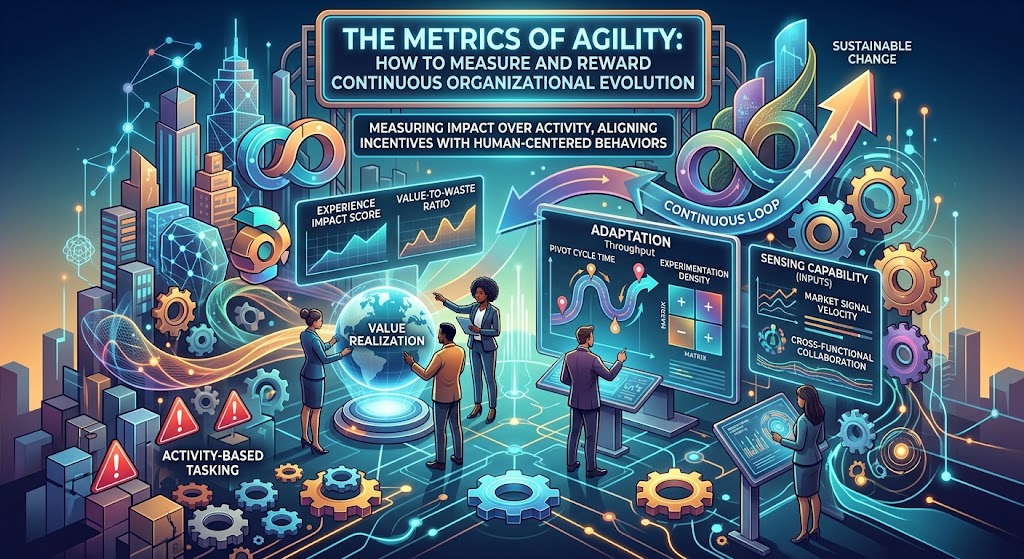
The core of this problem lies in what we choose to measure. Traditional management often defaults to Activity Metrics because they are easy to count and look impressive in quarterly reviews. Examples include:

  • Number of ideas submitted to an internal portal.
  • Total number of employees trained in agile methodologies.
  • Capital expenditure on new “Innovation Labs.”

While these are fine for tracking participation, they are “vanity metrics” that fail to correlate with long-term viability. Impact Metrics, conversely, focus on outcomes: Did we reduce customer friction? Did we decrease the time to value? Did we solve a problem that actually matters?

Defining Purpose-Based Metrics

To break free from the trap, we must transition to Purpose-Based Metrics. This framework moves the focus from “How much are we doing?” to “Why are we doing it, and for whom?”

“Measurement is not just about keeping score; it is about guiding behavior. If your metrics are divorced from your purpose, your teams will prioritize busywork over breakthroughs.” — Braden Kelley

Purpose-based metrics act as a strategic filter. They ensure that every experiment and every dollar spent is directly linked to the organization’s core reason for being. By measuring the human-centered value we create, we align our decision-making with the long-term health of both the customer and the enterprise.

Aligning the “North Star” with the “Ground Truth”

The greatest disconnect in modern strategy is the chasm between the boardroom’s “North Star” — the high-level mission statement — and the “Ground Truth” — the daily reality of employee actions and customer experiences. When metrics are purely financial, they fail to bridge this gap, leading to a culture that hits its numbers but misses its point.

The Hierarchy of Intent

To lead effectively, we must establish a clear Hierarchy of Intent. This is a vertical alignment where every micro-metric on the front lines can be traced back to the organizational purpose. If a team is measured on “call handle time,” but the organizational purpose is “unparalleled customer support,” the metric is actively sabotaging the intent. Purpose-based metrics ensure that:

    • Strategic Intent dictates the “What” (Objectives).
    • Human-Centered Value dictates the “How” (Key Results).
    • Operational Reality dictates the “Now” (Daily Tasks).

}

The Human Element: Experience over Transactions

Traditional KPIs often treat customers and employees as variables in a transactional equation. However, a purpose-based approach prioritizes Human Insights. Instead of asking “How many units did we move?”, we ask “How much friction did we remove from the customer’s life?”

By shifting focus toward qualitative human impact, we move from Service Level Agreements (SLAs) — which often measure mere compliance — to Experience Level Measures (XLMs). This shift ensures that decision-making is guided by the quality of the interaction rather than just the speed of the transaction.

Bridging the Gap: A Case Study in Pivoting Strategy

Consider a traditional software provider transitioning to a SaaS model. Initially, their “North Star” was Market Share, measured by “Licenses Sold.” This led to aggressive sales tactics but high churn, as the product wasn’t solving core problems. By shifting their primary metric to Customer Success Outcomes (e.g., “Time to first value” or “Feature adoption rate”), they realigned their engineering and sales teams with their actual purpose: helping customers succeed. The result was not just higher retention, but a more resilient brand identity.

“When the ‘Ground Truth’ of your data contradicts your ‘North Star’ vision, your strategy is an anchor, not a sail. Alignment requires the courage to measure the uncomfortable truths of the human experience.”

The Three Pillars of Purpose-Based Measurement

To move beyond simple profit-and-loss statements, organizations must categorize their metrics into three distinct pillars. These pillars ensure that the “why” of the organization is balanced against the “how” of its operations and the “what” of its future potential. Without this balance, firms risk optimizing for short-term efficiency at the expense of long-term relevance.

Pillar 1: Value Creation (Solving the Human Problem)

The first pillar focuses on the external impact. If our purpose is to serve a specific customer need, we must measure how effectively we are doing so. We move away from “Product Features Delivered” and toward “Customer Progress Made.”

  • Job-to-be-Done (JTBD) Completion: Are customers successfully finishing the task they “hired” our product to do?
  • Friction Reduction Score: A quantitative measure of how many steps or cognitive hurdles we’ve removed from the user journey.
  • Emotional Resonance: Using qualitative sentiment analysis to determine if the solution aligns with the user’s aspirational identity.

Pillar 2: Capability Velocity (The Internal Engine)

The second pillar measures the organizational health and its ability to adapt. High velocity isn’t about working more hours; it’s about how quickly the organization can learn and pivot based on new data.

  • Learning Loop Cycle Time: The duration between forming a hypothesis and gathering validated data from a real-world experiment.
  • Silo Permeability: Tracking the frequency and depth of cross-functional collaboration on “Horizon 2” and “Horizon 3” projects.
  • Decision Latency: Measuring the time it takes for a strategic insight to result in a resource allocation shift.

Pillar 3: Strategic Fit (The Future Compass)

The third pillar ensures that our current actions are not cannibalizing our future. It measures the alignment of resources against our stated vision, protecting the organization from “incrementalism creep.”

  • Portfolio Balance Ratio: The percentage of budget and talent assigned to transformative innovation versus maintaining the core business.
  • Purpose Alignment Score: A rubric-based assessment of new projects to ensure they don’t just “make money,” but actually “make sense” for the brand.
  • Unmet Need Exploration: Tracking the percentage of research efforts dedicated to problems we haven’t solved yet, rather than refining existing solutions.

“A balanced measurement strategy is like a tripod. If you focus only on Value Creation, you burn out your internal capabilities. If you focus only on Capability, you lose sight of the customer. If you ignore Strategic Fit, you build a very efficient road to a dead end.”

Moving from Lagging to Leading Indicators

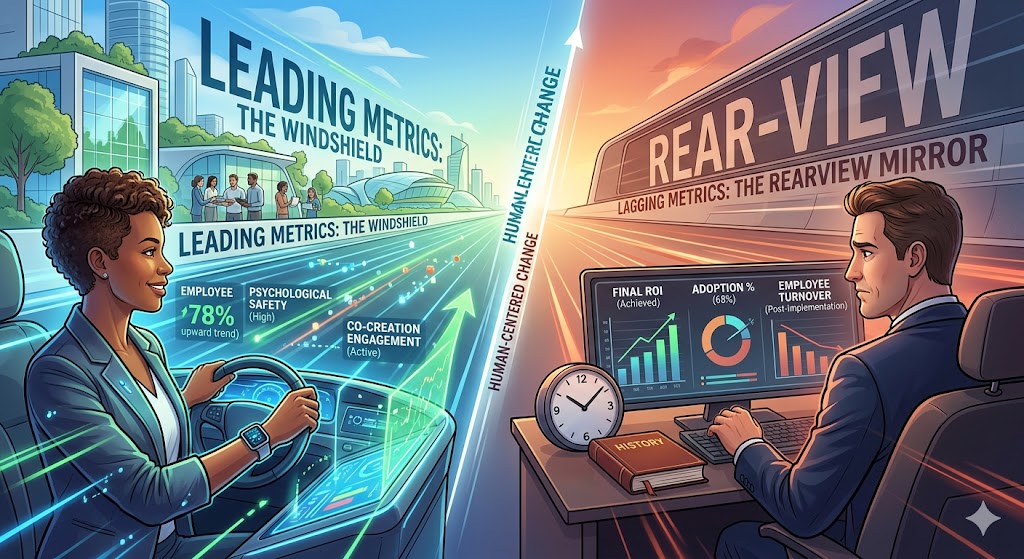
The fatal flaw in many innovation initiatives is the reliance on Lagging Indicators — data points like Revenue, Net Profit, and ROI. While these are essential for reporting past performance, they are “rearview mirror” metrics. In the context of innovation and change, by the time a lagging indicator tells you a project is failing, the resources have already been spent and the opportunity has passed.

The Rearview Mirror Problem

If we manage innovation through the lens of quarterly financial returns, we inadvertently kill high-potential ideas in their infancy. Purpose-based decision-making requires Leading Indicators: predictive signals that suggest we are on the right path toward our goal before the financial rewards manifest.

Implementing Innovation Accounting

To guide decision-making effectively, we must adopt an Innovation Accounting framework. This isn’t about traditional bookkeeping; it’s about measuring the mathematics of hope and evidence. We focus on three specific levels of data:

  • Level 1: Customer Curiosity: Are people willing to give us their attention? (e.g., click-through rates on a value proposition, sign-ups for a beta).
  • Level 2: Customer Commitment: Are people willing to give us their time or data? (e.g., time spent using a prototype, completion of a detailed survey, participation in a co-creation session).
  • Level 3: Customer Validation: Are people willing to give us their reputation or currency? (e.g., referral rates, pre-orders, or a “Letter of Intent”).

Measuring the Rate of Learning

In the early stages of a change initiative, our primary “currency” is not dollars, but Validated Learning. A project that “fails” but provides a massive insight into customer behavior is often more valuable than a project that “succeeds” incrementally without teaching us anything new. Purpose-based metrics track:

  • Hypothesis Velocity: How many “Leaps of Faith” assumptions did we test this week?
  • Pivot Frequency: How many times did we change direction based on evidence rather than ego?
  • Cost per Insight: How efficiently are we gaining the knowledge required to de-risk the next phase of investment?

“Leading indicators are the headlights of your organization. They don’t tell you how far you’ve traveled, but they show you whether you’re about to drive off a cliff or stay on the road to your purpose.” — Braden Kelley

Operationalizing the Shift: From Data to Decision-Making

The greatest challenge in transforming measurement is not the math — it is the corporate muscle memory. Most organizations are haunted by “Zombie Metrics”: KPIs that have long lost their relevance but continue to consume time and dictate behavior because “that’s how we’ve always done it.” Operationalizing purpose-based metrics requires a systematic pruning of the old to make room for the new.

The “Stop-Doing” List: Auditing Your KPIs

To begin the shift, leaders must conduct a Metric Audit. Every existing KPI should be interrogated with a single question: “Does this metric reward a behavior that aligns with our human-centered purpose?” If the answer is “no” or “I don’t know,” it belongs on the “Stop-Doing” list.

  • Identify Vanity Metrics: Look for numbers that exist solely to make the department look good without reflecting customer value.
  • Expose Conflicting Incentives: Identify where one department’s “success” metric (e.g., lower support costs) creates “failure” for another (e.g., lower customer retention).
  • Reduce Cognitive Load: A team focused on 20 KPIs is focused on none. Prune the list down to the 3-5 metrics that actually move the needle on purpose.

Transparency and Decentralized Power

Purpose-based metrics are most effective when they are democratized. When data is siloed in leadership dashboards, it remains a tool for control. When it is visible to the front lines, it becomes a tool for empowerment.

By using real-time dashboards that highlight Leading Indicators, we allow teams to make decentralized decisions. They no longer have to wait for permission to pivot because the data — aligned with the shared purpose — tells them exactly when their current path is no longer creating value.

Aligning Incentives: Rewarding the “Right” Failures

Culture doesn’t follow what you say; it follows what you reward. If you want a culture of innovation but only bonus people for hitting short-term financial targets, you will never see a breakthrough. Operationalizing this shift requires a reimagining of Incentive Alignment:

  • Celebrate “Validated Learning”: Create recognition programs for teams that killed a project early based on data, saving the company millions in potential waste.
  • XMO Oversight: Establish an Experience Management Office (XMO) to ensure that Experience Level Measures (XLMs) carry the same weight in performance reviews as traditional SLAs.
  • Risk-Adjusted KPIs: Allow for a “portfolio approach” to personal goals, where a portion of an employee’s success is tied to the quality of their experimentation rather than just the output.

“You cannot mandate innovation, but you can measure the barriers to it. If your incentives still reward safe incrementalism, no amount of ‘purpose-driven’ rhetoric will change the outcome.” — Braden Kelley

Conclusion: Metrics as a Language of Culture

Ultimately, what an organization chooses to measure is the clearest broadcast of its actual values. You can hang mission statements on every wall, but if your dashboards only track bottom-line efficiency, your culture will inevitably prioritize the machine over the human. Culture follows measurement. When we shift to purpose-based metrics, we aren’t just changing a spreadsheet; we are changing the internal language of the enterprise.

The Courage to Measure the Intangible

Moving toward a purpose-driven model requires a fundamental shift in leadership mindset. It requires the courage to acknowledge that the most important drivers of long-term success — trust, psychological safety, customer delight, and organizational agility — are often the hardest to quantify. However, staying tethered to easy, outdated KPIs is a recipe for irrelevance in an era of rapid Digital Transformation and Agentic AI.

The Flywheel of Purpose and Performance

When purpose-based metrics are implemented correctly, they create a self-sustaining flywheel:

  • Clarity: Teams understand exactly how their work contributes to the “North Star.”
  • Autonomy: Leading indicators provide the data needed to pivot without bureaucratic friction.
  • Mastery: Focus shifts from “hitting a number” to “solving a challenge,” driving higher engagement.

A Call to Action for Change Leaders

The transition does not have to happen overnight. Transformation is a journey, not an event. Start small by identifying one “Zombie Metric” to retire this quarter and replacing it with one Experience Level Measure (XLM) that tracks true human impact. Use that single data point to drive a different conversation in your next leadership meeting.

By aligning our metrics with our purpose, we move beyond the illusion of innovation and begin the real work of creating a future that is not only more productive but more human-centered.

“The goal of measurement is not to achieve certainty, but to reduce uncertainty. In a world of constant change, the most valuable metric you can track is your organization’s ability to learn, adapt, and stay true to its ‘Why’.”

Frequently Asked Questions

What is the difference between an SLA and an XLM?

A Service Level Agreement (SLA) typically measures technical compliance and efficiency (e.g., uptime or response time). An Experience Level Measure (XLM) focuses on the human impact of that service — measuring whether the interaction actually solved the user’s problem and how they felt during the process.

Why are leading indicators more important for innovation than ROI?

ROI is a lagging indicator that tells you what happened in the past. In innovation, you need leading indicators — like “customer curiosity” or “learning velocity” — to provide real-time feedback. These signals allow you to pivot or double down on an idea long before the final financial results are known.

How do I identify a “Zombie Metric” in my organization?

A Zombie Metric is any KPI that is tracked out of habit rather than utility. If a metric doesn’t drive a specific decision, doesn’t align with your human-centered purpose, or rewards behaviors that create silos, it is likely a Zombie Metric that should be retired.

Image credit: Google Gemini

Subscribe to Human-Centered Change & Innovation WeeklySign up here to get Human-Centered Change & Innovation Weekly delivered to your inbox every week.

Metrics That Matter in Distributed Innovation Teams

LAST UPDATED: March 9, 2026 at 10:35 PM
Metrics That Matter in Distributed Innovation Teams

GUEST POST from Art Inteligencia


The Distributed Dilemma: Moving Beyond Activity to Impact

In the modern landscape of Human-Centered Innovation, the physical walls of the innovation lab have finally crumbled. We have successfully assembled global teams of brilliant minds, yet many leaders remain haunted by a lingering question: If we can’t see the innovation happening, how do we know it’s working?

The traditional “management by walking around” is dead. In a distributed environment, relying on physical cues to gauge momentum or engagement is a recipe for stagnation. When teams are spread across time zones and digital interfaces, there is a natural tendency for leadership to retreat into activity-based management — tracking Jira tickets, counting Slack messages, or monitoring hours logged. However, activity is not progress, and busyness is not innovation.

To lead a truly agile, distributed innovation engine, we must address the Visibility Gap. This gap isn’t just about seeing people at their desks; it’s about the lack of clarity regarding how individual contributions aggregate into collective value. We need a compass, not just a dashboard.

“Innovation in a distributed world requires us to become masters of measuring the impact of work through a human-centered lens, rather than the volume of work through a mechanical one.”

This article explores a shift toward Innovation Accounting. We will move away from vanity metrics that offer a false sense of security and toward a framework that measures the velocity of learning, the health of our collaborative culture, and the ultimate reduction of customer friction. By providing distributed teams with clear, meaningful metrics, we don’t just track their performance — we empower their autonomy.

The Velocity of Learning: Measuring Input Over Throughput

In a Human-Centered Innovation framework, the most valuable currency an innovation team possesses is not their code or their prototypes — it is their validated learning. For distributed teams, where communication can be asynchronous and fragmented, the speed at which we move from a “hunch” to a “fact” is the ultimate predictor of success.

If we treat innovation as a linear manufacturing process, we fail. Instead, we must measure the inputs that fuel the engine of discovery. This requires a shift from measuring output (how much did we build?) to velocity (how fast are we learning?).

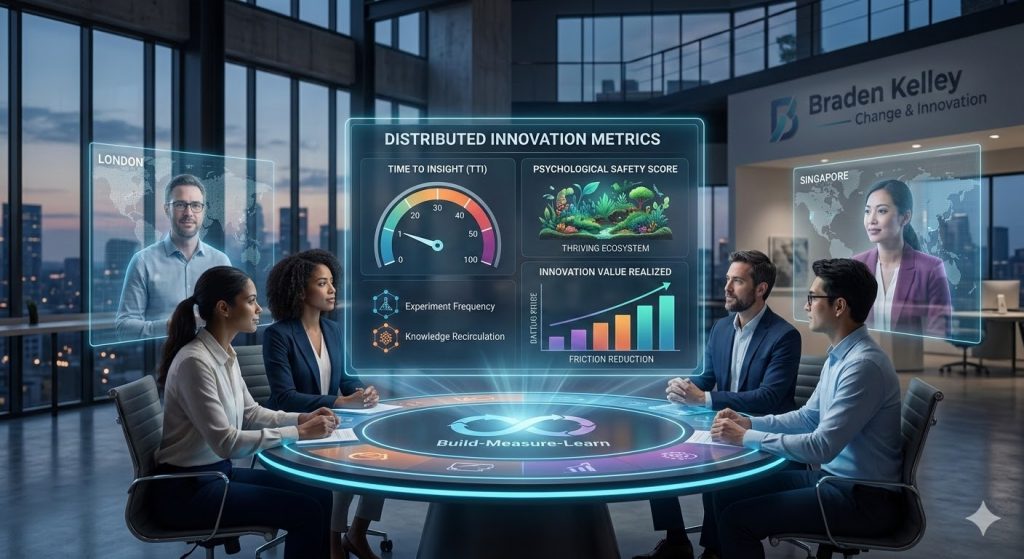
[Image of Build-Measure-Learn feedback loop]

Experimentation Frequency

The first metric that matters is the Frequency of Hypothesis Testing. In a distributed environment, teams can easily fall into “perfection paralysis,” where they over-engineer a solution before showing it to a customer. We must track the number of distinct experiments — interviews, smoke tests, or paper prototypes — conducted per month. The goal is to lower the cost of failure so that the frequency of attempts can rise.

Diversity of Contribution

Innovation thrives on Cross-Pollination. In distributed teams, there is a constant risk of regional silos where the “London pod” and the “Singapore pod” solve problems in isolation. We measure diversity by tracking the number of functional areas or geographic regions contributing to a single project’s pivot or persevere decision. If our insights are coming from a single demographic or location, our innovation is inherently fragile.

Time to Insight (TTI)

Perhaps the most critical metric for organizational agility is Time to Insight. This measures the delta between identifying a potential customer friction point and the completion of a validation study. A high TTI usually indicates a “Bureaucracy Leak” — where digital hand-offs and approval layers are choking the team’s ability to react to market shifts.

“In the race to the future, the winner isn’t the one who works the most hours, but the one who cycles through the Build-Measure-Learn loop the fastest.”

By focusing on these learning inputs, we provide distributed teams with a clear mandate: your job is not to stay busy; your job is to reduce uncertainty. When we measure learning, we foster a culture of curiosity that transcends time zones.

Collaborative Cohesion: The Human Health of Distributed Innovation

Innovation is a team sport that thrives on high-bandwidth trust. In a distributed environment, we lose the “water cooler” moments and the non-verbal cues that build psychological safety. If we don’t measure the health of our collaboration, we risk building a group of isolated task-performers rather than a cohesive innovation engine.

We must look beyond participation rates in Zoom calls and instead measure the quality and safety of the digital space we’ve created.

The Synchronicity Ratio

One of the greatest tensions in distributed work is the balance between Deep Work and Collaborative Collisions. We track the Synchronicity Ratio to ensure teams aren’t being smothered by “meeting fatigue” while also avoiding the isolation of “siloed execution.” A healthy ratio allows for long blocks of asynchronous focus, punctuated by high-intensity, synchronous creative sessions. If this ratio tilts too far in either direction, innovation velocity stalls.

Psychological Safety Scores

In a physical room, you can feel the tension when an idea is shot down. Digitally, that silence is invisible. We utilize frequent, anonymous Pulse Surveys to measure the team’s “Safety to Fail.” We ask: “Do you feel comfortable proposing a ‘wild’ idea in our digital workspace?” and “When an experiment fails, is the focus on the lesson or the blame?” A declining safety score is a leading indicator of a future lack of breakthrough ideas.

Knowledge Recirculation

True Organizational Agility depends on how effectively insights move across the network. We measure Knowledge Recirculation by tracking how often a finding from one distributed pod (e.g., a “Customer Friction” insight from the Dublin team) is cited or utilized in the project documentation of another (e.g., the Seattle team). This measures the “connective tissue” of the organization — ensuring we aren’t solving the same problem twice.

“Distance should never be an excuse for disconnectedness. In innovation, the strongest bond is not a shared office, but a shared understanding and the safety to challenge the status quo.”

By making these “soft” elements visible through data, we treat the team culture as a product that requires constant iteration and optimization. When the human core is healthy, the innovation output follows naturally.

Value Realization: Bridging Innovation to the Bottom Line

The ultimate test of a distributed innovation team is not the elegance of their ideas, but the tangible value those ideas create for the organization and its customers. In high-performing cultures, we must move beyond “innovation theater” — the appearance of being creative — and focus on Innovation Accounting that tracks how we are plugging revenue leaks and capturing new market opportunities.

In a distributed environment, the distance between the “builder” and the “buyer” can grow dangerously wide. We use value realization metrics to ensure every digital sprint is anchored in commercial and human reality.

Innovation Risk vs. Revenue Leakage

Every organization suffers from Revenue Leakage — the gap between the value a product could provide and what the customer actually experiences. We measure the impact of our innovation projects by their ability to close these gaps. By utilizing Risk & Revenue Leakage Diagnostics, distributed teams can prioritize projects that address high-friction customer touchpoints. We track the “Projected Leakage Recovery” (PLR) to justify the investment in distributed experimentation.

Customer Friction Reduction (CFR)

Our primary benchmark for success is the Customer Experience (CX) Audit. We don’t just launch features; we measure the reduction in customer effort. For a distributed team, this metric serves as a unifying North Star. Whether a developer is in Port Orchard or Singapore, their success is measured by the same standard: Did this innovation make the customer’s life measurably easier? We track the delta in friction scores before and after a solution is deployed.

The Pivot-to-Persevere Ratio

One of the most dangerous traits in a distributed team is “sunk cost bias,” where remote pods continue working on a failing idea simply because they lack the high-bandwidth feedback to stop. We measure the Pivot Rate — the percentage of projects that are significantly redirected or halted based on data. A pivot is not a failure; it is a successful validation that a specific path was incorrect. A team that never pivots is likely ignoring the data.

“True innovation is the profitable implementation of creative ideas. If we aren’t measuring the reduction of friction and the recovery of revenue, we aren’t innovating — we’re just experimenting.”

By tying distributed efforts to these hard-hitting value metrics, we ensure that the “freedom to explore” is balanced with the “responsibility to deliver.” This alignment creates a culture where every team member understands exactly how their digital contributions move the needle for the entire enterprise.

Pitfalls to Avoid: When Metrics Become the Mission

Even the most well-intentioned Innovation Accounting system can backfire if it is implemented without a human-centered perspective. In distributed teams, where data often replaces dialogue, metrics can easily be misinterpreted or, worse, “gamed.” To maintain a healthy innovation culture, leaders must be vigilant against the unintended consequences of high-visibility tracking.

Measurement should be a flashlight, not a hammer. When we weaponize data, we don’t improve performance; we simply teach people how to hide the truth.

The “Green Dashboard” Trap

In a distributed environment, there is a natural desire to report “green” status updates to headquarters to prove productivity. This leads to the Green Dashboard Trap — where every KPI looks perfect on paper, yet the organization is failing to launch meaningful products. We must encourage “Red” and “Yellow” statuses as signs of honesty and opportunities for Human-Centered Innovation. If a dashboard is always green, the team isn’t taking enough risks.

Over-Measurement Fatigue

There is a diminishing return on data collection. If an innovation team spends 20% of their week updating tracking tools and filling out pulse surveys, they are spending 20% less time solving Customer Friction. We must ensure that our metrics are “low-friction” themselves — ideally captured through existing workflows rather than manual entry. The goal is to spend more time innovating and less time reporting on innovation.

Misalignment with the North Star

The most dangerous pitfall is Local Optimization — where a distributed pod optimizes for a metric that doesn’t actually drive the broader strategy. For example, a team might increase their “Experimentation Frequency” by running trivial tests that don’t move the needle on Revenue Leakage. Every metric must be explicitly mapped back to the organization’s strategic goals. If the team can’t explain why a metric matters to the customer, it probably doesn’t.

“When a measure becomes a target, it ceases to be a good measure. Our focus must remain on the human impact of our innovations, not just the numbers on the screen.”

By anticipating these pitfalls, we can build a measurement system that supports Organizational Agility rather than stifling it. We use metrics to inform our conversations, not to replace them.

Conclusion: Measuring for Empowerment

The ultimate goal of Innovation Accounting for distributed teams is not control; it is autonomy. In a high-performing organization, metrics are the guardrails that allow teams to move fast without asking for permission at every turn. When we provide a distributed team with a clear understanding of what “success” looks like through a human-centered lens, we grant them the freedom to execute with Organizational Agility.

By shifting our focus from tracking presence to measuring impact, we transition from a culture of surveillance to a culture of empowerment.

Autonomy Through Clarity

When a distributed pod knows their primary metric is the reduction of Customer Friction, they don’t need a manager in a different time zone to tell them which feature to prioritize. The data provides the mandate. This clarity reduces the “cognitive load” of remote work, allowing teams to spend their creative energy on solving problems rather than navigating internal hierarchies.

The Future of Strategic Foresight

Finally, these metrics allow us to move from reactive management to Strategic Foresight. By tracking the Velocity of Learning and Knowledge Recirculation, leadership can predict which teams are on the verge of a breakthrough and which are stalling before the crisis actually hits. We use these insights to reallocate resources dynamically, ensuring that the organization remains resilient in the face of constant change.

“The most powerful tool a distributed leader has is a shared set of Metrics That Matter. When the team owns the data, they own the outcome.”

As we continue to navigate the complexities of Human-Centered Innovation, let us remember that the numbers are merely a shadow of the human effort behind them. Our mission is to ensure that every distributed mind—no matter where they are located—is empowered to contribute to a future that is more innovative, more agile, and more human.

Frequently Asked Questions

Why are traditional productivity metrics failing distributed innovation teams?

Traditional metrics often focus on “activity” (hours logged, tickets closed) rather than “impact” (validated learning, friction reduction). In a distributed environment, this creates a surveillance culture that stifles the psychological safety necessary for breakthrough creative thinking.

How do you measure “soft” cultural elements like psychological safety remotely?

We utilize frequent, anonymous pulse surveys and track “Knowledge Recirculation” across digital platforms. By measuring how often ideas are challenged or shared across distributed pods, we gain a data-driven view of the team’s collaborative health without needing physical proximity.

What is the most critical metric for organizational agility in innovation?

The “Velocity of Learning” is paramount. Specifically, tracking the “Time to Insight” — the speed at which a team moves from identifying a customer friction point to validating a solution — is the best predictor of long-term success and revenue leakage recovery.

Image credit: Google Gemini

Subscribe to Human-Centered Change & Innovation WeeklySign up here to get Human-Centered Change & Innovation Weekly delivered to your inbox every week.

Metrics for Systemic Human-Centered Design Success

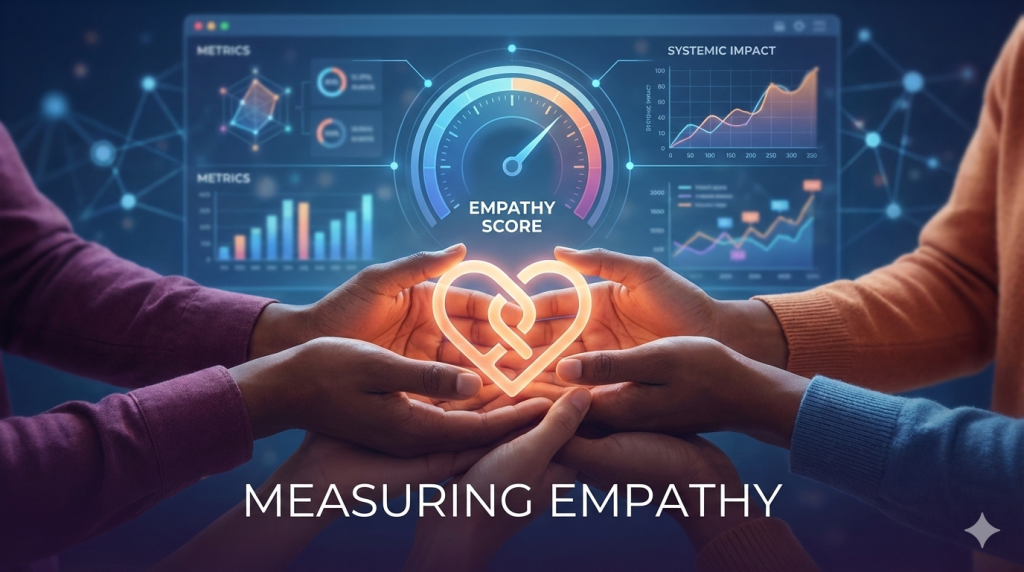
Measuring Empathy

LAST UPDATED: December 23, 2025 at 1:51PM

Metrics for Systemic Human-Centered Design Success

GUEST POST from Chateau G Pato

Empathy is frequently praised and rarely operationalized. In too many organizations, it lives in sticky notes, inspirational posters, and kickoff workshops — disconnected from how decisions are actually made. As human-centered design matures from a project-level practice into an enterprise capability, empathy must become measurable, repeatable, and systemic.

Measuring empathy is not about stripping humanity from design. It is about ensuring that human understanding survives scale, complexity, and quarterly pressure.

Re-framing Empathy as a Capability

Empathy is often misunderstood as an individual trait. In reality, sustainable empathy is an organizational capability supported by structures, incentives, and feedback loops. The question leaders should ask is not “Are our designers empathetic?” but rather “Does our system consistently produce empathetic outcomes?”

Metrics provide the answer.

A Practical Empathy Measurement Framework

1. Human Insight Integrity

These metrics assess whether decisions are grounded in real human understanding:

  • Percentage of strategic initiatives informed by primary research
  • Recency of customer insights used in decisions
  • Inclusion of marginalized or edge users

Outdated or secondhand insights are a hidden empathy killer.

2. Experience Friction Reduction

Empathy should reduce unnecessary effort and stress:

  • Time-on-task improvements
  • Drop-off and abandonment rates
  • Emotion-based experience ratings

3. Organizational Behavior Change

Look for evidence that empathy is shaping behavior:

  • Frequency of cross-functional research participation
  • Leadership presence in customer interactions
  • Reuse of validated insights across teams

4. Long-Term System Health

At scale, empathy improves system resilience:

  • Reduction in rework and failure demand
  • Employee engagement and retention
  • Trust and loyalty over time

“Empathy is not proven by how deeply we feel in a workshop, but by how consistently our systems change behavior in the real world. If you can’t measure that change, empathy remains a belief instead of a capability.”

Braden Kelley

Case Study 1: Retail Banking Transformation

A large retail bank invested heavily in digital channels but continued to see declining trust. By introducing empathy metrics focused on customer anxiety and clarity, the bank discovered that customers felt overwhelmed rather than empowered.

Design teams simplified language, reduced choice overload, and measured success through emotional confidence indicators. Within eighteen months, complaint volume dropped while product adoption increased — a clear signal of systemic empathy at work.

Case Study 2: Public Transportation Services

A metropolitan transit authority applied empathy metrics to rider experience. Beyond punctuality, they measured perceived safety, clarity of wayfinding, and stress during disruptions.

By addressing emotional pain points and tracking their reduction, the authority improved satisfaction without major infrastructure investment, proving that empathy can outperform capital expenditure.

Embedding Empathy into Governance

Empathy metrics only matter if they influence decisions. Leading organizations embed them into:

  • Executive dashboards
  • Investment prioritization
  • Performance reviews

When empathy metrics sit alongside financial and operational metrics, they shape trade-offs instead of reacting to them.

The Future of Human-Centered Measurement

As AI and automation accelerate, empathy will become a primary differentiator. Organizations that can measure and manage it will design systems that are not only efficient, but humane.

The goal is not perfect empathy. The goal is continuous human understanding at scale.

Frequently Asked Questions

FAQ

Why are empathy metrics necessary?
They ensure human needs remain visible and actionable as organizations scale.

Do empathy metrics replace qualitative research?
No. They amplify and sustain qualitative insights over time.

What is the first empathy metric to implement?
Track how often real customer insights directly inform decisions.

Extra Extra: Because innovation is all about change, Braden Kelley’s human-centered change methodology and tools are the best way to plan and execute the changes necessary to support your innovation and transformation efforts — all while literally getting everyone all on the same page for change. Find out more about the methodology and tools, including the book Charting Change by following the link. Be sure and download the TEN FREE TOOLS while you’re here.

Image credits: Pixabay, Google Gemini

Subscribe to Human-Centered Change & Innovation WeeklySign up here to get Human-Centered Change & Innovation Weekly delivered to your inbox every week.

Failing Fast Leads to More Failure

Most Companies Fail at Innovation Because...One scary statistic is that 70% of change initiatives fail. An overwhelming proportion of new product launches fail. Most new businesses fail.

The sad fact is that failure is all around us.

Is this why so many organizations talk about a fear of failure being one of their major innovation stumbling blocks?

And, so what mantra do many innovation and growth gurus expound as a solution?

“We need to fail fast.”

“We need to fail forward.”

“We need to fail smart.”

So, the solution most innovation consultancies put forward to organizations already coping with the wide ranging effects of failure, is to tell their employees that they need to fail more.

Say what?

If you can’t tell already, I really hate the whole fail fast mantra. Can we kill it yet?

You don’t want to fail fast, you want to learn fast.

And so, if you switch to learning fast instead, the efforts of your employees should then become laser focused on identifying what you need to learn with each iteration, or each experiment.

And your focus should also then become all about how well you are instrumenting for the learning you are trying to achieve.

This is more consistent with failing forward, but WE ARE NOT FOCUSED ON FAILURE.

Focusing on failure, leads to failure. Failure becomes the expected outcome.

Instead, we are focused on learning fast, and we can learn equally well from success as we can from failure – if our learning instrumentation is good.

The way that you achieve success in change AND in innovation, is by working hard to move the potential causes of failure farther forward in the innovation or change project lifecycle so that you have an opportunity to either design the flaws or obstacles out, or communicate them out by forcing the tough conversations during your planning process (for change or innovation) — this comes before you even begin executing your plan.

You’ve got to surface the sources of resistance, the faulty assumptions, and the barriers to be overcome — early.

Then we build a plan focused not on quick wins, but on maintaining transparency and momentum throughout the change implementation.

You may have noticed that I use the terms innovation and change almost interchangeably (often in the same sentence). This is because innovation is all about change, and because many of the barriers to change inside organizations are the same barriers that innovators face.

As an answer to these challenges, I created the Change Planning Toolkit™ to help organizations beat the 70% change failure rate by providing a suite of tools that allow change leaders to make a more visual, collaborative approach to change efforts. At the center of the approach sits the Change Planning Canvas™, very visual, very collaborative ala Lean Startup to help you prototype and evolve your change approach before you ever begin. The toolkit comes with a QuickStart Guide and my latest book Charting Change was designed to ground people in the philosophies that will help them succeed with both little C change efforts (projects) and big C change efforts (digital transformations, mergers, acquisitions, INNOVATION, etc.).

So, stop bringing more failure into your organization, and instead bring the tools into your organization that will help you achieve more success!

SPECIAL UPDATE

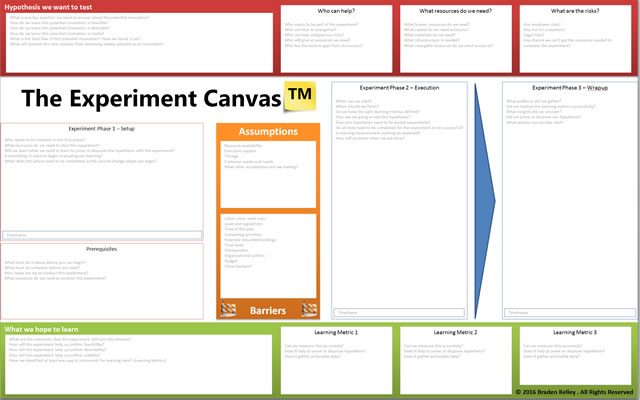
The Experiment Canvas

To help everyone accelerate their learning and to achieve better success in their human-centered innovation efforts, I will be creating and licensing a Human-Centered Innovation Toolkit™ to innovation consultants and practitioners around the world. I have been sharing early elements with my clients and I’m proud to be able to give you all a valuable taste of the kinds of tools that will be in this toolkit when it launches later this year by providing advance access to the first free download – The Experiment Canvas™. Designed to be used iteratively, and to quickly capture in a visual, collaborative way (in similar fashion the Change Planning Toolkit™).

Download The Experiment Canvas™ as a 35″x56″ scalable FREE PDF poster download

If you’re not clear on what the Change Planning Toolkit™ can do for you, please join me Thursday, June 8th at 9am PDT on Twitter for an Ask Me Anything (aka #AMA) session on the Change Planning Toolkit™ using the hashtag #cptoolkit and well, ask me anything!

A future #AMA on the Human-Centered Innovation Toolkit™ is coming soon too!

Innovation Audit from Braden Kelley

Subscribe to Human-Centered Change & Innovation WeeklySign up here to get Human-Centered Change & Innovation Weekly delivered to your inbox every week.
What is your level of Innovation Maturity?

Innovation Maturity Introduction

When it comes to innovation, no two companies are likely to be pursuing innovation in the same way, and they are also likely to be at different stages of innovation maturity. Because of this, even if you found out what your competitor’s innovation strategy was, it would be of no use to you. It is necessary for an innovation strategy to be tailored to your organization’s level of innovation maturity, your corporate strategy, and your innovation vision.

Free Innovation Maturity AssessmentAn organization’s innovation maturity level is important because you must first master a certain set of basic innovation capabilities before implementing more advanced innovation approaches into your strategy. For example, an organization just getting started on their innovation journey would be foolish to try and implement open innovation in their organization. Every organization should get their idea generation (including evolution), idea evaluation, and idea commercialization policies and processes working well with their employees first before opening themselves up to the outside world. Your organization’s innovation strategy must be appropriate to your level of innovation maturity for your innovation efforts to be successful.

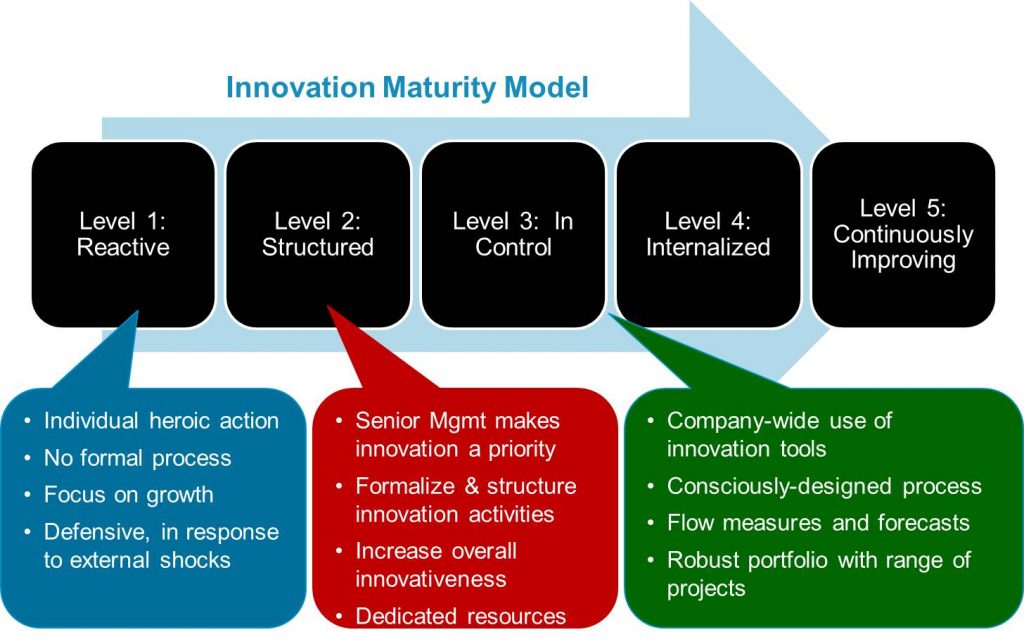
I developed the graphic below to explain the different levels of innovation maturity based on some thinking from Wharton professors Christian Terwiesch and Karl T. Ulrich, and I think it allows executives to determine at a glance where their organization is across the spectrum. I hope you find it useful.

Free Innovation Maturity Assessment

Special OfferTo help people evaluate their level of innovation maturity against the above graphic, I am sharing the 50 question innovation maturity assessment I use with clients. The assessment is most powerful when answers are gathered at multiple levels of the organization across several groups and several sites, but you can also fill it out yourself and get instant feedback – for FREE.

To get even more out of the innovation maturity assessment, for a nominal fee, I can help you organize a multiple group and/or multiple physical location survey of people in the organization to capture not just your level of innovation maturity, but also to provide preliminary innovation diagnostics on the areas of innovation challenge and opportunity in your organization.

I can set up a research study to capture a baseline innovation maturity level and analyze the data to unlock insights about the relative health of your innovation efforts. For a limited time, I will provide this service for the special introductory price of $499.99.

Click here to purchase the innovation diagnostic service
(Get help using the innovation maturity assessment across multiple sites and job functions and analyzing the results)

Innovation Maturity Model

Innovation Maturity Assessment Scoring Key (showing level of maturity)

Point totals are translated to the innovation maturity model as follows:

  • 000-100 = Level 1 – Reactive
  • 101-130 = Level 2 – Structured
  • 131-150 = Level 3 – In Control
  • 151-180 = Level 4 – Internalized
  • 181-200 = Level 5 – Continuously Improving

Click here to access the Innovation Maturity Assessment

Innovation Maturity Assessment Instructions

1. Read each statement and determine how much you agree with each one, using this scale:

  • 0 – None
  • 1 – A Little
  • 2 – Partially
  • 3 – Often
  • 4 – Fully

2. Select the answer for each question that is most appropriate.

The form will score the innovation maturity assessment and return a result to you via email along with the SCORING KEY and the Innovation Maturity Model graphic. Store the result as a baseline and come back annually and re-take the assessment to measure your progress!

Click here to access the Innovation Maturity Assessment

Click here to purchase the innovation diagnostic service
(Get help using the innovation maturity assessment across multiple sites and job functions and analyzing the results)

* Graphic adapted from the book Innovation Tournaments by Christian Terwiesch and Karl Ulrich

Subscribe to Human-Centered Change & Innovation WeeklySign up here to get Human-Centered Change & Innovation Weekly delivered to your inbox every week.

Measuring Organizational Agility – The Triple T Metric v1.0

Measuring Organizational Agility - The Triple T MetricThere is an increasing amount of chatter and confusion out there around what organizational agility is and feeling that it must be important to organizational success.

But, before we discuss organizational agility, it is important to define what we mean by the term.

BusinessDictionary.com has a decent definition:

“The capability of a company to rapidly change or adapt in response to changes in the market. A high degree of organizational agility can help a company to react successfully to the emergence of new competitors, the development of new industry-changing technologies, or sudden shifts in overall market conditions.”

Usually people begin speaking about organizational agility and its importance to the success of the organization when they speak about the increasing pace of change, and the challenge the organization faces in keeping up.

Because of this, one of the key measures of organizational agility you may want to consider using, I like to call the Triple T Metric:

Time
to
Transform

The Triple T Metric is a measure of how long it takes an organization to make a transformation. But to measure your progress on the Triple T Metric over time, you must define it and measure it in a consistent manner. So, if a transformation is like a trip from Point A to Point B, we must define Point A and Point B.

  • Point A = the point in time at which the organization recognizes a change is needed away from the steady state
  • Point B = the point in time at which the organization successfully arrives at the new steady state

You’ll notice that Point A doesn’t start at the point at which people AGREE that a change is needed and AGREE to make it, but at the point the organization RECOGNIZES a change is needed. This is because there is great opportunity to increase your organizational agility by increasing the speed at which the organization moves from recognizing the need for change, to agreeing to change, to planning the change, to executing the change.

This is just v1.0 of our discussion of the Triple T Metric, to introduce the concept. We’ll get into more detail in a future post.

All of these transitions must be included because organizational agility is ultimately about how quickly the organization can successfully plan, lead, and execute (manage and maintain) a change effort, increasing your organizational agility requires that you increase both your change capability and your change capacity.

How fast can your organization change?

If you want to learn how to change faster, and make your organization more agile, grab a copy of Charting Change and the supporting materials for book buyers!


Accelerate your change and transformation success

Subscribe to Human-Centered Change & Innovation WeeklySign up here to get Human-Centered Change & Innovation Weekly delivered to your inbox every week.
Innovation Quotes of the Day – April 30, 2012


“Albert Einstein wrote, ‘Everybody is a genius! But if you judge a fish by its ability to climb a tree, it will live its whole life believing that it is stupid!’
We are all capable of doing one thing better than any other person alive at this time in history!”

– Matthew Kelly


“In order for innovation to reliably happen at every level of the organization, it will be extremely useful for all members to have access to the voice of the customer.”

– Braden Kelley


“Imagination is not only the uniquely human capacity to envision that which is not, and therefore the fount of all invention and innovation. In its arguably most transformative and revelatory capacity, it is the power to that enables us to empathize with humans whose experiences we have never shared.”

– J.K. Rowling


What are some of your favorite innovation quotes?

Add one or more to the comments, listing the quote and who said it, and I’ll share the best of the submissions as future innovation quotes of the day!

Subscribe to Human-Centered Change & Innovation WeeklySign up here to get Human-Centered Change & Innovation Weekly delivered to your inbox every week.