I recently revisited a comment from one of my older posts on how to train and educate executives on innovation. It went something like this:
“Innovation requires time and drive to explore new vistas, so it’s understandable that busy employees can’t be bothered with it. The best approach is for senior managers to assign a team, giving them the time and resources to innovate.”
While I agree that dedicated innovation teams with the right resources are crucial, the notion that “busy employees can’t be bothered” with innovation is not just dangerous, it’s short-sighted.
If leaders believe innovation is only for a select few, it signals that innovation isn’t truly a priority. And in today’s fast-evolving landscape, companies that don’t prioritize innovation throughout their ranks are setting themselves up for stagnation.
Here are a few of my thoughts on the matter:
1. Innovation isn’t just for the few, it’s for everyone – strategically.
Not every employee needs to work on breakthrough innovation, but every employee should have the opportunity to contribute. Whether through idea portals, hackathons, or innovation challenges, businesses should create accessible ways for employees to share their ideas and build on others’.
2. Innovation should happen in the day-to-day.
Often, the best innovations come from employees focused on improving their immediate environment. This type of incremental innovation – refining processes, enhancing services, or finding small but impactful efficiencies – should happen at the business unit level. Meanwhile, dedicated teams can tackle more disruptive and higher-risk projects with a long-term payoff.
3. It’s time to re-frame innovation.
The term “innovation” has become vague and overused. Consider a term like “impact” as a way to shift the focus from concepts to tangible results. Impact is measurable and reflects the outcome, not just the process. After all, what matters isn’t innovation for its own sake, but the meaningful change it brings.
Finally, corporate innovation teams should shift their roles from doers to facilitators and integrators – empowering business units to innovate while connecting internal and external resources. Collaboration, both within and outside the organization, accelerates innovation, increasing diversity of thought and speeding up results.
Scaling innovation across the company is a collective effort, not a siloed one.
What’s your take on this?
Image Credits: Pexels
Sign up here to get Human-Centered Change & Innovation Weekly delivered to your inbox every week.
At the beginning of each month, we will profile the ten articles from the previous month that generated the most traffic to Human-Centered Change & Innovation. Did your favorite make the cut?
But enough delay, here are April’s ten most popular innovation posts:
If you’re not familiar with Human-Centered Change & Innovation, we publish 4-7 new articles every week built around innovation and transformation insights from our roster of contributing authors and ad hoc submissions from community members. Get the articles right in your Facebook, Twitter or Linkedin feeds too!
Have something to contribute?
Human-Centered Change & Innovation is open to contributions from any and all innovation and transformation professionals out there (practitioners, professors, researchers, consultants, authors, etc.) who have valuable human-centered change and innovation insights to share with everyone for the greater good. If you’d like to contribute, please contact me.
P.S. Here are our Top 40 Innovation Bloggers lists from the last four years:
For those of us working in the innovation and change field, it is hard to overstate the value and importance of AI. It opens doors, that were, for me at least, barely imaginable 10 years ago. And for someone who views analogy, crossing expertise boundaries, and the reapplication of ideas across domains as central to innovation, it’s hard to imagine a more useful tool.
But it is still a tool. And as with any tool, leaning it’s limitations, and how to use it skillfully is key. I make the analogy to an automobile. We don’t need to know everything about how it works, and we certainly don’t need to understand how to build it. But we do need to know what it can, and cannot do. We also need to learn how to drive it, and the better our driving skills, the more we get out of it.
AI, the Idiot Savant? An issue with current AI is that it is both intelligent and stupid at the same time (see Yejin Chois excellent TED talk that is attached). It has phenomenal ‘data intelligence’, but can also fail on even simple logic puzzles. Part of the problem is that AI lacks ‘common sense’ or the implicit framework that filters a great deal of human decision making and behavior. Chois calls this the ‘dark matter’ common sense of decision-making. I think of it as the framework of knowledge, morality, biases and common sense that we accumulate over time, and that is foundational to the unconscious ‘System 1’ elements that influence many, if not most of our decisions. But whatever we call it, it’s an important, but sometimes invisible and unintuitive part of human information processing that is can be missing from AI output.
Of course, AI is far from being unique in having limitations in the quality of its output. Any information source we use is subject to errors. We all know not to believe everything we read on the internet. That makes Google searches useful, but also potentially flawed. Even consulting with human experts has pitfalls. Not all experts agree, and even to most eminent expert can be subject to biases, or just good old fashioned human error. But most of us have learned to be appropriately skeptical of these sources of information. We routinely cross-reference, challenge data, seek second opinions and do not simply ‘parrot’ the data they provide.
But increasingly with AI, I’ve seen a tendency to treat its output with perhaps too much respect. The reasons for this are multi-faceted, but very human. Part of it may be the potential for generative AI to provide answers in an apparently definitive form. Part may simply be awe of its capabilities, and to confuse breadth of knowledge with accuracy. Another element is the ability it gives us to quickly penetrate areas where we may have little domain knowledge or background. As I’ve already mentioned, this is fantastic for those of us who value exploring new domains and analogies. But it comes with inherent challenges, as the further we step away from our own expertise, the easier it is for us to miss even basic mistakes.
As for AI’s limitations, Chois provides some sobering examples. It can pass a bar exam, but can fail abysmally on even simple logic problems. For example, it suggests building a bridge over broken glass and nails is likely to cause punctures! It has even suggested increasing the efficiency of paperclip manufacture by using humans as raw materials. Of course, these negative examples are somewhat cherry picked to make a point, but they do show how poor some AI answers can be, and how they can be low in common sense. Of course, when the errors are this obvious, we should automatically filter them out with our own common sense. But the challenge comes when we are dealing in areas where we have little experience, and AI delivers superficially plausible but flawed answers.
Why is this a weak spot for AI? At the root of this is that implicit knowledge is rarely articulated in the data AI scrapes. For example, a recipe will often say ‘remove the pot from the heat’, but rarely says ‘remove the pot from heat and don’t stick your fingers in the flames’. We’re supposed to know that already. Because it is ‘obvious’, and processed quickly, unconsciously and often automatically by our brains, it is rarely explicitly articulated. AI, however, cannot learn what is not said. And so because we don’t tend to state the obvious, it can make it challenging for an AI to learn it. It learns to take the pot off of the heat, but not the more obvious insight, which is to avoid getting burned when we do so.
This is obviously a known problem, and several strategies are employed to help address it. These include manually adding crafted examples and direct human input into AI’s training. But this level of human curation creates other potential risks. The minute humans start deciding what content should and should not be incorporated, or highlighted into AI training, the risk of transferring specific human biases to that AI increase. It also creates the potential for competing AI’s with different ‘viewpoints’, depending upon differences in both human input and the choices around what data-sets are scraped. There is a ‘nature’ component to the development of AI capability, but also a nurture influence. This is of course analogous the influence that parents, teachers and peers have on the values and biases of children as they develop their own frameworks.
But most humans are exposed to at least some diversity in the influences that shape their decision frameworks. Parents, peers and teachers provide generational variety, and the gradual and layered process that builds the human implicit decision framework help us to evolve a supporting network of contextual insight. It’s obvious imperfect, and the current culture wars are testament to some profound differences in end result. But to a large extent, we evolve similar, if not identical common sense frameworks. With AI, the narrower group contributing to curated ‘education’ increases the risk of both intentional and unintentional bias, and of ‘divergent intelligence’.
What Can We do? The most important thing is to be skeptical about AI output. Just because it sounds plausible, don’t assume it is. Just as we’d not take the first answer on a Google search as absolute truth, don’t do the same with AI. Ask it for references, and check them (early iterations were known to make up plausible looking but nonsense references). And of course, the more important the output is to us, the more important it is to check it. As I said at the beginning, it can be tempting to take verbatim output from AI, especially if it sounds plausible, or fits our theory or worldview. But always challenge the illusion of omnipotence that AI creates. It’s probably correct, but especially if its providing an important or surprising insight, double check it.
The Sci-Fi Monster! The concept of a childish super intelligence has been explored by more than one Science Fiction writer. But in many ways that is what we are dealing with in the case of AI. It’s informational ‘IQ’ is greater than the contextual or common sense ‘IQ’ , making it a different type of intelligence to those we are used to. And because so much of the human input side is proprietary and complex, it’s difficult to determine whether bias or misinformation is included in its output, and if so, how much? I’m sure these are solvable challenges. But some bias is probably unavoidable the moment any human intervention or selection invades choice of training materials or their interpretation. And as we see an increase in copyright law suits and settlements associated with AI, it becomes increasingly plausible that narrowing of sources will result in different AI’s with different ‘experiences’, and hence potentially different answers to questions.
AI is an incredible gift, but like the three wishes in Aladdin’s lamp, use it wisely and carefully. A little bit of skepticism, and some human validation is a good idea. Something that can pass the bar, but that lacks common sense is powerful, it could even get elected, but don’t automatically trust everything it says!
Image credits: Pexels
Sign up here to join 17,000+ leaders getting Human-Centered Change & Innovation Weekly delivered to their inbox every week.
The creative industries are experiencing a transformation, thanks to artificial intelligence (AI) tools that enhance productivity, spark innovation, and expand creative possibilities. From content creation to design, AI-powered tools are reshaping the way artists, designers, and thinkers work. This article explores these advancements, featuring real-world case studies that illustrate the impact of AI on creative processes.
The Rise of AI in Creative Processes
AI is equipped to handle tasks that traditionally required significant human effort, such as pattern recognition and data analysis. However, its influence on creativity isn’t about replacing human artistry—it’s about augmenting it. AI can handle repetitive tasks, allowing creatives to focus on what they do best: innovating and ideating.
Case Study 1: AI in Music Composition
AI Platform: AIVA (Artificial Intelligence Virtual Artist)
AIVA is an AI-based composer that’s been used by artists and musicians around the world to enhance and inspire music production. Trained on a wide range of classical compositions, AIVA can create original scores and suggest enhancements to existing compositions. By iterating with composers, AIVA helps create music that resonates emotionally with audiences.
Outcome: AIVA was employed in film scoring, leading to a fusion of human creativity and AI precision. Composers reported a 30% reduction in time spent on initial drafts, allowing more time to focus on intricacy and expression.
Tools Transforming the Industry
Beyond music, AI tools are influencing numerous sectors within creative industries. They provide everything from generative design and content curation to audience engagement analytics. Let’s explore another example where AI tools have significantly impacted creativity.
Case Study 2: AI in Graphic Design
AI Platform: Adobe Sensei
Adobe Sensei uses AI to boost productivity and creativity for graphic designers by automating mundane tasks such as object detection and layering. Designers can create more complex visuals in less time with AI assistance. Tools like Adobe’s “Content-Aware Fill” leverage AI algorithms to enhance or alter images seamlessly.
Outcome: A marketing agency integrated Adobe Sensei into their workflow, reducing their design time for digital advertising campaigns by 40%. Designers reported feeling less creatively fatigued, leading to a rise in innovative concepts and overall client satisfaction.
Conclusion
Artificial intelligence has carved out an invaluable role within the creative industries, not as a replacement, but as a powerful ally. The potential for AI to enhance creative output lies in its ability to handle intensive tasks, providing creatives with the freedom to push boundaries. As AI continues to evolve, so too will the possibilities for innovation, ensuring that the marriage between human creativity and machine precision leads to exciting new frontiers.
Extra Extra: Because innovation is all about change, Braden Kelley’s human-centered change methodology and tools are the best way to plan and execute the changes necessary to support your innovation and transformation efforts — all while literally getting everyone all on the same page for change. Find out more about the methodology and tools, including the book Charting Change by following the link. Be sure and download the TEN FREE TOOLS while you’re here.
Image credit: Microsoft CoPilot
Sign up here to get Human-Centered Change & Innovation Weekly delivered to your inbox every week.
In today’s fast-paced world, organizations must be agile and adaptive to remain competitive. Central to this adaptability is the ability to track and manage innovation effectively. Various tools and software platforms have been developed to help organizations manage the complexity of innovation processes, from ideation to implementation. This article will explore some of these tools, illustrating how they can be applied to real-world scenarios through case studies.
1. Understanding Innovation Tracking
Innovation tracking involves monitoring the development and implementation of new ideas within an organization. This process can include capturing inspiration, managing projects, and measuring impact. With a robust tracking system, teams can ensure alignment with strategic goals and demonstrate progress to stakeholders.
2. Essential Tools for Innovation Tracking
Several tools have emerged as leaders in innovation tracking due to their comprehensive features and user-friendly interfaces. Some of these include:
Idea Management Software: Platforms like Spigit, Brightidea, and IdeaScale help collect, evaluate, and prioritize innovative ideas from employees and stakeholders.
Project Management Tools: Tools such as Trello, Asana, and Monday.com support teams in managing tasks and workflows associated with innovation projects.
Data Analytics Platforms: Using platforms like Tableau and Power BI can help teams analyze and visualize innovation performance data.
3. Case Studies
Case Study 1: Johnson & Johnson’s Use of Brightidea
Johnson & Johnson (J&J), a global healthcare leader, faced the challenge of managing innovation across its vast network of employees. To streamline this process, J&J adopted Brightidea, an idea management platform that enables employees to submit, discuss, and evaluate new ideas.
“The introduction of Brightidea has transformed the way we approach innovation. By allowing employees at all levels to contribute, we’ve seen a dramatic increase in both the quality and quantity of ideas brought forward,” – Director of Innovation at Johnson & Johnson.
Brightidea facilitated the capturing of ideas from over 60,000 employees. By prioritizing ideas that align with strategic goals, Johnson & Johnson can efficiently allocate resources and develop new products that meet market needs. The platform’s intuitive interface and comprehensive analytics tools provide insights, enabling J&J to track the progress and impact of each innovation initiative.
Case Study 2: Trello and Power BI at XYZ Corporation
XYZ Corporation, a mid-sized tech company, struggled with fragmented innovation processes causing misalignment and delayed project timelines. By integrating Trello for project management and Power BI for analytics, XYZ significantly enhanced its innovation tracking capabilities.
“Utilizing Trello and Power BI has brought unprecedented visibility and efficiency to our innovation efforts, aligning teams and accelerating time-to-market,” – Innovation Program Manager at XYZ Corporation.
The Kanban-style interface of Trello allowed teams to manage tasks more effectively, improving collaboration and reducing project bottlenecks. Meanwhile, Power BI enabled the aggregation of project data for detailed analysis and reporting. As a result, XYZ Corporation could track performance metrics in real-time, gain insightful data-driven decisions, and optimize innovation strategies for greater success.
Conclusion
In conclusion, tracking innovation is an essential component for organizations seeking to maintain competitive advantage. By leveraging the right tools, businesses can cultivate a robust culture of innovation, ensuring ideas are nurtured from conception to implementation. Whether it’s through idea management platforms, project management software, or analysis tools, the right technology can empower organizations to remain agile and innovative in a dynamic market.
Bottom line: Futurology is not fortune telling. Futurists use a scientific approach to create their deliverables, but a methodology and tools like those in FutureHacking™ can empower anyone to engage in futurology themselves.
Image credit: Pixabay
Sign up here to get Human-Centered Change & Innovation Weekly delivered to your inbox every week.
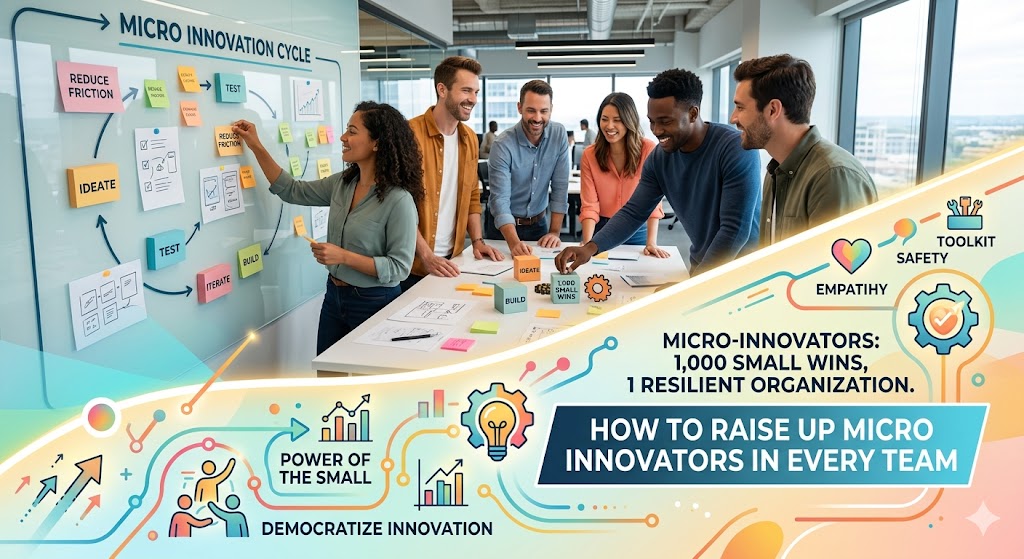
In many organizations, innovation is often mistakenly viewed as a monolithic event — a “Big Bang” disruption or a revolutionary product launch orchestrated by a specialized R&D department. This perspective creates a “Lone Genius” myth that inadvertently sidelines the vast majority of the workforce. To build a truly resilient, human-centered organization, we must shift our focus toward Micro-Innovation.
The Innovation Fallacy
Relying solely on top-down, high-stakes initiatives leaves an organization vulnerable to market shifts and internal stagnation. When innovation is cordoned off, the “frozen middle” and frontline staff become passive executioners of tasks rather than active problem solvers. This creates a gap between corporate strategy and the daily reality of customer friction.
Defining the Micro-Innovator
A Micro-Innovator is an individual — regardless of their job title — who applies a continuous improvement lens to their immediate sphere of influence. They are the team members who:
Identify “paper cuts” (small, recurring frustrations) in daily workflows.
Develop “workarounds” that eventually become more efficient than the standard process.
Utilize existing tools in novel ways to save time or enhance Experience Level Measures (XLMs).
The Cumulative Effect: 1,000 Small Wins
While a single disruptive pivot is rare and risky, the cumulative impact of 1,000 small improvements is profound. Micro-innovation acts as the “compound interest” of organizational change. By empowering every team member to fix what is broken in their own world, we move from a culture of “that’s not my job” to a culture of Infinite Innovation.
“Innovation is not a department; it is a fundamental human capability that thrives when we give people the agency to improve their own day-to-day reality.”
Phase 1: Creating Psychological Safety (The Foundation)
Before a single idea can be voiced, a team must feel that the environment is “innovation-ready.” Without psychological safety, the risk of looking foolish or being penalized for a failed experiment will always outweigh the potential benefit of a new idea. Raising up micro-innovators requires a foundational shift in how leadership perceives and reacts to the unknown.
Eliminating the “Cost of Failure”
In many corporate cultures, failure is a line item to be avoided at all costs. To foster micro-innovation, we must rebrand “failure” as Learning Cycles. When a team member attempts a small process improvement that doesn’t work, the post-mortem should not be a search for blame, but a quest for data. By lowering the stakes of these small-scale tests, we encourage more frequent “at-bats,” which statistically leads to more “home runs.”
The Permission to Question: Standard Operating Curiosity
Micro-innovation begins when a team member asks, “Why do we do it this way?” Leaders must move from being “The Answer Person” to “The Chief Questioner.” If a process exists simply because “that’s how we’ve always done it,” it is ripe for a human-centered redesign. Encouraging this curiosity — and rewarding it even when it challenges existing norms — is the spark that ignites the innovation bonfire.
The Human-Centered Lens: Empathy as an Engine
True innovation isn’t just about technology; it’s about people. We empower micro-innovators when we teach them to look at their workflows through a lens of empathy. This means asking:
“How does this step make my colleague’s job harder?”
“Where is the customer feeling friction that we’ve become blind to?”
“What small change would make our internal experience more fluid?”
When the goal is to reduce frustration for another human being, the motivation for innovation becomes intrinsic rather than mandated. This empathy-led approach ensures that micro-innovations are meaningful, not just “change for the sake of change.”
Insight: A leader’s most powerful tool for psychological safety is vulnerability. By sharing your own failed experiments and what you learned from them, you give your team the “air cover” they need to take their own risks.
Phase 3: Building the “Innovation Toolkit”
Empowerment without tools is merely a suggestion. To move from “permission to innovate” to “capability to innovate,” we must provide teams with a structured yet lightweight framework. The goal isn’t to turn every employee into a full-time designer, but to give them the mental models needed to navigate the journey from a problem to a solution.
Simplified Frameworks: The Eight I’s of Infinite Innovation
Micro-innovation thrives when there is a shared language. While high-level strategy might require deep dives, team-level innovation can be driven by a simplified version of the Eight I’s of Infinite Innovation. By focusing on the first few stages — Inspiration, Ideation, and Investigation — teams can quickly vet their own ideas before they ever reach a manager’s desk. This “Self-Vetting” reduces administrative drag and keeps the momentum high.
The 15-Minute Friction Audit
Innovation often fails because people feel they “don’t have time” for it. We must integrate discovery into the flow of work. A 15-Minute Friction Audit is a simple weekly practice where teams identify:
Redundancies: Where are we entering the same data twice?
Bottlenecks: Where is a process waiting for a “rubber stamp” that adds no value?
Shadow Work: What “workarounds” have we created that should actually be the standard process?
Resource Micro-Dosing: The 10% Rule
You cannot mandate innovation while simultaneously demanding 100% utilization of every minute of the workday. Resource Micro-Dosing involves carving out small, protected windows of time — such as “10% time” or “Innovation Fridays”—where the focus shifts from execution to evolution. This isn’t “free time”; it is “focused time” dedicated specifically to testing the hypotheses generated during the friction audits.
The Micro-Innovation Loop
Teach your teams this three-step mental model for any new idea:
Empathize: Who is hurting because of this current process?
Experiment: What is the smallest, cheapest way we can test an alternative?
Evaluate: Did the change improve our Experience Level Measures (XLMs) or just move the problem elsewhere?
By providing these tools, you transform innovation from a mysterious “spark” into a repeatable, democratic process that belongs to everyone.
Phase 4: From Ideation to Implementation
The graveyard of corporate culture is filled with “great ideas” that never transitioned into action. To raise up micro-innovators, we must bridge the gap between thinking and doing. This phase is about velocity — moving an idea from a team member’s head into a tangible test as quickly and cheaply as possible.
Low-Fidelity Prototyping: The “Paper and Tape” Solution
One of the biggest barriers to micro-innovation is the belief that every solution requires a software update or a budget line item. We must encourage Low-Fidelity Prototyping. If a team thinks a new form layout will work better, they should mock it up in a document or on a whiteboard first. By using “paper and tape” solutions, teams can iterate five times in a afternoon rather than waiting five months for a technical requirement document to be approved.
The Peer Review Loop: Socializing the Spark
Micro-innovation should not happen in a vacuum. Establishing a Peer Review Loop — such as a bi-weekly “Show and Tell” or a digital “Win Wall” — creates a culture of shared learning. When Team A shows how they automated a manual spreadsheet task, Team B often realizes they can apply a similar logic to their own workflow. This social proof validates the innovator and spreads the innovation naturally through the organization.
Scaling the Micro: Identifying Global Potential
Not every micro-innovation stays “micro.” A core responsibility of leadership is to act as a talent and idea scout. When a small-scale fix shows significant improvement in Experience Level Measures (XLMs), it should be evaluated for wider adoption. We must ask:
“Is this a localized fix, or does it solve a systemic pain point?”
“What happens to the workflow if we export this to three other departments?”
“Does this micro-innovation align with our broader Digital Transformation roadmap?”
The “Micro-to-Macro” Checklist
Before scaling a team-level innovation, ensure it meets these three criteria:
Portability: Can the solution function without the specific “hero” who created it?
Simplicity: Does it reduce complexity for the end-user, or just shift the burden?
Measurability: Can we prove it saved time, reduced errors, or improved the human experience?
By focusing on rapid implementation and deliberate scaling, you transform your teams from passive observers into an active, distributed R&D engine.
Phase 5: Recognition and Rewards (Beyond the Financial)
To sustain a culture of micro-innovation, we must move beyond the transactional. Traditional “suggestion box” bonuses often fail because they treat innovation as a one-off lottery win. Instead, we must focus on Human-Centered Recognition — acknowledging the intrinsic value of an individual’s contribution to the team’s collective success.
Visibility Over Incentives: The Power of Social Proof
While a small bonus is appreciated, visibility is often a more potent driver of long-term behavior. When a micro-innovator’s “workaround” or process improvement is highlighted in a company-wide meeting or a digital “Win Wall,” it signals to the entire organization that curiosity is a valued currency. This public validation transforms the innovator from a “rule-breaker” into a “pathfinder.”
Career Pathing: Innovation as a Core Competency
We must stop viewing innovation as an “extra-curricular” activity. True micro-innovation thrives when it is baked into the Performance Review process for every role — from administrative assistants to senior engineers. By measuring and rewarding the ability to identify and solve friction, we ensure that our best problem solvers are the ones who ascend the leadership ladder. We should ask during reviews:
“What processes did you challenge and improve this quarter?”
“How did you use your 10% time to enhance the team’s efficiency?”
“Who did you mentor or help to implement a micro-innovation?”
The “Innovation Bonfire” Effect: Creating Heat and Light
In the Eight I’s of Infinite Innovation, the final stages involve scaling and sustaining. Celebrating small wins creates “heat” (momentum) and “light” (clarity of purpose). This environment naturally attracts top talent — people want to work where they have the agency to make an impact. This cultural shift creates a self-sustaining loop where the organization no longer needs to “force” change; change becomes the natural byproduct of the environment.
The Micro-Innovation Reward Matrix
Reward Type
Example Action
Impact on Culture
Autonomy
Granting more time to work on a pet project.
Increases trust and ownership.
Access
Invitation to present the idea to senior leadership.
Builds confidence and breaks silos.
Advocacy
Using the micro-innovation as a case study for the department.
Validates the effort and encourages peers.
When you reward the behavior of innovation rather than just the outcome, you build a resilient team capable of navigating any disruption. You aren’t just rewarding a fix; you are rewarding the mindset of a micro-innovator.
VI. Conclusion: The Infinite Innovation Organization
To raise up micro-innovators is to perform the ultimate act of Human-Centered Leadership. It requires moving away from the “Command and Control” structures of the past — where a few people think and everyone else executes — toward a “Curate and Coach” model. In this new reality, the leader’s job is to clear the path, provide the tools, and then get out of the way.
The Shift in Leadership: From Gatekeeper to Facilitator
In a traditional hierarchy, a leader is a gatekeeper who protects the status quo. In an Infinite Innovation organization, the leader is a facilitator who protects the experiment. This shift requires humility; it means acknowledging that the person closest to the friction — the frontline worker, the junior analyst, the customer service rep — is often the one best equipped to solve it.
Final Call to Action: The Power of One
Building a culture of micro-innovation does not require a massive budget or a three-year roadmap. It starts with The Power of One:
One Team: Choose a single group to pilot these concepts.
One Friction Point: Ask them to identify one small thing that makes their job harder than it needs to be.
One Week: Give them the permission and the 15 minutes of “air cover” to test a solution.
Closing Thought: Resilience Through Participation
When everyone in your organization is empowered as a micro-innovator, change is no longer a threat to be managed; it is an opportunity to be seized. You stop being a company that reacts to disruption and start being a company that drives it from the bottom up. By raising up micro-innovators, you aren’t just improving your workflows — you are honoring the creative potential of every human being on your team.
The Micro-Innovator’s Manifesto: I see the friction. I have the tools. I have the safety. I will make it better.
Frequently Asked Questions
What is the difference between Micro-Innovation and Continuous Improvement?
While both aim for better efficiency, Micro-Innovation focuses specifically on the human-centered agency of the individual. It empowers employees to challenge the “why” behind their tasks and use creative problem-solving to reduce friction, rather than just following a top-down efficiency mandate.
How do I measure the success of micro-innovation?
Success is best measured through Experience Level Measures (XLMs) rather than just traditional KPIs. Look for a reduction in “shadow work,” an increase in employee engagement scores, and a decrease in recurring friction points reported by frontline teams.
Does micro-innovation require a dedicated budget?
No. The hallmark of a micro-innovation is that it is low-fidelity and low-cost. Most improvements come from repurposing existing tools, shifting meeting structures, or clarifying communication — requiring “resource micro-dosing” of time rather than a capital expenditure.
Image credit: Google Gemini
Sign up here to get Human-Centered Change & Innovation Weekly delivered to your inbox every week.

 Sign up here to get Human-Centered Change & Innovation Weekly delivered to your inbox every week.
 Drum roll please…