Tag Archives: agile

Introduction to Agile: Principles and Practices

Introduction to Agile: Principles and Practices

GUEST POST from Chateau G Pato

What is Agile?

Agile is not just a methodology, but a holistic approach to project management and software development. It emphasizes flexibility, collaboration, and rapid iteration. The core of Agile lies in its set of principles and practices designed to advance productivity and responsiveness to changing customer needs.

The Core Principles of Agile

  1. Customer Satisfaction through Early and Continuous Delivery: Deliver valuable software frequently, with a preference for shorter timescales.
  2. Welcome Changing Requirements: Even late in the development process, Agile processes harness change for the customer’s competitive advantage.
  3. Deliver Working Software Frequently: Prefer shorter timescales from a couple of weeks to a couple of months.
  4. Collaborate Daily with Business People and Developers: Ensure a close, daily cooperation between business stakeholders and developers.
  5. Build Projects around Motivated Individuals: Provide support and trust to the team, allowing them to get the job done.
  6. Face-to-Face Conversation: The most efficient method of conveying information to and within a development team is direct communication.
  7. Working Software is the Primary Measure of Progress: Focus on functional software to gauge how well the project is advancing.
  8. Maintain a Sustainable Pace: Agile processes promote sustainable development — the team should maintain a constant pace indefinitely.
  9. Continuous Attention to Technical Excellence: Enhances agility by focusing on good design and technical details.
  10. Simplicity is Essential: Maximize the amount of work not done, which is important.
  11. Self-Organizing Teams: The best architectures, requirements, and designs emerge from self-organizing teams.
  12. Regular Reflection and Adjustment: Periodically, the team reflects on how to become more effective and adjusts their behavior accordingly.

Case Study 1: Pixar’s Agile Film Making

Many might be familiar with Agile in software development, but Pixar, a leading animation studio, has effectively applied Agile principles in film making. Pixar’s process is not linear. Instead, they iterate on pieces of the film, from storyboarding to final animation, with constant feedback loops.

One key Agile principle Pixar uses is “early and continuous delivery of valuable increments.” This is evident where they focus on delivering short, rough sequences of the film for team and stakeholder review. These rough animations, or ‘reels,’ are iterated upon until the final movie emerges. Pixar also promotes a culture where it’s safe to fail early, as their focus is on rapid prototyping and feedback cycles.

Case Study 2: Spotify and Agile Scaling

Spotify, the global music streaming service, provides a stunning showcase of scaling Agile. Instead of traditional teams, Spotify uses “squads” — small, cross-functional, and self-organizing teams. Each squad operates much like a mini-startup, with accountability for a particular aspect of the service.

Spotify has scaled Agile by structuring squads into Tribes, which work on related areas of the service, allowing for collaboration and alignment. Governance is decentralized, and autonomy is high, which aligns with the Agile principle of self-organizing teams. Another critical aspect is Spotify’s use of “guilds” — groups of individuals with shared interests spanning across different squads, facilitating knowledge sharing and continuous improvement across the organization.

Agile Practices to Implement

Below are several Agile practices to consider implementing in your organization:

  • User Stories: Captures requirements from the perspective of the end-user.
  • Sprint Planning: Prioritize and plan work in time-boxed iterations.
  • Daily Stand-ups: Short, focused meetings to synchronize the team and address obstacles.
  • Sprint Reviews: Demonstrate and inspect the product after each iteration.
  • Retrospectives: Reflect on the process to identify improvements.
  • Kanban Boards: Visualize workflow and limit work in progress to optimize efficiency.

Conclusion

The adoption of Agile introduces a paradigm shift in how teams approach project management and execution. By embracing its principles and practices, organizations can enhance flexibility, foster innovation, and better respond to evolving customer needs. The case studies of Pixar and Spotify illustrate the versatile application of Agile across different domains, highlighting its potential to drive success whether in film making or global software services.

SPECIAL BONUS: The very best change planners use a visual, collaborative approach to create their deliverables. A methodology and tools like those in Change Planning Toolkit™ can empower anyone to become great change planners themselves.

Image credit: Pixabay

Subscribe to Human-Centered Change & Innovation WeeklySign up here to get Human-Centered Change & Innovation Weekly delivered to your inbox every week.

Building Resilient Organizations

Strategies for Designing Agile and Resilient Organizations that can Effectively Navigate Industry Disruptions

Building Resilient Organizations

GUEST POST from Chateau G Pato

In today’s fast-paced and ever-evolving business landscape, organizations face continuous disruptions that challenge their ability to remain competitive and thrive. To navigate these disruptions successfully, organizations must prioritize resilience and agility. By designing resilient organizations that can adapt and respond effectively, leaders can better position their businesses to weather industry disruptions and emerge stronger. In this article, we will explore strategies that can help build agile and resilient organizations, showcasing two compelling case studies that demonstrate their practical application.

1. Embracing a Culture of Adaptability:

A resilient organization begins with a resilient culture. Companies that foster a mindset of adaptability and continuous learning are better equipped to navigate industry disruptions. Organizations must first assess their current culture and identify areas in need of improvement. By encouraging innovation, risk-taking, and employee empowerment, businesses can build an environment that promotes flexibility and agility.

Case Study 1: Netflix

Netflix, originally a DVD rental service, recognized the shift in consumer behavior towards streaming services. Instead of resisting the change, Netflix embraced the disruption by evolving into a leading provider of online content. By prioritizing adaptability and empowering employees to experiment and take risks, Netflix capitalized on the opportunity to transform its business model, ultimately becoming one of the most influential disruptors in the entertainment industry.

2. Developing Robust Strategic Planning:

Strategic planning is essential for building resilient organizations. Effective planning allows businesses to anticipate disruptions, make proactive decisions, and quickly adapt to market shifts. Organizations must be willing to challenge conventional thinking, explore alternative scenarios, and foster an environment that supports experimentation.

Case Study 2: Amazon

Amazon’s journey from an online bookstore to a global retail giant serves as a testament to the company’s strategic planning capabilities. Amazon consistently invests in innovation, technology, and supply chain optimization to maintain a competitive edge. By staying ahead of industry disruptions, Amazon successfully integrated new business models like marketplace platforms and cloud computing, ensuring long-term sustainability.

3. Building Collaborative Networks:

In an increasingly interconnected business world, organizations cannot thrive in isolation. Resilient organizations actively cultivate partnerships, collaborations, and networks that allow them to leverage shared knowledge, resources, and expertise. Building strong relationships with suppliers, customers, and industry players fosters resilience by enhancing access to valuable information and enabling collaboration during times of disruption.

Conclusion

Building resilient organizations is vital to navigating industry disruptions successfully. By embracing a culture of adaptability, establishing robust strategic planning processes, and cultivating collaborative networks, businesses can enhance their resilience and fortify their ability to thrive amid uncertainty. The case studies of Netflix and Amazon exemplify these strategies’ effectiveness, showcasing how organizations that prioritize agility and resilience can not only survive but also lead industry disruptions. By leveraging these approaches, organizations can position themselves as catalysts for positive change and build a future-ready business ecosystem.

SPECIAL BONUS: The very best change planners use a visual, collaborative approach to create their deliverables. A methodology and tools like those in Change Planning Toolkit™ can empower anyone to become great change planners themselves.

Image credit: Pixabay

Subscribe to Human-Centered Change & Innovation WeeklySign up here to get Human-Centered Change & Innovation Weekly delivered to your inbox every week.

Change Leadership for Agile Organizations

Adapting to Rapid Change

Change Leadership for Agile OrganizationsGUEST POST from Art Inteligencia

In today’s complex and unpredictable business landscape, change has become a constant rather than an exception. Agile organizations that embrace change and adapt rapidly are more likely to succeed in an increasingly dynamic marketplace. However, achieving agility requires effective change leadership that empowers employees, aligns organizational values, and ensures seamless transitions. In this thought leadership article, we will explore the principles of change leadership for agile organizations through the analysis of two compelling case studies.

Case Study 1: Spotify’s Agile Transformation

In recent years, Spotify, the global music streaming giant, underwent a profound transformation to embrace agile practices and foster a culture of innovation. Their shift from a traditional hierarchical structure to a “tribe-squad-CT” model empowered autonomous cross-functional teams. Top management encouraged experimentation, where squads were free to take calculated risks and learn from failures. This cultural shift required strong change leadership that aligned the organization and inspired employees to embrace change.

Spotify’s change leaders focused on three core aspects:

1. Communicating a Compelling Vision: Leaders articulated a compelling vision that emphasized the need for agility and explained how it aligned with the organization’s strategic goals. They emphasized the benefits of empowerment, collaboration, and adaptability, ensuring that employees felt a sense of purpose and understood the value of change.

2. Nurturing Change Agents: Change leaders identified, trained, and empowered change agents within the organization. These agents served as advocates, mentors, and facilitators of change, supporting their respective teams through the transition. By creating a network of change agents, Spotify established a grassroots movement that accelerated the adoption of agile principles and practices.

3. Encouraging Continuous Learning: Recognizing that agility requires continuous learning, Spotify’s change leaders established a learning-oriented culture. They encouraged employees to embrace experimentation, learn from failures, and share their experiences. This created an environment that fostered innovation, collaboration, and rapid adaptation to change.

The successful transformation of Spotify showcases the effectiveness of change leadership in enabling organizational agility.

Case Study 2: Toyota’s Lean Manufacturing Revolution

Toyota’s journey towards becoming a global leader in automotive manufacturing is a testament to the power of change leadership in fostering agility. In the 1950s, Toyota faced significant challenges, including a resource-constrained post-war economy. They responded by developing the groundbreaking Toyota Production System (TPS), which revolutionized manufacturing processes and established the foundation for lean manufacturing.

Toyota’s change leadership approach encompassed the following elements:

1. Empowering Frontline Employees: Change leaders at Toyota recognized the value of frontline employees’ expertise. They empowered workers to identify and solve problems, emphasizing the importance of continuous improvement. This empowered culture fostered a sense of ownership, creating an environment where employees actively contributed to adapting to rapid changes and driving innovation.

2. Embracing Kaizen: Toyota’s change leaders popularized the Kaizen philosophy of continual improvement throughout the organization. They facilitated cross-functional collaboration and encouraged employees to seek incremental improvements in their work processes. This focus on Kaizen nurtured a culture of proactive responsiveness to change, benefitting not only the production line but the entire organization.

3. Leadership through Servant Mentality: Toyota’s change leaders assumed a servant leadership mentality, seeking to serve and support employees rather than commanding them. Leaders actively listened to the concerns and ideas of employees and provided the necessary resources and guidance to implement change.

By implementing these change leadership principles, Toyota transformed into an agile organization capable of rapidly adapting to shifting consumer demands and market conditions.

Conclusion

Change leadership is the catalyst for agility in organizations navigating rapid change. The case studies of Spotify and Toyota demonstrate how effective change leadership enables organizational adaptability, fosters a culture of innovation, and empowers employees to embrace and drive change. By communicating a compelling vision, nurturing change agents, encouraging continuous learning, empowering frontline employees, embracing Kaizen, and practicing servant leadership, organizations can pave the way for successful transformations in an increasingly volatile business environment. Embracing change leadership is the key to thriving in the face of rapid change.

Bottom line: Futurology is not fortune telling. Futurists use a scientific approach to create their deliverables, but a methodology and tools like those in FutureHacking™ can empower anyone to engage in futurology themselves.

Image credit: Pixabay

Subscribe to Human-Centered Change & Innovation WeeklySign up here to get Human-Centered Change & Innovation Weekly delivered to your inbox every week.

Designing an Innovation Lab: A Step-by-Step Guide

Designing an Innovation Lab: A Step-by-Step Guide

GUEST POST from Art Inteligencia
Innovation has become a driving force for organizations looking to adapt and thrive in an ever-changing business landscape. To foster a culture of creativity and problem-solving, many companies are now investing in innovation labs. These dedicated spaces provide employees with the tools, processes, and environment necessary to drive impactful change. This article aims to present a step-by-step guide on designing an innovation lab, exploring key considerations and showcasing two inspiring case studies.

Step 1: Defining the Purpose and Objectives

Before embarking on the design process, it is crucial to define the purpose and objectives of the innovation lab. Is it primarily focused on developing new products, enhancing customer experience, or addressing internal efficiency challenges? Identifying the intended outcomes will help shape the lab’s design, resources, and methodologies.

Step 2: Creating the Right Environment

A successful innovation lab requires a physical and cultural environment that encourages collaboration, risk-taking, and creativity. This includes considerations such as open floor plans, flexible workspaces, comfortable furniture, and access to cutting-edge technology. Attracting natural light and incorporating natural elements can also enhance productivity and well-being.

Case Study 1: Google X Moonshot Factory

One of the most renowned innovation labs is Google X, the parent company of Google. The Moonshot Factory, as they call it, is responsible for developing radical, moonshot ideas that address global issues. The lab’s unique design features open spaces, colorful furniture, brainstorming walls, and prototypes scattered throughout the area. This innovative approach creates an atmosphere that fosters creativity, experimentation, and a sense of purpose, enabling teams to tackle audacious challenges with confidence.

Step 3: Promote Cross-Pollination and Collaboration

To maximize the potential of an innovation lab, it is essential to encourage cross-pollination of ideas and collaboration among employees from various departments. By integrating diverse perspectives and expertise, organizations can foster a more holistic and inclusive approach to problem-solving. Setting up common areas, organizing regular ideation sessions, and facilitating knowledge-sharing opportunities all contribute to a vibrant collaborative culture.

Case Study 2: Autodesk’s Pier 9 Workshop

Autodesk’s Pier 9 Workshop in San Francisco serves as an innovation lab that brings together artists, designers, and engineers to explore the intersection of technology and creativity. The lab provides users with cutting-edge equipment and a platform to experiment and create innovative projects. By fostering collaboration between diverse disciplines and offering access to advanced tools, Autodesk empowers individuals to push their boundaries and unleash their creative potential.

Step 4: Implement Agile Processes and Iterative Techniques

To drive innovation effectively, organizations should embrace agile processes that allow for rapid experimentation, continuous improvement, and quick iteration cycles. Encouraging teams to adopt proven methodologies like Design Thinking or Lean Startup principles helps create a structure that balances creativity with tangible results. Emphasizing the importance of learning from failure and celebrating successes also fosters a growth mindset within the lab.

Conclusion

Designing and implementing an innovation lab requires a strategic approach with careful consideration of the purpose, environment, collaboration, and iterative processes. By following this step-by-step guide, organizations can establish a dedicated space that cultivates creativity, engagement, and breakthrough innovations. The case studies of Google X Moonshot Factory and Autodesk’s Pier 9 Workshop serve as inspiring examples of successful innovation labs that have revolutionized industries by embracing the power of human imagination and collaboration. The future belongs to those who dare to innovate, and an innovation lab is the gateway to unlocking boundless possibilities.

Bottom line: Futurology is not fortune telling. Futurists use a scientific approach to create their deliverables, but a methodology and tools like those in FutureHacking™ can empower anyone to engage in futurology themselves.

Image credit: Unsplash

Subscribe to Human-Centered Change & Innovation WeeklySign up here to get Human-Centered Change & Innovation Weekly delivered to your inbox every week.

Rise of the Evangelist

Chief Evangelist Braden Kelley

by Braden Kelley

What is an evangelist?

When many people hear this term, their minds used to picture Billy Graham or Pat Robertson, but this is changing. Why?

Our perceptions of evangelists are transforming as the pace of change accelerates to construct a new reality faster than most human brains can process the changes.

This creates a chasm in understanding and change readiness that evangelists can help bridge in a number of different ways.

Let us look at what an evangelist really is…

Oxford Dictionaries say an evangelist is a “zealous advocate of something.”

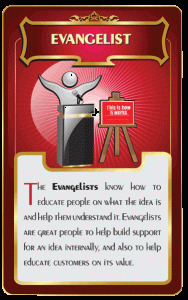
Nine Innovation Roles EvangelistIn business, the evangelist is a role that any of us can take on (with varying levels of success). Evangelism is very important to innovation success, which is why the evangelist is one of The Nine Innovation Roles™. This is how I define this particular role:

“The Evangelists know how to educate people on what the idea is and help them understand it. Evangelists are great people to help build support for an idea internally, and also to help educate customers on its value.”

Notice at this point we are talking about an evangelist as a role that can be played by one or more people, and not as a job that one or more people hold. Evangelism normally will be a role and not a job, but there are inflection points where this must change.

Outside of an innovation context, evangelism often falls on the shoulders of CEOs, business owners and product managers within organizations. When the need for evangelism is small, this can work. But for most organizations, this is no longer the case.

When should you hire an evangelist?

The time to cross over from evangelism as a role to evangelism as a job is when:

  1. The pace of internal change is accelerating faster than employees can grasp without help
  2. The pace of external change is accelerating faster than customers can understand without help
  3. Your company is facing disruption by new entrants or existing competitors
  4. You’re considering a digital transformation
  5. You’ve already embarked upon a digital transformation
  6. You’re using Agile in product development
  7. Your brand essence is being shifted by you or your customers
  8. You need a more human and personal presence in your marketing efforts to better connect with customers

When one or more of these conditions are true, you’ll find that it isn’t possible for CEOs, business owners and product owners to meet the needs for evangelism in the short spurts of time these people can dedicate to the necessary activities.

As highlighted by Agile Product Development’s presence in the list, organizations leveraging Agile to develop software-based products will find that their product managers are always engaged with the backlog with little time to focus on evangelism. They’re always focused on shipping something.

Some organizations will resist adding evangelists to their team, feeling that such a role is superfluous, but having one or more people focused on evangelism delivers value to the organization by executing a range of incredibly important activities, including:

  • Growing awareness
  • Building a community around the company and/or plugging the company into pre-existing external communities (potentially taking the brand to places it has never been before)
  • Generating interest
  • Working with customers and the marketing team to identify the stories that need to be told and the themes that need to be introduced and/or reinforced
  • Creating desire
  • Building and maintaining conversations with the community that cares about your products/services/brands
  • Engaging in an open and honest dialogue to help gather the voice of the customer
  • Facilitating action
  • Practicing a human-centered design mindset to continuously elicit needs and surface wants and desired outcomes

Depending on the size of the organization you may decide to have a single evangelist, or some larger organizations have more than one type of evangelist, including:

  1. Chief Evangelist
  2. Brand Evangelists
  3. Product Evangelists
  4. Service Evangelists
  5. Innovation Evangelists

This specialization occurs when the evangelism an organization needs become too big for one evangelist to handle. At that point a Chief Evangelist creates the evangelism strategy and manages the execution across the team of brand, product, service and other evangelism focus areas.

So what makes a good evangelist?

Evangelists arrive from a range of different job specialties, but key knowledge, skills and abilities include:

  • Empathetic
  • Passionate About the Company’s Mission, Products/Services, and Customers
  • Comfortable Public Speaker
  • Efficient and Effective Writer
  • Human-Centered Design Mindset
  • Experienced with Social Media, Audio and Video
  • Skilled Content Creator
  • Continuous Learner
  • Self-Directed and Comfortable with Ambiguity

… and ideally your chosen evangelists will already have some presence in the communities important to you, or the knowledge of how to establish a presence in these communities.

Customer buying journeys are notoriously unpredictable, meandering, long and non-linear. Evangelism is a critical part of helping to build relationships with potential buyers and increasing the chances that your brand will be top of mind when a non-buyer finally becomes a potential customer of your products or services.

It’s a long-term non-transactional investment, one that will pay dividends if you see the wisdom in making the expenditure.

Has your organization already invested in evangelists? What learnings would you like to share in the comments?

Are you ready for the evangelists to rise in your organization?

Or do you need help with evangelism? (contact me if you do)

Share the love!

p.s. I wrote a follow-up article for InnovationManagement.se that you might also enjoy — Increase Your Innovation Reputation and Velocity with an Innovation Evangelist


Accelerate your change and transformation success

Subscribe to Human-Centered Change & Innovation WeeklySign up here to get Human-Centered Change & Innovation Weekly delivered to your inbox every week.

The Evolution of Change Management

From Top-Down to Agile Approaches

The Evolution of Change Management

GUEST POST from Chateau G Pato

Change is an inevitable part of any organization’s growth and survival. In the past, change management strategies primarily followed a top-down approach, where leaders dictated the changes and employees were expected to comply. However, over time, as organizations faced increasing complexity and speed of change, a more agile approach to change management has emerged. This article explores the evolution of change management from top-down to agile approaches and provides two case study examples showcasing the benefits of adopting agile change practices.

The traditional top-down approach to change management involved leaders identifying the need for change, setting objectives, and then cascading the change down through the hierarchy. In this approach, employees were often not adequately involved or consulted, leading to resistance or low engagement. The lack of employee involvement also hampered creativity and innovation, with change initiatives frequently facing roadblocks and slow implementation.

Recognizing the limitations of the top-down approach, organizations began embracing agile change management methodologies, inspired by the principles derived from agile software development. The agile approach emphasizes collaboration, flexibility, and iterative progress, empowering employees to actively participate in the change process. This shift enables organizations to respond swiftly to changing circumstances and capitalize on emerging opportunities.

Case Study 1 – Spotify

One notable case study that highlights the effectiveness of an agile change approach is the transformation of Spotify. This music streaming giant faced the challenge of scaling rapidly while maintaining innovation and adaptability. They shifted from a traditional top-down approach to a squad-based, agile organizational structure. In their agile change management, cross-functional teams were empowered to make decisions, experiment, and continuously improve. This resulted in faster implementation of ideas, increased employee satisfaction, and enhanced customer experiences.

Case Study 2 – Dutch Government

Another case study illustrating the benefits of agile change practices is the digital transformation of the Dutch government. Facing the need to modernize and improve service delivery, they adopted an agile approach to change management. Using this methodology, they formed multidisciplinary teams responsible for specific projects, involving end-users throughout the development process. By conducting frequent iterations and incorporating feedback, the Dutch government successfully rolled out digital initiatives such as the Digital Identity App and the My Belastingdienst portal. The agile change approach ensured that the final products met users’ needs and expectations, leading to improved citizen engagement and satisfaction.

The shift from top-down to agile change management approaches is driven by the understanding that employees are key stakeholders and vital sources of expertise and innovation. By involving employees throughout the change process, organizations can tap into their knowledge, unlock creativity, and improve the quality and sustainability of change initiatives. This collaborative approach results in higher levels of ownership, engagement, and commitment from employees, fostering a culture of continuous learning and adaptation.

Conclusion

The evolution of change management from top-down to agile approaches represents a paradigm shift in how organizations navigate and embrace change. The agile approach, with its emphasis on collaboration, flexibility, and employee involvement, enables organizations to adapt swiftly in an ever-changing environment. Case studies such as Spotify and the Dutch Government’s digital transformation illustrate the positive outcomes of adopting agile change practices. Embracing agile change management not only accelerates the implementation of changes but also nurtures a culture of innovation, empowerment, and resilience in organizations.

Image credit: Pexels

Subscribe to Human-Centered Change & Innovation WeeklySign up here to get Human-Centered Change & Innovation Weekly delivered to your inbox every week.

Human-Centered Design and Agile Methodologies

A Powerful Combination

Human-Centered Design and Agile Methodologies

GUEST POST from Chateau G Pato

In today’s fast-paced and competitive market, organizations are increasingly realizing the importance of incorporating both Human-Centered Design (HCD) principles and Agile methodologies into their product development processes. By doing so, companies are able to create innovative and user-centric products while staying agile and responding swiftly to changing customer needs.

Human-Centered Design is an iterative design approach that focuses on understanding and meeting the needs, desires, and behaviors of end-users. It involves continuously involving users throughout the design process, gaining insights through user research, and incorporating their feedback to build products that truly address their pain points. On the other hand, Agile methodologies emphasize flexibility, collaboration, and adaptive planning, enabling teams to iteratively deliver value through frequent and incremental product releases.

When combining HCD with Agile, organizations can leverage the strengths of both methodologies and achieve remarkable results. Let’s explore two case studies that highlight the power of this combination.

Case Study 1: Airbnb

One of the most prominent examples of successful integration of HCD and Agile methodologies is Airbnb. In its early years, Airbnb faced the challenge of low user engagement and failed to attract users to their platform. Recognizing the importance of putting users at the center of their design strategy, Airbnb embraced HCD principles alongside an Agile development approach.

Airbnb extensively researched the needs and preferences of its target audience, even going as far as sending its designers to live with hosts in different cities to truly understand the user experience. The insights gained from these immersive research experiences helped Airbnb identify pain points and develop innovative features that addressed them effectively.

By integrating Agile methodologies, Airbnb was able to quickly implement and test its design ideas, gaining rapid feedback from users. They released regular updates and constantly improved their app based on user feedback, ensuring that the product remained user-centric. Today, Airbnb is a global leader in the accommodation industry, revolutionizing the way people experience travel.

Case Study 2: Intuit

Intuit, a leading financial software company, is another example of successfully combining HCD and Agile methodologies in their product development process. Intuit’s flagship product, TurboTax, enables users to file taxes easily and efficiently. However, in observance of a common challenge faced by many organizations, Intuit realized that users often dropped out during the tax filing process due to its complexity.

To address this issue, Intuit adopted an HCD approach. They conducted extensive user research, including in-depth interviews and usability testing, to understand the pain points hindering user adoption. Based on these insights, Intuit redesigned their tax filing process to be simpler, more intuitive, and less time-consuming.

Intuit complemented their HCD efforts with an Agile development methodology. By releasing regular updates and engaging with users throughout the development process, Intuit ensured that the changes made aligned with user needs. The incremental approach allowed them to constantly improve the product and significantly reduce customer drop-offs during tax filing.

The integration of HCD and Agile methods played a crucial role in the success of TurboTax, making it the most popular tax preparation software in the market today.

Conclusion

The combination of Human-Centered Design and Agile methodologies has proven to be a powerful tool for organizations seeking to create user-centric and innovative products. The case studies of Airbnb and Intuit demonstrate how this integration can lead to significant improvements in user experiences and overall business success. By prioritizing user needs and leveraging feedback through an iterative and adaptive approach, companies can adapt to changing market requirements while delivering products that make a lasting impact.

EDITOR’S NOTE: Braden Kelley’s Problem Finding Canvas can be a super useful starting point for doing design thinking or human-centered design.

“The Problem Finding Canvas should help you investigate a handful of areas to explore, choose the one most important to you, extract all of the potential challenges and opportunities and choose one to prioritize.”

Image credit: misterinnovation.com

Subscribe to Human-Centered Change & Innovation WeeklySign up here to get Human-Centered Change & Innovation Weekly delivered to your inbox every week.

Integrating Agile Evolution

Harmonizing Human-Centered Change with Traditional Frameworks

Integrating Agile Evolution

GUEST POST from Chateau G Pato


The Friction at the Frontier of Transformation

Organizations today find themselves caught in a structural tug-of-war. On one side stands the rigid certainty of traditional governance — monolithic Project Management Offices (PMOs), predictable Waterfall milestones, and the defensive posture of Six Sigma risk mitigation. On the other side is the fluid, fast-paced promise of Agile, demanding continuous adaptation, rapid-fire sprints, and decentralized decision-making.

Too often, leadership treats the transition between these two paradigms as a simple mechanical upgrade, expecting teams to shift their entire operating model at the flip of a switch. But process optimization invariably stalls when it fails to account for human dynamics. Forcing rigid frameworks to collide with agile methodologies without an intentional bridge doesn’t create velocity; it creates organizational whiplash, employee burnout, and resistance.

True organizational agility isn’t about recklessly discarding legacy structures, nor is it about blindly adopting a new set of rituals. Real transformation requires creating a harmonized ecosystem. By leveraging human-centered change and experience design ($HX$) as the connective tissue, leaders can bridge the gap between structure and flexibility — turning a chaotic cultural clash into a deliberate, sustainable evolution.

1. Deconstructing the Divide: Why Rigid Meets Agile Flops

The single greatest mistake an organization can make is treating Agile adoption as a static, milestone-driven project. When leadership applies a legacy, checkbox-oriented mindset to a philosophy built on continuous evolution, the transformation is doomed from the start. You cannot “schedule” the exact date a culture becomes adaptable, yet corporate roadmaps are routinely filled with arbitrary deadlines for when teams must magically achieve agility. This structural paradox creates immediate friction.

When employees are thrust into intensive sprint cadences, daily standups, and shifting backlogs without a corresponding evolution in leadership mindset, the human toll is severe. Without psychological safety, a daily standup stops being a collaborative sync and mutates into a micro-management interrogation. Instead of fostering autonomy, the pressure to deliver velocity points within rigid corporate silos triggers defensive behavior, leading directly to burnout and silent resistance.

Furthermore, traditional risk-aversion mechanics inherently stifle the experimental nature of an agile evolution. Agile requires a “fail-fast, learn-faster” environment, but legacy corporate governance is built to penalize variance and reward predictable uniformity. When the organizational immune system treats every minor experimental failure as a systemic threat, innovation is choked out. To harmonize these frameworks, we must first acknowledge that the bottleneck isn’t the software or the methodology — it is the friction between legacy control mechanisms and human adaptability.

2. The Human-Centered Change Architecture

Overcoming structural friction requires a fundamental shift in how we architect change. Traditional change management often treats people as passive targets of a rollout — silos to be managed through top-down mandates and static readiness checklists. A human-centered change approach flips this dynamic entirely, shifting the focus from managing resistance to actively designing for human experience.

This begins by mapping the change journey from the perspective of the people living it. By applying experience design (XD) principles, leaders can identify the hidden emotional and operational “friction points” that occur when legacy workflows collide with new agile cadences. It means asking where the cognitive overload happens, where old habits conflict with new expectations, and where the systemic gaps lie.

When we design the transition with empathy, communication ceases to be a series of broadcasted announcements and becomes an ongoing dialogue. Iterative feedback loops must be built into the transformation itself, mirroring the very agile principles we want teams to adopt. When employees see their input actively shaping the integration process, they cease to be subjects of a top-down mandate and instead become co-creators of a shared corporate evolution.

3. Strategies for Harmonization (The Integration Matrix)

Harmonizing the old with the new requires moving past ideological purity. The goal is not to force every corner of the enterprise into a dogmatic Agile mold, nor is it to let legacy bureaucracy paralyze innovation. Instead, leadership must intentionally architect a shared operating space where predictable governance and rapid experimentation reinforce one another.

This orchestration depends entirely on building bilingual leadership capability. Leaders and middle management must be systematically upskilled to translate metrics across the organizational divide. They need to confidently articulate how iterative value velocity at the team level directly de-risks capital expenditure and stabilizes long-term return on investment (ROI) for traditional executives.

To operationalize this, forward-thinking organizations are deploying hybrid governance models. By designing a structure of “Gated Agility” or “Fluid Waterfall,” the enterprise can maintain necessary macroscopic checkpoints — such as annual budgeting, compliance boundaries, and legal reviews — while leaving the internal execution layers entirely free to iterate, test, and pivot.

Finally, this harmonization cannot be achieved via a monolithic, one-size-fits-all rollout. It demands a modular change toolkit. Rather than forcing a uniform process onto vastly different business units, change leaders must provide a scalable menu of adaptable change tools and experience measures. This allows a core legal team to maintain their essential structured workflows, while an adjacent digital product team maximizes their experimental velocity, both operating seamlessly under the same organizational roof.

4. Sustaining the Evolution: From Doing Agile to Being Agile

Achieving initial integration is only half the battle; the true challenge lies in sustaining it. Too many organizations fall into the trap of merely “doing” Agile — mechanically going through the motions of standups and retrospectives — without ever shifting their core cultural foundations. To transition into truly “being” Agile, leadership must intentionally cultivate a continuous learning culture. This requires fundamentally rewiring the corporate reward system. If the enterprise continues to incentivize individuals solely on static, “on-time” delivery milestones, teams will naturally default to risk-averse, rigid behaviors, effectively poisoning the agile ecosystem.

Sustained evolution demands that we change what we measure. Traditional, lagging business metrics must be counterbalanced with forward-looking, human-centric agility indicators. Rather than obsessing exclusively over feature throughput or velocity points, organizations must track experience level measures (XLMs). By actively measuring team autonomy, psychological safety scores, and the cycle time from customer insight to value creation, leadership gains a realistic, human-centered view of organizational health and resilience.

Looking toward the horizon, this tight integration of human experience and adaptive systems becomes even more critical. As AI-driven workflows, generative automation, and decentralized networks rapidly reshape the corporate landscape, traditional structures will face unprecedented pressure. The future of work will not belong to the most rigid process, nor to the most chaotic startup. It will belong to the enterprises that have successfully built a fluid, human-centric muscle — where cutting-edge technology and flexible frameworks are continually guided by human intuition, empathy, and collective intelligence.

Conclusion: The Ultimate Competitive Advantage

When the dust settles on any corporate transformation, one reality remains clear: frameworks, methodologies, and tools are entirely inert on their own. They are merely vehicles. The true engine of sustained organizational growth is, and always will be, a healthy, aligned, and human-centered culture. Attempting to force-fit Agile into an organization without redesigning the human experience is an exercise in diminishing returns.

In an era defined by continuous disruption and accelerating technological shifts, an organization’s ultimate competitive advantage is its Adaptability Quotient. By leveraging human-centered change as the strategic bridge between legacy stability and modern flexibility, leadership can build an enterprise that doesn’t fracture under pressure. Instead, it creates an environment where people are empowered to navigate uncertainty with confidence and purpose.

For change leaders, executive sponsors, and transformation architects, the mandate is clear. It is time to stop managing change as a temporary, painful disruption to be endured. We must begin designing change as a continuous, collaborative, and inclusive evolution — one that respects legacy foundations while boldly co-creating the future of work.

Frequently Asked Questions

Below are answers to the most common questions regarding the harmonization of agile and traditional frameworks, formatted for both human readers and search engine crawlers using structured JSON-LD data.

1. Why do traditional change management approaches fail during an Agile transformation?

Traditional change management treats transformation as a linear project with a fixed end date, forcing top-down compliance and milestone checkboxes. Agile is rooted in continuous evolution and decentralized autonomy. When you attempt to “schedule” adaptability without building psychological safety or addressing the human workflow friction, you create cultural resistance and organizational burnout rather than genuine agility.

2. How can a company maintain financial compliance while allowing teams to work in Agile sprints?

This is achieved through hybrid governance models like “Gated Agility” or “Fluid Waterfall.” The macroscopic layers of the business — such as annual budgeting, regulatory compliance, and legal frameworks — remain structured with predictable checkpoints. However, the internal execution layers are given the freedom to pivot, experiment, and deliver value iteratively within those defined compliance boundaries.

3. What should organizations measure instead of just tracking project milestones?

Organizations must balance lagging financial indicators with Experience Level Measures (XLMs) and human-centric agility metrics. Instead of solely monitoring feature throughput, leaders should measure team autonomy, psychological safety scores, customer-value cycle times, and how effectively iterative feedback loops are driving continuous improvement.


Put This Into Practice With the Change Planning Toolkit™

The frameworks in this article are part of the Human-Centered Change™ methodology — a visual, collaborative system of 70+ tools built around the Change Planning Canvas™. 26 of the tools come with every copy of Charting Change.

Image credit: Gemini

Subscribe to Human-Centered Change & Innovation WeeklySign up here to get Human-Centered Change & Innovation Weekly delivered to your inbox every week.

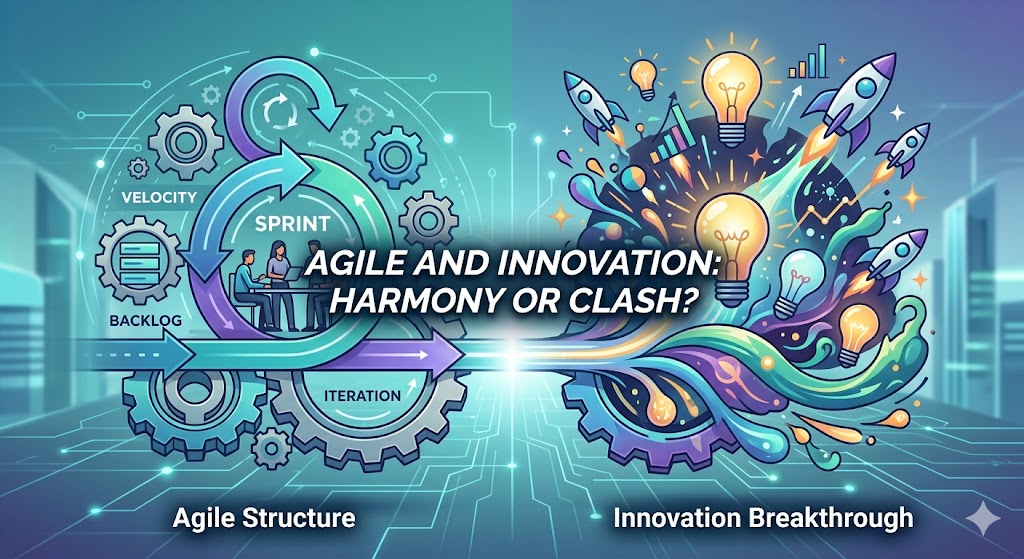
Does Agile Kill Innovation or Support It?

Evidence-Based Answers

LAST UPDATED: April 11, 2026 at 10:03 AM

Does Agile Kill Innovation or Support It?

GUEST POST from Chateau G Pato


The Great Methodology Clash

In the modern business landscape, Agile is often sold as the ultimate antidote to stagnation. However, a growing tension exists between the disciplined structure of Agile frameworks and the messy, non-linear reality of pure innovation.

Organizations frequently find themselves caught in a paradox: they adopt Agile to increase speed and responsiveness, yet they often discover that while their output increases, their “Big Ideas” seem to shrink into a series of minor, safe iterations. This phenomenon raises a critical question for leadership: Is the methodology driving us toward breakthroughs, or is it merely optimizing the status quo?

To find the answer, we must look past the anecdotes and marketing hype. This article explores the evidence-based reality of how Agile frameworks — including Scrum, Kanban, and SAFe — impact different types of innovation, from incremental improvements to radical, market-shifting discoveries.

How Agile Fuels the Innovation Engine

Contrary to the belief that structure stifles creativity, when implemented with a human-centered mindset, Agile provides the essential scaffolding for innovation to thrive. By shifting the focus from rigid long-term planning to adaptive learning, Agile frameworks can actually accelerate the journey from a raw idea to a market-ready solution.

De-Risking through Iteration

The “Fail Fast” mentality is often misunderstood as a celebration of failure; in reality, it is about reducing the cost of learning. By breaking down complex innovation projects into smaller, manageable increments, teams can test high-risk assumptions early. This prevents the “Big Bang” failure — where millions are spent on a product that no one actually wants.

The Feedback Loop: Aligning with Human Needs

Continuous integration and frequent review cycles ensure that innovation remains tethered to reality. Instead of innovating in a vacuum, Agile forces a constant dialogue with the end-user. This evidence-based approach ensures that the “Experience Design” isn’t just a hypothesis, but a validated solution that solves real human problems.

Psychological Safety and Autonomy

Innovation requires a culture where people feel safe to take risks. Agile’s emphasis on self-organizing, cross-functional teams empowers individuals to take ownership of their work. This autonomy is a primary driver of intrinsic motivation, which is the “secret sauce” behind most creative breakthroughs.

Eliminating “Innovation Theater”

Traditional waterfall environments often reward “Innovation Theater” — the production of elaborate slide decks and theoretical business cases. Agile demands working prototypes. By prioritizing tangible output over documentation, organizations can more accurately measure progress and pivot resources toward the ideas that demonstrate real potential.

When Agile Becomes a Straightjacket

While the benefits of Agile are well-documented, the methodology can inadvertently become a “innovation killer” if applied dogmatically. When the process becomes the priority over the purpose, the very structures meant to enable speed can end up anchoring a team to the shoreline of incrementalism.

The “Tyranny of the Sprint”

Innovation often requires deep, uninterrupted thinking and “unstructured” time to explore dead ends. The relentless cadence of two-week sprints can create a culture of urgency that prioritizes low-hanging fruit. Teams may gravitate toward tasks they are certain they can finish within the sprint window, effectively self-censoring breakthrough ideas that require longer, more complex exploration.

The Incrementalism Trap

Evidence suggests that Agile is a master at “polishing the stone” but can struggle to “find the diamond.” Because the framework is built on iterative feedback, it excels at evolutionary innovation (making an existing product 10% better). However, it often fails at revolutionary innovation, where the end goal isn’t yet clear enough to be broken down into neat user stories.

Loss of the “North Star”

In a poorly managed Agile environment, the Product Backlog can morph into a never-ending grocery list of features and bug fixes. When teams become obsessed with clearing tickets, they lose sight of the strategic vision. Without a strong “North Star” to guide the experience design, the product risks becoming a disjointed collection of features rather than a cohesive, meaningful solution.

Over-Emphasis on Velocity

What gets measured gets managed. If leadership defines success solely by “Velocity” (the number of story points completed), teams will naturally optimize for output over impact. This creates a “feature factory” where there is no room for the “productive waste” of experimentation, questioning assumptions, or starting over — all of which are vital to the innovation process.

The Evidence-Based Verdict: Context is King

The debate over whether Agile supports or kills innovation is rarely a binary “yes” or “no.” Instead, the evidence points toward a situational reality. Data from high-performing organizations suggests that Agile’s effectiveness is directly tied to the type of innovation being pursued and the horizon in which the team is operating.

The Innovation Horizon Model

To understand the impact of Agile, we must view it through the lens of the Three Horizons of Innovation:

  • Horizon 1 (Incremental): In this space of “polishing the stone,” Agile is an undisputed powerhouse. The evidence shows that iterative cycles significantly improve speed-to-market and quality for existing products.
  • Horizon 2 (Adjacent): Here, Agile requires a hybrid approach. Success depends on integrating Design Thinking to explore new markets before the engineering sprint begins.
  • Horizon 3 (Radical/Disruptive): This is where pure Agile often stumbles. Evidence indicates that radical breakthroughs require “Discovery Tracks” that are decoupled from the standard delivery cadence to allow for high-variance experimentation.

Why “Pure Agile” Isn’t Enough

Industry analysis of failed digital transformations shows a recurring pattern: organizations that adopt Agile without Human-Centered Design often end up building the “wrong thing” faster. The verdict is clear: Agile is a delivery framework, not a discovery framework. To support innovation, it must be paired with methodologies that focus on causal insights and human behavior.

The Cultural Variable

Finally, the evidence suggests that the “Agile-Innovation” link is moderated by culture. In organizations where “Agile” is used as a tool for micromanagement or purely for cost-cutting, innovation invariably dies. Conversely, in cultures that prioritize organizational agility and psychological safety, Agile provides the necessary structure to turn creative sparks into sustainable revenue.

Best Practices: Harmonizing the Two Worlds

Bridging the gap between the rigid requirements of a sprint and the fluid nature of innovation requires a shift from “Dogmatic Agile” to “Pragmatic Agility.” To ensure your methodology supports rather than stifles breakthroughs, consider these evidence-based strategies for harmonization.

Dual-Track Agile: Separate Discovery from Delivery

One of the most effective ways to protect innovation is to implement Dual-Track Agile. In this model, the “Discovery” track focuses on identifying human needs, rapid prototyping, and validating causal links, while the “Delivery” track focuses on building and deploying production-ready code. This ensures that the innovation pipeline is always full of validated ideas before they ever hit a developer’s backlog.

Allocating “Innovation Sprints” and Slack Time

Innovation cannot be scheduled into 15-minute stand-ups. Leading organizations often dedicate specific sprints — sometimes called “Innovation Sprints” or “Hack Weeks” — where the backlog is frozen, and teams are given the autonomy to explore speculative “What If” scenarios. This “slack” in the system is not waste; it is the necessary breathing room for creative synthesis.

Shift KPIs: From Output to Outcomes

If you measure a team by how many story points they finish (Output), they will avoid difficult, innovative tasks. To support innovation, leadership must shift to Outcome-based metrics. Instead of asking “How much did we build?”, ask “What customer behavior did we change?” or “What new revenue leakage did we plug?” Measuring Experience Level Measures (XLMs) ensures the team stays focused on value creation.

The Product Owner as a Visionary, Not a Clerk

For Agile to support innovation, the Product Owner must move beyond simply managing tickets. They must act as a “Chief Innovation Officer” for their product, balancing the immediate needs of the users with the long-term strategic “North Star.” Their role is to protect the team from feature bloat and ensure that every sprint is a step toward a more meaningful human experience.

Conclusion: It’s Not the Tool, It’s the Craftsman

The evidence is clear: Agile does not kill innovation. However, a rigid, dogmatic application of Agile ceremonies — without the balancing force of experience design and strategic foresight — can certainly suffocate it. When we prioritize “following the process” over “responding to human needs,” we lose the very essence of why we innovate in the first place.

To truly support innovation, organizations must move beyond the “Feature Factory” mindset. We must stop treating Agile as a set of handcuffs and start treating it as a flexible framework that empowers teams to explore, experiment, and execute with purpose. The goal isn’t just to move faster; it’s to move faster toward meaningful value.

As you look at your own organizational agility, ask yourself: Is your current velocity moving you toward a breakthrough, or just toward a deadline? Innovation requires the courage to step out of the sprint cycle when the path forward is unclear and the discipline to use Agile to scale that vision once the “North Star” is found.

Final Thought for Leaders

“Don’t let your methodology become your strategy. The most successful organizations are those that use Agile to deliver value, but use Human-Centered Innovation to define what that value should be.”

Frequently Asked Questions

Does Agile only work for incremental improvements?

While Agile is highly effective for incremental (Horizon 1) innovation, it can support radical breakthroughs if paired with a dedicated “Discovery Track.” Without this, the pressure of short sprints tends to favor smaller, safer updates over disruptive changes.

How can leadership prevent Agile from becoming a “Feature Factory”?

Leadership must shift focus from output metrics like “Velocity” or “Story Points” to outcome-based measures (XLMs). By rewarding the value created for the user rather than the volume of code shipped, teams are empowered to prioritize innovation.

What is the biggest risk of using Agile for innovation?

The primary risk is the “Tyranny of the Sprint,” where the relentless two-week cadence discourages the deep, unstructured exploration and “productive failure” necessary for true human-centered breakthroughs.

Image credits: Gemini

Subscribe to Human-Centered Change & Innovation WeeklySign up here to join 17,000+ leaders getting Human-Centered Change & Innovation Weekly delivered to their inbox every week.

The Benefits of Agile Project Management for SMEs

The Benefits of Agile Project Management for SMEs

GUEST POST from Art Inteligencia

The rapid pace of technological advancement and the increased competition in the business landscape have made project management a critical factor in the success of any organization. Small and medium-sized enterprises (SMEs) are no exception, and the implementation of agile project management can provide numerous benefits that can help them stay ahead of the competition.

Agile project management is a methodology that emphasizes flexibility and iterative progress, allowing teams to adapt quickly to changing conditions and customer needs. This type of project management has become increasingly popular in the business world and is a great option for SMEs looking to improve their project management capabilities. Here are five key benefits of agile project management for SMEs.

1. Improved Efficiency

Agile project management allows teams to break down large tasks into smaller, more manageable chunks, which can help teams complete projects efficiently and on time. The iterative nature of agile project management also encourages teams to test and revise plans and strategies regularly, which can help teams identify and address inefficiencies more quickly.

2. Improved Communication

Agile project management encourages teams to communicate frequently and collaboratively. This regular communication helps teams stay on the same page, reduces misunderstandings, and encourages everyone to contribute their ideas and perspectives.

3. Enhanced Flexibility

The iterative nature of agile project management makes it easier for teams to adjust to changing customer needs and priorities. This allows teams to respond quickly to changes, and to adjust their strategies accordingly.

4. Improved Quality

Agile project management encourages teams to consistently review and test their work, which can help identify and address any issues or problems more quickly and effectively. This can result in higher quality projects and products.

5. Increased Visibility

The regular communication encouraged by agile project management helps keep stakeholders informed of project progress and allows teams to identify potential risks or issues more quickly. This can help teams to take proactive steps to address any potential problems before they arise.

The implementation of agile project management can be a great way for SMEs to increase their project management capabilities and stay ahead of the competition. The five benefits discussed here are just the beginning of the many advantages that agile project management can provide.

Image credit: Pixabay

Subscribe to Human-Centered Change & Innovation WeeklySign up here to get Human-Centered Change & Innovation Weekly delivered to your inbox every week.