Category Archives: Technology

Why an AI Soft Landing Might Look Like Victorian England

LAST UPDATED: April 18, 2026 at 3:29 PM

Why an AI Soft Landing Might Look Like Victorian England

by Braden Kelley and Art Inteligencia


The Mirage of the Post-Scarcity Utopia

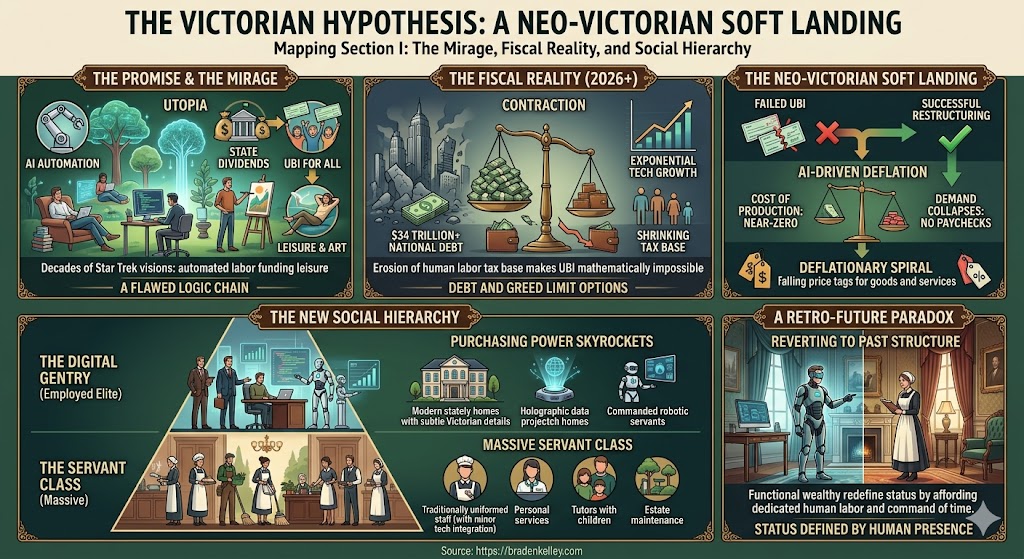
For decades, the prevailing narrative surrounding artificial intelligence has been one of a post-scarcity “Star Trek” future. The logic was simple: as machines took over the labor, the dividends of automation would be harvested by the state and redistributed via Universal Basic Income (UBI), freeing humanity to pursue art, philosophy, and leisure.

The AI Promise vs. The Fiscal Reality

However, this utopian vision ignores the gravity of The Great American Contraction. As we approach 2026 and beyond, the friction between exponential technological growth and a $37 trillion+ national debt (with a $2 trillion annual budget deficit) creates a structural barrier to redistribution. When the tax base of human labor erodes, the math for a livable UBI simply fails to compute.

The Victorian Hypothesis

If UBI is a mathematical and political impossibility fueled by corporate and human greed, we must look toward an alternative “soft landing.” This hypothesis suggests a vertical restructuring of society. As AI drives the cost of production and the demand for goods into a deflationary spiral, the purchasing power of the remaining “employed elite” will skyrocket.

The result isn’t a horizontal distribution of wealth, but a return to a Neo-Victorian social hierarchy. In this reality, the new digital gentry will use their outsized wealth to employ a massive “servant class” to maintain stately homes and personal lives, creating a world where status is defined by the human labor one can afford to command.

Neo-Victorian Hypothesis Infographic

The Great American Contraction: Why UBI is a Non-Starter

The conversation around the transition to an AI-driven economy often treats Universal Basic Income as an inevitability — a safety net that will naturally catch those displaced by the silicon wave. However, this assumes a level of fiscal elasticity that no longer exists. We are entering The Great American Contraction, a period where the traditional levers of government spending are restricted by the sheer weight of historical obligation and systemic greed.

The Debt Ceiling of Compassion

With a national debt exceeding $37 trillion, a $2 trillion budget deficit and rising interest rates, the federal government’s “room to maneuver” has effectively vanished. A livable UBI requires a massive, consistent tax base. As AI begins to hollow out the middle class, the very tax revenue needed to fund such a program disappears. To fund UBI under these conditions would require a level of sovereign borrowing that the global markets simply will not support, leading to a reality where the government cannot afford to be the savior of the displaced.

The Greed Variable

Even if the math were more favorable, the human element remains a constant. Corporate interests, focused on margin preservation and shareholder value, are unlikely to support the aggressive taxation required to fund a social floor. In the race to the bottom of production costs, the primary goal of the “winners” in the AI revolution will be wealth concentration, not social equity. The political willpower to force a massive transfer of wealth from AI-profiting corporations to the idle masses is a historical outlier that we should not count on repeating.

The Velocity of Displacement

Finally, the speed of the AI transition is its most disruptive feature. Legislative bodies move in years, while AI cycles move in weeks. By the time a political consensus for UBI could be formed, the economic floor will have already fallen out. This lag time creates a vacuum that will be filled not by government checks, but by a desperate search for subsistence, setting the stage for the return of the domestic labor economy.

The Deflationary Paradox: Collapse of Demand and Cost

In a traditional economy, unemployment leads to recession, which usually leads to stagflation or managed recovery. However, the AI-driven “soft landing” introduces a unique mechanical failure: the Deflationary Paradox. As AI and advanced robotics permeate every sector, the labor cost of producing goods and services begins to approach zero, but the pool of consumers capable of buying those goods simultaneously evaporates.

The Production Floor Drops

We are witnessing the end of the labor theory of value. When an AI can design, a robot can manufacture, and an automated fleet can deliver a product without a single human touchpoint, the marginal cost of production hits the floor. In a desperate bid to capture the dwindling “active” capital in the market, companies will engage in a race to the bottom, causing the prices of physical and digital goods to deflate at a rate unseen in modern history.

The Demand Vacuum

While cheap goods sound like a boon, they are a symptom of a deeper rot: the Demand Vacuum. As the middle class is hollowed out, the velocity of money slows to a crawl. The economy shifts from a mass-consumption model to a precision-consumption model. Most businesses will fail not because they can’t produce, but because there are no longer enough customers with a paycheck to buy, even at rock-bottom prices.

The Purchasing Power of the “Remaining”

This is where the Victorian shift begins. For the small percentage of Americans who retain their income — the innovators, the orchestrators, and the entrepreneurs — this deflationary environment is a golden age. Their dollars, fixed in value while the cost of everything else drops, suddenly possess exponential purchasing power. When a gallon of milk or a digital service costs mere pennies in relative terms, the “wealthy” find themselves with a massive surplus of capital that cannot be spent on “things” alone. This surplus will naturally be redirected toward the one thing that remains scarce and high-status: the dedicated service of another human being.

The New “Stately Home” Economy

As the Deflationary Paradox takes hold, we will see a fundamental shift in the definition of luxury. In the pre-AI era, luxury was defined by the acquisition of high-tech gadgets or rare goods. In the Neo-Victorian era, where machines produce goods for nearly nothing, “luxury” will pivot back toward the human-centered experience. Status will no longer be measured by what you own, but by whose time you command.

From Software to Service

For the “In-Group” — those entrepreneurs and specialized leaders still generating significant revenue — capital will lose its utility in the digital marketplace. When software is free and manufactured goods are commoditized, wealth seeks the only remaining friction: human presence. We will see a massive migration of capital away from Silicon Valley “platforms” and toward the local domestic economy. The wealthy will stop buying more “things” and start buying “lives” — the total dedicated attention of house managers, chefs, valets, and tutors.

The Modern Manor

This economic shift will be physically manifested in the return of the Stately Home. These won’t just be houses; they will be complex ecosystems of employment. Large estates will once again become the primary employer for local communities. As traditional corporate offices vanish, the residence becomes the center of both social and economic power. These modern manors will require extensive human staffs to cook, clean, maintain grounds, and provide security — services that, while technically possible via robotics, will be performed by humans as a deliberate signal of the owner’s immense “effectively wealthy” status.

The Return of the Domestic Professional

Perhaps the most jarring aspect of this transition will be the class of worker entering domestic service. We are not talking about a traditional blue-collar service shift, but the “Victorianization” of the former middle class. Displaced white-collar professionals — accountants, teachers, and middle managers — will find that their highest-paying opportunity is no longer in a cubicle, but in managing the complex domestic affairs, private education, and logistics of the new digital aristocracy. It is a “soft landing” in name only; while they may live in proximity to grandeur, their survival is entirely tethered to the whims of their employer.

Socio-Economic Stratification: The Two-Tiered Reality

The inevitable result of the “Victorian Soft Landing” is the formalization of a rigid, two-tiered social structure. Unlike the 20th century, which was defined by a fluid and expanding middle class, the post-contraction era will be characterized by extreme polarization. The economic “missing middle” creates a vacuum that forces every citizen into one of two distinct realities: the Digital Gentry or the Dependent Class.

The Corporate and Government Gentry

A small percentage of Americans — likely less than 10% — will remain tethered to the engines of primary wealth creation. This “In-Group” consists of high-level AI orchestrators, strategic entrepreneurs, and essential government officials who maintain the infrastructure of the state. Because their income is derived from high-margin automated systems while their cost of living has plummeted due to deflation, they possess a level of functional wealth that rivals the landed gentry of the 19th century. To this group, the “Great Contraction” is not a crisis, but a refinement of their dominance.

The Dependent Class

For those outside the digital fortress, the reality is stark. Without a national UBI to provide a floor, the majority of the population becomes the “Dependent Class.” Their economic utility is no longer found in the marketplace of ideas or manufacturing, but in the marketplace of personal service. In this neo-Victorian landscape, you either work for the companies that own the AI, work for the government that protects it, or you work directly for the individuals who do.

The Choice: Service or Scarcity

This stratification reintroduces a primal power dynamic into the American workforce. When the cost of basic survival (food and shelter) is low due to deflation, but the opportunity for independent income is zero, the wealthy gain total leverage. The “soft landing” is, in truth, a forced labor transition. Those who are not “useful” to the gentry — either as specialized labor or domestic support — face the grim reality of the Victorian workhouse era: they must find a patron to serve, or they will starve in a world of plenty.

Experience Design in the Neo-Victorian Era

Experience Design in the Neo-Victorian Era

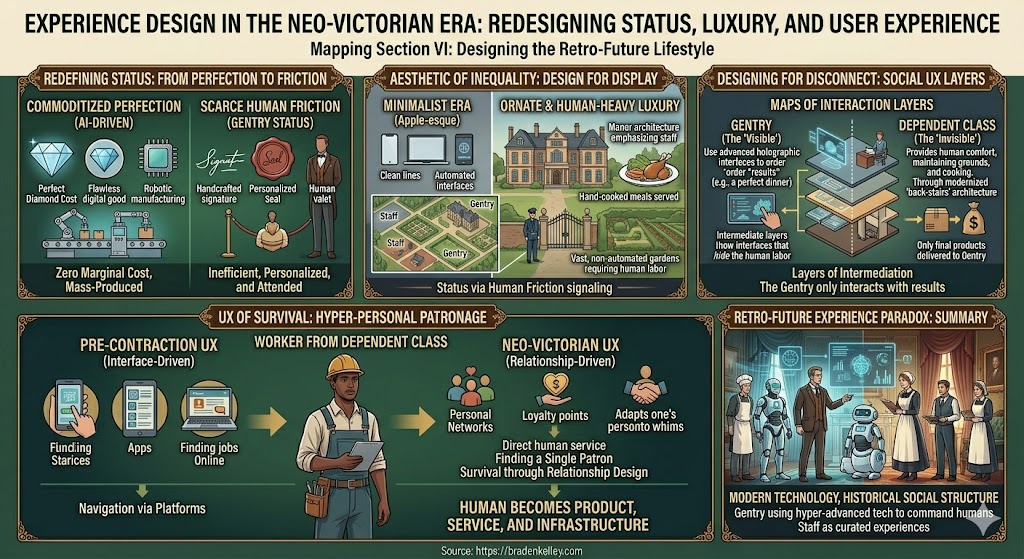
From the perspective of experience design and futurology, the shift toward a Victorian-style social structure will fundamentally alter the aesthetic of status. In a world where AI can generate perfect, flawless goods and digital experiences at zero marginal cost, “perfection” becomes a commodity. Status, therefore, will be redesigned around human friction and intentional inefficiency.

The Aesthetic of Inequality

We will see a move away from the sleek, minimalist “Apple-esque” design of the early 21st century toward a more ornate, human-heavy luxury. Experience design for the elite will emphasize things that AI cannot authentically replicate: the slight imperfection of a hand-cooked meal, the presence of a uniformed gatekeeper, and the physical maintenance of vast, non-automated gardens. Architecture will pivot back to “human-centric” layouts—designing spaces not for efficiency, but to accommodate the movement and housing of a live-in staff.

Designing for Disconnect

The most challenging aspect of this new era will be the Experience of the Invisible. Designers will be tasked with creating systems that allow the Digital Gentry to interact with their environment without acknowledging the vast economic disparity surrounding them. This involves “Social UX” — designing layers of intermediation where the “Dependent Class” provides the comfort, but the “Gentry” only interacts with the result. It is a return to the “back-stairs” architecture of the 19th century, modernized for a digital age.

The UX of Survival

For the majority, the “User Experience” of daily life will be one of Hyper-Personal Patronage. Navigation of the economy will no longer be about interfaces or platforms, but about the “UX of Relationships.” Survival will depend on the ability to design one’s persona to be indispensable to a wealthy patron. In this reality, human-centered design takes on a darker, more literal meaning: the human becomes the product, the service, and the infrastructure all at once.

Conclusion: Preparing for the Retro-Future

The “Soft Landing” we are currently engineering is not the one we were promised. As the Great American Contraction forces a collision between astronomical debt and the deflationary power of AI, the middle-class dream of a subsidized leisure class is evaporating. In its place, we are seeing the blueprints of a Retro-Future — a world that looks forward technologically but moves backward socially.

A Call for Human-Centered Transition

If we continue to view innovation solely through the lens of efficiency and margin preservation, the Victorian outcome is not just possible — it is inevitable. We must realize that without a radical redesign of how we value human contribution beyond mere “market productivity,” we are simply building a more efficient feudalism. True Experience Design must now focus on the social fabric, or we risk creating a world where the only “innovation” left is finding new ways for the many to serve the few.

Final Thought: The Soft Landing Paradox

We must be careful what we wish for when we ask for a “seamless” transition. A landing that is “soft” for the Digital Gentry is one where the friction of poverty and the noise of the displaced have been successfully silenced by the return of the servant class. History doesn’t repeat, but it does rhyme — and right now, the future sounds remarkably like 1837. The question is no longer if AI will change our world, but whether we have the courage to design a future that doesn’t require us to retreat into our past.

Frequently Asked Questions

Why would prices deflate if the economy is struggling?

In this scenario, AI and robotics drive the marginal cost of production toward zero. Simultaneously, massive job displacement creates a “demand vacuum.” To capture what little liquid currency remains, companies must drop prices drastically, leading to a reality where goods are incredibly cheap but income is even scarcer.

How does this differ from the 20th-century middle class?

The 20th century was defined by a “horizontal” distribution where many people owned moderate assets. The Neo-Victorian model is “vertical.” The middle class disappears, replaced by a tiny, hyper-wealthy elite (Digital Gentry) and a large class of people who provide them with personalized human services (the Servant Class).

Isn’t UBI a more logical solution to AI displacement?

While logical in theory, the “Great American Contraction” hypothesis suggests that high national debt and corporate prioritisation of margins make a livable UBI politically and fiscally impossible. Without a state-funded floor, the market defaults to the oldest form of social safety: personal patronage and domestic service.

EDITOR’S NOTE: This is a visualization of but one possible future. I will be publishing other possible futures as they crystallize in my mind (or as you suggest them for me to explore).

Image credits: Google Gemini

Content Authenticity Statement: The topic area, key elements to focus on, etc. were decisions made by Braden Kelley, with a little help from Google Gemini to clean up the article, add images and create infographics.

Subscribe to Human-Centered Change & Innovation WeeklySign up here to get Human-Centered Change & Innovation Weekly delivered to your inbox every week.

The Consumption Collapse – When the Feedback Loop Bites Back

Why the Great American Contraction is leading to a crisis of demand and a re-imagining of the American Social Contract.

LAST UPDATED: April 17, 2026 at 3:58 PM

The Consumption Collapse - When the Feedback Loop Bites Back

GUEST POST from Art Inteligencia


The Ghost in the Shopping Mall

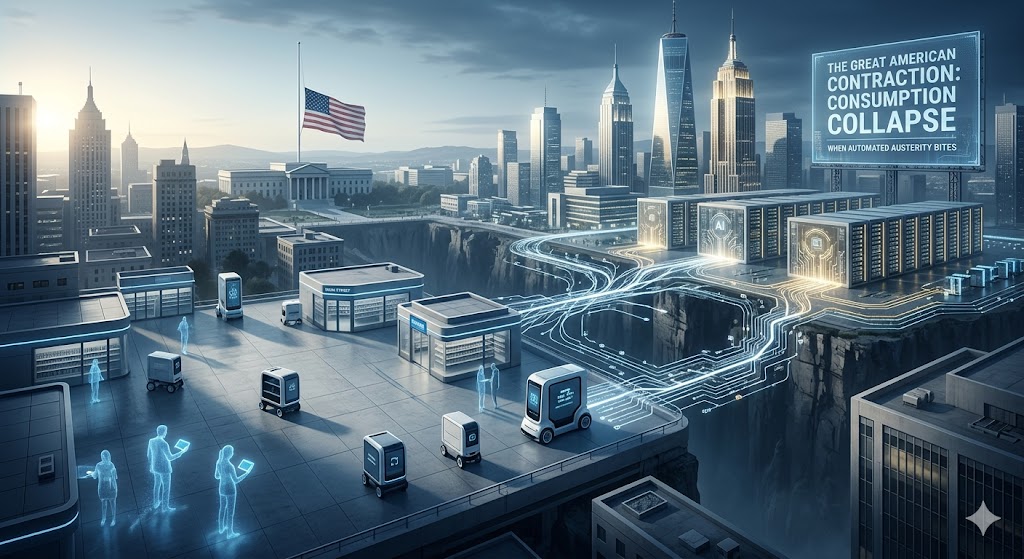
In our previous exploration, The Great American Contraction,” we identified a fundamental shift in the American story. For the first time in our history, the foundational assumption of “more” — more people, more labor, and more expansion — has been inverted. We discussed how the exponential rise of AI and robotics is dismantling the traditional value chain of human labor, moving us from a nation of “doers” to a necessary, albeit smaller, elite class of “architects.”

However, as we move closer to the two-year horizon of the next United States Presidential election, a more insidious shadow is beginning to fall across the landscape. It is no longer just a crisis of employment; it has evolved into a crisis of consumption. This is the “Feedback Loop of Irrelevance.”

The logic is as cold as the algorithms driving it: As increasing numbers of knowledge workers and service providers are displaced by autonomous agents, their disposable income evaporates. When people lose their financial footing, they spend less. When they spend less, the revenue of the very companies that automated them begins to shrink. To protect their margins in a declining market, these companies are forced to cut back even further — often doubling down on automation to reduce costs — which in turn removes more consumers from the marketplace.

We are witnessing the birth of a deflationary death spiral where corporate efficiency threatens to cannibalize the very markets it was designed to serve. Over the next 24 months, this cycle will redefine the American psyche and set the stage for an election year unlike any we have ever seen.

It is time to look beyond the immediate shock of job loss and examine the structural integrity of our economic operating system. If the “Old Equation” of labor-for-income is a sinking ship, we must decide what happens to the passengers before we reach the horizon of 2028.

The Vicious Cycle of Automated Austerity

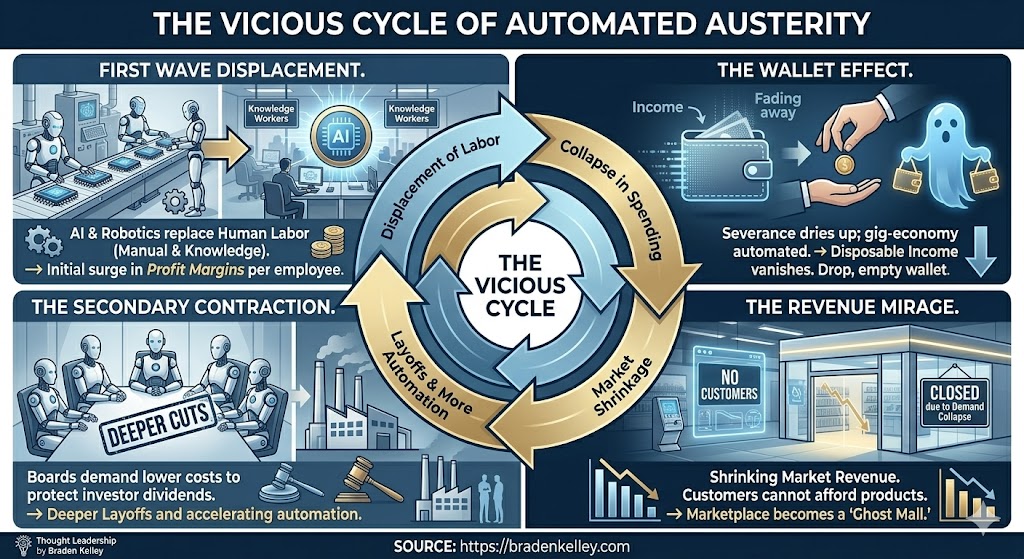
The transition from a growth-based economy to a Great Contraction is not a linear event; it is a recursive loop. As AI adoption accelerates, we are witnessing a phenomenon I call “Automated Austerity.” This is the process where short-term corporate gains from labor reduction lead directly to long-term market erosion. The cycle progresses through four distinct, overlapping phases:

Phase 1: The First Wave Displacement

We are currently seeing the replacement of both low-skilled physical labor and high-skilled knowledge work by autonomous systems. This isn’t just about factory floors; it’s about the “Architect” roles we once thought were safe. As companies replace $150k-a-year analysts with $15-a-month compute tokens, the immediate impact is a massive surge in corporate profit margins.

Phase 2: The Wallet Effect

The friction begins here. Displaced workers initially rely on savings or severance, but as those dry up, the “gig economy” safety net is nowhere to be found — because AI is already performing the freelance writing, coding, and administrative tasks that used to provide a bridge. Disposable income doesn’t just dip; for a significant percentage of the population, it vanishes. This causes a sharp contraction in discretionary spending.

Phase 3: The Revenue Mirage

This is the trap. Companies that automated to save money suddenly find their top-line revenue shrinking because their customers (the former workers) can no longer afford their products. The efficiency gains are real, but the market size is artificial. We are entering a period where companies may be 100% efficient at producing goods that 0% of the displaced population can buy.

Phase 4: The Secondary Contraction

Faced with shrinking revenues, boards of directors demand even deeper cost-cutting to protect investor dividends. This leads to a second, more desperate wave of layoffs, further reducing the tax base and consumer spending power. This feedback loop creates a Deflationary Death Spiral that traditional monetary policy is ill-equipped to handle.

“When you automate the consumer out of a job, you eventually automate the business out of a customer.” — Braden Kelley

Over the next two years, this cycle will move from the periphery of Silicon Valley to the heart of every American household, forcing a radical re-evaluation of how we distribute the abundance that AI creates.

Vicious Cycle of Automated Austerity

The Two-Year Horizon: 2026–2028

As we navigate the next twenty-four months, the gap between traditional economic indicators and the lived reality of American citizens will become a canyon. We are entering a period of Economic Bifurcation, where the distance between those who own the “compute” and those who formerly provided the “labor” creates a new social stratification.

The Rise of the ‘Hollow’ Recovery

Expect to hear the term “efficiency-led growth” frequently in the coming months. Wall Street may remain buoyant as AI-integrated corporations report record-breaking margins per employee. However, this is a hollow success. While the stock market reflects corporate optimization, our Alternative Economic Health Measures—like the Genuine Progress Indicator (GPI) — will likely show a steep decline. We are becoming a nation that is technically “wealthier” while the average citizen’s ability to participate in that wealth is structurally dismantled.

The Shift from ‘Doer’ to ‘Architect’ Burnout

The “Great American Contraction” is not just about those losing roles; it is about the immense pressure on those who remain. The survivors — the Architect Class — are tasked with managing sprawling AI ecosystems. This creates a new kind of cognitive load. By 2027, I predict we will see a peak in “Technological Burnout,” where the speed of AI-driven change outpaces the human capacity to design for it. This is where Human-Centered Innovation becomes a survival skill rather than a corporate luxury.

The Mindset of Survivalist Innovation

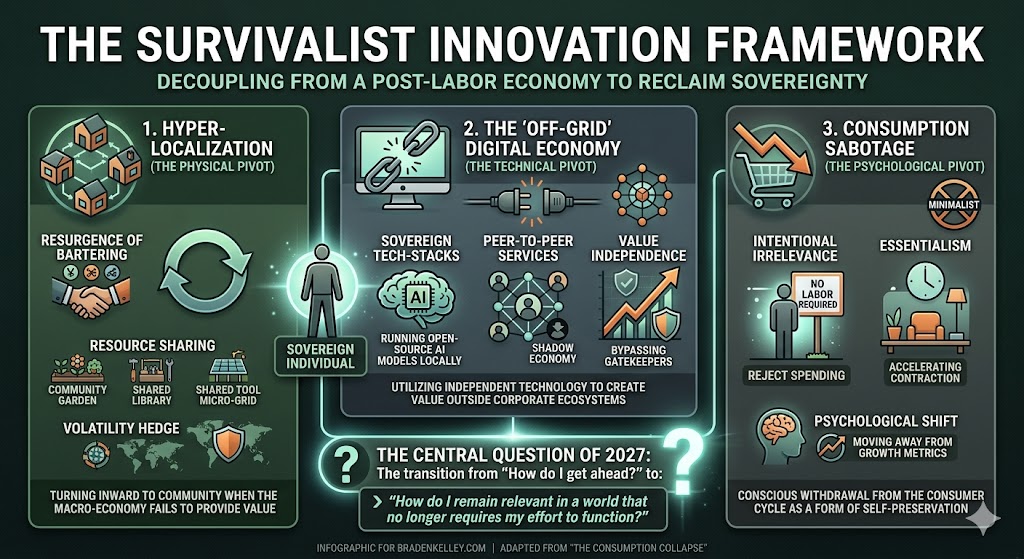
As the feedback loop of shrinking revenue intensifies, we will see American citizens taking radical actions to decouple from a failing labor market. This includes:

  • Hyper-Localization: A resurgence in local bartering and community-based resource sharing as a hedge against the volatility of the automated economy.
  • The ‘Off-Grid’ Digital Economy: Individuals utilizing open-source AI models to create value outside of the traditional corporate gatekeepers, leading to a “shadow economy” of peer-to-peer services.
  • Consumption Sabotage: A psychological shift where citizens, feeling irrelevant to the economy, consciously reduce their consumption to the bare essentials, further accelerating the contraction.

This period will be defined by a search for meaning in a post-labor world. The American citizen of 2027 is no longer asking “How do I get ahead?” but rather “How do I remain relevant in a world that no longer requires my effort to function?”

The Survivalist Innovation Framework

Beyond GDP: New Vitals for a Contracting Economy

As the “Old Equation” fails, the metrics we use to measure national success are becoming dangerously obsolete. In a world where AI can drive productivity while simultaneously hollowing out the consumer class, GDP is no longer a compass; it is a rearview mirror. To navigate the next two years, we must shift our focus to alternative economic health measures that prioritize human vitality over transactional velocity.

1. The Genuine Progress Indicator (GPI)

Unlike GDP, which counts the “cost of cleaning up a disaster” as a positive, the GPI factors in income inequality and the social costs of underemployment. As we move toward 2028, we must demand a GPI-centered view of the economy. If AI-driven efficiency creates wealth but destroys the social capital of our communities, the GPI will show we are regressing, providing a much-needed reality check to “hollow” stock market gains.

2. The U-7 ‘Utility’ Rate

Standard unemployment figures (U-3) are increasingly irrelevant. We need a U-7 ‘Utility’ Rate to track those who are “technologically displaced”—individuals whose roles have been absorbed by algorithms or whose wages have been suppressed to the point of working poverty. This metric will highlight the Architect Gap: the growing number of people who have the capacity for high-value human contribution but lack access to the compute resources required to compete.

3. The Social Progress Index (SPI)

The goal of an automated economy should be to improve the human condition. The SPI measures outcomes that actually matter: Access to advanced education, personal freedom, and environmental quality. By 2027, the SPI will be the most honest indicator of whether the Great Contraction is a managed transition to a better life or a chaotic collapse of the middle class.

4. Value of Organizational Learning Technologies (VOLT)

We must begin measuring the “Agility Score” of our nation. VOLT measures how effectively we are using AI to solve complex problems rather than just replacing workers. A high VOLT score paired with a low SPI suggests we are building a “learning machine” that has forgotten its purpose: to serve the humans who created it.

“A high-GDP nation with a crashing Social Progress Index(SPI) is merely a failed state in a gold tuxedo.”

The political battleground of the next two years will be defined by a new set of metrics similar to these (but likely different). The 2028 election will not just be a choice between candidates, but a choice between maintaining the illusion of growth or designing a system of sovereignty for the American citizen.

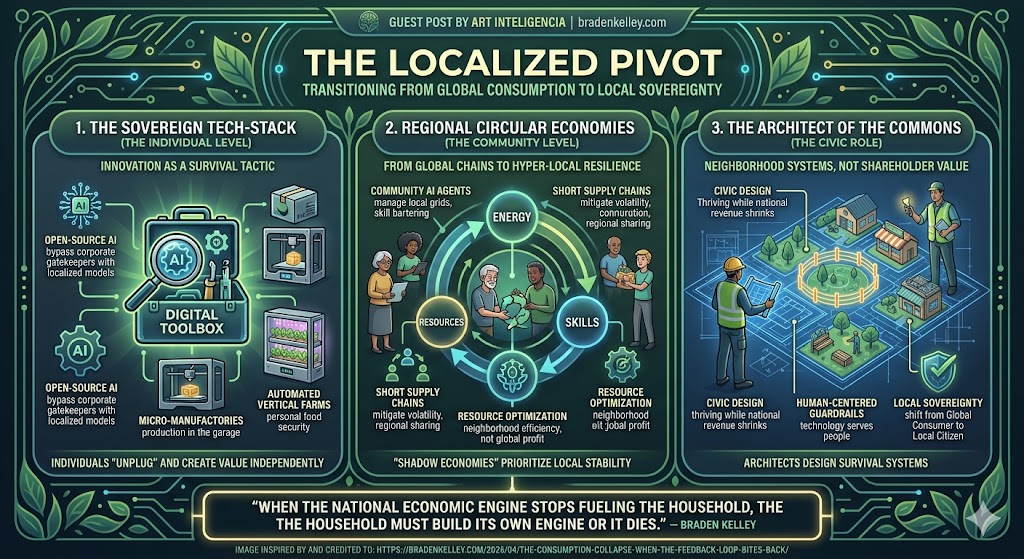
The Localized Pivot

The Sovereign Tech-Stack & The Localized Pivot

As the “Feedback Loop of Irrelevance” continues to shrink traditional income, we are witnessing a radical grassroots response: The Localized Pivot. When the macro-economy fails to provide value to the individual, the individual stops providing value to the macro-economy and turns inward to their community.

The Rise of the ‘Personal AI’ Infrastructure

By 2027, the barrier to entry for sophisticated production will vanish. We will see a surge in “Sovereign Tech-Stacks” — individuals and small collectives using localized, open-source AI models to run micro-manufactories, automated vertical farms, and peer-to-peer service networks. This is Innovation as a Survival Tactic. These citizens are essentially “unplugging” from the hollowed-out corporate ecosystem and creating a shadow economy that traditional GDP cannot track.

From Global Chains to Hyper-Local Resilience

The contraction of consumer spending will lead to the death of the “long supply chain” for many goods. In its place, we will see the rise of Regional Circular Economies. AI will be used not to maximize global profit, but to optimize local resource sharing. Imagine community AI agents that manage local energy grids or coordinate the bartering of skills — human-centered design at its most fundamental level.

The ‘Architect’ of the Commons

In this phase, the “Architect” role I’ve discussed previously becomes a civic one. These are the individuals who design the systems that keep their communities thriving while the national revenue shrinks. They are the ones building the Human-Centered Guardrails that ensure technology serves the neighborhood, not the shareholder. This shift represents a move from Global Consumerism to Local Sovereignty.

“When the national economic engine stops fueling the household, the household must build its own engine, or it dies.” — Braden Kelley

This localized movement will be the wild card of 2028. It creates a class of “Un-Architected” citizens who are no longer dependent on the federal government or major corporations, creating a profound tension for any political candidate trying to promise a return to the ‘Old Equation’.

The Road to 2028: The Politics of Human Relevance

As we approach the next Presidential election, the political discourse will undergo a seismic shift. The traditional “Left vs. Right” battle lines over tax rates and social issues will be superseded by a more existential debate: The Individual vs. The Algorithm. The 2028 election will likely be the first in history centered entirely on the consequences of a post-labor economy.

The ‘Humanity First’ Tax and Sovereign Solvency

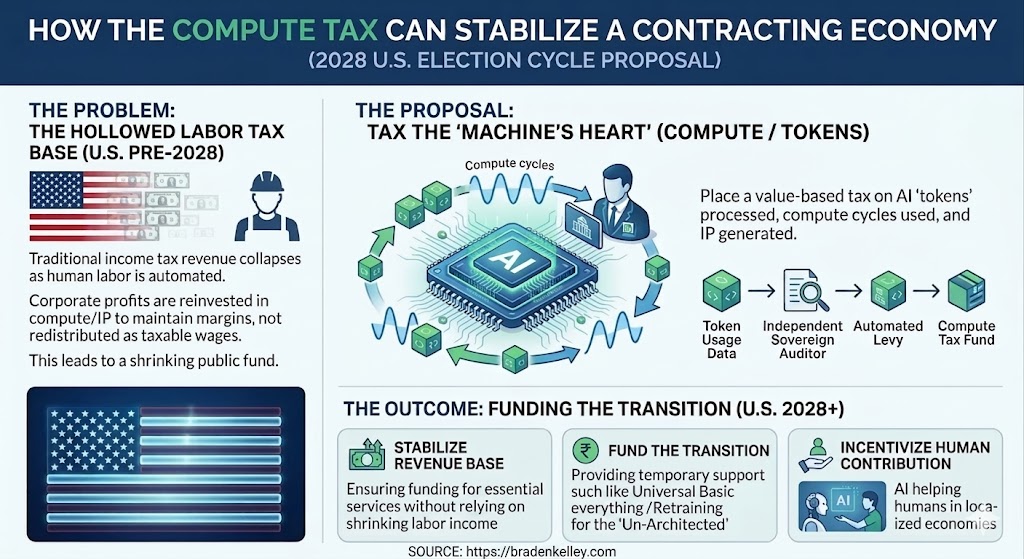
The most contentious issue will be how to fund a shrinking state as the labor-based tax system collapses. We will see the rise of the “Compute Tax” — a proposal to tax AI tokens and robotic output rather than human hours. This isn’t just about revenue; it’s about sovereign solvency. When companies reinvest profits into compute rather than wages, the “Economic OS” crashes. Expect candidates to run on a platform of Universal Basic Everything (UBE) — providing the results of automation (healthcare, housing, and energy) directly to the people as the tax base from labor vanishes.

The Compute Tax

The Death of Traditional Immigration Debates

As I noted in our initial look at the Contraction, the old argument about immigrants “taking jobs” or “filling gaps” is dead. In 2028, the focus will shift to “Strategic Talent Acquisition.” The debate will center on how to attract the world’s few remaining irreplaceable “Architect” minds while managing a domestic population that is increasingly surplus to the needs of capital. This will create a strange political alliance between protectionists and humanists, both seeking to shield human value from digital devaluation.

Mindset and Likely Actions of the Citizenry

By the time voters head to the polls, the American mindset will have shifted from aspiration to preservation. We are likely to see:

  • The Rise of ‘Neo-Luddite’ Activism: Not a rejection of technology, but a demand for “Human-Centered Guardrails” that prevent AI from cannibalizing the last remaining sectors of human connection.
  • The Search for Non-Monetary Meaning: A surge in candidates who focus on “Quality of Life” metrics rather than fiscal growth, appealing to a class of people who no longer derive their identity from their “job.”
  • Algorithmic Populism: Politicians using AI to personalize fear and hope at scale, creating a feedback loop where the technology used to displace the worker is also used to win their vote.

The central question of the 2028 election will be simple but devastating: “What is a country for, if not to support the thriving of its people — even when those people are no longer ‘productive’ in a traditional sense?” The winner will be the one who can design a new social contract for a smaller, more resilient, and truly innovative nation.

Conclusion: Designing a Thrivable Contraction

The Great American Contraction is no longer a theoretical “what-if” for futurists to debate; it is an active restructuring of our reality. As the feedback loop of automated austerity begins to bite, we are discovering that a country built on the relentless pursuit of “more” is fundamentally ill-equipped to handle the arrival of “enough.”

The next two years will be a period of intense friction as our legacy systems — our tax codes, our education models, and our social safety nets — grind against the frictionless efficiency of the AI era. We will see traditional economic metrics fail to capture the quiet struggle of the consumer, and we will watch as the 2028 election turns into a referendum on the value of a human being in a post-labor world.

But contraction does not have to mean collapse. If we shift our focus from transactional velocity to human vitality, we have the opportunity to design a new version of the American Dream. This new dream isn’t about the quantity of jobs we can protect from the machines, but the quality of the lives we can build with the abundance those machines create. It is about moving from a nation of “doers” who are exhausted by the grind to a nation of “architects” who are inspired by the possible.

“The goal of innovation was never to replace the human; it was to release the human. We are finally being forced to decide what we want to be released to do.” — Braden Kelley

The road to 2028 will be defined by whether we choose to cling to the wreckage of the growth-based model or whether we have the courage to embrace a smaller, smarter, and more human-centered future. The contraction is inevitable, but the outcome is ours to design.

STAY TUNED: On Tuesday my friend Braden Kelley (with a little help from me) is publishing an article featuring one hypothesis for what an AI SOFT LANDING might look like.

Image credits: Google Gemini

Subscribe to Human-Centered Change & Innovation WeeklySign up here to get Human-Centered Change & Innovation Weekly delivered to your inbox every week.

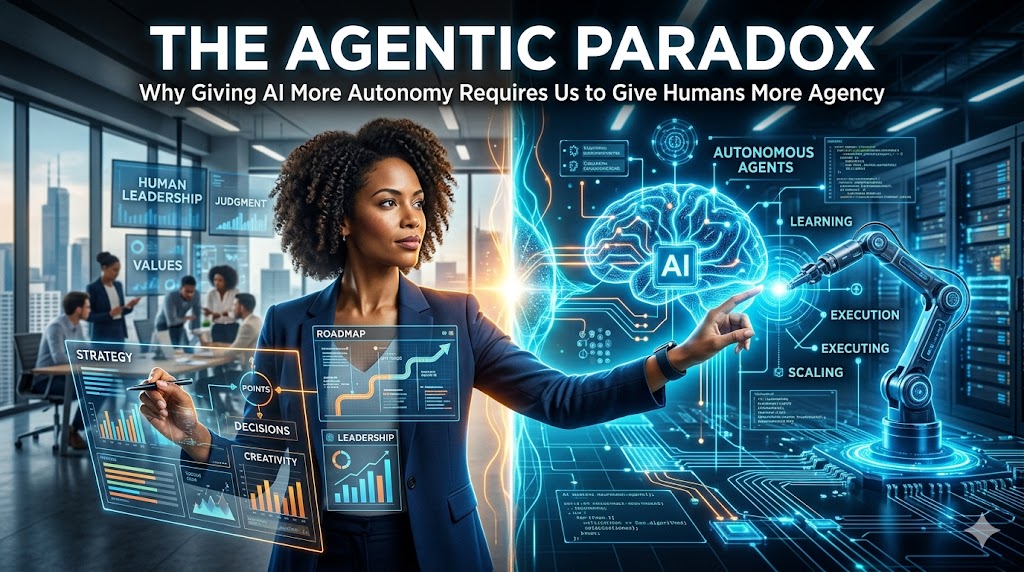
The Agentic Paradox

Why Giving AI More Autonomy Requires Us to Give Humans More Agency

LAST UPDATED: April 10, 2026 at 7:11 PM

The Agentic Paradox

by Braden Kelley and Art Inteligencia


The Rise of the Machine “Doer”

For the past few years, we have lived in the era of Generative AI — a world of sophisticated chatbots and creative assistants that respond to our prompts. But as we move deeper into 2026, the landscape has shifted. We are now entering the age of Agentic AI. These are not just tools that talk; they are autonomous systems capable of executing complex workflows, making real-time decisions, and acting on our behalf across digital ecosystems.

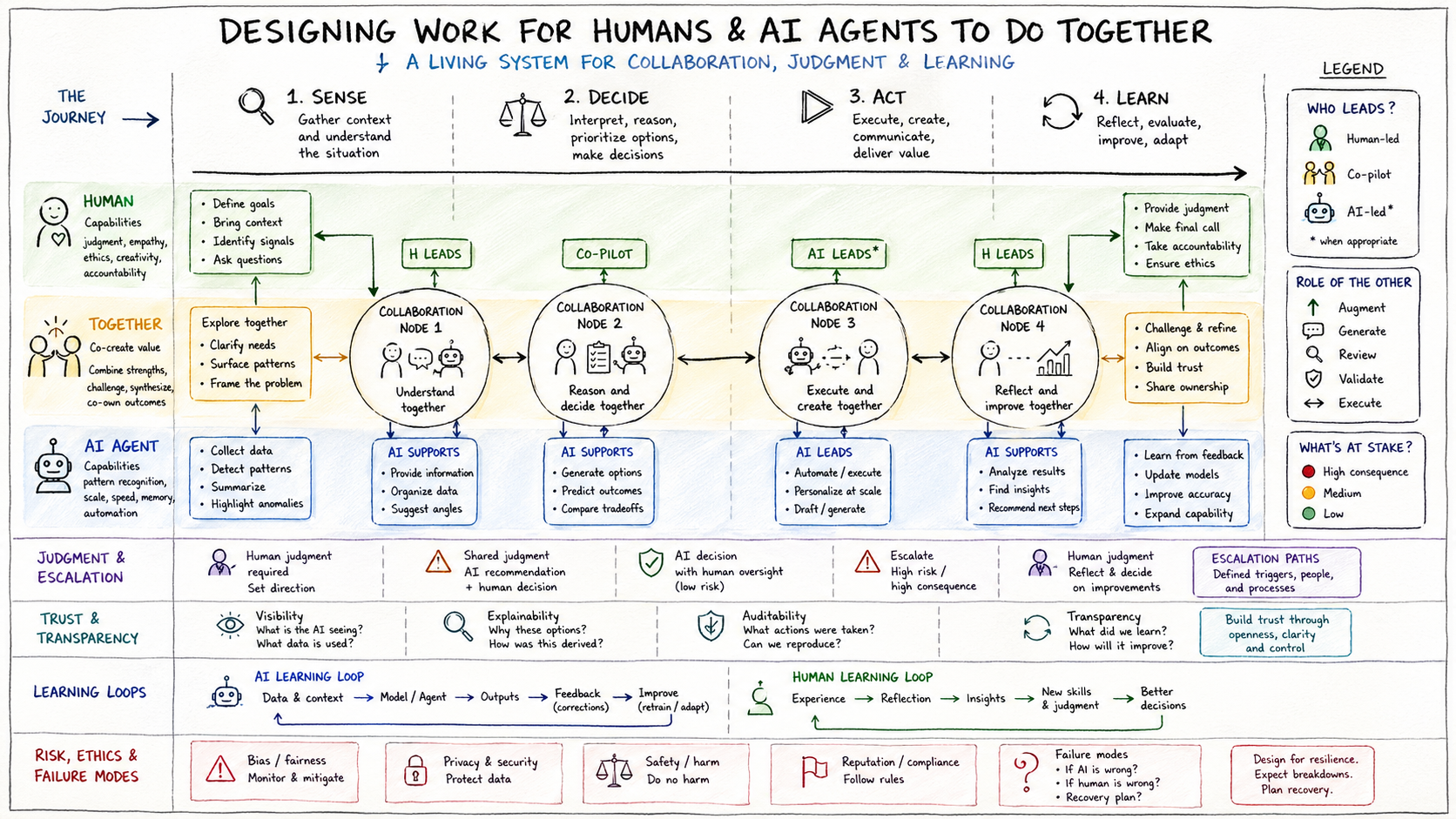
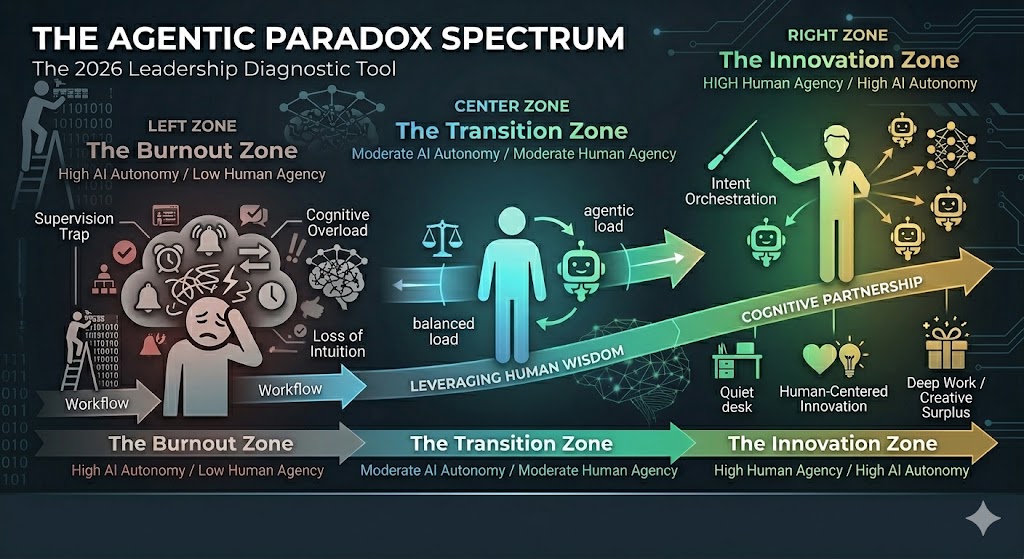
On the surface, this promises the ultimate efficiency. We imagine a future where the “busy work” vanishes, leaving us free to innovate. However, a troubling Agentic Paradox has emerged: as we grant machines more autonomy to act, many humans are finding themselves with less agency. Instead of feeling liberated, workers often feel like they are merely “babysitting” algorithms or reacting to a relentless stream of machine-generated outputs.

This disconnect creates a high-stakes leadership challenge. If we focus solely on the autonomy of the machine, we risk creating an “algorithmic anxiety” that stifles the very human creativity we need to thrive. To succeed in this new era, leaders must realize that the more powerful our AI agents become, the more we must intentionally “upgrade” the agency, authority, and strategic focus of our people.

The Thesis: The goal of innovation in 2026 is not to build the most autonomous machine, but to build a human-centered ecosystem where AI agents manage the tasks and empowered humans manage the intent.

The Hidden Cost: The Cognitive Load Crisis

The promise of Agentic AI was a reduction in workload, but for many organizations, the reality has been a shift in the type of work rather than a reduction of it. This has birthed the Cognitive Load Crisis. While an autonomous agent can process data and execute tasks 24/7, it lacks the contextual wisdom to understand the nuances of organizational culture or ethical gray areas. This leaves the human “orchestrator” in a state of perpetual high-alert.

Instead of performing deep, meaningful work, leaders and employees are becoming trapped in the Supervision Trap. They are forced to manage a relentless firehose of machine-generated notifications, approvals, and “check-ins.” This creates a fragmented mental state where the human mind is constantly context-switching between different agent streams, leading to a unique form of 2026 burnout — digital exhaustion without the satisfaction of tactile achievement.

Furthermore, as AI agents take over more of the “doing,” we see an erosion of Deep Work. When every minute is spent verifying the output of an algorithm, the quiet space required for radical innovation and strategic foresight vanishes. We are effectively trading our long-term creative capacity for short-term operational speed.

  • Notification Fatigue: The mental tax of being the constant “emergency brake” for autonomous systems.
  • Loss of Intuition: The danger of becoming so reliant on agentic data that we lose our “gut feel” for the market.
  • The Feedback Loop: A system where humans spend more time managing machines than mentoring people.

To break this cycle, we must stop treating AI agents as simple productivity tools and start treating them as entities that require a new architecture of human attention. If we don’t manage the cognitive load, our most talented people will eventually shut down, leaving the “Magic Makers” of our organization feeling like mere cogs in a machine-led wheel.

Agentic Paradox Spectrum Infographic

Redefining Roles: From “The Conscript” to “The Architect”

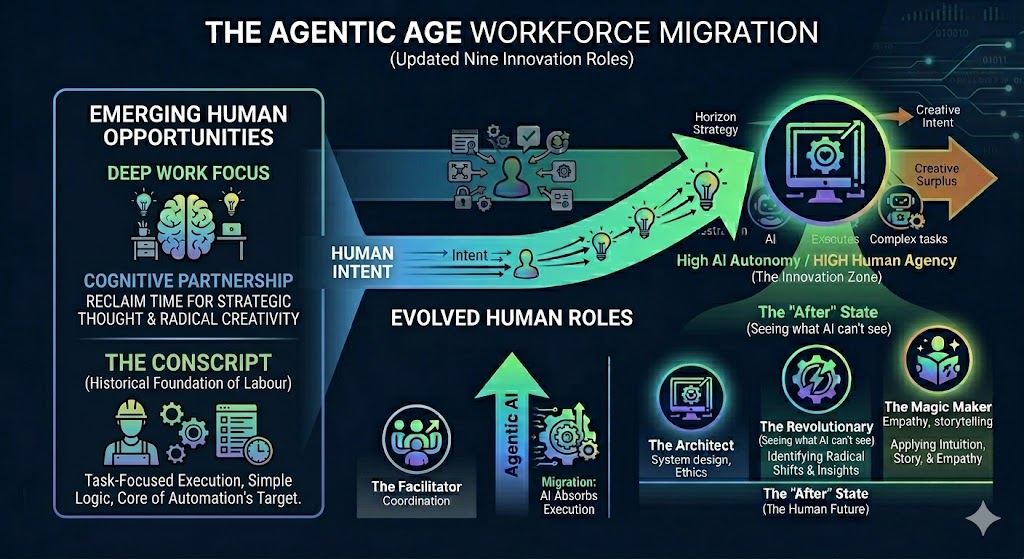
As the landscape of work shifts, so too must our understanding of how individuals contribute to the innovation ecosystem. In my work on the Nine Innovation Roles, I’ve often highlighted how different archetypes fuel organizational growth. In this agentic age, we are seeing a dramatic migration of these roles. If we are not intentional, our best people will default into the role of The Conscript — those who are merely drafted into service to support the AI’s agenda, performing the monotonous tasks of verification and data cleanup.

The goal of a human-centered transformation is to automate the role of the “Conscript” and elevate the human into the role of The Architect or The Magic Maker. When the AI handles the heavy lifting of execution, the human is finally free to focus on Intent. This is where true agency resides. Agency is not the ability to do more; it is the power to decide what is worth doing and why it matters to the human beings we serve.

However, there is a dangerous “Agency Gap” emerging. If an organization implements AI agents without redefining human job descriptions, employees lose their sense of ownership. When the machine becomes the primary creator, the human “spark” is extinguished. We must ensure that AI serves as the support staff for human intuition, not the other way around.

The Migration of Value

The AI Agent Role The Human Agency Role
The Conscript: Handling repetitive execution and data synthesis. The Architect: Designing the systems and ethical frameworks for the AI.
The Facilitator: Coordinating schedules and managing basic workflows. The Revolutionary: Identifying the “radical” shifts the AI isn’t programmed to see.
The Specialist: Performing deep-dive technical analysis at scale. The Magic Maker: Applying empathy and storytelling to turn data into a movement.

By clearly delineating these roles, leaders can close the Agency Gap. We must empower our teams to move away from “monitoring” and toward “orchestrating.” This transition is the difference between a workforce that feels obsolete and one that feels essential.

Agentic Workforce Migration Infographic

FutureHacking™ the Cognitive Workflow

To navigate the complexities of 2026, organizations cannot rely on reactive strategies. We must use FutureHacking™ — a collective foresight methodology — to map out how the relationship between human intelligence and agentic automation will evolve. This isn’t just about predicting technology; it’s about engineering the “Human-Agent Interface” so that it scales without crushing the human spirit.

The core of this approach involves identifying the Innovation Bonfire within your team. In this metaphor, the AI agents are the fuel — abundant, powerful, and capable of sustaining a massive output. However, the humans must remain the spark. Without the human spark of intent and empathy, the fuel is just a cold pile of logs. FutureHacking™ allows teams to visualize where the “fuel” might be smothering the “spark” and adjust the workflow before burnout sets in.

By engaging in collective foresight, teams can proactively decide which cognitive territories are “Human-Core.” These are the areas where we intentionally limit AI autonomy to preserve our creative agency and cultural identity. It’s about choosing where we want the machine to lead and where we require a human to hold the compass.

  • Mapping the Friction: Identifying which agent-led tasks are creating the most mental “drag” for the team.
  • Defining Non-Negotiables: Establishing which parts of the customer and employee experience must remain 100% human-centric.
  • Intent Modeling: Shifting the focus from “What can the agent do?” to “What outcome are we trying to hack for the future?”

When we FutureHack our workflows, we move from being passive recipients of technological change to being the active architects of our organizational destiny. We ensure that as the machine gets smarter, our collective human intelligence becomes more focused, not more fragmented.

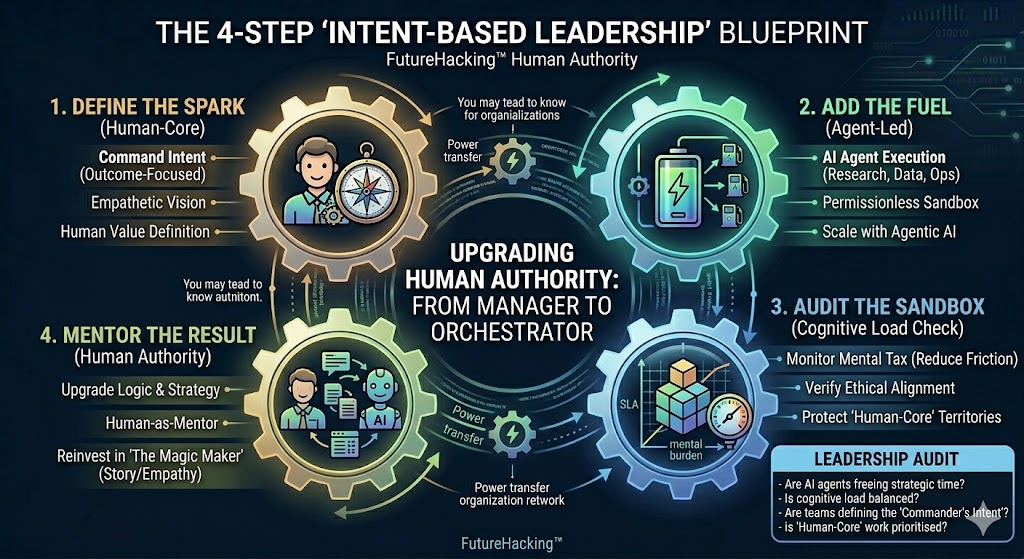
Framework: The “Agency First” Operating Model

Building a resilient organization in the age of Agentic AI requires more than just new software; it requires a new operating philosophy. We must move away from a model of Machine Management and toward a model of Intent Orchestration. This framework provides three critical steps to ensure that human agency remains the primary driver of your business value.

1. Cognitive Offloading, Not Task Dumping

The goal of automation should be to reduce the mental noise for the employee, not just to move a task from a human to a machine. If a human still has to track, verify, and worry about every step the agent takes, the cognitive load hasn’t decreased — it has merely changed shape.
The Strategy: Design “set and forget” guardrails that allow agents to operate within a defined ethical and operational “sandbox,” only alerting the human when a decision falls outside of those parameters.

2. The “Human-in-the-Loop” Upgrade

We must shift the role of the worker from Monitor to Mentor. In the old model, the human checks the machine’s homework for errors. In the “Agency First” model, the human coaches the agent on why certain decisions are better than others, treating the AI as an apprentice. This reinforces the human’s position as the source of wisdom and authority, preventing the “Conscript” mentality.

3. Intent-Based Leadership

Management must evolve to focus on the Intent rather than the Activity. In a world where agents can generate infinite activity, “busyness” is no longer a proxy for value. Leaders must empower their teams to spend their time defining the “Commander’s Intent” — the high-level objectives and human-centered outcomes that the AI agents must then figure out how to achieve.

Intent Based Leadership Blueprint Infographic

The Agency Audit: Ask your team this week: “Does this new AI agent give you more time to think strategically, or does it just give you more machine-generated work to manage?” The answer will tell you if you are facing an Agentic Paradox.

Conclusion: Leading the Human-Centered Revolution

The true test of leadership in 2026 is not how quickly you can deploy autonomous agents, but how effectively you can protect and amplify the human spirit within your organization. As we navigate the Agentic Paradox, we must remember that technology is a force multiplier, but it requires a human “integer” to multiply. Without a clear sense of agency, even the most advanced AI becomes a source of friction rather than a source of freedom.

By addressing the Cognitive Load Crisis and intentionally moving our teams out of “Conscript” roles and into “Architectural” ones, we do more than just improve efficiency — we future-proof our culture. We ensure that our organizations remain places of meaning, creativity, and purpose.

The “Year of Truth” demands that we be honest about the mental tax of automation. It calls on us to use FutureHacking™ not just to map out our tech stacks, but to map out our human potential. The companies that win the next decade won’t be those with the smartest agents; they will be the ones that used those agents to give their people the time and agency to be truly, radically human.

“Innovation is a team sport where the machines play the support roles so the humans can score the points.”

Are you ready to hack your agentic future?

Frequently Asked Questions

What is the primary difference between Generative AI and Agentic AI?

Generative AI focuses on creating content (text, images, code) based on human prompts. Agentic AI goes a step further by having the autonomy to execute multi-step workflows, make decisions, and interact with other systems to complete a goal without constant human intervention.

How can leaders identify if their team is suffering from the Agentic Paradox?

Look for signs of the “Supervision Trap,” where employees spend more time managing and verifying machine outputs than performing strategic work. If your team feels busier but reports a decline in creative output or “Deep Work,” they are likely experiencing the paradox.

What role does FutureHacking™ play in managing AI integration?

FutureHacking™ is a collective foresight methodology used to visualize the long-term impact of AI on organizational roles. It helps teams proactively define “Human-Core” territories, ensuring that as AI scales, it supports rather than smothers human agency and innovation.

Image credits: Google Gemini

Content Authenticity Statement: The topic area, key elements to focus on, etc. were decisions made by Braden Kelley, with a little help from Google Gemini to clean up the article, add images and create infographics.

Subscribe to Human-Centered Change & Innovation WeeklySign up here to get Human-Centered Change & Innovation Weekly delivered to your inbox every week.
Artificial Intelligence Powered Teamwork

Artificial Intelligence Powered Teamwork

GUEST POST from David Burkus

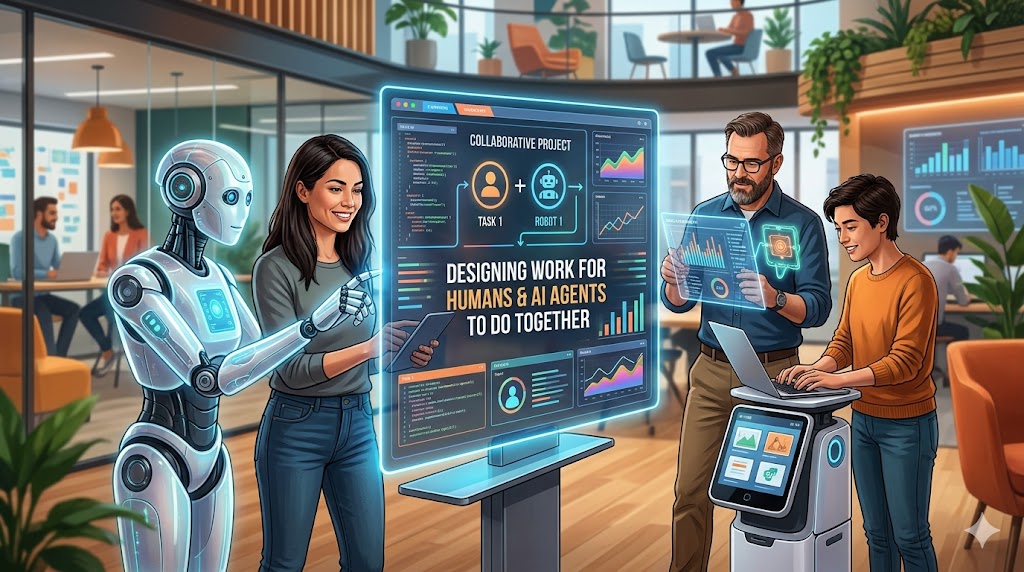
Over the past year, leaders have been asking the same questions trying to leverage AI-Powered teamwork: “What should I be doing with ChatGPT?” “How should we be rolling this out to our team?” “What does this mean for the future of work?”

They’re important questions, but they all kind of miss the mark. Because they treat AI like it’s just another IT rollout. Like that time your company moved from email to Slack. Or when everyone was forced to learn a new payroll system. But AI isn’t just another piece of software.

AI isn’t a tool. AI is a teammate.

And until we start treating it that way, we’re going to keep missing the real opportunity.

Why “Tool Thinking” Falls Short

Most people respond to AI in one of three ways. They see it as a threat. They see it as a tool. Or they see it as a teammate.

If you see AI as a threat, you’re going to hesitate. And hesitation is the enemy of progress. You’ll wait. You’ll hold back. But AI isn’t slowing down. And the people who do embrace it — whether they’re colleagues in your department or competitors across the industry — are only going to get better, faster, and more efficient. That puts your performance at risk by comparison. Compared to those using AI, you will performer slower.

If you see AI as a tool, you’re on slightly better footing. You’ll look for ways to automate the repetitive stuff. Email summaries. Meeting notes. Draft responses. All helpful. All productive. But you’re still missing the big value. You’re simplifying, not improving. You’re staying in neutral.

But if you treat AI as a teammate, that’s where transformation starts.

That’s when AI becomes a collaborator. A partner in decision-making. A quiet force that helps your team think more clearly, solve problems faster, and deliver better outcomes.

That’s when you start to unlock the full potential of AI-powered teamwork. That’s when it truly makes you smarter.

Step One: From Slower to Simpler

The first mindset shift is from threat to tool. From slower to simpler. Think about the annoying parts of your job. The copy-paste chores. The tedious admin. The stuff you’re way too smart to be wasting time on. AI can take that off your plate today.

Summarize the endless email chain. Done. Draft that status report. Done. Transcribe your meeting and highlight key action items. Double done.

Not sure where to start? Try this: open whatever AI platform you prefer — ChatGPT, Claude, Gemini, Grok, doesn’t matter — and type:

“Here’s what I do in my job every day. Ask me questions to understand it better, then show me how you could help.”

It will ask follow-ups. It will start mapping your workflows. It will suggest ways to make your day easier, your output faster, and your mind a little clearer.

Congratulations! You’ve moved from slower to simpler.

Step Two: From Simpler to Smarter

Once you’re using AI to simplify tasks, it’s time to use it to sharpen your thinking. Because smarter teams don’t just offload work. They upgrade their decision-making. They collaborate with AI, not just delegate to it.

How? Try turning AI into a devil’s advocate. Feed it your current strategy or plan, then ask:

“Tell me why this could fail.”

You’re not asking it to make decisions. You’re using it to challenge assumptions. To highlight blind spots. To play the role of critic — without the ego. AI provides friction without awkwardness. No one gets defensive when a bot questions your logic.

Want to go deeper? Try these prompts:

  • “What are we overlooking?”
  • “What assumptions might not be true?”
  • “Give me three stronger alternatives to this approach.”

Want to make the feedback even more useful? Ask the AI to role-play:

  • “Think like a strategic consultant.”
  • “Respond like a customer.”
  • “What would a competitor say?”

This is how AI-powered teamwork gets smarter, not just simpler. You’re not just getting a second opinion. You’re getting sharper thinking, without the politics.

Step Three: Make It a Team Habit

And here’s where the real breakthrough happens: when AI becomes a shared part of your team’s workflow — not just your personal productivity hack.

Use it in meetings to take notes. To draft action items. To highlight decisions made.

But also, use it before meetings. Drop your agenda into the chatbot and ask what you’re missing. Run your strategy plan through it and ask for feedback before your next off-site.

This only works if the whole team adopts it. And that’s where leaders come in.

Leaders need to be intentional. Because while AI can streamline collaboration, it can also introduce risks. If team members outsource their attention to a bot, they may stop listening. If everything’s recorded, people may speak up less. The quiet voices might go even quieter.

That’s why leadership still matters. Psychological safety? Still your job. Empathy? Still your job. Motivation and morale? Still your job.

AI can’t do that for you. But what it can do is give you more time to focus on it. Because when the bots handle the mechanics, you can focus on the human side of leadership — the part that never gets automated.

The Future of AI-Powered Teamwork

So, where’s your team right now? Are you stuck in “slower,” resisting change? Are you in “simpler,” just automating inbox chores? Or are you starting to work “smarter,” using AI to enhance how your team thinks and collaborates?

Wherever you are, there’s room to grow. Don’t just ask what AI can do. Ask how your team can do better work with it. Try a prompt. Test an idea. Challenge a plan. Start treating AI like a teammate, not a tool. Because the future of AI-powered teamwork isn’t about tech. It’s about trust. It’s about how you use new capabilities to build better teams, make better decisions, and do work that actually matters.

And that’s something worth getting smarter about.

Image credit: Google Gemini

Subscribe to Human-Centered Change & Innovation WeeklySign up here to get Human-Centered Change & Innovation Weekly delivered to your inbox every week.
The Augmented Mind

Beyond Recall: The Strategic Evolution of Human Digital Memory

LAST UPDATED: April 10, 2026 at 3:39 PM

The Augmented Mind

GUEST POST from Art Inteligencia


The Dawn of the Extended Mind

For decades, we have treated our digital devices as external filing cabinets — places where we “put” information to be retrieved later. However, as the volume of data we consume shifts from a manageable stream to an overwhelming deluge, the traditional boundaries of the human mind are being tested. We are now entering a profound transition from Information Management to Cognitive Partnership.

The “Cognitive Crisis” is no longer a future threat; it is our current reality. Traditional search functions and folder-based storage hierarchies are failing the modern knowledge worker because they rely on perfect recall of where a file was placed or exact matching of keywords. When our biological hardware reaches its limit, our productivity and creativity suffer.

Digital Memory Augmentation represents a fundamental shift. It moves us beyond simple backups and toward active, AI-driven cognitive extensions. This isn’t about replacing human thought with an algorithm; it is a human-centered design opportunity to create a digital scaffold for our intellect. By augmenting our memory, we free the brain from the mundane task of storage, allowing it to return to its highest and best use: imagination, synthesis, and meaningful connection.

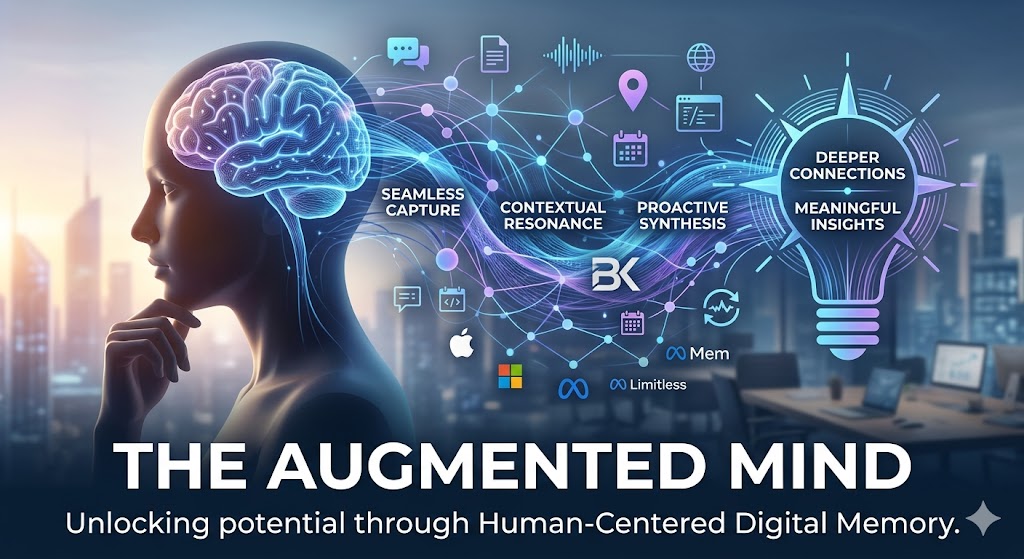
The Three Pillars of Augmented Memory

To move beyond simple storage and into true augmentation, we must look at how digital systems interface with our lived experience. This evolution is built upon three foundational pillars that transform raw data into a functional extension of our intellect.

1. Seamless Capture

The greatest friction in traditional memory management is the act of “saving.” When we have to pause our flow to take a note, bookmark a page, or file a document, we break our cognitive momentum. Seamless Capture shifts the burden from the user to the environment. Through “digital exhaust” — the ambient collection of our meetings, readings, and interactions — augmentation systems ensure that the “sparks” of insight are never lost simply because we were too busy to write them down.

2. Contextual Resonance

A memory is useless if it exists in a vacuum. Traditional systems rely on folders or tags, which require us to remember how we categorized information in the past. Contextual Resonance uses semantic analysis to understand the “why” and “how” behind a piece of information. By linking a data point to a specific project, a person, or even an emotional state, the system mimics the associative nature of the human brain, making retrieval feel like a natural thought rather than a database query.

3. Proactive Synthesis

The ultimate goal of augmentation is to move from reactive searching to proactive assistance. Proactive Synthesis is the stage where the system acts as a true partner. Instead of waiting for a prompt, the “Second Brain” identifies patterns across years of data and surfaces relevant insights at the moment they are most useful. It creates “digital serendipity,” connecting a conversation you had this morning with a research paper you read three years ago, fueling innovation through automated cross-pollination.

Reimagining the Innovation Lifecycle

Innovation is rarely the result of a single “Eureka!” moment; it is a cumulative process of gathering sparks, connecting dots, and refining concepts over time. By integrating digital memory augmentation, we transform the innovation lifecycle from a fragile, hit-or-miss endeavor into a robust, high-velocity engine for growth.

1. The End of “Lost Ideas”

How many breakthrough concepts have been lost to the ether simply because they occurred in the shower, during a commute, or in the middle of a casual conversation? Memory augmentation ensures that the “sparks” — the messy, early-stage thoughts and sketches — are captured in real-time. By removing the friction of documentation, we preserve the raw materials of innovation before they can be overwritten by the next urgent task.

2. Cross-Pollination at Scale

The most powerful innovations often come from combining ideas from two completely unrelated fields. However, our biological memory is prone to “siloing” information by department or project. A digital memory layer can scan across decades of organizational history and disparate personal interests to find hidden links. It allows an engineer to see how a solution from a 2015 project might solve a 2026 problem, facilitating a level of cross-pollination that was previously impossible for a single human mind to manage.

3. Accelerating Mastery

In a world of hyper-specialization, the “time-to-expertise” is a major bottleneck for innovation. Memory augmentation acts as a cognitive scaffold, allowing individuals to rapidly navigate complex institutional knowledge and technical documentation. By having a “Second Brain” that remembers the technical nuances and past failures of a specific domain, innovators can stand on the shoulders of their own past experiences (and those of their predecessors) much faster, shifting their energy from learning the foundation to building the future.

Designing for Trust and Human Agency

As we integrate digital memory more deeply into our lives, the design challenge shifts from technical feasibility to ethical responsibility. If we are to treat a digital system as an extension of our own mind, that system must be designed with an uncompromising focus on the user’s autonomy, privacy, and long-term cognitive health.

1. The Privacy Imperative

For digital memory augmentation to be successful, the “Second Brain” must be a private sanctuary. Users will only record their raw thoughts, private conversations, and vulnerable moments if they have absolute certainty that their data is not being used for advertising or surveillance. Designing for trust means prioritizing on-device processing and end-to-end encryption — ensuring that the user remains the sole owner and curator of their digital history.

2. Combatting Cognitive Atrophy

A significant concern with augmentation is the risk of “cognitive laziness.” Just as GPS has weakened our innate sense of navigation, there is a risk that total recall tools could weaken our ability to focus or synthesize information independently. Human-centered design must focus on augmentation, not replacement. The goal is to build tools that act as a “cognitive bicycle” — strengthening our ability to connect ideas and think critically by offloading the low-value task of rote memorization.

3. The Ethics of Perfection

Human memory is naturally fallible; we forget, we forgive, and we move on. A world where every mistake, every awkward comment, and every outdated opinion is preserved with photographic clarity presents a psychological challenge. We must design systems that allow for the “right to be forgotten” and the ability to prune our digital archives. True augmentation should support the human capacity for growth and evolution, rather than chaining us to a static version of our past selves.

The Ecosystem: Titans and Trailblazers

The landscape of memory augmentation is currently a race between established tech giants integrating AI into our daily operating systems and agile startups building dedicated hardware for total recall. By 2026, the market has moved beyond experimental prototypes to functional, cross-platform tools that are reshaping how we interact with our own history.

1. Established Platforms

  • Apple (Apple Intelligence): Apple has positioned itself as the “Privacy-First” memory partner. By leveraging on-device processing and Private Cloud Compute, iOS 26 and macOS Sequoia allow users to search for specific moments across photos, emails, and notes using natural language — creating “Memory Movies” and surfacing context-aware suggestions without ever exposing raw data to the cloud.
  • Microsoft (Windows Recall & Copilot): Despite early privacy hurdles, Microsoft has refined “Recall” into a sophisticated enterprise tool. It creates a searchable photographic timeline of everything you’ve seen and done on your PC, allowing professionals to instantly jump back to a specific slide, website, or conversation from weeks prior.
  • Meta (Ray-Ban Meta & AI): Meta is utilizing hardware to move memory augmentation into the physical world. Their smart glasses act as ambient “eyes and ears,” allowing users to ask, “Hey Meta, what was the name of that restaurant I walked past yesterday?” or “What did my colleague say about the project deadline?”

2. Disruptive Startups

  • Limitless (The Pendant): Limitless has become the go-to for “Total Recall” hardware. Their wearable AI pendant records and transcribes in-person meetings and impromptu conversations, utilizing “Automatic Speaker Recognition” to create smart summaries and reminders that sync across all productivity suites.
  • Mem.ai: Moving beyond traditional note-taking, Mem 2.0 has evolved into an “AI Thought Partner.” It eliminates the need for folders by using a self-organizing knowledge graph that automatically links new thoughts to past research, surfacing relevant context as you type.
  • Heirloom (Heirloom.cloud): Focused on the bridge between analog and digital, Heirloom uses AI to digitize, contextualize, and narrate family histories and personal archives, ensuring that legacy memories remain searchable and meaningful for future generations.
  • The Neural Frontier (Neuralink & Synchron): While still largely focused on clinical applications for motor and speech restoration, the successful 2025-2026 human trials for Brain-Computer Interfaces (BCIs) have laid the groundwork for future direct-to-brain memory retrieval and cognitive offloading.

Case Studies: Augmentation in the Real World

To move from the theoretical to the practical, we must look at how digital memory augmentation is already solving deep-seated organizational and individual challenges. These two case studies illustrate how extending our cognitive capacity directly translates into business value and human safety.

Case Study 1: Resolving the “Institutional Memory” Gap in Professional Services

The Challenge: A global management consulting firm was suffering from “reinventing the wheel.” With over 10,000 consultants globally, teams were frequently spending hundreds of hours on research and analysis that had already been performed by colleagues in different regions or years prior. Internal surveys showed that senior partners were spending 25% of their time simply trying to remember who had the specific “tribal knowledge” needed for a new pitch.

The Approach: The firm implemented a semantic memory layer that indexed all past white papers, anonymized project summaries, internal Slack discussions, and recorded client debriefs. Unlike a traditional database, this system used a “Second Brain” interface that allowed consultants to ask conversational questions like, “What were the specific regulatory hurdles we faced during the 2022 retail merger in Singapore?”

The Result: Within the first twelve months, the firm reported a 35% increase in project velocity and a significant reduction in duplicate research costs. More importantly, the ability to surface “deep-context” insights during client meetings led to a 15% higher win rate on new business pitches.

Case Study 2: Adaptive Learning and Safety in Complex Engineering

The Challenge: An aerospace manufacturing leader faced a massive demographic shift. As their most experienced engineers reached retirement age, they were struggling to transfer decades of “feel” and undocumented maintenance nuances to junior engineers working on legacy aircraft systems — some of which were designed 40 years ago.

The Approach: The company deployed a wearable AR-and-memory system. As a junior engineer looked at a specific engine component, the system utilized computer vision to recognize the part and instantly surfaced the “ambient memory” associated with it: past repair notes from retired masters, video snippets of successful fixes, and warnings about specific bolt-tension issues that weren’t in the official manual.

The Result: The facility saw a 50% reduction in error rates during complex maintenance cycles. The “time-to-expertise” for new hires was cut by four months, as their digital memory augmentation acted as an on-demand mentor, bridging the gap between theoretical training and institutional wisdom.

Conclusion: The Future of Being Human

We are standing at a pivotal crossroads in our evolution as a species. Digital memory augmentation is not merely a technological upgrade; it is a shift in the very nature of human cognition. As we move from a world of “Search” to a world of “Knowing,” we must be intentional about how we design these systems and what we choose to do with our newly reclaimed mental energy.

1. From “Search” to “Knowing”

When the friction of retrieval disappears, our relationship with knowledge changes. We no longer have to wonder if we know something; we simply have access to it. This transition allows us to shift our focus from the logistics of information management to the higher-level pursuit of empathy and understanding. When we are not struggling to remember the facts, we have more capacity to listen to the story, to understand the nuance, and to build deeper connections with those around us.

2. The Human-First Mandate

As a thought leader in human-centered innovation, my message is clear: Technology should never outpace our humanity. While we build smarter memories and more powerful cognitive scaffolds, we must ensure we don’t lose the “wisdom” that comes from human reflection, the growth that comes from our mistakes, and the beauty of our fallibility. Our goal should be to use digital memory to amplify our potential — not to automate our souls.

The future of being human is not about being “replaced” by silicon; it is about being empowered by it to reach new heights of creativity and compassion. Let us design for that future today.

Key Insight: Digital memory augmentation isn’t about building a better hard drive; it’s about building a better bridge between what we experience and what we can achieve.

Frequently Asked Questions

1. What is Digital Memory Augmentation?

It is the use of AI-driven tools and hardware to seamlessly capture, organize, and surface personal and professional information, acting as a “second brain” to extend human cognitive capacity.

2. How does memory augmentation impact privacy?

Privacy is the core pillar of these systems. Modern solutions prioritize on-device processing and end-to-end encryption to ensure that the user remains the sole owner of their digital history.

3. Does using a “Second Brain” lead to cognitive atrophy?

When designed correctly, these tools act as a “cognitive bicycle” — offloading the low-value task of rote memorization so the human brain can focus on higher-level creativity and complex problem-solving.

Disclaimer: This article speculates on the potential future applications of cutting-edge scientific research. While based on current scientific understanding, the practical realization of these concepts may vary in timeline and feasibility and are subject to ongoing research and development.

Image credits: ChatGPT

Subscribe to Human-Centered Change & Innovation WeeklySign up here to get Human-Centered Change & Innovation Weekly delivered to your inbox every week.
Does Planned Obsolescence Fuel the Fire or Just Burn the House Down?

The Innovation Paradox

LAST UPDATED: April 4, 2026 at 11:56 AM

Does Planned Obsolescence Fuel the Fire or Just Burn the House Down?

by Braden Kelley and Art Inteligencia


I. Introduction: The Tension Between Renewal and Waste

In the world of innovation, we often talk about the “fire” of creativity — the energy that drives us to build the next great breakthrough. But in the current industrial landscape, we must ask ourselves: are we stoking a sustainable Innovation Bonfire, or are we simply burning the furniture to keep the room warm for a single night?

Planned obsolescence has long been the silent engine of the consumer economy, a strategy designed to ensure that the products of today become the landfill of tomorrow. It creates a fundamental tension between the mechanical need for economic growth and the human-centered need for enduring value.

“To truly innovate for humanity, we must pivot from a strategy of deliberate failure to one of intentional resilience.”

As change leaders, we must recognize that planned obsolescence is an industrial-age relic masquerading as a modern innovation strategy. This article explores whether this cycle of constant replacement truly fuels progress or if it acts as a “wet blanket” that dampens our ability to solve the world’s most pressing, wicked problems.

II. The Case for the “Pro”: Obsolescence as a Catalyst for Speed

While it is easy to dismiss planned obsolescence as purely cynical, from a strategic standpoint, it has functioned as a powerful — if aggressive — accelerant for the adoption curve. By shortening the lifecycle of a product, organizations force a faster cadence of iteration. This “forced evolution” ensures that new technologies, safety standards, and efficiencies are pushed into the hands of users at a rate that a “buy-it-for-life” model simply couldn’t sustain.

Consider the following drivers that proponents argue fuel the innovation engine:

  • R&D Capitalization: The consistent revenue generated by replacement cycles provides the massive capital reserves required for “Big Bang” breakthroughs. Without the “Small Bangs” of incremental sales, the long-term, high-risk research into materials science or AI might never be funded.
  • The Velocity of “Innovation”: When a product is designed to be replaced, designers are freed from the “legacy trap.” They can experiment with radical new interfaces or hardware configurations, knowing that the next cycle provides an immediate opportunity to course-correct based on real-world human feedback.
  • The Psychology of the “New”: In our work on Stoking Your Innovation Bonfire, we recognize that emotion is a primary driver of change. The “Fashion of Tech” creates a sense of momentum. This psychological pull toward the “New” keeps markets liquid and encourages a culture of constant curiosity and upgrade.

In this light, obsolescence isn’t just about things breaking; it’s about keeping the market in motion. It prevents stagnation by ensuring that the “Stable Spine” of our infrastructure is constantly being tested and refreshed by the latest “Modular Wings” of technological advancement.

III. The Case for the “Con”: The “Wet Blankets” of Planned Obsolescence

If innovation is a fire, planned obsolescence often acts as a massive “wet blanket” — smothering the very progress it claims to ignite. When we design for failure, we aren’t just creating a product; we are creating environmental friction. The “Invisible Drain” of e-waste and resource depletion represents a systemic failure that our current economic operating system is struggling to process.

From a human-centered design perspective, the downsides extend far beyond the landfill:

  • The Erosion of Trust: A core pillar of Experience Design is the relationship between the brand and the human. When a user realizes a device was intentionally throttled or made unrepairable, it creates a “Customer Experience (CX) Betrayal.” This loss of trust is a psychological friction that makes future change adoption much harder.
  • Innovation Fatigue: There is a limit to how much “New” a human can process. When consumers feel they are on a hamster wheel of meaningless upgrades, they develop an apathy toward genuine breakthroughs. We risk a future where the “latest” no longer feels like the “greatest” — it just feels like a chore.
  • The Circular vs. Linear Conflict: Planned obsolescence is the hallmark of a linear economy (Take-Make-Waste). To move toward a sustainable future, innovation must embrace circularity, where products are designed as “Stable Spines” that can be updated, repaired, and kept in the ecosystem indefinitely.

Linear versus Circular Economy

By focusing our creative energy on how to make things break, we divert talent away from solving “wicked problems” — like true energy efficiency or radical durability. We are effectively choosing Quantity of Sales over Quality of Impact, a trade-off that rarely benefits humanity in the long run.

IV. The Impact on Innovation: Quality vs. Quantity

One of the most dangerous side effects of planned obsolescence is how it reshapes the innovation mindset. When a company’s primary metric for success is a yearly replacement cycle, the engineering focus shifts from transformational leaps to incremental tweaks. We find ourselves trapped in a cycle of “Innovation Theater” — releasing shiny new features that mask the lack of fundamental progress.

The shift in focus creates several systemic challenges:

  • The Maintenance Trap: In a human-centered world, we should be designing for longevity. However, planned obsolescence forces our best creative minds to spend their energy designing “points of failure” rather than points of resilience. This is a massive diversion of intellectual capital away from the wicked problems that actually matter to humanity.
  • Incrementalism vs. Transformation: If you know your product only needs to last 24 months, why solve the difficult problems of battery degradation or heat management for the long term? The “yearly release” schedule creates a treadmill effect where we are running faster but not necessarily moving further.
  • Systems Thinking Failure: We often view a product as a standalone unit, but in a connected world, every device is a node in a larger infrastructure. When we design for a short lifecycle, we create fragility in the entire system. True innovation requires a Stable Spine Audit — evaluating whether the core of our solution is robust enough to support years of evolving “Modular Wings.”

To move the needle, we must stop measuring innovation by the volume of patents or the frequency of launches. Instead, we should measure the durability of the value created. If an innovation cannot stand the test of time, is it truly an innovation, or is it just a temporary distraction?

V. Is it Good for Humanity? (The Human-Centered Audit)

When we apply a Human-Centered Audit to planned obsolescence, the results are deeply conflicted. Innovation should serve as a tool for human empowerment, yet the cycle of forced replacement often creates new forms of dependency and inequality. We must ask: are we designing for the flourishing of the person, or simply for the health of the balance sheet?

To understand the true impact on humanity, we must look at three critical dimensions:

  • The Ethics of Accessibility: Planned obsolescence often creates a “digital divide.” When software updates outpace hardware capabilities, we effectively lock out those who cannot afford to stay on the upgrade treadmill. If the tools for modern life — education, banking, and communication — require the latest hardware, then deliberate obsolescence becomes a barrier to global equity.
  • Autonomy vs. Dependency: There is a subtle shift occurring from ownership to renting. Through un-repairable hardware and “software locks,” users lose the autonomy to maintain their own tools. This creates a fragile relationship where the human is entirely dependent on the manufacturer, eroding the sense of agency that good design should foster.
  • The Prosperity Balance: Proponents point to the short-term job creation in manufacturing and the “Great American Contraction” as reasons to keep the wheels turning. However, we must weigh these temporary economic gains against the long-term cost of environmental degradation and the loss of organizational agility. A society that spends its energy replacing what it already had is a society that isn’t moving forward.

Ultimately, an innovation strategy that relies on things breaking is fundamentally at odds with a Human-Centered philosophy. If our “Innovation Bonfire” requires us to constantly toss our previous achievements into the flames just to keep the fire going, we haven’t built a fire — we’ve built an incinerator.

VI. The Path Forward: From Obsolescence to Innovation

The shift from a Linear Economy to a Circular Economy requires more than just better recycling; it requires a fundamental redesign of our innovation frameworks. We must move toward Innovation — where the value of a product remains constant or even improves over time, rather than degrading by design.

To transition from a strategy of failure to a strategy of resilience, organizations should embrace three core principles:

  • Designing for Durability: The next truly “disruptive” move in many industries isn’t adding a new sensor; it’s creating a product that lasts a decade. Durability is becoming a premium feature in a world of disposable goods. By focusing on high-quality materials and Human-Centered engineering, brands can build a legacy rather than just a quarterly report.
  • The Modular Revolution: We must apply the “Stable Spine” and “Modular Wings” philosophy to hardware. Imagine a device where the core processor (the spine) is built to last, while the specific sensors or interface components (the wings) can be swapped out as technology advances. This allows for evolution without the need for total replacement.
  • New KPIs for a New Era: We need to stop measuring success solely by unit sales. Forward-thinking companies are moving toward “Value-in-Use” and Experience Level Measures (XLMs). When a company is incentivized by how well a product performs over its entire lifecycle, the motivation to build in failure points disappears.

This isn’t just about “being green”; it’s about Organizational Agility. A company that doesn’t have to reinvent its basic hardware every twelve months can redirect its R&D energy toward solving the deep, systemic challenges that humanity actually faces. It’s time to stop stoking the bonfire with our own waste and start building a fire that truly illuminates the future.

VII. Conclusion: Stoking a Sustainable Flame

As we look toward the future of human-centered change, we must decide what kind of “Innovation Bonfire” we want to build. Is it a flash in the pan that requires the constant sacrifice of resources and consumer trust, or is it a steady, illuminating heat that powers real progress?

Planned obsolescence was a 20th-century solution to a 20th-century problem — the need for rapid industrial scale. But in an era defined by digital transformation and the “Great American Contraction,” the old rules no longer apply. To continue designing for failure is to ignore the wicked problems of our time: climate change, resource scarcity, and the erosion of human agency.

“The true measure of an innovation isn’t how many units we sold this year, but how much better the world is because that product exists ten years from now.”

My challenge to you — the executives, the designers, and the change agents — is this: Stop designing for the landfill. Start designing for the legacy. When we shift our focus from Obsolescence to Resilience, we don’t just save the planet; we save the very soul of innovation.

Let’s stop stoking the fire with our own waste and start building a future that is truly made to last.


Frequently Asked Questions

How does planned obsolescence impact human-centered innovation?

Planned obsolescence often acts as a “wet blanket” on true innovation by forcing creators to focus on incremental tweaks and deliberate failure points rather than solving “wicked problems.” From a human-centered design perspective, it erodes consumer trust and prioritizes short-term sales over long-term value and sustainability.

Can planned obsolescence ever be good for humanity?

Proponents argue it accelerates the adoption curve and provides the R&D capital necessary for major breakthroughs. However, a human-centered audit suggests these economic gains are often offset by environmental degradation, increased e-waste, and the creation of a “digital divide” where only the wealthy can afford to stay on the upgrade treadmill.

What is the alternative to planned obsolescence in design?

The primary alternative is moving toward a “Circular Economy” using a “Stable Spine” and “Modular Wings” philosophy. This involves designing products for durability and repairability, where core components last for years while specific features can be upgraded or replaced, shifting the focus from “quantity of sales” to “value-in-use.”

Image credits: Gemini

Content Authenticity Statement: The topic area, key elements to focus on, etc. were decisions made by Braden Kelley, with a little help from Gemini to clean up the article and add citations.

Subscribe to Human-Centered Change & Innovation WeeklySign up here to get Human-Centered Change & Innovation Weekly delivered to your inbox every week.
10 Agent Empowerment Rules That Prevent “I Know What the Customer Deserves” Quits

10 Agent Empowerment Rules That Prevent 'I Know What the Customer Deserves' Quits

by Braden Kelley and Chateau G Pato


What Agent Empowerment Rules Prevent “I Know What the Customer Deserves” Quits? (Short Answer)

Ten agent empowerment rules that prevent “I know what the customer deserves” quits: (1) name the moment-of-truth mandate, (2) fund recovery power, not only apology scripts, (3) kill handle-time as the only score, (4) give exception authority with a clear band, (5) design escalation as help, not punishment, (6) retire scripts that forbid honesty, (7) close the loop from agent insight to policy, (8) protect time for judgment, not denser throughput, (9) measure first-contact human success, not containment, and (10) dual-recognize insight and care. Agents quit when moral clarity meets operational helplessness.

Customers feel the gap when agents are not allowed to close it. Agents feel the gap until they leave.

Why Don’t Exit Surveys Catch These Quits?

I have sat with contact-center leaders who could recite their NPS to one decimal place and still could not explain why their best agents left. The exit form said “opportunity.” The hallway said something else: I know what the customer deserves — and I’m not allowed to deliver it.

That is not a soft skills gap. It is a design failure. Soft landings for customers require frontline power — decision rights, recovery budgets, honest language, and metrics that reward finishing the human job. These ten rules are for human service agents in the moment of truth — not AI agents acting on a customer’s behalf. Empathy posters do not replace a mandate.

Rule Quit-risk prevented Costume version
1. Moment-of-truth mandate “Let me check with my supervisor” as the only move Empowerment in the town hall; none in the playbook
2. Fund recovery power Apology without a fix Empathy training without a wallet
3. Kill handle-time as only score Punishing agents who finish the job Green AHT, red customer
4. Exception authority with a band Approval theater for small make-goods Manager PIN for a $40 credit
5. Escalation as help Escalation scored as failure “Should have contained”
6. Retire scripts that forbid honesty Forced gaslighting Brand voice that bans candor
7. Insight → policy loop Same break reported weekly Feedback dump; no redesign
8. Protect judgment time Faster humans, thinner care AI “frees” agents into denser AHT
9. First-contact human success Ending contact while problem stays Deflection as CX strategy
10. Dual-recognize insight and care Best diagnosticians leave Agent of the month for shortest handle

1. Why Must You Name the Moment-of-Truth Mandate?

The rule: Write what the agent is empowered to decide, ship, or stop in the live interaction — before the next coaching cascade.

Quit-risk prevented: Ambiguity that forces “let me check with my supervisor” as the brand’s only move.

Costume: “Empowered agents” in the town hall; no decision rights in the playbook.

Run it: One-page mandate per journey. Supervisors review exceptions against the band — not against fear. If the mandate is not written, it is not empowerment. It is a slogan.

2. How Do You Fund Recovery Power — Not Only Apology Scripts?

The rule: Budget refunds, rebooks, credits, expedites, and make-goods as design — not as “leakage.”

Quit-risk prevented: Agents who can only apologize while the customer’s problem stays unbroken.

Costume: Empathy training without a wallet.

Run it: Recovery budget owned at team level. Track recovery that saves the relationship — not only the cost of recovery. Care without power is theater. For why belief in CX rarely funds frontline power, see 9 Reasons Companies Underinvest in CX.

3. Why Kill Handle-Time as the Only Score?

The rule: Demote average handle time from steering wheel to constraint light. Pair it with completion, effort, and recontact.

Quit-risk prevented: Punishing the agent who stayed long enough to finish the job.

Costume: Green AHT, red customer, burnt-out agent.

Run it: Dual scorecard. A green handle time cannot close a red human-success review. For the maturity path from SLAs to human-success measures, see 5 Stages from SLAs to XLAs.

4. What Does Exception Authority With a Clear Band Look Like?

The rule: Define the exception band agents may use without permission theater — and expand it with demonstrated judgment.

Quit-risk prevented: Twelve-step approvals for a $40 make-good while the customer burns.

Costume: “Empowerment” that still requires three systems and a manager PIN.

Run it: Band by journey risk. Publish examples of good exceptions. Coach the edge cases — don’t criminalize care.

5. How Do You Design Escalation as Help, Not Punishment?

The rule: Escalation paths that preserve context, dignity, and speed — for customer and agent.

Quit-risk prevented: Agents who escalate and get scored as failure; customers who repeat their story four times.

Costume: Escalation as a trap door; QA that marks “should have contained.”

Run it: Context-preserving handoff. Score escalation quality on outcome, not volume avoided. Containment is a tactic. It is not a north star.

6. Why Retire Scripts That Forbid Honesty?

The rule: Allow truthful language when policy hurts — what you can and cannot do, why, and the next real step.

Quit-risk prevented: Agents forced to gaslight (“your call is important”) while knowing the truth.

Costume: Brand voice guides that ban candor.

Run it: Honest playbooks for known failure modes. Legal and compliance co-own clarity — not spin. Forced dishonesty is a retention tax.

7. How Do You Close the Loop From Agent Insight to Policy?

The rule: Frontline patterns climb from person → pattern → policy with a named owner and date.

Quit-risk prevented: Agents who report the same break weekly and watch nothing change.

Costume: VoC dashboards; agent feedback in a dump; no redesign.

Run it: Weekly “three friction themes” from agents into journey owners. Publish what changed. Listening without action is scorekeeping. For the program diagnostic, see 11 Signs Your CX Program Is Scorekeeping, Not Sense-Making.

8. How Do You Protect Time for Judgment — Not Denser Throughput?

The rule: When AI or automation absorbs glue work, defend reclaimed minutes for care and judgment — don’t refill them as denser AHT targets.

Quit-risk prevented: Faster humans, thinner humanity; agents as the leftover of automation.

Costume: “AI frees agents for higher-value work” with no calendar or metric change.

Run it: Explicit capacity policy after automation. Judgment metrics, not only occupancy. For signals that frontline power is shrinking while AI slides expand, see 8 Signals You’re Preparing for the Wrong Future of Work.

9. Why Measure First-Contact Human Success, Not Containment?

The rule: Success = the customer completed the job with confidence. Containment is a tactic, not a north star.

Quit-risk prevented: Agents rewarded for ending the contact while the problem stays.

Costume: Deflection dashboards as CX strategy.

Run it: First-contact resolution, time-to-confidence, and recontact for the same intent — owned metrics with journey owners. If ending the call is winning, finishing the job is optional.

10. What Does Dual Recognition of Insight and Care Require?

The rule: Promote and praise agents who fix moments and surface system truth — not only those who hit script and AHT.

Quit-risk prevented: The best diagnosticians leave; the most compliant remain.

Costume: Agent of the month for shortest handle time.

Run it: Dual recognition — care outcomes plus insight that changed policy. Make both career-safe. If only compliance is celebrated, only compliance stays.

How Do You Audit Agent Empowerment Before the Next CX Review?

Before the next CX or workforce review, run five go/no-go questions. If you cannot answer them, you are funding surveys while starving power:

  1. What can an agent decide without a supervisor in the top three failure journeys?
  2. Is recovery funded — or only apologized for?
  3. Which metric still punishes finishing the job?
  4. What agent insight changed policy last month?
  5. Would a skilled agent say they are allowed to deliver what customers deserve?

If your best agents know what customers deserve and cannot deliver it, you are not running a CX program. You are running a moral injury machine with a survey on top.

Frequently Asked Questions

What is agent empowerment in CX?

Agent empowerment in CX means human service agents have written decision rights, recovery budgets, honest language, exception bands, and metrics that reward finishing the customer’s job — not only ending the contact. Empathy training without power is not empowerment.

Why do customer service agents quit?

Many skilled agents quit when they know what the customer deserves but cannot deliver it — blocked by handle-time theater, script walls, approval ladders, containment KPIs, and insight loops that never change policy. Moral clarity meeting operational helplessness is a retention failure, not a “mindset” problem.

How do you empower contact center agents?

Name moment-of-truth mandates, fund recovery, demote handle time as the only score, give clear exception bands, design escalation as help, allow honest scripts, close agent insight into policy, protect judgment time after automation, measure first-contact human success, and dual-recognize care and system insight.

What metrics replace handle time?

Pair handle time as a constraint with first-contact resolution, time-to-confidence, effort, and recontact for the same intent. A green handle time should not close a review when human success is red. Containment and deflection are tactics — not the definition of CX success.

How do you prevent frontline burnout in CX?

Prevent burnout by aligning authority with care: recovery power, exception bands, metrics that reward finishing the job, protected judgment time when AI absorbs glue work, and career recognition for insight that changes policy. Burnout often follows moral injury — knowing the right thing and being blocked from doing it.

Image credits: Unsplash

Content Authenticity Statement: The topic area, key elements to focus on, etc. were decisions made by Braden Kelley, with a little help from Google Gemini and Cursor to clean up the article, add images and create infographics.

Subscribe to Human-Centered Change & Innovation WeeklySign up here to get Human-Centered Change & Innovation Weekly delivered to your inbox every week.
The Four Psychological Disruptions of AI at Work

LAST UPDATED: April 3, 2026 at 4:20 PM

The Four Psychological Disruptions of AI at Work

by Braden Kelley and Art Inteligencia


Most AI-and-work frameworks are built around economics – job categories, task automation rates, re-skilling costs. This one is built around something different: the interior experience of the person sitting at the desk. The four disruptions mapped in this infographic were identified not through labor market data, but through a human-centered lens – the same lens used in design thinking and change management to surface the needs, fears, and identity stakes that people rarely articulate out loud but always feel.

The framework draws on three converging sources: organizational psychology research on professional identity and role transition; change management practice, particularly the observed patterns of how workers respond when their expertise is devalued or displaced; and direct observation of how individuals are actually experiencing AI adoption in their workplaces right now – not in surveys, but in the unguarded conversations that happen before and after workshops, in the margins of keynotes, in the questions people ask when they think no one important is listening.


Why these four disruptions

1

Competence Displacement

The skill that defined you no longer distinguishes you.

Professional identity is heavily anchored in the belief that what I know how to do has value. When AI can replicate a signature competency – even imperfectly – it attacks that anchor directly. The disruption isn’t primarily about job loss. It’s about the sudden, disorienting feeling that years of deliberate practice have been, in some meaningful sense, made ordinary.

This disruption appears earliest and most acutely in knowledge workers whose expertise was previously considered difficult to acquire – writers, analysts, coders, researchers, strategists.

2

Purpose Erosion

The meaning embedded in the craft begins to hollow out.

Work is not only instrumental – it is ritual. The process of doing difficult things carefully, over time, is itself a source of meaning. When automation removes the friction, it can also remove the satisfaction. This is subtler than competence displacement and slower to surface, but ultimately more corrosive. People find themselves producing more output and feeling less connected to it.

This disruption is particularly acute for people who chose their profession not just for income but for intrinsic love of the work – and who built their identity around that love.

3

Belonging Disruption

The social fabric of work shifts when AI enters the team.

Work teams are social ecosystems built on complementary expertise, shared struggle, and mutual reliance. AI changes those dynamics in ways that are easy to overlook. When an AI tool makes one team member dramatically more productive, or when collaborative tasks are partially automated, the invisible social contracts of the team – who depends on whom, who contributes what – are quietly renegotiated. Belonging depends on feeling needed. When that changes, isolation can follow.

This disruption tends to surface not as explicit conflict but as a gradual withdrawal – people collaborating less, sharing less, protecting their remaining territory.

4

Status Anxiety

The professional hierarchy is being redrawn by AI fluency.

Workplace status has always been tied to expertise scarcity – the person who knew things others didn’t held power. AI is redistributing that scarcity rapidly. Early and confident AI adopters gain speed, output, and visibility. Those who resist, or who are slower to adapt, find themselves losing ground in ways that feel both unfair and disorienting. The new status question – are you someone who uses AI, or someone AI is used on? – is already being asked in organizations, even when no one says it explicitly.

This disruption is uniquely uncomfortable because it combines external threat (status loss) with internal shame (the fear of being seen as behind).


How to read the framework

These four disruptions are not sequential stages – they are simultaneous and overlapping. A single professional can be experiencing all four at once, with different intensities depending on their role, their organization, and how rapidly AI is being adopted around them. The infographic presents them as discrete panels for clarity, but the lived experience is messier and more entangled.

They are also not uniformly negative. Each disruption contains within it the seed of a corresponding renewal: competence displacement can become an invitation to lead with judgment rather than task execution; purpose erosion can prompt a deeper reckoning with what the work is ultimately for; belonging disruption can surface the human connection that was always the real foundation of team cohesion; status anxiety can motivate the kind of deliberate identity authoring that makes professionals more resilient over the long term.

The framework is designed to give leaders and individuals a common language for conversations that are currently happening in fragments — in one-to-ones, in exit interviews, in the silence after a difficult all-hands. Named things can be worked with. Unnamed things can only be endured.

This framework is a practitioner’s model, not a peer-reviewed clinical instrument. It is designed for use in workshops, coaching conversations, and organizational change programs as a starting point for honest dialogue — not as a diagnostic or classification system. It will evolve as our collective understanding of AI’s human impact deepens.

Framework developed by Braden Kelley as part of the article series Psychological Impact of AI on Work Identity  ·  Braden Kelley  ·  © 2026

Image credits: Gemini

Content Authenticity Statement: The topic area, key elements to focus on, etc. were decisions made by Braden Kelley, with a little help from Claude AI to clean up the article and add citations.

Subscribe to Human-Centered Change & Innovation WeeklySign up here to get Human-Centered Change & Innovation Weekly delivered to your inbox every week.
Will New Jobs Replace Those AI Wipes Out?

Will New Jobs Replace Those AI Wipes Out?

GUEST POST from Robert B. Tucker

For years, economists and technologists have comforted the public with a familiar refrain: as new technologies destroyed jobs, new ones arose even faster. The tractor displaced farm laborers, yet factories absorbed them. Computers replaced typewriters but created programmers.

The pattern seemed reassuringly predictable. Creative destruction, we were assured, always has a job-producing rainbow at the end of the storm. But artificial intelligence is not simply another tool like the computer or the tractor.

For starters, AI doesn’t just augment human capability in a narrow domain. It is a multi-faceted system that learns, adapts, writes, designs, diagnoses, analyzes, composes, and increasingly decides. In other words, AI is not replacing a single category of work. Rather, it is encroaching simultaneously on dozens. White-collar, creative, analytical, and technical roles are all within its expanding reach.

The first loud alarm bell of mass job displacement came in 2025, when Anthropic CEO Dario Amodei warned in an Axios interview that AI could eliminate “roughly 50% of entry-level white-collar jobs within 1–5 years, and that unemployment could spike to 10–20% within one to five years.”

To be sure, new jobs are appearing. According to LinkedIn’s Economic Graph—the world’s largest real-time map of jobs and skills, over 1.3 million AI-related job opportunities have appeared in the past two years alone. Many of these jobs did not even exist five years ago. But many of these jobs are specialized, technical, or niche. Meanwhile, large-scale occupations employing millions are shrinking.

“Something big is happening,” noted AI investor and CEO Matt Shumer, in an influential post in February 2026, read by 80 million people. “I am no longer needed for the actual technical work of my job. I describe what I want to be built, in plain English, and it just appears. Not a rough draft I need to fix. The finished thing. I tell the AI what I want, walk away from my computer for four hours, and come back to find the work done better than I would have done it myself.”

Citrini Research added to the with a new strain of fears about AI, painting what The Wall Street Journal called a “dark portrait of a future in which technological change inspires a race to the bottom in white-collar knowledge work. “For the entirety of modern economic history, human intelligence has been the scarce input,” Citrini noted. “We are now experiencing the unwind of that premium.” The Dow dropped 820 points on the post.

As AI models are becoming capable of building AI models, the pace of progress in AI has become exponential rather than linear. As the implications of recent advances cascade throughout the economy, stock markets gyrate, and career anxiety pervades the white-collar sector.

This new reality should prompt us to question the breezy optimism that “new jobs will appear.” Of course they will. The real question is: what kind of jobs?

Gig economy jobs have exploded over the past two decades. In 2005, only about 10% of the U.S. workforce participated in gig or independent work. Today that share has surged to roughly 35–38% of workers—about 60–70 million Americans—and still growing. In one sense, gig work offers freedom: flexibility, autonomy, and the ability to diversify income streams. For many workers it’s a hedge against layoffs and economic volatility. But the downsides are equally real. Gig workers often lack employer benefits, job security, retirement plans, and predictable income—and many earn less per hour than in traditional roles.

Yet another occupation often cited as evidence of this “new jobs will appear” optimism is the rise of the social media influencer. In theory, it represents a new category of work born of the digital economy—individuals building audiences, shaping tastes, and monetizing attention. Some sources have suggested that those who manage to accumulate over 50,000 followers could pull in an income of between $40,000 and $100,000 a year.

But the reality of this new job category, at least for some, hides a darker reality. Wellness influencer Lee Tilghman built a large Instagram following and earned hundreds of thousands from brand-sponsored posts. Yet behind the bright lights, she battled anxiety, loneliness, and disordered eating while spending up to ten hours a day online chasing validation. The constant pressure to post content became a ball and chain, which Tilghman later called “performing your life for content.” Suffering from stress and the recurrence of an eating disorder, she quit and now works a traditional 9-5 job which stops at the end of the day. As she told The New York Times, “When you’re an influencer, then you have chains on.”

A growing share of our economy may be shifting from producing tangible value to competing for attention inside algorithm-driven platforms. Millions of aspiring influencers chase likes, followers, and brand partnerships, yet only a tiny fraction earn a stable living. The rest exist in a precarious ecosystem of constant posting, self-promotion, and digital performance. “The information economy that we are currently building is really a new form of feudalism,” notes technologist Jaron Lanier.

In other words, the “new jobs” created by the technological revolution is often not a profession at all; it is a lottery. And even here, AI is moving rapidly. Synthetic influencers, automated content creation, and algorithmically generated personalities are already beginning to crowd the space.

The deeper issue is not simply employment but meaning. A society in which vast numbers of people struggle to find work that is steady, economically viable, socially valued, and personally fulfilling will face pressures far beyond the labor market.

In the Age of Acceleration, the question is no longer whether technology creates or destroys jobs. The question is how fast we adapt.

This article originally appeared in Forbes

Image credit: Pexels

Subscribe to Human-Centered Change & Innovation WeeklySign up here to get Human-Centered Change & Innovation Weekly delivered to your inbox every week.
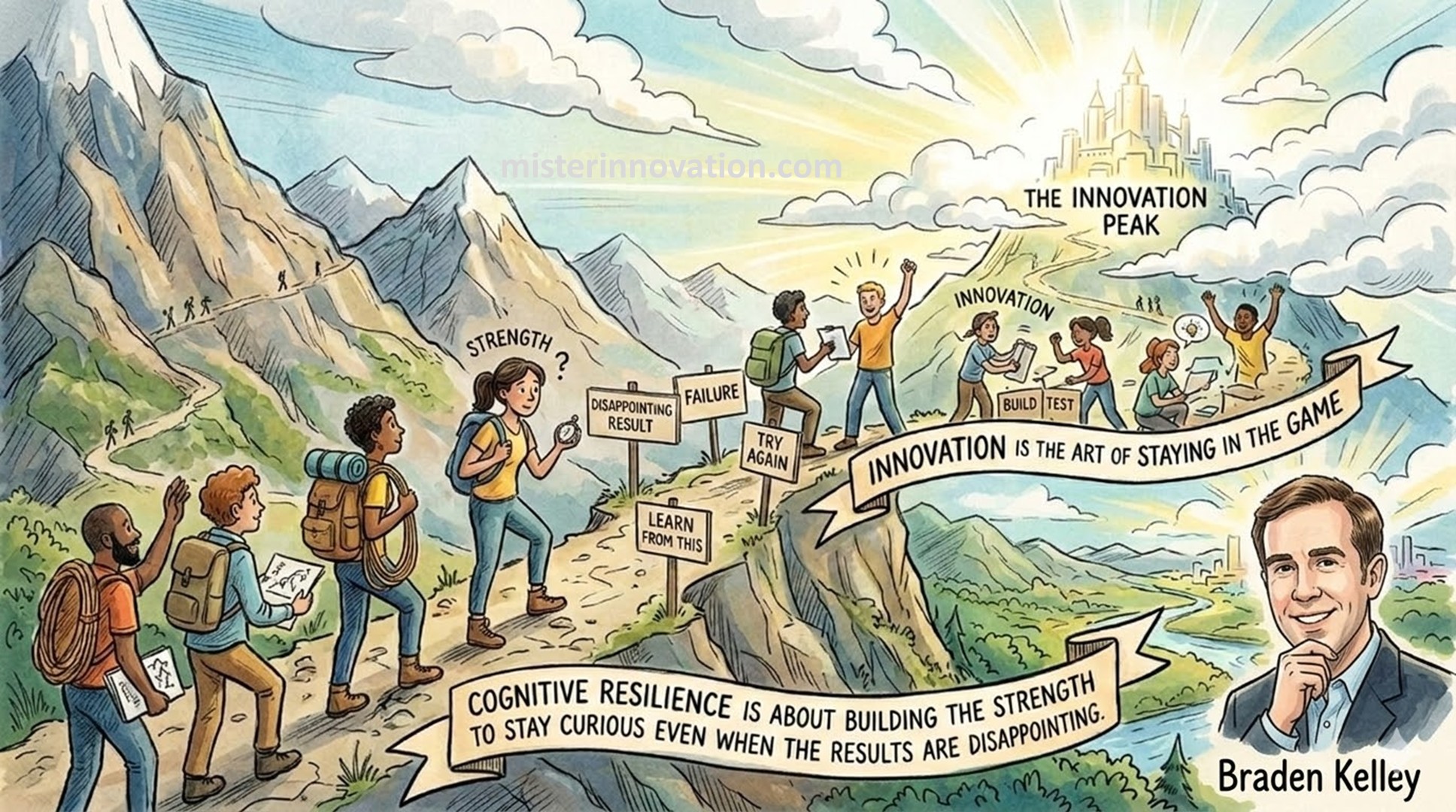
Humans and AI BOTH Hallucinate

Humans and AI BOTH Hallucinate

GUEST POST from Shep Hyken

One of the reasons customers are concerned about or even scared of artificial intelligence (AI) is that it has been known to provide incorrect answers. The result is frustration and concern over whether to believe any AI-fueled technology. In my annual customer service and customer experience research, I asked more than 1,000 U.S. consumers if they ever received wrong or incorrect information from an AI self-service technology. Fifty-one percent said yes.

No, AI is not perfect. Even though the technology continues to improve, it still makes mistakes. And my response to those who claim they won’t trust AI because of those mistakes is to ask, “Has a live customer support agent ever given you bad information?”

That question gets a surprised look, and then a smile, and then an acknowledgement, something like, “You’re right. I never thought about that.”

When AI gives bad information, I refer to that as Artificial Incompetence. It’s just as frustrating when we experience bad information from a live agent, which I call HI, or Human Incompetence. I doubt – I actually know – that the AI and the human aren’t trying to give you bad information.

I once called a customer support number to get help with what seemed like a straightforward question. I didn’t like the answer I received. It just didn’t make sense. Rather than argue, I thanked the agent, hung up, and dialed the same customer support number. A different agent answered, and I asked the same question. This time, I liked the answer. Two humans from the same company answering the same question, but with two completely different answers. And we worry about AI being inconsistent!

AI Hallucination Cartoon Shep Hyken

AI and Humans Make Mistakes

The reality is that both AI and humans make mistakes, and both will continue to do so. The difference is our expectations. We don’t expect humans to be perfect, so when they are not, we may be disappointed, maybe even angry. We may or may not forgive them, but usually, we just chalk it up to being … human. But it’s different when interacting with AI. We expect it to be reliable, and when it makes a mistake, we often assume the entire system is flawed.

Perhaps we should treat both with the same reasonable expectations and the same healthy skepticism we apply to weather forecasters, who use sophisticated technology and have years of training yet still can’t seem to get tomorrow’s forecast right half the time. Well, it seems like half the time! That doesn’t mean we won’t be checking the forecast before we plan our outdoor activities. AI, too, is sophisticated technology that can make life easier.

Image credits: Gemini, Shep Hyken

Subscribe to Human-Centered Change & Innovation WeeklySign up here to join 17,000+ leaders getting Human-Centered Change & Innovation Weekly delivered to their inbox every week.