Category Archives: Technology

5 Scenarios for Agentic Organizations

And What Leaders Must Own in Each

5 Scenarios for Agentic Organizations

by Braden Kelley and Chateau G Pato


What Must Leaders Own in Agentic Organizations? (Short Answer)

Five scenarios for agentic organizations — and what leaders must own in each: (1) Agentic Front Door — customer-acting agents; leaders own consent, undo, escalation, and brand accountability. (2) Agentic Operating Model — work-orchestrating agents; leaders own fairness, EX, and who gets meaningful work. (3) Agentic Decision Systems — agents that approve or choose within policy; leaders own decision rights, undo, and who can be asked why. (4) Agentic Innovation & Change — agents that accelerate experiments; leaders own problem framing, kill criteria, and adoption. (5) Agentic Ecosystem — agents that act across vendors and partners; leaders own seam promises, liability, and recovery across the handoff.

An agentic organization authorizes AI systems to act — route, refund, rebook, assign, escalate, negotiate, trigger workflows — not only to chat or recommend. Autonomy for the model is not a strategy. Ownership for the human who can still be held to account is.

Why Don’t Agents Automate Ownership?

I have watched rooms celebrate “agentic” the way they once celebrated sticky notes and digital transformation: as if naming the technology were the same as designing the landing.

Agents that act are a different animal from chatbots that reply. They refund. They rebook. They assign work. They approve inside a band. They negotiate across a seam. That is not a UX upgrade. It is a transfer of authority — and authority without designed ownership is a hard landing waiting for a Tuesday.

Soft landings are designed. In every agentic scenario, something remains non-delegable: consent, mandate, accountability, fairness, and the promise the brand will still keep when the agent gets it wrong.

Scenario Agents do Leaders must own
1. Agentic Front Door Act for customers (refund, rebook, route) Consent, undo, escalation, brand accountability
2. Agentic Operating Model Orchestrate internal work Fairness, EX, judgment time, meaningful work
3. Agentic Decision Systems Approve or choose inside policy bands Decision rights, why on Tuesday, undo/appeal
4. Agentic Innovation & Change Accelerate drafts, demos, pilots Problem frame, kill criteria, adoption owners
5. Agentic Ecosystem Act across vendors and partners Seam ownership, liability, cross-entity recovery

1. What Must Leaders Own in an Agentic Front Door Scenario?

The scenario: The primary customer path is an agent that does — refund, reschedule, rebook, update, route — not a FAQ that chats. Multi-step journey work moves at machine speed.

Agents do: Execute customer intent across systems without waiting for a ticket to crawl through three departments.

Hard landing: Autonomy without consent, undo, or human handoff. Containment becomes the KPI. The brand is optimized; dignity is optional. Customers are trapped in loops that photograph well in the steering committee.

Leaders must own: Clarity of what the agent may do; competence thresholds before it acts; customer control to stop, reverse, and escalate; care at the moment of failure; a named human recovery path. Soft landing is delegated action with a trust contract — not a cheaper call-center costume. For the customer trust design behind this scenario, see When AI Agents Act on Your Behalf: Designing Agentic Customer Experience That Earns Trust.

2. What Must Leaders Own When Agents Orchestrate the Operating Model?

The scenario: Internal work is assigned, scheduled, triaged, and progressed by agents across tickets, cases, and handoffs. Glue shrinks. Throughput rises. The calendar looks free — until it does not.

Agents do: Route, prioritize, draft, chase, and assemble the next step so humans spend fewer hours on fragmentation.

Hard landing: Humans become faster exception handlers. Saved minutes refill with denser interruptions. “Efficiency” strips judgment time and frontline agency. People become the leftover of automation — not the point of it.

Leaders must own: What work agents absorb versus what humans keep; protected contiguous time for judgment; employee experience as a design constraint, not a wellness poster; fairness in routing (who gets the grind, who gets growth); metrics that name human success, not only cycle-time vanity. Soft landing means glue automated, meaning kept. For the designed split of human versus machine work, read The AI Soft Landing.

3. What Must Leaders Own in Agentic Decision Systems?

The scenario: Agents approve, deny, price, allocate, or recommend within policy bands — finance, risk, access, offers, exceptions. High-volume choices move without a meeting. Edge cases escalate — in theory.

Agents do: Decide inside declared rules at a speed no committee can match.

Hard landing: Humans as rubber stamps. Unowned model choices. “The system decided” as a career-safe shrug. No undo when the band was wrong — and nobody left who can be asked why on Tuesday.

Leaders must own: Explicit decision rights (what the agent may decide alone); auditability so a human can reconstruct the choice; undo and appeal; a named person accountable for outcomes, not only for “the model’s accuracy”; the mandate to narrow or widen the band when reality contradicts the policy. Soft landing is speed with someone who can still be held to account.

4. What Must Leaders Own When Agents Accelerate Innovation and Change?

The scenario: Agents draft personas, roadmaps, prototypes, pilots, and change artifacts before lunch. Innovation velocity looks historic. The room fills with demos.

Agents do: Generate options, simulate, document, and accelerate demo day until the portfolio looks busy.

Hard landing: Faster wrong. Synthetic empathy. Pilots without mandate. Adoption theater. Innovation cosplay at higher RPM — more output, less impact that lands on Tuesday.

Leaders must own: Problem framing before acceleration; match of method to decision rights; behavior falsification (not applause demos); kill criteria with social permission to stop; adoption owners after the markers dry. Soft landing means agents own the draft; humans own the design and the landing. For habits that protect this ownership, see 9 Habits of Human-Centered Innovators That Still Matter in the Age of AI.

5. What Must Leaders Own in an Agentic Ecosystem Scenario?

The scenario: Agents representing the company, customer, and partners negotiate, book, fulfill, and escalate across organizational boundaries. Email chains and war rooms shrink. Multi-entity orchestration becomes normal.

Agents do: Cross the seam that used to require humans with calendars, contracts, and courage.

Hard landing: Orphan seams. “Not our agent” blame. Liability that lives nowhere. A brand promise broken between two green systems — each vendor’s SLA fine, the customer’s Tuesday ruined.

Leaders must own: Who owns the seam when agents disagree; contractual and ethical boundaries for partner agents; recovery power that spans entities; customer-visible accountability when the multi-agent path fails; stop conditions when optimization conflicts with dignity. Soft landing is multi-agent speed with a single human promise that still holds.

How Do Leaders Check Ownership Before an Agentic Investment?

Before the next agentic program, run five go/no-go questions. If you cannot answer them, you are buying autonomy without a landing:

  1. Where will the agent act — not only chat or recommend?
  2. Who owns consent, undo, and escalation in that scenario?
  3. What human work are we freeing — and what contiguous time will we protect for judgment?
  4. Who can be asked why when the agent chooses?
  5. Who owns the seam when agents cross teams or partners?

For the work humans should keep when glue shrinks, see 11 Human Endeavors AI Should Free (Not Replace). For how the agentic enterprise pitch lands soft or hard, read 10 Futures Being Pitched in 2026 — Soft Landing vs Hard Landing. For signals you are preparing for the wrong future, use 8 Signals You’re Preparing for the Wrong Future of Work.

Agents can own the action. Leaders own the landing — consent, mandate, accountability, fairness, and the promise after failure.

Frequently Asked Questions

What is an agentic organization?

An agentic organization authorizes AI systems to act — route, refund, rebook, assign, escalate, negotiate, and trigger workflows — not only to chat or recommend. It is an operating model with non-human actors holding authority, which makes designed human ownership of consent, mandate, accountability, and recovery essential.

What must leaders own in an agentic enterprise?

Leaders must own what agents cannot: consent, undo, and escalation at the front door; fairness and judgment time in the operating model; decision rights and accountability when agents choose; problem framing, kill criteria, and adoption in innovation; and seam ownership, liability, and recovery when agents act across partners.

What are scenarios for agentic AI in organizations?

Five common scenarios: agentic front door (customer-acting agents), agentic operating model (work orchestration), agentic decision systems (approvals inside policy bands), agentic innovation and change (accelerated bets and artifacts), and agentic ecosystem (cross-vendor and partner action). Each needs a different leadership ownership list.

How do you avoid a hard landing with AI agents?

Design the landing before you scale autonomy. Name where agents will act, who owns consent and undo, what human work you are freeing and protecting, who can be asked why when the agent chooses, and who owns the seam across teams or partners. Autonomy without ownership is a hard landing on Tuesday.

What is the difference between agentic CX and an agentic organization?

Agentic CX focuses on customer-facing agents that act on a customer’s behalf — and the trust contract of clarity, competence, control, and care. An agentic organization is broader: agents also orchestrate internal work, decide inside policy, accelerate innovation, and act across partner ecosystems. CX is one scenario; the organization has five places where leaders must own the landing.

Image credits: Cursor

Content Authenticity Statement: The topic area, key elements to focus on, etc. were decisions made by Braden Kelley, with a little help from Google Gemini and Cursor to clean up the article, add images and create infographics.

Subscribe to Human-Centered Change & Innovation WeeklySign up here to get Human-Centered Change & Innovation Weekly delivered to your inbox every week.

Winning with Artificial Intelligence in 90 Days

Winning with Artificial Intelligence in 90 Days

Exclusive Interview with Charlene Li

The rapid evolution of artificial intelligence (AI) has shifted the technology from a futuristic curiosity to the primary engine of modern organizational growth. In an era defined by data-driven decision-making, the ability to effectively harness machine learning and predictive analytics is no longer just a competitive advantage; it is a fundamental requirement for long-term viability. However, the path to integration is rarely linear. Many organizations find themselves caught between the urgent need for transformation and the daunting reality of legacy infrastructure, talent shortages, and the cultural shifts required to move beyond small-scale pilots toward true enterprise-wide intelligence.

While the potential for increased efficiency and innovation is clear, the execution remains a significant hurdle.

The organizations that thrive in this new landscape are those that treat AI as a core strategic pillar rather than a plug-and-play software update. This requires a rethink of how human talent and machine intelligence coexist, ensuring that the technology enhances human capability rather than simply automating existing inefficiencies. Overcoming these challenges involves not just technical prowess, but a disciplined approach to change management and a clear vision for how intelligence will redefine the value the organization provides to its customers.

Today we will dive deep into what it takes to quickly achieve success with artificial intelligence with our special guest.

Creating a 90-Day Blueprint to Win with Artificial Intelligence

Charlene LiI recently had the opportunity to interview Charlene Li, a New York Times bestselling author, keynote speaker, and AI transformation strategist. Her latest book, Winning with AI: The 90-Day Blueprint for Success, co-authored with Dr. Katia Walsh, gives senior leaders a practical framework for moving from AI experimentation to measurable business value. Her prior books include The Disruption Mindset, Open Leadership, and Groundswell. Fast Company named her one of the most creative people in business, and she has worked with global organizations including 14 of the Dow Jones Industrial 30 companies. She is the founder of Altimeter Group (acquired by Prophet) and currently leads Quantum Networks Group.

Below is the text of my interview with Charlene and a preview of the kinds of insights you’ll find in Winning with AI: The 90-Day Blueprint for Success presented in a Q&A format:

1. What confusion is being created by speaking of “AI” as one thing when there are different kinds of AI, and how does this hold back AI adoption?

When people say “AI,” they’re usually thinking ChatGPT. But ChatGPT is generative AI — and that’s just one of three types of AI showing up in business today. There’s also predictive AI, which has been quietly running in your CRM, your fraud detection, and your streaming recommendations for years. And there’s agentic AI, which takes autonomous action toward a goal rather than waiting for a prompt.

The Oracle (predictive), the Creator (generative), and the Agent (agentic) — that’s how Katia and I describe them in Winning with AI. They do fundamentally different things, and they require fundamentally different things from you.

The conflation matters because it leads to bad decisions. Leaders see a generative AI demo, get excited, and ask their teams to “do something with AI” — when the actual business problem might be better solved with predictive AI (and probably already could’ve been three years ago). Or they hear “agentic AI” and assume their organization is ready to deploy autonomous agents when they haven’t even gotten generative AI into their workforce yet.

The winners aren’t choosing among types — they’re using all three strategically, in combination. A customer care transformation might use predictive AI to route inquiries, generative AI to draft responses, and agentic AI to handle routine cases autonomously. Once you can see the three distinctly, the question stops being “what can I do with AI?” and starts being “what can AI do for me?” That’s the question that actually unlocks value.

2. What are some of the key characteristics of AI inertia and some of the best ways to break free?

We call it pilot purgatory — and almost every organization we work with is stuck there. The signs are easy to spot: dozens of disconnected pilots, lots of conference attendance, lots of slide decks, no measurable financial impact. An MIT study found 95% of AI initiatives fail to scale. That’s not a technology failure. It’s a failure of leadership and culture.

The classic characteristics:

    • Use cases as a strategy. Many use cases equals procrastination. A long list of pilots is how organizations look busy without committing to anything.
    • Diffused accountability. When the CIO, CFO, and CMO all “share” responsibility for AI, no one owns the outcome.
    • Waiting for the foundation to be perfect. Clean data, the right platform, the perfect org structure — these become reasons to delay rather than constraints to solve through.
    • Confusing motion with progress. Running pilots feels like progress. It isn’t, unless those pilots are tied to your most important business problems.

To break free: pick your biggest strategic problems, figure out how AI solves them, invest heavily in those solutions, and move with urgency. Appoint one AI value owner who lives, breathes, and dreams AI outcomes. Kill pilots that aren’t on a path to scale. And replace “fail fast” with “learn fast” — nobody actually rewards failure, and the language of failure lets people walk away from things that should be pushed through.
Speed is the new moat. The companies that win aren’t the ones with the best technology. They’re the ones that adapt faster than their competitors.

3. There are still a lot of people out there not using AI (or not realizing that they are). What are some of the best ways for people to get started with AI?

Most people are already using AI — every spam filter, every Google Maps route, every recommendation on a streaming service is AI. So the real question is: how do you get started with the kind of AI that’s reshaping work right now, which is generative AI?

My advice is genuinely simple. Pick one of the major tools — Claude, ChatGPT, Gemini, Copilot — and start using it for one real task you do every week. Not a toy task. A real one. Drafting an email. Prepping for a meeting. Summarizing a long document. Brainstorming an approach to a problem you’re stuck on.

Two practical tips that make a big difference:

Write better prompts. A good prompt has a role (“Act as a marketing strategist”), instructions (what you want done), context (the background the AI needs), and an output format (memo, table, slide outline). Then refine through dialogue. Most people give AI two sentences and judge it on the result. Give it two paragraphs and you’ll be amazed.

Try the flipped interaction. Instead of asking AI for an answer, ask it to ask you questions until it has enough context to give a good answer. For example, at the end of a prompt, add this sentence: “Ask me any clarifying questions you may have.” It turns your prompt into a conversation.

I think of AI fluency as learning to eat with chopsticks: at first you’re concentrating on every motion, and eventually it’s just how you eat. You won’t get there by reading about it. You get there by using it. Every day. On real work.

4. Does AI safety really matter? It seems like all of the major AI players are just focused on speed and getting to AGI before China, am I wrong?

You’re not wrong about what the AI players are doing. But you’re probably not playing that game – more on that below. First, I’d push back on the framing that safety and speed are opposites.

Think of Formula 1. The drivers who win championships have absolute confidence in their brakes, their crash structures, their fire suppression systems. That’s why they can push so hard on speed. Safety is what makes speed possible. The companies moving fastest on AI adoption aren’t the ones cutting corners on responsibility — they’re the ones with the highest ethical standards, because trust eliminates friction. When your team knows where the guardrails are, when your customers trust your intentions, when your board has confidence in your approach, you can move at the speed AI demands.

The 2024 Edelman Trust Barometer found that 43% of people would reject AI in products and services if they don’t believe the innovation has been thoroughly scrutinized. That’s not a PR problem — it’s a revenue and competitive position problem.

On the AGI race specifically, the geopolitical framing oversimplifies what’s actually a much more textured conversation about how AI is deployed within companies, governments, and communities. Most leaders I work with aren’t worrying about AGI — they’re worrying about whether their AI customer service tool is treating customers fairly, whether their AI-driven hiring screen is introducing bias, and whether their data is being used in ways customers didn’t consent to. Those are the safety questions that matter for the next five years, regardless of what the frontier players are doing.

5. Where is the government being too hands off with AI and its impacts, and what conversations should governments and societies be having about AI and its impacts that they’re not?

I’ll be careful here because I’m not a policy person — I work with the leaders implementing AI inside organizations. But from that vantage point, a few things stand out.

The conversation we aren’t having enough is about workforce transition. Not “will AI take jobs” — we’ve been arguing about that abstractly for three years. The real question is what happens to the millions of people whose roles will substantially change in the next five years, and who’s responsible for helping them adapt. Right now, that’s mostly being left to individual employers, and the gap between what enlightened employers are doing and what the median employer is doing is enormous. That gap will become a societal problem long before regulators catch up.

The second underdiscussed conversation is about education. We’re training a generation of students with curricula designed for a pre-AI world. By the time we figure out what AI fluency looks like in K–12, the kids who needed it most will be in the workforce.

Third — and this is where I’d actually like to see governments lean in more — is data. Most AI regulation focuses on the models. The leverage is in the data: who owns it, how it can be used, what consent looks like in a world where data collected for one purpose can be repurposed for AI training that wasn’t imagined when it was collected.

That said, regulations always lag technology. Anchoring your responsible and ethical AI policy in your organization’s values rather than waiting for rules is the right move, regardless of what governments do.

6. What are the key pillars that form the basis of a strong AI foundation for those who seek to take full advantage of AI in their organization?

In Winning with AI, Katia and I lay out four building blocks. They develop together, not sequentially.

Mindset — the cultural ability to move at AI’s speed. Speed, focus, customer-centricity, experimentation, and learning from setbacks rather than treating them as evidence that the technology doesn’t work. Without the right mindset, you can have the best tools in the world, and they’ll sit unused.

Skillset — AI fluency across the workforce, not just in IT. Everyone needs to understand what AI can and can’t do, how to use it responsibly, and how to apply it to their actual work.

Toolset — the technical foundation. We tell leaders to build with LEGO, not cathedrals. Modular, interchangeable components you can swap as the technology evolves, sitting on top of data that’s good enough to start with.

Decision-set — the governance and decision-making structures that let you move fast without breaking things. Who decides what, how quickly, with what oversight.

The mistake organizations make is treating these as a sequence — first we’ll fix the data, then we’ll train people, then we’ll deploy. That sequence will take you a decade. The right approach is to build the blocks while delivering value, using each AI application to strengthen multiple blocks at once.

And one piece that wraps all four: leadership. Without active, visible commitment from the top, the four building blocks don’t compound. With it, they accelerate.

7. Of all the outcomes that the different types of AI can achieve, which activities create the most value for organizations?
Winning with AIWe frame the value AI creates in three areas: engagement, efficiencies, and reinvention.

Engagement is about deepening relationships with customers and employees through personalization, prediction, and proactive service. Anticipating what someone needs before they articulate it.

Efficiencies are about doing what you already do, faster and cheaper. This is where most organizations start — and where most get stuck. Efficiency gains are real, but they’re easy for competitors to replicate, which means they don’t create lasting advantage.

Reinvention is the most transformational and the most uncomfortable. It’s not asking “how can we do what we do faster?” — it’s asking “what becomes possible now that the old constraints are gone?” New business models. New revenue streams. New markets that were never economical before.

The trap is thinking efficiency is AI’s value. We call it the efficiency trap. Companies that limit themselves to efficiency are using a strategic weapon as a cost-cutting tool. The real competitive advantage comes from engagement and reinvention.

A great example: Coursera. Translation used to cost about $10,000 per course, which made global expansion economically impossible at the scale of their 5,000+ course catalog. Generative AI eliminated that constraint overnight. CEO Jeff Maggioncalda saw it immediately and launched Project Genesis by the end of 2022. That’s reinvention — AI removing a constraint that defined the business model.

If I had to pick one activity that creates the most value, it would be: using AI to remove a constraint that has shaped your industry’s economics for so long that nobody questions it anymore.

8. There was a lot of talk for a while about becoming an AI-first organization. Is this something that companies should be trying to do?

No. Be AI-ready instead.

“AI-first” is a technology company’s framing. It puts the technology in the driver’s seat, which sounds visionary but in practice produces dozens of disconnected pilots with no strategic impact. You end up chasing AI because it’s shiny rather than because it solves a real problem.

“AI-ready” is a business leader’s framing. It puts strategy in the driver’s seat. You’re building the culture, the skills, the decision systems, and the technical foundation that let AI create real value against the strategic priorities you already have.

Said simply: AI-first is a technology mindset. AI-ready is a business mindset.

You don’t actually need an AI strategy. You need a business strategy that uses AI. Anyone selling you on an AI strategy is selling you the wrong thing.

9. What should people be doing as individuals to maintain their value to their organizations and to grow their careers?

Three things, in order.

One: develop genuine AI fluency. Not “I’ve used ChatGPT a few times” fluency. Real fluency — the kind where AI is woven into how you think, prepare, decide, and communicate. The people and organizations who get to AI fluence in 2026 will pull dramatically ahead of those who don’t, and the gap will be very hard to close once it opens.

Two: deepen what’s uniquely human. AI can amplify cognition at speeds and scales no individual can match. What it can’t do is exercise empathy, self-reflection, intuition, judgment, and wisdom. These five traits — the foundation of what Katia and I call “superhumans” in the book — become more valuable, not less, as AI handles more of the cognitive work. The leaders who pair AI’s reach with these distinctly human capacities are the ones creating the most value.

Three: build a lifelong learning practice. The shelf life of any specific skill is shrinking. The skill that doesn’t depreciate is the ability to learn — quickly, repeatedly, with intellectual humility. Normalize not knowing. Embed reflection into how you work. Treat curiosity as a professional asset, not a side hobby.

If you do those three things, you’ll be more valuable in the future than you are today, regardless of what happens to your specific role.

10. What have organizations gotten wrong about rolling out AI and what can the early adopters do to recover from botched initial rollouts?

The biggest things organizations get wrong:

  • Treating AI as a technology project. It’s a business initiative for value creation that happens to use technology. When IT owns it, it stays small.
  • Use cases instead of strategy. A laundry list of pilots is procrastination dressed up as progress.
  • Diffused accountability. Without a single AI value owner, the work fragments.
  • Skipping the people work. Throwing tools at employees without addressing the fear underneath. Until fear is replaced by trust, no amount of training will change behavior.

If you’ve already botched the rollout, here’s the recovery path:

Stop and audit. What’s actually scaling, what’s not, what’s draining resources without producing value? Be honest. Sunset the dead ends.

Appoint one accountable AI leader. If no single person is accountable for AI value creation across the enterprise, fix that this quarter. Not part-time, not committee-led — one person whose performance is measured on the value that AI creates.

Pick one strategically meaningful problem and go after it. Not the easiest problem. The one whose solution would matter most to the business.

Learn from Ally Bank. When generative AI emerged, Ally’s CIO Sathish Muthukrishnan deliberately chose the most resistant audience — customer service agents — and a low-stakes problem: summarizing customer calls. The result was so valuable that the agents who’d been most skeptical became the loudest advocates: “Don’t take this away from me.” Targeting the skeptics with a real win is one of the most powerful change strategies we’ve seen.

A botched rollout isn’t a death sentence. It’s actually a useful clearing of the underbrush — assuming you learn from it.

11. Several studies have come out recently about the negative effects of AI on human cognition. Any tips for how to best use AI without degrading your brain?

This is a real concern and worth taking seriously. The risk isn’t AI itself — it’s lazy AI use. Using AI to skip thinking rather than to enhance it.

A few habits I’ve found useful:

Think first, then prompt. Before going to AI for an answer, write down what you think. Coursera’s Jeff Maggioncalda calls this cognitive bootstrapping — write your perspective on a decision, then ask AI to challenge it: “What are the strengths and weaknesses of this view? What are my blind spots? What would you recommend I improve?” AI sharpens your thinking instead of replacing it.

Treat AI outputs as drafts, not deliverables. Read critically. Push back. Ask why. Verify facts. The moment you stop questioning AI’s outputs is the moment your thinking starts to atrophy.

Protect deep work. Schedule time for thinking that doesn’t involve AI at all. Reading, writing, reflecting, walking — the unstructured time where your brain consolidates what it knows. AI can compress research, but it can’t compress wisdom. That still has to come from lived experience, integrated over time.

Notice the difference between using AI to accelerate something you understand and using AI to substitute for understanding. Acceleration is healthy. Substitution erodes you.

The promise of AI isn’t to do our thinking for us. It’s to help us think better. The discipline is staying on the right side of that line.

12. Any question you wish I had asked but didn’t?

Yes — I’d love a question about the human possibility on the other side of this.

Most AI conversation is about risk, displacement, and disruption. Those are real. But the conversation Katia and I get most excited about is what becomes possible when AI handles the cognitive work that has been depleting people for decades — the synthesis, the routing, the routine analysis — and frees up human capacity for what only humans can do.

We call those people “superhumans” — not because they’re enhanced by technology in some sci-fi sense, but because they finally have the room to be more deeply human. To exercise empathy, self-reflection, intuition, judgment, and wisdom at a level that’s been crowded out by cognitive overload.

The first companies to deliberately develop and organization filled with superhumans won’t just have a competitive advantage. They’ll be creating an entirely new form of value — one we haven’t fully named yet. That’s the future I want leaders thinking about. Not “how do I survive AI?” but “what becomes possible for my people on the other side of this?”

Dream it. Then build it.

Conclusion

Thank you for the great conversation Charlene!

I hope everyone has enjoyed this peek into the mind of one of the women behind the insightful new title Winning with AI: The 90-Day Blueprint for Success!

Image credits: Charlene Li, Pexels

Subscribe to Human-Centered Change & Innovation WeeklySign up here to join 17,000+ leaders getting Human-Centered Change & Innovation Weekly delivered to their inbox every week.

11 Human Endeavors AI Should Free (Not Replace)

11 Human Endeavors AI Should Free (Not Replace)

by Braden Kelley and Art Inteligencia


What Human Work Should AI Free Instead of Replace? (Short Answer)

AI should free, not replace, eleven human endeavors: insight, empathy, problem definition, accountable decision making, direction setting, creativity, collaboration, teaching judgment, repair and recovery, stewardship of consequences, and presence. Free means machines absorb search, draft, route, summarize, classify, and schedule so people get larger blocks for the human job. Replace means a costume version — volume without stakes, answers without questions, speed without someone who can be held to account.

Soft landings are designed. These endeavors are what you are designing for — or you are just buying a faster leftover.

Free Them. Don’t Fake Them.

I have watched rooms celebrate “AI replacing” the wrong list. Drafting. Routing. Summarizing. Fine. Those are glue. Then someone says the model can do insight, empathy, strategy, and care — and the room nods because the demo was fluent.

Fluency is not a human endeavor. A human endeavor has stakes. It has someone who can be asked, on Tuesday, why they chose this and what they owe the people who will live with it. Use AI to take the fragmentation. Grow the list below. If you use it to wear the list as a costume, you did not automate work. You hollowed out the job and kept the title.

Endeavor AI should absorb Do not replace
1. Insight Hunt, summarize, cluster A point of view
2. Empathy Triage, transcripts, routing Dignity and lived stakes
3. Problem definition Draft options, retrieve briefs Owning the question
4. Accountable decisions Scenarios, prior-case retrieval The human who can say why
5. Direction Deck assembly, scrapes Where we are going and why
6. Creativity Blank page, ordinary first drafts Taste and the thing the model would not
7. Collaboration Scheduling, notes archaeology Trust and the hard conversation
8. Teaching judgment Content libraries, quizzes Coaching on live work
9. Repair Routing, history, templates Making it right with authority
10. Stewardship Monitoring noise, log hunt Owning consequences
11. Presence Pings, calendar confetti Contiguous attention

1. Should AI Replace Human Insight — or Free It?

Free from: Hunting files, first-pass summaries, clustering noise so a person can finally see a pattern.

Hard landing: More output, no meaning. Dashboards that never become a point of view. Insight theater at token speed.

Protect: Contiguous time to connect weak signals. Name insight as an output — a stance someone will defend — not a side effect of more slides.

2. Can AI Replace Empathy, or Only Free Humans to Practice It?

Free from: Triage queues, transcript dumps, “next best action” scripts that skip the human in the story.

Hard landing: Simulated care. Personalization that remembers everything except dignity.

Protect: Contact with real people. Recovery power. Empathy as a job, not a tone guideline. If nobody is allowed to feel the stakes and act, you did not free empathy. You automated a smile.

3. Why Must Humans Still Own Problem Definition When AI Answers Faster?

Free from: Instant roadmaps and solution spam that answer the wrong brief beautifully.

Hard landing: Faster wrong. The question never gets a human owner. The model is rewarded for answering, not for noticing you asked the wrong thing.

Protect: A mandate to sit with the problem. Kill “solutions” that skip the frame. Better questions are the scarce resource. Volume of answers is not.

4. What Should Stay Human About Decision Making Under Uncertainty?

Free from: Option generation, scenario drafts, retrieval of what we decided last time.

Hard landing: Humans as rubber stamps. Unowned model choices. “The system recommended it” as a moral exit.

Protect: Named decision rights. Undo. A human who can be asked why on Tuesday. Accountability does not live in the weights. It lives in a name.

5. How Does AI Free Direction Setting Instead of Faking Strategy?

Free from: Deck assembly, competitive scrapes, status collage pretending to be a journey.

Hard landing: Strategy as generated prose. Motion without a destination people can join.

Protect: Leaders spend reclaimed time on where we are going and why it is worth it — not on prettier status. Direction is a human promise. A paragraph is not a north star.

6. Should AI Replace Human Creativity?

Free from: Blank-page dread, mood-board hunting, first drafts of the ordinary.

Hard landing: Average at scale. Sameness with better lighting. Creativity measured in assets shipped.

Protect: Taste, constraint, and the courage to make something the model would not. AI can widen the table of raw material. It cannot want. Wanting — and choosing against the average — stays human.

7. How Should AI Free Collaboration Without Replacing Trust?

Free from: Scheduling glue, notes, “who said what” archaeology.

Hard landing: More meetings, thinner trust. Collaboration theater inside the tool while the hard conversation never happens.

Protect: Time together for conflict, repair, and making progress. Tools serve the relationship. If the software is the collaboration, you have a log. You do not have a team.

8. Why Should AI Free Teaching Judgment Instead of Replacing Managers?

Free from: Content libraries, quiz generation, completion tracking dressed up as capability.

Hard landing: Prompt training without practice. Managers as ticket routers. “Enablement” as a course nobody had time to become good from.

Protect: Managers as developers of judgment. Practice on live work. Coaching as the job AI should make room for — not the job it should delete because the LMS is green.

9. Can AI Replace Repair After Harm — or Only Prepare It?

Free from: Routing, drafting the apology template, finding the account history so a human is not starting from zero.

Hard landing: Automated “sorry” with no authority. Containment as the KPI. The customer hears a paragraph. Nobody can make it right.

Protect: Humans own the repair. Agents prep context. Dignity is not a macro. If the person who shows up cannot undo the harm, you replaced care with a script.

10. What Stewardship Must Humans Keep When Models Act?

Free from: Monitoring noise, first-line exception queues, log archaeology.

Hard landing: “The model decided.” Nobody is steward of the outcome. Harm has a stack trace and no owner.

Protect: Steward roles with names. Audits of harm. Consequences stay human-accountable. Agency without stewardship is just speed with a liability costume.

11. Why Is Presence a Human Endeavor AI Should Free, Not Fill?

Free from: Pings, task-switching tax, calendar confetti that turns a day into shrapnel.

Hard landing: Denser busyness. Always-on humans competing with always-on agents. The “saved” minutes immediately refilled.

Protect: Calendar policy as part of the AI bet. Presence — contiguous attention, holding the moment — as a scarce resource you refuse to refill with tickets. If nobody is actually here, nothing else on this list has a place to live.

How Do You Design an AI Soft Landing Around These Human Endeavors?

Before you buy the next copilot, run five questions. If you cannot answer them, you are shopping for a demo, not a landing:

  1. Which of these eleven should grow if this investment works?
  2. What glue does the machine take so that growth is possible — not theoretical?
  3. What fake replacement are we refusing — the costume version of insight, empathy, or care?
  4. Who owns the endeavor on Tuesday after the pilot applause?
  5. What metric still punishes depth — volume, handle time, tickets closed, tokens used?

The designed future behind this list is The AI Soft Landing. For the pitches that can land either way, see 10 Futures Being Pitched in 2026. If your organization is already buying the wrong landing, the diagnostic is 8 Signals You’re Preparing for the Wrong Future of Work. And if you want the practice habits that keep innovation human while the tools speed up, start with 9 Habits of Human-Centered Innovators That Still Matter in the Age of AI.

If AI replaces the human endeavor, you did not get leverage. You got a hollow job with a better demo. Free the eleven. Keep the names on the line.

Frequently Asked Questions

What human work should AI free up?

AI should free time for insight, empathy, problem definition, accountable decisions, direction, creativity, collaboration, teaching judgment, repair, stewardship, and presence — by absorbing glue work such as search, drafting, routing, summarizing, classifying, and scheduling. Those eleven should grow. The glue should shrink.

Should AI replace human creativity?

No. AI can take blank-page friction and ordinary first drafts so humans can spend more capacity on taste, constraint, and combinations the model would not choose. Replacing creativity with average-at-scale output is a hard landing: more assets, less meaning, less courage.

What is the difference between AI freeing work and replacing it?

Freeing work means the machine takes fragmentation and low-judgment transaction so a human endeavor gets more contiguous time and authority. Replacing it means the model performs a costume version — fluent, fast, unowned — while no one is accountable for stakes, dignity, or Tuesday.

What should humans still own in an AI workplace?

Humans should still own meaning, questions, decisions they can explain, direction people can join, taste, trust, coaching, repair with power, consequences, and presence. Models can prepare, retrieve, and draft. They cannot be the steward you ask why when it goes wrong.

How do you design an AI soft landing around human endeavors?

Name which endeavors should grow, what glue the machine will take, what fake replacement you refuse, who owns the endeavor after go-live, and which volume metrics you will stop using to punish depth. Calendar policy and decision rights are part of the investment — not a later “change” workstream.

Image credits: Pexels

Content Authenticity Statement: The topic area, key elements to focus on, etc. were decisions made by Braden Kelley, with a little help from Google Gemini and Cursor to clean up the article, add images and create infographics.

Subscribe to Human-Centered Change & Innovation WeeklySign up here to get Human-Centered Change & Innovation Weekly delivered to your inbox every week.

Why Zero UI Will Redefine Experience Design

The Invisible Interface

LAST UPDATED: May 2, 2026 at 9:13 AM

Why Zero UI Will Redefine Experience Design

GUEST POST from Art Inteligencia


I. Introduction: The End of the Glass Slab

The Screen Fatigue Phenomenon: We have reached a point of peak saturation with traditional displays. Our lives are currently mediated by glowing rectangles, leading to a fragmented human experience where the tool often overshadows the task.

Defining Zero UI: This is not the absence of an interface, but the disappearance of the user interface as we know it. It represents a move away from rigid, button-heavy menus toward more organic inputs like voice, haptics, computer vision, and ambient intelligence.

The Core Thesis: Technology is at its most powerful when it is invisible. By removing the friction between human intent and technological execution, we allow people to return their focus to the experience itself, rather than the device required to facilitate it.

II. The Sensory Stack: How Zero UI Works

Voice & Natural Language: We are witnessing a transition from the “Command-Line Interface” era of voice (where specific keywords were required) to fluid, contextual conversations. The goal is a system that understands nuance, sarcasm, and intent, mirroring human-to-human interaction.

Biometrics & Gesture Control: In a Zero UI world, the body becomes the input device. Through computer vision and skeletal tracking, technology can interpret a wave of a hand or a shift in gaze, allowing for spatial computing that feels like an extension of natural movement.

Proactive vs. Reactive Design: Traditional UI waits for a user to click; Zero UI anticipates. By leveraging machine learning and sensor data, systems can predict needs—adjusting the lighting when you enter a room or preparing a summary of a meeting before you even ask for it.

Haptics & Sensory Feedback: Communication doesn’t always need to be audible or visual. Subtle vibrations (haptics) or environmental changes (thermal or olfactory cues) can provide “glanceable” information without demanding the user’s full cognitive attention.

III. From UX to HX (Human Experience)

Designing for Context: In the era of Zero UI, the focus shifts from “clicks” to “intent.” Experience design no longer lives within the boundaries of a screen; it must account for a user’s physical location, environmental noise levels, and even social setting. We aren’t just designing a path to a button; we are designing a response to a human moment.

Reducing Cognitive Load: The “Invisible Assistant” model moves us away from app management and toward outcome management. By utilizing ambient intelligence, technology handles the “how” so humans can focus on the “why.” This creates a “Calm UI” effect, where digital interactions support our life goals without demanding constant visual attention.

The Ethics of Invisibility: As interfaces disappear, the “Black Box” problem grows. Designers must prioritize radical transparency—ensuring users understand when and how they are being sensed. Trust becomes the primary currency; without clear consent and “off-switches” for predictive features, invisible interfaces risk becoming intrusive rather than helpful.

From Screens to Systems: We are moving toward “Sentient Interfaces” that detect hesitation or frustration through behavioral cues. Transitioning to HX (Human Experience) means building ecosystems that are emotionally aware, neuro-inclusive, and capable of failing gracefully when the AI misinterprets human intent.

IV. Leading Innovators: The Architects of Invisibility

The transition to Zero UI is being led by a diverse ecosystem of startups and legacy tech giants. As of 2026, the following organizations are moving beyond the screen to define the future of human-centered interaction:

Company / Startup Core Focus Why They Matter Now
Neuralink Brain-Computer Interface (BCI) Entering high-volume production in 2026, Neuralink is moving BCI from clinical trials to the ultimate seamless interface: thought-based control.
Ultraleap Mid-air Haptics & Tracking By projecting ultrasound waves onto the skin, they provide tactile feedback in mid-air, crucial for non-visual “touch” in automotive and XR environments.
SoundHound AI Agentic Voice Commerce Their latest “Amelia 7” platform allows users to manage complex real-world transactions—like dinner reservations and parking—entirely through natural conversation.
Memories.ai Contextual Wearables (LUCI) Following the pivot of early wearables like the Humane Ai Pin, Memories.ai is building the “Android of AI wearables,” providing a system-level reference for ambient intelligence.
Synchron Endovascular BCI A key competitor to Neuralink, Synchron focuses on minimally invasive brain interfaces that allow users to control digital devices via the blood vessels, emphasizing safety and accessibility.

Strategic Implementation: For brands, the challenge is no longer just “building an app.” It is about integrating into these emerging ecosystems. Whether it is through voice agents or haptic-enabled environments, the goal for designers is to ensure their brand’s presence is felt and heard, even when it cannot be seen.

V. The Futurologist’s Perspective: What’s Next?

The Transition to “Liquid Services”: In 2026, we are moving away from the “static app” model. Instead, we are entering the era of liquid services—capabilities that flow seamlessly across devices. Your interaction might start as a voice command in the kitchen, continue as a haptic pulse on your wrist while walking, and conclude as a spatial projection in your vehicle. The interface is no longer a destination; it is a persistent, supportive presence.

Hyper-Personalization and Ambient Intelligence: One-size-fits-all design is dead. Leveraging what I call “Fortified Intelligence,” future systems will adapt in real-time to the individual’s neurodiversity, physical abilities, and current emotional state. Environments will become “sentient,” adjusting lighting, acoustics, and information density based on the user’s “Digital Persona” without a single manual adjustment.

The Challenge for Designers: Behavioral Architecture: The role of the designer is shifting from visual storytelling to behavioral and sensory architecture. We are no longer just drawing screens; we are defining the “rules of engagement” between humans and machines. This requires a Whole-Brain approach—part scientist to manage the data and part artist to inspire human connection. Success in this new landscape is measured by “Speed to Resilience” rather than just speed to market.

Reclaiming the Human Moment: Paradoxically, the more advanced our technology becomes, the more we value “human friction.” As Zero UI automates the logistical “drudge work” of life, experience design for the future will emphasize the things AI cannot replicate: intentional inefficiency, the warmth of human presence, and the physical tangibility of the world around us. We are designing technology to get it out of the way, so we can finally be human again.

VI. Conclusion: Reclaiming the Human Moment

Beyond Efficiency: As I often say, true innovation isn’t just about making things faster or cheaper—it’s about making things more human. Zero UI is the final step in removing the technical debt of the 21st century. By dissolving the “glass slab” that separates us from our tasks, we aren’t just improving efficiency; we are restoring presence. When the technology disappears, we are finally free to focus on the work that matters and the people who inspire us.

A Call for Design Integrity: As we look toward the 2030s, the “Wild West” era of digital interfaces is closing. We are entering an era of Structural Integrity in experience design. Designers and innovation leaders must move beyond “Process Theater”—workshops that generate ideas without outcomes—and start building the resilient, invisible infrastructure that supports a flourishing society. We must have the courage to design a future that doesn’t require us to retreat into the friction of the past.

Final Thought: The most disruptive interface is the one that doesn’t exist because it works so well you’ve forgotten it’s there. The goal of the Invisible Interface is not to automate the human out of the loop, but to close the loop on friction, leaving only the experience behind. Let’s design an infrastructure that doesn’t just survive the future, but defines it.

Are you ready to move from UX to HX?

If you’re looking to get to the future first, increase your speed of innovation, or create a culture of continuous transformation, connect with Braden Kelley for a keynote or a FutureHacking™ workshop to teach you to be your own futurist.

Frequently Asked Questions

What is the difference between Zero UI and traditional UI?

Traditional UI (User Interface) relies on visual elements like screens, buttons, and menus to facilitate interaction. Zero UI moves away from these “glass slabs,” instead utilizing natural human behaviors—such as voice, gestures, haptics, and ambient intelligence—to interact with technology without a physical screen as the primary mediator.

How does Zero UI improve the Human Experience (HX)?

By reducing cognitive load and removing the friction of navigating complex menus, Zero UI allows technology to become a proactive assistant rather than a reactive tool. This shift toward “Human Experience” prioritizes context and intent, allowing users to stay present in their physical environment while still benefiting from digital capabilities.

Is Zero UI secure and private?

As interfaces become invisible, transparency becomes the most critical design element. Leading innovators are focusing on “Privacy by Design,” ensuring that ambient sensing and voice processing are handled with clear consent and robust encryption, often processing data locally (on-edge) rather than in the cloud to maintain user trust.

Disclaimer: This article speculates on the potential future applications of cutting-edge scientific research. While based on current scientific understanding, the practical realization of these concepts may vary in timeline and feasibility and are subject to ongoing research and development.

Image credits: Gemini

Subscribe to Human-Centered Change & Innovation WeeklySign up here to get Human-Centered Change & Innovation Weekly delivered to your inbox every week.

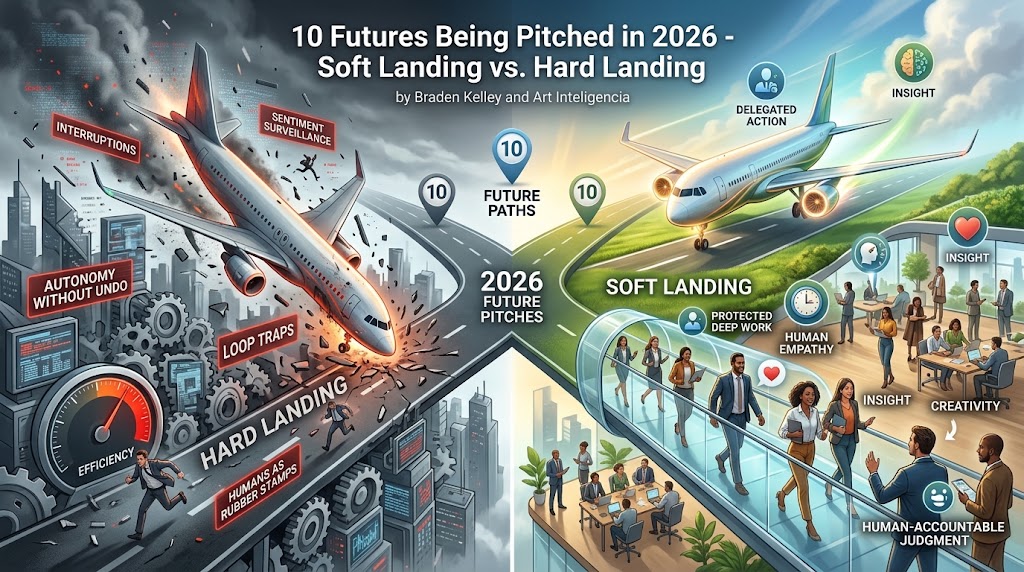
10 Futures Being Pitched in 2026

Soft Landing vs. Hard Landing

10 Futures Being Pitched in 2026

by Braden Kelley and Art Inteligencia


What Is a Soft Landing vs a Hard Landing? (Short Answer)

A hard landing is a future where technology does more of everything — including the human parts of work — and people are left with leftovers, interruptions, and less agency. A soft landing is a future where machines absorb fragmentation and low-judgment transaction so humans can spend larger blocks of time on insight, empathy, decision making, direction setting, problem definition, creativity, and collaboration.

Ten futures being pitched in 2026: the agentic enterprise, the end of busywork, hyper-personalization, autonomous customer service, experience-led management (XLAs), adaptive environments, AI-native innovation, post-survey listening, the civic scoreboard, and human–AI collaboration as the default job. Each pitch has both landings. Soft landings are designed. Hard landings arrive when efficiency is the only value on the dashboard.

The Pitch Is Not the Landing

Futurology has a bad habit: it sells the vehicle and skips the runway. 2026 is loud with promised futures — agents that act, workdays without busywork, rooms that adapt, governments you can finally compare. None of that is destiny. The same capability can make people more human or less human. The difference is design: whose attention is protected, whose interest is optimized, and whether someone can undo what the system just did in their name.

Future being pitched Hard landing Soft landing
1. Agentic enterprise Autonomy without undo Delegated action with trust
2. End of busywork Denser interruptions Protected deep work
3. Hyper-personalization Surveillance Memory that serves the person
4. Autonomous service Loop traps, no escalation AI for routine; humans for exception
5. Experience-led management Paper XLAs Red experience can stop a green SLA
6. Adaptive environments Nervous system as funnel Adaptive hospitality
7. AI-native innovation Theater at higher RPM Faster learning with kill criteria
8. Post-survey listening Sentiment surveillance Dialogue + closed loops
9. Civic scoreboard Weaponized rankings Fair peer comparison, local ownership
10. Hybrid jobs Humans as rubber stamps Human-accountable judgment

1. The Agentic Enterprise

The pitch: AI agents that act — refund, reschedule, route, orchestrate — not merely chat. Work moves from answers to delegated action.

Hard landing: Systems with authority and no undo. Opaque decisions optimized for the brand. Customers trapped; employees inheriting messes they cannot explain. Autonomy without a trust contract.

Soft landing: Delegated action with clarity (when AI is acting), competence (finish the job, keep context), control (override, reach a human), and care (optimize for the person’s stated goal). The agent is hospitality with a spine, not a cheaper maze.

2. The End of Busywork

The pitch: AI absorbs task switching — draft, search, summarize, schedule, classify — so calendars open for strategy.

Hard landing: Ten minutes saved, ten interruptions poured back in. People become faster transaction machines. Motion still impersonates progress; the day is denser, not deeper.

Soft landing: Glue work automated; judgment kept human. Deep-work blocks protected as policy, not privilege. The question is not “how much faster?” It is “what human capability do we want more of now?”

3. Hyper-Personalization at Scale

The pitch: Every journey remembers you. The brand that knows your name — and your next need — wins.

Hard landing: Surveillance with a smile. Memory that ignores consent. Recommendations that steer toward what is easiest to sell. Remembering everything except dignity.

Soft landing: Memory in service of the person’s stated goal. Explanation, minimization, opt-out. Personalization that feels like being recognized, not managed.

4. Autonomous Customer Service

The pitch: Most routine issues resolved without a human. Containment looks like a cost miracle.

Hard landing: Loop traps, lost context, blocked escalation. Two or three failed attempts and the customer switches. “Self-service” that is really forced service.

Soft landing: AI handles multi-step routine work. Humans take complexity, emotion, and exception — with context intact. Resolution and recoverability beat deflection as the definition of winning.

5. Experience-Led Management (XLAs over SLAs)

The pitch: Stop managing only by uptime. Measure whether humans succeeded — then commit to it.

Hard landing: Paper XLAs. Beautiful language, same SLA incentives. A green dashboard still closes the review while people quietly fail the job.

Soft landing: Experience Level Measures with owners. A red human-success score can stop a “healthy” service review. SLAs keep the lights on; XLAs steer.

6. Adaptive / Ambient Environments

The pitch: Spaces that sense occupancy, mood, and need — lighting, sound, flow that shift with you.

Hard landing: The nervous system treated as a conversion funnel. Adaptation without consent. Comfort used to extract attention and spend.

Soft landing: Adaptive hospitality — accessibility, cognitive rest, dignity. Environments that notice people and adjust so they can do the human job they came to do.

7. AI-Native Innovation

The pitch: Faster ideation, prototypes, and insight at machine speed. Innovation becomes a default capability, not a lab.

Hard landing: Innovation theater at higher RPM. Idea cemeteries with better graphics. More pilots, same inability to scale or kill.

Soft landing: Faster learning loops tied to sponsors, kill criteria, and adopted human outcomes. Speed in service of contact with reality — not a denser costume.

8. The Post-Survey Listening Future

The pitch: Conversational and agentic voice of the customer replaces forms nobody fills out. Feedback becomes dialogue.

Hard landing: Always-on sentiment surveillance. Insight that never funds action. Customers talked about, still not heard.

Soft landing: Dialogue with consent. Closed loops people can feel. Listening that changes the work — hear, understand, act, confirm — not a new dashboard for the old inaction.

9. The Civic Scoreboard

The pitch: AI makes public value comparable — peer-relative outcomes per dollar, local scoreboards citizens can actually use.

Hard landing: Weaponized rankings. Fog replaced by partisan dashboards. Performance gaps smeared as crimes; methods too opaque to challenge.

Soft landing: Human-centered civic instruments — primary sources, transparent methods, local ownership. Performance, structure, and integrity kept on separate panels so accountability can survive scrutiny.

10. Human–AI Collaboration as the Default Job

The pitch: Every role becomes hybrid. Agents as coworkers. The intelligent enterprise as the new normal.

Hard landing: Role anxiety with no redesign. Humans as rubber stamps for the model. Unowned decisions. Managers still coordinating tasks while judgment goes untrained and unrewarded.

Soft landing: Jobs redesigned around what stays human-accountable. Managers develop people’s judgment. Hybrid work has a contract: what the machine may do, what a person must own, and how you recover when the collaboration fails.

How Do You Choose a Soft Landing for a 2026 Future Pitch?

Before you buy the story — vendor, board slide, or internal moonshot — run the landing, not the brochure:

  1. Whose attention gets protected if this works — or does every efficiency get refilled with noise?
  2. Whose interest is optimized — the human in the journey, or the cost curve?
  3. What can be undone — and how does a person reach a human without being punished?
  4. What human endeavor grows — insight, empathy, problem definition, collaboration — if the machine takes the glue?
  5. What would the hard landing look like — and who would feel it first?

The future is not what gets pitched. It is what you design the landing to be. 2026 will not run out of stories. It will run out of leaders willing to specify the human outcome before they fund the machine.

Frequently Asked Questions

What is the difference between an AI soft landing and a hard landing?

A hard landing is when technology does more of everything, including human work, leaving people with interruptions and less agency. A soft landing is when machines absorb fragmented, low-judgment tasks so humans can spend more time on insight, empathy, decisions, direction, problem definition, creativity, and collaboration. Soft landings are designed; hard landings follow when efficiency is the only goal.

What futures are being pitched in 2026?

Ten prominent pitches are the agentic enterprise, the end of busywork, hyper-personalization at scale, autonomous customer service, experience-led management with XLAs, adaptive environments, AI-native innovation, post-survey conversational listening, civic AI scoreboards, and human–AI collaboration as the default job. Each can land as more human or less human depending on design.

How do you choose a soft landing for AI and future-of-work bets?

Ask whose attention is protected, whose interest is optimized, what can be undone, which human endeavors will grow, and who would feel a hard landing first. Fund the human operating model — owners, consent, recovery, and incentives — not only the capability demo.

Is a soft landing the same as slowing down AI adoption?

No. A soft landing can move quickly on glue work — drafting, routing, summarizing, classifying — while going slower on authority, personalization, and decisions that require dignity and accountability. Speed without a human contract is usually a hard landing with better branding.

What should leaders do before buying a 2026 future-of-work pitch?

Name the hard landing in human terms, specify the soft landing in behaviors and decision rights, and refuse to fund a pitch that cannot say who is protected, who is optimized, and how failure is reversed. The brochure is not the runway.

Image credits: Google Gemini

Content Authenticity Statement: The topic area, key elements to focus on, etc. were decisions made by Braden Kelley, with a little help from Google Gemini and Cursor to clean up the article, add images and create infographics.

Subscribe to Human-Centered Change & Innovation WeeklySign up here to get Human-Centered Change & Innovation Weekly delivered to your inbox every week.

Designing Work for Humans and AI Agents to Do Together

LAST UPDATED: April 29, 2026 at 6:28 PM

Designing Work for Humans and AI Agents to Do Together

by Braden Kelley and Art Inteligencia


The Work Design Gap

We are not struggling to build artificial intelligence. We are struggling to design work for it.

Across industries, organizations are layering AI onto workflows that were never meant for collaboration. The result is predictable: inefficiency, mistrust, and unrealized value.

The real divide is not human versus AI. It is between work that is intentionally designed for collaboration and work that is not.

Why Traditional Tools Fail Us

Most of our management tools were built for a different era.

  • Process maps assume predictability
  • Org charts assume static roles
  • RACI models assume clear ownership

But human and AI collaboration is dynamic, contextual, and continuously learning. These tools help us optimize yesterday’s work, not design tomorrow’s.

What we need is a new visual language for collaboration.

Introducing the Human–AI Collaboration Canvas

The infographic below is not just a diagram. It is a thinking tool.

Its purpose is to make invisible interactions visible, clarify roles without over-constraining them, and embed judgment, trust, and learning into how work gets done.

This is a shift from process design to system design for collaboration.

Designing Work for Humans and AI Infographic

The Three-Lane Model: A More Honest Representation of Work

The canvas is built around three interconnected lanes:

The Human Lane

Where judgment, empathy, ethics, and accountability live. Humans frame the problem, not just solve it.

The AI Agent Lane

Where scale, speed, pattern recognition, and automation operate. AI expands what is possible.

The “Together” Lane

This is where value is actually created. Co-creation, co-decision, and co-learning happen here.

If you are not explicitly designing the middle lane, you are leaving value on the table.

The Work Journey: Sense → Decide → Act → Learn

Instead of rigid workflows, the canvas maps work as an adaptive cycle:

  • Sense: Understand context and gather signals
  • Decide: Blend human reasoning with AI recommendations
  • Act: Execute with scale and oversight
  • Learn: Reflect, adapt, and improve

Learning is not the end of the process. It feeds everything.

Collaboration Nodes: Where the Magic (or Failure) Happens

At key points in the journey are collaboration nodes—the moments where humans and AI interact.

Each node forces three critical questions:

  • Who leads?
  • What is the role of the other?
  • What is at stake?

Most AI failures are not technical failures. They are interaction design failures.

Making Judgment Visible

One of the biggest risks in AI adoption is invisible decision-making.

The canvas highlights:

  • Where human judgment is required
  • Where AI recommendations are sufficient
  • Where escalation is necessary

Automation without explicit judgment design is just risk at scale.

Designing for Trust, Not Just Performance

Capability alone is not enough. Systems must be trusted to be used effectively.

This requires:

  • Transparency
  • Explainability
  • Auditability

The real question is not “Can the AI do this?” but “Will humans trust and use this appropriately?”

Learning Loops: The System That Gets Smarter

The canvas includes two reinforcing learning loops:

  • AI Learning Loop: Data → Model → Output → Feedback → Improvement
  • Human Learning Loop: Experience → Reflection → Insight → Better decisions

The real competitive advantage is not AI itself. It is how quickly your combined system learns.

Risk, Ethics, and Failure by Design

No system is perfect. The best systems are designed with failure in mind.

The canvas highlights:

  • Bias and fairness
  • Privacy and security
  • Safety and compliance

It also asks essential questions:

  • What happens if the AI is wrong?
  • What happens if the human is wrong?
  • How do we recover?

Resilience comes from designing for breakdowns, not ignoring them.

Human-AI Agent Work Collaboration Canvas

How to Use This Canvas

This is a practical tool, not a theoretical one.

  • Use it in workshops to map collaboration
  • Audit existing workflows
  • Design new human–AI systems from scratch

A simple place to start:

  1. Map one critical workflow
  2. Identify collaboration nodes
  3. Redesign the “together” lane first

Designing for a More Human Future

AI does not reduce the need for humans. It raises the bar for how we design work.

The goal is not efficiency alone. The goal is better decisions, better experiences, and better outcomes.

The organizations that win will not be the ones with the most AI. They will be the ones who best design how humans and AI work together.

EDITOR’S NOTE: You should read this article too to learn more about atomizing work for man and machine to do together.

Content Authenticity Statement: The topic area, key elements to focus on, etc. were decisions made by Braden Kelley, with a little help from ChatGPT and Google Gemini to clean up the article, add images and create infographics.

Image credits: Google Gemini, ChatGPT

Subscribe to Human-Centered Change & Innovation WeeklySign up here to get Human-Centered Change & Innovation Weekly delivered to your inbox every week.

Why the AI Data Centers of 2030 Will Be Sovereign Fortresses

The Great Decoupling

LAST UPDATED: April 27, 2026 at 6:17 PM

Why the AI Data Centers of 2030 Will Be Sovereign Fortresses

GUEST POST from Art Inteligencia


The End of the “Cloud” Illusion

For over a decade, we have been captivated by the metaphor of the “Cloud” — a term that suggests something ethereal, weightless, and omnipresent. But as we navigate the complexities of 2026, the veneer is stripping away. We are realizing that the intelligence driving our civilization is not floating in the sky; it is anchored in massive, high-heat industrial complexes that represent the most concentrated physical assets in human history.

The Convergence of Geopolitical Risk

The shift from digital convenience to National Survival is being driven by a perfect storm. The insatiable energy hunger of agentic AI models has collided with a period of intense global instability. We can no longer view data centers as mere real estate or IT infrastructure. They have become the “high ground” of the modern era. If these cognitive nodes are compromised, the ripple effect doesn’t just crash an app — it destabilizes the national experience.

The Thesis: The Rise of the Fortress Data Center

To ensure true national resilience, we must move beyond the “open campus” model of silicon valley. We are theorizing a future where AI data centers must evolve into self-contained, military-grade sovereign zones. These facilities will likely be:

  • Locally Powered: Utilizing dedicated nuclear SMRs to decouple from the fragile civilian grid.
  • Physically Fortified: Protected with the same kinetic rigor as a strategic missile silo.
  • Logically Isolated: Air-gapped to ensure that the nation’s “Digital Brain” remains untainted by external interference.

The Energy Sovereignty Mandate

The era of the data center as a passive consumer of the public utility is coming to an end. As AI models scale, their appetite for electricity has transitioned from a manageable operational expense to a systemic threat to civilian infrastructure. To maintain social license and operational continuity, the “Fortress Data Center” must become an island of power.

The Fragility of the Public Handshake

For years, tech giants have relied on “handshake deals” with regional utilities, often receiving preferential access to the grid. However, the sheer scale of 2026’s compute requirements has pushed these grids to a breaking point. When a single training run consumes enough energy to power a mid-sized city, the risk of “energy poverty” for the average citizen becomes a human-centered design crisis. Sovereignty requires that we stop competing with the public for the same electrons.

The Nuclear Option: Microgrids and SMRs

The transition toward Small Modular Reactors (SMRs) is no longer a “futurologist’s dream” — it is a mechanical necessity. By embedding nuclear or advanced geothermal power directly into the facility’s footprint, we create an isolated power source that is:

  • Resilient: Immune to regional grid failures, cyber-attacks on public utilities, or physical sabotage of long-distance transmission lines.
  • Scalable: Power generation that grows in lockstep with compute capacity, without requiring decade-long public infrastructure projects.
  • Sustainable: Providing the high-density, carbon-free baseload power required for 24/7 AI operations.

The Design Principle: We must decouple the “National Brain” (the AI) from the “National Body” (the civilian grid) to ensure that the pursuit of innovation never compromises the basic human need for heat, light, and stability.

Signal 2: The Data Center as a Kinetic Target

In the early 2020s, we viewed data center security through the lens of firewalls and encryption. But as we move through 2026, the paradigm has shifted. If a nation’s economy, defense, and essential services are orchestrated by a specific set of GPU clusters, those clusters become the highest-value kinetic targets in any conflict. We must stop designing them like warehouses and start designing them like aircraft carriers.

AI Data Center Drone Defense

Transitioning to the “Military Base” Model

The “Fortress Data Center” logic dictates that physical security must match the strategic importance of the data held within. This evolution requires a fundamental shift in architecture and protocol:

  • Physical Hardening: Implementing reinforced, blast-resistant shells and subterranean compute floors to protect against aerial or domestic threats.
  • Exclusion Zones: Establishing significant geographic perimeters and “no-fly” zones, effectively transitioning these sites into sovereign military installations.
  • On-Site Readiness: Constant tactical presence to defend against unconventional warfare, ensuring the “Digital Front Line” is never left vulnerable to physical breach.

Sovereign Silos and Logical Air-Gaps

Beyond physical walls, we must address Logical Sovereignty. A national AI asset cannot be fully secure if it is perpetually tethered to the public internet. The next generation of security involves “Air-Gapping”—the practice of physically isolating a computer network from unsecured networks.

By creating Sovereign Silos, we prevent the “poisoning” of national intelligence models from external actors and ensure that in the event of a global network collapse, the nation’s internal cognitive capacity remains operational.

The Futurology Perspective: We are moving from the era of “Open Innovation” to the era of “Fortified Intelligence.” The goal is not to hinder progress, but to ensure that our progress cannot be used as a weapon against us.

Designing the Experience of Security

As we fortify the physical and digital walls of our AI infrastructure, we face a profound Experience Design challenge. How do we prevent these “Fortress Data Centers” from becoming symbols of state opacity or fear? In 2026, the success of a national security strategy depends as much on Trust Architecture as it does on concrete and steel.

The Transparency Paradox

We are entering a Transparency Paradox: the more critical an AI system becomes to national security, the more secret its inner workings must be to prevent exploitation. Using Human-Centered Design principles, we must design interfaces and communication loops that provide the public with “Proof of Integrity” without revealing “Methods of Operation.”

  • Auditability: Creating independent, high-clearance civilian oversight boards to ensure the “Fortress” remains aligned with democratic values.
  • Public ROI: Clearly demonstrating how the security of these sites directly enables the stability of civilian services — from healthcare logistics to disaster response.

Trust Literacy and the Citizen Experience

We must build Trust Literacy within the population. If citizens perceive these centers only as “military black boxes,” we risk a breakdown in social cohesion. The experience of the “Fortress” must be framed as a Digital Utility — much like a water treatment plant or a power station — that is guarded not to exclude the public, but to guarantee their safety and continuity of life.

Distributed Nodes: The Anti-Fragile Strategy

From a Systems Thinking perspective, a single, massive “Fortress” is a single point of failure. The superior experience of security lies in a distributed network of regional hubs.

  • Hyper-Localization: Placing smaller, fortified nodes near the communities they serve to reduce latency and improve regional resilience.
  • Redundancy by Design: Ensuring that if one node is taken offline or isolated, the national “Neural Network” can reroute and adapt instantly, mimicking biological resilience.

Thought Leader Insight: Security isn’t just the absence of threat; it is the presence of confidence. We don’t just design the bunker; we design the relationship between the bunker and the people it serves.

The Strategic Implications: A New Innovation Roadmap

The shift toward fortified, sovereign AI infrastructure isn’t just a defensive maneuver; it is a fundamental pivot in how we approach the Innovation Lifecycle. In the past, we optimized for “Speed to Market.” In the landscape of 2026, the new north star is “Speed to Resilience.” This requires a total realignment of our strategic roadmaps.

For Leaders: From Efficiency to Robustness

Business and technology leaders must move beyond the “Just-in-Time” compute model. The era of relying on offshore, third-party clusters for mission-critical intelligence is closing. Strategic roadmapping now requires:

  • Infrastructure Integration: Treating compute and energy as a single, inseparable architectural stack.
  • Risk Re-evaluation: Factoring “Geopolitical Latency” into every project — the risk that a global event could sever access to centralized public clouds.

For Policy Makers: Funding the Digital Front Line

The “Fortress Data Center” cannot be built on corporate balance sheets alone. This is a public-private imperative. We are seeing the emergence of new funding mechanisms, such as:

  • National AI Sovereignty Acts: Legislative frameworks that provide subsidies for companies building “Sovereign-Ready” infrastructure.
  • Regulatory Sandboxes: Fast-tracking the deployment of Small Modular Reactors (SMRs) specifically for data center use, bypassing the decades-long red tape of traditional nuclear projects.

For Humanity: Ensuring the “Dividends of Security”

As a Human-Centered Innovation leader, my greatest concern is that these walls will lock innovation away from the people. Our roadmap must include “Avenues of Access.” While the hardware is fortified and the power source is isolated, the outputs — the medical breakthroughs, the climate models, and the educational tools — must remain a public good.

Strategic Takeaway: We aren’t just building walls; we are building a foundation. Innovation thrives when the underlying system is stable. By securing the “where” and “how” of AI, we liberate the “what” and “why” for everyone.

Conclusion: Choosing Our Preferable Future

The transition of AI data centers into sovereign, nuclear-powered fortresses is not an inevitability to be feared, but a strategic design choice to be mastered. As we look ahead from 2026, we must acknowledge that the “Wild West” era of digital infrastructure is over. We are entering the era of Structural Integrity.

The Choice: Proactive Design vs. Reactive Crisis

We have a window of opportunity to choose our path. We can wait for a catastrophic system failure — a grid collapse or a kinetic strike on a vulnerable node — to force our hand, or we can proactively apply FutureHacking™ principles to build resilience into the very foundations of our digital age.

The Goal: A Fortified but Flourishing Society

The ultimate goal of the “Fortress Data Center” is not isolationism; it is Insulation. By insulating our most critical cognitive assets from the volatility of global energy markets and geopolitical conflict, we create the stability required for the next great leap in human experience.

  • Security provides the safety to experiment.
  • Sovereignty provides the freedom to operate.
  • Isolated Power provides the continuity to grow.

True innovation isn’t just about what the AI can do; it’s about building a world where the AI’s “home” is as secure as the values it is meant to protect. Let’s design an infrastructure that doesn’t just survive the future, but defines it.

Final Thought: In the race for AI supremacy, the winner won’t just have the best algorithms; they will have the most resilient “ground truth.” The fortress isn’t a retreat — it’s a launchpad.

Frequently Asked Questions

1. Why can’t we just use the existing electrical grid for AI data centers?

The current grid is built for predictable civilian and industrial use. AI training requires massive, concentrated loads that can destabilize local power for residents. By using isolated sources like SMRs, we protect the public’s energy security while ensuring the AI never faces a “brownout.”

2. Does making data centers military bases mean civilian AI development will stop?

Not at all. Think of it like the GPS system: it is maintained and secured by the military for national resilience, yet it provides the foundation for thousands of civilian innovations. The “fortress” protects the hardware, not the creativity.

3. What makes a data center a “sovereign” asset?

Sovereignty in this context means independence. A sovereign data center isn’t reliant on international supply chains for power or vulnerable public networks for its logic. It is a self-sustaining node that can continue to function even if the global internet or local grid is compromised.

Disclaimer: This article speculates on the potential future applications of cutting-edge scientific research. While based on current scientific understanding, the practical realization of these concepts may vary in timeline and feasibility and are subject to ongoing research and development.

Image credits: Gemini

Subscribe to Human-Centered Change & Innovation WeeklySign up here to get Human-Centered Change & Innovation Weekly delivered to your inbox every week.

The Human-Premium Renaissance

Another AI Soft Landing Scenario Exploration

LAST UPDATED: April 24, 2026 at 6:52 PM

The Human-Premium Renaissance

by Braden Kelley and Art Inteligencia


I. Beyond the “Empty Desk”

The prevailing narrative surrounding embodied AI and robotics is often one of inevitable displacement. As automation reaches a scale where it can replicate human labor at a fraction of the cost, the fear of an “empty desk” economy—one where human participation is optional—has become a central anxiety of the 2020s.

Defining the “Soft Landing”

A soft landing represents a societal transition that sidesteps the extremes of total economic collapse or violent revolution. It is the search for a new equilibrium where human value is not just preserved, but reimagined within a landscape of infinite machine productivity.

The Core Thesis: Value in the Biological

While many forecast a return to a “Victorian” class structure defined by service and servitude, this scenario proposes a more viable, long-term alternative. The Human-Premium Renaissance suggests that:

  • Commoditized Perfection: As AI makes perfect execution free, the market value of “flawless” drops to zero.
  • The Premium of Imperfection: Economic value will migrate to the “biological origin”—the hand-carved, the human-thought, and the uniquely flawed.
  • Narrative over Utility: We are moving toward an era where we no longer pay for what a product does, but for the human story behind its creation.

In this scenario, human labor isn’t a cost to be minimized; it is the unique identifier that prevents a product from becoming a valueless commodity.

II. The Framework: Utility Floor vs. Premium Ceiling

The viability of this soft landing rests on a bifurcation of the economy into two distinct layers. This structure allows for mass survival through automation while preserving a high-value labor market for human endeavor.

The Utility Floor: The World of “Perfect Commodities”

In this layer, AI and embodied robotics handle the fundamental requirements of modern life. Logistics, basic food production, energy management, and routine diagnostics are optimized to a point where the marginal cost of production approaches zero.

  • Standardization: Everything produced at the floor is “perfect” but uniform.
  • Abundance: Scarcity is eliminated for basic needs, preventing the societal collapse often predicted in mass-unemployment scenarios.
  • Devaluation: Because these goods are generated without human effort, they lack the “prestige” required to command a premium price.

The Premium Ceiling: The Human Narrative

Above the utility floor sits the “Premium Ceiling.” This is a market tier where consumers—who now have their basic needs met by the floor—spend their discretionary wealth on items and services that possess a biological provenance.

  • Authenticity as the New Scarcity: In a world of infinite digital and robotic replicas, the one thing that cannot be mass-produced is the unique perspective and history of a specific human being.
  • The Human-Centric Premium: We see the rise of “Slow Innovation,” where the value is found in the time, struggle, and intent behind the creation rather than the speed of its delivery.

The Strategic Shift: From Utility to Origin

This transition represents a fundamental shift in how we define economic value. We move away from asking “What can this do for me?” (Utility) and toward asking “Who made this, and what is their story?” (Origin).

While the Utility Floor keeps society running, the Premium Ceiling gives society a reason to keep trading, creating, and connecting.

III. Economic Viability: Why This Model Works

The skeptic’s immediate response to a “human-premium” model is usually grounded in the cold logic of the bottom line: If a machine can do it cheaper, why would anyone pay for a human? The answer lies in the shifting definition of value in a post-scarcity utility environment.

The Scarcity of Authenticity

In an era of infinite AI-generated content and robotic manufacturing, “perfection” is no longer a differentiator—it is a baseline requirement. When every digital image is flawlessly composed and every physical object is mathematically precise, human attention, history, and original thought become the only truly non-fungible resources.

  • Effort Heuristic: Humans are psychologically predisposed to value objects and services more highly when they perceive a high degree of effort or “struggle” behind them.
  • Biological Connection: We are social animals who seek the “ghost in the machine.” We don’t just want a solution; we want to know another consciousness intended for us to have it.

The Veblen Good Effect

As basic needs are met by the Utility Floor, discretionary spending migrates toward status symbols. In this scenario, human labor becomes a Veblen Good—a luxury item where demand increases as the price (and the perceived exclusivity of the human touch) rises.

“The hand-carved chair with its slight, organic imperfections becomes a status symbol of the elite, while the flawless, 3D-printed alternative becomes the hallmark of the masses.”

Democratization of Expertise and the “Company of One”

Unlike previous industrial shifts that required massive capital for factories, AI is a capital of the mind. This technology allows individual artisans and “augmented experts” to compete with monolithic corporations.

  • Skill Augmentation: AI doesn’t just replace the expert; it allows the “middle-skill” human to perform at an elite level, spreading the ability to generate high-value, personalized work across a much larger population.
  • Niche Viability: Lowering the cost of production allows for the “Long Tail” of human services to thrive. Small-scale, highly specialized human businesses become economically sustainable because their overhead is managed by AI.

By moving the human worker from a “cost to be minimized” to a “feature to be highlighted,” companies can maintain high margins and justify the continued circulation of capital back into human hands.

Preventing the Consolidation - Breaking the Monopoly on Production

IV. Preventing Wealth Consolidation: Breaking the Monopoly on Production

One of the greatest risks of an AI-driven economy is the “Winner-Take-All” effect, where the owners of the most powerful algorithms capture the entirety of global productivity. However, the Human-Premium Renaissance offers structural defenses against this consolidation by shifting the power of production from centralized capital to distributed intelligence.

The “Company of One” Era

In previous industrial revolutions, scale was a prerequisite for success. You needed a factory to compete with a factory. Today, AI acts as a force multiplier for the individual. When the cost of sophisticated research, design, and logistics drops to near zero, the competitive advantage of a massive corporation—its ability to manage complexity—evaporates.

  • Democratized Innovation: Individual creators can now orchestrate global supply chains and reach global audiences with the same efficiency as a Fortune 500 company.
  • Agility over Scale: Smaller, human-led entities can pivot and personalize their offerings faster than a shareholder-beholden giant, allowing wealth to remain with the creator.

The Circular Human Economy

As global logistics become a commodity (the Utility Floor), we anticipate a resurgence in localized, high-trust commerce. AI-assisted cooperatives and local “Experience Stewards” can replace centralized “Gig Economy” platforms.

  • Localism: Trust is a human currency that does not scale well in an algorithm. By focusing on community-specific needs, human workers can create “walled gardens” of value that shareholders cannot easily penetrate.
  • Profit Retention: When the “platform” is a decentralized protocol rather than a Silicon Valley intermediary, more of the transaction value stays in the pockets of the local human service provider.

Narrative Ownership and Provenance

To prevent AI from simply harvesting and replicating human creativity for the benefit of shareholders, this scenario relies on Digital Provenance.

  • Certification of Origin: Using watermarking and blockchain-based verification, human-made products carry a “digital signature.” This allows creators to maintain the equity of their original work.
  • The Authenticity Tax: If a company uses AI to mimic a specific human’s style or narrative, the legal and social frameworks of the Renaissance model demand a “royalty of origin,” ensuring capital flows back to the human inspiration.

Wealth consolidation occurs when production is centralized. The Renaissance scenario is inherently decentralizing, as it prizes the one thing that cannot be mass-produced: the individual human perspective.

V. Comparing the “Soft Landings”: Victorian vs. Renaissance

To understand the trajectory of our economic future, we must distinguish between two types of “soft landings.” While both scenarios avoid immediate catastrophe, they offer fundamentally different versions of human dignity and wealth distribution.

Feature Victorian England Scenario Human-Premium Renaissance
Core Driver Inequality of Wealth and Power. Inequality of Authenticity and Scarcity.
The Human Role Tasks: Performing labor AI won’t do (low-cost servitude). Meaning: Performing labor AI can’t do (high-value narrative).
Economic Logic Humans as “Cheap Alternatives” to expensive robots. Humans as “Luxury Exceptions” to cheap, mass-produced AI.
Social Structure Centralized and Rigidly Hierarchical. Decentralized and Networked Communities.
Primary Value Obedience and Time. Trust and Shared Experience.
Role of AI The “Master’s Tool” for efficiency. The “Artisan’s Apprentice” for augmentation.

The Crucial Distinction

In the Victorian Scenario, the “servant class” is trapped by a lack of access to capital and a surplus of desperate labor. Success is measured by how well one can serve the elite.

In the Renaissance Scenario, the “artisan class” is empowered by AI to bypass traditional gatekeepers. Success is measured by how well one can connect with other humans through unique, un-automatable narratives. One is a world of servitude; the other is a world of stewardship.

While the Victorian model is a race to the bottom in cost, the Renaissance model is a race to the top in meaning.

Innovation Challenge - From Optimization to Orchestration

VI. The Innovation Challenge: From Optimization to Orchestration

For decades, the core driver of innovation has been Efficiency—doing things faster, cheaper, and with less friction. In the Human-Premium Renaissance, this paradigm reaches its logical conclusion: AI handles all optimization. When efficiency is “solved,” the new frontier of innovation becomes the Human Experience.

The Innovation of “Friction”

In a world of instant gratification provided by the Utility Floor, value is created by intentionally “slowing down” the experience. This is the art of Meaningful Friction.

  • Intentionality over Velocity: Future innovation won’t focus on how to get a product to a customer in ten minutes, but on how to make the ten minutes they spend with your brand the most memorable part of their day.
  • Biological Synchronization: Designing systems that align with human circadian rhythms, emotional cycles, and social needs rather than purely digital throughput.

The New Leadership Role: The Narrative Orchestrator

The role of the leader must shift. We are moving away from the “Optimization Officer” model toward the Narrative Orchestrator.

  • Curation as Strategy: Leaders will spend less time managing processes (AI will do this) and more time curating the talent, stories, and human connections that define the brand’s “Premium” status.
  • Stewardship of Trust: Because trust is a non-automatable resource, the primary job of leadership is to protect and grow the “Trust Equity” between the human staff and the customer base.

Redefining Innovation Maturity

In this scenario, a “mature” organization is not one with the most advanced tech stack, but one that has successfully integrated AI to the point of Invisibility.

Innovation maturity will be measured by an organization’s ability to use AI to automate the “Work” so it can empower its people to perform the “Art.”

This shift forces a total rethink of R&D. We are no longer just solving technical problems; we are solving for human belonging, status, and meaning in a post-labor world.

VII. Conclusion: Choosing Our Trajectory

The transition to an economy defined by embodied AI and mass automation does not have a predetermined destination. While the technical capabilities of generative systems and robotics are advancing at an exponential rate, the social and economic architecture we build around them remains a matter of human agency.

A Choice of Valuations

The “Victorian” and “Renaissance” scenarios represent two distinct paths for the future of work. One path values human time as a commodity—a low-cost alternative to a machine. The other values human time as a canvas—the unique source of narrative and meaning that an algorithm cannot replicate.

The Final Frontier of Competitive Advantage

As we move deeper into the 2030s, the most successful organizations will not be those that achieved the highest level of automation, but those that used that automation to solve the “Utility Floor” problem so they could focus entirely on the “Premium Ceiling.”

The ultimate goal of AI should not be to replace the worker, but to replace the “work”—the repetitive, the mundane, and the soul-crushing—thereby freeing the human to perform the “art” that only they can provide.

The soft landing is within reach, but it requires us to stop asking how we can compete with machines and start asking how we can better complement each other. The future isn’t defined by the artificial; it is defined by what becomes possible when the artificial is so ubiquitous that the human finally becomes the premium.

Frequently Asked Questions: The Human-Premium Renaissance

1. What is the difference between the “Utility Floor” and the “Premium Ceiling”?

The Utility Floor refers to the baseline economy where AI and robotics produce essential goods (food, logistics, basic software) at near-zero marginal cost, making them affordable commodities. The Premium Ceiling is the high-value market tier where consumers pay a significant markup for products and services with a “biological provenance”—meaning they are created, curated, or delivered by humans.

2. How does this scenario prevent massive wealth consolidation?

Unlike previous industrial shifts that required massive capital, AI acts as a “capital of the mind.” This allows for the rise of the Company of One, where individuals use AI to handle complex operations, allowing them to compete with large corporations. Furthermore, because “authenticity” cannot be mass-produced by a central algorithm, the value remains distributed among individual human creators and local communities.

3. Why is “human imperfection” considered an economic asset?

In a world where AI can generate “perfect” results instantly, perfection becomes a devalued commodity. Human “errors” or “uniqueness” serve as proof of biological origin—a signal of authenticity that AI cannot authentically replicate. This creates an Effort Heuristic, where consumers psychologically value the struggle and intent of a human creator over the sterile precision of a machine.

EDITOR’S NOTE: This is a visualization of but one possible future. I will be publishing other possible futures as they crystallize in my mind (or as you suggest them for me to explore).

Image credits: Google Gemini

Content Authenticity Statement: The topic area, key elements to focus on, etc. were decisions made by Braden Kelley, with a little help from Google Gemini to clean up the article, add images and create infographics.

Subscribe to Human-Centered Change & Innovation WeeklySign up here to get Human-Centered Change & Innovation Weekly delivered to your inbox every week.

AI State of the Union

Image Generation Edition

LAST UPDATED: April 26, 2026 at 11:39 AM

AI State of the Union - Image Generation Edition

by Braden Kelley


Watching the evolution of AI over the past eighty years (83 actually) has been fascinating to watch (admittedly, I haven’t been alive long enough to watch all of it), but the evolution over the past 3 1/2 years following an extended AI winter has been nothing short of amazing. To anchor us and set context for what’s next, here is ChatGPT’s evolution over the current AI spring:

The Evolution of GPT Models

A quick reference for the major milestones in generative AI development:

Version Release Date Key Achievement
GPT-3 June 2020 The first massive 175-billion parameter model.
ChatGPT Nov 2022 Brought generative AI to the general public via a chat interface.
GPT-4 March 2023 Introduced advanced reasoning and multimodal (image) support.
GPT-5 August 2025 A “network of models” approach for complex problem-solving.
GPT-5.5 April 2026 Current state-of-the-art model for nuanced reasoning.

Earlier this week OpenAI released a new image model and people were wondering why, after killing of their video model Sora to focus their limited resources, would they introduce a new, potentially resource hungry image model that will burn more of their compute?

My uninformed user perspective is that perhaps OpenAI’s leaders saw what it could do and they just couldn’t justify depriving the public of it given their stated mission to “ensure artificial general intelligence (AGI) benefits all of humanity.”

Creativity and Innovation and Change Quote

I’ve created more than 1,200 quote posters over the past few years for people to use in their meetings, presentations, keynotes and workshops (download them for FREE at http://misterinnovation.com) using freely available images initially from sites like Pixabay, Unsplash, Pexels and Wikimedia Commons like the one above because the image generation capabilities of the AI models were so bad.

Anticipatory Leader Quote

Then about eight months ago when Google launched Nano Banana the AI image generation started to be good enough at capturing the essence of a quote to use an AI generated image instead of a photo (see the example above), before layering the quote in a translucent layer on top of it.

Cognitive Resilience Quote

But then in March 2026 I started using Gemini’s Nano Banana 2 to start creating hand drawn style images for the quote posters (like the one above) because of it’s ability to MUCH BETTER handle the inclusion of text into an image. You can see in this image, not only was it able to include the quote in the image, but it was able to add some other supplementary text (on its own) into the image AND an image of me, without me asking it to!

I started using this hand drawn style for many of the quote posters I’ve created over the past couple of months, doing a daily bake-off between Gemini, ChatGPT and Grok (which loses 99% of the time) and in March 2026 Gemini was winning most of the bake-offs until maybe April when it started to be about 50-50 between Gemini and ChatGPT.

BUT, with the release of OpenAI’s new image model earlier this week, ChatGPT has been winning every day and it is because it has been creating images like this one off a single, simple text prompt with the quote, author and requested style provided:

Remote-First Intentional Design Quote

Now remember, all I gave ChatGPT was the quote and the author and asked it to capture the essence of the quote in a hand-drawn style. IT decided to add all of these other informational, education, inspirational elements and my jaw literally dropped.

If I was an OpenAI executive and saw this result to my prompt, I too would have argued for the release of this image model given OpenAI’s mission. This ability is superhuman. I as a human would have stopped at finding an image that reinforces or enhances the meaning of the quote.

This image model turned the quote into a multi-dimensional learning tool that transmits far more insight and information in a single document than the already powerful single sentence did.

The quote is still an important distillation that is far easier to remember and thus to drive behavior change from, but the rest of the content that the OpenAI image model created of its own volition adds value for those who want to quickly double-click on the essence and learn more.

So, this is where we are with AI image generation now, this is the kind of power these tools now have. The only question is:

What are you going to do with them next?

Image credits: Google Gemini and http://misterinnovation.com (download all 1,200+ FREE)

Subscribe to Human-Centered Change & Innovation WeeklySign up here to get Human-Centered Change & Innovation Weekly delivered to your inbox every week.

The Authenticity Mandate

A Leader’s Guide to Truth Literacy and Verification Technology

LAST UPDATED: April 24, 2026 at 3:51 PM

The Authenticity Mandate

GUEST POST from Art Inteligencia


The Executive Summary: Why Truth is the New Alpha

As we navigate the complexities of 2026, we have moved past the novelty of generative AI and straight into a crisis of Experience Integrity. In an era where agentic AI can simulate human empathy and synthetic media can fabricate history in real-time, the landscape of leadership has fundamentally shifted. We are no longer just managing information flows; we are the primary stewards of reality for our customers and employees.

The Erosion of “Shared Reality”

The explosion of synthetic media is no longer a technical curiosity—it is a systemic business risk. When the phrase “seeing is believing” becomes obsolete, the friction between a brand and its audience increases exponentially. For leaders, this means moving beyond reactive fact-checking toward a proactive stance on digital provenance. If your stakeholders cannot trust the pixels, they cannot trust the promise behind them.

The Trust Premium: Truth Literacy as a Core Requirement

Truth Literacy has graduated from a niche digital skill to a foundational pillar of organizational agility. In today’s marketplace, there is a measurable “Trust Premium.” Organizations that can demonstrably verify their digital footprint earn a level of loyalty that traditional marketing spend can no longer secure. This literacy must permeate every department—from the experience designers in CX to the compliance officers in Legal.

The Stakes: From Hallucinations to Liability

The cost of inaction is no longer theoretical. We are witnessing the rise of CX Betrayal—the specific psychological break that occurs when a user realizes their interaction was built on an unverified, synthetic foundation. Beyond the erosion of brand equity, the regulatory environment now places the burden of proof squarely on the enterprise. Unverified automated decisions and AI-driven hallucinations are no longer just “technical bugs”; they are significant liabilities that can impact the bottom line and board-level stability.

The Verification Spectrum: Provenance vs. Detection

To effectively manage digital integrity, leaders must distinguish between two fundamentally different approaches: proving the truth and catching the lie. This “Verification Spectrum” defines how organizations validate the media they produce, consume, and distribute.

Provenance: The Digital Birth Certificate

Provenance focuses on the origin and history of a piece of content. Rather than trying to guess if an image is “fake,” provenance allows us to see exactly where it came from and what has happened to it since.

  • C2PA Standards: The Content Authenticity Initiative (CAI) and the C2PA standard provide the technical foundation for “Content Credentials.” These are cryptographic layers embedded in the file—a nutrition label for digital media—that show the camera used, the software that edited it, and any AI enhancements applied.
  • Radical Transparency: For the audience, provenance replaces suspicion with certainty. It moves the burden of proof from the user’s eyes to the asset’s metadata.

Detection: The Digital Polygraph

While provenance works for new content, detection is the necessary “defense” against the billions of existing unverified assets. Detection uses AI to monitor AI, looking for the tell-tale signs of synthetic manipulation.

  • Artifact Analysis: Modern detection engines hunt for biological inconsistencies—such as unnatural blood flow in skin (photoplethysmography) or mismatched reflections in pupils—that are difficult for generative models to perfect.
  • The Arms Race: Leaders must understand that detection is a moving target. As synthetic models improve, detection artifacts disappear, necessitating a shift toward multi-layered “defense-in-depth” strategies that look for behavioral anomalies rather than just visual ones.

Watermarking and Fingerprinting

These technologies serve as the connective tissue between provenance and detection.

  • Invisible Watermarking: Embedding durable, imperceptible signals into content that can survive compression, cropping, or screenshots. This allows brands to “claim” their official communications even when they are reshared in low-trust environments.
  • Digital Fingerprinting: Creating a unique mathematical hash of a file to track its distribution and detect unauthorized tampering or “vibe-coding” by third parties.

Building a Truth-Literate Culture

Technology alone cannot solve the trust crisis. True organizational resilience requires a fundamental shift in how your workforce perceives and interacts with information. Building a “Truth-Literate” culture means moving beyond passive skepticism—which often leads to cynicism and paralysis—toward active verification.

Upskilling for the “Post-Truth” Workplace

In a world where high-fidelity fakes are ubiquitous, we must equip our teams with the cognitive tools to navigate ambiguity. This isn’t just about training people to spot deepfakes; it’s about fostering a mindset of “Zero-Trust Content.”

  • Critical Inquiry: Teaching employees to evaluate the source, the medium, and the intent behind every interaction.
  • The Cost of Speed: Encouraging a “pause” in decision-making when dealing with high-stakes digital assets, ensuring that the pressure for real-time response doesn’t bypass necessary verification protocols.

Operationalizing Veracity: Truth as a Workflow

Verification must move from an afterthought to a core component of the content lifecycle. Whether it is a marketing campaign, a CEO’s internal video address, or an HR training module, truth must be “baked in” from the start.

  • Verification Checkpoints: Integrating automated and human-in-the-loop verification steps into your creative and communications pipelines.
  • Provenance-First Creation: Standardizing the use of tools that automatically generate content credentials at the moment of creation, ensuring your internal assets are “born authentic.”

Closing the Governance Gap

The most significant risk to an organization is often the lack of alignment between departments. Truth Literacy requires a unified front that bridges the traditional silos of Legal, IT, and Customer Experience (CX).

  • The Unified Policy: Developing a clear, cross-functional charter on how your organization uses synthetic media, how it discloses that usage, and how it responds to “synthetic attacks” on the brand.
  • Stakeholder Alignment: Ensuring that the Legal team understands the technical capabilities of provenance, while the CX team understands the ethical boundaries of AI-driven engagement.

The Verification Landscape: Leading Companies and Startups

For leaders to move from awareness to action, it is essential to understand the vendor ecosystem. The market for “Truth Tech” is currently bifurcating into two distinct categories: Shields (technologies that detect and block synthetic threats) and Certificates (technologies that prove an asset’s authentic origin).

The following table outlines the key players and the specific organizational challenges they address:

Category Key Players What They Solve
Enterprise Provenance Adobe (CAI), Truepic, Microsoft Implementing “Content Credentials” to provide an immutable history of edits and origins for digital assets.
Deepfake Detection Reality Defender, Sentinel, Pindrop Real-time analysis to detect synthetic audio and video in high-stakes environments like banking and media.
Strategic Verification NewsGuard, Factmata Providing “Trust Scores” and contextual intelligence for data sources and information cycles.
Forensic Integrity Attestiv, Sensity AI Authenticating photos and videos for insurance, legal, and forensic applications where evidence tampering is a risk.
Authentication Infrastructure Digimarc, Sony Invisible digital watermarking and sensor-level verification at the point of capture (e.g., in cameras).

Choosing Your Partners

When evaluating these vendors, leaders should not look for a “silver bullet” but rather a defense-in-depth strategy. A robust truth infrastructure requires both a “hardened” creation process (provenance) and an “intelligent” perimeter (detection).

  • Interoperability: Ensure the technology adheres to open standards like C2PA, so your verified assets are recognized across the global digital ecosystem.
  • Scalability: Look for solutions that can integrate directly into your existing CMS, CRM, and communication platforms without adding significant latency to the user experience.
  • Ethical Alignment: Partner with companies that prioritize user privacy and the ethical use of metadata, ensuring that in your quest for truth, you do not compromise human agency.

The Strategic Roadmap: Moving from Reaction to Resilience

Transitioning an organization from a state of reactive skepticism to one of proactive resilience does not happen by accident. It requires a structured, phased approach that aligns your technical capabilities with your cultural values. This roadmap provides the high-level steps necessary to secure your “Experience Integrity.”

Phase 1: The Audit—Assessing Your Vulnerability

Before you can defend your truth, you must understand where it is most likely to be attacked. This phase involves a comprehensive assessment of your “Truth Surface Area.”

  • Identifying Friction Points: Mapping the customer and employee journeys to identify where unverified information could cause the most damage (e.g., automated customer support, financial reporting, or executive communications).
  • The “Shadow AI” Audit: Understanding how your teams are currently using generative tools and identifying where synthetic content is being created without provenance or oversight.

Phase 2: The Infrastructure—Hardening the Foundation

Once the vulnerabilities are mapped, the focus shifts to building the technical and procedural “shields” that will protect the organization.

  • Standardizing Provenance: Adopting open standards like C2PA across your content creation stack. This ensures that every official asset your organization produces carries an immutable “Birth Certificate.”
  • Vendor Selection: Curating a stack of verification technologies—choosing the right mix of detection and provenance tools that integrate seamlessly with your existing infrastructure.
  • The “Stable Spine” of Data: Ensuring your internal data repositories are audited and secure, serving as the “Single Source of Truth” that feeds your agentic AI models.

Phase 3: The Disclosure Policy—The Transparency Standard

The final phase is about setting the standard for how you interact with the world. In an age of synthetic reality, radical transparency is your greatest competitive advantage.

  • Explicit Disclosure: Establishing clear guidelines for when and how you disclose the use of AI or synthetic enhancements. This builds trust by removing the “guessing game” for the user.
  • The Incident Response Playbook: Developing a specific protocol for responding to “synthetic attacks”—such as deepfakes of leadership or spoofed brand assets—ensuring your team can move from detection to debunking in minutes, not days.
  • Continuous Learning: Treating Truth Literacy as a living capability, with regular updates to training and technology as the AI landscape continues to evolve.

Conclusion: Leading with Integrity

As we look toward the horizon of the next decade, one thing is certain: technology will continue to accelerate our ability to create convincing illusions. However, while technology can verify data, only leaders can verify intent. In the end, Truth Literacy is not just a technical hurdle to clear—it is a human-centered commitment to the people we serve.

The Human Element in a Synthetic World

We must remember that every data point and every digital asset represents a touchpoint with a human being. When we invest in verification technology, we aren’t just protecting a file; we are protecting the sanctity of the human experience. As leaders, our role is to ensure that as our tools become more “agentic” and autonomous, they remain tethered to our core human values of honesty and transparency.

The Competitive Edge of the Authentic

The future belongs to the “Real.” In a marketplace flooded with infinite, low-cost fakes, authenticity becomes the ultimate luxury good and the most durable competitive advantage. The brands that win in 2026 and beyond will be those that can definitively prove their “realness.” By adopting the strategies of provenance, building a truth-literate culture, and leading with radical transparency, you aren’t just avoiding a crisis—you are capturing the highest possible market share of human trust.

Stay curious, stay skeptical where necessary, but above all, stay human. The architecture of the future is built on the foundations of truth we lay today.

Frequently Asked Questions

1. What is the fundamental difference between content provenance and deepfake detection?

Think of provenance as a digital birth certificate; it uses standards like C2PA to cryptographically prove where an asset came from and how it was edited. Detection, on the other hand, is like a digital polygraph; it uses AI to analyze existing content for “artifacts” or inconsistencies that suggest it was synthetically generated. Provenance focuses on proving the truth, while detection focuses on catching the lie.

2. Why is “Truth Literacy” considered a business imperative rather than just a technical skill?

In an era of “Experience Integrity,” a brand’s value is tied directly to its perceived authenticity. If a customer realizes they’ve been misled by an unverified synthetic interaction—what I call CX Betrayal—the trust is broken permanently. Truth Literacy ensures that leaders and teams can identify these risks, protecting the organization from reputational damage and legal liability.

3. How can an organization begin adopting C2PA standards today?

The first step is a Truth Surface Audit to identify where you create and distribute high-stakes content. From there, you should adopt tools from providers like Adobe or Microsoft that already support “Content Credentials.” By embedding these manifests into your assets at the point of creation, you ensure your official communications are “born authentic” and verifiable across the global digital ecosystem.

Disclaimer: This article speculates on the potential future applications of cutting-edge scientific research. While based on current scientific understanding, the practical realization of these concepts may vary in timeline and feasibility and are subject to ongoing research and development.

Image credits: ChatGPT

Subscribe to Human-Centered Change & Innovation WeeklySign up here to get Human-Centered Change & Innovation Weekly delivered to your inbox every week.