Category Archives: Product Innovation

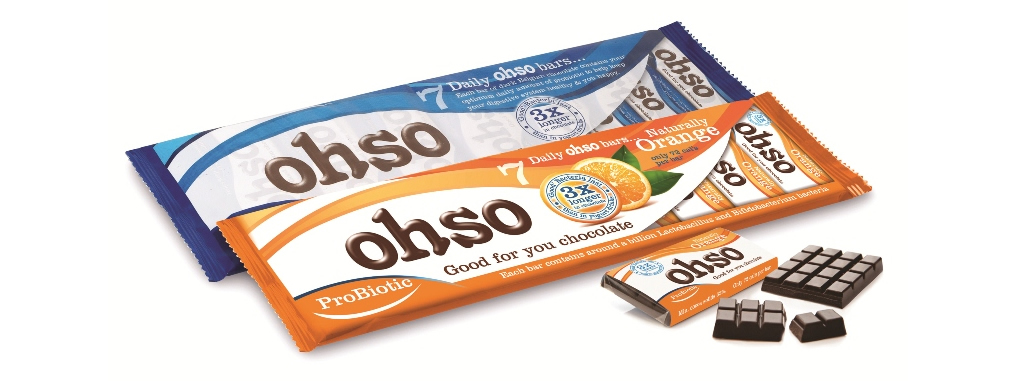
Food Innovation Sighting – Probiotic Chocolate

Food Innovation Sighting - Probiotic Chocolate

I came across the inspiration for this latest food innovation sighting through a London Business School announcement of their upcoming TELL Series speakers, and noticing that Nancy Cruickshank, co-Founder of MyShowcase would be speaking on May 21, 2014.

Clicking over to the web site, I noticed that one of the highlighted products was Ohso Probiotic Chocolate which Andrew Marten brands as a healthy chocolate.

“Ohso Probiotic Chocolate is, quite frankly, the best invention since sliced bread. A delicious dark Belgian chocolate, it contains over a billion friendly bacteria per mini bar. If you love dark chocolate, you will love Ohso. And it loves you back, because as well as tasting divine it promotes your wellbeing via your gut.”

Apparently chocolate helps probiotics survive the journey to the gut where they can do some good and potentially help irritable bowel syndrome (IBS) sufferers.

Who knew?

So, here’s the question…

Innovation or not?


Build a common language of innovation on your team

Subscribe to Human-Centered Change & Innovation WeeklySign up here to get Human-Centered Change & Innovation Weekly delivered to your inbox every week.

Driving Your Differentiator Down

GUEST POST from Stephen Shapiro

Imagine you are a company that produces products for consumers. It could be toothpaste or soft drinks. You decide that your differentiator is your marketing.

Given this, you might assume that the marketing department is the most important part of the business.

This assumption would be wrong.

There is no “most important” department in any organization. Each contributes to the differentiator in their own unique way.

To determine how, you need to dig deeper.

What aspects of your marketing sets you apart? Is it really just about your advertising or brand recognition? Or is there more to it?

For example, maybe it’s your scientifically proven marketing claims that set you apart – “Our laundry detergent cleans whites 50% better than the competition.” For marketing to promote these facts, you of course need to have an R&D team that can create these products. Although (in this example) R&D’s primary role is to support the company’s marketing efforts, this does not mean the marketing function is more important. Everyone is equally important. For example, packaging becomes critical for highlighting claims. Product distribution may impact how a package is displayed on the store shelf. Technology that supports the acquisition of intellectual property may play a major role, as will the lawyers who secure the IP.

But maybe your marketing is not about scientific claims but is instead about clever promotions. Your products target a younger demographic. Therefore you create competitions that appeal to these individuals. Product development now shifts from creating the “best” product to potentially one that responds to consumer suggestions (think Mountain Dew flavors created by customers or M&M colors voted on by customers). Manufacturing needs to get in the act of making sure these new flavors/colors can be produced. The technology that runs competitions and sifts through consumer recommendations quickly and efficiently will help facilitate the customization.

Of course, recruiting makes sure you hire the right people for all of these “marketing” roles. Training makes sure that the critical skills are in place. And so on.

The key is to cascade your differentiator down to every individual.

It is critical that you innovate where you differentiate. But differentiation is not a department or function. Each employee in every department directly contributes to your differentiator. In order for them to know how to make the greatest impact, your differentiator needs to translated in a way that helps individuals prioritize their work.

Innovation is everyone’s job. But everyone should not be innovating everywhere.

Subscribe to Human-Centered Change & Innovation WeeklySign up here to join 17,000+ leaders getting Human-Centered Change & Innovation Weekly delivered to their inbox every week.

Is GE Trying to be Too Quirky?

Is GE Trying to be Too Quirky?

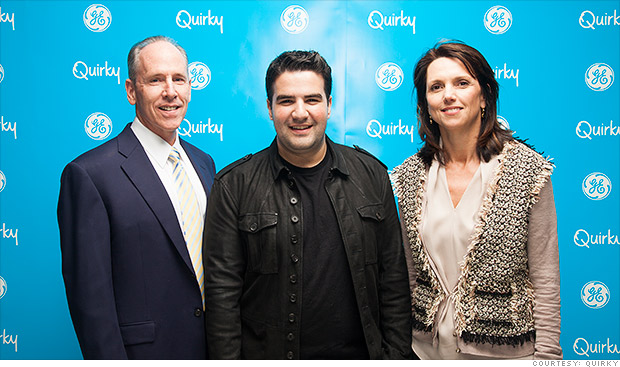
Last week GE and Quirky announced a new partnership where GE will make some of its library of patents available as part of Quirky’s new inspiration platform, allowing inventors to use some of its patents in their potentially novel consumer product invention ideas. This on its surface is a very interesting and logical open innovation partnership. Some people are talking about it as a crowdsourcing partnership, but it isn’t really because the work product is not well-defined and being sourced from multiple competing providers. No, this is an open innovation partnership.

Here is the Quirky and GE partnership announcement video:


It is very interesting to me that GE chose to partner with Quirky and not someone like Innocentive, NineSigma, Idea Connection or someone else. I’m curious what others think this indicates about the future of these firms. Personally, I think that this is something that Quirky is better equipped to make happen than these other firms, and that Innocentive and others still fill an important need using a completely different approach (challenge-driven innovation).

Is GE Trying to be Too Quirky?

Whether or not GE creates any sizable new businesses from their participation in this partnership, I still think this is a brilliant marketing move by Beth and her team and it will be interesting to see whether any impactful inventions come from people leveraging GE’s patent portfolio.

Here is Quirky’s video announcing their inspiration platform (which they raised $68 million to help build):


There is one thing that bugs me a wee bit about Quirky. My tagline since 2006 has been “Making innovation insights accessible for the greater good” and it feels like they’ve swiped it to create theirs – “Making invention accessible.” Surely as creative people they could have invented their own tagline instead of swiping mine. 😉 (wink)

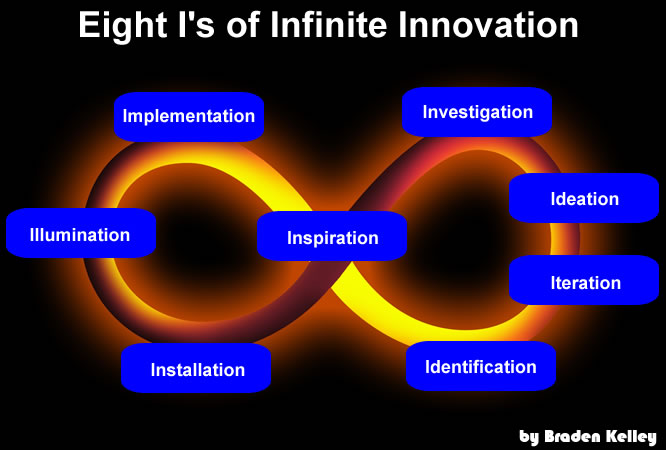
But, there is another idea of mine trapped in this announcement that I’d like to highlight and set free, and that is the idea that innovation is not just about ideas, but that other factors are equally important – including inspiration, investigation, and iteration. These are captured in my incredibly popular Eight I’s of Infinite Innovation framework.

Eight I's of Infinite Innovation

Be sure and follow this article link to the Eight I’s of Infinite Innovation if you missed the link above, or if you’re not clicking away to learn more, here is a quick list of the eight stages:

  1. Inspiration
  2. Investigation
  3. Ideation
  4. Iteration
  5. Identification
  6. Implementation
  7. Illumination
  8. Installation

Personally I don’t think their platform appears to go far enough to deliver inspiration or to empower investigation, and as a software and internet guy I would be happy to help Quirky and GE strengthen the solution if they’re interested in making this platform more successful.

Will any successful innovations come out of this GE and Quirky partnership?

I’d love to hear what you think.

Image credits: GE, Quirky


Build a common language of innovation on your team

Subscribe to Human-Centered Change & Innovation WeeklySign up here to get Human-Centered Change & Innovation Weekly delivered to your inbox every week.

Optimizing Innovation Resonance

Optimizing Innovation ResonanceWhat does resonance mean to you?

The word has many different dictionary definitions depending on the context, but most of them focus on vibrations reaching an ideal state.

Here are two of the most relevant dictionary definitions for our innovation resonance context today:

  • “a quality of evoking response” (Merriam-Webster)
  • “the effect of an event or work of art beyond its immediate or surface meaning” (Bing)

Here also are a couple of my favorite resonance quotes:

  • “I think whatever resonance I may be able to achieve is in part simply from the amount of reading and learning that I acquired along the way.” – Robert B. Parker
  • “I think if the movie has resonance and stimulates the viewer to talk about it, you can have as large an audience as you want.” – Andy Garcia

I’ve written in the past about how innovation is all about value and about how innovation veracity is more important than innovation velocity. Now it is time to take the innovation conversations about value and veracity to the next level – to innovation resonance – and how difficult it is to achieve and maintain.

Optimizing Innovation ResonanceAchieving innovation resonance is about going from 1+1=2 to a state where 1+1+1+1=7, where the sum of the valuable parts in some new potential innovation suddenly becomes greater than the individual components and value may be created that you might not have even anticipated. When you reach this state of innovation nirvana, the power of resonance pushes your invention over the line from invention to innovation, and adoption becomes widespread. People start talking about, spreading it like a virus, and ultimately supplementing your marketing efforts in much more effective ways.

To achieve innovation resonance you must create value with innovation veracity and deliver it in a product or service with the right velocity and course corrections as you bring your potential innovation into the marketplace. Innovation veracity is about identifying the truths that are important to the customer in the problem space you are investigating, the inspirations and the insights that will hopefully lead to better ideas, more value creation, and hopefully, eventually – innovation resonance.

You’ll notice that I used the words hopefully and eventually in the last sentence in relation to achieving innovation resonance, and this is because our best attempts to anticipate the wants and needs of the marketplace will not always be immediately correct, and may require course corrections in the product or service to better match the expected or desired value.

And the ultimate value encompassed in a potential innovation attempting to achieve resonance, comes from three main sources:

1. Value Creation
2. Value Access
3. Value Translation

Innovation = Value Creation * Value Access * Value Translation

You’ll notice in this equation that the parts multiply, and as a result if you do any of the three badly, your potential innovation will fail. But do ALL three well and you will have the opportunity to achieve innovation resonance.
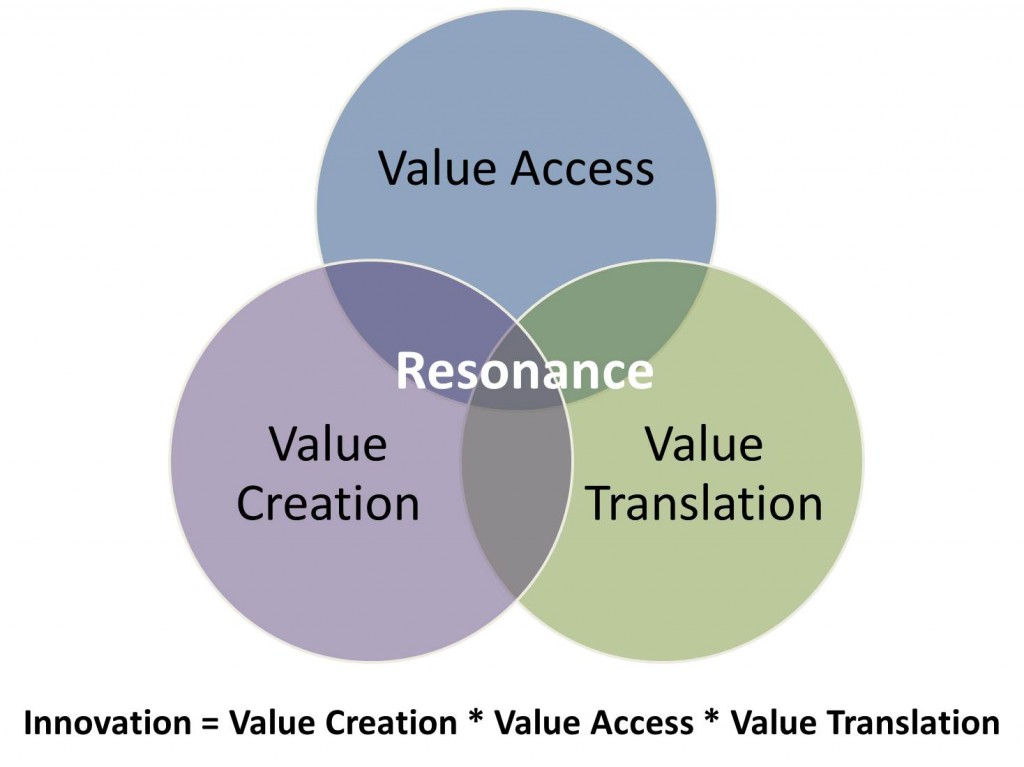
Innovation Resonance Venn Diagram

Optimizing Innovation Resonance

To optimize the value creation component of innovation, you must seek innovation veracity early on, identifying the fundamental truths upon which your potentially innovative solution will be built. During the value creation process you must prototype early and often to test and learn whether your insights are correct and resonating in their expression within the product or service as you expect. From the reactions to your prototypes you must evolve the solution to create more value.

To optimize the value access piece of innovation, you must seek to identify where friction is created in the delivery of your solution and seek to remove it. Carefully observe both where things are awkward or difficult for you to produce and scale the solution, and for your customer to consider and consume it. These friction points represent an opportunity to remove barriers to adoption and to increase potential innovation resonance through better production, purchase and consumption experiences.

To optimize the value translation piece of innovation, you must first identify the gaps in understanding and readiness among your target customers, your plan for working to close these gaps and prepare the market for your launch, and then you’ll want to find your picture or image that communicates a thousand words. Most importantly, you must be aware that the more disruptive your potential innovation the more you may have to educate your potential customers before you even try to sell to them, and so you must build the appropriate amount of market preparation time into the launch plan for your potential innovation plan. Thought leadership marketing and innovation marketing strategies can be very powerful here to help customers understand how the new solution will fit into their lives and why they will want to abandon their existing solution – even if it is the ‘do nothing’ solution.

Resonance Example #1 – The BMW Mini – Barbie in Motion

Barbie Mini CooperOne of those most fun, visually appealing vehicles on the road has to be BMW’s re-release of the Mini. I don’t have one, have only ridden in one once, but whenever I see one driving around, it makes me smile. And if you have any question about whether or not the Mini has achieved a level of resonance (at least in the USA and probably elsewhere), then how would you explain the photo of the Mini on the left that shows you can buy a Mini to drive Ken and Barbie around in? Can you buy a convertible Chrysler LeBaron for Barbie to drive around in? No, but you can buy a Fiat 500, another car achieving resonance here in the USA.

Resonance Example #2 – iPod Nano – Falling from the Pinnacle

iPod Nano 6th GenerationThe iPod Nano is a great example of the rise and fall of innovation resonance. The iPod took three years to take off (right about the time the iPod Nano was released). The trigger for innovation resonance was the Windows version of iTunes (Value Creation), combined with the launch of Apple Retail Stores (Value Access), combined with the iconic advertising campaigns (Value Translation). The iPod became a phenomenon with sales peaking in 2008 right after the iPhone release. Sales have been falling since then, but during this decline came the September 2010 release of the 6th Generation iPod Nano – which resonates to this day – so much so that Apple replaced the design six months ago to protect the market for their upcoming iWatch.

Maintaining Innovation Resonance

As we know from music, to maintain resonance, you must continue to inject energy and focus into the system – a bell won’t ring forever. And as we know from human psychology, just because you continue to ring the bell doesn’t mean that people will continue to want to listen to it in the same way forever. Tastes change, preferences change, the definition of value for each component creating value for customers can potentially change. And so to remain the market leader, to maintain innovation resonance, you must continue to observe, to learn, and to modify your solution to optimize the innovation value equation as needed over time.

One great example of an innovative organization losing resonance over time was Dell. They (and a handful others) came into the PC marketplace with a disruptive business model, captured market share, rose to #1, and then gradually started to lose their position because they didn’t recognize a shift in the relative value of cost vs. design in the marketplace, causing them to lose market share to HP, Apple and others.

One way to look at the difference in strategies between HP and Dell might be to use the Strategy Canvas from the Blue Ocean Strategy methodology. You can see an example of a Strategy Canvas for the wine industry here:
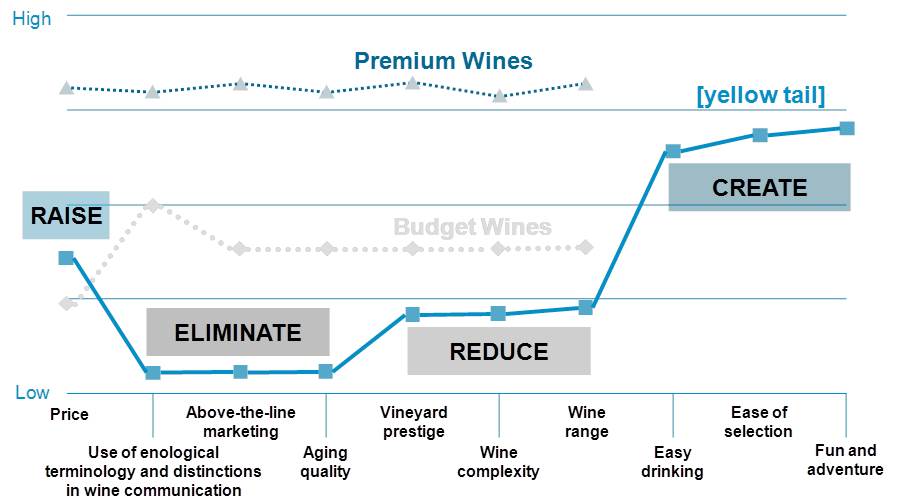
Blue Ocean Strategy Canvas

But traditional Blue Ocean Strategy (or Value Innovation) is very static. As you can see, building a Strategy Canvas using Blue Ocean Strategy methods is a snapshot in time looking at the relative performance of a company on a selected set of value dimensions against its competition. To sail into a Blue Ocean the theory goes, you must select certain value dimensions to either:

  1. Raise
  2. Eliminate
  3. Reduce
  4. Create

But as we know, value dimension performance, value dimension importance, and the competitive dynamics within the industry are not static, but change over time.

It is because of this weakness in the Blue Ocean Strategy methodology that I layer on the investigation of value dimension performance and importance onto any Value Innovation work that I might do. You can see in the two example images below related to the Dell vs. HP example about how changes in performance over time on certain value dimensions relative to what is “good enough” in the minds of customers can lead to changes in the relative importance of various value dimensions in the mind of the customers.
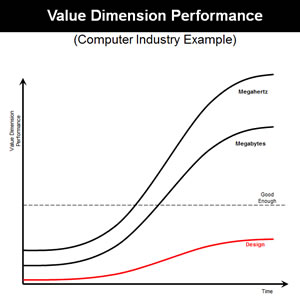
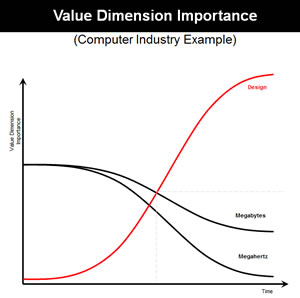
Value Dimension Performance Value Dimension Importance

Because we cannot perfectly predict how customers will consume our product or service when we bring it to market, and because of the shifting sands of value force you to continuously re-evaluate the current situation with value dimensions and value importance, we must re-evaluate where we see the innovation process beginning and ending. Smart companies are recognizing that is not just about coming up with a great idea, or having a great launch, but about creating a commitment to launching, learning, and dialing in success by working to create and then maintain innovation resonance. Whirlpool Corporation, one of the early pioneers of a systematic pursuit of innovation excellence, has seen this and has created a commitment to launching and learning and has added a third diamond to their double diamond innovation methodology called ‘Deliver and Grow’.
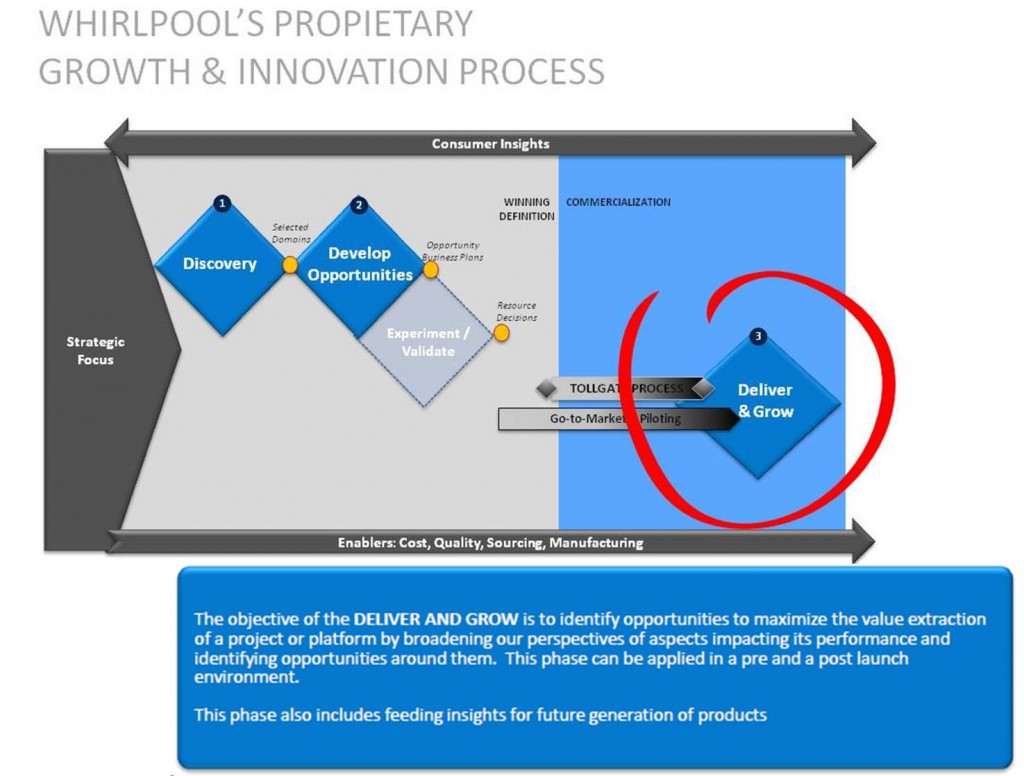
Whirlpool Triple Diamond Process

Moises Norena, the Global Director of Innovation at the Whirlpool Corporation, was kind enough to share these thoughts:

“While we put a significant emphasis in the front end of innovation and in the commercialization phase, we recognize that you can not launch a product and sit and wait for its success. With the third diamond we assure that innovation teams stay engaged in the product management while it is in the market, contrasting the results with the predictions, not only on business performance but against the consumer and trade promise they were designed to deliver. We also ask these teams to use the innovation tools and process to identify opportunities to experiment and to maximize value extraction from the market.”

Conclusion

To achieve and maintain innovation resonance, you must nurture a commitment to learning fast, both during the innovation development process and after the launch of a potential innovation. You must maintain a laser focus on how you are creating value, helping people access that value, and translating that value for people so they can understand how your potential innovation may fit into their lives. So, do you have processes in place as part of your innovation methodology for measuring and evolving solutions in place to help you get to innovation resonance?

If not, keep a focus on value creation, value access, and value translation, use my evolutions of the Blue Ocean Strategy framework, and have a look at The Eight I’s of Infinite Innovation framework that I created or at the Whirlpool Corporation’s Triple Diamond methodology to help you deliver and grow more successful innovation into your organization, and hopefully reach some level of innovation resonance.

Build a common language of innovation on your team

Subscribe to Human-Centered Change & Innovation WeeklySign up here to get Human-Centered Change & Innovation Weekly delivered to your inbox every week.
Using Gravity to Save and Improve Lives

Using Gravity to Save and Improve Lives

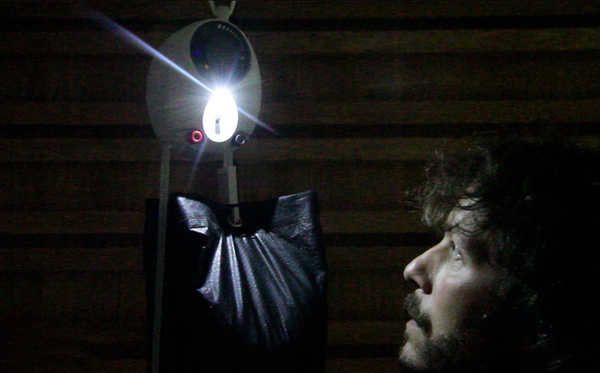
I came across an IndieGogo project that is focused on building and trialing a gravity-powered power station that can serve either as a lantern or as a flexible power source that can be used to power a task light, recharge batteries, or potentially other things that users might dream up that the designers can’t yet imagine.

Check out their video from IndieGogo:

They have already raised FIVE TIMES the money they set out to raise on IndieGogo.

I found it interesting in their promotional video that initially they started with a design challenge of designing a system that would charge a light for indoor use using a solar panel, but that they decided to abandon the approach specified from the outset and pursue alternate power sources.

Also interesting from the IndieGogo project page are the following facts:

The World Bank estimates that, as a result, 780 million women and children inhale smoke which is equivalent to smoking 2 packets of cigarettes every day. 60% of adult, female lung-cancer victims in developing nations are non-smokers. The fumes also cause eye infections and cataracts, but burning kerosene is also more immediately dangerous: 2.5 million people a year, in India alone, suffer severe burns from overturned kerosene lamps. Burning Kerosene also comes with a financial burden: kerosene for lighting ALONE can consume 10 to 20% of a household’s income. This burden traps people in a permanent state of subsistence living, buying cupfuls of fuel for their daily needs, as and when they can.

The burning of Kerosene for lighting also produces 244 million tonnes of Carbon Dioxide annually.

So, what do you think, a meaningful innovation or an interesting but impractical invention?

More information available on their web site here.


Build a common language of innovation on your team

Subscribe to Human-Centered Change & Innovation WeeklySign up here to get Human-Centered Change & Innovation Weekly delivered to your inbox every week.
Innovation Ripe for the Plucking

Innovation Ripe for the PluckingToo often we all run around trying to pluck a gamechanging idea out of thin air that nobody has ever seen, solving a problem that has never been solved, when really if the truth be told, there are still lots of existing problems with lots of solutions that are still waiting for a simple, elegant solution.

Is Quirky’s new ‘Pluck’ one of those simple, elegant solutions that you wish you had thought of? Are there other products that do this job better. Are you jealous of the margins they are likely to earn on such a simple product (assuming people are willing to pay the $12.99 asking price)?

Well, whatever you think, the Pluck is a great example of how innovation can come from the simple just as much as it can come from the complex, because innovation after all is about transforming the useful seeds of invention into solutions valued above every existing alternative – and then making the result widely adopted.

So, are you overcomplicating things in your search for innovation?

Moral of the story – Don’t be afraid to break a few eggs in your quest for innovation.


Build a common language of innovation on your team

Subscribe to Human-Centered Change & Innovation WeeklySign up here to get Human-Centered Change & Innovation Weekly delivered to your inbox every week.
Apple Touches on a Potential Innovation Integration

Apple Touches on a Potential Innovation Integration

Recently Apple announced its intention to acquire Authentec, a biometric authentication company. Apple was in a real hurry to complete the acquisition and it makes you wonder whether Authentec’s fingerprint authentication technology will make it into the home button of the iPhone 5 and possibly the iPad Mini in the coming months.

If Apple were to integrate the Authentec technology into the home button on the iPhone 5, the iPad Mini, and eventually the iPad 4, then it would not only create a handy way to make the devices easily personalized for multiple users of the same device (or just a simple password-free login for a single user), but purportedly the technology also has the ability to recognize multiple fingers (allowing for the home button to potentially achieve multiple functions), and to serve as authentication for mobile payments (most likely via NFC – Near Field Communications).

That would mean that Apple would add a lot of new functionality with the integration of this tiny piece of hardware, several software updates, and another tiny piece of hardware for NFC. But more importantly, these tiny pieces of hardware and software could make the computing experience more personal, and more naturally personalized as you move around the environment into different applications.

I know it is only a replacement for what could or can be done with a password, but I would love to be able to have apps like Netflix personalized based on whose finger was used.

This could become a great example of flexible design and innovating for the future present if they launch the iPhone 5 with these technologies. That would show that they started the design process with this as only a possibility but decided AFTER the technology looked ready to actually integrate it into the shipping product, and remained flexible enough to integrate the component near the end of the design process – something that is very hard to do, but very powerful.

Are all of these potential innovations ranging from the minor (login) to the transformative (speeding up mobile payment adoption) likely to make the cut for the iPhone 5?

I guess we will wait and see what happens on September 12th.

Subscribe to Human-Centered Change & Innovation WeeklySign up here to get Human-Centered Change & Innovation Weekly delivered to your inbox every week.
Innovation Convergence

GUEST POST from Stephen Shapiro

I never really thought much about toothpaste. But at the last two innovation conferences where I spoke, toothpaste was one of the hot topics.

At the FT Innovate conference in London, Unilever discussed their “Signal White Now” (and other brands) toothpaste. Instead of using harsh bleaches and abrasives, they borrowed an optical-effect technology from their laundry team. This toothpaste uses a blue pigment to make yellow teeth instantly appear whiter. This same ingredient is used to make white clothes look even whiter.

At the Open Innovation Summit in Orlando, GSK discussed how their “Aquafresh iso-active” toothpaste borrowed an idea from Edge shaving cream (now a division of Energizer Holdings, Inc). The toothpaste comes out like a gel, but foams in the mouth, much like the shaving cream. This formulation, according to the can I was given, removes 25% more bacteria than regular toothpaste – or 3x more according to the picture on the right.

This got me thinking. If toothpaste manufacturers can get ideas from shaving cream and laundry detergent, where else could they get ideas? Within 5 minutes, I thought up a few ideas of how to gain inspiration from other products:

  1. Pop Rocks: As a kid, I loved how Pop Rocks, the carbonated candy, exploded in your mouth. What if you added Pop Rock-like crystals to toothpaste? Not only would the toothpaste foam, it would fizz and explode. Maybe this would blast the plaque off your teeth. Of course, it might blast off your teeth like Pop Rocks reputedly did a few times.
  2. Shampoo: Shampoos are infused with vitamins and minerals to give your hair bounce and shine. What if you infused toothpaste with these ingredients? Or maybe you could add some homeopathic remedies – for those who believe in these alternative “medicines.” Sublingual administration (under the tongue) is a common and effective way of delivering drugs directly into the bloodstream.
  3. Conditioner: We use shampoo to clean and conditioner to protect. Maybe they can create a tooth conditioner; a special toothpaste that you use after your regular toothpaste. It could coat your teeth to prevent staining, bad breath, or split ends. Even better, they could borrow the “technology” used by shampoos like “Pearl” that combine shampoo and conditioner into one formulation.
  4. Moisturizers: Several moisturizers have an AM and a PM formulation. One is used in the morning and the other at night before you go to sleep. The AM formula of toothpaste could be infused with caffeine that would be absorbed into the bloodstream sublingually (see idea #2 above). And the PM formulation could be infused with melatonin to help you sleep better at night.
  5. Weight Loss Products: I’m not sure how this would work, but what if you could create a toothpaste that somehow made certain foods taste bad? This might cause you to reduce the amount of food you eat. Or maybe there is another way to make toothpaste a weight loss product. OK, this one is a stretch, but there might be a kernel of an idea there!

In a breakout at the Open Innovation Summit, an innovation leader from Johnson & Johnson, when asked to name the most important word for their business right now, answered “Convergence.” By this, he meant the sharing of ideas across business units and brands.

Ideas can indeed come from anywhere. And quite often, the best ideas will come from inside your own organization – just from a different product, function, division, or brand. Where will your next big idea come from?

If you have other toothpaste innovation ideas, I would love for you to post them as comments!

Subscribe to Human-Centered Change & Innovation WeeklySign up here to join 17,000+ leaders getting Human-Centered Change & Innovation Weekly delivered to their inbox every week.

Why Edison Was Wrong

GUEST POST from Stephen Shapiro

The other night I had an enlightening conversation with Alph Bingham, the co-founder of InnoCentive from Eli Lilly. This guy is fascinating!

Alph suggested that many people do not like open innovation (external crowd sourcing) because it runs counter to a widely held belief of the R&D community. Researchers often throw around the Edison quote, “I have not failed 700 times. I have not failed once. I have succeeded in proving that those 700 ways will not work. When I have eliminated the ways that will not work, I will find the way that will work.”


Researchers use this quote because it “validates” the iterative development innovation process; the cornerstone of most R&D departments. They have convinced themselves that they learn as much from their failures as they do from their successes. Call it what you want, the 700 attempts were failures.

When some R&D people look at open innovation, they see it as linear rather than iterative: post a challenge and get a solution. This seems inconsistent with their belief in learning from failures.

Alph made the point that in the R&D world, the value of iterative development is overrated.

What if Edison found a solution to the light bulb challenge on the first try? Would that be bad? Would he have continued to find the 700 ways that did not work? Did the 700 failures really add that much value? Can R&D organizations afford to fail 700 times? Not in today’s competitive environment.


Alph suggested that open innovation is a massively parallel process where failures and successes happen at the same time. You post a challenge and you get dozens or hundreds of solutions. Some won’t work. But all you need is one solution that does work. And with open innovation, you only pay only for the solutions that do work. Failures cost you nothing in terms of time and money. With internal iterative development, you pay for the successes and the failures. Do you really learn enough from your failures to justify the extra cost and time involved?

Alph’s perspective is fascinating and I fully agree with him for analytical/deterministic challenges. Creative challenges and their solutions, on the other hand, often can’t be proven correct until they are tried out in the real world. Iterative development – via small and scaling experiments – may still be the best approach for solving less deterministic problems. I call this approach the “build it, try it, fix it” model. Having said that, the iterations could potentially be staged as a series of open innovation challenges that continue to refine concepts until they are market ready. This would be a massively parallel iterative creative development. Very cool.

This got me thinking about a conversation I had with an executive from Chrysler many years ago while I was working at Accenture. I asked him who he felt his biggest competition would be in the future. He pointed at me and said, “You.” Although he was half-joking, it’s true that the role of car manufacturers these days is less about manufacturing and more about integration. The Accentures of the world are masterful at integration.

And maybe this integration skill is the MOST important skill for your organization to have.


As platforms like InnoCentive continue to grow, problem solving of all types – creative and analytical – will be outsourced in a massive parallel way to a huge network for solvers. If we take this to an extreme where all challenges are outsourced via crowdsourcing, the role of a company would only be to integrate these solutions together into a seamless offering.

Although this is easier said than done, this one skill may be critical for the survival of your business…and maybe even the US economy.

China and India have a growing base of highly educated engineers and experts. Eastern European countries and parts of Asia have large creative bases. The world is truly flat. And all of these countries have people who are willing to work for pennies on the dollar.

If we try to beat these countries at their game, we will lose. We could never educate enough people. And even if we could, our workforce would probably not be willing to labor for lower wages.

Integration is the key. Yes it is difficult. And that is good news. While the rest of the world is focused on the trees (the point solutions to specific challenges), we need to become masterful at defining the forest (the strategy, architecture, and integration of the point solutions). This is where value is created. And this is much harder to outsource.

It reminds me of something from my “24/7 Innovation” book I wrote back in 2001…

“(As innovators,) we are architects of companies and industries. An architect is not a ‘reengineer.’ To illustrate this point, I often ask clients what is the difference between an optimist, a pessimist, a reengineering consultant, and an architect. The optimist looks at a half filled glass of water and sees it as half-full. The pessimist looks at the same glass and sees it as half-empty. The reengineering consultant sees too much glass. Cut off the top. Downsize. An architect looks at the same glass and asks questions such as ‘Who’s thirsty?’ ‘Why water?’ Or ‘Is there another way to satisfy the thirst?’ It is this questioning, challenging and rethinking that differentiates architects from those who rearrange the deck chairs on The Titanic.”

Find solutions everywhere. Embrace open innovation. And think like an architect. Ask the difficult questions. Assess what matters most. And build a core competency around integrating point solutions.

Remember, we are no longer in the tree business…we are in the forest business.

Bonus: An interview with Alph Bingham and Dwayne Spradlin of Innocentive.

Subscribe to Human-Centered Change & Innovation WeeklySign up here to join 17,000+ leaders getting Human-Centered Change & Innovation Weekly delivered to their inbox every week.

Discovering Innovation Around the House

GUEST POST from Stephen Shapiro

Last night I was hungry and decided to make some tuna fish. I opened my refrigerator and found an 18 ounce squeeze bottle of mayonnaise. As I started to make my meal, I realized that the mayo had expired 6 months ago. I guess I don’t use it very often because the bottle was still 90% full.

After throwing out my expired food, I realized that there is a lot to learn from things we take for granted around the house. Here are just three thoughts I had this morning:

Fail Cheaply – Although Costco is one of my favorite stores, I rarely buy perishable items there because I can’t predict how much I will use. Sometimes, as is the case with my mayo, buying the smallest size and paying a premium is better than saving money on larger quantities. Smaller quantities result in less space used, less waste when things don’t work out, and lower costs all around. In business, your best bet is to become masterful at creating small, inexpensive and scalable experiments that give you insights into the real world… not just backroom-based predictions. As you gain new insights and become more confident that a new idea will work (i.e., there is greater predictability), then you can ramp up and go for efficiency.

Sell One, Make One – I debated using a different example for this… One situation no one ever wants to be in is sitting on the toilet and running out of toilet paper. The best solution is to always have a spare roll within reach. When the main roll is finished, the spare role is put into the dispenser, and the backup roll is replaced. This is an example of a simple manufacturing technique called “sell one, make one.” To avoid running out of product, companies often produce large quantities of inventory. But as we saw in the “fail cheaply” example above, this can lead to waste. Items that don’t sell need to be liquidated at significant discounts. In the meantime, the inventory takes up space and hurts your cash flow. Instead, if you get your manufacturing process (or your innovation implementation process) efficient enough, you can make one immediately after you sell one – that is, when you sell one, you make one. You will never run out if demand never exceeds your ability to manufacture.

Lather Rinse But Don’t Repeat – Shampoo bottles are famous for telling you to lather, rinse, and repeat. I have been doing it every morning without thinking. As an experiment, I tried skipping the repeat step. No difference. I even experimented with using less than one pump of shampoo. Same result. Sometimes we take on wasteful activities because we never through to step back and question them. I reduced shampoo usage by 75% without any impact on my hair. From my experience, most companies can reduce wasteful activities simply by questioning what has always been done in the past.

Here’s something to try. Every day, find something interesting around the house:

  • It could be the upside-down ketchup bottle (what took them so long to come up with that idea?).
  • It could be the laundry detergent that is super concentrated so you use 75% less liquid, meaning less packaging and easier carrying.
  • Or maybe it is the Clorox Disinfecting Wipes that impregnate paper towels with cleaning solution to simplify cleaning.

After selecting your innovation, see how that concept could be applied to your business. Do not look for ways to apply that specific product. Instead you want to apply the thought process that was used in developing the product. For example, with the Clorox wipes, where in your business can you combine two distinct items (products or processes) to create something that is simpler and more efficient.

The purpose is not necessarily to find new ideas (although that would be nice). Rather it is a great way to exercise your creativity muscle.

Steve Jobs, CEO of Apple Inc, once said, “Creativity is just having enough dots to connect… connect experiences and synthesize new things. The reason creative people are able to do that is that they’ve had more experiences or have thought more about their experiences than other people.”

Or, in my words, creativity is about “collecting and connecting” dots.

This daily exercise will help you become more observant (collecting dots). And it will help you become masterful at connecting dots. All of this will help you become more creative every day.

For more on my perspective on creativity, read my article on “Dot Versus Line” thinking.

Subscribe to Human-Centered Change & Innovation WeeklySign up here to join 17,000+ leaders getting Human-Centered Change & Innovation Weekly delivered to their inbox every week.