Category Archives: collaboration

Collaboration Being Killed by Collaboration Software

Collaboration Being Killed by Collaboration Software

GUEST POST from Robyn Bolton

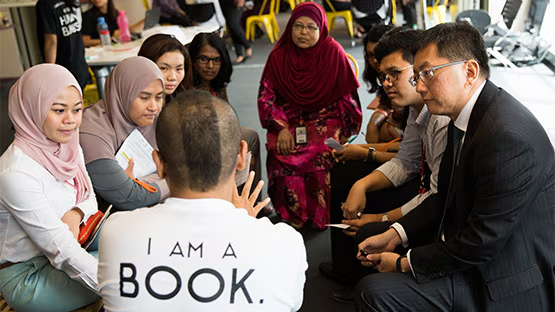
In our race to enable and support hybrid teams, our reliance on collaboration software has inadvertently caused us to forget the art of true collaboration. 

The pandemic forced us to rely on digital platforms for communication and creativity. But as we embraced these tools, something essential was lost in translation. Last week, I watched team members sitting elbow-to-elbow spend two hours synthesizing discovery interviews and debating opportunity areas entirely by chat.

What collaboration is

“Collaboration” seems to have joined the ranks of meaningless corporate buzzwords.  In an analysis of 1001 values from 172 businesses, “collaboration” was the #2 most common value (integrity was #1), appearing in 23% of the companies’ value statements. 

What it means in those companies’ statements is anyone’s guess (we’ve all been in situations where stated values and lived values are two different things).  But according to the dictionary, collaboration is “the situation of two or more people working together to create or achieve the same thing.”

That’s a short definition with a lot of depth. 

  • “The same thing” means that the people working together are working towards a shared goal in which they have a stake in the outcome (not just the completion). 
  • “Working together” points towards interdependence, that everyone brings something unique to the work and that shared goal cannot be achieved without each person’s unique contribution. 
  • “Two or more people” needing each other to achieve a shared outcome requires a shared sense of respect, deep trust, and vulnerability.

It’s easy to forget what “collaboration” means.  But we seem to have forgotten how to do it.

What collaboration is not

As people grow more comfortable “collaborating” online, it seems that fewer people are actually collaborating.   

Instead, they’re:

  • Transacting: There is nothing wrong with email, texts, or messaging someone on your platform of choice.  But for the love of goodness, don’t tell me our exchange was a collaboration. If it were, every trip to the ATM would be a team-building exercise.
  • Offering choices:  When you go out to eat at a fast-food restaurant, do you collaborate with the employee to design your meal?  No.  You order off a menu.  Offering a choice between two or three options (without the opportunity to edit or customize the options), isn’t collaboration.  It’s taking an order.
  • Complying: Compliance is “the act of obeying a law or rule, especially one that controls a particular industry or type of work.”  Following rules isn’t collaboration, it’s following a recipe
  • Cooperating Cooperation is when two or more people work together independently or interdependently to achieve someone else’s goal.  Collaboration requires shared objectives and ownership, not just shared tasks and timelines.

There’s nothing wrong with any of these activities.  Just don’t confuse them with collaboration because it sends the wrong message to your people. 

Why this matters

This isn’t an ivory-tower debate about semantics.

When people believe that simple Q&A, giving limited and unalterable options, following rules, and delivering requests are collaboration, they stop thinking.  Curiosity, creativity, and problem-solving give way to efficiency and box-checking.  Organizations stop exploring, developing, and innovating and start doing the same thing better, faster, and cheaper.

So, if you truly want your organization to grow because it’s filled with creative and empathetic problem-solvers, invest in reclaiming the true spirit of collaboration.  After all, the next big idea isn’t hiding in a chat log—it’s waiting to be born in the spark of genuine collaboration.

Image credit: Unsplash

Subscribe to Human-Centered Change & Innovation WeeklySign up here to join 17,000+ leaders getting Human-Centered Change & Innovation Weekly delivered to their inbox every week.

A Shared Language for Radical Change

A Shared Language for Radical Change

GUEST POST from Greg Satell

One of the toughest things about change is simply to have your idea understood. The status quo always has inertia on its side and never yields its power gracefully. People need a reason to believe in change, but they never need much convincing to allow things to go along as they always have. Inaction is the easiest thing in the world.

This can be incredibly frustrating. It doesn’t matter if you’re a political revolutionary, a social visionary or an entrepreneur, if you have an idea you think can impact the world, you want people to be as excited about it as you are. So you try to describe it in vivid language that highlights how wonderfully different it really is.

The pitfall that many would-be revolutionaries fall into is they fail to communicate in terms that others are able to accept and internalize. Make no mistake. Nobody needs to understand your idea. If you think your idea is important and want it to spread, then you need to meet people where they are, not where you’d like them to be. That’s how you make change real.

The Importance Of Finding Your Tribe

There’s no question that Pixar is one of the most successful creative enterprises ever. Yet in his memoir, Creativity, Inc., Pixar founder Ed Catmull wrote that “early on, all of our movies suck.” Catmull calls initial ideas “ugly babies,” because they start out, “awkward and unformed, vulnerable and incomplete.” Few can see what those ugly babies can grow into.

That’s why it’s important to start with a majority. You can always expand a majority out, but once you are in the minority you will either immediately feel pushback or, even worse, you will simply be ignored. If you can find a tribe of people who are as passionate about your idea as you are, you can empower them to succeed and bring in others to join you as well.

There is, however, a danger to this approach. Consider a study that examined networks of the cast and crew of Broadway plays. The researchers found that if no one had ever worked together before, results tended to be poor. However, if the networks among the cast and crew became too dense— becoming a close-knit tribe—performance also suffered.

The problem is that tribes tend to be echo chambers that filter outside voices. Consensus becomes doctrine and, eventually, gospel. Dissension is not only discouraged, but often punished. Eventually, a private language emerges that encodes the gospel into linguistic convention and customs. The outside world loses internal tribal relevance.

The Pitfalls Of A Private Language

Every field of endeavor must navigate the two competing needs: specialization and relevance. For example, a doctor treating a complex disease must master the private, technical language of her field to confer with colleagues, but must also translate those same concepts to a public, common language to communicate with patients in ways they can understand.

Yet as the philosopher Ludwig Wittgenstein explained, these types of private languages can be problematic. He made the analogy of a beetle in a box. If everybody had something in a box that they called a beetle, but no one could examine each other’s box, there would be no way of knowing whether everybody was actually talking about the same thing or not.

What Wittgenstein pointed out was that in this situation, the term “beetle” would lose relevance and meaning. It would simply refer to something that everybody had in their box, whatever that was. Everybody could just nod their heads not knowing whether they were talking about an insect, a German automobile or a British rock band. The same also happens with professional jargon and lingo.

I see this problem all the time in my work helping organizations to bring change about. People leading, say, a digital transformation are, not surprisingly, enthusiastic about digital technology and speak to other enthusiasts in the private, technical language native to their tribe. Unfortunately, to everyone else, this language holds little meaning or relevance. For all practical purposes, it might as well be a “beetle in a box.”

Creating A Shared Identity Through Shared Values And Shared Purpose

The easiest way to attack change is to position it as fundamentally at odds with the prevailing culture. In an organizational environment, those who oppose change often speak of undermining business models or corporate “DNA.” In much the same way, social and political movements are often portrayed as “foreign” or “radical.”

That’s why successful change efforts create shared identity through shared values and shared purpose. In the struggle for women’s voting rights in America, groups of Silent Sentinels would picket the White House with slogans taken from President Woodrow Wilson’s own books. To win over nationalistic populations in rural areas, the Serbian revolutionary movement Otpor made the patriotic plea, “Resistance, Because I Love Serbia.”

We find the same strategy effective in our work with organizational transformations. Not everybody loves technology, for example, but everybody can see the value of serving customers better, in operating more efficiently and in creating a better workplace. If you can communicate the need for change in terms of shared values and purpose, it’ll be easier for others to accept.

Even more importantly, people need to see that change can work. That’s why we always recommend starting with a keystone change, which represents a clear and tangible objective, involves multiple stakeholders and paves the way for future change. For example, with digital transformations, we advise our clients to automate the most mundane tasks first, even if those aren’t necessarily the highest priority tasks for the project.

Would You Rather Make A Point Or Make A Difference?

One of the most difficult things about leading change is that you need to let people embrace it for their own reasons, which might not necessarily be your own. When you’re passionate about an idea, you want others to see it the same way you do, with all its beautiful complexity and nuance. You want people to share your devotion and fervor.

Many change efforts end up sabotaging themselves for exactly this reason. People who love technology want others to love it too. Those who feel strongly about racial and gender-based diversity want everyone to see injustice and inequality just as they do. Innovators in any area can often be single-minded in their pursuit of change.

The truth is that we all have a need to be recognized and when others don’t share a view that we feel strongly about, it offends our sense of dignity. The danger, of course, is that in our rapture we descend into solipsism and fail to recognize the dignity of others. We proudly speak in a private language amongst our tribe and expect others to try and find a way in.

Yet the world simply doesn’t work that way. If you care about change, you need to hold yourself accountable to be an effective messenger. You have to make the effort to express yourself in terms that your targets of influence are willing to accept. That doesn’t in any way mean you have to compromise. It simply means that you need to advocate effectively.

In the final analysis, you need to decide whether you’d rather make a point, or make a difference.

— Article courtesy of the Digital Tonto blog
— Image credits: Pixabay

Subscribe to Human-Centered Change & Innovation WeeklySign up here to join 17,000+ leaders getting Human-Centered Change & Innovation Weekly delivered to their inbox every week.

What We Can Learn from MrBeast’s Onboarding

Lessons from a Leaked Document

What We Can Learn From MrBeast's Onboarding

GUEST POST from Robyn Bolton

In the often murky world of corporate communication, a leaked MrBeast document has emerged as a beacon of clarity. Far from being your typical vague, jargon-filled memo, this onboarding document is a crystal-clear recipe for success that’s as refreshing as it is rare.

But first, let’s address the elephant in the room. MrBeast’s empire isn’t without its share of controversy. Reports of toxic work environments, unsafe conditions for contestants, and allegations of rigged games cast a shadow over his content creation machine and his leadership capabilities. These are serious issues that merit investigation and discussion. As a result, this post isn’t an endorsement of MrBeast as a leader, it’s an endorsement of an onboarding document that he wrote.

The Secret Sauce: Clarity Meets Innovation

What sets this document apart is its razor-sharp clarity and relentless focus on creativity. Unlike the vague platitudes that plague many corporate communications, job descriptions, and performance matrixes, this document clearly outlines expectations, success metrics, and the strategies and tactics to fuel continuous innovation.

This clarity is transformative for people and organizations. When team members understand both the guardrails and the goals, they channel their creative energy into groundbreaking ideas rather than second-guessing their approach and worrying about repercussions.

Expectations: Always Be Learning

The first principle is a clear directive: always be learning. In MrBeast’s world, this isn’t just about personal growth—it’s about staying ahead in a rapidly changing digital landscape. This commitment to continuous learning fuels innovation by ensuring the team is constantly exploring new technologies, trends, and creative techniques.

While some see the definition of A, B, and C-players as evidence of a toxic workplace, the fact is that it’s the reality in most workplaces.  It’s the absence of clarity, usually disguised by claims of family-like cultures that value diversity, that makes workplaces toxic. 

Metrics: The Start of a Feedback Loop

The focus on specific success metrics like Click-Through Rate and Average View Duration isn’t just about measurement—it’s about creating a feedback loop for innovation. Clear benchmarks developed over time allow teams to quickly assess the impact of new ideas and iterate accordingly.  It also removes the temptation and ability to “move the goalposts” to create the appearance of success.

Strategy: Structure Meets Creativity

After describing what success looks like for employees and how they’ll be measured, the document outlines a structured content formula akin to an innovation strategy. It provides a clear framework of priorities, goals, and boundaries while encouraging creative experimentation within those boundaries.

Starting with a step-by-step guide to making videos with a “wow” factor, the document also emphasizes the criticality of focusing on “critical components” and managing dependencies and

Far from the usual corporate claims that direction and “how to’s” constrain creativity and disempower employees, this approach creates a safety net that allows employees to be successful while still pushing the envelope of what’s possible in content creation.

How to Become Your Version of (a non-controversial) Mr. Beast

You don’t have to be a content creator, social media savant, or company founder to follow MrBeast’s lead.  You have to do something much more difficult – communicate clearly and consistently.

  1. Clearly define what success looks like (and doesn’t) for your employees and projects.
  2. Establish frameworks that encourage bold ideas while maintaining focus.
  3. Define objective success metrics and consistently measure, track, and use them.

This leaked MrBeast document offers more than just a glimpse into a YouTube empire; it’s a masterclass in leadership in the era of hybrid workplaces, geographically dispersed teams, and emerging cultures and norms. 

The document’s approach shows that innovation doesn’t have to be chaotic. By providing clear expectations and frameworks, leaders can create an environment where creativity thrives, and groundbreaking ideas can be rapidly developed and implemented.

When viewed in the bigger context of the MrBeast organization, however, the document is also a reminder that no matter how clear you think your communication is, you must be vigilant for those who claim that bad behavior is just a “misunderstanding.” Leaders know that no amount of views, clicks, or revenue is worth sacrificing the well-being of their teams.

Image credit: Wikimedia Commons

Subscribe to Human-Centered Change & Innovation WeeklySign up here to join 17,000+ leaders getting Human-Centered Change & Innovation Weekly delivered to their inbox every week.

Does Diversity Increase Team Performance?

Does Diversity Increase Team Performance?

GUEST POST from David Burkus

It’s often said by teams that “diversity is our strength.” We take for granted the idea that diverse teams bring more lived experiences, ideas, and solutions to the table. When asked, “How does diversity affect teamwork?” most leaders assume that teams composed of individuals from different backgrounds, cultures, and perspectives are more likely to approach problems from various angles and come up with innovative solutions. And hence most leaders assume that diversity is a source of greater performance.

And while that’s true—it’s not as clear cut as we assume.

When you look at the research, the relationship between diversity and high-performing teams isn’t always a positive correlation. For diversity to truly enhance teamwork, teams need to establish psychological safety and build shared understanding. Otherwise, diverse ideas, perspectives, and experiences can cause more friction than innovation.

In this article, we will explore the importance of psychological safety and shared understanding in diverse teams. By understanding the impact of diversity on teamwork and implementing these practices, teams can harness the full potential of their diverse members and achieve better problem-solving and value creation.

Psychological Safety

Psychological safety is crucial for diverse teams to tap into the benefits of diversity. When team members feel psychologically safe, they are more likely to share their ideas, take risks, and engage in open and honest discussions. As a leader, it is essential to create an environment where team members feel comfortable expressing themselves without fear of judgment or negative consequences.

One way to build psychological safety is by demonstrating vulnerability as a leader. When leaders openly share their own challenges, mistakes, and uncertainties, it creates a safe space for team members to do the same. This builds trust and shows that it is acceptable to take risks and make mistakes. By embracing vulnerability, leaders can set the tone for open communication and encourage team members to bring their authentic selves to the discussion.

Another important aspect of psychological safety is teaching respectful dissent. Disagreements are inevitable in any team, but it is crucial to handle them in a productive and respectful manner. Encouraging team members to express their differing opinions and perspectives fosters a culture of healthy debate and prevents the formation of echo chambers. By establishing guidelines for respectful dissent, teams can ensure that disagreements are seen as opportunities for growth and learning rather than sources of conflict.

Shared Understanding

Shared understanding is important for diverse teams to work together effectively. When team members have a clear understanding of each other’s work preferences, strengths, and weaknesses, they can collaborate more efficiently and leverage each other’s skills and expertise. Building shared understanding requires intentional efforts to create an environment where team members can openly discuss their working styles and expectations.

One strategy for building shared understanding is to use exercises like the “manual of me.” This exercise involves team members sharing information about their preferred communication styles, work habits, and personal preferences. By understanding each other’s preferences, team members can adapt their communication and collaboration approaches to accommodate different working styles.

Creating a team working agreement is another effective way to establish shared understanding. This agreement outlines the team’s norms and expectations, addressing questions about how the team wants to work together. It can cover topics such as communication channels, decision-making processes, and conflict resolution strategies. By collectively defining these guidelines, teams can ensure that everyone is on the same page and reduce misunderstandings or conflicts that may arise due to differences in working styles or expectations.

Diversity, when combined with psychological safety and shared understanding, enhances teamwork, and leads to improved performance. By creating an environment where team members feel safe to express themselves and fostering shared understanding, teams can tap into the full potential of their diverse members. Embracing diversity as a strength allows teams to approach problems from various perspectives, leading to better problem-solving and value creation. And that helps everyone on the team do their best work ever.

Image credit: Pexels

Originally published on DavidBurkus.com on September 11, 2023

Subscribe to Human-Centered Change & Innovation WeeklySign up here to get Human-Centered Change & Innovation Weekly delivered to your inbox every week.

Why Small Innovations Matter Now More Than Ever

Searching for Silver Linings

Why Small Innovations Matter Now More Than Ever

GUEST POST from Robyn Bolton

Do you feel like you’re drowning in a sea of bad news? You’re not alone. We’re standing in the eye of a storm of war, political division, and endless layoffs. In times like these, why bother with innovation when we’re using all our energy to survive and make sense of things?

I’ve asked myself this question with increasing frequency over the past months.  After hours of searching, querying, and reading to understand why you, me, or any other individual should bother with innovation, I can tell you two things:

  1. There’s no logical, data-backed reason why any individual should bother innovating (there are many logical, data-backed reasons why companies should innovate)
  2. Innovation is the only life raft that’s ever carried us from merely surviving to thriving.

If that seems like a big, overwhelming, and exhausting expectation to place on innovators, you’re right.  But it doesn’t have to be because innovation is also small things that make you smile, spark your curiosity, and prompt you to ask, “How might we…?”

Here are three small innovations that broke through the dark clouds of the news cycle, made me smile, and started a domino effect of questions and wonder.

LEGO Braille Bricks: Building a More Inclusive World

Lego Braille

You know them, and you love them (unless you’ve stepped on one), and somehow, they got even better.  In 2023, LEGO released Braille Bricks to the public.

By modifying the studs (those bumps on the top of the brick) to correspond with the braille alphabet, numbers, and symbols and complementing the toy with a website offering a range of activities, educator resources, and community support, LEGO built a bridge between sighted and visually impaired worlds, one tiny brick at a time.

How might a small change build empathy and connect people?


The Open Book: Fulfilling a Dream by Working on Vacation

The Open Book

Have you ever dreamed of going on vacation so that you could work an hourly job without pay?  Would you believe there is a two-year waitlist of people willing to pay for such an experience?

Welcome to The Open Book, a second-hand bookstore in Wigtown, Scotland, that offers “bibliophiles, avid readers, kindred book lovers, and adventure seekers” the opportunity to live out their dreams of running the bookstore by day and living above it in a tiny apartment by night.  The bookstore is owned and operated by a local nonprofit, and all proceeds, about $10,000 per year, go to supporting the Wigtown Book Festival.

How might you turn your passion into an experience others would pay for?


The Human Library: Checking Out Books That Talk Back

Human Library

If used books aren’t your thing, consider going to The Human Library.  This innovative concept started in Copenhagen in 2000 and has spread to over 80 countries, offering a unique twist on traditional libraries.  Readers “borrow” individuals from all walks of life – from refugees to rockstars refugees, from people with disabilities to those with unusual occupations – to hear their stories, ask difficult questions, and engage in open dialogue.

How might you create opportunities for dialogue and challenge your preconceptions?


Small Things Make a Big Difference

In a world that often feels dark, these small innovations are helpful reminders that if you are curious, creative, and just a bit brave, you can spark joy, wonder, and change.

How will you innovate, no matter how small, to brighten your corner of the world?

Image credit: Pixabay

Subscribe to Human-Centered Change & Innovation WeeklySign up here to join 17,000+ leaders getting Human-Centered Change & Innovation Weekly delivered to their inbox every week.

Don’t Listen to the ‘We Can’t Do That’ Lie

These Are the Truths

Don't Listen to the 'We Can't Do That' Lie

GUEST POST from Robyn Bolton

How many times have you proposed a new idea and been told, “We can’t do that?” Probably quite a few.  My favorite memory of being told, “We can’t do that,” happened many years ago while working with a client in the publishing industry:

Client: We can’t do that.

Me: Why?

Client: Because we already tried it, and it didn’t work.

Me: When did you try it?

Client: 1972

Me: Well, things certainly haven’t changed since 1972, so you’re right, we definitely shouldn’t try again.

I can only assume they appreciated my sarcasm as much as the idea because we eventually did try the idea, and, 30+ years later, it did work. But the client never would have enjoyed that success if my team and I had not seen through “we can’t do that” and helped them admit (confess) what they really meant.

Quick acknowledgment

Yes, sometimes “We can’t do that” is true.  Laws and regulations define what can and can’t be done.  But they are rarely as binary as people make them out to be.  In those gray areas, the lie of “we can’t do that” obscures the truth of won’t, not able to, and don’t care.

“I won’t do it.”

When you hear “can’t,” it usually means “won’t.”  Sometimes, the “won’t” is for a good reason – “I won’t do the dishes tonight because I have an urgent deadline, and if I don’t deliver, my job is at risk.”  Sometimes, the “won’t” isn’t for a good reason – “I won’t do the dishes because I don’t want to.”  When that’s the case, “won’t” becomes “can’t” in the hope that the person making the request backs off and finds another solution. 

For my client, “We can’t do that” actually meant, “I won’t do that because it failed before and, even though that was thirty years ago, I’m afraid it will fail again, and I will be embarrassed, and it may impact my reputation and job security.”

You can’t work with “can’t.”  You can work with “won’t.”  When someone “won’t” do something, it’s because there’s a barrier, real or perceived.  By understanding the barrier, you can work together to understand, remove, or find a way around it.

“I’m not able to do it.”

“Can’t” may also come with unspoken caveats.  We can’t do that because we’ve never done it before and are scared.  We can’t do that because it is outside the scope of our work.  We can’t do that because we don’t know how. 

Like “won’t,” you can work with “not able to” to understand the gap between where you are now and where you want to go.  If it’s because you’re scared of doing something new, you can have conversations to get smarter about the topic or run small experiments to get real-world learnings.  If you’re not able to do something because it’s not within your scope of work, you can expand your scope or work with people who have it in their scope.  If you don’t know how, you can talk to people, take classes, and watch videos to learn how.

“I don’t care.”

As brave as it is devastating, “we can’t do that” can mean “I don’t care enough to do that.” 

Executives rarely admit to not caring, but you see it in their actions. When they say that innovation and growth are important but don’t fund them or pull resources at the first sign of a wobble in the business, they don’t care. If they did care, they would try to find a way to keep investing and supporting the things they say are priorities.

Exploring options, trying, making an effort—that’s the difference between “I won’t do it” and “I don’t care.”    “I won’t do that” is overcome through logic and action because the executive is intellectually and practically open to options. “I don’t care” requires someone to change their priorities, beliefs, and self-perception, changes that require major personal, societal, or economic events.

Now it’s your turn to tell the truth

Are you willing to ask the questions to find them?

Image credit: Unsplash

Subscribe to Human-Centered Change & Innovation WeeklySign up here to join 17,000+ leaders getting Human-Centered Change & Innovation Weekly delivered to their inbox every week.

False Choice – Founder versus Manager

False Choice - Founder versus Manager

GUEST POST from Robyn Bolton

Paul Graham, cofounder of Y Combinator, was so inspired by a speech by Airbnb cofounder and CEO that he wrote an essay about well-intentioned advice that, to scale a business, founders must shift modes and become managers.

It went viral. 

In the essay, he argued that:

In effect there are two different ways to run a company: founder mode and manager mode. Till now most people even in Silicon Valley have implicitly assumed that scaling a startup meant switching to manager mode. But we can infer the existence of another mode from the dismay of founders who’ve tried it, and the success of their attempts to escape from it.

With curiosity and an open mind, I read on.

I finished with a deep sigh and an eye roll. 

This is why.

Manager Mode: The realm of liars and professional fakers

On the off chance that you thought Graham’s essay would be a balanced and reflective examination of management styles in different corporate contexts, his description of Manager Mode should relieve you of that thought:

The way managers are taught to run companies seems to be like modular design in the sense that you treat subtrees of the org chart as black boxes. You tell your direct reports what to do, and it’s up to them to figure out how. But you don’t get involved in the details of what they do. That would be micromanaging them, which is bad.

Hire good people and give them room to do their jobs. Sounds great when it’s described that way, doesn’t it? Except in practice, judging from the report of founder after founder, what this often turns out to mean is: hire professional fakers and let them drive the company into the ground.

Later, he writes about how founders are gaslit into adopting Manager Mode from every angle, including by “VCs who haven’t been founders themselves don’t know how founders should run companies, and C-level execs, as a class, include some of the most skillful liars in the world.”

Founder Mode: A meritocracy of lifelong learners

For Graham, Founder Mode boils down to two things:

  1. Sweating the details
  2. Engaging with employees throughout the organization beyond just direct reports.  He cites Steve Jobs’ practice of holding “an annual retreat for what he considered the 100 most important people at Apple, and these were not the 100 people highest on the org chart.”

To his credit, Graham acknowledges that getting involved in the details is micromanaging, “which is bad,” and that delegation is required because “founders can’t keep running a 2000 person company the way they ran it when it had 20.” A week later, he acknowledged that female founders “don’t have permission to run their companies in Founder Mode the same way men can.”

Yet he persists in believing that Founder, not Manager, Mode is critical to success,

“Look at what founders have achieved already, and yet they’ve achieved this against a headwind of bad advice. Imagine what they’ll do once we can tell them how to run their companies like Steve Jobs instead of John Sculley.”

Leader Mode: Manager Mode + Founder Mode

The essay is interesting, but I have real issues with two of his key points:

  • Professional managers are disconnected from the people and businesses they manage, and as a result, their practices and behaviors are inconsistent with startup success.
  • Founders should ignore conventional wisdom and micromanage to their heart’s content.

Most “professional managers” I’ve met are deeply connected to the people they manage, committed to the businesses they operate, and act with integrity and authenticity. They are a far cry from the “professional fakers” and “skillful liars” Graham describes.

Most founders I’ve met should not be allowed near the details once they have a team in place. Their meddling, need for control, and soul-crushing FOMO (Fear of Missing Out) lead to chaos, burnout, and failure.

The truth is, it’s contextual.  The leaders I know switch between Founder and Manager mode based on the context.  They work with the passion of founders, trust with the confidence of managers, and are smart and humble enough to accept feedback when they go too far in one direction or the other.

Being both manager and founder isn’t just the essence of being a leader. It’s the essence of being a successful corporate innovator.  You are a founder,  investing in, advocating for, and sweating the details of ambiguous and risky work.  And you are a manager navigating the economic, operational, and political minefields that govern the core business and fund your paycheck and your team.

Image credit: Pexels

Subscribe to Human-Centered Change & Innovation WeeklySign up here to join 17,000+ leaders getting Human-Centered Change & Innovation Weekly delivered to their inbox every week.

Why Modifying This One Question Changes Everything

Why Modifying This One Question Changes Everything

GUEST POST from Robyn Bolton

You know that asking questions is essential.  After all, when you’re innovating, you’re doing something new, which means you’re learning, and the best way to learn is by asking questions.  You also know that asking genuine questions, rather than rhetorical or weaponized ones, is critical to building a culture of curiosity, exploration, and smart risk-taking.  But did you know that making a small change to a single question can radically change everything for your innovation strategy, process, and portfolio?

What is your hypothesis?

Before Lean Startup, there was Discovery-Driven Planning.  This approach, first proposed by Columbia Business School professor Rita McGrath and Wharton School professor Ian MacMillan in their 1995 HBR article, outlines a “planning” approach that acknowledges and embraces assumptions (instead of pretending that they’re facts) and relentlessly tests them to uncover new data and inform and update the plan.

It’s the scientific method applied to business.

How confident are you?

However, not all assumptions or hypotheses are created equal.  This was the assertion in the 2010 HBR article “Beating the Odds When You Launch a New Venture.”  Using examples from Netflix, Johnson & Johnson, and a host of other large enterprises and scrappy startups, the authors encourage innovators to ask two questions about their assumptions:

  1. How confident am I that this assumption is true?
  2. What is the (negative) impact on the idea if the assumption is false?

By asking these two questions of every assumption, the innovator sorts assumptions into three categories:

  1. Deal Killers: Assumptions that, if left untested, threaten the idea’s entire existence
  2. Path-dependent risks: Assumptions that impact the strategic underpinnings of the idea and cost significant time and money to resolve
  3. High ROI risks: Assumptions that can be quickly and easily tested but don’t have a significant impact on the idea’s strategy or viability

However, human beings have a long and inglorious history of overconfidence.  This well-established bias in which our confidence in our judgment exceeds the objective (data-based) accuracy of those judgments resulted in disasters like Chernobyl, the sinking of the Titanic, the explosions of the Space Shuttle Challenger and Discovery, and the Titan submersible explosion.

Let’s not add your innovation to that list.

How much of your money are you willing to bet?

For years, I’ve worked with executives and their teams to adopt Discovery-Driven Planning and focus their earliest efforts on testing Deal Killer assumptions. I was always struck by how confident everyone was and rather dubious when they reported that they had no Deal Killer assumptions.

So, I changed the question.

Instead of asking how confident they were, I asked how much they would bet. Then I made it personal—high confidence meant you were willing to bet your annual income, medium confidence meant dinner for the team at a Michelin-starred restaurant, and low confidence meant a cup of coffee.

Suddenly, people weren’t quite so confident, and there were A LOT of Deal Killers to test.

Make it Personal

It’s easy to become complacent in companies.  You don’t get paid more if you come in under budget, and you don’t get fired if you overspend.  Your budget is a rounding error in the context of all the money available to the company.  And your signing authority is probably a rounding error on the rounding error that is your budget.  So why worry about ten grand here and a hundred grand there?

Because neither you, your team, nor your innovation efforts have the luxury of complacency.

Innovation is always under scrutiny.  People expect you to generate results with a fraction of the resources in record time.  If you don’t, you, your team, and your budget are the first to be cut.

The business of innovation is personal.  Treat it that way. 

How much of your time, money, and reputation are you willing to risk?  What do you need your team to risk in terms of their time, money, and professional aspirations?  How much time, money, and reputation are your stakeholders willing to risk?

The answers change everything.

Image credit: Pixabay

Subscribe to Human-Centered Change & Innovation WeeklySign up here to join 17,000+ leaders getting Human-Centered Change & Innovation Weekly delivered to their inbox every week.

Who is More Creative – Women or Men?

753 Studies Have the Answer

Who is More Creative – Women or Men?

GUEST POST from Robyn Bolton

You were born creative. As an infant, you had to figure many things out—how to get fed or changed, get help or attention, and make a onesie covered in spit-up still look adorable.  As you grew older, your creativity grew, too.  You drew pictures, wrote stories, played dress-up, and acted out imaginary stories.

Then you went to school, and it was time to be serious.  Suddenly, creativity had a time and place.  It became an elective or a hobby.  Something you did just enough of to be “well-rounded” but not so much that you would be judged irresponsible or impractical.

When you entered the “real world,” your job determined whether you were creative.  Advertising, design, marketing, innovation?  Creative.  Business, medicine, law, engineering?  Not creative.

As if Job-title-a-determinant-of-creativity wasn’t silly enough, in 2022, a paper was published in the Journal of Applied Psychology that declared that, based on a meta-analysis of 259 studies (n=79,915), there is a “male advantage in creative performance.”

Somewhere, Don Draper, Pablo Picasso, and Norman Mailer high-fived.

But, as every good researcher (and innovator) knows, the headline is rarely the truth.  The truth is that it’s contextual and complicated, and everything from how the original studies collected data to how “creativity” was defined matters.

But that’s not what got reported.  It’s also not what people remember when they reference this study (and I have heard more than a few people invoke these findings in the three years since publication).

That is why I was happy to see Fortune report on a new study just published in the Journal of Applied Psychology. The study cites findings from a meta-analysis of 753 studies (n=265,762 individuals) that show men and women are equally creative. When “usefulness (of an idea) is explicitly incorporated in creativity assessment,” women’s creativity is “stronger.”

Somewhere, Mary Wells LawrenceFrida Kahlo, and Virginia Woolf high-fived.

Of course, this finding is also contextual.

What makes someone “creative?”

Both studies defined creativity as “the generation of novel and useful ideas.”

However, while the first study focused on how context drives creativity, the second study looked deeper, focusing on two essential elements of creativity: risk-taking and empathy. The authors argued that risk-taking is critical to generating novel ideas, while empathy is essential to developing useful ideas.

Does gender influence creativity?

It can.  But even when it does, it doesn’t make one gender more or less creative than the other.

Given “contextual moderators” like country-level culture, industry gender composition, and role status, men tend to follow an “agentic pathway” (creativity via risk-taking), so they are more likely to generate novel ideas.

However, given the same contextual moderators, women follow a “communal pathway” (creativity via empathy), so they are more likely to generate useful ideas.

How you can use this to maximize creativity

Innovation and creativity go hand in hand. Both focus on creating something new (novel) and valuable (useful).  So, to maximize innovation within your team or organization, maximize creativity by:

  • Explicitly incorporate novelty and usefulness in assessment criteria.  If you focus only on usefulness, you’ll end up with extremely safe and incremental improvements.  If you focus only on novelty, you’ll end up with impractical and useless ideas.
  • Recruit for risk-taking and empathy.  While the manifestation of these two skills tends to fall along gender lines, don’t be sexist and assume that’s always the case.  When seeking people to join your team or your brainstorming session, find people who have demonstrated strong risk-taking or empathy-focused behaviors and invite them in.
  • Always consider the context.  Just as “contextual moderators” impact people’s creative pathways, so too does the environment you create.  If you want people to take risks, be vulnerable, and exhibit empathy, you must establish a psychologically safe environment first.  And that starts with making sure there aren’t any “tokens” (one of a “type”) in the group.

Which brings us back to the beginning.

You ARE creative.

How will you be creative today?

Image credit: Unsplash

Subscribe to Human-Centered Change & Innovation WeeklySign up here to join 17,000+ leaders getting Human-Centered Change & Innovation Weekly delivered to their inbox every week.

Igniting Innovation with Deep Dialogue

Igniting Innovation with Deep Dialogue

GUEST POST from Janet Sernack

I have just returned from a short sabbatical in Bali, Indonesia, a place of unparalleled beauty, lushness, and deep spirituality. Bali invites and fosters opportunities for retreat, reflection, and replenishment and is a vital space for restoration and renewal. As you may know, a sabbatical is an extended period away from work for study, travel, or personal growth. In my case, it was in response to an invitation to attend a deep dialogue session that included high-level leaders from many countries and sectors of society across the Asia Pacific region.  This entailed days spent in deep listening and inquiring processes involving quietening the mind, accessing the heart and respecting the body within a unique environment. It supported people through their change fatigue, unleashed their emotional energy, and sparked collective intelligence to emerge hopefulness, unity, faith, and possibility in the future of humanity.

It allowed people to emerge, diverge, and converge their positive and creative change choices to transform their worlds.

What is deep dialogue?

Dialogue can be defined as “a sustained collective inquiry into the processes, assumptions, and certainties that structure everyday experience”. The word “dialogue” originates from two Greek roots, ‘dia’ and ‘logos’ suggesting “meaning flowing through.”

It’s important to understand that dialogue is not the same as the often unproductive and mechanistic debates we are familiar with. Deep dialogue is a sustained collective inquiry that sparks collective intelligence through a facilitated process that delves into the values, needs, beliefs, thoughts, feelings, assumptions and certainties that shape our everyday experiences, feelings and thoughts about the future.

Deep dialogue is not just a creative conversation; it involves strategic, collective and insightful inquiry, detached observation, attention and intention, and multi-faceted listening processes.

It requires a willingness to suspend and let go of reactive and defensive exchanges and delve into their systemic causes. It helps to spark people’s collective intelligence to create moments of clarity in resolving complex and critical problems creatively and differently.

In contrast with more familiar modes of inquiry, deep dialogue involves an emergence process. It begins without an agenda and a ‘leader’ but with an accomplished facilitator and without a specific task or decision to make.

One key element in fostering productive dialogue is the role of the facilitator. The facilitator’s task is to co-create a collective holding space that encourages participants to disrupt and safely challenge their habitual thinking processes. This approach is based on the understanding that our problems cannot be solved using the same thinking that created them.

Knowing that we can’t keep on producing the results we want.

Deep dialogue evokes collective intelligence, opening new possibilities for shared thinking and fostering a sense of authenticity, unity and shared purpose in any endeavour.

What are the barriers that often hinder deep and meaningful dialogue?

The constant, relentless impact of accelerating change, disruption, and uncertainty, as well as the ongoing impact of our post-COVID isolation and people’s lack of belonging, never allows or permits us the key moments that enable us to engage in and reap the benefits that deep dialogue offers.

This lack of belonging and isolation are significant barriers to meaningful dialogue that evoke the positive changes we seek in our personal and professional lives.

As a seasoned corporate trainer, facilitator, coach, and consultant, I have observed that many people unconsciously still suffer from emotional overwhelm, causing them to lose their ‘spark’ or emotional energy. They also unconsciously suffer from cognitive overload, with little mental or thinking space to explore the impact of their thoughts and feelings on who they are, which diminishes any positivity, hope, and optimism for themselves, their teams, and organisations today and in the future.

Alternately, it is much easier and more comfortable for some people to be unconsciously reactive, defensive, and singularly focused, never developing their pause power.

By avoiding taking any personal responsibility or being accountable for interrupting their busyness and shifting their inner being, and developing the deliberate calm required to be, think, and act differently in the face of any instability, insecurity, sorrow, or unwellness, they may be experiencing in their hearts and minds.

Upon arrival, I discovered I was also unconsciously doing this despite my regular wellness routine and habits.

During the three-day process, I was encouraged to pay attention and notice how energetically, emotionally, and physically exhausted I felt and how my mind had been kidnapped and overloaded by my unconscious fears and anxiety over the state of the world.

Like many others, I had also unconsciously been wilfully pushing myself as a human doing rather than as a human being.   

This left no space or safe moments for sparking moments of clarity, never mind socialising or connecting with others to spark collective intelligence and consciously effect positive change.

Why is deep dialogue critical in today’s uncertain and disrupted world?

Fortunately, I was supported to enter and engage in deep dialogue, which allowed our group of global leaders to safely interrupt our ‘busyness’, stop, and emerge a range of vital and subtle moments.  

To cultivate and nurture our inner awareness by retreating and reflecting through mindfulness, contemplation, meditation, and silence.  

It awakened us to become conscious of the subtle world that connects our unique cognitive and emotional inner structures of thoughts and feelings to the outer world we mostly unconsciously created and experienced. 

It was a powerful, transformative experience for every one of us.

Because when we change, the world changes.

Choosing to cross the bridge consciously

We can engage in deep dialogue when we are empowered, enabled and equipped to stop, pause, retreat, and reflect.

By being curious, compassionate, and courageous in opening our hearts, minds, and will, we can spark regeneration, replenishment, and renewal of the range of options, choices, and intentions.

We can cross the bridge, individually and collectively, to re-create or co-create a compelling, sustainable, inclusive, and equitable future for everyone.

Anyone can be proactive and evoke creative sparks collectively and collaboratively to unleash our options, choices, and intentions by being in the present and bridging the past with a desirable future.

It is foundational to creating, inventing, and innovating our futures and reclaiming our inner dignity and power over our lives.

To spark our collective intelligence, all leaders must commit to consciously using this moment to create what is possible rather than reacting and passively accepting what might appear inevitable to some of us.

Please find out more about our work at ImagineNation™.

Please find out about our collective learning products and tools, including The Coach for Innovators, Leaders, and Teams Certified Program, presented by Janet Sernack, it is a collaborative, intimate, and profoundly personalised innovation coaching and learning program supported by a global group of peers over 9-weeks, and can be customised as a bespoke corporate learning program.

It is a blended and transformational change and learning program that will give you a deep understanding of the language, principles, and applications of an ecosystem focus, human-centric approach, and emergent structure (Theory U) to innovation, and upskill people and teams and develop their future fitness, within your unique innovation context. Please find out more about our products and tools.

Image Credit: Pixabay

Subscribe to Human-Centered Change & Innovation WeeklySign up here to join 17,000+ leaders getting Human-Centered Change & Innovation Weekly delivered to their inbox every week.