Tag Archives: shared language

A Shared Language for Radical Change

A Shared Language for Radical Change

GUEST POST from Greg Satell

One of the toughest things about change is simply to have your idea understood. The status quo always has inertia on its side and never yields its power gracefully. People need a reason to believe in change, but they never need much convincing to allow things to go along as they always have. Inaction is the easiest thing in the world.

This can be incredibly frustrating. It doesn’t matter if you’re a political revolutionary, a social visionary or an entrepreneur, if you have an idea you think can impact the world, you want people to be as excited about it as you are. So you try to describe it in vivid language that highlights how wonderfully different it really is.

The pitfall that many would-be revolutionaries fall into is they fail to communicate in terms that others are able to accept and internalize. Make no mistake. Nobody needs to understand your idea. If you think your idea is important and want it to spread, then you need to meet people where they are, not where you’d like them to be. That’s how you make change real.

The Importance Of Finding Your Tribe

There’s no question that Pixar is one of the most successful creative enterprises ever. Yet in his memoir, Creativity, Inc., Pixar founder Ed Catmull wrote that “early on, all of our movies suck.” Catmull calls initial ideas “ugly babies,” because they start out, “awkward and unformed, vulnerable and incomplete.” Few can see what those ugly babies can grow into.

That’s why it’s important to start with a majority. You can always expand a majority out, but once you are in the minority you will either immediately feel pushback or, even worse, you will simply be ignored. If you can find a tribe of people who are as passionate about your idea as you are, you can empower them to succeed and bring in others to join you as well.

There is, however, a danger to this approach. Consider a study that examined networks of the cast and crew of Broadway plays. The researchers found that if no one had ever worked together before, results tended to be poor. However, if the networks among the cast and crew became too dense— becoming a close-knit tribe—performance also suffered.

The problem is that tribes tend to be echo chambers that filter outside voices. Consensus becomes doctrine and, eventually, gospel. Dissension is not only discouraged, but often punished. Eventually, a private language emerges that encodes the gospel into linguistic convention and customs. The outside world loses internal tribal relevance.

The Pitfalls Of A Private Language

Every field of endeavor must navigate the two competing needs: specialization and relevance. For example, a doctor treating a complex disease must master the private, technical language of her field to confer with colleagues, but must also translate those same concepts to a public, common language to communicate with patients in ways they can understand.

Yet as the philosopher Ludwig Wittgenstein explained, these types of private languages can be problematic. He made the analogy of a beetle in a box. If everybody had something in a box that they called a beetle, but no one could examine each other’s box, there would be no way of knowing whether everybody was actually talking about the same thing or not.

What Wittgenstein pointed out was that in this situation, the term “beetle” would lose relevance and meaning. It would simply refer to something that everybody had in their box, whatever that was. Everybody could just nod their heads not knowing whether they were talking about an insect, a German automobile or a British rock band. The same also happens with professional jargon and lingo.

I see this problem all the time in my work helping organizations to bring change about. People leading, say, a digital transformation are, not surprisingly, enthusiastic about digital technology and speak to other enthusiasts in the private, technical language native to their tribe. Unfortunately, to everyone else, this language holds little meaning or relevance. For all practical purposes, it might as well be a “beetle in a box.”

Creating A Shared Identity Through Shared Values And Shared Purpose

The easiest way to attack change is to position it as fundamentally at odds with the prevailing culture. In an organizational environment, those who oppose change often speak of undermining business models or corporate “DNA.” In much the same way, social and political movements are often portrayed as “foreign” or “radical.”

That’s why successful change efforts create shared identity through shared values and shared purpose. In the struggle for women’s voting rights in America, groups of Silent Sentinels would picket the White House with slogans taken from President Woodrow Wilson’s own books. To win over nationalistic populations in rural areas, the Serbian revolutionary movement Otpor made the patriotic plea, “Resistance, Because I Love Serbia.”

We find the same strategy effective in our work with organizational transformations. Not everybody loves technology, for example, but everybody can see the value of serving customers better, in operating more efficiently and in creating a better workplace. If you can communicate the need for change in terms of shared values and purpose, it’ll be easier for others to accept.

Even more importantly, people need to see that change can work. That’s why we always recommend starting with a keystone change, which represents a clear and tangible objective, involves multiple stakeholders and paves the way for future change. For example, with digital transformations, we advise our clients to automate the most mundane tasks first, even if those aren’t necessarily the highest priority tasks for the project.

Would You Rather Make A Point Or Make A Difference?

One of the most difficult things about leading change is that you need to let people embrace it for their own reasons, which might not necessarily be your own. When you’re passionate about an idea, you want others to see it the same way you do, with all its beautiful complexity and nuance. You want people to share your devotion and fervor.

Many change efforts end up sabotaging themselves for exactly this reason. People who love technology want others to love it too. Those who feel strongly about racial and gender-based diversity want everyone to see injustice and inequality just as they do. Innovators in any area can often be single-minded in their pursuit of change.

The truth is that we all have a need to be recognized and when others don’t share a view that we feel strongly about, it offends our sense of dignity. The danger, of course, is that in our rapture we descend into solipsism and fail to recognize the dignity of others. We proudly speak in a private language amongst our tribe and expect others to try and find a way in.

Yet the world simply doesn’t work that way. If you care about change, you need to hold yourself accountable to be an effective messenger. You have to make the effort to express yourself in terms that your targets of influence are willing to accept. That doesn’t in any way mean you have to compromise. It simply means that you need to advocate effectively.

In the final analysis, you need to decide whether you’d rather make a point, or make a difference.

— Article courtesy of the Digital Tonto blog
— Image credits: Pixabay

Subscribe to Human-Centered Change & Innovation WeeklySign up here to join 17,000+ leaders getting Human-Centered Change & Innovation Weekly delivered to their inbox every week.
Building a Shared Language

How Visual Anchors Align Diverse Corporate Stakeholders

Building a Shared Language - Visual Anchors

GUEST POST from Art Inteligencia


The Corporate Tower of Babel

Innovation and organizational change rarely fail because of a lack of ambition or talent. They stall in the quiet, frustrating spaces between departments where intent gets lost in translation. When executive leadership, engineering, design, marketing, and finance gather around a strategic initiative, every function nod in agreement—yet each leaves the room with a fundamentally different vision of what was actually decided.

This is the modern Corporate Tower of Babel. Text-heavy memos, sixty-slide decks, and bulleted strategic plans create a dangerous illusion of alignment. We rely on abstract buzzwords and industry jargon that sound decisive on the surface, but mean entirely different things depending on a team member’s functional background, risk tolerance, and daily priorities.

The Cost of Cognitive Friction

When strategic directives remain locked in ambiguous prose, the human cost is immediate. Employees experience cognitive friction and paralysis, forced to navigate unclear expectations while attempting to deliver on cross-functional mandates. The friction leads to misaligned priorities, wasted resources, and friction between teams that should be driving transformational value together.

To overcome this disconnect, organizations must shift from verbal rhetoric to visual clarity. Human-centered change requires a shared language—one that democratizes collaboration, externalizes complex ideas, and gives diverse corporate stakeholders a single, unified canvas upon which to build the future.

What is a Visual Anchor?

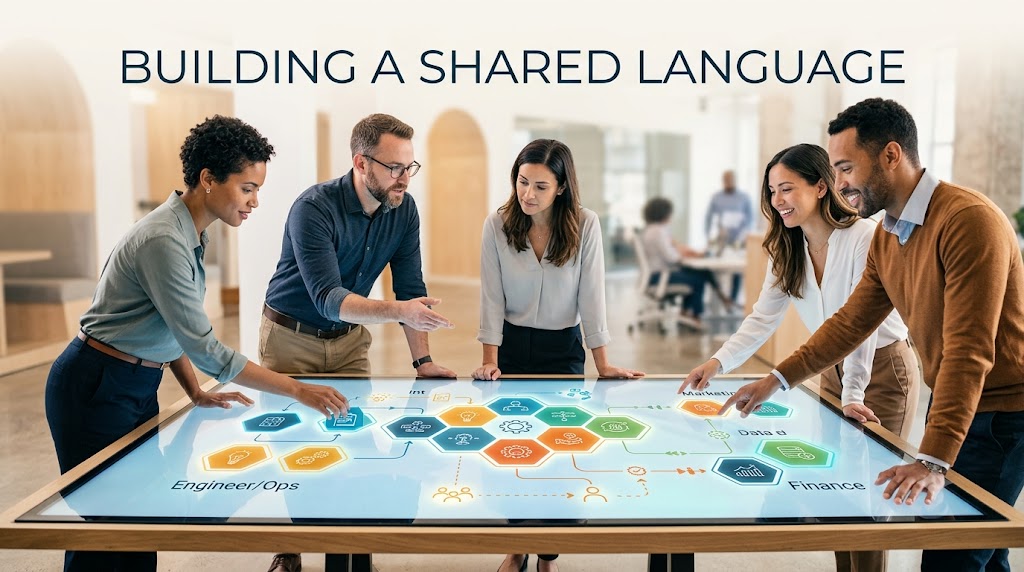
A visual anchor is far more than a decorative graphic or an infographic summarizing a project. It is an interactive, structured visual framework—such as a canvas, ecosystem map, or experience blueprint—designed to serve as a shared working space. By externalizing complex ideas onto a visible surface, visual anchors provide a consistent point of reference that keeps cross-functional teams grounded in the same reality throughout the lifecycle of an initiative.

The Science of Visual Processing

The human brain processes visual information significantly faster than dense text. Visual anchors leverage spatial reasoning and pattern recognition, allowing stakeholders to grasp system architecture, dependencies, and customer journeys at a glance. More importantly, this shared visual surface creates psychological safety: when a team member critiques a box, sticky note, or arrow on a canvas, they are challenging an externalized idea rather than attacking a person or a department’s territorial agenda.

Neutral Ground for Collaboration

Standard documents often carry implicit power dynamics—a slide deck built by Finance carries a distinct bias toward cost control, while a document from Product leans heavily into features. A visual anchor acts as neutral territory. By shifting collective ownership from “my department’s document” to “our shared canvas,” it democratizes participation and ensures every function—from engineering and operations to design and executive leadership—has an equal voice in shaping the outcome.

The Mechanics of Alignment Through Visual Anchors

Alignment is not a passive state achieved at the end of a kickoff meeting; it is an active, iterative process of shared sense-making. Visual anchors provide the necessary scaffolding for this process by transforming abstract strategic intent into tangible, navigable structures that stakeholders can collectively stress-test, refine, and own.

Externalizing Ambiguity and Complexity

When strategic goals remain purely verbal, ambiguity hides behind familiar buzzwords. A visual anchor forces implicit assumptions out into the open. By placing components, workflows, and objectives onto a structured canvas, cross-functional teams can immediately identify gaps, conflicting priorities, and unaddressed risks. Visualizing the system makes the invisible friction points visible, turning vague debate into precise problem-solving.

Standardizing a Shared Vocabulary

Different functional teams naturally speak different professional dialects—Finance focuses on ROI and risk mitigation, Engineering on feasibility and technical debt, Design on user friction, and Marketing on positioning. Visual anchors establish a unified semantic foundation. By anchoring key concepts, touchpoints, and success metrics to specific visual elements, the framework establishes a consistent vocabulary that translates priorities across department lines.

Mapping Hidden Dependencies

Complex organizational change invariably triggers ripple effects across operations, technology, and customer touchpoints. Visual frameworks map these interdependencies in real time. Revealing how a change in backend architecture impacts customer experience—or how a shifting business model alters operational capacity—enables teams to spot bottlenecks early, align timelines, and build holistic solutions that account for the entire organizational ecosystem.

Designing and Deploying Visual Anchors for Change

The true value of a visual anchor lies not in the final design of the artifact, but in the collaborative process of populating and refining it. Deploying visual tools is an act of change leadership; it requires deliberate facilitation that moves teams away from passive consumption and into active co-creation.

Co-Creation Over Mandate

Visual anchors are ineffective when delivered as finished top-down directives. When executive leadership hands down a completed canvas, it reproduces the same passive resistance as a traditional memo. True alignment happens during the workshop—when cross-functional stakeholders physically or digitally place sticky notes, debate placement, and co-author the content. Co-creation builds psychological ownership, transforming stakeholders from passive recipients into active champions of the strategy.

Grounding the Anchor in Human Experience

To prevent visual tools from becoming abstract exercises, they must be anchored in authentic human experience. Whether mapping a digital transformation or an organizational restructuring, the framework should explicitly link strategic decisions to both customer experience (CX) touchpoints and employee experience (EX) realities. Keeping the human impact visible ensures that operational efficiency never comes at the expense of end-user value or workforce engagement.

Scaling from Workshop Whiteboards to Daily Governance

A visual anchor must not remain trapped in a workshop Miro board or pinned to a conference room wall. To drive sustained organizational change, visual frameworks must be integrated into operational cadences, project management artifacts, and executive review rhythms. By using the visual anchor as a live dashboard for ongoing governance, leaders maintain strategic alignment, monitor shifting dependencies, and continuously orient cross-functional teams around a shared visual truth.

Future-Proofing Corporate Alignment

As organizations face accelerating market shifts and technological disruption, the methods we use to build alignment must also evolve. Static strategies locked in rigid documentation are no longer sufficient. Future-ready leadership requires dynamic, visual systems that keep cross-functional teams resilient, adaptable, and aligned in real time.

Spatial Computing and AI-Augmented Collaboration

The next frontier of visual anchoring moves beyond two-dimensional whiteboards into spatial computing and artificial intelligence. Generative AI tools and spatial whiteboards will dynamically surface hidden dependencies, automatically organize stakeholder input, and simulate scenario outcomes on the fly. These advanced visual environments will allow cross-functional teams to interact with complex organizational ecosystems, stress-testing strategies in immersive environments before committing capital and resources.

From Static Roadmaps to Dynamic Ecosystem Maps

Traditional multi-year transformation roadmaps often become obsolete the moment market conditions change. Forward-looking organizations are shifting toward continuous change readiness powered by dynamic visual ecosystem maps. By maintaining a living visual model of customer experience, technology infrastructure, and operational capabilities, leaders can quickly communicate pivot points, reallocate resources, and keep diverse stakeholders aligned through continuous waves of change.

Conclusion: The Visual Canvas of Future Leadership

Innovation, organizational transformation, and experience design ultimately depend on human alignment. When diverse corporate stakeholders operate from fragmented mental models, even the most brilliant strategies collapse under the weight of miscommunication and friction. Visual anchors bridge this divide, replacing functional silos and text-heavy ambiguity with a shared visual surface where clarity and co-creation can thrive.

Bridging Vision and Execution

By democratizing collaboration, externalizing complex ideas, and establishing a unified semantic foundation, visual anchors convert disparate departmental priorities into a cohesive collective narrative. They allow leaders to move beyond the illusion of agreement, transforming passive consent into deep, shared commitment across engineering, design, operations, and executive leadership.

A Call to Action for Change Leaders

Stop relying solely on words, endless slide decks, and dense reports to drive complex strategic initiatives. Give your cross-functional teams a shared visual canvas—one that humanizes change, makes dependencies visible, and empowers every stakeholder to help build the future together.

Frequently Asked Questions

What is a visual anchor in corporate change management?

A visual anchor is an interactive, structured visual framework—such as a canvas, ecosystem map, or experience blueprint—designed to give cross-functional teams a shared surface to collaborate. Unlike static slide decks, visual anchors externalize complex ideas, align vocabulary, and make strategic dependencies visible to prevent miscommunication.

How do visual anchors help cross-functional alignment?

Visual anchors create a neutral, shared space that removes functional bias between departments like engineering, design, finance, and leadership. By leveraging visual processing and spatial reasoning, they lower cognitive friction, allow teams to critique ideas rather than people, and build psychological ownership through active co-creation.

How should visual anchors be integrated into daily operations?

To be effective, visual anchors must move beyond workshop sessions into regular governance and execution. Teams should use them as live dashboards during project reviews, strategic check-ins, and ongoing decision-making, keeping cross-functional priorities aligned as market conditions evolve.


Bottom line: Futurists are not fortune tellers. They use a formal approach to achieve their outcomes, but a methodology and tools like those in FutureHacking™ can empower anyone to be their own futurist.

Image credit: Gemini

Subscribe to Human-Centered Change & Innovation WeeklySign up here to get Human-Centered Change & Innovation Weekly delivered to your inbox every week.