Author Archives: Robyn Bolton

About Robyn Bolton

Robyn M. Bolton is the founder and chief navigator of MileZero, a consultancy that helps leaders use innovation to confidently and consistently grow revenue. She is also an assistant professor at the Massachusetts College of Art and Design, where she teaches innovation and strategy courses. She is the author of "Unlocking Innovation: A Leader’s Guide for Turning Bold Ideas into Tangible Results." She previously worked at Innosight, the innovation and strategy firm founded by Clayton Christensen; the Boston Consulting Group; and Procter & Gamble, where she helped develop and launch Swiffer. Bolton holds an MBA from Harvard Business School and a BS in marketing from Miami University. If you are frustrated that your innovation efforts are not producing results, she offers a free one-sheet with 5 Ways to Get Rapid Results from Innovation at www.MileZero.io

Three Maps to Innovation Success

3 Maps to Innovation Success

GUEST POST from Robyn Bolton

Several years ago, my now-husband and I were in London. It was his first time in the city but my 4th or 5th so, naturally, I talked a big game about how well I knew the city and how I would be, with the help of our handy tourist map, our tour guide.

Things were going fine until I took the wrong road leading away from Buckingham Palace. I thought we were heading straight to Parliament. We were not. 

After a walk that lasted far longer than it should have, he nervously asked,” We’re lost, aren’t we?”

With wounded pride and astounding stubbornness, I declared, “We’re not lost. I know exactly where we are. It’s just not where we want to be.”

Maps are incredibly useful. Until they’re not.

Innovation literature has more maps than a Rick Steves’ guidebook, and most are quite useful. If they’re used at the right time for the right purposes in the right way by the right people (which is a lot of rights that have to be right).

Here are three of my favorites – 2 classics and a new one that blew my mind

Stakeholder Map:

Stakeholder Map

Avoid getting blind-sided, buttering up the wrong people, or ignoring potential champions

  • What it is: A visual representation of the people, roles, and groups who (1) are involved in and affected by a challenge or system and (2) have the power to affect or are likely to be affected by the proposed solution. Stakeholders can be internal and/or external to the organization
  • Why you need one: To prioritize where and how you spend your time understanding, influencing, communicating, collaborating, persuading, and selling
  • When to create it: At the very beginning of a project and then updating as you learn more
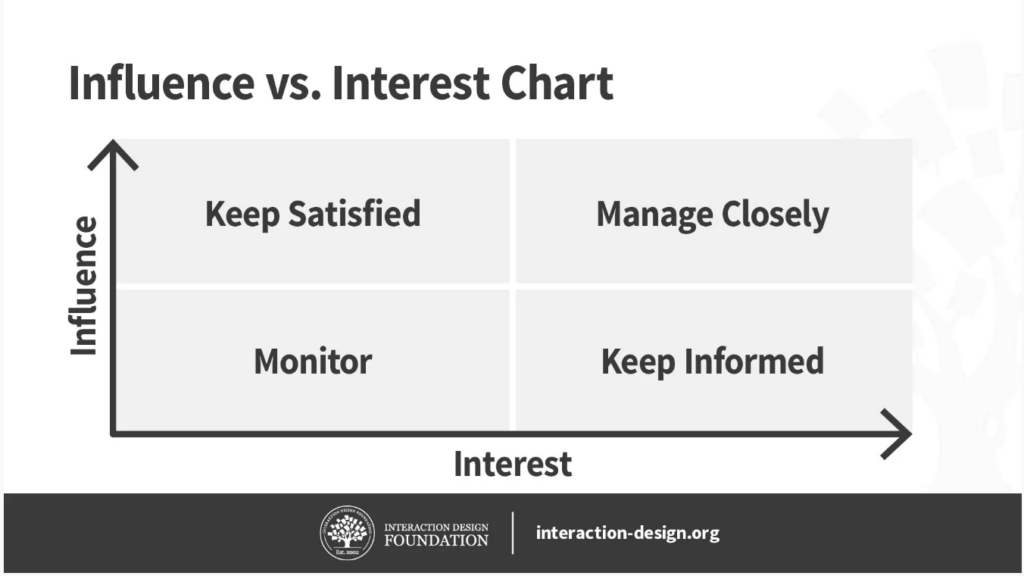
  • How to use it: Interaction Design Foundation explains it simply and concretely:
    • Brainstorm who your internal AND external stakeholders are
    • Prioritize them using an Influence x Interest two-by-two matrix
    • Engage and communicate based on their place in the chart

Journey Map

Customer Journey Map

Spot opportunities to create radical value through incremental innovations

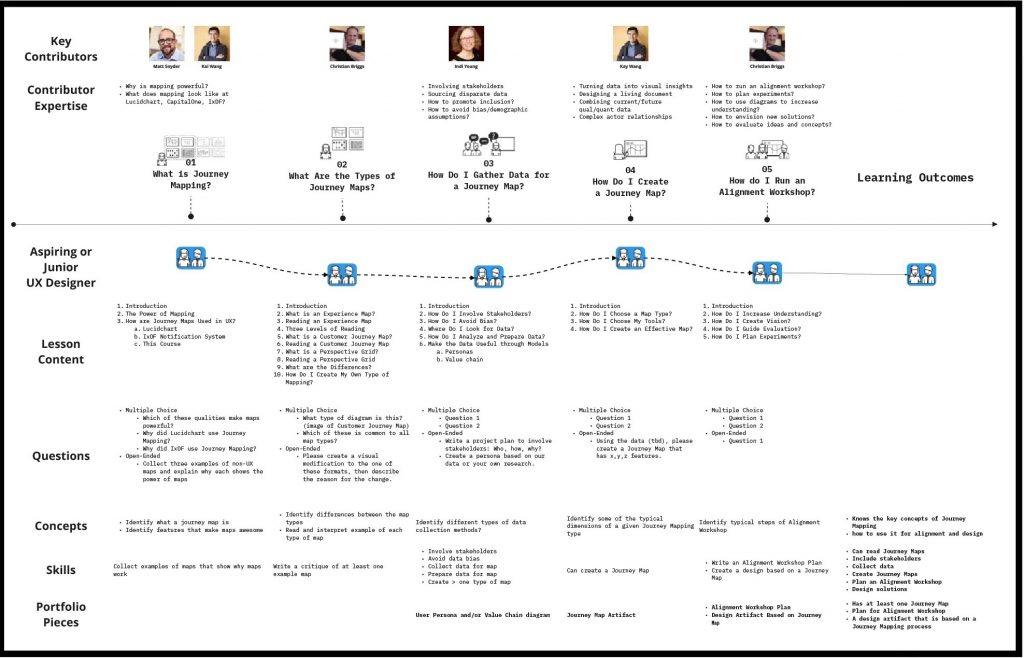
  • What it is: A visual representation of what your customer/consumer/user does, thinks, and feels as they move from awareness of a need/want/JTBD to loyalty to a solution. Journey maps should dig deep into moments where customers currently interact with your organization and highlight opportunities where interaction can and should occur
  • Why you need one: To identify opportunities for innovation by surfacing customer current pain points between your customer and your business (or competitors if your business isn’t there and can/should be)
  • When to create it:
    • Create the basic structure (start and end point) or a hypothesized journey before primary research.
    • During research, work with individual stakeholders to develop their maps using (and adapting) your initial structure.
    • At the end of research and before ideation, synthesize insights into the smallest possible number of maps to use as inspiration for solution brainstorming
  • How to use it: IDEO offers simple instructions and tips based on practical use:
    • Brainstorm who your internal AND external stakeholders are
    • Prioritize them using an Influence x Interest two-by-two matrix
    • Engage and communicate based on their place in the chart

Service Map:

Service Design Blueprint

Make journey maps actionable (and see how your innovation affects your operations)

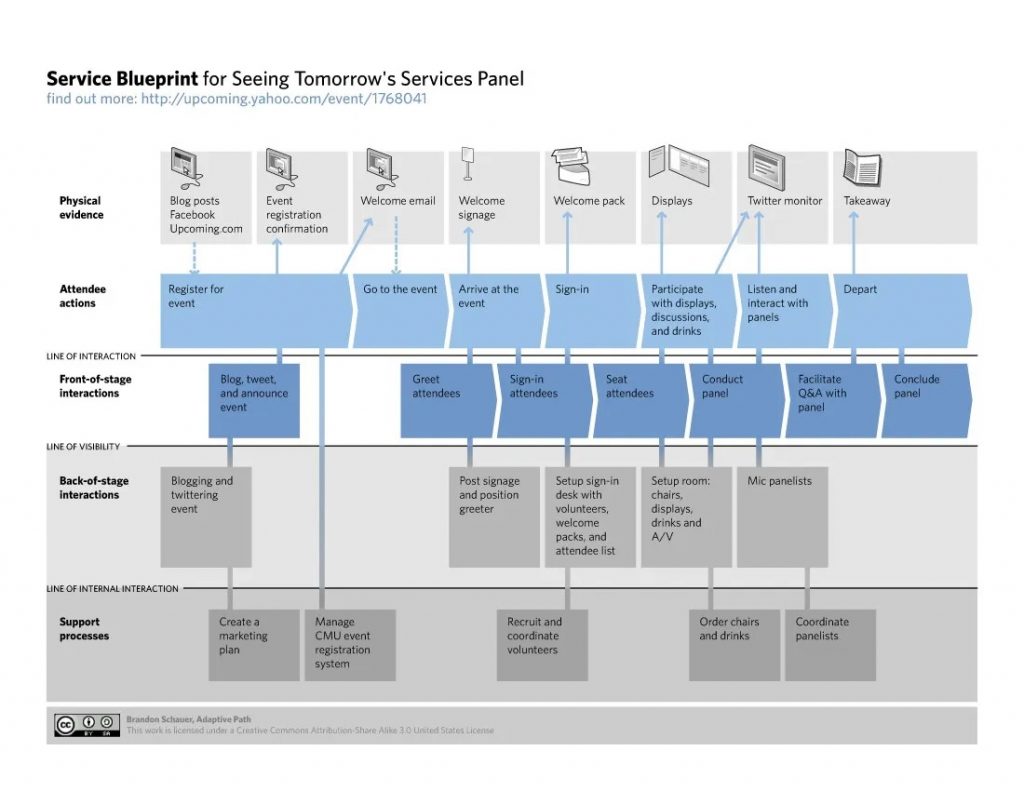
  • What it is: A visual representation of the people, touchpoints, processes, and technology required/desired both frontstage (what customers see) and backstage (what happens behind the scenes). Similar to process documentation with a special focus on the customer
  • Why you need one: Doing something new (i.e., innovating) often requires changes to internal operations, organizations, and processes, but these changes are often ignored or unexplored until late in the process, potentially slowing or stopping the development and launch of a new solution.
  • When to create it: Draft a baseline current state once you have 50% confidence in the general area or type of solution to be created (e.g., we want to improve the use of digital tools in classrooms, so let’s create a service map for our current digital offerings and operations). Then continually revise and update it as the solution/service develops.
  • How to use it: Interaction Design Foundation offers practical instructions and advice.
    • Identify the service to be blueprinted
    • Identify the customers to be service
    • Examine the customers’ experience of the process (customer journey map)
    • Identify the role and impact of employees, processes, technology, and other operational and organizational factors on the service
    • Link activities together to show a natural flow between frontstage and backstage

What’s your favorite map (innovation or otherwise)?

Image credits: Pixabay, Interaction Design Foundation

Subscribe to Human-Centered Change & Innovation WeeklySign up here to join 17,000+ leaders getting Human-Centered Change & Innovation Weekly delivered to their inbox every week.

Leaders Avoid Doing This One Thing

Leaders Avoid Doing This One Thing

GUEST POST from Robyn Bolton


Being a leader isn’t easy. You must BE accountable, compassionate, confident, curious, empathetic, focused, service-driven, and many other things. You must DO many things, including build relationships, communicate clearly, constantly learn, create accountability, develop people, inspire hope and trust, provide stability, and think critically. But if you’re not doing this one thing, none of the other things matter.

Show up.

It seems obvious, but you’ll be surprised how many “leaders” struggle with this. 

Especially when they’re tasked with managing both operations and innovation.

It’s easy to show up to lead operations.

When you have experience and confidence, know likely cause and effect, and can predict with relative certainty what will happen next, it’s easy to show up. You’re less likely to be wrong, which means you face less risk to your reputation, current role, and career prospects.

When it’s time to be a leader in the core business, you don’t think twice about showing up. It’s your job. If you don’t, the business, your career, and your reputation suffer. So, you show up, make decisions, and lead the team out of the unexpected.

It’s hard to show up to lead innovation.

When you are doing something new, facing more unknowns than knowns, and can’t guarantee an outcome, let alone success, showing up is scary. No one will blame you if you’re not there because you’re focused on the core business and its known risks and rewards. If you “lead from the back” (i.e., abdicate your responsibility to lead), you can claim that the team, your peers, or the company are not ready to do what it takes.

When it’s time to be a leader in innovation, there is always something in the core business that is more urgent, more important, and more demanding of your time and attention. Innovation may be your job, but the company rewards you for delivering the core business, so of course, you think twice.

Show up anyway

There’s a reason people use the term “incubation” to describe the early days of the innovation process. To incubate means to “cause or aid the development of” but that’s the 2nd definition. The 1st definition is “to sit on so as to hatch by the warmth of the body.”

You can’t incubate if you don’t show up.

Show up to the meeting or call, even if something else feels more urgent. Nine times out of ten, it can wait half an hour. If it can’t, reschedule the meeting to the next day (or the first day after the crisis) and tell your team why. Don’t say, “I don’t have time,” own your choice and explain, “This isn’t a priority at the moment because….”

Show up when the team is actively learning and learn along with them. Attend a customer interview, join the read-out at the end of an ideation session, and observe people using your (or competitive) solutions. Ask questions, engage in experiments, and welcome the experiences that will inform your decisions.

Show up when people question what the innovation team is doing and why. Especially when they complain that those resources could be put to better use in the core business. Explain that the innovation resources are investments in the company’s future, paving the way for success in an industry and market that is changing faster than ever.

You can’t lead if you don’t show up.

Early in my career, a boss said, “A leader without followers is just a person wandering lost.” Your followers can’t follow you if they can’t find you.

After all, “80% of success is showing up.”

Image credit: Pixabay

Subscribe to Human-Centered Change & Innovation WeeklySign up here to join 17,000+ leaders getting Human-Centered Change & Innovation Weekly delivered to their inbox every week.

Turn Cynics into Believers in Three Simple Steps

Turn Cynics into Believers in Three Simple Steps

GUEST POST from Robyn Bolton

You are a leader, an innovator, and an optimist. You see what’s possible, and you sell people on your vision, encouraging them to come on the journey of discovery with you. You’re making progress, getting things done until *WHAM* you run right into that one person. You know who I’m talking about.

Dr. No.

Sometimes you see them coming because they’re from Legal, Regulatory, Finance, or another function that has the reputation of being a perpetual killjoy.

Sometimes you hear them coming:

  • “Why are we doing this? Don’t we have enough to do?”
  • “We tried this in 19XX. It didn’t work then, and it won’t work now.”
  • “I don’t have time for this. I have real work to do.”

Sometimes they sneak up on you, privately supporting your efforts only to undermine your efforts publicly.

But they’re always there. Waiting for the opportunity to not just rain on your parade but to unleash a category 5 Hurricane of obstacles, barriers, and flat-out refusals on your innovation efforts.

This is precisely why Dr. No is among the first people to invite to the parade.

Why You Need to Say Yes to Dr. No

Let’s be honest, no one wants to do this. At best, Dr. No’s negativity and smug predictions of inevitable failure are downers, dampening and discouraging the culture of questioning, experimentation, and learning you’re trying to create. At worst, it can feel like working with a saboteur hell-bent on doing the “I told You So” dance atop the ruins of your innovation team.

But just like eating your vegetables, you need to do it because it will make you and your innovation efforts healthier, stronger, and more likely to live longer.

How to Say Yes to Dr. No

Step 1: Be Human. Together.

As with many things in life, the first step is changing how you think and behave. Naturally, you have feelings, perceptions, and even predictions about Dr. No and their likely behavior. Set them aside. Not because they’re incorrect but because you can’t move forward if you’re standing in a hole.

So, start with what you have in common – Dr. No is a human being, just like you.

Like other human beings, Dr. No needs to feel connected and accepted. When they don’t feel connected and accepted, they will feel defensive and under attack and respond by taking steps to protect themselves and their jobs. But when they connect and feel accepted, you have the foundation for psychological safety

To establish a connection and foster a feeling of acceptance, try:

  • Acknowledging the importance of the job they’re doing and its impact on the business
  • Asking questions to understand better how they think and what they prioritize
  • Building a rapport by sharing some of your aspirations and concerns and asking about theirs

Step 2: Invite Them on the Journey

People love what they create. It’s the only way to explain why people have outsized attachments to IKEA furniture, distorted art projects, and failed products. 

Invite Dr. No to be part of the creation process. Don’t tell them they’re part of it, that’s the business version of kidnapping, and no one likes being kidnapped. 

Instead, express your desire for them to be involved because you value their perspective. Ask them how and when they want to be involved. Share how you want them to be involved. Then work together to find a solution that works for both of you. Stay open to experimenting and changing how and when involvement happens. Make this a learning process for both of you as you work to do what’s best for the business.

Step 3: Stay curious

One of the most valuable lessons from Ted Lasso (and not Walt Whitman) is the importance of being curious, not judgmental.

As you do the work of innovation, there will be times when Dr. No lives up (or down) to their name. No matter how much time you invested in your relationship, how much psychological safety you built, or how involved they were in the process, they will still say No.

If you are judgmental, that No is the end of the conversation. If you’re curious, it’s the start.

So, get curious and ask,

  • What causes you to say that? (probe on what they see, think, and feel)
  • Have you seen something like this before? What was the context? What happened?
  • What do you need to see to say Yes?

Engage them in solving the problem with you rather than defending themselves against you.

Can Dr. No become Dr. Yes?

Maybe.

I’ve seen it happen, even to the point that Dr. No became the team’s loudest champion.

I’ve also seen it not happen. But even then, the No is less harsh, devastating, and final.

You won’t know until you try. Certainly, you won’t say no to that.

Image credit: Pexels

Subscribe to Human-Centered Change & Innovation WeeklySign up here to join 17,000+ leaders getting Human-Centered Change & Innovation Weekly delivered to their inbox every week.

3 Ways to Make Smarter Decisions – Confidently

3 Ways to Make Smarter Decisions - Confidently

GUEST POST from Robyn Bolton

When my niece was 4 years old, she looked at her mom (my sister) and said, “I can’t wait until I’m an adult so I can be in charge and make all the decisions.”  My sister laughed and laughed.

Being in charge looks glamorous from the outside, but it is challenging, painful, and sometimes soul-wrenching. Never is this truer than when you must make a tough decision and don’t have all the data you want or need. 

But lately, I’ve noticed more and more executives defer making decisions. They’ll say they want more data, to hear what another executive thinks, or are nervous that we’re rushing to decide. 

This deferral is a HUGE problem because making decisions is literally their job! After all, as Norman Schwarzkopf wrote in his autobiography, “When placed in command, take charge.” 

When you decide, you lose

decision is “a choice that you make about something after thinking about several possibilities.”  Seems innocent enough, right? Coke or Pepsi. Paper or plastic. Ariana Madix or Raquel Leviss (if you don’t know about this one, consider yourself lucky. If you choose to know about it, click here).

The problem with making decisions is that loss is unavoidable. Heck, the word “decide” comes from the Latin roots “de,” meaning off, and “caedre,” meaning cut. When you choose Coke, paper bags, or Ariana, you are cutting off the opportunity to drink Pepsi with that meal, use a plastic bag to carry your purchases or support Rachel in a pointless pop culture debate.

Decisions get more challenging as the stakes get higher because the fear of loss skyrockets. Loss aversion, a cognitive bias describing why the psychological pain of loss is twice as acute as the pleasure of gain, is common in cognitive psychology, decision theory, and behavioral economics. You see this bias in action when someone refuses to ask questions or challenge the status quo, to take a good deal because it’s below their initial baseline, or to sell an asset (like a house) for less than they paid for it. 

No decision is the worst decision

Deciding not to decide is often the worst decision of all. Because it feels like you’re avoiding loss and increasing your odds of making the right decision by gathering more data and input, it’s easy to forget that you’re losing time, employee engagement and morale, and potential revenue and profit.

When you decide not to decide, progress slows or even stops. No decision gives your competition time to catch up or even pass you. Your team gets frustrated, morale drops, and people search for other opportunities to progress and have an impact. The date of the first revenue slips further into the future, slowly becoming just a theoretical number in a spreadsheet.

Decide how to decide

In a VUCA world, a perfect, risk-free decision that offers only upside does not exist. If it did, the business wouldn’t need an executive with your experience, intellect, and courage. Yet here you are. 

It’s your job to make decisions.

Make that job easier by deciding how to decide

1. Tell people what you need to see to say Yes. “I’ll know it when I see it” is one of the biggest management cop-outs ever. If you don’t know what you want, don’t waste money and time requiring your team to become mind readers. But you probably know what you want. You’re just afraid of being wrong. Instead of allowing your fear to fuel inefficiency, tell the team what you need or want to see and that, as they make progress, that request might change. Then set regular check-ins so that if/when it happens, it happens quickly and is communicated clearly.

2. Break big decisions down into little decisions. I once worked with a team that had an idea for a new product. They planned to pitch to the executive committee and request 3 million dollars to develop and launch the idea. After some coaxing, we decided to avoid that disaster and brainstormed everything that needed to be true to make the idea work. We devised a plan to test the three assumptions that, if we were wrong, would instantly kill the idea. When we pitched to the executive committee, we received an immediate Yes.

3. Present options and implications. As anyone with a toddler knows, you don’t ask yes or no questions. You give them options – do you want to wear the yellow or pink shirt? If they pick something else, like their Batman costume, you explain the implications of that decision and why the options previously presented are better. Sometimes they pick the yellow shirt. Sometimes they pick the Batman costume. You could force them to make the right decision, but no one wins. (Yes, I just compared managers to toddlers. Prove me wrong).

It’s your decision

Being in charge requires making decisions. When you decide, you lose the option (maybe temporarily, maybe forever) to pursue a different path. But you can’t be afraid to do it.

After all, “Sometimes you win, sometimes you lose, sometimes it rains.”

Image credit: Pixabay

Subscribe to Human-Centered Change & Innovation WeeklySign up here to join 17,000+ leaders getting Human-Centered Change & Innovation Weekly delivered to their inbox every week.

Are You an Innovation Leader or Manager?

Are You an Innovation Leader or Manager?

GUEST POST from Robyn Bolton

“Leader” is a word that gets thrown around A LOT.

Senior Management Teams are now Senior Leadership Teams.

Business schools no longer train managers. They “educate leaders.”

Training programs for specific skills are now “Leadership Development Programs”

If “innovation” is a buzzword (and it is), then “leadership” is the grand poo-bah of buzzwords.

Let’s get one thing straight.

“Leadership,” as it is commonly used, is the “extra-ordinarization of the mundane.”

But it’s not meant to be.

If you are a leader, you use your personal qualities and behaviors to influence and inspire others to follow you because they choose to (not because the org chart requires them to). Any person, anywhere in the org chart, can be a leader because leadership has nothing to do with your position, responsibilities, or resources.

If you are a manager, executive, or senior executive, you have positional power, usually earned. These terms put you in a particular place in the org chart, define your scope of responsibility, and set guardrails around the human and financial resources you control.

There is nothing wrong with being a manager (or executive or senior executive). Those positions are earned through hard work and steady results. They are titles to aspire to, be proud of, and use in a professional setting.

But if you run around telling people you’re a leader, well, to misquote Margaret Thatcher, “Being a leader is like being a lady. If you have to tell people you are, you aren’t.”

Are you a leader?

There are thousands of books on leadership, millions of articles, and hundreds of experts. I am not a leadership expert, but I know a leader when I meet one. The same is true for the people around you. 

What do we see that helps us know whether or not you are a leader?

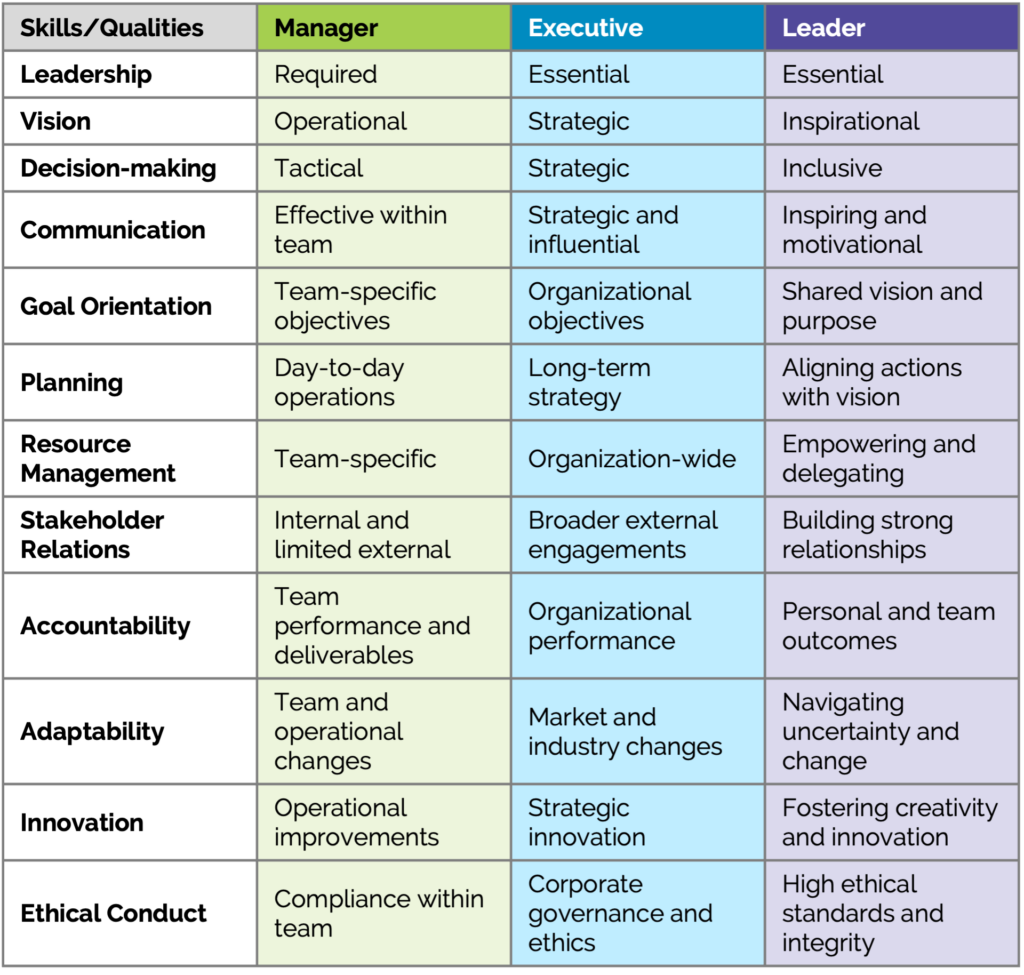
If the dozen articles I skimmed for this post are any indication, everyone has their own list, but there are some common items. To find the most frequently mentioned, I asked ChatGPT to list the qualities and behavior distinguishing leaders from managers and executives. 

Here’s what I got:

Here are my reactions:

  1. Uh, ok. This leadership list feels like what an executive should do, but I guess the difference between the two (executives focus on strategy, and leaders inspire and connect) proves my point (which is a bit discouraging)
  2. It feels like some leadership qualities are missing (e.g., empathy, fostering psychological safety, inspiring trust)
  3. Kinda surprised to see other leadership qualities (do you need to “foster creativity and innovation” to be a leader?)

That 3rd thought led to a fourth – if “fostering creativity and innovation” is a quality shared amongst all leaders, then is there a difference between business, operational, and innovation leaders?

Are you an innovation leader?

I’ve worked for and with leaders, and I can say with absolute confidence that while each of them was a great leader, few were great leaders of innovation.

Why? What made them great leaders in business and operations but not in innovation?

Do you even need to be good at leading innovation if you’re good at managing it?

What does it even mean to be an “innovation leader?”

What do you think?

Off the top of my head, qualities specific to innovation leaders are:

  1. Patient for revenue, impatient for learning and insights
  2. Oriented to action, not evaluation (judging)
  3. Curious and questioning, not arrogant and answering

What am I missing (because I know I’m missing a lot)?

What characteristics have you experienced with innovation leaders that make them unique from other types of leaders?

Subscribe to Human-Centered Change & Innovation WeeklySign up here to join 17,000+ leaders getting Human-Centered Change & Innovation Weekly delivered to their inbox every week.

Why You Must Define Innovation

(Hint: It’s All About Efficiency)

Why You Must Define Innovation

GUEST POST from Robyn Bolton

As the world around you becomes more volatile, uncertain, complex, and ambiguous (VUCA), you know that you need to build skills to navigate it and inspire others to follow your path.

But what if you are the source of ambiguity? 

Because you are. Every time you speak.

The words we use always have clear meaning and intent to us but may not (and often don’t) have the same meaning and intent to others. 

That’s why one of the first and most essential things a company can do when starting its innovation journey is to decide what “innovation” means. It may seem like an academic exercise, but it becomes very practical when you discover that one person thinks it means something new to the world, another thinks it’s a new product, and a third thinks it means anything commercialized.

Ambiguity = Efficiency?

“Innovation” isn’t the only word that is distractingly ambiguous. Language, in general, evolved to be ambiguous because ambiguity makes it more efficient. In 2012, cognitive scientists at MIT found the ambiguity–efficiency link, noting “words with fewer syllables and easier pronunciation can be ‘reused,’ avoiding the need for a vast and increasingly complex vocabulary.” 

You read that right. In language, ambiguity leads to efficiency.

Every time you speak, you’re ambiguous. You’re also efficient.

The RIGHT level of Ambiguity = Efficiency!

In 2014, researchers at Pompeu Fabra University in Barcelona found that language’s ambiguity is critical to communicating complex ideas,

“the researchers argue that the level of ambiguity we have in language is at just the right level to make it easy to speak and be understood. If every single object and concept had its own unique word, then language is completely unambiguous – but the vocabulary is huge. The listener doesn’t have to do any guessing about what the speaker is saying, but the speaker has to say a lot. For example, “Come here” might have to be something like “I want you to come to where I am standing.” At the other extreme, if the same word is used for everything, that makes it easy for the speaker, but the listener can’t tell if she is being told about the weather or a rampaging bear.”

.

Either way, communication is hard. But Sole and Seoane argue that with just the right amount of ambiguity, the two can find a good trade-off.”

A certain level of ambiguity is efficient. Too much or too little is inefficient.

How to find the RIGHT level of Ambiguity for “Innovation”

In everyday life, it’s ok for everyone to have a slightly different definition of innovation because we all generally agree it means “something new.”  Sure, there will be differences of opinion on some things (is a new car an “innovation” if it just improved on the previous model?). Still, overall, we can exist in this world and interact with each other despite, or maybe because of, the ambiguity.

Work is a different story. If you are responsible for, working on, or even associated with innovation, you better be very clear on what “innovation” means because its definition determines expectations and success for what you do. If it means one thing to you and a different thing to your boss, and a third thing to her boss, you’re in for a world of disappointment and pain.

Let’s avoid that.  Instead:

  1. Define the word
  2. Get everyone to agree on the definition
  3. Use the word and immediately follow it with, “And by that, I mean (definition)”

Gently correct people when they use the word to mean something other than the agreed-upon definition. Once everyone uses the word correctly, you can stop defining it every time because its meaning has taken root.

So, the next time someone rolls their eyes and comments on the “theoretical” or “academic” (i.e., not at all practical, useful, or actionable) exercise of defining innovation, smile and explain that this is an exercise in efficiency.

Subscribe to Human-Centered Change & Innovation WeeklySign up here to join 17,000+ leaders getting Human-Centered Change & Innovation Weekly delivered to their inbox every week.

How to Make Navigating Ambiguity a Super Power

How to Make Navigating Ambiguity a Super Power

GUEST POST from Robyn Bolton

You are a leader. The boss. The person in charge.

That means you know the answer to every question, make the right decision when faced with every choice, and act confidently when others are uncertain. Right?

(Insert uproarious laughter here).

Of course not. But you act like you do because you’re the leader, the boss, the person in charge.

You are not alone. We’re all doing it.

We act like we have the answers because we’ve been told that’s what leaders do. We act like we made the right decision because that’s what leaders do in a volatile, uncertain, complex, and ambiguous (VUCA) world where we must work quickly and flexibly while doing more with less.

But what if we didn’t? 

What if we stopped pretending to have the answer or know the right choice? What if we acknowledged the ambiguity of a situation, explored its options and interpretations for just a short while, and then decided?

We’d make more informed choices. We’d be more creative and innovative. We’d inspire others.

So why do we keep pretending?

Ambiguity: Yea! Meh. Have you lost your mind?!?

Stanford’s d.School calls the ability to navigate ambiguity “the super ability” because it’s necessary for problem-finding and problem-solving. Ambiguity “involves recognizing and stewing in the discomfort of not knowing, leveraging and embracing parallel possibilities, and resolving or emerging from ambiguity as needed.”

Navigating ambiguity is essential in a VUCA world, but not all want to. They found that people tend to do one of three things when faced with ambiguity:

  • Endure ambiguity as “a moment of time that comes before a solution and is antagonistic to the objective – it must be conquered to reach the goal.”
  • Engage ambiguity as “an off-road adventure; an alternate path to a goal. It might be rewarding and helpful or dangerous and detrimental. Its value is a chosen gamble. Exhilaration and exhaustion are equally expected.”
  • Embrace ambiguity as “oceanic and ever-present. Exploration is a challenge and an opportunity. The longer you spend in it, the more likely you are to discover something new. Every direction is a possibility. Navigation isn’t simple. It requires practice and patience.

Students tend to enter the program with a resignation that ambiguity must be endured. They leave embracing it because they learn how to navigate it.

You can too.

In fact, as a leader in a VUCA world, you and your team need to.

How to Embrace (or at least Engage) Ambiguity

When you want to learn something new, the library is one of the best places to start. In this case, the Library of Ambiguity  – an incredible collection of the resources, tools, and activities that professors at Stanford’s d.School use to help their students build this super ability.

It’s easy to get overwhelmed by the number of resources, so here are three that I recommend:

Design Project Scoping Guide

  • What it is: A guide for selecting, framing, and communicating the intentions of a design project
  • When to use it: When you are defining an innovation project and need to align on scope, goals, and priorities
  • Why I like it: The guide offers excellent examples of helpful and unhelpful scoping documents.

Learning Zone Reflection Tool

  • What it is: A tool to help individuals better understand the tolerance of ambiguity, especially their comfort, learning, and panic zones
  • When to use it: Stanford used this as a reflection tool at the end of an introductory course, BUT I would use it at the start of the project as a leadership alignment and team-building tool:
    • Leadership alignment – Ask individual decision-makers to identify their comfort, learning, and panic zones for each element of the Project Scoping Guide (problem to be solved, target customer, context, goals, and priorities), then synthesize the results. As a group, highlight areas of agreement and resolve areas of difference.
    • Team-building – At the start of the project, ask individual team members to complete the worksheet as it applies to both the project scope and the process. Individuals share their worksheets and, as a group, identify areas of shared comfort and develop ways to help each other through areas of learning or panic.
  • Why I like it: Very similar to the Project Playground concept I use with project teams to define the scope and set constraints, it can be used individually to build empathy and support amongst team members.

Team Dashboards

  • What it is: A tool to build trust and confidence amongst a team working through an ambiguous effort
  • When to use it: At regular pre-defined intervals during a project (e.g., every team check-in, at the end of each Sprint, once a month)
  • What I like about it:
    • Individuals complete it BEFORE the meeting, so the session focuses on discussing the dashboard, not completing it
    • The dashboard focuses on the usual business things (progress against responsibilities, the biggest challenge, next steps) and the “softer” elements that tend to have the most significant impact on team experience and productivity (mood, biggest accomplishment, team balance between talking and doing)

Learn It. Do It.

The world isn’t going to get simpler, clearer, or slower. It’s on you as a leader to learn how to deal with it. When to slow it down and explore and when to speed it up and act. No one is born knowing. We all learn along the way. The Library will help. No ambiguity about that!

Image credit: Pexels

Subscribe to Human-Centered Change & Innovation WeeklySign up here to join 17,000+ leaders getting Human-Centered Change & Innovation Weekly delivered to their inbox every week.

Are You Creative or Reactive?

Are You Creative or Reactive?

GUEST POST from Robyn Bolton

Creative and reactive both contain the same letters.

Different order.

Very different results.

These are strange times.

A relentless stream of news and updates are coming at us, warning us about COVID-19, a declining stock market, rising unemployment, and the financial crunch facing millions and millions of individuals and families.

On the other hand, we’re also getting daily notifications from companies about what they’re doing in the face of all of this news, tips for working from home and maintaining our mental health, and encouragement to support our friends, families, neighbors, and strangers in new ways.

Should we be scared or stoic? Isolated or connected? Hoarding or sharing?

Whatever you choose (and it is your choice), I encourage you to also be creative.

I’m not talking about being creative in the capital C way and take up painting, sculpting, composing, or any of the other activities we typically associate with the fine arts.

I’m talking about calmly assessing your situation, clearly acknowledging the constraints that are requiring change, and then exploring the “new normal” you can create.

This is what innovators do and you, yes YOU, are an innovator.

Innovators know that creativity thrives within constraints. If anything is possible and everything is permissible, you can do whatever you want! But that’s not how the world is. Not now and not before COVID-19.

We, people and businesses, have always faced constraints because we’ve never had infinite resources, money, or time. But we acknowledged the constraints and created within them. That’s what we have to do now.

Here’s some inspiration from the business world:

1. Devil’s Food Catering: From event caterer to consortium offering takeout meals

Caterers have to order food well before events take place so when events are cancelled, caterers are left with a lot of food that they’ve already paid for and without the event income that was going to cover their costs.

Devil’s Food Catering in Portland OR faced exactly this situation. Instead of letting the food go to waste or trying to become a take-out shop on their own, they created Handbasket by teaming with other with other Portland area restaurants, breweries, distilleries, bakeries, and other providers to create “handmade menus for quality in-home dining experiences during this of social distancing.”

2. Gyms, Fitness Studios, and Personal Trainers: From in-person to on-line communities

Some people are gifted with the motivation to workout and some of us, well… aren’t.

In-person classes and personal training are often the solutions we rely on because we feel a sense of connection with our instructors, trainers, and classmates. As gyms close and social distancing becomes a way of life, the loss of live workouts can deepen our sense of isolation.

Recognizing this, local gyms, studios, and personal trainers in cities across the country are offering livestream classes so that we can continue to feel connected AND healthy AND active from the comfort of our own homes.

p.s. the link above is for the Boston area but I found similar articles for Philly, Washington, Houston, and even Wyoming

3. Speakers Who Dare: From Broadway event to Livestream to Movie

Spears Who Dare bills itself as TED meets Broadway, “a groundbreaking speaker series produced like a Broadway show, featuring speakers from around the world who want to ignite change and inspire new ways of thinking.”

Scheduled to take place on March 24, the organizers recognized that, like many other live events, their original plans for a live Broadway event needed to change. Last week, they shifted from live to livestream, planning a 6-camera shoot of each speaker and performer sharing their messages and art in an empty theater.

Then NYC closed the theaters. Within hours the organizers shifted again and asked each speaker to record a “mini-movie” that could be edited together to create “a full-blown Speakers Who Dare Film” to be shared with a global audience, viewing together on the original event date.

How and what will YOU create today?

Just in case you need a nudge … find the perfect gif starring the perfect celebrity expressing the perfect emotion and send it to someone who needs it.

Subscribe to Human-Centered Change & Innovation WeeklySign up here to join 17,000+ leaders getting Human-Centered Change & Innovation Weekly delivered to their inbox every week.


10 Military Innovation Moments

GUEST POST from Robyn Bolton

Innovation is something different that creates value. Sometimes it’s big, new to the world, world-changing things. Sometimes it’s a slight tweak to make things easier, faster, cheaper or better.

Sometimes, it’s both.

It’s no secret that the military and NASA are birthplaces of incredible inventions (something new) and innovations (something different that creates value). Most people know that Velcro, nylon, and powdered drinks (Tang!) originated at Nasa, and that Jeep, GPS, and the internet come to us from the military.

But did you know that these 10 everyday innovations have their origin in the military?

1. Duct Tape

Invented in 1942 to seal ammo boxes with something that could resist water and dirt while also being fast and easy to remove so soldiers could quickly access ammunition when they needed it. Originally, it was made by applying a rubber-based adhesive to duck cloth, a plain and tightly woven cotton fabric, and has evolved over the years to be used for everything from repairing equipment on the moon to purses.

2. Synthetic Rubber Tires

Speaking of rubber, prior to WWII, most rubber was harvested from trees in South America and shipped to southern Asia where the majority of rubber products were produced. When the Axis powers cut-off access to Asia, the US military turned to Firestone, Goodyear, and Standard Oil to create a replacement substance. The recipe they created is still used today.

3. Silly Putty

Image Credit: thestrong.org

Like most inventions, there were a lot of failed experiments before the right synthetic rubber recipe was found. Silly Putty is the result of one of those experiments. A scientist at GE developed the strange substance but quickly shelved it after it became clear that it had no useful military application. Years later, GER execs started showing off the novelty item at cocktail parties, an advertising exec in attendance saw its commercial potential and bought the manufacturing rights, packaged it into eggs and sold it as a toy. 350 million eggs later, we’re still playing with it.

4. Superglue

The result of another failed experiment, Superglue came onto the market in 1958 and has stuck around ever since (sorry, that pun was intended). Military scientists were testing materials to use as clear plastic rifle sights and created an incredibly durable but impossibly sticky substance called cyanoacrylate. Nine years later it was being sold commercially as Superglue and eventually did make its way into military use during the Vietnam War as a way to immediately stop bleeding from wounds.

5. Feminine Hygiene Pads

Image Credit: Museum of American History

Before Superglue was used to stop bleeding, bandages woven with cellulose were used on the battlefields and hospitals. Seeing how effective the bandages were at holding blood and the convenience of having so many on hand, US and British WW1 nurses began using them as sanitary napkins and bandage makers adapted and expanded their post-War product lines to accommodate.

6. Undershirts

Image Credit: Foto-ianniello/Getty Images

While people have been wearing undergarments for centuries, the undershirt as we know it — a t-shaped, cotton, crewneck — didn’t come into being until the early twentieth century. Manufactured and sold by the Cooper Underwear Co., it caught the Navy’s eye as a more convenient and practical option than the current button-up shirts. In 1905, it became part of the official Navy uniform and the origin of the term “crewneck.”

7. Aerosol Big Spray

Image Credit: National WWII Museum

Soldiers fighting in the Pacific theater of WWII had a lot to worry about, so they were eager to cross mosquitos and malaria off that list. In response, the Department of Defense teamed up with the Department of Agriculture to find a way to deliver insecticide as a fine mist. The first aerosol “bug bomb” was patented in 1941 and, thanks to the development of a cheaper plastic aerosol valve, became commercially available to civilians in 1949.

8. Canned Food

Image Credit: Pacific Paratrooper — WordPress.com

While it’s not surprising that canned foods were originally created for the military, it may surprise you to learn that it was Napoleon’s armies that first used the concept. In response to the French Government’s offer of a large cash reward for anyone who could find a way to preserve large quantities of food, an inventor discovered that food cooked inside a jar wouldn’t spoil unless the seal leaked, or the container was broken. But glass jars are heavy and fragile, so innovation continued until WW1 when metal cans replaced the glass jars.

9. Microwave

RadaRange on the Nuclear Ship NS Savannah

This is another one that you probably would have guessed has its origins in the military but may be surprised by its actual origin story. The term “microwave” refers to an adaptation of radar technology that creates electromagnetic waves on a tiny scale and passes those micro-waves through food, vibrating it, and heating it quickly. The original microwaves made their debut in 1946 on ships but it took another 20 years to get the small and affordable enough to be commercially viable.

10. Wristwatches

Image Credit: Hodinkee

Watches first appeared on the scene in the 15th century but they didn’t become reliable or accurate until the late 1700s. However, up until the early 20th century, wristwatches were primarily worn as jewelry by women and men used pocket watches. During its military campaigns in the late 1880s, the British Army began using wristwatches as a way to synchronize maneuvers without alerting the enemy to their plans. And the rest, as they say, is history.


So, there you have it. 10 everyday innovations brought to us civilians by the military. Some, like synthetic rubber, started as intentional inventions (something new) and quickly became innovations (something new that creates value). Some, like superglue and silly putty, are “failed” experiments that became innovations. And some, like undershorts and feminine products, are pure innovations (value-creating adaptations of pre-existing products to serve different users and users).

Sources: USA TodayPocket-lint.com, and Mic.com

Subscribe to Human-Centered Change & Innovation WeeklySign up here to join 17,000+ leaders getting Human-Centered Change & Innovation Weekly delivered to their inbox every week.

Want to Innovate like Google?

Be Careful What You Wish For

Want to Innovate like Google?

GUEST POST from Robyn Bolton

A few weeks ago, a Google researcher leaked an internal document asserting that Google (and open AI) will lose the AI “arms race” to Open Source AI.

I’ll be honest: I didn’t understand much of the tech speak – LLM, LLaMA, RLHF, and LoRA are just letters to me. But I understood why the memo’s writer believed that Google was about to lose out on a promising new technology to a non-traditional competitor.

They’re the same reasons EVERY large established company loses to startups.

Congratulations, big, established industry incumbents, you’re finally innovating like Google!

(Please note the heavy dose of sarcasm intended).

Innovation at Google Today

The document’s author lists several reasons why “the gap is closing astonishingly quickly” in terms of Google’s edge in AI, including:

  1. “Retraining models from scratch is the hard path” – the tendency to want to re-use (re-train) old models because of all the time and effort spent building them, rather than start from scratch using newer and more flexible tools
  2. “Large models aren’t more capable in the long run if we can iterate faster on small models” – the tendency to want to test on a grand scale, believing the results are more reliable than small tests and drive rapid improvements.
  3. “Directly competing with open source is a losing proposition” – most people aren’t willing to pay for perfect when “good enough” is free.
  4. “We need them more than they need us” – When talent leaves, they take knowledge and experience with them. Sometimes the competitors you don’t see coming.
  5. “Individuals are not constrained by licenses to the same degree as corporations” – Different customers operate by different rules, and you need to adjust and reflect that.
  6. “Being your own customer means you understand the use case” – There’s a huge difference between designing a solution because it’s your job and designing it because you are in pain and need a solution.

What it sounds like at other companies

Even the statements above are a bit tech industry-centric, so let me translate them into industry-agnostic phrases, all of which have been said in actual client engagements.

  1. Just use what we have. We already paid to make it.
  2. Lots of little experiments will take too long, and the dataset is too small to be trusted. Just test everything all at once in a test market, like Canada or Belgium.
  3. We make the best . If customers aren’t willing to pay for it because they don’t understand how good it is, they’re idiots.
  4. It’s a three-person startup. Why are we wasting time talking about them?
  5. Aren’t we supposed to move fast and test cheaply? Just throw it in Google Translate, and we’ll be done.
  6. Urban Millennials are entitled and want a reward. They’ll love this! (60-year-old Midwesterner)

How You (and Google) can get back to the Innovative Old Days

The remedy isn’t rocket (or computer) science. You’ve probably heard (and even advocated for) some of the practices that help you avoid the above mistakes:

  1. Call out the “sunk cost fallacy,” clarify priorities, and be transparent about trade-offs. Even if minimizing costs is the highest priority, is it worth it at the expense of good or even accurate data?
  2. Define what you need to learn before you decide how to learn it. Apply the scientific method to the business by stating your hypothesis and determining multiple ways to prove or disprove it. Once that’s done, ask decision-makers what they need to see to agree with the test’s result (the burden of proof you need to meet).
  3. Talk. To. Your. Customers. Don’t run a survey. Don’t hire a research firm. Stand up from your desk, walk out of your office, go to your customers, and ask them open-ended questions (Why, how, when, what). 
  4. Constantly scan the horizon and seek out the small players. Sure, most of them won’t be anything to worry about, but some will be on to something. Pay attention to them.
  5. See #3
  6. See #3

Big companies don’t struggle with innovation because the leaders aren’t innovative (Google’s founders are still at the helm), the employees aren’t smart (Google’s engineers are amongst the smartest in the world), or the industry is stagnating (the Tech industry has been accused of a lot, but never that).

Big companies struggle to innovate because operating requires incredible time, money, and energy. Adding innovation, something utterly different, to the mix feels impossible. But employees and execs know it’s essential. So they try to make innovation easier by using the tools, processes, and practices they already have. 

It makes sense. 

Until you wake up and realize you’re Google.

Image credit: Unsplash

Subscribe to Human-Centered Change & Innovation WeeklySign up here to join 17,000+ leaders getting Human-Centered Change & Innovation Weekly delivered to their inbox every week.