Author Archives: Chateau G Pato

About Chateau G Pato

Chateau G Pato is a senior futurist at Inteligencia Ltd. She is passionate about content creation and thinks about it as more science than art. Chateau travels the world at the speed of light, over mountains and under oceans. Her favorite numbers are one and zero. Content Authenticity Statement: If it wasn't clear, any articles under Chateau's byline have been written by OpenAI Playground or Gemini using Braden Kelley and public content as inspiration.

Developing Design Thinking Skills Through Experiential Learning

Developing Design Thinking Skills Through Experiential Learning

GUEST POST from Chateau G Pato

Design thinking is an innovative problem-solving approach that emphasizes looking for creative solutions to complex problems. It encourages people to rethink the way they view an issue, break it down into smaller components, and then come up with solutions that could be developed through experimentation and collective learning. It is an important skill to have in all areas of life, from business to education and beyond.

Fortunately, experiential learning is one of the best ways to develop design thinking skills. This hands-on learning strategy gives participants the opportunity to gain knowledge and skills through direct experience in a range of contexts. Through this approach, individuals can broaden their horizons while engaging in an environment of learning and creative problem solving.

Case Study #1 – StarDesign

StarDesign is an industry leading tech company that utilizes experiential learning to develop design thinking skills in its employees. The company regularly puts its staff members in various challenging situations and calmly encourages them to look for creative solutions.

In one instance, a team of five was asked to develop one brand idea into five operational models for a new product launch. To foster creative thinking, the team was given the task to brainstorm a range of solutions that could be implemented. Through the experience, each member gained an understanding of how design thinking can be utilized to create value and innovate in an ever-changing industry.

Case Study #2 – The Adopt A School Program

The Adopt A School Program is a nonprofit organization in California that is focused on educating and developing young minds. The organization has developed an experiential learning approach to build design thinking skills in fifth graders. Through the program, young students are put into various design thinking challenges that encourage them to search for creative solutions. The organization has also implemented group activities such as team building events and creative brainstorming sessions.

The Adopt A School Program has helped to build an innovative culture in the classrooms by encouraging students to take risks and think outside the box. Through this approach, students have developed a better understanding of “thinking outside the box” and have gained a unique perspective on problem solving.

Conclusion

Experiential learning is an invaluable tool for developing design thinking skills. Through hands-on applications, people can gain an understanding of the unique problem-solving method and apply it to their own life. By engaging in challenging situations, they can expand their horizon and innovate through creative problem solving.

Image credit: Pexels

Subscribe to Human-Centered Change & Innovation WeeklySign up here to get Human-Centered Change & Innovation Weekly delivered to your inbox every week.

The Operational Mechanics of Multi-Stakeholder Participatory Design

Co-Creating Value

The Operational Mechanics of Multi-Stakeholder Participatory Design

GUEST POST from Chateau G Pato


Beyond the Buzzword of Collaboration

For decades, the standard corporate playbook for innovation has relied on a fundamentally flawed premise: that a select group of experts can sit in an isolated room, design a brilliant solution for a target audience, and then hand it over to a change management team to force implementation. The results are entirely predictable — expensive rollouts, deep-seated organizational resistance, and solutions that fail to survive first contact with real-world complexity. The reality is that top-down mandates are obsolete in a highly distributed, interconnected business ecosystem.

To build truly resilient systems, we must shift from designing for people to designing with them. Multi-stakeholder participatory design is not a feel-good, consensus-driven exercise; it is a rigorous operational strategy. By actively pulling frontline employees, cross-functional partners, compliance teams, and end customers directly into the creation engine, organizations can systematically de-risk innovation, accelerate change adoption, and expose critical blind spots before a single dollar is spent on scaling.

The Core Challenge: Everyone enthusiastically champions the concept of co-creation, but very few organizations actually build the operational infrastructure required to manage conflicting agendas, uneven power dynamics, and the messy data that collaborative design inevitably generates.

Moving from accidental collaboration to intentional co-creation requires more than enthusiasm — it requires a deliberate mechanics of engagement. This article breaks down the structural blueprint needed to transform participatory design from a messy workshop into a scalable, high-yield organizational capability.

I. Alignment & Architecture: Setting the Co-Creation Stage

You cannot launch a successful participatory design initiative on a whim. Without a deliberate architectural foundation, inviting multiple stakeholder groups into the same room quickly devolves into a chaotic airing of grievances or a hollow exercise in design theater. Before the first workshop or collaborative session is designed, you must intentionally map the human ecosystem and establish the rules of engagement.

Mapping the Complete Stakeholder Ecosystem

The most common failure point in collaborative design is myopic stakeholder selection. Teams usually invite the obvious subjects — the external customers and the direct product managers — while completely ignoring the broader internal ecosystem. True multi-stakeholder design requires mapping every group touched by the solution’s lifecycle. This means systematically identifying and bringing in:

  • Frontline Workers: The individuals who will actually execute the processes daily and possess unmatched tribal knowledge of current systemic workarounds.
  • Cross-Functional Partners: Downstream teams (such as Operations, IT, and Customer Support) whose workflows will be altered by the new design.
  • Guardians of Governance: Risk, legal, and compliance teams who are traditionally brought in at the very end to audit (and often veto) finalized concepts. Bringing them in early transforms them from gatekeepers into co-designers.

Neutralizing the Power-Equity Matrix

In any corporate ecosystem, hierarchy casts a long shadow. If a Vice President and a customer service representative are placed in the same co-creation session without structural guardrails, the representative will naturally defer to the executive. The executive’s opinions will be amplified, and the frontline reality will remain hidden.

To capture authentic insight, you must operationally neutralize these power dynamics. This is achieved by designing blind contribution mechanisms, utilizing anonymous digital brainstorming tools, and establishing explicit protocols that evaluate ideas based on empirical merit and alignment to project goals rather than the corporate rank of the contributor. Equity in co-creation means ensuring every participant has an equal voice and an equal platform, regardless of their position on the organizational chart.

Defining Shared Value Outcomes Upfront

Multi-stakeholder design cannot rely on altruism; people must understand what is in it for them to sustain their energy and engagement throughout the messy innovation lifecycle. Organizations must run an alignment exercise at the kickoff stage to explicitly define and document what “value” looks like for each distinct group.

While the business might be looking for a 20% increase in operational efficiency, the frontline employee might be looking for a reduction in daily software fatigue, and the compliance team might be looking for built-in risk mitigation. Recognizing, validating, and designing for these parallel value streams ensures that the final output delivers mutual benefit, securing long-term buy-in and eliminating friction during the eventual rollout.

II. The Operational Toolkit: Mechanics of Engagement

Co-creation fails when it is treated as an unstructured social gathering. When you bring diverse stakeholder groups together without a rigorous operational framework, the loudest voice in the room dominates, and the output becomes superficial. To extract deep, actionable insights from a multi-stakeholder ecosystem, you must deploy a structured toolkit that guides human energy into productive creative channels.

Structured Over Unstructured Collaboration

Open-ended brainstorming — the classic “blank whiteboard and a pile of sticky notes” approach — is highly inefficient. It favors extroverts, lacks direction, and rarely surfaces systemic insights. Instead, participatory design requires highly structured visual frameworks and canvas-based mapping tools.

By forcing stakeholders to interact within defined visual constraints — such as mapping out an explicit customer experience journey layer-by-layer, or utilizing structured innovation canvases — you focus the conversation on specific friction points. Visual canvases act as a universal language that translates abstract ideas into tangible concepts, allowing a software engineer, a frontline customer service agent, and an executive to collaborate on equal footing.

Asynchronous vs. Synchronous Collaborative Rhythms

In a fast-paced corporate environment, demanding hours of synchronous, real-time workshop attendance from busy stakeholders creates scheduling friction and leads to burnout. High-yield co-creation relies on a choreographed cadence that balances live collaboration with independent, asynchronous contribution.

  • Asynchronous Contribution: Used for deep reflection, initial data gathering, individual ideation, and reviewing synthesized outputs. Stakeholders contribute on their own time using digital whiteboards, shared documentation, and collaborative feedback loops. This ensures introverted or analytical thinkers have the time to formulate high-quality inputs.
  • Synchronous Co-Creation: Reserved strictly for high-leverage activities that require real-time human connection — such as debating critical trade-offs, building consensus, and running live prototyping simulations. These live sessions are kept tight, fast, and intensely focused because the groundwork was already laid asynchronously.

The Role of the Facilitator-Architect

In this operational model, the facilitator is no longer a passive timekeeper or a neutral scribe scribbling on a flipchart. The facilitator must step into the role of a Facilitator-Architect.

The Facilitator-Architect is an active translator and synthesizer. They must possess the business acumen to spot the hidden connective tissue between a complaint from a frontline worker and a strategic goal from a VP. Their job is to actively bridge communication gaps, challenge assumptions, and dynamically synthesize a messy sea of disparate inputs into cohesive, strategic insights that the organization can actually execute.

III. Managing the Messy Middle: Friction, Conflict, and Divergence

The middle phase of any participatory design initiative is inherently volatile. When you bring together diverse stakeholders with competing incentives, friction is not a possibility — it is a guarantee. The operational challenge is not to eliminate this friction, but to build the psychological and structural scaffolding necessary to harness it as a creative catalyst.

Embracing Productive Friction

Traditional corporate cultures treat conflict as an operational failure to be quickly suppressed or smoothed over with vague compromises. In participatory design, however, conflict is a rich source of raw data. When a compliance officer and a software developer clash over a feature, that tension exposes an underlying systemic truth about organizational risk and technical feasibility.

The goal is to channel this energy away from personal friction and toward productive, conceptual friction. By depersonalizing the debate and focusing purely on the systemic constraints or user needs being challenged, teams can use these moments of tension to unearth latent insights that a more harmonious, compliant group would completely miss.

The Convergence Engine

Allowing stakeholders to diverge and generate a wide pool of ideas is easy; bringing them back together into a single, actionable solution is where most collaborative efforts stall out. To prevent decision paralysis, organizations must deploy a transparent, objective “convergence engine.”

This engine relies on predefined operational mechanisms to filter, prioritize, and narrow down concepts without alienating the participants who proposed them. Rather than relying on arbitrary executive edicts, the group passes ideas through structured evaluation filters:

  • Impact/Effort and Value/Risk Matrices: Visually mapping ideas to separate high-yield quick wins from unrealistic passion projects.
  • Weighted Dot-Voting Protocols: Allowing stakeholders to vote based on specific criteria (e.g., impact on customer experience level measures) rather than personal preference.
  • Scenario Testing: Running rapid, hypothetical stress tests against real-world operational constraints to let unviable ideas filter themselves out empirically.

Psychological Safety as Operational Infrastructure

You cannot have genuine innovation without vulnerability, and you cannot have vulnerability without absolute psychological safety. If stakeholders fear that sharing a radical idea or pointing out a systemic flaw will negatively impact their career or standing, they will default to safe, generic platitudes.

Psychological safety is not an abstract culture goal; it must be built directly into the session’s rules of engagement. This requires implementing clear behavioral protocols from the outset: explicitly legalizing “constructive dissent,” enforcing equal turn-taking during discussions, celebrating the exposure of flaws during early prototyping, and establishing an environment where ideas are aggressively challenged, but the individuals who proposed them are deeply respected.

IV. From Co-Design to Co-Adoption: Driving Sustainable Change

The ultimate metric of success for any participatory design initiative is not the brilliance of the finalized concept — it is the velocity and sustainability of its actual adoption. Too many innovative designs die on the vine because the creation team hands the blueprints over to a traditional, top-down change management apparatus. By keeping the multi-stakeholder ecosystem actively engaged through the transition from strategy to execution, change ceases to be an event forced upon the organization and instead becomes an organic evolution.

Built-In Change Management and the “Not Invented Here” Antidote

One of the greatest inhibitors of corporate innovation is the “Not Invented Here” syndrome — the natural human tendency to resist, sabotage, or ignore solutions handed down by isolated corporate functions. When frontline staff, operational managers, and cross-functional teams feel that a new system is being imposed upon them from an ivory tower, resistance is inevitable.

Participatory design acts as a structural antidote to this resistance. Because these diverse stakeholders actively helped shape the solution, map the constraints, and design the workflows, they possess deep psychological ownership over the outcome. They are no longer the passive targets of a change management campaign; they are the architects of the solution. When it comes time to roll out the initiative, these participants naturally transform into grassroots champions, driving organic peer-to-peer adoption across their respective business units.

Feedback Loops and Continuous Prototyping

The co-creation process does not stop when the workshop ends or when the initial specification document is signed. To maintain momentum and preserve trust, organizations must establish transparent, continuous validation loops during the implementation phase.

As the design moves through active development and piloting, the core stakeholder group must be brought back in to interact with low-fidelity prototypes and early iterations. These feedback loops ensure that the original intent of the design isn’t lost in technical translation or diluted by engineering constraints. When stakeholders see their feedback actively molding the live product, their commitment to the final rollout intensifies.

Measuring Co-Created ROI: Balancing Hard and Soft Metrics

To justify the operational investment of multi-stakeholder design, organizations must move beyond traditional, lagging financial indicators and implement a holistic measurement framework. Evaluating the return on investment (ROI) of co-creation requires balancing hard operational metrics with human-centric Experience Level Measures (XLMs):

Measurement Category Specific Metrics Strategic Value
Hard Metrics
  • Adoption Velocity (Time to proficiency)
  • Post-launch rework and ticket volume
  • Project lifecycle acceleration
Proves the direct reduction of friction, wastage, and resistance during deployment.
Human-Centric Measures (XLMs)
  • Cross-functional trust index
  • Frontline software and process fatigue
  • Perceived psychological safety & empowerment
Quantifies the baseline lift in organizational innovation capability and long-term cultural resilience.

The True Value of Co-Creation: By capturing and optimizing for both hard operational efficiencies and soft human experience measures, leadership gains a rigorous, multi-dimensional view of how collaborative design directly de-risks execution and scales organizational capability.

Conclusion: The Future of Organization-Wide Innovation

The days of successful top-down corporate mandates are officially behind us. In a business landscape defined by hyper-complexity, rapid technological shifts, and distributed networks, no single executive or isolated group of experts possesses enough context to design flawless solutions from an ivory tower. Organizations that continue to rely on siloed, insular design processes will find themselves trapped in a costly cycle of high-resistance rollouts, expensive post-launch rework, and widespread employee fatigue.

The Futurist Outlook: Co-Creation as a Core Competency

As we look to the future of organizational design and business strategy, multi-stakeholder participatory design will quickly shift from an occasional, project-based luxury to an absolute baseline requirement. The most resilient and innovative companies of tomorrow will be those that institutionalize these collaborative mechanics — embedding them directly into their Experience Management Offices (XMOs) and standard operating procedures. Co-creation will become a permanent, scalable capability rather than a temporary workshop methodology.

By moving beyond the passive, feel-good buzzword of “collaboration” and implementing a rigorous operational infrastructure—one that maps entire human ecosystems, neutralizes corporate hierarchies with structured canvases, channels friction productively, and balances hard operational metrics with human-centric Experience Level Measures (XLMs) — organizations can tap into a massive well of latent intelligence.

The Strategic Imperative: The path forward requires a fundamental shift in leadership philosophy. To de-risk innovation and build an agile enterprise capable of thriving amidst continuous change, leaders must stop managing change from the top down and start co-creating value from the bottom up and inside out.

Frequently Asked Questions

1. How do you prevent dominant personalities or executives from taking over the co-creation process?

We use structured visual canvases, anonymous digital brainstorming tools, and strict contribution protocols rather than open-ended talking sessions. By focusing on empirical criteria (like impact on Experience Level Measures) and allowing blind submissions, we evaluate ideas based on their merit rather than the job title of the person who proposed them.

2. Doesn’t involving so many stakeholders slow down the initial design phase?

Yes, the initial alignment phase takes more deliberate planning. However, it drastically reduces the overall time-to-value. By identifying operational blockers, compliance issues, and user friction upfront, you avoid the massive, costly delays caused by post-launch rework, rollout resistance, and system rejection. You slow down to speed up.

3. What is the difference between traditional collaboration and participatory design?

Traditional collaboration often amounts to “design theater” — gathering people to give feedback on an already finished concept or asking them what they want in an unstructured brainstorm. Participatory design provides stakeholders with an operational toolkit to actively co-create the structural mechanics, workflows, and solutions alongside the design team from day one.

Put This Into Practice With the Change Planning Toolkit™

The frameworks in this article are part of the Human-Centered Change™ methodology — a visual, collaborative system of 70+ tools built around the Change Planning Canvas™. 26 of the tools come with every copy of Charting Change.

Image credit: Gemini

Subscribe to Human-Centered Change & Innovation WeeklySign up here to get Human-Centered Change & Innovation Weekly delivered to your inbox every week.

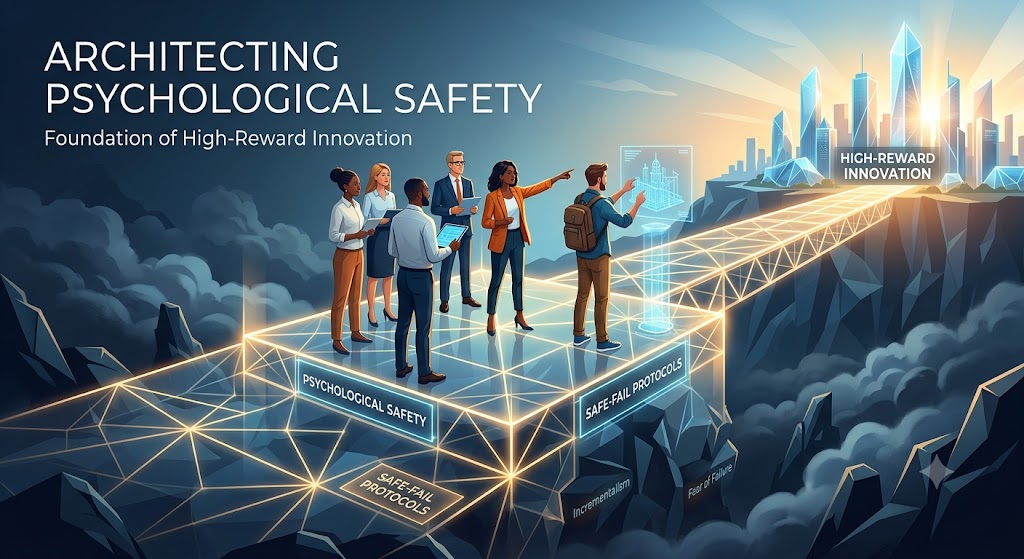
Architecting Psychological Safety

The Foundation of High-Risk, High-Reward Innovation

Architecting Psychological Safety

GUEST POST from Chateau G Pato


Organizations everywhere are demanding moonshots. Leaders stand on stages decreeing that their teams need to think bigger, disrupt industries, and embrace radical change. Yet, behind the scenes, an unspoken friction paralyzes the pipeline. We ask our people to leap across a chasm of high-risk, high-reward innovation, but we build our corporate infrastructure out of concrete and sharp edges. When they look down, all they see is the penalty for falling.

This is the core paradox of modern business: we crave breakthrough outcomes, but we unconsciously design environments that incentivize incremental safety. True innovation requires people to step into extreme ambiguity, challenge legacy assumptions, and risk public failure. If the human experience of that journey is defined by fear—fear of career stagnation, social friction, or executive blowback—people will naturally default to the path of least resistance. They will deliver optimized versions of yesterday’s ideas.

“Psychological safety is not about creating a soft, consequence-free comfort zone where everyone is polite. It is about architecting a high-performance environment where intellectual friction is intentional, and social friction is actively minimized.”

To unlock continuous, game-changing innovation, we must treat psychological safety not as a vague HR initiative, but as a deliberate architectural requirement. Innovation isn’t just a game of generating ideas; it is the discipline of managing the human experience of change. We don’t need braver employees; we need leaders who design ecosystems where bravery isn’t a prerequisite for speaking the truth.

I. The Human-Centered Architecture of Safety

To design an ecosystem where high-risk innovation thrives, we must view the organization through the lens of experience design. Culture is not an accident; it is the sum of every experience an employee has with a system, a process, or a leader. If we map the typical Innovator’s Journey, we quickly uncover the emotional toll of pushing boundaries.

Think about the exact touchpoints when a team member chooses to voice an unconventional idea, challenge a legacy operational model, or admit that a highly funded pilot is failing. In a poorly designed ecosystem, these moments are fraught with anxiety. The innovator must mentally calculate the social cost: “Will I look foolish? Will my manager see this as a distraction? Am I risking my next promotion?” When the perceived tax on vulnerability is too high, great insights are silenced long before they reach an innovation dashboard.

Designing the “Vulnerability Window”

Architecting safety requires us to intentionally design physical, digital, and cultural spaces that act as a Vulnerability Window. These are structured zones—whether a collaborative workshop, a digital innovation pipeline, or a weekly strategy review—where the traditional corporate hierarchy is explicitly paused. By designing low-friction entry points for dissenting opinions, we lower the personal risk of participation, allowing the best ideas to rise to the surface based on merit rather than organizational politics.

Moving from Fear to Structured Curiosity

The final component of this architecture is transforming how we react to the unexpected. When something goes wrong or an idea challenges the norm, the default corporate reflex is defensive. We must replace this fear response with a repeatable framework of structured curiosity.

Instead of demanding to know “Why didn’t you meet the legacy benchmark?”, human-centered leaders ask: “What did this experiment reveal about where the market is moving?” This simple shift in language reframes the entire human experience. It changes the narrative from an individual defending their value to a collaborative team uncovering a strategic signal.

II. Structural Mechanics: Building the Infrastructure for Risk

Cultural shifts mean very little if your organizational structure still punishes deviation from the norm. To turn psychological safety into a sustainable competitive advantage, we must back up our empathy with hard structural mechanics. Leadership cannot simply ask people to take bigger risks; we must build the operational infrastructure that makes risk-taking rational.

The “Safe Fail” Protocol

The first mechanical layer is the implementation of an explicit Safe Fail Protocol. High-risk exploration cannot survive if it is measured by the same rigid operational KPIs used to judge mature, predictable business lines. We must design isolated sandbox environments—both financial and operational—where teams have a mandate to push boundaries. Within these sandboxes, a “failed” experiment is not a compliance breach; it is a successful extraction of market data. By drawing clear, transparent boundaries around where experimentation lives, we protect the core business while freeing innovators from the paralyzing fear of accidental operational fallout.

Redefining Accountability

True psychological safety doesn’t eliminate accountability; it clarifies it. When a high-risk project misses its commercial target, the legacy corporate mechanism searches for a throat to choke. A human-centered innovation architecture pivots the question entirely. We shift the post-mortem from “Who blundered?” to “What did our design or system allow us to discover, and how quickly can we integrate that signal?” Accountability shifts away from guaranteeing a predictable outcome and moves toward guaranteeing rigorous experimentation, velocity of learning, and transparent communication.

The Portfolio Approach to Safety

Just as we balance risk across a product portfolio, leadership must apply a portfolio mindset to psychological safety itself. Different tiers of innovation require different degrees of environmental insulation.

Innovation Tier Risk Level Required Safety Infrastructure
Incremental (Core) Low Standard continuous improvement loops; low structural insulation needed.
Adjacent (Growth) Moderate Cross-functional autonomy; ring-fenced budgets to protect exploration from operational cuts.
Transformational (Moonshots) High Complete Safe Fail Protocols; direct executive air cover; decoupled from standard corporate KPIs.

By aligning your structural safety mechanics with the specific risk profile of the work, you ensure that radical thinkers have the heavy-duty air cover they need to explore the future, while routine optimizations remain crisp, efficient, and accountable.

III. Overcoming the Change Friction

Every time an organization attempts to install psychological safety, the existing corporate ecosystem fights back. This isn’t due to malice; it is the natural resistance of a system designed for predictability. When you introduce the ambiguity required for high-risk innovation, you trigger the organization’s cultural antibodies. To successfully navigate this transition, we must apply deliberate change management mechanics to dissolve this friction before it stalls our progress.

Neutralizing Cultural Antibodies

Cultural antibodies rarely attack out in the open. Instead, they manifest as passive-aggressive alignment, slow-rolling approvals, or the classic weaponization of process: “That’s a fascinating idea, but it doesn’t align with our current compliance framework.” These unspoken rules and systemic delays silently suffocate high-reward ideas before they ever have a chance to be validated. Human-centered leaders must actively hunt for these friction points, calling them out not as personal failures, but as structural barriers that need to be intentionally dismantled.

Empowering Middle Management

The heaviest friction in any transformation almost always concentrates in middle management. Frontline managers are caught in a brutal vice: executives demand radical innovation, yet their day-to-day compensation and performance reviews are tied to flawless operational predictability.

If a manager feels that championing a team member’s volatile, high-reward experiment puts their own career safety at risk, they will quietly kill it. We must equip middle management with specific tools and air cover—translating “risk” into the language of managed portfolios, and explicitly rewarding them for the velocity of insights their teams uncover, regardless of whether every experiment succeeds.

Co-Creating the Shift

The greatest irony of culture change is attempting to deploy psychological safety via a top-down executive mandate. You cannot force people to feel safe on command. True safety is built through Participatory Innovation—co-creating the new behavioral norms alongside the people who will actually live them.

By engaging teams to help define where the boundaries of the “Safe Fail” zones should sit, and inviting them to co-design the protocols for post-project learning, we replace resistance with active contribution. People do not resist change; they resist being changed. When they own the architecture of their own psychological safety, the cultural friction naturally begins to melt away.

Conclusion: The Ultimate Competitive Advantage

At its core, high-risk, high-reward innovation is not a technology problem, a capital problem, or an intellectual property problem. It is entirely a human problem. Algorithms can optimize what already exists, and capital can fund execution, but the cognitive leaps required to invent the future must be volunteered by people. They must come from human beings who feel secure enough to step away from the comfortable consensus and voice an unproven, volatile truth.

When organizations treat psychological safety as a soft, secondary culture metric, they are fundamentally misunderstanding the physics of change. Safety is the load-bearing infrastructure upon which all radical growth is built. Without it, your brilliant corporate strategies and expansive innovation budgets will only ever produce incremental optimizations—because your people will instinctively realize that the personal cost of a bold failure far outweighs the corporate reward of a breakthrough success.

The challenge for future-focused leaders is clear: stop standing at the front of the room asking your teams to be braver, more creative, or more disruptive. That places the burden of risk entirely on the individual. Instead, pivot your energy toward becoming an architect.

Intentionally design your experiences, structure your safe-fail mechanics, and co-create an ecosystem where bravery isn’t a prerequisite for speaking up. When you build a system where the truth is low-friction, high-reward innovation becomes the natural, inevitable output.

Frequently Asked Questions

1. Does psychological safety mean lowering performance standards?

Absolutely not. Psychological safety and high performance standards go hand in hand. It is not about creating a comfortable, consequence-free zone where accountability disappears. Instead, it is about creating an environment where intellectual friction is encouraged, allowing teams to ruthlessly critique ideas and take massive risks without fearing personal or social retaliation.

2. How do you prevent “Safe Fail” zones from draining corporate resources?

By strictly bounding them through fixed operational parameters, timeframes, and capital limits. A “Safe Fail” protocol is not a blank check for endless experimentation; it is a structured sandbox. The goal is to maximize the velocity of learning while capping the financial and operational blast radius, treating the investment as buying an option on future data.

3. What is the fastest way to identify cultural antibodies in our system?

Look closely at your friction points—specifically where projects stall, why ideas are modified to look more conventional, and how middle managers are compensated. When team members default to passive-aggressive alignment or use compliance frameworks as a shield to slow-roll unconventional ideas, your organizational antibodies are actively rejecting the risk.

Put This Into Practice With the Change Planning Toolkit™

The frameworks in this article are part of the Human-Centered Change™ methodology — a visual, collaborative system of 70+ tools built around the Change Planning Canvas™. 26 of the tools come with every copy of Charting Change.

Image credit: Gemini

Subscribe to Human-Centered Change & Innovation WeeklySign up here to get Human-Centered Change & Innovation Weekly delivered to your inbox every week.

Integrating Agile Evolution

Harmonizing Human-Centered Change with Traditional Frameworks

Integrating Agile Evolution

GUEST POST from Chateau G Pato


The Friction at the Frontier of Transformation

Organizations today find themselves caught in a structural tug-of-war. On one side stands the rigid certainty of traditional governance — monolithic Project Management Offices (PMOs), predictable Waterfall milestones, and the defensive posture of Six Sigma risk mitigation. On the other side is the fluid, fast-paced promise of Agile, demanding continuous adaptation, rapid-fire sprints, and decentralized decision-making.

Too often, leadership treats the transition between these two paradigms as a simple mechanical upgrade, expecting teams to shift their entire operating model at the flip of a switch. But process optimization invariably stalls when it fails to account for human dynamics. Forcing rigid frameworks to collide with agile methodologies without an intentional bridge doesn’t create velocity; it creates organizational whiplash, employee burnout, and resistance.

True organizational agility isn’t about recklessly discarding legacy structures, nor is it about blindly adopting a new set of rituals. Real transformation requires creating a harmonized ecosystem. By leveraging human-centered change and experience design ($HX$) as the connective tissue, leaders can bridge the gap between structure and flexibility — turning a chaotic cultural clash into a deliberate, sustainable evolution.

1. Deconstructing the Divide: Why Rigid Meets Agile Flops

The single greatest mistake an organization can make is treating Agile adoption as a static, milestone-driven project. When leadership applies a legacy, checkbox-oriented mindset to a philosophy built on continuous evolution, the transformation is doomed from the start. You cannot “schedule” the exact date a culture becomes adaptable, yet corporate roadmaps are routinely filled with arbitrary deadlines for when teams must magically achieve agility. This structural paradox creates immediate friction.

When employees are thrust into intensive sprint cadences, daily standups, and shifting backlogs without a corresponding evolution in leadership mindset, the human toll is severe. Without psychological safety, a daily standup stops being a collaborative sync and mutates into a micro-management interrogation. Instead of fostering autonomy, the pressure to deliver velocity points within rigid corporate silos triggers defensive behavior, leading directly to burnout and silent resistance.

Furthermore, traditional risk-aversion mechanics inherently stifle the experimental nature of an agile evolution. Agile requires a “fail-fast, learn-faster” environment, but legacy corporate governance is built to penalize variance and reward predictable uniformity. When the organizational immune system treats every minor experimental failure as a systemic threat, innovation is choked out. To harmonize these frameworks, we must first acknowledge that the bottleneck isn’t the software or the methodology — it is the friction between legacy control mechanisms and human adaptability.

2. The Human-Centered Change Architecture

Overcoming structural friction requires a fundamental shift in how we architect change. Traditional change management often treats people as passive targets of a rollout — silos to be managed through top-down mandates and static readiness checklists. A human-centered change approach flips this dynamic entirely, shifting the focus from managing resistance to actively designing for human experience.

This begins by mapping the change journey from the perspective of the people living it. By applying experience design (XD) principles, leaders can identify the hidden emotional and operational “friction points” that occur when legacy workflows collide with new agile cadences. It means asking where the cognitive overload happens, where old habits conflict with new expectations, and where the systemic gaps lie.

When we design the transition with empathy, communication ceases to be a series of broadcasted announcements and becomes an ongoing dialogue. Iterative feedback loops must be built into the transformation itself, mirroring the very agile principles we want teams to adopt. When employees see their input actively shaping the integration process, they cease to be subjects of a top-down mandate and instead become co-creators of a shared corporate evolution.

3. Strategies for Harmonization (The Integration Matrix)

Harmonizing the old with the new requires moving past ideological purity. The goal is not to force every corner of the enterprise into a dogmatic Agile mold, nor is it to let legacy bureaucracy paralyze innovation. Instead, leadership must intentionally architect a shared operating space where predictable governance and rapid experimentation reinforce one another.

This orchestration depends entirely on building bilingual leadership capability. Leaders and middle management must be systematically upskilled to translate metrics across the organizational divide. They need to confidently articulate how iterative value velocity at the team level directly de-risks capital expenditure and stabilizes long-term return on investment (ROI) for traditional executives.

To operationalize this, forward-thinking organizations are deploying hybrid governance models. By designing a structure of “Gated Agility” or “Fluid Waterfall,” the enterprise can maintain necessary macroscopic checkpoints — such as annual budgeting, compliance boundaries, and legal reviews — while leaving the internal execution layers entirely free to iterate, test, and pivot.

Finally, this harmonization cannot be achieved via a monolithic, one-size-fits-all rollout. It demands a modular change toolkit. Rather than forcing a uniform process onto vastly different business units, change leaders must provide a scalable menu of adaptable change tools and experience measures. This allows a core legal team to maintain their essential structured workflows, while an adjacent digital product team maximizes their experimental velocity, both operating seamlessly under the same organizational roof.

4. Sustaining the Evolution: From Doing Agile to Being Agile

Achieving initial integration is only half the battle; the true challenge lies in sustaining it. Too many organizations fall into the trap of merely “doing” Agile — mechanically going through the motions of standups and retrospectives — without ever shifting their core cultural foundations. To transition into truly “being” Agile, leadership must intentionally cultivate a continuous learning culture. This requires fundamentally rewiring the corporate reward system. If the enterprise continues to incentivize individuals solely on static, “on-time” delivery milestones, teams will naturally default to risk-averse, rigid behaviors, effectively poisoning the agile ecosystem.

Sustained evolution demands that we change what we measure. Traditional, lagging business metrics must be counterbalanced with forward-looking, human-centric agility indicators. Rather than obsessing exclusively over feature throughput or velocity points, organizations must track experience level measures (XLMs). By actively measuring team autonomy, psychological safety scores, and the cycle time from customer insight to value creation, leadership gains a realistic, human-centered view of organizational health and resilience.

Looking toward the horizon, this tight integration of human experience and adaptive systems becomes even more critical. As AI-driven workflows, generative automation, and decentralized networks rapidly reshape the corporate landscape, traditional structures will face unprecedented pressure. The future of work will not belong to the most rigid process, nor to the most chaotic startup. It will belong to the enterprises that have successfully built a fluid, human-centric muscle — where cutting-edge technology and flexible frameworks are continually guided by human intuition, empathy, and collective intelligence.

Conclusion: The Ultimate Competitive Advantage

When the dust settles on any corporate transformation, one reality remains clear: frameworks, methodologies, and tools are entirely inert on their own. They are merely vehicles. The true engine of sustained organizational growth is, and always will be, a healthy, aligned, and human-centered culture. Attempting to force-fit Agile into an organization without redesigning the human experience is an exercise in diminishing returns.

In an era defined by continuous disruption and accelerating technological shifts, an organization’s ultimate competitive advantage is its Adaptability Quotient. By leveraging human-centered change as the strategic bridge between legacy stability and modern flexibility, leadership can build an enterprise that doesn’t fracture under pressure. Instead, it creates an environment where people are empowered to navigate uncertainty with confidence and purpose.

For change leaders, executive sponsors, and transformation architects, the mandate is clear. It is time to stop managing change as a temporary, painful disruption to be endured. We must begin designing change as a continuous, collaborative, and inclusive evolution — one that respects legacy foundations while boldly co-creating the future of work.

Frequently Asked Questions

Below are answers to the most common questions regarding the harmonization of agile and traditional frameworks, formatted for both human readers and search engine crawlers using structured JSON-LD data.

1. Why do traditional change management approaches fail during an Agile transformation?

Traditional change management treats transformation as a linear project with a fixed end date, forcing top-down compliance and milestone checkboxes. Agile is rooted in continuous evolution and decentralized autonomy. When you attempt to “schedule” adaptability without building psychological safety or addressing the human workflow friction, you create cultural resistance and organizational burnout rather than genuine agility.

2. How can a company maintain financial compliance while allowing teams to work in Agile sprints?

This is achieved through hybrid governance models like “Gated Agility” or “Fluid Waterfall.” The macroscopic layers of the business — such as annual budgeting, regulatory compliance, and legal frameworks — remain structured with predictable checkpoints. However, the internal execution layers are given the freedom to pivot, experiment, and deliver value iteratively within those defined compliance boundaries.

3. What should organizations measure instead of just tracking project milestones?

Organizations must balance lagging financial indicators with Experience Level Measures (XLMs) and human-centric agility metrics. Instead of solely monitoring feature throughput, leaders should measure team autonomy, psychological safety scores, customer-value cycle times, and how effectively iterative feedback loops are driving continuous improvement.


Put This Into Practice With the Change Planning Toolkit™

The frameworks in this article are part of the Human-Centered Change™ methodology — a visual, collaborative system of 70+ tools built around the Change Planning Canvas™. 26 of the tools come with every copy of Charting Change.

Image credit: Gemini

Subscribe to Human-Centered Change & Innovation WeeklySign up here to get Human-Centered Change & Innovation Weekly delivered to your inbox every week.

The Modern Luddite Movement

Anticipating the Cultural Backlash to AI Displacement

The Modern Luddite Movement

GUEST POST from Chateau G Pato


The Friction of Unmanaged Progress

For years, the technology sector has operated under a dangerous illusion: the myth of seamless adoption. The prevailing corporate narrative suggests that artificial intelligence will be universally welcomed, quietly absorbing friction and smoothly elevating the workforce. But this viewpoint ignores a fundamental law of human-centered change: when technology moves faster than human psychology can process, culture strikes back.

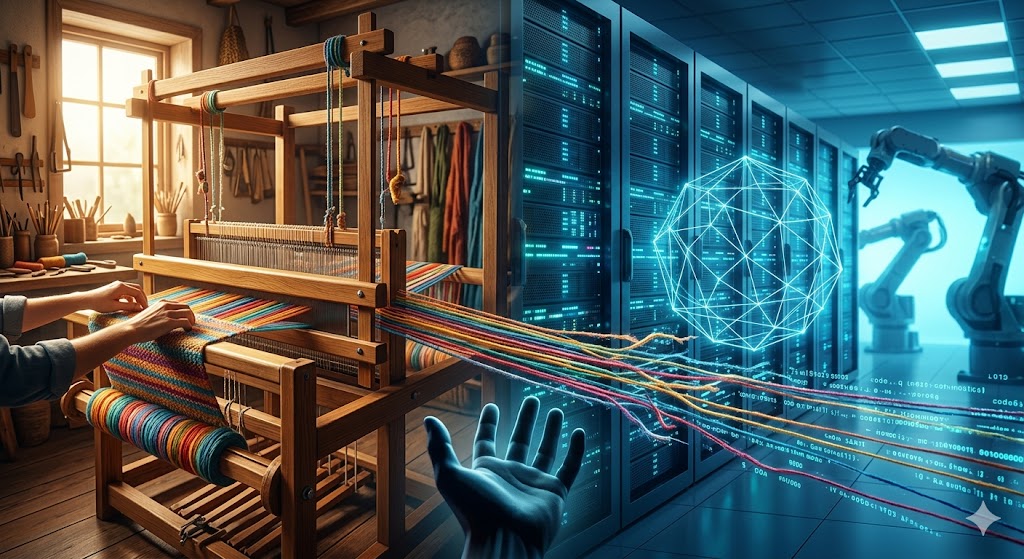
To understand the looming cultural backlash, we must first rescue history from its own terminology. In common parlance, a “Luddite” is dismissed as a technophobe — someone stubbornly clinging to the past out of ignorance. In reality, the 19th-century English textile workers who smashed mechanical looms weren’t fighting technology; they were fighting the destruction of their communities, their livelihoods, and their dignity. They were protesting a systemic failure of experience design. The Modern Luddite Movement will not be born in factories, but in the digital workspaces of knowledge workers, creatives, and strategists who see their intellectual sovereignty being commoditized overnight.

“True innovation is never just about building what is technologically possible; it’s about designing a future where humanity actually wants to live.”

The core tension of our current era is that we are treating a massive societal transformation as a mere software update. We are obsessing over algorithmic efficiency while completely neglecting the human experience of that change. The coming backlash is not a failure of human adaptability — it is a predictable, deeply human reaction to a profound lack of empathy in how innovation is being managed and deployed. If we continue to design people out of the equation, we shouldn’t be surprised when they decide to break the equation entirely.

I. The Anatomy of Disruption: Why This Backlash is Different

Every industrial milestone has forced humanity to renegotiate its relationship with labor. However, treating the rise of generative artificial intelligence as just another predictable chapter in economic history is a grave strategic error. The impending friction is structurally unique, characterized by unprecedented velocity, deep psychological dislocation, and a fundamental degradation of the end-user experience.

The Speed-to-Scale Problem

In past industrial revolutions, the transition of the workforce was measured in generations. When steam power or assembly lines reshaped manufacturing, the prolonged timeline allowed society to build new educational pipelines, adapt labor laws, and give workers time to naturally transition. Generative AI moves at internet speed, scaling globally in days rather than decades. This compressed adoption curve completely outpaces human psychological and economic retraining cycles. We are expecting professionals to reinvent their entire career architectures in months, creating an unprecedented deficit in human change management.

Identity vs. Utility

When mechanical automation disrupted blue-collar labor, it targeted physical exertion. The AI revolution targets cognitive output, striking directly at the core of human identity. For knowledge workers, strategists, and creatives, “what they do” is inextricably linked to “who they are.” When an algorithm can instantly replicate a piece of writing, a strategic analysis, or a visual design, the resulting crisis isn’t merely financial — it is deeply existential. Organizations that view headcount reduction purely as a line-item efficiency gain fail to realize they are tearing at the fabric of professional self-worth, triggering a potent, emotionally charged defensive response.

The Loss of the “Human Touch”

From an experience design perspective, the aggressive rush toward total automation introduces a critical flaw: the complete prioritization of transactional efficiency over relational connection. When every customer touchpoint, creative artifact, and organizational interface is filtered through an automated layer, the overall human experience begins to homogenize and degrade. This creates a vacuum of authentic connection. As digital spaces become hyper-automated and sterile, we will witness a powerful, consumer-led demand for friction — a deliberate rejection of algorithmic optimization in favor of verified, authentic human interaction.

II. Signals of the Emerging Counter-Culture

The cultural backlash to unmanaged automation is no longer a distant, hypothetical scenario; the early warning signals are already flashing across the professional and cultural landscape. As organizations continue to deploy technology without an accompanying architecture for human change management, a distinct, decentralized counter-culture is beginning to manifest. This movement is defined by a conscious retreat from algorithmic spaces and an active resistance against digital displacement.

The Rise of “Analog Enclaves”

We are witnessing the emergence of spaces, products, and communities that explicitly ban or restrict automated inputs. Just as the slow food movement arose in response to industrial fast food, “Analog Enclaves” are forming to preserve unoptimized human experiences. From creative agencies guaranteeing 100% human-authored strategies to local marketplaces operating on zero-algorithm models, consumer preferences are shifting. A premium is being placed on the intentional injection of human friction. The label “Human-Made” is transitioning from a point of nostalgic pride to a highly sought-after, defensive certification of authenticity and quality.

Digital Sabotage and Creative Non-Compliance

Resistance inside the enterprise is rarely loud; it is typically quiet, calculated, and highly effective. Knowledge workers are increasingly engaging in creative non-compliance to protect their domains. This manifests as data poisoning — intentionally introducing flawed inputs to disrupt automated training models — and the deliberate bypassing of corporate AI tools in favor of legacy, human-centric workflows. When workers feel they are being automated out of their own roles rather than augmented within them, survival instincts drive them to quietly sabotage the very systems designed to replace them.

Algorithmic Cynicism and Consumer Fatigue

From an experience design standpoint, the internet is rapidly approaching a saturation point of synthetic mediocrity. The digital ecosystem is cluttered with low-effort, AI-generated noise, resulting in widespread algorithmic cynicism among consumers. People are developing a profound fatigue toward hyper-optimized, sterile interfaces and generic content. This fatigue is driving users away from mass digital platforms and toward small, private, low-tech communities where the interaction is messy, unoptimized, and undeniably human. When efficiency completely destroys novelty and delight, the consumer simply walks away.

III. Designing the Alternative: Co-Creation Over Displacement

The solution to a cultural backlash is not to halt technological progress, but to change how we architect it. If leadership continues to treat human beings as variables to be optimized out of the system, resistance is guaranteed. To avoid systemic friction, organizations must pivot from predatory automation to participatory innovation, designing new organizational structures that value human ingenuity as the ultimate differentiator.

From Automation to Augmentation

We need to fundamentally reframe the corporate balance sheet. The current trend asks, “How many headcounts can this technology eliminate?” A human-centered leader asks, “How can this technology liberate our people to solve higher-order problems?” True innovation occurs at the intersection of technological capability and human insight. When we shift our focus from automation to augmentation, we design workflows where machines handle the heavy lifting of data processing, leaving humans free to focus on empathy, contextual judgment, and creative breakthroughs.

The “Human-in-the-Loop” Experience Architecture

In experience design, a system is only as good as the human outcomes it produces. Deploying automated systems without a robust human interface creates an fragile environment prone to failure. Organizations must intentionally build “Human-in-the-Loop” architectures, where human oversight is not an afterthought or a safety net, but a core structural component. By positioning employees and customers as active co-creators of the technology rather than passive recipients of its outputs, we foster ownership, drastically reduce change resistance, and ensure the final experience retains its vital human touch.

Continuous Upskilling as a Change Framework

You cannot successfully manage a technical transition without a matching human transition architecture. Expecting employees to adapt to a radically altered operational landscape without systemic support is a failure of leadership. Organizations must embed continuous upskilling directly into their operational models. This means designing clear, empathetic learning pathways that allow workers to evolve alongside the tools they use. When people see a clear path forward for their personal growth and economic security within the future vision of the company, the urge to resist transforms into an incentive to innovate.

Conclusion: A Call for Human-Centered Futurology

We stand at a critical crossroads in the evolution of work and culture. The rise of the Modern Luddite Movement is not an inevitable tragedy, but a flashing dashboard indicator warning us that our current innovation trajectory is dangerously out of balance. If we continue to allow technology to outpace empathy, we will lock ourselves into an era defined by systemic cultural friction, bitter labor disputes, and a fragmented digital ecosystem built entirely on mutual distrust.

The choice before us is a design challenge. We can either deploy artificial intelligence as a tool of displacement, or we can deliberately architect an inclusive future of work that honors and amplifies human capability. True futurology is not about passively predicting what technology will do to us; it is about actively designing what we will do with technology. It is time to move past the obsession with what is merely technologically possible and start focusing on what is humanly desirable. The best way to manage change is to ensure that everyone has a stake in the future we are building.

Frequently Asked Questions

Who are the “Modern Luddites” in the context of the AI revolution?

Unlike the historical stereotype of technophobes who hate progress, Modern Luddites are primarily knowledge workers, creatives, and strategists. They are resisting the systemic destruction of their livelihoods, intellectual sovereignty, and professional identities caused by rapid, unmanaged AI displacement.

What are the primary signals of an emerging cultural backlash to AI?

Key signals include the rise of “Analog Enclaves” (spaces and products certifying 100% human creation), quiet enterprise resistance like data poisoning or legacy workflow compliance, and consumer algorithmic cynicism driven by a saturation of sterile, AI-generated digital noise.

How can organizations avoid this backlash and manage AI changes successfully?

Organizations must shift from predatory automation to human-centered augmentation. This involves building “Human-in-the-Loop” experience architectures, involving employees in participatory co-creation, and implementing structured, empathetic upskilling frameworks that provide a clear path forward for human workers.

FutureHacking™ Is Coming

FutureHacking™ is Braden Kelley’s strategic foresight methodology — and a paid download and training program is launching soon. Register your interest now to be the first to know when it’s available, and get early access pricing.

Image credit: Gemini

Subscribe to Human-Centered Change & Innovation WeeklySign up here to get Human-Centered Change & Innovation Weekly delivered to your inbox every week.

Visionaries vs. Executioners – Resolving the Structural Friction in Creative Teams

Visionaries vs. Executioners - Resolving the Structural Friction in Creative Teams

GUEST POST from Chateau G Pato


I. Introduction: The Innovation Paradox

Ideas are cheap; execution is expensive. Yet, without a bold, customer-centric vision, flawless execution simply delivers the status quo faster. The greatest bottleneck to true business transformation isn’t a lack of capital or technology — it is the systemic friction between two vital groups: the Visionaries who dream up the future and the Executioners who keep the lights on today.

This natural tension is palpable in almost every creative and corporate team. Visionaries thrive in ambiguity, possibilities, and the abstract. Executioners thrive in predictability, strict metrics, and operational stability. When left unmanaged, this divide creates a destructive cultural chasm where dreamers view operations as a bureaucratic roadblock, and operators view dreamers as reckless and undisciplined.

To build a sustainable engine of growth, organizations must recognize that this friction is not a personality flaw; it is a structural design flaw. Resolving it requires shifting our focus from merely managing interpersonal conflict to actively designing a collaborative, human-centered ecosystem where both mindsets are purposefully integrated.

II. Anatomy of the Friction: Two Distinct Human Profiles

To bridge the chasm between strategy and execution, we must first build operational empathy. This requires analyzing the distinct mental models, drivers, and behaviors of the two core profiles at play. When we strip away the corporate jargon, we see two entirely different approaches to navigating reality.

The Visionary Mindset

Visionaries are inherently future-focused, constantly asking “What if?” and “Why not?” They possess a unique cognitive flexibility that allows them to see patterns where others see noise, anticipate latent customer needs, and fearlessly shatter existing constraints.

However, this superpower comes with a dark side. When unchecked, Visionaries fall victim to “Bright Shiny Object Syndrome.” They easily grow bored with the grueling details of implementation, suffer from a profound lack of operational empathy, and frequently leave a trail of half-baked, abandoned ideas in their wake, exhausting the team around them.

The Executioner Mindset

Conversely, Executioners are grounded firmly in the present, driven by the pragmatic mechanics of “How?” and “By when?” Their primary superpower lies in their ability to build scalable systems, mitigate organizational risk, and systematically transform raw chaos into predictable, repeatable revenue.

Yet, their dark side is equally limiting. Driven by a mandate for efficiency, Executioners can lean heavily on the defensive shield of “We’ve always done it this way.” This manifests as a rigid, default resistance to organizational change and a dangerous tendency to optimize exclusively for short-term operational stability at the direct expense of future relevance.

The Human Toll

When these two groups are forced to collaborate without a supportive architecture, the psychological safety of the team rapidly erodes. Instead of recognizing each other as vital counterweights, they degenerate into caricatures: Visionaries view Executioners as close-minded bureaucrats killing creativity, while Executioners view Visionaries as reckless, detached dreamers creating unnecessary work. The result is a toxic cultural friction that stalls progress and drives away top talent.

III. The Missing Link: Why Traditional Team Structures Fail

Most organizations recognize the cultural divide between their dreamers and their doers, yet their structural attempts to fix it typically make things worse. Traditional corporate design is built for linear efficiency, not dynamic collaboration. When applied to modern innovation, these legacy frameworks inevitably crack under the pressure, exposing three fundamental flaws in how teams are organized.

The “Over-the-Wall” Hand-off

The most pervasive mistake leaders make is treating innovation as a sequential relay race. The Visionaries huddle in a silo, map out a grand strategy, and then throw the completed concept “over the wall” to the operations team to execute. This immediate hand-off guarantees corporate organ rejection. Because the Executioners had no voice in shaping the idea, they lack context, feel zero ownership, and immediately encounter dozens of unaddressed operational constraints that stall the project out of the gate.

Misaligned Structural Incentives

At a systemic level, Visionaries and Executioners are literally incentivized to fight each other. Visionaries are typically evaluated and rewarded based on novelty, disruptive thinking, and the sheer volume of new ideas they generate. Executioners, on the other hand, are measured on efficiency, budget optimization, risk mitigation, and achieving zero errors. When you reward one group for creating variance and the other for eliminating it, structural friction isn’t just likely — it is mathematically guaranteed.

The Absence of an Operational Translation Layer

The final structural failure is linguistic. Visionaries speak in the language of abstract possibilities, high-level business models, and qualitative human emotions. Executioners speak in the language of process maps, technical requirements, bandwidth, and concrete key performance indicators (KPIs). Without a dedicated mechanism or framework to translate qualitative, human-centered insights into quantitative operational tasks, the two groups quickly reach a standstill, speaking completely past one another.

IV. The Human-Centered Solution: Designing the “Integration Layer”

Resolving systemic friction requires more than just telling teams to communicate better; it requires a deliberate structural intervention. We must explicitly design an “Integration Layer” that bridges the gap between abstract strategy and operational reality. By shifting our focus from internal corporate politics to shared human experiences, we can turn a source of friction into a powerful collaborative engine.

Building a Shared Language (The Customer Journey)

To break down the conceptual silos, teams must stop anchoring conversations in their own functional biases. Instead, the ultimate anchor must be the customer. By using human-centered design tools like visual customer journey maps, both Visionaries and Executioners gain a single, objective point of reference. The question shifts from “What do I want to build?” or “What is easiest to operate?” to “How does this specific step solve the user’s friction point?” This shared North Star grounds the vision while giving the execution clear, empathetic purpose.

Introducing the “Translator” Role

Organizations must formally recognize and fund a critical hybrid capability: the organizational Translator. These are rare individuals — often experienced product managers, change leads, or service designers — who possess high cognitive empathy and are bilingual. They can seamlessly pivot from discussing blue-sky possibilities with a Visionary to mapping out technical dependencies, operational constraints, and resource allocation with an Executioner. They prevent organ rejection by ensuring that creative intent is preserved even as it is adapted to fit the realities of the delivery system.

The Scaling Horizon Framework

Friction also occurs because teams try to force all ideas through the same operational pipeline at the same time. To fix this, leadership must implement a clear scaling horizon framework to categorize work and manage expectations:

  • Horizon 3 (The Future): Low-friction, high-ambiguity sandbox spaces where Visionaries can freely explore disruptive, human-centered concepts without the burden of immediate operational metrics.
  • Horizon 2 (The Transition): The vital incubation zone where the Translator role helps shape, test, and adapt the most promising concepts, explicitly preparing them for scale.
  • Horizon 1 (The Present): The highly structured operational engine where Executioners receive mature, de-risked concepts optimized for efficient, reliable execution.

V. Strategic Interventions for Leaders

Designing an integration layer provides the structural blueprint, but leaders must actively implement tactical interventions to shift daily team dynamics. Moving from friction to traction requires changing how people work together, how they are measured, and how they communicate when tension inevitably arises.

Co-Creation from Day One

To eliminate the destructive “over-the-wall” hand-off, leaders must mandate cross-functional co-creation from the very beginning of an initiative. This means bringing operational minds and execution leads into the early ideation and strategy phases — not to kill ideas, but to surface real-world constraints when they are cheapest to navigate. Conversely, Visionaries must stay attached to the project during implementation, acting as guardians of the core creative intent. When both groups co-create, ownership is shared, and the path to scaling is cleared early.

Dynamic Governance and Dual-Track KPIs

You cannot manage a collaborative ecosystem using legacy, one-dimensional metrics. Leaders must implement dynamic governance and dual-track Key Performance Indicators (KPIs) that explicitly reward cross-functional alignment. Instead of measuring Visionaries solely on the volume of ideas and Executioners solely on efficiency, success must be tied to integration. Performance tracking should evaluate metrics such as:

  • Concept Velocity: How efficiently a high-potential idea moves from a Horizon 3 concept to a Horizon 1 deployment.
  • Operational Feasibility Scores: How effectively a visionary concept incorporates real-world constraints before scaling begins.
  • Collaborative Translation: Shared accountability for the successful commercialization or adoption rate of a new initiative.

Designing Psychological Safety and Constructive Friction

Friction itself is not the enemy; destructive friction is. To turn interpersonal conflict into creative, constructive friction, leaders must establish ritualized, psychologically safe spaces where teams can debate ideas intensely without attacking individuals. Two powerful mechanisms for this include:

  • Project Premortems: Gathering both groups before a project launches to ask, “Assuming this fails spectacularly two years from now, what killed it?” This gives Executioners a safe, constructive channel to voice operational risks without sounding pessimistic, and forces Visionaries to confront real vulnerabilities early.
  • Friction Audits: Periodic, structured retrospective meetings designed specifically to look at the hand-offs and workflow between the strategy and execution teams, allowing them to optimize their shared process continuously.

VI. Conclusion: Harmonizing the Tension

Ultimately, successful innovation is never about choosing a side. A business that relies solely on Visionaries will eventually collapse under the weight of unfulfilled promises and chaotic pivots. Conversely, a business dominated entirely by Executioners will efficiently and predictably optimize itself into irrelevance. True enterprise agility and human-centered transformation require both mindsets to be firing in unison.

The friction we witness daily in creative and corporate teams is not an indictment of the people involved; it is a clear symptom of outdated organizational architecture. When we step up as leaders to build dedicated translation layers, establish co-creative workflows, and align our systemic incentives around shared customer-centric outcomes, we transform this structural liability into an invaluable asset.

The call to action for modern leadership is clear: stop trying to force your Visionaries to become rigid Executioners, and stop demanding that your Executioners become abstract dreamers. Instead, respect the unique cognitive strengths of both profiles, step back, and intentionally invest in the human-centered architecture, shared tools, and adaptive culture required to turn their friction into traction.

Frequently Asked Questions

Why do visionaries and executioners naturally clash on creative teams?

The clash is driven by a fundamental misalignment in cognitive models and structural incentives. Visionaries thrive on ambiguity, disruption, and future possibilities, and are often rewarded for novelty. Executioners thrive on predictability, risk mitigation, and operational stability, and are typically rewarded for efficiency and zero errors. Without a structural bridge, these opposing mandates naturally generate friction.

What is an organizational “Translator” and why is the role necessary?

An organizational Translator is a hybrid professional — such as an experienced product manager, service designer, or change leader — who speaks both the abstract language of strategy and the concrete language of operations. They are necessary to translate qualitative customer insights into quantitative operational requirements, preventing the corporate “organ rejection” that happens when ideas are thrown over the wall without operational context.

How can leaders turn destructive team friction into constructive traction?

Leaders can transform team friction by implementing three tactical interventions: requiring cross-functional co-creation from day one rather than linear hand-offs; designing dual-track KPIs that reward collaboration and concept velocity; and establishing ritualized, psychologically safe spaces like Project Premortems to surface operational risks constructively.


FutureHacking™ Is Coming

FutureHacking™ is Braden Kelley’s strategic foresight methodology — and a paid download and training program is launching soon. Register your interest now to be the first to know when it’s available, and get early access pricing.

Image credit: Gemini

Subscribe to Human-Centered Change & Innovation WeeklySign up here to get Human-Centered Change & Innovation Weekly delivered to your inbox every week.

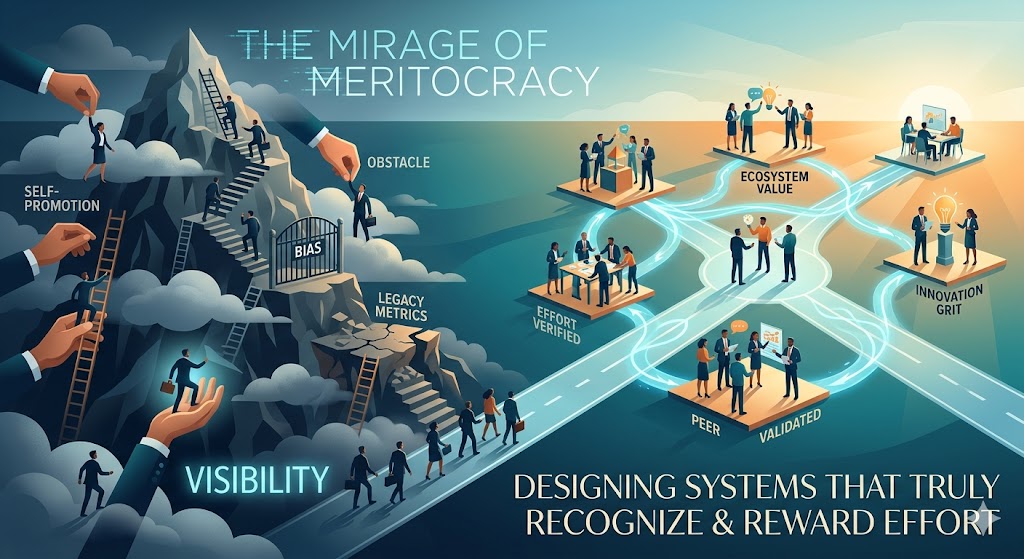
Designing Systems that Truly Recognize and Reward Effort

The Meritocracy Myth
Designing Systems that Truly Recognize and Reward Effort

GUEST POST from Chateau G Pato


The Mirage of the Level Playing Field

We love to believe that our organizations are built on a simple, comforting promise: if you work hard, contribute your best ideas, and put in the effort, you will succeed. This is the seductive allure of meritocracy. It’s a beautiful narrative that paints corporate progression as a perfectly balanced scale, weighing talent and exertion to distribute rewards with flawless precision.

But if we peel back the layers of modern corporate architecture, the reality is far less elegant. The systems we rely on to judge “merit” are rarely objective. Instead, traditional performance management frameworks are accidentally optimized to measure visibility, self-promotion, and political maneuvering rather than actual, sustained effort. We have created environments where the loudest voice in the room eclipses the deepest thinker, and where navigating institutional bias matters more than delivering genuine value.

The Cost to Continuous Innovation

As an innovation and change management strategist, I look at this systemic failure through a specific lens: what is this doing to our collective creative potential? True, breakthrough innovation requires absolute psychological safety and an environment that actively embraces cognitive diversity. When an organizational ecosystem rewards the most privileged path or the flashiest presentation over the grit of real problem-solving, innovation chokes.

Employees quickly realize that the game is rigged toward optics. As a result, they stop taking risks. They stop bringing their authentic, divergent ideas to the table, and they pivot their energy from doing great work to ensuring they are seen doing work. The organization enters a state of creative stagnation, all while leadership wonders why their expensive innovation initiatives are failing to yield results.

Redesigning the Human Experience

We cannot solve 21st-century innovation challenges with industrial-era appraisal systems. To unlock the full spectrum of human potential, we must fundamentally shift our approach. We have to move away from the lazy assumption that a fair meritocracy happens by accident, and instead intentionally design an organizational ecosystem that measures, recognizes, and rewards holistic human contribution. This article is a blueprint for that transformation — a guide for progressive leaders ready to dismantle the myths and architect systems where equitable outcomes ensure that rewards are directly and transparently relative to true effort.

Deconstructing the Myth: Why Current Systems Fail

To fix a broken system, we must first understand exactly how it is failing the people inside it. Most performance evaluation frameworks were built for a predictable, industrial world where tracking physical outputs was easy. Today, in an era defined by knowledge work, digital transformation, and collaborative ecosystems, those linear metrics are entirely obsolete. By relying on legacy structures, organizations have inadvertently codified bias, rewarding behaviors that damage company culture while leaving true value unrecognized.

The Visibility Bias and Corporate Theater

Perhaps the most glaring flaw in modern corporate environments is the “Visibility Bias.” Traditional appraisal systems are heavily weighted toward what leadership can actively see. This creates an environment of corporate theater, where employees are forced to spend significant energy marketing themselves rather than executing their actual roles.

We see this manifest in the celebration of the loudest voice in meetings, the relentless self-promotion on internal communication channels, and the hoarding of high-profile projects. When systems prioritize optics over outcomes, the introverted, deep-thinking, and hyper-focused executors are marginalized. The organization stops being a meritocracy and instead becomes a market for the best self-promoter.

The Proximity Penalty in Distributed Environments

The rapid shift toward hybrid and remote work models has exacerbated these systemic flaws, introducing a new challenge: the “Proximity Penalty.” Despite leaders claiming that location doesn’t matter, human nature and out-of-sight, out-of-mind biases tell a different story.

When managers evaluate talent based on unstructured observations rather than objective, behavior-based rubrics, those who physically sit closer to leadership gain an unfair advantage. They receive more impromptu mentoring, get pulled into ad-hoc strategic conversations, and project an illusion of greater effort simply through physical presence. Meanwhile, remote contributors who may be working with higher efficiency and fewer distractions face a career stagnation tax entirely unrelated to their merit.

Siloed Metrics vs. Ecosystem Value

Modern business challenges are complex and require deep cross-functional collaboration, yet our reward structures remain fiercely individualistic. Standard Key Performance Indicators (KPIs) isolate individuals into narrow silos, forcing them to compete against their peers for a fixed pool of rewards.

This creates a devastating blind spot: the failure to recognize “glue people.” Glue people are the vital contributors who build bridges across departments, mentor junior talent, diffuse conflict, and elevate the performance of everyone around them. Because their contribution isn’t captured on a localized, individualistic dashboard, they are often penalized during review cycles for not hitting rigid, isolated targets — even though the ecosystem would collapse without them.

The Innovation Paradox

Finally, traditional merit-based frameworks create an impossible paradox for organizations that claim to value innovation. Innovation requires experimentation, and experimentation inherently involves a high probability of failure.

When a system only rewards tidy, linear successes and predictable, incremental gains, it actively discourages risk-taking. Employees who propose bold, disruptive ideas and execute them flawlessly — only to have the market or the technology shift beneath them — are frequently penalized under standard review systems. By treating a well-executed, strategic failure the same as incompetence, organizations build a culture of compliance and safety, effectively killing their own long-term survival prospects.

The Human-Centered Design Framework for Fair Systems

Dismantling a broken system is only half the battle; the real challenge lies in what we choose to build in its place. To move past the flaws of accidental meritocracies, we must apply the principles of human-centered design to the architecture of our organizations. This means shifting our focus from rigid, bureaucratic procedures to the actual human beings navigating them, ensuring that the systems we create are inherently empathetic, context-aware, and co-created.

Empathy Mapping the Employee Experience

Every system design must begin with deep empathy. In traditional corporate structures, recognition mechanisms are built around a one-size-fits-all persona — usually the highly visible, extroverted individual who thrives in traditional corporate structures. To build a truly equitable framework, we must map out how our current evaluation and promotion pathways are experienced by a diverse range of talent.

How does an introverted software engineer who quietly saves a project from disaster experience your review cycle? How does a working parent navigating a hybrid schedule, or a brilliant contributor from an underrepresented background, experience your recognition tools? By actively identifying the hidden friction points, anxieties, and structural biases that these different personas encounter, we can begin to design out the systemic barriers that prevent true effort from being recognized.

Shifting the Formula: Input + Obstacle

A genuinely fair system requires a fundamental paradigm shift in what we measure. Legacy frameworks look exclusively at outputs — the final revenue number, the shipped product, or the closed deal. While outputs matter, evaluating them in a vacuum ignores the vastly different terrains employees must traverse to achieve them.

To fix this, human-centered systems alter the evaluation formula to look at Input + Obstacle. It is not just about what was achieved, but the context in which it was achieved. For example, an employee who maintains a stable client relationship in a severely under-resourced department, or under volatile market conditions, may be exerting significantly higher effort and demonstrating greater skill than someone hitting a higher target with a massive budget and a tailwind. By factoring obstacles into our rubrics, we ensure that rewards remain relative to the true grit and ingenuity invested.

The Co-Creation Principle

One of the core tenets of participatory innovation is that top-down design is inherently obsolete in complex human ecosystems. When leadership mandates evaluation criteria from behind closed doors, it inevitably leads to a disconnect between corporate metrics and daily operational realities. This top-down imposition breeds cynicism and resistance.

Instead, progressive organizations must adopt the Co-Creation Principle. This involves engaging employees across all tiers and departments to actively participate in defining what “effort,” “collaboration,” and “success” actually look like in their specific roles. When teams help build the rubrics, the criteria naturally align with the real value they provide to the business. More importantly, it shifts the dynamic from an authoritative monitoring exercise to a transparent, shared contract based on mutual trust and ownership.

Actionable Strategies for Changing the System

Philosophy and design frameworks provide the foundation, but changing an organizational culture requires concrete, structural interventions. We must replace vague intentions with deliberate mechanisms that rewire how value is tracked, verified, and rewarded. This means redesigning our metrics, dismantling the dependency on self-promotion, and establishing structures that make bold experimentation safe.

Redesigning the Metrics: Capturing Invisible Contributions

If we want to reward true effort, we have to start measuring what actually matters, not just what is easy to quantify. Organizations must expand their tracking mechanisms beyond individual output metrics to capture the collaborative labor that keeps teams functioning.

A critical tool in this evolution is the deployment of structured Peer-to-Peer recognition frameworks. This is not about superficial “social shout-outs,” but systematic, network-based tracking where team members validate who consistently steps up to unblock technical hurdles, mentors colleagues, or handles the essential “glue work” that prevents projects from derailing. By aggregating these peer signals, leadership can visually map the real anchors of the organization, ensuring that quiet, impactful effort is elevated and rewarded alongside highly visible milestones.

Decoupling Self-Promotion from Progression

Career advancement should never be a marketing contest. To level the playing field, organizations must deliberately separate an individual’s capacity for self-promotion from their professional progression.

This requires implementing highly objective, behavior-based rubrics for advancement. Instead of asking managers to evaluate abstract qualities like “leadership potential” or relying on who speaks up the most in meetings, promotions should be tethered to specific, demonstrable behaviors and verified competencies. When the path forward is governed by clear, verifiable standards rather than subjective impressions, introverted, remote, or historically marginalized talent can advance based on the undeniable merit of their work, without being forced to shout to be seen.

Institutionalizing the “Failure Fund”

If you only reward success, you inevitably incentivize compliance and incrementalism. To foster an environment of continuous innovation, we must design systems that actively de-risk the act of trying something new.

Progressive organizations can achieve this by institutionalizing a “Failure Fund” or dedicated recognition tracks specifically designed for “smart failures.” When a team proposes a bold, well-reasoned hypothesis, executes the experiment flawlessly, and documents the insights — yet the initiative fails due to shifting market dynamics or technological limitations — that effort should be celebrated, not penalized. By treating high-quality experimentation as a core competency and allocating rewards to the grit of the attempt, leaders remove the systemic terror of failure, unlocking the true creative capacity of their workforce.

Futurology: The Next Generation of Workplace Recognition

As we look toward the future of work, the intersection of advanced technology and human-centered design offers an unprecedented opportunity to permanently dismantle legacy appraisal models. We are moving away from bureaucratic, retrospective processes and entering an era of dynamic, real-time ecosystems. By leveraging emerging capabilities responsibly, we can transition from guess-driven management to data-verified equity.

AI as an Equity Partner

The conversation surrounding artificial intelligence in the workplace often centers on automation, monitoring, and efficiency optimization. However, a human-centered future positions AI not as an invasive surveillance mechanism, but as an equity partner designed to expose systemic bias.

Advanced organizational network analysis (ONA) tools can process passive communication meta-data—such as cross-departmental collaboration patterns, document edits, and support queues — to map how value actually flows through an enterprise. By identifying the unsung connective tissue of a company, AI can flag the hidden contributors who anchor critical projects but rarely claim the spotlight. This empowers leadership to proactively intervene, ensuring that the quiet, hyper-efficient engines of innovation are recognized before they experience burnout or seek opportunities elsewhere.

Continuous, Micro-Recognition Ecosystems

The traditional annual performance review is an administrative relic of the 20th century. It relies on the deeply flawed, easily manipulated mechanism of recency bias, reducing a human being’s entire year of effort, learning, and grit into a single, high-stakes negotiation.

The future belongs to continuous, micro-recognition ecosystems. By integrating micro-feedback loops directly into daily digital workflows, recognition becomes an ongoing, organic narrative. Whether it is validating a beautifully refactored piece of code, a brilliantly handled client escalation, or an insightful piece of strategic foresight, feedback should be captured in the moment. This immediate validation creates a transparent, immutable ledger of contribution that reflects the true cadence of modern knowledge work.

The Ripple Effect on Employer Brand

The ultimate byproduct of a system designed to truly recognize and reward effort is a profound, unshakeable competitive advantage. In a highly fragmented talent market, the world’s most exceptional creative problem solvers are hyper-aware of the meritocracy myth; they have experienced the frustration of corporate politics firsthand.

When an organization can demonstrably prove that its advancement pathways are governed by clear, behavior-based rubrics and verified ecosystem value rather than theater, it creates an immense gravitational pull. This radical fairness transforms the employer brand from a marketing slogan into an authentic cultural asset, attracting diverse, high-caliber talent who want to invest their energy where it will actually be seen, valued, and respected.

Conclusion: A Call to Action for Progressive Leaders

Dismantling the meritocracy myth is not an exercise in lowering organizational standards. On the contrary, it is about raising our standards of system design, operational integrity, and leadership accountability. For too long, organizations have hidden behind the lazy assumption that fairness happens automatically, treating equity as a passive byproduct of good intentions rather than an intentional, engineered outcome.

The Mindset Shift From Intention to Architecture

We must come to terms with a fundamental truth: a system that is not explicitly designed to be fair will default to rewarding privilege, proximity, and politics. Shifting away from this reality requires progressive leaders to move past the comforting rhetoric of merit and step into the role of organizational architects.

We must stop asking our people to navigate broken, biased, and opaque advancement structures and instead build transparent ecosystems where rewards are directly, measurably relative to true effort and verified ecosystem value. This shift requires courage — the courage to challenge legacy KPIs, to question who is actually driving value, and to fundamentally rethink how we define and celebrate success.

The Imperative of Human-Centered Systems

Ultimately, innovation is a deeply human endeavor. It cannot be automated, mandated, or forced through an outdated, industrial-era algorithm of corporate survival. If you want extraordinary human outcomes — breakthrough creativity, relentless problem-solving, and sustained agility — you cannot leave the human experience of your workforce to chance.

The choice before us is clear. We can continue to tolerate the corporate theater that drains our collective creative potential, or we can choose to design a future where every contributor knows their grit will be seen, their collaboration valued, and their effort recognized. Let’s stop pretending we have a meritocracy, and let’s start designing one.

Frequently Asked Questions

What is the “Meritocracy Myth” in modern organizations?

The meritocracy myth is the false belief that traditional corporate systems naturally recognize and reward the hardest workers and best ideas. In reality, legacy performance management systems are accidentally optimized for visibility, proximity, and self-promotion, often ignoring quiet execution, deep collaboration, and the true effort required to overcome significant obstacles.

How do we shift from measuring outputs to measuring true effort?

We must change the evaluation formula to look at Input + Obstacle. Instead of evaluating final outcomes in a vacuum, leaders must design behavior-based rubrics and deploy peer-to-peer recognition networks. This allows the organization to factor in the specific difficulties an employee overcame and capture the invisible “glue work” that elevates entire teams.

What does it mean for rewards to be “fair” in an innovation ecosystem?

Fairness does not mean equal outcomes for everyone regardless of input; it means equitable outcomes where rewards are directly relative to true effort and contribution. In an innovation-driven organization, this also means establishing mechanisms like a “Failure Fund” to reward high-quality, smart experimentation, ensuring employees aren’t penalized when a bold risk doesn’t yield a linear success.


Bottom line: Futurology is not fortune telling. Futurists use a scientific approach to create their deliverables, but a methodology and tools like those in FutureHacking™ can empower anyone to engage in futurology themselves.

Image credit: Gemini

Subscribe to Human-Centered Change & Innovation WeeklySign up here to get Human-Centered Change & Innovation Weekly delivered to your inbox every week.

How Molecule-Aware Experiences are Transforming Digital Commerce

Beyond the Flat Screen

How Molecule-Aware Experiences are Transforming Digital Commerce

GUEST POST from Chateau G Pato


I. Introduction: The Death of the 2D Glass Ceiling

For three decades, digital commerce has been trapped behind a wall of glass. We have built multi-billion dollar industries on the backs of desktop monitors, tablet screens, and smartphone viewports. While this evolution successfully democratized access and scaled global markets, it also forced human beings to compromise. It demanded that we interact with a rich, multi-sensory world of commerce through flat pixels, endless scrolling grids, and artificial two-dimensional environments. That era of compromise is officially coming to an end.

We are currently witnessing a massive paradigm shift: the transition from flat digital commerce to Molecule-Aware Experiences. This next frontier represents the convergence of spatial computing, advanced haptics, the Internet of Things (IoT), and programmable matter. “Molecule-aware” means digital commerce systems are no longer blind to the physical world; instead, they can sense, understand, and interact with physical reality at a granular, contextual level.

“The next frontier of innovation isn’t about looking at a screen; it’s about digital experiences that wrap around, understand, and materialize within our physical reality.”

As change leaders and innovators, we must recognize that the ultimate storefront is no longer an app on a phone—it is the very environment surrounding the consumer. To thrive in this new landscape, organizations must stop designing for the viewport and start designing for the human ecosystem.

II. The Evolution of Commerce: From Pixels to Atoms

To understand where digital commerce is going, we must first look at where it has been. The journey of digital trade has always been a story of removing friction, yet each major iteration has remained confined by the technology of its time:

  • Commerce 1.0 (The Catalog Web): The early days of the internet, which essentially digitized physical catalogs. It was static, transactional, and desktop-bound.
  • Commerce 2.0 (The Social & Mobile Web): The explosion of smartphones and social media. Commerce became hyper-portable, instant, and influenced by algorithmic feeds, yet it remained locked behind a 5-inch piece of glass.
  • Commerce 3.0 (The Omnichannel Ecosystem): The integration of digital and physical touchpoints, bridging online shopping with brick-and-mortar realities through concepts like BOPIS (Buy Online, Pick Up In Store) and basic augmented reality (AR) overlays.

Despite these advancements, we have hit an innovation chasm. Current digital commerce feels increasingly stagnant. Consumers are experiencing “scroll fatigue”—the exhaustion of evaluating rich, physical products through repetitive grids of flat images and text reviews. This 2D limitation creates an inherent trust gap; buyers cannot truly understand the scale, texture, weight, or contextual fit of an object before it arrives at their doorstep.

The Molecule-Aware Catalyst shatters this glass ceiling. By shifting the foundation of digital commerce from pixels to atoms, we are entering an era where smart materials, ambient sensors, and localized biometrics turn the consumer’s immediate physical environment into the ultimate interactive interface. We are no longer just pushing data to a screen; we are allowing digital information to interact directly with the physical matter of our daily lives.

III. Core Pillars of Molecule-Aware Experiences

Shifting from screen-based interactions to molecule-aware experiences requires a fundamental restructuring of our digital architecture. This new frontier is built upon three core technological and design pillars that allow digital systems to interact seamlessly with the physical world.

A. Spatial and Environmental Intelligence

True molecule-aware commerce goes far beyond basic augmented reality (AR) overlays that simply drop a digital 3D model onto a camera view. It requires deep, contextual environmental intelligence. Next-generation commerce systems utilize advanced spatial computing to map, analyze, and understand the layout, materials, lighting, and physical limitations of a consumer’s immediate surroundings.

For example, a system shouldn’t just know where a wall is; it must understand that the wall is made of exposed brick, absorbs light in a specific way, and has exactly 44 inches of clearance between two structural beams. This level of awareness ensures that digital products are contextualized perfectly within the unique physical reality of the user’s home or workspace before a transaction ever occurs.

B. Contextual & Sensory Relevancy

Human beings do not experience the world through sight and sound alone. Yet, traditional digital commerce completely ignores our senses of touch, smell, and taste. Molecule-aware experiences break this limitation by integrating micro-haptics, scent synthesis, and localized thermal feedback into the consideration phase of the buying journey.

By leveraging responsive materials and ambient IoT devices, brands can allow consumers to feel the grain of a wooden table, experience the weight distribution of a tool, or sample the aroma of a premium coffee blend from across the globe. By engaging the full spectrum of human sensory perception, we move from passive viewing to active, emotional experiencing.

C. Programmable Matter & Responsive Design

The ultimate realization of molecule-aware commerce lies in the convergence of digital data and programmable matter. We are moving toward a future where physical objects can dynamically alter their properties—such as shape, texture, density, or color—based on digital inputs.

In this ecosystem, responsive design extends beyond fluid web layouts into the physical realm. Imagine a universal prototyping device in a consumer’s home that can temporarily alter its physical form to mimic the handle of a luxury handbag, the grip of an athletic shoe, or the contours of an ergonomic chair. This allows for instantaneous physical testing, radically compressing the bridge between digital consideration and physical reality.

IV. Human-Centered Impact: Redefining the Customer Experience (CX)

As an advocate for human-centered design, I always remind innovators that technology is only as valuable as the human friction it removes or the human potential it unleashes. Shifting to molecule-aware experiences isn’t just a win for technological novelty; it fundamentally reshapes how human beings relate to, trust, and adopt digital commerce.

A. Frictionless Personalization

For years, digital personalization has been algorithmic and predictive, rely on crude data points like “people who bought this also liked…” Molecule-aware commerce transforms personalization from predictive guessing into real-time physical adaptation. Instead of forcing the human body to adapt to mass-produced items, digital products and environments dynamically adjust to the user’s unique physical constraints, biometric data, and ergonomic needs in real time. The product conforms to the human, not the other way around.

B. Bridging the Trust Gap

The single greatest point of friction in e-commerce today is uncertainty. Will it fit? Will it match? How does it actually feel? This uncertainty leads to massive cart abandonment and staggering return rates that plague retail logistics. By allowing consumers to physically interact with, feel, or spatially validate a digital item before clicking “buy,” we eliminate the guesswork. When a consumer can experience the exact physical reality of a product in their own space, the trust gap evaporates, building deep, unshakeable consumer confidence.

C. The Change Management of Daily Life

Every major technological leap requires a period of human adaptation. However, the beauty of molecule-aware commerce is that it aligns with natural human behaviors rather than forcing us to learn new digital interfaces. We are wired to touch, feel, and move through three-dimensional space. By embedding commerce into the physical fabric of our environments, the act of “checking out” or “browsing” disappears entirely into the background. It becomes ambient, intuitive, and seamlessly integrated into the rhythm of daily life.

V. Industry Transformations: Who Wins and Who Adapts?

The transition from a screen-centric model to a molecule-aware paradigm will not impact all sectors equally. For visionary leaders, this shift represents an unprecedented opportunity to rewrite the rules of market engagement. For those tethered to traditional 2D frameworks, it is a fast-approaching disruption. Let us look at how three major sectors will be completely redefined:

A. Fashion & Apparel: Beyond the Virtual Fitting Room

Early attempts at digital fashion relied on flat overlays or avatars that rarely captured the true behavior of textiles. Molecule-aware commerce changes the game entirely. Instead of simply looking at a virtual try-on, consumers will interact with smart, haptic-enabled fabrics or localized testing devices that mimic the exact texture, weight, shear, and drape of a garment remotely. Brands will no longer just sell an aesthetic; they will sell the tangible, tactile reality of their craftsmanship before a single piece of fabric is cut or shipped.

B. Home & Architecture: True Spatial Integration

Buying furniture or designing a space has traditionally been an exercise in spatial anxiety. Molecule-aware systems eliminate this by allowing furniture, decor, and architectural elements to project their exact physical presence into a room. This goes beyond visual rendering; it includes interactive calculations of weight distribution, environmental light absorption, acoustics, and structural impact. Consumers can walk through their altered physical environment, interacting with digital manifestations that respect and respond to the real boundaries of their homes.

C. CPG & Food/Beverage: Molecular Sampling

The Consumer Packaged Goods (CPG) and food sectors have historically been the hardest to digitize because they rely heavily on taste and smell. In a molecule-aware ecosystem, digital flavor profiling and localized molecular scent-mapping allow consumers to sample products safely and instantly from their own living rooms. Ambient IoT scent synthesizers and biometric taste-simulators will allow a consumer to experience a new beverage profile or premium fragrance. Once validated, the purchase triggers automated, localized micro-fulfillment or drone delivery, closing the loop between digital sensation and physical consumption.

VI. The Innovator’s Dilemma: Challenges on the Horizon

As with any radical leap in innovation, the transition to molecule-aware experiences is not without its friction. For every boundary we break, a new set of responsibilities and systemic challenges emerges. Forward-thinking leaders must proactively address these hurdles before they can successfully scale this new paradigm.

A. Privacy & Radical Transparency

Traditional e-commerce tracks clicks, scrolls, and purchase histories. Molecule-aware commerce, by its very nature, requires a much deeper look into the consumer’s private life. If a system is environmentally and spatially intelligent, it gathers data on the layout of a home, the value of surrounding possessions, biometric responses, and even daily physical habits. This demands a shift toward radical transparency and robust, zero-trust data privacy architectures. Organizations must prove to consumers that their physical sanctuaries will not be monetized or exploited.

B. Infrastructure & Scalability

We are currently looking at a highly fragmented technological landscape. For molecule-aware experiences to become ubiquitous, we must move past isolated hardware silos. The industry requires universal open standards and protocols that allow disparate spatial computing platforms, haptic devices, and ambient IoT networks to communicate seamlessly. Without cross-platform interoperability, the experience breaks down, leaving consumers frustrated by a fractured ecosystem.

C. The Human Resistance Factor

Perhaps the greatest challenge is not the technology itself, but the organizational change management required to implement it. Legacy enterprises are built to optimize existing, flat digital pipelines. Pivoting a business model from “selling items on a screen” to “curating a physical-digital ecosystem” requires a complete cultural and operational overhaul. Leaders must reshape their design, engineering, and marketing teams to think beyond 2D boundaries, helping traditional organizations overcome the inertia of past successes to embrace an entirely new dimension of commerce.

VII. Conclusion: The Call to Action for Future-Forward Leaders

The glass ceiling of the two-dimensional screen is shattering. We are standing at the precipice of a profound transformation, moving into a world where digital data no longer sits passively behind glass but actively participates in our physical reality. Molecule-aware experiences are fundamentally redefining the rules of engagement, trust, and human connection in digital commerce.

For change agents, innovators, and experience designers, this is a defining moment. The strategies that secured the successes of the mobile and web eras will not suffice in an environment built on spatial intelligence, sensory relevancy, and programmable matter. To win in this new landscape, leaders must undergo a critical mindset shift:

  • Stop designing for viewports: Move past the constraints of pixels, grids, and aspect ratios.
  • Start designing for human ecosystems: Build seamless, ambient experiences that respect, adapt to, and enrich the physical realities of human life.

The future of commerce belongs to those who can master this intersection of digital scalability and physical intimacy. The technology is arriving, the human desire for deeper experience is already here, and the competitive landscape is shifting. The only question left is whether your organization will be a spectator to this evolution, or the one driving it forward.

Frequently Asked Questions

What exactly makes an experience “molecule-aware”?

A molecule-aware experience is one where digital systems can actively sense, interpret, and physically interact with the consumer’s immediate 3D environment. Unlike traditional 2D apps or simple AR overlays, it utilizes spatial computing, ambient IoT sensors, smart materials, and advanced haptics to blend digital commerce seamlessly into physical matter and natural human behaviors.

How do molecule-aware experiences bridge the e-commerce “trust gap”?

The single greatest barrier to online shopping is the uncertainty of scale, texture, and fit, which leads to cart abandonment and high return rates. By engaging multiple senses—allowing consumers to feel tactile textures through micro-haptics, smell scents via digital synthesis, or validate exact spatial fit in their actual room—molecule-aware commerce removes the guesswork and builds deep consumer confidence before a purchase is made.

What is the biggest barrier for companies looking to adopt this technology?

While hardware fragmentation is a technical challenge, the primary barrier is organizational change management. Most legacy companies are built to optimize 2D grids and flat viewports. Shifting to an ambient, spatial paradigm requires a complete cultural overhaul, retraining design and engineering teams to think in three dimensions and curate holistic physical-digital ecosystems.

Bottom line: Futurology is not fortune telling. Futurists use a scientific approach to create their deliverables, but a methodology and tools like those in FutureHacking™ can empower anyone to engage in futurology themselves.

Image credit: Gemini

Subscribe to Human-Centered Change & Innovation WeeklySign up here to get Human-Centered Change & Innovation Weekly delivered to your inbox every week.

Architecting Optimistic Socioeconomic Scenarios for Tomorrow

Architecting Optimistic Socioeconomic Scenarios for Tomorrow

GUEST POST from Chateau G Pato


I. Introduction: The Narrative of Fear vs. The Architecture of Hope

We stand at a profound civilizational crossroads. As artificial intelligence accelerates from an emerging capability into an ambient, pervasive force, our collective conversation has become dangerously polarized. On one side, we are inundated with a dominant dystopian narrative — a bleak vision of mass workforce displacement, widening economic divides, and an existential loss of human agency. On the other side lies a naive techno-optimism that assumes market forces will naturally correct themselves.

Neither path serves us. The reality is that a “soft landing” for society — where disruption is minimized and opportunity is maximized — is not a stroke of luck or a natural byproduct of technological evolution. It must be a deliberately engineered outcome. To achieve this, we must shift our posture from passive forecasting to active futurology and intentional experience design.

This article proposes that by applying human-centered innovation methodologies to our grandest socioeconomic challenges, we can architect a future that prioritizes human dignity and potential. To guide this transition, we introduce a structured framework built upon three core operational pillars:

  • Human-AI Symbiosis: Redesigning the experience layer of work to ensure technology augments, rather than replaces, unique human ingenuity.
  • Proactive Upskilling Infrastructure: Building continuous, agile learning ecosystems that outpace technological obsolescence.
  • Inclusive Wealth Redesign: Constructing modern socioeconomic safety nets and stabilizers to distribute the dividends of an AI-driven economy equitably.

By intentional design, we can move past defensive governance and construct a proactive roadmap toward collective flourishing.

II. Designing the Human-AI Symbiosis (The Experience Layer)

To architect an optimistic tomorrow, we must fundamentally dismantle the zero-sum mindset dominating current corporate strategy. For too long, the default executive reflex has been to view technology strictly through the lens of cost reduction — asking, “How many headcounts can this replace?” True human-centered innovation demands a much more powerful question: “How can we amplify human ingenuity?”

Experience Design (XD) for the New Workplace

The transition from automation to augmentation requires deliberate Experience Design (XD). We are no longer just designing software interfaces; we are designing the future of human dignity at work. If AI systems are implemented as opaque, algorithmic managers that micromanage and dehumanize the workforce, we will face an epidemic of psychological burnout and organizational resistance.

Instead, leaders must design low-friction, intuitive, and transparent touchpoints. AI should function as a collaborative, supportive colleague — a “co-pilot” that absorbs the cognitive load of routine, administrative tasks, thereby freeing humans to focus on higher-order strategic thinking.

Unlocking Unique Human Value (UHV)

As artificial intelligence commoditizes knowledge retrieval and pattern recognition, the premium on what makes us uniquely human skyrockets. We must double down on fostering and scaling our Unique Human Value (UHV) — those deeply human traits that algorithms cannot replicate:

Unique Human Value (UHV) How AI Amplifies It
Radical Empathy & Deep Listening AI maps data trends, but humans uncover the unarticulated emotional needs of customers and citizens.
Systemic Problem-Solving AI optimizes specific variables; humans synthesize cross-disciplinary insights to tackle complex, wicked problems.
Collaborative Innovation Loops AI acts as an instantaneous sounding board, rapidly accelerating the prototyping and iterative cycles of human design teams.

By intentional design, the human-AI symbiosis transforms the workplace from an environment of existential anxiety into a canvas for unprecedented collective creativity.

III. The Re-Skilling Renaissance: Continuous Learning Infrastructure

The rapid acceleration of artificial intelligence has fundamentally broken our traditional education and training paradigms. Historically, learning was treated as a discrete life stage — a foundational block of knowledge acquired in youth to be utilized over a multi-decade career. Today, the half-life of professional skills is shrinking at an unprecedented rate. If we rely on reactive, retrospective training programs, we will permanently sentence a massive segment of the workforce to technological obsolescence.

Architecting Agile Learning Ecosystems

To engineer a soft landing, we must construct a Continuous Learning Infrastructure that moves at the speed of computation. Organizations must shift away from rigid, annual training modules and toward agile learning ecosystems that treat education as an ongoing, ambient experience. This requires:

  • Predictive Personalized Learning: Leveraging AI itself to map an individual employee’s current skill profile against real-time industry shifts, proactively serving up hyper-personalized curriculum paths before a skill gaps becomes a liability.
  • Micro-Credentials & Just-in-Time Loops: Breaking education down into bite-sized, contextual learning units embedded directly into the daily flow of work. Employees should be able to acquire, test, and validate a new micro-skill in minutes, not semesters.

Public-Private Orchestration

This renaissance cannot be realized by the private sector alone, nor can it be solved by outdated government mandates. It requires deep, intentional public-private orchestration. Enterprises and policymakers must collaborate to build shared regional talent pipelines.

Governments must re-envision social safety nets to include “educational capital accounts” for citizens, while corporations must stop viewing re-skilling as a line-item expense or a compliance tax write-off. Instead, human capital development must be recognized as a critical investment in systemic resilience — the ultimate shield against economic disruption.

“In an era of exponential change, organizational agility isn’t defined by your technology stack, but by the velocity at which your people can unlearn the past and adapt to the future.”

IV. Socioeconomic Safety Nets for an Accelerated Era

As artificial intelligence commoditizes both routine cognitive tasks and manual labor, it forces an existential reckoning with our foundational economic models. For centuries, the distribution of societal wealth has been fundamentally tethered to human labor and productivity. When exponential technology detaches output from human hours worked, the traditional social contract begins to fray. To prevent a fractured society, we must proactively redesign our socioeconomic safety nets for a post-scarcity-adjacent world.

Socioeconomic Stabilizers for Transition

Managing a soft landing requires building shock absorbers directly into the macroeconomy. We must move past politically stagnant debates and look at pragmatic, scalable mechanisms designed to transition workforce disruptions smoothly:

  • Universal Basic Income (UBI) & Sovereign Wealth Funds: Utilizing dividends from state-backed technology investments or automation frameworks to establish a baseline economic floor, ensuring citizens can meet essential needs while pivoting careers.
  • Data Dividends: Recognizing that large-scale AI models are trained on the collective digital exhaust of humanity. A data dividend model returns economic value to the citizens whose public data fundamentally enables these technologies.
  • The Care and Impact Economy: Reallocating capital to heavily subsidize and elevate fields that inherently require human touch — such as early childhood education, mental health, elder care, community building, and ecological restoration.

Bridging the New Digital Divide

Optimism cannot exist without equity. If access to cutting-edge AI infrastructure remains concentrated within a handful of elite corporations or wealthy nations, we risk accelerating a devastating form of digital feudalism.

Architecting a soft landing means democratizing access to computational power, localized foundational models, and open-source intelligence. By ensuring that diverse communities, small businesses, and developing economies possess the tools to build their own tailored AI solutions, we can transform a potential tool of displacement into the ultimate engine for decentralized global wealth creation.

Redesigning our safety nets isn’t about fostering dependence; it’s about providing the economic runway required for humanity to fearlessly leap into its next evolutionary chapter.

V. Operationalizing Optimism: A Call to Action for Leaders

Optimism without execution is merely a hallucination. For change leaders, futurists, and corporate executives, the time for passive observation and defensive posture has officially passed. It is no longer enough to establish passive ethics committees or compile endless risk-mitigation checklists. True leadership in the era of artificial intelligence demands that we operationalize optimism — turning philosophical ideals into concrete, human-centered business practices.

The New Strategic KPI Matrix

To architect a soft landing, we must change how we measure organizational success. If corporate key performance indicators (KPIs) remain narrow-sightedly focused on short-term margin expansion via labor reduction, systemic societal instability is guaranteed. Forward-thinking organizations are pioneering a new, balanced matrix that tethers technological advancement to human flourishing:

Traditional Metric The Human-Centered Shift Strategic Value
Headcount Reduction Capability Velocity Measuring how quickly teams can leverage AI to solve previously intractable customer and market challenges.
Pure Task Automation Augmentation ROI Tracking the uptick in employee creative output, strategic depth, and overall job fulfillment.
Siloed Tech Deployment Stakeholder Resilience Evaluating the long-term adaptability of the workforce and the shared economic health of the broader ecosystem.

The Co-Creation Principle

The most successful digital transitions are never forced from the top down; they are co-created from the ground up. Leaders must actively involve cross-functional stakeholders — including frontline employees, data privacy advocates, and end-consumers — in the design and deployment loops of new intelligence systems.

When workers are given the agency to co-design their own AI co-pilots, fear dissolves into ownership. Innovation ceases to be something that happens to them and becomes something built with them. This collaborative ecosystem is where true organizational agility is born.

“The mandate for leadership today is clear: Use technology to automate the transactional, so you can liberate the transformational potential of your people.”

VI. Conclusion: Choosing Our Tomorrow

Technology is never destiny. It is not an autonomous wave washing over an helpless civilization, nor is it a predetermined script written by a select few. At its core, artificial intelligence is a mirror — a profound reflection of human intent, systemic values, and choices. The dystopian futures that dominate our collective imagination are only inevitable if we choose to remain passive observers in our own story.

Architecting an AI soft landing requires us to step boldly into the roles of proactive futurists, thoughtful experience designers, and empathetic leaders. By deliberately engineering a human-AI symbiosis, building agile lifelong learning infrastructures, and modernizing our socioeconomic safety nets, we shift the paradigm. We transform a narrative of existential friction into a roadmap of unprecedented opportunity.

The true promise of this technological leap is not merely the optimization of existing workflows or the compounding of corporate margins. The true promise is liberation. By allowing advanced intelligence to absorb the repetitive, transactional, and mundane burdens of society, we unlock the capital, time, and cognitive freedom required to tackle humanity’s most complex, pressing challenges — from reversing environmental degradation to conquering systemic disease.

The future is not something that happens to us. The future is something we build. Let us choose to design a tomorrow where technology serves as the ultimate catalyst for human flourishing.

Thank you for reading. For more insights on human-centered innovation, experience design, and futurology, explore the work of Braden Kelley.

Frequently Asked Questions

1. What exactly is an “AI Soft Landing”?

An AI soft landing is a deliberately engineered socioeconomic transition where the widespread adoption of artificial intelligence enhances human capability rather than causing systemic economic displacement or societal friction. It focuses on proactive planning, upskilling, and inclusive economic models to ensure collective flourishing.

2. How can organizations measure “Augmentation ROI” instead of just headcount reduction?

Organizations can shift metrics to track capability velocity, creative output, and strategic value expansion. Instead of calculating how many jobs were eliminated, leaders measure the volume of new, complex challenges their AI-augmented teams can solve and the speed at which they deliver innovative solutions to the market.

3. Why is Experience Design (XD) critical to the AI transition?

Experience Design ensures that AI tools are built with human dignity, autonomy, and psychological safety in mind. By focusing on intuitive, collaborative, and transparent interfaces, XD transforms AI from an opaque, micromanaging algorithmic overseer into an empowering daily collaborator.

Bottom line: Futurology is not fortune telling. Futurists use a scientific approach to create their deliverables, but a methodology and tools like those in FutureHacking™ can empower anyone to engage in futurology themselves.

Image credit: Gemini

Subscribe to Human-Centered Change & Innovation WeeklySign up here to get Human-Centered Change & Innovation Weekly delivered to your inbox every week.
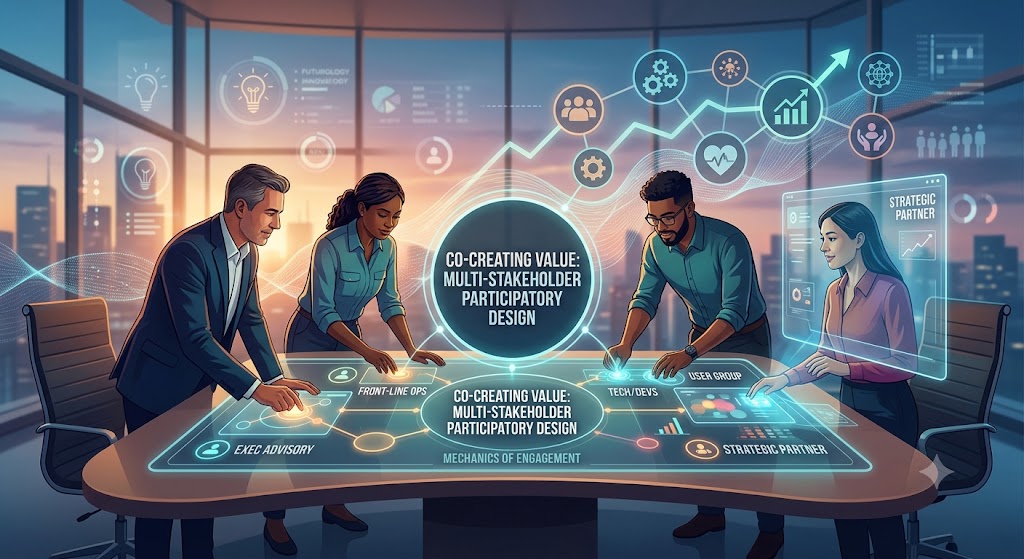
Why Customer Experience (CX) is Nothing Without Augmented Employee Experience

Designing the AX

Why Customer Experience (CX) is Nothing Without Augmented Employee Experience

GUEST POST from Chateau G Pato

Designing the AX: Why Customer Experience (CX) Is Nothing Without Augmented Employee Experience

Organizations globally pour billions into perfecting the front-end Customer Experience (CX). We map journeys, polish digital interfaces, and orchestrate brand touchpoints with meticulous precision. Yet, despite this massive investment, customer satisfaction frequently stagnates or plummets the moment a situation veers off-script. The glossy facade cracks because businesses continue to treat CX as an isolated, external objective.

The reality is that customer experience does not exist in a vacuum; it is a lagging indicator of your internal reality. CX is directly powered by the living, breathing employees tasked with delivering it. When the internal tools, workflows, and processes handed to employees are fragmented, manual, and deeply frustrating, that operational friction inevitably bleeds through to the customer.

To fix the external, we must radically reimagine the internal. This requires moving far beyond traditional Employee Experience (EX)—which has historically focused on superficial perks, workplace culture, and annual engagement surveys—and shifting toward Augmented Employee Experience (AX). AX is the deliberate, human-centered design of an ecosystem where technology, artificial intelligence, and streamlined processes act as extensions of human capability rather than sources of administrative drag. It is about removing cognitive load, eliminating systemic friction, and empowering people with the real-time insights they need to excel.

If you want to design an unforgettable customer experience, you must first design an augmented employee experience. True innovation begins from the inside out: design the AX, and the CX will follow.

I. Shift from EX to AX: What It Means to “Augment” the Worker

For over a decade, human resource professionals and executive leadership teams have rallied around the banner of Employee Experience (EX). Millions have been invested in open-concept office environments, high-end breakroom perks, wellness apps, and annual engagement surveys. While well-intentioned, traditional EX largely treats the symptoms of workplace dissatisfaction rather than its operational disease. A beautifully designed corporate campus or a monthly pulse survey cannot compensate for tools that break, databases that do not talk to each other, or bureaucratic bottlenecks that stifle human potential.

To unlock real organizational agility, we must transition from EX to Augmented Employee Experience (AX). AX shifts the lens from superficial contentment to core empowerment. It is the intentional design of digital and physical workspaces where human-centered change management converges with advanced technologies—such as predictive AI, automated knowledge routing, and collaborative workspaces. The objective of AX is simple: engineer an internal ecosystem where systems actively pull the administrative weight, allowing workers to perform at their absolute highest capacity.

Crucially, AX is not synonymous with automation. Automation is often driven by a cost-cutting imperative to remove the human from the loop entirely. AX, by contrast, is an investment in human capability. It marks the deliberate onset of what I call the cyborg transition—a collaborative state where technology does not replace the worker, but instead wraps around them to strip away cognitive load, data retrieval delays, and rote administrative drag.

When we deliberately design to augment rather than replace, we achieve the ultimate goal of experience architecture: freeing the workforce to focus on uniquely human traits. By delegating the analytical and mechanical heavy lifting to an augmented infrastructure, employees regain the mental bandwidth required to exercise creative problem-solving, strategic judgment, and deep, unhurried empathy.

II. The Symmetric Connection: How Flawed AX Sabotages CX

There is an unbreakable symmetry between the internal employee experience and the external customer experience. In experience design, this is the law of structural reflection: whatever fractures exist within your internal architecture will eventually express themselves as defects in your customer interactions. When leadership ignores the design of the employee workspace, they actively, albeit unintentionally, sabotage the brand promise.

The primary culprit of this sabotage is cognitive drain. Every time an employee is forced to switch contexts between fragmented software platforms, reconcile conflicting data across multiple legacy systems, or manually bypass a broken process, they expend valuable cognitive energy. Human focus and emotional reserves are finite resources. If an employee spends eighty percent of their mental capacity simply fighting their tools to get things done, they only have twenty percent left to focus on the actual human being standing in front of them or on the other end of the line.

This structural depletion causes a severe emotional spillover. Frustrated, exhausted, and hamstrung employees cannot deliver delightful, empathetic customer experiences. It is physically and psychologically impossible to project a warm, seamless brand experience when your immediate reality is chaotic, clunky, and rigid.

Consider how these friction points manifest in everyday real-world interactions:

  • The Support Agent Paradox: A customer calls with a complex problem, expecting an efficient resolution. Instead, they are placed on repeated holds. The friction isn’t a lack of agent willingness; it is the fact that the agent must navigate three separate legacy databases and a manual approval queue just to locate a single customer record.
  • The Frontline Impasse: A retail worker or service provider interacts directly with a client who requires a common-sense modification to a policy. Because internal operational silos are rigid and punitive, the worker has no authority or technological flexibility to act. They are forced to deliver a cold “no,” not because they lack empathy, but because their tools and governance prevent them from executing an equitable outcome.

When companies treat AX as a secondary operational concern, they pull the rug out from under their own CX investments. A customer-centric culture cannot thrive on top of a hostile internal infrastructure.

III. Moving Beyond Metrics: From SLAs to XLMs (Experience Level Measures)

You cannot manage what you do not measure, but more importantly, you cannot design transformation if you are measuring the wrong things. For decades, corporate IT, operations, and human resource departments have been governed by Service Level Agreements (SLAs). These metrics look great on dashboard line items: system uptime percentages, average ticket resolution times, and server processing speeds. Yet, this reliance on traditional SLAs hides a dangerous corporate illusion—the green-dashboard trap.

The green-dashboard trap occurs when every operational metric indicates optimal performance (all lights are green), yet the workforce is quietly drowning in administrative friction. An IT department might proudly report that a password reset or database query “resolved in under 24 hours,” hitting its SLA perfectly. Meanwhile, the employee was blocked from helping a customer for an entire business day. Traditional SLAs measure mechanical output and system availability; they completely fail to capture human sentiment, cognitive interruption, or the emotional toll of broken workflows.

To design a functional Augmented Employee Experience, progressive enterprises must transition from rigid SLAs to human-centric Experience Level Measures (XLMs). Where an SLA tracks the technical execution of a process, an XLM serves as a diagnostic tool designed to measure the true impact of internal tools, architectures, and automated changes on the employee’s mental well-being, clarity, and operational empowerment.

Shift in Paradigm: Traditional SLA: “Was the database accessible 99.9% of the time?”
vs. Modern XLM: “Did the database configuration actively minimize cognitive load and allow the employee to resolve the customer’s issue confidently on the first attempt?”

By explicitly map internal XLMs directly to external customer metrics—such as Net Promoter Score (NPS) or Customer Effort Score (CES)—organizations can conclusively demonstrate the true financial and cultural ROI of investing in AX. When you reduce internal friction and track experience as a core health metric, you provide employees with the seamless environment required to sustain an exceptional external brand presence.

IV. The Framework for Designing AX

Architecting a sustainable Augmented Employee Experience requires more than introducing a suite of modern digital tools. It demands a structured, intentional methodology. True AX transformation can only be realized by combining human-centered change management with collaborative, visual frameworks that map out the internal journey with the exact same rigor typically reserved for external customers.

To successfully design and deploy an AX strategy, leaders must focus on a three-pronged whole-system view:

  1. Journey Mapping the Internal Workflow: Just as we build detailed personas and touchpoint maps for buyers, we must utilize tools like an Experiment Canvas or internal journey blueprints for our workforce. Leaders need to trace an employee’s daily workflow to uncover where information drops, where tool switching causes cognitive friction, and where data silos stall progress.
  2. Sustaining a Whole-System View: Technology cannot be dropped into an organization in isolation. A truly augmented experience accounts for the fluid interplay between technology (the digital systems), space (physical or hybrid environments), culture (the behavioral norms), and process (the steps required to achieve an outcome). Adjusting one without aligning the others creates systemic rejection.
  3. Cultivating Psychological Safety & Adaptation: Rapid digital transformation introduces profound cognitive disruption. When implementing advanced systems—whether it is machine learning triage or automated workflow routing—leaders must deliberately design coping mechanisms and clear learning paths into the change strategy. This ensures that change fatigue is mitigated, psychological safety is preserved, and the workforce is granted a soft landing as they adapt to new operational realities.

When organizations leverage cross-functional, visual tools to plan out these touchpoints, they break down the traditional walls between IT, HR, and Operations. The result is a highly aligned infrastructure designed to actively support the human being tasked with driving the business forward.

V. The Future of Work: The Co-Creation of Value

As we look toward the horizon of corporate evolution, the traditional boundaries that have long segregated enterprise operations are rapidly dissolving. The future workplace will not be characterized by distinct, isolated interactions between an employee and a customer, or a user and a static piece of software. Instead, futurology points toward a dynamic, integrated ecosystem where the boundaries between the employee, the customer, and intelligent systems blur into a singular, continuous loop of value creation.

In this oncoming era, organizations must embrace the principle of democratic innovation. Historically, internal tools and digital environments have been handed down from on high—designed by detached corporate IT departments or purchased by procurement teams completely removed from the daily realities of the frontline. This top-down approach is a relic of legacy management. To build a highly responsive Augmented Employee Experience, the individuals closest to the actual work must be given the agency, the visual frameworks, and the low-code or AI-assisted capabilities to actively co-create their own AX tools.

Value within an enterprise is co-created symmetrically. When frontline employees are empowered to continuously shape, refine, and optimize their own digital environments, they are not merely improving their personal productivity. They are actively tailoring the machinery of the business to respond more fluidly to real-time customer needs.

The future of work does not belong to corporations that treat their workforces as passive operators of rigid software. It belongs to progressive, human-centered enterprises that treat their workforce as collaborative experience architects. By democratizing the evolution of AX, we ensure that as our tools grow more intelligent, our organizations grow more fundamentally human.

Conclusion: A Call to Action for Progressive Leaders

True, sustainable brand differentiation is never built on a glossy marketing veneer, a clever advertising campaign, or a slick mobile application. While those elements may attract initial interest, they are fragile. True differentiation is anchored deep within the enterprise—in an enabled, energized, and augmented workforce that possesses the cognitive freedom and systemic backing to delight customers consistently, even when situations become highly complex.

For progressive leaders, the mandate is clear: it is time to stop treating employee software, internal platforms, and operational workflows as mere administrative overhead to be minimized by procurement. We must start treating internal employee infrastructure as the primary engine of customer satisfaction and corporate growth. When you starve your internal systems of human-centered design, you are directly starving your customer experience.

The choice before modern leadership is not whether to adopt advanced technologies, but how to deploy them. If you deploy automation purely to reduce headcount or cut transaction costs, you create a sterile, rigid environment where customer friction thrives. But if you deploy technology to augment the individual—to remove administrative drag, dissolve data silos, and protect psychological safety—you unleash the true creative and empathetic potential of your organization.

If you want to radically transform the customer experience, stop looking outward. Look inward first. Design the AX, and the CX will inevitably follow.

Frequently Asked Questions (FAQ)

1. What is the fundamental difference between Employee Experience (EX) and Augmented Employee Experience (AX)?

Traditional Employee Experience (EX) generally focuses on peripheral culture, workplace satisfaction, and benefits—such as wellness perks, environment design, and engagement surveys. Augmented Employee Experience (AX), by contrast, is an intentional, human-centered architectural practice. AX deliberately integrates technology, artificial intelligence, and streamlined operational flows to strip away cognitive load, automate administrative drag, and actively augment the worker’s capability to perform high-value, empathetic tasks.

2. Why is Customer Experience (CX) dependent on the internal design of AX?

Customer Experience is a structural reflection and lagging indicator of your internal reality. When employees must battle fragmented software systems, rigid data silos, and bureaucratic friction, their finite cognitive and emotional energy is depleted. This systematic internal exhaustion creates negative emotional spillover, making it operationally impossible for frontline workers to deliver seamless, fast, and deeply empathetic customer touchpoints.

3. What are Experience Level Measures (XLMs) and how do they replace traditional SLAs?

Service Level Agreements (SLAs) measure technical and mechanical outputs, such as platform uptime or standard system resolution times. Experience Level Measures (XLMs) are human-centric diagnostic tools designed to measure the true sentiment, cognitive impact, and friction forced onto an employee by an internal workflow or system change. XLMs shift the focus from machine capability to human enablement, mapping internal operational ease directly to external customer satisfaction metrics.

Bottom line: Futurology is not fortune telling. Futurists use a scientific approach to create their deliverables, but a methodology and tools like those in FutureHacking™ can empower anyone to engage in futurology themselves.

Image credit: Pexels

Subscribe to Human-Centered Change & Innovation WeeklySign up here to get Human-Centered Change & Innovation Weekly delivered to your inbox every week.