The Meritocracy Myth
GUEST POST from Chateau G Pato
The Mirage of the Level Playing Field
We love to believe that our organizations are built on a simple, comforting promise: if you work hard, contribute your best ideas, and put in the effort, you will succeed. This is the seductive allure of meritocracy. It’s a beautiful narrative that paints corporate progression as a perfectly balanced scale, weighing talent and exertion to distribute rewards with flawless precision.
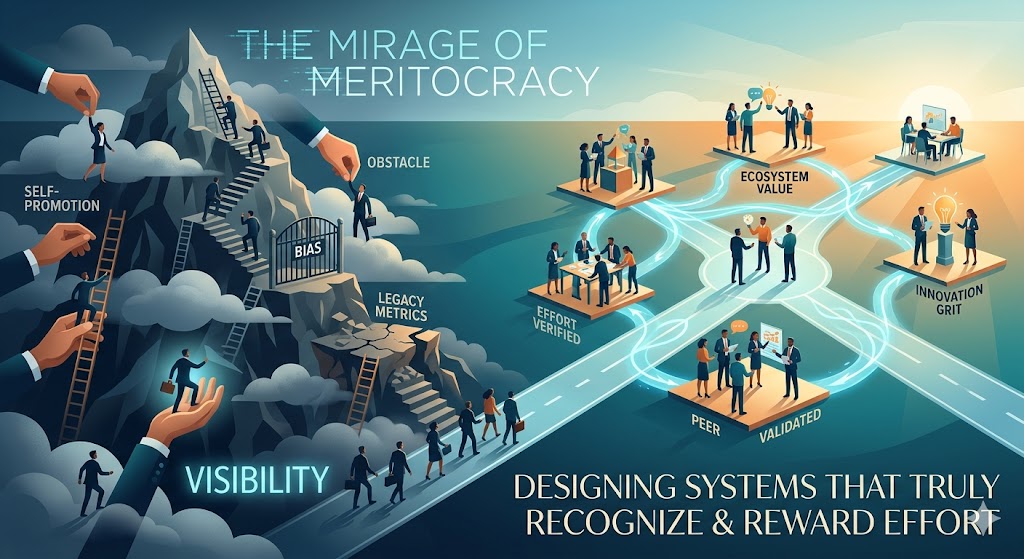
But if we peel back the layers of modern corporate architecture, the reality is far less elegant. The systems we rely on to judge “merit” are rarely objective. Instead, traditional performance management frameworks are accidentally optimized to measure visibility, self-promotion, and political maneuvering rather than actual, sustained effort. We have created environments where the loudest voice in the room eclipses the deepest thinker, and where navigating institutional bias matters more than delivering genuine value.
The Cost to Continuous Innovation
As an innovation and change management strategist, I look at this systemic failure through a specific lens: what is this doing to our collective creative potential? True, breakthrough innovation requires absolute psychological safety and an environment that actively embraces cognitive diversity. When an organizational ecosystem rewards the most privileged path or the flashiest presentation over the grit of real problem-solving, innovation chokes.
Employees quickly realize that the game is rigged toward optics. As a result, they stop taking risks. They stop bringing their authentic, divergent ideas to the table, and they pivot their energy from doing great work to ensuring they are seen doing work. The organization enters a state of creative stagnation, all while leadership wonders why their expensive innovation initiatives are failing to yield results.
Redesigning the Human Experience
We cannot solve 21st-century innovation challenges with industrial-era appraisal systems. To unlock the full spectrum of human potential, we must fundamentally shift our approach. We have to move away from the lazy assumption that a fair meritocracy happens by accident, and instead intentionally design an organizational ecosystem that measures, recognizes, and rewards holistic human contribution. This article is a blueprint for that transformation — a guide for progressive leaders ready to dismantle the myths and architect systems where equitable outcomes ensure that rewards are directly and transparently relative to true effort.
Deconstructing the Myth: Why Current Systems Fail
To fix a broken system, we must first understand exactly how it is failing the people inside it. Most performance evaluation frameworks were built for a predictable, industrial world where tracking physical outputs was easy. Today, in an era defined by knowledge work, digital transformation, and collaborative ecosystems, those linear metrics are entirely obsolete. By relying on legacy structures, organizations have inadvertently codified bias, rewarding behaviors that damage company culture while leaving true value unrecognized.
The Visibility Bias and Corporate Theater
Perhaps the most glaring flaw in modern corporate environments is the “Visibility Bias.” Traditional appraisal systems are heavily weighted toward what leadership can actively see. This creates an environment of corporate theater, where employees are forced to spend significant energy marketing themselves rather than executing their actual roles.
We see this manifest in the celebration of the loudest voice in meetings, the relentless self-promotion on internal communication channels, and the hoarding of high-profile projects. When systems prioritize optics over outcomes, the introverted, deep-thinking, and hyper-focused executors are marginalized. The organization stops being a meritocracy and instead becomes a market for the best self-promoter.
The Proximity Penalty in Distributed Environments
The rapid shift toward hybrid and remote work models has exacerbated these systemic flaws, introducing a new challenge: the “Proximity Penalty.” Despite leaders claiming that location doesn’t matter, human nature and out-of-sight, out-of-mind biases tell a different story.
When managers evaluate talent based on unstructured observations rather than objective, behavior-based rubrics, those who physically sit closer to leadership gain an unfair advantage. They receive more impromptu mentoring, get pulled into ad-hoc strategic conversations, and project an illusion of greater effort simply through physical presence. Meanwhile, remote contributors who may be working with higher efficiency and fewer distractions face a career stagnation tax entirely unrelated to their merit.
Siloed Metrics vs. Ecosystem Value
Modern business challenges are complex and require deep cross-functional collaboration, yet our reward structures remain fiercely individualistic. Standard Key Performance Indicators (KPIs) isolate individuals into narrow silos, forcing them to compete against their peers for a fixed pool of rewards.
This creates a devastating blind spot: the failure to recognize “glue people.” Glue people are the vital contributors who build bridges across departments, mentor junior talent, diffuse conflict, and elevate the performance of everyone around them. Because their contribution isn’t captured on a localized, individualistic dashboard, they are often penalized during review cycles for not hitting rigid, isolated targets — even though the ecosystem would collapse without them.
The Innovation Paradox
Finally, traditional merit-based frameworks create an impossible paradox for organizations that claim to value innovation. Innovation requires experimentation, and experimentation inherently involves a high probability of failure.
When a system only rewards tidy, linear successes and predictable, incremental gains, it actively discourages risk-taking. Employees who propose bold, disruptive ideas and execute them flawlessly — only to have the market or the technology shift beneath them — are frequently penalized under standard review systems. By treating a well-executed, strategic failure the same as incompetence, organizations build a culture of compliance and safety, effectively killing their own long-term survival prospects.
The Human-Centered Design Framework for Fair Systems
Dismantling a broken system is only half the battle; the real challenge lies in what we choose to build in its place. To move past the flaws of accidental meritocracies, we must apply the principles of human-centered design to the architecture of our organizations. This means shifting our focus from rigid, bureaucratic procedures to the actual human beings navigating them, ensuring that the systems we create are inherently empathetic, context-aware, and co-created.
Empathy Mapping the Employee Experience
Every system design must begin with deep empathy. In traditional corporate structures, recognition mechanisms are built around a one-size-fits-all persona — usually the highly visible, extroverted individual who thrives in traditional corporate structures. To build a truly equitable framework, we must map out how our current evaluation and promotion pathways are experienced by a diverse range of talent.
How does an introverted software engineer who quietly saves a project from disaster experience your review cycle? How does a working parent navigating a hybrid schedule, or a brilliant contributor from an underrepresented background, experience your recognition tools? By actively identifying the hidden friction points, anxieties, and structural biases that these different personas encounter, we can begin to design out the systemic barriers that prevent true effort from being recognized.
Shifting the Formula: Input + Obstacle
A genuinely fair system requires a fundamental paradigm shift in what we measure. Legacy frameworks look exclusively at outputs — the final revenue number, the shipped product, or the closed deal. While outputs matter, evaluating them in a vacuum ignores the vastly different terrains employees must traverse to achieve them.
To fix this, human-centered systems alter the evaluation formula to look at Input + Obstacle. It is not just about what was achieved, but the context in which it was achieved. For example, an employee who maintains a stable client relationship in a severely under-resourced department, or under volatile market conditions, may be exerting significantly higher effort and demonstrating greater skill than someone hitting a higher target with a massive budget and a tailwind. By factoring obstacles into our rubrics, we ensure that rewards remain relative to the true grit and ingenuity invested.
The Co-Creation Principle
One of the core tenets of participatory innovation is that top-down design is inherently obsolete in complex human ecosystems. When leadership mandates evaluation criteria from behind closed doors, it inevitably leads to a disconnect between corporate metrics and daily operational realities. This top-down imposition breeds cynicism and resistance.
Instead, progressive organizations must adopt the Co-Creation Principle. This involves engaging employees across all tiers and departments to actively participate in defining what “effort,” “collaboration,” and “success” actually look like in their specific roles. When teams help build the rubrics, the criteria naturally align with the real value they provide to the business. More importantly, it shifts the dynamic from an authoritative monitoring exercise to a transparent, shared contract based on mutual trust and ownership.
Actionable Strategies for Changing the System
Philosophy and design frameworks provide the foundation, but changing an organizational culture requires concrete, structural interventions. We must replace vague intentions with deliberate mechanisms that rewire how value is tracked, verified, and rewarded. This means redesigning our metrics, dismantling the dependency on self-promotion, and establishing structures that make bold experimentation safe.
Redesigning the Metrics: Capturing Invisible Contributions
If we want to reward true effort, we have to start measuring what actually matters, not just what is easy to quantify. Organizations must expand their tracking mechanisms beyond individual output metrics to capture the collaborative labor that keeps teams functioning.
A critical tool in this evolution is the deployment of structured Peer-to-Peer recognition frameworks. This is not about superficial “social shout-outs,” but systematic, network-based tracking where team members validate who consistently steps up to unblock technical hurdles, mentors colleagues, or handles the essential “glue work” that prevents projects from derailing. By aggregating these peer signals, leadership can visually map the real anchors of the organization, ensuring that quiet, impactful effort is elevated and rewarded alongside highly visible milestones.
Decoupling Self-Promotion from Progression
Career advancement should never be a marketing contest. To level the playing field, organizations must deliberately separate an individual’s capacity for self-promotion from their professional progression.
This requires implementing highly objective, behavior-based rubrics for advancement. Instead of asking managers to evaluate abstract qualities like “leadership potential” or relying on who speaks up the most in meetings, promotions should be tethered to specific, demonstrable behaviors and verified competencies. When the path forward is governed by clear, verifiable standards rather than subjective impressions, introverted, remote, or historically marginalized talent can advance based on the undeniable merit of their work, without being forced to shout to be seen.
Institutionalizing the “Failure Fund”
If you only reward success, you inevitably incentivize compliance and incrementalism. To foster an environment of continuous innovation, we must design systems that actively de-risk the act of trying something new.
Progressive organizations can achieve this by institutionalizing a “Failure Fund” or dedicated recognition tracks specifically designed for “smart failures.” When a team proposes a bold, well-reasoned hypothesis, executes the experiment flawlessly, and documents the insights — yet the initiative fails due to shifting market dynamics or technological limitations — that effort should be celebrated, not penalized. By treating high-quality experimentation as a core competency and allocating rewards to the grit of the attempt, leaders remove the systemic terror of failure, unlocking the true creative capacity of their workforce.
Futurology: The Next Generation of Workplace Recognition
As we look toward the future of work, the intersection of advanced technology and human-centered design offers an unprecedented opportunity to permanently dismantle legacy appraisal models. We are moving away from bureaucratic, retrospective processes and entering an era of dynamic, real-time ecosystems. By leveraging emerging capabilities responsibly, we can transition from guess-driven management to data-verified equity.
AI as an Equity Partner
The conversation surrounding artificial intelligence in the workplace often centers on automation, monitoring, and efficiency optimization. However, a human-centered future positions AI not as an invasive surveillance mechanism, but as an equity partner designed to expose systemic bias.
Advanced organizational network analysis (ONA) tools can process passive communication meta-data—such as cross-departmental collaboration patterns, document edits, and support queues — to map how value actually flows through an enterprise. By identifying the unsung connective tissue of a company, AI can flag the hidden contributors who anchor critical projects but rarely claim the spotlight. This empowers leadership to proactively intervene, ensuring that the quiet, hyper-efficient engines of innovation are recognized before they experience burnout or seek opportunities elsewhere.
Continuous, Micro-Recognition Ecosystems
The traditional annual performance review is an administrative relic of the 20th century. It relies on the deeply flawed, easily manipulated mechanism of recency bias, reducing a human being’s entire year of effort, learning, and grit into a single, high-stakes negotiation.
The future belongs to continuous, micro-recognition ecosystems. By integrating micro-feedback loops directly into daily digital workflows, recognition becomes an ongoing, organic narrative. Whether it is validating a beautifully refactored piece of code, a brilliantly handled client escalation, or an insightful piece of strategic foresight, feedback should be captured in the moment. This immediate validation creates a transparent, immutable ledger of contribution that reflects the true cadence of modern knowledge work.
The Ripple Effect on Employer Brand
The ultimate byproduct of a system designed to truly recognize and reward effort is a profound, unshakeable competitive advantage. In a highly fragmented talent market, the world’s most exceptional creative problem solvers are hyper-aware of the meritocracy myth; they have experienced the frustration of corporate politics firsthand.
When an organization can demonstrably prove that its advancement pathways are governed by clear, behavior-based rubrics and verified ecosystem value rather than theater, it creates an immense gravitational pull. This radical fairness transforms the employer brand from a marketing slogan into an authentic cultural asset, attracting diverse, high-caliber talent who want to invest their energy where it will actually be seen, valued, and respected.
Conclusion: A Call to Action for Progressive Leaders
Dismantling the meritocracy myth is not an exercise in lowering organizational standards. On the contrary, it is about raising our standards of system design, operational integrity, and leadership accountability. For too long, organizations have hidden behind the lazy assumption that fairness happens automatically, treating equity as a passive byproduct of good intentions rather than an intentional, engineered outcome.
The Mindset Shift From Intention to Architecture
We must come to terms with a fundamental truth: a system that is not explicitly designed to be fair will default to rewarding privilege, proximity, and politics. Shifting away from this reality requires progressive leaders to move past the comforting rhetoric of merit and step into the role of organizational architects.
We must stop asking our people to navigate broken, biased, and opaque advancement structures and instead build transparent ecosystems where rewards are directly, measurably relative to true effort and verified ecosystem value. This shift requires courage — the courage to challenge legacy KPIs, to question who is actually driving value, and to fundamentally rethink how we define and celebrate success.
The Imperative of Human-Centered Systems
Ultimately, innovation is a deeply human endeavor. It cannot be automated, mandated, or forced through an outdated, industrial-era algorithm of corporate survival. If you want extraordinary human outcomes — breakthrough creativity, relentless problem-solving, and sustained agility — you cannot leave the human experience of your workforce to chance.
The choice before us is clear. We can continue to tolerate the corporate theater that drains our collective creative potential, or we can choose to design a future where every contributor knows their grit will be seen, their collaboration valued, and their effort recognized. Let’s stop pretending we have a meritocracy, and let’s start designing one.
Frequently Asked Questions
What is the “Meritocracy Myth” in modern organizations?
The meritocracy myth is the false belief that traditional corporate systems naturally recognize and reward the hardest workers and best ideas. In reality, legacy performance management systems are accidentally optimized for visibility, proximity, and self-promotion, often ignoring quiet execution, deep collaboration, and the true effort required to overcome significant obstacles.
How do we shift from measuring outputs to measuring true effort?
We must change the evaluation formula to look at Input + Obstacle. Instead of evaluating final outcomes in a vacuum, leaders must design behavior-based rubrics and deploy peer-to-peer recognition networks. This allows the organization to factor in the specific difficulties an employee overcame and capture the invisible “glue work” that elevates entire teams.
What does it mean for rewards to be “fair” in an innovation ecosystem?
Fairness does not mean equal outcomes for everyone regardless of input; it means equitable outcomes where rewards are directly relative to true effort and contribution. In an innovation-driven organization, this also means establishing mechanisms like a “Failure Fund” to reward high-quality, smart experimentation, ensuring employees aren’t penalized when a bold risk doesn’t yield a linear success.
Bottom line: Futurology is not fortune telling. Futurists use a scientific approach to create their deliverables, but a methodology and tools like those in FutureHacking™ can empower anyone to engage in futurology themselves.
Image credit: Gemini
 Sign up here to get Human-Centered Change & Innovation Weekly delivered to your inbox every week.