Co-Creating Value
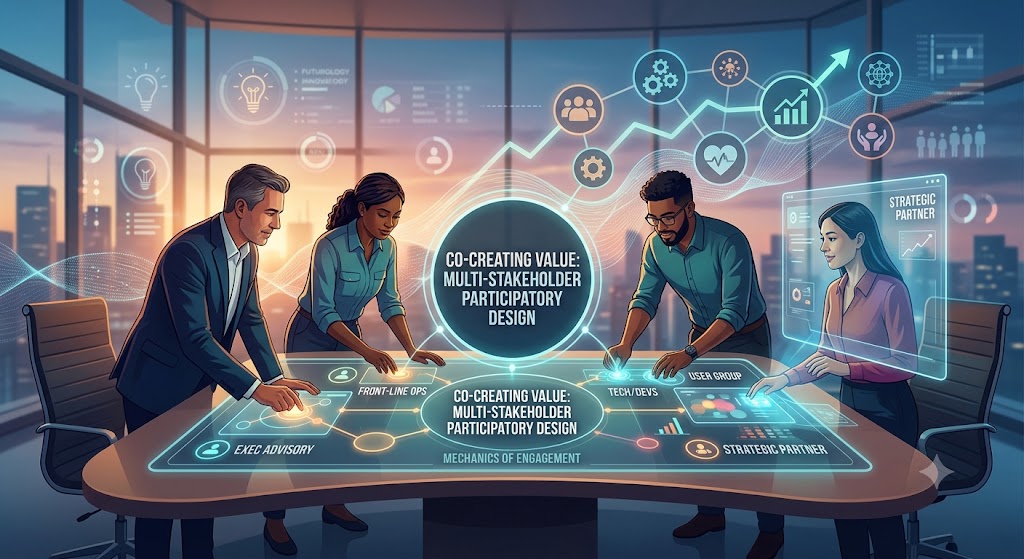
GUEST POST from Chateau G Pato
Beyond the Buzzword of Collaboration
For decades, the standard corporate playbook for innovation has relied on a fundamentally flawed premise: that a select group of experts can sit in an isolated room, design a brilliant solution for a target audience, and then hand it over to a change management team to force implementation. The results are entirely predictable — expensive rollouts, deep-seated organizational resistance, and solutions that fail to survive first contact with real-world complexity. The reality is that top-down mandates are obsolete in a highly distributed, interconnected business ecosystem.
To build truly resilient systems, we must shift from designing for people to designing with them. Multi-stakeholder participatory design is not a feel-good, consensus-driven exercise; it is a rigorous operational strategy. By actively pulling frontline employees, cross-functional partners, compliance teams, and end customers directly into the creation engine, organizations can systematically de-risk innovation, accelerate change adoption, and expose critical blind spots before a single dollar is spent on scaling.
The Core Challenge: Everyone enthusiastically champions the concept of co-creation, but very few organizations actually build the operational infrastructure required to manage conflicting agendas, uneven power dynamics, and the messy data that collaborative design inevitably generates.
Moving from accidental collaboration to intentional co-creation requires more than enthusiasm — it requires a deliberate mechanics of engagement. This article breaks down the structural blueprint needed to transform participatory design from a messy workshop into a scalable, high-yield organizational capability.
I. Alignment & Architecture: Setting the Co-Creation Stage
You cannot launch a successful participatory design initiative on a whim. Without a deliberate architectural foundation, inviting multiple stakeholder groups into the same room quickly devolves into a chaotic airing of grievances or a hollow exercise in design theater. Before the first workshop or collaborative session is designed, you must intentionally map the human ecosystem and establish the rules of engagement.
Mapping the Complete Stakeholder Ecosystem
The most common failure point in collaborative design is myopic stakeholder selection. Teams usually invite the obvious subjects — the external customers and the direct product managers — while completely ignoring the broader internal ecosystem. True multi-stakeholder design requires mapping every group touched by the solution’s lifecycle. This means systematically identifying and bringing in:
- Frontline Workers: The individuals who will actually execute the processes daily and possess unmatched tribal knowledge of current systemic workarounds.
- Cross-Functional Partners: Downstream teams (such as Operations, IT, and Customer Support) whose workflows will be altered by the new design.
- Guardians of Governance: Risk, legal, and compliance teams who are traditionally brought in at the very end to audit (and often veto) finalized concepts. Bringing them in early transforms them from gatekeepers into co-designers.
Neutralizing the Power-Equity Matrix
In any corporate ecosystem, hierarchy casts a long shadow. If a Vice President and a customer service representative are placed in the same co-creation session without structural guardrails, the representative will naturally defer to the executive. The executive’s opinions will be amplified, and the frontline reality will remain hidden.
To capture authentic insight, you must operationally neutralize these power dynamics. This is achieved by designing blind contribution mechanisms, utilizing anonymous digital brainstorming tools, and establishing explicit protocols that evaluate ideas based on empirical merit and alignment to project goals rather than the corporate rank of the contributor. Equity in co-creation means ensuring every participant has an equal voice and an equal platform, regardless of their position on the organizational chart.
Defining Shared Value Outcomes Upfront
Multi-stakeholder design cannot rely on altruism; people must understand what is in it for them to sustain their energy and engagement throughout the messy innovation lifecycle. Organizations must run an alignment exercise at the kickoff stage to explicitly define and document what “value” looks like for each distinct group.
While the business might be looking for a 20% increase in operational efficiency, the frontline employee might be looking for a reduction in daily software fatigue, and the compliance team might be looking for built-in risk mitigation. Recognizing, validating, and designing for these parallel value streams ensures that the final output delivers mutual benefit, securing long-term buy-in and eliminating friction during the eventual rollout.
II. The Operational Toolkit: Mechanics of Engagement
Co-creation fails when it is treated as an unstructured social gathering. When you bring diverse stakeholder groups together without a rigorous operational framework, the loudest voice in the room dominates, and the output becomes superficial. To extract deep, actionable insights from a multi-stakeholder ecosystem, you must deploy a structured toolkit that guides human energy into productive creative channels.
Structured Over Unstructured Collaboration
Open-ended brainstorming — the classic “blank whiteboard and a pile of sticky notes” approach — is highly inefficient. It favors extroverts, lacks direction, and rarely surfaces systemic insights. Instead, participatory design requires highly structured visual frameworks and canvas-based mapping tools.
By forcing stakeholders to interact within defined visual constraints — such as mapping out an explicit customer experience journey layer-by-layer, or utilizing structured innovation canvases — you focus the conversation on specific friction points. Visual canvases act as a universal language that translates abstract ideas into tangible concepts, allowing a software engineer, a frontline customer service agent, and an executive to collaborate on equal footing.
Asynchronous vs. Synchronous Collaborative Rhythms
In a fast-paced corporate environment, demanding hours of synchronous, real-time workshop attendance from busy stakeholders creates scheduling friction and leads to burnout. High-yield co-creation relies on a choreographed cadence that balances live collaboration with independent, asynchronous contribution.
- Asynchronous Contribution: Used for deep reflection, initial data gathering, individual ideation, and reviewing synthesized outputs. Stakeholders contribute on their own time using digital whiteboards, shared documentation, and collaborative feedback loops. This ensures introverted or analytical thinkers have the time to formulate high-quality inputs.
- Synchronous Co-Creation: Reserved strictly for high-leverage activities that require real-time human connection — such as debating critical trade-offs, building consensus, and running live prototyping simulations. These live sessions are kept tight, fast, and intensely focused because the groundwork was already laid asynchronously.
The Role of the Facilitator-Architect
In this operational model, the facilitator is no longer a passive timekeeper or a neutral scribe scribbling on a flipchart. The facilitator must step into the role of a Facilitator-Architect.
The Facilitator-Architect is an active translator and synthesizer. They must possess the business acumen to spot the hidden connective tissue between a complaint from a frontline worker and a strategic goal from a VP. Their job is to actively bridge communication gaps, challenge assumptions, and dynamically synthesize a messy sea of disparate inputs into cohesive, strategic insights that the organization can actually execute.
III. Managing the Messy Middle: Friction, Conflict, and Divergence
The middle phase of any participatory design initiative is inherently volatile. When you bring together diverse stakeholders with competing incentives, friction is not a possibility — it is a guarantee. The operational challenge is not to eliminate this friction, but to build the psychological and structural scaffolding necessary to harness it as a creative catalyst.
Embracing Productive Friction
Traditional corporate cultures treat conflict as an operational failure to be quickly suppressed or smoothed over with vague compromises. In participatory design, however, conflict is a rich source of raw data. When a compliance officer and a software developer clash over a feature, that tension exposes an underlying systemic truth about organizational risk and technical feasibility.
The goal is to channel this energy away from personal friction and toward productive, conceptual friction. By depersonalizing the debate and focusing purely on the systemic constraints or user needs being challenged, teams can use these moments of tension to unearth latent insights that a more harmonious, compliant group would completely miss.
The Convergence Engine
Allowing stakeholders to diverge and generate a wide pool of ideas is easy; bringing them back together into a single, actionable solution is where most collaborative efforts stall out. To prevent decision paralysis, organizations must deploy a transparent, objective “convergence engine.”
This engine relies on predefined operational mechanisms to filter, prioritize, and narrow down concepts without alienating the participants who proposed them. Rather than relying on arbitrary executive edicts, the group passes ideas through structured evaluation filters:
- Impact/Effort and Value/Risk Matrices: Visually mapping ideas to separate high-yield quick wins from unrealistic passion projects.
- Weighted Dot-Voting Protocols: Allowing stakeholders to vote based on specific criteria (e.g., impact on customer experience level measures) rather than personal preference.
- Scenario Testing: Running rapid, hypothetical stress tests against real-world operational constraints to let unviable ideas filter themselves out empirically.
Psychological Safety as Operational Infrastructure
You cannot have genuine innovation without vulnerability, and you cannot have vulnerability without absolute psychological safety. If stakeholders fear that sharing a radical idea or pointing out a systemic flaw will negatively impact their career or standing, they will default to safe, generic platitudes.
Psychological safety is not an abstract culture goal; it must be built directly into the session’s rules of engagement. This requires implementing clear behavioral protocols from the outset: explicitly legalizing “constructive dissent,” enforcing equal turn-taking during discussions, celebrating the exposure of flaws during early prototyping, and establishing an environment where ideas are aggressively challenged, but the individuals who proposed them are deeply respected.
IV. From Co-Design to Co-Adoption: Driving Sustainable Change
The ultimate metric of success for any participatory design initiative is not the brilliance of the finalized concept — it is the velocity and sustainability of its actual adoption. Too many innovative designs die on the vine because the creation team hands the blueprints over to a traditional, top-down change management apparatus. By keeping the multi-stakeholder ecosystem actively engaged through the transition from strategy to execution, change ceases to be an event forced upon the organization and instead becomes an organic evolution.
Built-In Change Management and the “Not Invented Here” Antidote
One of the greatest inhibitors of corporate innovation is the “Not Invented Here” syndrome — the natural human tendency to resist, sabotage, or ignore solutions handed down by isolated corporate functions. When frontline staff, operational managers, and cross-functional teams feel that a new system is being imposed upon them from an ivory tower, resistance is inevitable.
Participatory design acts as a structural antidote to this resistance. Because these diverse stakeholders actively helped shape the solution, map the constraints, and design the workflows, they possess deep psychological ownership over the outcome. They are no longer the passive targets of a change management campaign; they are the architects of the solution. When it comes time to roll out the initiative, these participants naturally transform into grassroots champions, driving organic peer-to-peer adoption across their respective business units.
Feedback Loops and Continuous Prototyping
The co-creation process does not stop when the workshop ends or when the initial specification document is signed. To maintain momentum and preserve trust, organizations must establish transparent, continuous validation loops during the implementation phase.
As the design moves through active development and piloting, the core stakeholder group must be brought back in to interact with low-fidelity prototypes and early iterations. These feedback loops ensure that the original intent of the design isn’t lost in technical translation or diluted by engineering constraints. When stakeholders see their feedback actively molding the live product, their commitment to the final rollout intensifies.
Measuring Co-Created ROI: Balancing Hard and Soft Metrics
To justify the operational investment of multi-stakeholder design, organizations must move beyond traditional, lagging financial indicators and implement a holistic measurement framework. Evaluating the return on investment (ROI) of co-creation requires balancing hard operational metrics with human-centric Experience Level Measures (XLMs):
| Measurement Category | Specific Metrics | Strategic Value |
|---|---|---|
| Hard Metrics |
|
Proves the direct reduction of friction, wastage, and resistance during deployment. |
| Human-Centric Measures (XLMs) |
|
Quantifies the baseline lift in organizational innovation capability and long-term cultural resilience. |
The True Value of Co-Creation: By capturing and optimizing for both hard operational efficiencies and soft human experience measures, leadership gains a rigorous, multi-dimensional view of how collaborative design directly de-risks execution and scales organizational capability.
Conclusion: The Future of Organization-Wide Innovation
The days of successful top-down corporate mandates are officially behind us. In a business landscape defined by hyper-complexity, rapid technological shifts, and distributed networks, no single executive or isolated group of experts possesses enough context to design flawless solutions from an ivory tower. Organizations that continue to rely on siloed, insular design processes will find themselves trapped in a costly cycle of high-resistance rollouts, expensive post-launch rework, and widespread employee fatigue.
The Futurist Outlook: Co-Creation as a Core Competency
As we look to the future of organizational design and business strategy, multi-stakeholder participatory design will quickly shift from an occasional, project-based luxury to an absolute baseline requirement. The most resilient and innovative companies of tomorrow will be those that institutionalize these collaborative mechanics — embedding them directly into their Experience Management Offices (XMOs) and standard operating procedures. Co-creation will become a permanent, scalable capability rather than a temporary workshop methodology.
By moving beyond the passive, feel-good buzzword of “collaboration” and implementing a rigorous operational infrastructure—one that maps entire human ecosystems, neutralizes corporate hierarchies with structured canvases, channels friction productively, and balances hard operational metrics with human-centric Experience Level Measures (XLMs) — organizations can tap into a massive well of latent intelligence.
The Strategic Imperative: The path forward requires a fundamental shift in leadership philosophy. To de-risk innovation and build an agile enterprise capable of thriving amidst continuous change, leaders must stop managing change from the top down and start co-creating value from the bottom up and inside out.
Frequently Asked Questions
1. How do you prevent dominant personalities or executives from taking over the co-creation process?
We use structured visual canvases, anonymous digital brainstorming tools, and strict contribution protocols rather than open-ended talking sessions. By focusing on empirical criteria (like impact on Experience Level Measures) and allowing blind submissions, we evaluate ideas based on their merit rather than the job title of the person who proposed them.
2. Doesn’t involving so many stakeholders slow down the initial design phase?
Yes, the initial alignment phase takes more deliberate planning. However, it drastically reduces the overall time-to-value. By identifying operational blockers, compliance issues, and user friction upfront, you avoid the massive, costly delays caused by post-launch rework, rollout resistance, and system rejection. You slow down to speed up.
3. What is the difference between traditional collaboration and participatory design?
Traditional collaboration often amounts to “design theater” — gathering people to give feedback on an already finished concept or asking them what they want in an unstructured brainstorm. Participatory design provides stakeholders with an operational toolkit to actively co-create the structural mechanics, workflows, and solutions alongside the design team from day one.
Put This Into Practice With the Change Planning Toolkit™
The frameworks in this article are part of the Human-Centered Change™ methodology — a visual, collaborative system of 70+ tools built around the Change Planning Canvas™. 26 of the tools come with every copy of Charting Change.
Image credit: Gemini
 Sign up here to get Human-Centered Change & Innovation Weekly delivered to your inbox every week.