The Foundation of High-Risk, High-Reward Innovation
GUEST POST from Chateau G Pato
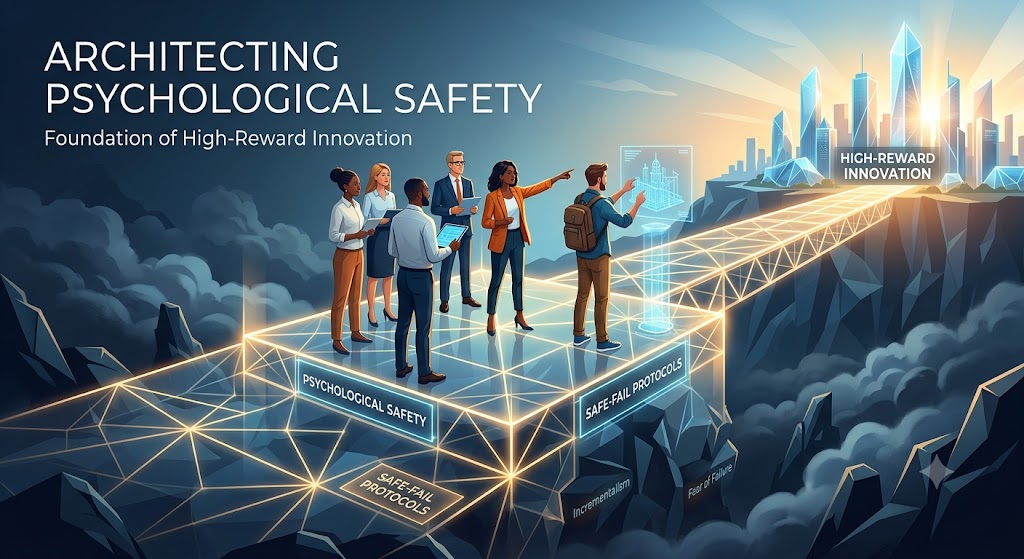
Organizations everywhere are demanding moonshots. Leaders stand on stages decreeing that their teams need to think bigger, disrupt industries, and embrace radical change. Yet, behind the scenes, an unspoken friction paralyzes the pipeline. We ask our people to leap across a chasm of high-risk, high-reward innovation, but we build our corporate infrastructure out of concrete and sharp edges. When they look down, all they see is the penalty for falling.
This is the core paradox of modern business: we crave breakthrough outcomes, but we unconsciously design environments that incentivize incremental safety. True innovation requires people to step into extreme ambiguity, challenge legacy assumptions, and risk public failure. If the human experience of that journey is defined by fear—fear of career stagnation, social friction, or executive blowback—people will naturally default to the path of least resistance. They will deliver optimized versions of yesterday’s ideas.
“Psychological safety is not about creating a soft, consequence-free comfort zone where everyone is polite. It is about architecting a high-performance environment where intellectual friction is intentional, and social friction is actively minimized.”
To unlock continuous, game-changing innovation, we must treat psychological safety not as a vague HR initiative, but as a deliberate architectural requirement. Innovation isn’t just a game of generating ideas; it is the discipline of managing the human experience of change. We don’t need braver employees; we need leaders who design ecosystems where bravery isn’t a prerequisite for speaking the truth.
I. The Human-Centered Architecture of Safety
To design an ecosystem where high-risk innovation thrives, we must view the organization through the lens of experience design. Culture is not an accident; it is the sum of every experience an employee has with a system, a process, or a leader. If we map the typical Innovator’s Journey, we quickly uncover the emotional toll of pushing boundaries.
Think about the exact touchpoints when a team member chooses to voice an unconventional idea, challenge a legacy operational model, or admit that a highly funded pilot is failing. In a poorly designed ecosystem, these moments are fraught with anxiety. The innovator must mentally calculate the social cost: “Will I look foolish? Will my manager see this as a distraction? Am I risking my next promotion?” When the perceived tax on vulnerability is too high, great insights are silenced long before they reach an innovation dashboard.
Designing the “Vulnerability Window”
Architecting safety requires us to intentionally design physical, digital, and cultural spaces that act as a Vulnerability Window. These are structured zones—whether a collaborative workshop, a digital innovation pipeline, or a weekly strategy review—where the traditional corporate hierarchy is explicitly paused. By designing low-friction entry points for dissenting opinions, we lower the personal risk of participation, allowing the best ideas to rise to the surface based on merit rather than organizational politics.
Moving from Fear to Structured Curiosity
The final component of this architecture is transforming how we react to the unexpected. When something goes wrong or an idea challenges the norm, the default corporate reflex is defensive. We must replace this fear response with a repeatable framework of structured curiosity.
Instead of demanding to know “Why didn’t you meet the legacy benchmark?”, human-centered leaders ask: “What did this experiment reveal about where the market is moving?” This simple shift in language reframes the entire human experience. It changes the narrative from an individual defending their value to a collaborative team uncovering a strategic signal.
II. Structural Mechanics: Building the Infrastructure for Risk
Cultural shifts mean very little if your organizational structure still punishes deviation from the norm. To turn psychological safety into a sustainable competitive advantage, we must back up our empathy with hard structural mechanics. Leadership cannot simply ask people to take bigger risks; we must build the operational infrastructure that makes risk-taking rational.
The “Safe Fail” Protocol
The first mechanical layer is the implementation of an explicit Safe Fail Protocol. High-risk exploration cannot survive if it is measured by the same rigid operational KPIs used to judge mature, predictable business lines. We must design isolated sandbox environments—both financial and operational—where teams have a mandate to push boundaries. Within these sandboxes, a “failed” experiment is not a compliance breach; it is a successful extraction of market data. By drawing clear, transparent boundaries around where experimentation lives, we protect the core business while freeing innovators from the paralyzing fear of accidental operational fallout.
Redefining Accountability
True psychological safety doesn’t eliminate accountability; it clarifies it. When a high-risk project misses its commercial target, the legacy corporate mechanism searches for a throat to choke. A human-centered innovation architecture pivots the question entirely. We shift the post-mortem from “Who blundered?” to “What did our design or system allow us to discover, and how quickly can we integrate that signal?” Accountability shifts away from guaranteeing a predictable outcome and moves toward guaranteeing rigorous experimentation, velocity of learning, and transparent communication.
The Portfolio Approach to Safety
Just as we balance risk across a product portfolio, leadership must apply a portfolio mindset to psychological safety itself. Different tiers of innovation require different degrees of environmental insulation.
| Innovation Tier | Risk Level | Required Safety Infrastructure |
|---|---|---|
| Incremental (Core) | Low | Standard continuous improvement loops; low structural insulation needed. |
| Adjacent (Growth) | Moderate | Cross-functional autonomy; ring-fenced budgets to protect exploration from operational cuts. |
| Transformational (Moonshots) | High | Complete Safe Fail Protocols; direct executive air cover; decoupled from standard corporate KPIs. |
By aligning your structural safety mechanics with the specific risk profile of the work, you ensure that radical thinkers have the heavy-duty air cover they need to explore the future, while routine optimizations remain crisp, efficient, and accountable.
III. Overcoming the Change Friction
Every time an organization attempts to install psychological safety, the existing corporate ecosystem fights back. This isn’t due to malice; it is the natural resistance of a system designed for predictability. When you introduce the ambiguity required for high-risk innovation, you trigger the organization’s cultural antibodies. To successfully navigate this transition, we must apply deliberate change management mechanics to dissolve this friction before it stalls our progress.
Neutralizing Cultural Antibodies
Cultural antibodies rarely attack out in the open. Instead, they manifest as passive-aggressive alignment, slow-rolling approvals, or the classic weaponization of process: “That’s a fascinating idea, but it doesn’t align with our current compliance framework.” These unspoken rules and systemic delays silently suffocate high-reward ideas before they ever have a chance to be validated. Human-centered leaders must actively hunt for these friction points, calling them out not as personal failures, but as structural barriers that need to be intentionally dismantled.
Empowering Middle Management
The heaviest friction in any transformation almost always concentrates in middle management. Frontline managers are caught in a brutal vice: executives demand radical innovation, yet their day-to-day compensation and performance reviews are tied to flawless operational predictability.
If a manager feels that championing a team member’s volatile, high-reward experiment puts their own career safety at risk, they will quietly kill it. We must equip middle management with specific tools and air cover—translating “risk” into the language of managed portfolios, and explicitly rewarding them for the velocity of insights their teams uncover, regardless of whether every experiment succeeds.
Co-Creating the Shift
The greatest irony of culture change is attempting to deploy psychological safety via a top-down executive mandate. You cannot force people to feel safe on command. True safety is built through Participatory Innovation—co-creating the new behavioral norms alongside the people who will actually live them.
By engaging teams to help define where the boundaries of the “Safe Fail” zones should sit, and inviting them to co-design the protocols for post-project learning, we replace resistance with active contribution. People do not resist change; they resist being changed. When they own the architecture of their own psychological safety, the cultural friction naturally begins to melt away.
Conclusion: The Ultimate Competitive Advantage
At its core, high-risk, high-reward innovation is not a technology problem, a capital problem, or an intellectual property problem. It is entirely a human problem. Algorithms can optimize what already exists, and capital can fund execution, but the cognitive leaps required to invent the future must be volunteered by people. They must come from human beings who feel secure enough to step away from the comfortable consensus and voice an unproven, volatile truth.
When organizations treat psychological safety as a soft, secondary culture metric, they are fundamentally misunderstanding the physics of change. Safety is the load-bearing infrastructure upon which all radical growth is built. Without it, your brilliant corporate strategies and expansive innovation budgets will only ever produce incremental optimizations—because your people will instinctively realize that the personal cost of a bold failure far outweighs the corporate reward of a breakthrough success.
The challenge for future-focused leaders is clear: stop standing at the front of the room asking your teams to be braver, more creative, or more disruptive. That places the burden of risk entirely on the individual. Instead, pivot your energy toward becoming an architect.
Intentionally design your experiences, structure your safe-fail mechanics, and co-create an ecosystem where bravery isn’t a prerequisite for speaking up. When you build a system where the truth is low-friction, high-reward innovation becomes the natural, inevitable output.
Frequently Asked Questions
1. Does psychological safety mean lowering performance standards?
Absolutely not. Psychological safety and high performance standards go hand in hand. It is not about creating a comfortable, consequence-free zone where accountability disappears. Instead, it is about creating an environment where intellectual friction is encouraged, allowing teams to ruthlessly critique ideas and take massive risks without fearing personal or social retaliation.
2. How do you prevent “Safe Fail” zones from draining corporate resources?
By strictly bounding them through fixed operational parameters, timeframes, and capital limits. A “Safe Fail” protocol is not a blank check for endless experimentation; it is a structured sandbox. The goal is to maximize the velocity of learning while capping the financial and operational blast radius, treating the investment as buying an option on future data.
3. What is the fastest way to identify cultural antibodies in our system?
Look closely at your friction points—specifically where projects stall, why ideas are modified to look more conventional, and how middle managers are compensated. When team members default to passive-aggressive alignment or use compliance frameworks as a shield to slow-roll unconventional ideas, your organizational antibodies are actively rejecting the risk.
Put This Into Practice With the Change Planning Toolkit™
The frameworks in this article are part of the Human-Centered Change™ methodology — a visual, collaborative system of 70+ tools built around the Change Planning Canvas™. 26 of the tools come with every copy of Charting Change.
Image credit: Gemini
 Sign up here to get Human-Centered Change & Innovation Weekly delivered to your inbox every week.