Designing the AX
GUEST POST from Chateau G Pato
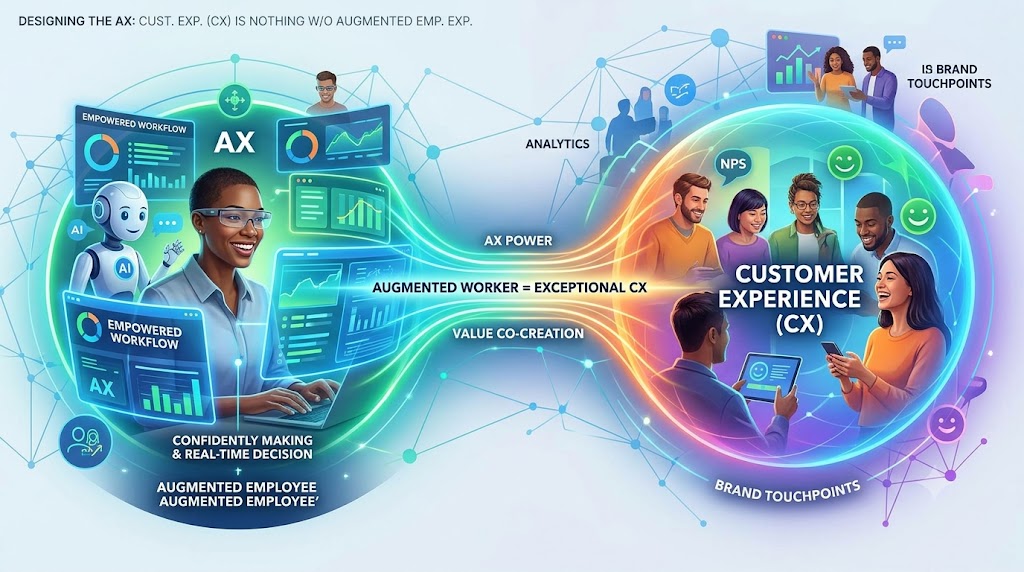
Designing the AX: Why Customer Experience (CX) Is Nothing Without Augmented Employee Experience
Organizations globally pour billions into perfecting the front-end Customer Experience (CX). We map journeys, polish digital interfaces, and orchestrate brand touchpoints with meticulous precision. Yet, despite this massive investment, customer satisfaction frequently stagnates or plummets the moment a situation veers off-script. The glossy facade cracks because businesses continue to treat CX as an isolated, external objective.
The reality is that customer experience does not exist in a vacuum; it is a lagging indicator of your internal reality. CX is directly powered by the living, breathing employees tasked with delivering it. When the internal tools, workflows, and processes handed to employees are fragmented, manual, and deeply frustrating, that operational friction inevitably bleeds through to the customer.
To fix the external, we must radically reimagine the internal. This requires moving far beyond traditional Employee Experience (EX)—which has historically focused on superficial perks, workplace culture, and annual engagement surveys—and shifting toward Augmented Employee Experience (AX). AX is the deliberate, human-centered design of an ecosystem where technology, artificial intelligence, and streamlined processes act as extensions of human capability rather than sources of administrative drag. It is about removing cognitive load, eliminating systemic friction, and empowering people with the real-time insights they need to excel.
If you want to design an unforgettable customer experience, you must first design an augmented employee experience. True innovation begins from the inside out: design the AX, and the CX will follow.
I. Shift from EX to AX: What It Means to “Augment” the Worker
For over a decade, human resource professionals and executive leadership teams have rallied around the banner of Employee Experience (EX). Millions have been invested in open-concept office environments, high-end breakroom perks, wellness apps, and annual engagement surveys. While well-intentioned, traditional EX largely treats the symptoms of workplace dissatisfaction rather than its operational disease. A beautifully designed corporate campus or a monthly pulse survey cannot compensate for tools that break, databases that do not talk to each other, or bureaucratic bottlenecks that stifle human potential.
To unlock real organizational agility, we must transition from EX to Augmented Employee Experience (AX). AX shifts the lens from superficial contentment to core empowerment. It is the intentional design of digital and physical workspaces where human-centered change management converges with advanced technologies—such as predictive AI, automated knowledge routing, and collaborative workspaces. The objective of AX is simple: engineer an internal ecosystem where systems actively pull the administrative weight, allowing workers to perform at their absolute highest capacity.
Crucially, AX is not synonymous with automation. Automation is often driven by a cost-cutting imperative to remove the human from the loop entirely. AX, by contrast, is an investment in human capability. It marks the deliberate onset of what I call the cyborg transition—a collaborative state where technology does not replace the worker, but instead wraps around them to strip away cognitive load, data retrieval delays, and rote administrative drag.
When we deliberately design to augment rather than replace, we achieve the ultimate goal of experience architecture: freeing the workforce to focus on uniquely human traits. By delegating the analytical and mechanical heavy lifting to an augmented infrastructure, employees regain the mental bandwidth required to exercise creative problem-solving, strategic judgment, and deep, unhurried empathy.
II. The Symmetric Connection: How Flawed AX Sabotages CX
There is an unbreakable symmetry between the internal employee experience and the external customer experience. In experience design, this is the law of structural reflection: whatever fractures exist within your internal architecture will eventually express themselves as defects in your customer interactions. When leadership ignores the design of the employee workspace, they actively, albeit unintentionally, sabotage the brand promise.
The primary culprit of this sabotage is cognitive drain. Every time an employee is forced to switch contexts between fragmented software platforms, reconcile conflicting data across multiple legacy systems, or manually bypass a broken process, they expend valuable cognitive energy. Human focus and emotional reserves are finite resources. If an employee spends eighty percent of their mental capacity simply fighting their tools to get things done, they only have twenty percent left to focus on the actual human being standing in front of them or on the other end of the line.
This structural depletion causes a severe emotional spillover. Frustrated, exhausted, and hamstrung employees cannot deliver delightful, empathetic customer experiences. It is physically and psychologically impossible to project a warm, seamless brand experience when your immediate reality is chaotic, clunky, and rigid.
Consider how these friction points manifest in everyday real-world interactions:
- The Support Agent Paradox: A customer calls with a complex problem, expecting an efficient resolution. Instead, they are placed on repeated holds. The friction isn’t a lack of agent willingness; it is the fact that the agent must navigate three separate legacy databases and a manual approval queue just to locate a single customer record.
- The Frontline Impasse: A retail worker or service provider interacts directly with a client who requires a common-sense modification to a policy. Because internal operational silos are rigid and punitive, the worker has no authority or technological flexibility to act. They are forced to deliver a cold “no,” not because they lack empathy, but because their tools and governance prevent them from executing an equitable outcome.
When companies treat AX as a secondary operational concern, they pull the rug out from under their own CX investments. A customer-centric culture cannot thrive on top of a hostile internal infrastructure.
III. Moving Beyond Metrics: From SLAs to XLMs (Experience Level Measures)
You cannot manage what you do not measure, but more importantly, you cannot design transformation if you are measuring the wrong things. For decades, corporate IT, operations, and human resource departments have been governed by Service Level Agreements (SLAs). These metrics look great on dashboard line items: system uptime percentages, average ticket resolution times, and server processing speeds. Yet, this reliance on traditional SLAs hides a dangerous corporate illusion—the green-dashboard trap.
The green-dashboard trap occurs when every operational metric indicates optimal performance (all lights are green), yet the workforce is quietly drowning in administrative friction. An IT department might proudly report that a password reset or database query “resolved in under 24 hours,” hitting its SLA perfectly. Meanwhile, the employee was blocked from helping a customer for an entire business day. Traditional SLAs measure mechanical output and system availability; they completely fail to capture human sentiment, cognitive interruption, or the emotional toll of broken workflows.
To design a functional Augmented Employee Experience, progressive enterprises must transition from rigid SLAs to human-centric Experience Level Measures (XLMs). Where an SLA tracks the technical execution of a process, an XLM serves as a diagnostic tool designed to measure the true impact of internal tools, architectures, and automated changes on the employee’s mental well-being, clarity, and operational empowerment.
Shift in Paradigm: Traditional SLA: “Was the database accessible 99.9% of the time?”
vs. Modern XLM: “Did the database configuration actively minimize cognitive load and allow the employee to resolve the customer’s issue confidently on the first attempt?”
By explicitly map internal XLMs directly to external customer metrics—such as Net Promoter Score (NPS) or Customer Effort Score (CES)—organizations can conclusively demonstrate the true financial and cultural ROI of investing in AX. When you reduce internal friction and track experience as a core health metric, you provide employees with the seamless environment required to sustain an exceptional external brand presence.
IV. The Framework for Designing AX
Architecting a sustainable Augmented Employee Experience requires more than introducing a suite of modern digital tools. It demands a structured, intentional methodology. True AX transformation can only be realized by combining human-centered change management with collaborative, visual frameworks that map out the internal journey with the exact same rigor typically reserved for external customers.
To successfully design and deploy an AX strategy, leaders must focus on a three-pronged whole-system view:
- Journey Mapping the Internal Workflow: Just as we build detailed personas and touchpoint maps for buyers, we must utilize tools like an Experiment Canvas or internal journey blueprints for our workforce. Leaders need to trace an employee’s daily workflow to uncover where information drops, where tool switching causes cognitive friction, and where data silos stall progress.
- Sustaining a Whole-System View: Technology cannot be dropped into an organization in isolation. A truly augmented experience accounts for the fluid interplay between technology (the digital systems), space (physical or hybrid environments), culture (the behavioral norms), and process (the steps required to achieve an outcome). Adjusting one without aligning the others creates systemic rejection.
- Cultivating Psychological Safety & Adaptation: Rapid digital transformation introduces profound cognitive disruption. When implementing advanced systems—whether it is machine learning triage or automated workflow routing—leaders must deliberately design coping mechanisms and clear learning paths into the change strategy. This ensures that change fatigue is mitigated, psychological safety is preserved, and the workforce is granted a soft landing as they adapt to new operational realities.
When organizations leverage cross-functional, visual tools to plan out these touchpoints, they break down the traditional walls between IT, HR, and Operations. The result is a highly aligned infrastructure designed to actively support the human being tasked with driving the business forward.
V. The Future of Work: The Co-Creation of Value
As we look toward the horizon of corporate evolution, the traditional boundaries that have long segregated enterprise operations are rapidly dissolving. The future workplace will not be characterized by distinct, isolated interactions between an employee and a customer, or a user and a static piece of software. Instead, futurology points toward a dynamic, integrated ecosystem where the boundaries between the employee, the customer, and intelligent systems blur into a singular, continuous loop of value creation.
In this oncoming era, organizations must embrace the principle of democratic innovation. Historically, internal tools and digital environments have been handed down from on high—designed by detached corporate IT departments or purchased by procurement teams completely removed from the daily realities of the frontline. This top-down approach is a relic of legacy management. To build a highly responsive Augmented Employee Experience, the individuals closest to the actual work must be given the agency, the visual frameworks, and the low-code or AI-assisted capabilities to actively co-create their own AX tools.
Value within an enterprise is co-created symmetrically. When frontline employees are empowered to continuously shape, refine, and optimize their own digital environments, they are not merely improving their personal productivity. They are actively tailoring the machinery of the business to respond more fluidly to real-time customer needs.
The future of work does not belong to corporations that treat their workforces as passive operators of rigid software. It belongs to progressive, human-centered enterprises that treat their workforce as collaborative experience architects. By democratizing the evolution of AX, we ensure that as our tools grow more intelligent, our organizations grow more fundamentally human.
Conclusion: A Call to Action for Progressive Leaders
True, sustainable brand differentiation is never built on a glossy marketing veneer, a clever advertising campaign, or a slick mobile application. While those elements may attract initial interest, they are fragile. True differentiation is anchored deep within the enterprise—in an enabled, energized, and augmented workforce that possesses the cognitive freedom and systemic backing to delight customers consistently, even when situations become highly complex.
For progressive leaders, the mandate is clear: it is time to stop treating employee software, internal platforms, and operational workflows as mere administrative overhead to be minimized by procurement. We must start treating internal employee infrastructure as the primary engine of customer satisfaction and corporate growth. When you starve your internal systems of human-centered design, you are directly starving your customer experience.
The choice before modern leadership is not whether to adopt advanced technologies, but how to deploy them. If you deploy automation purely to reduce headcount or cut transaction costs, you create a sterile, rigid environment where customer friction thrives. But if you deploy technology to augment the individual—to remove administrative drag, dissolve data silos, and protect psychological safety—you unleash the true creative and empathetic potential of your organization.
If you want to radically transform the customer experience, stop looking outward. Look inward first. Design the AX, and the CX will inevitably follow.
Frequently Asked Questions (FAQ)
1. What is the fundamental difference between Employee Experience (EX) and Augmented Employee Experience (AX)?
Traditional Employee Experience (EX) generally focuses on peripheral culture, workplace satisfaction, and benefits—such as wellness perks, environment design, and engagement surveys. Augmented Employee Experience (AX), by contrast, is an intentional, human-centered architectural practice. AX deliberately integrates technology, artificial intelligence, and streamlined operational flows to strip away cognitive load, automate administrative drag, and actively augment the worker’s capability to perform high-value, empathetic tasks.
2. Why is Customer Experience (CX) dependent on the internal design of AX?
Customer Experience is a structural reflection and lagging indicator of your internal reality. When employees must battle fragmented software systems, rigid data silos, and bureaucratic friction, their finite cognitive and emotional energy is depleted. This systematic internal exhaustion creates negative emotional spillover, making it operationally impossible for frontline workers to deliver seamless, fast, and deeply empathetic customer touchpoints.
3. What are Experience Level Measures (XLMs) and how do they replace traditional SLAs?
Service Level Agreements (SLAs) measure technical and mechanical outputs, such as platform uptime or standard system resolution times. Experience Level Measures (XLMs) are human-centric diagnostic tools designed to measure the true sentiment, cognitive impact, and friction forced onto an employee by an internal workflow or system change. XLMs shift the focus from machine capability to human enablement, mapping internal operational ease directly to external customer satisfaction metrics.
Bottom line: Futurology is not fortune telling. Futurists use a scientific approach to create their deliverables, but a methodology and tools like those in FutureHacking™ can empower anyone to engage in futurology themselves.
Image credit: Pexels
 Sign up here to get Human-Centered Change & Innovation Weekly delivered to your inbox every week.