Monthly Archives: March 2026

Connecting People in a Time of Isolation and Detachment

Connection People in a Time of Isolation and Detachment

GUEST POST from Douglas Ferguson

In today’s fast-paced and increasingly digital world, people often find themselves feeling disconnected from others, both in the workplace and their personal lives. The rise of remote work, the constant bombardment of information on social media, and the divisiveness of politics have only exacerbated these feelings of isolation and detachment. This disconnection is not only detrimental to our well-being but also poses significant challenges for organizations seeking to foster a collaborative and innovative environment. Now, more than ever, we must recognize the importance of fostering connection and nurturing relationships at work to repair the fractures that have formed in our society.

“We are all so much together, but we are all dying of loneliness.”– Albert Schweitzer

By acknowledging the current state of disconnection and actively working to promote understanding, empathy, and collaboration, we can create a more inclusive and productive workplace that benefits everyone involved. In this article, we will explore the consequences of disconnection, the power of connection and understanding, and the role of facilitation in fostering these essential relationships.

The consequences of disconnection

Disconnection can be observed across various aspects of our society. In politics, the polarization of opinions and the entrenchment of viewpoints create a divide that prevents productive dialogue and collaboration. Social media platforms contribute to this divide by amplifying echo chambers, wherein individuals are exposed primarily to information that reinforces their pre-existing beliefs, further deepening the rift between differing perspectives.

Disconnection also permeates the workplace and organizational structures. Within companies, miscommunication, a lack of understanding, and unaddressed conflicts can create disconnects between individuals and teams, hindering progress and innovation. These consequences are not limited to large-scale issues; even seemingly minor incidents, like a disagreement over conference room usage, can cause lasting resentment and erode workplace relationships.

A striking example of the dangerous consequences of disconnection is the recent classified document leaks via Discord. The individual responsible for the breach was motivated by feelings of isolation and a desire for recognition. This act of cyber espionage demonstrates how disconnection and the need for validation can drive individuals to take extreme risks and engage in destructive behaviors.

The consequences of disconnection can even be observed at a cellular level. In a recent Rich Roll Podcast episode, Dr. Zach Bush discussed the origins of cancer originating from cellular disconnection in the human body. When cells become disconnected from one another, they may begin to malfunction and grow uncontrollably, resulting in cancer. This biological phenomenon parallels the societal consequences of disconnection, wherein isolation and detachment can lead to radicalization and unproductive behaviors.

“The eternal quest of the human being is to shatter his loneliness.”– Norman Cousins

The power of connection and understanding

By fostering connection and understanding, we can counter the negative consequences of disconnection and create an environment where growth and collaboration thrive. Research consistently shows that diverse teams perform at higher levels when united by a shared purpose and understanding. Embracing and engaging with different perspectives not only sharpens our own viewpoints but also allows us to innovate and produce better products, services, and solutions.

A sense of belonging and purpose is crucial in the workplace. Employees often cite the team and the people they work with as key factors in job satisfaction. By building genuine connections and strong relationships, employees become more invested in the organization’s mission and feel a deeper commitment to their work. This sense of purpose is amplified when colleagues are able to collaborate effectively, respect each other’s opinions, and find common ground despite their differences.

Teamwork

“Alone we can do so little; together we can do so much.”– Helen Keller

There is extensive evidence supporting the importance of connection and relating at work. For instance, a study published in the Harvard Business Review found that employees who reported feeling more connected at work were more likely to be engaged and productive while also demonstrating higher levels of well-being and job satisfaction (1). Furthermore, research has consistently shown that diverse teams perform at the highest levels thanks to their ability to generate innovative ideas and foster a culture of learning and growth (2).

Several books highlight the significance of connection and relating at work. In “Social: Why Our Brains Are Wired to Connect,” neuroscientist Matthew D. Lieberman explores the ways our brains are hardwired for social connection, emphasizing the importance of developing strong relationships in all aspects of our lives, including the workplace (3). Similarly, in “The Power of Moments: Why Certain Experiences Have Extraordinary Impact,” Chip and Dan Heath discuss how creating meaningful, memorable experiences can foster deeper connections among coworkers and lead to a more engaged and satisfied workforce (4).

Connection and understanding are also vital for creating healthier organizations. Employees who feel connected and supported are more likely to engage in productive behaviors, contribute positively to the workplace culture, and stay committed to the organization’s goals. As a result, fostering connection and understanding not only benefits the individuals involved but also the organization as a whole.

Real-life examples of connection and relationships

Facilitators and leaders play a crucial role in fostering connection, understanding, and relationships within organizations. Creating the conditions necessary for open dialogue and collaboration can bridge divides and encourage growth through diverse perspectives.

Elena Farden is a Voltage Control Certified Facilitator, and her work as the Executive Director (ED) for the Native Hawaiian Education Council provides a compelling example of fostering connection and relationship building. As the ED, she is responsible for advocating for resources and support for Native Hawaiian education: expanding indigenous voices at the federal level.

Elena Farden – Executive Director (ED) for the Native Hawaiian Education Council

One key aspect of her work is anchoring her vision in the connection to the land, with her entire portfolio serving as a metaphor for connection to land with sense of place. In a recent conversation, Elena shared an insightful quote about this connection: “Our connection to the land is the foundation of our identity and purpose. As we nurture this connection, we strengthen our relationships and responsibility to work together for the betterment of our community.”

Elena utilizes the ʻauwai, a Hawaiian irrigation system, as an approach to facilitation. She discussed how one part of the irrigation process involves tempering the water to avoid damaging the crops. This approach resonated with her as an analogy for addressing controversial topics in her work. Elena explained, “Just like the water tempering process, facilitation requires a gentle approach when dealing with sensitive issues. By creating a safe space for open dialogue, we allow for growth and understanding to emerge.”

We Hear you

In her role as the Executive Director, Elena has demonstrated the power of connection and relationships in driving positive change. She has gone to bat for the Native Hawaiian community, facing challenges and building connections between different stakeholders. Through her work, she has shown that fostering relationships and understanding are crucial elements in addressing complex issues and finding solutions that benefit everyone involved.

One of Elena’s most significant achievements has been creating opportunities for collaboration and dialogue between the indigenous community and the government. This has not only facilitated the allocation of resources for Native Hawaiian education but has also strengthened the ties between the two parties. In her words, “When we build connections and relationships with people from different backgrounds, we create a solid foundation for collaboration and understanding. This, in turn, leads to more effective solutions and a stronger sense of our collective responsibility to community.”

Elena’s story is a powerful testament to the importance of connection and relationships in both personal and professional settings. By nurturing these connections, we can create healthier organizations and communities where individuals feel supported, understood, and empowered to reach their full potential.

The South African Truth and Reconciliation Commission (TRC), established in 1995, serves as another powerful testament to the importance of connection and relating in the healing process of a nation. Born out of the wounds of apartheid, the TRC aimed to provide a platform for victims and perpetrators alike to share their experiences and confront the harrowing truth about the country’s violent past. As Archbishop Desmond Tutu, the chair of the TRC, famously stated, “Forgiving and being reconciled to our enemies or our loved ones is not about pretending that things are other than they are… It is about finding a way in which to accept that which happened as that which happened, and then to move beyond it and to be willing to develop a new relationship.”

Through a process of public hearings, amnesty applications, and reparations, the TRC fostered understanding, forgiveness, and, ultimately, reconciliation among South Africans. The public hearings were instrumental in giving voice to the voiceless and allowing individuals to share their stories in a supportive environment. As one survivor, Nomonde Calata, poignantly said during her testimony, “Now that I have told the story, I feel like a great burden has been lifted from my shoulders.”

Despite its achievements, the TRC’s work was not without its challenges and controversies. Critics argue that the commission failed to hold all perpetrators accountable and that the reparations provided were insufficient to address the deep-rooted inequalities that persist in South African society. Nevertheless, the TRC’s efforts showcase the power of human connection in repairing deep-seated divisions and fostering a sense of unity.

By offering a space for individuals to engage with diverse perspectives and confront difficult truths, the TRC played a crucial role in helping South Africa move toward a more inclusive and equitable future. It demonstrated that open dialogue, empathy, and understanding can help build bridges between communities and lay the groundwork for healing.

The lessons learned from the TRC can be applied to various contexts, including personal relationships, community initiatives, and corporate environments. By fostering a culture of open communication and empathetic listening, we can encourage understanding, bridge divides, and create more harmonious relationships both in our personal lives and in the workplace.

In the workplace, facilitators can apply these principles by creating an environment where employees feel safe to express their ideas, engage with diverse perspectives, and collaborate effectively. This can be achieved through active listening, encouraging empathy, and fostering an atmosphere of trust and respect.

“The most basic of all human needs is the need to understand and be understood. The best way to understand people is to listen to them.”– Ralph G. Nichols

Here are some tips for facilitators and leaders to foster connection and relationships at work:

  1. Encourage open dialogue: Foster an environment where team members feel comfortable expressing their opinions and ideas, even if they differ from the majority. Set group agreements or commitments that ensure this openness. By encouraging open dialogue, we create opportunities for understanding and learning, which can lead to more informed decisions and innovative solutions.
  2. Cultivate empathy: Make an effort to understand the perspectives and experiences of others, even if they’re different from our own. By practicing empathy, we can break down barriers, reduce prejudice, and build stronger connections with those around us.
  3. Engage in community-building activities: Participate in initiatives that bring people together, both within your organization and your local community. This could include team-building events, volunteering, or joining local clubs or groups. These activities can help strengthen bonds between individuals and promote a sense of belonging.
  4. Practice active listening: When engaging in conversations, make a conscious effort to truly hear and understand what the other person is saying without judgment or interruption. Active listening helps to build trust and rapport and can lead to deeper connections and more productive discussions.
  5. Be mindful of the language we use: Words have power, and the language we choose to use can either build connection or create division. Be mindful of the words you use in your communication, and strive to choose language that is inclusive, respectful, and empathetic.
  6. Embrace diversity, equity, inclusion, and belonging: Make a conscious effort to create a diverse and inclusive environment where everyone feels valued and included, regardless of their background, beliefs, or perspectives. And lean into conversations and issues of identity, power, privilege, and justice. By embracing these approaches, we can benefit from the rich tapestry of ideas and experiences that each individual brings to the table and create a culture where all team members belong.

The Importance of Connection and Relationships 

The importance of connection and relationships at work cannot be ignored. By recognizing the negative consequences of disconnection and actively working to foster understanding, empathy, and collaboration, we can create a more inclusive and productive workplace that benefits everyone involved.

Facilitators and leaders play a critical role in promoting connection and relationships within organizations. By applying principles of empathy, active listening, and trust, they can bridge divides and encourage a culture of collaboration and growth.

As we continue to navigate an increasingly complex and interconnected world, nurturing connection and understanding at work is essential for building healthier organizations, driving innovation, and creating a more inclusive society.

“Connection is the energy that exists between people when they feel seen, heard, and valued; when they can give and receive without judgment; and when they derive sustenance and strength from the relationship.”– Brené Brown

As we move forward, it’s essential to prioritize connection and relationships at work. Reflect on your own experiences and consider the ways in which you can nurture stronger connections and understanding within your organization. Remember, you have the power to create a positive impact on your team and the overall work environment.

Consider the following steps as you work towards fostering connection and relationships:

  1. Assess your current work environment: Identify areas where you can promote understanding, empathy, and collaboration.
  2. Engage in open dialogue: Encourage open and honest conversations about the importance of connection and relationships within your team.
  3. Seek opportunities for growth: Look for ways to learn from diverse perspectives and foster personal and professional growth for yourself and your team members.
  4. Share your experiences: Share your own experiences of connection and understanding with others, and learn from their stories as well.
  5. Stay committed to the process: Building and maintaining strong connections and relationships takes time and effort. Stay committed to the process and recognize that growth and understanding may not happen overnight.

By actively working to build connection and relationships at work, we can create healthier organizations, foster innovation, and contribute to a more inclusive and equitable society.

Let’s make a conscious effort to prioritize connection, empathy, and collaboration in our workplaces and beyond.

Image Credits: Unsplash, Voltage Control, Elena Farden

Article originally posted at VoltageControl.com

Subscribe to Human-Centered Change & Innovation WeeklySign up here to get Human-Centered Change & Innovation Weekly delivered to your inbox every week.
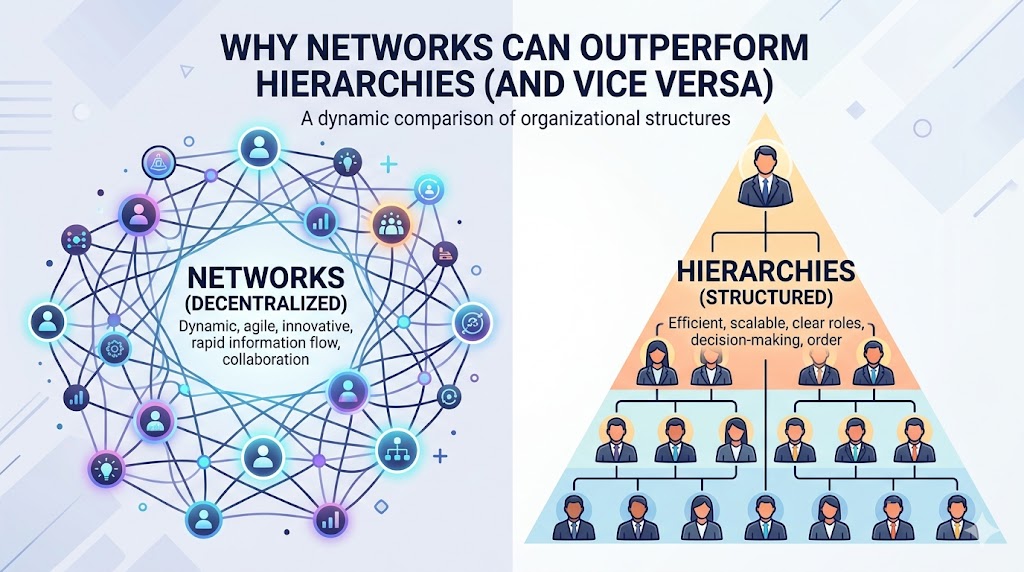
Why Networks Can Outperform Hierarchies

(And Vice Versa)

Why Networks Can Outperform Hierarchies

GUEST POST from Greg Satell

I still remember the bright autumn day in 2014 when I turned off of the main road in Exton, Pennsylvania onto a remote path. I was going to meet Brian J. Robertson, the creator of a hot new “flat” management approach called Holacracy. I was skeptical, because it seemed to be a cumbersome way to go about governance, but I was open to learning about it.

Many companies, most famously Zappos, were enthusiastically adopting it and there was no shortage of hype among the punditry about abolishing hierarchies. Brian, for his part, was gracious and patient with me, explaining how and why everything worked. Still, I had my doubts and remained unconvinced.

Recently, Stanford’s Bob Sutton pointed to Ronnie Lee’s research that confirmed my (and his) suspicions. While flatter structures can promote creativity, we need hierarchies to execute well. The truth is that hierarchies form naturally and, rather than trying to ignore that basic fact, we need to design enterprises with hierarchical networks in mind.

Evolution, Religion and Leadership

It’s become common today for many, especially in the academic world, to dismiss religion as the product of ancient superstition. Yet in The Righteous Mind, social psychologist Jonathan Haidt makes a powerful case that it plays an important evolutionary role. “There is now a great deal of evidence that religions do in fact help groups to cohere, solve free rider problems and win the competition for group-level survival,” he wrote.

So while many pundits often portray bureaucratic hierarchies as an anachronistic byproduct of the industrial revolution, it seems significant that religions tend to have hierarchical structures. Even religious activities that can be done individually, such as Buddhist meditation, are often led by someone who has an elevated group status.

So it stands to reason that hierarchy plays a similar governance role in organizations, helping to coordinate group activity by setting priorities, establishing basic rules and norms and, when needed, providing impetus to change direction and adapt to external events. Clearly, these are essential governance functions in any enterprise.

Many would say that, in an increasingly digital environment that helps us communicate and coordinate across boundaries of time and space, we simply don’t need the same levels of bureaucratic governance that we used to. However, what Professor Lee found in the startups he researched was that the levels of hierarchy increased significantly over the last 50 years, most probably due to the greater levels of complexity involved in work.

It’s important to note that, even after years of hype, it’s hard to find examples of successful non-hierarchical organizations. Even the rare exceptions, such as the Orpheus Chamber Orchestra, aren’t quite as flat in how they organize work as it would first seem. Zappos would eventually back away from Holacracy as would other early adopters, such as Medium.

Hierarchies Are Networks

The term “network” is often misconstrued. In management circles, it is often used to mean an organic, unfathomable, amorphous structure, but really a network is just any system of nodes connected by links. So, in that sense, any conceivable organizational structure is a network, even a typically hierarchical organizational chart.

The important question is what kind of networks do we want our organizations to be? If we look at the evidence from thousands of years of human civilization, we’d have to conclude that some sort of command and control mechanism is needed. At the same time, as our competitive environment becomes more complex, we want information to be able to go to where it is needed without getting stuck in leadership bottlenecks.

A bit of network science can be helpful here. For functional purposes, networks have two salient characteristics: clustering and path length. Clustering refers to the degree to which a network is made up of tightly knit groups while path length is a measure of social distance—the average number of links separating any two nodes in the network.

Ideally our organizational networks would have a high degree of clustering—to promote close collaboration and teamwork—as well as short path lengths so that information can get from one part of the enterprise to any other part with speed and efficiency. Intuitively, it seems like those two priorities are in conflict. However, thanks to some breakthroughs in network science in the late 90s, we know that such “small world” networks are not only achievable, but common.

What’s really important isn’t how your organizational chart is constructed, but how you design for connection and there are some common sense ways to do that.

Understanding Formal And Informal Structures

Every organization has both formal and informal structures. For example, while ostensibly open source communities have little formal organization, in practice they are very hierarchical, with high-status individuals driving the direction of the project. At the same time, even in a formal organization, there are informal relationships as when, say, you work in sales and your brother-in-law works in logistics in a very different part of the company.

Network scientists call people who link disparate networks in an organization boundary spanners and they are crucial for maintaining culture as an organization grows. Once you understand the importance of boundary spanners, you can start redesigning programs and platforms to optimize for connection.

There are a number of ways to network your organization by optimizing organizational platforms for connection. Facebook’s Engineering Bootcamp found that “bootcampers tend to form bonds with their classmates who joined near the same time and those bonds persist even after each has joined different teams.” At Experian, leadership found that a biking club led to boundary spanning collaborations at work, so they helped more clubs to get organized.

One striking example of how even small tweaks can improve connectivity is a project done at a bank’s call center. When it was found that a third of variation in productivity could be attributed to informal communication outside of meetings, the bank arranged for groups to go on coffee break together, increasing productivity by as much as 20% while improving employee satisfaction at the same time.

Perhaps most famously, Steve Jobs designed the headquarters both at Apple and Pixar to encourage random collisions among employees. It seems we’ve been asking the wrong question. The problem isn’t how we dismantle hierarchies, but how we connect them.

Leading Hierarchical Networks

For decades we’ve been hearing that we need to eliminate bureaucracy and break down silos. Yet there is little evidence of any success. In fact, when management guru Gary Hamel, who has been leading the call to “bust bureaucracy,” surveyed readers at Harvard Business Review he found that levels of organization had increased, not decreased.

The inescapable conclusion is that we’ve failed to do away with hierarchies because they serve a useful purpose. We need them. In much the same way, the much maligned “silos” form around centers of capability as a result of close collaboration. These are good things. We don’t want to eliminate them, we want to support and empower them.

So instead of trying to break down silos, we need to connect them. Network science tells us that it takes just a small amount of boundary spanning “random connections,” in order to bring social distance crashing down. We can’t just look at organizational charts, but need to focus on how meaningful relationships form in the real world.

The role of leadership in organizations has changed. It is no longer merely to plan and direct work, but to inspire meaning and empower belief. As I wrote in Cascades, the key to transformational change is small groups, loosely connected by united by a shared purpose. The job of leaders today is to help those groups connect and forge a common purpose.

If we are to lead effectively in an increasingly ecosystem-driven world, we need to empower networked hierarchies.

— Article courtesy of the Digital Tonto blog
— Image credit: Google Gemini

Subscribe to Human-Centered Change & Innovation WeeklySign up here to join 17,000+ leaders getting Human-Centered Change & Innovation Weekly delivered to their inbox every week.


Leading Through Uncertain Times

Leading Through Uncertain Times

GUEST POST from David Burkus

One of the biggest myths in leadership—especially when leading through uncertainty—is that strong leaders always appear rock-solid and unwavering. That they must exude confidence, provide a flawless roadmap, and convince everyone that the future is secure and under control. According to this myth, certainty equals strength, and any expression of doubt is a liability.

But here’s the truth: rigid confidence in a fragile plan is a recipe for disaster.

The act of planning is more important than any one plan. Why? Because when leading through uncertainty, no plan survives its first contact with reality. The philosopher Mike Tyson put it more bluntly: “Everybody has a plan until they get punched in the face.” Whether it’s a global crisis, an unexpected shift in the market, or internal organizational upheaval, uncertainty guarantees that what looked good on paper will eventually fall short.

The real job of leading through uncertainty isn’t about having the right answer in advance—it’s about building the capacity to learn, adapt, and course-correct as events unfold.

The False Confidence Temptation

It’s easy to see why the myth of the all-knowing, confident leader has endured. In high-stress situations, people crave clarity. They want someone to reassure them that everything will be okay. And leaders, sensing that pressure, often feel the need to perform certainty—even if they don’t feel it.

So, they commit early. They communicate loudly. And then when facts change—as they always do in uncertain times—they feel trapped. Trapped by the story they’ve already told. Trapped by the perception of strength they feel compelled to maintain. As a result, they stick to plans that no longer work, hoping their authority will carry the day.

Meanwhile, their teams are watching—and not just watching decisions. They’re watching adaptability. And when leaders don’t adapt, trust begins to erode.

Why False Confidence Fails

Uncertainty exposes the flaws in static leadership. When leaders cling to their original plans, they send an implicit message: “I’m more committed to being right than I am to doing what’s right.”

That mindset doesn’t just limit a leader’s effectiveness—it damages the team’s morale. Employees begin to withhold concerns or ideas because they believe the direction is locked in. They stop offering feedback, stop speaking up, and start disengaging.

Even worse, when a leader projects confidence without substance, it creates false security. Teams may charge forward based on outdated assumptions, only to find themselves caught unprepared when the landscape shifts. In these moments, the cost of inflexibility isn’t just lost opportunities—it’s lost credibility.

But the inverse is also true. When leaders are transparent about what they don’t know, and quick to adjust when new information arrives, they model something far more powerful: humility, agility, and resilience.

Embrace the Discomfort of Not Knowing

Leading through uncertainty begins with a mindset shift: from knowing to learning.

Satya Nadella, the CEO of Microsoft, put it best when he said leaders must move from being “know-it-alls” to “learn-it-alls.” That shift is more than clever. It’s essential. Because when uncertainty hits, your old playbook won’t cut it. The market changes. Customer needs evolve. What worked last quarter may not apply today.

If you’re stuck thinking “I’ve got this figured out,” you’re missing what the moment is trying to teach you.

Great leaders ask great questions: “What are we missing?” “What could go wrong?” “What does the team see that I don’t?” By doing so, they unlock insights that top-down planning alone can’t deliver.

Paradoxically, vulnerability builds trust. When leaders admit they don’t have all the answers, but they’re committed to finding better ones, teams respond with greater openness and creativity. They don’t need their leader to be infallible. They need their leader to be present, curious, and real.

Rehearse for Change, Don’t Just React to It

Uncertainty isn’t a rare event anymore. It’s the default setting.

And in this environment, the most successful leaders don’t just prepare for the known—they rehearse for the unknown.

Think of a quarterback. They don’t memorize a playbook and call it a day. They run drills for dozens of scenarios. They rehearse breakdowns, coverage changes, weather shifts—anything that might happen on game day. Why? Because in high-pressure moments, instinct takes over. Preparation becomes performance.

Leadership is no different. When faced with unexpected change, your ability to pivot comes from prior practice.

That’s why modern leaders rehearse for change. Not just Plan A, but Plans B, C, and D. And they do it with their teams. What if our biggest customer leaves? What if a key supplier goes dark? What if our product suddenly faces a new competitor?

These aren’t pessimistic questions. They’re practical ones. And talking through them isn’t fear-mongering—it’s building resilience.

When teams rehearse together, they’re better equipped to respond together. They know where to go, who needs support, and what priorities must shift. That shared preparedness builds confidence—not in the plan, but in the team’s ability to adapt.

Communicate Early, Often, and Honestly

In uncertain times, silence is dangerous. When leaders don’t communicate, teams don’t relax—they spiral.

The absence of information is rarely interpreted generously. If leaders don’t speak up, people start filling the void with their own assumptions. And human nature being what it is, those assumptions usually lean toward worst-case scenarios.

That’s why leaders must communicate promptly and transparently—even if they don’t have all the answers.

Transparency doesn’t mean having everything figured out. It means being clear about what you know, what you’re doing, and what you’re still working on. The message can be as simple as:

  • “Here’s what’s happening.”
  • “Here’s what we’re doing about it.”
  • “Here’s what we need from you.”

This clarity transforms uncertainty from a threat into a shared challenge. It gives people agency. It builds trust. And it reinforces the most important message a team can hear: “We’re in this together.”

Model Adaptability, Not Perfection

When the world is unpredictable, your leading through uncertainty playbook should be built around adaptability—not perfection.

That means acknowledging when circumstances change. Updating your direction when new facts emerge. And giving your team permission to do the same. It’s not enough to say “we’re agile” in principle. You have to live it in practice.

And perhaps most importantly, you need to create space for your team to learn with you. Ask for input. Share lessons learned. Celebrate smart adjustments, even if they came after a mistake. The goal isn’t to be flawless—it’s to be flexible.

The Real Strength in Leading Through Uncertainty

If there’s one thing we’ve learned from recent years, it’s that the ground will keep shifting. There will always be new disruptions, new challenges, and new unknowns. But the best leaders don’t fear that reality. They prepare for it. They build cultures of learning, resilience, and trust. They lead not by pretending to have all the answers, but by modeling the pursuit of better ones.

Leading through uncertainty isn’t about being the one who always knows. It’s about being the one who always learns. It’s about modeling curiosity, building flexibility, and fostering trust.

Because the truth is, your team doesn’t need a hero with all the answers. They need a human who’s willing to listen, adapt, and learn alongside them.

That’s the kind of leadership that endures—even when the future doesn’t go according to plan.

Image credit: Pexels

Subscribe to Human-Centered Change & Innovation WeeklySign up here to get Human-Centered Change & Innovation Weekly delivered to your inbox every week.


Neo-Feudalism and Innovation Impact

A System Designed to Concentrate Power – or Accelerate Breakthroughs?

LAST UPDATED: March 27, 2026 at 4:55 PM

Neo-Feudalism and Innovation Impact

by Braden Kelley and Art Inteligencia


The Return of Lords and Serfs — But This Time It’s Digital

For decades, we’ve told ourselves a reassuring story about progress. Markets would open. Technology would democratize opportunity. Innovation would decentralize power. The barriers to entry would fall, and with them, the dominance of entrenched elites.

And yet, as we step back and observe the system we’ve actually built, a different pattern begins to emerge. Power is concentrating, not dispersing. A small number of platforms, institutions, and individuals exert outsized influence over how value is created, distributed, and captured. Access — whether to customers, capital, data, or opportunity — is increasingly mediated by gatekeepers.

We may not call them lords. We may not call ourselves serfs. But the structural similarities are becoming difficult to ignore.

This is the uncomfortable premise at the heart of the growing conversation around neo-feudalism: that despite the language of free markets and open innovation, we are drifting toward a system defined less by competition and more by control — less by ownership and more by dependency.

At the same time, we are living through one of the most explosive periods of innovation in human history. Artificial intelligence, biotechnology, climate tech, and digital platforms are reshaping industries at a pace that would have been unimaginable even a generation ago. The capacity to innovate has never been greater.

How can we be experiencing both unprecedented innovation and unprecedented concentration of power at the same time?

Is this concentration a temporary distortion — something the system will eventually correct? Or is it an emergent feature of how innovation now scales in a digital, platform-driven world?

What does this mean for the future of innovation itself?

Because innovation is never neutral. It does not exist in a vacuum. It is shaped — constrained or accelerated — by the systems in which it operates. If those systems are evolving toward something that resembles a modern form of feudalism, then the implications extend far beyond markets and technology. They touch how we work, how we live, how we build wealth, and how we relate to one another.

Before we can assess whether neo-feudalism is helping or hindering innovation, we must first understand what it actually is — and what it is not.

What Is Neo-Feudalism? A Clear, Modern Definition

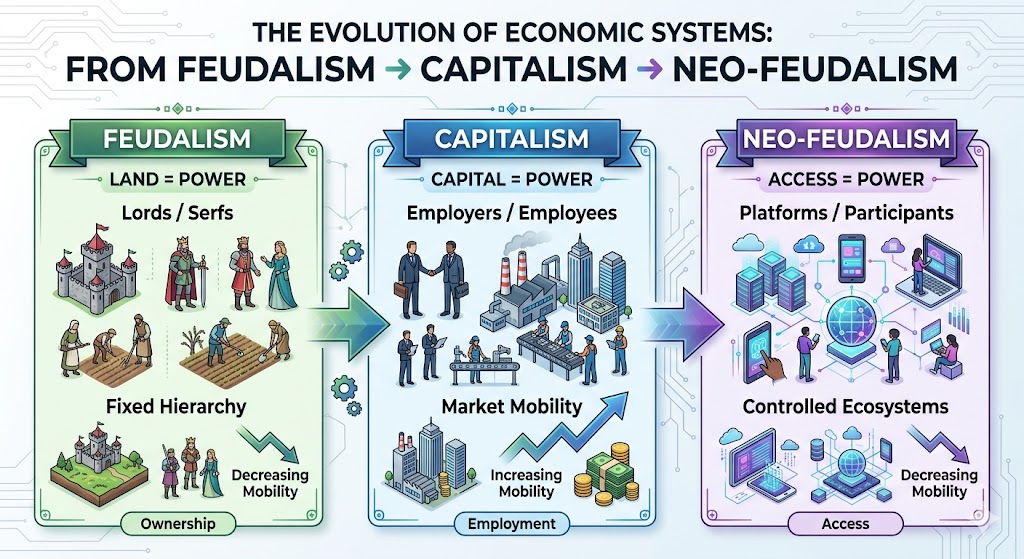
Neo-feudalism is a term increasingly used to describe a modern socio-economic system that echoes the structural dynamics of medieval feudalism, but in a contemporary, often digital, context. While not a perfect one-to-one comparison, the analogy is powerful because it highlights a shift away from open, competitive markets toward systems defined by concentrated power, controlled access, and growing dependency relationships.

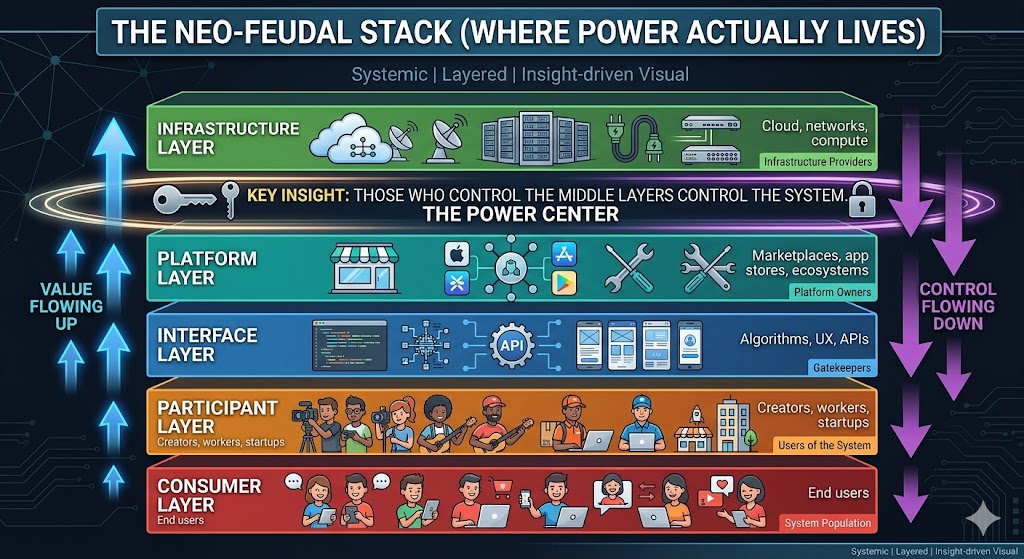
At its core, neo-feudalism describes a world in which a relatively small number of dominant entities — whether corporations, platforms, or institutions — exercise outsized influence over how value is created and distributed. Individuals and smaller organizations, in turn, become increasingly dependent on these entities for access to customers, income, infrastructure, and opportunity.

Several key characteristics define this emerging pattern:

Concentration of Power: Economic and technological power is increasingly concentrated in the hands of a few dominant players, creating asymmetries that are difficult for others to overcome.

Control of Access: Instead of owning “land” in the traditional sense, modern power centers control platforms, ecosystems, and infrastructure — effectively determining who gets access to markets and audiences.

Reduced Mobility: Upward mobility becomes more constrained as success is tied to proximity to, or permission from, these dominant entities.

Dependency Relationships: Workers, creators, and even companies become reliant on platforms and systems they do not control, trading autonomy for access and stability.

This dynamic shows up clearly in today’s economy. Digital platforms function as gatekeepers to visibility and revenue. The gig economy often shifts risk downward while concentrating rewards upward. Ownership — whether of assets, data, or distribution channels — is increasingly replaced by access-based models.

It is important to note that neo-feudalism is not a universally accepted or precisely defined concept. Variations of the idea have emerged to describe different aspects of the same shift.

Techno-feudalism emphasizes the role of large technology platforms in exerting control over digital markets and behaviors. Corporate neo-feudalism highlights the growing influence of multinational corporations as quasi-governing entities. Neo-medievalism points to a broader fragmentation of authority, where power is distributed across states, corporations, and networks rather than centralized in traditional nation-states.

Whether one views neo-feudalism as a precise diagnosis or simply a provocative metaphor, it serves an important purpose: it forces us to examine how power, access, and opportunity are actually structured in the modern economy — not how we assume they function.

And that distinction matters, because the way we define the system ultimately shapes how we understand its impact on innovation.

Evolution of Economics Systems Infographic

What Thought Leaders Are Saying (Pro and Con)

As the idea of neo-feudalism has gained traction, it has sparked a vigorous debate among economists, technologists, and social theorists. Some argue that we are witnessing a fundamental shift in the structure of the economy. Others contend that the term is more metaphor than reality. Understanding this debate is essential, because how we interpret the system shapes how we respond to it.

The “Yes, This Is Neo-Feudalism” Camp

Proponents of the concept argue that capitalism has evolved into something meaningfully different. In their view, markets are no longer truly open. Instead, they are increasingly controlled by dominant platforms that act as gatekeepers, setting the rules of participation and extracting value from those who depend on them.

This perspective suggests that we are moving toward a system where economic power resembles sovereignty. A small number of organizations exert control not just over markets, but over infrastructure, data flows, and even the terms of social interaction. In this view, individuals and businesses operate less as independent actors and more as participants within controlled ecosystems.

Some thought leaders have gone so far as to label this shift “techno-feudalism,” arguing that the owners of digital platforms function much like modern-day lords — owning the “land” on which economic activity takes place and collecting rents from those who operate within it.

The “No, This Is Still Capitalism” Camp

Critics of the neo-feudalism framing argue that while inequality and concentration have increased, the underlying system remains capitalism. Markets still exist, competition still occurs, and individuals are not bound to specific employers or platforms in the way serfs were bound to land.

From this perspective, the term “neo-feudalism” risks overstating the case and obscuring more practical diagnoses such as monopoly power, regulatory failure, or the natural dynamics of late-stage capitalism. These critics argue that using an imprecise metaphor may make the problem feel more dramatic, but less actionable.

They also point out that technological disruption continues to create new entrants and new forms of competition, even in industries that appear highly concentrated.

The Middle Ground: A Useful Lens, Not a Literal System

Between these two poles lies a more nuanced view. In this framing, neo-feudalism is not a literal description of the current system, but a lens that helps illuminate important structural shifts—particularly around power, access, and dependency.

This perspective acknowledges that while we are not returning to medieval conditions, we are seeing the emergence of dynamics that echo them in meaningful ways. The language of neo-feudalism, therefore, becomes a way to surface risks that might otherwise remain hidden behind the more familiar vocabulary of markets and competition.

Ultimately, the debate itself is revealing. The lack of consensus reflects the reality that we are in a transitional moment. The system is evolving faster than our ability to define it, and the labels we use are struggling to keep up.

But regardless of what we call it, the underlying question remains the same: how do these structural shifts influence the way innovation is created, scaled, and distributed?

The Case FOR Neo-Feudalism as a Positive Force for Innovation

At first glance, the idea that neo-feudalism could have a positive impact on innovation feels counterintuitive. After all, concentration of power and dependency relationships seem fundamentally at odds with the open, exploratory nature of innovation. But history — and the present moment — suggest a more complicated reality.

Under certain conditions, the very structures that concentrate power can also accelerate innovation in ways that more distributed systems struggle to match.

Stability Enables Long-Term Investment

One of the defining advantages of concentrated power is the ability to think and act long term. Large, dominant organizations have the resources and stability to invest in high-risk, high-reward initiatives that smaller players simply cannot afford. From artificial intelligence to space exploration to advanced biotechnology, many of today’s most ambitious innovations are being funded and scaled by entities with near-sovereign levels of capital and control.

Platforms as Innovation Ecosystems

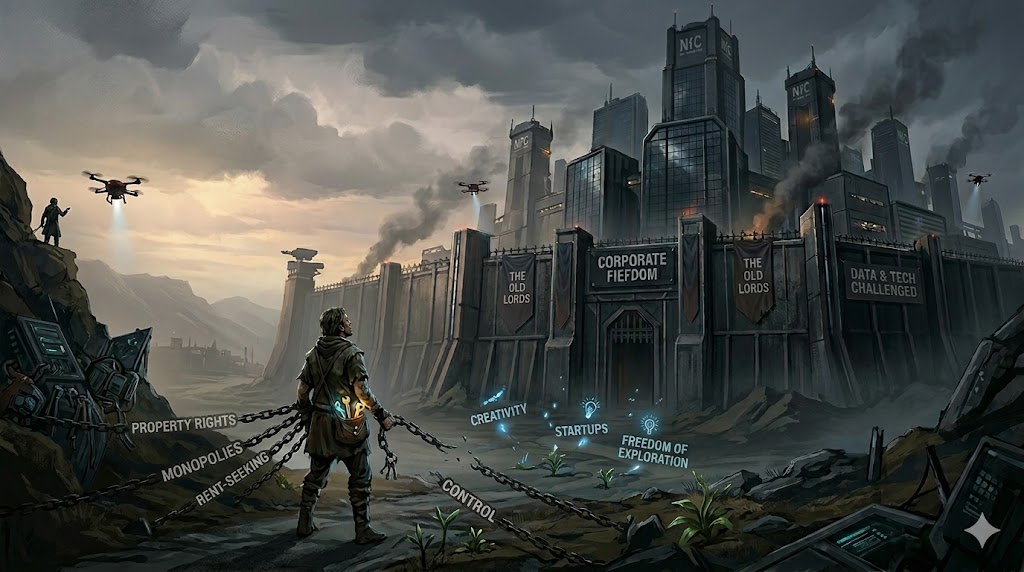
Modern platforms function as structured environments where innovation can occur rapidly. By providing standardized tools, infrastructure, and access to large user bases, they reduce friction for developers, entrepreneurs, and creators. In this sense, innovation happens “inside the castle walls,” where the rules are clear, the tools are accessible, and the pathways to scale are well established.

Talent Aggregation and Network Effects

Concentrated systems tend to attract concentrated talent. The best engineers, designers, and thinkers often cluster around leading organizations and ecosystems, creating dense networks of expertise. These environments increase the likelihood of idea collisions, accelerate learning cycles, and amplify the pace of innovation.

Reduced Coordination Costs

In highly decentralized systems, innovation can stall due to fragmentation, misalignment, and slow decision-making. Centralized structures, by contrast, can move quickly. Decisions are made faster, resources are allocated more efficiently, and large-scale initiatives can be executed without the same level of negotiation or compromise.

This speed can be a decisive advantage in domains where timing matters, from technology development to market entry.

The Rise of Patronage 2.0

In many ways, today’s innovation economy mirrors a modern form of patronage. Venture capital firms, large platforms, and corporate innovation arms provide funding, infrastructure, and distribution in exchange for equity, data, or dependence. While this relationship is not without tradeoffs, it enables individuals and startups to pursue ideas that might otherwise never get off the ground.

For many innovators, aligning with a powerful “patron” is the fastest — and sometimes only — path to scale.

Seen through this lens, neo-feudal dynamics do not simply constrain innovation. They can also create the conditions for rapid advancement, particularly at the frontier of technology.

The question, then, is not whether these structures can produce innovation. Clearly, they can. The more important question is what kinds of innovation they produce — and who ultimately benefits from them.

Neo-Feudal Stack Infographic

The Case AGAINST Neo-Feudalism as a Constraint on Innovation

While concentrated power can accelerate certain kinds of innovation, it can just as easily suppress others. From a human-centered perspective, neo-feudal dynamics introduce structural constraints that limit who gets to innovate, what gets built, and how value is ultimately distributed.

In many cases, the same forces that enable scale at the top create friction, dependency, and invisibility at the edges.

Innovation Becomes Permission-Based

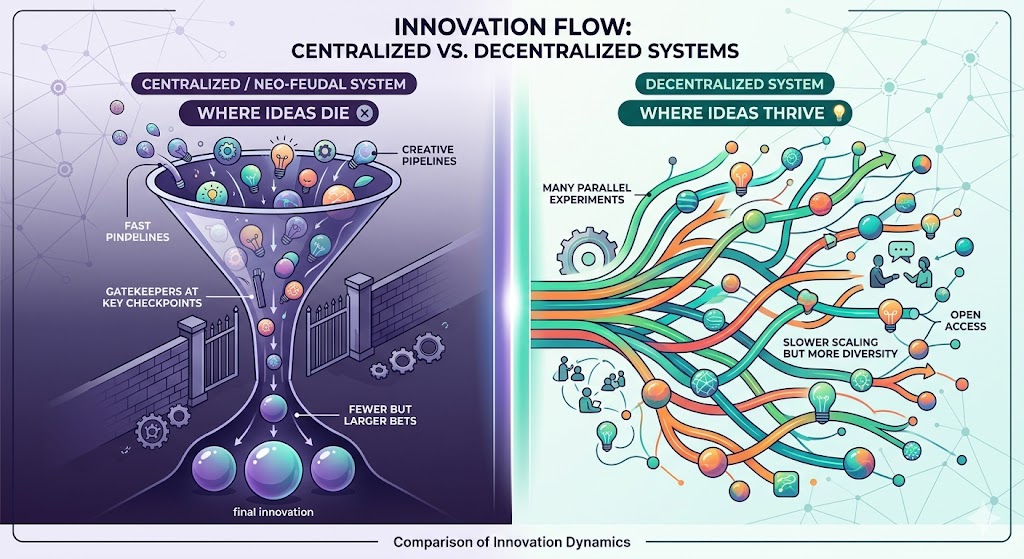
In a neo-feudal system, access is controlled. Platforms, investors, and dominant institutions act as gatekeepers, determining which ideas receive funding, visibility, and distribution. This shifts innovation from an open exploration to a permission-based system, where success depends as much on alignment with gatekeepers as it does on the quality of the idea itself.

The risk is clear: truly disruptive ideas — especially those that threaten existing power structures — may never see the light of day.

Decreased Diversity of Thought

When influence is concentrated within a relatively small group, so too are perspectives. Innovation thrives on diverse viewpoints, lived experiences, and unconventional thinking. But tightly connected elite networks can become echo chambers, reinforcing shared assumptions and filtering out ideas that fall outside the dominant narrative.

The result is a narrowing of the innovation pipeline at precisely the moment when broader input is most needed.

Talent Trapped in Dependency Loops

For many workers, creators, and entrepreneurs, participation in the modern economy requires dependence on platforms they do not control. Income, visibility, and growth are tied to algorithms, policies, and business models that can change without warning.

This uncertainty discourages risk-taking. When livelihoods are fragile, people optimize for stability rather than exploration — reducing the willingness to pursue bold or unconventional ideas.

Extraction Over Creation

As platforms mature, their incentives often shift from enabling value creation to maximizing value capture. Business models become optimized for rent extraction — taking a percentage of transactions, attention, or data — rather than expanding the overall pool of value.

This can distort innovation priorities, encouraging incremental improvements that increase engagement or monetization rather than breakthroughs that create entirely new value.

Hidden Fragility Behind Scale

Highly centralized systems can appear robust due to their size and reach, but they often lack resilience. When innovation is concentrated within a few dominant entities, failures can have outsized consequences. At the same time, alternative approaches and redundant systems are less likely to emerge, reducing the overall adaptability of the ecosystem.

Erosion of the Innovation Commons

Perhaps the most significant long-term risk is the erosion of shared spaces for experimentation and collaboration. As knowledge, tools, and data become increasingly proprietary, the “commons” that historically fueled innovation begin to shrink.

What was once open becomes gated. What was once shared becomes owned. And what was once a collective engine for progress becomes fragmented across competing silos.

From this perspective, neo-feudalism does not just shape innovation — it constrains its potential. It limits participation, narrows possibility, and shifts the balance from exploration to control.

Which raises a deeper question: even if innovation continues, is it the kind of innovation we actually need?

Centralized vs. Decentralized Innovation

Editorial Perspective: Beyond Innovation — Impacts on People, Society, and the Future

Innovation is only one dimension of neo-feudalism’s impact. To understand the full picture, we must examine how these dynamics affect personal finance, customer experience, employee experience, societal cohesion, and the broader trajectory of humanity.

Personal Finance: Ownership vs. Access

Neo-feudal structures often shift value from ownership to access. Individuals increasingly rent rather than own assets — from housing to software, from transportation to digital goods. This reduces opportunities for wealth accumulation and long-term financial security, creating dependency on centralized platforms and institutions.

Customer Experience: Convenience vs. Control

Platforms often deliver seamless, integrated experiences that delight customers. Yet this convenience comes at a cost: reduced choice, limited transparency, and dependence on a small number of dominant providers. What feels like freedom can also become subtle control.

Employee Experience: Flexibility vs. Precarity

The rise of gig work and contract-based employment provides flexibility, but often at the expense of security, benefits, and long-term stability. Workers may gain autonomy but lose agency over income, career trajectory, and participation in the value they create.

Societal Cohesion: Fragmentation vs. Stability

Neo-feudal structures create “walled gardens” — both digital and physical — that fragment communities and weaken shared social identity. The focus shifts from collective well-being to alignment with the dominant gatekeepers, eroding trust and social cohesion over time.

Innovation Paradox

The same structures that accelerate innovation at the top can suppress it at the edges. While resources and talent are concentrated in elite hubs, the diversity, experimentation, and autonomy that fuel broader innovation ecosystems may diminish, limiting society’s overall creative potential.

Ultimately, the question is not whether neo-feudalism can produce innovation —it can. The critical questions are: what kinds of innovation, who benefits from it, and what broader costs are being imposed on society?

Understanding these trade-offs is essential for leaders, policymakers, and innovators seeking to design systems that are not only efficient but also equitable, resilient, and human-centered.

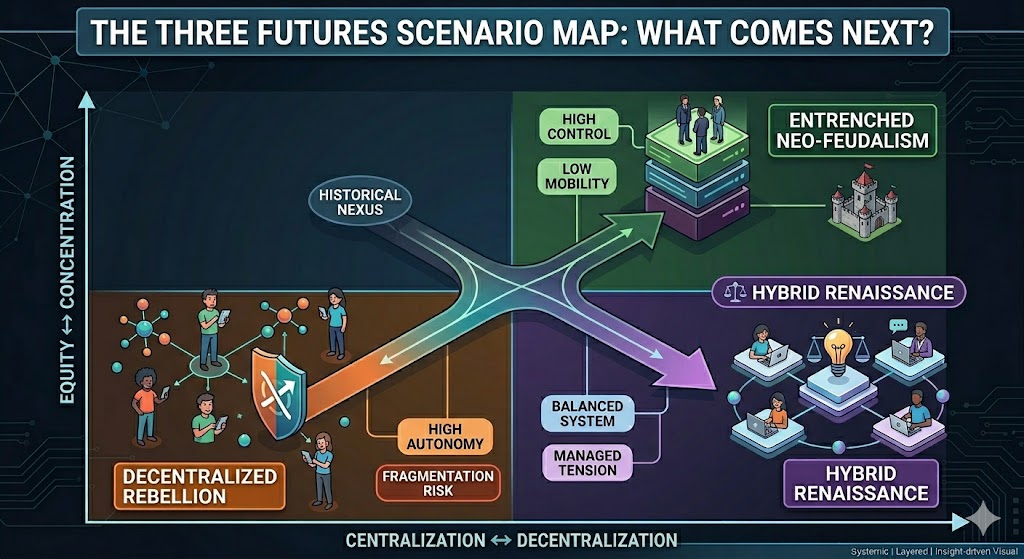
Three Neo-Feudalism Future Scenarios

What Comes Next? The Future of Humanity in a Neo-Feudal Trajectory

Looking ahead, the trajectory of neo-feudalism raises profound questions about the future of innovation, society, and humanity itself. While the current system exhibits both benefits and constraints, the ultimate outcome is not predetermined. Several potential futures are emerging.

1. Entrenched Neo-Feudalism

In this scenario, the concentration of power solidifies. Large platforms, corporations, and institutions become the primary arbiters of opportunity, innovation, and wealth. Innovation continues to occur, but primarily within the bounds set by dominant entities, reinforcing dependency and inequality.

2. Decentralized Rebellion

Technologies such as blockchain, decentralized autonomous organizations (DAOs), and open-source platforms could empower new models of governance and collaboration. Power becomes more distributed, enabling innovation and value creation outside centralized structures. Communities reclaim ownership, autonomy, and agency over their economic and creative lives.

3. Hybrid Renaissance (Most Likely)

A middle path may emerge in which concentrated power is balanced by decentralizing forces. Platforms and institutions retain some influence but are complemented by regulatory frameworks, public oversight, and decentralized networks. This hybrid system could preserve the benefits of scale and stability while expanding participation and opportunity for a wider range of innovators.

Each of these scenarios carries implications for innovation, wealth distribution, social cohesion, and human potential. Leaders and policymakers face the challenge of shaping a system that maximizes innovation while mitigating dependency, inequality, and fragility.

The critical question is this: will humanity design a future where innovation serves the many, or will it remain confined to the few who control the gates?

EDITOR’S NOTE: Stay tuned for future articles examining the impact on innovation of planned obsolescence, right to repair, CONTACT ME WITH OTHER SUGGESTIONS, etc.

Image credits: Gemini

Content Authenticity Statement: The topic area, key elements to focus on, etc. were decisions made by Braden Kelley, with a little help from ChatGPT to clean up the article and add citations.

Subscribe to Human-Centered Change & Innovation WeeklySign up here to get Human-Centered Change & Innovation Weekly delivered to your inbox every week.



How Good is Your Situational Awareness?

How Good is Your Situational Awareness?

GUEST POST from Mike Shipulski

Business and life are all about choosing how you want to allocate your time and money. In life, it’s your personal time and money and in business it’s the company’s.

If you’ve ever done any winter hiking, you know that it’s important to know the terrain. If there’s a mountain in the way, you either go over it or around it. But there is one thing you can’t do is pretend it’s not there. If you go around it, you’ve got to make sure you have enough energy, food, water and daylight to make the long trek to shelter. If you go over it, you’ve got to make sure you have the ice picks, crampons, down jackets and climbing skills to make it up and down to shelter. With winter hiking, the territory, gear and team capability matter. And the right decision is defined by situational awareness.

And what of the shelter? Does it sleep five, six or seven? And because you have seven on your team, it’s not really shelter if it sleeps five. And if you don’t know how many it sleeps, you’re not situationally aware. And if you’re not situationally aware, on five may fit in the shelter and two will freeze to death. Maybe before your trip you should look at the map and learn all the shelters their locations and how many the can hold. The right action and the safety of your crew depends on your situational awareness.

And the decision depends on how much daylight do you have left. Before you left basecamp it was possible to know when the sun will set. Did you take the time to look at the charts? Did you take advantage of the knowledge? If you don’t have enough sunlight, you’ve got to go over the top. If you do, you can take the leisurely great circle route around the mountain. And if you don’t know, you’ve got to roll the dice. I’d prefer to be aware of the situation and keep the dice in my pocket. And for that, you need to be aware of the situation.

Winter hiking is difficult enough even when you have maps of the terrain, weather forecasts, locations of the shelters and knowledge of when the sun will set. But it’s an unsafe activity when there are no maps of the territory, the weather is unknown and there’s no knowledge of the shelters. But that’s just how it is with innovation – the territory has never been hiked, no maps, no weather forecast, and shelters are unknown. With innovation, there’s no situational awareness unless you create it. And that’s why with innovation, the first step is to create the maps. No maps, no possibility of situational awareness.

The best people at situational awareness are the military. They know maps and they know how to use them. The know to do recon to position the enemy on the map and they know to use the situational awareness (the map, the enemy’s location, and their direction of travel) to decide how what to do. If the enemy’s force is small and in poorly defensible position, there are a certain set of actions that are viable. If the enemy force is large and has the high ground, it’s time to sit tight or retreat with dignity. (To be clear, I’m a pacifist and this military example does mean I condone violence of any kind. It’s just that the military is super good at situational awareness.)

If you’re not making maps of the competitive landscape, you’re doing it wrong. If you’re not moving resources around and speculating how the competition will respond based on the topography and your position within it, you’re not sharpening your situational awareness and you’re not taking full advantage of the information around you. If you don’t know where the mountains are you can’t avoid them or use them to slow your competition. And if you don’t know know where the shelters are an how many miles you can hike in a day, you don’t know if you’re overextending your position and putting your crew at risk.

Winter is coming. If you’re not creating maps to build situational awareness, what are you doing?

Image credit: Mrs. Gemstone

Subscribe to Human-Centered Change & Innovation WeeklySign up here to join 17,000+ leaders getting Human-Centered Change & Innovation Weekly delivered to their inbox every week.


Humans and AI BOTH Hallucinate

Humans and AI BOTH Hallucinate

GUEST POST from Shep Hyken

One of the reasons customers are concerned about or even scared of artificial intelligence (AI) is that it has been known to provide incorrect answers. The result is frustration and concern over whether to believe any AI-fueled technology. In my annual customer service and customer experience research, I asked more than 1,000 U.S. consumers if they ever received wrong or incorrect information from an AI self-service technology. Fifty-one percent said yes.

No, AI is not perfect. Even though the technology continues to improve, it still makes mistakes. And my response to those who claim they won’t trust AI because of those mistakes is to ask, “Has a live customer support agent ever given you bad information?”

That question gets a surprised look, and then a smile, and then an acknowledgement, something like, “You’re right. I never thought about that.”

When AI gives bad information, I refer to that as Artificial Incompetence. It’s just as frustrating when we experience bad information from a live agent, which I call HI, or Human Incompetence. I doubt – I actually know – that the AI and the human aren’t trying to give you bad information.

I once called a customer support number to get help with what seemed like a straightforward question. I didn’t like the answer I received. It just didn’t make sense. Rather than argue, I thanked the agent, hung up, and dialed the same customer support number. A different agent answered, and I asked the same question. This time, I liked the answer. Two humans from the same company answering the same question, but with two completely different answers. And we worry about AI being inconsistent!

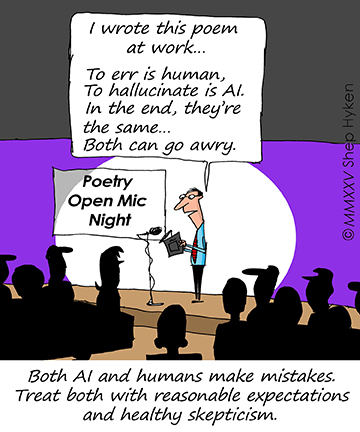
AI Hallucination Cartoon Shep Hyken

AI and Humans Make Mistakes

The reality is that both AI and humans make mistakes, and both will continue to do so. The difference is our expectations. We don’t expect humans to be perfect, so when they are not, we may be disappointed, maybe even angry. We may or may not forgive them, but usually, we just chalk it up to being … human. But it’s different when interacting with AI. We expect it to be reliable, and when it makes a mistake, we often assume the entire system is flawed.

Perhaps we should treat both with the same reasonable expectations and the same healthy skepticism we apply to weather forecasters, who use sophisticated technology and have years of training yet still can’t seem to get tomorrow’s forecast right half the time. Well, it seems like half the time! That doesn’t mean we won’t be checking the forecast before we plan our outdoor activities. AI, too, is sophisticated technology that can make life easier.

Image credits: Gemini, Shep Hyken

Subscribe to Human-Centered Change & Innovation WeeklySign up here to join 17,000+ leaders getting Human-Centered Change & Innovation Weekly delivered to their inbox every week.


Accelerating Change in Consumer Packaged Goods

Accelerating Change in Consumer Packaged Goods

GUEST POST from Geoffrey A. Moore

I had the pleasure of engaging with a team of executives from a Global 2000 Consumer Packaged Goods (CPG) company, and as always from such encounters, I learned something new.

The team is focused on accelerating change, and I was sharing with them the zone management model, and how each zone is intended to keep a characteristic pace. The Productivity Zone, by design, goes the slowest because its job is to take extra time in order to reduce risk and cost. The Incubation Zone, again by design, goes the fastest because its job is to take extra risk and pretty much ignore cost in order to reduce time.

What the team made me realize is that, given all the change coming at them (and, yes, we had been talking a lot about Generative AI and related technologies), they needed their Productivity Zone to speed up, come what may. The more I thought about it, the more I realized that this is not just a single CPG enterprise talking. Every Volume Operations enterprise at its core runs on processes. There is no other way to operate at scale, which means the Performance Zone is completely dependent on them. But here’s the thing—all those mission-critical processes are invented, maintained, and improved by the Productivity Zone.

So, here’s the challenge in a nutshell: How can you possibly speed up something that is inherently designed to go slow? Or, to make the goal more specific, how do you incubate a truly disruptive process and then, at the right moment, use it to transform your most conservative organizations?

Readers of this blog will not be surprised to hear me advocate for aligning the zone management framework with the Technology Adoption Life Cycle as a roadmap for how best to navigate these waters. Here’s how it plays out in four acts:

  1. Act One: Incubate, focusing on early adopters who are looking to explore the opportunities, leveraging a project model. You intend to prove the feasibility of the new process, and you will do whatever it takes to do so. Your goal is to show what good could look like while at the same time taking technical risk off the table, leaving adoption risk as the primary remaining challenge.
  2. Act Two: Transform, focusing exclusively on a single underperforming function led by pragmatists in pain, leveraging a solution model. You intend to use the breakthrough technology to completely revamp the process in question, taking it from underperforming to stellar. Your goal is to create a credible set of references to support your transition to Act Three.
  3. Act Three: Perform, focusing first on processes adjacent to those addressed by Act Two, ones that are performing adequately but could definitely be improved, led by pragmatists who are reluctant to change until they see others go first. You intend to create a groundswell of adoption that will convert their reluctance to change into a fear of missing out. Your goal is to lead with a “killer app,” highlighting whatever portion of your technology that can deliver a quick win, and then follow that up with a complete roll-out.
  4. Act Four: Secure, focusing on the revamped process end to end, monitoring quality from final deliverable back through each step, working with process managers who will be maintaining their portion of the new system. You intend to continuously improve following a data-driven approach supplemented with whatever analytics and AI can provide. Your goal is to operate at scale with unprecedented productivity and agility.

The key point of this framework is that it is linear. You take it one act at a time, and you do not skip over any acts. Your key metric is time to complete, both at the level of each act and of the whole play. With respect to anything transformational, know that most people appreciate it may take more than one year, and no one will give you three years. So you have a maximum of eight quarters to get to Act Four (which will be ongoing thereafter).

That’s what I think. What do you think?

Image Credit: Pexels

Subscribe to Human-Centered Change & Innovation WeeklySign up here to join 17,000+ leaders getting Human-Centered Change & Innovation Weekly delivered to their inbox every week.


Layoffs, AI, and the Future of Innovation

Efficiency Breakthrough or Creative Bankruptcy?

LAST UPDATED: March 21, 2026 at 10:24 PM

Layoffs, AI, and the Future of Innovation

by Braden Kelley and Art Inteligencia


Framing the Debate: Signals or Symptoms?

A new wave of layoffs across technology companies has reignited a familiar but increasingly urgent question: what exactly are we witnessing? On the surface, the explanation seems straightforward — companies are tightening costs, responding to macroeconomic pressures, and recalibrating after years of aggressive hiring. But beneath that surface lies a deeper and more consequential debate about the future of innovation, the role of engineers, and the impact of artificial intelligence on knowledge work itself.

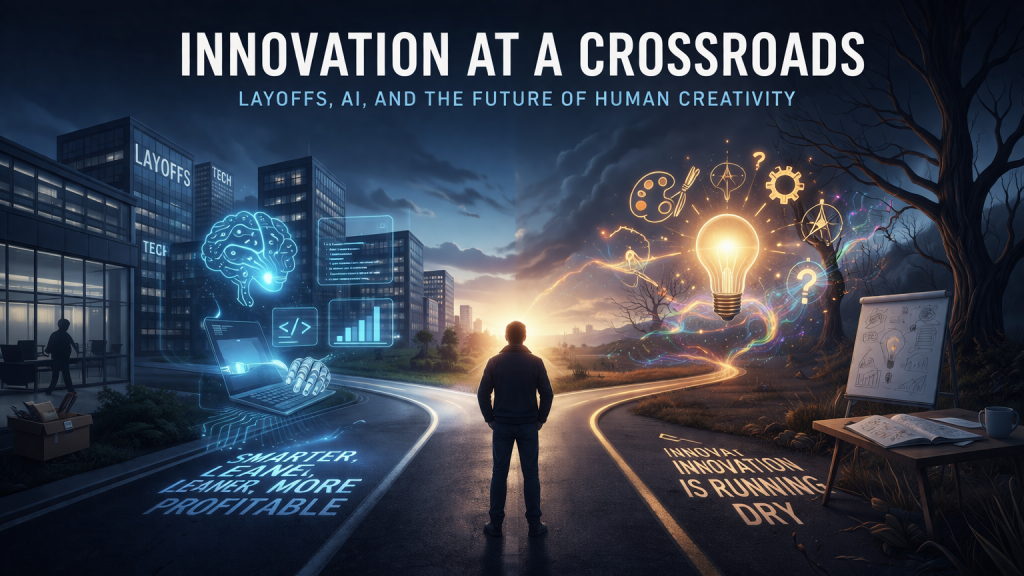
Two competing narratives have quickly emerged. The first frames these layoffs as a rational and even necessary evolution. In this view, advances in AI-powered development tools — ranging from large language models to code-generation systems — have fundamentally altered the productivity equation. Engineers equipped with tools like Claude or OpenAI Code can now accomplish in hours what once took days. The implication is clear: if output can be maintained or even increased with fewer people, then reducing headcount is not a sign of weakness but a signal of maturation. Companies are becoming leaner, more efficient, and ultimately more profitable.

The second narrative is far less optimistic. It suggests that layoffs are not a leading indicator of a smarter, AI-augmented future, but a trailing indicator of something more troubling — an innovation slowdown. According to this perspective, many technology companies have already harvested the most accessible opportunities within their existing platforms. What remains is incremental improvement rather than transformative change. In such an environment, cutting engineering talent becomes less about efficiency gains and more about a lack of compelling new problems to solve. The cupboard, in other words, may not be empty — but it may be significantly less full than it once was.

What makes this moment particularly complex is that both narratives can be true at the same time. AI is undeniably increasing productivity in certain domains, compressing development cycles and enabling smaller teams to deliver meaningful results. At the same time, innovation has never been solely a function of efficiency. Breakthroughs emerge from exploration, from cross-functional collisions, and from a willingness to invest in uncertain futures. Layoffs, especially when executed at scale, can disrupt the very conditions that make those breakthroughs possible.

This tension forces us to confront a more nuanced question: are these layoffs a signal of transformation or a symptom of stagnation? Are organizations courageously embracing a new model of AI-augmented work, or are they retreating into cost-cutting as a substitute for bold thinking? The answer matters, because it shapes not only how we interpret today’s decisions, but how we design organizations for tomorrow.

For leaders, the stakes extend beyond quarterly earnings. The choices being made now will determine whether AI becomes a catalyst for a new era of human-centered innovation or a tool that accelerates efficiency at the expense of imagination. For engineers, the implications are equally profound. Their roles are being redefined in real time — not just in terms of what they produce, but in how they create value within increasingly AI-mediated systems.

Ultimately, this is not just a debate about layoffs. It is a debate about what organizations choose to optimize for: productivity or possibility, efficiency or exploration, output or insight. And in that choice lies the future trajectory of innovation itself.

The Case for “Smarter, Leaner, More Profitable”

For many technology leaders, the recent wave of layoffs is not a retreat — it is a re-calibration. The argument is grounded in a simple but powerful premise: the economics of software development have fundamentally changed. With the rapid advancement of AI-assisted coding tools, the amount of output a single engineer can produce has increased dramatically. What once required large, specialized teams can now be accomplished by smaller, more versatile groups augmented by intelligent systems.

Tools such as Claude and OpenAI Code are not merely incremental improvements in developer productivity; they represent a shift in how work gets done. Routine coding tasks, boilerplate generation, debugging assistance, and even architectural suggestions can now be offloaded to AI. This allows engineers to spend less time writing repetitive code and more time focusing on higher-value activities such as system design, problem framing, and integration across complex environments.

In this emerging model, the role of the engineer evolves from builder to orchestrator. Instead of manually crafting every line of code, engineers guide, refine, and validate the outputs of AI systems. The result is a compression of development cycles — features are built faster, iterations occur more rapidly, and time-to-market shrinks. From a business perspective, this translates into a compelling opportunity: maintain or even increase output while reducing labor costs.

This logic is not without precedent. Across industries, waves of automation have consistently redefined the relationship between labor and productivity. In manufacturing, the introduction of robotics did not eliminate production; it scaled it. In many cases, it also improved quality and consistency. Proponents of the current shift argue that AI represents a similar inflection point for knowledge work. The companies that adapt fastest will be those that learn to pair human creativity with machine efficiency.

From a financial standpoint, the incentives are clear. Reducing headcount while sustaining output improves margins, a priority that has become increasingly important in an environment where growth-at-all-costs is no longer rewarded. Investors are placing greater emphasis on profitability and operational discipline, and companies are responding accordingly. Leaner teams are not just a byproduct of technological change — they are a strategic choice aligned with evolving market expectations.

There is also a strategic argument that goes beyond cost savings. By automating lower-value tasks, organizations can theoretically redeploy human talent toward more innovative efforts. Engineers freed from routine work can focus on solving harder problems, exploring new product ideas, and experimenting with emerging technologies. In this view, AI does not replace innovation capacity; it expands it by removing friction from the development process.

Smaller teams can also mean faster decision-making. With fewer layers of coordination required, organizations can become more agile, responding quickly to changing market conditions and customer needs. This agility is often cited as a competitive advantage, particularly in fast-moving technology sectors where speed can determine success or failure.

Ultimately, the “smarter, leaner” argument rests on a belief that efficiency and innovation are not mutually exclusive. Instead, they are mutually reinforcing. By leveraging AI to increase productivity, companies can create the financial and operational headroom needed to invest in the next wave of innovation. Layoffs, in this context, are not an admission of weakness — they are a signal that the underlying system of value creation is being rewritten.

The Case for “Innovation Is Running Dry”

While the efficiency narrative is compelling, an equally important — and more unsettling — interpretation of recent layoffs is gaining traction: that they reflect not technological progress, but an innovation slowdown. In this view, companies are not simply becoming leaner because they can do more with less, but because they have fewer truly novel problems worth investing in. The layoffs, therefore, are less a signal of transformation and more a symptom of diminishing opportunity.

Over the past decade, many technology companies have scaled around a set of highly successful platforms and business models. These platforms have been optimized, expanded, and monetized with remarkable effectiveness. But maturity brings constraints. As systems stabilize and markets saturate, the number of greenfield opportunities naturally declines. What remains is often incremental improvement — refinements, extensions, and efficiencies — rather than the kind of breakthrough innovation that requires large, exploratory engineering teams.

In this context, layoffs can be interpreted as a rational response to a shrinking frontier. If there are fewer bold bets to pursue, there is less need for the capacity required to pursue them. The risk, however, is that this becomes a self-reinforcing cycle. As organizations reduce investment in exploration, they further limit their ability to discover the next wave of opportunity. Over time, efficiency begins to crowd out possibility.

Compounding this dynamic is an increasing reliance on metrics that prioritize productivity over potential. Organizations are becoming exceptionally good at measuring what is already known — velocity, output, utilization — but far less adept at valuing what has yet to be discovered. When success is defined primarily by efficiency gains, it becomes harder to justify the uncertainty and longer time horizons associated with breakthrough innovation.

The rise of AI tools adds another layer of complexity. While these tools can accelerate development, they do not inherently generate new insight. They are trained on existing patterns, which means they are exceptionally effective at extending the present but less equipped to invent the future. This creates the risk of an “illusion of progress,” where output increases but originality does not. More code is produced, but not necessarily more meaningful innovation.

There are also significant cultural consequences to consider. Layoffs, particularly when they affect engineering and product teams, can erode trust and psychological safety within an organization. When employees perceive that their roles are precarious, they are less likely to take risks, challenge assumptions, or pursue unconventional ideas. Yet these behaviors are precisely what fuel innovation. In attempting to optimize for efficiency, companies may inadvertently suppress the very creativity they depend on for long-term growth.

Another often overlooked impact is the loss of institutional knowledge. Experienced engineers carry not just technical expertise, but contextual understanding of systems, decisions, and past experiments. When they leave, they take with them insights that are difficult to codify or replace. This loss can slow future innovation efforts, even as short-term efficiency metrics appear to improve.

Ultimately, the concern is not that companies are becoming more efficient — it is that they may be becoming too narrowly focused on efficiency at the expense of exploration. Innovation requires slack, curiosity, and a willingness to invest in uncertain outcomes. When organizations begin to treat these elements as expendable, they risk signaling something far more significant than cost discipline: a diminishing appetite for invention itself.

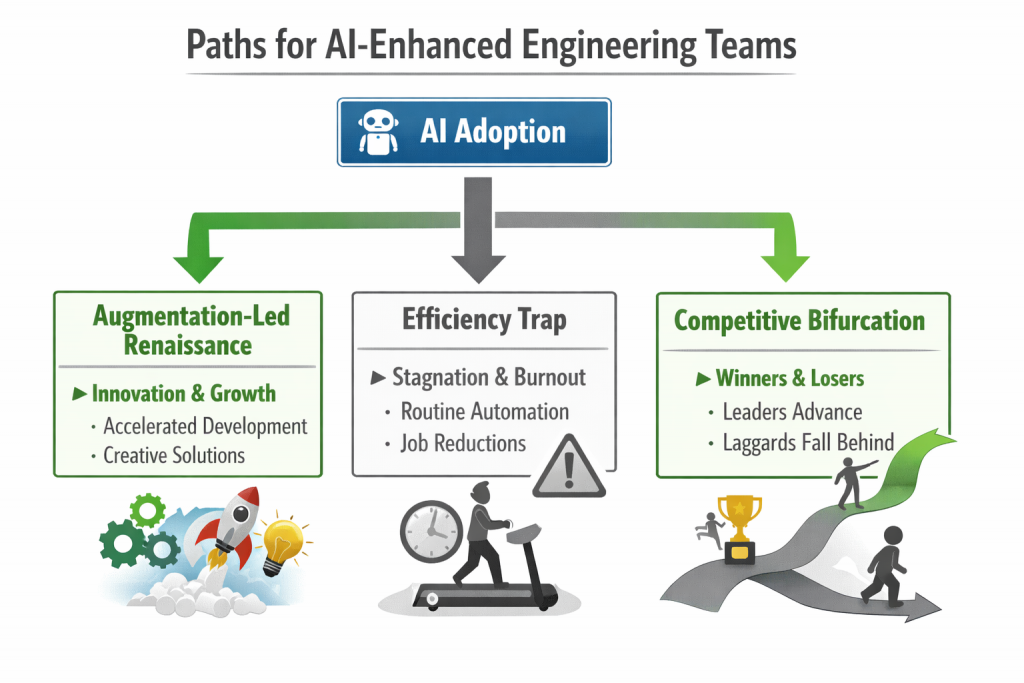
Paths to AI-Driven Engineering Outcomes

The Human-Centered Tension: Productivity vs. Possibility

Beneath the surface of the efficiency versus stagnation debate lies a deeper, more human tension — one that cannot be resolved by technology alone. At its core, innovation has never been just about output. It has always been about the quality of thinking, the diversity of perspectives, and the collisions between ideas that spark something new. When organizations focus too narrowly on productivity, they risk overlooking the very conditions that make possibility achievable.

Innovation does not emerge from isolated efficiency; it emerges from interaction. It is the byproduct of cross-functional curiosity — engineers engaging with designers, product managers challenging assumptions, customers re-framing problems, and leaders creating space for exploration. These interactions are often messy, inefficient, and difficult to measure. But they are also where breakthroughs live. When layoffs reduce not just headcount but diversity of thought and opportunities for collaboration, the innovation system itself becomes less dynamic.

The rise of AI-augmented work introduces a new layer to this tension. As engineers increasingly rely on AI tools to generate code, suggest solutions, and optimize workflows, their role begins to shift. They move from hands-on builders to orchestrators of machine-assisted output. While this shift can increase speed and efficiency, it also raises an important question: what happens to deep craft? The tacit knowledge developed through wrestling with complexity — the kind that often leads to unexpected insights — may be diminished if too much of the process is abstracted away.

There is also a cognitive risk. AI systems are designed to identify and replicate patterns based on existing data. This makes them powerful tools for scaling what is already known, but less effective at challenging foundational assumptions. If organizations become overly dependent on these systems, they may unintentionally standardize thinking. The range of possible solutions narrows, not because people lack creativity, but because the tools they use guide them toward familiar patterns.

Trust plays a critical role in navigating this tension. In environments where employees feel secure, valued, and empowered, they are more likely to experiment, take risks, and pursue unconventional ideas. Layoffs, particularly when they are frequent or poorly communicated, can erode that trust. The result is a more cautious workforce — one that prioritizes safety over exploration. In such environments, productivity may remain high, but the willingness to pursue breakthrough innovation often declines.

Curiosity is the other essential ingredient. It is the force that drives individuals to ask better questions, challenge the status quo, and seek out new possibilities. Yet curiosity requires space — time to think, room to explore, and permission to deviate from immediate objectives. When organizations optimize relentlessly for efficiency, that space tends to disappear. Every moment is accounted for, every effort measured, and every outcome expected to justify itself in the short term.

This creates a paradox. The same tools and strategies that enable organizations to move faster can also constrain their ability to think differently. Speed without reflection can lead to acceleration in the wrong direction. Efficiency without exploration can result in incremental progress that ultimately limits long-term growth.

For leaders, the challenge is not to choose between productivity and possibility, but to intentionally design for both. This means recognizing that innovation systems require balance — between execution and exploration, between structure and flexibility, and between human judgment and machine assistance. It requires protecting the conditions that enable creativity even as new technologies reshape how work gets done.

Ultimately, the question is not whether AI will make organizations more efficient — it already is. The question is whether leaders will use that efficiency to create more space for human ingenuity, or whether they will allow it to crowd out the very behaviors that make innovation possible in the first place.

The Future of Innovation in the Age of AI: Augmentation or Abdication?

As organizations navigate layoffs, AI adoption, and shifting expectations around productivity, the future of innovation is not predetermined — it is being actively shaped by the choices leaders make today. The central question is no longer whether artificial intelligence will transform how work gets done, but how that transformation will be directed. Will AI serve as an amplifier of human ingenuity, or will it become a mechanism for narrowing ambition in the pursuit of efficiency?

Three distinct paths are beginning to emerge. The first is an augmentation-led renaissance, where organizations successfully combine human creativity with machine capability. In this scenario, AI handles the repetitive and computationally intensive aspects of work, freeing humans to focus on problem framing, experimentation, and breakthrough thinking. Innovation accelerates not because there are fewer people, but because those people are empowered to operate at a higher level of abstraction and impact.

The second path is the efficiency trap. Here, organizations become so focused on optimizing output and reducing cost that they gradually lose their capacity for exploration. AI is used primarily to streamline existing processes rather than to unlock new possibilities. Over time, these organizations become highly efficient at executing yesterday’s ideas, but increasingly disconnected from tomorrow’s opportunities. What appears to be strength in the short term reveals itself as fragility in the long term.

The third path is a bifurcation of the competitive landscape. Some organizations will lean into augmentation, investing in both AI capabilities and the human systems required to harness them effectively. Others will prioritize efficiency, focusing on cost control and incremental gains. The result is a widening gap between companies that consistently generate new value and those that primarily replicate and optimize existing models. In such an environment, innovation becomes a defining differentiator rather than a baseline expectation.

What separates the leaders from the laggards will not be access to AI alone — those tools are increasingly commoditized — but how organizations integrate them into their innovation systems. Leading organizations will invest not just in AI infrastructure, but in what might be called curiosity infrastructure: the cultural, structural, and leadership practices that encourage questioning, exploration, and cross-functional collaboration. They will recognize that technology can accelerate execution, but only humans can redefine the problems worth solving.

This shift will require a redefinition of roles. Engineers, for example, will need to move beyond execution and into areas such as systems thinking, ethical judgment, and interdisciplinary collaboration. Their value will be measured not just by what they build, but by how they frame problems, challenge assumptions, and integrate diverse inputs into coherent solutions. Similarly, leaders will need to become stewards of both performance and possibility, ensuring that the drive for efficiency does not crowd out the pursuit of innovation.

Organizations that thrive will also be those that intentionally protect space for exploration. This does not mean abandoning discipline or ignoring financial realities. It means recognizing that innovation requires a portfolio approach — balancing investments in core optimization with bets on uncertain, high-potential opportunities. AI can make this balance more achievable by reducing the cost of experimentation, but only if leaders choose to reinvest those gains into discovery rather than solely into margin expansion.

Ultimately, the future of innovation in the age of AI will be defined by whether organizations treat these tools as a substitute for human thinking or as a catalyst for it. The real risk is not that AI replaces engineers — it is that organizations stop asking the kinds of questions that require engineers to think deeply, creatively, and collaboratively in the first place.

Augmentation or abdication is not a technological choice. It is a leadership choice. And in making it, organizations will determine whether this moment becomes a turning point toward a more innovative future — or a gradual slide into highly efficient irrelevance.

Frequently Asked Questions

1. Why are technology companies laying off engineers despite using AI tools?

Layoffs may result from a combination of efficiency gains and slowing innovation opportunities. AI tools like
Claude and OpenAI Code allow smaller teams to maintain or increase output, reducing the need for some roles.
At the same time, some companies face fewer breakthrough projects to pursue, which can also drive workforce reductions.

2. Does AI replace human engineers or just augment their work?

AI primarily augments engineers by automating repetitive coding, debugging, and optimization tasks. This allows
engineers to focus on higher-value activities such as system design, problem framing, and creative innovation.
While some roles shift, AI is intended as an amplifier of human ingenuity rather than a replacement.

3. How can companies maintain innovation in the age of AI?

Companies can preserve innovation by investing in curiosity infrastructure, protecting time and space for
experimentation, fostering cross-functional collaboration, and reinvesting efficiency gains into exploratory,
high-potential projects. Balancing productivity with opportunity ensures that humans and AI together drive breakthroughs.


Image credits: ChatGPT

Content Authenticity Statement: The topic area, key elements to focus on, etc. were decisions made by Braden Kelley, with a little help from ChatGPT to clean up the article and add citations.

Subscribe to Human-Centered Change & Innovation WeeklySign up here to get Human-Centered Change & Innovation Weekly delivered to your inbox every week.
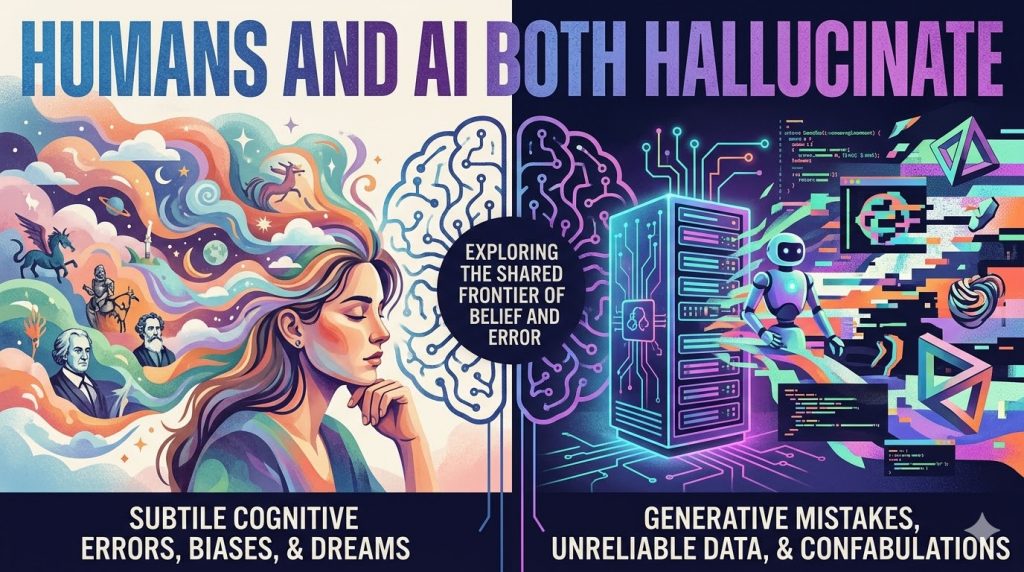


Change Starts with Empathy

(Even for Your Enemies)

Change Starts With Empathy

GUEST POST from Greg Satell

On September 17th, 2011, protesters began to stream into Zuccotti Park in Lower Manhattan and the #Occupy movement had begun. “We are the 99%,” they declared and as far as they were concerned, it was time for the reign of the “1%” to end. The protests soon spread like wildfire to 951 cities across 82 countries.

It failed miserably. Today, a decade later, it’s hard to find any real objective that was achieved except some vague assertions about “building awareness” and Bernie Sanders’ two failed presidential campaigns. Taking into the count the billions of dollars worth of resources expended in terms of time and effort, that is abysmal performance.

As I explained in Cascades, there were myriad reasons for #Occupy’s failure. One of the gravest errors, however, was the insistence on ideological purity and the lack of any effort to understand those who had different ideas from their own. If you expect to bring change about, you need to attract, rather than overpower. Empathy is a good place to start.

Finding Your Tribe

In 1901, before he became employed by the patent office, a young Albert Einstein put out an advertisement offering tutoring services in math and physics. Maurice Solovine, a Romanian philosophy student, responded to the ad but, after a brief discussion, Einstein told him that he didn’t need lessons. Still, he invited Solovine to come and visit him whenever he wished.

The two began meeting regularly and were soon joined by another friend of Einstein’s, a young Swiss mathematician named Conrad Habicht, and the three would discuss their own work as well as that of luminaries such as Ernst Mach, David Hume and Henri Poincaré. Eventually, these little gatherings acquired a name, The Olympia Academy.

Einstein had found his tribe and it became a key factor in the development of his “miracle year” papers that would turn the world of physics on its head in a few years later. It gave him a safe space to let his mind wander over the great questions of the day, formulate his ideas and get feedback from people that he trusted and respected.

This is a common pattern. Similar tribes, such as, the Vienna Circle, the Bloomsbury Group and the “Martians” of Fasori have, if anything, led to even greater achievement. So it’s easy to understand how those protesters descending on Zuccotti Park, finding themselves amongst so many who saw things as they did, felt as if they were on the brink of a historic moment.

They weren’t. And that’s what’s dangerous about tribes. Although they can lend support to a fledgling idea that needs to be nurtured, they can also blind us to hard truths that need to be examined.

Developing A Private Language

A tribe is a closed network that, almost by definition, is an echo chamber designed to develop its own practices, customs and culture. Perhaps not surprisingly, it is common for these networks to develop their own vocabulary to describe these unique aspects of the tribal experience and to make distinctions between members of the tribe and outsiders.

Consider what happened when Congressman John Lewis, the civil rights legend, showed up at an #Occupy rally in Atlanta. The protesters refused to let him speak. He left quietly and issued a polite statement, but an opportunity was lost and real damage was done to the movement and its cause. If John Lewis wasn’t welcome, what about the rest of us?

Later, the man who led the charge to prevent Congressman Lewis from speaking explained his reasons. He cited his suspicion of Lewis as part of the “two-party system,” which he felt had betrayed the country. Yet even more tellingly, he also explained that his main objection was due to the “form” of the event, which he felt was being violated.

It is common for tribes to fall into this kind of private language trap. The function of communication is inherently social and, if the customs and vernacular that you develop becomes so archaic and obscure that it is unable to perform that function, you have undermined the fundamental purpose of the activity.

Clearly, in any dialogue both the speaker and the listener have a responsibility to each other. However, if you consistently find that your message is not resonating outside your tribe, you probably want to rethink how you’re expressing it.

Shifting From Differentiating Value To Shared Values

Once you start separating yourself off and creating a private language for your adherents, it’s easy to fall into a form of solipsism in which the only meaningful reality is that of the shared experience of the tribe. Many aspiring revolutionaries seek to highlight this feeling by emphasizing difference in order to gin-up enthusiasm among their most loyal supporters.

That was certainly true of LGBTQ activists, who marched through city streets shouting slogans like “We’re here, we’re queer and we’d like to say hello.” They led a different lifestyle and wanted to demand that their dignity be recognized. More recently, Black Lives Matter activists made calls to “defund the police,” which many found to be shocking and anarchistic.

Corporate change agents tend to fall into a similar trap. They rant on about “radical” innovation and “disruption,” ignoring the fact that few like to be radicalized or disrupted. Proponents of agile development methods often tout their manifesto, oblivious to the reality that many outside the agile community find the whole thing a bit weird and unsettling.

While emphasizing difference may excite people who are already on board, it is through shared values that you bring people in. So it shouldn’t be a surprise that the fight for LGBTQ rights began to gain traction when activists started focusing on family values. Innovation doesn’t succeed because it’s “radical,” but when it solves a meaningful problem. The value of Agile methods isn’t a manifesto, but the fact that they can improve performance.

You Never Have To Compromise On Common Ground

One of the things that sticks in my head about my experiences during and after the Orange Revolution in Ukraine was an interview with Viktor Pinchuk. who is not only one of the country’s richest oligarch’s, but also the son-in-law of the former President and, at the time, a member of the Rada, the Ukrainian Parliament.

He was, by any definition, a full-fledged member of the “1%” that #Occupy took to the streets to protest. Before reading the article I would’ve expected him to be bitter about the abrupt shift in power. Yet he wasn’t. In fact, he explained that his biggest concern during the protests was that his own children were in the streets, and he feared for their safety.

The insight underlines one of the fundamental fallacies of failed change efforts like #Occupy and others, both in the streets and in the corporate world. They imagine change as a Manichean struggle between two countervailing forces in which we must either prevail or accept defeat and compromise. That is a false choice.

The truth is that any change we win by vanquishing our opponents is bound to be fleeting. Every revolution inspires its own counter-revolution. Lasting change is always built on common ground. The best place to start is by building empathy for your most ardent adversaries, not to give in to them, but to help you identify shared values.

After the Orange Revolution was over, we would learn that Pinchuk’s father-in-law, Leonid Kuchma, who was still in power, ordered the most reactionary forces in his regime to stand down. As it turned out, there were some places that even the famously corrupt leader would not go. In the end, he understood that his legacy, and therefore his interests, lay with the protesters in the streets.

— Article courtesy of the Digital Tonto blog
— Image credit: Google Gemini

Subscribe to Human-Centered Change & Innovation WeeklySign up here to join 17,000+ leaders getting Human-Centered Change & Innovation Weekly delivered to their inbox every week.


Drive Innovation Through Mindset

Drive Innovation Through Mindset

GUEST POST from Stefan Lindegaard

Uncertainty is no longer a temporary disruption. It has become a permanent condition of our world. The pace of change continues to accelerate, and the rise of artificial intelligence is the clearest symbol of this shift. We know AI is important, yet we do not fully understand its role. That combination of fast change and unknowns creates both pressure and opportunity for leaders, teams, and their organizations.

The question is: how do we respond?

Most organizations instinctively turn to processes, structures, or tools. These are important, but they do not work without the right foundation. At the core of innovation lies something simpler and more powerful: mindset.

Why Mindset Matters More Than Ever

Innovation is often framed as a matter of ideas, technology, or investment. Those are critical inputs, but they only thrive when people and teams have the capabilities and, above all, the mindset to make them work.

A mindset shapes how we think, behave, and collaborate. It influences whether we treat uncertainty as a threat or an opportunity, whether we see change as a disruption or as a chance to grow, and whether we treat AI as a danger or as a tool we can learn to use.

In other words: mindset drives behavior, and behavior drives innovation.

Three Realities Organizations Must Face

  1. Uncertainty is permanent: Leaders often wait for clarity before acting, but clarity rarely comes. The ability to navigate uncertainty rather than eliminate it is a defining skill of innovative organizations.
  2. The pace of change is accelerating: SMEs, startups and corporates all struggle with keeping up. Large companies may have more resources, but smaller organizations often have more agility. The common challenge is learning faster than the environment changes while implementing new ways of working effectively.
  3. AI is an unknown but critical factor: Most leaders agree AI will reshape their industry, but few know how. That is exactly the point: waiting until we know everything is too late. The right question is: what small steps can we take now to expand our comfort zone with AI?

Drive Innovation Through Mindset Infographic

How do we actually change a mindset?

This is one of the most common questions I get. It is easy to say that mindset matters, but how do we shift it?

The answer is to navigate the mindset zones:

  • Comfort zone: Where we feel safe but risk stagnation.
  • Fear zone: Where uncertainty triggers resistance, excuses, and hesitation.
  • Learning zone: Where we gain new skills and perspectives, often through discomfort.
  • Growth zone: Where we expand our capacity, create new value, and unlock innovation.

Innovation happens when we deliberately move between these zones and gradually expand the comfort zone which brings us closer to the learning and growth zones.

The mistake many leaders make is thinking this requires a radical leap. In reality, it is about small, repeated steps that turn fear into learning and learning into growth.

Over time, this becomes a habit for individuals and teams, and a foundation for building organizational capabilities for innovation.

Action Suggestions

  1. Pulse check your mindset: Ask yourself: How well do I handle uncertainty and change today? Rate yourself on a simple scale using the attached image with one of my exercises. This is your starting point.
  2. Apply the zones to AI: Where does AI sit for you? Comfort, fear, learning, or growth? Most people will find it partly in the fear zone. Instead of avoiding it, identify one small step – such as testing a tool, attending a workshop, or talking to a colleague – that moves it into learning.
  3. Turn reflection into action: For your team or organization, ask: What is one small action we can take in the next 30 days to strengthen our mindset in the context of innovation? Write it down and share it. The act of committing to a step creates momentum.
  4. Normalize uncertainty: Start conversations that treat uncertainty as a condition to navigate rather than a problem to solve. Build habits such as “uncertainty check-ins” in meetings where you share what is unknown and how you are adapting.
  5. Invest in learning capacity: Innovation is largely about] learning faster than competitors and faster than the pace of change and turning that learning into visible impact. Reward curiosity, reflection, and experimentation as much as results.

Closing Thoughts

Innovation is not a side project or a department. It is an organizational capability built on mindset. In a world of uncertainty, fast change, and emerging technologies like AI, this capability is no longer optional.

Expanding the comfort zone – again and again – is how leaders, teams, and organizations create the resilience to face today and the adaptability to seize tomorrow.

Small actions today, multiplied over time, become the foundation for long-term innovation.

Image Credit: Stefan Lindegaard, Gemini

Subscribe to Human-Centered Change & Innovation WeeklySign up here to get Human-Centered Change & Innovation Weekly delivered to your inbox every week.