
Tag Archives: hierarchies

Why Networks Can Outperform Hierarchies

(And Vice Versa)

Why Networks Can Outperform Hierarchies

GUEST POST from Greg Satell

I still remember the bright autumn day in 2014 when I turned off of the main road in Exton, Pennsylvania onto a remote path. I was going to meet Brian J. Robertson, the creator of a hot new “flat” management approach called Holacracy. I was skeptical, because it seemed to be a cumbersome way to go about governance, but I was open to learning about it.

Many companies, most famously Zappos, were enthusiastically adopting it and there was no shortage of hype among the punditry about abolishing hierarchies. Brian, for his part, was gracious and patient with me, explaining how and why everything worked. Still, I had my doubts and remained unconvinced.

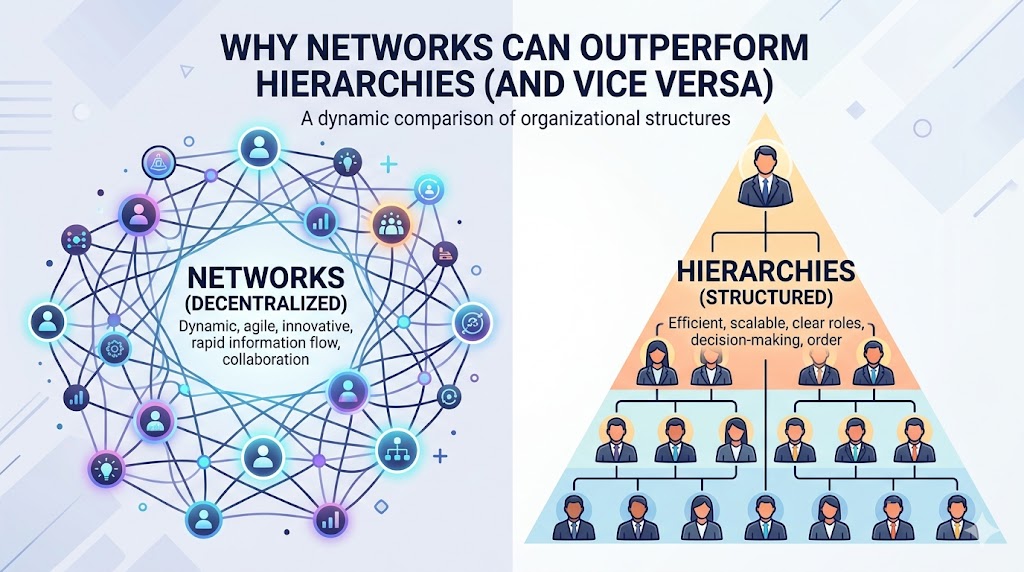
Recently, Stanford’s Bob Sutton pointed to Ronnie Lee’s research that confirmed my (and his) suspicions. While flatter structures can promote creativity, we need hierarchies to execute well. The truth is that hierarchies form naturally and, rather than trying to ignore that basic fact, we need to design enterprises with hierarchical networks in mind.

Evolution, Religion and Leadership

It’s become common today for many, especially in the academic world, to dismiss religion as the product of ancient superstition. Yet in The Righteous Mind, social psychologist Jonathan Haidt makes a powerful case that it plays an important evolutionary role. “There is now a great deal of evidence that religions do in fact help groups to cohere, solve free rider problems and win the competition for group-level survival,” he wrote.

So while many pundits often portray bureaucratic hierarchies as an anachronistic byproduct of the industrial revolution, it seems significant that religions tend to have hierarchical structures. Even religious activities that can be done individually, such as Buddhist meditation, are often led by someone who has an elevated group status.

So it stands to reason that hierarchy plays a similar governance role in organizations, helping to coordinate group activity by setting priorities, establishing basic rules and norms and, when needed, providing impetus to change direction and adapt to external events. Clearly, these are essential governance functions in any enterprise.

Many would say that, in an increasingly digital environment that helps us communicate and coordinate across boundaries of time and space, we simply don’t need the same levels of bureaucratic governance that we used to. However, what Professor Lee found in the startups he researched was that the levels of hierarchy increased significantly over the last 50 years, most probably due to the greater levels of complexity involved in work.

It’s important to note that, even after years of hype, it’s hard to find examples of successful non-hierarchical organizations. Even the rare exceptions, such as the Orpheus Chamber Orchestra, aren’t quite as flat in how they organize work as it would first seem. Zappos would eventually back away from Holacracy as would other early adopters, such as Medium.

Hierarchies Are Networks

The term “network” is often misconstrued. In management circles, it is often used to mean an organic, unfathomable, amorphous structure, but really a network is just any system of nodes connected by links. So, in that sense, any conceivable organizational structure is a network, even a typically hierarchical organizational chart.

The important question is what kind of networks do we want our organizations to be? If we look at the evidence from thousands of years of human civilization, we’d have to conclude that some sort of command and control mechanism is needed. At the same time, as our competitive environment becomes more complex, we want information to be able to go to where it is needed without getting stuck in leadership bottlenecks.

A bit of network science can be helpful here. For functional purposes, networks have two salient characteristics: clustering and path length. Clustering refers to the degree to which a network is made up of tightly knit groups while path length is a measure of social distance—the average number of links separating any two nodes in the network.

Ideally our organizational networks would have a high degree of clustering—to promote close collaboration and teamwork—as well as short path lengths so that information can get from one part of the enterprise to any other part with speed and efficiency. Intuitively, it seems like those two priorities are in conflict. However, thanks to some breakthroughs in network science in the late 90s, we know that such “small world” networks are not only achievable, but common.

What’s really important isn’t how your organizational chart is constructed, but how you design for connection and there are some common sense ways to do that.

Understanding Formal And Informal Structures

Every organization has both formal and informal structures. For example, while ostensibly open source communities have little formal organization, in practice they are very hierarchical, with high-status individuals driving the direction of the project. At the same time, even in a formal organization, there are informal relationships as when, say, you work in sales and your brother-in-law works in logistics in a very different part of the company.

Network scientists call people who link disparate networks in an organization boundary spanners and they are crucial for maintaining culture as an organization grows. Once you understand the importance of boundary spanners, you can start redesigning programs and platforms to optimize for connection.

There are a number of ways to network your organization by optimizing organizational platforms for connection. Facebook’s Engineering Bootcamp found that “bootcampers tend to form bonds with their classmates who joined near the same time and those bonds persist even after each has joined different teams.” At Experian, leadership found that a biking club led to boundary spanning collaborations at work, so they helped more clubs to get organized.

One striking example of how even small tweaks can improve connectivity is a project done at a bank’s call center. When it was found that a third of variation in productivity could be attributed to informal communication outside of meetings, the bank arranged for groups to go on coffee break together, increasing productivity by as much as 20% while improving employee satisfaction at the same time.

Perhaps most famously, Steve Jobs designed the headquarters both at Apple and Pixar to encourage random collisions among employees. It seems we’ve been asking the wrong question. The problem isn’t how we dismantle hierarchies, but how we connect them.

Leading Hierarchical Networks

For decades we’ve been hearing that we need to eliminate bureaucracy and break down silos. Yet there is little evidence of any success. In fact, when management guru Gary Hamel, who has been leading the call to “bust bureaucracy,” surveyed readers at Harvard Business Review he found that levels of organization had increased, not decreased.

The inescapable conclusion is that we’ve failed to do away with hierarchies because they serve a useful purpose. We need them. In much the same way, the much maligned “silos” form around centers of capability as a result of close collaboration. These are good things. We don’t want to eliminate them, we want to support and empower them.

So instead of trying to break down silos, we need to connect them. Network science tells us that it takes just a small amount of boundary spanning “random connections,” in order to bring social distance crashing down. We can’t just look at organizational charts, but need to focus on how meaningful relationships form in the real world.

The role of leadership in organizations has changed. It is no longer merely to plan and direct work, but to inspire meaning and empower belief. As I wrote in Cascades, the key to transformational change is small groups, loosely connected by united by a shared purpose. The job of leaders today is to help those groups connect and forge a common purpose.

If we are to lead effectively in an increasingly ecosystem-driven world, we need to empower networked hierarchies.

— Article courtesy of the Digital Tonto blog
— Image credit: Google Gemini

Subscribe to Human-Centered Change & Innovation WeeklySign up here to join 17,000+ leaders getting Human-Centered Change & Innovation Weekly delivered to their inbox every week.
Values Determine Your Competitiveness

Values Determine Your Competitiveness

GUEST POST from Greg Satell

When Lou Gerstner was chosen to lead IBM in 1993, he was an unlikely revolutionary. A McKinsey consultant and then the successful CEO of RJR Nabisco, he was considered to be a pillar of the establishment. He would, however, turn out to be as subversive as any activist, transforming the company and saving it from near-death.

Yet there was more to what he achieved than simply turning red ink to black. “The Gerstner revolution wasn’t about technology or strategy, it was about transforming our values and our culture to be in greater harmony with the market,” Irving Wladawsky-Berger, one of his chief lieutenants, told me.

Values are essential to how an enterprise honors its mission. They represent choices of what an organization will and will not do, what it rewards and what it punishes and how it defines success and failure. Perhaps most importantly, values will determine an enterprise’s relationships with other stakeholders, how it collaborates and what it can achieve.

Values Incur Costs And Constraints

At his very first press conference, Gerstner famously declared: “the last thing IBM needs right now is a vision.” It was an odd, even shocking statement for a new CEO charged with turning around a historic company. But what he understood, and few others did, was that unless he changed the culture to honor the values its success was built on, no strategy could succeed.

“At IBM we had lost sight of our values,” Wladawsky-Berger would later tell me. “For example, there was a long tradition of IBM executives dressing formally in a suit and tie. Yet that wasn’t a value, it was an early manifestation of a value. In the early days, many of IBM’s customers were banks, so IBM’s salespeople dressed to reflect their customers. So the value was to be close to customers.”

Gerstner had been a customer and knew that IBM did not always treat him well. At one point the company threatened to pull service from an entire data center because a single piece of competitive equipment was installed. So as CEO, he vowed to shift the focus from IBM’s “own “proprietary stack of technologies” to its customers’ “stack of business processes.”

Yet he did something else as well. He made it clear that he was willing to forego revenue on every sale to do what was right for the customer and he showed that he meant it. Over the years I’ve spoken to dozens of IBM executives from that period and virtually all of them have pointed this out. Not one seems to think IBM would still be in business today without it.

The truth is that if you’re not willing to incur costs and constraints, it’s not a value. It’s a platitude. “Lou refocused us all on customers and listening to what they wanted and he did it by example,” Wladawsky-Berger, remembers. “We started listening to customers more because he listened to customers.

Values Signal Trust And Credibility

In South Africa, the Congress of The People was held in June, 1955. The gathering, which included blacks, mixed race, Indians and liberal whites, convened to draft and adopt the Freedom Charter, much like the Continental Congress gathered to produce the Declaration of Independence in America. The idea was to come up with a common and inclusive vision.

However, the Freedom Charter was anything but moderate. It was a “revolutionary document precisely because the changes it envisioned could not be achieved without radically altering the economic and political structure of South Africa… In South Africa, to merely achieve fairness, one had to destroy apartheid itself, for it was the very embodiment of injustice,” Nelson Mandela would later write.

Yet despite its seemingly radical aims, the Freedom Charter spoke to common values, such as equal rights and equal protection under the law—not just among the signatories, but for anyone living in a free society. It was powerful because of how it signaled to outside stakeholders, such as international institutions, governments and corporations that they shared more with the anti-apartheid movement than they did with the regime.

It was because of those values that activists were able to successfully boycott firms, such as Barclays Bank and Shell Oil, that did business in South Africa. When those companies pulled their investments out, the dominoes began to fall. International sanctions and political pressure increased markedly and Apartheid became politically untenable.

Here again, values would play a crucial role. Much like Gerstner’s willingness to lose revenue on every sale to keep his commitment to IBM customers, Mandela’s commitment to the Freedom Charter, even during 27 years in prison, signaled to stakeholders—inside and outside of South Africa—that supporting his cause was the right thing to do.

Shared Values Drive Collaboration

In the 1960s and 70s, Route 128 outside of Boston was the center of technology, but by the 1990s Silicon Valley had taken over and never looked back. As AnnaLee Saxenian explained in her classic, Regional Advantage, the key difference had less to do with strategy, technology and tactics than it did with values and how the firms saw themselves.

Dominant Boston firms such as DEC, Data General and Wang Laboratories saw themselves as warring fiefdoms. The west coast startups, however, saw themselves as part of the same ecosystem and tended to band together and socialize. “Everybody worked for the same company — Silicon Valley,” Saxenian would later tell me.

This difference in values translated directly into differences in operational practice. For example, in Silicon Valley if you left your employer to start a company of your own, you were still considered part of the family. Many new entrepreneurs became suppliers or customers to their former employers and still socialized actively with their former colleagues. In Boston, if you left your firm you were treated as a pariah and an outcast.

When technology began to shift in the 80s and 90s, the Boston firms had little, if any, connection to the new ecosystems that were evolving. In Silicon Valley, however, connections to former employees acted as an antenna network, providing early market intelligence that helped those companies adapt.

When you value competition above all else, everyone is a potential enemy. However, when you are willing to forsake absolute fealty in the service of collaboration, you can leverage the assets of an entire ecosystem. Those may not show up on a strategic plan or a balance sheet, but they are just as important as any other asset.

Moving From Hierarchies to Networks

The truth is that IBM was not devoid of values when Gerstner arrived. It’s just that they’d gone awry. “IBM had always valued competitiveness, but we had started to compete with each other internally rather than working together to beat the competition,” Wladawsky-Berger remembers. Certainly it valued technology and profits, just not customers.

What Gerstner did was, as noted above, bring the company’s culture and values back into “harmony with the market.” The company no longer wielded monopoly-like power. It had to collaborate with a wide array of stakeholders. It was this realization that led it to become the first major technology company to embrace open source software and support Linux.

Traditionally we’ve seen the world as driven by hierarchies. Kings and queens ruled the world through aristocracies that carried out their orders. Corporate CEO’s outlined strategies that underlings would have to execute. Discipline was enforced through a system of punishments and rewards. Power was valued above all else.

Yet as Moisés Naím pointed out in The End of Power, “Power is easier to get, but harder to use or keep.” Therefore, the ability to attract has become more important than the power to compel or coerce. That’s why today, strategy has less to do with increasing efficiencies and acquiring resources and more to do with widening and deepening networks of connections.

Power no longer lies at the top of hierarchies, but emanates from the center of networks. What determines whether we will get there or not is our values.

— Article courtesy of the Digital Tonto blog
— Image credits: Pexels

Subscribe to Human-Centered Change & Innovation WeeklySign up here to join 17,000+ leaders getting Human-Centered Change & Innovation Weekly delivered to their inbox every week.
