Tag Archives: respect

Building Trust as a New Leader

Building Trust as a New Leader

GUEST POST from David Burkus

Most new leaders know they need to build trust with their team. But here’s where it gets tricky: what if it’s not your team — at least, not yet?

Imagine stepping into a leadership role where you didn’t get to pick the team. Maybe you were hired from outside the organization. Maybe you were promoted from another department. Either way, you’re the new leader, and the team you’re inheriting doesn’t know you yet. You don’t know if they’ve been burned before by a previous boss. You don’t know what scars or successes they carry. What you do know is that you need to build trust — and fast.

This is where most new leaders stumble. They try to shortcut the process. They launch a flurry of team-building exercises. They host lunches. They schedule marathon one-on-one meetings. These efforts come from a good place, but they often miss the mark. Because trust isn’t actually built. Trust isn’t even earned. Trust is reciprocated.

And if you’re serious about developing trust with a new team, you need to understand how that trust loop really works — and how to keep it moving forward.

Why Traditional Trust-Building Strategies Fall Short

When stepping into a new leadership role, it’s tempting to think that trust builds linearly — more lunches, more meetings, more smiles equals more trust. But that’s not how trust actually grows.

Trust moves in a loop, not a line. It starts with a small trust connection — maybe a conversation over coffee — and invites a tiny leap of faith from your team. Someone shares a new idea or dares to give you honest feedback. If you respond with respect — if you listen, appreciate, and show genuine curiosity — you complete the loop. You signal: It’s safe to trust me.

That small leap leads to slightly bigger risks. More candid conversations. More creative ideas. More vulnerability across the board. If you keep meeting those risks with respect, the trust loop keeps spinning faster and stronger. But if you miss those moments — or worse, get defensive — you stop the loop cold.

For a new leader, mastering this trust loop is everything.
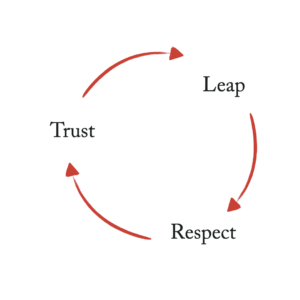
Trust Loop

How a New Leader Can Truly Build Trust

Building trust with a team you didn’t pick requires deliberate, daily actions. Here are four research-backed strategies to get the trust loop turning — and keep it spinning.

1. Signal Vulnerability Early

Everyone already knows you’re new. They know you don’t have all the answers yet. Pretending otherwise just makes you seem insecure or out of touch. Instead, lean into your newness.

Say things like, “I’m still learning how this team works.” Then prove it by listening. Create a space where people feel safe to teach you. This early show of vulnerability sparks empathy — and empathy is the gateway to trust.

When a new leader admits they don’t have it all figured out, it invites others to open up, too. It shows that you’re not just here to impose your will — you’re here to learn and lead together.

2. Share Information Transparently

Eventually, as the new leader, you will need to drive change. That’s probably part of why you were brought in. But when you do, don’t operate behind closed doors.

Instead, treat your team like insiders. Pull back the curtain. Share early information about strategy shifts or organizational changes. Say things like, “This isn’t finalized yet, but here’s what I’m hearing and thinking — and I’d love your perspective.

Transparency builds belonging. It signals, I trust you with this information. And when people feel trusted, they’re much more likely to trust you in return.

3. Respond to Vulnerability with Respect

When your team members finally take a risk — whether it’s sharing a frustration, giving you feedback, or floating a bold idea — recognize it for what it is: a test.

They’re not trying to undermine you. They’re trying to see if you’re the real deal.

Your job isn’t to defend your decisions or your leadership history. It’s to listen. Ask clarifying questions. Thank them for being honest. Engage with their ideas sincerely — even if you don’t ultimately agree.

The way you respond to those early leaps of faith will define whether the trust loop accelerates — or seizes up.

4. Amplify Unheard Voices

One of the easiest ways to build trust with a new team is to ensure every voice is heard, especially the quieter ones. When historically quiet team members finally speak up, make it clear their input matters. Amplify their ideas in meetings. Circle back to them in discussions. Let the entire team see that contributions aren’t just tolerated — they’re valued. Without open communication, hierarchy and politics creep in fast. By contrast, when people feel heard and respected, they lean in with greater commitment and creativity.

Trust First, Change Second

Inheriting a team is tough. You’re stepping into a culture you didn’t create, with dynamics you don’t fully understand yet. And because you’re the new leader, it’s tempting to rush into action — prove yourself, make changes, shake things up. Resist that temptation.

The real work of a new leader is not about being liked. It’s about being vulnerable. Encouraging interpersonal risks. Meeting those risks with deep respect. That’s how you build trust. That’s how you turn a group of individuals into a committed team.

Because at the end of the day, you don’t want a compliant team that simply does what they’re told. You want a committed team that’s ready to go above and beyond — and commitment always starts with trust.

Image credit: Pixabay

Subscribe to Human-Centered Change & Innovation WeeklySign up here to get Human-Centered Change & Innovation Weekly delivered to your inbox every week.

Top 10 Human-Centered Change & Innovation Articles of November 2024

Top 10 Human-Centered Change & Innovation Articles of November 2024Drum roll please…

At the beginning of each month, we will profile the ten articles from the previous month that generated the most traffic to Human-Centered Change & Innovation. Did your favorite make the cut?

But enough delay, here are November’s ten most popular innovation posts:

  1. A Shared Language for Radical Change — by Greg Satell
  2. Leadership Best Quacktices from Oregon’s Dan Lanning — by Braden Kelley
  3. Navigating Uncertainty Requires a Map — by John Bessant
  4. The Most Successful Innovation Approach is … — by Howard Tiersky
  5. Don’t Listen to These Three Change Consultant Recommendations — by Greg Satell
  6. What We Can Learn from MrBeast’s Onboarding — by Robyn Bolton
  7. Does Diversity Increase Team Performance? — by David Burkus
  8. Customer Experience Audit 101 — by Braden Kelley and Art Inteligencia
  9. Daily Practices of Great Managers — by David Burkus
  10. An Innovation Leadership Fable – Wisdom from the Waters — by Robyn Bolton

BONUS – Here are five more strong articles published in October that continue to resonate with people:

If you’re not familiar with Human-Centered Change & Innovation, we publish 4-7 new articles every week built around innovation and transformation insights from our roster of contributing authors and ad hoc submissions from community members. Get the articles right in your Facebook, Twitter or Linkedin feeds too!

SPECIAL BONUS: While supplies last, you can get the hardcover version of my first bestselling book Stoking Your Innovation Bonfire for 51% OFF until Amazon runs out of stock or changes the price. This deal won’t last long, so grab your copy while it lasts!

Build a Common Language of Innovation on your team

Have something to contribute?

Human-Centered Change & Innovation is open to contributions from any and all innovation and transformation professionals out there (practitioners, professors, researchers, consultants, authors, etc.) who have valuable human-centered change and innovation insights to share with everyone for the greater good. If you’d like to contribute, please contact me.

P.S. Here are our Top 40 Innovation Bloggers lists from the last four years:

Subscribe to Human-Centered Change & Innovation WeeklySign up here to get Human-Centered Change & Innovation Weekly delivered to your inbox every week.

Top 10 Human-Centered Change & Innovation Articles of October 2024

Top 10 Human-Centered Change & Innovation Articles of October 2024Drum roll please…

At the beginning of each month, we will profile the ten articles from the previous month that generated the most traffic to Human-Centered Change & Innovation. Did your favorite make the cut?

But enough delay, here are October’s ten most popular innovation posts:

  1. The Runaway Innovation Train — by Pete Foley
  2. How Leaders Make Employees Feel Respected — by David Burkus
  3. Innovation is Combination — by Greg Satell
  4. Why Modifying This One Question Changes Everything — by Robyn Bolton
  5. Acting on Strategy and Tactics — by Mike Shipulski
  6. Push versus Pull in the Productivity Zone — by Geoffrey A. Moore
  7. Next Generation Leadership Traits and Characteristics — by Stefan Lindegaard
  8. Humanizing Agility — by Janet Sernack
  9. Creating More Digital Value for Customers — by Howard Tiersky
  10. False Choice – Founder versus Manager — by Robyn Bolton

BONUS – Here are five more strong articles published in September that continue to resonate with people:

If you’re not familiar with Human-Centered Change & Innovation, we publish 4-7 new articles every week built around innovation and transformation insights from our roster of contributing authors and ad hoc submissions from community members. Get the articles right in your Facebook, Twitter or Linkedin feeds too!

SPECIAL BONUS – THREE DAYS ONLY: From now until 11:59PM ET on November 11, 2024 you can get the hardcover version of the SECOND EDITION of my latest bestselling book Charting Change for 40% OFF using code HARDC50. This deal won’t last long, so grab your copy while supplies last!

Accelerate your change and transformation success

Have something to contribute?

Human-Centered Change & Innovation is open to contributions from any and all innovation and transformation professionals out there (practitioners, professors, researchers, consultants, authors, etc.) who have valuable human-centered change and innovation insights to share with everyone for the greater good. If you’d like to contribute, please contact me.

P.S. Here are our Top 40 Innovation Bloggers lists from the last four years:

Subscribe to Human-Centered Change & Innovation WeeklySign up here to get Human-Centered Change & Innovation Weekly delivered to your inbox every week.

How Leaders Make Employees Feel Respected

How Leaders Make Employees Feel Respected

GUEST POST from David Burkus

Leadership is about relationships. And the cornerstone of just about every relationship is respect.

When employees feel respected, they are more engaged, motivated, and productive. But many managers struggle to convey their respect to team members. Consequently, colleagues often experience a sense of being undervalued, disconnected, or even inferior. It is difficult to envision individuals who harbor such sentiments being able to their best work ever.

In this article, we will outline how to make employees feel respected through five actions leaders can take to build a respectful work environment.

Check-In Often

The first action leaders can take to make employees feel respected is to check-in often. By staying in contact with your team members on a regular basis, you show that you value their work and progress. That’s why regularly checking in with team members through one-on-one meetings is essential for making them feel respected. During these check-ins, ask about their work progress and if they need any resources or support. But beyond just work-related checking in, this is a time to check in with them on a deeper level as well. Show genuine interest in their personal lives and let them choose how much they want to share. They may not answer right away, as it takes time to grow comfortable with sharing personal information at work. But inquiring about it still demonstrates that you care about them as individuals and not just as employees.

By maintaining open lines of communication and regularly checking in, you create a supportive and respectful environment where employees feel heard and valued.

Ask for Input

The second action leaders can take to make employees feel respected is to ask for input. Employees involved in the decision-making process feel like their perspective and knowledge is respected. You don’t need to agree to follow every decision they make, and you don’t even need to let them make the decision. But you should absolutely seek out their input before you decide. By asking for their input, you show respect for their expertise and that you value their opinions. And you recognize that others may have different perspectives and access to information that you may not have. Even if their input is not ultimately followed, it is crucial to explain the reasoning behind the decision. In fact, asking for input helps you better explain to employees why a decision was made that they may disagree with, while still helping employees understand that their input was considered and respected.

By actively seeking input from your team members, you foster a culture of collaboration, trust, and respect.

Demonstrate Trust

The third action leaders can take to make employees feel respected is to demonstrate trust. Trust is a fundamental aspect of creating a respectful work environment. And the research on how trust develops suggests that trust isn’t given or earned, it’s built over time through a reciprocal process. When people feel trusted, they’re more likely to respond with trustworthy behavior. And in a work-context, this means leaders ought to go first by demonstrating they trust their employees. This often takes the form of giving employees more autonomy. Set clear standards and expectations but allow them to find the best way to meet them. By giving autonomy, you show that you trust your employees’ abilities and judgment.

However, it is important to balance autonomy with accountability. While giving employees the freedom to work in their own way, ensure that they are still accountable to the team and the organization’s goals. This balance between trust and accountability creates a respectful and empowering work environment.

Referee Conflicts

The fourth action leaders can take to make employees feel respected is to referee conflicts. Conflicts within a team can be detrimental to a respectful work environment, but they can also be hugely beneficial. It just depends on the type of conflict and how it is handled. Personal conflicts need to be resolved and eliminated quickly. But task-focused conflicts can benefit the team by making ideas stronger and making final decisions better. As a leader, this means referring task-focused conflicts to ensure they stay productive. Establish ground rules for conflicts, such as starting with positive feedback before addressing disagreements. This helps create a safe space for open and productive discussions. Additionally, teach your team members how to have productive conflicts that lead to better ideas and solutions.

By encouraging task-focused conflict and working to find productive resolutions, you foster a culture of respect and continuous improvement.

Give Fair Feedback

The final action leaders can take to make employees feel respected is to give fair feedback. Providing direct and fair feedback is essential for helping employees improve and grow. When giving feedback, focus on both the positive aspects and areas for improvement. By acknowledging their strengths and offering constructive criticism, you show that you value their efforts and are invested in their professional development. Where many leaders go wrong is in spending too much time on constructive criticism and not enough time on positive elements of one’s performance. That’s not fair. Fair feedback ensures that the conversation is proportionate to the overall performance of the employee. If their work is 90 percent positive and 10 percent needing improvement, then the conversation should be 90 percent positive. This not only helps the constructive criticism be better received, but it also helps the employees know their contribution is valued.

By giving fair feedback, employees not only grow faster but they grow in their feeling of being respected.

Creating a respectful work environment requires consistent effort and commitment from leaders. By regularly checking in with team members, involving them in decision-making processes, demonstrating trust, refereeing conflicts, and giving fair feedback, you can make employees feel respected and valued. Remember, a respectful work environment leads to higher employee satisfaction, engagement, and productivity—in other words, employees who feel respected are employees able to do their best work ever.

Image credit: Pexels

Originally published on DavidBurkus.com on August 14, 2023

Subscribe to Human-Centered Change & Innovation WeeklySign up here to get Human-Centered Change & Innovation Weekly delivered to your inbox every week.

Top 10 Human-Centered Change & Innovation Articles of September 2024

Top 10 Human-Centered Change & Innovation Articles of September 2024Drum roll please…

At the beginning of each month, we will profile the ten articles from the previous month that generated the most traffic to Human-Centered Change & Innovation. Did your favorite make the cut?

But enough delay, here are September’s ten most popular innovation posts:

  1. Three Reasons Nobody Cares About Your Ideas — by Greg Satell
  2. Six Key Habits of Great Leaders — by David Burkus
  3. Are You Leading in the Wrong Zone? — by Geoffrey A. Moore
  4. Projects Don’t Go All Right or All Wrong — by Howard Tiersky
  5. How to Cultivate Respect as a Leader — by David Burkus
  6. What is Your Mindset? Fixed, Growth or Hybrid? — by Stefan Lindegaard
  7. Embracing Failure is a Catalyst for Learning and Innovation — by Stefan Lindegaard
  8. ISO Innovation Standards — by Robyn Bolton
  9. The Hidden Cost of Waiting — by Mike Shipulski
  10. AI Requires Conversational Intelligence — by Greg Satell

BONUS – Here are five more strong articles published in August that continue to resonate with people:

If you’re not familiar with Human-Centered Change & Innovation, we publish 4-7 new articles every week built around innovation and transformation insights from our roster of contributing authors and ad hoc submissions from community members. Get the articles right in your Facebook, Twitter or Linkedin feeds too!

SPECIAL BONUS – THREE DAYS ONLY: From now until 11:59PM ET you can get either the eBook or the hardcover version of the SECOND EDITION of my latest bestselling book Charting Change for 50% OFF using code FLSH50. This deal won’t last long, so grab your copy while supplies last!

Accelerate your change and transformation success

Have something to contribute?

Human-Centered Change & Innovation is open to contributions from any and all innovation and transformation professionals out there (practitioners, professors, researchers, consultants, authors, etc.) who have valuable human-centered change and innovation insights to share with everyone for the greater good. If you’d like to contribute, please contact me.

P.S. Here are our Top 40 Innovation Bloggers lists from the last four years:

Subscribe to Human-Centered Change & Innovation WeeklySign up here to get Human-Centered Change & Innovation Weekly delivered to your inbox every week.

The Role of Respect in Customer Service

The Role of Respect in Customer Service

GUEST POST from Shep Hyken

Some of you will not recognize the name Rodney Dangerfield, who was one of the funniest comedians of his time, if not all time. He passed away in 2004. (For those who aren’t familiar with Dangerfield, go to YouTube and search for his name, but only if you want to smile and laugh. And just a warning, some of his comedy club material is R-rated.)

Dangerfield had a signature line: I don’t get no respect. For example, “I don’t get no respect …

… When I was a kid, I played hide-and-seek. They wouldn’t even look for me.

… When I was a kid, my parents moved a lot, but I always found them.

… When I was a kid, I was so ugly my parents had to hang a pork chop around my neck to get the dog to play with me.”

That was fun, but it’s time to get serious. I was recently asked about the Pillars of Customer Service. Specifically, I was asked what I thought was the most important pillar.

Respect Cartoon from Shep Hyken

First, there are many “Pillars” of customer service, and if you do a little research, you’ll find articles by experts and examples from companies’ vision statements. As I thought of many of these, one immediately came to mind as an overarching important pillar:

“Respect the Customer.”

It may seem obvious that we should respect our customers. After all, without them, we don’t have a business. So, with that in mind, here are three of my favorite stats and findings about customer respect from my annual customer service research:

  • 61% of customers don’t think companies or brands respect their time! Ouch! This is because customers don’t like to wait on hold for long periods of time, or anything else that seems like a waste of their precious time. And speaking of making customers wait on hold …
  • 51% of customers are likely or very likely to switch companies or leave a brand because they had to wait too long on hold. It’s impossible to never make a customer hold. And, the concept of “too long” is different from one customer to the next. However, to mitigate the appearance of disrespect, at least let your customers know how long they will have to wait, and even better, give them the option of being called back.
  • 60% of customers are likely or very likely to switch companies or leave a brand because the company didn’t respond fast enough. This goes back to respecting your customers’ time. How long do they have to wait for a response?

While these findings focus on respecting the customer’s time, there are many other areas and opportunities to show respect to your customers. So, sit down with your team and discuss the answer to this simple question: Do you show your customers respect?

Image Credits: Pexels, Shep Hyken

Subscribe to Human-Centered Change & Innovation WeeklySign up here to join 17,000+ leaders getting Human-Centered Change & Innovation Weekly delivered to their inbox every week.