
Tag Archives: vulnerability

Building Trust as a New Leader

Building Trust as a New Leader

GUEST POST from David Burkus

Most new leaders know they need to build trust with their team. But here’s where it gets tricky: what if it’s not your team — at least, not yet?

Imagine stepping into a leadership role where you didn’t get to pick the team. Maybe you were hired from outside the organization. Maybe you were promoted from another department. Either way, you’re the new leader, and the team you’re inheriting doesn’t know you yet. You don’t know if they’ve been burned before by a previous boss. You don’t know what scars or successes they carry. What you do know is that you need to build trust — and fast.

This is where most new leaders stumble. They try to shortcut the process. They launch a flurry of team-building exercises. They host lunches. They schedule marathon one-on-one meetings. These efforts come from a good place, but they often miss the mark. Because trust isn’t actually built. Trust isn’t even earned. Trust is reciprocated.

And if you’re serious about developing trust with a new team, you need to understand how that trust loop really works — and how to keep it moving forward.

Why Traditional Trust-Building Strategies Fall Short

When stepping into a new leadership role, it’s tempting to think that trust builds linearly — more lunches, more meetings, more smiles equals more trust. But that’s not how trust actually grows.

Trust moves in a loop, not a line. It starts with a small trust connection — maybe a conversation over coffee — and invites a tiny leap of faith from your team. Someone shares a new idea or dares to give you honest feedback. If you respond with respect — if you listen, appreciate, and show genuine curiosity — you complete the loop. You signal: It’s safe to trust me.

That small leap leads to slightly bigger risks. More candid conversations. More creative ideas. More vulnerability across the board. If you keep meeting those risks with respect, the trust loop keeps spinning faster and stronger. But if you miss those moments — or worse, get defensive — you stop the loop cold.

For a new leader, mastering this trust loop is everything.
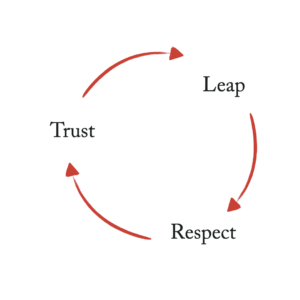
Trust Loop

How a New Leader Can Truly Build Trust

Building trust with a team you didn’t pick requires deliberate, daily actions. Here are four research-backed strategies to get the trust loop turning — and keep it spinning.

1. Signal Vulnerability Early

Everyone already knows you’re new. They know you don’t have all the answers yet. Pretending otherwise just makes you seem insecure or out of touch. Instead, lean into your newness.

Say things like, “I’m still learning how this team works.” Then prove it by listening. Create a space where people feel safe to teach you. This early show of vulnerability sparks empathy — and empathy is the gateway to trust.

When a new leader admits they don’t have it all figured out, it invites others to open up, too. It shows that you’re not just here to impose your will — you’re here to learn and lead together.

2. Share Information Transparently

Eventually, as the new leader, you will need to drive change. That’s probably part of why you were brought in. But when you do, don’t operate behind closed doors.

Instead, treat your team like insiders. Pull back the curtain. Share early information about strategy shifts or organizational changes. Say things like, “This isn’t finalized yet, but here’s what I’m hearing and thinking — and I’d love your perspective.

Transparency builds belonging. It signals, I trust you with this information. And when people feel trusted, they’re much more likely to trust you in return.

3. Respond to Vulnerability with Respect

When your team members finally take a risk — whether it’s sharing a frustration, giving you feedback, or floating a bold idea — recognize it for what it is: a test.

They’re not trying to undermine you. They’re trying to see if you’re the real deal.

Your job isn’t to defend your decisions or your leadership history. It’s to listen. Ask clarifying questions. Thank them for being honest. Engage with their ideas sincerely — even if you don’t ultimately agree.

The way you respond to those early leaps of faith will define whether the trust loop accelerates — or seizes up.

4. Amplify Unheard Voices

One of the easiest ways to build trust with a new team is to ensure every voice is heard, especially the quieter ones. When historically quiet team members finally speak up, make it clear their input matters. Amplify their ideas in meetings. Circle back to them in discussions. Let the entire team see that contributions aren’t just tolerated — they’re valued. Without open communication, hierarchy and politics creep in fast. By contrast, when people feel heard and respected, they lean in with greater commitment and creativity.

Trust First, Change Second

Inheriting a team is tough. You’re stepping into a culture you didn’t create, with dynamics you don’t fully understand yet. And because you’re the new leader, it’s tempting to rush into action — prove yourself, make changes, shake things up. Resist that temptation.

The real work of a new leader is not about being liked. It’s about being vulnerable. Encouraging interpersonal risks. Meeting those risks with deep respect. That’s how you build trust. That’s how you turn a group of individuals into a committed team.

Because at the end of the day, you don’t want a compliant team that simply does what they’re told. You want a committed team that’s ready to go above and beyond — and commitment always starts with trust.

Image credit: Pixabay

Subscribe to Human-Centered Change & Innovation WeeklySign up here to get Human-Centered Change & Innovation Weekly delivered to your inbox every week.

The Vulnerability Premium

Why Asking for Help Expands Collective Corporate Courage

The Vulnerability Premium

GUEST POST from Art Inteligencia


I. Introduction: The Corporate Armor Dilemma

The Status Quo: The traditional corporate playbook equates leadership with having all the answers. “Fake it till you make it” has mutated into a systemic fear of looking incompetent, forcing professionals to don a heavy layer of professional armor.

The Paradox of Perfection: When leaders and teams pretend to be invincible, they inadvertently build cultures of isolation, risk-aversion, and stagnant ideas. Perfectionism becomes the ultimate enemy of agility.

Introducing the “Vulnerability Premium”: It is time to flip the script. By treating the admission of a knowledge gap or a need for assistance not as a liability, but as a strategic asset, organizations can unlock unprecedented value.

Core Thesis: In a volatile, uncertain, and rapidly shifting world, asking for help is the ultimate catalyst for human-centered change. It is the single most effective mechanism for driving collective corporate courage and unlocking true, sustainable innovation.

II. Redefining Vulnerability as an Innovation Catalyst

To build a future-ready organization, we must first dismantle the outdated notion that vulnerability is a sign of weakness. In the arena of modern business, vulnerability is the very ground from which innovation grows.

The Human-Centered Lens

For too long, corporate transformation has focused strictly on technical architecture, systems, and financial metrics. But true transformation is always human-centered. When we view an organization through this lens, we realize that breakthrough ideas don’t come from flawless algorithms; they come from people who feel safe enough to admit what they don’t know and explore the uncharted spaces between their collective skillsets.

The Friction of “Knowing It All”

When an organizational culture demands infallibility, it introduces massive friction into experience design and digital transformation initiatives. If a manager or team leader cannot safely say, “I don’t understand how this new platform works,” or “Our current customer journey is failing here,” the problem remains hidden. The pressure to appear omniscient forces people to defend broken processes, ultimately stalling progress and killing agility.

The Spark of Collaboration

True innovation is rarely a solo sport; it is a game of cross-pollination. When an individual or a department has the courage to reach out and say, “We have a piece of the puzzle, but we need your expertise to finish it,” they smash the functional silos that paralyze large enterprises. Asking for help acts as an invitation, drawing diverse perspectives into the problem-solving sandbox and creating the collaborative friction necessary to generate truly novel solutions.

III. The Mechanics of the Vulnerability Premium

The “Vulnerability Premium” operates much like a financial premium — it is the excess return gained by choosing a higher-value, more courageous path over a safe, stagnant one. When an organization normalizes the act of asking for help, it unlocks tangible behavioral mechanics that fundamentally alter performance dynamics.

The Trust ROI

Every time a leader looks at their team and says, “I don’t know the answer to this, what do you think?” they aren’t eroding their authority; they are making a high-yield investment. This intentional vulnerability triggers an immediate return on investment in the form of psychological safety. It signals to the team that honesty is valued above posturing, creating a reciprocal loop of mutual trust that accelerates communication and decision-making speeds.

Lowering the Cost of Failure

In a culture where asking for help is stigmatized, employees spend an enormous amount of emotional and operational energy hiding mistakes, covering up gaps, and defending sunk costs. By reframing the request for assistance as a standard tool for excellence, organizations drastically lower the social cost of failure. Teams can flag risks early, openly share what isn’t working, and pivot or experiment with minimal friction.

The Experience Design (CX/EX) Connection

There is an unbreakable bond between employee experience (EX) and customer experience (CX). An organization cannot deliver an authentic, empathetic, and seamless experience to its customers if its internal culture is defined by fear, armor, and isolation. When we design internal experiences that respect and utilize human vulnerability, we build a workforce capable of projecting that same deep empathy outward into the market, resulting in superior product and service design.

IV. The Futurist’s View: Scaling Collective Courage

Looking toward the horizon, the operating environment for business is growing increasingly complex. As artificial intelligence, shifting global demographics, and macro-economic disruptions rapidly rewrite the rules of marketplace engagement, the era of the omniscient corporate leader is officially over.

Navigating the Unknown

In a relatively stable world, organizations could rely on historical data and rigid five-year plans. Today, we are navigating uncharted waters where no single individual, regardless of their talent or tenure, can possess the entire map. The future belongs to organizations that recognize that uncertainty is not a temporary hurdle to pass, but the permanent terrain on which we must execute.

From Hero Leadership to Collective Intelligence

We must consciously retire the myth of the lone, heroic innovator who retreats into a room and emerges with a flawless, market-disrupting strategy. True resilience requires shifting our paradigm toward decentralized collective intelligence. When leaders scale collective courage, they create an ecosystem where intelligence is distributed, and every node in the network is empowered to raise a hand, query the system, and pull in resources to solve emerging problems in real time.

Building Resilient Cultures

Organizations that successfully master and scale the Vulnerability Premium don’t just survive disruptive waves — they actively shape the future. Because their teams are not paralyzed by the fear of looking vulnerable, they possess the agility to wave the white flag early when a project hits an unforeseen roadblock. This early warning system allows the collective enterprise to quickly recalibrate, reallocate capital, and transform potential failure into a distinct competitive advantage.

V. Actionable Framework: Activating the Premium in Your Organization

Moving from a culture of professional armor to one that capitalizes on the Vulnerability Premium requires more than just inspiring rhetoric. It demands a deliberate, systemic redesign of leadership behaviors, organizational rituals, and internal infrastructure. Leaders must actively architect an ecosystem where seeking assistance is recognized as a hallmark of high performance.

Step 1: Model it from the Top

The journey toward collective corporate courage begins with leadership behavior. Executives must practice “intentional vulnerability” to set the tone for the rest of the enterprise. This does not mean oversharing or displaying manufactured insecurity; rather, it means confidently modeling intellectual humility. Tips for leaders include:

  • Regularly stating, “I don’t have the answer to this yet, and that’s why I’m bringing it to this team.”
  • Sharing personal “lessons learned” from past strategic missteps during all-hands meetings.
  • Actively asking junior team members for their unique perspectives and critiques on high-level initiatives.

Step 2: Reward the Ask

Culture is defined by what an organization tolerates, punishes, and rewards. To build the Vulnerability Premium into the fabric of your company, you must deliberately redesign your recognition and performance management systems. Organizations should:

  • Incentivize early risk detection by publicly praising teams that flag project gaps or blockers before they escalate into costly failures.
  • Incorporate collaborative metrics into performance reviews, measuring how effectively an individual or department pulls in cross-functional help to solve complex problems.
  • Celebrate the “pivots” — rebranding failed experiments not as waste, but as essential, crowdsourced learning milestones.

Step 3: Build the Infrastructure

To sustain this cultural shift, you must lower the social and operational friction of asking for help by embedding it into your organizational design and technology platforms. This involves creating formalized channels for collective intelligence, such as:

  • “Help Wanted” Innovation Boards: Digital workspaces where project leads can post specific creative or technical roadblocks, inviting cross-departmental experts to opt-in and assist.
  • Peer-to-Peer Consulting Rituals: Structured, bi-weekly “peer assists” where project teams present their current challenges to a diverse group of colleagues solely to gather constructive feedback and alternative solutions.
  • Psychologically Safe Feedback Loops: Anonymized, rapid-pulse survey tools designed to let teams report when they feel overwhelmed or lack the resources to meet a strategic objective, allowing leadership to deploy support proactively.

VI. Conclusion: The Courageous Leap Forward

As we stand on the precipice of an increasingly complex and fast-moving business landscape, the choice facing modern enterprises is stark. Organizations can continue to pay the heavy, invisible tax of hidden fear — where valuable energy is squandered on maintaining a facade of individual infallibility — or they can choose a more profitable path.

By consciously investing in the Vulnerability Premium, leaders can trade the exhausting burden of professional armor for the unstoppable momentum of collective corporate courage. When we design corporate experiences that honor human limitations and celebrate human collaboration, we don’t weaken the enterprise; we fortify it.

True corporate courage is not about charging blindly into the future with a false sense of absolute certainty. It is about having the systemic strength, the cultural maturity, and the intellectual humility to turn to your team, admit what you do not know, and build the future together.

Frequently Asked Questions

What exactly is the “Vulnerability Premium”?

The Vulnerability Premium is the measurable return an organization gains in psychological safety, trust, and innovation when it normalizes asking for help. By trading the heavy social cost of pretending to be infallible for collective intelligence, teams identify risks earlier, collaborate across silos, and design more empathetic solutions.

Does practicing vulnerability mean leaders should expose all their flaws?

No. In a professional context, vulnerability does not mean oversharing or manufactured insecurity. It means practicing “intentional vulnerability” and intellectual humility — confidently admitting when you don’t have all the answers, inviting diverse perspectives to the table, and framing help-seeking as a standard tool for operational excellence.

How can an organization start measuring the impact of this cultural shift?

Impact can be measured through specific human-centered metrics: a decrease in time-to-market for innovation projects (due to early roadblock detection), an increase in cross-departmental project resource sharing via collaborative platforms, and improved employee retention and engagement scores within internal feedback loops.

SPECIAL BONUS: Braden Kelley’s Problem Finding Canvas can be a super useful starting point for doing design thinking or human-centered design.

“The Problem Finding Canvas should help you investigate a handful of areas to explore, choose the one most important to you, extract all of the potential challenges and opportunities and choose one to prioritize.”

Image credit: Gemini

Subscribe to Human-Centered Change & Innovation WeeklySign up here to get Human-Centered Change & Innovation Weekly delivered to your inbox every week.