Tag Archives: future

Apple Announces Name Change to App-le

Apple Announces Name Change to App-le

First Apple changed its name from Apple Computer to Apple to better reflect a business focus that was extending beyond computers to music players, smartphones, digital music sales, and more.

And last week Apple announced a flurry of new products including:

  • iPhone 6s and iPhone 6s plus
  • All new Apple TV
  • iPad Pro
  • watchOS 2
  • iOS9

What was clear from the announcements is that Apple’s view the future of computing and entertainment is an App-centric one.

First Apple created Apps for the iPod. Anyone remember the iPod? Apple barely does. They still make iPods, but they’ve been dropped from the main menu on Apple’s web site and relegated to the text links at the bottom of the page. Then they create Apps for the iPhone and the iPad and the watch. And this past week Apple announced their App-centric vision for the future of television.

What is this vision?

It’s pretty simple really. Want to watch major league baseball (MLB) on your television, buy the MLB app. Want to watch HBO, buy the app. Cartoon Network? Get the app. You get the idea.

Why does Apple have this vision?

This App-centric vision of entertainment grows their ecosystem and enables Apple to make money not only from hardware sales, but also from commissions in the sale of all of these Apps. And as people buy more apps, they lock themselves further into Apple’s hardware, by design.

Apple’s App-centric vision for the future of television is good for creators of popular, quality content like HBO, the National Football League (NFL), Premier League Football, CNN, BBC, and for movie-centric aggregators (Netflix, Amazon). The evolving App-centric approach to television also has the benefit to the content creators of enabling them to build Apps that yes play full-screen video (what people expect), but also to integrate information, commerce and social elements into their Applications as they see fit. The downside is that content creators will lose the perceived safety that cable network bundling offers.

But the smartest, best run content creators are more likely to gradually embrace this App-centric possible future, and as a result Apple’s App-centric television future is likely to be a disaster for cable companies and other television-centric aggregators (Hulu, Sling). Why would you need an intermediary like a cable company when you can go straight to the source?

Cable companies could however try to beat Apple to the App Store model and potentially also beat them to the Spotify model for television if they move quickly. But are speed and courage what cable companies are known for?

YouTube and Facebook could also be big winners in Apple’s App-centric television future as both sites could become the home for a treasure trove of free sample shows, a place for people to discover new content to subscribe to. Facebook has made a big push into video the past few years, making this potential area of growth possible for them.

Apple missed the App-centric transition in music, and they had to go out and overpay for Beats to try and catch up to Spotify and others. They’ve also missed the early days of the App-centric transition in paid video apps as well, with Netflix enjoying the early success. They don’t want to get completely left behind, so they are making their big push towards an App-centric television future. The only question is how?

Will Apple look to create a subscription service like Netflix or Spotify as their App, or focus on promoting content creator Apps (NFL, CNN, etc.) through an App Store, both, or something completely different?

No matter which direction Apple chooses, it’s clear that with Apple it is all about the apps. So will Apple change its name to App-le? Probably not. But, they’ve made it very

clear that their vision for the future is an App-centric one. Will they be able to realize it?

Image credit: mashable.com

This article originally appeared on Linkedin

Accelerate your change and transformation success

Subscribe to Human-Centered Change & Innovation WeeklySign up here to get Human-Centered Change & Innovation Weekly delivered to your inbox every week.

Drowning in a Sea of Content

Drowning in Content

In #MyIndustry, content creation (I’m an author, keynote speaker and publisher), there is already a flood of content and the flood waters will not recede anytime soon. In fact, the rate of content creation is increasing as more companies launch content marketing and inbound marketing campaigns to pull customers to them.

Before the Internet came along, content was naturally limited by the potential throughput possible through a relatively fixed number of available channels:

  • Handful of TV stations
  • Radio stations
  • 1 or 2 local newspapers
  • A few dozen magazines
  • A handful of book publishers

Things remained relatively stable for several decades, then beginning in about 1980 this began to change. Cable and satellite television began to arrive taking television from a handful of stations to hundreds. The number of magazines began to grow, doubling between 1980-2000 according to Pew Research, online services and eventually the Internet emerged to provide a plethora of alternatives to traditional newspapers, and satellite and internet radio arrived. At the same time Amazon, Lulu and others launched the self-publishing revolution.

The amount of content available to people has exploded over the last 35 years. I saw a statistic recently that more than 1 TRILLION photos will be taken in 2015, compared to 2.7 Trillion photos cumulatively stored through the end of 2014.

With the rate of the content deluge increasing and with none of it draining out the bottom of the Internet bathtub, it will become harder and harder for a content creator like myself to capture people’s attention and to afford to continue to deliver quality insights from research, collaboration, and connection.

Being a content creator is a lot like being a space object, there are lots of asteroids in space, and it is easy to float around as an asteroid, but to carefully tend and cultivate an ecosystem that helps you attract enough mass and an atmosphere capable of generating and growing life is much harder.

Creating unique and differentiated insights to power content that educates, informs, or entertains (or potentially all three) is hard enough, but if you want to create something with its own source of gravity, you need to collect and harness many more skills, while also looking for potential collaborators with complimentary skills.

This will always be true for artists, musicians, authors, and any other kind of content creator. There is no going back?

So, what’s your center of gravity?

And how can you make it stronger?

In my own content creation sphere, I continue to work to strengthen the center of gravity in the innovation arena by working on a site redesign with my great Innovation Excellence co-Founders and the digital professionals at Juice Interactive, and growing a new center of gravity in the change arena with some new partners as we seek contributing authors for an upcoming launch of Charting-Change.com.

Helping to make innovation and change insights accessible for the greater good is what drives me, and I’ll keep doing it as long as I possibly can!

Image credit: Bunchcast


Accelerate your change and transformation success

Subscribe to Human-Centered Change & Innovation WeeklySign up here to get Human-Centered Change & Innovation Weekly delivered to your inbox every week.
Listen to Crowd Computing is Dead, Long Live the Cloud!

by Braden Kelley

The Innovation Excellence version of my recent article Cloud Computing is Dead, Long Live the Cloud! has done so well that Umano has decided to turn it into an audio-article that you can listen to while you work, drive, etc. if you were too busy to read it when it came out. 😉

Here is the audio file for your listening enjoyment:

(sorry, umano seems to have gone out of business)

Hopefully I will be able to bring you more of my articles narrated in this way for those of you who prefer to listen to content instead of read it.

Keep innovating!


Accelerate your change and transformation success

Subscribe to Human-Centered Change & Innovation WeeklySign up here to get Human-Centered Change & Innovation Weekly delivered to your inbox every week.

Microsoft’s Latest Vision of Future Productivity

Microsoft's Latest Vision of Future ProductivityI came across the latest vision of future productivity from Microsoft today and thought I would share it with you, along with a whole series of previous videos from Microsoft taking a look at the same subject area, ranging from 2009-2015. It is interesting to see what has changed and what has stayed the same over those six years in their view of the future.
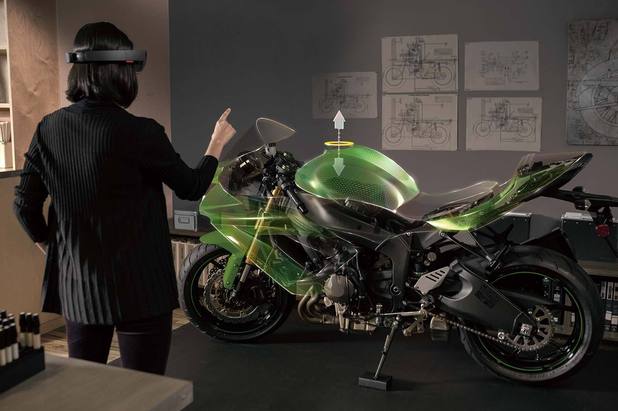

So, here is Microsoft’s latest vision of future productivity:

And here is a closer in, more present-oriented view of changes in how people think about technology, collaboration, and productivity from Julia White, General Manager, WW Office Marketing, Microsoft:

(sorry, someone made this video private)

It can also be interesting to see how visions of the future evolve over time, so here is Microsoft’s vision of the future from October 2011:

And their 2009 vision:

Does anything jump out that has either worked its way into Microsoft’s vision of the future of productivity or worked its way out of their vision that is notable?

I’d be curious to hear your thoughts and reactions to this series of videos and where you think things are going in the near term and longer term.


Accelerate your change and transformation success

Subscribe to Human-Centered Change & Innovation WeeklySign up here to get Human-Centered Change & Innovation Weekly delivered to your inbox every week.

Microsoft Stomps on Google Glass

Microsoft Stomps on Google Glass

Wow!

I have to start that word, because I’m not sure how else to describe what has just emerged from Microsoft Research in the new Microsoft HoloLens.

And as I say in the title, if you watch the video below you’ll clearly see that Microsoft has just busted Google Glass – both lenses.

I said from the beginning that Google Glass would never catch on as a consumer product, because they look dumb, cost a lot of money, and don’t really fit into most people’s lives (or add much of anything to them). Recently Google shut down its consumer facing Google Glass program while they try to fix its shortcomings.

Microsoft’s HoloLens on the other hand, if you’ve ever read Innovation is All About Value (if not, follow the link) then you’ll quickly see after watching the video above that Microsoft’s new potential innovation ticks all three boxes in my innovation success prediction framework:

  • Value Creation – Takes 3D objects from your screen and brings them to your physical environment AND lets you interact with them (my mind races thinking about the possibilities).
  • Value Translation – Watch the video. If you don’t see how this might fit first into many professions out there and enable some amazing rapid prototyping without building anything (watch out 3D printing companies!), and possibly also into your personal life, I’ll be shocked.
  • Value Access – Microsoft is already engaging partners to add more value to what is essentially a platform, not a product.

Microsoft HoloLens

Microsoft is being intentionally coy about saying when it will be releasing the Microsoft HoloLens, but some people are predicting it will be available in the Windows 10 launch timeframe, which Microsoft is also being vague about saying only “later in the year” – which for my money usually means Q4 (or maybe Q3) depending on how the preview version does in the wild.

So what do you think of Microsoft’s new HoloLens?

I for one will be reaching out to my friends at Microsoft (you know who you are) to get a personal preview for a further write-up in Innovation Excellence (the world’s most popular innovation web site), so stay tuned!


Accelerate your change and transformation success

Subscribe to Human-Centered Change & Innovation WeeklySign up here to get Human-Centered Change & Innovation Weekly delivered to your inbox every week.

Speed of Change

Speed of Change

Are You Innovating at the Speed of Change?

The world is changing all around us at an increasing rate, and individuals (and yes organizations too) are struggling to cope with this ever increasing pace of change.

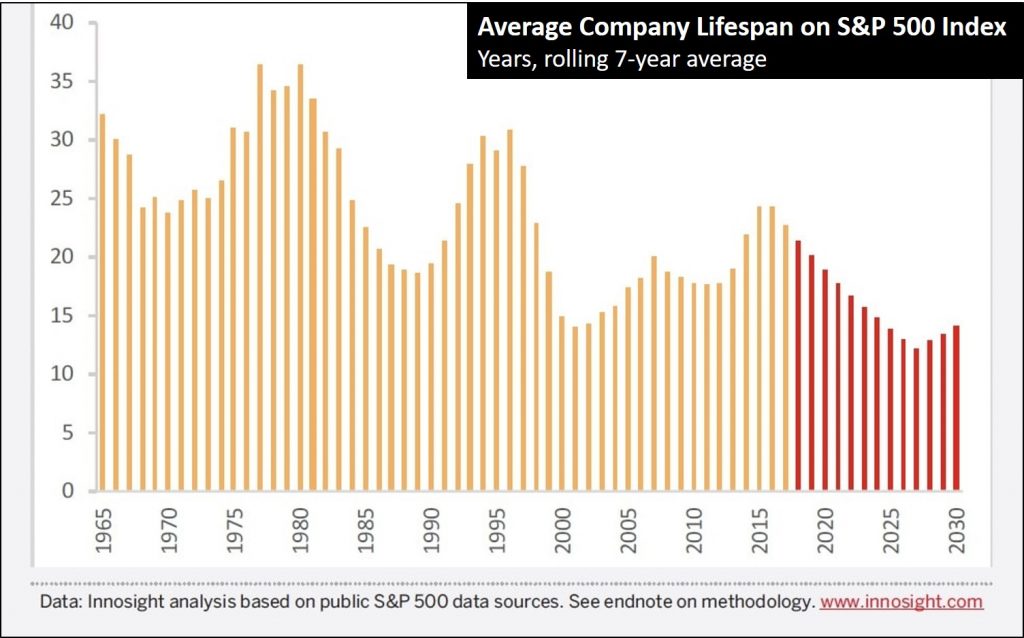
In fact, over the last 50 years the average lifespan of a company on the S&P 500 has dropped from 61 years to 18 years (and is forecast to shrink further in the future).1

Innosight Average Company Lifespan

Nobody of course wants to be one of those organizations that goes out of business, but the fact is that if your organization can’t innovate and change at the speed of change of its customers’ wants and needs, and the pace of geopolitical, social, and economic change in the world around it, then it will likely have to change its sign from open to CLOSED, permanently.

Your organization may indeed be doomed to fail if it develops on or more of the following change gaps:

  1. Your speed of hiring is slower than the speed of your growth
  2. Your speed of market understanding is slower than the pace of market change
  3. Your speed of insight dissemination and acceptance is slower than the pace of market change
  4. Your speed of idea commercialization is slower than the pace of market change
  5. Your speed of innovation is slower than the competition’s speed of innovation
  6. Your speed of internal change is slower than the rate of external change

The last one is of course the largest and the most important, and the most complex, being composed of your speed of:

  • Market Analysis (gathering of insights and inspiration)
  • Invention (creation of innovation source material)
  • Design (building a potential solution around an invention)
  • Development (taking the design and creating a scalable, launch ready solution)
  • Test (Evaluating with customers whether the solution works as designed and scales as intended)
  • Evolution (Launching the solution into the marketplace with open eyes and ears, pivoting/improving as necessary)

While it is possible to enter a market too early, you can survive this tactical error if you enter in a small way instead of committing to a global launch with grand customer promises. However, much more damage comes to organizations that enter too late. So, as an organization we must be constantly striving to get faster at discovering new market insights and adapting and aligning our organization to fulfill newly discovered market needs more quickly than our competition, otherwise we might find ourselves locked out of our customers’ top consideration set tier.

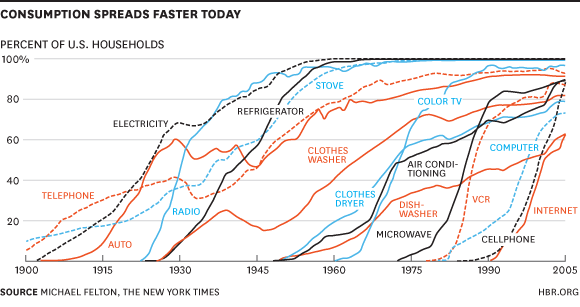
Consumption Spreads Faster

What other change gaps do you see as you look at your business or that of your competition?

This is the first of many articles that I will be writing in the run up to my second book (to be published by Palgrave Macmillan), in which I will explore the importance and implications of change in the ongoing success of organizations, along with building up a concise set of best practices and next practices for change.

To help kick off this journey I will be conducting a FREE webinar with my friends over at CoDev, focusing on how Innovation is All About Change. This exclusive sneak peek and Live Q&A will take place from 12:00-1:00pm ET on January 15, 2015, and will feature a quick introduction to a new visual, collaborative change planning toolkit that I’ve developed and am ready to share with the world. Click here to register (link expired).

I hope you’ll come join me on this journey to improve the pace of change in our organizations!

UPDATE to banner: You can now access a free recording of this webinar using PASSCODE 1515 here (link expired)

1. Innosight/Richard N. Foster/Standard & Poor’s
2. Image Source: Wikipedia


Build a common language of innovation on your team

Subscribe to Human-Centered Change & Innovation WeeklySign up here to get Human-Centered Change & Innovation Weekly delivered to your inbox every week.

Innovation Quotes of the Day – June 2, 2012


“Visionary people are visionary partly because of the very great many things they don’t see.”

– Berkeley Rice


“To innovate for the future present, you must maintain the flexibility to tweak branding and messaging (and even the product or service itself) should some of the forecast customer insights prove to be inaccurate and require updates.”

– Braden Kelley


“Ideas must work through the brains and the arms of good and brave men or they are no better than dreams.”

– Ralph Waldo Emerson


What are some of your favorite innovation quotes?

Add one or more to the comments, listing the quote and who said it, and I’ll share the best of the submissions as future innovation quotes of the day!

Subscribe to Human-Centered Change & Innovation WeeklySign up here to get Human-Centered Change & Innovation Weekly delivered to your inbox every week.

Innovation Quotes of the Day – May 31, 2012


“Every bursted bubble has a glory! Each abysmal failure makes a point! Every glowing path that goes astray, shows you how to find a better way. So every time you stumble never grumble. Next time you’ll bumble even less! For up from the ashes, up from the ashes, grow the roses of success!”

– From the movie “Chitty Chitty Bang Bang”


“You can’t really innovate for the past (your offering won’t be innovative and will be beaten easily by competitors). If you innovate for the future, then adoption will be slow until customers become ready. The trick is to task your insights team to provide guidance for the future present.”

– Braden Kelley


“The best way to have a good idea is to have a lot of ideas.”

– Dr. Linus Pauling
– submitted by Khululeka Khumalo


What are some of your favorite innovation quotes?

Add one or more to the comments, listing the quote and who said it, and I’ll share the best of the submissions as future innovation quotes of the day!

Subscribe to Human-Centered Change & Innovation WeeklySign up here to get Human-Centered Change & Innovation Weekly delivered to your inbox every week.

The Napkin PC and Other Innovative Ideas

The Napkin PC and Other Innovative IdeasI came across the web site for a Microsoft-sponsored alternative computing form factor contest a few years ago, and even still I must say there were a few interesting ideas that might help people begin to see the future of computing.
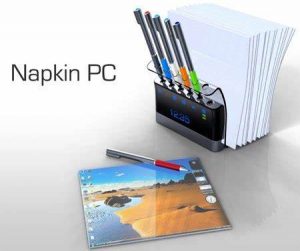
The most interesting concept was coincidentally the winner of the contest, the Napkin PC.

If you follow the link above you’ll see the artist conceptions and get a good sense of the vision. The gist is that some of the greatest advances in the world have been conceived on the lowly paper napkin in restaurants and coffee shops all over the world, so why not take the napkin high tech. Just don’t try and wipe up spilled coffee with it.

The concept consists of a rack to contain and potentially recharge the OLED “napkins” and the styluses that go with them. These “napkins” provide a computing interface much like a tablet computer and can be pinned up on a board or connected together to make a larger display.

The concept is targeted squarely at the brainstorming, ideation, collaboration space and if the designer can ever manage to pull it off, I think it would be a welcome tool for organizations everywhere.

So what is your vision for the future of computing?

Are there other sites on this topic you think others would find interesting?
— If so, please add a comment to this article with the URL

Build a Common Language of Innovation

Subscribe to Human-Centered Change & Innovation WeeklySign up here to get Human-Centered Change & Innovation Weekly delivered to your inbox every week.