Tag Archives: future

What Will the Smart Home of the Future Look Like?

What Will the Smart Home of the Future Look Like?

GUEST POST from Art Inteligencia

In recent years, the concept of a smart home has become increasingly popular. From voice-activated virtual assistants to interconnected devices, the technological advancement in home automation has revolutionized the way we live. With rapid advancements in artificial intelligence and the Internet of Things (IoT), it is intriguing to speculate about what the smart home of the future will look like. In this article, we will explore two case studies that offer a glimpse into the potential future of smart homes.

Case Study 1: The Connected Oasis

Imagine walking into a home where everything is interconnected, and your every need is anticipated. This vision of the future smart home is epitomized in the concept of the “Connected Oasis.” One example of this is showcased through the collaboration between Samsung and BMW. The companies are working on integrating their respective technologies to create a seamless experience between the car and the home.

Using artificial intelligence and sensors, the smart home of the future can recognize when the car is approaching and prepare everything accordingly. As you near your home, the lights automatically turn on, the temperature adjusts to your preferred setting, and the door unlocks as you approach it. Once inside, your smart home assistant greets you with personalized suggestions based on your daily routine and preferences. The smart home can even sync with your car, automatically setting GPS directions based on your calendar events or providing traffic updates as you prepare to leave.

Case Study 2: Sustainable and Energy-Efficient Living

With growing concerns about climate change and environmental sustainability, the future smart home is likely to prioritize energy efficiency and sustainable living. The GreenSmartHome project, developed by researchers at the University of Nottingham, envisions a home that utilizes renewable energy sources, maximizes energy efficiency, and encourages eco-friendly practices.

This smart home incorporates various features such as smart thermostats, solar power generation, and energy management systems. By analyzing data from smart sensors and weather forecasts, the home can optimize energy usage by controlling heating, cooling, and lighting systems. The smart home can also provide real-time feedback on energy consumption, offering homeowners insights to reduce their carbon footprint.

Furthermore, the GreenSmartHome integrates waste management systems, promoting recycling and composting practices. It even has a smart garden, where irrigation systems are automatically adjusted based on weather conditions and moisture levels in the soil, ensuring efficient water usage.

Conclusion

The smart home of the future holds vast potential, with a focus on enhanced convenience, interconnectivity, sustainability, and energy efficiency. From the Connected Oasis, where homes and cars seamlessly communicate, to the GreenSmartHome promoting eco-friendly practices, these case studies offer a glimpse into what we can expect from the future of smart homes.

While these concepts may seem like science fiction today, advancements in AI, IoT, and sustainable technologies suggest that these visions are within reach. As technology continues to evolve, the smart home of the future will likely become an integral part of our lives, shaping the way we interact with our homes and the environment.

Bottom line: Futurists are not fortune tellers. They use a formal approach to achieve their outcomes, but a methodology and tools like those in FutureHacking™ can empower anyone to be their own futurist.

Image credit: Pixabay

Subscribe to Human-Centered Change & Innovation WeeklySign up here to get Human-Centered Change & Innovation Weekly delivered to your inbox every week.

The Rise of Digital Health: What Does it Mean for the Future?

The Rise of Digital Health: What Does it Mean for the Future?

GUEST POST from Chateau G Pato

The healthcare industry has taken a decidedly digital approach to patient care in recent years. The rise of digital health technologies, from telemedicine to wearables, is changing how patients are treated, how diseases are managed, and how doctors communicate with each other. But what does this trend mean for the future of healthcare? This article examines a few examples of digital health technology and their potential implications for the industry as a whole.

Case Study 1 – Telemedicine

The first example of digital health technology is telemedicine. Telemedicine is the use of video conferencing, the telephone, email, or other electronic means of communication for medical care. Telemedicine has been hailed as a way to help increase access to medical care, allowing patients to communicate with remote providers, saving time, and reducing costs associated with transportation and other factors. What’s more, telemedicine can also reduce patient wait times and provide care in areas where healthcare services may not be readily available. In rural areas, for example, telemedicine can offer much needed access to specialists or treatments that may not be available locally.

Case Study 2 – Wearables

Another area of digital health technology is wearables. Wearables are devices, such as smartwatches and fitness trackers, that measure and transmit real-time patient data. Used in conjunction with healthcare applications, wearables can help monitor and manage chronic conditions such as diabetes, hypertension, and obesity. Additionally, wearables can be used to track and monitor patient activity, diet, and other lifestyle factors in order to provide useful insights. Furthermore, integrated with healthcare technologies, wearables can be used provide customized advice and treatments for patients, allowing providers to better understand and address patient needs.

Conclusion

Digital health technology is already proving to be a valuable asset to the healthcare industry, and its implications for the future are numerous. As the cost of care continues to rise and access to medical care remains limited in many areas, digital health technology can offer an effective and cost-effective solution to improve patient outcomes and bring greater efficiencies to medical care. From easier access to remote providers to better monitoring and management of chronic conditions, there is no doubt that digital health technologies will continue to shape the future of healthcare.

Bottom line: Futurology is not fortune telling. Futurists use a scientific approach to create their deliverables, but a methodology and tools like those in FutureHacking™ can empower anyone to engage in futurology themselves.

Image credit: Pexels

Subscribe to Human-Centered Change & Innovation WeeklySign up here to get Human-Centered Change & Innovation Weekly delivered to your inbox every week.

7 Trends Driving the Future of Innovation

7 Trends Driving the Future of Innovation

GUEST POST from Robert B. Tucker

Kraft Heinz’ stock is down 50 percent over the past 12 months, turnover in the executive ranks has increased, and the company’s inability to keep pace with changing consumer tastes is largely to blame. In an earnings call with investors, Kraft Heinz CEO Miguel Patricio observed that “we’ve been too focused on the present, and literally on firefighting. We need to focus on our competencies for the future.”

Yet a newly-released survey of over 200 major companies reveals Kraft Heinz is not alone. While most firms believe they’re “picking up on signals of change” that might disrupt their lines of business, fewer than half (42 percent) admit that they’re unable to act on those signals.

This is but one finding from “Benchmarking Innovation Impact” report, produced by Innovation Leader, an information and research firm in Boston, and sponsored by KPMG LLP. The report is an insightful collection of quantitative data about how big companies staff, structure, and fund their innovation efforts and includes interviews with companies like Google, Cisco, Bose, ESPN, and Capital One.

This year’s report surveyed 215 innovation, strategy, and R&D executives at large companies. To understand how the more sophisticated companies in that cohort were different from the average respondent, Innovation Leader identified a set of “role model” respondents that represented about 12 percent of the complete respondent set. These were respondents who’ve had innovation programs and processes in place for several years, and are starting to produce consistent and concrete outcomes.

Here are seven of the most surprising and counter-intuitive findings from this year’s report:

1. Seeing isn’t the same as doing.

Most companies see and talk regularly about the changes affecting their industry — like fast-moving competitors or changing customer behaviors. But they lack the ability to connect those observations to fast action. Call it the “seeing-doing gap.”

2. Rewarding innovation and innovators will always be a challenge.

Said another way, trophies are OK; time and money are better. The most commonly-used incentive to get employees participating in innovation programs is some sort of award or recognition. (“You get an Apple Watch! And you get an Apple Watch!”) But among the role model set of companies, surveyors found a higher percentage of companies supplementing recognition with dedicated time to continue developing an idea (30 percent) or seed funding (22 percent.) Google’s “20 percent time” for pet projects may be a bit of a myth, but some companies are trying to help employees get the time and funding they need to keep moving their projects forward.

3. Revenue generation is the mother of all metrics.

Among the “role model” set, revenue generated by new products or services was being measured by fully two-thirds of respondents. And 41 percent said they were also tracking cost reductions or efficiencies. It’s not enough just to collect metrics, though — they need to be communicated and disseminated to relevant colleagues up and down the org chart.

4. Recession worries haven’t yet rattled corporate innovators.

Despite stock market tremors, trade disputes, and slowing growth in many parts of the world, more than half (56 percent) of the corporate innovators in the Innovation Leader survey expect their company’s overall investment in innovation to increase from 2019 to 2020; just 7 percent expect a decrease. The rest expect it to remain stable.

5. Leadership support and the right strategy are more important than the ability to accept failure.

There’s been a lot of rhetoric in recent years around “celebrating failure” and becoming more tolerant of failure as a necessary shift, to create more space for experiments that may not pay off. But in many organizations, explaining that it’s OK to “fail fast” is not something the broad employee base is ever going to understand or embrace. The organization’s ability to “accept failure well” was not seen as a key enabler of success by the survey’s “role model” respondents. What was? Support from leadership; crafting the right strategy and vision for the innovation initiative; and assembling a team with the necessary skill sets to deliver on that strategy.

6. Attracting and retaining innovation talent matters.

When respondents are asked to name their biggest challenges, they started with the usual suspects: things like politics, turf wars, lack of alignment, and unidentified “cultural issues.” For most companies, building trust, enabling the right relationships and providing support are necessary pre-requisites to turning ideas into action.

But when surveyors focused on the priorities of the “role model” set of respondents, their top challenge was different: it’s recruiting top talent with in-demand skillsets, from data analytics to complex partnering arrangements with innovation ecosystems. These standout firms made it past the political minefields and are recognizing that having the right people on board are what’s key. Often a mix of company veterans and outsiders with fresh approaches are essential to building new products and launching new business models.

7. Innovators need to learn to just say no.

Previous annual surveys have found program leaders tasked with doing incremental and transformational innovation at the same time. “We run 17 programs in our company and we’re also a skunkworks and we’re supposed to be scouting interesting startups and running hackathons,” said one innovation leader. “We’re being run ragged.”

Attempting to do too much can result in nothing having a significant impact. The researchers recommend putting a stop to projects that are not blossoming and learning to say no to requests that expand the mandate. Kyl Nel, former innovation leader at North Carolina-based Lowe’s, the home improvement retailer, had a clear mandate that steered clear of redesigning the checkout process in the stores, or making forklifts more efficient. “We’re about next generation stuff that’s going to shape the way retail changes,” Nel told researchers in the inaugural report in 2015. Nel had Lowe’s experimenting with mobile robots in the stores and augmented reality as a way to visualize the end result of your home improvement project.

Nel has since left Lowes and joined Singularity University in speaking and writing about transformation. Not an uncommon career path for top corporate innovators, whose tenure is often short.

This article originally appeared in Forbes
Image credit: Innovation Leader

Subscribe to Human-Centered Change & Innovation WeeklySign up here to get Human-Centered Change & Innovation Weekly delivered to your inbox every week.

Investigating the Implications of Cloud Computing for the Future

Investigating the Implications of Cloud Computing for the Future

GUEST POST from Chateau G Pato

In recent years, cloud computing has become an increasingly attractive option for businesses, allowing them to reduce costs, improve efficiency, and access data anywhere, anytime. But what are the implications of this technology for the future? In this article, we’ll explore the potential implications of cloud computing, as well as look at two case studies that illustrate some of the possible outcomes.

Cloud computing allows companies to store and access data from remote servers, rather than from a physical location. This means that businesses can access the data they need more quickly and easily, without having to invest in expensive hardware. This can help reduce costs, improve efficiency, and free up resources that can be used to focus on other business objectives.

In addition to the financial benefits, cloud computing also offers a number of other advantages. For example, it can help businesses become more agile, enabling them to respond quickly to changing market conditions. It also provides a platform for collaboration and allows businesses to access data from anywhere in the world.

The potential implications of cloud computing for the future are far-reaching. As businesses continue to embrace the technology, there will be an increased demand for skilled professionals who can develop, maintain, and manage cloud-based systems. This will create new job opportunities and open up new avenues for businesses to explore.

In addition, the increased use of cloud computing could lead to greater data security and privacy. As businesses move their data to the cloud, they can take advantage of the latest security measures to protect their data. This could have a positive impact on the way businesses handle sensitive information and reduce the risk of data breaches.

Finally, cloud computing could have a dramatic impact on how businesses interact with customers. As companies move their data to the cloud, they can create personalized experiences for customers, allowing them to access data quickly and easily. This could make the customer experience much more efficient and reduce customer frustration.

To illustrate some of the potential implications of cloud computing for the future, let’s look at two case studies.

First, consider the case of Amazon. Amazon has been an early adopter of cloud computing and has used the technology to reduce costs and improve efficiency. As a result, Amazon has been able to offer customers a more personalized experience by using data to tailor their shopping experience.

Second, consider the case of Microsoft. Microsoft has embraced cloud computing to create a more flexible platform for businesses to develop, store, and manage data. As a result, businesses have been able to reduce costs, become more agile, and create new ways to engage with customers.

Overall, cloud computing has the potential to revolutionize the way businesses operate and interact with customers. As businesses continue to embrace the technology, the implications of cloud computing for the future could be far-reaching and profound.

Image credit: Pixabay

Subscribe to Human-Centered Change & Innovation WeeklySign up here to join 17,000+ leaders getting Human-Centered Change & Innovation Weekly delivered to their inbox every week.

How the Internet of Things Will Impact the Future of Business

How the Internet of Things Will Impact the Future of Business

GUEST POST from Art Inteligencia

The Internet of Things (IoT) is rapidly becoming a reality, and businesses of all sizes are beginning to recognize the potential of the technology. IoT is a network of physical objects, or “things,” that are connected through the internet and are able to exchange data. These objects can include anything from home appliances to industrial machinery and automobiles. As the technology continues to evolve, it will have a profound impact on the future of business.

One of the most important ways the Internet of Things will affect businesses is by allowing for improved production efficiency. IoT-enabled devices can communicate with each other, allowing for the monitoring and control of production processes. This will enable businesses to optimize their processes, resulting in increased efficiency and cost savings. IoT can also help identify potential problems with machinery and equipment, allowing businesses to take corrective action before a breakdown occurs.

IoT also has the potential to revolutionize customer service. IoT-enabled devices can collect data about customers, allowing businesses to better understand their needs and preferences. This data can be used to create tailored, personalized experiences for customers, ultimately creating a deeper connection with them and improving customer loyalty.

The Internet of Things will also impact the way businesses market their products and services. By using data collected from IoT-enabled devices, businesses can target their marketing campaigns more effectively and personalize them to meet the needs of their customers. This can help businesses reach more potential customers and increase their return on investment.

Finally, the Internet of Things has the potential to revolutionize the way businesses operate. By using advanced analytics, businesses can gain valuable insights into their operations and make better decisions. This can help them become more efficient and reduce costs, while also improving their customer service and marketing efforts.

The Internet of Things is already having a huge impact on the future of business, and it’s only going to get bigger. Businesses that embrace the technology now will be well positioned for success in the years to come.

Bottom line: Futurology and prescience are not fortune telling. Skilled futurologists and futurists use a scientific approach to create their deliverables, but a methodology and tools like those in FutureHacking™ can empower anyone to engage in futurology themselves.

Image credit: Pixabay

Subscribe to Human-Centered Change & Innovation WeeklySign up here to get Human-Centered Change & Innovation Weekly delivered to your inbox every week.

Exploring the Impact of Autonomous Vehicles on the Future of Transportation

Exploring the Impact of Autonomous Vehicles on the Future of Transportation

GUEST POST from Art Inteligencia

Autonomous vehicles (AVs) are quickly becoming a reality, with various companies and governments actively researching and developing the technology. AVs have the potential to revolutionize transportation, as they can provide a safer, more efficient, and more affordable way for people to get around. In this article, we will explore the impact of AVs on the future of transportation.

1. Reduced Accidents: One of the major benefits of AVs is that they could drastically reduce the number of accidents on the roads. By relying on advanced sensors and algorithms, AVs can make decisions much faster than humans and can respond to potential threats in a fraction of a second. This could lead to a significant reduction in the number of traffic fatalities and injuries.

2. Improved Efficiency: AVs are also expected to improve the efficiency of transportation. By coordinating with each other, AVs can travel closely together, reducing congestion and improving traffic flow. Additionally, AVs could take over mundane tasks like driving in slow-moving traffic, freeing up time for people to do other activities.

3. Lower Costs: AVs could also reduce the cost of transportation. By relying on electric power instead of gasoline, AVs could reduce the amount of money people spend on fuel. Additionally, AVs could be shared by multiple people, reducing the cost of owning a car.

4. Increased Accessibility: AVs could also increase accessibility for people who cannot drive. By providing a safe and affordable way for people to get around, AVs could open up transportation to those who are unable to drive, such as the elderly and people with disabilities.

5. New Business Models: Finally, AVs could also lead to the emergence of new business models. Companies could offer ride-hailing services with AVs, while other companies could offer subscription services that allow people to access a pool of AVs as needed. Additionally, AVs could be used to deliver goods, which could lead to a more efficient delivery system.

The potential impacts of AVs on the future of transportation are immense. From reducing the number of accidents and increasing efficiency to reducing costs and increasing accessibility, AVs could revolutionize the way people get around. With continued research and development, AVs could soon become a reality and could pave the way for a more efficient, safer, and more affordable future of transportation.

Bottom line: Futurology and prescience are not fortune telling. Skilled futurologists and futurists use a scientific approach to create their deliverables, but a methodology and tools like those in FutureHacking™ can empower anyone to engage in futurology themselves.

Image credit: Pixabay

Subscribe to Human-Centered Change & Innovation WeeklySign up here to get Human-Centered Change & Innovation Weekly delivered to your inbox every week.

Poking the Box for Innovation

Poking the Box for InnovationOne of the best ways to challenge people’s thinking and get a group moving in a direction towards innovation is to get the group to define the box.

Of course a million and one innovation and creativity consultants will endlessly drone on about thinking outside the box, but how can think outside the box if you’re not first clear on what the box looks like that you’re trying to think outside of?

When I speak about poking the box, I’m not doing so in the Seth Godin ‘take a risk’ sense, but from the perspective of wanting people to visualize themselves standing in the box, giving a voice to what each of the six main sides are for the context in which you’re trying to innovate.

Start by making a list of the top six assumptions/constraints that we all make in this context:

  1. Assumption/Constraint
  2. Assumption/Constraint
  3. Assumption/Constraint
  4. Assumption/Constraint
  5. What does success look like in this context? — or alternatively, another Assumption/Constraint
  6. What does failure look like in this context? — or alternatively, another Assumption/Constraint

I’d like to thank innovation colleague Ton Verbeek for sharing the following video which looks at the ‘box’ of ground transportation and what happens if you shift from a 2D approach to ground transportation to a 3D approach:

So, what are the assumptions in ground transportation?

What are the constraints?

What does success look like in ground transportation?

What does failure look like in ground transportation?

How has the designer who created this video poked the box?

How has the designer explored the walls of the box and proposed pushing some of them outwards?

Which other assumptions or constraints could be challenged in ground transportation and what characteristics would potential solutions have in order to push a particular wall outwards?

As an example, I would say that the assumption the designer has challenged here in the context of ground transportation is the following:

— Must make efficient use of land to transport the maximum amount of people and goods

What other walls of the ground transportation box could and what would that look like?


Accelerate your change and transformation success

Subscribe to Human-Centered Change & Innovation WeeklySign up here to get Human-Centered Change & Innovation Weekly delivered to your inbox every week.

Digital Transformation versus Digital Strategy

by Braden Kelley

In my last article, Digital Transformation Matters, we looked at the accelerating pace of change, the case for digital transformation, and our evolving interactions with technology. We also asked a simple question:

Are you ready to do business in a digital way for the digital age?

In our digital age all companies must change how they think, change how they interact with customers, partners, and suppliers, and change how the business works inside. Customer, partner, and supplier expectations have changed and a gap is opening between what they expect from their interaction with companies, and what those companies are currently able to deliver. Companies must immediately work to close this expectation gap or the entire business is at risk.

There are groups of digital natives out there that are extremely capable, have greater access to capital than ever before, and are very likely to re-imagine your business and your entire industry from the ground up if you don’t start making the necessary changes in your business to eliminate the opportunity.

If they attack, they will do it with a collection of digital strategies that utilize the power of the digital mindset to more efficiently and effectively utilize the available people, tools and technology, and to design better, more seamlessly interconnected and automated processes that can operate with only the occasional human intervention.

To defend your company’s very existence, you must start thinking like a technology company or go out of business. Part of that thinking is to fundamentally re-imagine how you structure and operate your business. You must look at your business and your industry in the same way that a digital native startup will if they seek to attack you and steal your market. To make this easier you can ask yourself five questions:

  1. If I were to build this business today, given everything that I know about the industry and its customers, and given all of the advances in people, process, technology and tools, how would I design it?
  2. From the customers’ perspective, where does the value come from?
  3. What structure and systems would deliver the maximum value with the minimum waste?
  4. What are the barriers to adoption and the obstacles to delight for my product(s) and/or service(s) and how will my design help potential customers overcome them?
  5. Where is the friction in my business that the latest usage methods of people, process, technology, and tools can help eliminate?

There are of course potentially other questions you may want to ask, but these five should get you most of the way to where you need to go in your initial strategic planning sessions. If you have other key questions that you think I’ve missed, please add them in the comments.

Digital Strategy vs. Digital Transformation

But how much appetite for going digital do you have?

This is where the question of digital strategy versus digital transformation comes in.

The two terms are often misused, in part by being used interchangeably when they are in fact two very different things.

A digital strategy is a strategy focused on utilizing digital technologies to better serve one particular group of people (customers, employees, partners, suppliers, etc.) or to serve the needs of one particular business group (HR, Finance, Marketing, Operations, etc.). The scope of a digital strategy can be quite narrow, such as using digital channels to market to consumers in a B2C company, or broader, such as re-imagining how marketing could be made more efficient through the use of digital tools like CRM, marketing automation, social media monitoring, etc. and hopefully become more effective at the same time.

Meanwhile, a digital transformation is an intensive process that begins by effectively building an entirely new organization from scratch utilizing:

  • All of the latest DIGITAL TECHNOLOGIES (artificial intelligence, predictive analytics, BPM, crowd computing, etc.)
  • The latest TOOLS (robotics, sensors, etc.)
  • The latest best practices and emerging next practices in PROCESS (continuous improvement, business architecture, lean startup, Business Process Management (BPM), crowd computing, and continuous innovation using a tool like The Eight I’s of Infinite Innovation™)
  • The optimal use of the other three to liberate the PEOPLE that work for you to spend less time on bureaucratic work and more time imagining the changes necessary to overcome barriers to adoption and obstacles to delight through better leadership methods, reward/recognition systems, physical spaces, collaboration and knowledge management systems, etc.

And ends with a plan for making the transformation from the old way of running the business to the new way.

The planning of the digital transformation is of course all done collaboratively on paper, whiteboards, and asynchronous electronic communication (hopefully not email, but more on that later). The goal is to think like a digital native, to think like a startup, to approach the idea of designing a company to utilize all of the advances in people, process, technology and tools to kill off your own company (at least as you know it). Because, if you don’t re-invent your company now and set yourself up with a new set of capabilities that enable you to continuously re-invent yourself as a company, then some venture capitalist is going to see an opportunity, find the right team of digital natives, and give them the necessary funding to enter your market and re-invent your entire industry for you.

It’s All About the Interfaces

People are fascinated with startups like Uber and with good reason because they have changed the lexicon and the way that we think about entire categories of products and services. Whether or not you believe there is causation, the fact remains that Yellow Cab in San Francisco filed for bankruptcy, and that Uber has placed an immense amount of pressure on taxi and airport limousine companies. But you should also be looking at what established technology companies like Amazon are doing because established technology companies are looking for growth and new markets too, and they might decide yours looks attractive, so you have to think like a technology company or go out of business.

One way that technology companies differ from non-technology companies is that they naturally focus on the interfaces, because that is where complex systems often fail. And so, if you are pursuing a digital strategy on your way to a digital transformation, you must first pick an interface, and then optimize the experience at that interface. It could be the interface between the company and customers, it could be the company to employee or employee to employee interface, or even the company to partner or company to supplier interface. Whatever interface you choose, your goal is to ultimately look at that interface with a fresh modern lens, and then utilize all of the latest (and emerging) approaches from a people, process, and technology perspective, to create a more efficient and more effective (aka better) experience.

The better job you do as an organization at removing friction at the interfaces, the more likely you are to become a partner of choice, supplier of choice, employer of choice, and/or a brand of choice. The value of becoming any or all of these could be the difference between the survival and growth of the organization, and a slow, agonizing death at the hands of a new, digital entrant or a digitizing incumbent that completes a digital transformation before your leadership team can agree it’s even necessary.

Architecting Your Organization for Change

One thing that both a digital strategy and a digital transformation have in common is that they will inflict change (in varying amounts) upon the organization, and with a more visual, collaborative approach to planning that change – like that enabled by the Change Planning Toolkit™ that I introduce in my new book Charting Change (available February 24, 2016) – you will increase your odds of beating the 70% change failure rate and of successfully achieving your digital change goals.

As you plan your change efforts it helps if you keep in mind the Five Keys to Successful Change™ and that you consider Architecting Your Organization for Change. Below you will see visualizations of both concepts and both are available as free downloads from the Change Planning Toolkit™, which is a collection of frameworks, worksheets, and other tools (including the Change Planning Canvas™).

Five Keys to Successful Change 550

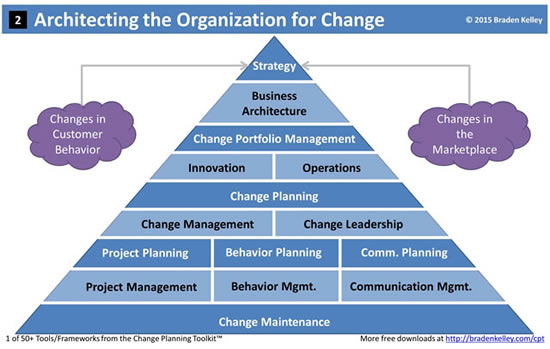
Architecting the Organization for Change

Click to access these frameworks as scalable 11″x17″ PDF downloads

These two frameworks will help you take a more holistic view of organizational change wider than just change management or change leadership, and helps organizations:

  1. Visualize a new way to increase organizational agility
  2. Integrate changes in the marketplace and customer behavior into the strategy
  3. Create a new organizational architecture that integrates all five elements of organizational change
  4. Make project, behavior and communications planning and management a central component of your change efforts
  5. One thing that should immediately jump out as you look at the Architecting the Organization for Change framework is that The Five Keys to Successful Change™ are embedded it.

Change Maintenance forms the foundation of a change-centric organization, ensuring that the changes necessary to ensure a healthy firm continue to persist (or are “maintained”), while the top of the organizational pyramid is driven by a conscious strategy that evolves over time, informed by changes in customer behavior and changes in the marketplace.

The strategy of the firm then determines the appropriate business architecture, and as the organization’s strategy changes, the business architecture may also need to change. Any necessary changes in the architecture of the business (new or updated capabilities or competencies) then will lead to modifications to the portfolio of change initiatives and projects (and remember every project is a change effort). These projects and initiatives will consist of innovation initiatives and efforts to create positive changes in the operations of the business.

The change efforts and projects identified as necessary and invested in as part of the change portfolio then represent projects that impact the innovation and operations for the firm, and in order to successfully execute them in the short term includes change planning, management, and leadership, and in the longer term the maintenance of the required changes.

And for the change efforts and projects to be successful the organization must also focus on project planning and management, behavior planning and management, and communications planning and management. The related projects, behaviors, and communications must all be effectively planned and managed in a way that keeps all three in sync.

I hope you see that by increasing your focus on the Change Planning discipline and through increased use of tools like the Architecting the Organization for Change framework from the Change Planning Toolkit™, your business will be able to more collaboratively and visually plan change efforts as large as a digital transformation or as small as a digital strategy and to increase your organizational agility.

More on organizational agility soon, so stay tuned!

In the meantime, please get yourself a copy of Charting Change as a hardcover (ebook coming soon) and get your free downloads from the Change Planning Toolkit™ (or go ahead and purchase a license now).


Buy the Change Planning Toolkit™ NowNow you can buy the Change Planning Toolkit™ – Individual Bronze License – Advance Purchase Edition here on this web site before the book launches.

This article originally appeared on Linkedin

Subscribe to Human-Centered Change & Innovation WeeklySign up here to get Human-Centered Change & Innovation Weekly delivered to your inbox every week.

Change Agents and the Future of Change Management

Change Agents and the Future of Change ManagementRecently I was identified in a mini research study as one of the top Key Opinion Leaders in change management on Twitter by Maven7, and they were curious about some of my opinions about organizational change, and asked me these two questions for an article titled ’14 Insightful Quotes from Influencers in Change Management’ on their blog.

1) In your opinion, how will change management evolve in the next 10 years?

2) Why is change agent involvement essential during a change initiative, and what best practices are there to involve them?

The article on their site just highlights a few quotes from the insights I shared with them surrounding these two questions, so if you’re more interested in hearing the full responses, please continue reading.

Question: In your opinion, how will change management evolve in the next 10 years?

I believe that the field of organizational change will evolve first by moving beyond change management. We currently speak about change management and maybe change leadership, but I believe we need to make the conversation about The Five Keys to Successful Change™ more pervasive. These five keys are:

  1. Change Planning
  2. Change Leadership
  3. Change Management
  4. Change Maintenance
  5. Change Portfolio Management

When we start moving the conversation beyond change management, we can start focusing as change professionals on achieving excellence in practice in all five areas, creating more efficient and effective tools and techniques for each. The new Change Planning Toolkit™ introduced in my book Charting Change (Feb 2016) is focused on making the planning of a change effort of any size (up to the level of mergers & acquisition, and down to the level of the project) more visual, more collaborative, and more human.

In today’s environment it is innovate or die, and the reason that most organizations are bad at innovation is that they are bad at change. So, the ability to create a culture of continuous change in an organization, and a commitment to empowering employees with the tools, techniques, and mindsets that lead to the creation of a new organizational capability in change for the organization, will lead to THE most important competitive advantage an organization could possibly possess – greater organizational agility.

This evolution of change management will lead to a group of companies with incredible organizational agility and a collection of companies that will join Blockbuster, Montgomery Ward, Borders, and Tower Records not because of mismanagement, but because of a refusal to move beyond change management to embrace The Five Keys to Successful Change™. Which will you be?

Question: Why is change agent involvement essential during a change initiative, and what best practices are there to involve them?

I don’t like the notion of a change agent. Instead I prefer the notion of a change movement inspired by a motivated change leadership team. The notion of the change agent confers the idea that one person can affect lasting change, and that’s just not reality. We might like to attribute a successful change to a single individual, but the truth is that in those situations a movement was created where people eagerly participated in affecting a certain change, where imagination and creativity were captured and harnessed to create a new reality.

The truth is that successful changes are led by a passionate change leadership team with a clear plan that empowers and engages people with a clear, and often tailored, vision for the new reality they hope to create with the broader team. Successful change leadership teams build a clear plan that can be easily shared in order to start creating movement, in order to overcome the inertia of the organization, and then they focus on building and sustaining the momentum necessary to realize the desired transformation, whether that is a “BIG C” change or a “little c” change.

Successful change leadership teams build a shared vision of the change process, and a common language for the change effort, with the support of something like the Change Planning Toolkit™. Unfortunately, 70% of change efforts fail, and one of the big reasons is the lack of alignment, and frankly, an understanding of why the change is necessary, important, and how it might be achieved. At the same time, organizations fail to provide the support necessary to help the change participants successfully adopt the desired change. If you focus on change agents instead of empowered change leadership teams, people will be less likely to adopt the change, or to sustain it. So, choose wisely.

Accelerate your change and transformation success

Subscribe to Human-Centered Change & Innovation WeeklySign up here to get Human-Centered Change & Innovation Weekly delivered to your inbox every week.

Building a Global Sensing Network – Revisited

Building a Global Sensing Network - RevisitedWhen I first wrote about Building a Global Sensing Network I wrote in the specific context of the war for innovation and the need to make sure you’re fighting it outside your organization — not inside.

We looked at how most organizations hire the most clever, educated, experienced and motivated people you could afford and then direct them to come up with the best customer solutions possible, organize and execute their production and marketing predictably and efficiently, and do their best to outmaneuver the competition.

In short, most organizations pursue success by building a fortress from which the organization can defend its intellectual property and its market position utilizing the human resources it can assemble within the castle walls. At the same time most organizations focus on achieving organizational success by achieving the greatest overlap possible between the skills, abilities and talents of each job applicant and the job description for each role.

But most organizations (referred to as Typical Organizations in the graphic below) fail to harness ALL of the skills, abilities and talents of the individuals they have in their organization to achieve greater performance as a collective. In my mind this is painful, wasted human capital – painful for the organization (lost potential revenue and profitability) and painful for the individual (boredom, stress, and disappointment).

Typical Organization

But, a handful of more progressive, innovative organizations are trying to do better to harness the passions AND the skills, abilities, and talents of their individuals to better achieve the collective’s ability to generate revenue and profits (or other appropriate benefits) by engaging their employees in the innovation efforts of the organization, and allowing their employees to take some of their skills, abilities and talents and apply them to help fulfill other job descriptions. This looks something more like this:

Innovative Organization

But in the most progressive organizations, they not only provide a way to better harness a more complete set of their employees’ skills, abilities and talents to more than one job description, but they also find a way to harness more of the skills, abilities, and talents that employees are currently realizing outside the organization in their hobbies, volunteer work, or other places.

And the successful organizations of the future will not stop there. They will also harness the connections their employees have outside the organization to increase the innovation capacity of the organization, and better engage not only partners in helping to fulfill the needs of different job descriptions, but they will also even engage their customers in achieving the work of the organization.

Where customer or partner skills, abilities and talents intersect with the job requirements, work can get done, and where customer or partner skills, abilities or talents intersect with employee skills, abilities or talents intersect, communities and connections have the chance to form and be nurtured. This is what organizations of the future will look like:

Organization of the Future

In this scenario, where innovative organizations begin to move beyond better harnessing the internal innovation capacity of their employees, to also harnessing the external capacity to work (and to innovate) of individuals outside of the organization (and to expand the scope of the collective), and to attract partners and customers to participate, organizations that allow and even encourage employees to develop a personal brand and greater external connections, will claim an outsized share of the potential benefits to both the mission of the organization and to its innovation efforts.

If your employees lack the external exposure, the external connections, and the external personal brand equity and awareness, how much harder will it be for your organization to:

  • Attract the best partners to your innovation efforts
  • Recruit the best customers to co-create with you
  • Build a strong pipeline of potential future internal talent

Through this lens you can see that in the future, successful innovation and change will be determined not just by how strong the brand of your organization is (or the collective), but also will be shaped by the strength of the personal brands of the collective’s component individuals.

As the commercial battlefield continues to change, future business success will be built upon more fluid boundaries and the ability to leverage skills, abilities and talents of people and other organizations outside the company and also the ability to:

  1. Utilize expert communities.
  2. Identify and gather technology trend information, customer insights and local social mutations from around the globe.
  3. Mobilize the organization in organic ways to utilize resources and information often beyond its control.
  4. Still organize and execute production and marketing predictably and efficiently in the middle of all this complexity.

Market leaders in our evolving reality will be increasingly determined not by an organization’s ability to outmaneuver the competition in a known market, but by their ability to identify and solve for the key unknowns in markets that will continue to become more global and less defined. Future market leaders will be those organizations that build superior global sensing networks and do a better job at making sense of the inputs from these networks to select the optimal actionable insights to drive innovation and change.

By this point, hopefully you are asking yourself three questions:

1. How do I create more fluid boundaries in my organization?

2. What does a global sensing network look like?

3. How do I build one?

One View of a Global Sensing Network

Building a Global Sensing NetworkThe purpose of a global sensing network is to allow an organization to collect and connect the partial insights and ideas that will form the basis of the organization’s next generation of customer solutions. This involves collecting and connecting:

Click to access this framework as a scalable 11″x17″ PDF download

1. Customer Insights

  • Ethnography
  • Private Communities
  • Focus Groups
  • Surveys
  • Lead User Observation

2. Core Technology Trends

3. Adjacent Technology Trends

4. Distant technology trends

5. Local social mutations

  • Demographic trends
  • Sociological trends
  • Economic trends
  • Political trends (including regulation)
  • Behavioral trends

6. Expert Communities

  • University Research
  • Government Research
  • Corporate Research
  • Charitable Research
  • Hobbyists

To actually build a global sensing network you need to start from the inside out. You have to take a look around inside your organization and see what employees you have, what natural connections they have, and where they are currently located on the globe. At the same time you need to understand how employees in your organization naturally connect with each other and define what core, adjacent and distant technologies mean in the context of your organization. You must also look and see what tools you have inside the organization for managing insights, expertise and information within the organization, and what expert communities you may already have connections into.

I would recommend beginning to establish your global sensing network inside your organization before venturing to build it out completely with the resources and connections that you will naturally need outside your organization. This will enable you to get some really great feedback from employees on the connections that will be necessary to foster and manage outside of your organization and to prepare your information sharing systems and internal communications to enable increased sharing and improved innovation inputs and outputs.

Accelerate your change and transformation success

It is likely that many organizations will already be gathering some level of customer insight information from ethnography, private communities, focus groups, surveys, lead user observation, etc. but not have a good infrastructure, policies or procedures in place for sharing this information. If you’re truly serious about creating a deep innovation capability and working to achieve innovation excellence in the same way that you pursue operational excellence, you should experiment with your systems by making customer information more available.

Next, you should leverage your employees and existing partnerships to reach outside the organization to organize and establish stronger communication channels with the relevant expert communities, including those focused on university research, government research, charitable research, corporate research (industry associations and competitors), and even to inventors or hobbyists.

And then finally from the connections you’ve built to this point, you should have identified where you have good people internally to provide information on local social mutations (local developments of interest spawned by local demographic, sociological, economic, political and behavioral trends), and where you have gaps. Hopefully by this point you may have also identified people outside your organization in countries around the world that you already have formal or informal connections to that can be leveraged to fill the gaps in your global sensing network footprint.

Conclusion

If you’re already involved in innovation and change, or have read a lot on the topic, it should be obvious to you why your organization needs a global sensing network.

Building a global sensing network helps organizations:

  • Accelerate their innovation efforts
  • Create more fluid organizational boundaries
  • Embrace a more open approach to innovation
  • Monitor emerging and evolving technologies
  • Track changes in customer behavior in the unending search for new insight-driven ideas

But the main that should jump out as you look at the download titled Building a Global Sensing Network is that innovation can come from anywhere, so you need to be listening everywhere.

The purpose for building a global sensing network is much like the purpose for having a SETI program. We know that there must be intelligent life outside the four walls of our organization, but to find it, we must be listening. And we must be listening so that we can amplify, combine and triangulate the weak signals that we might pick up so that we can find the next innovation and change that our organization is capable of delivering – before the competition. After all, there is a war for innovation and change out there. The only true unknown is who’s going to win.

I hope you’ll come join me on this journey to improve the pace and execution of innovation and change efforts in our organizations!

Sign up for Change Planning Toolkit™ launch updates

Click to access this framework as a scalable 11″x17″ PDF download

Subscribe to Human-Centered Change & Innovation WeeklySign up here to get Human-Centered Change & Innovation Weekly delivered to your inbox every week.