Tag Archives: Business Transformation

Igniting Innovation with Deep Dialogue

Igniting Innovation with Deep Dialogue

GUEST POST from Janet Sernack

I have just returned from a short sabbatical in Bali, Indonesia, a place of unparalleled beauty, lushness, and deep spirituality. Bali invites and fosters opportunities for retreat, reflection, and replenishment and is a vital space for restoration and renewal. As you may know, a sabbatical is an extended period away from work for study, travel, or personal growth. In my case, it was in response to an invitation to attend a deep dialogue session that included high-level leaders from many countries and sectors of society across the Asia Pacific region.  This entailed days spent in deep listening and inquiring processes involving quietening the mind, accessing the heart and respecting the body within a unique environment. It supported people through their change fatigue, unleashed their emotional energy, and sparked collective intelligence to emerge hopefulness, unity, faith, and possibility in the future of humanity.

It allowed people to emerge, diverge, and converge their positive and creative change choices to transform their worlds.

What is deep dialogue?

Dialogue can be defined as “a sustained collective inquiry into the processes, assumptions, and certainties that structure everyday experience”. The word “dialogue” originates from two Greek roots, ‘dia’ and ‘logos’ suggesting “meaning flowing through.”

It’s important to understand that dialogue is not the same as the often unproductive and mechanistic debates we are familiar with. Deep dialogue is a sustained collective inquiry that sparks collective intelligence through a facilitated process that delves into the values, needs, beliefs, thoughts, feelings, assumptions and certainties that shape our everyday experiences, feelings and thoughts about the future.

Deep dialogue is not just a creative conversation; it involves strategic, collective and insightful inquiry, detached observation, attention and intention, and multi-faceted listening processes.

It requires a willingness to suspend and let go of reactive and defensive exchanges and delve into their systemic causes. It helps to spark people’s collective intelligence to create moments of clarity in resolving complex and critical problems creatively and differently.

In contrast with more familiar modes of inquiry, deep dialogue involves an emergence process. It begins without an agenda and a ‘leader’ but with an accomplished facilitator and without a specific task or decision to make.

One key element in fostering productive dialogue is the role of the facilitator. The facilitator’s task is to co-create a collective holding space that encourages participants to disrupt and safely challenge their habitual thinking processes. This approach is based on the understanding that our problems cannot be solved using the same thinking that created them.

Knowing that we can’t keep on producing the results we want.

Deep dialogue evokes collective intelligence, opening new possibilities for shared thinking and fostering a sense of authenticity, unity and shared purpose in any endeavour.

What are the barriers that often hinder deep and meaningful dialogue?

The constant, relentless impact of accelerating change, disruption, and uncertainty, as well as the ongoing impact of our post-COVID isolation and people’s lack of belonging, never allows or permits us the key moments that enable us to engage in and reap the benefits that deep dialogue offers.

This lack of belonging and isolation are significant barriers to meaningful dialogue that evoke the positive changes we seek in our personal and professional lives.

As a seasoned corporate trainer, facilitator, coach, and consultant, I have observed that many people unconsciously still suffer from emotional overwhelm, causing them to lose their ‘spark’ or emotional energy. They also unconsciously suffer from cognitive overload, with little mental or thinking space to explore the impact of their thoughts and feelings on who they are, which diminishes any positivity, hope, and optimism for themselves, their teams, and organisations today and in the future.

Alternately, it is much easier and more comfortable for some people to be unconsciously reactive, defensive, and singularly focused, never developing their pause power.

By avoiding taking any personal responsibility or being accountable for interrupting their busyness and shifting their inner being, and developing the deliberate calm required to be, think, and act differently in the face of any instability, insecurity, sorrow, or unwellness, they may be experiencing in their hearts and minds.

Upon arrival, I discovered I was also unconsciously doing this despite my regular wellness routine and habits.

During the three-day process, I was encouraged to pay attention and notice how energetically, emotionally, and physically exhausted I felt and how my mind had been kidnapped and overloaded by my unconscious fears and anxiety over the state of the world.

Like many others, I had also unconsciously been wilfully pushing myself as a human doing rather than as a human being.   

This left no space or safe moments for sparking moments of clarity, never mind socialising or connecting with others to spark collective intelligence and consciously effect positive change.

Why is deep dialogue critical in today’s uncertain and disrupted world?

Fortunately, I was supported to enter and engage in deep dialogue, which allowed our group of global leaders to safely interrupt our ‘busyness’, stop, and emerge a range of vital and subtle moments.  

To cultivate and nurture our inner awareness by retreating and reflecting through mindfulness, contemplation, meditation, and silence.  

It awakened us to become conscious of the subtle world that connects our unique cognitive and emotional inner structures of thoughts and feelings to the outer world we mostly unconsciously created and experienced. 

It was a powerful, transformative experience for every one of us.

Because when we change, the world changes.

Choosing to cross the bridge consciously

We can engage in deep dialogue when we are empowered, enabled and equipped to stop, pause, retreat, and reflect.

By being curious, compassionate, and courageous in opening our hearts, minds, and will, we can spark regeneration, replenishment, and renewal of the range of options, choices, and intentions.

We can cross the bridge, individually and collectively, to re-create or co-create a compelling, sustainable, inclusive, and equitable future for everyone.

Anyone can be proactive and evoke creative sparks collectively and collaboratively to unleash our options, choices, and intentions by being in the present and bridging the past with a desirable future.

It is foundational to creating, inventing, and innovating our futures and reclaiming our inner dignity and power over our lives.

To spark our collective intelligence, all leaders must commit to consciously using this moment to create what is possible rather than reacting and passively accepting what might appear inevitable to some of us.

Please find out more about our work at ImagineNation™.

Please find out about our collective learning products and tools, including The Coach for Innovators, Leaders, and Teams Certified Program, presented by Janet Sernack, it is a collaborative, intimate, and profoundly personalised innovation coaching and learning program supported by a global group of peers over 9-weeks, and can be customised as a bespoke corporate learning program.

It is a blended and transformational change and learning program that will give you a deep understanding of the language, principles, and applications of an ecosystem focus, human-centric approach, and emergent structure (Theory U) to innovation, and upskill people and teams and develop their future fitness, within your unique innovation context. Please find out more about our products and tools.

Image Credit: Pixabay

Subscribe to Human-Centered Change & Innovation WeeklySign up here to join 17,000+ leaders getting Human-Centered Change & Innovation Weekly delivered to their inbox every week.

ISO Innovation Standards

The Good, the Bad, and the Missing

ISO Innovation Standards

GUEST POST from Robyn Bolton

In 2020, the International Standards Organization, most famous for its Quality Management Systems standard, published ISO 56000Innovation Management—Fundamentals and Vocabulary. Since then, ISO has released eight additional innovation standards. 

But is it possible to create international standards for innovation, or are we killing creativity?

That’s the question that InnoLead founder and CEO Scott Kirsner and I debated over lunch a few weeks ago.  Although we had heard of the standards and attended a few webinars, but we had never read them or spoken with corporate innovators about their experiences.

So, we set out to fix that.

Scott convened an all-star panel of innovators from Entergy, Black & Veatch, DFW Airport, Cisco, and a large financial institution to read and discuss two ISO Innovation Standards: ISO 56002, Innovation management – Innovation management systems – Requirements and ISO 56004, Innovation Management Assessment – Guidance.

The conversation was honest, featured a wide range of opinions, and is absolutely worth your time to watch

Here are my three biggest takeaways.

The Standards are a Good Idea

Innovation doesn’t have the best reputation.  It’s frequently treated as a hobby to be pursued when times are good and sometimes as a management boondoggle to justify pursuing pet ideas and taking field trips to fun places.

However, ISO Standards can change how innovation is perceived and supported.

Just as ISO’s Quality Management Standards established a framework for quality, the Innovation Management Standards aim to do the same for innovation. They provide shared fundamentals and a common vocabulary (ISO 56000), requirements for innovation management systems (ISO 56001 and ISO 56002), and guidance for measurement (ISO 56004), intellectual property management (ISO 56005), and partnerships (ISO 56003). By establishing these standards, organizations can transition innovation from a vague “trust me” proposition to a structured, best-practice approach.

The Documents are Dangerous

However, there’s a caveat: a little knowledge can be dangerous. The two standards I reviewed were dense and complex, totaling 56 pages, and they’re among the shortest in the series. Packed with terminology and suggestions, they can overwhelm experienced practitioners and mislead novices into thinking they have How To Guide for success.

Innovation is contextual.  Its strategies, priorities, and metrics must align with the broader organizational goals.  Using the standards as a mere checklist is more likely to lead to wasted time and effort building the “perfect” innovation management system while management grows increasingly frustrated by your lack of results.

The Most Important Stuff is Missing

Innovation is contextual, but there are still non-negotiables:   

  • Leadership commitment AND active involvement: Innovation isn’t an idea problem. It’s a leadership problem.  If leadership delegates innovation, fails to engage in the work, and won’t allocate required resources, you’re efforts are doomed to fail.
  • Adjacent and Radical Innovations require dedicated teams: Operations and innovation are fundamentally different. The former occurs in a context of known knowns and unknowns, where experience and expertise rule the day. The latter is a world of unknown unknowns, where curiosity, creativity, and experimentation are required. It is not reasonable to ask someone to live in both worlds simultaneously.
  • Innovation must not be a silo: Innovation cannot exist in a silo. Links must be maintained with the core business, as its performance directly impacts available resources and influences the direction of innovation initiatives.

These essential elements are mentioned in the standards but are not clearly identified. Their omission increases the risk of further innovation failures.

Something is better than nothing

The standards aren’t perfect.  But one of the core principles of innovation is to never let perfection get in the way of progress. 

Now it’s time to practice what we preach by testing the standards in the real world, scrapping what doesn’t work, embracing what does, and innovating and iterating our way to better.

Image credit: Pixabay

Subscribe to Human-Centered Change & Innovation WeeklySign up here to join 17,000+ leaders getting Human-Centered Change & Innovation Weekly delivered to their inbox every week.

How to Build Innovation Resilience in Uncertainty

Reality Strikes Back

How to Build Innovation Resilience in Uncertainty

GUEST POST from Robyn Bolton

“This time feels different.”  I’ve been hearing this from innovation practitioners and partners for months  We’ve seen innovation resilience tested in times of economic uncertainty and geopolitical volatility.  We’ve seen it flourish when markets soar and capital is abundant.  We’ve seen it all, but this time feels different.

In fact, we feel a great disturbance in the innovation force.

Disturbances aren’t always bad.  They’re often the spark that ignites innovation.  But understand the disturbance you must, before work with it you can.

So, to help us understand and navigate a time that feels, and likely is, different, I present “The Corporate Innovator’s Saga.”

Episode I: The R&D Men (are) Aces

(Sorry, that’s the most tortured one.  The titles get better, I promise)

A long time ago (1876), in a place not so far away (New Jersey), one man established what many consider the first R&D Lab.  A year later, Thomas Edison and his Menlo Park colleagues debuted the phonograph.

In the 20th century, as technology became more complex, invention shifted from individual inventors to corporate R&D labs. By the late 1960s, Bell Labs employed 15,000 people, including 1,200 PhDs.  In 1970, Xerox’s famed Palo Alto Research Center (PARC) opened.

Episode II: Attack of the Disruptors

For most of the twentieth century, R&D labs were the heroes or villains of executives’ innovation stories.  Then, Harvard Business School professor Clayton Christensen published, The Innovator’s Dilemma: When New Technologies Cause Great Firms to Fail. 

He revealed that executives’ myopic focus on serving their best (most profitable) customers caused them to miss new waves of innovation. In example after example, he showed that R&D often worked on disruptive (cheaper, good enough) technologies only to have their efforts shut down by executives worried about cannibalizing their existing businesses.

C-suites listened, and innovation went from an R&D problem to a business one.

Episode III: Revenge of the Designers

Design Thinking’s origins date back to the 1940s, its application to business gained prominence with l Tim Brown’s 2009 book, Change by Design: How Design Thinking Transforms Organizations and Inspires Innovation.

This book introduced frameworks still used today’s: desirability, feasibility, and viability; divergent and convergent thinking; and the process of empathy, problem definition, ideation, prototyping, and testing. 

Innovation now required business people to become designers, question the status quo, and operate untethered from the short-termism of business,

Episode IV: A New Hope (Startups)

The early 2000s were a dizzying time for corporate innovation. Executives feared disruption and poured resources into internal innovation teams and trainings. Meanwhile, a movement was gaining steam in Silicon Valley.

Y Combinator, the first seed accelerator, launched in 2005 and was followed a year later by TechStars. When Eric Ries published The Lean Startup: How Today’s Entrepreneurs Use Continuous Innovation to Create Radically Successful Businesses in 2011, the US was home to nearly 100 startup accelerators.

Now, businesspeople needed to become entrepreneurs capable of building, and scaling startups in environments purpose-built to kill risk and change.

In response, companies spun up internal accelerators, established corporate venture capital teams, and partnered with startup studios.

Episode V: Reality Strikes Back

Today, the combination of a global pandemic, regional wars, and a single year in which elections will affect 49% of the world’s population has everyone reeling. 

Naturally, this uncertainty triggered out need for a sense of control.  The first cut were “hobbies” like innovation and DEI.  Then, “non-essentials” like “extra” people and perks.  For losses continued into the “need to haves,” like operational investments and business expansion.

Recently, the idea of “growth at all costs” has come under scrutiny with advocates for more thoughtful growth strategies emerging There is still room for innovation IF it produces meaningful, measurable value.

Episode VI: Return of the Innovator (?)

I don’t know what’s next, but I hope this is the title.  And, if not, I hope whatever is next has Ewoks.

What do you hope for in the next episode?

Image credit: Pexels

Subscribe to Human-Centered Change & Innovation WeeklySign up here to join 17,000+ leaders getting Human-Centered Change & Innovation Weekly delivered to their inbox every week.

Five Keys to Company Longevity

Five Keys to Company Longevity

GUEST POST from Robyn Bolton

The quest for immortality is as old as humankind.  From King Gilgamesh in 2100 BCE to Jeff Bezos and Larry Page, the only thing that stops our pursuit of longevity is death.   So why don’t we apply this same verve and vigor to building things that last forever?  Why don’t we invest in corporate longevity?

Consider this—in the last 80 years, human life expectancy increased by almost 30% while corporate life expectancy declined by almost 500%. Other research indicates that the average company’s lifespan on the S&P 500 Index dropped from 60 years in 1960 to just under 15 years in 2024.

We spend billions on products to slow, stop, and even reverse aging. Yet, according to the New York Times, there are just seven keys to living longer.

Could achieving corporate longevity possibly be just as simple?

Yes.

Here are five keys to corporate longevity.

1. Take care of yourself today AND invest for tomorrow

We all know what we should do to stay healthy.  But one night, you don’t sleep well, and hearing your 5:00 am alarm is physically painful.  What harm is there in skipping just one workout? At work, you had a bad quarter, so cutting the research project or laying off the innovation team seems necessary.  After all, if you don’t save today, there won’t be a tomorrow, right?

Right.  But skipping workouts becomes a habit that can bring your retirement plans crashing down.   Just like cutting investments in R&D, innovation, and next-gen talent makes keeping up with, adapting, and growing in a rapidly changing world impossible.

2. Build and nurture relationships.  Inside AND outside your company

According to the Harvard Study of Adult Development, strong relationships lead to happier and healthier lives and are the biggest predictor of well-being.  Turns out relationships are also good for business.

Strategic alliances and partnerships directly grow revenue.  For example, 95% of Microsoft’s commercial revenue comes from its partner ecosystem. Starbucks’ collaboration with Nestle allowed the coffee chain to expand its presence in people’s lives while Nestle gained access to a growing category without the cost of building its own brand.  There’s a reason that Andreessen Horowitz declared partnerships a “need to have” in today’s world.

3. Everything in moderation

Toddlers are the only people more distracted by shiny objects than executives.  Total Quality Management.  Yes, please.  Disruptive Innovation.  Absolutely.  Agile.  Thank you, I’ll take two.

Chasing new ideas isn’t wrong. It’s how you chase them that’s dangerous. Uprooting your existing processes and forcing everyone to immediately adopt Agile is the corporate equivalent of a starvation diet. You’ll see immediate improvements, but long-term, you’ll end up worse off.

4. Eliminate bad habits (and bad people)

“The culture of any organization is shaped by the worse behavior the leader is willing to tolerate.”

Read that again.  Slowly. 

To live longer, stop engaging in, tolerating, and justifying bad habits.  To make your company live longer, stop tolerating and justifying people and behaviors that contradict your company’s culture.  Eliminating bad behavior is tough, but it’s the only way to get to your goal.  In life and in business.

5. Rest

Getting 7-8 hours of sleep a night adds years to your life.  Less than five hours doubles your dementia risk.  More sleep also boosts your productivity and creativity at work.

The latest example of rest’s power is the four-day workweek.  In 2022, 61 UK companies adopted it without any changes in pay.  Two years later, 54 still have the policy, and over 30 made it permanent.  Other companies, like Microsoft in Japan, reported productivity increases of more than 40%.

What will you unlock with these keys?

As a leader, you have the power to build a legacy and a company that thrives for generations.  But that only happens if you channel the same energy into achieving corporate longevity that you put into pursuing a longer, healthier life.

By embracing the keys of corporate longevity—caring for today while investing in tomorrow, nurturing relationships, practicing moderation, eliminating bad habits, and prioritizing rest—you’ll build businesses that endure.

The journey to corporate immortality starts with a single step. What’s yours?

Image credit: Pixabay

Subscribe to Human-Centered Change & Innovation WeeklySign up here to join 17,000+ leaders getting Human-Centered Change & Innovation Weekly delivered to their inbox every week.

Bringing Emotional Energy and Creative Thinking to AI

Bringing Emotional Energy and Creative Thinking to AI

GUEST POST from Janet Sernack

The impact of disruption, hyper-connectivity, and uncertainty, coupled with the pace of change, is causing many people to feel fearful and anxious. They become defensive and reactive and ‘go under’ emotionally and ‘go inwards’ cognitively by ruminating about their past and what bad things may happen in the future.  Dwelling on past mistakes, failures, and poor performance also causes them to disengage emotionally, take flight and move away, avoid taking action, fight, or freeze and become inert, paralyzed, and immobilized. The outcome is resistance to the possibilities and creative changes using Generative AI might bring. Because they lack the vital creative and emotional energy to generate creative thinking in partnership with AI, they will resist innovation-led change and stay ‘stuck’ in their habitual, safe and conventional roles, capabilities and identities.

Emotional energy is the catalyst that fuels the creative process. Understanding and harnessing this energy inspires and motivates individuals to explore and embrace creative thinking strategies in partnership with AI.

When a person’s emotional energy has contracted, it results in constrained, negative, pessimistic, and even catastrophic thinking habits.

Where there is no space, doorway, or threshold to take on anything new, novel, or different or to imagine what might be possible in an uncertain future to evolve, advance, or transform their personal or professional lives.

Emotional energy catalyzes people’s hope, positivity and optimism to approach their worlds differently.

When people are constrained from becoming hopeful, positive, and optimistic, they cannot apply foresight to explore future possibilities and opportunities at the accelerating pace that Generative AI tools offer in unleashing the human ingenuity and generating creative thinking required to solve challenges and increasingly complex problems.

Augmenting human creativity

Generative AI, as highlighted in a recent Harvard Business Review article, How Generative AI can Augment Human Creativity, has the potential to assist humans in creating innovative solutions. Its role is not to replace humans but to augment their creativity, helping them generate and identify novel ideas and improve the quality of raw ideas.

To empower individuals to make intelligent decisions and solve complex problems, it is crucial to notice, disrupt, dispute and deviate from their unresourceful default patterns or habitual ways of doing things.

Because emotional energy is the catalyst that fuels the creative process, it is crucial to help people find ways to re-ignite their emotional energy.

Empowering, enabling, and equipping them to embody and take on new, more resourceful emotional states and traits that allow them to break free from the constraints by identifying and letting go of old, irrelevant roles, capabilities, and identities. To take on new ones to facilitate positive changes, solve challenges, and deliver highly valued innovative solutions in partnership with Generative AI to generate creative thinking.

Generating the power of questions in problem-solving

I applied and implemented three key strategies to partner with Generative AI during the six-month coaching partnership. I used creative thinking strategies to develop a comprehensive life-coaching plan for a coaching client that serendipitously co-created a range of transformational outcomes.

Identify the key challenges, strengths, and systemic nature of the core problem and set a goal for change.

Encouraged to experiment with coaching in partnership with Generative AI, I created a comprehensive summary of what my client and I agreed her core problem was.  We defined a goal for effecting positive and constructive change and outlined evidence of achieving a successful outcome. I incorporated these elements into a descriptive paragraph and uploaded it into the Generative AI platform.

Develop a range of catalytic questions.

I focused on designing four key catalytic questions, to evoke and provoke creative thinking strategies. I requested the platform to design and develop a life-coaching plan to achieve our goal and solve her unique problem:   

Integration involves showing that two things which appear to be different are actually the same:

  • What might be some key existing transformational coaching elements that can be integrated into the new life-coaching plan I am trying to create to solve this problem?
  • Splitting involves seeing how two things that look the same might actually be different and can be divided into useful parts, like an assembly line:
  • What might be some key components of transformational coaching plans that can be combined to connect with a life-coaching plan to help solve this problem?
  • Figure-ground reversal involves realizing that what is crucial is in the background and not in the foreground, like the invention of Slack.
  • What might be some of the missing parts in the transformational and life coaching processes that might be included to help solve this problem?
  • Distal thinking involves imagining things different from the present, like the Tesla electric car.
  • What could be possible without boundaries, rules or limitations in harnessing the emotional energy required to partner with my client in our coaching relationship?
  • How might I create value for my client? What key constraints in her whole system relate to life coaching, and how might I leverage these to solve the problem differently?

It took less than a minute and consisted of a comprehensive, step-by-step, detailed plan that would have taken me at least half a day to consider and construct.

I was delighted to have an evidence-based example of successfully augmenting human creativity, partnering with Generative AI to generate creative thinking to advance my coaching partnership.

Partner with applying a transformational process.

It took less than a minute and consisted of a comprehensive, step-by-step, detailed plan that would have taken me at least half a day of using my pause-power to construct. I was delighted to have an evidence-based example of successfully augmenting human creativity to experiment with when partnering with Generative AI to generate creative thinking in my coaching partnership:

  • Generating and identifying a range of novel ideas towards improving her well-being.
  • Exploring and improving the range and quality of the initial raw ideas by applying pause power to incubate, illuminate, and generate creative thinking.
  • Identifying and developing a range of options for my client to choose from, allowing her to let go of what was depleting her emotional energy and retain her hopefulness, positivity, and optimism.
  • Identifying and developing a range of options for my client to choose from, to take on to manifest the desired future state of well-being and re-energize her emotional energy.

What was the outcome?

By co-creating a safe and collective holding space with my client, we supported her in re-energizing emotionally and applying future-oriented creative thinking strategies. We partnered with Generative AI to innovate my coaching approach and maximize our intelligence.

The outcome was personally transformative and sustained by:

  • Ensuring she re-ignited and identified strategies and new habits to sustain her emotional energy and make the necessary changes and future choices.
  • Applying circuit breakers and divergent thinking strategies to disrupt and dispute unresourceful beliefs, biases and behavior patterns.
  • Creating a safe space allowed her to deviate from her feelings, thoughts, and mindset to identify what new roles, capabilities, and identities to take on in the future and how they could benefit her and add value to the quality of her life.
  • Assisting in creating various ideas and options to refine when making significant lifestyle change choices.

It was a powerful learning experience for both my client and myself, reinforcing and validating that “Generative AI’s greatest potential is not replacing humans; it is to assist humans in their individual and collective efforts to create hitherto unimaginable solutions. It can truly democratize innovation.”

Please find out more about our work at ImagineNation™.

Check out our learning products and tools, including The Coach for Innovators, Leaders, and Teams Certified Program, presented by Janet Sernack. It is a collaborative, intimate, and profoundly personalised innovation coaching and learning program supported by a global group of peers over nine weeks and can be customised as a bespoke corporate learning program. Please find out more about our products and tools.

Image Credit: Pixabay

Subscribe to Human-Centered Change & Innovation WeeklySign up here to join 17,000+ leaders getting Human-Centered Change & Innovation Weekly delivered to their inbox every week.

Adjacent Innovation is the Key to Growth and Risk

Adjacent Innovation is the Key to Growth and Risk

GUEST POST from Robyn Bolton

It’s not easy leading innovation.  Especially these days.  You need to do more with less.  Take risks while guaranteeing results.  Keep up with competition through incremental innovation and redefine the industry with radical and disruptive innovation.  It’s maddening.  Until you find the Goldilocks Zone of adjacent innovation.

Adjacent Innovation: From Middle Child to Just Right

As HBS Professor Regina E. Herzlinger and her co-authors point out in a recent HBR article, the US is in the midst of an innovation crisis. The cost of lost productivity, estimated at over $10 trillion between 2006 and 2018, is a stark reminder of the economic consequences of a lack of innovation. This figure, equivalent to $95,000 per US worker, should serve as a wake-up call to the importance of innovation in driving economic growth.

The authors identify the root cause of this loss as the ‘polarized approach companies take to innovation.’ While companies focus on incremental innovation, the safe and reliable oldest child of the innovation family, the Venture Captialists chase after radical, transformative innovations, the wild, charismatic, free-spirited youngest child.  Meanwhile, adjacent innovation – new offerings and business models for existing customers or new customers for existing offerings and business models – is, like the middle child, too often overlooked.

It’s time to rediscover it.  In fact, it’s also time to embrace and pursue it as the most promising path back to growth.   While incremental innovation is safe and reliable, it’s also the equivalent of cold porridge. Radical or transformative innovation is sexy, but, like hot porridge, it’s more likely to scorch than sustain you. Adjacent innovation, however, is just right – daring enough to change the game and leapfrog the competition and safe enough to merit investment and generate short-term growth.

Proof in the Porridge: 4x the returns in HALF the time

Last year, I worked with an industrial goods company. Their products aren’t sexy, and their brands are far from household names, but they make the things that make America run and keep workers (and the public) safe. The pandemic’s supply chain disruptions battered their business, and their backlog ballooned from weeks to months and even years.  Yet amidst these challenges, they continued to look ahead, and what they saw was a $6M revenue cliff that had to be filled in three years and a product and innovation pipeline covered in dust and cobwebs.

From Day 1, we agreed to focus on adjacent innovation.  For four weeks, we brainstormed, interviewed customers, and analyzed their existing offerings and capabilities, ultimately developing three concepts – two new products for existing customers and one existing product repositioned to serve a new customer.  After eight more weeks of work, we had gathered enough data to reject one of the concepts and double down on the other two.  Three months later, the teams had developed business cases to support piloting two of the concepts.

It took six months to go from a blank piece of paper to pilot approval.

It took just another 12 months to record nearly $25M in new revenue.

Those results are more than “just right.”

Be Goldilocks. Pursue Adjacent Innovation

Every organization can pursue adjacent innovation.  In fact, most of the companies we consider amongst the world’s “Most Innovative” have that reputation because of adjacent innovation. 

How will you become your organization’s Innovation Goldilocks and use adjacent innovation to create “just right” growth?

Image credit: Pixabay

Subscribe to Human-Centered Change & Innovation WeeklySign up here to join 17,000+ leaders getting Human-Centered Change & Innovation Weekly delivered to their inbox every week.

What is Your Purpose?

What is Your Purpose?

GUEST POST from Robyn Bolton

Purpose.  Goal.  Mission.  You hear these words a lot this time of year.  Not because it’s the start of the annual business planning cycle but because it’s graduation season. 

Across the country, commencement speakers and wise family members espouse the importance of having a purpose to guide and sustain graduates as they set out on their next adventures.

All the talk of purpose can feel overwhelming, especially as you listen to graduates’ wide-eyed optimism about how they will change the world while stewing in an existential crisis that makes you wonder if you even have a purpose.

You do.

And part of that purpose is finding and creating purpose.

What is “Purpose?’

Purpose hasn’t reached buzzword status, but it’s close, so let’s start with a definition, or three, courtesy of The Britannica Dictionary:

  1. the reason why something is done or used: the aim or intention of something – The purpose of innovation is to create value
  2. the feeling of being determined to do or achieve something – The team worked with purpose
  3. the aim or goal of a person: what a person is trying to do, become, etc. – He knew from a young age that her sole purpose in life was to be an orthodontist

Three different definitions of purpose.  Three questions that it’s part of your purpose to ask.

“What’s THE purpose?”

Innovation is all about creating value.  Sometimes, to create value, you need to do new things.  Sometimes, you need to stop doing things.  It’s hard to tell the difference if you don’t ask.

That’s why innovative leaders are curious.  You aren’t afraid to ask, “What’s the purpose of this product/process/meeting/decision/(fill in the blank).”  You want to know “why something is done or used,” and they know that the best way to figure that out is by asking.

You ask this question at least once a day.  When you ask it, you’re genuinely curious about the answer.  After all, we’ve all experienced people and cultures that weaponize questions – “Johnny, is that where the scissors go?” or “Why did you think that was a good idea?” – and you reassure people that you’re asking a genuine question, even if they should know that by your tone.

“What’s OUR purpose?”

Innovation is hard.  You live in ambiguity and uncertainty.  You fail (learn) more often than you succeed.  You are told “No” and “Stop” more than “Yes,” “Keep going,” and “Thank You.”

Innovators are courageous.  You do the hard work of innovation because you are “determined to do or achieve something.” 

You also know that sustaining courage and purpose requires a team. 

You aren’t fooled by the myth of the lone genius. After all, Thomas Edison worked with as many as 200 people in his West Orange lab. Heck, even Steve Jobs needed Sir Jony Ive (and a few hundred other people) to bring his vision of “1,000 songs in your pocket” to life.

“What’s MY purpose?”

Innovation takes a long time.  Change happens gradually, then suddenly.  We chose to preserve what we have, rather than take a risk to get more.

Innovators are committed.  You are patient for change, steadfast in the face of resistance, and optimistic when others are afraid because of your “aim or goal…what [you are] trying to do, become, etc.” 

Even if you can’t articulate it in a grand statement or simple, pithy soundbite, you have a purpose.  As Viktor Frankl wrote, “Those who have a ‘why’ to live, can bear with almost any ‘how’.”

Three Purposes.  Three questions

Even if you lack the wide-eyed optimism of a new graduate and feel like you spend most days just muddling through life, because you are here, you have a purpose.  So tell me:

  1. When was the last time you were curious and asked, “What’s the purpose of (artifact of the status quo)?”
  2. When was the last time you were courageous and used your feeling of determination to inspire others to join your purpose, overcome obstacles, and get something done?
  3. When was the last time you had to dig deep, rediscover your purpose, and reinforce your commitment so that you could bear and overcome the “how?”

Image credit: Dall-E via Microsoft Bing

Subscribe to Human-Centered Change & Innovation WeeklySign up here to join 17,000+ leaders getting Human-Centered Change & Innovation Weekly delivered to their inbox every week.

Creating Value from Nothing

Creating Value from Nothing

GUEST POST from Robyn Bolton

Doing nothing fuels creativity and innovation, but that fuel is wasted if you don’t put it to use. Idleness clears the mind, allowing fresh ideas to emerge, but those ideas must be acted upon to create value.

Why is doing something with that fuel so difficult?

Don’t blame the status quo.

The moment we get thrown back into the topsy-turvy, deadline-driven, politics-navigating, schedule-juggling humdrum of everyday life, we slide back into old habits and routines.  The status quo is a well-known foe, so it’s tempting to blame it for our lack of action. 

But it’s not stopping us from taking the first step.

We’re stopping ourselves.

Blame one (or more) of these.

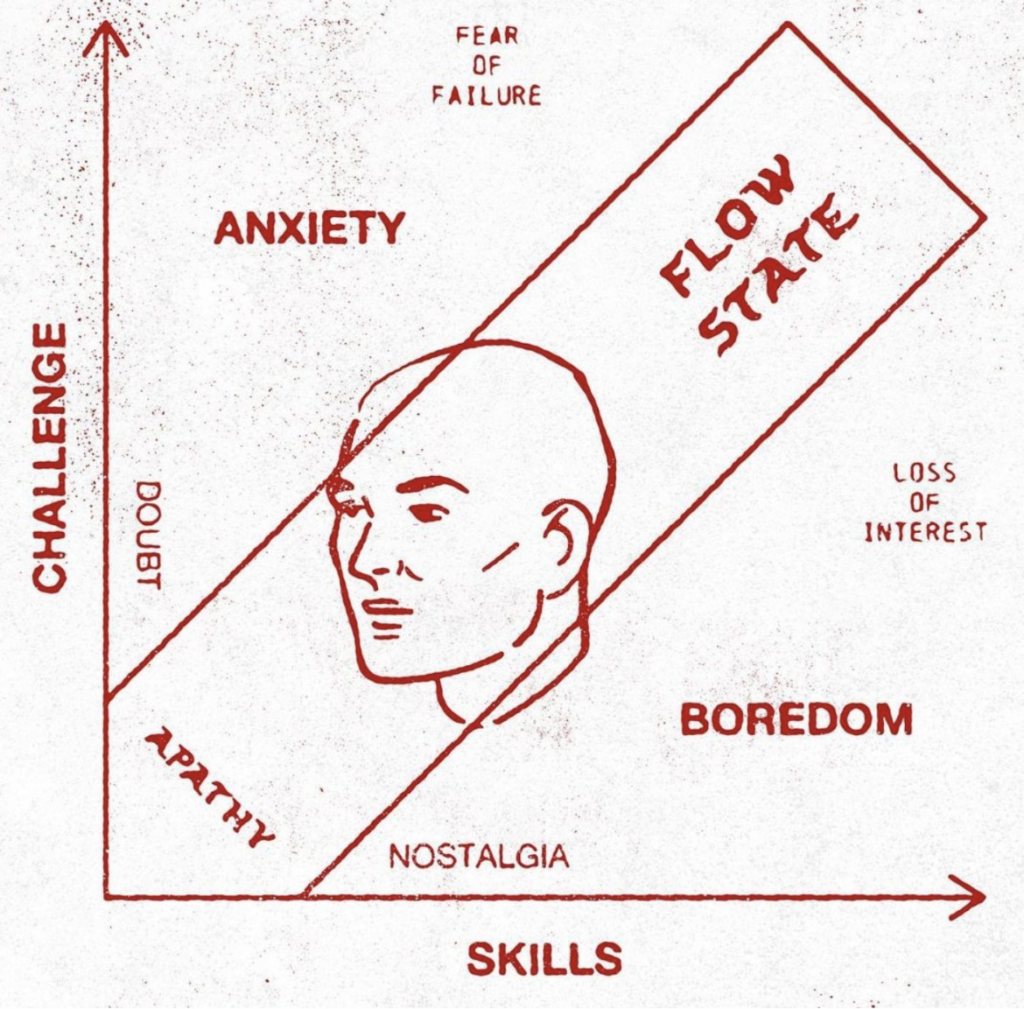
Last week, I stumbled upon this image from the Near Future Laboratory, based on a theory from psychologist Mihaly Csikszentmihalyi’s book Flow:

There’s a lot going on here, but four things jumped out at me:

  • When we don’t have the skills needed to do something challenging, we feel anxiety
  • When we don’t feel challenged because our skills exceed the task, we feel boredom
  • When we don’t feel challenged and we don’t have the skills, we feel apathy
  • When we have the skills and feel challenged, we are in flow

Four different states.  Only one of them is positive.

I don’t love those odds.

Yet we live them every day.

Every day, in every activity and interaction, we dance in and through these stages.  Anxiety when given a new project and doubt that we have what it takes. Boredom when asked to explain something for the 82nd time to a new colleague and nostalgia for when people stayed in jobs longer or spent time figuring things out for themselves.  Sometimes, we get lucky and find ourselves in a Flow State, where our skills perfectly match the challenge, and we lose track of space and time as we explore and create. Sometimes, we are mired in apathy.

Round and round we go. 

The same is true when we have a creative or innovative idea. We have creative thoughts, but the challenge seems too great, so we get nervous, doubt our abilities, and never speak up. We have an innovative idea, but we don’t think management will understand, let alone approve it, so we keep it to ourselves.

Anxiety.  Boredom.  Apathy.

One (or more) of these tells you that your creative thoughts are crazy and your innovative ideas are wild.  They tell you that none of them are ready to be presented to your boss with a multi-million-dollar funding request.  In fact, none of them should be shared with anyone, lest they think you, not your idea, is crazy.

Then overcome them

I’m not going to tell you not to feel anxiety, boredom, or apathy. I feel all three of those every day.

I am telling you not to get stuck there.

Yes, all the things anxiety, boredom, and apathy tell you about your crazy thoughts and innovative ideas may be true. AND it may also be true that there’s a spark of genius in your crazy thoughts and truly disruptive thinking in your innovative ideas. But you won’t know if you don’t act:

  • When you feel anxious, ask a friend, mentor, or trusted colleague if the challenge is as big as it seems or if you have the skills to take it on.
  • When you feel bored, find a new challenge
  • When you feel apathetic, change everything

Your thoughts and ideas are valuable.  Without them, nothing changes, and nothing gets better.

You have the fuel.  Now, need to be brave.

We need you to act.

Image credit: Pexels

Subscribe to Human-Centered Change & Innovation WeeklySign up here to join 17,000+ leaders getting Human-Centered Change & Innovation Weekly delivered to their inbox every week.
Do Nothing More Often

Do Nothing More Often

GUEST POST from Robyn Bolton

“What do you plan to do on vacation?” my friend asked.

“Nothing…”

Long silence

“…And it will be amazing.”

We live in a world that confuses activity with achievement so I should not have been surprised that the idea of deliberately doing nothing stunned my friend into silence.

After all, when people say, “I wish I had nothing to do” they usually mean “I wish I could choose what I do with my time.” And, when they do have the opportunity to choose, very few choose to do nothing.

Why does the idea of doing nothing make us so uncomfortable?

To put it bluntly, busy-ness is a status symbol.

In their paper, “Conspicuous Consumption of Time: When Busyness and Lack of Leisure Time Become a Status Symbol,” professors Silvia Bellezza (Columbia Business School), Neeru Paharia (Georgetown University), and Anat Keinan (Harvard University), wrote that people’s desire to be perceived as time-starved is

“driven by the perceptions that a busy person possesses desired human capital characteristics (competence, ambition) and is scarce and in demand on the job market.”

We didn’t always believe this.

For most of human history, we’ve had a pretty balanced view of the need for both work and leisure. Aristotle argued that virtue was obtainable through contemplation, not through endless activity. Most major religions call for a day of rest and reflection. Even 19th-century moral debates, as recorded by historian EO Thompson, recognized the value of hard work AND the importance of rest.

So what happened?

While it’s easy to say that we have to work more because of the demands of our jobs, the data says otherwise. In fact, according to a working paper by Jonathan Gershuny, a time-expert based on the UK, actual time spent at work has not increased since the 1960s.

The actual reason may be that we want to work more. According to economist Robert Frank, those who identify as workaholics believe that:

“building wealth…is a creative process, and the closest thing they have to fun.”

We choose to spend time working because Work — “the job itself, the psychic benefits of accumulating money, the pursuit of status, and the ability to afford the many expensive enrichments of an upper-class lifestyle” according to an article in The Atlantic — is what we find most fulfilling.

It’s not that I like working, I just don’t like wasting time.

We tend to equate doing nothing with laziness, apathy, a poor work ethic, and a host of other personality flaws and social ills. But what if that’s not true.

What if, in the process of doing nothing, we are as productive as when we do something?

Science is increasingly showing this to be the case.

Multiple fMRI studies have revealed the existence of the default mode network (DMN), a large-scale brain network that is most active when we’re day-dreaming. Researchers at the University of Southern California argue that

“downtime is, in fact, essential to mental processes that affirm our identities, develop our understanding of human behavior and instill an internal code of ethics — processes that depend on the DMN.”

The results of harnessing the power of your DMN are immense:

More creativity. The research discussed in Scientific American suggests that DMN is more active in creative people. For example, according to Psychology Today:

  • The most recorded song of all time, “Yesterday” by The Beatles, was ‘heard’ by Paul McCartney as he was waking up one morning. The melody was fully formed in his mind, and he went straight to the piano in his bedroom to find the chords to go with it, and later found words to fit the melody.
  • Mozart described how his musical ideas ‘flow best and most abundantly.’ when he was alone ‘traveling in a carriage or walking after a good meal, or during the night when I cannot sleep… Whence and how they come, I know not, nor can I force them.’
  • Tchaikovsky described how the idea for a composition usually came ‘suddenly and unexpectedly… It takes root with extraordinary force and rapidity, shoots up through the earth, puts forth branches and leaves, and finally blossoms.’

More productivity. According to an essay in The New York Times, “Idleness is not just a vacation, an indulgence or a vice; it is as indispensable to the brain as vitamin D is to the body, and deprived of it we suffer a mental affliction as disfiguring as rickets. The space and quiet that idleness provides is a necessary condition for standing back from life and seeing it whole, for making unexpected connections and waiting for the wild summer lightning strikes of inspiration — it is, paradoxically, necessary to getting any work done.”

Less burnout. Regardless of how many hours you work, consider this: researchers have found that it takes 25 minutes to recover from a phone call or an e-mail. On average, we are interrupted every 11 minutes which means that we can never catch up, we’re always behind.

That feeling of always being behind leads to burn-out which the World Health Organization officially recognized as a medical condition defined as a “syndrome conceptualized as resulting from chronic workplace stress that has not been successfully managed” and manifests with the following symptoms:

  • Feelings of energy depletion or exhaustion
  • Increased mental distance from one’s job, or feelings of negativism or cynicism related to one’s job
  • Reduced professional efficacy

Doing nothing, quieting our minds and not focusing on any particular task, can actually help reset our bodies systems, quieting the release of stress chemicals, slowing our heart rates, and improving our mental and physical energy

Better health. Multiple studies indicate that idleness “produces many health benefits including, but not limited to, reduced heart rate, better digestion, improvements in mood, and a boost in overall emotional well-being — which, of course, affects everything on a biochemical and physiological level, thereby serving as a major deciding factor on whether or not we fall ill, and/or remain ill. Mental downtime also replenishes glucose and oxygen levels in the brain, and allows our brains to process and file things, which leaves us feeling more rested and clear-headed, promotes a stronger sense of self-confidence, and…more willing to we trust change.”

Fine, you convinced me. How can I do nothing?

There are the usual suspects — vacations, meditation, and physical exercise — but, if you’re anything like me, the thought of even finding 5 minutes to listen to a meditation app is so overwhelming that I never even start.

An easier place to start, in my experience, is in intentionally working nothing into the moments that are already “free.” Here are three of my favorite ways to work a bit of nothing into my day.

Make the Snooze button work for you. When my alarm goes off, I instinctively hit the Snooze button because, I claim, it is my first and possibly only victory of the day. It’s also a great way to get 9 minutes of thoughtful quiet nothingness in which I can take a few deep breaths, scan my body for any aches and pains, and make sure that I’m calm and my mind is quiet when I get out of bed.

Stare out the window. I always place my computer next to a window so that I can stare out the window for a few minutes throughout the day and people think I’m thinking deep thoughts. Which I am. Subconsciously. Lest anyone accuse me of being lazy or unproductive while I watch the clouds roll by, I simply point them to research that shows “that individuals who took five to ten minute breaks from work to do nothing a few times a day displayed an approximately 50% increase in their ability to think clearly and creatively, thus rendering their work far more productive.

Bring the beach to you. Research from a variety of places, from the UK Census to The Journal of Coastal Zone Management, indicate that our brains and bodies benefit from time at the beach. But, if you can’t go to the beach, there are lots of ways to bring the beach to you. Perhaps the simplest is to bring more blue into your environment. Most people associate blue with feelings of calm and peace and a study published in the American Association for the Advancement of Science found that the color blue can boost creativity. Even putting a picture of a beach (or your own personal happy place) on your desk or computer screen can trigger your brain to slow down, relax, and possibly trigger your DMN.

With so many benefits, isn’t it time you started doing more nothing?

Image credit: Pexels

Subscribe to Human-Centered Change & Innovation WeeklySign up here to join 17,000+ leaders getting Human-Centered Change & Innovation Weekly delivered to their inbox every week.

Smarter Risk Taking

Smarter Risk Taking

GUEST POST from Janet Sernack

After founding ImagineNation™ in Israel, I invested a year of my time and considerable money in taking what I thought were smart risks to invent an experiential business game. This involved collaborating with one of the top game design companies to co-create a live business simulation incorporating innovative gamification elements intending to teach corporations how to be innovative.

To my shock and surprise at the time, my invention initially failed!

Despite being an adult and experiential learning specialist and having designed and facilitated hundreds of corporate learning games for some of Australia’s top 100 companies over twenty-five years. It felt really horrible, and it was a visceral, heartbreaking, shameful and ego-destroying experience that I would not want anyone, anywhere, ever to experience.

Deep Learning Experience

Yet, it became a profound learning experience, enabling me to understand how:

  • My imposter syndrome played a significant self-sabotaging role. It did not set me up for success, nor did it set me up for maximising the importance of self-efficacy and self-mastery when on an innovation roller-coaster ride.
  • I had not undertaken sufficient research studies to determine if users wanted and were ready to accept such a radical innovation. Nor had I noticed how much the corporate learning market was being disrupted by technology, causing significant time and budget constraints, that I had neglected to address.
  • I had not paused long enough to consider, anticipate, plan and mitigate the risks involved in prototyping a viable minimal product in a new market.
  • I had not considered the risks involved with collaborating with a new consulting partner and co-facilitator, as well as with a new client. Nor anticipated how to resolve the values conflict that erupted when the project failed.
  • I had not fully understood the process involved in iterating and pivoting a new invention and the time it would take to produce a commercially viable product that the market would understand, be ready for, and respond to.

Finally, it seems that I had unconsciously fallen victim to the innovative start-up entrepreneur’s curse – falling in love with my product!

This was generated by my excitement, enthusiasm and energy of the possibilities rather than balancing these courageously and compassionately with the:

  • Harsh realities to be innovative.
  • Vital role of smart risk-taking and experimentation.
  • What ‘fails fast, to learn quickly’ really means at the heart (emotional), head (cognitive) and gut (visceral) levels.

Value of Failing Fast

They say that people need to teach what they need to learn themselves.

This valuable failure enabled me to invest the next ten years in learning to make sense of innovation and what it means to be innovative, including:

  • Helped me develop self-efficacy, trust my inner knowing and judgement, and make a stand for myself in the face of opposition and criticism I often received when presenting at a global conference on the people side of innovation, especially by process engineers.
  • Investing more attention, time in iterating and pivoting, testing and validating the two-day business simulation MVP to make it more tangible, simpler and teachable. 
  • Acknowledging that technology had accelerated sufficiently to accept that the original creative idea of a simple hybrid board game was the most valuable commercial option that could make the difference I wanted to make in the world. 
  • Becoming more patient, self-compassionate, and courageous in smart risk-taking and leading, coaching, and engaging in team innovation and continuous learning through various innovation, entrepreneurial and intrapreneurial learning initiatives.

Iterating and Pivoting

I iterated, pivoted, and refined my intellectual property by presenting and bespoking the Coach for Innovators, Leaders and Teams Certified Program™ for over twelve years to global change-makers.

Most importantly, I reined in my competitive, risky and restless saboteur and focused on doing just one thing, which has finally morphed into a book, supported by a board game to teach people how to be innovative and develop an innovation mindset.

Taking Risks

In the fog of a globalised, disrupted, unpredictable and increasingly uncertain world, no innovation can progress, and no one can be innovative without smart risk-taking.

No innovation can improve without rigorous experimentation, where learning mainly happens by doing things to explore, discover, and know what not to do.  

Research has shown that most successful new business ventures abandoned their original business strategies when implementing their initial plans, learned what would and would not work in the market, and conserved sufficient resources to have a second or third stab at getting it right.

Trial and Error and Cause and Effect

Innovation is a never-ending, risky, adaptive process involving trial and error and understanding cause and effect.

Because people are fearful of making mistakes and the negative consequences of failure, innovation requires leadership to develop both foresight and prospection skills to:

  • Empower and enable them to paradoxically take both a strategic and systemic perspective and a human-centred approach. 
  • Equip them to be innovative when designing business ventures and transformation initiatives that deliver commercially viable outcomes to successfully improve the quality of people’s lives that are appreciated and cherished.

Risk-taking is a Choice

In most businesses and organizations, innovation involves taking considerable risks, especially if seeking to enter a new market with a new product. It is compounded and resisted by many people in organizations because they are too focused on personal survival, personal gain, short-term gain and shareholder return.

Unfortunately, many organizations end up, paradoxically, undermining their organization’s capacity to be innovative, adapt, innovate and grow. Mainly due to their people being disengaged, resistant to change, lacking agency and being held back by bureaucracy and hierarchy that is averse to smart risk-taking and experimentation.

The Future is Permissionless

Because most people generally do not have permission, and are not allowed to make mistakes. They are not encouraged to try new things, so they become risk-averse, avoidant, oppositional and conventional, and don’t feel safe in deviating from the accepted way of doing things.

This is commonly known as the ‘status quo’ and drives people to comply with ‘what is’ (even when it no longer matters) and not apply their human ingenuity, be innovative and create new inventions from ‘what could be’ possible and through smart risk-taking to partner with AI in delivering innovative solutions in a disruptive world of complexity and unknowns.

Image Credit: Unsplash

Subscribe to Human-Centered Change & Innovation WeeklySign up here to join 17,000+ leaders getting Human-Centered Change & Innovation Weekly delivered to their inbox every week.
