Category Archives: Customer Experience

Don’t Waste Your Time Talking to Customers

(until you answer these 3 questions)

Don’t Waste Your Time Talking to Customers

GUEST POST from Robyn Bolton

You know that customer insights are important.

You spend time and money to collect customer insights. 

But are you using them?

And by “using,” I don’t mean summarizing, synthesizing, discussing, PowerPointing, and presenting the insights.  I mean making decisions, changing strategies, and rethinking plans based on them.

I posed this question to a few dozen executives.  The awkward silence spoke volumes.

Why do we talk to customers but not listen to them?

In a world of ever more constrained resources, why do we spend our limited time and money collecting insights that we don’t use meaningfully?

It seems wild to have an answer or an insight and not use it, especially if you spent valuable resources getting it.  Can you imagine your high school self paying $50 for the answer key to the final in your most challenging class, then crumpling it up, throwing it away, and deciding to just wing the exam?

But this isn’t an exam.  This is our job, profession, reputation, and maybe even identity.  We have experience and expertise.  We are problem solvers.

We have the answers (or believe that we do).

After all, customers can’t tell us what they want.  We’re supposed to lead customers to where they should be. Waiting for insights or changing decisions based on what customers think slows us down, and isn’t innovation all about “failing fast,” minimal viable products, and agility?

So, we talk to customers because we know we should. 

We use the answers and insights to ensure we have brilliant things to tell the bosses when they ask.

We also miss the opportunity to create something that changes the game.

But it doesn’t have to be this way.

What do you NEED to learn?

It’s easy to rattle off a long list of things you want to learn from customers.  You probably also know the things you should learn from customers.  But what do you need to learn?

What do you need to know by the end of a conversation so that you can make a decision?

What is the missing piece in the puzzle that, without it, you can’t make progress?

What insight do you need so badly that you won’t end the conversation until you have it?

If the answer is “nothing,” why are you having the conversation?

Will you listen?

Hearing is the “process, function, or power of perceiving a sound,” while listening is “hearing things with thoughtful attention” and a critical first step in making a connection.  It’s the difference between talking to Charlie Brown’s teacher and talking to someone you care about deeply.  One is noise, the other is meaning.

You may hear everything in a conversation, but if you only listen to what you expect or want to hear, you’ll miss precious insights into situations, motivations, and social dynamics.

If you’re only going to listen to what you want to hear, why are you having the conversation?

Are you willing to be surprised?

We enter conversations to connect with others, and the best way to connect is to agree.  Finding common ground is exciting, comforting, and reassuring.  It’s great to meet someone from your hometown, who cheers for the same sports team, shares the same hobby, or loves the same restaurant.

When we find ourselves conversing with people who don’t share our beliefs, preferences, or experiences, our survival instincts kick in, and we fight, take flight, or (like my client) freeze.

But here’s the thing – you’re not being attacked by a different opinion. You’re being surprised by it. So, assuming you’re not under actual physical threat, are you willing to lean into the surprise, get curious, ask follow-up questions, and seek to understand it? 

If you’re not, why are you having the conversation?

Just because you should doesn’t mean you must.

You know that customer insights are important.

You spend time and money to collect customer insights. 

But are you using them to speed the path to product-market fit, establish competitive advantage, and create value?

If you’re not, why are you having the conversation?

Image Credit: Pexels

Subscribe to Human-Centered Change & Innovation WeeklySign up here to get Human-Centered Change & Innovation Weekly delivered to your inbox every week.

Curiosity Improves the Customer Experience

Curiosity Improves the Customer Experience

GUEST POST from Shep Hyken

“Curiosity killed the cat.” According to Wikipedia, this saying first appeared in a 1598 play, Every Man in His Humour, by English playwright Ben Johnson. The following year, Shakespeare used a similar quote in Much Ado About Nothing. The intent behind this saying is “to warn of the dangers of unnecessary investigation. …” In other words, be careful pushing for more information. Knowing more is not always best.

That may be the case for the cat, but it’s not so in the world of customer service. A good customer service rep, salesperson, or anyone interacting with a customer should be curious. And that kind of curiosity shows up in the questions they ask.

Here’s another quote for you to ponder, and this one is from Dan Sullivan, founder of the Strategic Coach program. He says, “In a world where everyone is vying to be the most interesting, be the one who is most interested.” In other words, be curious. Sullivan says to ask genuine questions, actively listen, and take the opportunity to get to know clients and customers anytime you have contact with them.

The idea of curiosity in customer service is simple. Ask more questions. Once you understand what the customer is asking for or what the underlying issue is, ask more questions for the purpose of clarity and understanding.

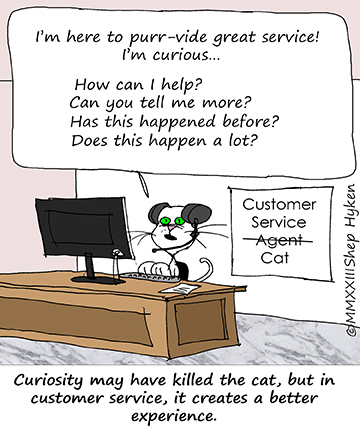
Shep Hyken Curiosity Cat Cartoon

Certain types of questions are better than others. For example, open-ended questions allow you to gather more information. An example would be, “Can you please tell me what was happening right before the problem began?”  A follow-up question such as, “Can you elaborate on that?” shows you’re actively listening. You may even let the customer know you’re taking notes. But be careful about asking too many “closed-ended questions.” These are questions that require simple yes or no responses. You don’t need to avoid them altogether, but too many yes/no questions could make a customer feel like they are in a courtroom being cross-examined by an unfriendly attorney.

Your goal is to grasp what the customer needs, and asking the right questions shows you are interested in helping the customer. It also demonstrates empathy, as the right questions show you are taking the time to understand the customer. And the right questions build trust. They help make the customer feel as if they are valued and heard.

Curiosity may have killed the cat, but it will give life to your customer relationships!

Image Credit: Unsplash

Subscribe to Human-Centered Change & Innovation WeeklySign up here to join 17,000+ leaders getting Human-Centered Change & Innovation Weekly delivered to their inbox every week.

CEO Secrets of a Successful Turnaround

CEO Secrets of a Successful Turnaround

GUEST POST from Shep Hyken

While most outside of the tech industry won’t know the Avaya brand, most will have experienced its technology if you’ve contacted customer support or communicated directly with a brand for any reason. It is a multinational technology company based in the U.S. that provides communications and collaboration technologies for contact centers in 172 countries, including 90% of the Fortune 100 companies in the U.S. Its product helps give a better customer service experience for its customer’s customers.

I had the opportunity to interview Alan Masarek about the Avaya story. Specifically, we discussed what happened since he joined the company less than one year ago. The short version of the story is that he and his leadership team successfully guided the company through Chapter 11 bankruptcy, restructuring its finances and streamlining its operations. And they did this while maintaining what Masarek calls Avaya’s North Star.

In referring to that “North Star,” Masarek says, “Customer service and experience is core to who we are and for every role in the company. Our customers count on us for the communications and collaboration technology that make customer interactions not only work, but work better.” He went on to explain the four core components they focus on:

1. Culture: Everything starts with culture. Masarek wants to make Avaya a “destination place to work,” which means attracting and keeping the best talent. Once you get good people, you must keep them there. His strategy for creating a “destination place to work” includes three components. The first is a rewards and recognition program that validates an employee’s efforts and creates a sense of accomplishment. The second is to create a culture employees want to be a part of. And third is to provide an opportunity for growth. Masarek says a company’s positive reviews and ratings on glassdoor.com, where employee rate their employers, is a success criteria he looks at.

2. Product: Avaya is a technology company and must continuously innovate and improve. They created a “product roadmap” where customers can see what products are being phased out, retained and, most importantly, being developed for the future. “We must deliver innovation—the right innovation—and we have to deliver it on time and with quality,” said Masarek. “We will be successful when we are both transparent (which is why Avaya published the roadmap) and reliable. When we deliver on that commitment over time, that reliability becomes trust.”

3. Customer Delight: If your customers don’t like the experience or the product doesn’t do what it’s supposed to do, they will find another company and product that meets their needs. Masarek recognizes the importance of customer delight and has invested heavily in hearing and understanding the “Voice of the Customer,” paying attention to customer satisfaction scores and NPS (Net Promoter Scores). Masarek is emphatic about customer delight, stating, “We are in service to the customer. CX is everyone’s responsibility.” And this isn’t just lip service. Those satisfaction and NPS numbers are tied to some of the employees’ compensation plans.

4. Accountability: “We must be accountable,” Masarek says, “to one another, to the customers, and to the results. When you take care of the first three (culture, product and customer delight), this fourth one becomes much easier to achieve.”

While sharing the entire story in a short article is impossible, you can see the overarching strategies and thinking behind Masarek’s leadership and Avaya’s success. And here’s my observation: It’s not complicated!

If you look at the four core components Avaya focuses on, you might say, “There’s nothing new here,” but don’t let simplicity, or that these seem like common sense, get in the way of incorporating them into your strategy. In good times and bad, focusing on culture, product, customer delight and accountability/results are the undeniable strategies that drive success.

This article originally appeared on Forbes.com

Image Credit: Unsplash

Subscribe to Human-Centered Change & Innovation WeeklySign up here to join 17,000+ leaders getting Human-Centered Change & Innovation Weekly delivered to their inbox every week.

Why Yelling at Customer Service Agents Doesn’t Work

Why Yelling at Customer Service Agents Doesn't Work

GUEST POST from Shep Hyken

Someone asked me a question: Sometimes I’m so frustrated when I call a company’s customer service number. I try to be nice, but that doesn’t always work. What do you think if I yell at them?

Here is my answer: A couple of old expressions come to mind. First, “The squeaky wheel gets the oil,” which means if you make enough noise, you might get some action. On the other hand, another expression might be more appropriate for these situations: “You catch more flies with honey than you do with vinegar.” So, be friendly but stern. At the beginning of the conversation, note the agent’s name and try to build a rapport. This also gives you a name to reference if you aren’t getting your problem resolved. Be direct about the problem, but don’t lose your temper. If you feel you’re getting angry, stop and pause. You can ask for a supervisor. And if you really think you are 100% right and the customer support agent is wrong, consider ending the call and calling back to speak with a different agent who may respond differently. I’m amazed at how often I call a company and talk to two or more people, getting a different answer each time.

So that’s my advice for the customer. Now, let’s switch to the business on the receiving end of the customer’s disappointment and anger and discuss the problem.

I’ve covered how to handle angry customers many times, so let’s not go there again. If you go to www.CustomerServiceArticles.com, you will find many articles covering that topic. Instead, I want to emphasize the last part of my response to the question: sometimes customer service agents – and other employees – have different answers to the same questions. The problem is a training issue.

My comment about not being surprised about getting different answers comes from my experience that companies don’t often focus on answers to common sense questions. The reason is that the answers should be common sense. But that doesn’t guarantee a consistent response from one employee to the next.

Create a database of customer questions and answers, and train employees to use it. The goal is to respond with the same answer every time. When a customer doubts the answer and calls back only to get a different answer from a different employee, it erodes the customer’s confidence, not to mention the frustration the customer experiences by not getting the right answer the first time. In short, consistency creates confidence.

By the way, if you have any questions about customer service or customer experience, reach out to me on any social media channel – I’m pretty much everywhere. I’ll answer your question on social media, in my weekly customer service newsletter, on my Amazing Business Radio podcast or on my Be Amazing or Go Home TV show. And be sure to use the hashtag #AskShep.

Image Credit: Pexels

Subscribe to Human-Centered Change & Innovation WeeklySign up here to join 17,000+ leaders getting Human-Centered Change & Innovation Weekly delivered to their inbox every week.

Six Ways to Put Customers At the Center of Your Business

Six Ways to Put Customers At the Center of Your Business

GUEST POST from Shep Hyken

It’s not uncommon to hear leaders say, “We must put the customer at the core of everything we do.” What does that really mean? I had a chance to interview Howard Moodycliffe for Amazing Business Radio. Moodycliffe is the CEO of TimeToReply, a SAAS company that empowers employees to deliver fast, efficient, consistent responses through email. In our interview, he gave his take on the “customer at the core of your business” comment and more. Below are some of what he believes goes into a successful customer experience, followed by my commentary.

1. Put the Customer First – According to Moodycliffe, this is the most important strategy. Here’s his advice. Answer the question, “What experience do you want your customers to have?,” and then create it. Customers must feel valued and respected, and their needs must always be at the forefront of anything you design—both the product or service and the process of doing business with you.

2. Be Proactive and Respond Quickly – A fast response is good, but proactive communication is better. Moodycliffe can look at customers’ data and determine if they should receive a proactive email. He’s also quick to point out that email is just one channel. His concept applies to customer communication regardless of the channel. In our interview, I shared that one of my clients in the internet/cable industry gathers all of the ways a customer can be contacted: email, phone, social channels, WhatsApp, etc. If there is a problem, they send announcements to all channels, hoping to reach the customer on one of them. As for responding quickly, knowing what the customer expects is essential. He quotes Jay Baer, who says, “Response time should be just a little faster than the customer expected.” And realize that each channel has different expectations. You probably won’t be happy if you call customer support and are put on hold for fifteen (15) minutes. But you would be elated if you sent an email and received a response within two hours.

3. Personalize the Experience – Moodycliffe says, “Customers want to feel like they are more than just a number.” Our customer experience research found that 71% of customers believe a personalized experience from an agent or company employee is important. However, making a customer feel as if they are an account or a number could be worse than a generic, un-personalized experience.

4. Use Technology to Your Advantage – Tech in customer service can be used to automate tasks, provide self-service options, and collect/analyze feedback. Moodycliffe emphasizes that technology should empower employees when they interact with customers. If you bring in a new program that is cumbersome and difficult for employees, that pain will eventually be felt by customers on the outside.

5. Empower Your Employees – While this has been preached by many (including myself), we all need to be reminded of the importance of letting your employees do what they are being paid to do: take care of customers (or other employees). In addition, another advantage of using technology is that it empowers users (employees) to be more effective and efficient at what they do.

6. Measure and Improve – The first thing that came to mind when Moodycliffe mentioned this was the quote often attributed to Peter Drucker: “You can’t manage what you don’t measure.” You can’t assume that you’re delivering a great customer experience. You must measure your performance and use feedback to create a better experience.

In today’s competitive landscape, the notion of putting customers at the core of your business isn’t a cliché — it’s a mandate for success. From Moodycliffe’s insights to research-backed strategies, it’s clear that proactive, personalized, and technology-empowered strategies are not an option but essential.

Image Credit: Pexels

Subscribe to Human-Centered Change & Innovation WeeklySign up here to join 17,000+ leaders getting Human-Centered Change & Innovation Weekly delivered to their inbox every week.

Playing to Win the Customer Service Game

Playing to Win the Customer Service Game

GUEST POST from Shep Hyken

One of the more enjoyable activities in my life is playing hockey. When I’m in town – not out speaking at conferences – I lace up the skates several times a week to play in a friendly hockey game. In close games, when my team is up by one or two goals, I remember my school days when our coaches encouraged us to continue playing to score, even when we were winning, versus switching to more defensive play to prevent the other team from scoring.

So, what does this have to do with business, specifically customer service and CX? Plenty!

In any team sport, the goal is to win. In the customer service world, we should create a “game plan” to deliver an experience that is perfect, never requiring a customer to reach out to us because of problems. Consider what Jeff Bezos of Amazon said many years ago: “The best customer service is if the customer doesn’t need to call you, doesn’t need to talk to you. It just works.” That’s a perfect example of playing to win.

But that doesn’t always work. Bezos quickly discovered that as perfect as Amazon might be, once the package left the warehouse, control was in the hands of delivery companies such as the USPS, FedEx, or UPS. If there was a delivery problem, even if it wasn’t Amazon’s fault, the customer still called Amazon.

That’s where Amazon learned to play great defense, typically managing complaints or issues so well that the company has earned a reputation for amazing customer service. And they still play to win. They continue to open more distribution sites and grow their fleet of airplanes and vehicles to manage the entire experience, so they don’t have to rely on outside vendors as much. And as perfect as they try to be, there will still be problems, so a good defense, as in a good customer service experience, supports the effort to win.

While we can’t all be Amazon, we can play a similar game. We need defense, which is the ability to respond to our customers’ questions, problems, needs, and complaints in a way that renews confidence for them to continue doing business with us. However, we must also play to win, which means continuously improving the customer experience, including eliminating or mitigating any of those customer issues.

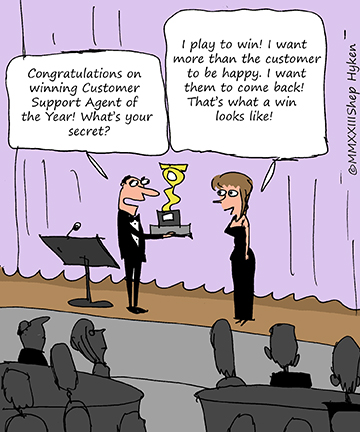
Shep Hyken Award Cartoon

In the customer service world, playing to win in customer service means eliminating the reasons customers call us for problems and complaints. Playing defense is focusing on being good at handling our customers’ problems or complaints. We need to be good at both.

Image Credits: Shep Hyken, Pexels

Subscribe to Human-Centered Change & Innovation WeeklySign up here to join 17,000+ leaders getting Human-Centered Change & Innovation Weekly delivered to their inbox every week.

Why Employees Must Do More Than Expected

(Even When It’s Not in Their Job Description)

Why Employees Must Do More Than Expected

GUEST POST from Shep Hyken

As customers, we appreciate it when someone we’re doing business with does more than we expect. Even if we don’t consciously recognize it when it’s happening, the value of that “something extra” makes us enjoy the experience and want to come back.

The same thing happens with employees inside an organization. You can usually find someone who seems to be doing more than expected – something that’s not in their job description.

The other night I was at a restaurant that had an outside patio. It looked like it was going to rain, so we opted to eat inside. About 20 minutes later, the sky opened up, and it didn’t just rain. It stormed. The wind blew over the tables and chairs, and one of the umbrellas blew onto the street. Without hesitation, our server, who was dressed neatly in black slacks, a dress shirt and a tie, ran outside in the pouring rain and moved the umbrella and all the tables and chairs into a covered area of the patio. He came back drenched. As he walked through the restaurant, all the customers who had been watching him through the window gave him an enthusiastic round of applause. I also noticed that the manager thanked him for being the “hero of the moment.”

When our server had dried off and returned to our table, I had to ask him, “When you applied to the job, was moving patio furniture in the rain included in the job description?” We laughed, and he smiled and said, “I just do what it takes.”

I loved that answer.

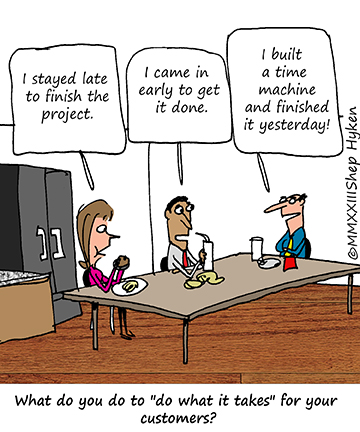
Doing More Than Expected Shep Hyken Cartoon

How many employees do what it takes? This comes in many forms, from working a little later when needed, coming to the office over the weekend if necessary or doing anything outside of a typical job description. By the way, I’m not suggesting employees should not be appropriately compensated for their hard work. They should be. And there’s nothing wrong if employees do only what you hired them to do, especially if they’re really good at it. You don’t want to lose them, so don’t expect them to do more and don’t be upset when they don’t. If you expected more, that should have been discussed and agreed upon when you hired them.

The point is you’ll find people willing to go above what’s expected and those who won’t. As a customer, which employee would you want to do business with? As an employer, which employee would you prefer to be taking care of your customers?

Image Credits: Shep Hyken, Pixabay

Subscribe to Human-Centered Change & Innovation WeeklySign up here to join 17,000+ leaders getting Human-Centered Change & Innovation Weekly delivered to their inbox every week.

The Biggest Customer Service Opportunity

The Biggest Customer Service Opportunity

GUEST POST from Shep Hyken

I was asked the same question three times in the last week: “What is the biggest opportunity in customer service?” If you had asked me this question a month ago – or asked it a month from now – there could be a different answer. But today’s answer is not just timely, but also timeless. And the answer is:

The Speed to Happiness

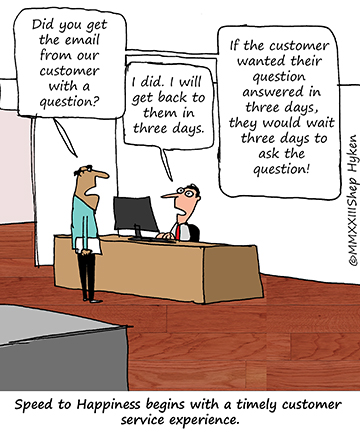
The meaning of this short answer is simple. If a customer has a problem, issue or question, the speed in which you move them from concerned or upset to happy could be the difference between the customer coming back or not. And when I refer to happiness, I’m not talking about utter delight or elation. I’m talking about a result that does three things:

  1. The customer’s problem, issue or question is resolved or answered.
  2. The interaction is managed quickly, efficiently and with as little friction as possible – ideally, without friction.
  3. The interaction is handled so well that the customer wouldn’t mind going through the process again if they had to.

It’s the second point of this answer that is most important, and it is where some companies fail. How the interaction is managed ideally leads to the third result, which is the ultimate level of happiness in problem-solving. A better word for happiness could be confidence.

Speed to Happiness Shep Hyken Cartoon

My definition of confidence in this situation is important. It’s more than just the confidence to continue doing business with the company after the interaction. It’s the confidence to enjoy doing business with the company.

There are certain companies that I dread calling for customer support. I know there will be long hold times and that after sharing my issue, I will probably be transferred at least once (probably more) to other people who are supposed to be better equipped to answer my question or resolve my problem. Then, there are companies that make it so easy to resolve an issue that I consider a support call part of the positive experience I have with them.

I’ve preached most of my career that resolving issues and managing complaints isn’t just about fixing problems. It’s about fixing the customer, which means restoring confidence. We want our customers to say, “I enjoy doing business with them. Even when there is a problem, I know they always take care of me, which is why … I’ll be back!”

Image Credits: Shep Hyken, Pexels

Subscribe to Human-Centered Change & Innovation WeeklySign up here to join 17,000+ leaders getting Human-Centered Change & Innovation Weekly delivered to their inbox every week.

How to Create Energy with Customers (And Everyone Else)

How to Create Energy with Customers (And Everyone Else)

GUEST POST from Shep Hyken

The heliotropic effect is the tendency for any living thing to be drawn toward energy. For example, if you put a plant on a windowsill, it will eventually lean toward the window where the sun comes in, soaking up those rays as the nourishment it needs to sustain its life.

Dr. Harry Cohen took this scientific concept and applied it to humans. In his book Be the Sun, Not the Salt, he defines the human version of the heliotropic effect as “being kind, authentic, compassionate, grateful and positive. … When you are being heliotropic, you are a positive energizer that uplifts others.”

In this short book that most people could read in less than an hour, Dr. Cohen shares 30 simple yet powerful principles and tactics that will create the energy that draws people to you. For leaders, you will build a stronger following. For managers, you will create a better work environment. And if you deal with customers, which is the focus of my work, you will get them to like you, trust you and want to do more business with you. And the best part about these thirty (30) ideas is that they don’t cost money, and you can put them into practice immediately.

Here are a few of my favorites that will make you think and, if you practice them, will have a heliotropic effect of attracting others toward you.

    1. Do All the Good You Can — Let’s start with the first one in the book. Just do good. People will be drawn to you, you’ll be more effective in what you do, and you’ll feel good yourself. It’s a fulfilling idea. When you do good, you feel good.
    2. Be Helpful — This seems so simple and obvious, but consider this. In our annual customer experience research, we asked more than 1,000 U.S. consumers, “What customer service experiences are most likely to cause you to come back?” The No. 1 answer was helpful. Such a simple concept!
    3. Show You Care — Insincerity is easy to spot, and nobody likes to do business or be around insincere people. You can’t fake caring—so don’t try. Be authentic about it. Maya Angelou said, “If you find it in your heart to care for somebody else, you will have succeeded.” I also like the Theodore Roosevelt quote Dr. Cohen included in this chapter, “Nobody cares how much you know until they know how much you care.”
    4. Apologize Well — When you find yourself faced with a confrontation, mistake or problem, the first words that come out of your mouth should be an acknowledgment and apology. Saying something as simple as “I’m sorry” can start to turn a negative situation around. A clear, sincere apology at the beginning of a conversation does two things. First, it positively kicks off the process of fixing a problem. Second, it helps restore the customer’s confidence.
    5. Hold the Salt — The opposite of the heliotropic sun, as the book title implies, is salt. To “hold the salt” is about not always saying everything on your mind. It’s sometimes better to bite your tongue and say nothing rather than try to get the last word or emphasize a point that doesn’t really need to be emphasized.
    6. Don’t Be a Complexifier — I’ve always believed that part of my success is simplifying the complicated. I recently wrote an article about how to make your business simple. Simplicity usually makes things better. Complex processes make it hard for customers and employees. Be easy, convenient and simple to do business with!
    7. Speak Fluent Gratitude — This is the perfect one to end on. Expressing appreciation to others is powerful. Dr. Cohen shared research that shows “cultivating gratitude makes you and the people around you feel better.” I love people who have an attitude of gratitude. And this is also an opportunity to express my gratitude to you for taking the time to read and share this article! Thank you!

    .

    This article originally appeared on Forbes.com

    Image Credits: Shep Hyken

    Subscribe to Human-Centered Change & Innovation WeeklySign up here to join 17,000+ leaders getting Human-Centered Change & Innovation Weekly delivered to their inbox every week.

A New Innovation Sphere

A New Innovation Sphere

GUEST POST from Pete Foley

I’m obsessed with the newly opened Sphere in Las Vegas as an example of Innovation.   As I write this, U2 are preparing for their second show there, and Vegas is buzzing about the new innovation they are performing in.  That in of itself is quite something.  Vegas is a city that is nor short of entertainment and visual spectacle, so for an innovation to capture the collective imagination in this way it has to be genuinely Wow.  And that ‘Wow’ means there are opportunities for the innovation community to learn from it. 

For those of you who might have missed it, The Sphere is an approximately 20,000 seat auditorium with razor sharp cutting edge multisensory capabilities that include a 16K resolution wraparound interior LED screen, speakers with beamforming and wave field synthesis technology, and 4D haptic physical effects built into the seats. The exterior of the 366 foot high building features 580,000 sq ft of LED displays which have transformed the already ostentatious Las Vegas skyline. Images including a giant eye, moon, earth, smiley face, Halloween pumpkin and various underwater scenes and geometric animations light up the sky, together with advertisements that are rumored to cost almost $500,000 per day.  Together with giant drone displays and giant LED displays on adjacent casinos mean that Bladerunner has truly come to Vegas. But these descriptions simply don’t do it justice, you really, really have to see it. 

Las Vegas U2 Residency at the Sphere

Master of Attention – Leveraging Visual Science to the Full:  The outside is a brilliant example of visual marketing that leverages just about every insight possible for grabbing attention. It’s scale is simply ‘Wow!’, and you can see it from the mountains surrounding Vegas, or from the plane as you come into land.   The content it displays on its outside is brilliantly designed to capture attention. It has the fundamental visual cues of movement, color, luminescence, contrast and scale, but these are all turned up to 11, maybe even 12.  This alone pretty much compels attention, even in a city whose skyline is already replete with all of these.  When designing for visual attention, I often invoke the ‘Times Square analogy’.  When trying to grab attention in a visually crowded context, signal to noise is your friend, and a simple, ‘less is more’ design can stand out against a background context of intense, complex visual noise.  But the Sphere has instead leapt s-curves, and has instead leveraged new technology to be brighter, bigger, more colorful and create an order of magnitude more movement than its surroundings.  It visually shouts above the surrounding visual noise, and has created genuine separation, at least for now. 

But it also leverages many other elements that we know command attention.  It uses faces, eyes, and natural cues that tap into our unconscious cognitive attentional architecture.  The giant eye, giant pumpkin and giant smiley face tap these attentional mechanisms, but in a playful way.  The orange and black of the pumpkin or the yellow and black of the smiley face tap into implicit biomimetic ‘danger’ clues, but in a way that resolves instantly to turn attention from avoid to approach.  The giant jellyfish and whales floating above the strip tap into our attentional priority mechanisms for natural cues.  And of course, it all fits the surprisingly obvious cognitive structure that creates ‘Wow!’.  A giant smiley emoji floating above the Vegas skyline is initially surprising, but also pretty obvious once you realize it is the sphere! 

And this is of course a dynamic display, that once it captures your attention, then advertises the upcoming U2 show or other paid advertising.  As I mentioned before, that advertising does not come cheap, but it does come with pretty much guaranteed engagement.  You really do need to see it for yourself if you can, but I’ve also captured some video here:

The Real Innovation Magic: The outside of The Sphere is stunning, but the inside goes even further, and provides a new and disruptive technology platform that opens the door for all sorts of creativity and innovation in entertainment and beyond. The potential to leverage the super-additive power of multi-sensory combinations to command attention and emotion is staggering.

The opening act was U2, and the show has received mostly positive but also mixed reviews. Everyone raves about the staggering visual effects, the sound quality, and the spectacle. But others do point out that the band itself gets somewhat lost, and/or is overshadowed by the new technology.

But this is just the beginning.   The technology platform is truly disruptive innovation that will open the door for all sorts of innovation and creativity. It fundamentally challenges the ‘givens’ of what a concert is. The U2 show is still based on and marketed as the band being the ‘star’ of the show. But the Sphere is an unprecedented immersive multimedia experience that can and likely will change that completely, making the venue the star itself. The potential for great musicians, visual and multisensory artist to create unprecedented customer experience is enormous.  Artists from Gaga to Muse, or their successors must be salivating at the potential to bring until now impossible visions to life, and deliver multi-sensory experience to audiences on a scale not previously imagined. Disruptive innovation often emerges at the interface of previous expertise, and the potential for hybrid sensory experiences that the Sphere offer are unprecedented. Imagine visuals created and inspired by the Webb telescope accompanied by an orchestra that sonically surrounds the audience in ways they’ve never experienced or perhaps imagined. And of course, new technology will challenge new creative’s to leverage it in ways we haven’t yet imagined.  Cawsie Jijina, the engineer who designed the Sphere maybe says it best:

You have the best audio there possibly can be today. You have the best visual there can possible be today. Now you just have to wait and let some artist meet some batshit crazy engineer and techie and create something totally new.” 

This technology platform will stimulate emergent blends of creative innovation that will challenge our expectations of what a show is.  It will likely require both creative’s and audiences to give up on some pre-conceptions. But I love to see a new technology emerge in front of my eyes. We ain’t seen nothing yet. 

Las Vegas Sphere Halloween

Image credits: Pete Foley

Subscribe to Human-Centered Change & Innovation WeeklySign up here to join 17,000+ leaders getting Human-Centered Change & Innovation Weekly delivered to their inbox every week.