 A while back on the drive home from the Seattle-Tacoma airport (SEA) after a trip where I served as an innovation speaker at an event, I noticed a large building by the side of the freeway advertising Indoor Sky Diving. The sign peaked my curiosity to investigate what indoor sky diving could possibly mean and so I set up a visit with iFly Seattle co-founder Lysa Adams.
My visit surfaced three key innovation-related concepts I would like to discuss:
- Challenging Orthodoxies
- Changing Perspectives
- Tunnel Vision
1. Challenging Orthodoxies
Rowan and I talk a lot here on Innovation Excellence about how challenging orthodoxies is one way to identify insights to drive innovation efforts, and it made me wonder:
Have they successfully challenged the skydiving orthodoxies that you need the following to experience the thrill of skydiving or ‘flying’?
- To jump out of an airplane
- To carry and deploy a parachute
- To learn several parachuting skills before progressing to sky diving
What if you could experience experience sky diving without the parachute and the airplane and the training?
Well, after my visit it was clear that iFly and SkyVenture have successfully challenged these orthodoxies with the indoor flying centers they’ve built here in Seattle and 22 other locations around the world including Hollywood, Dubai, and Singapore.
The facility itself seemed to be well-designed, recycling the air through two fan-driven intersecting circles of air that are accelerated from about 30mph through the basement up to 100-160 mph through the chamber up and back around again. Integrated into the space around the necessary apparatus are meeting rooms for corporate team-building events and party rooms for private functions. Organizations as diverse as Microsoft, Boeing, and the military have used the facility. It’s a pretty a cool facility and it was even a fair amount of fun just to watch others fly from the integrated viewing area.
So what is indoor skydiving and how can you experience the thrill of skydiving and ‘flying’ without the plane or the parachute? Well here is a video that shows an amateur learning the basic skills in their first session:
In a vertical wind tunnel people are able to fly in any of the four different skydiving positions – stomach, back, sitting, and head down (after mastering the previous one) – supported by wind speeds typically of 100 miles per hour or higher (an indoor hurricane). The vertical wind tunnel at iFly Seattle is state of the art, allowing wind speeds of up to 160 miles per hour.
I had the opportunity to learn how to fly and try it out for a couple of minutes, and I looked pretty much like the novices in the video above. I was flying successfully by my second minute, floating up beyond the reach of the instructor temporarily, and never felt any of the fear I might have felt if I had done my ‘flying’ by jumping out of an airplane. It was an amazing experience, and I could see how it could be very addictive.
So other than challenging orthodoxies, what does any of this have to do with innovation?
2. Changing Perspectives
Innovation often comes from looking at things from a different perspective, or from observing something potentially valuable to your target customers in another context that you can adapt and bring to them as a new solution offering.
This change in perspective can come from using creativity tools like Edward de Bono’s ‘Six Thinking Hats’ or other tools like mind mapping, brainstorming, brainwriting, SCAMPER, SIT, or from building and tapping into a Global Sensing Network.
Or it can come from physically changing your orientation. In the case of sky diving, sometimes sky diving teams have to get down on their bellies on wheelie boards on the concrete to show each other the tricks they plan to do in the air or in the vertical wind tunnel. It’s hard for the brain to imagine in a vertical orientation what is going to take place in a horizontal orientation, and this simple physical shift makes all the difference.
If it doesn’t come natural to our brains to imagine the horizontal from the vertical, imagine the trouble our brains have imagining different business contexts without being immersed in them. We often have to go see the other context for ourselves as a result, but a Global Sensing Network can help avoid this need to some extent. But this requirement to see things for ourselves highlights something very important. Because changing perspectives presents a challenge for our human brains, it presents an opportunity for us to work to achieve competitive separation.
Imagine the competitive advantage your organization could build over the other organizations in your context if you could build up your perception shifting muscles to recognize the relevant challenges and opportunities in other geographies and contexts faster than the competition?
3. Tunnel Vision
Do you remember what is like the first time you learned to drive a car? Do you remember how much you had to focus on every little detail from how hard you were pushing the accelerator to how fast you were moving the steering wheel left or right? But how much attention do you pay to these things now?
 It came to me as I was staring at the vertical wind tunnel and talking with Lysa Adams about the challenges that beginners have when they learn to jump out of a plane and deploy a parachute, that when it comes to the human brain we have tunnel vision while learning a new skill. This tunnel vision, caused by our lack of experience, causes us to focus on a very small subset of parameters in the environment and makes it impossible for us to notice a lot of the other things going on around us or to focus our attention more broadly.
When it comes to innovation, most organizations suffer from innovation tunnel vision because as they look to involve more employees in their innovation efforts, they don’t give their employees the opportunity to learn and practice new innovation skills. Instead in many organizations we expect employees to just be innovative.
When it comes to creativity skills that tap into our right brain capacity, it is important to remember that as we master right brain skills they move to the left brain. And, when your left brain is occupied, then the right brain can go into a more creative mode. This is why you have many of your most creative ideas in the shower, or while you are driving, etc.
When the left brain is occupied it is less likely to intervene and criticize the ideas your right brain comes up with while they are embryonic and partially formed and kill them before you develop them further. When the left brain is not jumping in and trying to determine whether the ideas are logical or not, the right brain can focus on pure creativity.
This is why it is so important to create things like a common language of innovation, a shared innovation vision/strategy/goals, and to have a structured innovation process. If these things are all very clearly understood across the organization, then your innovation tunnel vision opens up a bit wider to allow you to identify more relevant insights and come up with better ideas. But you can’t stop there. If you want to engage all employees in innovation in your organization (or even a subset), and you want to open up the innovation tunnel vision in your organization even wider, then you must provide innovation training to every employee in the organization (or your chosen subset).
The faster you can get your employees to a level of comfort with your innovation language, vision/strategy/goals, process, and tools, the sooner they will be driving innovation with their knees, eating a Big Mac, and changing your innovation soundtrack – all with the windows down letting in new stimulus and fresh air into your innovation efforts.
Every organization has innovation tunnel vision, the question is how wide or narrow your field of vision is and how much you’re doing to pry the blinders farther apart.
Conclusion
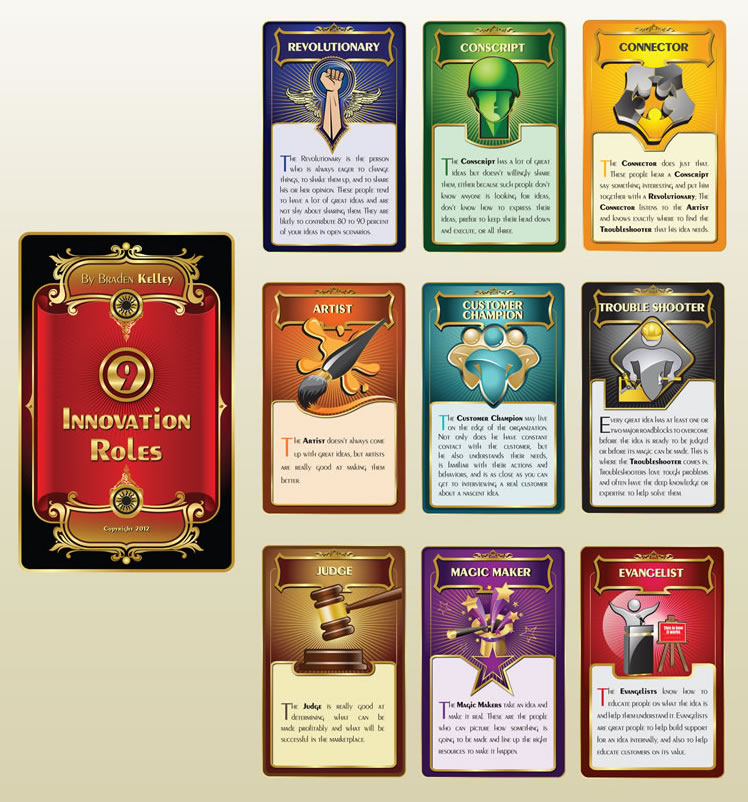
We all are innovative in our own way, which is why I created the Nine Innovation Roles. But at the same time, we all have a certain level of innovation capacity, and if we develop that capacity we can achieve much more. If you want to get better at innovation as an individual or as an organization, you must learn new skills and you must practice them. Otherwise you will be an innovation belly flier forever. Thanks to Darren (my instructor at iFly Seattle – who used to be involved with Cirque du Soleil) and to Lysa Adams I was able to fly for the first time, but if I want to progress to back flying or sit flying on the way to head down flying and doing tricks, I must practice – in the same way that you must practice innovation in your organization. To conclude, I’ll leave you with this video of one of the instructors showing off and some team flying:
If you ever get the chance to try out indoor skydiving or ‘flying’, I highly recommend it as an amazing, fun experience. The cost runs about $60 for some basic instruction and a couple of instructor monitored flights (without the whole parachute or jumping out of the plane part). Happy innovating (or flying)!

 Sign up here to get Human-Centered Change & Innovation Weekly delivered to your inbox every week.
 When it comes to education, we should adopt Nike’s famous motto and ‘Just Do It’.
 Here was my response: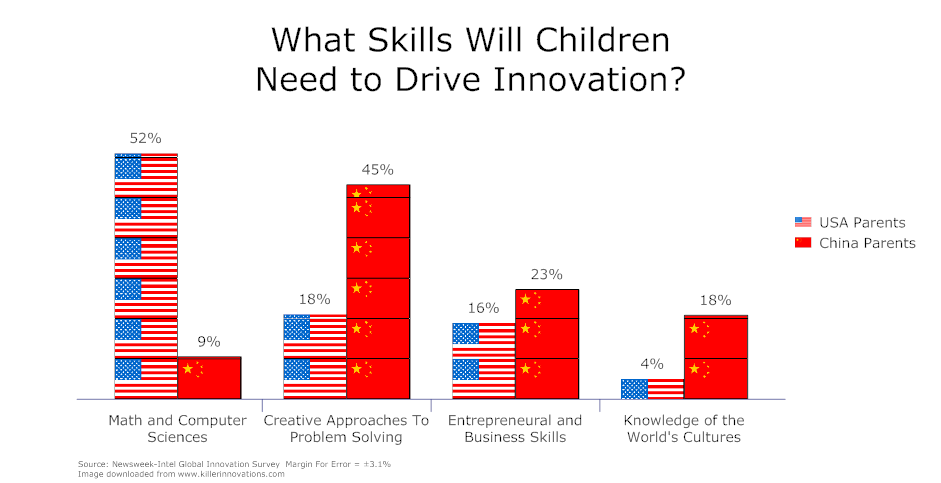
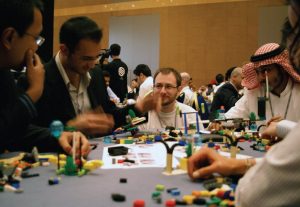 “The community building began with the students placed into teams and, led by Jens Hoffmann of Strategic Play, proceeded with the team members building LEGO models to represent themselves, their ideal teammate and what each individual would contribute to their team during the two day workshop. From there, the teams created a group model, with the team members building and writing about how their community could service society. While the models were challenging to think about, the students all were creative in their models and bonded while building the group model, with groups getting more and more animated in their discussions and building. Building was punctuated by comments and laughs as teams built different models and items. With a common goal, the teams began to bond, regardless of language and culture, and by the end of the day, each table had a shared model, a shared language and shared view of the world.”
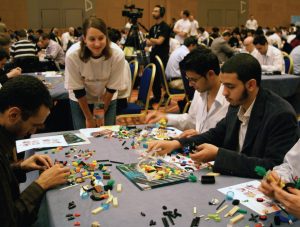 “Afterwards, there was a final session devoted to evaluating the lessons learned. Bashar Al Safadi of Omniegypt was the host of this session, where the teams discussed what they learned from all of their activities. From their discussions, the top points were determined and presented to all of the teams. And through all the differences the students had when they first met, they found they had a lot in common – and they all had learned to communicate and have fun with each other.
 I’m in the throes of bringing
 I had coffee with a