Monthly Archives: January 2022

Fun Ways to Foster Innovation with Gamification

Fun Ways to Foster Innovation with Gamification

GUEST POST from Art Inteligencia

In today’s rapidly changing business landscape, fostering innovation is not just advantageous — it’s essential. But how can organizations kindle this spirit of innovation in a way that is engaging and sustainable? Enter gamification: the art of applying game-design elements in non-game contexts. By infusing work with fun, gamification has the power to drive motivation, encourage creativity, and ultimately, foster innovation. This article explores how two companies successfully employed gamification to boost their innovation efforts.

Case Study 1: Microsoft’s Language Quality Game

Microsoft faced a challenge that is common to global technology companies: ensuring the quality and consistency of translated content across different languages. The process of identifying and fixing errors in translations can be tedious and time-consuming. To combat this, Microsoft implemented a gamified approach known as the “Language Quality Game.”

The game involved users and employees who could earn points, badges, and visual accolades by identifying errors or suggesting improvements to translation strings. Not only did this encourage more participation, but it also created a sense of competition and engagement among users and employees. As a result, Microsoft was able to improve the accuracy of its translations while also fostering a sense of ownership and contribution among its linguistically diverse user base.

Case Study 2: SAP’s Quiz-Based Idea Competition

SAP, a leader in enterprise software solutions, faced the internal challenge of stimulating innovative ideas from its global workforce. To tackle this, SAP turned to gamification by creating a quiz-based idea competition known as “InnoJam 48.” Participants were grouped into teams and tasked with solving real-world challenges by creating innovative software solutions within 48 hours.

The incorporation of gamified elements like quizzes, real-time feedback, and virtual leaderboards infused a competitive spirit into the event and motivated employees to put forward their best ideas. This approach not only inspired creative problem-solving but also cultivated a culture of continuous innovation. The best ideas were recognized and rewarded, encouraging more employees to participate in future events.

Conclusion

Gamification has emerged as a powerful tool for driving innovation in organizations. By leveraging the intrinsic human desire for fun, competition, and achievement, companies like Microsoft and SAP have successfully harnessed the power of gamification to foster innovation. It effectively transforms mundane tasks and challenges into engaging, rewarding experiences. As businesses strive to innovate in ever-evolving markets, gamification presents itself as an enticing strategy to consider.

Bottom line: Futurology is not fortune telling. Futurists use a scientific approach to create their deliverables, but a methodology and tools like those in FutureHacking™ can empower anyone to engage in futurology themselves.

Image credit: Pixabay

Subscribe to Human-Centered Change & Innovation WeeklySign up here to get Human-Centered Change & Innovation Weekly delivered to your inbox every week.

Parallels Between the 1920’s and Today Are Frightening

Parallels Between the 1920's and Today Are Frightening

GUEST POST from Greg Satell

It should be clear by now we are entering a pivotal era. We are currently undergoing four profound shifts, that include changing patterns of demographics, migration, resources and technology. The stress lines are already beginning to show, with increasing tensions over race and class as well as questions about the influence technology and institutions have over our lives.

The last time we faced anything like this kind of tumult was in the 1960s which, much like today, saw the emergence of a new generation, the Baby-Boomers, that had very different values than their predecessors. Their activism achieved significant advances for women and minorities, but also at times, led to tumult and riots.

Yet the changes we are undergoing today appear to be even more significant than we did then. In fact, you would have to go back to the 1920s to find an era that had as much potential for both prosperity and ruin. Unfortunately, it led to economic upheaval, genocide and war on a scale never seen before in world history. We need to do better this time around.

Panics, Pandemics and War

A Wall Street crisis that threatened the greater economy and led to sweeping legislation that reshaped government influence in the financial sector was prelude to both the 1920’s and the 2020’s. Both the Bankers Panic of 1907 and the Great Recession which began in 2007 resulted in landmark legislation, the Federal Reserve Act and Dodd-Frank, respectively.

Continuing in the same vein of eerie parallel, the 1918 flu epidemic killed between 20 million and 50 million people and raged for more than two years, until 1920, when it finally got under control. Much like today, there were social distancing guidelines, significant economic impacts and long-term effects on educational attainment.

Perhaps not surprisingly, there was no small amount of controversy about measures taken to control the pandemic a century ago. People were frustrated with isolation (it goes without saying that there was no Netflix in 1918). Organizations like the Anti-Mask League of San Francisco rose up in defiance.

The years leading up to the 1920s were also war-torn, with World War I ravaging Europe and the colonial order increasingly coming under pressure. Much like the “War on Terrorism,” today, the organized violence, combined with the panics and pandemics, made for an overall feeling that society was unravelling, and many began to look for a scapegoat.

Migration, Globalization and Nativism

In 1892, Ellis Island opened its doors and America became a beacon to those around the world looking for a better life. New immigrants poured in and, by 1910, almost 15% of the US population were immigrants. As the 1920s approached, the strains in society were becoming steadily more obvious and more visceral.

The differences among the newcomers aroused suspicion, perhaps best exemplified by the Sacco and Vanzetti trial, in which two apparently innocent immigrants were convicted and executed for murder. Many believed that the new arrivals brought disease, criminality and “un-American” political and religious beliefs, especially with regard to Bolshevism.

Fears began to manifest themselves in growing nativism and there were increasing calls to limit immigration. The Immigration Act of 1917 specifically targeted Asians and established a literacy test for new arrivals. The Immigration Act of 1924 established quotas which favored northern and Western Europeans over those of Southern and Eastern Europe as well as Jews. The film Birth of A Nation led to a resurgence of the Ku Klux Klan.

Scholars see many parallels between the run-up to the 1920s and today. Although nativism these days is primarily focused against muslims and immigrants from South America, the same accusations of un-American political and religious beliefs, as well as outright criminality, are spurring on a resurgence of hate groups like the Proud Boys. Attorney General Merrick Garland has pledged to make prosecuting white supremacists a top priority.

A New Era of Innovation

As Robert Gordon explained in The Rise and Fall of American Growth, prosperity in the 20th century was largely driven by two technologies, electricity and the internal combustion engine. Neither were linear or obvious. Both were first invented in the 1880’s but didn’t really begin to scale until the 1920’s.

That’s not uncommon. In fact, it takes decades for a new discovery to make a measurable impact on the world. That’s how long is needed to first identify a useful application for a technology and then for ecosystems to form and secondary technologies to arise. Electricity and internal combustions would ignite a productivity boom that would last 50 years, from roughly 1920 until 1970.

For example, as economist Paul David explained in a highly cited paper, it wasn’t the light bulb, but in allowing managers to rearrange work in factories, that electricity first had a significant effect on society. Yet it was in the 1920s that things really began to take off. Refrigerated rail cars transformed diets and labor-saving appliances such as the vacuum cleaner would eventually pave the way for women in the workforce. The first radio stations appeared, revolutionizing entertainment.

Today, although the digital revolution itself has largely been a disappointment, there’s considerable evidence that we may be entering a new era of innovation as the emphasis shifts from bits to atoms. New computing architectures, such as quantum and neuromorphic computing, as well as synthetic biology and materials science, may help to reshape the economy for decades to come.

A Return to Normalcy?

Not surprisingly, by 1920 the American people were exhausted. Technological change, cultural disruption brought about by decades of mass immigration, economic instability and war made people yearn for calmer, gentler times. Warren G. Harding’s presidential campaign touted “a return to normalcy” and people bought in.

Yet while the “Roaring Twenties” are remembered as a golden age, they set the seeds for what came later. Although the stock market boomed, lack of regulation led to the stock market crash of 1929 and the Great Depression. The harsh reparations imposed by the Treaty of Versailles made the rise of Hitler possible.

The 1930s brought upon almost unimaginable horror. Economic hardship in Europe paved the way for fascism. Failed collectivization in the Soviet Union led to massive famine and, later, Stalin’s great purges. Rising nativism, in the US and around the world, led to diminished trade as well as violence against Jews and other minorities. World War II was almost inevitable.

It would be foolish beyond belief to deny the potential of history repeating itself. Still, the past is not necessarily prologue. The 1930s were not the inevitable result of impersonal historical forces, but of choices consciously made. We could have made different ones and received the bounty of the prosperity that followed World War II without the calamity that preceded it.

What we have to come to terms with is that technology won’t save us. Markets won’t save us. Our future will be the product of the choices we make. We should endeavor to choose wisely.

— Article courtesy of the Digital Tonto blog
— Image credit: Pixabay

Subscribe to Human-Centered Change & Innovation WeeklySign up here to get Human-Centered Change & Innovation Weekly delivered to your inbox every week.

The Leader’s Role in Innovation

From Vision to Execution

The Leader's Role in Innovation

GUEST POST from Chateau G Pato

In the rapidly evolving business landscape, innovation is the bridge that connects customer needs with future-ready solutions. Yet, moving from vision to execution is often fraught with challenges. As a human-centered change and innovation thought leader, I believe that the success of this transformation hinges on effective leadership. Leaders play a pivotal role in navigating the complexities of innovation, driving the alignment of their teams, and ensuring the diligent execution of ideas. In this article, we will delve into the responsibilities of leaders during the innovation journey and illustrate these points with two insightful case studies.

The Leader’s Role in Innovation

Leading innovation isn’t just about having a great idea or setting ambitious goals. It requires a strategic approach and a deep commitment to fostering a culture of innovation. Leaders must be visionaries and executors, guiding their teams through the sometimes uncertain terrain of taking an idea to market. This involves:

  • Creating a Shared Vision: Leaders must articulate a clear and compelling vision that inspires and aligns the team towards a common purpose.
  • Fostering a Culture of Creativity: Encouraging experimentation, accepting failures as learning opportunities, and creating an enabling environment where creativity can thrive.
  • Empowering Teams: Empowering team members with the autonomy and resources needed to innovate effectively.
  • Ensuring Strategic Alignment: Ensuring that innovation efforts align with overall business strategies and customer needs.
  • Facilitating Cross-functional Collaboration: Breaking down silos to enable diverse teams to collaborate and co-create effectively.
  • Measuring and Iterating: Establishing metrics for success and being agile in iterating solutions based on feedback and results.

Case Study 1: Procter & Gamble’s Innovation Factory

Procter & Gamble (P&G) is renowned for its methodical approach to innovation. Guided by leaders who understand the value of systematic innovation, P&G built an ‘Innovation Factory’—a scalable platform that connects internal and external innovators to collaboratively solve problems. Leaders at P&G shifted their role from decision-makers to facilitators who guide and support these collaborations.

Key Takeaways:

  • P&G’s leadership encouraged open innovation by breaking down the traditional boundaries of R&D, allowing new ideas to flow in from different industries and cultures.
  • Their leaders empowered employees with the tools and resources necessary to explore innovative projects, carefully balancing guidance with creative freedom.
  • Through constant iteration and a focus on unmet consumer needs, P&G’s leadership ensures that innovation is strategically aligned with its business goals.

Case Study 2: Tesla’s Visionary Leadership

Tesla, under the leadership of Elon Musk, has distinguished itself as a leading innovator in the automotive industry. Musk’s leadership style demonstrates a clear vision combined with calculated risk-taking, propelling Tesla from an ambitious startup into a market leader.

Key Takeaways:

  • Elon Musk’s vision for sustainable energy and transport is deeply embedded in Tesla’s mission, energizing employees and stakeholders alike.
  • Tesla’s leadership embraces an iterative development process, dubbed ‘rapid iteration,’ that challenges traditional automotive development cycles.
  • Musk empowers his teams through high expectations and innovative work environments, ensuring that they are aligned with Tesla’s vision even when facing substantial challenges.

Conclusion

As seen in the cases of Procter & Gamble and Tesla, effective leadership is critical in the journey of innovation from vision to execution. By creating a shared vision, fostering a culture of creativity, and empowering their teams, leaders can overcome the obstacles inherent in the innovation process. As organizations navigate the complexities of the modern world, those with leaders who inspire, guide, and execute on innovative visions will be the ones to thrive.

Bottom line: Futurology is not fortune telling. Futurists use a scientific approach to create their deliverables, but a methodology and tools like those in FutureHacking™ can empower anyone to engage in futurology themselves.

Image credit: Pixabay

Subscribe to Human-Centered Change & Innovation WeeklySign up here to get Human-Centered Change & Innovation Weekly delivered to your inbox every week.

The Education Business Model Canvas

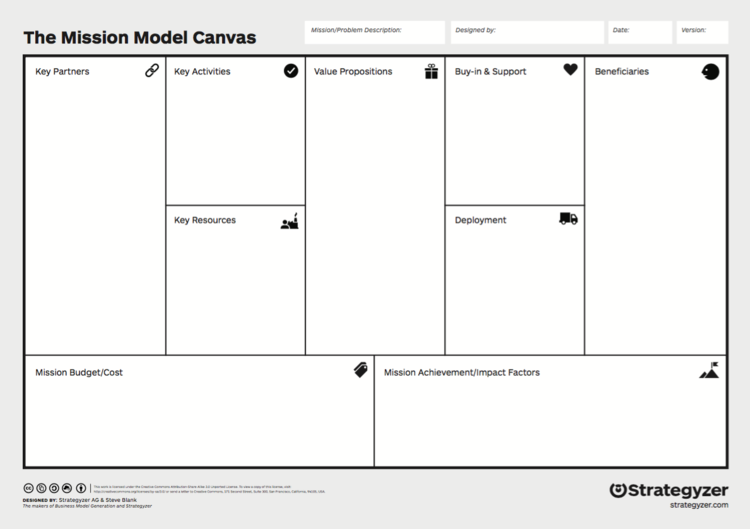
Mission Model Canvas

GUEST POST from Arlen Meyers

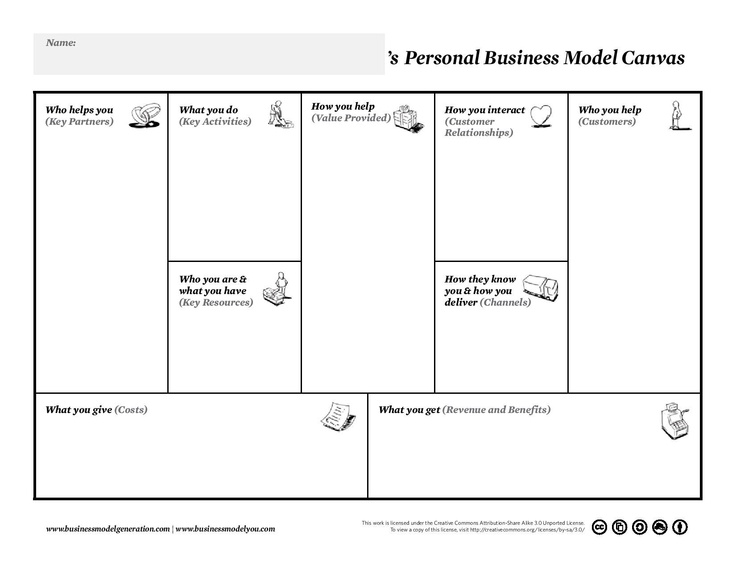
The business model canvas is one of many useful tools to design, evolve and test products and services business models. While the original model was proposed to help founders create a viable and scaleable business model, it has also helped non-profit executives, as the mission driven business model, and those looking to make a career change, using a personal business model as the Business Model You.

Personal Business Model Canvas

The construct is also useful if you are an edupreneur, trying to create and launch new educational products and services, including new courses, certificates, programs or degree offerings.

Edupreneurship rests on several foundational principles:

  1. Having an entrepreneurial mindset
  2. Intra- and entrepreneurial knowledge, skills, abilities and competencies
  3. Design thinking focused on creating stakeholder and beneficiary defined outcomes
  4. A systems engineering approach to solving wicked problems, like how to fix outcomes disparities and their social determinants
  5. A different business model
  6. More respect for and attention to edupreneurial champions
  7. Better teacher education and training
  8. An incentive and reward system for not just tweaking a failed system , but rather, making it obsolete given the basic structural changes in the US economy
  9. Eliminating unnecessary and burdensome bureaucracy, credentialing that does not add value and administrivia
  10. Paying more attention to and measuring student defined outcomes
  11. Better public-private integration
  12. K-20 integration and alignment

13. Teaching students what they need to win the 4th industrial revolution

14. Embracing cradle to career integration

15. Creating a competent diverse and equitable talent pipeline

We has seen several recent advances in edupreneurship.

Here is the boomer’s guide to teaching millenials.

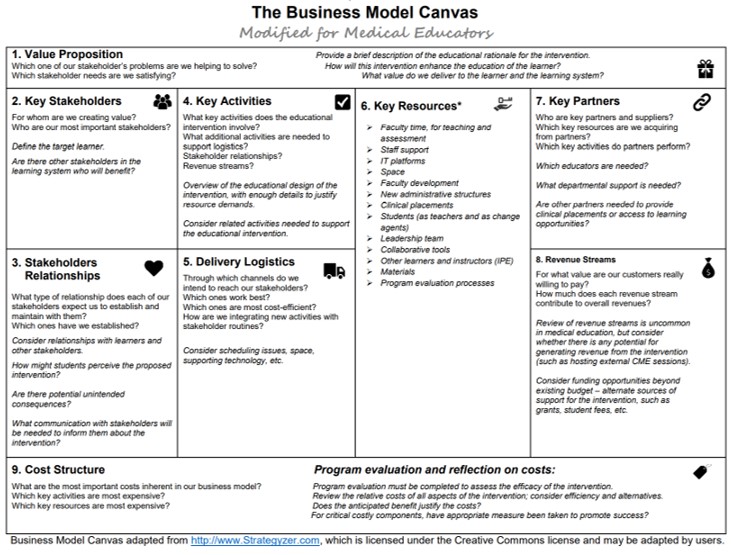
The UGME steering committee recognizes that medical education programs are faced with the ubiquitous challenge of repeated calls for innovation and that, frequently, these calls do not adequately address the associated resource demands. As medical educators, we have become highly creative in identifying strategies to do more with less, but as we know, this is not a sustainable model of stewardship. In 2016 and 2017, the UGME section collaborated with the Group on Business Affairs (GBA) to explore evolving models to support and sustain UGME programming. A result of this work is the Business Model Canvas for Medical Educators. The original Business Model Canvas was proposed by Alexander Osterwalder in 2008 and has been modified over time to fit other needs. The Table of Contents will direct you to resources, including the Business Model Canvas for Medical Educators template and two examples submitted by institutions who have successfully used the template to secure funding from within their own institution.

Business Model Canvas for Medical Educators

The edupreneurship business model canvas has a few modifications to the traditional startup one:

Customer segments: The primary customer are students. However, there are many other education stakeholders, including admininstrators, alumni, donors, employers and parents. In addition, for any given subject, potential students will have different backgrounds and experience in the subject, will have different jobs they want done, and, therefore, will have different applications for what they learned, be it finding a job, getting a promotion, or adding value where they presently work.

Value proposition: For each customer segment , you have a specific value proposision. You typically describe it in the course syllabus, telling users about the intended audience, the goals of the course, the learning objectives, and the curriculum. For example, the value proposition for a course I teach to xMBA/HA students is :

This course will introduce graduate level students in healthcare administration and leadership to the principles and practice of healthcare innovation and entrepreneurship defined as the pursuit of opportunity under volatile, uncertain, complex and ambiguous conditions with the goal of creating stakeholder defined value through the deployment of innovation using a valid, automatic, scaleable and time sensitive (VAST) business model.

Following completion of this course, you should be able to:

1. identify gaps in your health entrepreneurship competencies and develop a personal and professional development plan to address them

2. create an organizational culture of innovation, lead innovators and overcome the barriers to healthcare innovation dissemination and implementation

3. identify the multiple clinical and non-clinical ways to practice healthcare entrepreneurship

4. Create a plan to solve a problem inside or outside of your organization that meets the goals of the quintuple aim (Quality, cost, access, experience, waste/business operations)

5. Identify the startup life cycle and challenges at each stage

Channels: This describes how you will deliver your course. Will it be face to face, online or some hybrid model with elements of both?

Customer relationships: This describes how you will get, keep and grow the numbers of students who will take the course, e.g. promoting in the course catalog, attending a career or course proposal day, creating awareness on social media or using word or mouth dissemination from previous students.

Revenue model: This describes how your employer or you will generate revenue from the products. Traditionally, universisty based courses use a “butts in the seats” model, but COVID and new eductional technologies have radically changes the revenue generating possibilities, inluding advertising, freemium models, subscription models and others.

Key resources: This describes the human, physical, intellectual property and financial resources you will need to build, execute and scale your initiative. For example, do you want to copyright your materials, or , do you want to make them an open educational resource using a Creative Commons license?

Key activities: This what you need to do to perform and deliver on your value proposition, like what you will do using a learning management system, like create videos, run office hours, moderate asynchronous virtual discussions and design and grade exams and quizzes

Key partnerships: This describes who can help you, be they guest faculty, educational technology partners, corporate sponsors, e.g. if you are using project based learning techniques or online tools and resouce producers, e.g cases from the Harvard Business School collection.

Costs: This describes the tangible and intangible costs to produce your product. In most instances, your time, opportunity costs and effort will overshadow the monetary costs.

COVID has accelerated the pace of change in higher education, forcing them to create entrepreneurial universities. Teaching faculty how to use the education business model canvas should be part of faculty development to mimimize projecdt and product failure.

Here is what I learned, using the business model canvas, teaching sickcare innovation and entrepreneurship to first year medical students at the University of Colorado.

In this post , Steve Blank offers a new definition of why startups exist: a startup is an organization formed to search for a repeatable and scalable business model.

So is a new course or certificate. Use the education driven business model to make your product desireable, feasible, viable and adaptable and be sure to document your success when it comes time for your evaluation,promotion and tenure review. More likely, though, you will be including it in your failure resume, since, like the vast majority of new products, yours is likely to fail because 1) you offered a product students don’t want to buy or someone does not want to pay for, and 2) you do not have a VAST educational product business model.

Image credits: Strategyzer

Subscribe to Human-Centered Change & Innovation WeeklySign up here to get Human-Centered Change & Innovation Weekly delivered to your inbox every week.

Innovative Tools for Enhancing User Research

Innovative Tools for Enhancing User Research

GUEST POST from Art Inteligencia

In the fast-paced world of innovation, understanding the needs and behaviors of users has never been more crucial. As organizations strive to create products and services that truly resonate, effective user research becomes indispensable. Fortunately, a suite of innovative tools is now available to enhance the way we conduct user research. This article explores some of these tools and illustrates their impact through real-world case studies.

Innovative Tools for User Research

In the digital age, a plethora of user research tools has emerged, offering user researchers unprecedented insights into consumer behavior. Among these tools, augmented reality (AR) user testing, AI-driven sentiment analysis, and real-time collaboration platforms have gained prominence. These tools facilitate deeper understanding and engagement with users, often leading to breakthroughs in product and service design.

Case Studies

Case Study 1: XYZ Inc. Leverages Augmented Reality for User Testing

XYZ Inc., a tech company focused on smart home solutions, incorporated augmented reality (AR) into their user research strategy. By utilizing AR for user testing, they allowed participants to interact with virtual prototypes of their new home-automation system in a realistic environment. This approach not only reduced the costs associated with physical prototyping but also provided users with a more intuitive experience.

Through AR, XYZ Inc. gathered valuable feedback on user interactions with interfaces, uncovering usability issues that traditional methods would have overlooked. As a result, the company was able to refine its user experience design significantly before launching the product, leading to higher customer satisfaction and adoption rates.

Case Study 2: ABC Corp. Utilizes AI-driven Sentiment Analysis

ABC Corp., a financial services firm, implemented AI-driven sentiment analysis to interpret user feedback on their mobile banking app. By integrating AI algorithms that processed thousands of feedback entries, they were able to detect not only the content but also the emotional tone of user comments.

This tool provided insights that went beyond what conventional surveys and interviews could capture. ABC Corp. discovered specific pain points related to security and navigation and identified that sentiments were particularly negative among users aged 50 and above. Armed with this knowledge, they prioritized user-friendly designs and security enhancements tailored to meet the needs of this demographic, resulting in a significant uptick in positive user feedback and app engagement.

Conclusion

The integration of innovative tools in user research is transforming the landscape of user-centered design. As illustrated by the case studies of XYZ Inc. and ABC Corp., adopting new technologies such as AR user testing and AI-driven sentiment analysis can lead to profound insights and significantly enhance product design and user satisfaction. Embracing these tools not only strengthens the research process but also places organizations at the forefront of innovation, ultimately fostering a deeper connection with the end-users.

Bottom line: Futurology is not fortune telling. Futurists use a scientific approach to create their deliverables, but a methodology and tools like those in FutureHacking™ can empower anyone to engage in futurology themselves.

Image credit: Pixabay

Subscribe to Human-Centered Change & Innovation WeeklySign up here to get Human-Centered Change & Innovation Weekly delivered to your inbox every week.

The Interplay Between Culture and Organizational Change

The Interplay Between Culture and Organizational Change

GUEST POST from Chateau G Pato

In today’s rapidly evolving business landscape, successful organizational change is not merely a strategic imperative but an existential necessity. At the heart of this change lies an intricate and often underappreciated force – organizational culture. Culture, the unwritten ethos of any organization, influences how change is perceived, implemented, and sustained. As a human-centered change and innovation thought leader, I aim to explore this interplay between culture and change through insightful case studies that underline this dynamic relationship.

Case Study 1: Acme Corp – The Culture Catalyst

Acme Corp, a leading player in the tech industry, was facing a critical phase. Despite strong technical capabilities, they found themselves lagging in innovation and customer satisfaction. The root cause was traced back to the company’s culture, which was mired in risk aversion and departmental silos, stifling cross-functional collaboration and creativity.

Recognizing this, the leadership embarked on a cultural transformation journey aimed at fostering a more agile and collaborative environment. Here’s how they did it:

  • Leadership as Culture Champions: Leaders demonstrated the desired behaviors, championing open communication and empowering employees to take calculated risks.
  • Redefining Values and Behaviors: They revisited their core values, aligning them with the new strategic vision, and communicated these through storytelling and workshops.
  • Structural Adjustments: The company restructured teams to promote cross-functional collaboration and introduced dynamic project teams to address complex challenges.

Within two years, Acme Corp experienced a marked increase in innovation output and customer satisfaction scores. By making culture a focal point, they were able to unlock the full potential of their organizational change initiatives.

Case Study 2: HealthCo – Navigating Cultural Resistance

HealthCo, a large healthcare provider, embarked on a digital transformation journey aimed at enhancing patient care and operational efficiency. However, the initiative faced significant resistance rooted in a deeply ingrained hierarchical culture. Employees were accustomed to rigid procedures and hesitant to embrace new technologies.

HealthCo’s approach to overcoming this challenge involved:

  • Inclusive Change Design: Involving employees at all levels in designing the change process, which provided a sense of ownership and reduced resistance.
  • Targeted Training Programs: Comprehensive training sessions were held to equip staff with the necessary skills and confidence to use new digital tools effectively.
  • Recognition and Feedback Loops: Establishing mechanisms for recognizing adaptation efforts and fostering an ongoing feedback culture to continually refine the processes.

While the transformation at HealthCo took longer than anticipated, the focus on gradually reshaping their culture ensured a sustainable, long-term embrace of digital practices, ultimately leading to improved patient outcomes.

Conclusion

The interplay between culture and organizational change is both intricate and profound. As seen through the experiences of Acme Corp and HealthCo, understanding and harnessing cultural dynamics is crucial to effective change management. Leaders must recognize that culture is not merely an abstract concept but a tangible influence on strategy and execution. By proactively aligning culture with change objectives, organizations can drive innovation, enhance performance, and thrive in a fast-paced world.

Whether you are in the nascent stages of a transformation or managing ongoing change, always remember: culture is the lens through which change is viewed and valued. Cultivate it wisely, and it becomes your greatest ally in transformation efforts.

Bottom line: Futurology is not fortune telling. Futurists use a scientific approach to create their deliverables, but a methodology and tools like those in FutureHacking™ can empower anyone to engage in futurology themselves.

Image credit: Pixabay

Subscribe to Human-Centered Change & Innovation WeeklySign up here to get Human-Centered Change & Innovation Weekly delivered to your inbox every week.

Cybersecurity Concerns in Emerging Technologies

Cybersecurity Concerns in Emerging Technologies

GUEST POST from Art Inteligencia

As we stand on the brink of a new era defined by exponential technological growth, cybersecurity continues to emerge as a critical focal point in the adoption and deployment of emerging technologies. The accelerating pace at which these technologies are being integrated into business processes and our daily lives underscores the importance of developing robust security measures to safeguard against increasing cyber threats.

Risks and Implications

Emerging technologies such as Artificial Intelligence (AI), Internet of Things (IoT), blockchain, and quantum computing are revolutionizing industries. However, they also come with their set of cybersecurity risks. As digital transformation permeates more deeply into organizational structures, ensuring the security of digital infrastructures becomes paramount.

Case Study: Internet of Things (IoT) Vulnerabilities

The proliferation of IoT devices has brought unprecedented connectivity and convenience. However, it has also multiplied the attack surfaces for cybercriminals. A notable incident was the Mirai Botnet attack in 2016, which exploited IoT devices to carry out a Distributed Denial of Service (DDoS) attack, crippling major websites worldwide.

The lack of proper security measures in many IoT devices, such as default passwords and inadequate patch management, allows attackers to gain control and recruit these devices into botnets. This case illustrates the necessity for stronger security protocols and standards in the manufacturing and deployment of IoT devices.

Case Study: Blockchain and Cryptocurrency Threats

Blockchain technology underpins cryptocurrencies and offers enhanced security characteristics due to its decentralized and immutable nature. However, the rise of cryptocurrencies has also attracted cybercriminals seeking to exploit vulnerabilities in exchanges and wallets.

The infamous 2018 Coincheck hack in Japan exemplifies the risks associated with insufficient security in cryptocurrency exchanges. The hackers stole over $500 million worth of NEM cryptocurrency, highlighting how inadequate security measures and lack of regulatory oversight can lead to significant financial losses.

This case underscores the importance of implementing comprehensive cybersecurity strategies and regulatory frameworks to protect digital assets and enhance trust in blockchain-related technologies.

Moving Forward

As organizations increasingly adopt emerging technologies, a holistic approach to cybersecurity becomes essential. This includes prioritizing the security of digital assets, fostering a culture of cybersecurity awareness, and advocating for global standards and regulations tailored to evolving threats.

Businesses, governments, and individuals must collaborate to ensure that the innovative potential of emerging technologies is harnessed responsibly, and that cybersecurity strategies evolve to counteract the sophisticated attacks of the future.

Bottom line: Futurology is not fortune telling. Futurists use a scientific approach to create their deliverables, but a methodology and tools like those in FutureHacking™ can empower anyone to engage in futurology themselves.

Image credit: Pixabay

Subscribe to Human-Centered Change & Innovation WeeklySign up here to get Human-Centered Change & Innovation Weekly delivered to your inbox every week.

Bureaucracy and Politics versus Innovation

Bureaucracy and Politics versus Innovation

Innovation in military hardware is really hard.

I wanted to call this article “Corruption versus Innovation” but I sailed back from the precipice to a more forgiving title to give the government and military contractors the benefit of the doubt that the Littoral Combat Ship (LCS) program – aka Little Crappy Ships – was not corporate welfare but merely a poorly executed military contract.

Back in 2004 the Bush administration decided it wanted to increase military spending.

One of the ways they decided to do this was to initiate a new shipbuilding program that benefited Lockheed Martin and General Dynamics. The initial phase of the project called for two ships of each design to be built at an estimated cost of $220 million each. The initial phase of this suspect shipbuilding program went so poorly that congress canceled the second ship each company was scheduled to build and re-opened bidding.

The government pushed for fixed price contracting, and despite agreeing to a fixed price of $432-437 million each, the first ship set sail at a price of $637 million and the second at a whopping $704 million. This for a ship that was initially envisioned to only need a crew of forty sailors (eight officers and 32 enlisted) to operate. This was later changed to a crew of 73 sailors and 20 airmen to operate helicopters, UAV’s or other special equipment.

After beginning the LCS program in 2004, it wasn’t until 2013 that the initial LCS achieved its first deployment – to Singapore. That’s nine years from initiation to product launch. Think about how much has changed in the last nine years – we’ll come back to this point later.

The continuing poor performance of both the program (never-ending cost overruns), and the ship itself, forced the US Navy to reduce its orders from 55 of the ships to 32. Despite this reduction in the number of ships, the Navy chose to still take delivery of all 120 of the helicopters designed to pair with the ships, deeming it more expensive to cancel the contract for the excess helicopters than to go ahead and take delivery.

You can probably see now why I was going to call this article “Corruption versus Innovation” as the billions of dollars siphoned from the taxpayers to the military contractors and their shareholders pile up.

What’s worse, not only have the ships proven to be THREE TIMES more expensive to acquire than advertised, but they break down all the time and cost nearly as much to operate annually as an Arleigh-Burke Destroyer AND they have still yet to deploy their mine countermeasure and anti-submarine warfare capabilities.

The situation is so bad that the Navy is abandoning the program and looking to replace its little crappy ships (LCS) with a new Frigate program – the FFG (X) to be constructed by an Italian shipbuilding firm.

So, what went wrong?

Through the eyes of both a U.S. Navy Veteran, and as an innovation professional, here are my thoughts about how the U.S. Government can require its contractors to leverage more innovation best practices in their provision of services on behalf of the American people. Here are five places to start:

1. Pick the Right Time Horizon for Your Design Challenge

One of the biggest mistakes that organizations make is not consider how long it takes to develop, launch and market a new product or service without considering how an identified customer insight might change over that timeframe. For example, if it takes you two years to launch a new product and you’re developing that product based on a customer insight identified today, there is a chance that two years from now the customer may no longer value the key elements of the solution you’re designing. So, you must make sure that you’re designing against a customer insight that will still be relevant at the end of your product development and launch timeline.
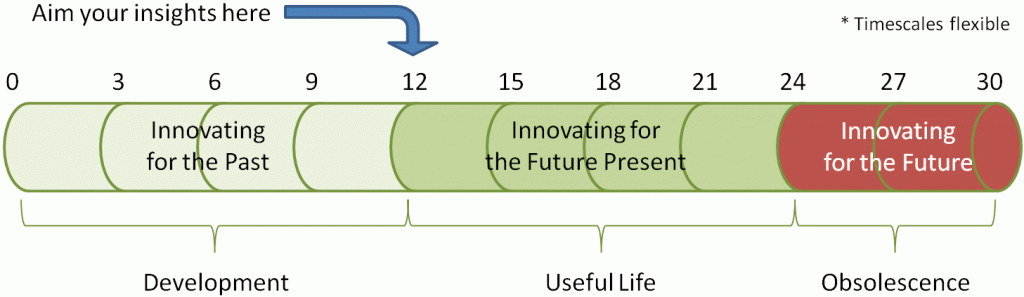
Innovating for the Future Present

For more, see my article Are You Innovating for the Past or the Future?

2. Make Sure You’re Solving a Problem Worth Solving

It is really easy to latch on to a single problem and decide to solve it. But is it the right problem to solve?

Smart organizations don’t jump to problem solving too soon, but instead start with problem finding in a divergent manner before converging via problem prioritization, then diverge again in a problem deep dive and finally converge into a problem summary and a research brief focused on a carefully chosen problem worth solving.
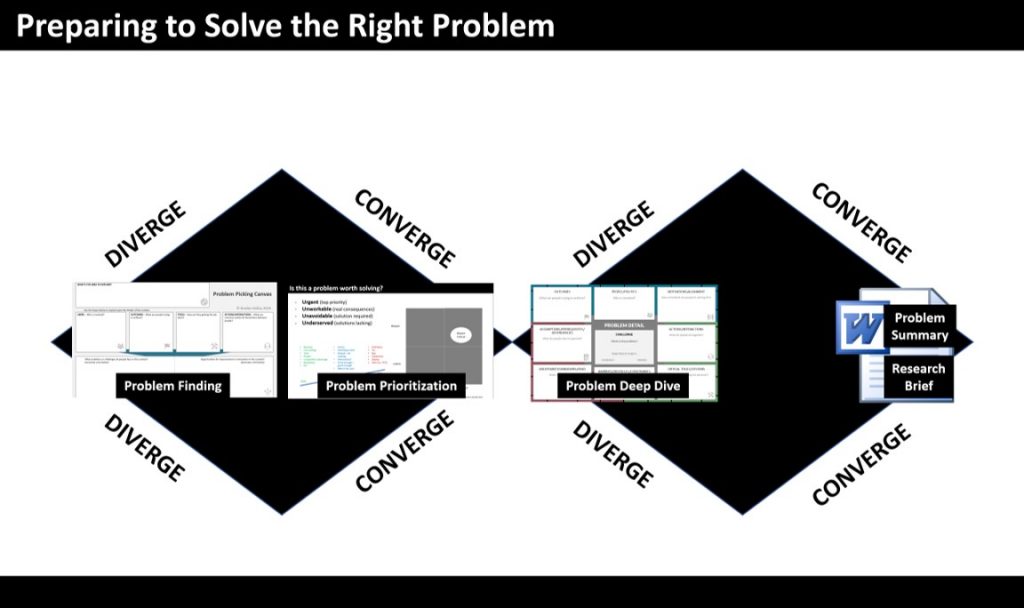
Preparing to Solve the Right Problem

For more, see my article Picking a Problem Worth Solving From a Sea of Problems

3. Identify Potential Fatal Flaws

No idea is perfect, and so when you can identify the potential fatal flaws or the high hurdles that have to be overcome, you can challenge them, you can solve for them, you can unleash the passion of your team on trying to find a way around them.

The fatal flaws are always there, and the wise innovator doesn’t ignore them or assume that they will overcome them at some point in the future, but instead invests energy upfront into both trying to identify the fatal flaws of their idea and into identifying whether they can isolate the solutions before moving the idea forward.

For more, see my article Innovation and Entrepreneurship Fatal Flaws

4. Create an Experimentation Strategy and a Plan for Learning Fast

When it comes to innovation, it is not as important whether you fail fast or fail slow or whether you fail at all, but how fast you learn. And make no mistake, you don’t have to fail to innovate (although there are always some obstacles along the way). With the right approach to innovation you can learn quickly from failures AND successes.

The key is to pursue your innovation efforts as a discrete set of experiments designed to learn certain things and instrumenting each project phase in such a way that the desired learning is achieved.

The central question should always be:

“What do we hope to learn from this effort?”
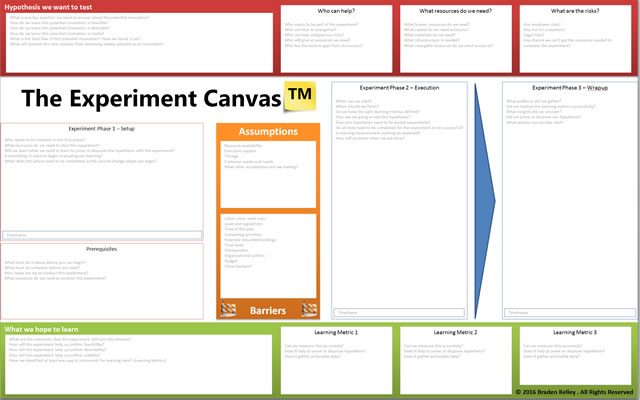
The Experiment Canvas

My Experiment Canvas is a great free tool you can download from this web site to help you design and execute a series of carefully selected experiments to help you get the right learning and to help identify early on whether or not you can realistically solve for the potential fatal flaws – as early as possible – while investments are low.

For more, see my article Don’t Fail Fast – Learn Fast and download your free Experiment Canvas poster to print or to use as a background to lock down and put virtual sticky notes on top of in online whiteboarding tools like Miro, Mural, LucidSpark or Microsoft Whiteboard.

5. Design for Modularity to Reduce Obsolescence

The LCS was promised to be a modular warship capable of performing multiple missions, but the contractors have failed to deliver on this promise.

It takes a really long time to put a new ship design to sea and into service. So, if you get it wrong, like with the LCS program, it will be many more years before you can replace a faulty design with a new design.

We rarely successfully predict the future, so it is important to design in the capability to adapt solutions as they are developed to match emerging realities. Otherwise, you can end up designing a solution for a problem that goes away.

To reduce the chances of designing a new ship for a mission that may no longer be needed by the time it is put to sea, it is imperative that each ship is designed to be intentionally modular. It is imperative that each ship is designed as a platform of platforms.

The automobile industry has gotten really good at designing in this way. Different trim levels have different stereo options, for example, or a dealer can install a spoiler or a luggage rack pretty easily if a customer desires it.

Designing with modularity and upgradeability in mind to change out key components to different mission needs that may emerge over time or new technologies that may create new or enhanced capabilities, is an incredibly powerful way to extend the usefulness and lifespan of each new maritime defense hull.

Conclusion

The U.S. Navy is in a quandary about what to do with the Littoral Combat Ships (LCS) it already has.

So much so that it has reached out to fleet commanders to inquire what missions the ships should be deployed against – according to Naval Surface Forces Vice Adm. Roy Kitchener.

The Navy should consider opening up their queries for help even wider, perhaps to the global innovation community.

But, with that said, as a U.S. Navy veteran I think the perception of the success or failure of this program would be seen much differently if they had successfully deployed the Anti-Mine Countermeasure and Anti-Submarine Warfare capabilities BEFORE the Surface Warfare capabilities.

Frigates and Destroyers are much more capable surface warfare platforms, and in hindsight the billions of dollars wasted on this program could have been much better spent for the benefit of the American people.

So, I hope that military contractors and the U.S. Government will improve their ability to deliver increased value at a decreased price as they pursue future shipbuilding programs and leverage some of the innovation best practices above.

Grabbing a copy of Stoking Your Innovation Bonfire would also be a great place to start.

Go Navy!

Image credit: Wikimedia Commons (ship photo)
All other images: Braden Kelley (All Rights Reserved)

Subscribe to Human-Centered Change & Innovation WeeklySign up here to get Human-Centered Change & Innovation Weekly delivered to your inbox every week.

Overcoming Common Challenges in Innovation Measurement

Overcoming Common Challenges in Innovation Measurement

GUEST POST from Chateau G Pato

Innovation is both an art and a science, requiring an ability to measure progress and impact accurately. Yet, many organizations struggle with this aspect of innovation management. With the right insights and tools, these challenges can be transformed into opportunities for growth.

Understanding the Challenges

At its core, innovation measurement is about assessing not only the outcomes but also the process of generating new ideas. Common challenges include defining relevant metrics, addressing the subjectivity of success criteria, and the difficulty in quantifying intangible benefits.

Case Study 1: TechCorp’s Innovation Metric Overhaul

TechCorp, a leading technology company, faced difficulties in linking their innovation activities with overall business performance. Their existing metrics focused too heavily on short-term financial returns, ignoring longer-term strategic value. As a result, many potentially groundbreaking projects were starved of resources too early in their development.

To address this, TechCorp adopted a holistic innovation measurement framework. They introduced a balanced scorecard approach, incorporating non-financial measures such as customer satisfaction, employee engagement, and patent activity. Over the next two years, the company witnessed a 25% increase in successful project transitions from development to market, as well as improved alignment of innovation efforts with long-term strategic goals.

Case Study 2: InnovateSoft’s Journey to Quantifying Intangibles

InnovateSoft, a software development firm, struggled with capturing the intangible benefits of their innovation programs, such as brand reputation and knowledge sharing. These benefits were acknowledged qualitatively but lacked quantitative support, making it difficult to justify spending to stakeholders.

InnovateSoft tackled this challenge by developing an “innovation impact scorecard” that included metrics for brand mentions, industry recognition, and internal knowledge transfer sessions. The introduction of these new metrics allowed InnovateSoft to visibly connect their innovation practices with market presence and internal culture enrichment. As a result, the company gained increased budget approvals and, crucially, experienced an uplift in employee morale and creativity.

Concluding Thoughts

Measuring innovation is not a one-size-fits-all endeavor, but the success stories of TechCorp and InnovateSoft demonstrate that with the right framework and commitment, the inherent challenges can be effectively navigated. Organizations must be willing to adapt their measurement approaches to align more closely with their unique strategic objectives while embracing both qualitative and quantitative metrics.

Ultimately, mastering innovation measurement empowers organizations to not only track and report progress but also to foster a culture of innovation that is sustainable and impactful.

Bottom line: Futurology is not fortune telling. Futurists use a scientific approach to create their deliverables, but a methodology and tools like those in FutureHacking™ can empower anyone to engage in futurology themselves.

Image credit: Pixabay

Subscribe to Human-Centered Change & Innovation WeeklySign up here to get Human-Centered Change & Innovation Weekly delivered to your inbox every week.

Cross-Functional Collaboration in Design

Breaking Down Silos

Cross-Functional Collaboration in Design

GUEST POST from Art Inteligencia

In today’s rapidly evolving business landscape, the traditional silos that once segmented different departments within organizations are becoming increasingly detrimental. Cross-functional collaboration is no longer optional but essential, especially in the field of design where the synthesis of diverse perspectives can spur innovation and lead to holistic solutions. Here’s a look into why breaking down silos is crucial for impactful design and how real-world examples are leading the way.

The Importance of Cross-Functional Collaboration in Design

Design is the nexus where aesthetics meet functionality, and understanding the client or customer is crucial. By involving diverse teams, organizations can ensure their designs are not only visually appealing but also technically feasible, user-oriented, and market-ready. This collaborative approach encourages creativity and helps identify unforeseen challenges early in the design process.

Case Study 1: XYZ Tech’s Product Development

Background

XYZ Tech, a leader in consumer electronics, wanted to develop an innovative smart home device. Historically, the design team and engineering teams worked independently, leading to delays and frequent iterations.

Approach

To break down the silos, XYZ Tech initiated a series of cross-functional design sprints that brought together designers, engineers, marketers, and customer service representatives. The goal was to leverage each department’s expertise from the outset.

Outcome

This integration led to a faster development cycle. By combining insights from each team, the initial prototypes were more refined, and the final product launch was accelerated by six months. In addition, the collaboration resulted in a product that not only met technical specifications but exceeded customer expectations in user experience and aesthetics.

Case Study 2: ABC Fintech’s Mobile App Revival

Background

ABC Fintech faced declining user engagement with their mobile app. Feedback indicated issues with functionality and user interface which had been designed in isolation.

Approach

To tackle this, ABC Fintech organized workshops that included members from UX design, IT, customer support, and analytics teams. This cross-functional team worked collaboratively in real-time, sharing insights and user data to inform design decisions.

Outcome

The collaboration brought vital customer insights to the forefront, leading to a redesigned app that was intuitive and responsive. Post-launch analytics showed a 40% increase in user engagement and a positive shift in user satisfaction scores.

Conclusion

Breaking down silos and fostering cross-functional collaboration are keys to fostering innovation in design. The synergy derived from diverse perspectives can lead organizations to not only design better products but also to achieve greater efficiency and customer satisfaction. As these case studies demonstrate, the collective strength of interconnected teams is a formidable force in the world of design.

“Collaboration is the essence of life. The wind, bees, and flowers work together, to spread the pollen.” – Amit Ray

Bottom line: Futurology is not fortune telling. Futurists use a scientific approach to create their deliverables, but a methodology and tools like those in FutureHacking™ can empower anyone to engage in futurology themselves.

Image credit: Pexels

Subscribe to Human-Centered Change & Innovation WeeklySign up here to get Human-Centered Change & Innovation Weekly delivered to your inbox every week.