
Tag Archives: Soft Skills

Taking Personal Responsibility – Seeing Self as Cause

Taking Personal Responsibility – Seeing Self as Cause

GUEST POST from Janet Sernack

In our last two blogs on Taking Personal Responsibility, we stated that when people aren’t taking personal responsibility, they cannot be accountable, they will fail in their jobs, and their teams, and fail to grow as individuals and as leaders. Taking personal responsibility is an especially crucial capability to develop self-awareness and self-regulation skills in the decade of both disruption and transformation. It all starts with seeing self as the cause of what happens to us, rather than baling it on the effects events and problems have on us! Where people can learn to recognize the structures at play in their lives and change them so that they can create what they really want to create in their lives, teams, or organizations.

In the last two blogs, we shared a range of tips for shifting people’s location, by creating a line of choice, to help them shift from being below the line and blaming others for their reactive response, to getting above the line quickly.  Through shifting their language from “you, they and them” to “I, we and us” and bravely disrupting and calling out people when they do slip below the line. How doing this allows people to also systemically shift across the maturity continuum, from dependence to independence and ultimately towards interdependence.

In a recent newsletter Otto Scharmer, from the Presencing Institute states “Between action and non-action there is a place. A portal into the unknown. But what are we each called to contribute to the vision of the emerging future? Perhaps these times are simply doorways into the heart of the storm, a necessary journey through the cycles of time required to create change”.

Creating the place – the sacred pause

When I made a significant career change from a design and marketing management consultant to becoming a corporate trainer, one of the core principles I was expected to teach to senior corporate managers and leaders was taking personal responsibility.

Little knowing, that at the end of the workshop, going back to my hotel room and beating myself up, for all of the “wrongs” in the delivery of the learning program, was totally out of integrity with this core principle.

Realising that when people say – those that teach need to learn, I had mistakenly thought that I had to take responsibility for enacting the small imperfections I had delivered during the day, by berating myself, making myself “wrong” and through below the line self-depreciation!

Where I perfectly acted out the harmful process of self-blame, rather than rationally assessing the impact of each small imperfection, shifting to being above the line where I could intentionally apply the sacred pause:

  • Hit my pause button to get present, accept my emotional state,
  • Connect with what really happened to unpack the reality of the situation and eliminate my distortions around it,
  • Check-in and acknowledge how I was truly feeling about what happened,
  • Acknowledge some of the many things that I had done really well,
  • Ask myself what is the outcome/result I want for participants next program?
  • Ask myself what can I really learn from this situation?
  • Consciously choose what to do differently the next time I ran the program.

I still often find myself struggling with creating the Sacred Space between Stimulus and Response and have noticed in my global coaching practice, that many of my well-intentioned clients struggle with this too.

The impact of the last two and a half years of working at home, alone, online, with minimal social interactions and contact, has caused many of them to languish in their reactivity, and for some of them, into drowning in a very full emotional boat, rather than riding the wave of disruptive change.

Being the creative cause

In our work at ImagineNation, whether we help people, leaders and teams adapt, innovate and grow through disruption, their ability to develop true self-awareness and be above the line is often the most valuable and fundamental skill set they develop.

It then enables us to make the distinction that creating is completely different from reacting or responding to the circumstances people find themselves in by applying the sacred pause.

When people shift towards seeing self as the cause they are able to create and co-create what they want in their lives, teams or organization by learning to create by creating, starting with asking the question:

  • What result do you want to create in your life?
  • What is the reality of your current situation?

This creates a state of tension, it is this tension that seeks resolution.

In his ground-breaking book The Path of Least Resistance Robert Fritz, goes on to describe and rank these desired results as “Fundamental Choices, Primary Choices, and Secondary Choices.”

Because there is one thing that we can all do right and is totally in our control – is to shift towards seeing self as the cause and make a set of conscious choices, with open hearts, minds, and wills, as to how we think, feel and choose to act.

“We are the creative force of our life, and through our own decisions rather than our conditions, if we carefully learn to do certain things, we can accomplish those goals.”

We all have the options and choices in taking responsibility, empowering ourselves and others to be imaginative and creative, and using the range of rapid changes, ongoing disruption, uncertainty, and the adverse pandemic consequences, as levers for shifting and controlling, the way we think, feel.

Benefits of seeing self as the cause and being above the line

Applying the sacred pause to make change choices in how we act – and being brave and bold in shifting across the maturity continuum, will help us to cultivate the creativity, interdependence, and systemic thinking we all need right now because it:

  • Helps people self-regulate their reactive emotional responses, be more open-hearted and emotionally agile, and helps develop psychologically safe work environments where people can collaborate and experiment, and fail without the fear of retribution or punishment.
  • Enables people to be more open-minded, imaginative, and curious and creates a safe space for continuous learning, maximizing diversity and inclusion, and proactive intentional change and transformation.
  • Promotes ownership of a problem or challenging situation and helps develop constructive and creative responses to problems and an ability to take intelligent actions.
  • Gives people an opportunity to impact positively on others and build empowered trusted and collaborative relationships.
  • Enables entrepreneurs and innovators to invent creative solutions and drive successful innovative outcomes.
  • Building the foundations for accountability, where people focus their locus of control on what they promise to deliver, enables them to be intrinsically motivated, and take smart risks on negotiating outcomes that they can be counted on for delivering.

Tips for seeing self as the cause and operating above the line

Taking personal responsibility and seeing self as the cause involves:

  • Acknowledging that “I/we had a role or contributed in some way, to the fact that this has not worked out the way “I/we wanted.”
  • Clarifying the outcome or result in you want from a specific situation or a problem.
  • Seeking alternatives and options for making intelligent choices and actions, and using the language of “I/we can” and “I/we will” to achieve the outcome.
  • Replacing avoiding, being cynical and argumentative, blaming, shaming, controlling, and complaining with courageous, compassionate, and creative language and acts of intention.
  • People become victors who operate from “self as cause” where they are empowered to be the creative forces in their own lives by making fundamental, primary, and secondary change choices.
  • Trust your inner knowing and deep wisdom that everything has a specific and definable cause and that each and every one of us has the freedom to choose how to respond to it.

Back to leadership basics

As Stephen Covey says, people need to deeply and honestly say “I am what I am today because of the choices I made yesterday” because it’s not what happens to us, it’s our reactive response to what happens that hurts us.

Being willing to step back, retreat, and reflect on the gap between the results you want, and the results you are getting all starts with stepping inward, backward, and forwards, using the sacred pause, to ask:

  • What happened? What were the key driving forces behind it?
  • How am I/we truly feeling about it?
  • What was my/our role in causing this situation, or result?
  • What can I/we learn from it?
  • What is the result/outcome I want to create in the future?
  • What can I/we then do to create it?

As a corporate trainer, consultant and coach, I found out the hard way that developing the self-awareness and self-regulation skills in taking personal responsibility and seeing self as the cause is the basis of the personal power and freedom that is so important to me, and almost everyone else I am currently interacting with.

It’s the foundation for transcending paralysis, overwhelm, and stuck-ness and activating our sense of agency to transform society and ourselves.

This is the third and final blog in a series of blogs on the theme of taking responsibility – going back to leadership basics. Read the previous two here:

Find out about our learning products and tools, including The Coach for Innovators, Leaders, and Teams Certified Program, a collaborative, intimate, and deeply personalized innovation coaching and learning program, supported by a global group of peers over 9-weeks, starting Tuesday, October 18, 2022. It is a blended and transformational change and learning program that will give you a deep understanding of the language, principles, and applications of an ecosystem focus,  human-centric approach, and emergent structure (Theory U) to innovation, and upskill people and teams and develop their future fitness, within your unique context.

Image credit: Pixabay

Subscribe to Human-Centered Change & Innovation WeeklySign up here to get Human-Centered Change & Innovation Weekly delivered to your inbox every week.
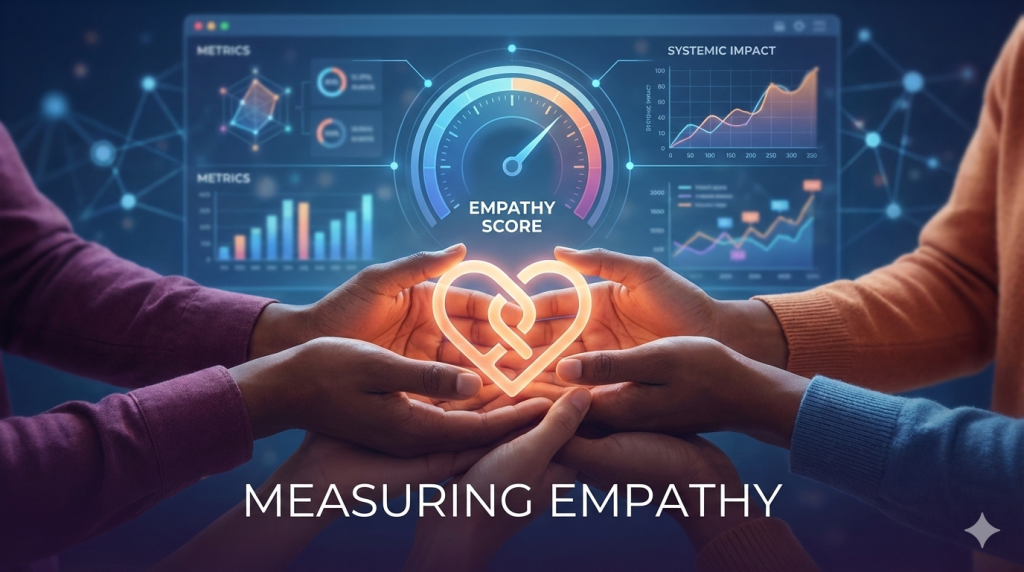
Measuring Competencies Like Empathy and Collaboration

Certifying Soft Skills

Measuring Competencies Like Empathy and Collaboration

GUEST POST from Chateau G Pato
LAST UPDATED: January 19, 2026 at 12:29PM

For decades, the corporate world has operated on a convenient fiction: that “hard skills” — coding, accounting, engineering — are the solid bedrock of business, while “soft skills” are the fuzzy, unenforceable garnishes. We hire for the hard, and we fire for the lack of the soft.

As we navigate an era defined by rapid technological disruption and the rise of Artificial Intelligence, this distinction is not just obsolete; it is dangerous. When machines can crunch numbers faster and generate code cleaner than any human, the true differentiator for an organization — the engine of sustainable innovation and successful change management — becomes the intensely human capacity to connect, understand, and co-create.

The problem has never been that organizations don’t value empathy or collaboration. The problem is that they haven’t known how to measure them with rigor. If we cannot measure it, we cannot manage it, and we certainly cannot certify it. To build truly human-centered organizations, we must crack the code on credentialing the very competencies that make us human.

“We are entering an age where your technical expertise gets you in the room, but your ability to empathize and collaborate determines your impact once you are there. Innovation is a social endeavor; if we can’t measure the quality of our connection, we can’t improve the quality of our creation.”

— Braden Kelley

Moving Beyond the “Vibe Check”

The historical skepticism toward certifying soft skills stems from a reliance on self-assessment. Asking an employee, “How empathetic are you on a scale of 1 to 10?” is useless data. True measurement requires moving from sentiment to demonstrated behavior in context.

We must shift our focus from assessing internal states (how someone feels) to external applications (what someone does with those feelings to drive valuable outcomes). A certification in empathy, for example, shouldn’t signify that a person is “nice.” It should signify that they possess a verified toolkit for uncovering latent user needs and the emotional intelligence to navigate complex stakeholder resistance during change initiatives.

Case Study 1: The “Applied Empathy” Badge in Service Design

The Challenge

A prominent financial services firm found that its digital transformation efforts were stalling. Their product teams were technically proficient but were building solutions based on assumptions rather than user realities, leading to poor adoption rates. They needed to embed deep user understanding into their development lifecycle.

The Measurement Solution

Instead of a generic communications workshop, the firm worked to develop an “Applied Empathy Practitioner” certification. To earn this, candidates had to pass a rigorous, multi-stage evaluation:

  • Scenario-Based Simulation: Candidates engaged in role-play scenarios with “difficult customers,” evaluated not on appeasement, but on their ability to use active inquiry to uncover the root cause of frustration.
  • Portfolio of Evidence: Candidates had to submit documented examples of how an insight gained through empathetic interviewing directly altered a product roadmap or service feature. They had to prove the application of the skill.

The Outcome

The certification became a prerequisite for lead design roles. The company saw a 40% reduction in post-launch rework because consumer friction points were identified earlier. They moved empathy from a “nice-to-have” trait to a measurable, certifiable professional competency linked to reduced risk.

Case Study 2: Certifying Collaboration in a Siloed Tech Giant

The Challenge

A global software enterprise was struggling with innovation velocity. While individual departments were high-performing, cross-functional projects frequently died on the vine due to territorialism and a lack of psychological safety. They needed leaders who could act as bridges, not gatekeepers.

The Measurement Solution

The organization realized that certifying collaboration couldn’t be based on a multiple-choice test. They developed a “Master Collaborator” credential focused on network dynamics and team environment:

  • Organizational Network Analysis (ONA): Instead of just asking “Are you a team player?”, the company used anonymized metadata to map communication flows. They identified individuals who served as high-trust connectors between disparate groups.
  • 360-Degree “Safety” Index: Peers and subordinates evaluated candidates specifically on their ability to create psychological safety—the environment where people feel safe to take risks and voice dissenting opinions without fear of retribution.

The Outcome

Leaders who achieved this certification were placed in charge of critical, high-risk innovation initiatives. The data showed that teams led by certified collaborators brought new products to market 25% faster, primarily because information flowed freely and failures were treated as learning opportunities rather than punishable offenses.

“In the symphony of innovation, empathy isn’t just a note — it’s the harmony that binds the orchestra together, allowing every voice to resonate.”

— Braden Kelley

Case Study 3: Google’s Project Oxygen

Google, a pioneer in data-driven decision-making, launched Project Oxygen in 2008 to identify what makes a great manager. Through extensive analysis of over 10,000 performance reviews, feedback surveys, and interviews, they discovered that technical skills ranked eighth on the list of top behaviors. Instead, top managers excelled in coaching, empowering teams, and showing genuine concern for team members’ success and well-being — hallmarks of empathy.

To certify these competencies, Google developed comprehensive training programs and certification pathways
integrated into their leadership development. Managers undergo rigorous assessments, including peer reviews, self-evaluations, and behavioral interviews focused on specific actions like “is a good coach” and “has a clear vision and strategy for the team.” Successful participants earn internal certifications that directly influence promotions, compensation, and leadership opportunities.

The impact has been profound. Teams led by certified managers report higher satisfaction scores, lower attrition rates, and up to 20% better performance metrics in areas like project delivery and innovation output. This case study illustrates how quantifying soft skills through structured, data-backed feedback can translate into measurable business outcomes, proving that empathy isn’t just nice — it’s a competitive advantage.

Case Study 4: IBM’s Digital Badge Program

IBM has been at the forefront of skills certification with their open badges initiative, launched in 2015. This program extends beyond technical proficiencies to include soft skills like collaboration, agility, and empathy. For instance, to earn a “Collaborative Innovator” badge, employees must complete real-world projects involving cross-functional teams, submit detailed evidence of their contributions, and receive endorsements from at least three peers or supervisors.

A particularly compelling application was during IBM’s transition to hybrid work models following the global pandemic. Employees pursuing certification participated in immersive virtual reality simulations where they navigated complex team conflicts, such as resolving disagreements in diverse groups. These scenarios tested empathy through active listening exercises, inclusive decision-making, and emotional support simulations. Performance is evaluated using AI analytics that score interactions based on predefined empathy and collaboration rubrics.

Badges are issued on a blockchain platform, ensuring they are secure, verifiable, and portable across careers. Data from IBM indicates that employees with soft skill badges are 15% more likely to be promoted internally and report 25% higher job satisfaction levels. Moreover, teams with a higher density of certified collaborators exhibit faster problem-solving times and more innovative patent filings. IBM’s model showcases how blending technology with human-centric evaluation can standardize soft skill certification while preserving the authenticity of interpersonal dynamics.

The Future of Human-Centered Credentialing

Certifying these skills is not about creating a new layer of bureaucracy. It is about signaling value. By creating rigorous standards for empathy, collaboration, adaptability, and resilience, we provide a roadmap for employees to develop the skills that actually matter in a volatile future.

These certifications cannot be “one-and-done.” Just as technical certifications require renewal, soft skill credentials must be dynamic, requiring ongoing evidence of application in increasingly complex scenarios. This ensures that the skills are living capabilities, not just framed certificates.

As leaders in human-centered change, we must champion the idea that the “hardest” skills to master — and the most valuable to measure — are the ones that connect us.

Frequently Asked Questions

Why is it difficult to measure soft skills like empathy?

Soft skills are inherently subjective and context-dependent. Unlike technical skills which have binary outcomes (the code works or it doesn’t), soft skills like empathy rely on behavioral indicators, the perception of others, and the ability to apply emotional intelligence in varied scenarios, making quantitative measurement challenging.

How can organizations effectively certify collaboration?

Effective certification moves beyond self-assessments and utilizes 360-degree feedback mechanisms, Organizational Network Analysis (ONA) to see who genuinely connects silos, and scenario-based evaluations that test a person’s ability to foster psychological safety and manage conflict constructively.

What is the business value of certifying soft skills?

Certifying soft skills provides a tangible framework for creating a human-centered culture. It leads to better innovation through diverse perspectives, faster adoption of change initiatives due to higher trust, and improved retention by valuing the human element of work.

Extra Extra: Because innovation is all about change, Braden Kelley’s human-centered change methodology and tools are the best way to plan and execute the changes necessary to support your innovation and transformation efforts — all while literally getting everyone all on the same page for change. Find out more about the methodology and tools, including the book Charting Change by following the link. Be sure and download the TEN FREE TOOLS while you’re here.

Image credits: Google Gemini

Subscribe to Human-Centered Change & Innovation WeeklySign up here to get Human-Centered Change & Innovation Weekly delivered to your inbox every week.