Tag Archives: human brain

Are Humans Just a Fleshy Generative AI Machine?

Are Humans Just a Fleshy Generative AI Machine?

GUEST POST from Geoffrey A. Moore

By now you have heard that GenAI’s natural language conversational abilities are anchored in what one wag has termed “auto-correct on steroids.” That is, by ingesting as much text as it can possibly hoover up, and by calculating the probability that any given sequence of words will be followed by a specific next word, it mimics human speech in a truly remarkable way. But, do you know why that is so?

The answer is, because that is exactly what we humans do as well.

Think about how you converse. Where do your words come from? Oh, when you are being deliberate, you can indeed choose your words, but most of the time that is not what you are doing. Instead, you are riding a conversational impulse and just going with the flow. If you had to inspect every word before you said it, you could not possibly converse. Indeed, you spout entire paragraphs that are largely pre-constructed, something like the shticks that comedians perform.

Of course, sometimes you really are being more deliberate, especially when you are working out an idea and choosing your words carefully. But have you ever wondered where those candidate words you are choosing come from? They come from your very own LLM (Large Language Model) even though, compared to ChatGPT’s, it probably should be called a TWLM (Teeny Weeny Language Model).

The point is, for most of our conversational time, we are in the realm of rhetoric, not logic. We are using words to express our feelings and to influence our listeners. We’re not arguing before the Supreme Court (although even there we would be drawing on many of the same skills). Rhetoric is more like an athletic performance than a logical analysis would be. You stay in the moment, read and react, and rely heavily on instinct—there just isn’t time for anything else.

So, if all this is the case, then how are we not like GenAI? The answer here is pretty straightforward as well. We use concepts. It doesn’t.

Concepts are a, well, a pretty abstract concept, so what are we really talking about here? Concepts start with nouns. Every noun we use represents a body of forces that in some way is relevant to life in this world. Water makes us wet. It helps us clean things. It relieves thirst. It will drown a mammal but keep a fish alive. We know a lot about water. Same thing with rock, paper, and scissors. Same thing with cars, clothes, and cash. Same thing with love, languor, and loneliness.

All of our knowledge of the world aggregates around nouns and noun-like phrases. To these, we attach verbs and verb-like phrases that show how these forces act out in the world and what changes they create. And we add modifiers to tease out the nuances and differences among similar forces acting in similar ways. Altogether, we are creating ideas—concepts—which we can link up in increasingly complex structures through the fourth and final word type, conjunctions.

Now, from the time you were an infant, your brain has been working out all the permutations you could imagine that arise from combining two or more forces. It might have begun with you discovering what happens when you put your finger in your eye, or when you burp, or when your mother smiles at you. Anyway, over the years you have developed a remarkable inventory of what is usually called common sense, as in be careful not to touch a hot stove, or chew with your mouth closed, or don’t accept rides from strangers.

The point is you have the ability to take any two nouns at random and imagine how they might interact with one another, and from that effort, you can draw practical conclusions about experiences you have never actually undergone. You can imagine exception conditions—you can touch a hot stove if you are wearing an oven mitt, you can chew bubble gum at a baseball game with your mouth open, and you can use Uber.

You may not think this is amazing, but I assure you that every AI scientist does. That’s because none of them have come close (as yet) to duplicating what you do automatically. GenAI doesn’t even try. Indeed, its crowning success is due directly to the fact that it doesn’t even try. By contrast, all the work that has gone into GOFAI (Good Old-Fashioned AI) has been devoted precisely to the task of conceptualizing, typically as a prelude to planning and then acting, and to date, it has come up painfully short.

So, yes GenAI is amazing. But so are you.

That’s what I think. What do you think?

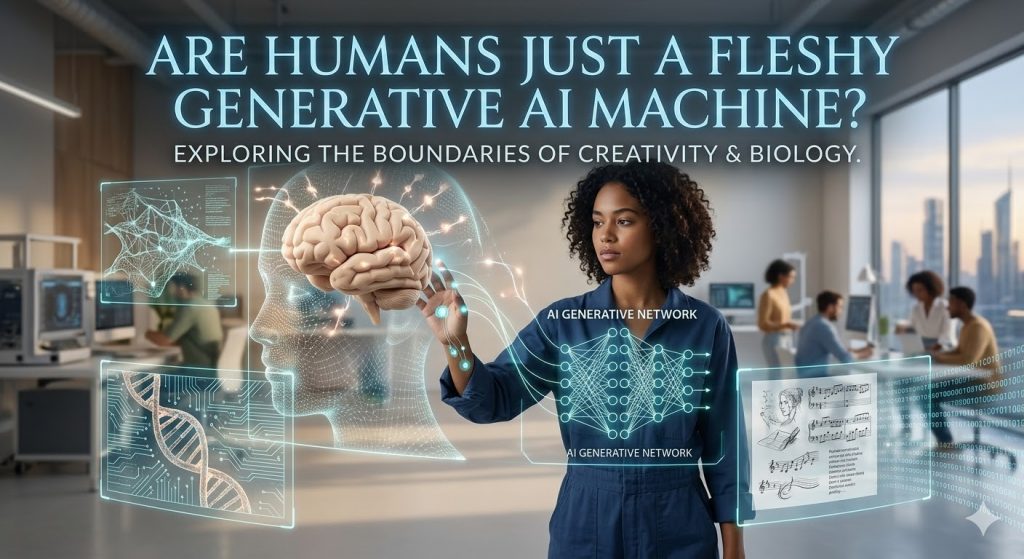
Image Credit: Google Gemini

Subscribe to Human-Centered Change & Innovation WeeklySign up here to join 17,000+ leaders getting Human-Centered Change & Innovation Weekly delivered to their inbox every week.

Top 10 Human-Centered Change & Innovation Articles of March 2023

Top 10 Human-Centered Change & Innovation Articles of March 2023Drum roll please…

At the beginning of each month, we will profile the ten articles from the previous month that generated the most traffic to Human-Centered Change & Innovation. Did your favorite make the cut?

But enough delay, here are March’s ten most popular innovation posts:

  1. Taking Care of Yourself is Not Impossible — by Mike Shipulski
  2. Rise of the Prompt Engineer — by Art Inteligencia
  3. A Guide to Effective Brainstorming — by Diana Porumboiu
  4. What Disruptive Innovation Really Is — by Geoffrey A. Moore
  5. The 6 Building Blocks of Great Teams — by David Burkus
  6. Take Charge of Your Mind to Reclaim Your Potential — by Janet Sernack
  7. Ten Reasons You Must Deliver Amazing Customer Experiences — by Shep Hyken
  8. Deciding You Have Enough Opens Up New Frontiers — by Mike Shipulski
  9. The AI Apocalypse is Here – 3 Reasons You Should Celebrate! — by Robyn Bolton
  10. Artificial Intelligence is Forcing Us to Answer Some Very Human Questions — by Greg Satell

BONUS – Here are five more strong articles published in February that continue to resonate with people:

If you’re not familiar with Human-Centered Change & Innovation, we publish 4-7 new articles every week built around innovation and transformation insights from our roster of contributing authors and ad hoc submissions from community members. Get the articles right in your Facebook, Twitter or Linkedin feeds too!

Have something to contribute?

Human-Centered Change & Innovation is open to contributions from any and all innovation and transformation professionals out there (practitioners, professors, researchers, consultants, authors, etc.) who have valuable human-centered change and innovation insights to share with everyone for the greater good. If you’d like to contribute, please contact me.

P.S. Here are our Top 40 Innovation Bloggers lists from the last three years:

Subscribe to Human-Centered Change & Innovation WeeklySign up here to get Human-Centered Change & Innovation Weekly delivered to your inbox every week.

Training Your Quantum Human Computer

Quantum Human Computing

What is quantum computing?

According to Wikipedia, “Quantum computing is the use of quantum phenomena such as superposition and entanglement to perform computation. Computers that perform quantum computations are known as quantum computers.”

Rather than try and explain all of the ins and outs of how quantum computing differs from traditional computing and why it matters, I encourage you to check out this YouTube video:

In case you were curious, according to the Guinness Book of World Records, the current record holder for quantum computing is a Google machine capable of processing 72 Quantum Bits. There is supposedly a machine in China capable of 76 Qubits, but it has yet to be fully recognized as the new record holder.

So, what does quantum computing have to do with humanity and the human brain and our collective future?

Is the human brain a quantum computer?

The easy answer is – we’re not sure – but scientists are conducting experiments to try and determine whether the human brain is capable of computing in a quantum way.

As the pace of change in our world accelerates and data proliferates, we will need to train our brains to use less traditional brute force computing of going through every possibility one after another to do more parallel processing, better pattern recognition, and generating an increase in our ability to see insights straight away.

Connect the Dots

But how can we train our brains?

There are many different ways to better prepare your brain as we move from the Information Age to the Age of Insight. Let me start you off with two good ones and invite you to add more in the comments:

1. Connect the Dots

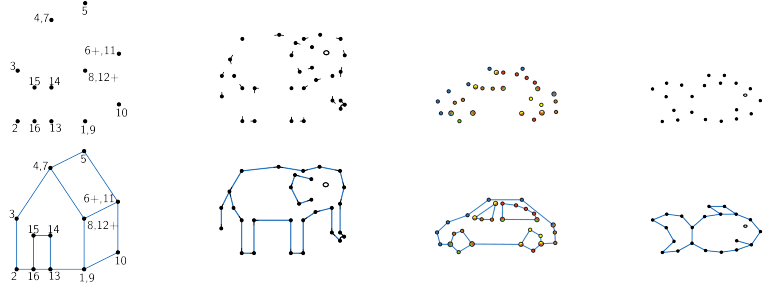
Many of us grew up doing connect-the-dot puzzles, and they seemed pretty easy. But, that is with visual queues. The image above shows a number of different visual queues. Connect the dots, especially without numbers or visual queues are great proving grounds for improving your visual pattern recognition skills.

2. DLAIY JMBULE

One of my favorites is the word game DAILY JUMBLE in my local newspaper. You can also play it online. The key here is to work not on using brute force to reorder the letters into a word, but trying to train your brain to just SEE THE WORD – instantly.

Succeeding at this and other ways of training your brain to be more like a quantum computer involves getting better at removing your conscious analytical brain from the picture and letting other parts of your brain take over. It’s not easy. It takes practice – continual practice – because it is really hard to keep the analytical brain out of the way.

So, are you willing to give it a try?

Stay tuned for the next article in this series “The Age of Insight” …

Image credits: Utrecht University, Pixabay


Accelerate your change and transformation success

Subscribe to Human-Centered Change & Innovation WeeklySign up here to get Human-Centered Change & Innovation Weekly delivered to your inbox every week.