Tag Archives: growth

Change Management Strategies for Organizational Growth

A Comprehensive Guide

Change Management Strategies for Organizational Growth

GUEST POST from Art Inteligencia

Change is the only constant in today’s dynamic business environment. Amidst rapid technological advancements, evolving market demands, and global economic shifts, organizations must continuously adapt to survive and thrive. As a thought leader in human-centered innovation and change, I’ve distilled critical change management strategies that foster organizational growth. In this article, I’ll explore these strategies and elucidate them through two compelling case studies.

1. Embrace a Culture of Continuous Improvement

Successful organizations cultivate a culture that encourages constant enhancement and innovation. This involves empowering employees at all levels to identify inefficiencies and propose improvements. Implementing a continuous improvement mindset can lead to sustained, incremental growth and resilience against market shocks.

Case Study: Toyota

Toyota’s adoption of the Kaizen philosophy epitomizes a culture of continuous improvement. “Kaizen” translates to “change for better,” a principle that Toyota has ingrained in its DNA. Employees at all levels, from assembly line workers to executives, are encouraged to contribute ideas. Daily team meetings, called “morning markets,” provide a forum for discussing suggestions.

One notable initiative was the introduction of the Andon cord—a system allowing any worker to halt production if they noticed a defect. This not only improved quality but also demonstrated Toyota’s commitment to giving employees ownership in the production process. Over time, this approach reduced defects, cut costs, and bolstered Toyota’s reputation for reliability, thereby increasing market share and driving growth.

2. Foster Agile Leadership and Decision-Making

Navigating change requires leaders who are agile and adaptable. Agile leaders can pivot quickly in response to disruptions and ensure that their organization remains aligned with the market. They cultivate a work environment where swift, yet informed decision-making is the norm

Case Study: Spotify

Spotify’s organizational growth can be strongly attributed to its adoption of the Agile framework. Instead of traditional top-down management, Spotify operates in small, autonomous teams known as “squads.” Each squad is responsible for a specific feature or component of the platform and functions like a mini-startup within the company.

These squads are empowered to make decisions and execute changes independently, enabling faster development cycles and quicker responses to market needs. This agility allowed Spotify to outmaneuver larger competitors, consistently deliver innovative product features, and rapidly expand its global user base.

3. Engage Stakeholders Through Transparent Communication

Clear and consistent communication is crucial for any change initiative. Engaging stakeholders—from employees to external partners—through transparent communication builds trust and mitigates resistance to change.

Case Study: GE’s Transformation Under Jack Welch

When Jack Welch assumed the role of CEO at General Electric (GE), he embarked on a massive transformation program known as “boundaryless behavior.” Welch’s vision was to dismantle bureaucratic silos and create a more integrated, competitive company.

One of his critical strategies was transparent and direct communication. Welch held regular town hall meetings, shared the company’s financial performance openly, and involved employees in decision-making processes. Training programs known as “Work-Outs” were established where employees could voice concerns and offer solutions directly to executives. This open dialogue not only enhanced employee morale but also facilitated smoother implementation of change initiatives, ultimately fueling GE’s growth into a powerhouse conglomerate.

4. Leverage Data-Driven Decision Making

Emphasizing data-driven decision-making ensures that organizations navigate change with precision and confidence. By leveraging data analytics, companies can identify trends, pinpoint inefficiencies, and forecast the impact of potential changes.

Case Study: Netflix’s Evolution

Netflix’s transition from a DVD rental service to a leading streaming platform and content creator exemplifies data-driven decision making. Initially, Netflix used data analytics to revolutionize its DVD rental service, predicting customer preferences and optimizing inventory.

As the market evolved, Netflix pivoted to streaming, leveraging viewer data to curate personalized recommendations and drive user engagement. Their data-driven approach also extended to content creation; by analyzing viewer metrics, Netflix identified gaps in the market and produced popular original series like “House of Cards” and “Stranger Things,” which significantly boosted subscriptions and propelled the company’s growth.

5. Develop Resilience Through Continuous Learning

Building an organization that champions continuous learning and skill development prepares the workforce to adapt to future challenges and technological advancements. By investing in continuous professional development, organizations can retain talent and foster innovation.

Case Study: AT&T’s Workforce 2020 Initiative

AT&T recognized the need to adapt to the digital era and launched the Workforce 2020 initiative. This comprehensive, multi-year strategy aimed to reskill its workforce to meet the demands of emerging technologies.

AT&T partnered with leading online education platforms and provided employees with resources to gain new skills in data science, cybersecurity, and other critical areas. By 2020, over half the workforce had participated in reskilling programs, bolstering the company’s innovative capabilities and maintaining its competitive edge in the fast-evolving tech landscape.

Conclusion

Implementing effective change management strategies is not a one-size-fits-all proposition. The success stories of Toyota, Spotify, General Electric, Netflix, and AT&T highlight how a tailored approach grounded in continuous improvement, agile leadership, transparent communication, data-driven decision making, and continuous learning can drive organizational growth. By learning from these exemplars and applying these strategies thoughtfully, organizations can navigate change successfully and foster sustainable growth.

Bottom line: Futurology is not fortune telling. Futurists use a scientific approach to create their deliverables, but a methodology and tools like those in FutureHacking™ can empower anyone to engage in futurology themselves.

Image credit: Pexels

Subscribe to Human-Centered Change & Innovation WeeklySign up here to get Human-Centered Change & Innovation Weekly delivered to your inbox every week.
The Ideation Lifecycle

Aligning Distinct Behavioral Archetypes with Stages of Growth

The Ideation Lifecycle

GUEST POST from Chateau G Pato


The Human Engine of Growth

Too often, organizations face an invisible wall. They have the capitalization, the market opportunity, and a product that shows immense promise, yet scaling stalls. Leaders pore over financial models, tweak operational processes, and restructure reporting lines, completely missing the underlying reality: companies fail to scale because they have the wrong human behaviors driving the wrong stage of growth. Growth is not merely a sequence of financial milestones; it is a human evolution.

The Paradigm Shift: From Persona to Archetype

For years, design and marketing have leaned heavily on static personas—demographic and psychographic snapshots of who people are. But in the fast-moving landscapes of innovation and change management, who someone is matters far less than how they act, think, and decide under pressure.

By shifting our focus toward fluid behavioral archetypes, we unlock a deeper understanding of organizational chemistry. Archetypes capture dynamic mindsets and problem-solving styles. When we map these behavioral patterns to the distinct horizons of business expansion, we gain the ability to intentionally design the human ecosystem required for sustained success.

The Core Thesis

Sustainable innovation, seamless customer experiences, and successful organizational scaling require leaders to dynamically align distinct behavioral archetypes with the specific cultural and strategic demands of each growth stage. To try to solve tomorrow’s scaling problems with yesterday’s behavioral archetypes is a recipe for stagnation. Success lies in matching the right mindsets to the right moment.

Demystifying Behavioral Archetypes vs. Growth Stages

To build a truly agile, human-centered organization, we must first change how we look at our people. Traditional demographic profiles or rigid job descriptions are no longer sufficient. Innovation and digital transformation require a shift toward behavioral archetypes—and a clear understanding of how these mindsets interact with the natural lifecycle of organizational growth.

Why Behavioral Archetypes Supercharge Innovation and Change

Unlike traditional personas, which anchor people to static identities or demographic boxes, behavioral archetypes focus purely on mindsets, decision-making patterns, and operational motivations. They answer the critical questions: How does this person approach ambiguity? What drives their problem-solving? How do they handle risk?

In times of rapid change, archetypes allow leaders to look past job titles and tap into the underlying cognitive diversity of their workforce. By focusing on behavioral archetypes rather than static roles, organizations can build fluid, cross-functional teams optimized for specific challenges, fostering an environment where Adaptability Quotient (AQ) can truly thrive.

The Lifecycle of Growth: From Inception to Renewal

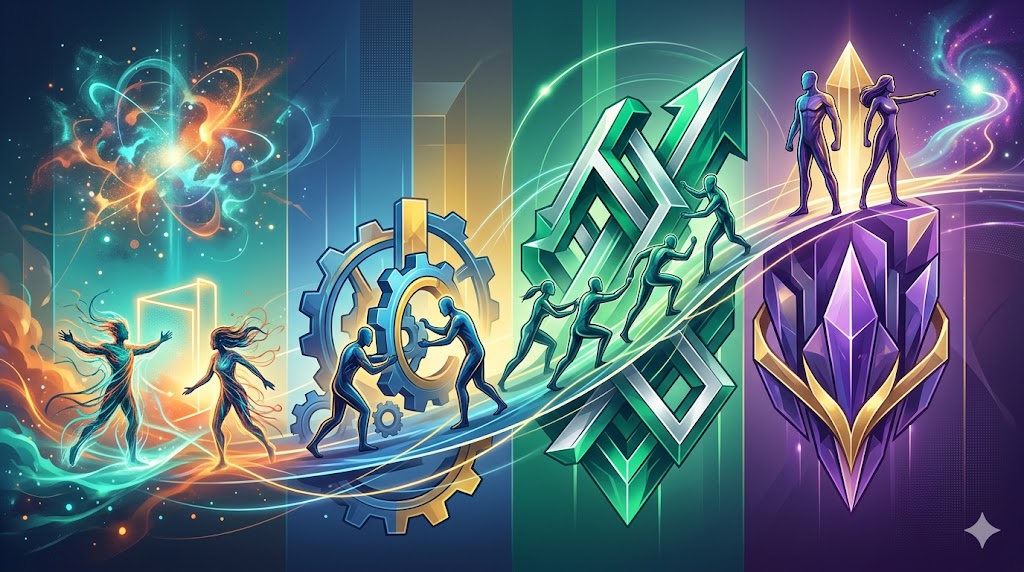
Every product, service, or organization moves through a predictable lifecycle of evolution. While various business models slice these phases differently, from a human and experience design perspective, growth breaks down into four critical cultural horizons:

  • Inception & Exploration: Navigating extreme ambiguity to uncover deep customer needs and find a problem worth solving.
  • Validation & Fit: Turning raw, chaotic ideas into a structured, repeatable, and high-value customer experience.
  • Acceleration & Scaling: Stripping out operational friction, optimizing processes, and expanding market reach rapidly.
  • Maturity & Renewal: Protecting and optimizing the highly successful core business while actively exploring the next S-curve of growth.

The Friction Point: When Mindsets and Milestones Misalign

The most dangerous operational blind spot occurs when an organization successfully transitions to a new growth phase financially or structurally, but its culture remains stuck in the previous one. This mismatch creates severe organizational friction.

For instance, if a company enters the Scaling phase but tries to run it using the chaotic, highly unstructured behavioral mindsets that worked beautifully during Inception, the result is operational whiplash and strategic burnout. Conversely, injecting highly rigid, process-driven optimization mindsets into the early Exploration phase will suffocate creativity before it can take root. Recognizing and proactively managing this alignment is the core responsibility of modern leadership.

Mapping the Matrix: Archetypes Aligned to Growth Stages

To successfully navigate the organizational lifecycle, leaders must intentionally place specific mindsets at the helm of each stage. Below is the behavioral blueprint for matching human archetypes to business horizons.

Stage 1: Inception & Exploration (The “Zero to One” Phase)

Primary Objective: Finding a problem worth solving under conditions of extreme ambiguity.

The Ideal Archetype: The Catalyst Explorer

  • Key Characteristics: High tolerance for ambiguity, deeply empathetic listener, naturally curious, comfortable with rapid failure and pivot cycles.
  • Role in this Stage: The Catalyst Explorer is built to wade into chaos. They excel at talking to customers, looking past surface-level complaints, and uncovering deep, unspoken frustrations. They do not look for clean data; they look for friction points and insights.
  • Strategic Impact: They prevent the organization from falling in love with a solution too early, ensuring that the initial value proposition is rooted in a real, deeply felt human need rather than internal assumptions.

Stage 2: Validation & Product-Market Fit (The “One to Ten” Phase)

Primary Objective: Proving commercial value, refining the experience, and establishing a repeatable value delivery model.

The Ideal Archetype: The Value Architect

  • Key Characteristics: Expert pattern-recognizer, holistic systems thinker, analytical yet user-obsessed, highly iterative refiner.
  • Role in this Stage: If the Explorer finds the raw gold, the Value Architect builds the mine. They take the raw insights and scattered prototypes from Stage 1 and translate them into a structured, functional, and repeatable customer journey. They bridge the gap between creative chaos and operational commercialization.
  • Strategic Impact: They ensure that the product or service isn’t just a “good idea,” but a stable, high-value ecosystem that can reliably deliver an exceptional user experience at a justifiable cost.

Stage 3: Acceleration & Scaling (The “Ten to One Hundred” Phase)

Primary Objective: Rapid market expansion, organizational optimization, and stripping out operational friction.

The Ideal Archetype: The Scalability Evangelist

  • Key Characteristics: Highly collaborative, process-oriented, champion of operational excellence, master of cross-functional alignment.
  • Role in this Stage: This phase requires a cultural shift from “building” to “multiplying.” The Scalability Evangelist codifies the experience. They build the playbooks, break down operational silos, and ensure that as the company grows by 10x or 100x, the core quality of the human experience doesn’t degrade. They evangelize the vision across expanding teams.
  • Strategic Impact: They remove individual dependencies, turning a bespoke operation into an optimized growth machine capable of handling volume without losing its cultural or experiential soul.

Stage 4: Maturity, Continuous Improvement & Renewal (The “One Hundred to Beyond” Phase)

Primary Objective: Defending core market share while simultaneously identifying and seeding the next S-curve of growth.

The Ideal Archetype: The Dual-Drive Futurist

  • Key Characteristics: Long-term vision, cognitively ambidextrous, risk-intelligent, capable of balancing present operations with future possibilities.
  • Role in this Stage: Mature organizations naturally default to complacency and risk aversion. The Dual-Drive Futurist fights this inertia. They possess the unique ability to respect and protect the highly profitable core business (the “Cash Cow”) while simultaneously advocating for, funding, and protecting the fragile new innovations that will replace it tomorrow.
  • Strategic Impact: They prevent corporate obsolescence. By constantly injecting fresh, human-centered foresight back into the mature ecosystem, they trigger a renewal phase before the decline curve sets in.

The Dilemma of the “Archetype Shift” (Managing the Change)

Identifying the right archetypes is only half the battle; the real test of leadership lies in managing the transitions between them. As an organization successfully moves from one stage of growth to the next, the dominant cultural mindset must shift accordingly. This transition is rarely seamless, and if unmanaged, it creates profound organizational friction and human anxiety.

The Human Cost of Growth

Growth is inherently disruptive to the human ecosystem. When a company transitions, for example, from validation to rapid scaling, the unconstructed freedom that early employees loved is replaced by standard operating procedures and metrics.

The “Catalyst Explorers” who thrived in the chaotic early days may feel constrained, micromanaged, or sidelined by the arrival of process-driven “Scalability Evangelists.” Conversely, if a company needs to pivot and reinvent itself, employees optimized for optimization may resist the sudden reintroduction of ambiguity. Left unaddressed, these shifts lead to cultural fracturing, loss of key talent, and operational paralysis.

The Leader’s Responsibility: Intentional Realignment and Upskilling

Thoughtful leadership requires recognizing that people do not need to be discarded when a growth stage changes; instead, their focus must be intentionally realigned. Leaders must act as talent orchestrators by taking the following steps:

  • Conduct Regular Mindset Audits: Continually evaluate the Adaptability Quotient (AQ) and natural behavioral inclinations of the team against the current strategic horizon.
  • Provide Clear Paths for Upskilling: Help team members understand how their core strengths can manifest differently in a new phase—such as helping an Explorer apply their deep customer empathy to training new hires during a scaling phase.
  • Honor Past Contributions: Ensure that the foundational work of previous stages is celebrated, preventing a cultural divide between the “old guard” and “new scaling experts.”

Designing Organizational On-Ramps and Off-Ramps

To prevent friction, organizations must design explicit behavioral handoffs. This means creating a psychologically safe environment where one archetype can gracefully pass the baton to the next.

For instance, when a product moves from validation to scaling, a formal “hand-off architecture” should be established. The Value Architects should collaborate directly with the Scalability Evangelists, ensuring that the operational blueprints preserve the core integrity of the original user experience. By designing these structural on-ramps and off-ramps, leadership transforms what could be a jarring disruption into a smooth, predictable, and empowering cultural evolution.

Conclusion: Designing a Dynamic Human Ecosystem

Growth is never a purely financial, structural, or technological milestone—it is fundamentally a human journey. The most beautifully architected digital transformation strategy or the most disruptive innovation pipeline will stall if the organization fails to align its dominant human behaviors with the strategic needs of the moment. True organizational agility requires looking past static personas and rigid job descriptions to embrace the fluid power of behavioral archetypes.

The Ultimate Innovation Lever

By intentionally orchestrating the transitions from Catalyst Explorers to Value Architects, expanding through Scalability Evangelists, and constantly renewing via Dual-Drive Futurists, leadership builds a sustainable engine for continuous growth. This intentional alignment doesn’t just drive market value; it creates a thriving, high-AQ workplace culture where individuals are uniquely positioned to do their best work exactly when the company needs it most.

A Call to Action for Modern Leaders

As you look at your own organization or product portfolio today, look past the quarterly metrics and ask yourself the tougher human questions:

  • What growth horizon are we actually operating in right now?
  • Are we trying to solve tomorrow’s complex scaling and optimization challenges with yesterday’s unstructured, exploratory mindsets?
  • Are we suffocating our next big growth engine by forcing it through rigid, mature operational frameworks too early?

The blueprint for sustained innovation lies in matching the right mindsets to the right moment. Audit your human ecosystem, design your behavioral hand-offs with empathy and intention, and build an organization capable of evolving as fast as the future demands.

Frequently Asked Questions

How do behavioral archetypes differ from traditional user personas?

Traditional personas anchor individuals to static demographic and psychographic profiles (who they are). Behavioral archetypes focus purely on fluid mindsets, decision-making patterns, and operational motivations (how they act under pressure). This makes archetypes far more effective for managing dynamic organizational change and innovation timelines.

What is the biggest mistake leaders make when transitioning between growth stages?

The most common failure point is “mindset misalignment”—trying to solve a new stage’s problems with the previous stage’s behaviors. For example, forcing a creative exploration team to follow rigid scaling processes too early suffocates innovation, while attempting to scale a business using chaotic, unstructured early-stage mindsets leads to operational burnout.

How can a leader assess if their team has the right Adaptability Quotient (AQ) for growth?

Leaders can conduct regular mindset audits to evaluate how team members handle risk, respond to ambiguity, and collaborate across silos. Measuring AQ involves observing behavioral patterns during rapid pivots rather than relying on fixed job descriptions or technical skill sets.


Image credit: Gemini

Subscribe to Human-Centered Change & Innovation WeeklySign up here to get Human-Centered Change & Innovation Weekly delivered to your inbox every week.

How Business Leaders Can Leverage Futures Research to Unlock Growth Opportunities

How Business Leaders Can Leverage Futures Research to Unlock Growth Opportunities

GUEST POST from Art Inteligencia

The future of business is often uncertain. With emerging technologies, new markets, and changing customer needs, it can be difficult for business leaders to keep up. Futures research can provide insight into potential opportunities and threats that could impact a business. By leveraging this research, business leaders can better understand the current trends and anticipate future changes, allowing them to capitalize on growth opportunities.

Futures research is an interdisciplinary field that uses a variety of methods to explore potential future scenarios. It can involve data from various sources, such as market research, customer feedback, and technology and industry trends. By studying these factors, researchers can identify key trends and patterns that can inform decision-making.

Business leaders can use this data to assess their current positioning and identify potential opportunities. For example, they can use futures research to identify emerging markets and customer segments, as well as areas of potential growth. They can also use it to determine the best strategies for capitalizing on those opportunities, such as developing new products or services, or entering new markets.

Futures research can also help business leaders identify potential threats. By understanding the current trends, they can anticipate potential risks and develop strategies to mitigate them. For example, they can track the development of new technologies and analyze the potential impact on their business. This can help them stay ahead of the competition and be better prepared for changes in the market.

Finally, business leaders can use futures research to develop more effective strategies for achieving their goals. By analyzing current trends and anticipating future changes, they can develop more effective business plans and strategies for achieving their goals. This will help them stay competitive, capitalize on new opportunities, and remain agile in the face of change.

In conclusion, futures research can be a powerful tool for business leaders. By leveraging this research, they can better understand current trends, anticipate future changes, and identify potential opportunities for growth. This can help them stay ahead of the competition, capitalize on new opportunities, and develop more effective strategies for achieving their goals.

Bottom line: Futurology and futures research are not fortune telling. Skilled futurologists and futurists use a scientific approach to create their deliverables, but a methodology and tools like those in FutureHacking™ can empower anyone to engage in futurology themselves.

Image credit: Pixabay

Subscribe to Human-Centered Change & Innovation WeeklySign up here to get Human-Centered Change & Innovation Weekly delivered to your inbox every week.

Thought Leadership Builds Firm Value

by Braden Kelley

Thought Leadership Builds Firm ValueConsulting firms sell expertise, and their currency is trust. Large consultancies like Boston Consulting Group, Bain, McKinsey, Deloitte, Accenture and others make their money from being a trusted advisor to companies around the world. Why do companies trust them?

One reason is that companies always value an external perspective, and there is a large army of alumni from these firms in organizations around the world guiding their leadership to choose their former employer as that external perspective or that extra pair of hands needed in tackling a large strategic challenge.

But there are also several other considerations that factor into an organizations choice of a trusted advisor, including:

  1. Previous experience
  2. Industry expertise
  3. Area of practice specialty (Strategy, HR, Innovation, Finance, M&A, Technology, etc.)
  4. Personal relationships
  5. Thought leadership

The resulting client work creates staffing plans within consultancies to provide billable hours for project execution. And, while most consulting firms spring to life and find early success because of the strength of their thought leadership, in general, over time most consulting firms tend to under-invest in thought leadership and as a consequence they find themselves vulnerable to new entrants nibbling around the edges of their core business and see their growth slow and eventually turn negative. Thought leadership generates the initial creation and success of the firm and leads to millions of dollars, or potentially even billions of dollars, of revenue for the consulting firm, but despite this fact, most consultancies under-invest in thought leadership.

Part of the reason for the inevitable decline in the firm’s thought leadership investments occurs because thought leadership is rarely anyone’s primary focus inside most consulting firms. Thought leadership is usually seen as the responsibility of the partners and principals of the firm AFTER they meet their revenue goals. How frequently are these people likely to have the time or energy to create the kind of quality and revolutionary thought leadership that leads to the sustaining or expansionary growth that every firm desires?

What we end up with is a level of thought leadership inside most firms that in the best case leads to a maintenance of the firm’s existing business, and in the worst case either no new thought leadership is created, or that which is created, is insufficient to maintain the firm’s current level of business.

A successful partner in most firms keeps their people busy and possibly creates some growth in billable hours for the firm, but rarely will you find that partners are able to create thought leadership capable of creating whole new lines of business. Not through any fault of their own, but because they simply don’t have the time to do it all.

To make things worse, the world is changing…

It used to be that information was scarce and external knowledge was valued by the client.

Now information is freely available and knowledge can thus be created within the client.

An increasing number of companies are therefore relying on their employees to educate themselves, while also creating their own internal consultancies, and relying less on external consultancies as a result.

At the same time, companies are becoming less open to being sold consulting services and instead more focused on becoming buyers of consulting services. And where do companies turn when they seek to be educated buyers of consulting services?

To the thought leadership they can find online from the different consulting firms in their consideration set. This is part of the reason for the rising importance of inbound marketing and content marketing as part of the marketing mix in all industries, but consulting firms are struggling to identify and provide the content necessary to help them maintain (and possibly extend) their success in this new environment.

And, even with all of these changes, most traditional consulting firms still hire traditional consultants and fail to hire people with established social media visibility, great content creation skills, the ability to get published, and the ability to help traditional consultants create both sustaining and revolutionary thought leadership. Firms are still hiring round pegs for their round holes to generate thousands of dollars a year in revenue and ignoring the square pegs with these skills that could generate millions of dollars in new revenue per year for the firm.

Marketing and advertising agencies operate in a similar client-firm ecosystem, but their value proposition is more tilted towards selling creativity and execution. In these industries we’ve seen huge consolidation driven by the need to acquire the new thought leadership, creativity and execution necessary to keep their existing clients, and we’re starting to see the same dynamics in the business consulting market.

The value of thought leadership and employees capable of creating and facilitating the execution of a great content marketing strategy driven by thought leadership, cannot be underestimated.

If anyone doubts the value boost of a thought leader to a firm, even outside the consulting market, ask yourself:

How much did Steve Jobs add to the value of Apple?

How much value did Jack Welch add to the value of GE?

How much value does Elon Musk bring to Tesla Motors?

Great thought leaders and thought leadership add a tremendous amount of value to the brand equity and the value of the firm, so why don’t consulting firms pay more attention to attracting or cultivating great internal thought leaders and thought leadership facilitators within their firms?

How much is a thought leader worth to you?

Do you need one?

Accelerate your change and transformation success

Subscribe to Human-Centered Change & Innovation WeeklySign up here to get Human-Centered Change & Innovation Weekly delivered to your inbox every week.

Whither Innovation in Indiana?

Whither Innovation in Indiana?Now that I’ve got your attention, let’s talk about homosexuality and whether it has any impact on innovation. There probably are two no more polarizing topics in the United States than homosexuality and abortion. But the truth is that if both sides of the political and religious spectrum focused on the golden rule, there would be less corruption, we’d all be a lot happier, probably have more innovation, and our politics would be more productive.

Today we have another great case study for how short people’s attention spans have gotten, how the government can help or hinder innovation, how little investigative journalism still remains in the United States, and how easily people are swayed by a soundbite that runs contrary to (or in support of) their own personal religious or political beliefs.

But this article isn’t going to be some diatribe in support or opposition to Indiana’s Religious Freedom Restoration Act (RFRA) legislation (referred to by the media as an anti-gay law) because I freely admit I don’t fully understand all of the implications of a similar federal law and whether federal protections for gays apply to the state law.

Instead I’d like to focus briefly on what this controversy brings to mind for me in regards to the efforts of hard-working folks attempting to stimulate innovation in Indiana (and elsewhere).

Point #1: People Must Feel Safe to Innovate

If we take Maslow’s Heirarchy of Needs as gospel (okay, maybe that’s dangerous word choice), then safety is one of the most important needs for people, and in order to innovate people must feel safe. True innovation usually requires taking risks and doing things in a new way, and if people feel that trying something new or even just being different has a high price, then people won’t step out of their comfort zone and push the boundaries of conventional wisdom. So if we are truly trying to do everything we can to inspire innovation in our region, shouldn’t we also try to do everything we can to make it feel like a place where it is safe to be different and where that difference is potentially even celebrated?

Point #2: Diversity is Important (to a point)

We all look at the same situation through different eyes and a different history of experiences, values and beliefs. This diversity can help create different idea fragments that can be connected together to create revolutionary new ideas with the potential to become innovations. But at the same time, having some shared experiences helps to make it easier to communicate and to have a higher level of trust (assuming those experiences were good ones). So if we are truly trying to do everything we can to inspire innovation in our region, shouldn’t we also do everything we can to make different groups of people look to our region as a good place to move to so we have a diverse talent pool?

Conclusion: If Culture Trumps Strategy, Environment Trumps Startups

The world is changing. It used to be that companies started and grew in the community where they were founded, hiring increasing numbers of people from the surrounding areas and attracting others from elsewhere. Now, an increasing number of companies (especially digital ones) are moving to more distributed models where they create satellite offices where the talent is rather than trying to attract all of the talent to a single location.

Economically this is meaning that it is becoming less important that the next Facebook starts in your town than it is for the next Facebook to want to have an office in your town. This means that for cities, counties, states and countries, the greater economic impact is likely to be made not from trying to encourage lots of startups, but instead from trying to create an environment that young, talented people choose to live in.

And when you create a place that is attractive for smart, creative people to move to, you know what, you’re likely to end up not just with more growing digital companies seeking a presence, but also a larger number of startups than if you started with the goal of specifically trying to encourage startups.

Does your region focus on creating startups as the primary goal or on making itself an attractive place for a young, diverse and talented population to live?

Does this uproar help Indiana establish its as an attractive place to be, or work against that perception?

I’ll let you decide!

P.S. If you’re curious, here are The Metro Areas With the Largest, and Smallest, Gay Populations (for what it’s worth, Indianapolis isn’t on either list)


Accelerate your change and transformation success

Subscribe to Human-Centered Change & Innovation WeeklySign up here to get Human-Centered Change & Innovation Weekly delivered to your inbox every week.

Eight I’s of Infinite Innovation – PDF Version

Eight I's of Infinite Innovation - PDF VersionIn the wake of my hugely popular article on Innovation Excellence I’ve decided to make it available as a PDF.

Download the Eight I’s of Infinite Innovation PDF now

Some authors talk about successful innovation being the sum of idea plus execution, others talk about the importance of insight and its role in driving the creation of ideas that will be meaningful to customers, and even fewer about the role of inspiration in uncovering potential insight. But innovation is all about value and each of the definitions, frameworks, and models out there only tell part of the story of successful innovation.

To achieve sustainable success at innovation, you must work to embed a repeatable process and way of thinking within your organization, and this is why it is important to have a simple common language and guiding framework of infinite innovation that all employees can easily grasp. If innovation becomes too complex, or seems too difficult then people will stop pursuing it, or supporting it.

Some organizations try to achieve this simplicity, or to make the pursuit of innovation seem more attainable, by viewing innovation as a project-driven activity. But, a project approach to innovation will prevent it from ever becoming a way of life in your organization. Instead you must work to position innovation as something infinite, a pillar of the organization, something with its own quest for excellence – a professional practice to be committed to.

So, if we take a lot of the best practices of innovation excellence and mix them together with a few new ingredients, the result is a simple framework organizations can use to guide their sustainable pursuit of innovation – the Eight I’s of Infinite Innovation. This new framework anchors what is a very collaborative process. Here is the framework and some of the many points organizations must consider during each stage of the continuous process…

To continue reading, download the PDF

Subscribe to Human-Centered Change & Innovation WeeklySign up here to get Human-Centered Change & Innovation Weekly delivered to your inbox every week.

Innovation Quotes of the Day – April 18, 2012


“Sometimes the hardest thing in life is to know which bridge to cross and which to burn.”

– From the movie ‘The International’


“Incremental innovations can often be explained to customers, but disruptive innovations often require you to educate them on how they will fit into their life.”

– Braden Kelley


“Acquire with the intention to retain, and retain with the intention to grow.”

– Lester Wunderman


What are some of your favorite innovation quotes?

Add one or more to the comments, listing the quote and who said it, and I’ll share the best of the submissions as future innovation quotes of the day!

Subscribe to Human-Centered Change & Innovation WeeklySign up here to get Human-Centered Change & Innovation Weekly delivered to your inbox every week.