Tag Archives: Employee Experience

The Agency Revolution

What People Really Want from Employers Today

LAST UPDATED: April 19, 2026 at 5:38 PM
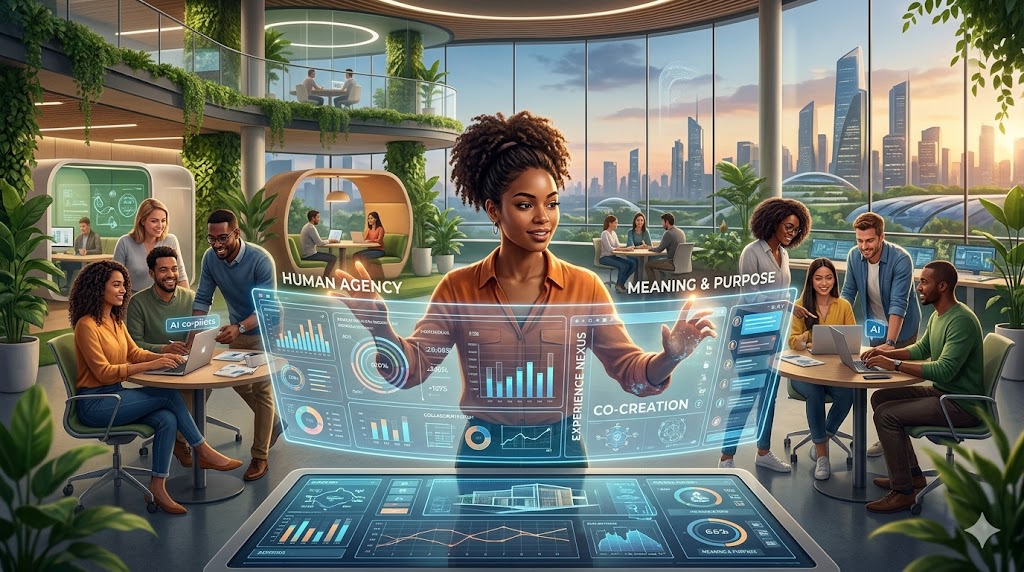
The Agency Revolution

GUEST POST from Chateau G Pato


The Death of the “Conscript” Mentality

For decades, the traditional employment contract was built on a transactional foundation: the “Conscript” model. Organizations expected employees to trade their time, compliance, and cognitive labor for a steady paycheck and a cubicle. But the world has shifted. In a landscape defined by rapid technological acceleration and shifting social values, the era of the industrial-era conscript is officially over.

Today, people are looking to be Architects and Magic Makers. They are no longer content being cogs in a machine; they want to be the designers of the machine itself. This shift represents a fundamental move from passive participation to active contribution. If innovation is truly the act of removing friction from the human experience, then as leaders, we must start by removing the friction within our own organizational structures.

“The most attractive employers in 2026 aren’t those offering the flashiest perks, but those who provide the highest level of Human Agency.”

In this article, we explore how the most successful organizations are moving away from managing “headcount” and toward empowering individuals to own their impact, drive change, and find a sense of true agency in their professional lives.

Radical Transparency & Psychological Safety: The Fuel for Change

Innovation and change are inherently risky endeavors. If an employee fears that a failed experiment or a dissenting opinion will lead to professional exile, they will naturally default to the status quo. Psychological safety is not a “soft” HR concept; it is the essential fuel for an agile organization. Without it, your innovation engine is running on an empty tank.

To move forward, leaders must dismantle the “Zero-Error Trap.” In many corporate cultures, the cost of being wrong is perceived as higher than the benefit of being right. This creates a culture of silence where employees hide their best ideas and mask emerging problems. To thrive, we must shift the focus from “avoiding failure” to “maximizing learning velocity.”

Achieving this requires Radical Communication Loops. We need to create direct, unfiltered lines of communication from the “edges” of the organization — where the employees interact with customers — to the “center” where strategy is formed. When people see that their insights lead to tangible change, they stop being observers and start being owners.

  • Safety as Fuel: Creating an environment where curiosity is prioritized over compliance.
  • Dismantling the Zero-Error Trap: Celebrating the “intelligent failure” that provides a competitive roadmap.
  • Edge-to-Center Feedback: Ensuring the front lines have a voice in the boardroom.

The “Agency First” Model: Automating the Mundane to Elevate the Human

We are entering an era where the value of a human being in the workplace is no longer measured by their ability to perform repetitive tasks. The “Agency First” model focuses on Cognitive Offloading — using AI and automation to strip away the “mental noise” of administrative drudgery. This isn’t about replacement; it’s about liberation. When we automate the mundane, we don’t just save time; we reclaim the cognitive bandwidth necessary for deep thought and creative problem-solving.

This shift requires a fundamental evolution in management: moving from Monitor to Mentor. Instead of supervisors checking machine-generated outputs, the modern employee takes on the role of a system architect or “AI Coach.” They are responsible for the Human-in-the-Loop upgrade, ensuring that technology serves human goals rather than the other way around.

Ultimately, people today want to focus on Intent. In a world of infinite digital “busyness,” the most valuable skill is the ability to define the Commander’s Intent — the “why” behind the work. By letting intelligent systems handle the “how,” employees are empowered to steer the ship rather than just rowing in the galley. This is how we move from a workforce that is merely busy to a workforce that is profoundly impactful.

“The goal of digital transformation isn’t to make people work more like machines; it’s to use machines so that people can work more like humans.” — Braden Kelley

The Experience Nexus: Co-Creating the Workplace

In the past, organizations treated Customer Experience (CX) and Employee Experience (EX) as separate silos. Today, we realize they are two sides of the same coin. I call this the Experience Nexus. To deliver a seamless external brand, you must first design a seamless internal culture. We are seeing the rise of the Experience Management Office (XMO) — a centralized hub that integrates CX, EX, and Partner Experience (PX) to ensure every touchpoint is human-centered.

Modern employees don’t want to be passive recipients of HR policies; they want to be active designers. This is where the Employee Advisory Board comes in. By involving staff in the co-creation of the workplace — from hybrid work rituals to the selection of software — you shift the dynamic from “us vs. them” to a shared mission. When people help build the house, they care more about the foundation.

However, co-creation requires Radical Transparency regarding the data we collect. As we move toward neuroadaptive workplaces and advanced sensing, maintaining Data Sovereignty is critical. People want to know what is being measured and why. They want the assurance that technology is being used to support their flourishing, not just to track their keystrokes. Transparency builds the trust that makes innovation possible.

  • Unified Experience: Bridging the gap between how we treat customers and how we treat our team.
  • Co-Design Principles: Moving from top-down mandates to collaborative culture-building.
  • Privacy as a Pillar: Respecting individual sovereignty in an increasingly digital environment.

Meaning as the North Star (Not Just “Happiness”)

There is a common misconception in leadership circles that the ultimate goal is “employee happiness.” While happiness is wonderful, it is a trailing indicator. The leading indicator — the one that actually drives retention and brilliance — is Meaning. People don’t just want to feel good at work; they want to feel that their work matters. They want to see the direct line between their daily tasks and the success of the customer.

This shift requires us to rethink performance management entirely. We need to move away from the industrial mindset of “weeding out” low performers and toward a philosophy of “Re-potting.” Often, an employee isn’t failing; they are simply planted in the wrong soil. By identifying their unique aspirations and shifting them into roles where their specific talents can flourish, we honor the human being while optimizing the organization.

The Dream Organization is one where the friction between individual aspiration and corporate objectives disappears. When a company’s North Star aligns with the employee’s personal sense of purpose, you don’t need to “manage” them in the traditional sense. You simply need to provide the resources and get out of their way. In 2026, the competitive advantage belongs to the companies that can bridge the gap between “making a living” and “making a difference.”

“Stop trying to engineer happiness. Start designing for significance.”

Conclusion: Getting to the Future First

We are currently living through a profound transition in the nature of work. We are moving from a world where we use tools to perform tasks, to a world where we inhabit intelligent systems. Navigating this shift requires a FutureHacking™ mindset — the ability to look at the horizon not with fear, but with the intent to shape it. The future isn’t something that happens to us; it’s something we build through the choices we make today.

As leaders, our primary call to action is simple yet challenging: Stop trying to “make people happy” and start making their work important. When an individual understands their role in the larger story of innovation and human experience, engagement becomes a natural byproduct rather than a forced metric. We must provide the agency, the safety, and the tools that allow our teams to move from being participants in a process to being masters of their craft.

Change doesn’t happen in the boardroom through slide decks and mandates. It happens in the hearts and minds of the people on the front lines who choose to bring their best selves to work every day. By designing an organization that honors human potential, you don’t just stay competitive — you get to the future first.

The question isn’t whether the workplace will change, but whether you will be the one to lead that change. Let’s build something meaningful together.

Frequently Asked Questions

1. What is the difference between a “Conscript” and a “Magic Maker”?

A “Conscript” is an employee who performs work based on transactional compliance — trading time for a paycheck. A “Magic Maker” is an empowered individual who uses their agency to solve problems, innovate, and create value through human-centered design and passion.

2. Why is psychological safety considered the “fuel” for innovation?

Innovation requires the freedom to experiment and fail. Psychological safety ensures that employees can take calculated risks and share dissenting opinions without fear of retribution, which is essential for rapid learning and organizational agility.

3. What does “re-potting” talent mean in a modern organization?

Rather than traditional performance management that “weeds out” low performers, “re-potting” involves identifying an individual’s unique strengths and moving them into a different role or environment where they can better flourish and contribute to the mission.

Image credit: Google Gemini

Subscribe to Human-Centered Change & Innovation WeeklySign up here to get Human-Centered Change & Innovation Weekly delivered to your inbox every week.
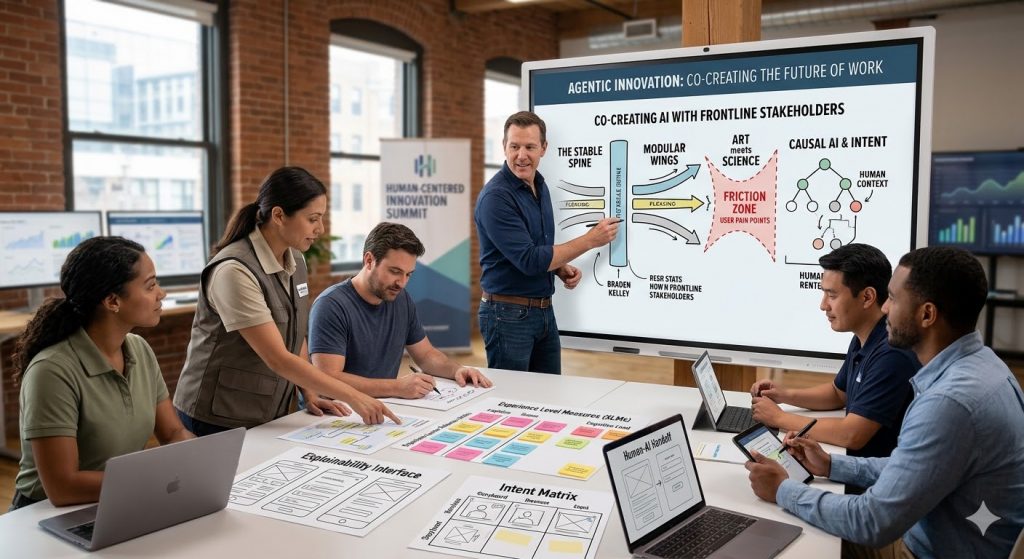
Co-Creating AI with Frontline Stakeholders

LAST UPDATED: March 14, 2026 at 11:52 AM

Co-Creating AI with Frontline Stakeholders

GUEST POST from Art Inteligencia


I. The “Stable Spine” of Trust: Anchoring AI in Human Safety

To scale any innovation — especially one as disruptive as Agentic AI — an organization must first establish what I call the “Stable Spine.” This is the rigid, dependable core of organizational values, psychological safety, and transparent communication that allows the “Modular Wings” of technological experimentation to flex without breaking the culture.

Establishing Psychological Safety First

The greatest barrier to AI adoption isn’t technical debt; it’s automation anxiety. When frontline stakeholders feel that AI is being “done to” them, they instinctively protect their tribal knowledge. Co-creation flips this script. By involving employees before a single line of code is written, we shift the narrative from replacement to augmentation.

  • The Pre-Mortem Dialogue: Openly discussing “What happens if this works?” and “How does this change your value to the firm?”
  • Vulnerability in Leadership: Admitting that the AI is a “student” and the frontline workers are the “teachers” provides the grounding needed for honest feedback.

Moving from “Black Box” to “Glass Box” Collaboration

Traditional AI implementations often fail because they are opaque. A Human-Centered approach demands a “Glass Box” philosophy where the logic, data inputs, and intent of the AI are visible to those using it. When a Regulatory Compliance Officer understands why an agent flagged a specific document, they transition from a skeptic to a supervisor of the technology.

Defining the Shared Purpose

The “Stable Spine” is reinforced when the AI’s goals are perfectly aligned with the frontline’s daily friction points. We aren’t just implementing AI to “increase efficiency” (a corporate-centric goal); we are implementing it to “remove the soul-crushing administrative burden” (a human-centric goal). Shared Purpose is the glue that keeps stakeholders engaged when the initial novelty of the tech wears off.

“Innovation is not about the technology; it’s about the humans the technology serves. If the spine of trust isn’t straight, the wings of innovation will never lift.” — Braden Kelley

II. Identifying High-Friction “Experience Level Measures” (XLMs)

To move beyond the hype of AI, we must move beyond the vanity of traditional metrics. In a human-centered innovation framework, we don’t just look at Key Performance Indicators (KPIs); we look at Experience Level Measures (XLMs). While a KPI tells you what happened (e.g., “Average Handle Time”), an XLM tells you how it felt for the human involved. This is where the real “Revenue Leakage” and “Engagement Leakage” are hidden.

The CX/EX Audit: Hunting for Friction

Innovation starts by identifying where human potential is being throttled. We conduct a dual audit of the Customer Experience (CX) and the Employee Experience (EX). When frontline stakeholders are forced to perform “swivel-chair” data entry or navigate fragmented legacy systems, their cognitive load is exhausted before they ever reach a high-value task. These are the high-friction zones ripe for AI co-creation.

Mapping the “Soul-Crushing” Journey

By mapping the stakeholder journey, we can pinpoint specific moments where AI agents can act as a “frictionless lubricant.” We look for three specific types of friction:

  • Cognitive Friction: Where a worker must synthesize too much disparate data to make a simple decision.
  • Process Friction: Where “the way we’ve always done it” creates unnecessary loops or wait times.
  • Emotional Friction: Where the task is so repetitive or mundane that it leads to burnout and disengagement.

From SLAs to XLMs: Redefining Value

Traditional Service Level Agreements (SLAs) are often centered on the machine or the process. In a co-created AI environment, we shift the focus to the human outcome. If an AI agent reduces a task from 60 minutes to 10 minutes, the value isn’t just the 50 minutes saved; the value is what the human does with that newly found 50 minutes. Does it go toward deep work, creative problem solving, or building a stronger relationship with the customer?

Traditional Metric (KPI) Human-Centered Metric (XLM) The AI Opportunity
Task Completion Rate Cognitive Ease Score Automating “Low-Value” data synthesis.
Response Time Empathy Availability Freeing up humans for complex emotional labor.
Error Rate Confidence Index Using AI as a “second pair of eyes” to reduce stress.

“Efficiency is doing things right; Effectiveness is doing the right things. XLMs ensure that our AI initiatives are making us more effective, not just faster at being frustrated.” — Braden Kelley

III. The Co-Creation Workshop: Where Art Meets Science

In the world of innovation, we often talk about the “Science” of data and the “Art” of human intuition. The Co-Creation Workshop is the laboratory where these two forces collide. We don’t just ask frontline stakeholders what they want; we observe how they solve problems and then design AI “agents” that mimic their best instincts while automating their worst hurdles.

Empathy-Driven Design and Personas

We begin by building robust Personas for our frontline stakeholders. Whether it’s a Global Supply Chain Manager balancing logistics during a port strike or a Customer Success Lead managing a high-churn account, we need to understand the emotional and contextual landscape they inhabit. This empathy-driven approach ensures the AI is built for the “messy reality” of the job, not a sanitized version of the process manual.

[Image of an Empathy Map for User Experience Design]

Designing “Modular Wings” for Human Agency

A key Braden Kelley principle is that while the organization needs a “Stable Spine,” the frontline needs “Modular Wings.” In our workshop, we identify which parts of the AI system should be rigid (compliance, data integrity) and which should be flexible (UI preferences, decision-making thresholds).

  • The Rigidity: The underlying LLM and the corporate data safety protocols.
  • The Flexibility: The ability for the frontline worker to “tune” the agent’s tone, level of detail, and escalation triggers.

By giving users the “knobs and dials,” we increase their sense of ownership over the final product.

Rapid Prototyping: The Experience Walkthrough

Instead of long development cycles, we use Experience Prototypes. These are low-fidelity simulations — sometimes as simple as a storyboard or a “Wizard of Oz” test — where the human interacts with a “pretend” AI. This allows us to map the Human-AI Handoff:

  1. The Trigger: What event causes the human to turn to the AI?
  2. The Interaction: How does the AI present information? (Is it a suggestion, a summary, or a draft?)
  3. The Judgment: How does the human validate or correct the AI’s output?
  4. The Feedback Loop: How does the AI learn from that correction?

The “Art” of Intuition vs. The “Science” of Automation

The workshop highlights that AI excels at Synthesizing (Science), but humans excel at Contextualizing (Art). We use this session to define the “Escalation Matrix.” If the data is 90% certain but the human “gut feeling” says otherwise, how does the system handle that conflict? Designing for this tension is what makes an AI tool truly innovative rather than just “efficient.”

“Co-creation is the bridge between a tool that is technically impressive and a tool that is actually used. If the frontline doesn’t see their ‘Art’ reflected in the ‘Science’ of the AI, they will find a way to bypass it.” — Braden Kelley

IV. Solving for “Causal AI” and Intent: From Correlation to Context

In the “Science” of standard machine learning, models are often built on correlations — patterns in data that suggest what might happen next. But for a frontline worker in a high-stakes environment, “what” isn’t enough. To truly co-create, we must move toward Causal AI, where the system and the human collaborate to understand the why behind a recommendation. This is where we bridge the gap between algorithmic output and human intent.

Moving Beyond the Correlation Trap

If an AI agent suggests a supply chain reroute or a specific credit adjustment, the frontline stakeholder needs to see the “connective tissue” of that logic. Without causality, the AI is just a black box throwing out guesses. In our co-creation sessions, we design Explainability Interfaces that highlight the primary drivers of a decision.

  • The “Why” Prompt: Every AI suggestion should include a “Show Logic” feature that maps the causal factors (e.g., “Delayed shipment in Suez + Low local inventory + 10% surge in regional demand”).
  • The Counter-Factual: Allowing users to ask, “What if the shipment wasn’t delayed?” to see how the AI’s intent changes.

Context Injection: The Frontline as the “Ground Truth”

Data science often suffers from “Data Silos” — it sees the numbers but misses the Context. A frontline worker knows that a 20% spike in orders might be a one-time anomaly due to a local event, not a permanent trend.

Co-creation allows us to build “Context Injection” points where the human can feed the “Art” of their situational awareness back into the “Science” of the model. This transforms the AI from a static tool into a dynamic partner that respects the Ground Truth of the shop floor or the call center.

Human-in-the-Loop (HITL) 2.0: From Safety Net to Co-Pilot

We are evolving the concept of Human-in-the-Loop. In version 1.0, the human was merely a “kill switch” for when the AI failed. In HITL 2.0, the human is a Co-Pilot. We design the interaction so that:

  1. The AI Proposes: Offering 2–3 paths based on data.
  2. The Human Disposes: Choosing the path that aligns with the current organizational intent (which might shift faster than the data).
  3. The System Learns: Capturing the reasoning behind the human’s choice to refine future causal models.

The Outcome: Cognitive Alignment

When we solve for intent, we achieve Cognitive Alignment. The frontline stakeholder no longer views the AI as a competitor or a mystery, but as an extension of their own expertise. They aren’t just using an app; they are directing an agent that understands their goals, their constraints, and their “Art.”

“An AI that can’t explain its ‘Why’ will eventually be ignored by the people who know ‘How.’ Causal AI is the key to moving from temporary adoption to permanent innovation.”

V. Scaling the Innovation Bonfire: From Pilot to Organizational Agility

The final challenge of any innovation isn’t the spark; it’s the sustainment. Too often, co-creation is treated as a “one-off” workshop. To truly scale, we must take the lessons from our frontline stakeholders and feed them back into the organizational furnace. This is how we move from a single pilot to what I call the “Innovation Bonfire” — a self-sustaining culture of continuous improvement.

Avoiding the “Pilot Trap”

Many AI initiatives die in “Pilot Purgatory” because they fail to account for the Systemic Friction of a full-scale rollout. Scaling requires moving from a specialized co-creation group to a broader “Modular Wings” approach across the enterprise. We must ensure that the insights gained from one department (e.g., Supply Chain) are translated into reusable components for another (e.g., R&D Project Management).

  • Internal Advocacy: Empowering your original co-creators to act as “Innovation Ambassadors.” Their peers are more likely to trust a tool recommended by a colleague than one mandated by IT.
  • Feedback Loops: Implementing automated mechanisms where frontline users can “vote” on AI suggestions or flag hallucinations in real-time.

The Flywheel of Continuous Learning

Innovation is not a destination; it’s a cycle. As the AI handles more of the “Science” (the repetitive, high-rigor tasks), the frontline stakeholders have more bandwidth for the “Art” (the complex, high-empathy tasks). This creates a Flywheel Effect:

  1. Release: The AI releases human capacity by removing friction.
  2. Reinvest: Humans reinvest that capacity into solving higher-order problems.
  3. Refine: Those new solutions provide fresh data and “Ground Truth” to further refine the AI.

Maintaining the “Human-Centered” Spark at Scale

As you scale, the temptation is to “standardize” everything until the “Art” is squeezed out. This is a mistake. Organizational Agility depends on your ability to maintain that Stable Spine of core processes while allowing different teams the autonomy to adapt the AI to their unique workflows.

We must continuously ask: “Is this technology still serving the human, or have we started serving the technology?” Revisiting your Experience Level Measures (XLMs) quarterly ensures that the innovation remains grounded in actual human value rather than just technical efficiency.

The Outcome: An Agentic Organization

An organization that masters co-creation doesn’t just “use AI.” It becomes an Agentic Organization — a living system where humans and machines are seamlessly integrated, each playing to their strengths. The “Science” of the AI provides the scale, but the “Art” of your people provides the competitive advantage. That is how you win in a world of constant change.

“To scale an innovation bonfire, you don’t just need more fuel; you need more oxygen. In an organization, that oxygen is the trust, empathy, and agency of your frontline people.” — Braden Kelley

Conclusion: Leading the Agentic Revolution with Empathy

The journey from top-down implementation to bottom-up co-creation is the defining shift of the current technological era. As we have explored, successfully integrating AI into the fabric of an organization is not merely a technical hurdle — it is a human-centered design challenge. When we balance the Science of algorithmic rigor with the Art of human empathy, we don’t just “deploy software”; we empower a workforce.

The Human-Centered Dividend

By prioritizing the “Stable Spine” of trust and focusing on Experience Level Measures (XLMs), organizations can unlock a level of agility that was previously impossible. The dividend of this approach is twofold:

  • Operational Resilience: Systems built on the “Ground Truth” of frontline expertise are inherently more robust and adaptable to market shifts.
  • Human Flourishing: By removing “soul-crushing” friction, we allow our people to return to the work they were meant to do — creative problem solving, strategic thinking, and high-empathy customer connection.

A Call to Action for Innovation Leaders

The Innovation Bonfire is waiting to be lit, but it requires leaders who are brave enough to share the matches. If you are ready to move beyond the “Black Box” and start co-creating with your most valuable asset — your people — start with these three steps:

  1. Audit the Friction: Use XLMs to find where your frontline is currently being throttled.
  2. Invite the Experts: Bring the people who do the work into the design room before the technology is finalized.
  3. Design for “Why”: Prioritize causal clarity over simple correlation to build a “Glass Box” culture.

Final Thought

In a world increasingly dominated by Agentic AI, the ultimate competitive advantage isn’t the code you own; it’s the Human-AI Synergy you cultivate. Innovation is, and always has been, a team sport. Your most important teammates are already on your payroll, waiting to help you build the future.

“We shape our tools, and thereafter our tools shape us. Let us ensure we shape our AI with enough heart to make the future a place where humans truly belong.” — Braden Kelley

Continue the Conversation

Are you ready to audit your organization’s Customer Experience or develop a Human-Centered AI Strategy? Let’s work together to turn your innovation friction into a scalable bonfire.

Contact: Book an advisory session

Frequently Asked Questions

To help both human readers and search engines better understand the core concepts of co-creating AI, I’ve prepared this brief FAQ. Below the human-readable text, you’ll find the JSON-LD structured data to help “answer engines” index this content accurately.

1. What is the difference between a KPI and an XLM in AI implementation?

While a Key Performance Indicator (KPI) measures the “What” (output, speed, efficiency), an Experience Level Measure (XLM) measures the “How” (the human experience of the process). In AI, XLMs track things like cognitive load and emotional friction to ensure the technology is actually helping people, not just making a broken process faster.

2. Why is “Causal AI” important for frontline stakeholders?

Standard AI often shows correlations, but Causal AI explains the logic or “Why” behind a suggestion. For frontline workers, understanding the intent and cause of an AI recommendation builds trust and allows them to apply their own contextual expertise — the “Art” — to the AI’s “Science.”

3. How does the “Stable Spine” framework assist with AI adoption?

The Stable Spine represents the rigid core of trust, safety, and transparency within an organization. By establishing this foundation first, leaders provide the security employees need to experiment with the “Modular Wings” — the flexible, innovative applications of AI that can change and adapt over time.

Image credit: Google Gemini

Subscribe to Human-Centered Change & Innovation WeeklySign up here to get Human-Centered Change & Innovation Weekly delivered to your inbox every week.

Innovating the Post-Pandemic Office Experience

The Connected Workspace

LAST UPDATED: December 17, 2025 at 11:49AM

Innovating the Post-Pandemic Office Experience - The Connected Workspace

GUEST POST from Chateau G Pato

The pandemic did not eliminate the office. It eliminated complacency. For decades, organizations treated the workplace as static infrastructure rather than a dynamic system shaping behavior, culture, and innovation. As a human-centered change and innovation practitioner, I see the post-pandemic moment as a rare inflection point: a chance to intentionally design the connected workspace.

The connected workspace recognizes that work happens across physical, digital, and social environments simultaneously. It is not a return-to-office strategy or a remote-work manifesto. It is an experience strategy that aligns space, technology, and leadership behaviors around human needs.

Reframing the Office as a Platform for Value Creation

In the past, offices were optimized for presence. Today, they must be optimized for purpose. This means designing environments that support collaboration, learning, and innovation rather than default individual work. The connected workspace functions as a platform where people come together intentionally to create value that cannot be easily generated alone.

When organizations fail to make this shift, they create friction. Employees question why they are commuting, meetings exclude remote voices, and culture becomes fragmented. Connection must be designed, not assumed.

Case Study One: Microsoft’s Human-Centered Hybrid Evolution

Microsoft approached hybrid work as a design challenge rather than a policy problem. By combining qualitative employee research with quantitative work-pattern data, the organization gained insight into how collaboration, focus, and well-being intersect.

Offices were redesigned to prioritize collaboration, while technology investments ensured remote participants were equally visible and heard. Teams were empowered to define norms that fit their context, reinforcing autonomy and trust. Microsoft’s approach demonstrates that a connected workspace is a living system requiring continuous learning and adaptation.

Technology Should Disappear, Not Dominate

In a truly connected workspace, technology becomes invisible. Tools exist to support human interaction, not to dictate it. When employees spend more time managing tools than solving problems, connection erodes.

Human-centered organizations evaluate technology through the lens of experience outcomes: clarity, inclusion, and reduced cognitive load. Surveillance-driven metrics may promise control, but they undermine trust, which is the foundation of connection.

Case Study Two: Atlassian’s Intentional Distribution Model

Atlassian’s Team Anywhere strategy illustrates that connection is not dependent on proximity. By explicitly designing for asynchronous collaboration and redefining offices as collaboration destinations, the company avoided the hybrid trap of unequal experiences.

Clear documentation, transparent decision-making, and shared rituals ensured that employees remained aligned regardless of location. Atlassian’s success underscores a critical insight: connection is behavioral before it is spatial.

Inclusion as a Core Design Principle

Hybrid work amplifies inequities when inclusion is an afterthought. A connected workspace must be designed to support diverse working styles, abilities, and life circumstances. This includes equitable meeting practices, flexible schedules, and environments that support focus as well as interaction.

Inclusion is not achieved through statements or training alone. It is experienced daily through systems and behaviors. When people feel they belong, they contribute more fully.

Leaders as Stewards of Connection

Leadership in the connected workspace is less about supervision and more about stewardship. Leaders shape connection through how they communicate, how they listen, and how they respond to uncertainty. They must be willing to experiment and to treat the workplace as a prototype rather than a finished product.

The most effective leaders understand that connection is a competitive advantage. It fuels innovation, resilience, and trust.

Final Thoughts

The future of work will not be decided by floor plans or mandates. It will be shaped by organizations willing to design experiences that honor human needs while enabling high performance. The connected workspace is not a trend. It is the next evolution of how we work together.

Those who invest in connection will not just adapt to the future of work. They will help define it.

Frequently Asked Questions

1. What defines a connected workspace?

A connected workspace intentionally integrates physical environments, digital tools, and cultural practices to support meaningful collaboration and inclusion.

2. Is a connected workspace the same as hybrid work?

No. Hybrid work describes where work happens, while a connected workspace focuses on how people experience work across locations.

3. What is the biggest risk in post-pandemic office design?

The biggest risk is recreating old office models without intentionally designing for connection, inclusion, and purpose.

4. What is the most common mistake companies make in hybrid work?

The biggest mistake is Proximity Bias. This occurs when leaders unconsciously favor employees who are physically present in the office with better assignments, more mentorship, and faster promotions. A true connected workspace must actively implement protocols to ensure visibility and equity for remote participants.

5. How can we maintain office culture when people are rarely together?

Culture is not created by free snacks or ping-pong tables; it is created by shared purpose and consistent communication. In a connected workspace, culture must be maintained through intentional digital rituals, transparent documentation, and “Deep Connection Days” where teams gather physically specifically for relationship building, not just routine tasks.

6. What technology is essential for a connected workspace?

Beyond standard video conferencing, the most essential tools are Persistent Digital Canvases (like Miro or Mural) and Asynchronous Communication Hubs (like Notion or Slack). These tools act as the “connective tissue” that holds projects together when people are working at different times and in different locations.

Extra Extra: Because innovation is all about change, Braden Kelley’s human-centered change methodology and tools are the best way to plan and execute the changes necessary to support your innovation and transformation efforts — all while literally getting everyone all on the same page for change. Find out more about the methodology and tools, including the book Charting Change by following the link. Be sure and download the TEN FREE TOOLS while you’re here.

Image credit: Pixabay

Subscribe to Human-Centered Change & Innovation WeeklySign up here to get Human-Centered Change & Innovation Weekly delivered to your inbox every week.

The Benefits of Change Management for Employees

The Benefits of Change Management for Employees

GUEST POST from Art Inteligencia

Change management is an important part of any successful business. It can be an intimidating process, and employees may not always be comfortable with it. However, when done correctly, change management can bring about many benefits for employees.

First and foremost, change management can help employees stay abreast of the latest industry trends and technologies. By having a structured system in place, it is easier for employees to stay informed and up-to-date on the latest changes. This enables employees to remain competitive in their field and stay ahead of their peers.

Change management can also help employees develop new skills. By introducing new processes and systems, employees are given the opportunity to learn new skills that are in demand in the workplace. This, in turn, can lead to more job opportunities and career advancement.

In addition, change management can help foster a positive and productive work environment. By introducing new ways of working, employees can feel more engaged and motivated to succeed. This can lead to increased job satisfaction and improved employee morale.

Finally, change management can help businesses remain competitive. By introducing new processes and systems, businesses can keep up with their competitors and remain ahead of the curve. This can have a positive impact on the bottom line, as businesses are able to remain profitable and grow.

Put another way, here is a list of ten change management benefits for employees:

1. Increased job satisfaction: Change management provides employees with the opportunity to develop new skills and gain a greater sense of control over their job.

2. Improved communication: Change management encourages employees to communicate more effectively and openly with each other and their managers.

3. Increased efficiency: Change management can help streamline processes and improve efficiency, freeing up employees to focus on their core tasks.

4. Improved teamwork: Change management encourages employees to work together to achieve the organization’s goals, increasing collaboration and camaraderie.

5. Improved relationships: Change management can help build relationships between different departments and employees, leading to better understanding and teamwork.

6. Increased creativity: Change management encourages employees to think outside the box and come up with innovative solutions to problems.

7. Increased morale: Change management can help employees better understand the organization’s mission and goals, leading to increased engagement and motivation.

8. Improved problem solving: Change management encourages employees to identify problems and develop solutions, making them more effective problem solvers.

9. Enhanced leadership: Change management can help senior leaders better manage change, leading to better decision making and improved performance.

10. Reduced stress: Change management can help employees manage their stress more effectively, leading to fewer absences and greater productivity.

In conclusion, change management can be a daunting process, but it is essential for businesses to remain competitive and successful. By introducing change management, businesses can ensure their employees stay up-to-date on the latest technologies, develop new skills, foster a positive work environment, and remain competitive. Ultimately, it is a win-win situation for everyone involved.

Image credit: Pexels

Subscribe to Human-Centered Change & Innovation WeeklySign up here to get Human-Centered Change & Innovation Weekly delivered to your inbox every week.