Category Archives: Entrepreneurship

For Sale – Innovative Business Idea

For Sale - Innovative Business IdeaA few years ago I looked around the corporate and consulting landscapes and I noticed that there was a talent gap in both places. There are many occasions when consulting firms look to their bench and don’t have the talent they need there to fulfill a client need right away and so sometimes they lose business to their competition. And on the corporate side, there are many occasions when a manager or director has more work than they can possibly do themselves and what they really need is not a consultant but a smart, flexible resource that can parachute in and get up to speed helping them very fast. Having been called in to fill both of these kinds of gaps from time to time alerted me to the existence of these two market needs, and so I started to create extendedbench.com.

There is definitely a need for an ‘extended bench’ or a ‘talent stable’. Unfortunately I don’t have time to build out this business and in an effort to simplify my life, I thought I would put the web site and the associated domains and collateral, pitch decks, etc. that I’ve started up for sale to someone who has a passion for realizing the idea – probably someone from a staffing or recruiting background.

The following domains are included in the sale:

  • extendedbench.com
  • talentstable.com

Have a look at the web site, decide what these assets are worth to you to accelerate your entrepreneurial pursuit, and make an offer (no offer too low).

And if you think the idea is terrible, sound off in the comments about why.

Subscribe to Human-Centered Change & Innovation WeeklySign up here to get Human-Centered Change & Innovation Weekly delivered to your inbox every week.

Become a Certified Nine Innovation Roles Workshop Facilitator

In support of my crowdfunding project over on IndieGoGo I am offering an incredible deal to the first TEN (10) individuals to grab this perk:

Grab the Nine Innovation Roles Workshop Facilitator Certification Perk

In exchange for each $500 investment, the first TEN (10) people anywhere in the world will get:

  1. One of only TEN (10) spots in an online seminar where I will personally train you on how to facilitate a Nine Innovation Roles workshop or public seminar
  2. A share of any Nine Innovation Roles Workshop leads that I can’t fulfill myself
  3. A Nine Innovation Roles Seminar Pack – which includes TEN (10) Nine Innovation Roles Group Diagnostic Tools to use with your first set of workshop participants (a $199.99 value)

This is a great opportunity to add the Nine Innovation Roles Group Diagnostic Workshop to your roster of innovation services that you offer to clients. You should be able to charge between $2,000-$5,000 + expenses for each of the sessions you facilitate depending on the length and amount of custom content, so you should recoup your $500 investment after running your first workshop or public seminar.

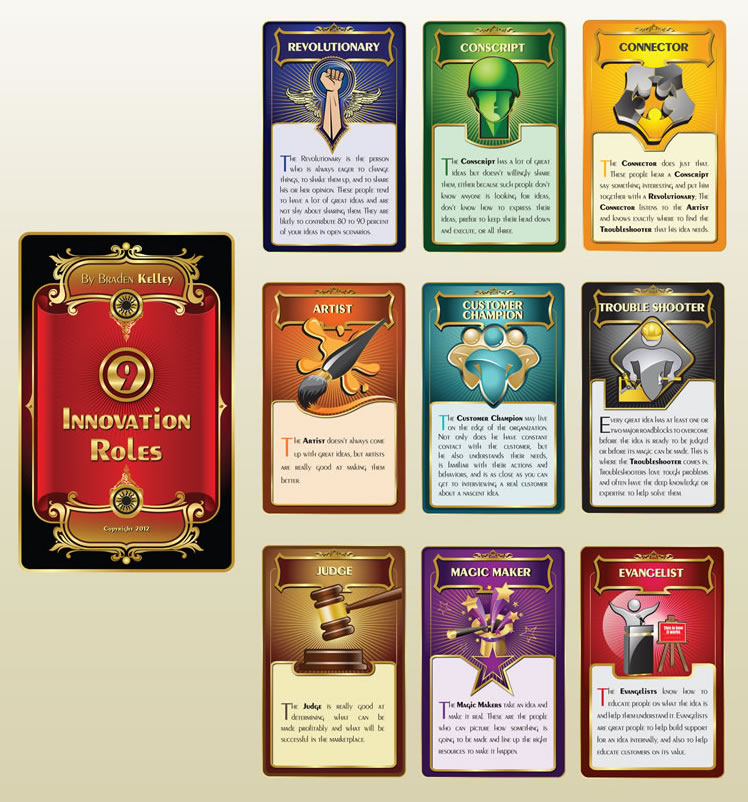
You can click to read more about The Nine Innovation Roles.

Grab the Certified Nine Innovation Roles Workshop Facilitator Perk

The Nine Innovation Roles diagnostic workshop will create a fun, interactive experience for innovation teams or organizations to use to help people better understand what roles they fill on innovation projects, why the team’s or organization’s innovation efforts are failing, and how they can together improve the innovation performance of their teams or organization.

Design for Nine Innovation Roles Group Diagnostic Tool

So, grab this Amazing Innovation Keynote and Nine Innovation Roles Workshop Deal and help your innovation teams be more successful in the future. Don’t wait. Be one of only TEN (10) people worldwide to get this perk, or pre-order the seminar kit and run run workshops or seminars on your own.

Subscribe to Human-Centered Change & Innovation WeeklySign up here to get Human-Centered Change & Innovation Weekly delivered to your inbox every week.

Innovation Costs of Reducing the Flow of Immigrants and Travelers to USA

Innovation Costs of Reducing the Flow of Immigrants and Travelers to USA

September 11th was a traumatic event for the psychology of the nation but also for its innovation capacity. After 9/11 the United States started admitting fewer highly skilled immigrants, invited fewer students to come study here, and companies and consumers cut back on their travel budgets.

These factors, along with many others, combined to reduce the amount of face to face collaboration and created new innovation headwinds for the country.

In 2001, Michael Porter of Harvard Business School published a report ranking the United States as #1 in terms of innovative capacity. By 2009, the Economist Intelligence Unit had dropped the United States in its innovation rankings from #3 between 2002 – 2006 to #4 between 2004 – 2008. The most recent Global Innovation Index has the United States falling from #1 in 2009 to #7 in 2011 — behind Switzerland, Sweden, Singapore, Hong Kong, Finland, and Denmark.

If you’re the United States, not being #1 anymore is a definite concern. Innovation drives job creation, and any decrease in the pace of domestic innovation will ultimately lead to lower economic growth. As the United States slides down the innovation rankings, restrictive immigration policies suddenly look less smart.

The number of foreign student visas increased by a third during the 90s, peaking in 2001 at 293,357 before dropping post-9/11 by 20 percent nearly overnight. It took five years before foreign student visa numbers recovered to 2001 levels. Last year, 331,208 foreign student visas were issued.

But a drop-off in highly skilled immigration does not account for the entire drop in America’s innovation leadership. Another headwind that hit post-9/11 was the drop-off in travel in America. In August 2001, 65.4 million airline passengers traveled to the country. It took three years for passenger growth to resume.

Travel — both corporate and leisure — is important to innovation for three main reasons:

  1. People see and experience things that spark new ideas
  2. Face-to-face meetings deepen human connection and improve productivity and collaboration.
  3. Innovation partnerships and acquisitions are often made in-person.

The United States is at an innovation crossroads. We must commit to attracting more innovators to this country, and to traveling abroad more. Not doing so is guaranteed to exacerbate America’s slide from innovation leader to laggard.

This article first appeared on The Atlantic before drifting into the archive

Build a Common Language of Innovation

Subscribe to Human-Centered Change & Innovation WeeklySign up here to get Human-Centered Change & Innovation Weekly delivered to your inbox every week.

Innovation or Invention? – Gyroscopically Stabilized Electric Motorcycle

Innovation or Invention? - Gyroscopically Stabilized Electric MotorcycleI came across the C-1 from Lit Motors in an article by Donna Sturgess over on Innovation Excellence that made me wonder, will this be an invention or an innovation?

As you may know my definition of innovation stresses that a new offering must transform the useful seeds on invention into solutions valued above every existing alternative. An there are lots of existing alternatives in this space including:

  • Bicycle
  • Public Transportation
  • Skateboards and Razr Scooters
  • Smart ForTwo
  • BMW C1 (launched in 2000)
  • Standard Motorcycle
  • Standard Scooter
  • Segway
  • Segway Hands-Free
  • Nissan Leaf (and variants)

Is the gyroscopic stabilization and electric drive enough to distinguish it from some of these other options?

What about at a price of $24,000 – up from earlier estimates of $16,000?

For me there are a couple of key questions. Are they going to try to keep it categorized as a motorcycle or try and get it categorized as a car? And if so, will it survive the car crash safety tests. Although getting it re-classified as a car might make it more accessible (no motorcycle license needed), I have a hard time thinking the greater access would offset the publishing of head on and rear crash test results (and pictures). So, I would place this one in the invention camp – unlikely to reach wide adoption.

What do you think? Invention or innovation?

Is this something that will catch on with commuters around the world?

Build a Common Language of Innovation

Subscribe to Human-Centered Change & Innovation WeeklySign up here to get Human-Centered Change & Innovation Weekly delivered to your inbox every week.

Global Innovation Index 2011 – Innovation Efficiency

Global Innovation Index 2011 - Innovation EfficiencyThis article is the third in a series of four articles digging into the recently released Global Innovation Index 2011 put together by Insead along with knowledge partners Alcatel-Lucent, Booz & Co., the Confederation of Indian Industry (CII), and the World Intellectual Property Organization (WIPO).

There is a lot of data in the Global Innovation Index 2011 and so I thought it would share it with you bit by bit to make it digestible and then share my overall thoughts. In previous articles we shared the country rankings and the input/output rankings.

Below you’ll find the country rankings based on innovation efficiency (an index comparing the innovation outputs to inputs):

Global Innovation Index 2011 - Innovation Efficiency

In the final article – coming soon – I will give my analysis of the outcomes and implications of the Global Innovation Index 2011. Until then, feel free to sound off in the comments about whether you believe your country’s position in the innovation inputs or outputs rankings are justified or off base.

Additional Global Innovation Index 2011 Articles:

#1 – Global Innovation Index 2011 – Country Rankings
#2 – Global Innovation Index 2011 – Inputs and Outputs
#3 – THE ARTICLE ABOVE
#4 – Coming Soon – Global Innovation Index 2011 – Final Analysis

In the meantime, consider following the Human-Centered Change & Innovation page on LinkedIn.

Subscribe to Human-Centered Change & Innovation WeeklySign up here to get Human-Centered Change & Innovation Weekly delivered to your inbox every week.

One Simple Action Can Change Your Life

GUEST POST from Stephen Shapiro

Recently, a number of people have asked me how I became an author and professional speaker. I reflected upon it and realized that it all started with one simple action. And maybe, to make major change happen, that’s all you need: one small move.

The year was 1993. I was a relatively junior person at Andersen Consulting (now Accenture). I was 7 years out of college and was working on projects like everyone else. I blended into the woodwork and was not distinguished from any of the other 40,000 consultants.

And then one day I had an idea: I realized that I was interested in “cultural transformation” work and felt that Andersen’s culture could use a little transforming. Therefore I decided to call the CEO, George Shaheen, and ask for a meeting to discuss this, um, idea. Yes, I admit, it sounds a little crazy.

I moved into action. I found a company directory, looked up the direct dial number for George, and placed the call. I remember the call well. His executive assistant answered the phone and asked what I wanted. I said, “I want to speak with George Shaheen about transforming Andersen Consulting.”

I am certain she must have looked at the phone and thought, “Who is this crazy person?” She responded, “Excuse me. What do you want?” I repeated myself. She was polite and said, “Ok, let me see what I can do.” She hung up and I assumed that would be the end of things.

The next day, the partner leading the project I was working on came to my desk. Although he was many levels down the totem pole, word got to him quickly. He asked me, “Did you call George Shaheen?” I confirmed that I had. I’m sure HE thought I was crazy. He said, “Maybe I can help you.” I proceeded to tell him my idea about transforming the company’s culture. His response – “I know someone, Bill Stoddard, who is involved with an effort called ‘Enterprise Transformation.’ Maybe you want to meet him instead.” I said, “I would love to meet with Bill. And I still want to meet with George.”

Long story short, I did eventually meet with George, and it was an interesting meeting. But the person who changed my career forever was Bill Stoddard. Meeting him put my career on a totally different trajectory. For some reason he liked me and asked me to work with him on a new initiate he was leading called Value Driven Re-Engineering (he was only an adviser to the Enterprise Transformation initiative). I stopped doing full-time client work and started working with Bill. Our re-engineering work turned out to be big. VERY big. At one point, over one-third of the company’s revenues could be tied back to re-engineering. I was busy leading training sessions and giving speeches around the world.

This started me on the path towards the career I have now. A career I absolutely love.

And none of this might have happened if it weren’t for that one phone call to George.

Sometimes one action can forever change the course of your life, or your business.

Of course, I did not realize that this call would lead me down a totally new path. But sometimes, we can predict possible futures based on actions.

What action can you take TODAY that could change the course of events for you or your business. If the action doesn’t seem outrageous or crazy, keep on thinking.

  • Who can you call that you would never typically have the guts to call?
  • What can you do that is out of your comfort zone, but could have life changing implications?
  • Where could you go that you would never go, but might open up new opportunities?

Sometimes, just taking the first step on a new path can change the course of future events.

Subscribe to Human-Centered Change & Innovation WeeklySign up here to join 17,000+ leaders getting Human-Centered Change & Innovation Weekly delivered to their inbox every week.