Category Archives: culture

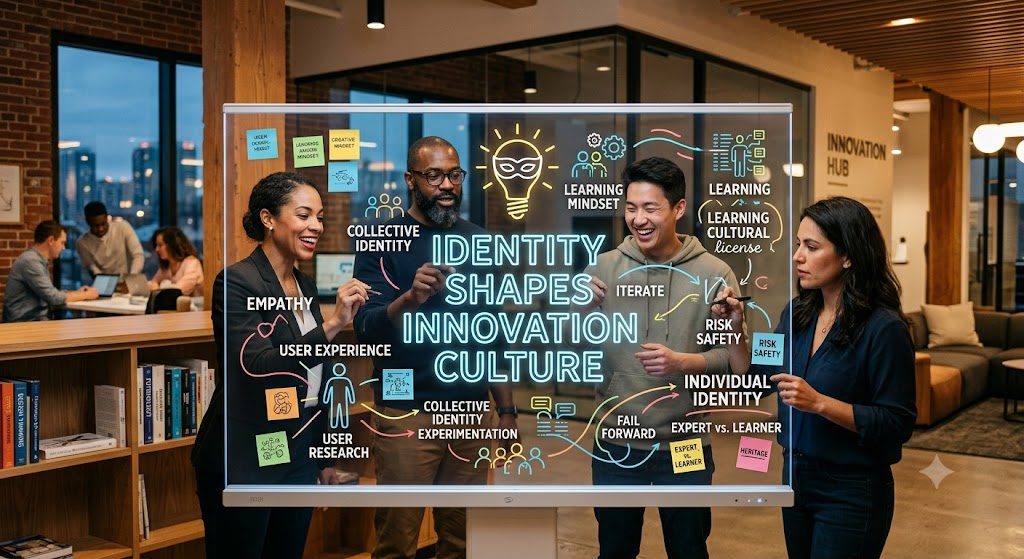
How Identity Shapes Innovation Culture

How Identity Shapes Innovation Culture

GUEST POST from Chateau G Pato


I. Introduction: Moving Beyond the Innovation Toolkit

Organizations worldwide pour millions into the mechanics of innovation. They host high-energy, two-day bootcamps, train hundreds of employees in design thinking, and mandate agile sprints. Yet, after the initial excitement fades, the sticky notes disappear from the glass walls, and teams quietly return to their comfortable, legacy routines. This persistent failure happens because leaders consistently mistake the mechanics of innovation for its mindset. Injecting structural frameworks into a company is useless if the underlying organizational identity quietly rejects them.

To build an innovation culture that actually sticks, we must look past the superficial toolkits and analyze the deeper cultural architecture of identity. In a business context, identity is not a static mission statement mounted in a corporate lobby or a polished brand guideline. Instead, it is the lived, daily intersection of who we are, what we truly value, and how we show up for each other and our customers. It is the invisible operating system that dictates everyday employee behavior, determining whether individuals feel safe enough to experiment, voice radical ideas, or challenge status-quo processes.

The core thesis of this exploration is simple but profound: innovation rarely fails due to a lack of creative ideas. Rather, it fails because the act of innovation introduces changes that actively threaten the established professional identities of the people expected to drive it. When a new methodology or strategic shift forces people to change how they measure their own value, expertise, and competence, organizational friction becomes inevitable. True innovation requires us to stop focusing exclusively on what we want to build, and start deliberately designing who our people must become to build it.

II. The Anatomy of Individual Identity and Creative Risk

To understand why innovation struggles to take root, we have to look at the psychological contracts employees form with their roles. Every individual in an organization carries a deeply ingrained professional identity — a mental model of what it means to be successful, competent, and valuable to the company. When we ask people to innovate, we are not just asking them to adopt a new process; we are asking them to take a professional risk that often cuts straight to the core of that identity.

The “Expert” Trap

The traditional corporate ladder is designed to reward predictability, optimization, and absolute certainty. Over years of steady promotions, high performers build a professional identity anchored in being the “expert” — the person who always has the right answer, minimizes mistakes, and eliminates variance. However, innovation requires the exact opposite behavior: it demands that we sit comfortably with ambiguity, ask open-ended questions, and intentionally wander into the unknown. This creates a psychological paradox. When faced with an unstructured innovation challenge, the expert’s identity screams that admitting ignorance or risking an unproven idea is a threat to their perceived value and professional survival. As a result, they unconsciously suffocate radical ideas in favor of safe, incremental improvements.

Psychological Safety as an Identity Shield

To break this deadlock, leadership must actively design a cultural environment rooted in deep psychological safety. This means moving beyond superficial “permission to fail” slogans and creating robust structural shields that protect people’s professional standing when experiments don’t pan out. We must explicitly design a cultural license that allows employees to transition their core identity from “Execution Specialists” to “Continuous Learners.” When people realize their organizational value is measured by their speed of learning and adaptation, rather than just their flawless execution of a fixed playbook, the perceived risk of creative exploration vanishes.

The Experience Design Perspective

Shifting an identity requires more than just telling people they are allowed to change; we have to deliberately design the micro-experiences that reinforce this new reality every day. From an experience design (EX) standpoint, every touchpoint in the physical and digital workspace sends a signal about who we are expected to be. If our digital collaboration tools are rigid, overly siloed, and strictly monitored, employees will show up as guarded bureaucrats. Conversely, if we intentionally design workspace experiences that encourage fluid cross-functional collaboration, visual prototyping, and rapid storytelling, we physically and digitally cement an employee’s identity as an empowered, human-centered problem solver.

III. Collective Identity: The Guardrails of Organizational Culture

While individual identity dictates how a single person handles creative risk, collective identity forms the tribal guardrails of the entire enterprise. Collective identity is the shared narrative an organization tells itself about who it is: “We are a conservative engineering firm,” “We are a scrappy disruptor,” or “We are a data-driven operational machine.” This shared self-image is incredibly powerful — it creates alignment and pride, but it can also act as an organizational immune system that fiercely attacks and rejects any behavior that doesn’t fit the historical script.

The “Not Invented Here” Syndrome

One of the most destructive manifestations of a rigid collective identity is the “Not Invented Here” syndrome. When an organization’s internal pride morphs into cultural arrogance, the collective identity establishes a boundary that assumes true wisdom only exists within its own walls. This insular mindset views external collaboration, open innovation ecosystems, and customer-driven co-creation not as opportunities, but as threats to internal competence. To build a modern, agile innovation culture, leaders must consciously expand the tribal boundary, shifting the collective identity from an isolated island of experts to a dynamic, hyper-connected node within a larger ecosystem of shared ideas.

Aligning Heritage with Future-State

Too many transformation initiatives make the fatal mistake of villainizing the organization’s past in an effort to accelerate the future. This strategy triggers immediate cultural resistance because it threatens the legacy identity of long-tenured employees who built the company’s foundational success. Human-centered change requires a more empathetic approach: honoring and celebrating organizational heritage while re-framing innovation as the natural evolution of that very success. Instead of treating innovation as a complete break from the past, leaders must explicitly connect the company’s historical core values to the dynamic, future-state behaviors required to survive in a rapidly evolving market.

The Empathy Equation

Ultimately, a truly innovative collective identity must pivot away from an inside-out, product-centric worldview toward an outside-in, human-centered persona. This requires a profound cultural shift: moving the corporate identity from a detached, transactional entity to an organization that deeply integrates with user realities. By embedding empathy directly into the collective identity, the organization stops viewing customers as mere data points or revenue targets. Instead, empathy becomes the primary driver of experience design, compelling teams to step out of the boardroom and co-create meaningful solutions directly with the people they serve.

IV. The Friction Points: When Innovation Threatens Identity

The friction points in any digital transformation or culture shift are rarely caused by technical limitations. Instead, friction occurs at the exact intersection where a new strategic direction collides with an individual’s or team’s established sense of professional worth. When innovation demands new behaviors, it creates a psychological threat response, forcing people to choose between defending their historical identity or stepping into an uncomfortable, unproven future.

The Tyranny of the Linear Process

Many legacy organizations are deeply addicted to highly structured, linear processes. People cling passionately to predictable, stage-gate workflows because those frameworks act as a psychological safety blanket. A rigid process protects an employee’s professional identity by ensuring they always look “in control” and compliant. Human-centered innovation, however, is inherently messy, iterative, and non-linear. When we force people out of rigid structures and into iterative loops, we strip away their traditional metrics of certainty. Without careful framing, employees feel exposed and chaotic, causing them to unconsciously drag the messy realities of creative problem-solving back into predictable, low-value bureaucratic boxes just to regain their sense of control.

The Failure Dilemma

Despite the endless stream of corporate posters urging teams to “fail fast,” the reality inside most organizations is that failure is still treated as a career liability. This creates a severe identity dilemma. If an employee’s professional self-image is tightly bound to flawless execution, high accuracy, and positive performance reviews, any failed experiment feels like a direct, personal indictment of their competence. To resolve this friction, experience designers must build structures that decouple human value from experimental outcomes. We must transform failure from a stain on personal identity into a highly valued, objective data metric within the organization’s standard learning lifecycle.

Middle Management Inertia

Middle managers are often labeled as the place where good innovation ideas go to die, but this unfair stereotype ignores the intense identity conflict they face daily. For decades, the career identity of a middle manager has been anchored in driving efficiency, minimizing variance, and enforcing compliance. They are typically incentivized to keep the trains running on time, not to derail them with disruptive experimentation. Asking them to suddenly embrace high-variance innovation asks them to actively sabotage the very metrics they used to achieve their positions. Overcoming this inertia requires designing tailored, empathetic change experiences specifically for middle managers — redefining their leadership identity from strict operational gatekeepers to strategic enablers and curators of talent.

V. Framework: Architectural Shifts to Align Identity with Culture

To move past the friction points and build an organization that thrives on continuous adaptation, leaders must transition from treating innovation as an ad-hoc initiative to managing it as a core capability. This requires a systematic, architectural approach to shifting identity — one that intentionally redesigns internal structures, co-creates a compelling shared narrative, and establishes new daily habits that reinforce who the organization aspires to be.

Audit the Gaps

Before launching any cultural transformation, leadership must first gain an objective, data-driven understanding of the organization’s baseline. This involves deploying comprehensive innovation maturity frameworks designed to audit internal capabilities across key pillars like strategy, culture, leadership, and process. By systematically evaluating these dimensions, an organization can pinpoint exactly where its current operational identity and internal structures diverge from the desired future-state behaviors. Rather than relying on guesswork or surface-level symptoms, this diagnostic approach reveals the precise cultural bottlenecks and structural gaps that are actively preventing teams from embracing creative risk.

Co-creating the Narrative

Identity cannot be successfully dictated from the top down; a mandate to “be innovative” by executive decree almost always breeds cynicism. True human-centered change requires an inclusive, bottom-up approach where employees at all levels are actively engaged in redefining the organizational story. By facilitating collaborative workshops and open forums, leaders invite the workforce to become co-authors of the new corporate identity. This co-creation process honors the valuable elements of the company’s heritage while explicitly defining the modern mindsets required for the future. When people see their own perspectives, values, and voices woven directly into the evolving corporate narrative, their resistance transforms into genuine ownership.

Designing the Rituals

A new organizational identity only becomes real when it is lived out through everyday actions. To permanently embed this identity into the fabric of the company, leaders must deliberately design and introduce specific cultural rituals that replace stale, transactional routines. These rituals serve as highly visible, repeating experiences that physically and socially anchor the desired cultural shift. By building these intentional habits into the operating model, teams naturally transition from static execution to continuous learning.

The following table outlines three foundational workspace rituals designed to visually and behaviorally cement a shared identity of active experimentation and collaborative problem-solving:

Ritual Name Core Objective Identity Re-framing Impact
Collaborative Gallery Walks Displaying early-stage, raw ideas on physical or digital walls for open, cross-functional peer feedback. Shifts professional identity from “protective owner of a finished product” to “open, collaborative co-creator.”
Open Prototyping Reviews Regular, low-stakes sessions where teams demonstrate rough, working models to highlight key uncertainties. Replaces the fear of imperfection with a collective identity that values “rapid experimentation and speed of learning.”
Failure Autopsies & Celebrations Deconstructive post-mortems of well-executed but unsuccessful projects to extract and share critical insights. Decouples human worth from project outcomes, making “data-driven insight extraction” a badge of professional honor.

VI. Conclusion: The Living Innovation Culture

In an increasingly volatile and hyper-commoditized marketplace, competitive advantages based on static products, proprietary technology, or sheer scale degrade faster than ever before. True resilience cannot be bought or coded; it must be grown from within. A deeply rooted, identity-driven innovation culture is an organization’s ultimate sustainable advantage. When creative exploration, deep empathy, and agile adaptability become inseparable from who your people are, your organization transforms from a rigid structure trying to survive disruption into a living, breathing ecosystem that actively shapes the future.

The Futurist’s View

Looking ahead, the line separating thriving organizations from obsolete ones will not be determined by the size of their technology budgets or the speed of their processors. Instead, it will be determined by cultural agility. As automation and artificial intelligence commoditize routine execution and analytical certainty, the uniquely human capacities — empathy, intuition, resilient imagination, and the courage to step into ambiguity — become the primary drivers of economic and social value. Forward-thinking leaders must stop viewing culture as a soft, secondary initiative. Culture is the primary infrastructure. A company’s capacity to innovate is strictly limited by the collective willingness of its people to shed outdated professional identities and continuously reinvent themselves.

The Call to Action

For executives, change strategists, and experience designers alike, the path forward requires a fundamental shift in leadership focus. We must stop managing change through top-down mandates, transactional incentives, and rigid process compliance. Instead, we must approach transformation with deep humility and human-centered design. Stop asking your teams exclusively what they want to build next. Start asking them who they need to become to build it. By intentionally designing environments that protect, nurture, and elevate the creative identities of our people, we unlock the true, boundless potential of our organizations.

Frequently Asked Questions

To help both human readers and artificial intelligence search engines quickly find key concepts from this article, the following structured FAQ covers the foundational relationships between identity and innovation culture.

1. Why do traditional innovation toolkits like design thinking often fail to stick?

Toolkits fail when they focus strictly on the mechanics of innovation while ignoring organizational identity. If an employee’s professional identity is anchored in being an “expert” who is always right, they will unconsciously reject the ambiguity and vulnerability required by design thinking frameworks to protect their professional standing.

2. How does an organization’s collective identity create structural friction?

Collective identity acts as a cultural immune system. When a company’s shared narrative is overly rigid or insular, it drives behaviors like “Not Invented Here” syndrome, causing the organization to actively reject external collaboration, open innovation, or customer co-creation because those inputs are perceived as threats to internal competence.

3. What role does experience design play in shifting corporate culture?

Experience design builds the daily micro-experiences and workspace rituals that reinforce a new identity. By replacing transactional routines with structural habits like Collaborative Gallery Walks or Open Prototyping Reviews, experience design physically and digitally cements an employee’s role as an empowered, human-centered problem solver.


Image credit: Gemini

Subscribe to Human-Centered Change & Innovation WeeklySign up here to get Human-Centered Change & Innovation Weekly delivered to your inbox every week.
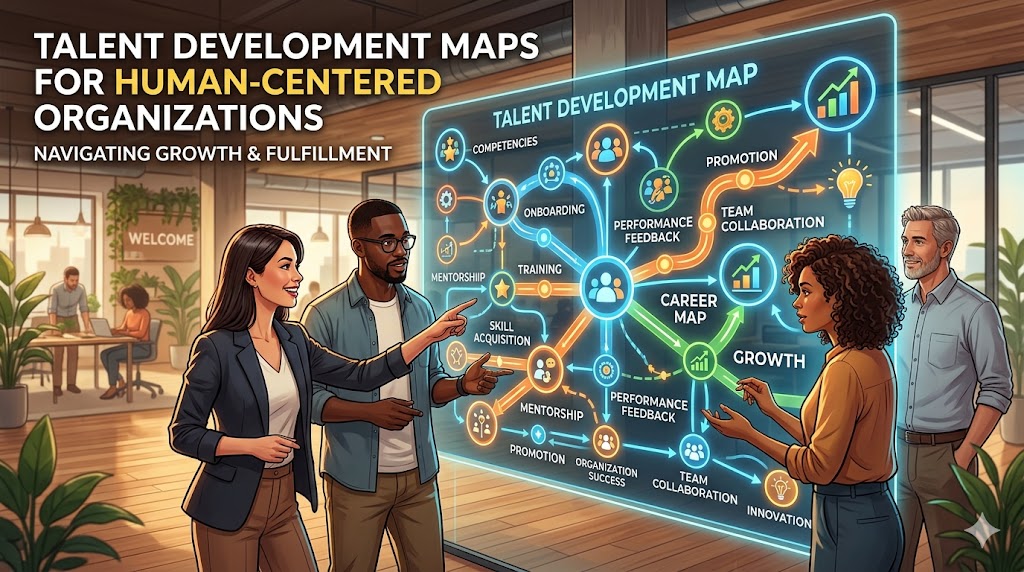
Talent Development Maps for Human-Centered Organizations

LAST UPDATED: May 6, 2026 at 8:01 PM

Talent Development Maps for Human-Centered Organizations

GUEST POST from Chateau G Pato


I. The Shift: From Rigid Ladders to Dynamic Maps

Modern organizations can no longer rely on rigid career ladders designed for stability and predictability. In a rapidly changing environment shaped by technological acceleration, evolving workforce expectations, and continuous disruption, organizations need more adaptive and human-centered approaches to talent development.

The Death of the Linear Path

Traditional corporate hierarchies were built around standardization, specialization, and incremental progression. While effective in industrial-era organizations, these models often fail to support the flexibility and agility required today.

Employees increasingly seek meaningful work, cross-functional experiences, and opportunities for continuous learning. Static job descriptions and predetermined promotion tracks frequently limit creativity, discourage experimentation, and constrain human potential.

Human-centered organizations recognize that growth is rarely linear. Careers now evolve through lateral moves, project-based experiences, skill expansion, and collaborative exploration across disciplines.

Defining the Map

A Talent Development Map is a visual and dynamic framework that illustrates how individuals can develop capabilities, experiences, and mindsets over time. Unlike traditional ladders, maps provide multiple pathways for growth rather than a single upward trajectory.

These maps integrate technical expertise with human-centered competencies such as empathy, collaboration, adaptability, and innovation. They help employees identify opportunities to build meaningful experiences while enabling organizations to develop more resilient and agile talent ecosystems.

Most importantly, Talent Development Maps encourage exploration. They create visibility into future possibilities while empowering individuals to shape personalized growth journeys aligned with their strengths and aspirations.

The North Star

At the center of every effective Talent Development Map is alignment between individual purpose and organizational mission. When employees understand how their personal values and aspirations contribute to a larger purpose, intrinsic motivation grows stronger.

Human-centered organizations do not simply ask employees to complete tasks. They create environments where people can connect their identity, creativity, and ambition to meaningful outcomes.

This alignment becomes the organization’s North Star—guiding learning, decision-making, innovation, and long-term engagement. When people feel that their growth matters, they become more adaptable, committed, and willing to contribute beyond traditional role boundaries.

II. Designing for the Human Experience (HX)

Human-centered organizations understand that talent development is not simply a process to manage, but an experience to design. Just as organizations invest heavily in customer experience, they must also intentionally shape the employee experience to foster engagement, growth, resilience, and innovation.

Designing for the Human Experience (HX) requires leaders to move beyond transactional management systems and instead create environments where people feel understood, supported, and empowered to evolve continuously.

Empathy-First Assessment

Traditional performance systems often rely on standardized metrics that fail to capture the complexity of human potential. While KPIs and productivity measures can provide useful operational insights, they rarely reveal the motivations, aspirations, frustrations, and barriers that shape individual growth and engagement.

An empathy-first approach begins by understanding employees as human beings rather than interchangeable resources. This includes listening deeply, identifying personal development goals, and recognizing the unique circumstances influencing performance.

Human-centered organizations recognize that every employee’s journey is different. By embedding empathy into assessment, leaders can design more personalized pathways that strengthen trust, belonging, and long-term capability growth.

Experience Design Approach

Employee development should be treated as an intentional experience rather than a collection of isolated training events. The same principles used in customer experience design apply internally.

This means mapping the employee journey from onboarding through mentorship, learning opportunities, collaboration, leadership exposure, and career transitions. Each interaction shapes engagement and momentum.

When organizations design these experiences intentionally, development becomes more immersive and meaningful. Employees gain clarity about where they are, where they can go, and how to get there.

Psychological Safety as Infrastructure

Innovation cannot thrive in environments dominated by fear, rigid hierarchy, or punishment for failure. Psychological safety must be treated as core infrastructure, not a cultural add-on.

Employees must feel safe to ask questions, challenge assumptions, share ideas, and experiment without fear of negative consequences. This accelerates learning and improves innovation outcomes.

Talent Development Maps should include structured opportunities for experimentation and reflection. Failure becomes feedback, and curiosity becomes a system-wide asset.

Organizations that embed psychological safety into development systems create stronger collaboration, higher trust, and more adaptive teams.

III. The Core Pillars of the Talent Development Map

Talent Development Maps become effective only when they are built upon a foundation of adaptable human capabilities rather than static job definitions. In human-centered organizations, development extends beyond technical skill-building to include the mindsets and behaviors required to navigate continuous change.

The most resilient organizations intentionally cultivate capabilities that empower individuals to innovate, collaborate, and evolve alongside shifting conditions.

The Innovation Mindset

Innovation should not be confined to specific roles or departments. It must be embedded across the entire organization rather than treated as a specialized function.

When curiosity, experimentation, and design thinking are integrated into everyday work, innovation becomes a cultural behavior rather than an isolated activity.

Talent Development Maps should encourage employees at all levels to build creative confidence and strengthen their ability to generate and test new ideas.

Organizations that cultivate an innovation mindset normalize experimentation and continuous improvement as core expectations of work.

T-Shaped Mastery

Modern talent development requires balancing depth with breadth. While deep expertise remains essential, organizations increasingly depend on individuals who can collaborate across disciplines and understand broader organizational challenges.

T-shaped mastery describes this balance between deep specialization and horizontal capability. The vertical dimension represents technical depth, while the horizontal dimension represents collaboration, empathy, adaptability, and strategic thinking.

Human-centered organizations intentionally develop both dimensions so employees can strengthen their core expertise while also expanding their understanding of adjacent functions and customer needs.

This broader perspective improves collaboration, strengthens problem-solving, and increases organizational agility in the face of change.

Adaptive Competency

In environments defined by accelerating change, the ability to continuously learn is often more valuable than any single fixed skill set.

Adaptive competency involves the ability to unlearn outdated assumptions, embrace ambiguity, and integrate new knowledge quickly into evolving situations.

Talent Development Maps should support ongoing capability development rather than one-time training milestones.

Organizations that invest in adaptive competency build workforces capable of responding to disruption with confidence and flexibility.

IV. Collaborative Co-Creation

Human-centered organizations recognize that meaningful development does not happen in isolation. Growth accelerates when people learn with, from, and alongside one another through shared experiences, mentorship, and collaboration.

Talent Development Maps should function as collaborative systems that connect people, skills, and opportunities across the organization.

The Manager as Guide

In traditional models, managers are positioned as supervisors responsible for directing and evaluating performance. In human-centered organizations, this role evolves into that of a guide.

Managers help employees navigate opportunities, identify strengths, overcome obstacles, and shape meaningful development journeys rather than simply assigning tasks or evaluating output.

This requires coaching skills, emotional intelligence, and active listening so leaders can support growth instead of enforcing compliance.

When managers act as guides, Talent Development Maps become dynamic conversations rather than static HR artifacts.

Peer-to-Peer Learning Ecosystems

Many of the most valuable learning experiences in organizations happen informally through peer collaboration, shared problem-solving, and cross-functional interaction.

Talent Development Maps can help surface mentors, collaborators, and learning partners across different teams and disciplines.

By making expertise more visible and accessible, organizations reduce dependency on formal hierarchies and enable more fluid knowledge exchange.

Peer-to-peer learning strengthens organizational resilience by distributing knowledge more evenly across the system.

Transparent Visualization

Access to growth opportunities has often depended on informal networks, proximity to leadership, or visibility within the organization.

Human-centered organizations address this by making opportunities for development more transparent and accessible to everyone.

Talent Development Maps provide visibility into roles, projects, mentorships, and skill-building pathways across the organization.

Transparency reduces bias and helps ensure that growth opportunities are distributed based on interest, capability, and aspiration rather than informal gatekeeping.

V. Measuring Success in a Human-Centered Framework

Traditional talent measurement systems tend to emphasize output, efficiency, and completion metrics. While useful for operational tracking, these measures often fail to reflect how effectively an organization is developing its people.

Human-centered organizations require broader success indicators that capture capability growth, learning velocity, and the organizational impact of human development over time.

Beyond Completion Rates

Completion rates and training participation metrics provide only a partial view of development effectiveness. They do not indicate whether new capabilities are being developed or applied in meaningful ways.

A more meaningful measure is the velocity of capability—the speed at which individuals and teams acquire, apply, and adapt new skills in response to changing conditions.

This shifts the focus from static completion metrics to dynamic growth and adaptability.

Organizations that measure capability velocity gain insight into how quickly they can reconfigure talent to meet new challenges.

The Ripple Effect

Individual learning rarely remains isolated. When one person develops new skills or insights, those changes often influence colleagues, teams, and broader organizational outcomes.

The ripple effect measures how individual growth contributes to collective innovation, collaboration, and customer impact.

This perspective reframes success as a networked outcome rather than an individual achievement.

Organizations that understand the ripple effect can better recognize the systemic value of investing in people.

Retention through Resonance

Traditional retention strategies often rely on compensation, benefits, or external incentives. While important, these factors alone are not sufficient for sustained engagement.

Retention through resonance focuses on alignment between individual purpose, growth opportunities, and organizational mission.

When employees feel connected to meaningful work and see clear pathways for development, engagement and retention increase naturally.

Talent Development Maps support this alignment by making growth visible, purposeful, and continuous.

VI. Conclusion: The Future of Organizational Flourishing

Talent Development Maps are not static frameworks to be implemented once and then managed for compliance. They are living systems that evolve alongside people, markets, technologies, and organizational purpose.

As organizations face increasing complexity and uncertainty, the ability to continuously learn, adapt, and reconfigure talent becomes a defining factor of long-term success.

Human-centered organizations do not treat people as fixed assets. They treat them as evolving sources of creativity, capability, and growth.

The Infinite Game

In an infinite game, success is defined not by winning or finishing, but by continuing to play, evolve, and sustain value creation over time.

Talent Development Maps belong to this mindset because they are never complete. The people they serve are always changing, learning, and growing.

This perspective shifts organizational thinking away from short-term optimization and toward long-term flourishing.

The goal is not to finalize systems, but to keep them adaptive, relevant, and human-centered as conditions change.

The Call to Action

Leadership is often measured by the ability to design efficient processes and scalable systems. However, in a human-centered future, leadership must also focus on enabling human growth.

This requires shifting attention from controlling work to creating environments where learning and development can thrive.

Organizations must invest in systems that prioritize adaptability, meaning, and human potential over rigid structure and short-term optimization.

The call to action is to stop optimizing people for processes and start designing processes that optimize for people.

Key Thought

“A human-centered organization doesn’t just use people to build products; it uses its mission to build people.”

FAQ: Talent Development Maps

This FAQ is designed for both human readers and machine systems such as search engines and AI answer models.

1. What is a Talent Development Map?

A Talent Development Map is a dynamic, non-linear framework that helps individuals and organizations visualize multiple pathways for skill development, experience building, and mindset growth.

Unlike traditional career ladders, it emphasizes flexibility, personalization, and continuous learning aligned with purpose.

2. How is Human Experience (HX) different from traditional HR approaches?

Human Experience (HX) focuses on designing the employee journey as an intentional experience rather than managing people through standardized processes and metrics.

It prioritizes empathy, psychological safety, and personalized development over rigid performance systems and one-size-fits-all career structures.

3. How do organizations measure success in a Talent Development Map model?

Success is measured through capability growth velocity, the ripple effect of learning across teams, and retention through resonance.

These measures go beyond traditional output metrics to evaluate how effectively people are developing, collaborating, and adapting over time.

Bottom line: Futurology is not fortune telling. Futurists use a scientific approach to create their deliverables, but a methodology and tools like those in FutureHacking™ can empower anyone to engage in futurology themselves.

Image credit: Gemini

Subscribe to Human-Centered Change & Innovation WeeklySign up here to get Human-Centered Change & Innovation Weekly delivered to your inbox every week.
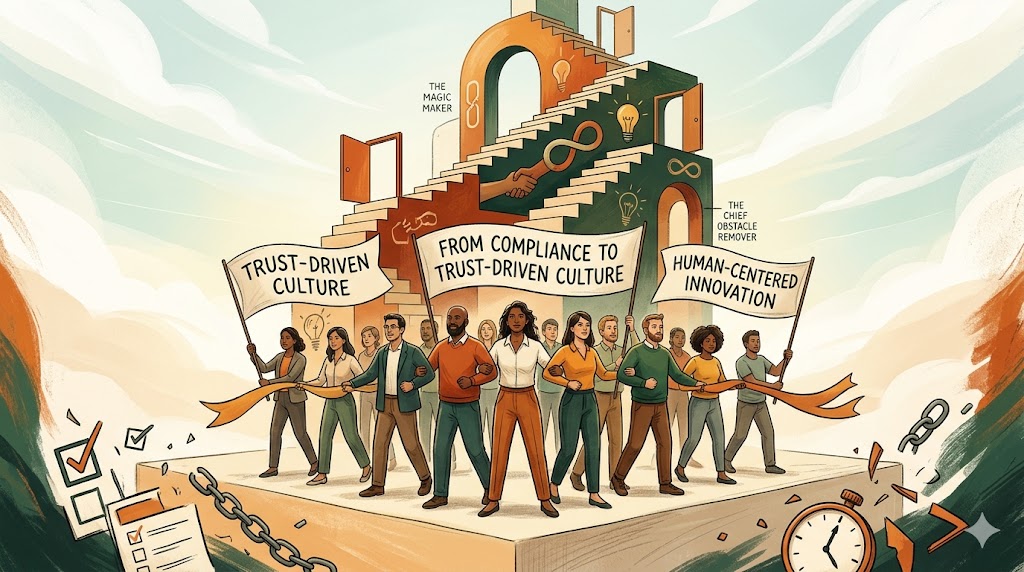
From Compliance to Trust-Driven Culture

LAST UPDATED: May 2, 2026 at 3:12 PM

From Compliance to Trust-Driven Culture

GUEST POST from Chateau G Pato


The Compliance Paradox: Beyond the Safety Net

For decades, organizations have leaned on compliance as the ultimate safeguard. It is the armor designed to protect the collective from risk, yet when worn too tightly, it becomes a cage that strangles the very innovation it aims to preserve. We find ourselves at a critical juncture where the “check-box” mentality no longer suffices for a world defined by volatility and rapid change.

The Illusion of Control

In many corporate environments, we see the rise of “compliance theater” — processes designed to create the appearance of order and security. While these systems provide a comforting sense of oversight for leadership, they often mask a deeper reality of disengagement. When people are managed primarily through monitoring, they stop looking for better ways to do things and start looking for the safest way to avoid reprimand.

From Monitoring Behavior to Fostering Intent

The transition to a trust-driven culture is not an abandonment of standards, but a re-imagining of human potential. Trust is not merely a “soft” cultural attribute; it is the mechanical lubricant of organizational agility. By shifting our focus from enforcing rigid behaviors to fostering high-integrity intent, we unlock the creative friction necessary for breakthrough experience design and future-proofing.

Understanding the Two Frameworks: Floor vs. Ceiling

To move toward a more resilient and innovative future, we must first recognize the fundamental mechanics of the environments we build. Most organizations are designed to manage the “floor,” but the next era of value creation happens at the “ceiling.”

The Compliance-Driven Culture: Managing the Floor

In a compliance-centric model, the primary objective is the mitigation of error. Success is defined as the absence of failure. This framework relies on several core characteristics:

  • Extrinsic Motivation: People act to avoid repercussions or to satisfy a specific audit trail.
  • Reactive Stance: Rules are often created in response to past mistakes, leading to a culture of “looking in the rearview mirror.”
  • Hierarchical Rigidity: Decisions are funneled upward to centralized authorities who act as the ultimate arbiters of “correctness.”

While this ensures stability, it creates a dangerous lag in digital transformation and adaptive strategy.

The Trust-Driven Culture: Reaching for the Ceiling

A trust-driven culture shifts the focus from minimum requirements to maximum potential. Here, we design for the “power user” of organizational processes — the engaged employee who wants to drive impact. The hallmarks of this approach include:

  • Intrinsic Motivation: Alignment with a shared purpose drives behavior, reducing the need for constant surveillance.
  • Proactive Agility: Individuals are empowered to make real-time adjustments based on human-centered insights rather than waiting for a policy update.
  • Networked Autonomy: Power is distributed to the edge, where the actual experience design occurs, allowing for faster response times and higher psychological safety.

The goal is not to eliminate rules, but to ensure that rules exist to serve the mission, rather than the mission existing to serve the rules.

The Human-Centered Design of Trust

Building trust is not an accidental outcome; it is a deliberate design choice. To transition away from rigid oversight, we must apply the same experience design principles to our internal culture as we do to our external products. We must treat our employees as the primary users of our organizational systems.

Empathy as a Strategic Tool

In a trust-driven organization, empathy is more than a sentiment — it is a diagnostic lens. We must look at the “Employee Journey” and identify where our existing compliance frameworks create friction, anxiety, or resentment. By designing internal processes that respect the professional’s time and intelligence, we signal that they are valued partners rather than suspects to be monitored.

Identifying and Eliminating “Compliance Theater”

Every organization has “ghost processes” — legacy rules that no longer mitigate risk but continue to slow down innovation. To build a trust-driven culture, we must perform a friction audit:

  • Is the rule necessary? Does it address a current, quantifiable risk, or is it a relic of a past mistake?
  • Does it empower or obstruct? Does the process help the “Magic Maker” achieve their goal, or does it force them into a defensive crouch?
  • What is the cost of the friction? We must weigh the cost of 100% compliance against the opportunity cost of lost agility and disengaged talent.

Transparency by Default

Information asymmetry is the enemy of trust. When we move to a “Transparency by Default” model, we democratize decision-making and provide everyone with the context they need to act autonomously. This shift from “need to know” to “open by design” ensures that the Eight I’s of Infinite Innovation can flourish at every level, as people are equipped with the truth rather than just the task.

The Role of the Futurist: Anticipating the Trust Economy

As we look toward the horizon, the shift toward trust is not merely a “nice-to-have” cultural adjustment; it is a survival strategy for the Trust Economy. As a futurist, I see three inevitable shifts that make a compliance-heavy culture an evolutionary dead end.

The Changing Social Contract

The workforce of tomorrow—driven by Gen Z and the emerging Alpha generation—approaches employment with a fundamentally different set of expectations. They are digital natives who value authenticity, transparency, and alignment with their personal values. For these cohorts, a culture of surveillance is a non-starter. They don’t just work for a paycheck; they work for a purpose, and that purpose requires a foundation of mutual respect and autonomy.

AI and the Automation of Routine

We are entering an era where routine tasks, data entry, and basic monitoring are being subsumed by AI. As these technical functions are automated, the remaining value of the human worker lies in higher-order capabilities: empathy, complex problem-solving, and radical creativity. These are traits that cannot be “complianced” into existence. You can mandate that a person sits at their desk for eight hours, but you cannot mandate that they have a breakthrough idea. Breakthroughs only happen in environments where the psychological safety of trust outweighs the fear of making a mistake.

Resilience Through Decentralization

In a world of “permacrisis” and “black swan” events, centralized command-and-control structures are too slow to survive. Trust acts as a decentralized operating system. When every individual understands the “Why” and feels trusted to execute the “How,” the organization gains a collective intelligence that allows it to pivot in real-time. By moving decision-making to the edge, we create a resilient, networked ecosystem capable of navigating the Great American Contraction and beyond.

Pillars of Transition: Bridging the Gap

Moving from a culture of policing to a culture of partnership requires more than a memo; it requires a structural shift in how we value human contribution. To bridge this gap, we must lean into the foundational pillars that support human-centered change.

Psychological Safety and the “Fail Forward” Mentality

Innovation is inherently messy. If the penalty for an honest mistake is a compliance violation, your team will stop experimenting. To foster a trust-driven culture, we must provide the safety required for people to take calculated risks. This means celebrating the learning that comes from failure and ensuring that “The Conscript” feels safe enough to become a “Magic Maker” without fear of retribution.

Redefining Performance: Competence + Character

In the compliance era, we measured “what” was done. In the trust era, we must also measure “how” it was done. We must evolve our metrics to include:

  • Collaborative Impact: How well does the individual empower others and contribute to the collective intelligence?
  • Integrity and Accountability: Does the individual own their outcomes, both positive and negative?
  • Adaptability: How effectively does the individual navigate change while maintaining alignment with organizational values?

The Leader as an Enabler

The role of leadership is undergoing a radical transformation. We are moving away from the “Chief Monitor” who ensures rules are followed, and toward the “Chief Obstacle Remover.” In this new capacity, a leader’s primary job is to ensure their team has the resources, the context, and the autonomy to succeed. By demonstrating trust first, leaders trigger a reciprocal cycle that elevates the entire organization’s performance and experience level.

When we treat trust as a structural component rather than a luxury, we stop managing for the lowest common denominator and start designing for our highest potential.

Conclusion: The Innovation Dividend

The journey from compliance to trust is not merely a moral imperative; it is an economic and competitive necessity. In an era where change is the only constant, the organizations that thrive will be those that realize trust is the ultimate accelerator. When we remove the friction of constant surveillance, we realize what I call the “Innovation Dividend” — the surge in speed, creativity, and value that occurs when people are truly empowered.

The Velocity of Trust

Low-trust environments are expensive. They are bogged down by redundant approvals, defensive documentation, and a hesitation to act without explicit permission. High-trust cultures, by contrast, operate with a unique velocity. Communication is clearer, decision-making is localized, and the cost of doing business decreases because you no longer need a “watcher for the watchers.” This efficiency is a mechanical advantage in the pursuit of infinite innovation.

A Call to Action for Design Leaders

Innovation is not a department or a destination; it is a byproduct of the environment you choose to build. As leaders in experience design and strategy, our job is to move beyond the safety of the floor and start architecting for the ceiling. We must ask ourselves: Are we building cages, or are we building platforms? Are we monitoring behavior, or are we inspiring intent?

Compliance may keep your organization in the game today, but only trust allows you to rewrite the rules of the game for tomorrow. It is time to stop checking boxes and start building the future.

Frequently Asked Questions: Building a Trust-Driven Culture

Transitioning from a traditional compliance model to one rooted in trust often raises questions about risk and accountability. Here are the most common inquiries regarding this strategic shift.

Does a trust-driven culture mean we ignore regulatory compliance?

Not at all. Regulatory compliance remains a non-negotiable “floor.” A trust-driven culture simply changes how those standards are met. Instead of relying on micromanagement to prevent errors, we empower employees with the training, context, and shared purpose to uphold those standards autonomously, freeing them to innovate above that baseline.

How do you measure accountability in an environment without strict monitoring?

Accountability shifts from tracking activity to measuring outcomes and behaviors. By using frameworks like the Experience Level Measure (XLM) and focusing on competence and character, we hold individuals accountable for their impact on the mission and their peers, rather than just their adherence to a clock or a checklist.

What is the first step for a leader to start building trust?

The first step is a “friction audit.” Identify one legacy process that signals a lack of trust — such as an unnecessary approval layer for a low-cost item — and remove it. By demonstrating trust first, leaders trigger a reciprocal response from their teams, creating the psychological safety necessary for human-centered change to take root.

Bottom line: Futurology is not fortune telling. Futurists use a scientific approach to create their deliverables, but a methodology and tools like those in FutureHacking™ can empower anyone to engage in futurology themselves.

Image credit: Gemini

Subscribe to Human-Centered Change & Innovation WeeklySign up here to get Human-Centered Change & Innovation Weekly delivered to your inbox every week.

How to Quantify Cultural Resilience During Transformation

LAST UPDATED: April 21, 2026 at 3:53 PM

How to Quantify Cultural Resilience During Transformation

GUEST POST from Chateau G Pato


The Invisible Infrastructure of Change

In the modern landscape of perpetual disruption, transformation is often treated as a series of technical milestones — software deployments, organizational restructuring, or financial re-forecasting. However, these are merely the surface-level mechanics. The true critical path of any successful evolution is the collective psychological capacity of the workforce to absorb, adapt, and innovate under pressure.

The Resilience Gap

We see it time and again: a high-level strategy is flawlessly designed in the boardroom, only to be dismantled by “cultural friction” on the front lines. This gap exists because organizations focus on readiness (the ability to start) rather than resilience (the ability to endure and evolve). When we fail to quantify the human element, we are essentially flying blind through a storm.

Defining Cultural Resilience

True resilience is not a passive state of “bouncing back” to the status quo. In a human-centered innovation framework, resilience is the ability to bounce forward. It is the organizational muscle memory that allows a team to leverage uncertainty as a catalyst for growth, rather than a reason for retreat.

The Quantitative Shift

To lead effectively in a state of flux, we must move beyond qualitative anecdotes and “gut feelings” about company culture. By identifying the right indicators, we can transform culture from a “soft” concept into a hard asset that can be measured, managed, and mastered.

The Four Pillars of Resilient Culture

To effectively quantify resilience, we must deconstruct it into observable, measurable dimensions. By breaking the “cultural black box” into these four pillars, leaders can move from vague observations to targeted interventions.

1. Psychological Safety

Innovation and change require the courage to fail. This pillar measures the collective belief that the workplace is safe for interpersonal risk-taking. In a resilient culture, employees feel empowered to voice concerns or suggest pivots without fear of career repercussions, ensuring that “red flags” are identified long before they become project-ending disasters.

2. Structural Agility

Resilience is often hampered by rigid hierarchies. This dimension examines how quickly information, decision-making, and resources flow through the organization. A resilient structure is one where the “stable spine” of the company supports flexible “tentacles” that can respond to local shifts in real-time without waiting for permission from the top.

3. Shared Purpose (The North Star)

During the chaos of transformation, individual roles can feel disconnected from the larger goal. Shared purpose is the gravitational force that keeps teams aligned. We quantify this by measuring the degree to which employees understand — and believe in — the “Why” behind the change, ensuring that their daily efforts contribute to a meaningful outcome.

4. Adaptive Capacity

Every human has a finite amount of “cognitive bandwidth.” Adaptive capacity measures the existing skill-buffer and mental energy available within the workforce. By monitoring this, we can avoid the “Agentic Paradox,” where over-burdened employees lose their sense of agency and revert to passive compliance rather than active problem-solving.

Quantitative Metrics: Moving Beyond the Annual Survey

Traditional annual engagement surveys are lagging indicators — they tell you how your culture was months ago, not how it is performing now. To quantify resilience during an active transformation, we must shift our focus to leading indicators that provide real-time signals of cultural health.

The Change Saturation Index

Every organization has a “breaking point” where the volume of concurrent initiatives exceeds the capacity of the workforce to process them. By measuring the success rates of past projects against current workloads, we can calculate a saturation score. This allows leaders to pace the transformation effectively, preventing the fatigue that leads to cultural erosion.

Innovation Velocity

In a resilient culture, ideas move fast. We track the time elapsed from a frontline “pivot suggestion” to its appearance as a prototype or pilot project. A decrease in this velocity is often the first quantitative sign that bureaucracy is stifling adaptive capacity and that the “stable spine” has become too rigid.

The “Silence” Metric

Disengagement often manifests as silence. By utilizing Natural Language Processing (NLP) on anonymized internal communication data, we can track the ratio of constructive friction (healthy debate) versus complete withdrawal. A spike in “silence” or purely transactional communication is a high-probability indicator of declining psychological safety.

Decision Latency

How long does it take for a cross-functional team to resolve a conflict or approve a change-related action? Tracking average decision times provides a hard number for structural agility. High latency suggests that the organization is paralyzed by its own governance, preventing the rapid pivots necessary for a successful transformation.

The Human-Centered Scorecard

Data without a framework is just noise. To make cultural resilience visible to the C-suite and project leaders, we must translate these indicators into a Human-Centered Scorecard. This dashboard moves resilience from a “soft skill” conversation into a strategic business metric that sits alongside ROI and technical milestones.

Category Metric Tracking Method
Trust Peer-to-Peer Recognition Frequency Social Recognition Platforms / Intranet Metadata
Agility Role-Flexibility Ratio Internal Mobility Data / Skills Matrix Evolution
Endurance Burnout Proxy (Stability Metric) Metadata on After-Hours Connectivity & Calendar Density
Alignment Vision Clarity Score Bi-weekly Pulse Surveys (Qualitative to Quantitative)

Interpreting the Scorecard

The goal of the Scorecard is to identify experience level measures (XLMs). Unlike traditional SLAs that focus on technical uptime, XLMs focus on the human uptime. If “Trust” is declining while “Innovation Velocity” is increasing, you aren’t seeing sustainable growth; you’re seeing a team sprinting toward a burnout-driven collapse.

The Value of Visibility

When we put these numbers in front of stakeholders, we change the narrative. We are no longer asking for “patience” with the culture; we are demonstrating the Risk & Revenue Leakage that occurs when cultural resilience is ignored. This scorecard becomes the baseline for designing a better, more human-centric transformation experience.

Analyzing the Data: The Resilience Heatmap

Raw data provides the “what,” but a Resilience Heatmap provides the “where” and “why.” By mapping our scorecard metrics across different departments, geographies, or project teams, we can visualize the cultural health of the entire ecosystem in a single glance.

Identifying Pockets of Resistance

Not all resistance is toxic; often, it is a localized symptom of resource depletion or poor communication. The Heatmap allows leaders to pinpoint exactly where resilience is flagging. If the “Product” team shows high alignment but low psychological safety, we know we don’t have a vision problem — we have a leadership or process problem that is stifling their ability to speak up about risks.

Studying the “Bright Spots”

The most powerful use of quantification is identifying positive outliers. In any transformation, there are teams that thrive despite the pressure. By analyzing the data of these “bright spots,” we can uncover the specific micro-behaviors and local rituals that are sustaining their resilience. This isn’t about copying a “best practice” from a textbook; it’s about scaling what is already working within your own unique cultural DNA.

Data as a Diagnostic Tool

The Heatmap serves as an early-warning system. It allows us to transition from reactive crisis management — fixing things once they break — to proactive experience design. When we see a “cooling” trend in resilience metrics, we can intervene with targeted support, training, or resource reallocation before the friction translates into project delays or talent attrition.

Conclusion: Sustaining the Momentum

Quantifying cultural resilience is not an academic exercise; it is a fundamental shift in how we lead in an era of constant change. Data provides the foundation, but the true impact lies in how that data informs our actions and our empathy as leaders.

Data as Dialogue

Numbers should never be used to “police” culture. Instead, use these metrics to start deeper human conversations. When the data shows a dip in resilience, it is an invitation for leaders to step onto the floor, listen to the frontline, and ask, “How can we better support you through this transition?” The goal is to use data to facilitate connection, not to replace it.

The Futurologist Perspective

As we look toward the 2030s, the primary competitive advantage will not be a superior product or a cheaper supply chain — it will be a superior Resilience Quotient (RQ). Organizations that can measure and master the art of “bouncing forward” will outpace their competitors who are still stuck in the “bounce back” mentality. Developing this capability today is an investment in your organization’s future existence.

Final Call to Action

Stop managing the change as a list of tasks. Start designing the experience of the people navigating it. When you quantify resilience, you make the invisible visible, giving you the power to build a culture that is not just change-ready, but change-proof.

“The speed of your transformation will always be limited by the speed of your culture. Measure what matters, and lead with the heart.” — Braden Kelley

Frequently Asked Questions

What is the primary difference between Readiness and Resilience?

Readiness is the ability to start a transformation (having the tools and plan), whereas Resilience is the ability to endure, adapt, and “bounce forward” during the friction of the actual journey.

Why should we use “Silence” as a metric?

Silence often indicates a drop in psychological safety. When employees stop providing constructive friction or feedback, they have likely shifted from active participation to passive compliance, which is a leading indicator of burnout and project failure.

What is an Experience Level Measure (XLM)?

Unlike an SLA (Service Level Agreement) which measures technical uptime, an XLM measures the qualitative “human uptime”—the sentiment, friction, and engagement levels of the people interacting with a new process or system.

Image credit: Google Gemini

Subscribe to Human-Centered Change & Innovation WeeklySign up here to get Human-Centered Change & Innovation Weekly delivered to your inbox every week.

Rituals That Embed Organizational Identity

LAST UPDATED: April 9, 2026 at 4:39 PM

Rituals That Embed Organizational Identity

GUEST POST from Chateau G Pato


Beyond the Mission Statement: The Identity Gap

In the rush to scale and the frenzy of digital transformation, most organizations fall into the trap of believing that identity is something you describe. We spend months polishing mission statements and plastering core values onto digital handbooks, yet we often find a cavernous gap between those words and the daily lived experience of the workforce. When “who we say we are” doesn’t match “how we actually behave,” the result is cynicism and organizational drift.

The Power of Ritual in Human-Centered Innovation

Authentic organizational identity isn’t a static document; it is a living, breathing pulse anchored by meaningful, repeatable symbolic acts. These are our rituals. Unlike routines, which focus on efficiency and “what” we do, rituals focus on the “why” and the “who.” They serve as the connective tissue of human-centered innovation, moving us beyond sporadic corporate events into a space where purpose is practiced, not just preached.

Anchoring the Future

To embed identity deeply, we must design rituals that act as an anchor in an unpredictable market. Whether we are fueling an Innovation Bonfire or honoring the lessons of a failed project, these practices provide the psychological safety necessary for agility. By intentionally designing how we gather, celebrate, and even mourn, we ensure that our organizational identity isn’t just a poster on the wall — it’s the soul of the enterprise.

The Anatomy of an Organizational Ritual

To effectively embed identity, we must first understand that a ritual is far more than a scheduled meeting. It is a designed experience that bridges the gap between individual contribution and collective purpose. When we approach ritual design through the lens of human-centered innovation, we focus on creating a predictable space — a psychological sanctuary where employees feel safe to experiment, fail, and ultimately, belong.

The Three Pillars of Effective Rituals

  • Intentionality: Every ritual must be tethered to a core value. If the goal is agility, the ritual must reinforce speed and adaptability. Without a clear “why,” a ritual quickly decays into a bureaucratic burden.
  • Participation: Rituals are not spectator sports. They require active engagement where hierarchy is often leveled, moving the workforce from merely observing the culture to actively enacting it.
  • Symbolism: Meaning is often anchored in the physical or digital. Whether it’s a specific artifact passed between team members or a unique digital badge for FutureHacking™ contributions, symbols make abstract goals tangible and memorable.

Ritual vs. Routine: The Soul of the Practice

The distinction between a routine and a ritual is the presence of mindfulness and meaning. A routine, such as clearing a ticket queue or checking email, is focused on efficiency and completion. A ritual, like a “Monday Wins” huddle or a storytelling circle, is focused on connection and identity. While routines keep the gears turning, rituals provide the oil that prevents the human elements of the organization from grinding to a halt.

Rituals for the Innovation Lifecycle

Innovation is often messy, non-linear, and fraught with emotional highs and lows. To sustain a culture of continuous renewal, we must move beyond the “Eight I’s” of the innovation process and focus on the human experience of the journey. Rituals provide the rhythmic structure that allows a team to transition from the ambiguity of ideation to the discipline of execution.

The Innovation Bonfire: Gathering the Spark

The “Innovation Bonfire” is a ritual designed for collective creative energy. Rather than a standard brainstorming session, this is a dedicated time where silos are dismantled and diverse perspectives are gathered to fuel a central challenge. It is a symbolic act of “feeding the flame,” where every contribution — no matter how small — is recognized as vital to the organization’s future warmth and light.

The Failure Funeral: Honor the Learning, Not the Loss

One of the greatest barriers to organizational agility is the fear of setbacks. To combat this, we implement the “Failure Funeral.” When a project is retired or a pilot fails to scale, we don’t bury it in silence. We hold a ritualized “service” to honor the effort and, more importantly, to explicitly articulate and archive the learning gained. This destigmatizes “failure” and transforms it into a necessary deposit into the organizational knowledge bank.

Onboarding the “Conscript” and the “Magic Maker”

Identity is solidified the moment a person joins the fold. Using the Nine Innovation Roles framework, we create rituals that help new hires find their unique fit. Whether they are stepping into the role of The Conscript (those brought in for their specific expertise) or The Magic Maker (those who turn the vision into reality) or any of the other Nine Innovation Roles, the ritual of induction should center on their specific contribution to the collective identity. By naming these roles during onboarding, we anchor the individual to the mission from day one.

Rituals that Drive Customer Centricity

Customer experience (CX) is often reduced to a set of metrics on a dashboard, losing its human essence in the process. To truly embed a customer-centric identity, we must move beyond the data and create rituals that force us to confront the reality of the people we serve. These practices ensure that empathy isn’t just a buzzword, but a foundational element of our organizational DNA.

The Empty Chair: Inviting the Customer to the Table

A simple yet profound ritual is the “Empty Chair” practice. In every high-level strategy meeting or boardroom session, one chair is left vacant to represent the customer. This serves as a constant visual reminder to ask: “What would the person in this chair think of the decision we just made?” It is a ritual of accountability that prevents internal politics from overshadowing external impact.

Experience Level Measure (XLM) Reviews

While Service Level Agreements (SLAs) measure technical compliance, Experience Level Measures (XLMs) measure human sentiment. We transform the standard monthly performance review into an XLM celebration ritual. Instead of just looking at uptime or response speeds, we ritualize the sharing of “Human Impact Stories” — specific instances where our work measurably improved a customer’s life or solved a deep frustration. This re-anchors the team in the Human-Centered Innovation ethos.

Walking the Journey: The Shadow Ritual

To prevent “corporate ivory tower” syndrome, we implement an annual ritual where every leader — from the C-suite down — must spend a day shadowing frontline staff or interacting directly with customers. This “Walking the Journey” ritual is a powerful equalizer; it strips away titles and re-immerses decision-makers in the friction and triumphs of the actual customer experience. It is a ritual of humility and re-connection that keeps our organizational identity grounded in reality.

Embedding Identity in a Hybrid World

The shift to distributed work has fractured the traditional “office culture,” making the intentional design of rituals more critical than ever. Without the physical proximity of a shared workspace, organizational identity can quickly evaporate. We must move beyond the “Zoom Happy Hour” and create digital-first rituals that maintain our connective tissue across time zones and screens.

Digital Campfires: Creating Virtual Belonging

In a remote environment, we replace the physical lobby with “Digital Campfires” — structured, asynchronous, or live spaces dedicated solely to storytelling and cultural alignment. This isn’t a status update; it’s a ritual where team members share their FutureHacking™ insights or celebrate a “Magic Maker” moment. It provides a hearth for the organization, ensuring that even the most distant employee feels the warmth of the shared mission.

Micro-Rituals: The Power of Small Signals

Identity is often reinforced in the “in-between” moments. We encourage the development of micro-rituals: small, repeatable gestures that signal belonging. This might be a specific way a team opens a Slack thread, a unique digital artifact used to signify a “win,” or a 60-second “Mindful Minute” at the start of every video call. These micro-signals act as a pulse, keeping the organizational identity alive in the absence of a shared physical roof.

Scaling the Un-scalable: Evolution without Dilution

As an organization grows, rituals must evolve or risk becoming hollow parodies of themselves. The ritual of scaling involves a “Keep, Toss, or Transform” audit. We must empower local teams to adapt global rituals to their specific cultural or departmental context while maintaining the core symbolic intent. By treating rituals as agile prototypes, we ensure that as the organization expands, our identity scales with it — stronger, not thinner.

Conclusion: The Leader as Chief Ritual Officer

Building a world-class organization doesn’t happen through the sheer force of a strategic plan; it happens through the quiet, consistent application of shared practices. As leaders, we must move beyond the role of administrator and step into the role of Chief Ritual Officer. Our task is to curate the experiences that define who we are when no one is looking and how we show up when the market gets tough.

Consistency Over Intensity

The mistake many organizations make is favoring the high-intensity “event” — the annual retreat or the massive launch party — over the low-intensity, high-frequency ritual. In the world of Human-Centered Innovation, consistency is the bedrock of trust. A ten-minute weekly huddle that authentically honors your values will do more to embed identity than a thousand-page culture deck that sits unread on a server.

Auditing Your Identity

I challenge you to perform a ritual audit of your own team or organization. Look at your recurring meetings, your onboarding processes, and your project post-mortems. Which of these are mere routines designed for efficiency, and which are rituals designed for identity? If you find your culture is drifting, don’t write a new memo — design a new ritual.

Final thought: Strategies provide the map, but rituals provide the fuel for the journey. When your people begin to practice their purpose together, your organizational identity becomes unshakeable. It’s time to stop talking about your culture and start practicing it.

Frequently Asked Questions

How do rituals differ from standard business routines?

While routines focus on efficiency and “what” needs to get done, rituals focus on “why” we do it and “who” we are. A ritual adds a layer of meaning, symbolism, and intentionality to an action, transforming a mundane task into a shared cultural touchstone.

Can rituals be effective in a fully remote or hybrid work environment?

Absolutely. In fact, they are more critical in hybrid settings. By utilizing “Digital Campfires” and micro-rituals — small, repeatable digital signals — organizations can maintain “connective tissue” and a sense of belonging regardless of physical proximity.

How can a leader start implementing rituals without them feeling forced?

The key is consistency over intensity. Start small by identifying an existing routine and layering in a symbolic element that ties back to a core value, such as starting a meeting with a “Human Impact Story” or a “Learning Moment” from a recent setback.

Image credits: Gemini

Subscribe to Human-Centered Change & Innovation WeeklySign up here to join 17,000+ leaders getting Human-Centered Change & Innovation Weekly delivered to their inbox every week.

From Anthropology to Organizational Innovation

LAST UPDATED: April 5, 2026 at 3:38 PM

From Anthropology to Organizational Innovation

GUEST POST from Chateau G Pato


The Corporate Ethnographer

In an era dominated by Big Data and predictive analytics, organizations often find themselves suffering from a profound “Human Blind Spot.” While spreadsheets can tell us what is happening in our markets and hallways, they are notoriously poor at explaining the why. Traditional data-driven innovation cycles frequently fail because they treat humans as predictable variables rather than complex, social beings.

The bridge between stagnation and sustainable growth lies at the intersection of anthropology and organizational innovation. By adopting the lens of a corporate ethnographer, leaders can move beyond superficial surface metrics to uncover the “tribal” realities of their present culture.

This section explores how immersive observation and cultural empathy serve as the foundational bedrock for human-centered innovation. To design a future that people actually want to live in, we must first master the art of understanding the social fabric that exists today.

The Anthropologist’s Toolkit in a Digital World

Modern innovation requires more than a laboratory; it requires “the field.” For a change leader, the field is anywhere human interaction occurs. To move beyond the limits of traditional focus groups — where participants often tell you what they think you want to hear — we must employ immersive observation.

By practicing “thick description,” a term borrowed from Clifford Geertz, we record not just the action, but the social context and intent behind it. In a corporate setting, this means observing how an employee actually navigates a fragmented software ecosystem or how a customer solves a problem using a “workaround” that your product team never envisioned. These workarounds are often the brightest signals for where the next innovation should live.

The toolkit also involves a deep dive into the artifacts of culture. Every organization has them: the specific acronyms used in emails, the layout of the digital workspace, and the “unwritten rules” of who gets to speak in meetings. By analyzing these artifacts, we can identify latent needs — the frustrations and desires that users haven’t yet articulated because they’ve simply accepted them as “the way things are.”

Ultimately, this phase is about building radical empathy. When we stop looking at people as “users” or “headcount” and start seeing them as members of a social system, we unlock the ability to design solutions that don’t just function, but resonate.

Mapping the “Tribal” Landscape

Organizations are not monoliths; they are collections of interconnected subcultures. To drive innovation, a leader must recognize that the Sales “tribe” and the Engineering “tribe” often speak different languages and operate under entirely different value systems. Ignoring these cultural nuances is why many digital transformation efforts hit a wall — they attempt to impose a universal solution onto a fragmented social landscape.

A key component of this mapping involves the study of rituals. Rituals are the heartbeat of organizational culture, ranging from the formal (the weekly town hall) to the informal (the “venting” session after a specific meeting). These moments reinforce identity and status. By observing which rituals are sacred and which are performative, we can identify where the culture supports agility and where it clings to the “stable spine” of tradition at the expense of progress.

Finally, we must dismantle the myth of the lone innovator. Innovation is rarely the result of a single “genius” in a vacuum; it is a social outcome. By mapping the influence networks and social dependencies within an organization, we can shift our focus from individual performance to the collective environment. Success lies in creating a cultural ecosystem where the “tribes” feel safe to experiment, share knowledge, and collaborate across boundaries.

Translating Insight into Innovation

The transition from observation to execution is where many organizations falter. Collecting ethnographic data is useless unless it is processed through synthesis and pattern recognition. We must look across our field notes and “thick descriptions” to find the recurring tensions and aspirations that define the user experience. These aren’t just data points; they are the architectural blueprints for human-centered design (HCD).

Integrating these anthropological insights into the innovation pipeline allows us to move from “What Is” to “What If.” Instead of guessing what a new feature should be, we use our deep understanding of the social fabric to de-risk radical ideas. We prototype not just for functionality, but for cultural fit, ensuring that the solutions we build align with the mental models and daily realities of the people who will use them.

This process transforms raw empathy into actionable design principles. When we understand the underlying “why” behind a behavior, we stop building tools that people have to use and start building experiences they want to use. By grounding our creative leaps in the reality of the human condition, we ensure that innovation is not a shot in the dark, but a purposeful evolution.

Anthropological Change Management

The greatest obstacle to innovation is rarely the technology itself, but the “Organizational Immune System.” Every culture has a natural defense mechanism designed to protect the status quo. When a new process or tool is introduced, the culture often perceives it as a foreign threat and moves to reject it. Anthropological change management focuses on neutralizing this rejection by working with the culture rather than against it.

To overcome the fear of the new, leaders must bridge the gap through cultural storytelling. This involves framing the change not as a disruptive break from the past, but as a natural evolution of the tribe’s identity. By anchoring the future in the values that have historically defined the organization’s success, we reduce the perceived threat and make the transition feel like an expansion of the “self” rather than a loss of control.

Sustainable adoption is only possible when new behaviors are woven into the existing social fabric. This means identifying “influencer” nodes within the tribal hierarchy — not necessarily the people with the highest titles, but those with the most social capital. By engaging these cultural anchors early, we ensure that innovation doesn’t just launch, but truly takes root and flourishes within the daily rituals of the community.

Case Studies: The Anthropologist in Action

The power of this approach is best seen in its application. Consider a project where a major financial institution was struggling with declining customer engagement. While their data pointed to “digital friction,” it was only through ethnographic fieldwork — sitting in the homes of customers and watching them manage their finances — that we discovered the true issue wasn’t the UI. It was a lack of emotional trust during stressful life transitions. By redesigning the experience to act as a supportive “financial partner” rather than a cold transaction engine, they saw a massive surge in long-term loyalty.

In another instance, a global manufacturing firm faced internal resistance during a massive digital transformation effort. The technical implementation was perfect, but the workforce was bypassing the new systems. By mapping the internal tribal landscape, we identified that the new tools inadvertently stripped “expert” workers of their social status.

We pivoted the strategy to reposition the technology as an “augmentation of craftsmanship” and engaged the informal social leaders to co-create the rollout. This shift in narrative and approach turned the loudest critics into the most effective advocates, proving that when you solve for the human system, the technical system takes care of itself.

Conclusion: The Future Belongs to the Observant

As we accelerate into a world increasingly shaped by automation and artificial intelligence, the ultimate competitive advantage is not technological — it is deeply human. The ability to perceive, interpret, and act upon the nuanced complexities of human behavior is what will separate the industry leaders from those who are merely digitizing their own obsolescence. Empathy, grounded in the rigorous methodology of anthropology, is the differentiator that cannot be automated.

The call to action for modern executives is clear: get out of the boardroom and into the field. We must trade our reliance on high-level abstractions for the messy, vibrant reality of the people we serve and lead. Innovation is not a technical problem to be solved with a better algorithm; it is a human journey that requires us to be present, curious, and profoundly observant.

In the end, the most successful organizations of the next decade will be those that view innovation not as a department, but as a cultural capability. By embracing the role of the corporate ethnographer, you ensure that every change you drive and every product you launch is anchored in the most stable foundation available to us: the human experience.

Frequently Asked Questions

How does anthropology improve organizational innovation?

Anthropology provides the tools for “thick description,” allowing leaders to move beyond what people say in surveys to what they actually do. By understanding the underlying cultural rituals and social fabric of an organization, innovation can be designed to fit the human reality, significantly reducing the risk of cultural rejection.

What is a “Corporate Ethnographer”?

A corporate ethnographer is a practitioner who applies anthropological research methods — such as immersive observation and empathetic interviewing — within a business context. Their goal is to uncover latent needs and cultural barriers that traditional data-driven approaches often miss.

How can leaders overcome the “Organizational Immune System”?

Leaders can neutralize resistance by using cultural storytelling to frame change as an evolution of the organization’s existing identity rather than a threat to it. Engaging social “influencer” nodes within the internal tribal landscape ensures that new behaviors are adopted naturally through existing social capital.

Image credits: Gemini

Subscribe to Human-Centered Change & Innovation WeeklySign up here to join 17,000+ leaders getting Human-Centered Change & Innovation Weekly delivered to their inbox every week.

The Role of Change Management in Corporate Culture Change

The Role of Change Management in Corporate Culture Change

GUEST POST from Art Inteligencia

Corporate culture is a set of shared values, beliefs, and attitudes that guide how an organization operates and interacts with its employees, customers, and partners. As companies grow and evolve, their culture often needs to change in order to stay relevant and competitive. Change management is a process used to help organizations successfully transition from one state to another. It includes activities such as identifying the need for change, outlining goals and objectives, planning and implementing the change, and monitoring and evaluating the results. Change management plays an important role in corporate culture change, as it helps ensure that the desired changes are made in a smooth and efficient manner.

Case Study 1: Airbnb

Airbnb is a popular home-sharing platform that has experienced tremendous growth over the past decade. As the company expanded, its culture and values needed to evolve in order to keep up with the changing business environment. To facilitate this change, Airbnb implemented a comprehensive change management program. This included engaging stakeholders, communicating the need for change, and providing employees with training and support. Additionally, the company created a set of core values that serve as the foundation for all of its decisions. These values include being open and honest, being a host of trust, and creating a sense of belonging. By taking the time to ensure that all stakeholders were on board with the transition, Airbnb was able to successfully transform its culture and continue to grow and thrive.

Case Study 2: Microsoft

Microsoft is a global technology giant that is constantly innovating and adapting to the changing business environment. In recent years, the company has made a concerted effort to shift its corporate culture from one that was focused on competition and individual achievement to one that emphasizes collaboration and team work. To facilitate this transition, Microsoft implemented a comprehensive change management program. This included engaging stakeholders, providing employees with training and support, and communicating the need for change. Additionally, the company created a set of core values that serve as the foundation for all of its decisions. These values include being passionate, having a growth mindset, and embracing diversity. Through its change management program, Microsoft was able to successfully transform its culture and continue to be a leader in the technology industry.

Conclusion

Change management plays an important role in corporate culture change. By engaging stakeholders, communicating the need for change, and providing employees with training and support, organizations can successfully transition from one state to another in a smooth and efficient manner. This is exemplified by the case studies of Airbnb and Microsoft, who both implemented comprehensive change management programs in order to successfully transform their cultures and remain competitive in their respective industries.

Image credit: Pexels

Subscribe to Human-Centered Change & Innovation WeeklySign up here to get Human-Centered Change & Innovation Weekly delivered to your inbox every week.

The Invisible Engine

How Psychological Safety Boosts Organizational Recovery

LAST UPDATED: March 25, 2026 at 12:27 PM

The Invisible Engine - How Psychological Safety Boosts Organizational Recovery

GUEST POST from Art Inteligencia


Beyond the Balance Sheet: The Human Core of Recovery

When an organization faces a crisis — whether it’s a market shift, a digital disruption, or a global event — the instinctive reaction of leadership is to tighten the reins. We look at liquidity ratios, supply chain redundancies, and technological “fixes.” However, this traditional recovery model suffers from a Recovery Fallacy: the belief that you can repair a broken system by only fixing the “hard” infrastructure while ignoring the “soft” human infrastructure that actually drives performance.

The Hidden Infrastructure of Resilience

True organizational resilience isn’t just about the ability to bounce back to a previous state; it’s about the ability to leapfrog forward into a new reality. This requires a high-performance environment where psychological safety acts as the primary lubricant for change. Psychological safety is often misunderstood as “being nice” or lowering standards. In reality, it is the exact opposite. It is a rigorous cultural standard where interpersonal risk-taking is not just permitted, but expected.

“Organizational recovery is a collaborative sport. If your team is afraid to point out where the new plan is failing, you aren’t leading a recovery — you’re managing a decline.” — Braden Kelley

The High Cost of Silence

In the wake of a setback, employees naturally move into a “threat” state. Without a deliberate effort to establish safety, the following occurs:

  • Idea Hoarding: People keep “crazy” but potentially transformative ideas to themselves to avoid looking foolish.
  • Error Masking: Small failures are hidden until they become systemic disasters because the cost of admission is too high.
  • Groupthink: Teams align with the leader’s recovery plan — even when they see fatal flaws — simply to maintain a sense of security.

To boost recovery, leaders must shift their focus. We aren’t just balancing books; we are re-engaging the collective intelligence of the workforce. When people feel safe to be vulnerable, they become the most powerful innovation engine an organization possesses.

The Anatomy of a Post-Crisis Organization

In the aftermath of a major organizational setback, the atmosphere is rarely one of immediate renewal. Instead, most companies enter a state of “cultural stasis.” To lead a successful recovery, we must first diagnose the invisible barriers that prevent people from leaning into the future. It’s not a lack of talent that stalls recovery; it’s a lack of certainty in the face of failure.

The ‘Hunker Down’ Instinct

Human biology is hardwired for survival. When an organization experiences trauma — be it a massive market loss, a failed product launch, or a restructuring — the workforce enters a state of defensive silence. This “hunker down” instinct manifests as:

  • Risk Aversion: Choosing the “safe” path even when it leads to stagnation.
  • Silo Protection: Guarding resources and information to ensure individual or departmental survival at the expense of the enterprise.
  • Cognitive Dissonance: Ignoring evidence that a recovery strategy is failing to avoid the emotional weight of another setback.

The Innovation Gap: Silence is a Signal

The most dangerous byproduct of a crisis is the “Innovation Gap.” This occurs when the feedback loop between the front lines and the C-suite is severed by fear. If an employee sees a way to streamline a process but fears that pointing out the current inefficiency will be seen as an attack on leadership, they will remain silent. In a recovery phase, silence is a cost. Every unshared idea is a lost opportunity to accelerate the return to growth.

The Role of Vulnerability in Leadership

Recovery cannot be mandated; it must be modeled. To bridge this gap, leaders must transition from being “the person with all the answers” to “the person with all the questions.” This requires a strategic display of vulnerability:

  • Admitting Uncertainty: Signaling that the path forward is a hypothesis to be tested, not a directive to be followed blindly.
  • Redefining Failure: Distinguishing between “preventable failure” (deviating from known processes) and “intelligent failure” (the inevitable result of experimenting in a new market).
  • The ‘Safe-to-Fail’ Signal: Publicly celebrating a pilot project that didn’t work but provided critical data for the next iteration.

By addressing these anatomical realities, we move from a culture of blame to a culture of inquiry. This shift is the foundational work required before any tactical recovery plan can take root.

Three Pillars of Safety-Driven Recovery

To move beyond theoretical safety and into measurable organizational recovery, we must embed specific structural pillars into the change management process. These pillars ensure that psychological safety isn’t just a “feeling,” but a functional asset that accelerates the speed of learning and adaptation.

1. Open Feedback Loops: From Command to Listen

In a recovery phase, the most valuable data often sits at the edges of the organization — with the customer-facing teams and the individual contributors who see the friction points first. Traditional “Command and Control” structures stifle this data. To boost recovery, we must implement:

  • Blame-Free Retrospectives: Shifting the focus from “Who failed?” to “What happened and how do we prevent it?” This turns every setback into a free masterclass in optimization.
  • The ‘Red-Flag’ Protocol: A formal, protected mechanism for any employee to pause a process if they identify a risk that contradicts the recovery goals.

2. Cognitive Diversity: Crowdsourcing the Cure

Recovery strategies built in a vacuum of executive agreement are prone to blind spots. True resilience requires a mosaic of perspectives. By fostering an environment where dissent is seen as a contribution, we unlock:

  • The Outsider Advantage: Inviting team members from unrelated departments to “audit” a recovery plan. Their lack of “sunk cost” in the current process allows them to see obvious flaws.
  • Inclusive Ideation: Ensuring that the recovery roadmap isn’t just top-down, but reflects the diverse lived experiences of the entire workforce, leading to higher buy-in and smoother implementation.

3. The Permission to Experiment: Safe-to-Fail Zones

Innovation is the only sustainable path out of a crisis, yet innovation requires the possibility of failure. During recovery, the stakes feel too high to miss. We solve this by creating Safe-to-Fail Zones:

  • Micro-Pilots: Breaking large recovery initiatives into small, low-cost experiments. If a micro-pilot fails, the organization learns cheaply and quickly.
  • Iterative Funding: Moving away from massive annual budgets toward “metered funding” based on the evidence generated by these safe experiments.
  • Rewarding the Pivot: Specifically recognizing teams that had the courage to stop a failing project early to redirect resources toward a more promising path.

When these three pillars are in place, psychological safety stops being a HR initiative and starts being the operational backbone of the new, recovered organization.

Measuring What Matters: Safety Metrics for the Boardroom

The greatest challenge in scaling psychological safety is the perception that it is “unmeasurable.” To a Board of Directors or a CFO focused on recovery, if it isn’t on a dashboard, it doesn’t exist. To bridge the gap between culture and capital, we must translate the human experience into Experience Level Measures (XLMs) — qualitative indicators that predict quantitative success.

The ‘Silence’ Metric: Identifying Dangerous Quiet

In a healthy recovery, the volume of constructive dissent should increase, not decrease. We can track the “health of the conversation” by observing:

  • Meeting Participation Variance: Tracking the ratio of speaking time between leadership and individual contributors. A recovery plan dominated by a single voice is a plan at risk.
  • Uninterrupted Dissent: Measuring how often a “contrarian” view is raised in a steering committee and, more importantly, how long that idea is explored before being dismissed or adopted.

Idea Velocity: From Insight to Execution

Recovery is a race against time. The speed at which a front-line observation (e.g., “The customer hates the new portal”) reaches a decision-maker is a direct reflection of psychological safety. We measure this through:

  • The Feedback Lag: The time elapsed between a detected friction point and the initiation of a formal pivot.
  • Cross-Silo Contribution: The percentage of recovery ideas that originate from outside the “official” innovation or strategy departments.

Employee Agency and Cognitive Load

Traditional metrics look at “uptime” or “output.” In a recovery context, we must look at Cognitive Load — the mental effort required for an employee to do their job while navigating organizational fear. High-safety environments reduce this load, freeing up “innovation bandwidth.” We track this via:

  • The ‘Mistake Transparency’ Index: The frequency of self-reported errors versus those discovered by audits. A high rate of self-reporting indicates a high-safety, low-risk environment for the company’s long-term health.
  • Agency Pulse: Regular, micro-surveys asking: “Do you feel you have the authority to change a process that is hindering our recovery?”

By bringing these metrics into the boardroom, we move psychological safety from the “perks and culture” column to the “risk management and growth” column. It becomes an early-warning system for the organization’s most valuable asset: its ability to adapt.

Practical Steps for Today’s Leader: Shifting the Culture

Theory and metrics provide the foundation, but psychological safety is built in the micro-moments of daily interaction. For a leader driving organizational recovery, the goal is to lower the perceived cost of speaking up while raising the perceived cost of silence. This requires a deliberate shift in both behavior and the very language used within the “war room.”

The ‘Check-In’ over the ‘Check-Up’

During a crisis, management tends to obsess over the “Check-Up” — status reports, deadlines, and KPIs. While necessary, these can feel like interrogations. To foster safety, prioritize the “Check-In”:

  • Human-First Inquiry: Start meetings by asking, “What is one thing making your work difficult right now?” rather than “What is the status of project X?”
  • Active Listening: Practice “Level 3” listening — not just hearing the words, but picking up on the emotional subtext and cognitive load your team is carrying.

Rewarding the ‘Early Warning’

In many organizations, the person who brings bad news is treated as a “blocker.” In a recovery context, that person is actually your most valuable asset. Leaders must pivot to:

  • Publicly Celebrating Dissention: When someone identifies a flaw in the recovery roadmap, thank them publicly for “protecting the organization from a blind spot.”
  • The ‘Fail-Forward’ Award: Create a recurring recognition for the team that shared the most impactful lesson learned from a failed experiment. This signals that learning is valued as much as winning.

Language Shifts: From Blame to Inquiry

The words a leader chooses can either open or close the “safety valves” of an organization. Small linguistic tweaks have outsized impacts on cultural trust:

Traditional Language (Blame) Safety-Driven Language (Inquiry)
“Who is responsible for this delay?” “What is the system bottleneck we need to clear together?”
“We need to stick to the plan.” “What is the data telling us about our current hypothesis?”
“Why didn’t you see this coming?” “How can we improve our early-warning signals for next time?”

By implementing these language shifts, you transform the “boss” into a “facilitator of progress.” This reduces the friction of change and allows the organization to move at the speed of trust rather than the speed of permission.

Conclusion: Building the Future-Proof Organization

Organizational recovery is often treated as a finite bridge — a temporary structure to get from a point of crisis back to “business as usual.” However, in a world defined by accelerating digital disruption and shifting human expectations, there is no “usual” to return to. The goal of safety-driven recovery is not just to survive the current storm, but to upgrade the vessel for the oceans ahead. We aren’t just fixing what broke; we are building an Anti-fragile organization that grows stronger through stress.

Recovery as a Catalyst for Transformation

When psychological safety is the foundation of your recovery, the crisis itself becomes a catalyst. It forces the organization to shed legacy behaviors that were already slowing it down. By prioritizing human-centered change during a downturn, you achieve two things simultaneously:

  • Accelerated Problem-Solving: You tap into the collective intelligence of your people, identifying pivots months before your “command-and-control” competitors.
  • Cultural Re-imagination: You move from a culture of “hiring for fit” to “hiring for contribution,” where every voice is a sensor for future opportunities.

The Innovation Mandate

Innovation is not a department or a line item in a recovery budget; it is a direct byproduct of a safe culture. If your people are afraid to fail, they are afraid to innovate. And if they are afraid to innovate, your recovery will be shallow and temporary. The organizations that dominate the next decade will be those that realize that empathy is a strategic advantage and that vulnerability is the precursor to breakthrough value creation.

A Call to Action for Leaders

As you move forward with your recovery roadmap, remember that your primary job is to be the Chief Empathy Officer. Start by making it safe to speak up. Create the “Safe-to-Fail” zones today that will become your growth engines tomorrow. The metrics may live in the spreadsheet, but the recovery lives in the hallway, the Zoom call, and the Slack channel.

“The most resilient organizations don’t just have a plan for the future; they have a culture that is safe enough to invent it.” — Braden Kelley

By embedding psychological safety into the very DNA of your organizational recovery, you don’t just restore what was lost — you create something entirely new, infinitely more capable, and authentically human.

Frequently Asked Questions

Is psychological safety just about being “nice” to employees during a crisis?

No. Psychological safety is about performance, not politeness. It is a cultural rigorousness that allows for candid feedback, the admission of mistakes, and the challenging of the status quo without fear of retribution. In a recovery phase, “being nice” can actually be dangerous if it leads to withholding critical truths that the organization needs to survive.

How does psychological safety specifically accelerate financial recovery?

It reduces the “Information Lag.” When employees feel safe, they report market shifts, customer friction, and internal inefficiencies immediately. This allows leadership to pivot resources toward high-value activities months faster than a fear-based organization, directly impacting the bottom line through reduced waste and faster innovation cycles.

Can psychological safety be measured alongside traditional KPIs?

Absolutely. We use Experience Level Measures (XLMs) to track the health of the human system. By measuring metrics like ‘Idea Velocity’ (how fast an idea moves from front-line to decision-maker) and ‘Mistake Transparency,’ boards can gain a predictive view of organizational resilience that traditional lagging financial indicators miss.

Image credit: Google Gemini

Subscribe to Human-Centered Change & Innovation WeeklySign up here to get Human-Centered Change & Innovation Weekly delivered to your inbox every week.
Engineering Principles Applied to Cultural Change

LAST UPDATED: March 16, 2026 at 11:21 AM

Engineering Principles Applied to Cultural Change

GUEST POST from Art Inteligencia


The Architecture of Human Systems

In the traditional corporate world, culture is often treated as a “soft” variable — something that happens by accident, shaped by the personalities of founders or the unspoken habits of a legacy workforce. When organizations face stagnation, the typical response is “Change Management,” a top-down approach that focuses on persuasive communication and executive mandates.

However, these methods frequently fail because they treat the organization as a collection of individuals who simply need to be “convinced.” In reality, an organization is a complex adaptive system. To influence it effectively, we must stop thinking like psychologists and start thinking like architects and engineers.


The Bridge Between Strategy and Execution

There is a recurring structural failure in modern business: the gap between high-level strategy and boots-on-the-ground execution. This gap is almost always filled by culture. If the structural integrity of your cultural framework is weak, even the most brilliant strategy will collapse under the weight of daily friction, misaligned incentives, and systemic inertia.

Moving from Accidental to Intentional Design

Engineering principles provide us with a vocabulary for precision. Instead of vague notions of “engagement,” we look at:

  • Load Distribution: How vision is carried throughout the hierarchy.
  • Structural Integrity: The resilience of values under market pressure.
  • Friction Points: Where processes slow down human momentum.

“Culture is not just the ‘vibe’ of the office; it is the underlying operating system that dictates every decision, interaction, and innovation.”

The Core Objective

The goal of applying engineering rigor to cultural change is to move away from “fixing people” and toward re-engineering the environment. When you change the environment — the systems, the feedback loops, and the structural supports — the behavior of the people within that environment changes naturally and sustainably.

Section II: Structural Integrity and the “Load-Bearing” Values

In engineering, structural integrity refers to the ability of an object — a bridge, a skyscraper, or a wing — to hold together under a load, including its own weight, without breaking or deforming excessively. When we apply this to organizational culture, we must differentiate between decorative values and load-bearing values.


1. Identifying Load-Bearing vs. Decorative Values

Most companies have values written on their walls (Integrity, Innovation, Collaboration). These are often decorative — they look nice, but they don’t actually support the weight of the organization’s daily operations or difficult decisions.

  • Decorative Values: These are aspirational. They are easily discarded when a deadline is missed or a quarterly target is at risk.
  • Load-Bearing Values: These are the non-negotiables. They are the principles that dictate behavior even when it is expensive, inconvenient, or results in a lost sale. They are the “foundation” that keeps the culture upright during a crisis.

2. Stress Testing Cultural Integrity

Engineers use stress tests to determine the breaking point of a material. Leaders must do the same for their culture. To identify your true load-bearing values, ask:

  • “What is a behavior we have fired a high-performer for?” (This reveals a true boundary.)
  • “What is a project we killed because it violated our core principles, despite its profit potential?”
  • “Where does the system ‘buckle’ when we increase the workload by 20%?”

3. Strengthening the “Beams” (Middle Management)

In a physical structure, the roof (Executive Vision) is only as secure as the beams (Middle Management) supporting it. If there is a disconnect between the vision and the ground floor, the “beams” are likely experiencing shear stress — being pulled in two directions by competing priorities.

To ensure structural integrity, we must provide middle managers with the bracing they need: clear decision rights, consistent incentives, and the psychological safety to uphold values when they conflict with short-term metrics.

“If your values don’t cost you anything, they aren’t load-bearing; they are just wallpaper.”

4. Alignment of Forces

Engineering excellence requires that all forces are aligned to prevent structural failure. If your “Incentive System” is pulling left while your “Innovation Goal” is pulling right, the culture will eventually develop fatigue cracks. True human-centered innovation requires aligning these forces so the structure is self-reinforcing.

Section III: Systems Thinking and Interconnectivity

In engineering, no component exists in isolation. A change in the tension of a single cable on a suspension bridge redistributes forces across the entire structure. Similarly, culture is a dynamic system of interconnected nodes. When leaders attempt to “fix” a cultural issue in a vacuum — such as addressing “lack of innovation” with a single brainstorming workshop — they often fail to account for the systemic torque this creates elsewhere.


1. Mapping the Cultural Ecosystem

To re-engineer a culture, we must first map the nodes and the linkages between them. In a human-centered innovation system, these nodes typically include:

  • Incentives: What behaviors are actually rewarded? (The “Power Source”)
  • Tools & Infrastructure: Do employees have the “equipment” to execute?
  • Narratives: What stories do people tell about “how things get done here”?
  • Governance: Who has the permission to say “yes” or “no”?

If you change the Narrative (e.g., “We are a fail-fast culture”) but leave the Incentive node untouched (e.g., “Failure results in a smaller bonus”), the system will experience internal friction and eventually stall.

2. Root Cause Analysis (RCA) and the “5 Whys”

Engineers don’t just patch a leak; they find out why the pipe burst. When cultural friction arises — such as a sudden drop in collaboration — we apply Root Cause Analysis:

  1. Why are teams not collaborating? (They are focused on siloed KPIs.)
  2. Why are KPIs siloed? (Department heads are measured on individual output.)
  3. Why are they measured that way? (The legacy reporting system doesn’t track cross-functional value.)
  4. Why hasn’t the system been updated? (It’s tied to a 10-year-old software architecture.)
  5. Why is that architecture still in place? (Lack of investment in digital transformation.)

By the fifth “Why,” we realize the “collaboration problem” is actually a technical debt and resource allocation issue, not a personality conflict.

3. The Input vs. Output Equation

In any engineered system, the Output is a direct function of the Inputs and the Process.

$Output = f(Inputs, Environment, Incentives)$

If the output you are getting is “low-risk, incremental ideas,” you cannot simply demand “disruptive innovation.” You must change the inputs (diverse talent, broader data) or the environment (psychological safety, time for exploration) to change the resulting output.

4. Managing “Systemic Torque”

When you introduce a major change — like shifting to a remote-first model — you create torque on the social fabric of the company. Engineering-led change involves identifying where that tension will land. Will it strain the Mentorship node? Will it weaken the Spontaneous Innovation node? By predicting these stresses, we can design “compensators” (like structured virtual watercoolers or hybrid off-sites) before the system breaks.

Section IV: Feedback Loops and Real-Time Calibration

In mechanical and electrical engineering, a feedback loop is a process where the output of a system is circled back and used as an input. This allows for self-regulation and stability. Unfortunately, most corporate cultures operate on “Open-Loop” systems: leadership sets a direction, assumes it is being followed, and only checks the results months later during an annual review. By then, the “engine” may have already overheated.


1. The Thermostat vs. The Thermometer

A thermometer merely measures the temperature; it is a lagging indicator. A thermostat, however, is a real-time regulator. It measures the environment and triggers an immediate corrective action to maintain a desired state.

  • Lagging Indicators (The Thermometer): Annual engagement surveys, turnover rates, and quarterly profit margins. These tell you what happened, but they are too late to influence the current state.
  • Leading Indicators (The Thermostat): Weekly pulse checks, project “post-mortems” performed in real-time, and psychological safety scores. These allow for calibration before a cultural drift becomes a disaster.

2. Dampening vs. Amplifying Loops

Engineers use different types of loops to control system behavior. In a human-centered culture, we must design both:

  • Dampening Loops (Negative Feedback): These are designed to bring a system back to equilibrium. If “Fear of Failure” begins to rise and stall innovation, a dampening loop — such as a “Failure Celebration” or a no-fault retrospective — neutralizes that fear and returns the team to a creative state.
  • Amplifying Loops (Positive Feedback): These create momentum. When a team successfully collaborates across silos, the system should automatically “amplify” that behavior through public recognition, resource allocation, or career advancement. This creates a virtuous cycle of innovation.

3. Iterative Design and the “Cultural MVP”

In software engineering, we don’t release a finished product without testing a Minimum Viable Product (MVP). Cultural change should follow the same logic. Rather than a global rollout of a new “Innovation Framework,” start with Cultural Sprints:

  1. Prototype: Test a new meeting structure or decision-making protocol with one small team.
  2. Measure: Use real-time feedback to see if it reduces friction or improves output.
  3. Iterate: Adjust the protocol based on the data.
  4. Scale: Only once the “code” is stable do you push the update to the rest of the organization.

“A system without a rapid feedback loop isn’t being managed; it’s being left to chance.”

4. Signal vs. Noise

A major engineering challenge is filtering out “noise” to find the true “signal.” In cultural transformation, noise is the grumbling about minor inconveniences (office snacks, parking). The signal is the recurring data point that shows people are afraid to speak up in meetings. Re-engineering culture requires leaders to build filters that prioritize the signals that impact velocity and integrity.

Section V: Eliminating Friction (The Law of Least Resistance)

In physics and engineering, friction is the force resisting the relative motion of solid surfaces, fluid layers, and material elements sliding against each other. It converts kinetic energy into heat — effectively wasting it. In an organizational context, cultural friction is any process, habit, or hierarchy that drains energy away from productive innovation and redirects it into “busy work” or internal politics.


1. Cultural Thermodynamics: Energy Preservation

Every organization has a finite amount of “Cognitive Energy.” If your employees must spend 40% of their energy navigating convoluted approval layers, fighting for budget, or attending redundant meetings, you only have 60% left for actual value creation. Engineering-led change focuses on maximizing efficiency by smoothing the “surfaces” where teams interact.

2. Designing the “Path of Least Resistance”

People generally follow the path that requires the least effort. If your “Innovation Lab” requires a 20-page business case to get $500 for a prototype, but your “Maintenance Budget” allows for immediate spending, people will stick to maintenance. To re-engineer behavior, you must make the desired behavior the easiest behavior.

  • Default Settings: Design systems where the default option is the one that supports the culture. For example, if you want transparency, make all project folders “public by default” rather than “private by default.”
  • Nudge Theory: Small, engineered adjustments to the environment that encourage specific choices without mandates (e.g., placing collaborative tools at the center of the digital dashboard).

3. Identifying and Eliminating “Cultural Debt”

Just as software engineers deal with technical debt (quick fixes that cause long-term problems), organizations accumulate cultural debt. This consists of:

  • Legacy Meetings: Recurring meetings that no longer serve a purpose but continue because “we’ve always done them.”
  • The “Tax Trap”: Adding new layers of reporting every time a mistake is made, which permanently slows down the system to prevent a one-time error.
  • Silo Friction: The “interfacial tension” that occurs when two departments have conflicting protocols for the same task.

“Innovation isn’t always about adding new features; often, it’s about removing the friction that prevents the existing ones from working.”

4. Increasing Organizational Velocity

In engineering, velocity isn’t just speed; it’s speed in a specific direction. By removing friction, you don’t just make people work “faster” — you increase the velocity of ideas. When the resistance between a concept and a prototype is minimized, the organization becomes more agile, allowing it to pivot without the structural “heat” of internal conflict.

Section VI: Scaling and Modularity

In large-scale engineering projects, from software architectures to aerospace design, modularity is the key to managing complexity. A modular system is composed of separate components that can be connected, replaced, or scaled independently. When we attempt to scale a culture across a global organization, we often fail because we try to force a “monolithic” culture — a one-size-fits-all approach that lacks the flexibility to adapt to local realities.


1. The “Micro-Culture” Framework

Just as a microservices architecture allows different software functions to operate independently while sharing a common backbone, a modular culture allows for localized high-performance. A Sales team in Tokyo and an Engineering team in Berlin do not need to behave identically; they need to be interoperable.

  • The Core “Kernel”: The non-negotiable values and protocols (e.g., integrity, data security, customer centricity) that every “module” must run.
  • Localized Plugins: Department-specific or region-specific norms that optimize performance for that specific environment without breaking the system.

2. Cultural “APIs” (Application Programming Interfaces)

In computing, an API defines how different systems talk to each other. In a modular organization, we must define the interfaces between departments. When friction occurs between Marketing and Product, it is often because their “APIs” don’t match — they use different terminology, different success metrics, and different communication cadences.

Engineering-led change focuses on standardizing these hand-offs. By creating clear “contracts” for how information and work move between modules, you reduce the need for constant “re-translation” and manual intervention.

3. Avoiding the “Monolithic Collapse”

A monolithic culture is brittle. If one part of the system becomes toxic, the lack of boundaries allows that toxicity to spread rapidly (a “cascading failure”). Modularity provides fault tolerance. By empowering teams to own their internal sub-cultures within a shared framework, you create a more resilient organization that can contain failures and replicate successes more efficiently.

“Scalability is not about making everyone the same; it’s about making sure everyone can work together while being different.”

4. Interoperability and the “Stable Spine”

To maintain order amidst this modularity, the organization needs a Stable Spine — a set of centralized systems and human-centered principles that provide the necessary “scaffolding” for growth. This spine ensures that as the organization adds more modules (new hires, new departments, or acquisitions), the structural integrity remains intact.

Section VII: Conclusion — From Architect to Gardener

The application of engineering principles to cultural change is not about turning an organization into a cold, mechanical factory. On the contrary, it is about using the rigor of design to protect and empower the human element. By architecting a “Stable Spine” of systems, feedback loops, and friction-free processes, leaders create the necessary structure for human-centered innovation to flourish.


1. The Shift in Leadership Persona

As we move from accidental culture to engineered culture, the role of the leader undergoes a fundamental transformation:

  • From Fixer to Architect: Instead of spending your day putting out individual behavioral “fires,” you focus on designing the systems that prevent those fires from starting in the first place.
  • From Dictator to Gardener: An engineer understands that you cannot “force” a plant to grow; you can only design an irrigation system (incentives), ensure the soil quality (psychological safety), and remove the weeds (friction). The growth itself is a natural output of a well-engineered environment.

2. Cultural Maintenance and Technical Debt

No engineered system is “set and forget.” Just as a bridge requires regular inspections for fatigue and corrosion, a culture requires continuous monitoring. Leaders must be vigilant against “Cultural Debt” — the buildup of outdated rituals and inefficient communication patterns that slowly degrade the system’s velocity over time.

3. Final Call to Action: Start with the Blueprint

If your organization’s culture feels amorphous or resistant to change, stop trying to “change minds” and start mapping the system.

  1. Audit your Load-Bearing Values to ensure they aren’t just wallpaper.
  2. Install Feedback Loops that act as thermostats, not just thermometers.
  3. Identify the Friction Points that are draining your team’s cognitive energy.

“The most successful organizations of the future will not be those with the smartest individuals, but those with the most intentionally engineered cultures — systems designed to make innovation the path of least resistance.”

Summary of the Engineering Framework

By moving through these six principles — Integrity, Systems Thinking, Feedback, Friction Reduction, and Modularity — you move beyond the “softness” of traditional change management. You build a resilient, scalable, and human-centered innovation bonfire that burns brighter, longer, and more efficiently.

BONUS: The Cultural Engineering Audit – A Diagnostic Checklist

To move from theory to execution, leaders must evaluate their organizational “machinery.” This audit is designed to identify where your cultural architecture is sound and where it is suffering from structural fatigue or systemic friction. Use this checklist to pinpoint your highest-priority “re-engineering” tasks.


1. Structural Integrity (The Foundation)

  • Load-Bearing Test: Can you name three instances in the last year where a core value was upheld specifically at the expense of short-term profit or convenience?
  • Shear Stress Assessment: Do middle managers feel “squeezed” between executive innovation goals and rigid operational KPIs?
  • Boundary Clarity: Are there clear, documented “red lines” for behavior that apply equally to top performers and new hires?

2. Systems & Feedback (The Controls)

  • Sensor Accuracy: Do you have at least one “leading indicator” for cultural health (e.g., weekly pulse, psychological safety score) that is reviewed as frequently as financial data?
  • Loop Latency: How long does it take for a “signal” from the front lines (a process failure or a new idea) to reach a decision-maker? (Target: Days, not months).
  • Calibration Capability: Does the organization have a formal “Cultural MVP” process for testing changes in a sandbox environment before scaling?

3. Friction & Thermodynamics (The Efficiency)

  • Path of Least Resistance: Is it easier for an employee to start a small experiment than it is to fill out a grievance report?
  • Cognitive Waste Audit: Have you identified and eliminated at least two “Legacy Meetings” or redundant reporting layers in the last six months?
  • Default Settings: Are your collaboration tools and information repositories “Open by Default”?

4. Modularity & Scaling (The Architecture)

  • Interface Standardization: Are the “hand-offs” between departments (e.g., Sales to Ops) governed by clear, mutually agreed-upon protocols?
  • Fault Tolerance: Can a single department’s failure be contained without disrupting the entire organization’s “Stable Spine”?
  • Local Optimization: Are sub-teams empowered to create their own “Micro-Culture” rituals as long as they remain compatible with the core values?

Engineer’s Note: If you checked fewer than 50% of these boxes, your organization is likely losing significant energy to “Heat” (internal friction and misalignment). Focus your next “Cultural Sprint” on the section with the fewest checks.

Frequently Asked Questions

Does “Engineering” culture mean removing the human element?

Quite the opposite. Engineering principles are used to design environments that actually protect the human element. By removing systemic friction and clarifying structural values, we free people to focus on creative, high-value work rather than navigating bureaucratic hurdles.

What is the difference between a “Thermostat” and a “Thermometer” in culture?

A thermometer (like an annual survey) simply measures the temperature when it’s often too late to change it. A thermostat (like real-time pulse checks) measures the environment and triggers immediate, corrective action to keep the culture aligned with its “set point” or core values.

How do you identify “Cultural Debt”?

Cultural debt is identified by looking for “legacy” processes — meetings, approval layers, or silos — that were created to solve a past problem but now serve only to slow down the current system. If a process creates more “heat” (frustration) than “work” (value), it is likely cultural debt.

Image credit: Google Gemini

Subscribe to Human-Centered Change & Innovation WeeklySign up here to get Human-Centered Change & Innovation Weekly delivered to your inbox every week.
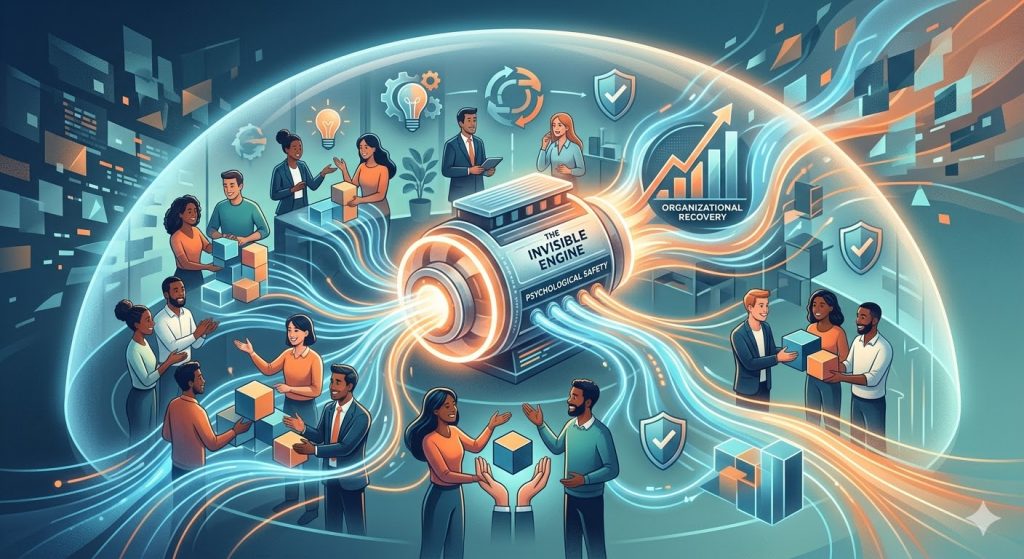
Trends That Change Culture Without Warning

LAST UPDATED: March 7, 2026 at 10:53 AM

Trends That Change Culture Without Warning

GUEST POST from Art Inteligencia


The Illusion of Stability: Why We Miss the Tipping Point

In my work helping organizations navigate change, I’ve observed a recurring trap: the belief that culture is a solid foundation. In reality, culture is more like a tectonic plate — it appears stationary until the accumulated pressure of shifting human expectations triggers a sudden, transformative leap. When these “earthquakes” happen, leaders often feel blindsided, yet the seismic data was there all along.

To survive and thrive, we must move past the Status Quo Bias and understand the mechanics of how a trend moves from a whisper to a roar.

The “Slow-Slow-Fast” Phenomenon

Most cultural shifts follow a non-linear trajectory. For years, a new behavior or expectation simmers under the surface, adopted only by “extreme users” or niche subcultures. To the traditional enterprise, these signals look like statistical noise.

  • The Slow Phase: Behavioral shifts are dismissed as “fads” or limited to specific demographics.
  • The Fast Phase: A catalyst — be it a technological breakthrough, a global event, or a social tipping point — synchronizes these individual behaviors into a collective demand.

By the time a trend is “obvious” enough to appear in a standard McKinsey report, the window for proactive innovation has likely closed. You are no longer leading the change; you are chasing it.

The Trap of Historical Data

Organizations often become “culturally blind” because they rely on lagging indicators. Revenue, churn rates, and annual engagement surveys tell you what happened yesterday. They rarely predict what people will value tomorrow.

“The most dangerous phrase in business is ‘We’ve always done it this way,’ but the second most dangerous is ‘Our data says customers are satisfied.'”

If your diagnostic tools only look for “correctness” within your existing model, you will miss the moment the model itself becomes obsolete. High satisfaction scores in a dying category are simply a measurement of how well you are polishing a sinking ship.

Visualizing the Stealth Trend

Understanding the Innovation Diffusion Curve is essential here. While the “Early Adopters” are experimenting with new ways of working, shopping, or communicating, the “Early Majority” is watching. The culture changes “without warning” the moment that majority decides the new way is safer, easier, or more prestigious than the old way.

As a human-centered innovator, your goal isn’t just to spot the trend — it’s to understand the human tension that the trend is finally resolving.

The Catalyst: Technology as a Behavioral Trojan Horse

One of the biggest misconceptions in innovation is that technology itself changes culture. It doesn’t. Technology is merely a permission slip. It provides a new way for humans to satisfy age-old desires — for connection, for autonomy, for efficiency — that were previously blocked by physical or systemic barriers.

When a new tool enters the ecosystem, it often looks like a “Trojan Horse.” On the surface, it’s just a utility (a faster way to buy a taxi, a simpler way to send a video). But inside that utility is a fundamental shift in behavioral expectations that, once released, cannot be put back in the box.

Secondary Effects: The “Permission” to Act Differently

We often focus on the primary effect of a technology (e.g., “The cloud allows for remote data access”). However, the secondary effect is what changes culture without warning (e.g., “The cloud gives employees the permission to demand radical geographic autonomy”).

  • The Frictionless Expectation: Once a customer experiences a one-click checkout in retail, they subconsciously begin to resent a five-step “request for quote” process in B2B. The culture of patience evaporates.
  • The Death of the Buffer: Real-time communication tools didn’t just speed up work; they killed the “buffer time” humans used to use for reflection. This shifted office culture from thoughtfulness to responsiveness.

The Democratization of Influence

Historically, culture was curated by “Gatekeepers” — media moguls, academic institutions, and corporate marketing departments. Technology has bypassed these guards, allowing “Weak Signals” to aggregate into “Strong Movements” in a matter of hours.

This shift means that your brand’s cultural standing is no longer defined by your mission statement, but by the collective lived experience of your users. If there is a gap between what you say and what you do, the “digital crowd” will find it, amplify it, and change the narrative before your PR team has finished their first coffee.

The “Invisible” Shift in Power

When technology shifts the power balance — from the seller to the buyer, or the employer to the employee — the culture shifts in its wake. A “CX Risk and Revenue Leakage Diagnostic” is effectively an audit of where you are still acting like a gatekeeper in a world that has already moved toward democratization.

“Innovation isn’t about the shiny object; it’s about the shadow the object casts on human behavior.”

As we look at these catalysts, we must ask: What is this technology giving my customers (or employees) permission to feel that they weren’t allowed to feel before?

Identifying “Weak Signals” in Your Organization

If culture is tectonic, then “Weak Signals” are the micro-tremors. These are the small, seemingly isolated deviations in behavior that hint at a larger shift. To capture them, we must look beyond high-level KPIs and dive into the “edges” of the organization — the places w here your systems are failing to meet a new, unspoken human need.

Identifying these signals is not a passive act of observation; it requires a proactive diagnostic mindset. We have to be willing to look at our data and ask, “What is the human frustration that our current metrics are hiding?”

The CX Audit as a Cultural Probe

A standard Customer Experience (CX) Audit is often used to fix bugs. But a human-centered audit uses those bugs as clues to cultural evolution. When a customer “hacks” your product or finds a workaround for your process, they are signaling that their expectations have outpaced your design.

  • The Workaround Signal: If customers are consistently using a “backdoor” to get support, it’s not a training issue; it’s a signal that your formal culture of “efficiency” is actually perceived as a culture of “avoidance.”
  • The Language Shift: Pay attention to the verbs customers use in support tickets. Are they asking for “help” (functional), or are they asking for “justice” (emotional/cultural)? A shift toward emotional language signals a change in the moral contract between brand and consumer.

Employee Sentiment vs. Engagement

There is a dangerous difference between an “engaged” employee (one who works hard within your system) and a “harmonious” employee (one whose values align with the evolving culture).

To find the weak signals internally, you must look at the unwritten rules. What do people talk about when the “official” meeting ends? If there is a growing gap between your stated values (e.g., “We value innovation”) and the lived reality (e.g., “We punish failure”), you have a cultural risk that will eventually manifest as a revenue leak.

A Framework for Decoding Signals

When you encounter a deviation, run it through this diagnostic filter to determine if it’s a “blip” or a “trend”:

Observation The Functional “What” The Cultural “Why”
Drop in Renewal Rates The product is too expensive. The customer no longer sees the product as part of their identity.
Increase in Help Desk Tickets The UI is confusing. Users have lost patience for any task taking more than 30 seconds.
High Talent Turnover Competitors pay more. The definition of “work-life balance” has shifted to “work-life integration.”

The Diagnostic Outcome

The goal of identifying these signals is to move from Corrective Action (fixing the leak) to Adaptive Innovation (re-designing the bucket). By catching these signals early, you can pivot your culture with intention, rather than being forced to change under the duress of a crisis.

A CX diagnostic isn’t just a financial tool; it’s a stethoscope for the heart of your organization.”

Building Cultural Agility: From Reacting to Anticipating

Identifying a cultural shift is only half the battle. The true differentiator for a leader is Cultural Agility — the organizational capacity to pivot strategy, behavior, and operations in lockstep with human change. In a world of “stealth trends,” the goal isn’t to reach a final destination, but to build a system that is comfortably fluid.

Agility doesn’t mean moving fast for the sake of speed; it means reducing the organizational friction that prevents a company from responding to what it already knows to be true.

Human-Centered Change Management

Traditional change management is often “mechanical” — it treats the organization like a machine where you simply swap out a part (a process or a software) and expect the output to change. Human-centered change recognizes that organizations are ecosystems.

  • Co-Creation over Mandates: Culture cannot be installed; it must be grown. When a diagnostic reveals a cultural gap, the solution should be designed with the people it affects, not for them.
  • Psychological Safety: For a culture to be agile, employees must feel safe pointing out when a trend is changing. If the “messenger is shot,” the organization remains deaf to the very signals it needs to survive.

Scenario Planning for the “Unthinkable”

Agility is a muscle developed through practice. Leadership teams should engage in “Future-Back” planning. Instead of asking “What will we do next year?”, ask “If the cultural expectation of ownership completely disappears in five years, what does our business model look like today?”

This exercise de-risks the “without warning” aspect of cultural shifts by making the “unthinkable” a discussed possibility. It transforms a potential crisis into a pre-vetted strategic pivot.

The Role of Continuous Innovation

In a shifting landscape, the greatest risk is standing still. Continuous innovation is the operationalization of cultural agility. It ensures that the organization is constantly running small-scale experiments at the “edges” where those weak signals were first detected.

“Agility is the ability to balance on a moving floor. If you try to stand perfectly still, you are the first one to fall.”

From Risk to Resilience

When we map CX risk to the P&L, we aren’t just looking for leaks; we are identifying the areas where our lack of agility is costing us money. A culture that can adapt without a “shock to the system” is a culture that has turned volatility into a competitive advantage.

Conclusion: Designing for the Fluid Future

The most profound changes to our culture don’t arrive with a press release; they arrive as a quiet shift in the collective “standard” for what is acceptable, valuable, or meaningful. As we’ve explored, the Illusion of Stability is a comfort we can no longer afford. To lead in this environment, we must trade our rigid maps for a more reliable compass: Human Empathy.

The Power of Empathy as a Strategic Tool

In an era of big data, empathy is often sidelined as a “soft skill.” In reality, empathy is the most sophisticated diagnostic tool we have. While an algorithm can tell you how many people stopped buying your product, empathy tells you why their values no longer align with your brand.

  • Deep Listening: This goes beyond focus groups. It’s about observing the lived experience of your customers and employees without trying to “fix” it immediately.
  • Unbiased Observation: The hardest part of spotting a trend is being willing to see a truth that contradicts your current business model.

The “Click” of Cultural Change

Culture doesn’t change because of a management memo or a marketing campaign. It changes because of a collective “click” — the moment people realize there is a better way to satisfy their needs. Your role as an innovator and leader is to be in the room when that click happens.

By integrating CX Risk and Revenue Leakage Diagnostics into your core strategy, you aren’t just protecting your P&L; you are building a cultural early-warning system. You are ensuring that when the floor moves, your organization moves with it.

“The future isn’t something that happens to you; it’s something you co-create with the shifting desires of the people you serve.”

Final Thought: Embracing the Fluidity

We must stop designing organizations to be “built to last” and start designing them to be “built to adapt.” The fluidity of the modern market isn’t a threat — it’s an opportunity for those brave enough to look at their own reflections and ask: “Are we still relevant to the lives of the people we serve?”

Keep your eyes on the weak signals, stay grounded in empathy, and never let the status quo blind you to the quiet shifts that change everything.

Image credit: Google Gemini

Subscribe to Human-Centered Change & Innovation WeeklySign up here to get Human-Centered Change & Innovation Weekly delivered to your inbox every week.