LAST UPDATED: May 2, 2026 at 3:12 PM
GUEST POST from Chateau G Pato
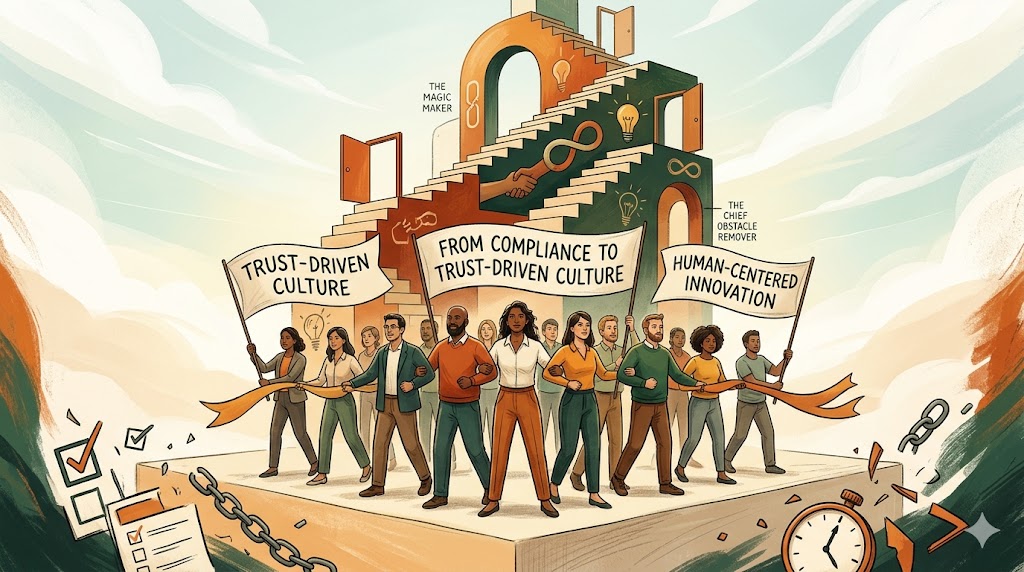
The Compliance Paradox: Beyond the Safety Net
For decades, organizations have leaned on compliance as the ultimate safeguard. It is the armor designed to protect the collective from risk, yet when worn too tightly, it becomes a cage that strangles the very innovation it aims to preserve. We find ourselves at a critical juncture where the “check-box” mentality no longer suffices for a world defined by volatility and rapid change.
The Illusion of Control
In many corporate environments, we see the rise of “compliance theater” — processes designed to create the appearance of order and security. While these systems provide a comforting sense of oversight for leadership, they often mask a deeper reality of disengagement. When people are managed primarily through monitoring, they stop looking for better ways to do things and start looking for the safest way to avoid reprimand.
From Monitoring Behavior to Fostering Intent
The transition to a trust-driven culture is not an abandonment of standards, but a re-imagining of human potential. Trust is not merely a “soft” cultural attribute; it is the mechanical lubricant of organizational agility. By shifting our focus from enforcing rigid behaviors to fostering high-integrity intent, we unlock the creative friction necessary for breakthrough experience design and future-proofing.
Understanding the Two Frameworks: Floor vs. Ceiling
To move toward a more resilient and innovative future, we must first recognize the fundamental mechanics of the environments we build. Most organizations are designed to manage the “floor,” but the next era of value creation happens at the “ceiling.”
The Compliance-Driven Culture: Managing the Floor
In a compliance-centric model, the primary objective is the mitigation of error. Success is defined as the absence of failure. This framework relies on several core characteristics:
- Extrinsic Motivation: People act to avoid repercussions or to satisfy a specific audit trail.
- Reactive Stance: Rules are often created in response to past mistakes, leading to a culture of “looking in the rearview mirror.”
- Hierarchical Rigidity: Decisions are funneled upward to centralized authorities who act as the ultimate arbiters of “correctness.”
While this ensures stability, it creates a dangerous lag in digital transformation and adaptive strategy.
The Trust-Driven Culture: Reaching for the Ceiling
A trust-driven culture shifts the focus from minimum requirements to maximum potential. Here, we design for the “power user” of organizational processes — the engaged employee who wants to drive impact. The hallmarks of this approach include:
- Intrinsic Motivation: Alignment with a shared purpose drives behavior, reducing the need for constant surveillance.
- Proactive Agility: Individuals are empowered to make real-time adjustments based on human-centered insights rather than waiting for a policy update.
- Networked Autonomy: Power is distributed to the edge, where the actual experience design occurs, allowing for faster response times and higher psychological safety.
The goal is not to eliminate rules, but to ensure that rules exist to serve the mission, rather than the mission existing to serve the rules.
The Human-Centered Design of Trust
Building trust is not an accidental outcome; it is a deliberate design choice. To transition away from rigid oversight, we must apply the same experience design principles to our internal culture as we do to our external products. We must treat our employees as the primary users of our organizational systems.
Empathy as a Strategic Tool
In a trust-driven organization, empathy is more than a sentiment — it is a diagnostic lens. We must look at the “Employee Journey” and identify where our existing compliance frameworks create friction, anxiety, or resentment. By designing internal processes that respect the professional’s time and intelligence, we signal that they are valued partners rather than suspects to be monitored.
Identifying and Eliminating “Compliance Theater”
Every organization has “ghost processes” — legacy rules that no longer mitigate risk but continue to slow down innovation. To build a trust-driven culture, we must perform a friction audit:
- Is the rule necessary? Does it address a current, quantifiable risk, or is it a relic of a past mistake?
- Does it empower or obstruct? Does the process help the “Magic Maker” achieve their goal, or does it force them into a defensive crouch?
- What is the cost of the friction? We must weigh the cost of 100% compliance against the opportunity cost of lost agility and disengaged talent.
Transparency by Default
Information asymmetry is the enemy of trust. When we move to a “Transparency by Default” model, we democratize decision-making and provide everyone with the context they need to act autonomously. This shift from “need to know” to “open by design” ensures that the Eight I’s of Infinite Innovation can flourish at every level, as people are equipped with the truth rather than just the task.
The Role of the Futurist: Anticipating the Trust Economy
As we look toward the horizon, the shift toward trust is not merely a “nice-to-have” cultural adjustment; it is a survival strategy for the Trust Economy. As a futurist, I see three inevitable shifts that make a compliance-heavy culture an evolutionary dead end.
The Changing Social Contract
The workforce of tomorrow—driven by Gen Z and the emerging Alpha generation—approaches employment with a fundamentally different set of expectations. They are digital natives who value authenticity, transparency, and alignment with their personal values. For these cohorts, a culture of surveillance is a non-starter. They don’t just work for a paycheck; they work for a purpose, and that purpose requires a foundation of mutual respect and autonomy.
AI and the Automation of Routine
We are entering an era where routine tasks, data entry, and basic monitoring are being subsumed by AI. As these technical functions are automated, the remaining value of the human worker lies in higher-order capabilities: empathy, complex problem-solving, and radical creativity. These are traits that cannot be “complianced” into existence. You can mandate that a person sits at their desk for eight hours, but you cannot mandate that they have a breakthrough idea. Breakthroughs only happen in environments where the psychological safety of trust outweighs the fear of making a mistake.
Resilience Through Decentralization
In a world of “permacrisis” and “black swan” events, centralized command-and-control structures are too slow to survive. Trust acts as a decentralized operating system. When every individual understands the “Why” and feels trusted to execute the “How,” the organization gains a collective intelligence that allows it to pivot in real-time. By moving decision-making to the edge, we create a resilient, networked ecosystem capable of navigating the Great American Contraction and beyond.
Pillars of Transition: Bridging the Gap
Moving from a culture of policing to a culture of partnership requires more than a memo; it requires a structural shift in how we value human contribution. To bridge this gap, we must lean into the foundational pillars that support human-centered change.
Psychological Safety and the “Fail Forward” Mentality
Innovation is inherently messy. If the penalty for an honest mistake is a compliance violation, your team will stop experimenting. To foster a trust-driven culture, we must provide the safety required for people to take calculated risks. This means celebrating the learning that comes from failure and ensuring that “The Conscript” feels safe enough to become a “Magic Maker” without fear of retribution.
Redefining Performance: Competence + Character
In the compliance era, we measured “what” was done. In the trust era, we must also measure “how” it was done. We must evolve our metrics to include:
- Collaborative Impact: How well does the individual empower others and contribute to the collective intelligence?
- Integrity and Accountability: Does the individual own their outcomes, both positive and negative?
- Adaptability: How effectively does the individual navigate change while maintaining alignment with organizational values?
The Leader as an Enabler
The role of leadership is undergoing a radical transformation. We are moving away from the “Chief Monitor” who ensures rules are followed, and toward the “Chief Obstacle Remover.” In this new capacity, a leader’s primary job is to ensure their team has the resources, the context, and the autonomy to succeed. By demonstrating trust first, leaders trigger a reciprocal cycle that elevates the entire organization’s performance and experience level.
When we treat trust as a structural component rather than a luxury, we stop managing for the lowest common denominator and start designing for our highest potential.
Conclusion: The Innovation Dividend
The journey from compliance to trust is not merely a moral imperative; it is an economic and competitive necessity. In an era where change is the only constant, the organizations that thrive will be those that realize trust is the ultimate accelerator. When we remove the friction of constant surveillance, we realize what I call the “Innovation Dividend” — the surge in speed, creativity, and value that occurs when people are truly empowered.
The Velocity of Trust
Low-trust environments are expensive. They are bogged down by redundant approvals, defensive documentation, and a hesitation to act without explicit permission. High-trust cultures, by contrast, operate with a unique velocity. Communication is clearer, decision-making is localized, and the cost of doing business decreases because you no longer need a “watcher for the watchers.” This efficiency is a mechanical advantage in the pursuit of infinite innovation.
A Call to Action for Design Leaders
Innovation is not a department or a destination; it is a byproduct of the environment you choose to build. As leaders in experience design and strategy, our job is to move beyond the safety of the floor and start architecting for the ceiling. We must ask ourselves: Are we building cages, or are we building platforms? Are we monitoring behavior, or are we inspiring intent?
Compliance may keep your organization in the game today, but only trust allows you to rewrite the rules of the game for tomorrow. It is time to stop checking boxes and start building the future.
Frequently Asked Questions: Building a Trust-Driven Culture
Transitioning from a traditional compliance model to one rooted in trust often raises questions about risk and accountability. Here are the most common inquiries regarding this strategic shift.
Does a trust-driven culture mean we ignore regulatory compliance?
Not at all. Regulatory compliance remains a non-negotiable “floor.” A trust-driven culture simply changes how those standards are met. Instead of relying on micromanagement to prevent errors, we empower employees with the training, context, and shared purpose to uphold those standards autonomously, freeing them to innovate above that baseline.
How do you measure accountability in an environment without strict monitoring?
Accountability shifts from tracking activity to measuring outcomes and behaviors. By using frameworks like the Experience Level Measure (XLM) and focusing on competence and character, we hold individuals accountable for their impact on the mission and their peers, rather than just their adherence to a clock or a checklist.
What is the first step for a leader to start building trust?
The first step is a “friction audit.” Identify one legacy process that signals a lack of trust — such as an unnecessary approval layer for a low-cost item — and remove it. By demonstrating trust first, leaders trigger a reciprocal response from their teams, creating the psychological safety necessary for human-centered change to take root.
Bottom line: Futurology is not fortune telling. Futurists use a scientific approach to create their deliverables, but a methodology and tools like those in FutureHacking™ can empower anyone to engage in futurology themselves.
Image credit: Gemini
 Sign up here to get Human-Centered Change & Innovation Weekly delivered to your inbox every week.