
Author Archives: Janet Sernack ImagineNation

About Janet Sernack ImagineNation

Janet Sernack is the Founder of ImagineNation™ a global innovation learning and coaching company that helps organisations, leaders, teams, and coaches adapt, innovate, and grow through disruption. She is an EMCC Master Practioner and ICF PCC executive, team, leadership and innovation coach, an award-winning global blogger on the people side of innovation, and presenter of the ICF CCE Coach for Innovators, Leaders and Teams Certified Program and is currently writing a book on "Anyone Can Learn to Innovate."

Innovation Teams Do Not Innovate

Innovation Teams Do Not Innovate

Guest Post from Janet Sernack

In our first blog in this series of three blogs, we reinforced and validated the importance and role of collaboration. We then described the range of emerging new, inspirational, and adaptive models that lean into complexity and catalyze and embed sustainable innovative workplace culture change. Where some organizations, like Alibaba, Disney, Google, Salesforce, and GE, developed their future fitness by courageously investing in catalyzing, igniting, and leading change through innovation teams.

Innovation teams are teams that don’t innovate!

Conventional team collaboration performance and development approaches are still relevant and foundational to long-term organizational success.  And, a new range of organizational needs are emerging in our fast-changing and disruptive world, that complement conventional team development processes including the importance of:

  • Providing a unified and holistic and systemic “collective mind” focussed on adding value to customers,
  • Being agile, focused, and in charge to make faster decisions,
  • Sharing resources and insights to reduce costs,
  • Working interdependencies to improve efficiencies and productivity,
  • Shifting focus from being competitive towards co-creating ecosystems to solve bigger, more complex problems, to lead, embed, and sustain value-adding change in a disruptive world.

According to the authors of Eat, Sleep Innovate, an innovation team is formed to develop “something different that creates value” and do this best in a culture where such behaviors come naturally.

These behaviors include:

  • Curiosity
  • Customer obsession
  • Adeptness to ambiguity
  • Collaboration
  • Empowerment
  • Accountability

Purpose of innovation teams

The purpose of an innovation team is to create an environment that unlocks an organization’s collective intelligence (capacity, competence, and confidence) and builds the capability to change as fast as change itself.

Usually, through providing mentorship, coaching, and learning process in ways that align, engage, enable, equip and leverage peoples’ collective intelligence to:

  • Adapt to higher levels of ambiguity and uncertainty,
  • Challenge the status quo and help break a conventional business as usual habits, leadership styles, and comfortable ways of working,
  • Provoke future “fast forward” (horizon three) thinking,
  • Support the implementation of digital and organizational transformational efforts,
  • Collectively and collaboratively drive innovation across organizations pragmatically and make it a reality,
  • Leverage synergies across ecosystems to solve complex problems and deliver increased value to customers.

Ultimately, to provoke and evoke future “fast forward” creative discoveries and experiment with new platforms and possible future business models to help guide future renewal and reinventions.

Delivering these, as smart and multi-disciplinary teams in ways that are timely, agile, and disciplined that potentially support and bring significant value to customers, the market, and to the organization.

Unconventional stretch collaboration requires connection, cognitive dissonance, and conflict

Experimenting with, iterating, and adapting new collaborative models, enables organizations and their leaders, to shift their focus – from being defensively competitive towards being creatively constructive.

Where the goal is to create a high performing, connected, and networked workplace culture where people:

  • Have the time and space to deeply connect, collaborate, and co-create value,
  • Maximize differences and diversity of thought,
  • Generate the urgency and creative energy to innovate,
  • Feel safe and have permission to freely share ideas, wisdom, knowledge, information, resources, and perspectives.

Innovation teams create discord and generate conflict

At ImagineNation™ we have found that the best way for innovation teams to perform is through building safety and trust, whilst simultaneously being safely provocative and evocative in creating discord and conflict to disrupt peoples conventional thought processes, behaviors, and habits.

To engage people in maximizing differences and diversity to generate creative ideas, and experiment with inventive prototypes, that ultimately solve big and complex problems and deliver commercially astute, innovative solutions.

By connecting, networking, and focussing on co-creation and emphasizing collaboration, inclusion, and mutual accountability, and not on being competitive.

Dealing with the organizational blockers – Innovation teams

At ImagineNation™ our experience has enabled us to understand and reduce the range of key common blockers to transformational and innovation-led change initiatives.

Where we support clients identify, and resolve and remove them by enabling and equipping innovation teams to:

  • Develop agile and innovation mindsets: building capability in safely exposing and disrupting rigid mindsets through customized mindset shifting, behavioral-based, skills development programs.
  • Understand the impact of the organization’s collective mindset: supporting teams to develop an empathic understanding of one another, then shifting how they feel and think to act differently, and cultivate the discomfort resilience when facing the challenges and failures in the innovation rollercoaster ride.
  • Enable leadership development: through educating, mentoring, and coaching leaders to grow their adaptive, collaborative, engaging, and innovative team leadership and membership capabilities.
  • Foster the development of an adaptive and innovative culture: by applying the cultural assessment and diagnostic processes that result in pragmatic culture change initiatives.
  • Ensure strategic alignment: sensing, perceiving, and developing a mutual focus, common language and understanding, and a collaborative networked way of working, that bridges the gap between the current and desired states.

Setting up an innovation team – the critical success factors

At ImagineNation™ we have also helped our clients identify, and embed the critical success factors, that enable innovation teams to drive and embed innovation-led change and transformational initiatives by ensuring:

  • Alignment to the mission, vision, purpose, values.
  • Strategic allocation of resources.
  • Leadership team sponsorship and mentorship.
  • Investment in team members and leader’s capability development.
  • Thinking big and focussing on clarifying and delivering future “fast forward” far-reaching solutions to highly impactful challenges.
  • Organization engagement and enrolment in implementing changes and creating, inventing, and delivering innovative solutions.
  • Lines of sight to stakeholders, eco-system players, and customers, taking an empathic value-adding perspective at all times.

Innovation teams – an unfreezing opportunity to co-create future-fit organizations

Embracing this type of collaborative approach creates an unprecedented opportunity for organizations, who have been upended as a result of the Covid-19 crisis, to develop a sense of urgency toward unfreezing and eliminating their corporate antibodies.

Empathizing with the range of challenges leaders are facing right now, where many are slowly waking up to a post-covid world, where there is an unprecedented and urgent opportunity to co-create a “new normal” that is well-designed to lift any of the emotional barriers to teamwork, locked-down relationships and online fatigue.

Opening the door to a new kind of co-creative, collaborative and cohesive team spirit that allows and encourages people to re-imagine, re-learn, reinvent and co-create new, fresh future fit, adaptive and innovative, people and customer-centric systems, structures, business models, and ecosystems.

All of which are mandatory for delivering future “fast forward” strategies for applying the collaborative and collective intelligence required for increasing value in innovative ways that people and customers appreciate and cherish, in ways we have not previously imagined, that connect with and contribute to, the good of the whole.

Find out about our learning products and tools, including The Coach for Innovators Certified Program, a collaborative, intimate, and deep personalized innovation coaching and learning program, supported by a global group of peers over 8-weeks, starting Tuesday, October 19, 2021.

It is a blended and transformational change and learning program that will give you a deep understanding of the language, principles, and applications of a human-centred approach and emergent structure (Theory U) to innovation, within your unique context. Find out more

Subscribe to Human-Centered Change & Innovation WeeklySign up here to get Human-Centered Change & Innovation Weekly delivered to your inbox every week.

Catalysing Change Through Innovation Teams

Catalysing Change Through Innovation Teams

Guest Post from Janet Sernack

What makes Israel so innovative? And what has this got to do with teaming? One of the key discoveries, we made, almost ten years ago, when we relocated to Israel, was the power of its innovation eco-system – the result of a collaboration between the state, venture capital firms, successful entrepreneurs, educational system, business system, incubators, and accelerators. Reinforcing and validating the importance and role of collaboration, where a range of new, inspirational, and adaptive models that lean into complexity and catalyze and embed innovative workplace culture changes, have emerged. Where some organizations have strategically and systemically, courageously invested in applying these new models internally, in catalyzing change through innovation teams.

Transform creative discoveries

Innovation teams transform creative discoveries and ideas into new platforms and business models in timely, agile, and disciplined ways that bring significant value to the market and organization. Who, according to Nick Udall, CEO and co-founder of nowhere, effectively deliver the desired step-changes, breakthrough innovations, and organizational transformation, in ways that “move beyond what we know and step into the unknown, where the relationship between cause and effect is more ambiguous, hidden, subtle and multi-dimensional.”

New collaborative models

The range of new collaborative models, include teams and teaming, tribes, collectives, and eco-systems, are all designed to help organizations innovate in turbulent times.

Where they empower and enable everyone to be involved in innovating, and in responding to the diverse assortment of complex challenges emerging from the Covid-19 crises. They also empower and enable people to co-sense and co-create inventive solutions to the range of “complex” challenges, in ways that potentially engineer 21st-century adaptability, growth, success, and sustainability, in countries, communities, and organizations.

Capacity to change

Groups, teams, and teaming are now the “DNA of cultures of innovation”, who fuel organizations, with an “evolutionary advantage – the capacity to change as fast as change itself.” As we transition from our pre-Covid-19 conventional business-as-usual “normals”, organizations have the opportunity to adapt to the high levels of ambiguity by leveraging their peoples’ collective genius.

Utilizing innovation teams to multiply their value and co-create innovation cultures that catalyze growth, in the post-Covid-19 world through:

  • Emerging and exploring possibilities
  • Discovering creative opportunities
  • Making strategic decisions
  • Incubating and accelerating new ideas.

Realm of the creative team

According to Dr. Nick Udall in “Riding the Creativity Roller-Coaster” – creative teams embrace and work with the unknown, intangible, invisible, the unconscious and the implicate, that their key challenges are “to wander with wonder into the unknown.”

Through cultivating a 21st-century skill set, including – attending and observing, questioning, listening and differing, risk-taking and experimenting, and teaming and networking that enables them to be, think and act differently.

Catalyzing change through innovation teams involves creating a culture of innovation, which according to the authors of “Eat, Sleep, Innovate” – is one in which (mindsets) and behaviors that drive innovation come naturally.

Where creative teams are formed around a Passionate Purpose, that propels them into the unknown, in an unpredictable world, where they connect and stretch with cognitive dissonance and creative tension, through developing discomfort resilience. To co-create collective breakthroughs that shift them beyond managing the probable, toward leading what’s possible.

Role of collective mindsets and behaviors

One of the key elements that we can intentionally cultivate is our ability to develop habits that build our mental toughness and emotional agility to cope with stress and adversity, at the same time, paradoxically, create, invent and innovate.

The one thing that we can all control, and is controllable, are our individual and collective mindsets – how we think, feel and choose to act, in solving complex problems, performing and innovating, to dance on the edges of our comfort zones, in the face of the kinds of uncertainties we confront today.

Challenges in creating a culture of innovation 

Our research at ImagineNation™ has found that many organizations are disappointed and disillusioned with many of the conventional approaches to effecting culture change, largely because of variables including:

  • Confusion between the role of climate, culture, and engagement assessments and processes, knowing which one aligns to their purpose, strategy, and goals and delivers the greatest and most relevant value.
  • The typically large financial investment that is required to fund them.
  • The time it takes to design or customize, and implement them.
  • The complexity of tools and processes available that are involved in contextualizing and measuring desired changes.
  • Designating responsibility and accountability for role modeling, leading, and implementing the desired changes.
  • Building peoples’ readiness and receptivity to the desired change.
  • Efforts are required in removing the systemic blockers to change.
  • Designing and delivering the most appropriate change and learning interventions.
  • The false promises of “innovation theatre”.
  • The time it takes to reap desired results, often years.

In response to our client’s need for speedy, cost-effective, and simple, internal and collaborative culture change initiatives, we developed an integrated, simple, yet profoundly effective approach that integrates three powerful streams for catalyzing change through innovation teams:

  1. Team development and teaming skills
  2. Education and learning interventions
  3. Coaching and mentoring initiatives

By taking these variables into account, focussing on building the internal capability, and offering a different and fresh perspective towards catalyzing change through innovation teams.

Creating a culture of innovation – the innovation team 

We took inspiration from our 32 years of collective knowledge, wisdom, and experience across the domains of change management, culture, leadership, and team development as well as from our 8 years of iterating and pivoting our approach to the People Side of Innovation.

Coupling this with our extensive research sources, we developed and customized a team-based action and blended learning and coaching methodology for innovation teams, described as:

  • Change catalysts who operate with senior leadership sponsorship, empowered and equipped to trigger internal change management, engagement, and learning initiatives.
  • Teachers, coaches, and mentors who provide coaching and mentoring support to educate people in innovation principles and processes that cultivate sustainable innovation through co-creating learning programs and events.
  • A small effective and cohesive team, of evangelists, agitators, coaches, and guides and enables the whole organization to participate through partnering and collaborating on potentially ground-breaking (Moonshot) projects, aligned to the organization’s vision, purpose, and strategy.
  • Amazing networkers and influencers who work both within and outside of silos to inspire and motivate people to co-operate and collaborate by taking a systemic perspective, leveraging organizational independencies, to co-sense and co-create groundbreaking (Moonshot) prototypes that they pitch to senior leaders.
  • Being customer-obsessed and equipped with the innovation agility – capacity, competence, and confidence to adapt, transform, and constantly innovate to maximize the impact of innovation across the organization to affect growth, and deliver improved value by making innovation everyone’s job, every day, to make innovation a habit and way of life.

Developing the future fit future-facing company

Involves a commitment toward catalyzing change through innovation teams, leveraging teams, tribes, collectives as internal growth engines, who collaborate quickly to respond to ambiguity, turbulence, and rapid developments. By being nimble and agile, leading with open minds, hearts, and will to be present and compassionate to emerging human needs, courageously experiment with different business models, and creatively contribute to an improved future, for everyone.

This is the first in a series of three blogs about catalyzing change through innovation teams, why innovation teams are important in catalyzing culture change, and what an innovation team does.

Check out our second blog which describes how an innovation team operates and our final blog which includes an evidence-based case study of an effective and successful innovation team in a client organization.

Find out about our learning products and tools, including The Coach for Innovators Certified Program, a collaborative, intimate, and deep personalized innovation coaching and learning program, supported by a global group of peers over 8-weeks, starting Tuesday, October 19, 2021.

It is a blended and transformational change and learning program that will give you a deep understanding of the language, principles, and applications of a human-centered approach and emergent structure (Theory U) to innovation, within your unique context. Find out more

Image credit: Unsplash.com

Subscribe to Human-Centered Change & Innovation WeeklySign up here to get Human-Centered Change & Innovation Weekly delivered to your inbox every week.

Evoke Deep Change by Shifting Consciousness

GUEST POST from Janet Sernack

Australia is experiencing a range of catastrophic Black Swan environmental events, including mega bushfires, floods, hail and dust storms which have now catalyzed as serious wicked problems. Simultaneously, we are living in disruptive VUCA conditions, yet we are generously and courageously helping out others, to save homes, native animals, and flora and fauna. In a state of political instability and uncertainty, and, like the rest of the global community, we are being challenged by the emerging threat of a coronavirus pandemic. Such a range of catastrophic conditions provides global and local opportunities for an inflection point to emerge.  Our governments and our organizations are facing a time of significant change, also be described as a turning point where “the economy has crossed an inflection point and is poised for bigger things”. Creating an opportunity to evoke deep change by shifting consciousness, by cultivating enhanced levels of personal and systemic self-awareness.

Resulting in consciously choosing what might be the most useful, creative and intelligent set of responses to these catastrophic crises and disruptive VUCA conditions. According to Singularity University, evidence of this already exists; where powerful new entrepreneurs are consciously working strategically and systemically, towards integrating exponential technologies with human factors to solve some of the world’s greatest challenges.

What do we mean by consciousness?

Consciousness: “the state of being aware of and responsive to one’s surroundings” is at the core of our ImagineNation™ innovation model. It involves evoking and cultivating the states and qualities of mind, through intentional and specific mindset shifts, that enable us to be and think differently, as well as to act differently by taking intelligent and right actions that serve the collective and the good of the whole system.

Evoke deep change by shifting consciousness – where attention goes, energy flows

Our approach and method involve:

  • Knowing how to pay deep attention to step into the unknown, to explore and discover what is really going on in the whole system, through retreat, stillness, silence and reflective inquiry practices.
  • Being mindful, composed and detached in a disruptive VUCA world, through being proactive, in choosing what might be the most useful, imaginative, creative and intelligent set of responses in the situation and being accountable for delivering it.
  • Being intentional towards manifesting what is wanted, being fully present, aware and attentive as to what happens in the worlds both inside and outside of our worlds, with detachment, wonder and curiosity.
  • Making fundamental choices that interrupt conventional ways of delivering results, allowing, and not forcing them to emerge, diverge and converge, by operating at higher levels and frequencies of co-creative consciousness.

To mindfully engage, motivate and pull people towards cracks, opening and thresholds that inspires them to shift their way of being, thinking and doing, and evoke deep change through shifting consciousness, to be fluid and flow purposefully in disruptive VUCA conditions.

Crossing the post-conventional threshold

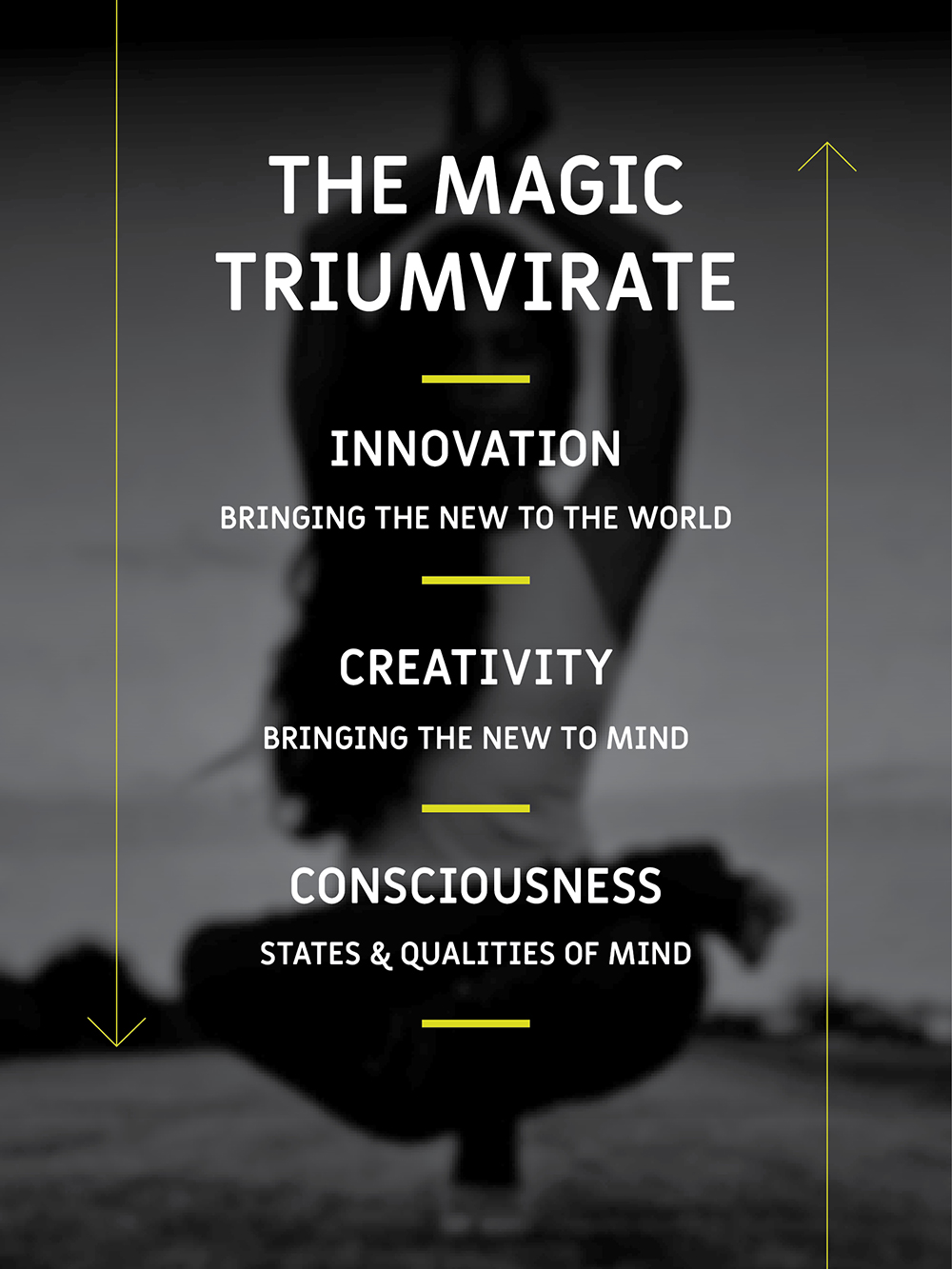
Our approach incorporates and integrates the work of Dr. Nick Udall, in “Riding the Creativity Rollercoaster” with innovation, described as making changes that add value and successfully bring the new to the world.

In his book, he describes this as “crossing the post-conventional threshold” where:

“Organizational cultures, leaders, and teams need to step over in order to create containers and hold spaces potent enough and large enough to:

  • Catalyze creative insights and collective breakthroughs
  • Face into the super wicked problems of society
  • Ultimately evoke the music of innovation – thereby enabling us all to live and work at a higher, co-creative frequency.”

What is the ImagineNation™ innovation model?

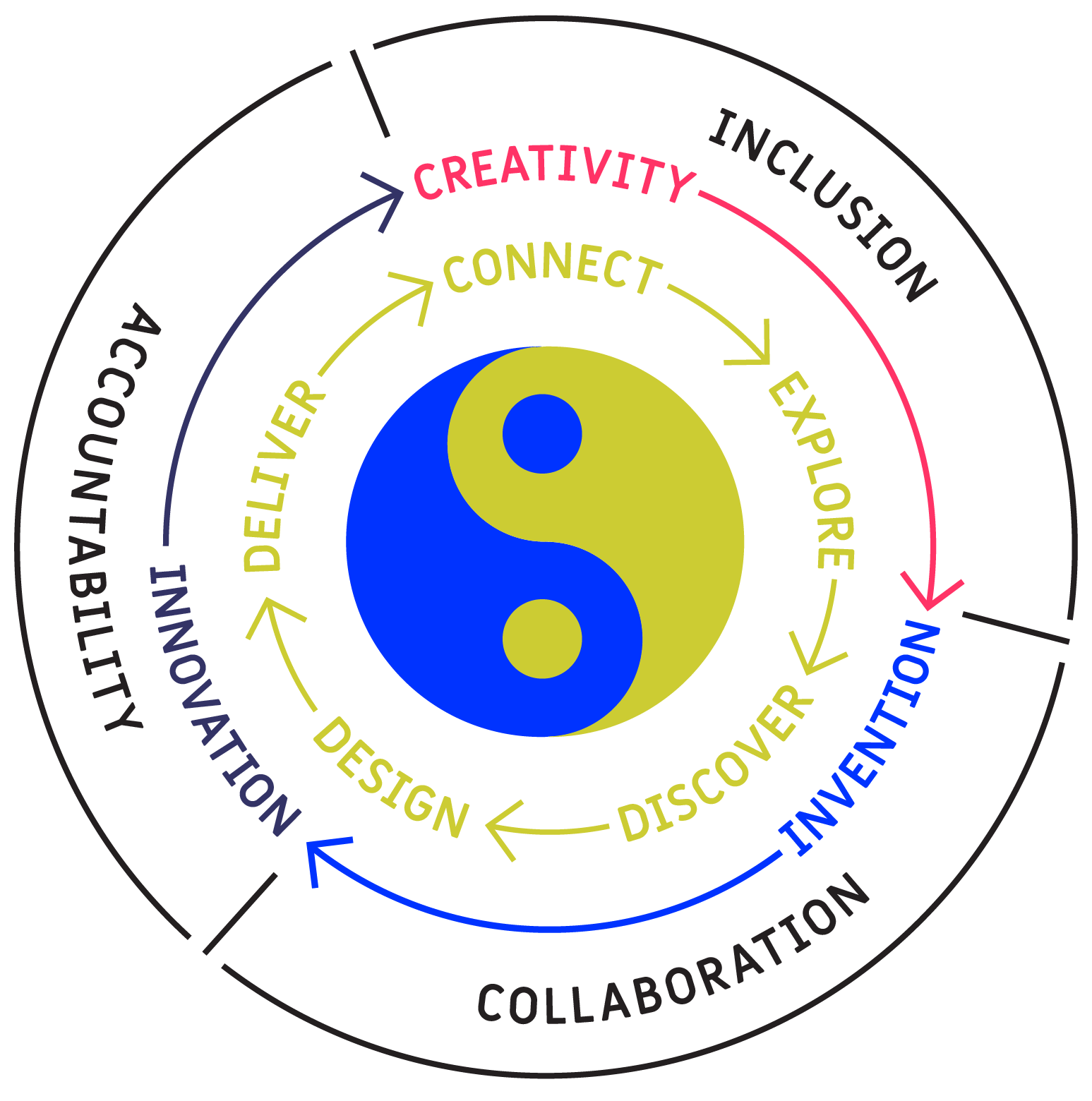
To evoke deep change through shifting consciousness, requires us to dance fluidly and flow purposefully in disruptive VUCA conditions, it also involves cultivating collective creativity and collective consciousness across key phases:

  • Connect with others, with sensing and empathizing with the opportunity or problem, as well as connecting and associating with the patterns and trends emerging, diverging and converging in the whole system.
  • Explore with a paradox lens and an open mind, heart and will as to “what is” with applying elastic thinking to evoke “what could be”.
  • Discover cracks, emerge opening and thresholds for emerging and colliding creative ideas for creating and capturing value to target markets.
  • Design using human-centered design thinking and generative discovery skills to invent high-value solutions that customers will appreciate and cherish
  • Deliver commercial, impactful and sustainable valuable outcomes, through developing a culture of inclusion, collaboration, and accountability that people appreciate and cherish.

Enacting and embodying the Magic Triumvirate

Creativity is about bringing the “new” to mind described in the book as:

“Being the dance between what we know and don’t know, and it is through this dance that we make meaning of the world around us. Making the unknown knowable, the unconscious conscious, and the invisible visible”.

It is a mindful, emergent and whole body, neurological process, that brings forth this newness. Requiring cultivating an open mind (curiosity and detachment), an open heart (connection and compassion) and an open will (being willing to let go of control and wilfulness and being courageous and confident in the face of the unknown disruptive VUCA conditions.)

To awaken states and qualities of mind (mindsets) that help creativity flow and flourish as well as create intentional pattern interrupts to “business as usual” or habitual states and qualities of mind that inhibit or kill our curiosity and creativity. To then co-create a frequency that allows us to “awaken” the leadership qualities, consciousness, states and qualities of mind, our cognitive, heart and gut intelligence that help creativity flourish, and dispel those that kill it.

Evoke deep change through shifting consciousness involves an awakening

The “awakening” process aims to raise people’s levels of Self, Relational and Systemic Awareness, so they become conscious organisms and tap into the wider collective intelligence available to us in the whole system.

  • Invention involves a unique or novel device, method, composition or process. It may be an improvement upon a machine or product or a new process for creating an object or a result. An invention that achieves a completely unique function or result may be a radical or disruptive breakthrough.
  • Innovation involves making changes that add value, knowing how to be present, see, respond to opportunities and solve problems in creative ways that people value and cherish
  • Inclusion is both the involvement and the empowerment of people, where their inherent worth and dignity is recognized. An inclusive approach promotes and sustains a sense of belonging; it values and practices respect for the talents, beliefs, backgrounds, and ways of living of its members.
  • Collaboration in the context of innovation is when two or more people (often groups and teams) work purposefully together, across silos to maximize differences and diversity, to generate creative ideas for accomplishing a common goal.
  • Accountability involves giving and keeping your word, negotiating a contract between two or more parties, involves giving your word, for what you are being counted on, to deliver. What a person has committed, or has promised, to deliver, as a measurable, timely and specific outcome.

Considering that the technologies that are emerging, diverging and converging, are getting faster and faster, you might also take a moment to hit your own pause button, retreat and reflect how you might evoke deep change through shifting consciousness?

Especially in the face of the unknown and with disruptive VUCA conditions continuing to confront, challenge and confuse us, how might you enhance your level of personal and systemic self-awareness, to help create the inflection and turning points the world needs right now?

Find out about The Coach for Innovators Certified Program, a collaborative, intimate and deep personalized innovation coaching and learning program, supported by a global group of peers over 8-weeks, starting October 20, 2020. It is a blended learning program that will give you a deep understanding of the language, principles, and applications of a human-centered approach to innovation, within your unique context. Find out more.

Contact us now at mailto:janet@imaginenation.com.au to find out how we can partner with you to learn, adapt and grow your business in the digital age.


Subscribe to Human-Centered Change & Innovation WeeklySign up here to get Human-Centered Change & Innovation Weekly delivered to your inbox every week.
Strategic and Systemic Alignment – why they really matter

GUEST POST from Janet Sernack

In my early days at Compass Learning, I designed and delivered a wide range of top team strategic alignment and development programs. Where the focus was on enabling and empowering team members to metaphorically “sing from the same song sheet” – by agreeing to and articulating a common purpose, clarifying roles and goals and driving mutual accountability. Also, by establishing, the most effective communication, decision making, and problem-solving processes, all of which were designed to cultivate trusted relationships. The outcomes included increased cohesion, collaboration, and agility, making them resilient and sustainable as high performing and fast-moving effective teams – who responded quickly to change, often in the face of disruption and adversity.

Since I evolved Compass Learning, more than six years ago, into ImagineNation™ where our focus is on enabling people and organization to be, think and act differently to adapt and grow through disruption. I realized that strategic alignment is more important than ever, especially in a globalized, connected and VUCA world.  Where leaders, teams, and organizations, who are seeking to thrive and survive in the playing fields of the future, must collectively and cohesively learn to “sing from a new and different song sheet”.

Aligning strategically and systemically

This new song sheets agency involves humming tunes about customer-centricity, adaptiveness, collaboration, and innovation, as the most effective ways of improving organizational performance and growth.

Where the outcome is a strategically and systemically aligned, resilient and sustainable organization.

This involves aligning systemically all elements of a business – the market strategy, leadership team, operating environment and culture. As well as the way the company itself is organized, led and managed so it can adapt, connect, evolve and create value, and great results, through innovation and disruption.

All these critical elements need to be aligned, in such a way as to best support the fulfillment of its long-term purpose for change, adaptation, growth or innovation.

Especially in a competitive and globalized world, where speed and agility matter most!

How do you know whether you are aligned, or not?

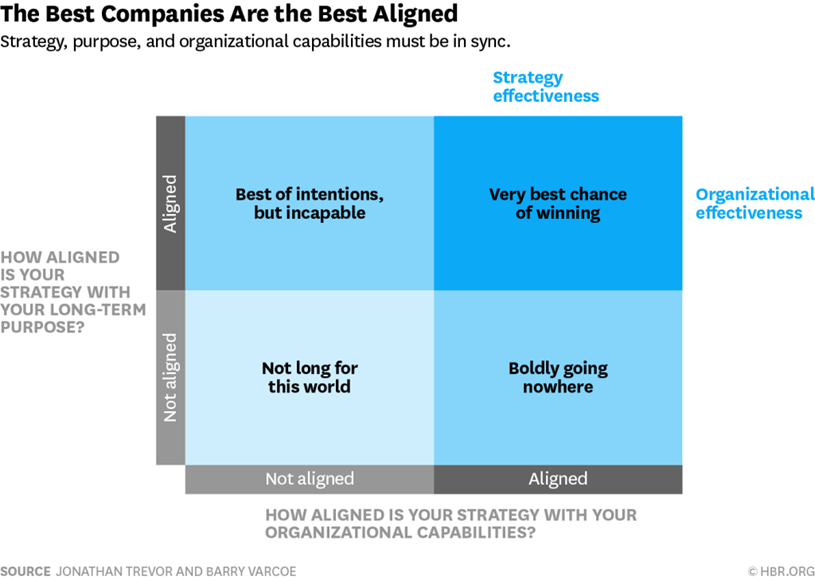
Taking a balcony perspective, authors Jonathan Trevor and Barry Varcoe, in a recent HBR article https://hbr.org/2016/05/a-simple-way-to-test-your-companys-strategic-alignment present a simple model illustrated below:

Where does your organization sit?

  • Very best chance of winning: Companies that score highly on both scales stand the very best chance of winning in their competitive field.
  • Best of intentions, but incapable: Companies that score highly on the purpose and strategy alignment scale, but low on the strategy and organization scale, are more or less incapable of implementing their strategy as intended.
  • Boldly going nowhere: Businesses that have strong alignment between their strategy and organization, but weak alignment between strategy and purpose are classed as “boldly going nowhere.”
  • Not long for this world: Companies that score low on both scales are in crisis, even if it isn’t immediately obvious.

How might you then answer these four questions?

Take a moment to pause, retreat and reflect – how you might respond to the following five questions about your level of strategic alignment to your long-term purpose vision for change, adaptation, growth or innovation:

  1. How well is your business strategy supporting the fulfillment of your company’s purpose?
  2. How is your leadership team aligned and enabled to effectively deliver the business strategy?
  3. How well is your organization overall, especially your culture, supporting the achievement of your business strategy?
  4. How aligned is your strategy with your overall organizational capability?
  5. How resilient and sustainable is your organization in the face of exponential change and disruption?

Simplifying strategic alignment

At ImagineNation™ we searched the world to discover better ways of helping our clients understand the importance of strategic alignment to help them build a more resilient and sustainable organization. To enable them to shift from taking the short term “fix it” approaches, aptly described as “innovation theatre” to move toward understanding and resolving the deeper root causes.

In a recent HBR article https://hbr.org/2019/10/why-companies-do-innovation-theater-instead-of-actual-innovation, Steve Blank reinforces this perspective:

“Today, as large organizations are facing continuous disruption, they’ve recognized that their existing strategy and organizational structures aren’t nimble enough to access and mobilize the innovative talent and technology they need to meet these challenges. These organizations know they need to change, but often the result has been a form of organizational whack-a-mole – a futile attempt at trying to swat at problems as they pop-up without understanding their root cause.

Ultimately, companies and government agencies need to stop doing this or they will fail.”.

He reinforces the need for simplifying strategic alignment, supporting organizational redesign, which our research and experience, at ImagineNation™ requires:

  • Exploring differing methodologies to qualify and quantify, the impact of strategic alignment, on performance. Identifying both the tangible gains and losses across the strategic, systemic, leadership, culture and capability domains.
  • Making the vital and crucial strategic alignment links between strategy and mindsets, both individual and collective. To inform strategic decision making, in order to drive organization-wide, intelligent actions.
  • Identifying and managing the crucial relationship between mindsets and culture. Realizing that mindset shifts enable business transformations that enhance organizational capability that results in an adaptive, customer-centric, resilient and sustainable
  • Supported by systemic, organization-wide innovation learning and daily activities, and process reforms.

Taking the first steps – adopting a process to fix this

Boards, CEO’S and leadership teams have the opportunity to ensure that “innovation theatrics” are dropped, and that they take responsibility for leading people and organizations forward in the imagination and digital ages.

By taking charge of their strategic alignment and building an Innovation Doctrine –encompassing a staged, strategic and systemic approach to retool to win in the next decade.

That is kickstarted by applying a validated, business-based assessment process and system – designed to strengthen alignment between leaders, strategy, processes, systems, and culture across functions, leadership levels, locations and regions within the organization.

The Organizational Growth Indicator

We recommend using a multifactorial and customizable model (OGI®) to assess your organization’s ability to grow through innovation and change and:

  1. Assess both the strengths and the constraints occurring in your organizational system that impact your ability to affect value creation and organizational growth.
  2. Measure the current state of your leaders, people’s, teams’ ability to adapt connect, evolve and create value through innovation and disruption.
  3. Develop a description of your Culture Type, and assess your organization’s cultural “Readiness” for change – your organization’s ability to shift and transform adaptively.
  4. Codify the organization’s Collective Cultural Mindset and link it to Performance Metrics – revenue growth, profitability and other KPI’s (Key Performance Indicators) important to the organization.
  5. Truly assess and measure the impact (ROI) of past, current and future Training and Organisational Development Initiatives implemented to improve the organization’s innovative and transformative capabilities.

The last word – it’s all of them, all at once

Reinforcing that developing strategic alignment is more important than ever, in building an adaptive, customer-centric, collaborative and innovative resilient and sustainable organization.

To both prepare people for a future they cannot control or predict, in a disruptive world, and enable them to also flourish and grow in the playing fields of the future.

It takes courage, conviction, and commitment, and if you are not convinced yet, take heed of Steve Blanks warning to us all:

“The type of disruption most companies and government agencies are facing is a once-in-every-few-centuries event. Disruption today is more than just changes in technology, or channel, or competitors – it’s all of them, all at once. And these forces are completely reshaping both commerce and defense.”

Find out about The Coach for Innovators Certified Program, a collaborative, intimate and deep personalized innovation coaching and learning program, supported by a global group of peers over 8-weeks, starting January 28, 2020. It is a blended learning program that will give you a deep understanding of the language, principles, and applications of a human-centered approach to innovation, within your unique context. Find out more.


Image credit: Pixabay


Subscribe to Human-Centered Change & Innovation WeeklySign up here to get Human-Centered Change & Innovation Weekly delivered to your inbox every week.
Creating high-performing and faster-moving teams

GUEST POST from Janet Sernack

It seems that every meeting I went to recently, and almost every person I spoke to, mentioned the new book, from the authors of How Google Works – The Trillion Dollar Coach. I dutifully ordered it and once I had the chance, diligently read it. It is described as the “blueprint for forward-thinking business leaders and managers that will help them create high-performing and faster-moving teams and companies”. A sort of Tuesdays with Morrie for aspiring managers and leaders in the connected, digitized exponentially changing the world, making team coaching the new collaborative cultural norm. A book that deeply honours and unpacks the great impact of Bill Campbell on the digital giants of Silicon Valley, outlines his team coaching techniques that resulted in high-performing and faster-moving teams, within collaborative workplace cultures.

Three key business nutshells

Here are the three key nutshells I uncovered in a world where team coaching is the new collaborative cultural norm for aspiring managers and leaders towards creating high-performing and faster-moving teams.

  1. Leading innovative tech companies, no matter whether it was Google, Intuit, Microsoft or Apple, all benefited from coaching. By drawing on their coach to support, respect, trust and enable them to close the gaps between what they were currently doing, and what they needed to do to build and sustain their ultimate awesome successes.
  2. Many start-up founders and techno’s tend to be individualistic, passionate and often anti-conventional contrarian thinkers, misfits, and high achieving doers. Operating from intuition, being willing to experiment and learn from their failures, they often found themselves at odds with their boards, investors, and people. By drawing on the wisdom of their coach, they acquired the management (and leadership) fundamentals necessary to be flexible, adaptive and agile in knowing how to respond quickly and deal effectively with the range of challenges that emerged as they built their businesses by creating high-performing and faster-moving teams.
  3. Whilst digital and technical expertise, vision and passion, technology, strategy, creativity, and invention all co-exist and drive innovative start-ups, they all ultimately acknowledged that “it’s the people” who, who operate best as high-performing and faster-moving teams, who manage, lead, execute and deliver operational excellence and high-performance business outcomes. By drawing on the wisdom of their coach to help them manage and lead their people to be more effective in their jobs, and to grow and develop. By assuming that their people want to do well, they are capable of doing great things and come to work fired up to do them. By creating an environment that liberates and amplifies that energy.

What are the key learnings towards creating high-performing and faster-moving teams?

The top priority of any manager is the well-being and success of their people, and it takes deep attention, intention and (soft) skills to enact and embody this effectively by creating high-performing and faster-moving teams:

  • Within an environment that supports people to be successful by giving them the tools, information, training, and coaching to succeed.
  • Ensuring that people are respected, no matter where they are coming from and that their unique career goals are understood.
  • Being aware, sensitive and empathic to their life’s choices.
  • Trusting and freeing people up to do their jobs and make decisions, by knowing that people want to do well and believing that they will.

My own Bill Campbell Story

In the mid-1990s, Westpac, one of Australia’s big four banks, had a near-death experience, where poor investment decisions and board instability put them right on the edge of failure. Where they almost went to the wall, with the share price falling to around the $6.00 mark.

Bob Joss, “a builder, and not a wrecker” from Wells Fargo, was recruited to lead the way forward. Amongst a range of significant strategies, including raising the profile of women in the bank, he instituted a transformational leadership program branded ‘Making it Happen’. It involved the top 1200 managers globally, and I was fortunate to be a lead facilitator in delivering the program. Which focussed on building a leader’s capability to set and achieve key goals, and deliver specific financial and structural business outcomes, through their people.

It was where I met first encountered Robert, my “Bill Campbell”, not only as a contrarian and challenging participant (and there were many), he was also the new CIO of Westpac Financial Services.  During one of the workshops, I mentioned that we had a new approach towards Developing Top Teams in organisations, which focussed on building the leadership and collaborative capabilities in high-performing and faster-moving teams.

This heralded the beginning of what became a twenty-year professional win/win relationship because Robert intuitively knew that “it’s the people” who manage, lead, execute and deliver operational excellence and high-performance business outcomes. In his many manifestations, as the CIO in a diverse range of technology-based companies, he knew that people perform at their best, through collaboration, in teams. He also knew and diligently practiced “working the people, before solving the problem” despite some of the people involved, operating as misfits and renegades.

In many ways, up until today, Robert unconsciously acted as my coach, during my twenty-year professional development as a corporate consultant, trainer, facilitator, coach and even, as a start-up entrepreneur when I founded ImagineNation™. Every time he shifted to a more senior or different role, we always opened our minds and hearts towards boldly and courageously experimenting and advancing our methodologies in effecting team led strategic change. Constantly testing, validating, iterating and pivoting different, adaptive and innovative approaches toward designing and delivering the most effective, top team leadership and membership development programs, for current as well as for creating high-performing and faster-moving teams.

Three key nutshells in creating high-performing and faster-moving teams

Here are the three key nutshells I uncovered in a world where team coaching is the new collaborative cultural norm, in developing the trusted relationships, in high-performing and faster-moving teams, in the digital age:

  1. Every team needs clarity of purpose, whether it is a project-based team or a functional team, they need to share a creative conversation about why they exist and what they hope to achieve by working together. It needs to be inspirational (passionately purposeful to ignite people’s intrinsic motivation), achievable (as a measurable outcome) and meaningful (value-adding and making a difference).
  2. Every team member needs role clarity, again whether it is a project-based team or a functional team, they need to share a creative conversation about their individual contribution and accountability towards achieving the teams’ purpose. Each person’s role needs to be clearly defined, understood by everyone on the team so that they can support each other to achieve, and be mutually accountable for delivering the meta or high-level purpose. People need to be committed and convinced that their individual and collective strengths, will provide cohesion. To be mutually respectful of each other’s talent, knowledge, experience, and skills, and have the determination, and grit required for each other’s success.
  3. Every team needs a set of agreed core and agile processes, for effectively guiding their behaviours, communicating, solving problems and making decisions. People need to be willing to take personal responsibility for enacting and embodying the behaviours, following the communications (and meeting schedules and guidelines), as well as the decision making and problem-solving processes. Even when they may not agree with the team’s decision, they become committed to “team first” and become mutually accountable for enacting them.

With companies today, contending with new dimensions of competition– shaping malleable situations, adapting to uncertain ones, and surviving harsh ones – all require new approaches. Team coaching is one of the new collaborative cultural norms in creating high-performing and faster-moving teams, and within collaborative communities, to lead in the imagination age, in today’s fast-changing world.


Image credit: Pixabay


Subscribe to Human-Centered Change & Innovation WeeklySign up here to get Human-Centered Change & Innovation Weekly delivered to your inbox every week.
Leading People in the Imagination Age

GUEST POST from Janet Sernack

Most of us are aware that the nature of work is changing. According to Singularity University, while emerging technologies may destroy many jobs, they will also create many new appealing ones. Widespread innovation, in the imagination age, will give birth to exciting new industries, all of which are sources of new jobs and occupations. It’s exciting to imagine an intriguing parallel future in which technology has created even more opportunities for the workforce. Where people will maximize the potential of all three of their key modalities; heads, hearts, and hands to fill the interpersonal and creative roles that will be hardest of all to mechanize. Where, according to Deloitte, in the recent article, “The path to prosperity: Why the future of work is human” the boring, repetitive work will be done by robots, leaving the more challenging, creative and interesting work for us humans, making leading people, a key priority.

Welcome to the imagination age

The imagination age is a theoretical period beyond the information age where creativity and imagination will become the primary creators of economic value. Contrasting with the information age where analysis and thinking have been the main activities.

“An imagination economy is defined by some thinkers as an economy where intuitive and creative thinking create economic value after logical and rational thinking has been outsourced to other economies.”

John Hagel, co-chairman of Deloitte’s Centre for the Edge, also believes the future of work relies on drawing out our capabilities that are not context-specific and that create value. And he doesn’t believe these skills are limited to the creative class. “I believe we all, as human beings, have curiosity, creativity, imagination, social intelligence, and emotional intelligence,” he said.

The new logic of competition

In a recent article, by BCG Henderson Institute, The New Logic of Competition they state that “Today’s business leaders are dealing with complex competitive concerns in the short run. But as the 2020s approach, they must also look beyond today’s situation and understand at a more fundamental level what will separate the winners from the losers in the next decade”

Outlining five new imperatives of competition that will come to the forefront for many businesses, one of which is the opportunity for organizations to compete on imagination through imagining and harnessing new ideas.

Putting people at the centre

How can we prepare people, and especially leaders, for the imagination age to solve some of the world’s biggest challenges, creatively and collaboratively, through experimentation and innovation?

At ImagineNation™ we develop people’s head, heart, and hand capabilities, that enhance the multiple intelligences that enable them to make smart decisions and take intelligent action:

  • Head or cognitive intelligence to be more inquisitive, imaginative, curious and creative.
  • Heart or emotional intelligence to be more connected, centred, empathic and compassionate.
  • Hand or visceral intelligence to be more courageous, determined and collaborative.

In the “The path to prosperity: Why the future of work is human”Deloitte also states that If we set up the right workplaces – with people at the centre – where leading people really matters, Australia (and other nations), can be smarter, happier and more engaged than they are today:

  • Workers can have the skills they need (effectively making them better suited to – smarter – for the jobs of the future) in the imagination age.
  • Better matching between what businesses need and what workers have can make workplaces happier and more efficient.
  • And more flexible workplaces can encourage more people to work – to be more engaged than they are today.

Shifting the leadership paradigm

With these factors in mind, how might they impact future leaders, and how can we prepare leaders to simultaneously and speedily improve and sustain business performance, whilst create meaningful work for people – in ways that are agile, trustworthy and collaborative?

One way might be to focus on developing their head, heart and hand capabilities, by igniting the six C’s of innovation leadership.

These are the foundations for leading in ways that activate people’s ability to be, think, talk and act differently, to survive and thrive in the imagination age.

Introducing the six C’s for leading people in the imagination age

  1. Connected: being fully present to self, other, group and the whole system, being transparent and composed, evoking both ‘what is’ and imagining ‘what could be’ possible.
  2. Curiosity: being open-minded, inquisitive, enquiring and listening, to self, other, group, and the whole system, evoking wonder, novelty, and possibilities to sense opportunities.
  3. Compassionate: being open-hearted and empathic to the feelings and suffering of self, other, group, and the whole system, bringing out the very best in people, evoking kindness and gratitude in self and others.
  4. Courageous: being strong, candid, assertive, bold and provocative, to take smart risks and challenge the status quo, disrupt how people habitually and comfortably feel, think and do things, evoking mindset and behaviour shifts that shift the status quo.
  5. Confidence: being self-efficacious, believing in self and other’s ability to effect change, create, invent and innovate, evoking determination, persistence, and resilience to sustain intelligent actions, that deliver the desired results.
  6. Creativity: embodying and enacting all of the C’s of innovation to ideate, invent and innovate, through facilitating generative conversations, that result in smarter, speedier ways of solving problems and making intelligent decisions for the good of the whole.

Imagination will be the most valued skill in our modern society

In The Singularity is Near book, Raymond Kurzweil states that future combination of AI, nanotechnology, and biotechnology will create a world where anything that can be imagined will be possible, raising the importance of imagination as the key mode of human thinking and being.

Making leading people, in the imagination age and economy, a very noble endeavor, where McKinsey states in their article, “Leading in the 21st century”

“If the burden of leadership in the modern age seems overwhelming, the potential benefits are overwhelming too. Large organizations – if led well – can do more for more people than they have at any other moment in history. That is the flip side of all the chaos, complexity, and pressure, and it makes leading through those challenges a noble endeavor”.


Image credit: Pixabay


Subscribe to Human-Centered Change & Innovation WeeklySign up here to get Human-Centered Change & Innovation Weekly delivered to your inbox every week.

The interplay between innovation, creativity, and consciousness

GUEST POST from Janet Sernack

Innovation consulting can be a lonely place for a woman to play, especially in a conventional, male-oriented, and competitive marketplace like Melbourne is today. Making networking a key way of enhancing my intellectual, emotional and social capital, consciousness and creativity.  Involving going out of my way to meet people with different business and life experiences, backgrounds and perspectives. Reflecting on my years of experience networking in a variety of diverse groups, communities, and associations, I realized that it’s one of the key ways people can experience the interplay between innovation, creativity, and consciousness, that emerges new ideas. That allowed me to explore and discover unknown territories, with people in similar and competing fields, with different and diverse worldviews, and levels of creativity and consciousness.

Power of learning through networking

Networking is not only a powerful way of cultivating strategic & synergistic relationships, with peers, potential clients and also with professional and social communities. It’s also one of the most useful, easy and accessible ways of learning. It enables us to extend their feeling and thinking processes and knowledge base. It is also enjoyable building connections, and ultimately collaborative relationships with different people across diverse professions, demographics, groups, teams, hierarchies, disciplines and structures.

Because it is a non-prescriptive and agile way of learning, which also requires us to take time out for reflection, where according to Jennifer Porter in an article for HBR “Why You Should Make Time for Self-Reflection (Even If You Hate Doing It)”

“Reflection gives the brain an opportunity to pause amidst the chaos, untangle and sort through observations and experiences, consider multiple possible interpretations, and create meaning. This meaning becomes learning, which can then inform future mindsets and actions. For leaders, this “meaning-making” is crucial to their ongoing growth and development”.

Why is this important?

With this in mind, I joined a new Meetup group, focusing on the future of work to research and have personal experience in researching learning new ways of experiencing the interplay between innovation, creativity, and consciousness, that emerges new ideas.

Reflecting on this experience, it reinforced my understanding that innovation emerges from a co-creative frequency, and not from a process. Involving real creative conversations, within a safe holding space and container where the interplay between innovation, creativity, and consciousness, that emerges new ideas, spontaneously happens.

Because, it’s the way we reflect, think, relate, learn and organize that either moves us towards this frequency or away from it.

“To evoke the music of innovation – to tune the frequency in which our teams and organizations operate – by design”.

“This is because leaders need to understand how innovation is an output of our creativity, and how creativity is an outcome of our level of consciousness”.

Innovation is a dance

At ImagineNation™ we agree with Dr Nick Udall, in ‘Riding the Creative Rollercoaster’ that “innovation is about bringing the new to the world, creativity is about bringing the new to the mind, it the dance between what we know and what we don’t know, and it is through this dance that we make meaning of the world around us, making the unknowable knowable the unconscious conscious and the invisible visible”.

That this dance is fundamental to the emergence of newness in all disciplines. By awakening states and qualities of mind, heart and will that help creativity flourish, and to disrupt and interrupt those that kill our creativity.

Dr. Nick Udall says that “To do this we need to raise our levels of Self, Relational and Systemic Awareness, to become conscious organisms and tap into the wider collective intelligence”

Despite the constant war for our attention, it is actually from the ‘empty spaces’ that we intentionally create, that the future emerges. Knowing how to artfully and skilfully facilitate creative conversations enables ‘empty spaces’ to manifest.

This is the mandatory skillset for leadership, trainers, facilitators, consultants, and coaches to reflect upon, cultivate and master to achieve 21st-century success.

Taking the first step

Involves co-creating the frequency that allows us to awaken the leadership qualities, consciousness, states and qualities of mind, heart and will that help creativity flourish, and disrupt and interrupt those that kill our creativity.

It’s all about the mindsets of innovation and transformational leadership:

–    Slow down and surrender to ‘not knowing’- by embracing a loose ‘what’s possible’ mindset.

–    Be willing to ‘unlearn’ and let go of what you do know – by embracing a ‘beginner’s’ mindset (for all that I know I am just beginning to learn).

–    Be willing to learn afresh – by embracing a growth mindset (that sees setback and challenges and opportunities for change and learning).

–    Wander into wonder – by embracing a ‘wonder’ mindset (seeking novelty, willing to play and experiment with patterns, trends, and novel ideas)

–    Play with the rhythm – by embrace a ‘gamer’ mindset (being bold and courageous in taking smart risks, to learn by failing fast).

Strategies to embrace reflection, learning, and consciousness  

In innovation coaching and our executive coaching programs, we support clients to adopt a 4-step strategy that embraces reflection and learning. To cultivate the leadership skills involved in orchestrating the dance, and interplay between innovation, creativity, and consciousness.

  1. Pausing and retreating, in stillness and silence, to raise their levels of self, relational and systemic awareness.

–    Exploring and discovering what is really going on in the whole system; to become conscious organisms and tap into the wider collective intelligence.

  • What is really going on for me, for others, right now? How am /they feeling, and what am /they thinking?
  • What do I believe about that? What if it isn’t true? What if I am wrong?
  1. Reviewing, in stillness and silence, their current states and qualities of mind, heart, and will.

–    Exploring, discovering and taking the conscious consideration and analysis of beliefs, mindsets, and actions occurring within the whole system to emerge options for learning.

–    Choosing options that help creativity flourish, and to disrupt and interrupt those that kill their creativity.

  • What is important for me/us to consider (your specific situation) and why do I/we care?
  • Why is it important to be, think or act differently?
  • How can I think differently about that?
  1. Reflecting on the dance, in stillness and silence, to make meaning of the world around us, making the unknowable knowable the unconscious conscious and the invisible visible.

–    Identifying what beliefs, mindsets, and actions are the most is useful and what is not useful, towards achieving their desired outcome.

  • What’s possible in this situation?
  • What is being asked of us?
  • What is the emerging story?
  1. Resetting their attention and intention towards making the unknowable knowable the unconscious conscious and the invisible visible.
  • What can I let go of for this to emerge?
  • What will make my heart sing?
  • How might this really make a difference?

This allows them to develop their consciousness and associational muscle, and to ultimately know how to find and follow a state of Flow.

This supports the creation of a container and holding space, enacted and embodied as creative conversations in which individuals, leaders, teams, organizations can create, innovate, function and grow.

Power of networking with reflecting

Rather than using networking as an individual or business building activity, play with it as an effective way of building alliances and networks to intentionally harness consciousness, collective intelligence to maximize the diversity of thought, ideas, and solutions.

Embrace it as a vehicle for creating ‘volunteer armies’ that tackle tough challenges, and where innovation, creativity, and consciousness intersect, through the safe holding spaces and containers, that creative conversations embrace.

In organic, agile and autonomous ways to speedily execute change initiatives that resolve strategic threats, solve business, civic and social dilemmas, and wicked problems. Utilizing the intellectual, emotional and social capital of network resources to explore the interplay between innovation, creativity, and consciousness.

In ways that release the consciousness and co-creative potential of collaborative leaders and teams within innovative organizational cultures, to transform problems and threats into creative opportunities and innovative solutions.

As Søren Kierkegaard, the famous philosopher said – “Life can only be understood backward, but it must be lived forwards”.


Subscribe to Human-Centered Change & Innovation WeeklySign up here to get Human-Centered Change & Innovation Weekly delivered to your inbox every week.

Overcoming Challenges Through Continuous Learning

GUEST POST from Janet Sernack

Last week, I went to a fantastically informative event, hosted by the Churchill Club, Melbourne. It was about “Developing the Tech Talent of the Future”. New technologies and shifting customer expectations are shifting the business game. In the same way, new platforms, products and services, business models and other emerging creative surprises are, disrupting the learning game. To promote this “sold out” event, The Churchill Cub shared “keeping up with our changing world of work requires access to continuous learning and micro-credentials to attain the bite-sized chunks of knowledge we need. It’s about access to the right content, at the right quantity and quality of choice, in the right time and context and, at the right price”.

How can organisations, academic institutions and especially schools ensure that people have the skills for today, to deliver these types of digital transformation? To also develop the skills required to surmount future challenges, so what then, is the role of continuous learning?

The world has turned upside down

According to Steve Blank, the 20th century was the golden age for corporations. Today, companies face five challenges they never had to deal with previously:

  • Challenge One – As companies are discovering every day, the web has changed everything.
  • Challenge Two – Large companies are dealing with start-up’s that are funded with unimaginable capital.
  • Challenge Three – Today, investors willingly fund start-ups to do anything on day one. Anything. Including break the law.
  • Challenge Four – In a start-up, 100% of the company is focused on innovation and entrepreneurship. In a large corporation, 99% of the company is focused on the execution of the current business model by building repeatable processes and procedures.
  • Challenge Five – In a start-up, if you win, it’s a payout of billions of dollars. In a large company, for the individual, there is no such payout.

A mismatch between supply and demand

So how do we redesign an approach to learning to continuously uncover and cultivate the emerging skills required to confront these challenges?

Where, The Churchill Club stated that already “our largest tech firms report that they are struggling to find the right talent and have resorted to recruiting overseas, or investing in internal boot-camps and academy training for those they do hire locally”.

One of the key points raised at the Churchill Club event, with tech industries represented by realestate.com, and carsales.com, is the growing mismatch between the supply and demand of skilled talent. Especially in developing the capability to design and deliver digital transformations.

If technology is now at the core of everything we do now and will be more so in the future, how can we ensure that talent will be open to continuous learning?  How can we resource them to develop the new and emerging skillsets, innovations and start-up business models to survive and thrive in a VUCA world?

 A new model for education

Interestingly, the panel was hosted by Kee Wong, Managing Director, e-Centric Innovations. Who presented a new model of education, launching soon in Victoria. Aimed at “equipping our talented workforce with the skills required by our domestic tech industry, and more broadly to support our aspirations as a global tech city”.

Based on a simple eco-system concept, it links universities (flexible academic learning), with tech companies (onsite practical application) and content-rich, online learning platforms (data and knowledge). Designed to speedily close gaps between “theory” and “practice” by cultivating commercial acumen, via onsite real-world experiences and open the “glass doors” between experience and performance, and create the space for continuous learning.

New best practices

According to McKinsey, to make a digital transformation more likely to succeed they identified five “best practice categories” which link, essentially to the “basics”- leadership, capability building, empowerment tools, and communication, yet reframed and renewed for digital world success:

  1. Having the right, digital-savvy leaders in place.
  2. Building capabilities for the workforce of the future.
  3. Empowering people to work in new ways.
  4. Giving day-to-day tools a digital upgrade.
  5. Communicating frequently via traditional and digital methods.

Their survey results confirm that developing talent and skills throughout the organization – a fundamental action for traditional transformations – is one of the most important factors for success in digital change efforts.

“Companies that can bridge the gap between the skills they currently have and the skills they’ll need in the future increase their odds of a successful digital transformation by 170%”.

Building core capability

A question raised at the event introduced the notion of defining a set of core capabilities, necessary, for talent success in any current, or likely future job role.

As I am deeply committed to continuous learning and have many years of experience in developing adult learning-based, corporate learning programs, I decided to explore this idea further.  When designing courses, I always centred the meta-design around defining an agreed set of desired core emotional states (feel), mindsets (think) and capabilities (act). I played with integrating this knowledge and skill-set, with my experience in designing corporate transformational leadership and innovation curriculum.  I then researched options as to what this might mean in light of the panel discussion and McKinsey categories and Steve Blanks perspective.

Creativity, agility, resilience, tenacity, and curiosity

Here’s what Steve Blank suggested: “I think innovation and entrepreneurship will become the liberal arts of the 21st century. With the nature of work changing, the core skills entrepreneurs need to know to become practitioners are actually core skills that everybody will need to know to get a job: creativity, agility, resilience, tenacity, curiosity”.

The new war with start-ups for talent

In the past, organisations, acquired university research via the transfer of technology, becoming magnets for the best and brightest students. In the upside-down world that is emerging, this is not always the case.

As evidenced by the high tech panelists at the Churchill Club event, “companies are no longer competing for this tech and talent with their corporate peers, but with start-ups”.

Remember – In a start-up, 100% of the company is focused on innovation and entrepreneurship. In a large corporation, 99% of the company is focused on the execution of the current business model by building repeatable processes and procedures. In a start-up, if you win, it’s a payout of billions of dollars. In a large company, for the individual, there is no such payout.

Emerging skills are evolving faster

The future will involve constant change and unpredictable disruption, being able to sense and respond to shifts as they appear, to thrive and flourish is crucial.

Here are some of our thought starters; what if your organisation invested in…

  • Adopting a systematic approach to identify, measure, and develop emerging skills, by building a learning culture that attracts and engages current as well as next-generation talent?
  • Embracing collaboration and applying eco-system approaches, that potentially link universities (flexible academic learning), with tech companies (onsite practical application) and content-rich, online learning platforms?
  • Developing digital-savvy and people-savvy leaders?
  • Developing a deeply connected core, through effective human interactions and communications, as well as through technology and digital channels?
  • Teaching talent how to cultivate and sustain creativity, agility, resilience, tenacity, curiosity?
  • Coaching talent to apply these core skills “on the job”, continuously learning how to enact the human and commercial acumen that organizations need to succeed?

Join the next free monthly innovation webinar in our Making Innovation a Habit Series – “Adapting and Growing your Business through disruption” It’s on Thursday, 18th July 2019 at 8.00am Sydney & Melbourne, 10.00am Auckland, 7.00pm Buenos Aires, 11.00pm London, 6.00pm New York. In just 45 minutes learn how the business playing field has shifted, and how to lead the way by enabling organisations, leaders, and teams to collaborate, survive and thrive through an exponential change in a VUCA world. Register now.


Subscribe to Human-Centered Change & Innovation WeeklySign up here to get Human-Centered Change & Innovation Weekly delivered to your inbox every week.

Developing Collaborative Leadership Styles

GUEST POST from Janet Sernack

With a new Australian government recently in place, it raises key questions around the impact of collaborative, autocratic or competitive leadership styles. This caused many voters, like myself, to question what leadership style might be best for our country’s future? Is it a leader who runs a presidential style campaign, operating from an “I” or a singular perspective, or is it a leadership style,  operating from “we” or from a team perspective? Whilst political polices may vary, or not, how important was it for voters to support an inclusive leadership style and a unified team? Or was it in line with global trends, appropriate to elect “the shouty guy” ?

Is it a merely a question of values, and is it also about questioning the role and importance of innovation and modernity? Also, in times of volatility, uncertainty, complexity and ambiguity, are we required to make similar observations and powerful decisions about the range of leadership styles currently demonstrated in many of our organizations? By chairpersons, boards, and CEO’s, also operating from an individual, autocratic and singular “I” centred leadership style? Or by those willing to take responsibility and unite people toward a common cause,  demonstrating an inclusive and collaborative “we” centred leadership style? Perhaps motivated to use their powerful role to impact positively and contribute to the future of humanity and common good in a VUCA world?

Shifting from the singular to the plural – from I to we

Shifting from the singular to the plural – from an “I” to “we” and “us” leadership style is more likely to drive responsibility and accountability. For the results they deliver, whether it is in government or in organizations. Whether the goal is to get people to work together across internal boundaries, or silos, or to create high performing, seamless and collaborative operating organisational cultures. It involves giving people the time and space, skills and techniques, to deeply connect and collectively make effective internal decisions, reduce costs and improve efficiencies, to co-create valuable products and services that customers value and cherish.  It also requires a trustworthy and dependable leadership style that establishes clarity and meaning, so that people are non-defensive and feel safe enough to take smart risks, because leaders have their back.

The outcome is an environment where people develop rapid and unstructured interactions between the different groups within the organization, and where competitive behaviour is discouraged and collaborative behaviours are rewarded.

Creating organisational cultures that cultivates these attributes involves developing:

  • An agreed clarity of purpose for working together, even if it is a short-term project, across divisions, departments, technologies and demographics, that really makes a difference to the organization or institution.
  • A set of simple clear goals and role clarity.
  • Trust and mutual respect for what everyone uniquely brings to the table.
  • A willingness to develop simple, agile processes that involve taking risks, creatively solving problems and making fast and effective decisions.
  • Permission to freely share ideas, wisdom, knowledge, information, resources, and perspectives.

Finally, it involves creating psychological safety within the organisational culture, where people have permission to constructively disagree, to use difference, discord, dissonance and conflict to build on, rather than oppose, each other’s contribution towards generate creative ideas and innovative solutions.

“Executives underestimate not only the inevitability of conflict but also—and this is key—its importance to the organization. The disagreements sparked by differences in perspective, competencies, access to information, and strategic focus within a company actually generate much of the value that can come from collaboration across organizational boundaries. Clashes between parties are the crucibles in which creative solutions are developed and wise trade-offs among competing objectives are made. So instead of trying simply to reduce disagreements, senior executives need to embrace conflict and, just as important, institutionalize mechanisms for managing it”.

Thinking, talking and acting differently – from directing to coaching

It’s time for leaders, whether in organisations or institutions to be willing to think, talk and act differently, in creating the future. To embrace a leadership style that intentionally shines the spotlight on the well-being others (and the organization or nation), whilst staying in the shadows themselves.

This can be achieved through effective executive coaching involving feedback and guidance in developing the mindsets, behaviours and skills involved in facilitating creative collaboration conversations:

According to Adam Grant“Coaching is in vogue: it used to be just athletes and entertainers who had coaches, but now we have leaders taking on executive coaches and employees learning from speaking coaches. The reality, though, is that a formal coach will only see a fraction of the moments where you could benefit from feedback and guidance. It’s up to all of us to coach our employees, our colleagues, and even sometimes our bosses”.

A new world of conscious, creative and commercial possibilities

Leaders who skilfully and artfully engage their people and teams in creative collaboration conversations enables them to shift out of their business as usual conventional ways of being, thinking, talking and acting. It empowers them to step over the threshold that opens up a new world of conscious, creative and commercial possibilities and:

  • Creates containers and holding spaces in which individuals, teams, organizations and eco-systems can function and grow.
  • Taps into the wider collective intelligence (and genius) that emerges and cultivates modern, innovative organizations, leaders and teams.
  • Supports people and teams to connect, explore, see and solve problems in modern and innovative ways that people value and cherish.

Taking the first steps towards facilitating creative collaborative conversations

  1. Build your own and your people’s generative discovery skill-sets

Start by building a common understanding, structured method and language for managing conflict and constructive disagreement by teaching and coaching people how to be present and confident, in how to listen, talk, inquire and debate collaboratively, from “we” and “us” and from a “what best for the business/nation/customer” perspective.

  1. Provide people with structured common methods

Develop agreed and structured decision making and solving problems methods, coach people to apply them on the job, and make them part of day to day business activities.

  1. Enable and empower people to flow with, and learn from conflict, volatility, uncertainty, complexity, ambiguity

Embrace the new world of “business as unusual” by acknowledging, safely exposing and working with people’s fears and concerns for the future. Coach people and teams to be empathic and adaptive, help them to learn from conflict and disputes, by positioning these as valuable resources for arguable change.

Moving beyond collaboration between people

Whilst it is crucial to focus on harnessing your collective genius and on bringing out the best in others, this is just the beginning of the new modern era of business, politics and institutional change.  Because collaboration between people is just the beginning and is the basic foundation for creating a future where humans and machines work alongside each other, making each other smarter, to contribute towards a more sustainable future, the common good and the future of humanity.

As researched by PWC:

“The key to making that work is to embrace collaboration at all levels: internally, externally, and with technology itself. Collaboration is more than technological tools. It’s more than a cultural willingness to work together to come up with new ideas. You need both. And when you combine them, you unlock tremendous power. Now is the time to start turning that key”.

Find out about The Coach for Innovators Certified Program, a collaborative, intimate & deep personalized learning program, supported by a global group of peers over 8-weeks, starting October 22, 2019. It is a deep blended learning program that will give you a deep understanding of the language, principles & applications of a human centered approach to innovation, within your unique context. Find out more.


Subscribe to Human-Centered Change & Innovation WeeklySign up here to get Human-Centered Change & Innovation Weekly delivered to your inbox every week.

Emerging Collaborative Tribes, Networks and Collectives

GUEST POST from Janet Sernack

It is becoming widely accepted that collaborative organisations adopt more fluid and loose structures, where individuals are given greater responsibility to take smart risks, make decisions appropriate to their role and the task concerned:

  • Without hierarchy, status, power plays and the conventional “red tape” implicit rules, where people have a hunger to learn, are willing to continually improve and learn by doing.
  • Where people recognize the need to change the broader working environment to implement and sustain the desired changes, including governance processes, funding models and processes.
  • Where organizations invest in software tooling and automation to support people to work smarter and faster.

Collaboration workplace culture examples

New, inspirational and adaptive models for embedding a collaborative workplace culture have evolved, that are timely, agile and relevant for 21st century organizations include four collaborative constructs:    

  1. Teams and teaming; defined by what they are trying to achieve, may be transient, and are made up of a collection of diverse and different roles required to complete the purpose, goals or tasks. Also by sharing their complimentary skills, knowledge and experience they can contribute to a particular task, problem, creative conversation, discussion or activity through effective team processes, trusted relationships, role clarity and mutual accountability.

“A typical team at Australia Post has a business analyst, a designer, a tester, several developers and an “iteration manager” who operates like a conductor, managing the workflow to get the best out of the team. Gough says he looks for “T-shaped people” who have deep knowledge of their specialist area (the vertical part of the “T”) but know enough about other areas to help out if needed (the horizontal part of the “T”)”.

  1. Tribes: ANZ’s agile transformation uses terminology from the so-called “Spotify model” where it arranges workers into “tribes” of 150 people, and breaks down those tribes further into between 20 and 30 squads – each squad has a mix of people and skills to enable it to function autonomously and be self-contained. Where difference’s and diversity are maximized through creating discord and disagreement and even conflict to co-create generative solutions.

“Getting cross-tribe collaboration is something we’re really working hard on again now to go ‘How do we keep people aligned across tribes so that we don’t reinvent the same problem and solve it in one tribe and then solve the same problem in another tribe? Part of the solution to that is to have “cross-tribe collaboration groups called chapters and guilds” – essentially comprising people with common interests and experience – such as user experience – that have the remit to roam across tribes”.

  1. Collectives: Larger group of individuals, connected by technology, who self-organize, work together on common projects without relying on internal hierarchies, which may exist temporarily or over long periods. Where membership is voluntary and people willingly share knowledge, skills, resources, experience and wisdom to create a free, transparent and safe space, where people are motivated to contribute to the whole or the common good.

Kickstarter is an American public-benefit corporation based in Brooklyn, New York, that maintains a global crowdfunding platform focused on creativity and merchandising. The company’s stated mission is to “help bring creative projects to life”

  1. Eco-system: A business ecosystem is the network of organizations – including suppliers, distributors, customers, competitors, government agencies, and academic institutions get involved in the delivery of a specific product or service by co-operating and collaborating internally. The goal is to compete externally by driving new collaborations to address rising social and environmental challenges, harnessing creativity and innovation to lower the cost of production or allow members to reach new customers, accelerating the learning process to effectively collaborate and share insights, skills, expertise and knowledge and creating new ways to address fundamental human needs and desires.

The Global Food Safety Initiative (GFSI), a non-profit organization whose members include many of the world’s largest food producers, distributors, and retailers. It helps coordinate a global, co-creative, and collaborative approach to addressing the growing challenge in a global food system of ensuring safety for consumers and protecting the reputation of the industry. Some of its members compete ferociously in their markets, but also collaborate aggressively to ensure the certification, shared standards, superior monitoring, and shared learning and leading practices that together create a safer food industry and boost consumer confidence.

In a nutshell®

As Adam Kahane states in his new book-  “Collaborating with the enemy”“Collaboration doesn’t mean that either you prevail & get what you want, or both of you sacrifice & meet somewhere in the middle. The higher potential of collaboration with diverse others is that together you’ll be able to understand more of your situation & so will be able to create new options that are better than the ones you’d been able to imagine or implement separately – better than forcing, adapting or exiting.”

Experimenting with these adapting some of these new collaborative models, enables organizations and their leaders, to shift their focus – from being defensively competition towards being constructive. Where the goal is to create high performing, collaborative workplace cultures where people have the time and space to deeply connect and co-create value, where people feel safe and have permission to freely share ideas, wisdom, knowledge, information, resources, and perspectives.

The best way to achieve that is through building trust, creating discord and conflict to generate creative ideas and innovative solutions, focusing more on co-creation and emphasizing collaboration, not competition.

Join the next free monthly innovation webinar in our Making Innovation a Habit Series – “Coaching on the cusp of disruption” It’s on Thursday, 13th June 2019 at 9.00pm Sydney & Melbourne, 7.00pm Perth & Hong Kong, 12.00pm London, 1.00pm Berlin, 7.00am New York. Register now. In just 45 minutes learn how the leadership and coaching playing fields have shifted, and how, as innovation coaches we lead the way by enabling our clients to survive and thrive through exponential change and disruption.

Find out about The Coach for Innovators Certified Program, a collaborative, intimate & deep personalized learning program, supported by a global group of peers over 8-weeks, starting October 15, 2019. It is a deep blended learning program that will give you a deep understanding of the language, principles & applications of a human centered approach to innovation, within your unique context. Find out more.


Subscribe to Human-Centered Change & Innovation WeeklySign up here to get Human-Centered Change & Innovation Weekly delivered to your inbox every week.