In collaboration with IIR and the Back End of Innovation conference, I hosted a webinar last year titled ‘Mobilizing Your Innovation Army’ examining how organizations can engage the hearts, minds, and eyes of employees into the innovation efforts of the organization. Here is a video recording from the webinar:
Too much of the time the innovation conversation focuses on whether someone is innovative or not. We waste far too much time focusing on how people can become more innovative instead of stopping to think about the possibility that everyone is innovative in their own way.
The lone innovator myth needs to die.
Great ‘lone innovators’ like Alexander Graham Bell and Thomas Edison had teams of people surrounding them and helping them succeed.
Innovation is a team sport, and in this webinar we will take a look at how to engage your entire workforce in the innovation process by leveraging The Nine Innovation Roles to harness the different unique innovation capabilities that we all possess. We are all innovative in our own ways, and The Nine Innovation Roles help you evaluate your current workforce and provide insight into how to mobilize an innovation army.
In this recording of my webinar for the Back End of Innovation conference, I focus on:
The importance of building a common language of innovation
I do a lot of work as a social business and innovation speaker at events all around the world. If you’d like me to speak at your company or event, please contact me.
Sign up here to get Human-Centered Change & Innovation Weekly delivered to your inbox every week.
The failure of Solyndra – a United States solar energy venture backed by $535 million in federal loan guarantees drew the ire of many people concerned with the state of the federal budget deficit and the growing national debt. But was the federal government wrong to offer loan guarantees to Solyndra?
This is the question many people asked back when the failure happened, and I would be interested to hear what you think.
In a previous article I stated some of my thoughts on the role the federal government should play in the overall innovation ecosystem in the United States, and I stand by what I said in that article – An Open Letter on Innovation to President Obama.
To quote the relevant part for the discussion:
We need to take a step back and define what the role of government is in our overall innovation efforts as a country:
What are the big research challenges that companies are unwilling to spend on that if pursued and conquered, would unleash a wave of innovation?
How can companies and the government work together to fund and share technology that doesn’t define competition, but does accelerate productivity and global competitiveness of U.S. firms against foreign competitors?
How can we restructure our tax system to reward successful American firms for taking the bigger risks that will help them continue to lead their industries in the future?
How can we incent American exporters trailing foreign competitors to try and leapfrog and disrupt foreign competitors, take market share, and create jobs in this country?
Should we build a deep innovation coaching capability into the Small Business Administration so that small companies can get access to innovation education?
If the last wave of innovation in this country was built on the passion and ideas of foreign born entrepreneurs, should we not be doing more (not less) to encourage the world’s best to come here and study and start businesses?
If we are in a war for innovation, should we not be building innovation alliances with countries in the same way we have built military alliances for centuries? More and more companies are doing this, why not countries?
You’ll notice that nowhere on this list was funding companies. This is a special skill and one that most people wouldn’t think about the government as having, especially when you take into account that identifying a potentially successful startup is not about the idea, but about identifying strong management teams that have the capability to lead a team of people to find and overcome the critical flaws in the founding idea and get the final solution to market. Funding companies isn’t something that the government should be focusing on – even when they pursue it in a portfolio approach (Solyndra represents only 2% of the Department of Energy’s committed loan guarantees).
From an outsider’s perspective the $535 million would have been better spent in discovering and transferring a platform technology to multiple companies that could then work towards getting the basic platform technology to market (funded by the private sector). Then other American entrepreneurs could have generated even more jobs by building upon it. Think about the growth in the US Economy that the platform technology of the Internet generated. It is too soon to see whether the failure of Solyndra will be a big blow or a small blow to the Obama administration’s innovation efforts, but it probably also didn’t help that last week Alan Greenspan was quoted as saying:
“Can innovation create jobs? The answer is that is not its focus,”
“Jobs are created in that process and what happens in private industry as technology decreases unit costs and especially labor costs, profits go up, companies expand and then they hire people,”
“Innovation reduces jobs, and there is no way getting around that syllogism,”
Alan Greenspan may be simplifying things here and ignoring that there are more types of innovation than cost innovation, but hey, let’s give the guy a break as innovation is not really his focus.
Also this week it emerged that Thomas Friedman has a new book coming out with Michael Mandelbaum called That Used to be Us that essentially says the United States must innovate or else. After all, we’re never going to be cheaper, so we have to better and more innovative. That leaves a huge challenge for the government of the United States.
To replace all of the debt-fueled, consumption-related jobs that will likely never come back, the United States must come together as a collection of public, private, and charitable institutions to re-train our workforce and change our mindset as a country to focus not on consumption but creation in order to generate the new jobs necessary to reduce a 9.2% unemployment rate.
But for all of the focus in the media and academia on improving the quality of Science, Technology, Engineering, and Math (STEM) education in America, we must also introduce an equally strong focus on creating young people that are equally capable of becoming the flexible and adaptable workforce that organizations will need to continue to succeed at innovation. This includes helping reinforce the value of unplugging in our always-on society that suffers from expectations of immediate response.
All of this taken together still shows that the United States still needs a cohesive, long-term, committed innovation strategy if we are to prevent the country’s continued loss of ground to other rising economies over time. Because any innovation strategy requires long-term focus and commitment, I remain doubtful that the United States politicians will be up to the task, and very doubtful that in an era of collapsing education budgets that we will be able to train our children to be more flexible and adaptable with the requisite skills in language to translate the value of their ideas, the technical skills to create the value, and the logic to create the systems necessary to make it easier to access the value of their ideas. But we will see.
It is my belief as I have said before in my article Stop Praying for Education Reform that we must come together outside the normal school day to educate our children in the skills necessary to create the innovation capacity they will need to take our country forward through the rest of this century, and help to maintain its place near the top of the economic pyramid.
Ultimately the question is not whether the United States CAN still lead the world in innovation, but whether we have the WILL.
What do you think?
Sign up here to get Human-Centered Change & Innovation Weekly delivered to your inbox every week.
I’ve been talking for a while now as an innovation speaker how crucial value is to innovation. It is no consequence as a result that value sits at the center of my definition of innovation:
Innovation transforms the useful seeds of invention into solutions valued above every existing alternative – and widely adopted.
In this definition you will also see that I draw a distinction between useful and valuable, and I develop it further in my book Stoking Your Innovation Bonfire – the following is an excerpt on the topic from the book:
“Often usefulness comes from what a product or service does for you, and value comes from how it does it. If you’re looking to truly deliver innovative products and services into the marketplace, then once you succeed at the designing and developing the ‘what’, don’t forget to also focus on achieving excellence in the ‘how’.”
One of my favorite example of the useful versus valuable distinction is the mousetrap. Despite the hundreds or thousands of patent applications submitted every year for new mousetrap designs, most people still purchase the same simple snapping mousetrap that you see in cartoons and that has been around for a hundred years. The mousetrap is a great example of how easy it is to generate innovation investment opportunities and how difficult it is to create something that is truly valuable.
This distinction between useful and valuable is one that you must seek to understand and by turning this into a lens through which you can look at the potential of your innovation investment opportunities, the higher the return you will have from your innovation portfolio.
Speaking of which, maybe we should stop talking about idea generation, idea management and idea evaluation and instead begin thinking about ideas as innovation investment opportunities. Just changing the language we use in talking about innovation can change the way we think about things and the outcomes that we are able to generate. The images we choose and the language we use is incredibly important and we’ll discuss this in more detail here in a moment. But first I would like to share my innovation equation to counter the popular (innovation = idea + execution) equation. I like to say that:
Innovation = Value Creation (x) Value Access (x) Value Translation
Now you will notice that the components are multiplicative not additive. Do one or two well and one poorly and it doesn’t necessarily add up to a positive result. Doing one poorly and two well can still doom your innovation investment to failure. Let’s look at the three equation components in brief:
Value Creation is pretty self-explanatory. Your innovation investment must create incremental or completely new value large enough to overcome the switching costs of moving to your new solution from the old solution (including the ‘Do Nothing Solution’). New value can be created by making something more efficient, more effective, possible that wasn’t possible before, or create new psychological or emotional benefits.
Value Access could also be thought of as friction reduction. How easy do you make it for customers and consumers to access the value you’ve created. How well has the product or service been designed to allow people to access the value easily? How easy is it for the solution to be created? How easy is it for people to do business with you?
Value Translation is all about helping people understand the value you’ve created and how it fits into their lives. Value translation is also about understanding where on a continuum between the need for explanation and education that your solution falls. Incremental innovations can usually just be explained to people because they anchor to something they already understand, but radical or disruptive innovations inevitably require some level of education (often far in advance of the launch).
Done really well, value translation also helps to communicate how easy it will be for customers and consumers to exchange their old solution for the new solution. My favorite example of poor value translation and brilliant value translation come from the same company and the same product launch – The Apple iPad. It’s hard to believe, but Apple actually announced the iPad with the following statement:
“Our most advanced technology in a magical and revolutionary device at an unbelievable price.”
This set off a firestorm of criticism and put the launch at risk of failure. But amazingly Apple managed to come up with the Out of Home (OOH) advertisements with a person with their feet up on a couch and the iPad on their lap (see above) by the time the product shipping. If a picture is worth a thousand words, this particular picture will probably end up being worth billions of dollars to Apple.
Never Forget!
Value creation is important, but you can’t succeed without equal attention being paid to both value access and value translation…
Because innovation is all about value…
Value Creation (x) Value Access (x) Value Translation = Success!
This is the first of a series of video and text interviews with innovation leaders at a range of companies that are seeking to create innovation excellence in their organizations. This interview, and many others with innovation leaders from trailblazing organizations around the globe, will build upon the foundation of the research and findings contained in my first book – Stoking Your Innovation Bonfire – and will form part of a case study on Intuit for my next publishing effort. This effort will be a highly collaborative and interactive endeavor looking at what is required to make innovation a deep capability in successful organizations.
If you think your organization is doing some really great work to create innovation excellence in your organization, please contact me.
I am excited to present the first innovation interview in this video interview series examining some of the topic surrounding the development of a deep innovation capability. I had the opportunity to interview Scott Cook, Co-Founder and Chairman of Intuit, at The Economist’s “Innovation 2011: Entrepreneurship for a Disruptive World” event in Berkeley, CA. In this video Scott talks about some of the key factors required in helping an organization become excellent at innovation. Below you will find the video and a written transcript.
Here is the innovation interview transcript:
Hello everyone this is Braden Kelley of Blogging Innovation. here with Scott Cook the founder of Intuit. Scott, I would really like to ask you about innovation and building innovation as a deep capability within the organization and as you started Intuit and as you look to grow and make it a successful company, what are some of the key things that you tried to do to help make innovation a capability in a continuous possibility for the organization.
Scott: Yeah that is something we have been spending a lot of time on over the last 4 years so I think a lot of the DNA we have on innovation is good in the company but we had lost some of the skill and capabilities. We hired new people, new managers so we went into a big rebuilding starting in 07. Things that have been very— I mean what you are trying to do, is change and improve the way teams do their daily work and the way managers, what they expect of teams.
So we worked it at all levels, so I work with teams from the top and it changes your expectations of what business unit leaders do with their teams and then we have innovation catalysts who work to couch teams and help teams when they hit innovation roadblocks or trying to leap and really change their thinking. We also work on skill building so one example is that a number of our executives had actually narrowed who we would hire from various companies, good folks but it never actually done innovation in a way that we teach people to do it.
So we took 2 days of an off site with just the top 18 people in the company and had our innovation catalyst come in and have them do the very process that we expect to our teams. Customer immersion with the customers and the executives did it, why we recruited customers as they came in. The nature of going broad that day— in a nature of trying to come to a key insight, testing that insight back with the customers then going broad, I don’t care with that insight, what could you do and then narrowing.
We made them go through the same steps that we expect as a team so they personally could have done it. I find it hard for leaders to lead to a destination, they have not yet been. So that is why we had to work on a leash up level but at the same time we were working on the team so how they work. So that is, we also do internal company broadcasts where we take teams inside Intuit and they tell their stories of how they did it step-by-step because we all learn from stories.
Another thing that we do is we teach by doing. We used to teach by preaching, talk at people. I don’t find adults learn from being talked at. They just retain the same habits they already have. So if we really want to change habits you have to get them to practice the new habits. So now when we do company meetings or leadership development sessions most of it is doing very little of it as listening. We get them busy doing the very things we want them to do or with homework in advance where they had to interview people who do what we want, then to do and learning from that and report back into a very doing process.
So that has been a big change we have made as from how we actually conduct the meetings where we want to use them to change habits so it is a series of things, note it happens fast step-by-step. Some teams move faster than others and we try to use those to inspire the rest but I think as I worked with teams now I see them— we are getting better outputs higher success rates with customers much higher than ratings of new products, fewer failures are pruned out early and cheap which is the whole goal. So I have seen the output metrics now finally after 4 years at working at this that you would project in the desire from making these sorts of interventions.
Braden:So in talking with other people in Intuit, it became very clear that when the company started small there was this idea of Follow Me Home’s, and then you know kind of follow me into the office and the catalyst programs sounds like one of the things that you are doing to try to instill some of these behaviors across the company and expose people to some of the ideas. And as I, you know talked with people at the organization it became very clear that the design for the like concept that you are trying to move across the organization is spreading farther and wider and then as you pursue that what are some of the key challenges that you found and that you have overcome over time in relation to trying to take some of the small company ethos as you have grown and maintain that those aspects of designing for a customer to like?
Scott: I want to say 2 things one is there is a challenge of team size. The team’s size when we started of course was small so everyone in the team was very close to customers. Our team size has grew and it grew and it grew and once you get a bigger team you move from 4 people working on a product to the 20 or 30 or 50, well then you have got some people in the team who go out and meet with customers. Other people say “Nah, I don’t need to do that, you do that, oh just listen to what you are saying” and suddenly you just get most of the team who has never met with customers or has not met in the last year with customers or with prospects.
And then you have much more communication problems, you don’t have shared vision, you don’t have shared understanding, a lot of things go haywire so key is to get back to smaller team sizes. So we have been busting up the team sizes sort of taking teams that used to be 30 or 40 and broken up some note in some cases no team bigger than 4. And we have to architect the work a lot more if those teams are truly going to be independent and that is our jobs as leaders. So that has been one very helpful thing. I think another. I would focus on learning from customer behaviors, not learning from customers, learning from customer behaviors.
Because the tempting tendency is for people on teams to rely on what customers say and maybe that works if you are selling to specialists. Let us say you are selling to a doctor who does cardiac surgery 8 hours a day, 5 days a week maybe that person can really tell you accurately what they are going to do if confronted with a new offering. But for regular people that just sell regular stuff to who might do taxes ones a year or might work with a bank ones in a week or pay their employees ones every 2 weeks. What they tell you, maybe half of it they will actually do, but you actually don’t know which half you are listening to.
So I learn much more reliable behaviors, trust observable behaviors that you can observe and measure either measure remotely through what happens in the web or you can measure by observing with your own eyes. The tendency though when you take people having them trained and send them out to meet with customers is they have got to interview customers. Well you just invented the word’s most expensive way to do a customer interview. If you are going to interview them call them on the phone or send survey, don’t do Follow Me Home.
Follow me homes are there so you can see with your eyes so shut up, say nothing, watch for an hour or two, or three then you can ask him about what you saw and then you are asking about behaviors. That is still an interview, not the most reliable but it will be better because you are probing about specific behaviors yourself. So I say that is the second thing that we have worked to re-instill this trust behaviors and behavioral data, not attitudes or words.
Braden:Very good, well I think the insight is very important and really and the taking the time to listen like you said is very important to innovation, I mean that is what we are all trying to do there early is the people that follow blogging innovation so on behalf of the readers and the viewers of Blogging Innovation, I think you very much Scott for your time and again this has been Braden Kelley of Blogging Innovation here with Scott Cook of Intuit.
Sign up here to get Human-Centered Change & Innovation Weekly delivered to your inbox every week.
What may have started with a question from @evanjacobs at Amazon.com’s shareholder meeting one year ago, ended with interesting commentary from Amazon’s CEO – Jeff Bezos – on their philosophy around invention, innovation, and risk taking.
The key insights I extracted from Bezos’ response to the question about their lack of big visible market failures and whether Amazon is continuing to take bold enough risks are as follows:
1. Invention versus Innovation
It was very interesting that Jeff Bezos only used the word innovation once in his response, choosing instead to focus on talking about invention. I think that there is an interesting distinction and an important point there. Innovation is not something you do it’s something you’ve done. It’s backward looking to some extent because innovation requires widespread adoption. Innovation definitely can be a goal, while invention can be seen as a component of the pursuit, the attempt to innovate. One important point to remember is that inventions typically cross the bridge from invention to innovation because the solution is not only useful but it is valuable, and the customer makes this determination not you. Another important point – not made by Bezos – is that there are many other factors that go along with invention to create innovation that must be managed, including: psychology, communications, education, trends, politics, legal, and more. This leads me to the second insight extracted from Bezos’ response.
2. “We are willing to be misunderstood for long periods of time”
You may have a great vision for what is possible, but customers may not be ready. There may be incremental improvements or complementary products that must come onto the marketplace before your product can succeed. The political or legal climate may not be right for the transformation your product or service may enable (think Segway). You must seek to understand where you will be misunderstood so you can make plans to address the misunderstandings. If you assume people will ‘just get it once they see it’ you will fail. Also, the more disruptive or radical an innovation the more your communications must shift from explanation to education. But frankly, you can invent amazing things but just be too early. Corning’s Gorilla Glass was invented 50 years ago, and only now is becoming successful. Kindle wasn’t an overnight success, neither was Amazon’s third party seller effort – it took three tries to get it right. Which leads me to the third insight…
3. “We are stubborn on vision. We are flexible on details”
How many leaders can make this distinction accurately between vision and details? How many leaders can throw away their execution to start again in service of their vision? Apple threw away the Motorola ROKR and tried again and came up with the iPhone. Amazon tried three different times to get the third-party sellers just right because they believed in the vision that opening up their store to outside sellers was the right direction to take their business. The key distinction here and the questions to ask yourself when something is failing are the following:
“Do we have the wrong vision for where the market is moving or do we have the wrong details?”
“Have we misjudged key timing, legal, political, or other aspects in our pursuit of this vision?”
4. “We are planting more seeds right now, and it is too early to talk about them”
This is one of the keys to the pursuit of innovation – not going public too early. Bezos’ captures it perfectly with his comment about it being very difficult to innovate “if you are not willing to be misunderstood”, and I would add that it is very difficult if you are not PREPARED to be misunderstood. You must have a plan. So, innovate early and often, place lots of small bets, continue to invest in the ones that fit your vision and overcome key hurdles, and most importantly keep things quiet until you have a good grasp on exactly how you plan to explain your invention or educate people on its potential value BEFORE you go public – or the road from invention to innovation will only get harder.
What do you think about the Jeff Bezos commentary below?
Continue reading for an excerpt of the text of Bezos’ response, transcribed from the company’s webcast.
“You should anticipate a certain amount of failure. Our two big initiatives, AWS and Kindle — two big, clean-sheet initiatives — have worked out very well. Ninety-plus percent of the innovation at Amazon is incremental and critical and much less risky. We know how to open new product categories. We know how to open new geographies. That doesn’t mean that these things are guaranteed to work, but we have a lot of expertise and a lot of knowledge. We know how to open new fulfillment centers, whether to open one, where to locate it, how big to make it. All of these things based on our operating history are things that we can analyze quantitatively rather than to have to make intuitive judgments.
When you look at something like, go back in time when we started working on Kindle almost seven years ago…. There you just have to place a bet. If you place enough of those bets, and if you place them early enough, none of them are ever betting the company. By the time you are betting the company, it means you haven’t invented for too long.
If you invent frequently and are willing to fail, then you never get to that point where you really need to bet the whole company. AWS also started about six or seven years ago. We are planting more seeds right now, and it is too early to talk about them, but we are going to continue to plant seeds. And I can guarantee you that everything we do will not work. And, I am never concerned about that…. We are stubborn on vision. We are flexible on details…. We don’t give up on things easily. Our third-party seller business is an example of that. It took us three tries to get the third-party seller business to work. We didn’t give up.
But. if you get to a point where you look at it and you say look, we are continuing invest a lot of money in this, and it’s not working and we have a bunch of other good businesses, and this is a hypothetical scenario, and we are going to give up on this. On the day you decide to give up on it, what happens? Your operating margins go up because you stopped investing in something that wasn’t working. Is that really such a bad day?
So, my mind never lets me get in a place where I think we can’t afford to take these bets, because the bad case never seems that bad to me. And, I think to have that point of view, requires a corporate culture that does a few things. I don’t think every company can do that, can take that point of view. A big piece of the story we tell ourselves about who we are, is that we are willing to invent. We are willing to think long-term. We start with the customer and work backwards. And, very importantly, we are willing to be misunderstood for long periods of time.
I believe if you don’t have that set of things in your corporate culture, then you can’t do large-scale invention. You can do incremental invention, which is critically important for any company. But it is very difficult — if you are not willing to be misunderstood. People will misunderstand you.
Any time you do something big, that’s disruptive — Kindle, AWS — there will be critics. And there will be at least two kinds of critics. There will be well-meaning critics who genuinely misunderstand what you are doing or genuinely have a different opinion. And there will be the self-interested critics that have a vested interest in not liking what you are doing and they will have reason to misunderstand. And you have to be willing to ignore both types of critics. You listen to them, because you want to see, always testing, is it possible they are right?
But if you hold back and you say, ‘No, we believe in this vision,’ then you just stay heads down, stay focused and you build out your vision.”
Sign up here to get Human-Centered Change & Innovation Weekly delivered to your inbox every week.
For my last article for the American Express OPEN Forum I thought I would go out with a bang and attack a controversial topic, something that people are starting to believe as an empirical truth. Something that I don’t believe has to be true.
It seems like most people are starting to believe that it is inevitable that formal innovation efforts begin with high energy and wane over time. And that this is true even if you’ve built robust innovation processes and have strong support for innovation at all levels of an organization.
I must say that what many people are portraying as inevitability is a myth, and falls prey to the age old quote:
“There are lies, damn lies, and statistics.”
The reason why we have this myth is that people misinterpret a key artifact of most formal innovation processes as a representation of reality. The artifact in question is that typically when organizations begin a formal innovation effort and start soliciting ideas from their employees or even their suppliers, partners or customers, they get a huge spike in the numbers of ideas at the beginning and then the volume of submitted ideas tapers off over time.
Scott Painter, Founder and Chief Executive Officer of TrueCar, made a great comment at an innovation event put on by The Economist about how all ideas have a ‘fatal flaw’. But like all great insights, on the surface the audience does not always recognize all of its potential impact on their thinking, and the author of the comment does not always recognize its transcendent ability to simplify and drive impact deep into the broader context of business.
The ‘fatal flaw’ comment was made in the context of entrepreneurs and the rose-colored glasses that they tend to wear when it comes to the warts of their idea. But, if you step back and take a wider view, the same thing about ‘fatal flaws’ can be said of all ideas, not just the ideas of entrepreneurs – take the ideas of innovators for example. Entrepreneurs and innovators share much in common, and successful entrepreneurs are often those capable of transforming useful inventions into valuable innovations.
Now, one thing that we all know to be true is that whether we are talking about the ideas of entrepreneurs or the ideas of innovators, people love to poke holes in anyone’s idea. And, when it is time to look for the fatal flaw of an idea, you have to harness this tendency of individuals, because you want to find the fatal flaw of an idea as early as possible.
The first reason that it is so important to find fatal flaws early is not so that you can strangle every potential innovation or potential new business in the crib, but so that you can make smart investments of your limited resources. We only have so much energy and resources to expend on developing ideas, so you want to cull those that will fail in the marketplace from your portfolio as early as possible to invest all your energy and resources into those that have the best chances of succeeding.
The second reason that it is crucial to identify the fatal flaws in ideas early is that often they are harder to see than their benefits, and so you want as much time as possible early on before resources are mobilized and the financial commitments escalate to evaluate whether or not the fatal flaws can be overcome.
You have to say to yourself: “Wow, this is a really great idea; what would make this fail in the marketplace? What would prevent this idea from succeeding with customers, and how do we solve for this? Can we solve for this?”
No idea is perfect, and so when you can identify the potential fatal flaws or the high hurdles that have to be overcome, you can challenge them, you can solve for them, you can unleash the passion of your team on trying to find a way around them. The fatal flaws are always there, and the wise entrepreneur or innovator doesn’t ignore them or assume that they will overcome them at some point in the future, but instead invests energy upfront into both trying to identify the fatal flaws of their idea and into identifying whether they can isolate the solutions before moving the idea forward.
Timing is a huge key to success both for entrepreneurial ventures and for the development of innovation. Sometimes the time is not right to proceed, and the smart entrepreneurs and innovators can recognize this.
So what’s the fatal flaw of your idea?
Are you ignoring it and pushing forward?
Or are you testing to see if you can solve it, and moving on if you can’t?
Many of you out there are entrepreneurs, running small businesses (or big ones), struggling to make your business successful. But when did you first know that you were destined to be an entrepreneur? And what challenges or ridicule have you endured as the result of your decision to quit a stable job or perhaps to never take one?
What possessed you to instead pursue either an independent lifestyle business or to attempt to build something that scales and becomes the hopefully stable employment for others?
I had the opportunity to sit down with Lara Feltin, one half of the husband-and-wife team that started a small business networking community in Seattle six years ago and now boasts more than 65,000 members around the country. Their community started with the tagline ‘Business networking that doesn’t suck’ but they have since switched the tagline that goes with their Biznik site to ‘Going it alone, together.’
Biznik, while sometimes compared to LinkedIn or Facebook, is not about marketing but about building relationships—specifically connecting solopreneurs and small business people with each other, hopefully creating long-term mutually beneficial connections. The site started as an attempt for professional photographer Lara Feltin and Web developer Dan McCombs to connect and share with their fellow entrepreneurs. But it has evolved into a service that tens of thousands of other entrepreneurs now use to connect with each other online and offline.
That mix of online and offline connections has served as a strong growth engine in places like Seattle, where Biznik counts 15,000 people as members. And if money were no object, the couple would probably invest more resources in helping to foster a stronger online/offline connection between community members. But, living within constraints has helped the site be self-supporting, live within a budget and prioritize future development effectively.
Picking up where my hugely popular article ‘Rise of the Social Business Architect‘ (PDF) leaves off, I thought I would examine the world of web design in a world where the tools of social media are becoming increasingly important and integrated into how business gets done (and even how searching and search results are done).
When it comes to putting up a web site, most entrepreneurs and marketers unfortunately look at it from their perspective (what do I want to say?) instead of from their potential customers’ perspective (what do they want or need to know?). This causes most entrepreneurs and marketers to start building web sites for their new product or service in the same basic way (a push marketing approach).
First, they go out and hire a web designer to build them a web site, only to have the web designer ask them three main questions:
1. What kind of visual design are you looking for? (…and what are your favorite web sites and why?)
2. Do you need the web site to run on any particular technology platform?
3. What kinds of content do you have? (…and what is your menu structure going to be?)
The third question often provokes a deer in the headlights kind of response – “Oh shoot, we have to write something” – and then after the entrepreneur or marketer recovers from the shock they think about what they want to say.
The entrepreneur or marketer hastily runs off and sketches out a set of pages that they want to have (or they use another site as a template) and then they write (or hire someone to write) copy for each page, and when the copy is written and the design is complete they have someone build the web site using the design and content as a guide.
The end result is a web site that stands alone as a new domain in the digital wilderness, disconnected from the rest of the digital world. This may be great for putting on business cards and email signatures, but the chances are low of someone finding the new web site and actually caring about the product or service.
Frustrated that nobody is coming to the new web site, maybe the marketer or entrepreneur creates a Facebook page or a Twitter account, but then those likely sit there – lacking a clear purpose or a point of conversation.
Still trying to provoke activity on their web site, maybe the marketer/entrepreneur starts to create deeper level content that their potential customers might actually care about, with the potential of moving them along the customer purchasing journey, and put it on the site. When few people find the new content that the marketer/entrepreneur created at great time and/or expense, maybe they buy some pay-per-click advertising (PPC) to drive people to it, wondering when the financial bleeding will stop.
Finally, maybe they place the content off-site in places where potential customers actually gather and might find it (and find the new web site as a result).
What would happen if you flipped the traditional push marketing web design paradigm around and used a pull marketing approach instead?
I would contend that is exactly what you should do if you want to build a social business, and to prove it, over the next couple of months I will flip the traditional web site design model on its and head and use an upside down social web design model for my new domain in the wilderness – http://b2bpull.com – which will be the home of a new digital agency focused on b2b pull marketing strategy and execution services.
So what does an upside down social web design approach look like?
Well, the first key is to keep the customer at the center of your plans, not the product or service you plan to offer. My current web site – https://bradenkelley.com – is all about me – my thinking, my services, my creations, etc. I am the product, and I sit at the center. The web site in this evolving case study – http://b2bpull.com – will be built with b2b marketing managers at the center, and now I’ll lay out what the steps in a pull marketing approach to social web site design should be.
Blackjack!
Here are the 21 steps to building an Upside Down Social Web Design:
While you are exploring what product or service to offer to potential customers, also explore how they shop for the kind of product or service you are going to offer. Seek to understand where their areas of confusion are, and what kinds of information they seek out to help them make the decisions about which companies to consider and which products or services they are interested in learning more about.
Create a simple landing page that tells people what is coming soon, and that contains a simple form asking people what they’d like to know more about. If you go to http://b2bpull.com now you will find not a web site, but a landing page asking people what they’d like to know about b2b pull marketing. So, please let me know what you’d like to know about using content to drive an increase in inbound sales leads, and I’ll work to build answers to share with the world.
Create a simple logo (you can change this later) that is a square image (this is for use as a profile photo in any profiles you create – i.e. Twitter/Facebook)
If your prospective customers are on Twitter, then create an account on Twitter – if they are not, then skip this step. At a minimum, populate your profile with a description of your product or service, a profile image, the URL of your landing page, and a background image to make your profile more visually engaging and distinctive. Send a tweet or two letting people know what you’re planning to do and inquiring what people would like to know more about (as it relates to your specialty area). Do research to find out who else tweets interesting things about your specialty and start following them. Retweet one or two interesting things that they share (every day) – be sure and use appropriate #hashtags in your re-tweets to help people find them.
If your prospective customers are on Facebook, then create a Facebook page and at a minimum populate it with a profile photo, a cover image, and an about us. If your prospective customers do not spend time on Facebook, then skip this step. Add links to the one or two interesting things that you find on Twitter each day that relate to your specialty area. That will start giving you some interesting content on your Facebook page (instead of it staying blank), feed it into your fans’ Facebook content streams, and give people an idea of what to expect in the future.
Look for interesting groups on Linkedin that focus on your specialty area and join them. Consider starting your own Linkedin group. See what people are sharing in the groups you join. Consider sharing some of what you find on Twitter in the discussions area of the groups that you join (or create) to add value.
Scour the web for sites and blogs in your specialty area that are ideally independent of any one company, publish interesting content, and have multiple contributing authors. Ask your friends and network connections in your specialty area for recommendations too. Use Alexa, Compete, and other tools to identify which of the sites get the most traffic.
Refer to your research in step #1 to identify which topics in your specialty area that customers look for information on the most to help them further their progress along their purchasing journey. Hopefully one or more of these topics you will have deep knowledge and expertise on. Commit to writing a white paper on one of these topics.
See if one or more of the sites in step #7 will allow you publish an article announcing your research effort for this white paper on their web site in order to build interest and hopefully participation in this effort.
Write the white paper (ideally with contributions from current or prospective customers), and when complete, create one or more articles for digital publication from each white paper.
Add another simple form to your landing page for people to fill out with name/company/title/email/phone in order to download the white paper (make phone optional) and ask their permission (with a check box) to send them information about an upcoming webinar to discuss its findings.
Create an electronic presentation to share the findings of the white paper you’ve created. Be sure to embed contact details in it and a link to your landing page (which will become your web site later).
Create accounts on presentation sharing sites like Slideshare and Scribd and share the presentation you’ve created. Be sure that you fill out your profile on these sites and include a link to your landing page as part of your profile if possible.
Inquire with the most promising sites identified in step #7 to find out if they accept article submissions and submit one or more of the articles you created from your white paper.
Identify short snippets from the white paper and articles that work well as quotes or insights and will fit into status updates on Twitter, Facebook, Linkedin, Google+, or other communities where it makes sense to share them. Be sure and include a shortened url (bit.ly, su.pr, ow.ly, etc.) to the article, presentation, or white paper.
Look for professional associations and complimentary vendors in your specialty area that conduct regular webinars and ask if they would be interested in doing a webinar with you to share the findings of your white paper with their members or current/prospective customers. If you do a webinar, be sure that they record the webinar and share the link with you to the recording (and hopefully the email list of attendees). Check to see if they can provide a recording of the webinar in a video format that you can share. If you can’t find someone to do a webinar with to share your findings, consider doing one yourself. While having a large number of people attend live is helpful, what is more important here is the recording (you can help potential customers find this 24/7/365).
Add the link to the webinar recording to your landing page.
Create an account on YouTube and possibly also on Vimeo and populate your profile in a similar manner to Twitter (not neglecting to link to relevant assets). Upload the video file from the webinar (if you were able to get one), plus add it to your Facebook page if you’ve created one. If you are comfortable in front of the camera, consider recording a separate video segment highlighting the key findings from your white paper to upload to your video channels.
Be sure and share links to the white paper, the webinar, the webinar recording, and any articles you created from the white paper through your Twitter, Facebook, Linkedin, and any other communities linked to your subject matter.
Repeat as many times as necessary until you have enough content to build your web site.
Last but not least, design and build your web site, incorporating all of the content elements that you created. Not only will it be easier to build the web site because you have already built a lot of the content required to populate any design your web designer might come up with, but the quality of your web design may improve and be more social because the designer will have a clearer idea of what you are selling and the goals you are trying to achieve with your new web site.
The importance of social media in the internet ecosystem is only continuing to grow, and so it is time to design web sites in a different, more social way. The way that people buy things, especially more complicated products and services with longer cycles (particularly B2B products) is changing as well. This will make marketing organizations focus more on pull marketing and less on push marketing. This will force marketers and entrepreneurs to focus less on building beautiful, flash-driven web designs and more on building valuable, socially-driven, content-rich ecosystems (of which the web site is only a part).
In short, the future of marketing belongs to marketers who are good at creating social pull.
So, how strong is your social pull?
Sign up here to get Human-Centered Change & Innovation Weekly delivered to your inbox every week.
I had the honor of keynoting last year at the Imaginatik Innovation Leaders Forum at the New York Stock Exchange in New York City. But, I also had the privilege of hearing great innovation leaders speak from a diverse set of organizations including: Chubb, NYSE, Bombardier, Medco, and the General Services Administration (GSA).
When it comes to innovation, people are always talking about organizations like Apple and Google, but there are a lot of other organizations working hard to achieve innovation excellence.
Fighting for Innovation
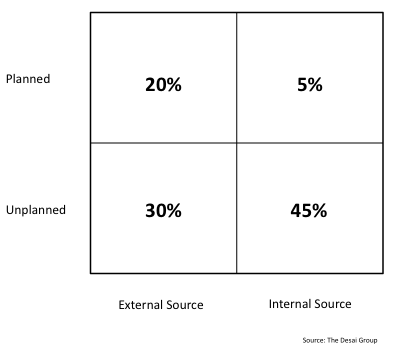
Jon Bidwell, Chief Innovation Officer at Chubb, shared some interesting research from the Desai Group that found that 75 percent of successful innovation efforts came as the result of unplanned activities (either internal or external), and only 5 percent of innovation successes were the result of internal, planned innovation activities. This of course would lead you to believe that while diligently pursuing innovation is important, most successful innovations are going to bubble up outside your normal, formal new product development processes.
Insight to remember: You have to choose which fights to pick. We celebrate George Washington’s victories, but at the same time, lesser known is that he was an expert at retreating. This allowed him to save his best army personnel for battles he thought he could win.


 Sign up here to get Human-Centered Change & Innovation Weekly delivered to your inbox every week.
 The
The  I’ve been talking for a while now as an
  This is the first of a series of video and text interviews with innovation leaders at a range of companies that are seeking to create innovation excellence in their organizations. This interview, and many others with innovation leaders from trailblazing organizations around the globe, will build upon the foundation of the research and findings contained in my first book –
  What may have started with a
  For my last article for the
 Scott Painter, Founder and Chief Executive Officer of
 Many of you out there are entrepreneurs, running small businesses (or big ones), struggling to make your business successful. But when did you first know that you were destined to be an entrepreneur? And what challenges or ridicule have you endured as the result of your decision to quit a stable job or perhaps to never take one?
 Picking up where my hugely popular article ‘
 I had the honor of keynoting last year at the Imaginatik Innovation Leaders Forum at the New York Stock Exchange in New York City. But, I also had the privilege of hearing great innovation leaders speak from a diverse set of organizations including: Chubb, NYSE, Bombardier, Medco, and the General Services Administration (GSA).