 What does resonance mean to you?
The word has many different dictionary definitions depending on the context, but most of them focus on vibrations reaching an ideal state.
Here are two of the most relevant dictionary definitions for our innovation resonance context today:
- “a quality of evoking response” (Merriam-Webster)
- “the effect of an event or work of art beyond its immediate or surface meaning” (Bing)
Here also are a couple of my favorite resonance quotes:
- “I think whatever resonance I may be able to achieve is in part simply from the amount of reading and learning that I acquired along the way.” – Robert B. Parker
- “I think if the movie has resonance and stimulates the viewer to talk about it, you can have as large an audience as you want.” – Andy Garcia
I’ve written in the past about how innovation is all about value and about how innovation veracity is more important than innovation velocity. Now it is time to take the innovation conversations about value and veracity to the next level – to innovation resonance – and how difficult it is to achieve and maintain.
 Achieving innovation resonance is about going from 1+1=2 to a state where 1+1+1+1=7, where the sum of the valuable parts in some new potential innovation suddenly becomes greater than the individual components and value may be created that you might not have even anticipated. When you reach this state of innovation nirvana, the power of resonance pushes your invention over the line from invention to innovation, and adoption becomes widespread. People start talking about, spreading it like a virus, and ultimately supplementing your marketing efforts in much more effective ways.
To achieve innovation resonance you must create value with innovation veracity and deliver it in a product or service with the right velocity and course corrections as you bring your potential innovation into the marketplace. Innovation veracity is about identifying the truths that are important to the customer in the problem space you are investigating, the inspirations and the insights that will hopefully lead to better ideas, more value creation, and hopefully, eventually – innovation resonance.
You’ll notice that I used the words hopefully and eventually in the last sentence in relation to achieving innovation resonance, and this is because our best attempts to anticipate the wants and needs of the marketplace will not always be immediately correct, and may require course corrections in the product or service to better match the expected or desired value.
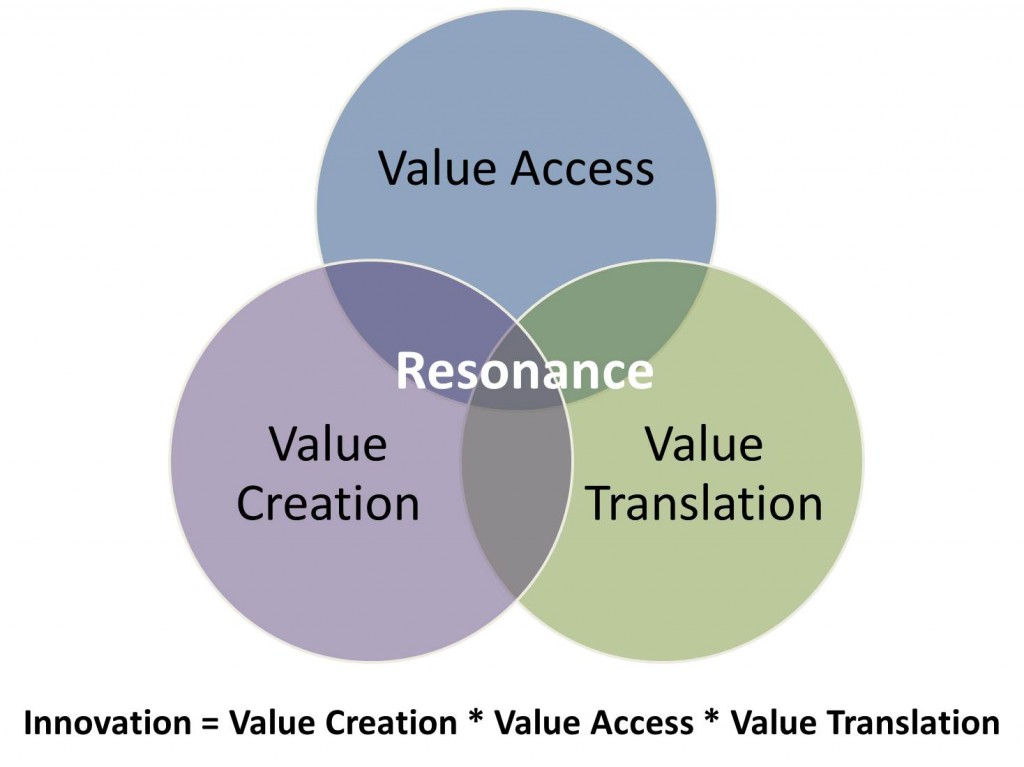
And the ultimate value encompassed in a potential innovation attempting to achieve resonance, comes from three main sources:
1. Value Creation
2. Value Access
3. Value Translation
Innovation = Value Creation * Value Access * Value Translation
You’ll notice in this equation that the parts multiply, and as a result if you do any of the three badly, your potential innovation will fail. But do ALL three well and you will have the opportunity to achieve innovation resonance.
Optimizing Innovation Resonance
To optimize the value creation component of innovation, you must seek innovation veracity early on, identifying the fundamental truths upon which your potentially innovative solution will be built. During the value creation process you must prototype early and often to test and learn whether your insights are correct and resonating in their expression within the product or service as you expect. From the reactions to your prototypes you must evolve the solution to create more value.
To optimize the value access piece of innovation, you must seek to identify where friction is created in the delivery of your solution and seek to remove it. Carefully observe both where things are awkward or difficult for you to produce and scale the solution, and for your customer to consider and consume it. These friction points represent an opportunity to remove barriers to adoption and to increase potential innovation resonance through better production, purchase and consumption experiences.
To optimize the value translation piece of innovation, you must first identify the gaps in understanding and readiness among your target customers, your plan for working to close these gaps and prepare the market for your launch, and then you’ll want to find your picture or image that communicates a thousand words. Most importantly, you must be aware that the more disruptive your potential innovation the more you may have to educate your potential customers before you even try to sell to them, and so you must build the appropriate amount of market preparation time into the launch plan for your potential innovation plan. Thought leadership marketing and innovation marketing strategies can be very powerful here to help customers understand how the new solution will fit into their lives and why they will want to abandon their existing solution – even if it is the ‘do nothing’ solution.
Resonance Example #1 – The BMW Mini – Barbie in Motion
 One of those most fun, visually appealing vehicles on the road has to be BMW’s re-release of the Mini. I don’t have one, have only ridden in one once, but whenever I see one driving around, it makes me smile. And if you have any question about whether or not the Mini has achieved a level of resonance (at least in the USA and probably elsewhere), then how would you explain the photo of the Mini on the left that shows you can buy a Mini to drive Ken and Barbie around in? Can you buy a convertible Chrysler LeBaron for Barbie to drive around in? No, but you can buy a Fiat 500, another car achieving resonance here in the USA.
Resonance Example #2 – iPod Nano – Falling from the Pinnacle
 The iPod Nano is a great example of the rise and fall of innovation resonance. The iPod took three years to take off (right about the time the iPod Nano was released). The trigger for innovation resonance was the Windows version of iTunes (Value Creation), combined with the launch of Apple Retail Stores (Value Access), combined with the iconic advertising campaigns (Value Translation). The iPod became a phenomenon with sales peaking in 2008 right after the iPhone release. Sales have been falling since then, but during this decline came the September 2010 release of the 6th Generation iPod Nano – which resonates to this day – so much so that Apple replaced the design six months ago to protect the market for their upcoming iWatch.
Maintaining Innovation Resonance
As we know from music, to maintain resonance, you must continue to inject energy and focus into the system – a bell won’t ring forever. And as we know from human psychology, just because you continue to ring the bell doesn’t mean that people will continue to want to listen to it in the same way forever. Tastes change, preferences change, the definition of value for each component creating value for customers can potentially change. And so to remain the market leader, to maintain innovation resonance, you must continue to observe, to learn, and to modify your solution to optimize the innovation value equation as needed over time.
One great example of an innovative organization losing resonance over time was Dell. They (and a handful others) came into the PC marketplace with a disruptive business model, captured market share, rose to #1, and then gradually started to lose their position because they didn’t recognize a shift in the relative value of cost vs. design in the marketplace, causing them to lose market share to HP, Apple and others.
One way to look at the difference in strategies between HP and Dell might be to use the Strategy Canvas from the Blue Ocean Strategy methodology. You can see an example of a Strategy Canvas for the wine industry here:
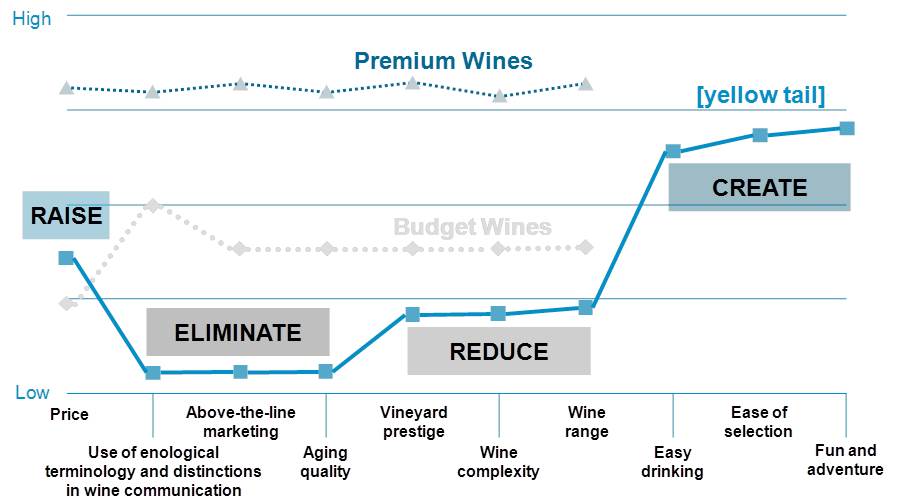
But traditional Blue Ocean Strategy (or Value Innovation) is very static. As you can see, building a Strategy Canvas using Blue Ocean Strategy methods is a snapshot in time looking at the relative performance of a company on a selected set of value dimensions against its competition. To sail into a Blue Ocean the theory goes, you must select certain value dimensions to either:
- Raise
- Eliminate
- Reduce
- Create
But as we know, value dimension performance, value dimension importance, and the competitive dynamics within the industry are not static, but change over time.
It is because of this weakness in the Blue Ocean Strategy methodology that I layer on the investigation of value dimension performance and importance onto any Value Innovation work that I might do. You can see in the two example images below related to the Dell vs. HP example about how changes in performance over time on certain value dimensions relative to what is “good enough” in the minds of customers can lead to changes in the relative importance of various value dimensions in the mind of the customers.
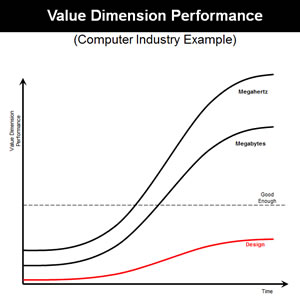
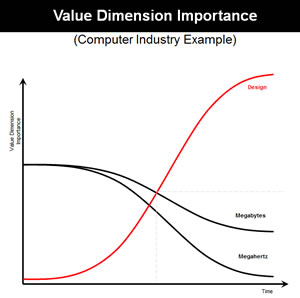
Because we cannot perfectly predict how customers will consume our product or service when we bring it to market, and because of the shifting sands of value force you to continuously re-evaluate the current situation with value dimensions and value importance, we must re-evaluate where we see the innovation process beginning and ending. Smart companies are recognizing that is not just about coming up with a great idea, or having a great launch, but about creating a commitment to launching, learning, and dialing in success by working to create and then maintain innovation resonance. Whirlpool Corporation, one of the early pioneers of a systematic pursuit of innovation excellence, has seen this and has created a commitment to launching and learning and has added a third diamond to their double diamond innovation methodology called ‘Deliver and Grow’.
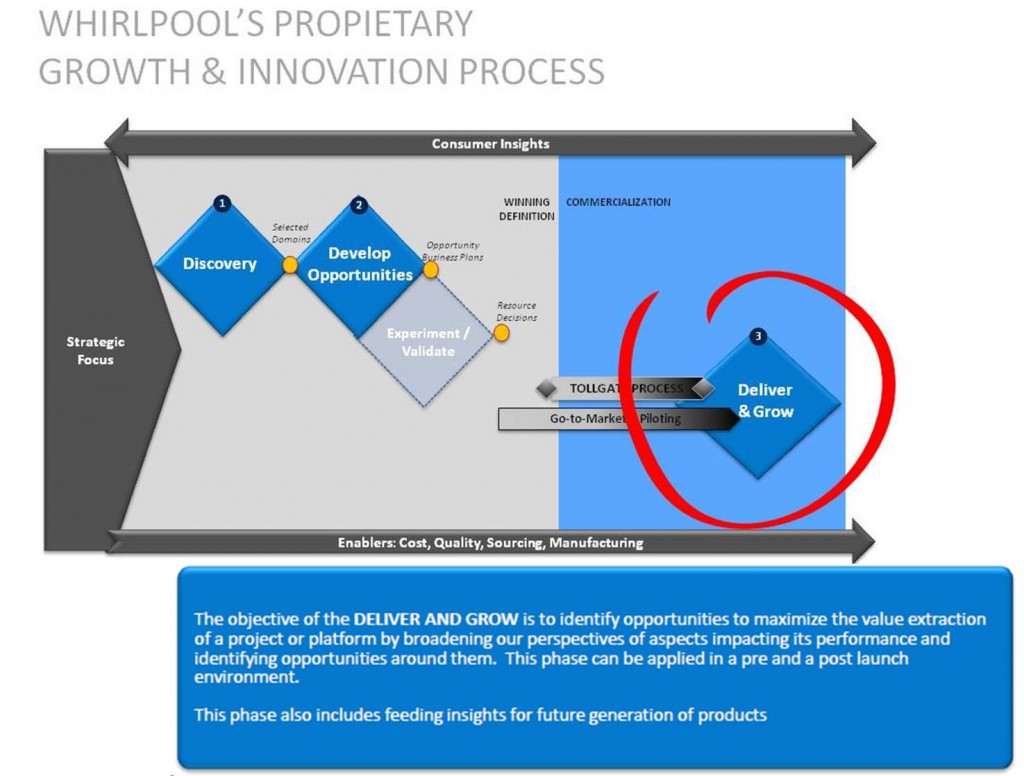
Moises Norena, the Global Director of Innovation at the Whirlpool Corporation, was kind enough to share these thoughts:
“While we put a significant emphasis in the front end of innovation and in the commercialization phase, we recognize that you can not launch a product and sit and wait for its success. With the third diamond we assure that innovation teams stay engaged in the product management while it is in the market, contrasting the results with the predictions, not only on business performance but against the consumer and trade promise they were designed to deliver. We also ask these teams to use the innovation tools and process to identify opportunities to experiment and to maximize value extraction from the market.”
Conclusion
To achieve and maintain innovation resonance, you must nurture a commitment to learning fast, both during the innovation development process and after the launch of a potential innovation. You must maintain a laser focus on how you are creating value, helping people access that value, and translating that value for people so they can understand how your potential innovation may fit into their lives. So, do you have processes in place as part of your innovation methodology for measuring and evolving solutions in place to help you get to innovation resonance?
If not, keep a focus on value creation, value access, and value translation, use my evolutions of the Blue Ocean Strategy framework, and have a look at The Eight I’s of Infinite Innovation framework that I created or at the Whirlpool Corporation’s Triple Diamond methodology to help you deliver and grow more successful innovation into your organization, and hopefully reach some level of innovation resonance.

 Sign up here to get Human-Centered Change & Innovation Weekly delivered to your inbox every week.