Tag Archives: digital transformation

Flaws in the Crawl Walk Run Methodology

The Flawed Crawl Walk Run Methodology

Many of you may have heard of the Crawl Walk Run project methodology. For those of you that haven’t the idea is that if a project team is trying to achieve something big, that sometimes you have to evolve your approach in stages rather than trying to make all the changes all at once. Many people are quite fond of this approach and can be heard repeating the mantra “Let’s crawl before we walk, let’s walk before we run.” Others have evolved Crawl Walk Run into Crawl Walk Run Fly. One of those groups is Edelman (a public relations firm), which in the following image proposes the following Crawl Walk Run Fly approach to social media:
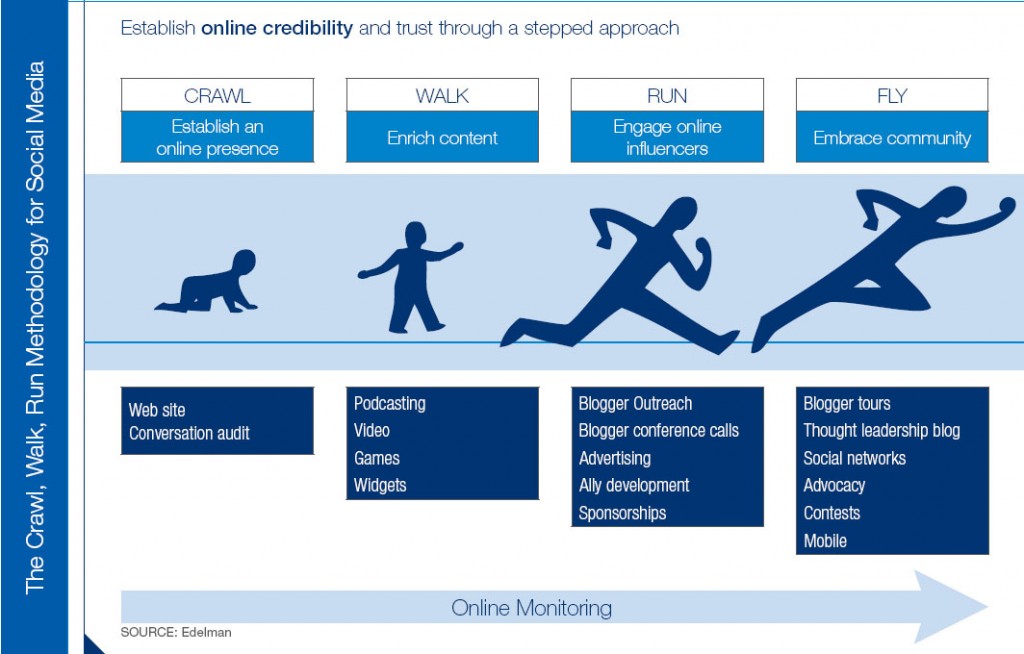
Crawl Walk Run Fly Edelman

Ultimately the Crawl Walk Run Fly project approach looks back to the following Martin Luther King, Jr. quote for its inspiration and structure:

“If you can’t fly then run, if you can’t run then walk, if you can’t walk then crawl, but whatever you do you have to keep moving forward.” – Martin Luther King, Jr.

But the flaw in the Crawl Walk Run project approach was exposed in a conversation I had yesterday with Stewart Pearson, a former client and friend, who happens to be the founder of Consilient Group, an emerging consulting group focused on helping clients undertake data-driven, insight-driven digital transformations to empower organizations to ignite sustainable growth and innovation.

Stewart was speaking about how some companies get stuck in this Crawl Walk Run mindset, and potentially jeopardize their future as a going concern. The truth is that Crawl Walk Run is only applicable to a small subset of projects, and definitely not appropriate for strategic projects because of the imminent danger of the competition transforming faster than you to better serve (and thus take) customers in the marketplace. Stewart captured this in the following way (slightly modified here by me):

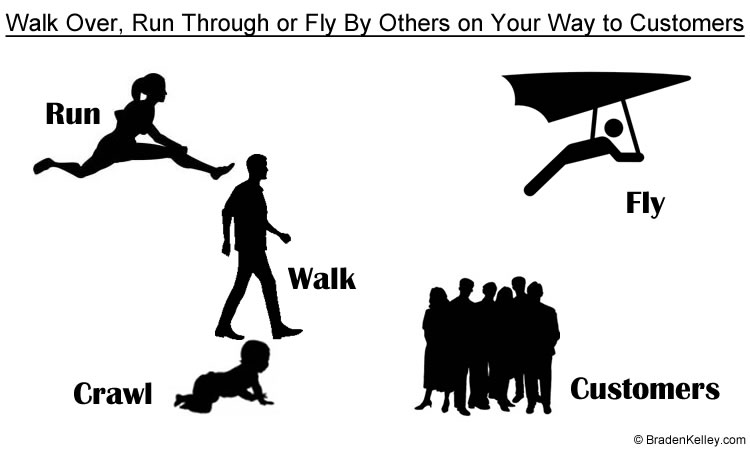
“The danger of Crawl Walk Run is that while you’re busy crawling, a competitor is going to walk over you, right before another competitor runs over both of you.”

Then of course we can add in to this that if the customers wants and/or needs have changed, then simultaneously startups will not be crawling, or walking, or running, but FLYING by those incumbents engaged in a crawl, walk, or run strategies to maintain their relevance to the customers in the marketplace. But startups face their own danger in their FLY strategy, embodied in their lack of experience and infrastructure, and in many cases, their need to educate. This can cause startups to fly past the place where customers wants and needs have moved. So the flying strategy is not without risk.

Consulting clients or people inside your firm (depending on your context) may push back against this idea and again something like “Let’s crawl before we walk.” and it’s really seductive to give into this and tow the company line that achieving something is better than achieving nothing. But at the same time, the financial, human and capital resources that you might invest in implementing a broad crawl effort could potentially be more smartly implemented in a narrow run or fly effort off to the side that may then have the potential to be rolled out in a broad manner.

So, in situations where the company potentially faces more risk from moving slowly than from moving too fast, look for opportunities to craft a strategy that allows you to pick a small part of your business (possibly a single project or a single client) that you can begin building out a run strategy for (a strategy that leverages the existing experience and infrastructure of the organization) or a fly strategy (one that completely re-imagines your market approach).

The idea here being to prototype, test, learn, and then scale your transformative new market approach rather than gradually transforming your market approach in a series of phases. This is more like the approach we use in the innovation space, and has a lot of potential in helping to accelerate your ability to continuously transform your organization the maintain optimal value exchanges with your customers.

What do you think?

Do you think your organization could move away from the siren’s song of Crawl Walk Run, or are you stuck on all fours for the rest of your career with your existing client or employer?

This article originally was featured on Linkedin

Accelerate your change and transformation success

Subscribe to Human-Centered Change & Innovation WeeklySign up here to get Human-Centered Change & Innovation Weekly delivered to your inbox every week.

The Digital Innovation Talent Shortage

The Digital Innovation Talent ShortageI was watching our Seattle Seahawks lose to the Green Bay Packers on Sunday and was surprised to see a series of television ads air during the game from GE, not touting how great their products are, but why GE is a great place for software developers to come work.

Each 30 second advertisement will have cost GE nearly $700,000, meaning that GE probably spent $2 million last Sunday. First I’ll share the ads and then I’ll share my thoughts on their significance.

All three advertisements are in this single video from ad agency BBDO:

  • Advertisement #1 (Parents’ reaction to Owen taking a developer job at GE)
  • Advertisement #2 (Fellow students’ reaction to Owen taking a job with GE)
  • Advertisement #3 (Friends’ reaction to Owen taking a developer job with GE)

All three ads highlight the gap between most people’s industrial age thinking and our new digital reality, and close with the tagline:

“The digital company. That’s also an industrial company.”

A year ago, together with Linda Bernardi, a Chief Innovation Officer at IBM, the two of us wrote about this very subject in our article for the world’s most popular innovation web site, Innovation Excellence:

You’re Either a Technology Business or You’re Out of Business

The sad truth is that most companies don’t realize this. GE, based on this ad campaign, obviously does. I won’t re-visit all of the points in the article, but instead I encourage you to read it, and for now I’ll focus on additional thoughts emerging since then. One thing I did after publishing this article with Linda, was ask the following question at my previous employer:

“Are we a technology company that happens to serve customers in the health insurance industry, or are we a health insurance company with an IT department?”

Does anyone want to guess what the majority of people answered?

The healthcare industry is undergoing a period of incredible change, but they are not the only ones. Technology is transforming market and customer expectations faster than executives and employees can transform their thinking. Customers expect more, they demand more, in every industry, and this is opening the door both for new entrants and for existing competitors to rearrange the market share picture, IF they take strategic actions focused on transforming into a more digital, more collaborative, more innovative organization. The questions every organization should be asking themselves include:

  1. How can we modify the architecture of our organization to cope with the increasing pace of change?
  2. How can we increase our organizational agility?
  3. How can we retain the talent we need to power a true digital transformation?
  4. How can we attract the talent we need to fill the gaps in our skills base to empower a successful digital transformation and to drive success in the marketplace as a social business?

I see GE’s ad campaign as the canary in the coal mine, an example of a large company awakening to one of the major challenges every organization faces in continuing to stay relevant (and profitable) in a rapidly changing, digital, always connected world.

The fact is that almost every organization needs more digital innovation talent…

And you know what?

There is a shortage…

Keeping up with the pace of technological change is hard enough. Conducting a digital transformation, and becoming a true social business is even harder, but INCREDIBLY important to your current and future success. The companies that realize this and commit to a coordinated digital transformation, embracing the fact that they are a technology company serving a particular industry and a certain set of customers will have a better chance of attracting the scarce talent they need to complete the work to emerge out the other side. And you MUST do this before every other company out there piles on and causes an incredibly bloody fight for the scarce digital innovation talent out there, and the market share that is at risk.

I will be writing more about how to increase your organizational agility and to achieve a successful digital transformation in the coming months in the run up to the publishing of my second book by Palgrave Macmillan on organizational change and the Change Planning Toolkit™.

Are you going to be like GE and admit that you need to change the way you think of yourself as an organization and change the perception potential employees have of you in the marketplace?

Are you ready to become a social business?

Do you have what you need to achieve a successful digital transformation?

Are you ready to admit that you need help getting there?

Image credit: news-leader.com


Accelerate your change and transformation success

Subscribe to Human-Centered Change & Innovation WeeklySign up here to get Human-Centered Change & Innovation Weekly delivered to your inbox every week.

Measuring Organizational Agility – The Triple T Metric v1.0

Measuring Organizational Agility - The Triple T MetricThere is an increasing amount of chatter and confusion out there around what organizational agility is and feeling that it must be important to organizational success.

But, before we discuss organizational agility, it is important to define what we mean by the term.

BusinessDictionary.com has a decent definition:

“The capability of a company to rapidly change or adapt in response to changes in the market. A high degree of organizational agility can help a company to react successfully to the emergence of new competitors, the development of new industry-changing technologies, or sudden shifts in overall market conditions.”

Usually people begin speaking about organizational agility and its importance to the success of the organization when they speak about the increasing pace of change, and the challenge the organization faces in keeping up.

Because of this, one of the key measures of organizational agility you may want to consider using, I like to call the Triple T Metric:

Time
to
Transform

The Triple T Metric is a measure of how long it takes an organization to make a transformation. But to measure your progress on the Triple T Metric over time, you must define it and measure it in a consistent manner. So, if a transformation is like a trip from Point A to Point B, we must define Point A and Point B.

  • Point A = the point in time at which the organization recognizes a change is needed away from the steady state
  • Point B = the point in time at which the organization successfully arrives at the new steady state

You’ll notice that Point A doesn’t start at the point at which people AGREE that a change is needed and AGREE to make it, but at the point the organization RECOGNIZES a change is needed. This is because there is great opportunity to increase your organizational agility by increasing the speed at which the organization moves from recognizing the need for change, to agreeing to change, to planning the change, to executing the change.

This is just v1.0 of our discussion of the Triple T Metric, to introduce the concept. We’ll get into more detail in a future post.

All of these transitions must be included because organizational agility is ultimately about how quickly the organization can successfully plan, lead, and execute (manage and maintain) a change effort, increasing your organizational agility requires that you increase both your change capability and your change capacity.

How fast can your organization change?

If you want to learn how to change faster, and make your organization more agile, grab a copy of Charting Change and the supporting materials for book buyers!


Accelerate your change and transformation success

Subscribe to Human-Centered Change & Innovation WeeklySign up here to get Human-Centered Change & Innovation Weekly delivered to your inbox every week.

Think Like a Tech Company or Go Out of Business

Think Like a Tech Company or Go Out of Business

by Braden Kelley and Linda Bernardi

Even in 2014, there are business sectors who feel they are not ‘tech companies’. News flash: Whether you are a consumer products company, an insurance company, a hotel, or a pharmaceutical company, your business is a technology business. Why?

Technology is the link between any business and its customers. To say technology is not core to your business strategy, means you think customers are not the key to your business success. So, your business is a technology business whether you want it to be or not.

Today technology is how you market and sell your products, make your business more efficient, and most importantly, how you stay connected to your customers. Some companies mistake the importance of technology to mean that they need to open a twitter account and monitor social media, put in an ERP and CRM system, and revamp their web site. But the importance of technology in today’s business environment is more than that.

ERP and CRM are common tools, a requirement to remain competitive, and while social media and the internet are important to sales and marketing success, they are becoming yesterday’s news as customers develop deeper connections to their mobile devices. If you aren’t on their devices and interacting in a meaningful way with them there in real-time, you won’t stay connected to them in the long run.

Let’s look at the impact on a few different industries whose members tend not to see themselves as technology companies:

1. Fortune 100 consumer product goods (CPG) companies
2. Hotel Chains
3. Big Box Retailers

1. Fortune 100 CPG companies typically manufacture large quantities of consistent products and have visually pleasing (static) web pages for consumers. But they don’t use technology well enough to detect what the market wants before it knows it, often fail to personalize or customize products to customer needs, and usually lack the online networks that could help connect other customer product needs together into new potential product ideas that the company could co-create with their customers. Often connection means post mortem analytics on data collected in the past, or, analyzing previous customer interactions with static web pages. Creating authentic customer connections requires online and mobile technology these companies usually don’t possess. I don’t mean apps (which often are pretty much the same as a website), but new physical/online/mobile engagement models that inspire customers to stay connected to the company (and each other) in a dynamic, evolving community. Rethinking is needed here. The customer is not just a buyer but an influencer. If CPG companies want to sell that next bottle of $300 facial cream, they better consider delighting, and not just marketing to, their customer base.

2. AirBnB has proven to be a major disruptive force in the hotel and hospitality business, grabbing a massive foothold in a market that the Homeaway.com member companies created and should have dominated. Resistance to AirBnB is massive and lawsuits are abundant, but for a moment let’s go beyond the hype and explore the angst of traditional hotels. AirBnB created a highly connected, effective community of property owners and property renters. This bi-directional ecosystem can only thrive if they are both happy and satisfied. To experience what they’ve created, first go to a traditional hotel website (pictures of room, building, lobby) and then go to AirBnB and browse the hundreds of customer experiences their property owners offer. On the hotel site you’ll see they’ve created the mechanics of paying to rent a hotel room, while on AirBnB you’ll see that they’ve created both an ecosystem and an experience.

3. Big box retailers have done a poor job of seeing themselves as technology companies capable of fending off challenges from online-only retailers. Target made the mistake of seeing themselves as a retailer, not a technology business, and so they outsourced their ecommerce to Amazon in the beginning, only to regret doing so because Amazon was able to learn which 20% of their inventory drove 80% of their profits, and when.

Meanwhile, Costco and Walmart, despite being two of the most successful retailers in the world, have struggled to find success online because they can’t get beyond their brick and mortar heritage to see themselves as a technology business with an integrated online/offline ecosystem. Seriously, it is 2014, do we still need to get our Costco circulars in the mail? Nothing has changed about Costco’s interaction with its customers. Walmart exacerbated the disconnection between the two sides of their business by creating a separate online division and exiling it to Silicon Valley. Costco sells different products online than offline. The results of both of these approaches have been far from stellar.

Build a Common Language of Innovation on your team

Technology Lowers Barriers to Entry

In the history of the world, it has never been easier to start and scale a business to a global footprint, not in a matter of decades or years, but in months. And it is not just the other companies in your industry and technology-driven startups that you have to worry about if you choose not to view yourself as a technology company and move as fast as they do. You have to worry about competition from established technology players like Google and Amazon too, because one day they (or people that used to work for them) might decide that your market is attractive enough to enter and come disrupt your industry. For example, Amazon has become a book publisher and a financial services company.

Technology Enables Experiences

Technology enables the creation of customer experiences. I am going to choose my insurance company based on my experience. At the end of the day if all prices are comparable, then how the businesses you interact with make you feel, and the connections you’ve built with them will matter more. Without an emphasis on using technology to make your business a social business, you will find your company displaced by others that do. You must lead your industry in identifying opportunities to use technology to get closer to your customers. The future of business will be all about delighting customers and making their experience more personal.

Technology is not just a tool, but central to everything you do in today’s always on, always connected digital age.

Here are ten ways that technology can help you become a more social business:

  1. Building Connections
  2. Developing Networks
  3. Global Sensing and Prediction
  4. Sharing Recommendations
  5. Creating Experiences
  6. Personalization
  7. Customization
  8. Co-Creation
  9. Crowdsourcing
  10. Open Innovation

To give you an example of what things will look like in the future, the forward thinking health insurance company will leverage the mobile device for virtual ID cards, drug interaction warnings, personal triage, mobile care, wellness, cost sharing calculations, FSA/HSA administration, diagnostics, and more.

Conclusion

In conclusion, no matter what business you are in, it is very dangerous not to see technology as a competitive differentiator and a core driver of your business. Instead, you must constantly look at how you can become more of a technology company in order to enable deeper customer connections and more meaningful experiences. Today if you don’t connect with, understand, delight and start predicting your customer’s needs/wants, you may not thrive in your industry and your competition and new entrants who do embrace technology will replace you.

This article is brought to you by Linda Bernardi and Braden Kelley. Collectively, we have over 30 years of experience working with large, global multi-disciplinary enterprises. We write this with care and passion as we want your enterprises to succeed. We would love to hear your thoughts.


Guest Collaborator:

Linda BernardiLinda Bernardi is a Technology Strategist, Investor, and Founder & CEO at StraTerra Partners, The Bernardi Leadership Institute and a Strategic Advisor at Cloudant Inc. She is also the Author of Provoke, Why the Global Culture of Disruption is the Only Hope for Innovation. Learn more here about Linda’s work on disrupting large enterprise analytics.

Please note the following licensing terms for Stikkee Situations cartoons:

1. BLOGS – Link back to https://bradenkelley.com/category/stikkees/ and you can embed them for free
2. PRESENTATIONS, please send $25 to me on PayPal by clicking the button 3. NEWSLETTERS & WEB SITES, please send me $50 on PayPal by clicking the button
License for presentations - $25
License for newsletters and web sites - $50

Subscribe to Human-Centered Change & Innovation WeeklySign up here to get Human-Centered Change & Innovation Weekly delivered to your inbox every week.
